Article

Study of the Hyperfine Structure of Sr II, Ba I and Ba II: An MCDHF Approach for Modeling the Low-Lying Levels

1
Physique Atomique et Astrophysique, Université de Mons—UMONS, B-7000 Mons, Belgium
2
Materials Science and Applied Mathematics, Malmö University, SE-205 06 Malmö, Sweden
3
Spectroscopy, Quantum Chemistry and Atmospheric Remote Sensing, Université Libre de Bruxelles, B-1050 Brussels, Belgium
*
Author to whom correspondence should be addressed.
Atoms 2026, 14(3), 17; https://doi.org/10.3390/atoms14030017
Submission received: 19 January 2026 / Revised: 2 March 2026 / Accepted: 3 March 2026 / Published: 5 March 2026
(This article belongs to the Special Issue Computational Atomic Physics in Astrophysics)

Abstract

Using the Multiconfiguration Dirac–Hartree–Fock method as implemented in the General Relativistic Atomic Structure Package, the magnetic dipole and electric quadrupole hyperfine structure constants were determined for the ground and first excited levels of 135,137Ba II isotopes, as well as for 137Ba I and 87Sr II, to assess the robustness of the developed model. This study builds upon and extends previous investigations by examining the levels involved in resonance lines, with the aim of resolving persistent discrepancies in the hyperfine structure of 137Ba II and 87Sr II. New code developments such as the use of natural orbitals, as well as the addition of polarization effects and Configuration State Function Generators, as implemented in GRASPG, were tested for these heavy elements. The developed strategy allowed us to achieve encouraging results that satisfactorily agree with experiments for all studied levels but D 5 / 2 2 in the 137Ba II isotope. This disagreement was also observed in 135Ba II isotope as well as in 87Sr II. With two valence electrons, 137Ba I is definitely more complex, requiring a multireference approach. Even with the latter, the theory–observation disagreement observed for the hyperfine structure of the low-lying levels remains large in comparison with the alkali-like systems. Possible ongoing developments to remediate this issue are discussed in the conclusions.

1. Introduction

Heavy elements are created in neutron-capture processes. The two most known processes are the s- and r-process. The first one produces half of the elements heavier than iron [1]. It is slow in the sense that neutron density is low enough ( 10 7 10 13 neutrons per cm3) to allow β decay of nuclei. It produces elements ranging from Fe to Sr-Y and up to Pb, with lead being the heaviest element generated by this process. The latter r-process, taking place in astrophysical sites where the neutron density is more important (>1020 neutrons per cm3 [2]), does not allow β decay between two neutron captures. Only when the neutron flux is exhausted, the unstable nuclei return to stability through a cascade of β decay, leading to the formation of elements heavier than Pb. Ranging just in between these two processes, an intermediate process, the i-process, with a neutron density of 10 12 –1015 neutrons per cm3 [2] was highlighted by Cowan and Rose [3] in order to explain the observed anomalies in abundances of Sr, Ba, La, and Eu.
In the solar system, the majority of heavy elements are produced in a mix of s- and r-processes. For instance, 82% of Ba is produced by the s-process, but only 6% for Eu. The other part is produced by the r-process [4]. Consequently, Ba is frequently employed as a signature element for the s-process, while Eu serves as one for the r-process. The study of the spectral lines of these elements, as well as their abundance ratio [Ba/Eu], can be used to determine which process dominates the production. For low-metallicity subgiant stars like HD 140283, which is one of oldest stars of the Universe and mainly composed of hydrogen and helium, the r-process elements should be dominant [5]. During nucleosynthesis processes, different Ba isotopes are created: the odd ones are affected by the hyperfine splitting of the energy levels that can be easily resolved by spectrometers. Therefore, they be used to determine abundances of these isotopes via the isotopic ratio f odd , Ba defined by
f odd , Ba = N ( 135 Ba ) + N ( 137 Ba ) N ( Ba ) ,
with N(Ba) being the number of all Ba atoms. The isotopic ratio is key in several studies on the determination of dominant nucleosynthesis processes. Depending on the value of this ratio, Arlandini et al. [4] concluded that a value of f odd , Ba 0.46 was the signature of a Ba r-process creation, while a value of f odd , Ba 0.11 was the marker of the s-process. Whenever the value of f odd , Ba is located between these two margins, it could mean that a mix of these two processes has occurred. Regarding the HD 140283 star, the uncertainties obtained by Lambert & Allende Prieto [6] were too high to determine the formation process. A more recent study using 3D-LTE spectral line modeling [7] showed that Ba was produced using the r-process, matching the theoretical predictions with f odd , Ba 0.38 .
Alternatively, neutral Ba (Ba I) can be used to determine the stellar abundances and therefore the isotopic ratio. Reddy & Lambert [8] showed that the 5535 Å line is unfortunately blended with a Fe I transition for the HD 17925 star, leading to an overestimation of abundances. However, the study of Ba I and very precise atomic data are still needed for the abundance analysis of cool stars [8].
Strontium (Sr) is the second neutron-capture element that shows very strong absorption lines even in metal-poor stars [9]. The Sr II lines are less affected by NLTE effects compared to Ba II, making Sr II a more reliable abundance indicator in some cases [9]. Sr exhibits an electronic structure analogous to that of Ba, but with a lower atomic mass. This makes Sr a valuable system for extended calculations to better analyze potential trends among elements in the same group of the periodic table.
Other types of stars, like Carbon-Enriched Metal-Poor (CEMP) stars, show particular abundance ratios. The CEMP-rs stars, highlighted by Barbuy et al. [10], are interesting because they exhibit overabundances in both s- and r-process elements. Using the Ba II line profiles, studies [11] show that stars like HE 2208–1239 could have heavy elements produced by the i-process. This conclusion still needs to be handled with care as the [Ba/Fe] abundances were taken strictly equal to [Ce/Fe] ones in order to deal with Ba overabundances obtained by considering subordinate excited levels.
Therefore, accurate determination of hyperfine structure (HFS) constants is essential for reliable barium (Ba) abundance analyses, particularly when estimating the odd-isotope fraction f odd , Ba . The Ba II resonance lines, especially at 4554 Å and 4934 Å, are significantly split by HFS due to the presence of odd isotopes ( Ba 135 and Ba 137 ), which possess nuclear spins (I = 3/2). These odd isotopes cause asymmetries and broadenings in the line profiles that are not present in even isotopes. By modeling the observed line shapes—including HFS components derived from laboratory measurements of magnetic dipole (A) and electric quadrupole (B) constants—astronomers can disentangle the contributions of odd and even isotopes. The resulting best-fit synthetic spectrum yields an estimate of f odd , Ba [12].
The most rigorous work should encapsulate both HFS and isotopic shift (IS). However, the IS is often neglected due to its very difficult measurement from atomic lines, as the shift is negligible (often only a few mÅ) compared to the line width that is highly constrained by the instrumental resolution [11].
Using the Multiconfiguration Dirac–Hartree–Fock (MCDHF) method [13], as implemented in the General Relativistic Atomic Structure Package (GRASP) [14], our study extends the work of Itano [15] on the excited D levels of 137Ba II and 87Sr II. We focus on calculating the hyperfine structure constants for the ground as well as the first excited levels. To address the discrepancies identified by Itano [15] for the A ( 2 D 5 / 2 ) constant for these ions, we employ a comprehensive analysis using independent correlation models. Additionally, we benchmark the new code developments including natural orbitals and non-orthogonal orbital sets that explicitly account for polarization effects. This work is the first determination of HFS constants using the MCDHF method for the levels involved in the resonance lines of 87Sr II and give additional theoretical values with an uncertainty determination for the D 3 / 2 2 and P 1 / 2 o 2 levels, where experimental data are unavailable. Finally, the developed correlation models are applied to the more complex system of 137Ba I, aiming to refine earlier MCDHF theoretical results [16]. While this study does not simulate nucleosynthesis yields, the HFS constants provided in this study are essential input for stellar spectroscopy codes used to infer process-specific abundances. The statistical uncertainties quantified in our recommended values are critical for propagating errors in f odd , Ba determinations, which in turn constrain the dominant nucleosynthesis pathway.
The paper is structured as follows.In Section 2, the theoretical method used to determine the hyperfine structure constants of 135,137Ba II, 137Ba I, and 87Sr II are presented as well as a in-depth study of correlation models and excitations. Then, in Section 3, the best results obtained for each element are discussed as new methods are tested. Finally, in Section 4, the key results and outlooks are given as a conclusion.

2. Methods

2.1. Multiconfiguration Dirac–Hartree–Fock Method

The Multiconfiguration Dirac–Hartree–Fock (MCDHF) method, as presented in Grant’s book [13], is a fully relativistic approach to atomic structure, particularly suited for moderate-to-heavy elements and highly charged ions. It is a multiconfiguration method in a sense that the wave function of the atomic state | Γ π J M J , with Γ being its identifying label, J as the total angular momentum quantum number of the polyelectronic system, M J as the total magnetic quantum number, and π as the parity, is approximated by an Atomic State Function (ASF) Ψ , which is a linear combination of Configuration State Functions (CSFs) Φ
Ψ ( Γ π J M J ) = i = 1 N CSFs c i Γ π J Φ ( γ i π J M J ) ,
where γ i specifies the electronic configuration, the coupling tree of angular momenta, and other quantum numbers needed to uniquely describe the CSF.
The { c i Γ π J } set represents all the mixing coefficients that are determined, along with the total energy E, by solving the eigenvalue problem
H c = E c
with H being the Hamiltonian matrix. By applying the variational principle on an energy functional, a system of coupled integro-differential equations, namely the MCDHF equations, is obtained for the radial parts of the spin-orbitals building the CSFs and solved using the self-consistent field iterative method.

2.2. Hyperfine Structure

The atomic property of interest in this paper is the hyperfine structure. The latter is related to the hyperfine structure constants, i.e., the magnetic dipole constant A and the electric quadrupole constant B. The hyperfine interaction can be expressed as a multipolar expansion given by
H HFS = k 1 T ( k ) · M ( k ) ,
where T ( k ) and M ( k ) are spherical tensor operators of rank k in the electronic and nuclear space, respectively, that represent the dipolar magnetic (M1) and quadrupole electric (E2) interactions when k is equal to 1 and 2, respectively. For an atom composed of N e electrons, the T ( k ) operators for k = 1 , 2 are given by
T ( 1 ) = j = 1 N e t ( 1 ) ( j ) = j = 1 N e i 2 α r 2 ( α j · C ( 1 ) ( θ j , φ j ) ) ,
T ( 2 ) = j = 1 N e t ( 2 ) ( j ) = j = 1 N e r j 3 C ( 2 ) ( θ j , φ j ) .
The nuclear magnetic dipole moment μ I and the electric quadrupole moment Q are defined through the matrix elements of the nuclear tensor operators M ( k ) for k = 1 , 2 , respectively,
μ I = I I | M ( 1 ) | I I ,
Q = 2 I I | M ( 2 ) | I I ,
with M ( 1 ) μ I , M ( 2 ) Q 2 being the electric quadrupole tensor and | I I being the nuclear state with the maximum component of the nuclear spin, M I = I [17].
If the hyperfine interaction is weak so that the interaction energy is small compared with the fine structure level splitting, the Hamiltonian (4) can be treated perturbatively. The first-order energy contribution is
E HFS = Γ J I F M F | H HFS | Γ J I F M F = E HFS M 1 + E HFS E 2 ,
where | Γ I J F M F is the zeroth-order wave function of the coupled state [18], and F and M F are, respectively, the hyperfine structure total angular momentum and its projection along the quantization axis. In practice, the magnetic dipole A and the electric quadrupole B constants are factorized out for calculation, with
E HFS M 1 = 1 2 A Γ J C
E HFS E 2 = B Γ J 3 4 C ( C + 1 ) I ( I + 1 ) J ( J + 1 ) 2 I ( 2 I 1 ) J ( 2 J 1 ) ,
where
A Γ J = μ I I 1 J ( J + 1 ) 2 ( J + 1 ) Γ J | | T ( 1 ) | | Γ J
B Γ J = 2 Q J ( 2 J 1 ) ( J + 1 ) ( 2 J + 1 ) ( 2 J + 3 ) Γ J | | T ( 2 ) | | Γ J ,
and C = F ( F + 1 ) J ( J + 1 ) I ( I + 1 ) . The reduced matrix elements Γ J | | O ( k ) | | Γ J , with O ( k ) = T ( 1 ) or T ( 2 ) , are computed using the ASFs through the GRASP package [14].

2.3. Computational Details

The hyperfine structure constants were calculated using the GRASP package, first introduced by Dyall et al. [19], in a systematic manner using the latest GRASP2018 version [14], where all application programs are described in [20]. To speed up the calculations, the new code GRASPG developed by Si et al. [21], using the powerful Configuration State Function Generators (CSFGs), has been employed for the configuration interaction part of the work.
Following the ideas of Papoulia et al. [22], we derive recommended hyperfine structure (HFS) constants for each studied level by treating the results of the largest Relativistic Configuration Interaction (RCI) calculations, employing distinct optimization strategies, as a set of independent values. This statistical approach enables us to give a mean value and a standard deviation to the calculated constants, thereby providing a robust estimate of the HFS constants, crucial when there is no experimental data. The recommended values are presented in the form μ ± 2 σ , corresponding to a 95 % confidence interval. Further details, including the specific optimization strategies and statistical analyses, are provided for each studied ion.

3. Results and Discussion

3.1. Ba II

Barium ( Z = 56 ) has 40 known isotopes, but only 8 of them are stable and 7 are natural. Because astrophysicists are interested in the odd isotopes for the determination of f odd , Ba , only the A = 135 , 137 nuclei are considered in this paper. Moreover, only 5 levels have been studied—3 even levels ( [ X e ] 6 s 2 S 1 / 2 , [ X e ] 5 d 2 D 3 / 2 , 5 / 2 ) and 2 odd levels ( [ X e ] 6 p 2 P 1 / 2 , 3 / 2 o )—as the S and P levels are very often used for abundance calculations when studying the resonance lines. The D levels are also of interest because more accurate atomic data could help astrophysicists in their determination of abundances thanks to the secondary lines.
For these levels, theoretical studies have already been conducted by Sahoo et al. [23] using the Relativistic Coupled Cluster (RCC) method, as well as by Safronova [24] applying the Relativistic Many-Body Perturbation Theory (RMBPT). Itano’s work [15] is of particular interest as he used the MCDHF method, the same one used for our calculations. These theoretical results are compared with experimental values obtained by laser-induced hyperfine transition spectroscopy [25,26,27,28].
The Active Set (AS) [18] and the layer-by-layer [20] approaches have been considered. These approaches are useful for the study of heavy elements as only a small portion of orbitals needs to be optimized at each step of the calculation. Let us take the concrete example of the ground level S 1 / 2 2 of 137Ba II for which a single reference (SR) is used for defining the zero-order set of CSFs from which orbital substitutions are considered. The first layer in the AS approach is the Dirac–Hartree–Fock (DHF) one, based on the spectroscopic orbitals. For instance, the [ X e ] 6 s 2 S 1 / 2 level has the { 6 s , 5 p , 4 d } AS, in the non-relativistic notation, where the largest n quantum number is quoted for each -symmetry. For each selected AS, the hyperfine structure constants are evaluated with the corresponding MCDHF wave function. The AS is progressively enlarged by considering more correlation orbitals, with the hope of achieving the convergence of the considered atomic property, within some a priori accepted variation interval. The increasing ASs are given in Table 1 for the different levels considered in the present study. The choice of restricting the ASs to m a x = 4 (g-orbitals) can be justified by the fact that the orbitals having a higher angular momentum are located further away from the nucleus; therefore, they do not significantly contribute to the hyperfine structure constants [29].
The choice of substitutions to include in the correlation models is the key to obtain reliable estimations of atomic parameters with the MCDHF method. It can been seen from Equations (5) and (6) that the hyperfine structure constants involve one-electron operators only. Therefore, the CSFs generated from single (S) substitutions are the most important, and they are included in the single and restricted double (SrD) substitution strategies, where restricted means that there is at most one hole in the active core orbitals (e.g., [30]). Moreover, according to non-relativistic atomic physics [31], the s electrons have a non-zero probability of presence in the nucleus. Electronic substitutions from these are therefore important for the HFS and an optimization strategy based on SrD substitutions involving the most important s orbitals is a natural choice.
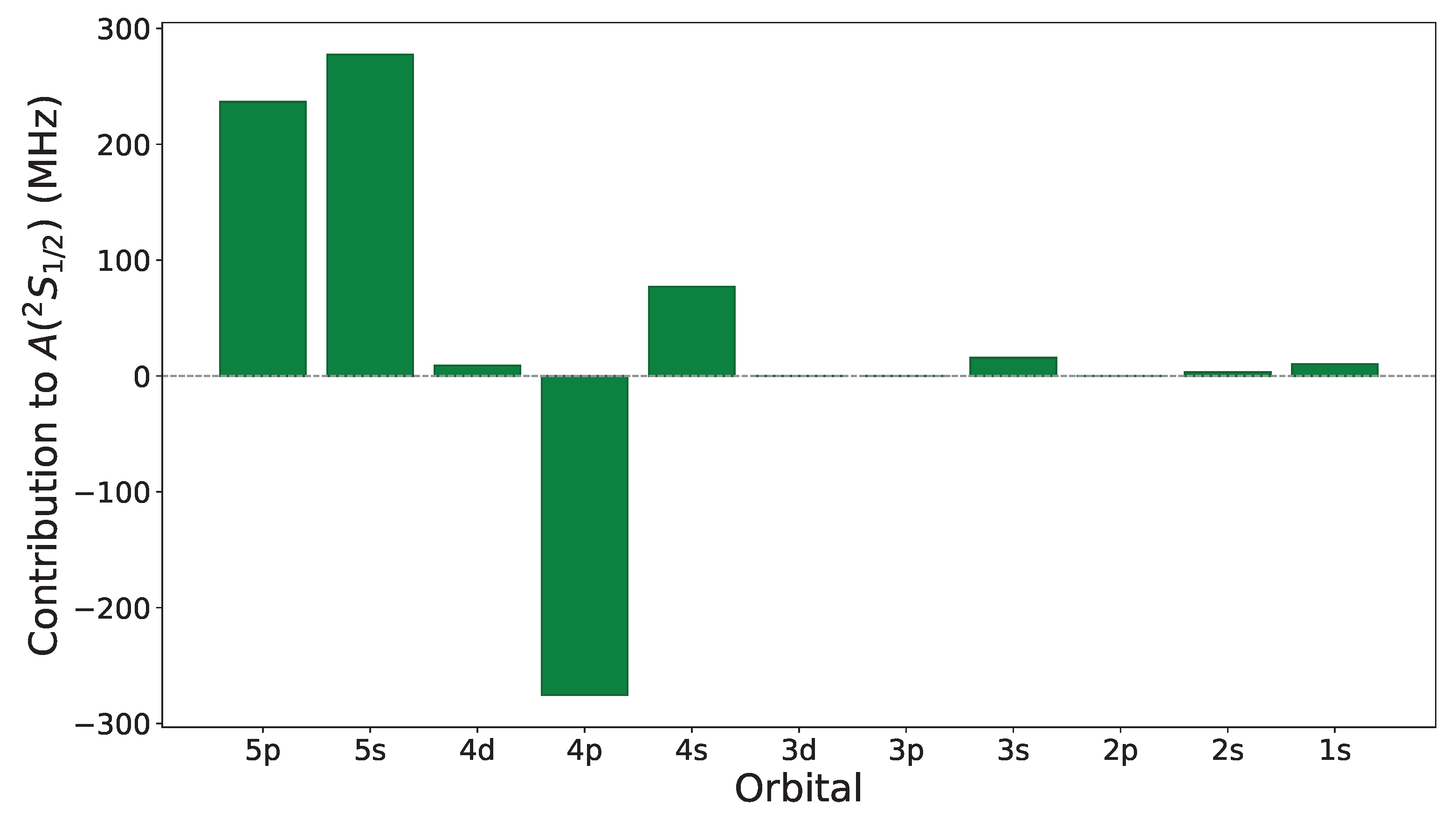
Inspired by the work of Bieroń et al. [32], the impact of different classes of orbital substitutions has been studied for the ground and first excited levels in 137Ba II. Using an orbital basis that has been optimized with SrD substitutions from the 5s, 5p core-, and the 6s valence- orbitals, with at most one substitution of the core orbitals, more correlation excitations are accumulated by allowing single and double (SD) substitutions from deeper orbitals, using the multireference (MR) ( [ X e ] 6 s + [ X e ] 5 d ) for the even parity and the single reference (SR) [ X e ] 6 p for the odd parity. Figure 1 shows the different contributions of single (S) substitutions to the magnetic dipole hyperfine constant A ( 2 S 1 / 2 ) . Double (D) substitutions were also investigated but, as shown by Bieroń et al. [32], their contribution is much smaller.
This analysis illustrates that most of the one-electron orbital substitutions increase the A ( 2 S 1 / 2 ) constant. The contributions of the 4 s , 3 s , 2 s and 1 s single substitutions confirm their importance for the HFS. Nevertheless, the adopted optimization strategy limits the orbital substitutions to the outer occupied subshells as deep as the 4 p orbital, even if the n s , n = 1 , 2 , 3 , 4 orbitals are a priori relevant. The validity of this restriction was assessed for the [ X e ] 6 s 2 S 1 / 2 level by observing that the sum of the S substitution contributions from those core orbitals was less than 1%. The same strategy has been adopted for the excited levels as those contributions were even smaller than for the ground level. According to Yuan et al. [33], the p 1 / 2 core electrons can also make non-vanishing exchange core polarization contributions in the relativistic theory. This is confirmed by the rather large negative contribution of the single substitutions of the 4 p orbital (≃ 300 MHz).
Thanks to this analysis, the optimization of the radial orbitals is focused on core–valence (CV) correlations. A stepwise approach was used for the ground S 1 / 2 2 level, but for conciseness, the reported results are limited to those obtained with two selected optimization schemes. Using the AS described in Table 1, the first one allows SrD substitutions as deep as the 5 s orbital, in order to include the two important contributions from 5 p and 5 s orbitals, as seen in Figure 1. According to this figure, another interesting strategy is the one allowing SrD substitutions as deep as the 4 p orbital, even if its contribution is to decrease the A constant value. The corresponding results are given in Table 2, under the labels CV SrD n l 5 s and n l 4 p , respectively.
Considering the ground level, we can see that the hyperfine constant values become stable at the level of AS5 for both optimization strategies. The calculations have been extended up to AS7 to manage the convergence with a larger number of correlation orbitals and in order to monitor the Relativistic Configuration Interaction (RCI) calculations that follow the orbital optimization MCDHF calculations. The first optimization strategy, CV SrD n l 5 s , gives promising results, with an A constant value approaching the experimental value within 55 MHz for AS7. The second strategy, CV SrD n l 4 p , overestimates the experimental value by about 400 MHz for AS7.
For the excited levels, a similar behavior is observed, with a stable value achieved for AS5, in great agreement with experimental values for the first optimization strategy and an overestimation for the second one. For example, the D levels results show that the CV SrD n l 5 s approach better suits the A hyperfine constants, with 5% and 16% for the D 3 / 2 2 and D 5 / 2 2 levels, respectively, but not the B constants, for which a large theory–observation discrepancy ( 41 %) is observed for both levels. Adding more correlations in the CV SrD n l 4 p model improves the agreement with experiment for the B hyperfine constants, within less than a MHz for both of the D levels. This comes with a high price to pay: the A theoretical constants overestimate the experimental values by up to 80% for the D 5 / 2 2 level. When the computations were undertaken, this behavior was unknown, as Itano’s MCDHF work [15] did not mention any of these observations. We believe that adding correlation orbitals with higher l encapsulates the orbital polarization that was neglected and is important for a reliable determination of the B hyperfine constant [17].
After the MCDHF optimization step, more correlations can be added in Relativistic Configuration Interaction (RCI) calculations. As it has been shown in the literature [36], higher-order correlations are important for the HFS. Even if H HFS (4) only contains one-electron tensor operators, the inclusion of single and non-restricted double (SD) substitutions leads to a rearrangement of mixing coefficients [37]. Core–core (CC) correlations are therefore added to the model. Two RCI strategies were tested on the basis of the two considered optimization strategies. These calculations showed that the hyperfine constants are very sensitive to the correlation model. Ultimately, the more correlations the better, with CC SD n l { 5 p , 5 s , 4 p , 4 s } substitutions added to the CV SrD n l 4 p optimization, giving a value as close as 0.3% ( 12 MHz) to the experimental value for the ground level. CC correlation excitations from deeper p or s orbitals were found to be negligible for the HFS. This result is consistent with the conclusions drawn by the study of Figure 1.
The same RCI strategy has been applied to the excited levels. The P levels hyperfine constants are still underestimated, but agree satisfactorily (<10%) with the experimental values. Results for the D levels are accurate within less than 2 MHz for all constants. However, the A ( 2 D 5 / 2 ) constant differs from the experimental value by more than 140%. This behavior was already observed by Itano [15] while using MCDHF. However, other theoretical methods, such as RCC or RMBPT, do not face such an issue. As far as the MCDHF/RCI method is concerned, the agreement with observation of the theoretical values of the present work is systematically better than the one found by Itano [15].
As detailed in Section 2.3, the recommended values for the hyperfine structure (HFS) constants are presented in the μ ± 2 σ format, reflecting a 95 % confidence interval. The optimization of the radial components of the spin-orbitals depends critically on the electronic configuration. The recommended values explicitly highlights the differences arising from the choice of orbital basis set. An optimization strategy limited to the 5 s electrons yields more accurate results for the magnetic dipole constant A. In contrast, the electric quadrupole constant B is better described when deeper correlations (up to 4 p electrons) are included. Consequently, no single optimization strategy universally applies to both constants. This distinction is seen in the recommended values, where a 2 σ uncertainty range is employed to assess the sensitivity of each constant to the chosen optimization approach.
Several studies have proposed improved methods for calculating the hyperfine structure (HFS) constants of different atomic species. Li et al. [38] and Ma et al. [29] investigated the role of polarization orbitals in light of Li and N elements. A similar analysis was carried out for Ba 137 II with the GRASPG package that allowed more flexibility for the relabeling, and it yielded promising results. The A constants of the S 1 / 2 2 and D 3 / 2 2 levels increased by about 200 MHz and 4 MHz, respectively, regardless of the computational strategy used (MCDHF CV SrD n l 5 s + RCI CC SD n l 5 s , or MCDHF CV SrD n l 4 p + RCI CC SD n l { 5 p , 5 s , 4 p , 4 s } ). For the D 5 / 2 2 level, the A constant decreased by 2 MHz (from 9 to 12 MHz) with the first strategy, reaching a negligible 0.2 % difference with the experimental value. This decreasing trend was also observed with the second, more complete strategy, although the reduction was smaller and could not entirely solve the A ( 2 D 5 / 2 ) problem. In contrast, the B constants of the D levels were barely affected by the polarization orbitals. These results are encouraging, but difficult to obtain in practice. The artificially enlarged orbital sets and the moving ASF labels indeed require a careful and time-consuming study. With the available computational resources and time, it was not possible to fully monitor the convergence of the calculations.
In the layer-by-layer approach [20] used for the MCDHF calculations, only the newly introduced orbitals are optimized at each step, while the others remain frozen to avoid the numerical instability issues often encountered when allowing all the orbitals to be variational. Natural orbitals (NOs) provide an alternative basis for studying the HFS. Originally developed in quantum chemistry to account for electron correlation in molecules [39,40], they were later introduced in atomic physics by Lindgren et al. [41] for perturbative treatments of the HFS. More recently, Schiffmann et al. [42] extended the NO formalism to the MCDHF framework in GRASP using the rdensity program. Their work on Na I [43] demonstrated that relaxing frozen orbitals significantly affects the HFS constants. A similar study on Ba 137 II has been performed. After the RCI steps, the orbital basis is transformed and the calculations are performed again. This showed a systematic increase in both A and B constants across all levels considered in the MCDHF CV SrD n l 4 p + RCI CC SD n l { 5 p , 5 s , 4 p , 4 s } strategy. This trend is consistent with the Na I results. However, the case of the A ( 2 D 5 / 2 ) constant was not resolved. The calculated value increased from 5 to 7 MHz, resulting in a discrepancy of about 160% with the experimental value.
Finally, allowing triple (T) substitutions in HFS calculations has been shown to correct CC correlation effects in 109Cd I–II [44], an element similar to Ba 137 I–II with an outer s shell. For Ba 137 II , only a limited subset of T substitutions could be included, since the number of CSFs grows very rapidly with respect to the increasing orbital set. Nevertheless, the inclusion of substitutions improved the HFS constants for the odd P levels.
As hyperfine structure constants values are needed for different odd isotopes to compute f odd , Ba that can be used by astrophysicists, the Ba 135 II values were calculated from the MCDHF CV SrD n l 4 p + RCI CC SD n l { 5 p , 5 s , 4 p , 4 s } ones from Ba 137 II calculations in Table 2, employing appropriate scaling with the nuclear magnetic dipole μ and electric quadrupole Q moments for Ba 135 [22] taken from IAEA’s database [34].
While Mårtensson-Pendrill et al. [45] used the RCC method in a traditional way, the results given by Sahoo et al. [46] were obtained by computing B / Q values. The Q values were extracted from experimental data and were compared to the theoretical ones for different levels, and different isotopes for consistency checks. A new study from Cserveny & Roberts [47] was not known by the time all the present calculations were finished. However, their results are given in Table 3 in order to compare our MCDHF results with their Atomic Many-body Perturbation theory in the Screened Coulomb Interaction (AMPSCI). These theoretical results are also compared with the experimental values of Wendt et al. [28] for the S 1 / 2 2 level, Silverans et al. [26] for the excited D 3 / 2 , 5 / 2 2 levels and Villemoes et al. [27] for the P 1 / 2 , 3 / 2 o 2 levels, all obtained using the collinear laser-ion beam spectroscopy technique. The calculated values for 135Ba II using the approach described above are reported in Table 3 for the five considered levels, with an estimation of the uncertainty on our recommended values.
The latter are in good agreement with experiment, with discrepancies of approximately 4% for the ground level and less than 5 % for the computed B hyperfine structure constants of D levels. However, a high discrepancy between theory and experiment (≃120%) persists for the A ( 2 D 5 / 2 ) constant, to be compared with the 6 % found for the D 3 / 2 2 level. The present theoretical values of the HFS constants of the P levels do agree reasonably well with observation, with discrepancies ranging from 7% to 10%. While the results of Cserveny & Roberts [47] appear to be in better agreement for all levels except for the A hyperfine structure constants of the D levels, their values carry high uncertainties that cover our calculated MCDHF values.

3.2. Sr II

The second test case of the applicability of the model developed for Ba 137 II is Sr 87 II , a lighter alkali-like ion with a similar electronic configuration. The levels of interest are similar to the ones considered in 137Ba II, i.e., [ K r ] 5 s 2 S 1 / 2 , [ K r ] 4 d 2 D 3 / 2 , 5 / 2 for the even parity, and [ K r ] 5 p 2 P 1 / 2 , 3 / 2 o for the odd parity. The hyperfine structure constants have already been computed in the literature. Theoretical values using the RMBPT [35] or MCDHF [15] approaches are aiming to reproduce the experimental results obtained using laser-microwave double resonance spectroscopy [48,49] or via collinear fast beam laser spectroscopy [50].
For the five considered levels, the ASs are given in Table 4 and are similar to the ones used in 137Ba II calculations.
Applying to 87Sr II the computational strategy developed for 137Ba II yields the results presented in Table 5. The latter demonstrates the great direct applicability of the MCDHF CV SrD n l 4 p + RCI CC SD n l { 5 p , 5 s , 4 p , 4 s } model. The hyperfine structure constants are indeed well reproduced, with, for example, 14 MHz for the A ( 2 S 1 / 2 ) constant. However, while this strategy looks reliable for the A ( 2 D 3 / 2 ) constant in 137Ba II, there remains a large disagreement with other theoretical results (≈50%) for 87Sr II. Additionally, the problematic behavior previously observed for the A ( 2 D 5 / 2 ) constant persists.
Not only does the recommended value exhibit the difficulty to use a single optimization scheme for both A and B constants, but it also gives a robust value for astrophysicists with an uncertainty evaluation, where there is no experimental values, such as in the D 3 / 2 2 and P 1 / 2 o 2 levels. The recommended values for this work are in satisfactory agreement with experiments and available theoretical data, while reproducing Itano’s [15] discrepancy for the A ( 2 D 5 / 2 ) constant. Such as in the 137Ba II, this smallest value for the five studied levels is the most sensitive to the orbital basis change. To understand this, we investigate the magnetic dipole hyperfine structure constant of 4 d 2 D 3 / 2 , 5 / 2 based on the non-relativistic formalism for which the hyperfine interaction constants are given as the sum of the orbital, spin-dipolar and Fermi contact terms [31]. An initial Hartree–Fock (HF) calculation yields the terms at the top in Table 6.
We see that the Fermi contact term is zero for both states. At the lines below come the Multiconfiguration Hartree–Fock (MCHF) CV results, opening 4 s and 4 p for substitutions to one layer of correlation orbitals { 5 s , 5 p , 5 d } . For the calculations including CV correlation, we see a positive interference with the contact term for the J = 3 / 2 level and a negative interference for the J = 5 / 2 one, explaining the smallness of this constant as well as the difficulties in getting it correct. Obviously, a small imbalance in the large and canceling contributions due to an incomplete orbital basis and/or the neglect of higher-order correlation has a large impact on the total hyperfine interaction constant [51]. Even if the A constant is given by an operator with only one term in relativistic theory, there is a similar internal cancellation in MCDHF as in MCHF, explaining why it is so hard to obtain the hyperfine interaction constant right. The coupled cluster and RMBPT theories manage to balance the terms better due to the completeness of the basis, but also due to the fact that they contain non-linear terms corresponding to triple and higher-level excitations [52].
The natural orbitals (NOs) transformation was also investigated for the MCDHF CV SrD n l 4 p + RCI CC SD n l { 5 p , 5 s , 4 p , 4 s } strategy for 87Sr II and showed an increase in the positive values, as well as a decrease in the negative values. Similarly to the Ba 137 II case, this approach could not solve the problem of the A ( 2 D 5 / 2 ) and even worsens it.

3.3. Ba I

The last test of the applicability of the developed model in 137Ba II is performed in neutral barium, 137Ba I, an atomic system with one more s valence electrons. Therefore, MCDHF calculations should be performed by taking into consideration the valence–valence (VV) correlations. However, we already observed from the present Ba II study that the core–valence (CV) correlations are key to the model. It is therefore interesting to compare the obtained results when including and omitting the CV correlations in the optimization step. The first levels that have an hyperfine splitting are the excited [ X e ] 6 s 5 d 1 D 2 , D 1 , 2 3 and [ X e ] 6 s 6 p 1 , 3 P 1 o ones, as the ground level has a J = 0 value. The HFS constants have already been calculated in the literature. Theoretical calculations are performed using Dirac–Fock or Multiconfigurational Dirac–Fock [16], RCC [53], or RMBPT [54] methods and aim to reproduce the experimental results gathered in multiple studies with different experimental setups: interaction of an atomic beam with a magnetic field and a radio-frequency radiation [55,56], optical techniques [57], or induced hyperfine transitions using lasers [58].
In order to monitor the effect of adding VV correlations, multiple optimizations, using a SR or a MR, have been made with the ASs given in Table 7. While the SR only contains the configuration of interest, the MR for the D and the P levels were enlarged by a single extra configuration, namely [ X e ] 5 d 2 and [ X e ] 6 p 5 d , respectively. These configurations were found to be crucial in estimating the hyperfine structure constants of 137Ba I. One way to identify them is to use the rcsfmr program [20], which relies on the squared expansion coefficients of the LSJ-coupled CSFs, on a VV+CV correlations model. Setting a cut-off weight of 95% in the eigenvector composition gives the configurations that contribute by at least 5% and can be added to the MR. Including additional configurations beyond these two was found to be computationally inefficient, as it induced only negligible changes in the hyperfine structure constants.
The results given in Table 8 were produced adopting different optimization and configuration interaction strategies, considering a single- (SR) or a multireference (MR) set. Three orbital-optimization strategies and their associated RCI were considered. The first one, including only the VV correlations, is clearly underestimating the experimental values for the A hyperfine constants. The B constants are in good agreement with experiment for two out of three D levels, and underestimated for the P levels. This is not surprising as the hyperfine interaction is strongly affected by core–valence electron correlation. The second optimization scheme adds CV SrD n l 5 s to the VV correlations. The corresponding results are in better agreement with the experimental values for all considered levels. The final optimization strategy digs deeper into the core with CV SrD n l 4 p added to VV SD + CV SrD n l 5 s correlations. Just like Ba 137 II , some values are far away from experiment, like the D 1 , 2 3 constants. The orbitals resulting from the last two optimization strategies are the most promising when looking at the MCDHF results.
Moving to RCI calculations as those performed for Ba 137 II ultimately led to promising results. Observations made for Ba 137 II also apply consistently to Ba I: (i) a decrease in all the A values, (ii) no change in the B constants for the D levels, and (iii) a decrease in this B constant for the P levels for the CC SD n l { 5 p , 5 s , 4 p , 4 s } RCI calculations, for both optimization strategies. However, the agreement with experimental values is not as good as in Ba 137 II or Sr 87 II , the best being a 0.2% difference for the A ( 3 D 2 ) constant, and the worst being 80% for the A ( 1 D 2 ) constant. Note that there exists a systematic trend where the largest discrepancy with experiment is often obtained for the smaller HFS constants, such as the A ( 2 D 5 / 2 ) constant in Ba 137 II .
Enlarging the reference set (SR → MR) yields better results for the largest MCDHF calculations based on the VV SrD + CV SrD n l 4 p + RCI CC SD n l { 5 p , 5 s , 4 p , 4 s } strategy, especially for the A ( 1 D 2 ) and A ( 1 P 1 o ) hyperfine constants for which the two-configuration mixing found in the MR wave functions are particularly large. The A ( 1 D 2 ) value decreases from −17 to −75 MHz, in much better agreement (≃10%) with observation. The use of a MR also reduces drastically the A ( 1 P 1 o ) value, from 64.06 MHz to 103.07 MHz, achieving a 6% agreement with experiments. However, the B constants are also decreased by ≈10 MHz, deteriorating the agreement with experimental values.
The theory–experiment agreement is the best for the MR calculations in the D levels, but is still acceptable in the recommended values. This work gives the best MCDHF values as well as an uncertainty determination, uncommon for such works. This was achieved by taking into account deeper core correlations, when they were totally neglected in the Olsson et al. study [16], and therefore missed the crucial CV correlations, essential for an accurate description of the HFS. Moreover, the 2 σ uncertainty covers most of the experimental results.
The transformation into natural orbitals has also been studied. In the case of the SR, the impact on the D levels is limited. The B hyperfine constants do not significantly change using the NOs, with the highest change of +0.2 MHz for the D 2 1 level. However, the effect on the A constants is a bit larger, improving the agreement with experiment for the D 1 , 2 3 levels, but degrading it for the D 2 1 level. The improvement is similar for the odd levels. Applying the natural orbitals in the MR case does not significantly improve the theory–observation agreement for all levels. Therefore, the applicability of the developed MCDHF CV SrD n l 4 p + RCI CC SD n l { 5 p , 5 s , 4 p , 4 s } strategy in Ba 137 II is not as straightforward as in Sr 87 II .

4. Conclusions

This work has enabled an in-depth study of the hyperfine structure of the astrophysically relevant atomic levels of 137Ba I, 135,137Ba II, and 87Sr II, using relativistic atomic calculations based on the MCDHF/RCI method as implemented in the GRASP package. The main objective was to estimate hyperfine structure constants, within a unified model for selected levels and for elements with similar atomic structures, in order to improve the interpretation of stellar spectra.
The detailed analysis of 137Ba II revealed that each level requires a tailored optimization strategy. For instance, the A hyperfine constant is optimally described by focusing on core–valence (CV) correlations limited to n l 5 s , while the B constant needs deeper correlations extending to 4 p electrons. This distinction underscores the different sensitivity of A and B to electron correlation effects, confirmed by the statistical spread of recommended values. The persistent discrepancy of the A ( 2 D 5 / 2 ) constant highlights the challenges in determining accurate small HFS constants in heavy elements. While the inclusion of higher-order correlations (triple substitutions) improved both A and B constants for the odd levels, the A ( 2 D 5 / 2 ) issue remains unresolved.
The MCDHF model developed for 137Ba II was directly applicable to 87Sr II, yielding results in very good agreement with the experiment. The smallest HFS constant, A ( 2 D 5 / 2 ) , was found to be highly sensitive to the orbital basis, reflecting internal cancellations between orbital, spin-dipolar, and Fermi contact terms in the non-relativistic framework. This work provides the first theoretical uncertainty estimates for levels lacking experimental data (e.g., D 3 / 2 2 and P 1 / 2 o 2 ), which are critical for astrophysical applications.
Finally, the complexity of 137Ba I, arising from its two valence electrons, necessitated a multireference approach to account for non-negligible configuration mixing. While MR calculations significantly improved the A ( 1 D 2 ) and A ( 1 P 1 o ) constants, achieving less than 10 % discrepancy with experiment, the theory–observation gap remains larger than for 135,137Ba II or 87Sr II. Nevertheless, this study enables theoretical uncertainty quantification and represents the most accurate MCDHF calculations for HFS constants since the work of Olsson et al. [16].
Our recommended values enable a qualitative connection to the determination of f odd , Ba . If the hyperfine structure (HFS) constants are systematically overestimated, the resulting spectral lines exhibit greater broadening and asymmetry than observed experimentally. To align the modeled spectra with observations, the isotopic ratio f odd , Ba must be adjusted downward, with the effect of reducing the contribution of odd isotopes. On the other hand, underestimation of the HFS constants would necessitate an upward adjustment of f odd , Ba , amplifying the odd isotope abundances in the modeled spectra. This adjustment could ultimately lead to incorrect conclusions about the nucleosynthesis process.
This study tested new code developments for improving hyperfine structure calculations in heavy elements. Polarization orbitals, integrated into the orbital basis via energy-functional optimization that showed promise for light elements (e.g., Li [38] and N [29]), were partially tested due to the high computational load in 137Ba II. The reduction in the number of required CSFs could enable deeper electron correlation studies without sacrificing accuracy. The upcoming integration of Partitioned Correlation Functions (PCFs) [59] into GRASPG [60] is expected to significantly reduce computational demands, enabling more efficient calculations. Natural orbitals were also explored to refine hyperfine constants by relaxing core–valence polarization and improving near-nuclear electron density. For 135,137Ba II and 87Sr II, natural orbitals systematically adjusted A and B constants (increasing positive values and decreasing negative ones), consistent with prior observations in Na [43]. However, their impact on 137Ba I was negligible.
Future studies should incorporate isotope shifts (IS), currently neglected due to their small magnitude, to achieve a holistic modeling of stellar line profiles. A combined HFS + IS analysis would further refine f odd , Ba determinations and enhance the reliability of galactic chemical evolution models.

Author Contributions

Conceptualization, L.N., L.M. and P.P.; methodology, L.N., L.M., P.P. and P.J.; software, P.J.; validation, L.N., L.M., P.P., P.J. and M.G.; formal analysis, L.N.; investigation, L.N.; resources, L.N., L.M. and P.P.; data curation, L.N., L.M. and P.P.; writing—original draft preparation, L.N., L.M. and P.P.; writing—review and editing, L.N., L.M., P.P., P.J. and M.G.; visualization, P.P.; supervision, L.M. and P.P.; project administration, P.P.; funding acquisition, P.P. All authors have read and agreed to the published version of the manuscript.

Funding

This research was funded by F.R.S.-FNRS–EOS grant number O.0004.22. This project received funding from the FWO and F.R.S.-FNRS under the Excellence of Science (EOS) program (number O.0004.22). Part of the atomic calculations were made with computational resources provided by the Consortium des Equipements de Calcul Intensif (CECI), funded by the F.R.S.-FNRS under grant no. 2.5020.11 and by the Walloon Region of Belgium. P.J. acknowledges support from the Swedish Research Council (VR 2023-05367).

Data Availability Statement

The original contributions presented in this study are included in the article.

Acknowledgments

P.P. is Research Associate of the Belgian Fund for Scientific Research F.R.S.-FNRS.

Conflicts of Interest

The authors declare no conflicts of interest. The funders had no role in the design of the study; in the collection, analyses, or interpretation of data; in the writing of the manuscript; or in the decision to publish the results.

Abbreviations

The following abbreviations are used in this manuscript:
3D-LTE3D Local Thermodynamic Equilibrium
AMPSCIAtomic Many-body Perturbation theory in the Screened Coulomb Interaction
ASActive Set
ASFAtomic State Function
CCCore–Core
CEMPCarbon-Enhanced Metal-Poor
CSFConfiguration State Function
CSFGConfiguration State Function Generator
CVCore–Valence
DDouble
DHFDirac–Hartree–Fock
GRASPGeneral Relativistic Atomic Structure Package
HFHartree–Fock
HFSHyperfine Structure
ISIsotope Shift
MCDHFMulticonfiguration Dirac–Hartree–Fock
MCHFMulticonfiguration Hartree–Fock
MRMultiReference
NONatural Orbital
PCFPartitioned Correlation Function
RCCRelativistic Coupled Cluster
RCIRelativistic Configuration Interaction
RMBPTRelativistic Many-Body Perturbation Theory
SSingle
SrDSingle and restricted Double
SRSingle Reference
VVValence–Valence

References

  1. Busso, M.; Gallino, R.; Wasserburg, G.J. Nucleosynthesis in Asymptotic Giant Branch Stars: Relevance for Galactic Enrichment and Solar System Formation. Annu. Rev. Astron. Astrophys. 1999, 37, 239–309. [Google Scholar] [CrossRef]
  2. Lugaro, M.; Pignatari, M.; Reifarth, R.; Wiescher, M. The s-Process and Beyond. Annu. Rev. Nucl. Part. Sci. 2023, 73, 315–340. [Google Scholar] [CrossRef]
  3. Cowan, J.J.; Rose, W.K. Production of C-14 and neutrons in red giants. Astrophys. J. 1977, 212, 149. [Google Scholar] [CrossRef]
  4. Arlandini, C.; Kappeler, F.; Wisshak, K.; Gallino, R.; Lugaro, M.; Busso, M.; Straniero, O. Neutron Capture in Low-Mass Asymptotic Giant Branch Stars: Cross Sections and Abundance Signatures. Astrophys. J. 1999, 525, 886–900. [Google Scholar] [CrossRef]
  5. Peterson, R.C. The Extreme Overabundance of Molybdenum in two Metal-Poor Stars. Astrophys. J. 2011, 742, 21. [Google Scholar] [CrossRef]
  6. Lambert, D.L.; Allende Prieto, C. The isotopic mixture of barium in the metal-poor subgiant HD 140283. Mon. Not. R. Astron. Soc. 2002, 335, 325–334. [Google Scholar] [CrossRef][Green Version]
  7. Gallagher, A.J.; Ludwig, H.G.; Ryan, S.G.; Aoki, W. A three-dimensional hydrodynamical line profile analysis of iron lines and barium isotopes in HD 40283. Astron. Astrophys. 2015, 579, A94. [Google Scholar] [CrossRef]
  8. Reddy, A.B.S.; Lambert, D.L. Local associations and the barium puzzle. Mon. Not. R. Astron. Soc. 2015, 454, 1976–1991. [Google Scholar] [CrossRef][Green Version]
  9. Hansen, C.J.; Bergemann, M.; Cescutti, G.; François, P.; Arcones, A.; Karakas, A.I.; Lind, K.; Chiappini, C. LTE or non-LTE, that is the question: The NLTE chemical evolution of strontium in extremely metal-poor stars. Astron. Astrophys. 2013, 551, A57. [Google Scholar] [CrossRef]
  10. Barbuy, B.; Cayrel, R.; Spite, M.; Beers, T.C.; Spite, F.; Nordström, B.; Nissen, P.E. Analysis of two CH/CN-strong very metal-poor stars. Astron. Astrophys. 1997, 317, L63–L66. [Google Scholar]
  11. Van Eck, S.; Giribaldi, R.; Merle, T.; Lambotte, A.; Karinkuzhi, D.; Goriely, S.; Choplin, A.; Storm, N.; Gerber, J.; Siess, L.; et al. From the s-Process to the i-Process: A New Perspective on the Chemical Enrichment of Extrinsic Stars. Galaxies 2024, 12, 89. [Google Scholar] [CrossRef]
  12. Magain, P.; Zhao, G. Barium isotopes in the very metal-poor star HD 140283. Astron. Astrophys. 1993, 268, L27–L29. [Google Scholar]
  13. Grant, I.P. Relativistic Quantum Theory of Atoms and Molecules; Springer: New York, NY, USA, 2007. [Google Scholar] [CrossRef]
  14. Froese Fischer, C.; Gaigalas, G.; Jönsson, P.; Bieroń, J. GRASP—2018—A Fortran 95 version of the General Relativistic Atomic Structure Package. Comput. Phys. Commun. 2019, 237, 184–187. [Google Scholar] [CrossRef]
  15. Itano, W. Quadrupole moments and hyperfine constants of metastable states of Ca+, Sr+, Ba+, Yb+, Hg+ and Au. Phys. Rev. A 2006, 73, 022510. [Google Scholar] [CrossRef]
  16. Olsson, T.; Rosén, A.; Fricke, B.; Torbohm, G. Analysis of the electronic structure, hyperfine structure, and volume isotope shifts in the low lying states of Ba I and Ba II. Phys. Scr. 1988, 37, 730–741. [Google Scholar] [CrossRef][Green Version]
  17. Lindgren, I.; Morrison, J. Atomic Many-Body Theory; Springer: Berlin/Heidelberg, Germany, 1986. [Google Scholar] [CrossRef]
  18. Jönsson, P.; Godefroid, M.; Gaigalas, G.; Ekman, J.; Grumer, J.; Li, W.; Li, J.; Brage, T.; Grant, I.P.; Bieroń, J.; et al. An Introduction to Relativistic Theory as Implemented in GRASP. Atoms 2022, 11, 7. [Google Scholar] [CrossRef]
  19. Dyall, K.; Grant, I.; Johnson, C.; Parpia, F.; Plummer, E. GRASP: A general-purpose relativistic atomic structure program. Comput. Phys. Commun. 1989, 55, 425–456. [Google Scholar] [CrossRef]
  20. Jönsson, P.; Gaigalas, G.; Fischer, C.F.; Bieroń, J.; Grant, I.P.; Brage, T.; Ekman, J.; Godefroid, M.; Grumer, J.; Li, J.; et al. GRASP Manual for Users. Atoms 2023, 11, 68. [Google Scholar] [CrossRef]
  21. Si, R.; Li, Y.; Wang, K.; Chen, C.; Gaigalas, G.; Godefroid, M.; Jönsson, P. GRASPG—An extension to GRASP2018 based on configuration state function generators. Comput. Phys. Commun. 2025, 312, 109604. [Google Scholar] [CrossRef]
  22. Papoulia, A.; Schiffmann, S.; Bieroń, J.; Gaigalas, G.; Godefroid, M.; Harman, Z.; Jönsson, P.; Oreshkina, N.S.; Pyykkö, P.; Tupitsyn, I.I. Ab initio electronic factors of the A and B hyperfine structure constants for the 5s25p6s1,3Po1 states in Sn I. Phys. Rev. A 2021, 103, 022815. [Google Scholar] [CrossRef]
  23. Sahoo, B.K.; Das, B.P.; Chaudhuri, R.K.; Mukherjee, D. Theoretical studies of the 6s2S1/2→5d2D3/2 parity-nonconserving transition amplitude in Ba+ and associated properties. Phys. Rev. A 2007, 75, 032507. [Google Scholar] [CrossRef]
  24. Safronova, U.I. Relativistic many-body calculation of energies, lifetimes, hyperfine constants, multipole polarizabilities, and blackbody radiation shift in 137Ba II. Phys. Rev. A 2010, 81, 052506. [Google Scholar] [CrossRef]
  25. Blatt, R.; Werth, G. Precision determination of the ground-state hyperfine splitting in 137Ba+ using the ion-storage technique. Phys. Rev. A 1982, 25, 1476–1482. [Google Scholar] [CrossRef]
  26. Silverans, R.E.; Borghs, G.; De Bisschop, P.; Van Hove, M. Hyperfine structure of the 5d2DJ states in the alkaline-earth Ba ion by fast-ion-beam laser-rf spectroscopy. Phys. Rev. A 1986, 33, 2117–2120. [Google Scholar] [CrossRef] [PubMed]
  27. Villemoes, P.; Arnesen, A.; Heijkenskjold, F.; Wannstrom, A. Isotope shifts and hyperfine structure of 134–138Ba II by fast ion beam-laser spectroscopy. J. Phys. B 1993, 26, 4289–4299. [Google Scholar] [CrossRef]
  28. Wendt, K.; Ahmad, S.A.; Buchinger, F.; Mueller, A.C.; Neugart, R.; Otten, E.W. Relativistic J-dependence of the isotope shift in the 6s-6p doublet of Ba II. Z. Phys. A 1984, 318, 125–129. [Google Scholar] [CrossRef]
  29. Ma, M.; Li, Y.; Godefroid, M.; Gaigalas, G.; Li, J.; Bieroń, J.; Chen, C.; Wang, J.; Jönsson, P. Natural Orbitals and Targeted Non-Orthogonal Orbital Sets for Atomic Hyperfine Structure Multiconfiguration Calculations. Atoms 2024, 12, 30. [Google Scholar] [CrossRef]
  30. Bieroń, J.; Froese Fischer, C.; Indelicato, P.; Jönsson, P.; Pyykkö, P. Complete-active-space multiconfiguration Dirac-Hartree-Fock calculations of hyperfine-structure constants of the gold atom. Phys. Rev. A 2009, 79, 052502. [Google Scholar] [CrossRef]
  31. Fischer, C.F.; Brage, T.; Jönsson, P. Computational Atomic Structure: An MCHF Approach; Routledge: London, UK, 1997. [Google Scholar] [CrossRef]
  32. Bieroń, J.; Filippin, L.; Gaigalas, G.; Godefroid, M.; Jönsson, P.; Pyykkö, P. Ab initio calculations of the hyperfine structure of zinc and evaluation of the nuclear quadrupole moment Q(67Zn). Phys. Rev. A 2018, 97, 062505. [Google Scholar] [CrossRef]
  33. Yuan, X.; Panigrahy, S.N.; Dougherty, R.W.; Das, T.P.; Andriessen, J. Hyperfine strucutres of Ca+ and Sr+ ions: Summary of trends in hyperfine interactions in the alkaline-earth metal ions and corresponding series with similar electronic structures. Phys. Rev. A 1995, 52, 197–207. [Google Scholar] [CrossRef] [PubMed]
  34. Mertzimekis, T.J.; Stamou, K.; Psaltis, A. An online database of nuclear electromagnetic moments. Nucl. Instruments Methods Phys. Res. Sect. A Accel. Spectrometers Detect. Assoc. Equip. 2016, 807, 56–60. [Google Scholar] [CrossRef]
  35. Safronova, U.I. All–order perturbation calculation of energies, hyperfine constants, multipole polarizabilities, and blackbody radiation shift in 87Sr II. Phys. Rev. A 2010, 82, 022504. [Google Scholar] [CrossRef]
  36. Engels, B. Study of influences of various excitation classes on ab initio calculated isotropic hyperfine coupling constants. Theor. Chem. Acc. 1993, 86, 429–437. [Google Scholar] [CrossRef]
  37. Bieroń, J.; Fischer, C.F.; Fritzsche, S.; Gaigalas, G.; Grant, I.P.; Indelicato, P.; Jönsson, P.; Pyykkö, P. Ab initio MCDHF calculations of electron–nucleus interactions. Phys. Scr. 2015, 90, 054011. [Google Scholar] [CrossRef]
  38. Li, Y.; Jönsson, P.; Godefroid, M.; Gaigalas, G.; Bieroń, J.; Marques, J.P.; Indelicato, P.; Chen, C. Independently Optimized Orbital Sets in GRASP—The Case of Hyperfine Structure in Li I. Atoms 2022, 11, 4. [Google Scholar] [CrossRef]
  39. Werner, H. Matrix-Formulated Direct Multiconfiguration Self-Consistent Field and Multiconfiguration Reference Configuration-Interaction Methods. In Advances in Chemical Physics; Wiley Online Library: Hoboken, NJ, USA, 1987; pp. 1–62. [Google Scholar] [CrossRef]
  40. Knowles, P.; Schütz, M.; Werner, H.J. Modern Methods and Algorithms of Quantum Chemistry, Proceedings; NIC Series; John von Neumann Institute for Computing: Jülich, Germany, 2000; pp. 97–179. [Google Scholar]
  41. Lindgren, I.; Lindgren, J.; Mårtensson, A.M. Many-body calculations of the hyperfine interaction of some excited states of alkali atoms, using approximate Brueckner or natural orbitals. Z. Phys. A 1976, 279, 113–125. [Google Scholar] [CrossRef]
  42. Schiffmann, S.; Li, J.; Ekman, J.; Gaigalas, G.; Godefroid, M.; Jönsson, P.; Bieroń, J. Relativistic radial electron density functions and natural orbitals from GRASP2018. Comput. Phys. Commun. 2022, 278, 108403. [Google Scholar] [CrossRef]
  43. Schiffmann, S.; Godefroid, M.; Ekman, J.; Jönsson, P.; Fischer, C.F. Natural orbitals in multiconfiguration calculations of hyperfine-structure parameters. Phys. Rev. A 2020, 101, 062510. [Google Scholar] [CrossRef]
  44. Lu, B.; Lu, X.; Wang, T.; Chang, H. Ab initio calculations of the hyperfine structure of 109Cd, 109Cd+ and reevaluation of the nuclear quadrupole moment Q(109Cd). J. Phys. B 2022, 55, 205002. [Google Scholar] [CrossRef]
  45. Martensson-Pendrill, A.M.; Ynnerman, A. Isotope shift and nuclear charge radii of barium isotopes. J. Phys. B 1992, 25, L551–L559. [Google Scholar] [CrossRef]
  46. Sahoo, B.K.; Barrett, M.D.; Das, B.P. Reliability test for the experimental results of electric-quadrupole hyperfine-structure constants and assessment of nuclear quadrupole moments in 135Ba and 137Ba. Phys. Rev. A 2013, 87, 042506. [Google Scholar] [CrossRef]
  47. Cserveny, R.B.; Roberts, B.M. Theoretical characterization of the barium II and radium II ions. Phys. Rev. A 2025, 112, 032816. [Google Scholar] [CrossRef]
  48. Sunaoshi, H.; Fukashiro, Y.; Furukawa, M.; Yamauchi, M.; Hayashibe, S.; Shinozuka, T.; Fujioka, M.; Satoh, I.; Wada, M.; Matsuki, S. A precision measurement of the hyperfine structure of 87Sr+. Hyperfine Interact. 1993, 78, 241–245. [Google Scholar] [CrossRef]
  49. Barwood, G.P.; Gao, K.; Gill, P.; Huang, G.; Klein, H.A. Observation of the hyperfine structure of the 2S1/22D5/2 transition in 87Sr+. Phys. Rev. A 2003, 67, 013402. [Google Scholar] [CrossRef]
  50. Buchinger, F.; Ramsay, E.B.; Arnold, E.; Neu, W.; Neugart, R.; Wendt, K.; Silverans, R.E.; Lievens, P.; Vermeeren, L.; Berdichevsky, D.; et al. Systematics of nuclear ground state properties in 78–100Sr by laser spectroscopy. Phys. Rev. C 1990, 41, 2883–2897. [Google Scholar] [CrossRef]
  51. Boualili, F.Z.; Nemouchi, M.; Godefroid, M.; Jönsson, P. Weak correlation and strong relativistic effects on the hyperfine interaction in fluorine. Phys. Rev. A 2021, 104, 062813. [Google Scholar] [CrossRef]
  52. Sahoo, B.K.; Jönsson, P.; Gaigalas, G. Comparative analysis of Mg+ properties using multiconfiguration Dirac-Hartree-Fock and relativistic coupled-cluster methods. Phys. Rev. A 2025, 112, 012809. [Google Scholar] [CrossRef]
  53. Tang, Y.B. Determination of nuclear quadrupole moments for 25Mg, 87Sr, and 135,137Ba via configuration-interaction combined with a coupled-cluster approach. arXiv 2025, arXiv:2512.07603v2. [Google Scholar] [CrossRef]
  54. Kozlov, M.; Porsev, S. Polarizabilities and hyperfine structure constants of the low-lying levels of barium. Eur. Phys. J. D 1999, 5, 59–63. [Google Scholar] [CrossRef]
  55. Schmelling, S.G. Hyperfine structure in the metastable D states of atomic barium. Phys. Rev. A 1974, 9, 1097–1102. [Google Scholar] [CrossRef]
  56. Gustavsson, M.; Olsson, G.; Rosén, A. Hyperfine-structure investigation in the 6s5d configuration of 135Ba and 137Ba. Z. Phys. A 1979, 290, 231–243. [Google Scholar] [CrossRef]
  57. Kluge, H.J.; Sauter, H. Levelcrossing experiments in the first excited 1P1 states of the alkaline earths. Z. Phys. 1974, 270, 295–309. [Google Scholar] [CrossRef]
  58. Zu Putlitz, G. Bestimmung der elektrischen Kernquadrupolmomente der beiden ungeraden stabilen Bariumisotope 135Ba und 137Ba. Ann. Phys. 1963, 466, 248–260. [Google Scholar] [CrossRef]
  59. Verdebout, S.; Rynkun, P.; Jönsson, P.; Gaigalas, G.; Fischer, C.F.; Godefroid, M. A partitioned correlation function interaction approach for describing electron correlation in atoms. J. Phys. B 2013, 46, 085003. [Google Scholar] [CrossRef]
  60. Wu, S.; Si, R.; Chen, C.; Gaigalas, G.; Godefroid, M.; Jönsson, P. Private communication, in preparation, 2026.
Figure 1. Contributions of single (S) orbital substitutions relative to the DHF A ( 2 S 1 / 2 ) constant in 137Ba II.
Atoms 14 00017 g001
Table 1. Considered active sets used for the levels studied in 135,137Ba II.
Correlation Layer S 1 / 2 2 D 3 / 2 , 5 / 2 2 P 1 / 2 , 3 / 2 o 2
DHF (SR) { 6 s , 5 p , 4 d } { 5 s , 5 p , 5 d } { 5 s , 6 p , 4 d }
AS1 { 7 s , 6 p , 5 d , 4 f } { 6 s , 6 p , 6 d , 4 f } { 6 s , 7 p , 5 d , 4 f }
AS2 { 8 s , 7 p , 6 d , 5 f , 5 g } { 7 s , 7 p , 7 d , 5 f , 5 g } { 7 s , 8 p , 6 d , 5 f , 5 g }
AS3 { 9 s , 8 p , 7 d , 6 f , 6 g } { 8 s , 8 p , 8 d , 6 f , 6 g } { 8 s , 9 p , 7 d , 6 f , 6 g }
AS4 { 10 s , 9 p , 8 d , 7 f , 7 g } { 9 s , 9 p , 9 d , 7 f , 7 g } { 9 s , 10 p , 8 d , 7 f , 7 g }
AS5 { 11 s , 10 p , 9 d , 8 f , 8 g } { 10 s , 10 p , 10 d , 8 f , 8 g } { 10 s , 11 p , 9 d , 8 f , 8 g }
AS6 { 12 s , 11 p , 10 d , 9 f , 9 g } { 11 s , 11 p , 11 d , 9 f , 9 g } { 11 s , 12 p , 10 d , 9 f , 9 g }
AS7 { 13 s , 12 p , 11 d , 10 f , 10 g } { 12 s , 12 p , 12 d , 10 f , 10 g } { 12 s , 13 p , 11 d , 10 f , 10 g }
Table 2. Magnetic dipole A and electric quadrupole B hyperfine structure constants (in MHz) of Ba 137 II ( I = 3 / 2 , μ = 0.9375 μ N , Q = 0.236 b [34]), compared to available theoretical and experimental data. The recommended values are given in the form of μ ± 2 σ , exhibiting a 95 % confidence level. : Number of CSFs obtained after reduction using the rcsfginteract_csfg code a: Th. Sahoo et al. (RCC) [23]; b: Th. Safronova (RMBPT) [35]; c: Th. Itano (MCDHF) [15]; d: Expt. Blatt & Werth [25]; e: Expt. Silverans et al. [26]; f: Expt. Villemoes et al. [27].
Step S 1 / 2 2 D 3 / 2 2 D 5 / 2 2 P 1 / 2 o 2 P 3 / 2 o 2
N CSFs A N CSFs A B N CSFs A B N CSFs A N CSFs A B
Optimization CV SrD n l 5 s
DHF1306011323315342154018059
MCDHF (+AS1)54373512018020130−2426746551179578
MCDHF (+AS2)217388543317727496−193625068941712583
MCDHF (+AS3)4943992944181261100−173554271591912586
MCDHF (+AS4)88539631653179271942−1436950716162312285
MCDHF (+AS5)139039742560180273022−15351474719252912286
MCDHF (+AS6)200939633665179274340−14352114717363712286
MCDHF (+AS7)274239644968180275896−14352870716494712285
RCI CC SD n l 5 s (+AS7)12,385363627,462 1653038 541 −94011,173 62326,620 10675
RCI CC SD n l { 5 p , 5 s , 4 p , 4 s } (+AS7)24,762377354,916 1683977,074 −3.825222,338 64352,232 11680
Optimization CV SrD n l 4 p
DHF1306011323315342154018059
MCDHF (+AS1)135382332118626355−22341836961969880
MCDHF (+AS2)57241141182202431374−958660722112213089
MCDHF (+AS3)132343822597214433069−6581453814250413699
MCDHF (+AS4)238843644566215465437−26125628264442136100
MCDHF (+AS5)376744147089216458479−36039878376936138101
MCDHF (+AS6)5460440910,1662154612,195−26157288379986137101
MCDHF (+AS7)7467441213,7972164616,585−261778583713,592138101
RCI CC SD n l 5 s (+AS7)17,110397236,291 1954749,230 16216,088 71235,265 11787
RCI CC SD n l { 5 p , 5 s , 4 p , 4 s } (+AS7)27,513403160,116 1894683,458 56225,147 69258,232 12085
This work, recommended3902 ± 364 179 ± 2943 ± 11 1 ± 1257 ± 14 667 ± 69 118 ± 682 ± 8
Th. a4078 19046 −1262 741 12893
Th. b3997 19246 −1061 734 12193
Th. c 19351 968
Expt.4018.87 ± 0.18 d 189.7288 ± 0.0006 e44.54 ± 0.16 e −12.028 ± 0.011 e59.533 ± 0.043 e 743.7 ±  0.3 f 127.2 ± 0.2 f92.5 ± 0.2 f
Table 3. Magnetic dipole A and electric quadrupole B hyperfine structure constants (in MHz) of Ba 135 II ( I = 3 / 2 , μ = 0.8381 μ N , Q = 0.153 b [34]), compared to available theoretical and experimental data. The recommended values are given in the form of μ ± 2 σ , exhibiting a 95 % confidence level. a: Th. Mårtensson-Pendrill et al. (RCC) [45]; b: Th. Cserveny & Roberts (AMPSCI) [47]; c: Th. Sahoo et al. (RCC) [46]; d: Expt. Wendt et al. [28]; e: Expt. Silverans et al. [26]; f: Expt. Villemoes et al. [27].
LevelAB
This Work Th. a Th. b Expt. This Work Th. c Expt.
S 1 / 2 2 3469 ± 33835953595 ± 193593.3 ± 2.2 red d///
D 3 / 2 2 159  ± 27190190 ± 18169.5892 ± 0.0009 e28 ± 72928.9536 ± 0.0025 e
D 5 / 2 2 2 ± 11−14−14 ± 17−10.735 ± 0.002 e37 ± 103938.688 ± 0.010 e
P 1 / 2 o 2 596 ± 67673673 ± 92664.5 ± 0.3 f///
P 3 / 2 o 2 105 ± 8113113 ± 88113.0 ± 0.1 f53 ± 65859.0 ± 0.1 f
Table 4. Considered active sets used for the levels studied in 87Sr II.
Correlation Layer S 1 / 2 2 D 3 / 2 , 5 / 2 2 P 1 / 2 , 3 / 2 o 2
DHF { 5 s , 4 p , 3 d } { 4 s , 4 p , 4 d } { 4 s , 5 p , 3 d }
AS1 { 6 s , 5 p , 4 d , 4 f } { 5 s , 5 p , 5 d , 4 f } { 5 s , 6 p , 4 d , 4 f }
AS2 { 7 s , 6 p , 5 d , 5 f , 5 g } { 6 s , 6 p , 6 d , 5 f , 5 g } { 6 s , 7 p , 5 d , 5 f , 5 g }
AS3 { 8 s , 7 p , 6 d , 6 f , 6 g } { 7 s , 7 p , 7 d , 6 f , 6 g } { 7 s , 8 p , 6 d , 6 f , 6 g }
AS4 { 9 s , 8 p , 7 d , 7 f , 7 g } { 8 s , 8 p , 8 d , 7 f , 7 g } { 8 s , 9 p , 7 d , 7 f , 7 g }
AS5 { 10 s , 9 p , 8 d , 8 f , 8 g } { 9 s , 9 p , 9 d , 8 f , 8 g } { 9 s , 10 p , 8 d , 8 f , 8 g }
AS6 { 11 s , 10 p , 9 d , 9 f , 9 g } { 10 s , 10 p , 10 d , 9 f , 9 g } { 10 s , 11 p , 9 d , 9 f , 9 g }
AS7 { 12 s , 11 p , 10 d , 10 f , 10 g } { 11 s , 11 p , 11 d , 10 f , 10 g } { 11 s , 12 p , 10 d , 10 f , 10 g }
Table 5. Magnetic dipole A and electric quadrupole B hyperfine structure constants (in MHz) of Sr 87 II ( I = 9 / 2 , μ = 1.09316 μ N , Q = 0.305 b [34]), compared to available theoretical and experimental data. The recommended values are given in the form of μ ± 2 σ , exhibiting a 95 % confidence level. : Number of CSFs obtained after reduction using the rcsfginteract_csfg code; a: Th. Safronova (RMBPT) [35]; b: Th. Itano (MCDHF) [15]; c: Expt. Suanoshi et al. [48]; d: Expt. Barwood et al. [49]; e: Expt. Buchinger et al. [50].
Step S 1 / 2 2 D 3 / 2 2 D 5 / 2 2 P 1 / 2 o 2 P 3 / 2 o 2
N CSFs A N CSFs A B N CSFs A B N CSFs A N CSFs A B
Optimization CV SrD n l 4 s
DHF1−7611−32251−13351−1321−2355
MCDHF (+AS1)54−928120−431713032374−156117−2874
MCDHF (+AS2)217−967433−4524496233250−169417−3679
MCDHF (+AS3)494−996944−46241100233542−174919−3781
MCDHF (+AS4)885−9891653−45241942134950−1741623−3680
MCDHF (+AS5)1390−9922560−462430221341474−1752529−3681
MCDHF (+AS6)2009−9913665−462443401332114−1753637−3681
MCDHF (+AS7)2742−9904968−462458961332870−1744947−3681
RCI CC SD n l 4 s (+AS7)10,727 −91327,462 −583638,541 −34711,173 −15226,620 −3171
RCI CC SD n l { 4 p , 4 s , 3 p , 3 s } (+AS7)21 446 −94854,916 −413277,074 −14522,338 −15853,232 −3476
Optimization CV SrD n l 3 p
DHF1−7611−32251−13351−1321−2355
MCDHF (+AS1)135−931321−4420355328183−159296−2876
MCDHF (+AS2)572−9851182−48351375049660−1731122−3782
MCDHF (+AS3)1323−10432597−533730690521453−1902504−3990
MCDHF (+AS4)2388−10494566−54405437−2542562−1944442−3991
MCDHF (+AS5)3767−10577089−55388479−2523987−1966936−4092
MCDHF (+AS6)5460−105810,166−553812,195−2535728−1969986−4092
MCDHF (+AS7)7467−105913,797−553816,585−2537785−19613,592−4092
RCI CC SD n l 4 s (+AS7)15,452 −96736,291 −483849,230 −25316,088 −16935,265 −3480
RCI CC SD n l { 4 p , 4 s , 3 p , 3 s } (+AS7)24,197 −98460,126 −233783,458 −25225,147 −16558,232 −3580
This work, recommended−966 ± 51 −32 ± 2635 ± 7 −2 ± 149 ± 10 −161 ± 10 −35 ± 178 ± 6
Th. a−998 −4737 252 −177 −3589
Th. b −4641 −357
Expt. c−1000.4737 ± 0.0011
Expt. d 2.1743 ± 0.001449.11 ± 0.06
Expt. e−1000.5 ± 1.0 −36.0 ± 0.488.5 ± 5.4
Table 6. M1 hyperfine interaction constants A in MHz for 4 d 2 D 3 / 2 , 5 / 2 in 87Sr II. The results at the top are from a HF calculation and the individual contributions from the orbital, spin-dipolar, and Fermi contact terms are shown along with the total value. The results at the bottom are the corresponding values from an MCHF calculation, including CV correlation based on one layer of correlation orbitals.
LevelTerm Contribution
Orbital Spin-Dipolar Contact Total A
HF
D 3 / 2 2 26.7 8.9 0.0 35.7
D 5 / 2 2 17.8 2.50.0 15.3
MCHF CV
D 3 / 2 2 19.9 3.7 14.6 38.2
D 5 / 2 2 13.3 1.114.62.4
Table 7. Considered active sets used for the studied levels in 137Ba I.
Correlation Layer D 2 1 , D 1 , 2 3 P 1 o 1 , P 1 o 3
SR MR SR MR
DHF { 6 s , 5 p , 5 d } { 6 s , 5 p , 5 d } { 6 s , 6 p , 4 d } { 6 s , 6 p , 5 d }
AS1 { 7 s , 6 p , 6 d , 4 f } { 7 s , 6 p , 6 d , 4 f } { 7 s , 7 p , 5 d , 4 f } { 7 s , 7 p , 6 d , 4 f }
AS2 { 8 s , 7 p , 7 d , 5 f , 5 g } { 8 s , 7 p , 7 d , 5 f , 5 g } { 8 s , 8 p , 6 d , 5 f , 5 g } { 8 s , 8 p , 7 d , 5 f , 5 g }
AS3 { 9 s , 8 p , 8 d , 6 f , 6 g } { 9 s , 8 p , 8 d , 6 f , 6 g } { 9 s , 9 p , 7 d , 6 f , 6 g } { 9 s , 9 p , 8 d , 6 f , 6 g }
AS4 { 10 s , 9 p , 9 d , 7 f , 7 g } { 10 s , 9 p , 9 d , 7 f , 7 g } { 10 s , 10 p , 8 d , 7 f , 7 g } { 10 s , 10 p , 9 d , 7 f , 7 g }
AS5 { 11 s , 10 p , 10 d , 8 f , 8 g } { 11 s , 10 p , 10 d , 8 f , 8 g } { 11 s , 11 p , 9 d , 8 f , 8 g } { 11 s , 11 p , 10 d , 8 f , 8 g }
AS6 { 12 s , 11 p , 11 d , 9 f , 9 g } { 12 s , 11 p , 11 d , 9 f , 9 g } { 12 s , 12 p , 10 d , 9 f , 9 g } { 12 s , 12 p , 11 d , 9 f , 9 g }
AS7 { 13 s , 12 p , 12 d , 10 f , 10 g } { 13 s , 12 p , 12 d , 10 f , 10 g } { 13 s , 13 p , 11 d , 10 f , 10 g } { 13 s , 13 p , 12 d , 10 f , 10 g }
Table 8. Magnetic dipole A and electric quadrupole B hyperfine structure constants (in MHz) of Ba 137 I obtained for AS7 ( I = 3 / 2 , μ = 0.9375 μ N , Q = 0.236 b [34]), compared to available theoretical and experimental data. The recommended values are given in the form of μ ± 2 σ , exhibiting a 95 % confidence level. : Number of CSFs obtained after reduction using the rcsfginteract_csfg code; a: Th. Olsson et al. (DF, MCDF) [16]; b: Th. Tang (RCC) [53]; c: Th. Kozlov et al. (RMBPT) [54]; d: Expt. Gustavsson et al. [56]; e: Expt. Schmelling [55]; f: Expt. Kluge et al. [57]; g: Expt. zu Putlitz [58].
Strategy D 1 3 D 2 1 D 2 3 P 1 o 1 P 1 o 3
N CSFs A B N CSFs A B A B N CSFs A B A B
Single reference
MCDHF VV SrD 557−35312815−223830117194−4525787−25
RCI CC SD n l 5 s 27,750 −434994,033 −10332511346,739 −3033851−27
RCI CC SD n l { 5 p , 5 s , 4 p , 4 s } 54,943 −44611187,251 −5402561792,909 −2436872−28
MCDHF VV SrD + CV SrD n l 5 s 37,522−5131153 330−77374001628,368−95351084−37
RCI CC SD n l 5 s 48,471 −50012140,798 −23393281773,025 −6032967−29
RCI CC SD n l { 5 p , 5 s , 4 p , 4 s } 96,385 −52415280,781 −194833822103,635 −6032967−29
MCDHF VV SrD + CV SrD n l 4 p 55,291 −54618129,863 −79564562877,458−102431216−42
RCI CC SD n l 5 s 84,190 −52618226,898 −215737227119,259 −69371067−33
RCI CC SD n l { 5 p , 5 s , 4 p , 4 s } 117,852 −54718334,107 −175637126173,007 −64371073−32
Multireference
MCDHF VV SrD 557−35312815−223830117614−4626788−25
RCI CC SD n l 5 s 75,823 −47910235,817 −403229014165,636 −8630898−23
RCI CC SD n l { 5 p , 5 s , 4 p , 4 s } 151,089 −49112470,819 −403829617330,658 −8831908−23
MCDHF VV SrD + CV SrD n l 5 s 36,420 −5131152,895 −80364021660,610 −11933947−24
RCI CC SD n l 5 s 110,102 −51710285,738 −673236216222,175 −4134866−23
RCI CC SD n l { 5 p , 5 s , 4 p , 4 s } 185,368 −53213520,740 −673836819387,197 −3834862−23
MCDHF VV SrD + CV SrD n l 4 p 101,890 −54518148,083 −885446527164,291 −10832925−21
RCI CC SD n l 5 s 175,572 −54617380,926 −744841424327,304 −10126877−18
RCI CC SD n l { 5 p , 5 s , 4 p , 4 s } 249,704 −56416614,395 −754641524490,884 −10326875−18
This work, recommended−517 ± 8514 ± 5 −37 ± 5744 ± 14341 ± 11521 ± 8 −63 ± 5933 ± 8926 ± 163−26 ± 10
Th. a−36819 −134132048 −53−880453
Th. b−514 ± 14 −84 ± 4 421 ± 11 −112 ± 2
Th. c−54718 −1026740527 −107511160−43
Expt.−520.536 ± 0.003 d17.890 ± 0.003 d −82.180 ± 0.003 e59.564 ± 0.014 e415.928 ± 0.003 d25.899 ± 0.013 d −109.2 ± 1.2 f51 ± 12 f1150.59 ± 0.02 g−41.61 ± 0.02 g
Disclaimer/Publisher’s Note: The statements, opinions and data contained in all publications are solely those of the individual author(s) and contributor(s) and not of MDPI and/or the editor(s). MDPI and/or the editor(s) disclaim responsibility for any injury to people or property resulting from any ideas, methods, instructions or products referred to in the content.