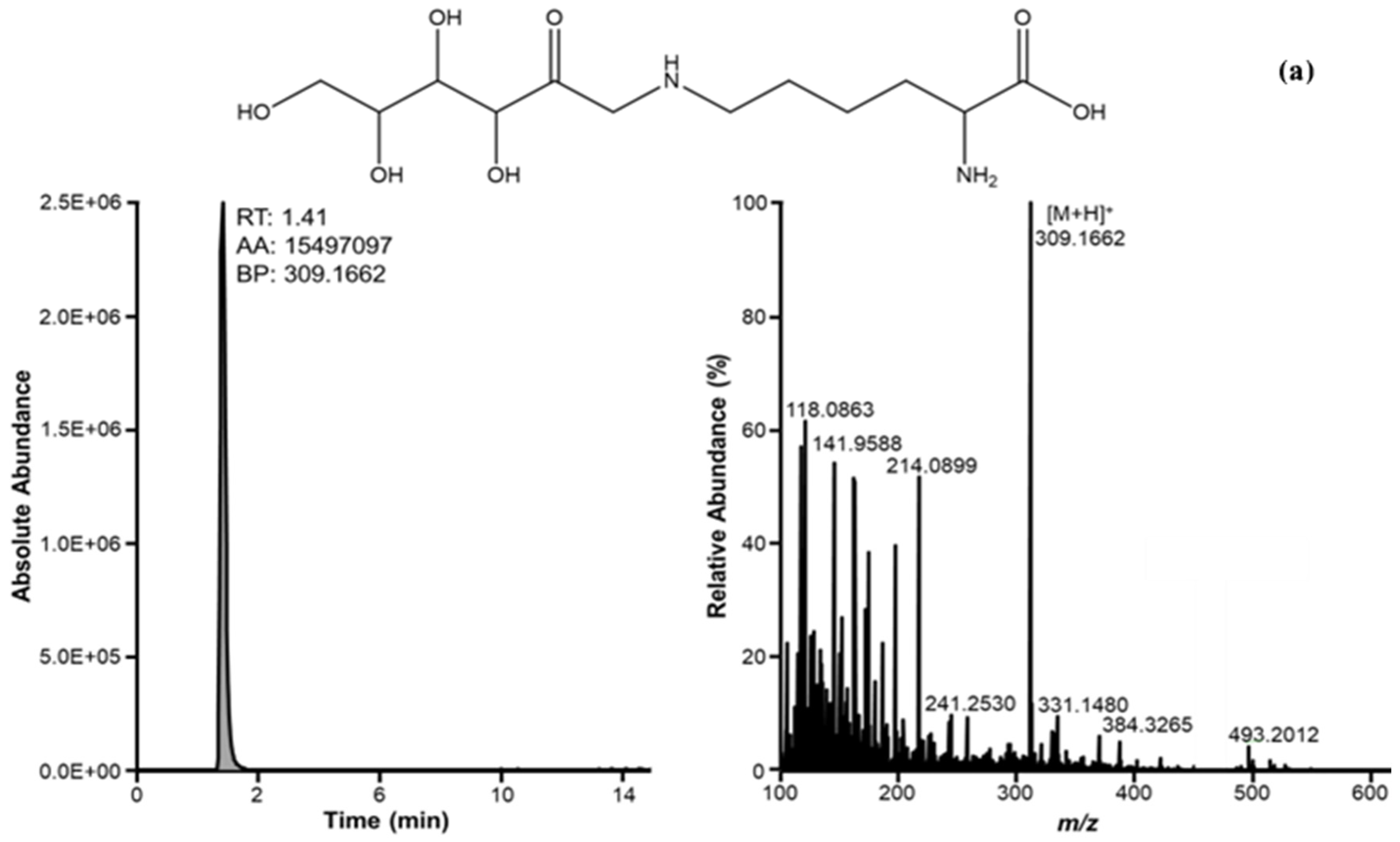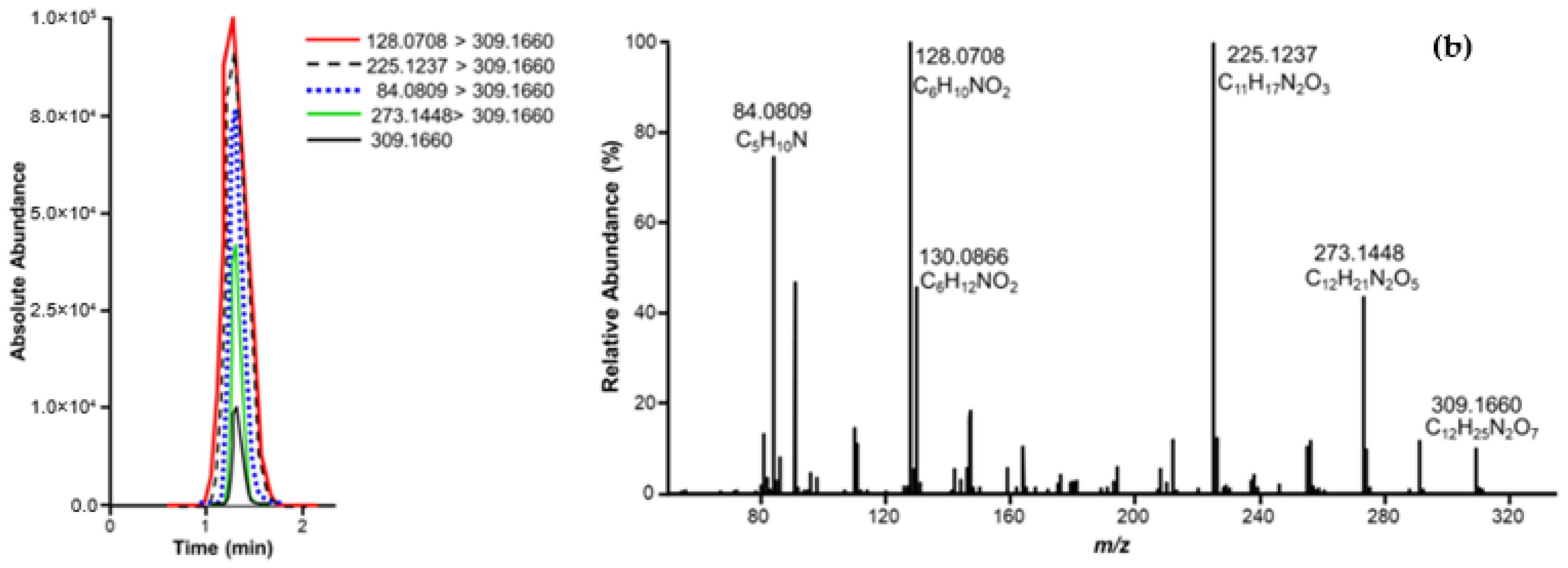

Multimatrix Detection and Quantification of the Advanced Glycation End Products Precursor Fructoselysine via UHPLC-HRMS/MS

 ,
,  , , and
Abstract
1. Introduction
2. Materials and Methods
2.1. Chemicals and Reagents
2.2. Preparation of Standard Stock Solutions and Spiked Matrices
2.3. Biological Samples and Sample Preparation
2.4. Chromatographic Separation and Mass Spectrometric Conditions
2.5. Peak Extraction and FL Quantification
2.6. Method Validation
2.7. Quantification of Biological Samples
2.8. Matrix Effects
3. Results
3.1. Method Validation Results
3.1.1. Linearity, LOD, and LOQ

| FL Ions | R2 | LOD μmol/L | LOQ μmol/L | |
|---|---|---|---|---|
| Product ion (m/z) | 128.0706 | 0.9990 | 0.020 | 0.062 |
| Parent ion (m/z) | 309.1660 | 0.9988 | 0.025 | 0.077 |
3.1.2. Accuracy and Precision
| Theoretical Concentration | FL Parent Ion Area (±RSD) | FL Product Ion Area (±RSD) | Amount Recovered (μmol/L) | Recovery (%) | |||
|---|---|---|---|---|---|---|---|
| (µmol/L) | m/z 309.1660 | m/z 128.0706 | m/z 309.1660 | m/z 128.0706 | m/z 309.1660 | m/z 128.0706 | |
| 0.5 | 3.87 × 10⁶ (±7.08 × 10⁵) | 3.87 × 10⁵ (±7.62 × 10⁴) | 0.481 | 0.546 | 96% | 109% | |
| FL Calibration | 5.0 | 4.51 × 10⁷ (±5.70 × 10⁶) | 3.46 × 10⁶ (±4.45 × 10⁵) | 4.745 | 5.094 | 95% | 102% |
| 10.0 | 9.74 × 10⁷ (±1.53 × 10⁷) | 6.76 × 10⁶ (±1.15 × 10⁶) | 10.149 | 9.988 | 101% | 100% | |
| 0.5 | 3.17 × 10⁶ | 3.11 × 10⁵ | 0.508 | 0.528 | 102% | 106% | |
| Samples | 5.0 | 3.94 × 10⁷ | 3.01 × 10⁶ | 4.900 | 5.297 | 98% | 106% |
| 10.0 | 8.21 × 10⁷ | 5.61 × 10⁶ | 10.072 | 9.880 | 101% | 99% | |
| Sample | Replicate | m/z = 128.0706 Measured Concentration | m/z = 309.1660 Measured Concentration | Intra-Day Variation (RSD%) m/z 128; m/z 309 | Inter-Day Variation (RSD%) m/z 128; m/z 309 |
|---|---|---|---|---|---|
| R1 | 2.33 | 2.60 | |||
| FL std 2.5 µmol/L | R2 | 2.51 | 2.58 | 5.98; 1.17 | 6.01; 2.72 |
| R3 | 2.69 | 2.53 | |||
| R1 | 9.02 | 5.87 | |||
| QCs | R2 | 8.48 | 5.85 | 3.1; 0.1 | 2.27; 2.62 |
| R3 | 9.10 | 5.86 |
3.1.3. Carry-Over
3.1.4. Matrix Effect
3.2. FL Profiles in Biological Samples
4. Discussion
5. Conclusions
Supplementary Materials
Author Contributions
Funding
Institutional Review Board Statement
Informed Consent Statement
Data Availability Statement
Conflicts of Interest
Abbreviations
| UHPLC-MS/MS | Ultra-High-Performance Liquid Chromatography tandem Mass Spectrometry |
| AGEs | Advanced Glycation End Products |
| sRAGE | Reduced Soluble Decoy Receptor |
| FL | Fructoselysine |
| LOD | Limit Of Detection |
| LOQ | Limit Of Quantification |
| RSD | Relative Standard Deviation |
| ACN | Acetonitrile |
| MeOH | Methanol |
| H2O | Water |
| PRM | Parallel Reaction Monitoring |
| FWHM | Full Width at Half Maximum |
| FS | Full Scan |
| RT | Retention Time |
References
- Cepas, V.; Collino, M.; Mayo, J.C.; Sainz, R.M. Redox Signaling and Advanced Glycation End products (AGEs) in Diet-Related Diseases. Antioxidants 2020, 9, 142. [Google Scholar] [CrossRef]
- Chuyen, N.V. Toxicity of the AGEs generated from the Maillard reaction: On the relationship of food-AGEs and biological-AGEs. Mol. Nutr. Food Res. 2006, 50, 1140–1149. [Google Scholar] [CrossRef]
- Fournet, M.; Bonte, F.; Desmouliere, A. Glycation Damage: A Possible Hub for Major Pathophysiological Disorders and Aging. Aging Dis. 2018, 9, 880–900. [Google Scholar] [CrossRef]
- Spotti, M.J.; Loyeau, P.A.; Marangón, A.; Noir, H.; Rubiolo, A.C.; Carrara, C.R. Influence of Maillard reaction extent on acid induced gels of whey proteins and dextrans. Food Hydrocoll. 2019, 91, 224–231. [Google Scholar] [CrossRef]
- Maillard, L.C. Reaction of amino acids on sugars: Formation of melanoidins by a systematic way. Comput. Rend. Acad. Sci. 1912, 154, 66–68. [Google Scholar] [CrossRef]
- Ma, H.; Liu, W.; Frost, L.; Kirschenbaum, L.J.; Dain, J.A.; Seeram, N.P. Glucitol-core containing gallotannins inhibit the formation of advanced glycation end-products mediated by their antioxidant potential. Food Funct. 2016, 7, 2213–2222. [Google Scholar] [CrossRef] [PubMed]
- Delgado-Andrade, C.; Fogliano, V. Dietary Advanced Glycosylation End-Products (dAGEs) and Melanoidins Formed through the Maillard Reaction: Physiological Consequences of their Intake. Annu. Rev. Food Sci. Technol. 2018, 9, 271–291. [Google Scholar] [CrossRef] [PubMed]
- Rahbar, S.; Blumenfeld, O.; Ranney, H.M. Studies of an unusual hemoglobin in patients with diabetes mellitus. Biochem. Biophys. Res. Commun. 1969, 36, 838–843. [Google Scholar] [CrossRef]
- Chen, J.H.; Lin, X.; Bu, C.; Zhang, X. Role of advanced glycation end products in mobility and considerations in possible dietary and nutritional intervention strategies. Nutr. Metab. 2018, 15, 72. [Google Scholar] [CrossRef]
- Twarda-Clapa, A.; Olczak, A.; Bialkowska, A.M.; Koziołkiewicz, M. Advanced Glycation End-Products (AGEs): Formation, Chemistry, Classification, Receptors, and Diseases Related to AGEs. Cells 2022, 11, 1312. [Google Scholar] [CrossRef]
- Chaudhuri, J.; Bains, Y.; Guha, S.; Kahn, A.; Hall, D.; Bose, N.; Gugliucci, A.; Kapahi, P. The Role of Advanced Glycation End Products in Aging and Metabolic Diseases: Bridging Association and Causality. Cell Metab. 2018, 28, 337–352. [Google Scholar] [CrossRef]
- Perrone, A.; Giovino, A.; Benny, J.; Martinelli, F. Advanced Glycation End Products (AGEs): Biochemistry, Signaling, Analytical Methods, and Epigenetic Effects. Oxid. Med. Cell Longev. 2020, 1, 3818196. [Google Scholar] [CrossRef] [PubMed]
- Suzuki, A.; Yabu, A.; Nakamura, H. Advanced glycation end products in musculoskeletal system and disorders. Methods 2022, 203, 179–186. [Google Scholar] [CrossRef]
- Erbersdobler, H.F.; Somoza, V. Forty years of furosine—Forty years of using Maillard reaction products as indicators of the nutritional quality of foods. Mol. Nutr. Food Res. 2007, 51, 423–430. [Google Scholar] [CrossRef]
- Ott, C.; Jacobs, K.; Haucke, E.; Navarrete Santos, A.; Grune, T.; Simm, A. Role of advanced glycation end products in cellular signaling. Redox Biol. 2014, 2, 411–429. [Google Scholar] [CrossRef]
- Corica, D.; Pepe, G.; Currò, M.; Aversa, T.; Tropeano, A.; Ientile, R.; Wasniewska, M. Methods to investigate advanced glycation end-product and their application in clinical practice. Methods 2022, 203, 90–102. [Google Scholar] [CrossRef]
- Poojary, M.M.; Zhang, W.; Greco, I.; De Gobba, C.; Olsen, K.; Lund, M.N. Liquid chromatography quadrupole-Orbitrap mass spectrometry for the simultaneous analysis of advanced glycation end products and protein-derived cross-links in food and biological matrices. J. Chromatogr. A 2020, 1615, 460767. [Google Scholar] [CrossRef] [PubMed]
- van Dongen, K.C.W.; van der Zande, M.; Bruyneel, B.; Vervoort, J.J.M.; Rietjens, I.M.C.M.; Belzer, C.; Beekmann, K. An in vitro model for microbial fructoselysine degradation shows substantial interindividual differences in metabolic capacities of human fecal slurries. Toxicol. In Vitro 2021, 72, 105078. [Google Scholar] [CrossRef]
- van Dongen, K.C.W.; Belzer, C.; Bakker, W.; Rietjens, I.M.C.M.; Beekmann, K. Inter- and Intraindividual Differences in the Capacity of the Human Intestinal Microbiome in Fecal Slurries to Metabolize Fructoselysine and Carboxymethyllysine. J. Agric. Food Chem. 2022, 70, 11759–11768. [Google Scholar] [CrossRef] [PubMed]
- van Dongen, K.C.W.; Ioannou, A.; Wesseling, S.; Beekmann, K.; Belzer, C. Differences in gut microbial fructoselysine degradation activity between breast-fed and formula-fed infants. FEMS Microbiol. Ecol. 2022, 99, fiac145. [Google Scholar] [CrossRef]
- van Dongen, K.C.W.; Kappetein, L.; Miro Estruch, I.; Belzer, C.; Beekmann, K.; Rietjens, I.M. Differences in kinetics and dynamics of endogenous versus exogenous advanced glycation end products (AGEs) and their precursors. Food Chem. Toxicol. 2022, 164, 112987. [Google Scholar] [CrossRef]
- van Dongen, K.C.W.; Linkens, A.M.A.; Wetzels, S.M.W.; Wouters, K.; Vanmierlo, T.; van de Waarenburg, M.P.H.; Scheijen, J.L.J.M.; de Vos, W.M.; Belzer, C.; Schalkwijk, C.G. Dietary advanced glycation endproducts (AGEs) increase their concentration in plasma and tissues, result in inflammation and modulate gut microbial composition in mice; evidence for reversibility. Food Res. Int. 2021, 147, 110547. [Google Scholar] [CrossRef]
- Xiao, Z.; Zhang, Z.; Huang, S.; Lon, J.R.; Xie, S. Metabolic Profiling of Serum for Osteoarthritis Biomarkers. Dis. Markers 2022, 2022, 1800812. [Google Scholar] [CrossRef]
- ICH Q2(R2): Validation of Analytical Procedures. Available online: https://www.ema.europa.eu/en/ich-q2r2-validation-analytical-procedures-scientific-guideline (accessed on 10 September 2024).
- Chavan, S.; Desai, D. Analytical method validation: A brief review. World J. Adv. Res. Rev. 2022, 16, 389–402. [Google Scholar] [CrossRef]
- Sargent, M. (Ed.) Guide to Achieving Reliable Quantitative LC-MS Measurements, 1st ed.; RSC Analytical Methods Committee: Cambridge, UK, 2013; pp. 1–61. ISBN 978-0-948926-27-3. [Google Scholar]
- Brings, S.; Fleming, T.; Freichel, M.; Muckenthaler, M.U.; Herzig, S.; Nawroth, P.P. Dicarbonyls and Advanced Glycation End-Products in the Development of Diabetic Complications and Targets for Intervention. Int. J. Mol. Sci. 2017, 18, 984. [Google Scholar] [CrossRef]
- Wu, Y.; Li, Y.; Zheng, L.; Wang, P.; Liu, Y.; Wu, Y.; Gong, Z. The neurotoxicity of Nε-(carboxymethyl)lysine in food processing by a study based on animal and organotypic cell culture. Ecotoxicol. Environ. Saf. 2020, 190, 110077. [Google Scholar] [CrossRef]
- Wang, D.; Wang, J.; Liu, X.; Du, K.; Liu, H.; Yang, X.; Liu, T.; Liu, Q.; Wang, M.; Guo, J. Quantifying carboxymethyl lysine and carboxyethyl lysine in human plasma: Clinical insights into aging research using liquid chromatography-tandem mass spectrometry. BMC Biotechnol. 2024, 24, 12. [Google Scholar] [CrossRef]
- Boesten, D.M.P.H.J.; Elie, A.G.I.M.; Drittij-Reijnders, M.-J.; den Hartog, G.J.M.; Bast, A. Effect of Nɛ-carboxymethyllysine on oxidative stress and the glutathione system in beta cells. Toxicol. Rep. 2014, 1, 973–980. [Google Scholar] [CrossRef] [PubMed]
- Oimomi, M.; Nishimoto, S.; Kitamura, Y.; Matsumoto, S.; Hatanaka, H.; Ishikawa, K.; Baba, S. Increased fructose-lysine of hair protein in diabetic patients. Klin. Wochenschr. 1985, 63, 728–730. [Google Scholar] [CrossRef] [PubMed]
- Hanssen, N.M.; Beulens, J.W.; van Dieren, S.; Scheijen, J.L.; van der A Daphne, L.; Spijkerman, A.M.; van der Schouw, Y.T.; Stehouwer, C.D.; Schalkwijk, C.G. Plasma advanced glycation end products are associated with incident cardiovascular events in individuals with type 2 diabetes: A case-cohort study with a median follow-up of 10 years (EPIC-NL). Diabetes 2015, 64, 257–265. [Google Scholar] [CrossRef]
- Rabbani, N.; Thornalley, P.J. Hidden complexities in the measurement of fructosyl-lysine and advanced glycation end products for risk prediction of vascular complications of diabetes. Diabetes 2015, 64, 9–11. [Google Scholar] [CrossRef][Green Version]
- Goh, S.Y.; Cooper, M.E. The role of advanced glycation end products in progression and complications of diabetes. J. Clin. Endocrinol. Metab. 2008, 93, 1143–1152. [Google Scholar] [CrossRef]
- Rungratanawanich, W.; Qu, Y.; Wang, X.; Essa, M.M.; Song, B.J. Advanced glycation end products (AGEs) and other adducts in aging-related diseases and alcohol-mediated tissue injury. Exp. Mol. Med. 2021, 53, 168–188. [Google Scholar] [CrossRef] [PubMed]
- Uribarri, J.; Cai, W.; Peppa, M.; Goodman, S.; Ferrucci, L.; Striker, G.; Vlassara, H. Circulating glycotoxins and dietary advanced glycation endproducts: Two links to inflammatory response, oxidative stress, and aging. J. Gerontol. A Biol. Sci. Med. Sci. 2007, 62, 427–433. [Google Scholar] [CrossRef] [PubMed]
- Nowak, A.; Przywara-Chowaniec, B.; Blachut, D.; Nowalany-Kozielska, E.; Tyrpień-Golder, K. Advanced glycation end-products (AGEs) and their soluble receptor (sRAGE) in women suffering from systemic lupus erythematosus (SLE). Cells 2021, 10, 3523. [Google Scholar] [CrossRef] [PubMed]
- Carrión-Barberà, I.; Triginer, L.; Tío, L.; Pérez-García, C.; Ribes, A.; Abad, V.; Pros, A.; Monfort, J.; Salman-Monte, T.C. Serum advanced glycation end products and their soluble receptor as new biomarkers in systemic lupus erythematosus. Biomedicines 2024, 12, 610. [Google Scholar] [CrossRef]
- Papagrigoraki, A.; Del Giglio, M.; Cosma, C.; Maurelli, M.; Girolomoni, G.; Lapolla, A. Advanced glycation end products are increased in the skin and blood of patients with severe psoriasis. Acta Derm. Venereol. 2017, 97, 782–787. [Google Scholar] [CrossRef]
- Kang, P.; Chen, J.; Wang, S.; Zhang, S.; Li, S.; Guo, S.; Song, P.; Liu, L.; Wang, G.; Gao, T.; et al. Advanced glycation end products-induced activation of keratinocytes: A mechanism underlying cutaneous immune response in psoriasis. J. Innate Immun. 2023, 15, 876–892. [Google Scholar] [CrossRef]
- Radziszewski, M.; Galus, R.; Łuszczyński, K.; Winiarski, S.; Wąsowski, D.; Malejczyk, J.; Włodarski, P.; Ścieżyńska, A. The RAGE pathway in skin pathology development: A comprehensive review of its role and therapeutic potential. Int. J. Mol. Sci. 2024, 25, 13570. [Google Scholar] [CrossRef]


Disclaimer/Publisher’s Note: The statements, opinions and data contained in all publications are solely those of the individual author(s) and contributor(s) and not of MDPI and/or the editor(s). MDPI and/or the editor(s) disclaim responsibility for any injury to people or property resulting from any ideas, methods, instructions or products referred to in the content. |
© 2026 by the authors. Licensee MDPI, Basel, Switzerland. This article is an open access article distributed under the terms and conditions of the Creative Commons Attribution (CC BY) license.
Share and Cite
Fenizia, S.; Manfredi, M.; Antoniotti, V.; Tini, S.; Baima, J.; Prodam, F.; Barberis, E. Multimatrix Detection and Quantification of the Advanced Glycation End Products Precursor Fructoselysine via UHPLC-HRMS/MS. Metabolites 2026, 16, 78. https://doi.org/10.3390/metabo16010078
Fenizia S, Manfredi M, Antoniotti V, Tini S, Baima J, Prodam F, Barberis E. Multimatrix Detection and Quantification of the Advanced Glycation End Products Precursor Fructoselysine via UHPLC-HRMS/MS. Metabolites. 2026; 16(1):78. https://doi.org/10.3390/metabo16010078
Chicago/Turabian StyleFenizia, Simona, Marcello Manfredi, Valentina Antoniotti, Sabrina Tini, Jessica Baima, Flavia Prodam, and Elettra Barberis. 2026. "Multimatrix Detection and Quantification of the Advanced Glycation End Products Precursor Fructoselysine via UHPLC-HRMS/MS" Metabolites 16, no. 1: 78. https://doi.org/10.3390/metabo16010078
APA StyleFenizia, S., Manfredi, M., Antoniotti, V., Tini, S., Baima, J., Prodam, F., & Barberis, E. (2026). Multimatrix Detection and Quantification of the Advanced Glycation End Products Precursor Fructoselysine via UHPLC-HRMS/MS. Metabolites, 16(1), 78. https://doi.org/10.3390/metabo16010078