
Review

Obesity, Dietary Fats, and Gastrointestinal Cancer Risk-Potential Mechanisms Relating to Lipid Metabolism and Inflammation

by
Kathleen A. J. Mitchelson
1,
Fiona O’Connell
2,
Jacintha O’Sullivan
2 and
Helen M. Roche
1,3,*
1
Nutrigenomics Research Group, UCD Conway Institute, UCD Institute of Food and Health, and School of Public Health, Physiotherapy and Sports Science, University College Dublin, D04 H1W8 Dublin, Ireland
2
Department of Surgery, Trinity St. James’s Cancer Institute and Trinity Translational Medicine Institute, St. James’s Hospital and Trinity College Dublin, D08 W9RT Dublin, Ireland
3
Institute for Global Food Security, School of Biological Sciences, Queens University Belfast, Belfast BT9 5DL, UK
*
Author to whom correspondence should be addressed.
Metabolites 2024, 14(1), 42; https://doi.org/10.3390/metabo14010042

Submission received: 28 November 2023 / Revised: 28 December 2023 / Accepted: 29 December 2023 / Published: 10 January 2024
(This article belongs to the Section Nutrition and Metabolism)

Abstract

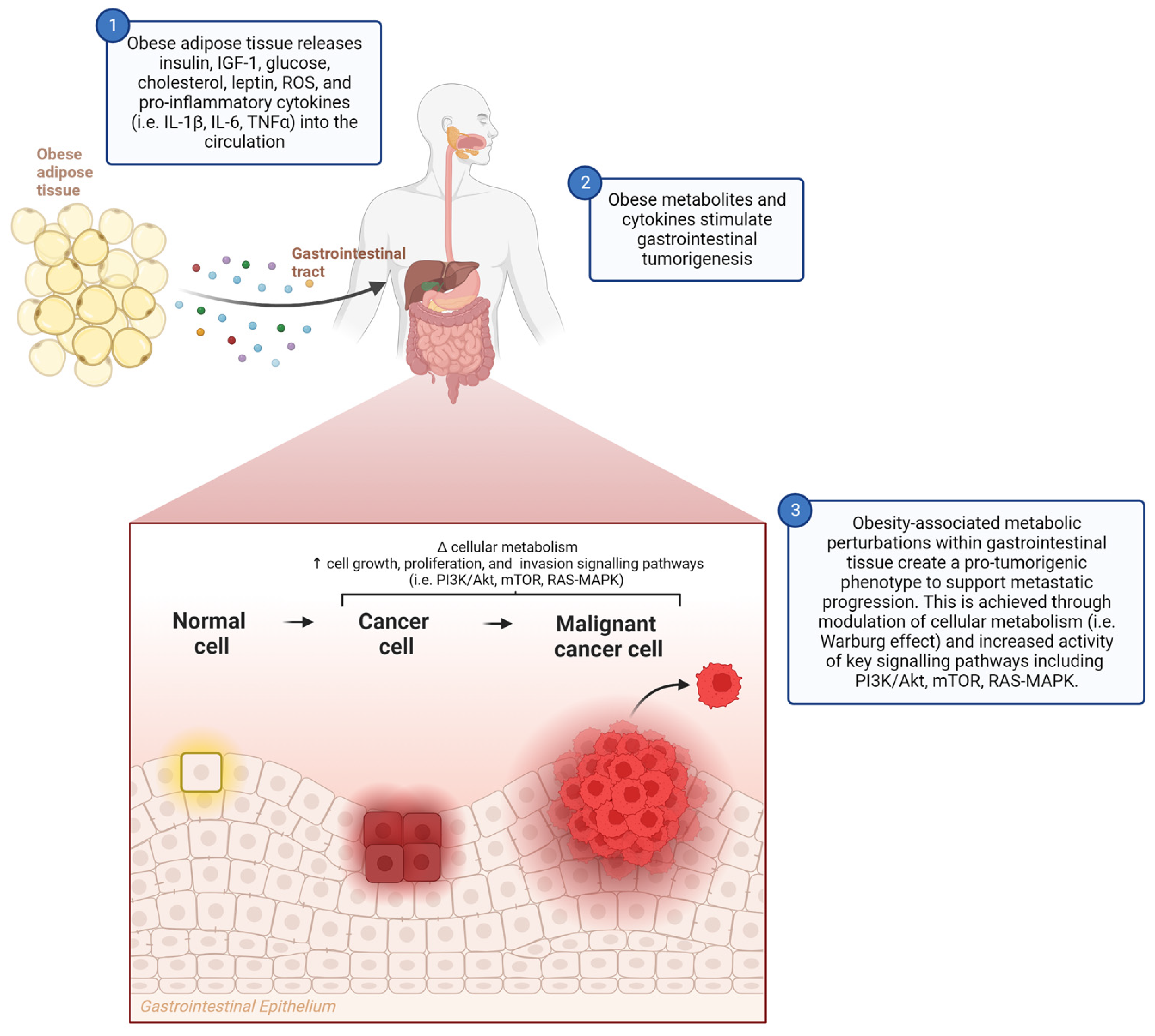
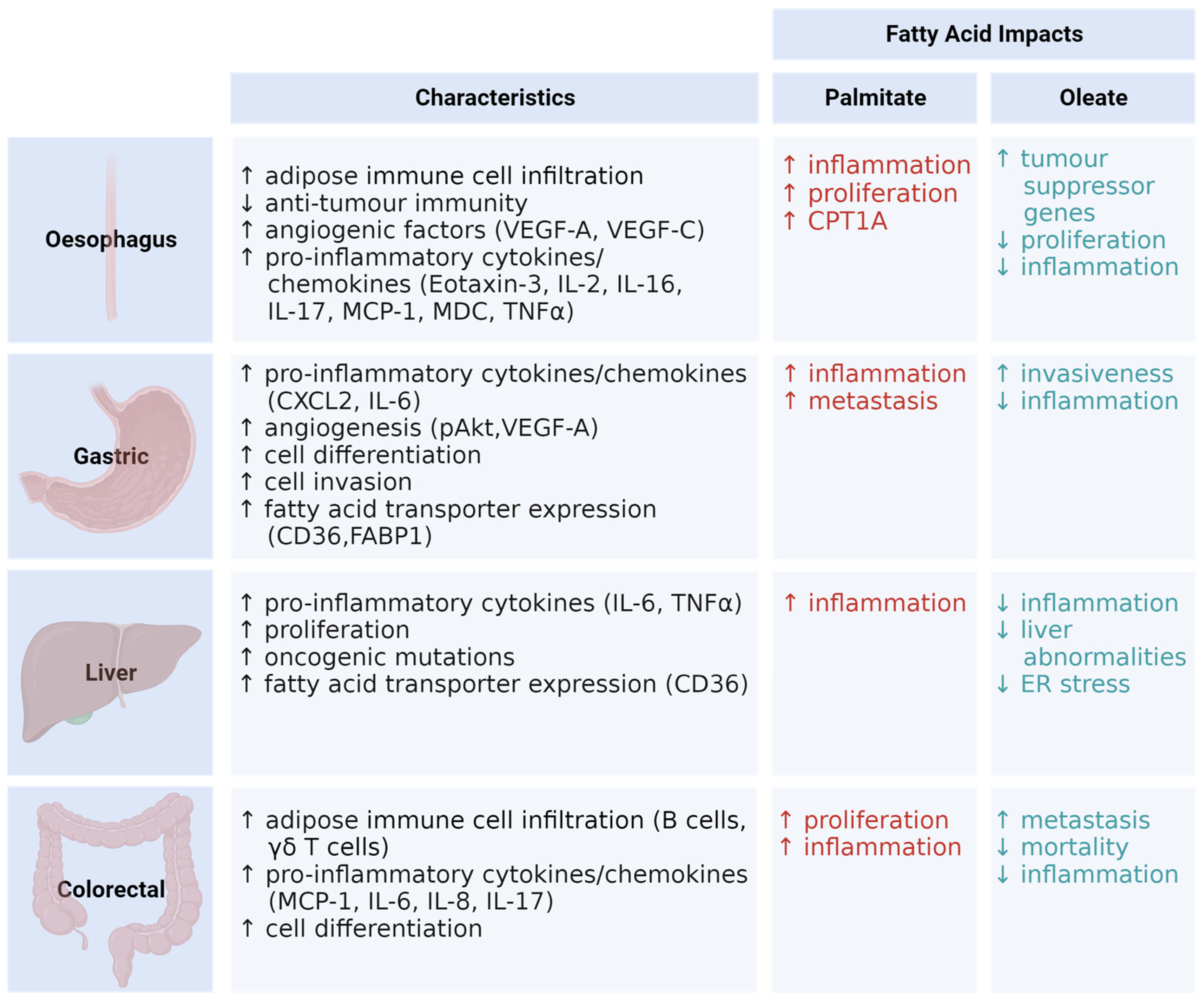
Obesity is a major driving factor in the incidence, progression, and poor treatment response in gastrointestinal cancers. Herein, we conducted a comprehensive analysis of the impact of obesity and its resulting metabolic perturbations across four gastrointestinal cancer types, namely, oesophageal, gastric, liver, and colorectal cancer. Importantly, not all obese phenotypes are equal. Obese adipose tissue heterogeneity depends on the location, structure, cellular profile (including resident immune cell populations), and dietary fatty acid intake. We discuss whether adipose heterogeneity impacts the tumorigenic environment. Dietary fat quality, in particular saturated fatty acids, promotes a hypertrophic, pro-inflammatory adipose profile, in contrast to monounsaturated fatty acids, resulting in a hyperplastic, less inflammatory adipose phenotype. The purpose of this review is to examine the impact of obesity, including dietary fat quality, on adipose tissue biology and oncogenesis, specifically focusing on lipid metabolism and inflammatory mechanisms. This is achieved with a particular focus on gastrointestinal cancers as exemplar models of obesity-associated cancers.
Keywords: obesity; adipose; diet; saturated fatty acids; monounsaturated fatty acids; gastrointestinal cancer; metabolism; inflammation obesity; adipose; diet; saturated fatty acids; monounsaturated fatty acids; gastrointestinal cancer; metabolism; inflammation