
Review

Next-Generation Genome-Scale Metabolic Modeling through Integration of Regulatory Mechanisms
1
Department of Biomedical Engineering, University of Michigan, Ann Arbor, MI 48109, USA
2
Department of Computational Medicine and Bioinformatics, University of Michigan, Ann Arbor, MI 48109, USA
3
Program in Chemical Biology, University of Michigan, Ann Arbor, MI 48109, USA
4
Center for Bioinformatics and Computational Medicine, University of Michigan, Ann Arbor, MI 48109, USA
5
Rogel Cancer Center, University of Michigan Medical School, Ann Arbor, MI 48109, USA
*
Author to whom correspondence should be addressed.
Metabolites 2021, 11(9), 606; https://doi.org/10.3390/metabo11090606

Submission received: 21 July 2021 / Revised: 1 September 2021 / Accepted: 3 September 2021 / Published: 7 September 2021
(This article belongs to the Special Issue Genome-Scale Metabolic Models)

Abstract

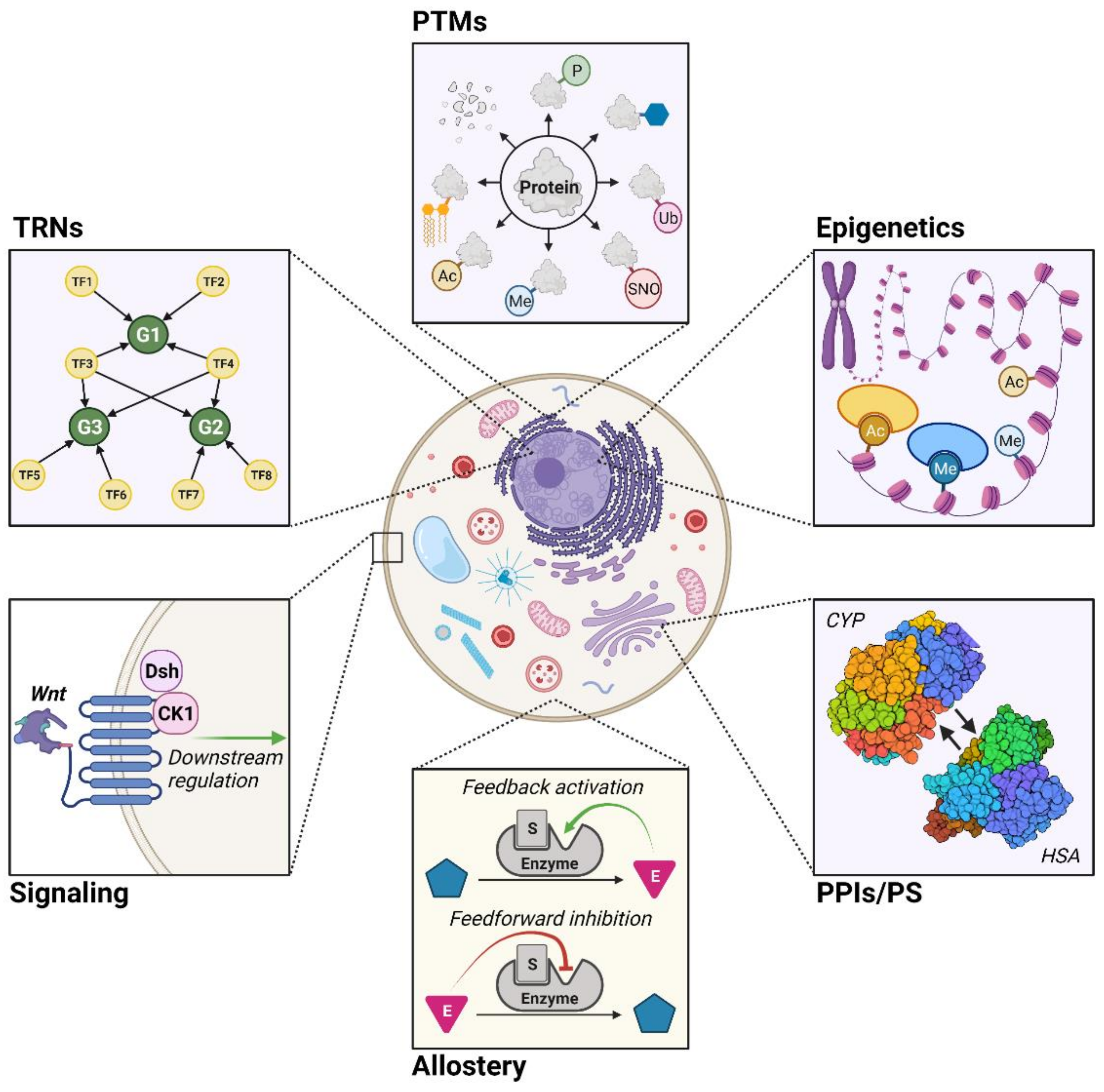
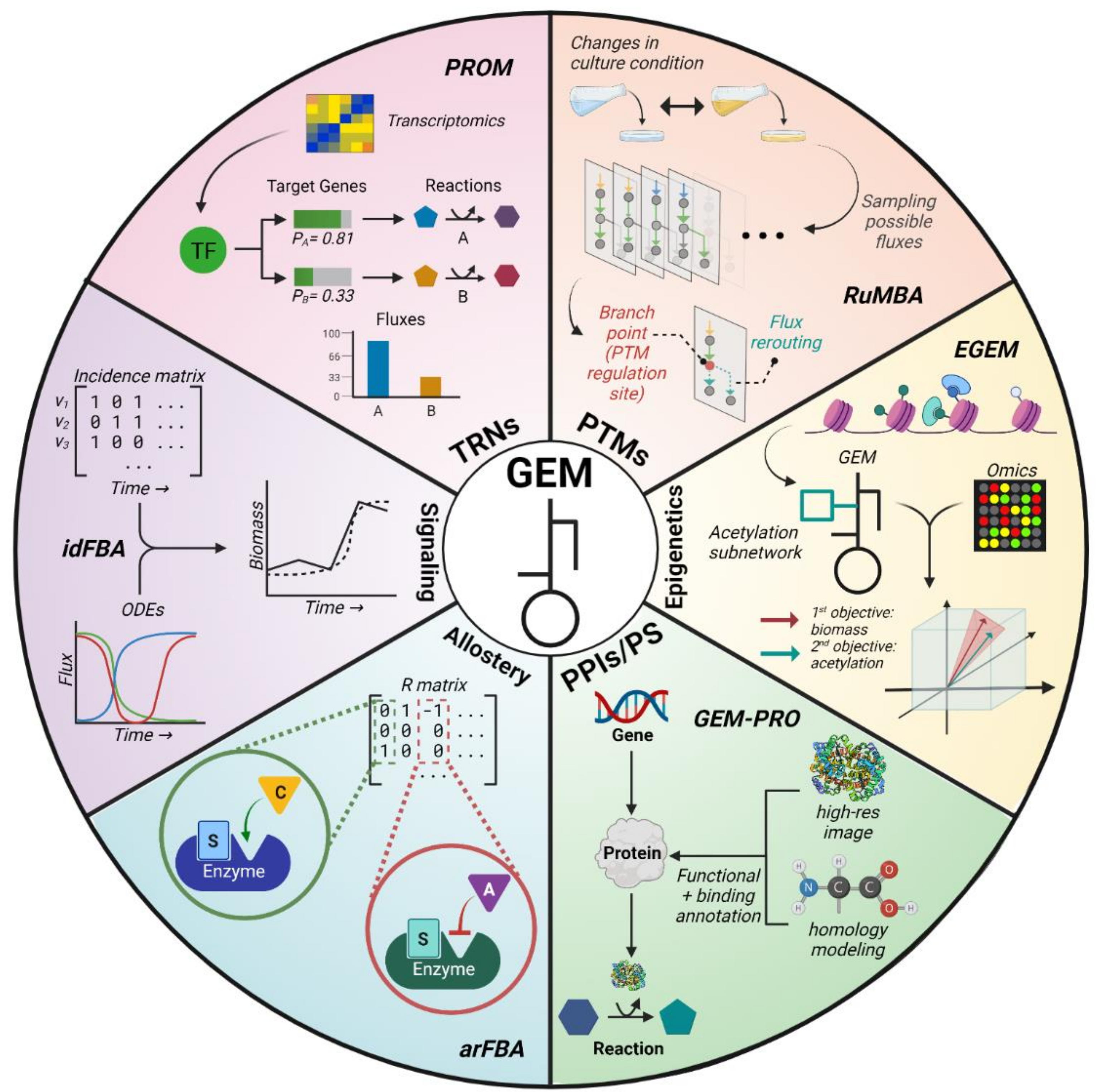
Genome-scale metabolic models (GEMs) are powerful tools for understanding metabolism from a systems-level perspective. However, GEMs in their most basic form fail to account for cellular regulation. A diverse set of mechanisms regulate cellular metabolism, enabling organisms to respond to a wide range of conditions. This limitation of GEMs has prompted the development of new methods to integrate regulatory mechanisms, thereby enhancing the predictive capabilities and broadening the scope of GEMs. Here, we cover integrative models encompassing six types of regulatory mechanisms: transcriptional regulatory networks (TRNs), post-translational modifications (PTMs), epigenetics, protein–protein interactions and protein stability (PPIs/PS), allostery, and signaling networks. We discuss 22 integrative GEM modeling methods and how these have been used to simulate metabolic regulation during normal and pathological conditions. While these advances have been remarkable, there remains a need for comprehensive and widespread integration of regulatory constraints into GEMs. We conclude by discussing challenges in constructing GEMs with regulation and highlight areas that need to be addressed for the successful modeling of metabolic regulation. Next-generation integrative GEMs that incorporate multiple regulatory mechanisms and their crosstalk will be invaluable for discovering cell-type and disease-specific metabolic control mechanisms.
Keywords: metabolic regulation; metabolic networks; constraint-based modeling; systems biology; genome-scale network models metabolic regulation; metabolic networks; constraint-based modeling; systems biology; genome-scale network models