Review

Kalanchoe daigremontiana from Ornamental to Pharmaceutical Applications

by
Cecilia Guadalupe de Loza-García
1,
Ana Belem Rubio-García
1,
Salvador Hernández-Estrada
1,
Luis Alfonso Hernández-Villaseñor
1,
Luis Antonio Ramirez-Contreras
1,
Jorge Manuel Silva-Jara
2,
Jorge L. Mejía-Méndez
3,
Zuamí Villagrán
1,
Eugenio Sánchez-Arreola
4,
Napoleón González-Silva
1 and
Luis Miguel Anaya-Esparza
5,*
1
Centro Universitario de Los Altos, Universidad de Guadalajara, Tepatitlan de Morelos 47620, Mexico
2
Centro Universitario de Ciencias Exactas e Ingenierías, Universidad de Guadalajara, Guadalajara 44430, Mexico
3
Tecnológico de Monterrey, Escuela de Ingeniería y Ciencias, Epigmenio González 500, San Pablo, Santiago de Querétaro 76130, Mexico
4
Departamento de Ciencias Químico-Biológicas, Universidad de las Américas Puebla, Santa Catarina Mártir s/n, San Andrés Cholula 72810, Mexico
5
Centro de Estudios para la Agricultura, la Alimentación y la Crisis Climática, Centro Universitario de los Altos, Universidad de Guadalajara, Tepatitlán de Morelos 47620, Mexico
*
Author to whom correspondence should be addressed.
Sci. Pharm. 2026, 94(2), 27; https://doi.org/10.3390/scipharm94020027
Submission received: 18 February 2026 / Revised: 27 March 2026 / Accepted: 29 March 2026 / Published: 31 March 2026

Abstract

Kalanchoe daigremontiana, a succulent herbaceous plant in the Crassulaceae family from Madagascar, has gained global popularity as an ornamental and medicinal species. This review examines the traditional uses, phytochemical composition, biological properties, toxicological aspects, and regulatory challenges of K. daigremontiana. The traditional medicinal uses of its leaves and roots include treating burns, rheumatic disorders, hypertension, diabetes, kidney pain, diarrhea, cough, fever, gastric issues, anxiety, inflammation, and cancer. Chemical compounds identified include phenolic acids, flavonoids, tannins, alkaloids, glycosides, saponins, sterols, terpenes, and fatty acids, with phenolic compounds and bufadienolides being predominant. In vitro studies of the crude extracts, bufadienolide-rich fractions, and isolated compounds have shown antioxidant, antibacterial, antifungal, antiviral, antiparasitic, anthelmintic, anti-inflammatory, anticoagulant, anti-aging, cytotoxic, antitumoral, and antiproliferative properties. In vivo studies have demonstrated hepatoprotective, skincare, and cardiac-glycoside-like effects. While crude extracts and bufadienolide-rich fractions have shown toxic effects in 2-week-old chicks, guinea pigs, and Artemia salina, no toxicity has been reported in goats, broiler chickens, laying hens, or human erythrocytes. Although K. daigremontiana-based products are commercially available as dietary supplements with various health claims, these lack scientific validation. Despite the potential pharmaceutical applications of K. daigremontiana, further research is needed to determine its effects, dosage, mechanisms, long-term safety, and side effects, with clinical studies essential to validate its therapeutic potential.

1. Introduction

Botanical sources remain indispensable in both traditional and contemporary medicine, serving as abundant reservoirs for the discovery of novel bioactive compounds. Historically, plant-derived secondary metabolites have formed the basis of numerous clinically approved drugs with diverse therapeutic properties [1,2]. A particularly promising botanical source of therapeutic agents is the Crassulaceae family, notably species in the genus Kalanchoe [3,4,5]. In this context, some members of this genus (K. pinnata, K. laciniata, and K. crenata, and K. daigremontiana) possess a longstanding history of therapeutic use and are colloquially referred to as “miracle leaf” due to their remarkable healing properties and traditional applications in treating skin injuries, pain, fever, headache, convulsions, antiseptic needs, burns, arthritis, gastric and menstrual disorders, cough, anxiety, and cancer among others [1,5].
K. daigremontiana, commonly known as the “mother of thousands,” is a native of Madagascar and South Africa but has spread to various tropical and subtropical regions worldwide (i.e., Mexico, Brazil, Peru, Australia, India, and Poland). This succulent has gained international recognition not only for its unique asexual reproductive strategy, involving foliar plantlets, but also for its exceptional ecological adaptability. In Mexico, it is primarily used as an ornamental plant due to its aesthetic appeal [6]; however, in some areas, K. daigremontiana is considered invasive and toxic [7,8]. Despite these concerns, K. daigremontiana has been integrated into traditional medicinal systems across diverse countries worldwide, such as Mexico, the USA, Brazil, Peru, South Africa, India, and Poland [5,8]. Ethnobotanical records document its varied therapeutic applications, ranging from treating inflammatory conditions and microbial infections to its use as a topical cicatrizing agent for wound healing [6,9,10,11,12,13,14,15].
The scientific evidence demonstrated that extracts from roots, stems, and leaves of K. daigremontiana exhibited antimicrobial, antioxidant, anti-inflammatory, cytotoxic, antitumor, antiproliferative, antidiabetic, antiaging, anticoagulant, and anthelmintic properties [8,11,14,16,17], supporting their recognition as a medicinal plant [18]. According to the literature, most of the biological activities reported on extracts and fractions are attributed to the presence of bioactive compounds, including phenolic acids, flavonoids, alkaloids, saponins, and steroids [1,17]. In this context, K. daigremontiana is a significant botanical material of pharmaceutical interest. Therefore, this review aims to synthesize scientific studies that describe the traditional uses, phytochemical constituents, biological properties, toxicological considerations, and regulatory challenges associated with K. daigremontiana.

2. Traditional Uses and Health Importance

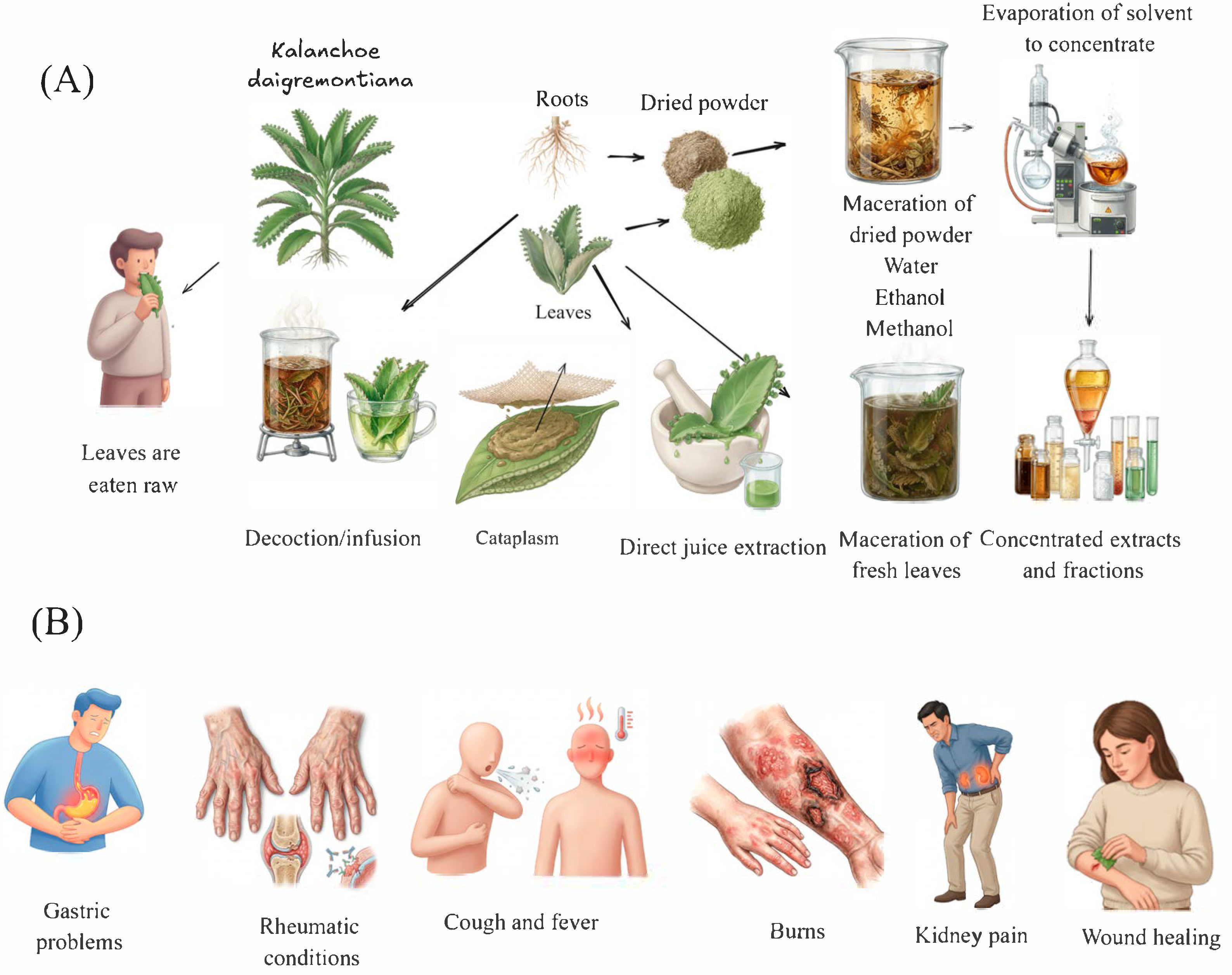
Kalanchoe daigremontiana is an herbaceous plant commonly cultivated as an ornamental addition to gardens and homes [14]. On the other hand, many people (often from Africa, South and Central America, and Asia) have used this plant species in their traditional healthcare system (i.e., Ayurdeva, Chinese Traditional Medicine, Anthroposophic medicine, and German Homeopathic Pharmacopoeia) [1,19]. In traditional medicine, K. daigremontiana leaves or roots are used in infusions, decoctions, cataplasm, crude extracts preparations obtained by maceration, or even compresses from crushed leaves as an alternative treatment for a variety of ailments, such as burns, rheumatic conditions, hypertension, diabetes, kidney pain, diarrhea, infections (antiseptic), cough, fever, deep wounds, gangrene, ulcers, gastric problems, abscesses, anxiety, inflammation, and various types of cancer [9,10,12,14,15,20,21,22,23].
Additionally, the extract obtained after crushing fresh leaves from K. daigremontiana is used to alleviate skin irritation [13], combat microbial infections, and aid in the treatment of asthma, ulcers, and wound healing [24,25]. Furthermore, in some regions, clean and disinfected K. daigremontiana leaves are eaten raw to address leucorrhea and gastric issues [9]. In this context, most bioactivities of K. daigremontiana are attributed to the presence of diverse secondary metabolites and bioactive compounds [5,11,19,26,27]. Figure 1 shows the most common preparations for traditional and research uses.

3. Bioactive Compounds Identified in Kalanchoe daigremontiana

Phytochemicals are secondary metabolites synthesized by plants that hold potential for the discovery of new pharmaceutical drugs [1,2]. Table 1 lists the various phytochemicals, both qualitative and quantitative, identified in the leaves, roots, flowers, and wax fractions of K. daigremontiana, including phenolic acids, flavonoids, tannins, alkaloids, glycosides, saponins, sterols, terpenes, and fatty acids [16,19,28,29,30]. Among the numerous phytochemicals reported in K. daigremontiana, phenolic compounds and bufadienolides are considered the predominant groups. These compounds are responsible for the bioactivity of K. daigremontiana [25]. Additionally, qualitative methods for the identification of bioactive compounds include chemical colorimetric reactions (i.e., Folin Ciocalteau’s and aluminum chloride reactions) and chromatographic techniques such as Thin-layer chromatography and High-Performance Liquid Chromatography (HPLC), while quantitative methods include HPLC, HPLC with Diode Array Detection (HPLC-DAD), Liquid Chromatography–Electrospray Ionization–Tandem Mass Spectrometry (LC–ESI-MS/MS), Time-of-Flight Mass Spectrometry (TOF-MS), gas chromatography, and nuclear magnetic resonance.
Polyphenolic compounds are metabolites derived from secondary plant pathways, playing essential roles in plant growth, development, and defense mechanisms. These compounds are characterized by an aromatic benzene ring and at least one hydroxyl group in their structure [41]. These compounds are classified as phenolic acids, flavonoids, tannins, stilbenes, and lignans based on their chemical structure [42]. Notably, K. daigremontiana leaves contain significant amounts of phenols, ranging from 0.1482 to 50.15 mg/g, while flavonoid levels have been reported at 7.35 and 17.35 mg/g [19,23,31]. Furthermore, the phenolic acids and flavonoids identified in K. daigremontiana leaves include gallic, chlorogenic, γ-resorcylic, p-coumaric, ferulic, caffeic, syringic, protocatechuic, sinapic, and ellagic acids, as well as kaempferol, catechin, rutin, quercetin, myricetin, delphinidin 3-O-glucoside, pelargonidin-3-glucoside, cyanidin-3-glucoside, and chrysene [11,20,34,37]. These compounds are highlighted by their antioxidant, anti-inflammatory, and antimicrobial properties [19,23,31].
Bufadienolides are the most extensively studied phytochemicals in Kalanchoe species, particularly in the leaves and roots of K. daigremontiana [10,13,21,27,35,38,43,44,45]. These compounds are characterized by a steroid nucleus (cyclopentanoperhydrophenanthrene) linked to a six-membered lactone ring (α-pyron) at the C-17β position [25,46]. Over 40 bufadienolide compounds have been identified in the leaves and roots of K. daigremontiana [17,47]. According to the literature, these compounds have been identified in aqueous, ethanolic, methanolic, and dichloromethane extracts or fractions [5,21,24,27,38,46,48]. Among these, 19-(acetyloxy)-1ß,3ß,5ß,11α,14ß-pentahydroxy-12-oxobufa-20,22-dienolide, 19-(acetyloxy)-3ß,5ß,11α,14ß-tetrahydroxybufa-20,22-dienolide, and 19-(acetyloxy)-1ß,3ß,5ß,14ß -tetrahydroxybufa-20,22-dienolide showed the highest reported concentration [40]. Various studies have reported that these compounds exhibited cytotoxic, antitumor, cardiotonic, and analgesic properties [49,50].
Given the widespread use of K. daigremontiana in both traditional medicine and scientific research, a comprehensive phytochemical analysis is warranted to elucidate its potential applications.

4. Biological Activities of Extracts from Kalanchoe daigremontiana

Kalanchoe daigremontiana has been used as a medicinal plant to treat various health conditions [3]. Given its widespread and popular use, scientific research has been conducted to corroborate its pharmaceutical potential. Studies report that its leaf and root extracts possess antioxidant, antimicrobial, anti-inflammatory, thrombin-inhibitory, hepatoprotective, anti-aging and skincare, cardiac glycoside-like, and anticancer properties, as discussed below.
Among the 44 reports that evaluated the biological activities of K. daigremontiana reviewed for this manuscript, approximately 80% corresponded to in vitro studies and 20% to in vivo studies, including murine, poultry, goat, and Artemia salina. Regarding the plant part used, 92.5% corresponded to leaves, and the remaining to roots. Regarding the extraction methods, 47.72% involved maceration in organic solvents, and the remaining methods were magnetic stirring, the Soxhlet method, ultrasonic waves, cold pressure, percolation, lixiviation, leaching, and homogenization. The most common solvents were water (29.54%), ethanol (29.54%), and methanol (25%); the remaining fractions comprised dichloromethane, carbon tetrachloride, and bufadienolide-rich fractions. Additionally, most in vitro studies are antioxidant evaluations (31.37%), cytotoxicity studies (27.49%), and antimicrobial studies (19.6%). The remaining 23.54% were evaluated for anti-inflammatory, anticoagulant, anti-aging, hepatoprotective, and skin-care properties, among others. The research groups that have studies K. daigremontiana are predominantly from Poland [5,27,35], Mexico [6,8,16], Russia [30], Brazil [32], and Indonesia [38], among others.

4.1. Antioxidant

Kalanchoe daigremontiana is recognized as a significant source of antioxidant compounds [11]. The pharmacological significance of these compounds is attributed to their capacity to neutralize reactive species, thereby mitigating oxidative-induced cellular damage associated with the pathogenesis of non-communicable diseases, such as diabetes, cardiovascular conditions, neurological disorders, and cancer [21]. As summarized in Table 2, leaves are the primary site for extracting antioxidant compounds, typically via maceration. Nonetheless, other methods, such as high-speed blending, percolation, and magnetic stirring, have been used for extraction. While polar solvents such as ethanol, methanol, and aqueous systems are commonly used, some studies have investigated the use of isopropanol and solvent partitioning to isolate high-purity fractions. Typically, the extracts are concentrated through rotary evaporation and subsequently resuspended in water prior to analysis. Methodologically, antioxidant quantification has been documented across a broad concentration range from 1 µg/mL to 450 mg/mL, utilizing a comprehensive array of in vitro assays, including DPPH (2,2-diphenyl-1-picrylhydrazyl), ABTS (2,2′-Azino-bis(3-ethylbenzothiazoline-6-sulfonic acid), and superoxide and nitric oxide radicals, FRAP (ferric reducing assay power), and ORAC (oxygen radical absorbance capacity).
Maltok et al. [51] reported that the K. daigremonitiana plant is a good source of antioxidant compounds. The filtered juice obtained after crushing the leaves of K. daigremontiana demonstrated moderate antiradical activity against DPPH and ABTS radicals, as well as low ferric and molybdenum reducing capabilities [17]. Notably, the macerated extract showed higher antioxidant activity in the ABTS assay than in the DPPH assay [19]. Ethanolic extracts obtained through maceration of K. daigremontiana leaves showed DDPH radical scavenging activity up to 66.89% in a concentration-dependent manner (25–200 µg/mL), with an EC50 value of 145 µg/mL [52].
Bogucka-Kocka et al. [11] observed similar trends, reporting up to 80% inhibition of DPPH radical, with an EC50 value of 180 µg/mL. Additionally, this extract demonstrated antioxidant activity against superoxide radicals (50% of inhibition; EC50 of 56.2 µg/mL) and nitric oxide radicals (100% of inhibition; EC50 of 270 µg/mL). The authors agree that these antioxidant effects are attributed to the concentration and type of bioactive compounds present in the extracts, noting the presence of benzoic and caffeic acid derivatives [11]. Furthermore, it has been documented that macerated aqueous extracts from K. daigremonitiana leaves exhibited higher antioxidant activity in the FRAP assay (IC50: 1271 µg/mL) than in the DPPH assay (IC50: 1750 µg/mL), highlighting the influence of phytochemical composition and concentration on antioxidant activity [21]. Furthermore, ethanol, hexane, dichloromethane, butanol, and water fractions obtained from K. daigremontiana leaves exhibited antioxidant properties against DPPH and ABTS radicals and anti-lipid peroxidation activity [53].
Additionally, Elizondo-Lluevano et al. [54] reported that the macerated methanolic extract exhibited strong inhibitory activity against the DPPH radical (IC50: 19.2 µg/mL), attributed to its flavonoid content, which was comparable to that of Vitamin E (IC50: 16.9 µg/mL).
de Andrade et al. [23] demonstrated that the K. daigremontiana leaf aqueous extract obtained through a high-speed blender exhibited superior antioxidant activity in the ABTS assay (193.61 µg/mL) compared to the DPPH assay (>1000 µg/mL). Furthermore, employing the same extraction technique, it has been documented that isopropanol extracts from K. daigremontiana leaves showed enhanced antioxidant activity in both DPPH and ORAC assays (3000 and 900 µmol Trolox equivalent/µg extract, respectively) compared to ethanolic (1200 and 700 µmol Trolox equivalent/µg extract) and aqueous (300 µmol Trolox equivalent/µg extract) extracts [55]. These results were attributed to the expected amount and type of bioactive compounds extracted by each solvent [23,55].
Baéz et al. [56] demonstrated that the 70% ethanolic extract (IC50: 3.01 µg/mL) derived from K. daigremontiana leaves through magnetic stirring exhibited superior DPPH radical inhibition compared to the 50% ethanol (IC50: 4.41 µg/mL), 80% ethanol (IC50: 3.80 µg/mL), and 80% methanol (IC50: 3.51 µg/mL) extracts. Similarly, Quintero et al. [14] observed that the aqueous extract obtained via magnetic stirring from K. daigremontiana leaves at a concentration of 1000 µg/mL showed low to moderate inhibitory effects against the DPPH radical (34.7%), with no inhibition detected for superoxide and nitric oxide radicals. Additionally, the methanolic extract obtained by percolation from K. daigremontiana leaves demonstrated inhibitory activity against both DPPH and ABTS radicals [34]. Paitan et al. [57] reported that extracts from K. daigremontiana leaves obtained through lixiviation exhibited inhibitory activity against ABTS radical cation. Additionally, Kolodziejczyk-Czepas et al. [27] evaluated the antioxidant activity of a bufadienolide-rich fraction isolated from K. daigremontiana roots in DPPH radical and blood plasma in vitro. In the DPPH assay, the fraction exhibited an EC50 of 21.8 µg/mL. In the blood plasma model under peroxynitrite-induced oxidative stress, the extract exhibited moderate antioxidant activity and no cytotoxic effects at concentrations ranging from 1 to 50 µg/mL.
K. daigremontiana leaves and roots are a source of antioxidant compounds because they can inhibit the formation of free radicals harmful to human cells and have a key role in protecting against diverse chronic non-communicable diseases, such as diabetes, cardiovascular conditions, and cancer. This evidence could support the use of K. daigremontiana as a medicinal plant for treating oxidative stress-related diseases.

4.2. Antimicrobial

In traditional medicine, K. daigremontiana is extensively used to treat infectious diseases, including parasitic, viral, and bacterial infections [4]. In research studies, the leaves of K. daigremontiana are primarily used for antimicrobial purposes, including antibacterial, antifungal, antiviral, antiparasitic, and anthelmintic, as shown in Table 3. For antimicrobial purposes, ethanol, methanol, and aqueous extracts are commonly utilized; these extracts are typically concentrated through rotary evaporation up to dryness and subsequently resuspended in water, dimethyl sulfoxide (DMSO), and methanol, as well as fractionated with n-hexane, carbon tetrachloride, and chloroform, which are dried and resuspended prior to analysis. For the antibacterial activity of K. daigremontiana leaf extracts, disk diffusion and microdilution are the most used analytical methods. Using the disk diffusion method, Anisimov et al. [30] reported that the ethanolic extract of K. daigremontiana leaves (5 mg/mL) obtained by homogenization exhibited antibacterial activity against Escherichia coli (4 mm of inhibition) and Staphylococcus aureus (6 mm of inhibition).
Additionally, it has been reported that ethanolic extract obtained by leaching showed antibacterial properties in a strain-dependent manner, where Pseudomonas aeruginosa (18.6 mm of inhibition) was more sensitive to the extract, followed by S. aureus (13 mm of inhibition), Salmonella Enteriditis (11.7 mm of inhibition), and Escherichia coli (11.7 mm of inhibition) [57]. Nahar et al. [58] evaluated the effectiveness of different partitioned extracts (n-hexane, chloroform, methanol, and carbon tetrachloride) from K. daigremontiana leaves against a variety of Gram-positive (Bacillus cereus, Bacillus megaterium, Bacillus subtilis, Staphylococcus aureus, and Sarcina lutea) and Gram-negative (E. coli, P. aeruginosa, S. Paratyphi, S. Typhi, Shigella boydii, S. dysenteriae, Vibrio mimicus, and V. parahemolyticus) bacteria. They reported that the antibacterial effects of partitioned extractives from n-hexane, chloroform, and methanol were dependent on the bacterial strain. In contrast, the carbon tetrachloride partitioned extract exhibited strong antibacterial activity against all evaluated strains (9 to 14 mm of inhibition); these results were compared with standard kanamycin, which showed inhibition zones from 10 to 18 mm depending on the evaluated strain. Furthermore, it has been reported that the methanolic extract from K. daigremontiana leaves (evaporated to dryness and resuspended in methanol) can inhibit the growth of S. Typhi up to 41.7%, compared with chloramphenicol control [8].
Rivero-Pérez et al. [6] evaluated the antibacterial effect of methanol-water extract from K. daigremontiana leaves against E. coli, Salmonella Typhimurium, Salmonella Choleraesuis, Pseudomonas aeruginosa, Listeria monocytogenes, Bacillus subtilis, and Staphylococcus aureus by microdilution assay, calculating the minimum inhibitory concentration values (MIC) They reported that the extract showed no activity against E. coli, S. Typhimurium, or S. Choleraesuis; low activity against P. aeruginosa and L. monocytogenes (MIC of 100 mg/mL); and strong activity against B. subtilis and S. aureus (MIC of 0.781 mg/mL); these results were compared to standard kanamycin, which showed MIC values ranged from 1 to 64 µg/mL in a strain-dependent response. The authors concluded that Gram-positive bacteria are more sensitive to the extract than Gram-negative bacteria, possibly due to differences in cell membranes. For its part, the water and dichloromethane fraction obtained from ethanolic extracts from K. daigremontiana exhibited antibacterial activity against a variety of bacterial strains (Streptococcus β-hemolyzing group A, Streptococcus β-hemolyzing group G, Corynebacterium diphtheriae, S. aureus, Staphylococcus epidermidis, Clostridium sporogenes, Clostridium bifermentans, Cutibacterium acnes, Streptococcus equinus, and Helicobacter pylori); however, its effects was in bacterial strain-dependent response and solvent fraction, with MIC values of 0.064 to >9.0 mg/mL for water fractions and 0.125 to >2.0 mg/mL for dichloromethane fractions. The most sensitive bacteria were S. epidermidis (MIC of 0.064 mg/mL) for the water fraction and C. sporogenes (MIC of 0.125 mg/mL) for the dichloromethane fraction; these results were compared to ampicillin, which showed MIC values ranging from 6.3 × 10⁻⁵ to 0.016 mg/mL [5]. Conversely, in a previous study, it has been reported that a bufadienolide-rich fraction from water extract (MIC: >50 µg/mL) of K. daigremontiana leaves exhibited higher antibacterial activity than derived from ethanol extracts (MIC: 98.4–787 µg/mL) against β-Hemolytic Streptococcus group A, β-Hemolytic Streptococcus group G, C. diphtheriae, S. aureus, S. epidermidis, Enterococcus hirae, and E. coli; these results were compared to ampicillin, which showed MIC values ranged from ˂0.03 to 0.3125 µg/mL [59].
The antifungal activity of K. daigremontiana extracts has been evaluated against molds (Aspergillus niger) and yeasts (Candida albicans, Saccharomyces cerevisiae, and Safale S-04) in model systems. It has been reported that ethanolic extract (5 mg/mL) from K. daigremontiana exhibited antifungal properties against Safale S-04 and C. albicans, but not for A. niger; these results were compared to Nitrofungin® [30]. On the other hand, it has been reported that partitioned extractive with carbon tetrachloride from macerated methanolic extract showed antifungal activity against C. albicans and A. niger, but not for S. cerevisiae [58]. For its part, it has been reported that the dichloromethane fraction obtained from macerated methanolic extracts from K. daigremontiana leaves can inhibit the C. albicans growth (MIC: 2 mg/mL) [5], whereas the water extract from showed strong inhibitory effects against C. albicans (>50 µg/mL); these values were higher than standard amphotericin, which showed MIC values ranged from 0.06 to 0.01 µg/mL [59].
Regarding antiviral properties of K. daigremontiana leaves, Gomes-Ürményi et al. [32] reported that the ethyl acetate fraction obtained from macerated methanolic extract exhibited strong inhibitory effects against Human herpesvirus type 1 (HHV-1; EC50: 0.97 µg/mL) and Human herpesvirus type 2 (HHV-2; EC50: 0.72 µg/mL). Furthermore, it has been reported that macerated aqueous extract from K. daigremontiana leaves shows an ability to prevent HHV-1 infection by direct inhibition of the virus attachment, penetration, and blocking of infection when used in pretreatment or post-entry treatment; these effects were observed in a concentration-dependent response (1–160 mg/mL) [35]. The antiviral activity was attributed to the phenolic acids and bufadienolides present in the extracts [32].
The antiparasitic and anthelmintic properties of K. daigremontiana leaf extracts have also been investigated [6,16,54]. Elizondo-Lluevano et al. [54] evaluated the effect of macerated methanolic extract on trophozoites from Entamoeba histolytica and Trichomonas vaginalis, important parasites that directly impact public health. They reported that the extract exhibited antiparasitic properties with LC50 values of 70.71 and 105.27 µg/mL, respectively; these values were compared to metronidazole, which showed MIC values of 0.17 and 0.09 µg/mL, respectively. Similar trends were observed when evaluating this extract against these parasites in their logarithmic growth phase [16]. Additionally, the macerated methanolic-water extract from K. daigremontiana leaves exhibited anthelmintic properties against Haemonchus contortus eggs collected from feces from infected lambs. The extract inhibited 99.5% of H. contortus eggs from hatching and reduced the motility of 85.2% of L3 larvae (400 mg/mL), with LC50 values of 66.5 mg/mL and 1.5 mg/mL for hatching eggs and the inhibition of motility, respectively; these results were compared to Ivermectin 5, which showed 100% of egg hatching inhibition and mortality [6].
According to these data, the extracts from K. daigremontiana leaves exhibited antibacterial, antifungal, antiviral, antiparasitic, and anthelmintic properties. Although these effects depended on the type of extract and concentration, as well as microbial strain, results supported the traditional uses of K. daigremontiana leaves to treat microbial infections.

4.3. Anti-Inflammatory

Inflammation is the body’s primary biological response, serving as a defense mechanism against pathogens, allergens, and injuries that may lead to tissue damage and dysfunction. This process is a critical factor in the pathogenesis of a diverse array of diseases, including bacterial infections, cardiovascular disorders, metabolic syndromes, autoimmune diseases, neurodegenerative disorders, and cancer [60,61]. In this context, it has been reported that extracts from K. daigremontiana leaves exhibited in vitro and in vivo anti-inflammatory properties [14,56].
The ethanolic extract from the aerial parts of K. daigremontiana has demonstrated the ability to inhibit 50% (IC50) of LOX enzyme activity at a concentration of 21.96 µg/mL [56]. The lipoxygenase (LOX) pathway facilitates the incorporation of molecular oxygen into arachidonic acid, leading to the production of unsaturated hydroperoxides [62]; these compounds act as precursors to potent inflammatory mediators, such as leukotrienes, which play critical roles in promoting chemotaxis and vasodilation, enhancing the inflammatory response by attracting and activating immune cells [62,63]. For its part, Quintero et al. [14] in a carrageenan-induced rat paw edema model reported that both aqueous (0.782 mL, 7 h) and petroleum ether (0.762 mL, 3 h) extracts from K. daigremontiana leaves exhibited anti-inflammatory properties, reducing inflammation by 105.69% and 79.95%, respectively, which were comparable to those observed with diclofenac in the positive control group. According to the authors, the anti-inflammatory effects were associated with the presence of steroidal compounds.

4.4. Anticoagulant

The anticoagulant properties of plant-derived compounds have been extensively investigated over recent decades as potential adjuvant or preventive anti-thrombotic therapies. In this regard, Kolodziejczyk-Czepas et al. [40] assessed the in vitro inhibitory effect of a bufadienolide-rich fraction from K. daigremonitiana roots (1 to 50 µg/mL) on the enzymatic activity of serine proteinase-thrombin (plasma coagulation factor II). The study reported that the fraction in question reduced the amidolytic (IC50 value of 2.79 µg/mL) and proteolytic activity of thrombin (isolated fibrinogen polymerization: IC50 of 2.18 µg/mL and fibrinogen polymerization in blood plasma: IC50 of 11.32 µg/mL), with results surpassing those of the reference compound argatroban (IC50 values: 0.78, 0.003, and 0.029 µg/mL, respectively). The thrombin-inhibitory effect was attributed to the bioactivity of bufadienolide compounds, which act as uncompetitive inhibitors of thrombin.
Kolodziejczyk-Czepas et al. [64] further evaluated the effect of a bufadienolide-rich fraction from K. daigremontiana roots on the enzymatic properties of plasmin. They observed a 75% reduction in plasmin activity, with an IC50 of 16.70 µg/mL. The in silico analysis suggested that K. daigremontiana extracts contain compounds (bersaldegenin, bersaldegenin-1,3,5-orthoacetate, bersaldegenin-1-acetate, hovetrichoside C, and deigredorigenin-3-acetate) that may function as uncompetitive inhibitors of plasmin [64]. Additionally, in a previous study, it has been reported that the bufadienolide-rich fraction from K.daigremontiana roots did not induce cytotoxic effects to blood platelets at concentrations ranging from 1 to 50 µg/mL [27]. These results indicate that K. daigremontiana could be a valuable source of anti-thrombotic agents [45].

4.5. Hepatoprotective

The excessive accumulation of adipose tissue defines obesity. It serves as a primary risk factor for type 2 diabetes, a chronic disease with a complex etiology and significant socioeconomic and clinical implications, potentially affecting liver function. Considering the necessity for cost-effective therapeutic strategies, various plants, including K. daigremontiana, have gained recognition in traditional medicine. In this context, Madariaga-Navarrete et al. [19] investigated the effect of filtered juice from crushed leaves of K. daigremontiana (without the addition of any solvent) in a hyperglycemia-induced rat model, to support the antidiabetic application of K. daigremontiana in traditional medicine. The study found that the group fed a sugar-rich diet and supplemented with 2 mL of crude extract exhibited normal liver tissue architecture, similar to that of the positive control group. In contrast, the negative control group showed moderate liver damage. The authors attributed the beneficial effects of the crude extract to bioactive molecules; however, they did not characterize the extract’s phytochemical profile. Although these results help validate the traditional use of K. daigremontiana, further robust studies are needed.

4.6. Antiaging and Skin Care

Skin aging is exacerbated by inflammatory processes driven by oxidative stress and external factors, including ultraviolet radiation, dietary habits, smoking, and psychological stress. Hering et al. [17] investigated the anti-aging properties of the extract obtained by crushing fresh leaves of K. daigremontiana in a transdermal diffusion skin model (Strat-M membrane), with pure water as a control. Their findings revealed the presence of bufadienolides in the extract. Additionally, it was noted that after 24 h of diffusion through the skin model, no bufadienolide compounds were found in the subcutaneous filtrate, suggesting that these compounds cannot penetrate membranes. Nowak [65] formulated a topical product for human skin care incorporating K. daigremontiana extracts. This product has proven effective in treating skin conditions and disorders, including atopic dermatitis, psoriasis, allergic contact dermatitis, herpes virus infection, and acne. In this context, the application of Kalanchoe daigremontiana extracts in the development of skincare cosmetics or therapeutically effective topical treatments for specific medical skin disorders is promising. According to the authors, these effects were attributed to the bufadienolides and flavonoids present in K. daigremontiana extracts [17,65].

4.7. Cardiac Glycoside-like Effect

The pharmacological significance of bufadienolides lies in their potent cardiotonic properties. These compounds have potential therapeutic applications in the management of congestive heart failure and in regulating ventricular rate in supraventricular arrhythmias, owing to their ability to enhance myocardial contractility. As naturally occurring positive inotropic agents, they act through mechanisms analogous to those of traditional cardiac glycosides [45].
Scholtysik et al. [66] documented that a bufadienolide compound isolated by column chromatography (after Soxhlet extraction with methanolic and fractionation with butanol) from K. daigremontiana leaves exhibited cardiac glycoside-like effects (infused intravenously at a rate of 20 µg/kg/min) in a guinea pig model comparable to ouabain. However, at elevated doses (760–860 µg/kg/min), toxic effects were observed, resulting in ventricular arrhythmias and mortality. Nonetheless, n-butanol extracts from Kalanchoe crenata leaves have been reported to reduce blood pressure and heart rate in a normotensive anesthetized murine model of hypertension. The authors proposed that these extracts might exert cardiac effects by blocking potassium channels [67].

4.8. Cytotoxicity

The cytotoxic effects of K. daigremontiana have been examined using extracts from both leaves and roots. Research has primarily concentrated on aqueous, ethanolic, and methanolic extracts, as well as water and dichloromethane fractions. The extracts or fractions are typically concentrated to dryness or lyophilized, then resuspended in water and dimethyl sulfoxide prior to analysis. These extracts have been evaluated in vitro against a diverse array of human cancer cell lines, including ovarian (SKOV3), cervical adenocarcinoma (HeLa), breast (MCF-7), malignant melanoma (A375), liver (HepG2), lymphoblastic leukemia (H9 and J45.01), multiple myeloma (MM), mammary gland adenocarcinoma (MDA-MB 231), colon (HT29), Burkitt’s lymphoma (Raji cells), as well as in blood platelets and human erythrocytes (Table 4).
Supratman et al. [68] isolated several bufadienolides from K. daigemontiana leaves and reported significant inhibitory activity against Epstein–Barr virus (EBV), which is closely linked to oncogenesis. Bryophillin A showed the highest potency, with an IC50 of 0.4 µM, whereas bryophilin C and bersaldegenin-3-acetate had IC50 values of 1.6 and 3.0 µM, respectively. Suppression of EBV activation was crucial for maintaining cell viability by preventing virus-induced transformation. Bryophillin A also demonstrated cytotoxicity against the A549 (human lung carcinoma) and HCT-8 (colon cancer) cell lines.
Table 4. Cytotoxic activity of Kalanchoe daigremontiana.
Plant PartExtraction MethodSolventResuspension/FractionationConcentrationModel AssayRelevant ResultsRef.
LeavesMaceration
(Extract was concentrated in a rotary evaporator, followed by fractionation)
Ethanol 95%Aqueous and dichloromethane fractions were filtered, concentrated, and lyophilized prior to use2–150 µg/mLSKOV3
A375
HeLa S3
MCF-7
The dichloromethane fraction exhibited strong cytotoxicity (average IC50 5.42 µg/mL) for all cell lines evaluated[5]
LeavesMaceration
(Extracts were filtered, concentrated, and lyophilized)
95% Ethanol
Water
The extracts were dissolved in DMSO and distilled water0.1–150 µg/mLSKOV-3
HeLa S3
MCF-7
A-375
Aqueous extract exhibited stronger cytotoxicity than ethanolic extract[59]
LeavesMaceration
(Extract was filtered, concentrated, fractionated, and lyophilized)
95% EthanolWater and
dichloromethane
fractions were dissolved in DMSO
2–150 µg/mLSKOV-3
HeLa S3
MCF-7
A-375
The dichloromethane fraction exhibited strong cytotoxicity across all cell lines (IC50 values < 10 µg/mL). Water fraction did not show cytotoxic effects[13]
LeavesMaceration
(Extract was filtered, concentrated, and lyophilized)
WaterThe dried extract was resuspended in distilled water40–300 µg/mLSKOV-3Extract exhibited antiproliferative and cytotoxic activity[21]
LeavesMacerationEthanolNo information3.9–500 µg/mLHepG2Extract showed strong antitumor activity (IC50: 107.8 µg/mL)[69]
LeavesMaceration
(Extract was concentrated in a rotary evaporator to dryness)
Ethanol 96%No informationNo informationJ45.01H9 cellsEthanolic extract exhibited cytotoxicity against H9 cells (IC50: 359.4 µg/mL)[11]
LeavesMacerationWaterNot used1.57 mg/mLMM cellsThe extract showed moderate cytotoxicity[24]
LeavesLeaching
(Extract was filtered and concentrated in a rotary evaporator)
EthanolWater: 95%:The concentrated extract was used for the preparation of phytosomes1–100 μg/mLMCF-7
HeLa
Phytoniosomes showed cytotoxicity at 25 μg/mL in both cell lines[28]
LeavesMaceration
(Extract was concentrated using a rotary evaporator)
Methanol 100%Extract was resuspended at 1 mg/mL in 0.5% (w/v) DMSO500–1000 μg/mLhuman blood erythrocytesThe extract showed cytotoxicity against human erythrocytes in a dose-dependent response[54]
LeavesLeaching
(Extract was concentrated in a rotary evaporator to dryness)
Ethanol water: 1:2 (v/v):No information25–200 µg/mLMDA-MB-231 metastatic breast cancerEncapsulated extract showed a higher cytotoxic effect (IC50 48.53 µg/mL) than the non-encapsulated extract (IC50 61.29 µg/mL)[48]
LeavesMaceration
(Extract was concentrated in a rotary evaporator)
Methanol 100%No informationNo informationRaji cellsExtract exhibited potent inhibitory effects on Epstein–Barr virus early antigen activation[68]
LeavesUltrasonic waves(Aqueous extract was freeze-dried. Ethanolic extract was evaporated in a hot-air oven to dryness)WaterEthanolNo information5–70 μg/mLHT29 human
colon cancer
Aqueous and ethanolic extracts showed antiproliferative properties (IC50: 42.81 μg/mL)[55]
RootsMaceration
(Extract was concentrated in a rotary evaporator and lyophilized).
WaterDried extract was suspended in 1% (v/v) aqueous methanol to obtain a bufadienolide-rich fraction1–50 µg/mLBlood
platelets
The bufadienolide-rich fraction did not induce damage to blood platelets[27]
DMSO: dimethyl sulfoxide; SKOV3: Sloan-Kettering Ovarian Cancer Cell Line 3; HeLa: cervical adenocarcinoma, MCF-7: breast cancer cell line; A375: malignant melanoma cell line, HepG2: human liver cancer cell line; H9 and J45.01: lymphoblastic leukemia cell lines, MM: multiple myeloma cells, MDA-MB 231: mammary gland adenocarcinoma cell line, HT29: adenocarcinoma colon cell line, Raji cells: Burkitt’s lymphoma.
Stefanowicz-Hajduk et al. [5] studied the effects of K. daigremontiana leaf water and dichloromethane fractions on SKOV-3, HeLa, MCF-7, and A375 human cancer cell lines. The water fraction did not exhibit cytotoxicity, with a half-maximal inhibitory concentration (IC50) higher than 100 µg/mL, whereas the dichloromethane fraction was strongly cytotoxic across all lines (IC50 5.42–8.02 µg/mL). Earlier research found that aqueous K. daigremontiana leaf extracts were cytotoxic to HeLa (IC50 1.48 µg/mL), SKOV-3 (IC50 10.12 µg/mL), and A375 (IC50 36.05 µg/mL), while ethanolic extracts were not (IC50 > 100 µg/mL) [59]. Another study reported that both aqueous and ethanolic extracts were not cytotoxic to these cell lines. Still, the dichloromethane fraction was highly cytotoxic (IC50 < 10 µg/mL), possibly because of bersaldegenin-1,3,5-orthoacetate [13]. In 2022, the same researchers showed that 200 µg/mL of the K. daigremontiana leaf water fraction lowered SKOV-3 cell viability to 38.3%, with a cell death rate of 39.85% [21]. The cytotoxic effects of K. daigremontiana bioactive compounds are usually attributed to their ability to block the cell cycle at the S and G2/M phases. This leads to apoptosis through mitochondrial dysfunction, which releases pro-apoptotic factors and activates the caspase cascade. When the mitochondrial membrane loses integrity, likely due to reactive oxygen species, it triggers mitochondrial permeability changes, leading to irreversible DNA fragmentation and cell death, as a result of the combined action of phenolic acids, flavonoids, and bufadienolides [21,59].
Bogucka-Kocka et al. [11] found that ethanolic extracts from K. daigremontiana leaves, prepared by accelerated solid extraction and maceration, showed low cytotoxicity in H9 (human T-cell) and J45.01 (human acute lymphoblastic leukemia) cell lines, with IC50 values of 844/956 and 712/359 µg/mL, respectively. The extraction method affected cytotoxicity, which was linked to the specific compounds isolated. Similarly, Pestana et al. [69] evaluated the cytotoxic activity of aqueous and ethanolic K. daigremontiana leaf extracts against hepatocellular carcinoma (HepG2) cells. The ethanolic extract was more cytotoxic (IC50 107.8 µg/mL) than the aqueous extract (IC50: 279.5 µg/mL). At the same time, both solvents extracted similar compounds; ethanol improved compound recovery and increased cytotoxic potency against HepG2 cells. Additionally, the aqueous extract of K. daigremontiana leaves reduced the viability of multiple myeloma cells (MM-RPMI 8226 line) to 47.8% at 1.57 mg/mL. This effect was attributed to the inhibition of mitochondrial NADH dehydrogenase activity, which decreased cell viability. The extract also caused a 19% reduction in mitochondrial membrane potential, leading to oxidative stress and the oxidation of cancer cells [24].
Vergara-Castañeda et al. [55] demonstrated that the ethanolic extract exhibited the highest inhibition of cell proliferation (67.10%) at 71.42 µg/mL, whereas the aqueous extract produced a lower, dose-dependent inhibition (45.04%). The antiproliferative activity was associated with the presence and concentration of specific phytochemicals. Alvarado-Palacios et al. [48] formulated a nanoencapsulated K. daigremontiana leaf extract and assessed its efficacy against metastatic breast cancer (MDA-MB-231) and non-cancerous breast cells (MCF 10A). The nanoencapsulated extract was more effective than the free extract in inhibiting MDA-MB-231 cells, with IC50 values of 48.53 µg/mL and 61.29 µg/mL, respectively. Notably, the nanoencapsulated treatment did not induce cytotoxicity in healthy MCF-10A cells, even at 200 µg/mL, whereas the free extract exhibited significant toxicity, with an IC50 of 100.2 µg/mL. The observed cytotoxicity was attributed to apoptosis, as evidenced by nuclear fragmentation, chromatin condensation, organelle degradation, and cell membrane deformation.
A recent study investigated K. daigremontiana-loaded phytoniosomes to enhance the anticancer efficacy of radiotherapy in HeLa and MCF-7 cell lines. Short-term exposure (24 h) demonstrated comparable activity between the free extract and the encapsulated form. In contrast, long-term exposure (72 h) to 100 µg/mL of phytoniosomes resulted in significant cell death. Combining radiotherapy with a minimal dose of phytoniosomes (1 µg/mL) was highly effective, reducing cell viability to approximately 7% in MCF-7 and 8% in HeLa cells. These findings suggest that the K. daigremontiana extract functions as a radiosensitizer by disrupting mitochondrial membrane potential and augmenting radiation-induced pro-apoptotic effects [28]. Elizondo-Luévano et al. [54] further reported that methanolic K. daigremontiana leaf extract exhibited low cytotoxicity on human erythrocytes, with 7.4% hemolysis observed in a concentration-dependent manner. No toxic effects were detected at concentrations below 0.2 mg/mL. Additionally, a bufadienolide-rich fraction from K. daigremontiana roots did not exhibit cytotoxicity in blood plasma at concentrations ranging from 1 to 50 µg/mL, likely due to the potent antioxidant properties of K. daigremontiana extracts [27].
Current evidence indicates that extracts or fractions from K. daigremontiana leaves and roots exhibit significant in vitro cytotoxicity, supporting their traditional use in cancer therapy. However, additional studies are necessary to assess the in vivo cytotoxic, antiproliferative, and antitumor effects of K. daigremontiana.

4.9. Other Research Uses of Plant Parts, Pulp, Extracts, and Isolated Compounds from Kalanchoe daigremontiana

Additional applications of K. daigremontiana extracts or plant parts have been documented, including their use to treat scabies in rabbits [70], their performance in goats, laying hens, and broiler chickens [31,71,72], and their use as insecticides [38,73]. Moreover, extracts from K. daigremontiana have been employed as reducing agents in the green synthesis of nanoparticles for diverse applications [55,74,75].
In a recent study, Sifuentes-Saucedo et al. [70] developed an oleate derived from K. daigremontiana, using olive oil as a base, for the treatment of scabies in rabbits. The treatment regimen involved applying oleate to the rabbits’ ears and legs over four days, resulting in the complete eradication of scabies and the healing of the rabbits’ ears and legs. The efficacy of the oleate may be attributed to the presence of secondary metabolites, flavonoids, and terpenes in K. daigremontiana.
Vázquez-García et al. [71] investigated the impact of K. daigremontiana supplementation over a 52-day period (2 kg of dried plant per ton of feed) on renal and hepatic functions, metabolic processes, and reproductive performance (including weight changes and reproductive efficiency) in multiparous Alpine goats during the breeding season. The findings indicated that moderate inclusion of K. daigremontiana did not affect renal function, as evidenced by the absence of significant differences in blood urea nitrogen and creatinine levels between the control and supplemented groups at the end of the bioassay. Similarly, hepatic function remained unaffected, with no significant variations in alanine aminotransferase and gamma-glutamyl transpeptidase activities among the groups and inconsistent values for alkaline phosphatase, aspartate aminotransferase, and albumin across sampling dates, suggesting no discernible impact on liver function. Additionally, there were no significant changes in metabolic markers (glucose and cholesterol), nor were there differences in body weight and reproductive performance across treatments. Notably, the supplemented group exhibited an earlier conception date than the control group. The authors emphasized the need for further research to ascertain the optimal supplementation level that enhances productivity and reproductive benefits while mitigating potential toxicity.
Korczyński et al. [31] investigated the potential use of the K. daigremontiana plant as a feed additive for increasing the productivity of laying hens. They evaluated the impact of incorporating 5% of pulp from K. daigremontiana into the diet of laying hens over a 45-week period. The study revealed that this dietary modification did not influence the hens’ performance or their biochemical blood parameters. Additionally, the inclusion of the pulp did not affect eggshell strength, yolk color, or egg protein quality. However, it was observed that eggs from hens receiving the pulp supplementation were heavier compared to those from the control group. Blood analyses indicated comparable levels of aspartate aminotransferase and alkaline phosphatase between the two groups, although alanine aminotransferase levels were elevated in the pulp-supplemented group. By the conclusion of the study, the group receiving the pulp exhibited a 15% reduction in total cholesterol levels. Initially, antioxidant activity, as measured by glutathione peroxidase, was higher in the pulp-supplemented group, but this difference was not sustained by the end of the experiment. The authors concluded that K. daigremontiana did not enhance egg quality or hen health and was deemed unsuitable as a feed additive. On the other hand, recently it has been reported that the incorporation of K. daigremontiana dried plant (20 g/ton of basal diet) on broiler chicken diet over 49 days significantly improves productive performance (daily weight gain, final weight, better feed conversion) and liver indicators (lower concentrations of liver enzymes and troponin T) in broiler chickens [72].
Insecticidal compounds play a crucial role in agricultural practices, as they are essential for managing insect pests. In this regard, K. daigremontiana has been documented to possess insecticidal properties against third-instar larvae of silkworms, with particular emphasis on bufadienolides isolated from the ethyl acetate fraction of its leaves. These effects are primarily attributed to the structural characteristics of these compounds, notably the presence of oxygenated substituents (at C-11 and C-12) on the C-ring [38,73].
Furthermore, K. daigremontiana leaf extracts have been effectively utilized as reducing agents in the eco-friendly synthesis of inorganic nanoparticles for various applications. Morales et al. [76] successfully synthesized magnetic nanoparticles for mercury removal in aqueous media, using ferric chloride hexahydrate and ferrous chloride tetrahydrate as precursors, with K. daigremontiana leaf extracts serving as the reducing agent, achieving a mercury removal efficiency exceeding 75% in aqueous solutions. Additionally, silver nanoparticles (AgNPs), which exhibit photocatalytic activity against methylene blue and antimicrobial properties against Escherichia coli and Staphylococcus aureus, have been synthesized using K. daigremontiana leaf extracts as a stabilizing agent and silver nitrate as a precursor [74]. Moreover, AgNPs synthesized with K. daigremontiana leaf extract demonstrated stability for up to 27 months under dark conditions without significant alterations in their physical properties [75]. Vergara-Castañeda et al. [55] synthesized gold nanoparticles using a gold(III) chloride solution as a precursor and K. daigremontiana leaf extract as a reducing agent. These nanoparticles exhibited antiradical and reducing properties in the ORAC and ABTS assays, as well as the ability to inhibit HT29 cancer cell growth and modulate cellular peroxides, indicating their potential use in biomedical and pharmaceutical fields. Authors agree that the phytochemical profile of K. daigremontiana leaf extracts significantly impacts the properties of synthesized nanoparticles.

5. Toxicological Reports of Kalanchoe daigremontiana

While K. daigremontiana is traditionally acknowledged for its medicinal properties in addressing various ailments, caution is warranted regarding its use and consumption in forms such as salads, juices (fresh extracts obtained after crushing leaves), infusions, and decoctions [3]. This caution is necessitated by the presence of compounds, specifically glycosidic aglycones and steroids, which are toxic to the human body at higher doses [15]. It is noteworthy that K. daigremontiana is classified as a toxic plant (like other Kalanchoe species [5]) in some countries, including Mexico, South Africa, and Australia [8,71].
It has been indicated that K. daigremontiana plants contain compounds (cardiac glycosides) toxic to wildlife [7]. Nonetheless, this plant could be toxic to cattle and other farm animals when consumed without adequate forage [5,71]. Moreover, previous studies have documented toxic effects, including depression, muscular incoordination, twitching, neck spiraling, tremors, convulsions, paralysis, and death, in 2-week-old chicks that ingested between 0.8% and 1.2% of their body weight in K. daigremontiana leaves [77]. Additionally, it has been reported that the A2 compound isolated from K. daigremontiana leaves elicits typical electrocardiogram (ECG) signs of digitalis intoxication when administered intravenously to guinea pigs, leading to ventricular arrhythmias at 760 µg/kg and death at 860 µg/kg.
In the Artemia salina model, it has been documented that the lethal dose of K. daigremontiana extracts depends on the solvent used. The n-hexane soluble partitionate exhibited an LC50 value of 70.71 µg/mL, followed by the methanol extract with an LC50 of 59.46 µg/mL, the chloroform soluble partitionate with a median lethal concentration (LC50) of 4.42 µg/mL, and the carbon tetrachloride soluble partitionate with an LC50 of 0.78 µg/mL. According to Clarkson’s index, these extracts are classified as toxic to humans (LC50 < 100 µg/mL), yet they may have potential as chemoprotective agents [78].
In contrast, no toxicological effects were observed in goats when a moderate inclusion of K. daigremontiana leaves (2 kg/ton of feed) was assessed [71]. Similarly, no adverse effects were noted in laying hens (5% of pulp from K. daigremontiana in the basal diet) [33] and broiler chickens (20 g/ton of basal diet) [72]. Furthermore, the methanolic extract from K. daigremontiana leaves demonstrated low toxicity in human erythrocytes, with erythrocyte hemolysis of less than 0.5% at 100 µg/mL and 7.4% at 1000 µg/mL [16]. Consistent findings were reported by Elizondo-Lluevano et al. [54] who observed no toxicity in human erythrocytes at concentrations below 0.2 mg/mL.
One potential approach to mitigate the toxicity of K. daigremontiana extracts or isolated compounds is to formulate modified liposomes or nanocapsules. Alvarado-Palacios et al. [48] successfully nanoencapsulated a hydroalcoholic extract derived from K. daigremontiana leaves, demonstrating an absence of cytotoxic effects on normal cells at 200 µg/mL, while exhibiting selective effects on breast cancer cell lines.
Given the limited information on the toxicological potential of Kalanchoe daigremontiana, some phytochemicals identified in K. daigremontiana were selected for in silico analysis to further elucidate their physicochemical, drug-likeness, and toxicity through SwissADME database (https://www.molecular-modelling.ch/swiss-drug-design.html; accessed on 10 March 2026), absorption was analyzed on pkCSM server (https://biosig.lab.uq.edu.au/pkcsm/prediction; accessed on 10 March 2026), and toxicological properties were tested on ProTox 3.0 platform (https://tox.charite.de/protox3/index.php?site=compound_input; accessed on 10 March 2026) and ADMET-AI server (https://admet.ai.greenstonebio.com/; accessed on 10 March 2026). In addition, SMILES nomenclature for each compound was obtained from the PubChem database (https://pubchem.ncbi.nlm.nih.gov/; accessed on 10 March 2026).
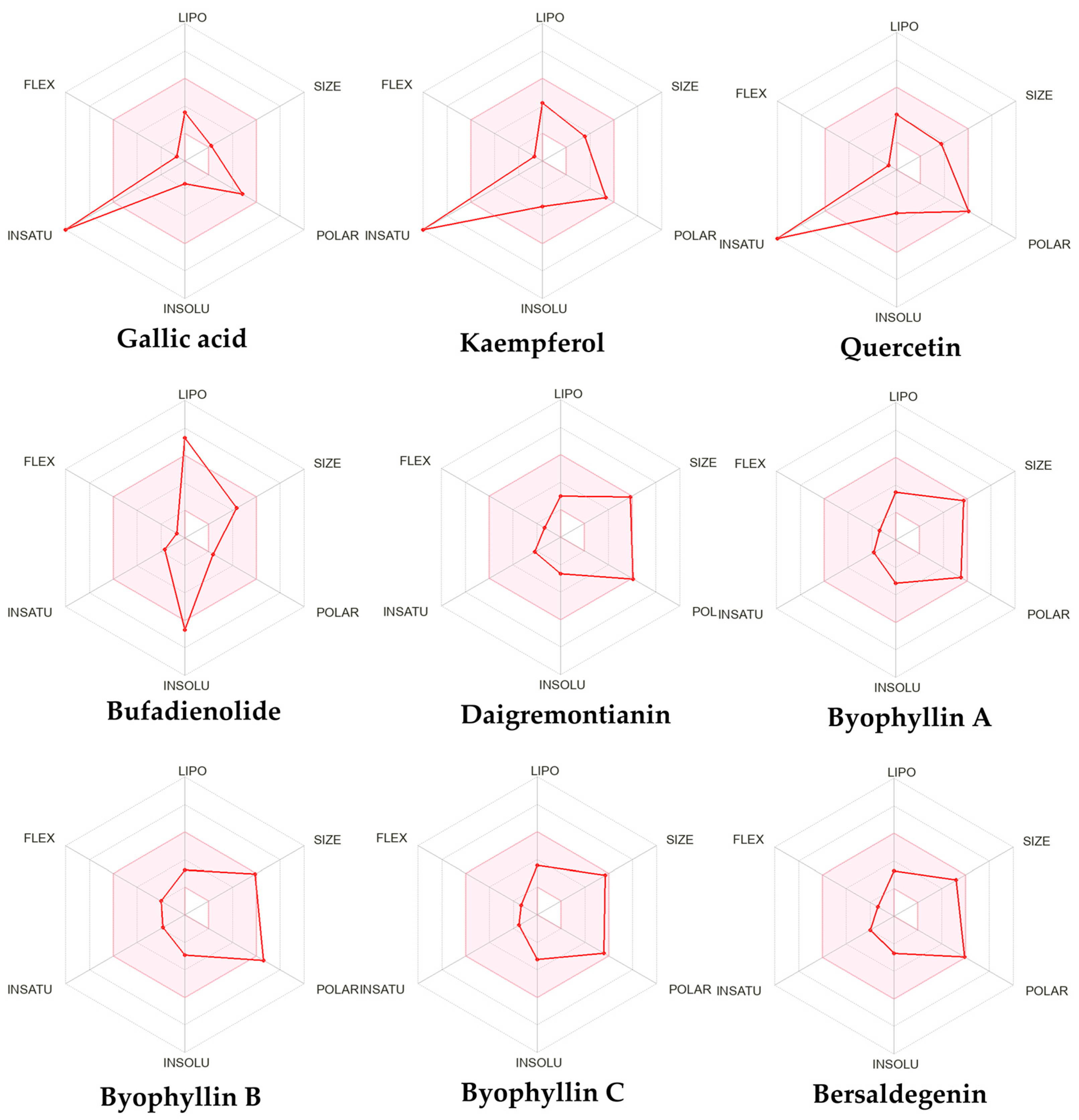
Figure 2 illustrates radar plots depicting the principal physicochemical properties of nine compounds derived from K. daigremontiana, including gallic acid, kaempferol, quercetin, bufadienolide, daigremontianin, bryophyllin A, bryophyllin B, bryophyllin C, and bersaldegenin. These plots assess parameters such as molecular size (SIZE), insolubility (INSOLU), flexibility (FLEX), lipophilicity (LIPO), polarity (POL), and unsaturation (INSATU), which collectively characterize the oral bioavailability and drug-likeness of these compounds. The radar plot profiles for gallic acid, kaempferol, and quercetin predominantly remained within the pink area, except for unsaturation, indicating the optimal range for oral drug absorption. This observation suggests that these molecules exhibit a balanced profile of hydrophobicity and molecular weight, which facilitates their passive diffusion across biological membranes [79].
Conversely, the radar plots for daigremontianin, byophyllin A, byophyllin B, byophyllin C, and bersaldegenin revealed deviations along the saturation and polarity axes. These deviations suggest a more intricate molecular architecture. The reduced saturation values of these compounds indicate a rigid, polycyclic steroidal framework that, while enhancing molecular recognition and binding affinity for specific biological targets, may limit metabolic flexibility. Additionally, the shifts in polarity imply a more specialized permeation profile than that of highly compliant phenolic compounds. Bufadienolide demonstrates increased lipophilicity, suggesting a propensity to associate with lipid environments and potentially traverse cell membranes [79].
These diverse physicochemical characteristics suggest that K. daigremontiana metabolites exhibit structural diversity, which could lead to varied interactions with target proteins and diverse biological effects.
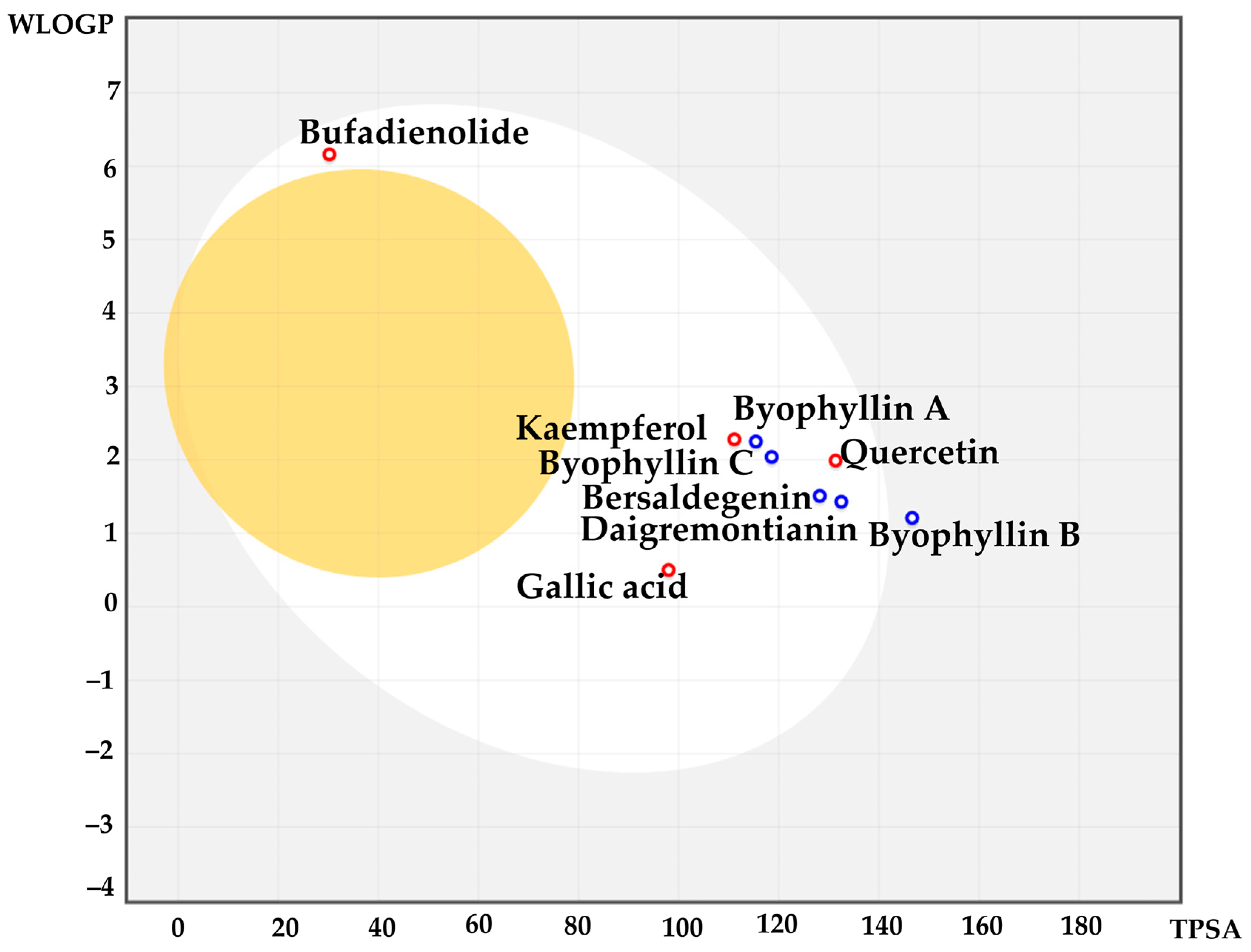
Figure 3 presents a “boiled egg plot” that illustrates the relationship between lipophilicity (WLOGP, Y-axis) and polarity (TPSA, X-axis) for the nine compounds derived from K. daigremontiana. This plot serves as a predictive tool for assessing a compound’s potential to traverse biological barriers, such as the blood–brain barrier (BBB, yellow region) and human intestinal absorption (HIA, white region). All compounds, except for byophyllin B, are located within the white region, indicating highly probable human intestinal absorption. Byophyllin B, however, is situated outside both regions, suggesting limited absorption and poor barrier permeability [79].
The in silico toxicological properties of the compounds selected from K. daigremontiana are presented in Table 5. The pharmacological characteristics of a molecule can be assessed using the Lipinski, Ghose, Veber, Egan, and Muegge filters or rules. Lipinski’s rules evaluate properties such as molecular weight (MW < 500 g/mol), the number of hydrogen-bond donors (HBD < 5), the number of hydrogen-bond acceptors (HBA < 10), and lipophilicity (LogP > 5). Ghose’s rules are based on molecular weight (160 g/mol > MW < 480 g/mol), lipophilicity (−0.4 > LogP < 5.6), molar refractivity (40 < MR < 130), and the number of atoms (20 < nA < 70). Veber’s rules consider parameters such as rotatable bonds (RB < 10) and polar surface area (PSA < 140 Å). Egan’s rules propose filters based on molecular weight (500 g/mol > MW), lipophilicity (−0.4 < LogP < 5), and the number of hydrogen bond acceptors (HBA < 10). Finally, the Muegge filters focus on molecular weight (200 g/mol > PM < 600 g/mol), the number of hydrogen bond donors (nEDH < 5), the number of hydrogen bond acceptors (nEAH < 10), lipophilicity (−2 < LogP < 5), and structural features [79]. Based on this analysis, kaempferol, quercetin, bryophillin A, bryophillin C, and bersaldegenin were the only compounds that did not violate any of the aforementioned rules. In contrast, bufadienolide was identified as the compound with the most violations across different rules, including those of Lipinski, Ghose, Egan, and Muegge.
To enhance understanding of a compound’s bioavailability, several factors were evaluated, including water solubility, Caco-2 permeability, intestinal absorption, skin permeability, and the compound’s role as a substrate or inhibitor of P-glycoprotein. Among the compounds analyzed, gallic acid exhibited superior water solubility, whereas bryophyllin A demonstrated the highest permeability across Caco-2 cell membranes. Furthermore, daigremontianin and gallic acid were identified as having optimal intestinal absorption and skin permeability, respectively. Kaempferol, quercetin, daigremontianin, bryophyllin B, and bryophyllin C functioned as substrates of P-glycoprotein, which is known to decrease intracellular compound accumulation. Conversely, bufadienolide was identified as an inhibitor of this protein, indicating its potential to enhance the intracellular concentration and bioavailability of drugs. However, this effect may also be detrimental, as it could increase the toxicity of co-administered drugs [80].
Three distinct platforms, including pkCSM [80], ProTox 3.0 [81], and ADMET-AI [82], were utilized to evaluate the toxicity parameters of the nine compounds selected from K. daigremontiana. These parameters encompassed the median lethal dose (LD50) in both human and murine models, toxicity classification, and specific toxicity types, including mutagenicity, carcinogenicity, and hepatotoxicity. The analyzed compounds exhibited a spectrum of toxicities, ranging from class 5 (low toxicity) to class 2 (toxic). For example, quercetin, gallic acid, and kaempferol demonstrated LD50 values of 159, 2000, and 3919 mg/kg, respectively, corresponding to classes 3, 4, and 5, indicating a low toxicity risk. In contrast, compounds such as bufadienolide and bersaldegenin presented LD50 values of 25 mg/kg, classified as class 2, suggesting high toxicity. Conversely, daigremontianin, bryophyllin A, bryophyllin B, and bryophyllin C were not found on the ProTox 3.0 server [81].
Regarding the maximum tolerated daily dose, gallic acid exhibited a more favorable response than all other compounds, whereas bryophyllin C was the least benign. Among other parameters related to optimal compound doses, acute and chronic oral toxicity in rats were considered, with gallic acid and bufadienolide showing the lowest optimal values in these categories. Additionally, daigremontianin, bryophyllin A, bryophyllin B, and bersaldegeninan were found to be potentially hepatotoxic. Conversely, the ADMET-AI platform predicted a high propensity for quercetin to cause liver damage (0.93) and to be mutagenic [82]. Bufadienolide emerged as the compound with the greatest potential to induce toxicity in the aquatic model Tetrahymena pyriformis, exhibited the highest value among the compounds for cancer induction, and was the sole compound to inhibit hERG II, a property associated with cardiac toxicity. Other parameters, such as hERG I inhibition and the AMES mutagenicity test, indicated that all compounds presented minimal risk on these indicators [80].

6. Regulatory and Commercialization Challenges for K. daigremontiana

Traditional medicine often uses herbal remedies, preparing infusions, decoctions, and extracts from whole plants or specific parts to treat various ailments. About 80% of the global population relies on herbal formulations for primary healthcare, driven by cultural practices and affordability, and this trend is growing. K. daigremontiana is recognized for its medicinal properties and is used to treat health conditions in Mexico, the USA, Brazil, Peru, South Africa, India, and Poland [5,8]. However, its transition from traditional use to global acceptance as a modern medicine faces significant safety and regulatory challenges [83,84].
In Mexico, the General Health Law recognizes herbal medicines; however, there is a significant regulatory gap for species such as Kalanchoe, which are frequently marketed as dietary supplements or herbal remedies. As a result, these products are not required to demonstrate quality, potency, or safety prior to market entry. Many herbal medicines remain unregistered and are distributed without essential safety or toxicological assessments. For instance, a range of K. daigremontiana-based products, including capsules, powders, dried leaves, and concentrated extracts, is available online as dietary supplements. Some are labeled “natural 100% natural,” and their recommended uses are based on traditional practices and ancestral knowledge. These products claim to support schizophrenia treatment, promote healing, reduce inflammation, combat cancer or cellular damage, aid in hypertension, and relieve pain. Nevertheless, these claims lack scientific or clinical support.
In this context, adverse effects associated with herbal remedies frequently result from misidentification of plants, adulteration, undeclared substances, contamination, incorrect dosing, and consumer misuse [85]. To mitigate these risks, protocols should be implemented to validate the therapeutic use of K. daigremontiana and standardize its formulations. This process should include comprehensive pharmacokinetic and pharmacodynamic characterization to facilitate integration into regulated pharmacological practices in Mexico and internationally. Strengthening legislative frameworks through collaboration among research centers, universities, and government agencies is essential to ensure scientific validation, standardization, and effective regulation of the commercialization of K. daigremontiana [83,84].

7. Conclusions

Kalanchoe daigremontiana is extensively utilized in traditional medicine as an alternative remedy for various ailments, including burns, rheumatic conditions, hypertension, diabetes, renal pain, diarrhea, microbial infections, cough, fever, deep wounds, gangrene, ulcers, skin irritation, gastric issues, asthma, abscesses, anxiety, inflammation, and cancer. Leaves are predominantly used to prepare infusions, decoctions, cataplasms, macerated extracts, and fresh extracts obtained after crushing leaves.
A wide array of phytochemicals, chiefly phenolic compounds and bufadienolides, have been identified in this plant species. These phytochemicals exhibit a range of bioactivities, including antioxidant, antibacterial, antifungal, antiviral, antiparasitic, anthelmintic, anti-inflammatory, anticoagulant, anti-aging, dermatological, cytotoxic, antitumoral, antiproliferative, hepatoprotective, and cardiac glycoside-like effects.
Crude extracts and bufadienolide-rich fractions have demonstrated toxic effects in 2-week-old chicks, guinea pigs, and Artemia salina. However, no toxicity has been reported in goats, broiler chickens, laying hens, or human erythrocytes. Although K. daigremontiana-based products are commercially available as dietary supplements with various health claims, they lack scientific validation. Consequently, further research is necessary to ascertain the level of human exposure to traditional and commercial products. Given the absence of clinical studies providing guideline values for toxicity and the lack of scientific data to ensure safety, extreme caution should be exercised.
Despite the potential pharmaceutical applications of K. daigremontiana, further research is imperative to elucidate its effects, dosage, mechanisms, long-term safety, and side effects. Clinical studies are essential to validate its therapeutic potential and determine the concentration limits for beneficial effects and toxic thresholds of this species. Until such data becomes available, the cautious use and consumption of K. daigremontiana are recommended.

Author Contributions

Conceptualization, L.M.A.-E.; methodology, C.G.d.L.-G., A.B.R.-G., S.H.-E., L.A.H.-V., L.A.R.-C., J.M.S.-J., J.L.M.-M., Z.V., E.S.-A., N.G.-S., and L.M.A.-E.; writing—original draft preparation, C.G.d.L.-G., A.B.R.-G., S.H.-E., L.A.H.-V., L.A.R.-C., J.M.S.-J., J.L.M.-M., Z.V., E.S.-A., N.G.-S., and L.M.A.-E.; writing—review and editing, J.M.S.-J., J.L.M.-M., Z.V., and L.M.A.-E. All authors have read and agreed to the published version of the manuscript.

Funding

This research received no external funding.

Institutional Review Board Statement

Not applicable.

Informed Consent Statement

Not applicable.

Data Availability Statement

No new data were created or analyzed in this study. Data sharing is not applicable to this article.

Acknowledgments

Cecilia Guadalupe de Loza-García (CVU: 2080833), Ana Belem Rubio-García (CVU: 1041000), Salvador Hernández-Estrada (CVU: 1319414), and Luis Alfonso Hernandez-Villasenor (CVU: 629990) gratefully acknowledge the financial support for the scholarship from SECIHTI-Mexico for Postgraduate studies in the Biosciences program from the Centro Universitario de Los Altos (CUALTOS) of the University of Guadalajara. Thanks to Jaime Venegas Urteaga and Yajaira Magaly Mercado Gómez for their technical support as part of their activities in the “Early incorporation into Research Program” from CUALTOS, and to the Instituto de Investigación en Ciencias Médicas (IICM) from CUALTOS for the infrastructure support.

Conflicts of Interest

The authors declare no conflicts of interest.

References

  1. dos Santos-Nascimento, L.B.; Casanova, L.M.; Costa, S.S. Bioactive Compounds from Kalanchoe Genus Potentially Useful for the Development of New Drugs. Life 2023, 13, 646. [Google Scholar] [CrossRef] [Scilit]
  2. Lozano-Milo, E.; García-Pérez, P.; Gallego, P.P. Narrative Review of Production of Antioxidants and Anticancer Compounds from Bryophyllum spp. (Kalanchoe) Using Plant Cell Tissue Culture. Longhua Chin. Med. 2020, 3, 1–11. [Google Scholar] [CrossRef] [Scilit]
  3. Carreiro-Faustino, D.; das Chagas-Lima, N.N.; James-Allahdadi, K.; Cedraz-Pinto, L. Biological Properties of Different Extracts of Kalanchoe daigremontiana (‘Mother of Thousands’): A Review. RPS Pharm. Pharmacol. Rep. 2022, 1, 1–6. [Google Scholar] [CrossRef] [Scilit]
  4. Assis de Andrade, E.; Machinski, I.; Terso Ventura, A.C.; Barr, S.A.; Pereira, A.V.; Beltrame, F.L.; Strangman, W.K.; Williamson, R.T. A Review of the Popular Uses, Anatomical, Chemical, and Biological Aspects of Kalanchoe (Crassulaceae): A Genus of Plants Known as “Miracle Leaf”. Molecules 2023, 28, 5574. [Google Scholar] [CrossRef] [Scilit]
  5. Stefanowicz-Hajduk, J.; Hering, A.; Kowalczyk, M.; Hałasa, R.; Gucwa, M.; Ochocka, J.R. Kalanchoe sp. Extracts—Phytochemistry, Cytotoxic, and Antimicrobial Activities. Plants 2023, 12, 2268. [Google Scholar] [CrossRef] [Scilit] [PubMed]
  6. Rivero-Pérez, N.; Prieto-Méndez, J.; Hernández-Fuentes, A.; Zaragoza-Bastida, A.; Madariaga-Navarrete, A. In Vitro Anthelmintic and Antibacterial Effect of Kalanchoe daigremontiana Leaves and Stems Hydroalcoholic Extract. Abanico Vet. 2022, 12, 1–16. [Google Scholar]
  7. Herrera, I.; Ferrer-Paris, J.R.; Benzo, D.; Flores, S.; García, B.; Nassar, J.M. An Invasive Succulent Plant (Kalanchoe daigremontiana) Influences Soil Carbon and Nitrogen Mineralization in a Neotropical Semiarid Zone. Pedosphere 2018, 28, 632–643. [Google Scholar] [CrossRef] [Scilit]
  8. Rojas-Mejia, M.F.; Olvera-Ramírez, R.; Medina-Jaritz, N.B. Antimicrobial Activity of a Methanolic Extract of Kalanchoe daigremontiana Raym.-Hamet and H. Perrier against Salmonella Typhi ATCC 6589. Magna Sci. Adv. Res. Rev. 2025, 13, 85–88. [Google Scholar] [CrossRef] [Scilit]
  9. Mawla, F.; Khatoon, S.; Rehana, F.; Jahan, S.; Moshiur Rahman Shelley, M.; Hossain, S.; Mozammel Haq, W.; Rahman, S.; Debnath, K.; Rahmatullah, M. Ethnomedicinal Plants of Folk Medicinal Practitioners in Four Villages of Natore and Rajshahi Districts, Bangladesh. J. Sustain. Agric. 2012, 6, 406–416. [Google Scholar]
  10. Moniuszko-Szajwaj, B.; Pecio, Ł.; Kowalczyk, M.; Stochmal, A. New Bufadienolides Isolated from the Roots of Kalanchoe daigremontiana (Crassulaceae). Molecules 2016, 21, 243. [Google Scholar] [CrossRef] [Scilit]
  11. Bogucka-Kocka, A.; Zidorn, C.; Kasprzycka, M.; Szymczak, G.; Szewczyk, K. Phenolic Acid Content, Antioxidant and Cytotoxic Activities of Four Kalanchoë Species. Saudi J. Biol. Sci. 2018, 25, 622–630. [Google Scholar] [CrossRef] [Scilit] [PubMed]
  12. Zawirska-Wojtasiak, R.; Jankowska, B.; Piechowska, P.; Mildner-Szkudlarz, S. Vitamin C and Aroma Composition of Fresh Leaves from Kalanchoe pinnata and Kalanchoe daigremontiana. Sci. Rep. 2019, 9, 19786. [Google Scholar] [CrossRef] [Scilit] [PubMed]
  13. Stefanowicz-Hajduk, J.; Asztemborska, M.; Krauze-Baranowska, M.; Godlewska, S.; Gucwa, M.; Moniuszko-Szajwaj, B.; Stochmal, A.; Ochocka, J.R. Identification of Flavonoids and Bufadienolides and Cytotoxic Effects of Kalanchoe daigremontiana Extracts on Human Cancer Cell Lines. Planta Med. 2020, 86, 239–246. [Google Scholar] [PubMed]
  14. Quintero, E.J.; Guerrero de León, E..; Morán-Pinzón, J.; Mero, A.; León, E.; Cano, L.P.P. Evaluation of the Leaf Extracts of Kalanchoe pinnata and Kalanchoe daigremontiana: Chemistry, Antioxidant and Anti-Inflammatory Activity. Eur. J. Med. Plants 2021, 32, 45–54. [Google Scholar] [CrossRef] [Scilit]
  15. Saleem, A. Kalanchoe daigremontiana: Properties, Habitat, Properties. Glob. Res. J. Nat. Sci. Technol. 2023, 1, 25–32. [Google Scholar] [CrossRef] [Scilit]
  16. Chávez-Montes, A.; Bazaldúa Rodríguez, A.F.; Larqué-García, H.; Gutiérrez Soto, G.; Elizondo-Luévano, J.H. Actividad Antiparasitaria In Vitro del Extracto Metanólico de Kalanchoe daigremontiana (Crassulaceae) en Contra de Entamoeba histolytica y Trichomonas vaginalis. Sci. Agric. Vita 2024, 1, 1–9. [Google Scholar]
  17. Hering, A.; Cal, K.; Kowalczyk, M.; Kastsevich, A.; Ivashchanka, Y.; Ochocka, J.R.; Stefanowicz-Hajduk, J. Bufadienolide Penetration Through the Skin Membrane and Antiaging Properties of Kalanchoe spp. Juices in Dermal Applications. Molecules 2025, 30, 802. [Google Scholar] [CrossRef] [Scilit]
  18. Delgado-González, C.R.; Sharma, A.; Islas-Pelcastre, M.; Saucedo-García, M.; Aquino-Torres, E.; Pacheco-Trejo, J.; Armenta-Jaime, S.; Rivero-Pérez, N.; Madariaga-Navarrete, A. From Traditional Use to Molecular Mechanisms: A Bioinformatic and Pharmacological Review of the Genus Kalanchoe with In Silico Evidence. BioTech 2025, 14, 97. [Google Scholar] [CrossRef] [Scilit]
  19. Madariaga-Navarrete, A.; Aquino-Torres, E.; Cariño-Cortés, R.; Villagómez-Ibarra, R.; Ocampo-López, J.; Sharma, A.; Hernández-Fuentes, A.D. Kalanchoe daigremontiana: Functional Properties and Histopathological Effects on Wistar Rats under Hyperglycemia-Inducing Diet. Indian. J. Pharm. Educ. Res. 2021, 55, 445–454. [Google Scholar]
  20. Chernetsky, M.; Woźniak, A.; Skalska-Kamińska, A.; Żuraw, B.; Blicharska, E.; Rejdak, R.; Donica, H.; Weryszko-Chmielewska, E. Structure of Leaves and Phenolic Acids in Kalanchoë daigremontiana Raym.-Hamet & H. Perrier. Acta Sci. Pol. Hortorum Cultus 2018, 17, 137–155. [Google Scholar] [CrossRef] [Scilit]
  21. Stefanowicz-Hajduk, J.; Hering, A.; Gucwa, M.; Sztormowska-Achranowicz, K.; Kowalczyk, M.; Soluch, A.; Ochocka, J.R. An In Vitro Anticancer, Antioxidant, and Phytochemical Study on Water Extract of Kalanchoe daigremontiana Raym.-Hamet and H. Perrier. Molecules 2022, 27, 2280. [Google Scholar] [CrossRef] [Scilit]
  22. Süsskind, M.; Thürmann, P.A.; Lüke, C.; Jeschke, E.; Tabali, M.; Matthes, H.; Ostermann, T. Adverse Drug Reactions in a Complementary Medicine Hospital: A Prospective, Intensified Surveillance Study. Evid.-Based Complement. Altern. Med. 2012, 1, 320760. [Google Scholar] [CrossRef] [Scilit] [PubMed]
  23. de Andrade, E.A.; Machinski, I.; de Almeida, V.P.; Perera, W.H.; Williamson, R.T.; Strangman, W.K.; Manfron, J.; Beltrame, F.L. Differentiating Two Species of ‘Mother-of-Thousands’: Kalanchoe daigremontiana and Kalanchoe × houghtonii. Braz. Arch. Biol. Technol. 2024, 67, e24240333. [Google Scholar] [CrossRef] [Scilit]
  24. Akentieva, N.P.; Shushanov, S.S.; Gizatullin, A.R.; Prikhodchenko, T.R.; Shkondina, N.I.; D’agaro, E. The Effect of Plant Extracts Kalanchoe daigremontiana and Aloe arborescens on the Metabolism of Human Multiple Myeloma Cells. Biointerface Res. Appl. Chem. 2021, 11, 13171–13186. [Google Scholar]
  25. García-Pérez, P.; Lozano-Milo, E.; Landin, M.; Gallego, P.P. From Ethnomedicine to Plant Biotechnology and Machine Learning: The Valorization of the Medicinal Plant Bryophyllum sp. Pharmaceuticals 2020, 13, 444. [Google Scholar] [CrossRef] [Scilit] [PubMed]
  26. Dogra, P.; Sharma, K.; Bharti, J.; Kumar, N.; Kumar, D. Kalanchoe pinnata is a Miraculous Plant: A review. J. Biomed. Allied Res. 2022, 4, 1–10. [Google Scholar] [CrossRef] [Scilit]
  27. Kolodziejczyk-Czepas, J.; Nowak, P.; Wachowicz, B.; Piechocka, J.; Głowacki, R.; Moniuszko-Szajwaj, B.; Stochmal, A. Antioxidant Efficacy of Kalanchoe daigremontiana Bufadienolide-Rich Fraction in Blood Plasma In Vitro. Pharm. Biol. 2016, 54, 3182–3188. [Google Scholar] [CrossRef] [Scilit]
  28. Barlas, F.B. Enhancing the Efficacy of Radiotherapy with Kalanchoe daigremontiana: A Nanotechnological Approach. J. Radiat. Res. Appl. Sci. 2023, 16, 100612. [Google Scholar] [CrossRef] [Scilit]
  29. Kruk, J.; Pisarski, A.; Szymańska, R. Novel Vitamin E Forms in Leaves of Kalanchoe daigremontiana and Phaseolus coccineus. J. Plant Physiol. 2011, 168, 2021–2027. [Google Scholar] [CrossRef] [Scilit]
  30. Anisimov, M.M.; Gerasimenko, N.I.; Chaikina, E.L.; Serebryakov, Y.M. Biological Activity of Metabolites of the Herb Kalanchoe daigremontiana. Biol. Bull. 2009, 36, 568–574. [Google Scholar] [CrossRef] [Scilit]
  31. Korczyński, M.; Opaliński, S.; Popiela-Pleban, E.; Jamroz, D.; Kołacz, R.; Bubel, F.; Stochmal, A.; Grzelak, A. Influence of Pulp from Kalanchoe daigremontiana on Performance, Egg Quality and Selected Blood Parameters of Laying Hens. Eur. Poult. Sci. 2014, 78, 1–13. [Google Scholar] [CrossRef] [Scilit]
  32. Ürményi, F.G.G.; Saraiva, G.d.N.; Casanova, L.M.; Matos, A.d.S.; de Magalhães Camargo, L.M.; Romanos, M.T.V.; Costa, S.S. Anti-HSV-1 and HSV-2 Flavonoids and a New Kaempferol Triglycoside from the Medicinal Plant Kalanchoe daigremontiana. Chem. Biodivers. 2016, 13, 1707–1714. [Google Scholar] [CrossRef] [Scilit] [PubMed]
  33. Ürményi, F.G.G.; Camargo, L.M.M.; Costa, S.S. Caracterização de Flavonoide em Kalanchoe daigremontiana, Uma Planta Ornamental da Família Crassulaceae; Sociedade Brasileira de Química: São Paulo, Brazil, 2011. [Google Scholar]
  34. Mejía, M.A.P.; Julián, L.; Gallego, T.; Arango, V. Kalanchoe daigremontiana Raym.-Hamet & H. Perrier and Its Potential Use as a Source of Natural Antioxidants and Colorants. Rev. Cuba. Plantas Med. 2014, 19, 61–68. [Google Scholar]
  35. Chodkowski, M.; Nowak, S.; Janicka, M.; Sobczak, M.; Granica, S.; Bańbura, M.W.; Krzyzowska, M.; Cymerys, J. In Vitro Antiviral Activity of Kalanchoe daigremontiana Extract against Human Herpesvirus Type 1. Int. J. Mol. Sci. 2024, 25, 7507. [Google Scholar] [CrossRef] [Scilit]
  36. de Andrade, E.A.; Machinski, I.; de Almeida, V.P.; Barr, S.A.; Perera, W.H.; Manfron, J.; Beltrame, F.L.; Williamson, R.T.; Strangman, W.K. Quality Control Strategies for Differentiation of Kalanchoe Species. Phytochem. Anal. 2025, 36, 2385–2400. [Google Scholar] [CrossRef] [Scilit]
  37. das Chagas Lima, N.N.; Faustino, D.C.; de Almeida, B.S.; De Magalhães, B.E.A.; Santos, L.F.P.; de Andrade Santana, D.; Pinto, L.C. Extracts from “Mother of Thousands” (Kalanchoe daigremontiana) Are Potent Compounds to Improve Vegetable Oil Stability during Storage. Eur. Food Res. Technol. 2023, 249, 1627–1635. [Google Scholar] [CrossRef] [Scilit]
  38. Supratman, U.; Fujita, T.; Akiyama, K.; Hayashi, H. Insecticidal Compounds from Kalanchoe daigremontiana × tubiflora. Phytochemistry 2001, 58, 311–314. [Google Scholar] [CrossRef] [Scilit] [PubMed]
  39. Jetter, R.; Sodhi, R. Chemical Composition and Microstructure of Waxy Plant Surfaces: Triterpenoids and Fatty Acid Derivatives on Leaves of Kalanchoe daigremontiana. Surf. Interface Anal. 2011, 43, 326–330. [Google Scholar] [CrossRef] [Scilit]
  40. Kolodziejczyk-Czepas, J.; Sieradzka, M.; Moniuszko-Szajwaj, B.; Pecio, Ł.; Ponczek, M.B.; Nowak, P.; Stochmal, A. Bufadienolides from Kalanchoe daigremontiana as Thrombin Inhibitors—In Vitro and In Silico Study. Int. J. Biol. Macromol. 2017, 99, 141–150. [Google Scholar] [CrossRef] [Scilit]
  41. Xu, L.; Wang, X. A Comprehensive Review of Phenolic Compounds in Horticultural Plants. Int. J. Mol. Sci. 2025, 26, 5767. [Google Scholar] [CrossRef] [Scilit]
  42. Oluwole, O.; Fernando, W.B.; Lumanlan, J.; Ademuyiwa, O.; Jayasena, V. Role of Phenolic Acid, Tannins, Stilbenes, Lignans and Flavonoids in Human Health—A Review. Int. J. Food Sci. Technol. 2022, 57, 6326–6335. [Google Scholar] [CrossRef] [Scilit]
  43. Oufir, M.; Seiler, C.; Gerodetti, M.; Gerber, J.; Fürer, K.; Mennet-von Eiff, M.; Elsas, S.M.; Brenneisen, R.; Von Mandach, U.; Hamburger, M.; et al. Quantification of Bufadienolides in Bryophyllum pinnatum Leaves and Manufactured Products by UHPLC-ESIMS/MS. Planta Med. 2015, 81, 1190–1197. [Google Scholar] [CrossRef] [Scilit]
  44. Huang, M.-K.; Yang, H.-L.; Hseu, Y.-C.; Liaw, C.-C.; Tseng, Y.-H.; Tsuzuki, M.; Kuo, Y.-H. Cardenolides and Bufadienolide Glycosides from Kalanchoe tubiflora and Evaluation of Cytotoxicity. Planta Med. 2013, 79, 1362–1369. [Google Scholar] [CrossRef] [Scilit] [PubMed]
  45. Kolodziejczyk-Czepas, J.; Stochmal, A. Bufadienolides of Kalanchoe Species: An Overview of Chemical Structure, Biological Activity and Prospects for Pharmacological Use. Phytochem. Rev. 2017, 16, 1155–1171. [Google Scholar] [CrossRef] [Scilit] [PubMed]
  46. Souza, L.; Oliveira, J.P.d.S.; Fernandes, A.d.S.; Macedo, A.F.; Araujo-Lima, C.F.; Felzenszwalb, I. UHPLC-MS Metabolomic Profile and In Silico Pharmacokinetic Approach of Kalanchoe daigremontiana Raym.-Hamet & H. Perrier Aqueous Extracts. J. Pharm. Biomed. Anal. 2024, 238, 115827. [Google Scholar] [PubMed]
  47. Wagner, H.; Fischer, M.; Lotter, H. New Bufadienolides from Kalanchoe daigremontiana Hamet et Perr. (Crassulaceae). Z. Für Naturforschung B 1985, 40, 1226–1228. [Google Scholar] [CrossRef] [Scilit]
  48. Alvarado-Palacios, Q.G.; San Martin-Martinez, E.; Gomez-García, C.; Estanislao-Gomez, C.C.; Casañas-Pimentel, R. Nanoencapsulation of the Aranto (Kalanchoe daigremontiana) Aquoethanolic Extract by Nanospray Dryer and Its Selective Effect on Breast Cancer Cell Line. Int. J. Pharmacogn. Phytochem. Res. 2015, 7, 888–895. [Google Scholar]
  49. Lin, R.; Ye, Q.; He, Q.; Kim, D.S.; Chen, D.; Jin, L.; Wang, W.; Li, J. Mechanistic Analysis of Anti-Prostate Cancer and Toxicity-Reducing Effects of Bufadienolides Extracts: Comparative Efficacy and Safety with Isolated Bioactive Compounds. J. Ethnopharmacol. 2025, 352, 120182. [Google Scholar] [CrossRef] [Scilit]
  50. Shao, H.; Li, B.; Li, H.; Gao, L.; Zhang, C.; Sheng, H.; Zhu, L. Novel Strategies for Solubility and Bioavailability Enhancement of Bufadienolides. Molecules 2022, 27, 51. [Google Scholar] [CrossRef] [Scilit]
  51. Matłok, N.; Piechowiak, T.; Zardzewiały, M.; Balawejder, M. Effect of Ozone Treatment on the Contents of Selected Bioactive Phytochemicals in Leaves of Alligator Plant Kalanchoe daigremontiana. Appl. Sci. 2022, 12, 8934. [Google Scholar] [CrossRef] [Scilit]
  52. Da Silva, G.R.; Ribeiro, A.J.d.S.; Coutinho, J.M.d.S.; Dos Santos, É.L.; Haragushiku, V.d.S. Comparison of Antioxidant Potential from Kalanchoe daigremontiana and Kalanchoe laetivirens Extracts Applied in Biodiesel. Braz. J. Dev. 2022, 8, 16998–17015. [Google Scholar]
  53. Shujaat, S.; Chaudhary, S.; Sherin, L. Comparison of Antioxidant Potential, Total Flavonoid and Phenolic Contents of Different Extracts of Kalanchoe daigremontiana Leaves. Asian J. Org. Med. Chem. 2017, 2, 5–8. [Google Scholar] [CrossRef] [Scilit]
  54. Elizondo-Luévano, J.H.; Pérez-Narváez, O.A.; Sánchez-García, E.; Castro-Ríos, R.; Hernández-García, M.E.; Chávez-Montes, A. In Vitro Effect of Kalanchoe daigremontiana and Its Main Component, Quercetin against Entamoeba histolytica and Trichomonas vaginalis. Iran. J. Parasitol. 2021, 16, 394–401. [Google Scholar]
  55. Vergara-Castañeda, H.; Granados-Segura, L.O.; Luna-Bárcenas, G.; McClements, D.J.; Herrera-Hernández, M.G.; Arjona, N.; Hernández-Martinez, A.R.; Estevez, M.; Pool, H. Gold Nanoparticles Bioreduced by Natural Extracts of Arantho (Kalanchoe daigremontiana) for Biological Purposes. Mater. Res. Express 2019, 6, 055010. [Google Scholar] [CrossRef] [Scilit]
  56. Báez, M.; Torres, E.I.; Gruszycki, A.E.; Alba, D.A.; Valenzuela, G.M.; Gruszycki, M.R. Antioxidant and Anti-Inflammatory Activity in Hydroalcoholic Extracts of Kalanchoe daigremontiana Raym.-Hamet & H. Perrier. Rev. Colomb. Cienc. Químico-Farm. 2021, 50, 86–99. [Google Scholar]
  57. Paitan, E.N.; Marmolejo, D.; Gutiérrez, M.L.; Sotelo, A.; Cordova, J.S. Actividad Antibacteriana y Caracterización de Extractos de Hojas de Kalanchoe Cultivadas en Maceta (daigremontiana y tubiflora). Prospect. Univ. Cienc. Agrar. 2025, 6, 1–6. [Google Scholar]
  58. Nahar, K.; Khan, M.G.U.; Rahman, M.S.; Begum, B.; Rashid, M.A. Antimicrobial and Cytotoxic Activities of Bryophyllum daigremontianum. Dhaka Univ. J. Pharm. Sci. 2008, 7, 99–101. [Google Scholar] [CrossRef] [Scilit]
  59. Stefanowicz-Hajduk, J.; Hering, A.; Gucwa, M.; Hałasa, R.; Soluch, A.; Kowalczyk, M.; Stochmal, A.; Ochocka, R. Biological Activities of Leaf Extracts from Selected Kalanchoe Species and Their Relationship with Bufadienolides Content. Pharm. Biol. 2020, 58, 732–740. [Google Scholar] [CrossRef] [Scilit]
  60. Gusev, E.; Zhuravleva, Y. Inflammation: A New Look at an Old Problem. Int. J. Mol. Sci. 2022, 23, 4596. [Google Scholar] [CrossRef] [Scilit] [PubMed]
  61. Huang, H.; Ke, Q.; Li, N.; Yang, Z.; Shen, J.; Zeng, L.; Zeng, Q.; Wei, X.; Yang, H.; Wang, D.; et al. Advanced Biomaterials and Delivery Modalities to Alleviate Cancer Therapy-Induced Inflammation. Biomaterials 2026, 324, 123419. [Google Scholar] [CrossRef] [Scilit] [PubMed]
  62. Hu, C.; Ma, S. Recent Development of Lipoxygenase Inhibitors as Anti-Inflammatory Agents. MedChemComm 2018, 9, 212–225. [Google Scholar] [CrossRef] [Scilit] [PubMed]
  63. Teder, T.; König, S.; Singh, R.; Samuelsson, B.; Werz, O.; Garscha, U.; Haeggström, J.Z. Modulation of the 5-Lipoxygenase Pathway by Chalcogen-Containing Inhibitors of Leukotriene A4 Hydrolase. Int. J. Mol. Sci. 2023, 24, 7539. [Google Scholar] [CrossRef] [Scilit]
  64. Kolodziejczyk-Czepas, J.; Pasiński, B.; Ponczek, M.B.; Moniuszko-Szajwaj, B.; Kowalczyk, M.; Pecio, Ł.; Nowak, P.; Stochmal, A. Bufadienolides from Kalanchoe daigremontiana Modulate the Enzymatic Activity of Plasmin—In Vitro and In Silico Analyses. Int. J. Biol. Macromol. 2018, 120, 1591–1600. [Google Scholar] [CrossRef] [Scilit]
  65. Nowak, P. WO2018197668—SKIN CARE COMPOSITION. U.S. Patent 2020/0276256 A1, 3 September 2020. [Google Scholar]
  66. Scholtysikl, G.; Wagner, H.; Fischer, M.; Rüegg, U. Cardiac Glycoside-like Effects of a Bufadienolide Extracted from Kalanchoe daigremontiana. In Cardiac Glycosides 1785–1985: Biochemistry—Pharmacology—Clinical Relevance; Erdmann, E., Greef, K., Skou, J.C., Eds.; Springer: Berlin/Heidelberg, Germany, 1986; Volume 1, pp. 171–179. [Google Scholar]
  67. Nguelefack, T.B.; Dimo, T.; Dongmo, A.B.; Sontia, B.; Fotio, A.L.; Watcho, P.; Kamanyi, A.; Vierling, W. Cardiovascular Effects of the N-Butanol Extract from Kalanchoe crenata Leaves. Pharm. Biol. 2008, 46, 846–853. [Google Scholar] [CrossRef] [Scilit]
  68. Supratman, U.; Fujita, R.; Akiyama, K.; Hayashi, H.; Murakami, A.; Sakai, H.; Koshimizu, K.; Ohigashi, H. Anti-tumor Promoting Activity of Bufadienolides from Kalanchoe piannata and K. daigremontiana × butiflora. Biosci. Biotechol. Biochem. 2001, 65, 947–949. [Google Scholar] [CrossRef] [Scilit]
  69. Pestana Martínez, M.A.; Piermattey Ditta, J.H.; Anaya Gil, J.L.; Caballero Gallardo, K. Cytotoxic Potential of Kalanchoe daigremontiana Extracts on Hepatocellular Carcinoma Cells. Univ. Sci. 2025, 30, S1–S31. [Google Scholar] [CrossRef] [Scilit]
  70. Sifuentes-Saucedo, D.M.; Vargas-Monter, J.; Zúñiga-Estrada, E.A.; Rodríguez-Ortega, L.T.; Santiago-Santander, A.; Torres-Álvarez, S. Kalanchoe daigremontiana Extract to Combat Scabies in Rabbits. XAHNI Bol. Cient. 2025, 2, 21–26. [Google Scholar]
  71. Vázquez-García, J.M.; Ballesteros-Rodea, G.; Cuevas-Reyes, V.; Hernández-Arteaga, L.E.S.; Peña-Avelino, L.Y.; López-Aguirre, S.; Sims, R.; Cavazos-Galindo, J.M.; Rosales-Nieto, C.A. Impact of Kalanchoe (Kalanchoe daigremontiana) Supplementation in Goat Maternal Diet on Hepatic and Renal Function and Reproductive Performance. Biology 2025, 14, 376. [Google Scholar] [CrossRef] [Scilit] [PubMed]
  72. López-Aguirre, S.; Pinos Rodríguez, J.M.; Devezé-Murillo, P.; Estrada-Coates, A.T.; Rosales-Nieto, C.A.; Torres-Martínez, C.J. Effects of Bryophyllum daigremontianum in the Broiler Diet on Productive Performance and Serum Parameters. Rev. Mex. Cienc. Pecu. 2025, 16, 130–137. [Google Scholar] [CrossRef] [Scilit]
  73. Maharani, R.; Fajriah, S.; Hardiawan, R.; Supratman, U. Insecticidal Bufadienolides from the Leaves of Kalanchoe daigremontiana (Crassulaceae). In Proceedings of the International Seminar on Chemistry; AIP Publishing: Melville, NY, USA, 2008; pp. 236–239. [Google Scholar]
  74. Molina, G.A.; Esparza, R.; López-Miranda, J.L.; Hernández-Martínez, A.R.; España-Sánchez, B.L.; Elizalde-Peña, E.A.; Estevez, M. Green Synthesis of Ag Nanoflowers Using Kalanchoe daigremontiana Extract for Enhanced Photocatalytic and Antibacterial Activities. Colloids Surf. B Biointerfaces 2019, 180, 141–149. [Google Scholar] [CrossRef] [Scilit]
  75. Morales, G.; Campillo, G.; Vélez, E.; Urquijo, J.; Hincapié, C.; Osorio, J. Kalanchoe daigremontiana Leaf Extract: A Green Stabilizing Agent in Synthesis of Silver Nanoparticles. J. Phys. Conf. Ser. 2019, 1247, 012019. [Google Scholar] [CrossRef] [Scilit]
  76. Morales, G.; Campillo, G.; Vélez, E.; Osorio, J.; Urquijo, J.; Velásquez, Á.A. Green Synthesis of Magnetic Nanoparticles Using Leaf Extracts of Aloe vera and Kalanchoe daigremontiana. J. Phys. Conf. Ser. 2019, 1247, 012021. [Google Scholar] [CrossRef] [Scilit]
  77. Williams, M.C.; Smith, M.C. Toxicity of Kalanchoe spp. to Chicks. Am. J. Vet. Res. 1984, 3, 543–546. [Google Scholar] [CrossRef] [Scilit]
  78. Clarkson, C.; Maharaj, V.J.; Crouch, N.R.; Grace, O.M.; Pillay, P.; Matsabisa, M.G.; Bhagwandin, N.; Smith, P.J.; Folb, P.I. In Vitro Antiplasmodial Activity of Medicinal Plants Native to or Naturalised in South Africa. J. Ethnopharmacol. 2004, 92, 177–191. [Google Scholar] [CrossRef]
  79. Daina, A.; Michielin, O.; Zoete, V. SwissADME: A Free Web Tool to Evaluate Pharmacokinetics, Druglikeness, and Medicinal Chemistry Friendliness of Small Molecules. Sci. Rep. 2017, 7, 42717. [Google Scholar] [CrossRef] [Scilit] [PubMed]
  80. Pires, D.E.V.; Blundell, T.L.; Ascher, D.B. pkCSM: Predicting Small-Molecule Pharmacokinetic and Toxicity Properties Using Graph-Based Signatures. J. Med. Chem. 2015, 54, 4066–4072. [Google Scholar] [CrossRef] [Scilit]
  81. Banerjee, P.; Kemmler, E.; Dunkel, M.; Preissner, R. ProTox 3.0: A Web Server for the Prediction of Toxicity of Chemicals. Nucleic Acids Res. 2024, 52, W513–W520. [Google Scholar] [CrossRef] [Scilit]
  82. Swanson, K.; Walther, P.; Leitz, J.; Mukherjee, S.; Wu, J.C.; Shivnaraine, R.V.; Zou, J. ADMET-AI: A Machine Learning ADMET Platform for Evaluation of Large-Scale Chemical Libraries. Bioinformatics 2024, 40, btae416. [Google Scholar] [CrossRef] [Scilit]
  83. Saggar, S.; Mir, P.A.; Kumar, N.; Chawla, A.; Uppal, J.; Shilpa, S.; Kaur, A. Traditional and Herbal Medicines: Opportunities and Challenges. Pharmacogn. Res. 2022, 14, 107–114. [Google Scholar] [CrossRef] [Scilit]
  84. Prabhakar, P.; Banerjee, M. Research Journal of Biotechnology. Res. J. Biotechnol. 2021, 16, 212–222. [Google Scholar]
  85. Mobaswar Hossain, C.; Gera, M.; Asraf Ali, K. Current Status and Challenges of Herbal Drug Development and Regulatory Aspect: A Global Perspective. Asian J. Pharm. Clin. Res. 2022, 15, 31–41. [Google Scholar] [CrossRef] [Scilit]
Figure 1. Schematic representation of the most common preparations (A) and traditional medicinal uses (B) of Kalanchoe daigremontiana leaves and roots. Figure created with illustrae.co.
Scipharm 94 00027 g001
Figure 2. Physicochemical properties assessed for Kalanchoe daigremontiana compounds include lipophilicity (LIPO), molecular size (SIZE), polarity (POLAR), insolubility (INSOLU), unsaturation (INSATU), and flexibility (FLEX). The pink shaded region shows the suitable physicochemical range that the radar plot of the target compound must entirely encompass to be considered drug-like. The red line shows the physicochemical properties of the corresponding compound.
Scipharm 94 00027 g002
Figure 3. Egg plot from SwissADME exhibits the water partition coefficient (WlogP) versus the topological polar surface area (TPSA) for Kalanchoe daigremontiana compounds. Propensity of compounds to be substrate of P-gp by coloured points: blue for substrate (PGP+ ) and red for non-substrate (PGP− ) [79].
Scipharm 94 00027 g003
Table 1. Phytochemicals reported in Kalanchoe daigremontiana.
Plant PartExtraction MethodSolventDetection/Quantification MethodReported CompoundIdentified/ContentBiological Activity
Reported
Ref.
LeavesMacerationMethanolChemical colorimetric reactionSterols
Flavonoids
Alkaloids
Saponins
IdentifiedAntiparasitic[16]
LeavesAccelerated solvent extractionEthanol-water
(70:30 v/v)
HPLC-PDATotal phenolics14.82 mg/100 g DMNot reported[31]
Total flavonoids725 mg/100 g DM
Total anthocyanins2.95 mg/100 g DM
LeavesAccelerated solvent extractionEthanol-water
(70:30 v/v)
LC–ESI-MS/MSGallic acid1.1 µg/g DMAntioxidant Cytotoxic[11]
Chlorogenic acid0.97 µg/g DM
γ-Resorcylic acid0.21 µg/g DM
p-Coumaric acid1.3 µg/g DM
Ferulic acid72.1 µg/g DM
Caffeic acid16.5 µg/g DM
ß-Rosorcylic acid0.22 µg/g DM
Syringic acid7.46 µg/g DM
Protocatechuic acid24.82 µg/g DM
LeavesMaceration with waterFlavonoid-rich
fraction
HPLC-DAD
NMR spectroscopy
3-O-β-D-xylopyranosyl (1→2) α-L-rhamnopyranoside
quercetin-3-O-β-Dxylopyranosyl
(1→2) α-L-rhamnopyranoside
kaempferol-3-O-β-Dxylopyranosyl
(1→2)-α-L-rhamnopyranoside-7-O-β-D-glucopyranoside
IdentifiedAntiviral Cytotoxic[32]
LeavesMaceration with waterFlavonoid-rich
fraction
NMR spectroscopykaempferol-3-O-xylopyranosyl(1→2) rhamnopyranosideIdentifiedNot reported[33]
LeavesUltrasonic wavesMethanolTLC/DensitometryGallic acid
Caffeic acid
p-coumaric acid
Protocatechuic acid
IdentifiedNot reported[20]
LeavesPercolationMethanol
Ethanol
Mass spectrometryAminoacids
Tannins
Flavonoids
Triterpenoids
Cardiotonics
Alkaloids
Leucoanthocyanidin
IdentifiedAntioxidant[34]
LeavesMacerationWaterUHPLC-DAD-MSkaempferol 3-O-β-D-xylopyranosyl-
(1→2)-α-L-rhamnopyranoside-7-O-β-D-glucopyranoside
quercetin 3-O-α-L-arabinopyranosyl-
(1→2)-α-L-rhamnopyranoside
Daigremontianin isomer
Bryophyllin a
Kapinnatoside (kaempferol
3-O-α-L-arabinopyranosyl-(1→2)-α-
L-rhamnopyranoside)
Bersaldegenin-1-acetate
Bersaldegenin-2-acetate
Daigremontianin
Bersaldegenin-1,3,5-orthoacetate
IdentifiedAntiviral[35]
LeavesFresh juice after crushing leavesNot usedSpectrophotometricallyRed carotenoids0.39 mg/g DMNo information[19]
Yellow carotenoids0.46 mg/g DM
Total carotenoids0.54 mg/g DM
Phenolic compounds21.40 mg/g DM
Total flavonoids17.35 mg/g DM
LeavesMacerationWaterUHPLC-DAD-ESI-MSTetrahydroxy-bufadienolide-rhamnoside107.2 ng/g DMAnticancer Antioxidant[21]
Tetrahydroxy-bufadienolide-dHex isomer 1Identified
Tetrahydroxy-oxo-bufadienolide-acetate isomer 1186.6 ng/g DM
Tetrahydroxy-bufadienolide-dHex isomer 2Identified
Bersaldegenin-acetate/bryophyllin-C isomer 135.6 ng/g DM
Bryophyllin-B/bryotoxin-B isomer 1113.4 ng/g DM
daigremontianin isomer 156.2 ng/g DM
Bryophyllin-A/bryotoxin-C isomer 1573.5 ng/g DM
Bryophyllin-B/bryotoxin-B isomer 2Identified
Daigremontianin isomer 281.4 ng/g DM
Bryophyllin-A/bryotoxin-C isomer 2Identified
Tetrahydroxy-oxo-bufadienolide-acetate isomer 2Identified
Daigremontianin isomer 3Identified
Bryophyllin-A/bryotoxin-C isomer 2Identified
Bersaldegenin-acetate/bryophyllin-C isomer 219.2 ng/g DM
Daigredorigenin-acetate2.0 ng/g DM
Daigremontianin399.4 ng/g DM
Methyl-daigremonate isomer 1Identified
Methyl-daigremonate isomer 2Identified
Bersaldegenin-1,3,5-orthoacetate757.4 ng/g DM
LeavesFresh juice after crushing leavesNot usedUHPLC QTOF-MS3β-(O-α-L-rhamnopyranosyl)-5β,11α,14 β,19-tetrahydroxybufa-20,22-dieneIdentifiedAntioxidant[17]
Bryophyllin BIdentified
Etrahydroxy-bufadiene-O-dHexIdentified
Bersaldegenin-acetate isomer 1Identified
Bryotoxin-BIdentified
Bryophyllin A/bryotoxin C5.9 mg/g DM
Bersaldegenin-acetate isomer 2Identified
Bryophyllin A/bryotoxin C isomer 2Identified
Diagremontianin isomer1.9 mg/g DM
Bryophyllin –C3.0 mg/g DM
Diagremontianin4.6 mg/g DM
1,3,5-bersaldegenin-orthoacetate80.4 mg/g DM
LeavesTurbo extractionWaterUPLC-MS/MS HPTLCSagittatin A
4′′-Acetylsagittatin A
Kaempferol 3-(2′′-rhamnosyl-
6′′-acetylgalactoside) 7 rhamnoside
4″-Acetylsagittatin A
Highly glycosylated flavonoids
IdentifiedNot reported[36]
LeavesMacerationWater/ethanolHPLC-DADCathechinIdentifiedAntioxidant[37]
Syringic acid3.44/8.09 µg/g DM
Vanillin3.63/7.99 µg/g DM
p-Coumaric acid3.19/7.90 µg/g DM
Sinapic acid3.85/8.81 µg/g DM
Rutin3.82/8.39 µg/g DM
Ellagic acidIdentified
Quercetin7.37/16.51 µg/g DM
Chrysine36.53/79.91 µg/g DM
LeavesCold pressure of fresh leavesNot usedSPME/GC/MS Furan, 2-ethyl
Hexanal
2-Hexenal
Heptanal
2,4-Hexadienal (E, E)
2 (5 H)—Furanone,5-ethyl
Oxalic acid
1-Octen-3-ol
Furan, 2-pentyl
1,4-Hexadiene,3-ethyl
1-Hexanol, 2-ethyl
Nonanal
2-Nonenal (E)
Cyclohexanol,5-methyl-2-(1-methylethyl)
Decanal
1-Cyclohexene-1-carboxaldehyde,2,6,6-trimethyl
Tetradecane
Hexadecane
IdentifiedNot reported[12]
LeavesMaceration with Ethanol-water (95:5 v/v)Bufadienolide- and flavonoid-rich
fractions
HPLC-DAD-ESI-MSBryophyllin A
Bryophyllin C
Bersaldegenin-3-orthoacetate
Daigremontianin
Methyl daigremonate
Bersaldegenin-1,3,5-orthoacetate
Quercetin O-triglycoside
Kaempferol 3-O-xylosyl rhamnoside-7-O-glucoside
Myricetin O-diglycoside
Myricetin O-hexoside
Unknown isoflavone
Myricetin O-rhamnoside
Unknown flavonoid
Isorhamnetin O-diglycoside
Quercetin 3-O-glucoside
Patuletin O-pentoside
Unknown isoflavone
Kaempferitrin
Isorhamnetin O-hexoside
Quercetin 3-O-xylosyl-rhamnoside
Kaempferol O-acetyl-rhamnoside
Kaempferol 3-O-arabinosyl-rhamnoside
isorhamnetin O-diglycoside
Kaempferol 3-O-xylosyl-rhamnoside
Kaempferol O-diglycoside
IdentifiedCytotoxic[13]
LeavesMacerationMethanolNMR spectroscopyBryophyllin A
Bryophyllin C
Bersaldegenin-3-acetate
Bersaldegenin-1,3,5-orthoacetate
Daigremontianin
Bersaldegenin-1-acetate
Methyl daigremonate
IdentifiedInsecticidal[38]
LeavesBlending extractionWaterUPLC-MS/MS Phenolic compounds50.15 mg/g DMAntioxidant[23]
Flavonoid glycosidesIdentified
LeavesMaceration with hexaneTocopherol-rich
fraction
HPLC-MSα–Tocopherol16.9–24.9 µg/g FWNot reported[29]
γ-Tocopherol7.9–37.3 µg/g FW
δ-Tocopherol1.1–5.4 µg/g FW
γ + ß-Tocomonoenol1.7–3.1 µg/g FW
δ-Tocomonoenol0.33–0.65 µg/g FW
LeavesMaceration with chloroformWax fractionTOF-SIMSGlutinol8–12%Not reported[39]
Friedelin5–9%
Triacontanol˂2%
n-tritriacontane˂2%
Octacosanoic acid˂2%
RootsMaceration with waterBufadienolide-rich fractionHPLC-MS1ß,3ß,5ß,14ß,19-pentahydroxybufa-20,22-dienolide1.07 mg/g DMThrombin inhibitory[40]
19-(acetyloxy)-1ß,3ß,5ß,14ß-tetrahydroxybufa-20,22-dienolide13.23 mg/g DM
3ß-(O-α-l-rhamnopyranosyl)-5ß,11α,14ß,19-
tetrahydroxybufa-20,22-dienolide
9.42 mg/g DM
19-(acetyloxy)-3ß,5ß,11α,14ß-tetrahydroxybufa-20,22-dienolide14.13 mg/g DM
3ß,5ß,11α,14ß,19-pentahydroxy-12-oxo-bufa-20,22-dienolide3.78 mg/g DM
19-(acetyloxy)-3ß,5ß,11α,14ß-tetrahydroxy-12-oxobufa-20,22-dienolide8.64 mg/g DM
19-(acetyloxy)-1ß,3ß,5ß,11α,14ß-pentahydroxy-12-oxobufa-20,22-dienolide14.13 mg/g DM
1ß-(acetyloxy)-3ß,5ß,11α,14ß,19-pentahydroxy-12-oxobufa-20,22-dienolideIdentified
11α,19-dihydroxytelocinobufagin
(3ß,5ß,11α,14,19-pentahydroxybufa-20,22-dienolide)
7.23 mg/g DM
Bersaldegenin 1-acetate1.59 mg/g DM
Daigredorigenin 3-acetate4.13 mg/g DM
Bersaldegenin 1,3,5-orthoacetate29 mg/g DM
Bryotoxin B10.64 mg/g DM
Bryophyllin B1.47 mg/g DM
Bersaldegenin1.75 mg/g DM
Hellebrigenin 3-acetate1.37 mg/g DM
Hovetrichoside C28.17 mg/g DM
Schisandriside14.13 mg/g DM
(7S-8R)-dihydrodehydrodiconiferyl-alcohol-3-O-glucoside2.67 mg/g DM
(7R-8S)-dihydrodehydrodiconiferyl-alcohol-3-O-glucoside2.67 mg/g DM
RootsMacerationBufadienol-rich
fraction
UPLC-MS11α,19-dihydroxytelocinobufagin
bersaldegenin-1-acetate
0.06 mg/g DMAntioxidant
Cytotoxic
[27]
Bersaldegenin-10.051 mg/g DM
3,5-orthoacetate0.064 mg/g DM
19-acetyloxy-11α-hydroxy-12-oxo-telocinobufagin0.068 mg/g DM
19-acetyloxy-1b-hydroxytelocinobufagin0.068 mg/g DM
RootsUltrasonic wavesWaterHPLC-ESI-MS
NMR spectroscopy
1β,3β,5β,14β,19-pentahydroxybufa-20,22-dienolide5.3 µg/g DMNot reported[10]
19-(acetyloxy)-1β,3β,5β,14β -tetrahydroxybufa-20,22-dienolide11.2 µg/g DM
3β-O-α-L-rhamno-pyranosyl-5β,11α,14β,19-tetrahydroxybufa-20,22-dienolide11 µg/g DM
19-(acetyloxy)-3β,5β,11α,14β -tetrahydroxybufa-20,22-dienolide6.1 µg/g DM
3β,5β,11α,14β,19-pentahydroxy-12-oxo-bufa-20,22-dienolide15.4 µg/g DM
19-(acetyloxy)-3β,5β,11α,14_-tetrahydroxy-12-oxo-bufa-20,22-dienolide25 µg/g DM
19-(acetyloxy)-1β,3β,5β,11α,14β-pentahydroxy-12-oxo-bufa-20,22-dienolide6 µg/g DM
1β-(acetyloxy)-3β,5β,11α,14β,19-pentahydroxy-12-oxo-bufa-20,22-dienolide14.7 µg/g DM
11α,19-dihydroxytelocinobufagin4.8 µg/g DM
Bersaldegenin-1-acetate4.6 µg/g DM
Daigredorigenin-3-acetate9.5 µg/g DM
Bersaldegenin-1,3,5-orthoacetate25.8 µg/g DM
Bryotoxin B6.4 µg/g DM
Bryophyllin B8.5 µg/g DM
Bersaldegenin6.2 µg/g DM
FlowersMacerationAcidified methanolTOF-MSDelphinidin 3-O-glucoside
Pelargonidin-3-glucoside
Cyanidin-3-glucoside
IdentifiedAntioxidant[34]
No informationExtraction of waxLipidic fractionTLC/Gravimetric methodFatty acids45.4 mg/100 g FWAntihemolytic
Antimicrobial
[30]
β-carotene2.6 mg/100 g FW
Chlorophylls60.6 mg/100 g FW
Carotenoids19.6 mg/100 g FW
Sterols16.4 mg/100 g FW
Sterol ethers9.8 mg/100 g FW
Fatty acid ethers21 mg/100 g FW
Triacylglicerols38 mg/100 g FW
Monogalactosyl diglyceride9 mg/100 g FW
Sulfochinovosyl diglycerine9.8 mg/100 g FW
Phospholipids13.4 mg/100 g FW
DM: Dry Matter; FW: Fresh Weight; HPLC: High-Performance Liquid Chromatography; HPLC-PDA: High-Performance Liquid Chromatography with Photo Diode Array Detection; NMR: Nuclear Magnetic Resonance; TLC: Thin Layer Chromatography; HPLC-DAD: High-Performance Liquid Chromatography with Diode Array Detection; LC–ESI-MS/MS: Liquid Chromatography–Electrospray Ionization–Tandem Mass Spectrometry; TOF-MS: Time-of-Flight Mass Spectrometry; NMR: Nuclear Magnetic Resonance; UHPLC-DAD-MS: Ultra-High Performance Liquid Chromatography—Diode Array Detector—Mass Spectrometry; UHPLC-DAD-ESI-MS: Ultra-high-performance liquid chromatography diode array detector electrospray ionization tandem mass spectrometry; UHPLC: Ultra-High-Performance Liquid Chromatography; QTOF-MS: Quadrupole Time-of-Flight Mass Spectrometry; SPME/GC/MS: Solid-Phase Microextraction/Gas Chromatography/Mass Spectrometry; UPLC-MS/MS: Ultra-Performance Liquid Chromatography-Tandem Mass Spectrometry; TOF-SIMS: Time-of-Flight Secondary Ion Mass Spectrometry.
Table 2. Antioxidant activity reported in Kalanchoe daigremontiana.
Plant PartExtraction/Extract ConditioningSolvent
Extraction
Resuspension/FractionationConcentrationModel AssayRelevant ResultsRef.
LeavesNINI Direct
quantification
DPPH
ABTS
Plants are a source of antioxidant compounds[51]
LeavesFresh juice after crushing leaves
(After extraction and evaporation at 40 °C, lyophilized)
Not usedNo information0.6–450 mg/mLDPPH
ABTS
FRAP
Molybdenum
reducing power
The juice exhibited moderate dose-dependent antioxidant capacity[17]
LeavesMaceration in a juice extractorNot usedNot usedDirect
quantification
DPPH
ABTS
The antioxidant activity was higher for ABTS than for DPPH[19]
LeavesMacerationEthanol 70%No information25–200 µg/mLDPPHThe inhibition (10.81 to 66.89%) of DPPH radical was concentration dependent, with an EC50 value of 145 µg/mL[52]
LeavesMaceration
(Collected extracts were vacuum concentrated to dryness)
96% ethanolThe residues were dissolved in HPLC-grade water prior to analysis1–1000 µg/mLDPPH
Superoxide radical
Nitric oxide radical
The antioxidant capacity was dependent on the concentration and the antiradical method[11]
LeavesMaceration
(Extract was filtered, concentrated by rotary evaporation at 40 °C, and lyophilized.)
WaterThe dried extract was dissolved in distilled water prior to analysis0.04–2.5 mg/mLDPPH
FRAP
The antioxidant activity was higher for FRAP than for DPPH[21]
LeavesMaceration
(Extract was concentrated by rotary evaporation at 60 °C up to dryness)
Water
Ethanol 70%
No information31.5 mg/mL
70 mg/mL
NIThe extracts improve the stability of vegetable oil during storage[37]
LeavesMaceration
(Extracts were dried)
EthanolFractions:
Ethanol
Hexane
Dichloromethane
Butanol
Water
NIDPPH
ABTS
Total antioxidant activity
Anti-lipid peroxidation activity
All fractions exhibited antioxidant activity[53]
LeavesMaceration
(Extract was concentrated using a rotary evaporator)
Methanol No information20–2500 µg/mLDPPHThe extract exhibited good antioxidant properties with IC50 values of 19.2 µg/mL[54]
LeavesGrinding in a high-speed blender
(Extract was filtered and freeze-dried)
WaterNo information40–400 µg/mLDPPH
ABTS
The aqueous extract exhibited antioxidant capacity[23]
LeavesGrinding in a high-speed blender
(Aqueous extract was freeze-dried, ethanolic and isopropanolic extracts were concentrated by rotatory evaporator up to dryness)
Water
Ethanol
Isopropanol
No informationDirect
quantification
ORAC
ABTS
The antioxidant activity was dependent on the solvent used; isopropanol > ethanol > water[55]
LeavesMagnetic stirring
(Extracts were concentrated by rotary evaporation)
Ethanol 50%
Ethanol 70%
Ethanol 80%
Methanol 80%
No information5 mg/mLDPPHThe extract exhibited antioxidant properties[56]
LeavesMaceration
(Extracts were concentrated by rotary evaporation)
Water
Ethanol
Petrol ether
All extracts were dissolved in DMSO at
different
concentrations
1000 µg/mLDPPH
Superoxide radical
Nitric oxide radical
The extract exhibited antioxidant activity in the DPPH test, but not for superoxide and nitric oxide radicals[14]
LeavesPercolation
(Extract was concentrated)
MethanolRedissolved in ethanol and stored at 4 °CDirect
quantification
DPPH
ABTS
The antioxidant activity was higher for DPPH than ABTS[34]
LeavesLixiviation
(Filtered and concentrated using rotary vapor up to dryness)
Ethanol 78% No informationDirect
quantification
ABTSThe extract exhibited antioxidant properties[57]
RootsMaceration
(Extract was concentrated and lyophilized)
WaterBufadienolide-rich fraction1–100 µg/mLDPPH
FRAP
The fraction exhibited antioxidant properties in the used assay models[27]
DPPH: 2,2-diphenyl-1-picrylhydrazyl radical; ABTS: 2,2′-Azino-bis(3-ethylbenzothiazoline-6-sulfonic acid) radical cation; FRAP: Ferric reducing assay power; ORAC: Oxygen radical absorbance capacity.
Table 3. Antimicrobial activity of Kalanchoe daigremontiana extracts.
ActivityPlant PartExtraction/Extract ConditioningSolventResuspension/FractionationConcentrationMicroorganismsModel AssayRelevant ResultsRef.
AntibacterialLeavesMaceration
(Extract was concentrated by rotary evaporator at 40 °C, followed by fractionation)
Ethanol 95%Aqueous and dichloromethane fractions were filtered, concentrated up to dryness, and lyophilized prior to use9 to 0.0035 mg/mLStreptococcus β-hemolyzing group A
Streptococcus β-hemolyzing group G
Corynebacterium diphtheriae
Staphylococcus aureus
Staphylococcus epidermidis
Clostridium sporogenes
Clostridium bifermentans
Cutibacterium acnes
Streptococcus equinus
Helicobacter pylori
Broth
microdilution
The extract exhibited antibacterial activity against all evaluated microorganisms, but effectiveness was dependent on the strain, extract concentration, and type of fraction[5]
AntibacterialLeavesMaceration
(Extract was concentrated by rotary evaporator, followed by fractionation)
Methanoln-hexane, carbon tetrachloride, chloroform, and aqueous fractions were dried and resuspended300 μg/diskBacillus cereus
Bacillus megaterium
Bacillus subtilis
Staphylococcus aureus
Sarcina lutea
Escherichia coli
Pseudomonas aeruginosa
Salmonella Paratyphi
Salmonella Typhi
Shigella boydii
Shigella dysenteriae
Vibrio mimicus
Vibrio parahemolyticus
Disk diffusionThe extract exhibited antibacterial activity against all evaluated microorganisms, but effectiveness was dependent on the strain[58]
AntibacterialLeavesLeaching
(Extract was filtered and concentrated by rotary evaporator)
Ethanol 78%No informationNIEscherichia coli
Staphylococcus aureus
Pseudomonas aeruinosa
Salmonella Enteritidis
Disk diffusionThe extract exhibited antibacterial activity against all evaluated microorganisms, but effectiveness was dependent on the strain[57]
AntibacterialLeavesMaceration
(Extract was concentrated by rotatory evaporator)
MethanolResuspended in methanol1.5 mg/mLSalmonella TyphiDisk diffusionThe extract showed an inhibition of 41.7%[8]
AntibacterialLeavesMaceration
(Extract was concentrated in a rotary evaporator up to dryness)
Methanol-water
30–70%
No information100 mg/mLListeria monocytogenes
Salmonella Typhimurium
Pseudomonas aeruinosa
Salmonella Choleraesuis
Bacillus subtilis
Escherichia coli
Staphylococcus aureus
Broth
microdilution
The antibacterial effects were dependent on the bacterial species and the concentration of the extract[6]
AntibacterialNIHomogenization
(Extract was filtered and concentrated in a rotary evaporator)
Ethanol 96%No information5 mg/mLEscherichia coli
Staphylococcus aureus
Disk diffusionThe extract showed antibacterial properties against E. coli and S. aureus[30]
AntifungalLeavesMaceration
(Extract was concentrated in a rotary evaporator, following fractionation)
Methanoln-hexane, carbon tetrachloride, chloroform, and aqueous fractions were dried and resuspended300 μg/diskCandida albicans
Aspergillus niger
Saccharomyces cerevisiae
Disk diffusionThe extracts showed antifungal activity, but effectiveness varied by strain. No effects were detected in S. cerevisiae[58]
AntifungalNIHomogenization
(Extract was filtered and concentrated in a rotary evaporator)
Ethanol 96%No information5 mg/mLSafale S-04
Candida albicans
Aspergillus niger
Well diffusionThe extracts showed antifungal activity, but effectiveness varied by strain. No effects were detected in A. niger[30]
AntifungalLeavesMaceration
(Extract was concentrated by rotary evaporator at 40 °C, followed by fractionation)
Ethanol 95%Aqueous and dichloromethane fractions were filtered, concentrated up to dryness, and lyophilized prior to use9 to 0.0035 mg/mLCandida albicansBroth
microdilution
No significant effects were observed on C. albicans inhibition[5]
AntiviralLeavesMacerationWaterNo information1–160 mg/mLHuman herpesvirus type 1 (HHV-1)qPCRThe extract reduces viral infection in a concentration-dependent manner[35]
AntiviralLeavesGrinding in a high-speed blender (Extract was concentrated by evaporation)WaterNo informationHSV-1:
EC50: 0.97 µg/mL
HSV-2
EC50: 0.72 µg/mL
Human herpesvirus type 1 (HHV-1)
Human herpesvirus type 2 (HHV-2)
PCRThe extract exhibited antiviral properties against HHV-1 and HHV-2[32]
AntiparasiticLeavesMaceration
(Concentrated using a rotary evaporator)
MethanolExtract resuspended at 1 mg/mL in 0.5% (w/v) DMSOLC50: 70.71 µg/mL
LC50: 105.27 µg/mL
Entamoeba histolytica
Trichomonas vaginalis
(trophozoites form)
Microassay
technique
The extract showed antiparasitic activity against trophozoites of E. istolytica and T. vaginalis in their trophozoite phases[54]
AntiparasiticLeavesMaceration
(Extract was filtered and concentrated using a rotary evaporator)
MethanolExtract was resuspended in DMSO (≤5%)LC50: 70.71 µg/mL
LC50: 105.27 µg/mL
Entamoeba histolytica
Trichomonas vaginalis
(logarithmic phase)
Microassay
technique
The extract showed antiparasitic activity against trophozoites of E. istolytica and T. vaginalis in their logarithmic phases[16]
AnthelminticLeavesMaceration
(Extract was concentrated in a rotary evaporator)
Methanol-water 30–70%No informationEgg hatching
LC50: 66.5 mg/mL
LC90: 87.3 mg/mL
Haemonchus contortus eggs collected from the feces of infected lambsELISAThe extract inhibits the egg hatching (99.5%) and reduces the motility of larvae (85% at 400 mg/mL[6]
DMSO: dimethyl sulfoxide; EC50: half maximal effective concentration; LC50: mean lethal concentration.
Table 5. In silico toxicological properties of compounds from Kalanchoe daigremontiana.
Prediction PlatformFormulaC7H6O5C15H10O6C15H10O7C24H34O2C26H30O9C26H32O8C26H34O9C26H34O8C24H32O7
CompoundGallic AcidKaempferolQuercetinBufadienolideDaigremontianinBryophyllin ABryophyllin B Bryophyllin CBersaldegenin
SwissADMEDrug likeness and bioavailability
* LipinskiYes, 0Yes, 0Yes, 0Yes, 1 Yes, 0Yes, 0Yes, 0Yes, 0Yes, 0
* GhoseNo, 2YesYesNo, 1No, 1YesNo, 1YesYes
* VeberYesYesYesYesYes YesNo, 1YesYes
* EganYesYesYesNo, 1 No, 1YesNo, 1YesYes
* MueggeNo, 1YesYesNo, 1Yes YesYesYesYes
1 Bioavailability score0.560.550.550.550.550.550.550.550.55
pkCSMAbsorption
2 Water solubility−2.56−3.04−2.925−5.567−3.88−4.113−3.58−3.896−3.916
3 Caco-2
permeability
−0.0810.032−0.2291.2231.1761.3510.571.2020.411
4 Intestinal
absorption
43.37474.2977.20799.5410085.23792.16480.02373.917
5 Skin
Permeability
−2.375−2.735−2.735−2.669−2.964−2.977−2.788−2.91−3.154
6 P-glycoprotein substrateNoYes YesNo Yes NoYesYesYes
7 P-glycoprotein I inhibitorNoNo NoYesNoNoNoNoNo
Toxicity
parameters
8 AMES toxicityNoNo NoNoNoNoNoNoNo
9 Max. tolerated dose0.70.5310.499−0.206−1.179−1.3−1.106−1.213−0.722
10 hERG I inhibitorNoNo NoNoNoNoNoNoNo
11 hERG II inhibitorNoNo NoYesNoNoNoNoNo
12 Oral Rat Acute Toxicity (LD50)2.2182.4492.4712.6183.0252.3372.4312.7062.241
13 Oral Rat Chronic Toxicity (LOAEL)3.062.5052.6120.8192.42121.6362.1441.8181.932
14 HepatotoxicityNoNo NoNo YesYesYesNoYes
15 T.Pyriformis toxicity0.2850.3120.2880.360.2850.2860.2850.2850.292
ProTox 3.0Toxicity
parameters
16 LD50 (Human)2000391915925Compound nor foundCompound nor foundCompound nor foundCompound nor found25
17 Toxicity class4532Compound nor foundCompound nor foundCompound nor foundCompound nor found2
ADMET-AI18 Clinical Toxicity0.030.030.030.040.100.120.130.170.08
19 Mutagenicity0.150.410.560.060.280.450.110.310.08
20 Drug-Induced Liver Injury0.710.900.930.200.620.360.170.270.15
21 Carcinogenicity0.100.030.030.120.020.014.22 × 10−30.010.01
* Yes/No, number of violations of Lipinski, Ghose, Veber, Egan, and Muegge rules; 1 Probability score; 2 Water solubility (log mol/L); 3 Caco2 permeability (log Papp in 10−6 cm/s); 4 Intestinal absorption (human) (% absorbed); 5 Skin Permeability (log Kp); 6 P-glycoprotein substrate (Yes/No); 7 P-glycoprotein I inhibitor (Yes/No); 8 AMES toxicity (Yes/No);9 Max. tolerated dose (human) (log mg/kg/day); 10 hERG I inhibitor (Yes/No); 11 hERG II inhibitor (Yes/No); 12 Oral Rat Acute Toxicity (LD50) (mol/kg); 13 Oral Rat Chronic Toxicity (LOAEL) (log mg/kg bw/day); 14 Hepatotoxicity (Yes/No); 15 T.Pyriformis toxicity (log ug/L); 16 LD50 (Human) (mg/kg); 17 Toxicity class is in the classification form 1 to 6. Class 1 is the most toxic and lethal, and class 6 is non–toxic. 18 Clinical Toxicity (probability score); 19 Mutagenicity (probability score); 20 Drug-Induced Liver Injury (probability score); 21 Carcinogenicity (probability score).
Disclaimer/Publisher’s Note: The statements, opinions and data contained in all publications are solely those of the individual author(s) and contributor(s) and not of MDPI and/or the editor(s). MDPI and/or the editor(s) disclaim responsibility for any injury to people or property resulting from any ideas, methods, instructions or products referred to in the content.