1. Introduction
Brown algae, a group of marine macroalgae primarily found in tropical and subtropical regions, play a crucial role in maintaining the connectivity of marine ecosystems by providing shelter and food for a diverse array of marine species [
1]. However, their excessive accumulation on coastal shores can disrupt local ecosystems and negatively affect both aquatic life and human health [
2]. Sargassum decomposes within 48 h of reaching the shore, releasing harmful gases such as hydrogen sulfide (H
2S) and ammonia (NH
3). To mitigate this, local authorities often employ physical barriers or manual collection. Beyond these short-term measures, efforts are increasingly focused on valorization strategies that exploit their rich content of bioactive compounds, such as alginates, sulfated polysaccharides, and polyphenols, with Sargassum-derived molecules showing promise in pharmaceutical photoprotection [
3,
4,
5].
Exposure to ultraviolet (UV) radiation is known to cause a range of adverse health effects, including inflammation, erythema, DNA damage, oxidative stress, hyperpigmentation, and skin cancer [
6]. To mitigate these effects, sunscreens combining inorganic and organic filters are widely used. Inorganic filters, such as titanium dioxide and zinc oxide, are chemically inert minerals that absorb, scatter, and reflect UV radiation (290–400 nm). Their efficacy depends strongly on particle size: while larger particles reflect more light, they often leave a visible white residue, which has motivated the engineering of micro- and sub-microscale formulations [
7]. Conversely, organic UV filters absorb radiation through their molecular structure, but they face issues such as instability and photodegradation, which reduce their effectiveness over time. Given these limitations, there is growing interest in natural UV filters, particularly those with inherent antioxidant activity and the capacity to absorb UVA and UVB radiation [
8].
One of the most noteworthy bioactive compounds in brown algae is fucoidan, a sulfated polysaccharide primarily composed of sulfated L-fucose. Found in the cell walls and extracellular matrix of brown algae, fucoidan can constitute up to 40% of the dry weight [
9]. Fucoidans exhibit a range of beneficial biological properties, including anticoagulant, antiviral, anti-inflammatory, anti-allergic, anticancer, and antioxidant effects. Their photoprotective effects, primarily attributed to antioxidant and anti-photoaging properties, together with their biodegradability and biocompatibility, make fucoidans attractive candidates for UV-protective formulations. In addition, they are used commercially as stabilizers, emulsifiers, and thickeners [
9,
10].
Fucoidan-based sub-micron carriers, particularly when combined with chitosan, display favorable physicochemical characteristics for the delivery of bioactive compounds. These colloidal particles are not only biocompatible and environmentally sustainable but also benefit from the natural abundance of their components [
11,
12]. An increasing body of research supports the efficacy of fucoidan–chitosan (F/Cs) colloidal particles in encapsulating quercetin with high efficiency, offering significant protection against oxidative degradation while enhancing the flavonol’s aqueous solubility and bioavailability [
12]. Expanding on this foundation, Lin et al. developed quercetin–fucoidan nanocomposites exhibiting notable chemo-immunotherapeutic potential [
13]. In contrast, Lu et al. engineered a layer-by-layer zein/low-molecular-weight fucoidan–chitosan delivery system capable of selectively targeting inflamed vasculature with quercetin payloads [
14]. Collectively, these findings underscore the versatility of fucoidan–chitosan systems as sustainable carriers for polyphenolic, UV-active compounds with potential in biomedical and cosmeceutical applications.
Chitosan, an amino-polysaccharide with pH-sensitive behavior, is particularly suitable for oral and topical drug delivery applications. Additionally, flavonoids have been recognized for their strong UV-absorbing and antioxidant properties. Among these, quercetin, a flavonol found in various fruits and plants, has been extensively studied for its high antioxidant activity and broad UVA–UVB absorption. However, its application in topical formulations is limited by poor water solubility, low skin permeability, and susceptibility to oxidative degradation. To address these challenges, lipid-based systems such as sub-micron emulsions, solid lipid nanoparticles, and liposomes have been explored to enhance quercetin’s stability and bioavailability [
15,
16]. While these systems offer high encapsulation efficiency, they often exhibit low pH stability and rapid release rates. In contrast, polymeric colloidal particles offer improved solubility, controlled release, and superior photostability, thereby overcoming the main drawbacks of lipid-based systems [
17,
18].
Fucoidan and chitosan represent a particularly compelling combination for the development of photoprotective colloidal carriers, owing to their complementary physicochemical properties and well-documented biological activities. Fucoidan, a sulfated polysaccharide of marine origin, possesses intrinsic UV-absorbing capacity in the UVB range, along with potent antioxidant and anti-photoaging properties that synergistically reinforce the photoprotective function of encapsulated actives. Its anionic sulfate groups enable spontaneous electrostatic self-assembly with the cationic amino groups of chitosan under mild aqueous conditions, yielding stable polyelectrolyte complexes without the need for organic solvents or cross-linking agents [
9]. Chitosan, in turn, contributes mucoadhesive and skin-penetration-enhancing properties, as well as pH-responsive drug-release behavior that is advantageous for topical dermatological applications [
16]. Together, these marine-derived biopolymers form a biocompatible, biodegradable, and ecologically sustainable matrix that not only addresses the formulation challenges of poorly soluble UV-active molecules such as quercetin but also adds intrinsic multifunctionality combining UV attenuation, radical scavenging, and controlled release within a single carrier system. Fucoidan–chitosan poly-electrolyte complexes are a highly attractive foundation for next-generation, naturally derived photoprotective formulations in cosmeceutical and pharmaceutical applications due to their convergence of characteristics.
This study aims to design a fucoidan–chitosan (F/Cs) polymeric matrix to enhance the photoprotective and antioxidant efficacy of quercetin while addressing its inherent limitations in solubility and chemical stability. Unlike most previous research, which has mainly focused on encapsulation efficiency or anticancer activity, the present work systematically optimizes the F/Cs mass ratio and pH conditions using a complete randomized block design (RCBD). The F/Cs colloidal particles were synthesized via a polyelectrolyte self-assembly method and comprehensively characterized regarding their physicochemical properties (infrared spectroscopy, UV–VIS spectrophotometry, and dynamic light scattering). The resulting particle size, surface charge, and UVA–UVB absorption capacity were then evaluated to assess their shielding efficacy and radical-scavenging performance. Collectively, these findings contribute to the development of biodegradable and biocompatible colloidal carrier systems for potential use in cosmetic and pharmaceutical formulations targeting photoprotection and oxidative stress mitigation.
2. Materials and Methods
Biological material was collected from the beaches of Taganga, Santa Marta (Magdalena, Colombia) (Framework Contract for Access to Genetic Resources and their Derivative Products, 126 of 2016, RGE0156-13, Ministry of Environment and Sustainable Development, Bogota, Colombia). Chitosan (Cs), quercetin (Q), commercial fucoidan from Fucus vesiculosus (reference standard), calcium chloride, diammonium salt of 2,2′-azino-bis (3-ethylbenzothiazoline-6-sulfonic acid) (ABTS), and 2,2-diphenyl-1-picrylhydrazyl (DPPH) were obtained from Sigma-Aldrich (St. Louis, MO, USA). Glacial acetic acid, hydrochloric acid, sodium hydroxide, and methanol were purchased from Merck Chemical Supplies (Darmstadt, Germany).
2.1. Fucoidan Extraction
Biological material was processed following a previously reported methodology [
19] with minor changes. Dried biomass (50 g) was thoroughly washed with tap water, oven-dried at 50 °C for 12 h, and subsequently milled using a household grinder. The ground material was suspended in 500 mL of 0.1 M hydrochloric acid (HCl) at a solid-to-liquid ratio of 1:10 (
w/
v). The suspension was stirred gently at room temperature for 24 h and then vacuum-filtered. The resulting filtrate was neutralized to pH 7.0 using 1.0 M sodium hydroxide (NaOH). Pigments, proteins, and polyphenolic compounds were removed by adding three volumes of cold ethanol to the neutralized solution. The resulting precipitate was collected by centrifugation at 3500 rpm for 25 min, redissolved in distilled water, and acidified to pH 2.0 using 1.0 M HCl. Subsequently, calcium chloride (4.0 M) was added to promote selective precipitation. The supernatant was subjected to ethanol precipitation (3:1
v/
v) once again, and the polysaccharide-enriched fraction was collected for further use.
2.2. Fractionating by Ultrafiltration
The crude fucoidan extract was first dissolved in distilled water and subjected to dialysis using membranes with a molecular weight cut-off (MWCO) of 12–14 kDa for 72 h at 4 °C, with water changes every six hours to ensure efficient removal of low-molecular-weight impurities. Following dialysis, 25 mL of the resulting dialysate (0.1%
w/
v) was fractionated sequentially using Amicon Ultra-15 centrifugal filter units equipped with regenerated cellulose membranes of 100, 50, and 10 kDa MWCOs. Each ultrafiltration step was carried out at 4000×
g and 20 °C for 30 min. The resulting size-based fractions were designated as follows: 100R (>100 kDa), 50R (50–100 kDa), and 10R (10–50 kDa). These defined molecular weight fractions were subsequently employed to investigate possible correlations between fucoidan size distribution and its UVA–UVB absorption behavior, as well as its DPPH radical-scavenging activity. The fucoidan used in this study was previously isolated from
Sargassum filipendula and characterized in terms of monosaccharide composition, sulfate and uronic acid content, and molecular weight distribution, as detailed in our earlier work [
19]. Additional structural insights obtained through nuclear magnetic resonance (NMR) spectroscopy are provided in the
Supplementary Material (Figures S1–S7).
2.3. Preparation of Fucoidan–Chitosan Colloidal Particles
Stock solutions (0.1%
w/
v) were prepared by dissolving 100 mg of chitosan in 0.2% (
w/
v) acetic acid and adjusting the final volume to 100 mL (pH 3.6), and by dissolving 100 mg of crude or fractionated fucoidan in 100 mL of deionized water under continuous magnetic stirring at 25 °C. Equal volumes of the chitosan and fucoidan solutions were then combined to yield fucoidan–chitosan (F/Cs) mass ratios of 0.5:1, 1:0.5 or 1:1 (
w/
w). The pH of each formulation was adjusted to 4.0, 5.0, or 6.0 using 0.1 M NaOH or HCl. These values correspond to the pH range in which chitosan remains at least 80% protonated (pKa ≈ 6.5), and fucoidan is fully deprotonated and anionic, conditions that are favorable for electrostatic complexation. Colloidal particles were formed via ultrasonication using a Branson SFX550 ultrasonic processor (20 kHz, 6 mm probe diameter). Ultrasonication was performed using three 3 s pulses at 20% amplitude, each separated by 7 s intervals (total elapsed time ≈ 30 s; effective sonication time = 9 s). All formulations were prepared in triplicate to ensure reproducibility [
20].
2.4. Quercetin Loading
Quercetin was solubilized in methanol to a concentration of 0.1%
w/
v (1 mg mL
−1). Immediately before sonication, the quercetin solution was added dropwise to the fucoidan–chitosan mixture to achieve a final mass ratio of fucoidan–chitosan-quercetin (F/Cs/Q) of 1:1:0.5 (
w/
w/
w), while ensuring that the methanol content did not exceed 0.8%
v/
v. Following colloidal particle formation via ultrasonication (as described in
Section 2.3), the resulting suspensions were centrifuged at 3500 rpm for 30 min. The resulting pellets were then washed twice with methanol to ensure removal of unbound quercetin.
2.5. Characterization of Colloidal Systems
Freeze-dried 100R fucoidan and fucoidan–chitosan (F/Cs) particles were characterized by Fourier-transform infrared spectroscopy (FTIR) using a Shimadzu spectrometer (Columbia, MD, USA) (range 4000–400 cm−1, resolution 4 cm−1, 32 scans per sample). Particle size distribution, including hydrodynamic diameter (Z-average), polydispersity index (PDI), and ζ-potential, was determined at 25 °C using dynamic light scattering (DLS) on a Zetasizer Pro (Malvern Panalytical, Malvern, UK). Measurements were conducted in disposable polystyrene cuvettes (for size) and DTS 1070 folded capillary cells (for ζ-potential) at a fixed scattering angle of 173°. All colloidal suspensions were diluted 1:10 (v/v) in deionized water before analysis, and the calculations were performed using the default solvent parameters for water at 25 °C (refractive index = 1.330; viscosity = 0.8872 cP) provided by the instrument software (Zetasizer Software version 7.10, Malvern Panalytical, Malvern, UK). All samples were measured in triplicate to ensure reproducibility.
2.6. UVA–UVB Absorption and Antioxidant Assays
For UV absorption analysis, samples were diluted to a concentration of 0.25 mg mL−1 in deionized water and transferred to quartz cuvettes (path length: 1 cm). Absorbance readings were recorded at 290, 310, 340, and 380 nm using an Agilent 8453 UV-Visible spectrophotometer. Specific absorption coefficients were calculated to assess the photoprotective properties of the samples across the UVA–UVB spectrum.
Antioxidant capacity was assessed using DPPH [
21] and ABTS [
22] radical-scavenging assays, following the protocol of Mejía Giraldo et al. [
23]. Samples were tested at concentrations ranging from 0 to 200 µg mL
−1. For the DPPH assay, mixtures were incubated in the dark for 30 min, while ABTS assays involved a 6 min incubation. In both cases, radical inhibition was calculated from the decrease in absorbance relative to control solutions. Ascorbic acid was included as a positive control.
2.7. Loading Efficiency and Loading Capacity
The amount of quercetin encapsulated within the particles was quantified by dissolving the pellets in 5 mL of glacial acetic acid. The resulting solution was filtered, and 20 µL aliquots were diluted in 2 mL of methanol. Quercetin concentration was determined spectrophotometrically at 370 nm using a pre-established calibration curve. The encapsulation performance was evaluated in terms of loading efficiency (LE) and loading capacity (LC), calculated according to the following equations:
All measurements were performed in triplicate, and values are expressed as mean ± standard deviation.
2.8. Statistical Analysis
All results are expressed as mean ± standard deviation (SD) from at least three independent replicates. Data was analyzed using either a randomized complete block design (RCBD) or one-way analysis of variance (ANOVA), followed by Tukey’s post hoc test, where applicable, to assess differences among group means. The RCBD approach was chosen to minimize experimental variability and to evaluate main effects under controlled blocking conditions. Statistical analyses were performed using Statgraphics Centurion XIX (Statgraphics Technologies, Inc., The Plains, VA, USA) and Microsoft Excel (Microsoft Corp., Redmond, WA, USA). A p-value < 0.05 was considered statistically significant.
3. Results and Discussion
3.1. Extraction Yield
The crude extract (CE) yield was 1.73% (
w/
w, dry biomass). Fraction yields are expressed relative to the CE: 100R = 84.9% of CE, 50R = 6.57% and 10R = 6.02% (
Table 1). The sugar content of the fucoidan extract isolated from
Sargassum filipendula has been previously reported [
19]. Compared to commercial fucoidan derived from
Fucus vesiculosus, the fucoidan-enriched crude extract demonstrated higher levels of key components, including fucose (63.0 ± 1.1%
w/
w), uronic acids (8.60 ± 1.5%
w/
w), and sulfated sugars (43.6 ± 1.8%
w/
w).
The degree of deacetylation (DD) of chitosan was assessed using acid-base potentiometric titration. The resulting titration curve displayed two distinct inflection points, indicating the neutralization of ionizable functional groups. Using the Ingman and Still method [
24], the titration data were linearized (y = −0.8586x + 0.0049, R
2 = 0.9986), yielding an equivalence volume of 4.90 × 10
−3 L. Based on these results, the degree of deacetylation of chitosan was calculated to be 85.3%.
3.2. Spectroscopic Characterization of Fucoidan from S. filipendula
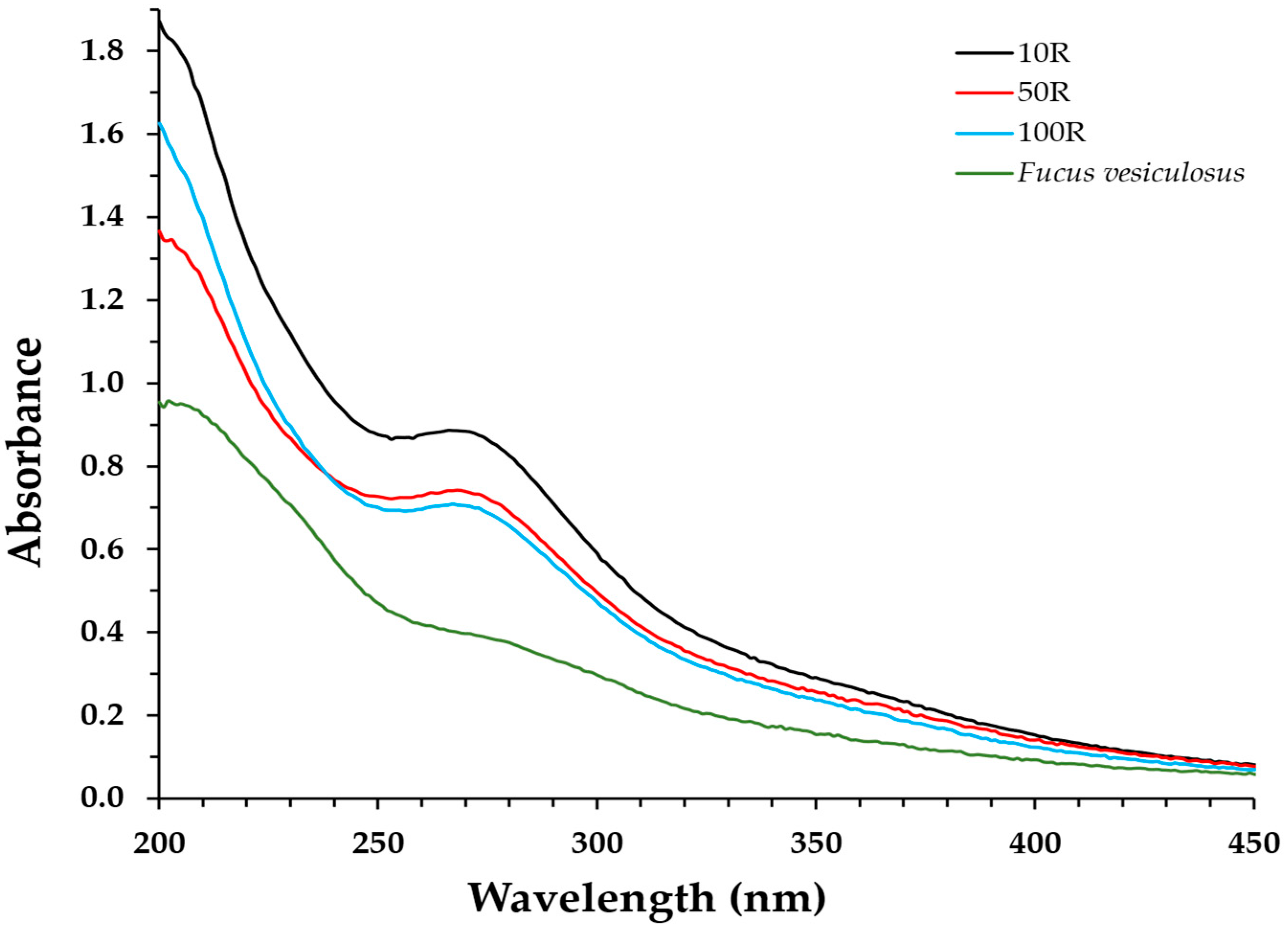
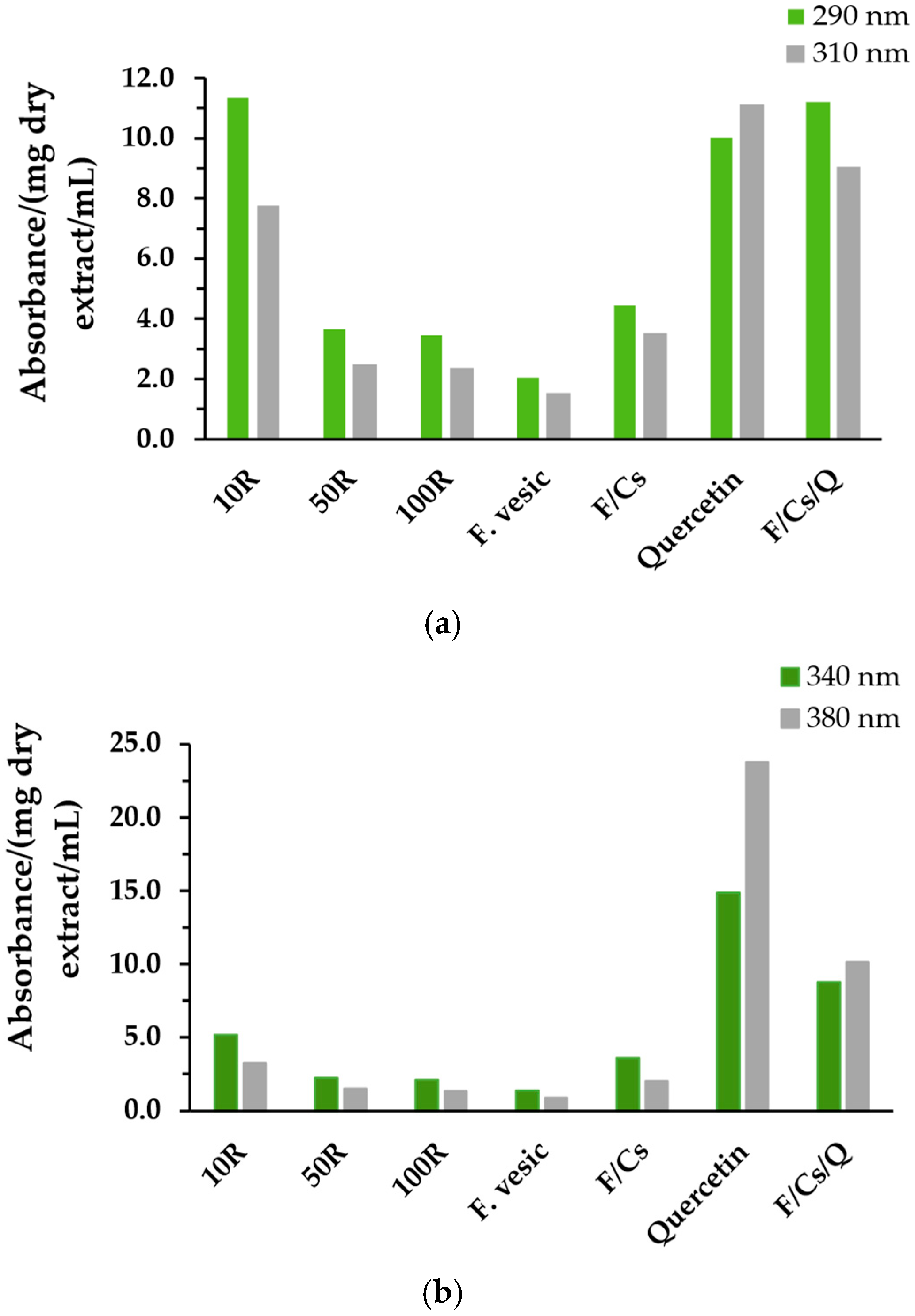
UV–Vis spectra of fucoidan fractions displayed detectable absorption in both the UVB (290–320 nm) and, to a lesser extent, the UVA (320–400 nm) regions, which are relevant for solar radiation protection. The low-MW 10R fraction showed the strongest absorbance at 290 and 310 nm (
Figure 1), likely reflecting a higher content of phenolic residues or low-mass chromophoric compounds. Interestingly, commercial fucoidan from
F. vesiculosus exhibited lower absorbance than the extract obtained in this study, underscoring the influence of extraction source and processing. Variations in UV absorption are generally attributed to the presence of chromophores such as aromatic rings and conjugated systems, rather than sulfate groups. In line with this, a distinct peak around 270 nm may indicate electrostatic interactions between polysaccharides and aromatic compounds, as previously reported [
25].
1H NMR analysis of the
S. filipendula fucoidan revealed multiple overlapping signals, consistent with the complex and heterogeneous nature of the polysaccharide [
17]. Characteristic fucoidan signals were observed between 1.0 and 1.5 ppm, corresponding to the H6 methyl protons of α-L-fucopyranose residues. Resonances in the range 3.0–4.3 ppm were assigned to H2–H5 of various sugar residues, while anomeric H1 protons appeared between 5.0 and 5.5 ppm. Similarly, the
13C NMR spectrum displayed significant complexity; nonetheless, key characteristic peaks were identifiable. Anomeric carbon signals (C1) appeared between 97 and 103 ppm, and the methyl carbon (C6) of α-L-fucopyranosides was observed at 15.5–17.0 ppm. Carbons C2 through C5 of the heterogeneous sugar residues were assigned signals in the 61–85 ppm range. Further insights from 2D
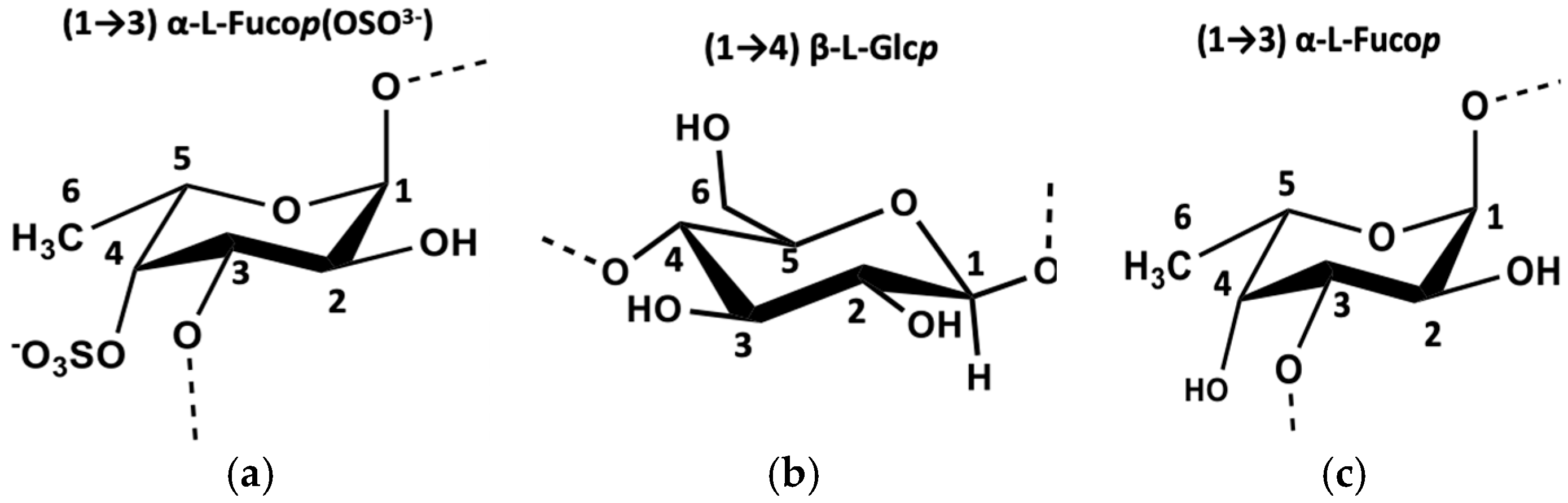
1H-
13C spectra supported the presence of three recurring patterns: (i) (1 → 3)-linked α-L-fucopyranose sulfated at C4, (ii) (1 → 4)-linked β-D-glucopyranose, and (iii) (1 → 3)-linked α-L-fucopyranose lacking sulfate groups (
Figure 2). These features are consistent with previously reported fucoidan structures and highlight the extract’s structural heterogeneity.
The fucoidan extracted from
S. filipendula in this study exhibited distinct chemical characteristics compared to commercial fucoidan derived from
F. vesiculosus. While both are sulfated polysaccharides primarily composed of L-fucose residues, their monosaccharide composition, degree of sulfation, and uronic acid content differ significantly, reflecting species-specific structural diversity and the influence of extraction conditions. Commercial fucoidan from
F. vesiculosus typically contains 40–50% fucose, 15–30% sulfate, and 5–10% uronic acids, with a molecular weight distribution generally ranging from 20 to 200 kDa, often centered around 60–100 kDa [
9,
26,
27]. Its backbone is mainly composed of (1→3)- or alternating (1→3)/(1→4)-linked α-L-fucopyranose residues, with sulfate substitution typically at the C-2 and/or C-4 position [
28,
29]. These features contribute to reported anticoagulant, antioxidants, and anti-inflammatory activities, and commercial fucoidan is usually highly water-soluble with low protein content.
By contrast, the S. filipendula fucoidan isolated here showed a higher fucose content (63.0 ± 1.1% w/w), greater sulfate content (43.6 ± 1.8% w/w), and elevated uronic acid levels (8.60 ± 1.5% w/w). These values exceed those typically reported for commercial preparations, indicating a fucose-rich and more heavily sulfated structure. Such structural differences may contribute to enhanced biological activity, including antioxidant capacity, although direct correlations with UV absorption are more likely influenced by associated phenolic or conjugated compounds. In addition, the extract displayed heterogeneous molecular weight distribution, with fractions defined via ultrafiltration (10R, 50R, 100R), enabling size-dependent functional comparisons that are not usually possible with standardized commercial products.
Overall, the fucoidan obtained from S. filipendula presents distinct compositional features that may enhance its biological potential, particularly in antioxidant defense and photoprotection. These findings underscore the importance of algal species selection and extraction methodology in tailoring fucoidan properties for biomedical and cosmeceutical applications.
3.3. Infrared and UV-Vis Spectroscopic Analysis of Fucoidan–Chitosan System
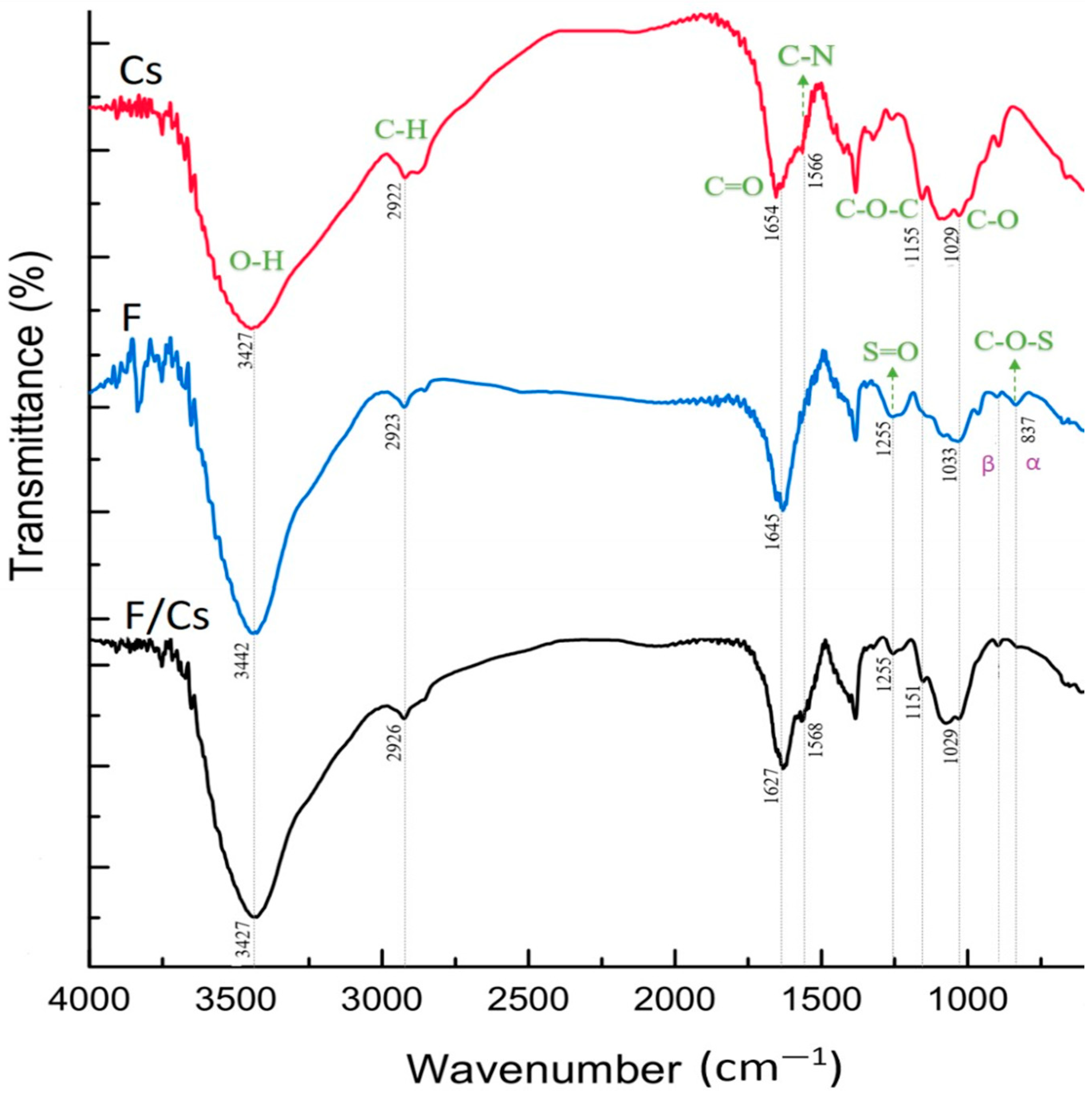
The IR spectroscopic profiles of both polymers showed typical polysaccharide features (
Figure 3). A broad band between 3000 and 3600 cm
−1 corresponded to O–H stretching vibrations of hydroxyl groups, while medium peaks at 2922 and 2879 cm
−1 were assigned to C–H and CH
2 stretching. In the fingerprint region, bands at 1155 cm
−1 and 1030 cm
−1 were attributed to glycosidic C–O–C and C–O stretching, respectively, consistent with the polysaccharide backbone structure [
30].
Distinctive bands allowed discrimination between the two polymers. Chitosan showed signals of acetyl groups, with a band at 1654 cm
−1 (C=O stretching, amide I) and a weak peak at 1566 cm
−1 (C–N stretching, amide II). Fucoidan exhibited sulfate-associated bands at 1255 cm
−1 (S=O stretching) and 837 cm
−1 (C–O–S vibration), together with a band at 1645 cm
−1 that may arise from carboxyl groups of uronic acids. Additional peaks near 847 and 890 cm
−1 were consistent with α- and β-anomeric carbon configurations, respectively [
17].
The spectrum of fucoidan–chitosan particles (F/Cs NPs) combined characteristic peaks from both polymers with slight shifts. For instance, the amide I band shifted from 1654 to 1627 cm
−1, while the C–N stretching band became more pronounced and the C–O–S signal decreased in intensity. These spectral changes suggest electrostatic interactions between the sulfate groups of fucoidan and the protonated amines of chitosan, rather than the formation of new covalent bonds [
11].
As shown in
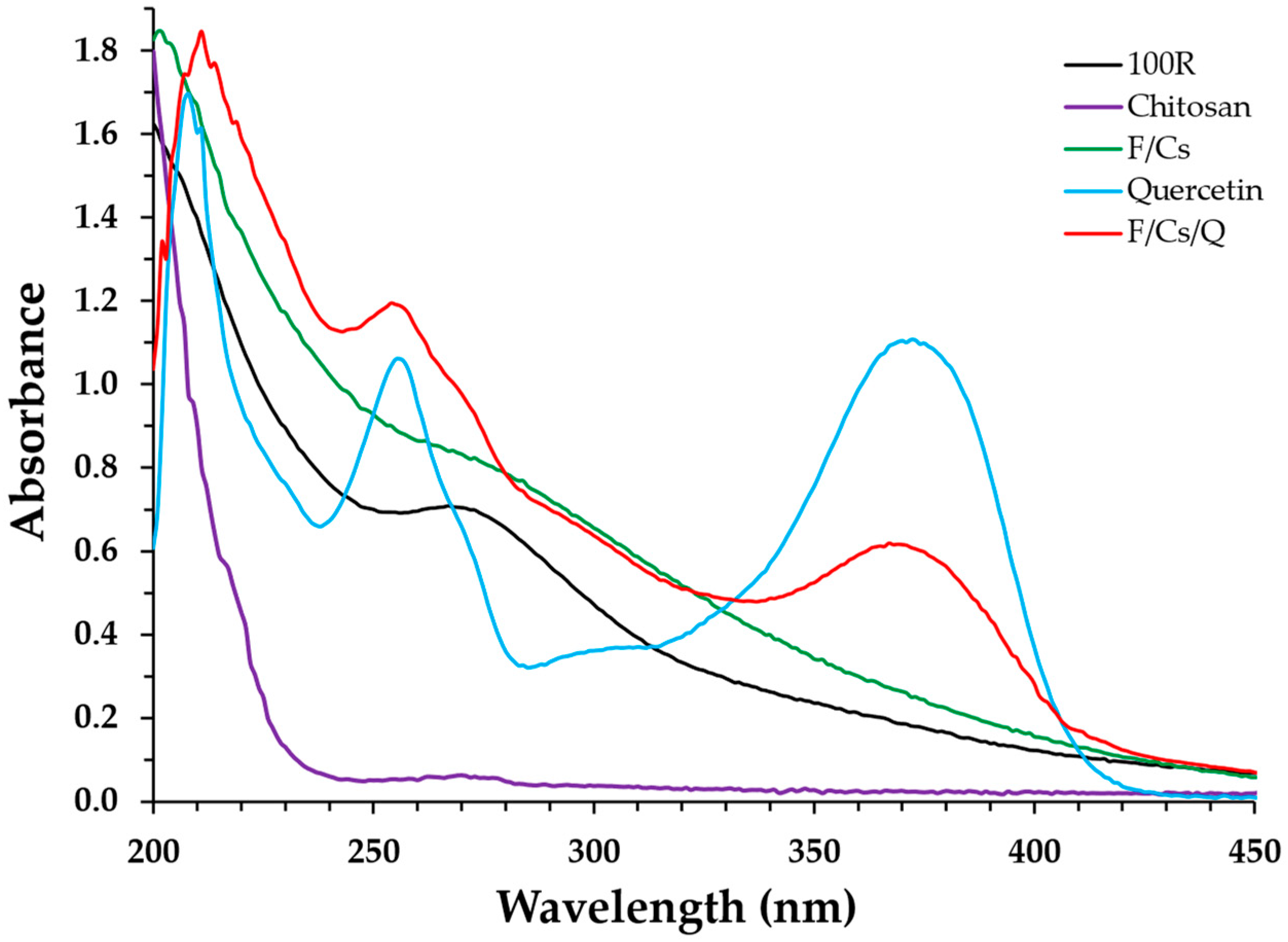
Figure 4, the UV-Vis absorption profiles of the different components exhibited distinctive patterns. Chitosan displayed negligible absorbance across the UV region, confirming its role as an inert polymeric carrier. Fucoidan (100R fraction) exhibited moderate absorption in the 220–280 nm range, with limited extension into the UVA-UVB region, consistent with the absence of aromatic chromophores. Free quercetin presented its two characteristic maxima at 254 and ~365 nm, corresponding to π–π and n–π* transitions of its aromatic rings, which account for its dual UVA-UVB coverage. The F/Cs particles without quercetin showed only modest absorption, like fucoidan, but with slightly broadened features, suggesting subtle alterations in electronic interactions upon colloidal particle formation. In contrast, the quercetin-loaded particles (F/Cs/Q) exhibited a broader absorption profile: while the intensity of the quercetin peak at 365 nm decreased compared to the free flavonol, absorption remained sustained across the UVB (290–320 nm) and UVA (320–380 nm) regions. This spectral behavior indicates partial encapsulation of quercetin, which reduces free absorbance but enhances its stability and preserves broad-spectrum photoprotective potential.
The relative absorption coefficient was calculated as absorbance per mg of dry extract per mL, corrected for dilution factors, to enable comparison among samples. Absorbance measurements were taken at the following wavelengths:
290 nm, marking the lower limit of the UVB range,
310 nm, corresponding to the maximum erythemal response, the most effective wavelength for inducing skin reddening.
340 nm, representing the plateau region of the UVA spectrum, and
380 nm, which lies 10 nm above the critical wavelength, is used to assess broad-spectrum protection. (λc: 370 nm).
As shown in
Figure 5, fucoidan extracts, the commercial
F. vesiculosus sample, and F/Cs particles (without quercetin) exhibited their highest absorbance within the UVB region (290–310 nm), consistent with their limited chromophoric content. Among the size-defined fucoidan fractions, the low-molecular-weight 10R sample (<50 kDa) displayed the strongest absorption at 290 and 310 nm, likely reflecting enrichment in phenolic residues or small conjugated sugars that enhance UVB absorption. In contrast, quercetin and the F/Cs/Q particles exhibited broad-spectrum UV coverage. Free quercetin showed strong absorbance at both UVB and UVA ranges, attributable to the aromatic rings and conjugated systems within its structure. Upon encapsulation, absorption intensity decreased modestly but remained broad and sustained across the UVA–UVB spectrum, suggesting effective photoprotection while reducing free quercetin exposure and enhancing its photostability [
31,
32]. This complementary behavior highlights the synergistic contribution of fucoidan (UVB absorption) and quercetin (UVA–UVB coverage), positioning F/Cs/Q particles as multifunctional natural UV filters with improved stability and efficacy compared to their free components.
3.4. ANOVA Analysis: Effect of Parameters
Table 2 summarizes the ANOVA results, highlighting the relative contributions of formulation parameters to particle size. Both the F/Cs ratio (
p = 0.0149) and pH (
p = 0.0060) significantly influenced particle size (
p < 0.05). Partitioning of the total variance showed that pH accounted for the largest proportion (≈58.4%), whereas the F/Cs ratio explained ≈23.7%. The remaining ≈17.9% was attributed to residual variability. The Shapiro–Wilk test (
p = 0.6735) confirmed normality of residuals, validating the assumptions of the ANOVA model.
These results emphasize the central role of pH in modulating the physicochemical properties of the fucoidan–chitosan system [
33,
34,
35]. The pronounced effect of pH reflects the sensitivity of polyelectrolyte complex formation to the ionization state of functional groups, namely, the amino groups in chitosan and the sulfate or carboxyl groups in fucoidan. Variations in protonation/deprotonation directly affect electrostatic interactions, thereby influencing particle aggregation and size distribution. While the F/Cs ratio also contributed significantly to particle size modulation, its lower impact indicates that stoichiometric balance alone cannot fully control particle dimensions without accounting for pH. Optimizing pH is therefore critical to achieve particles with consistent size and improved colloidal stability, an essential consideration for topical delivery systems, where particle size strongly influences skin penetration and bioavailability [
36,
37].
3.5. Particle Size of F/Cs Particles and Quercetin Incorporation
A fucoidan–chitosan matrix was formed through the electrostatic complexation between the negatively charged sulfate groups of fucoidan and the protonated amino groups of chitosan, resulting in stable polyelectrolyte complexes. The efficiency of this self-assembly process depends strongly on the protonation state of both polymers, which is pH-dependent. Chitosan, with a degree of deacetylation of 85.3%, provides a high density of amino groups capable of protonation under acidic conditions [
38]. However, due to its dissociation constant (pKa ≈ 6.5), protonation efficiency and net cationic charge decrease markedly as the pH approaches neutrality. This reduction weakens electrostatic interactions required for sub-micron carrier formation, while the limited solubility of chitosan under near-neutral or alkaline conditions can lead to precipitation and poor reproducibility [
39]. In contrast, fucoidan, containing 43.6% sulfated sugars, exhibits progressively higher negative charge density with increasing pH, due to the deprotonation of sulfate groups. Thus, increasing both the F/Cs ratio and the pH enhances the relative negative charge of fucoidan, improving the electrostatic interactions when a stoichiometric charge balance is achieved [
40].
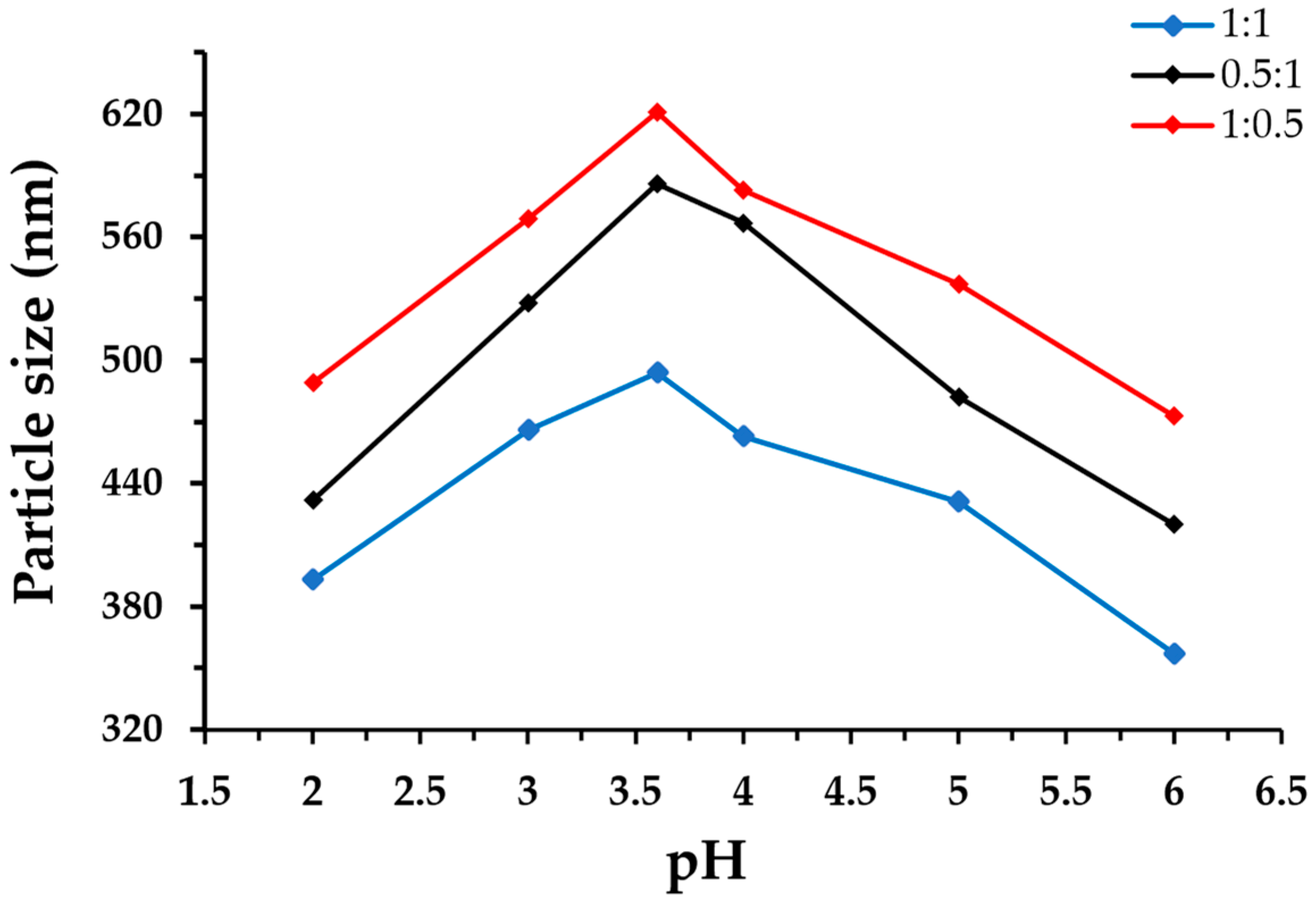
Particle size was significantly influenced by the F/Cs ratio. The 1:1 ratio consistently produced the smallest particles (357–494 nm), followed by the 0.5:1 (421–587 nm) and 1:0.5 (463–630 nm) ratios. This behavior was consistently observed across all pH values (
Figure 6), highlighting the robustness of the trend. According to
Table 3, particle size ranged from 357 to 494 nm depending on pH. The smallest size was observed at pH 6.0 (357 ± 14 nm), whereas pH 3.6 yielded significantly larger and more heterogeneous particles (494 ± 18 nm, polydispersity index, PDI = 0.399 ± 0.041). In contrast, PDI values at pH 5.0 (0.252 ± 0.059) and pH 6.0 (0.266 ± 0.028) were the lowest, reflecting improved dispersity.
ζ-potential values ranged from +38.2 to +66.0 mV across conditions, exceeding |30 mV|, indicative of favorable electrostatic stabilization. The highest stability was recorded at pH 4.0 (+66.0 ± 4.5 mV), while at pH 5.0 (+43.5 ± 1.6 mV) the ζ-potential remained sufficient to ensure colloidal stability alongside a narrower size distribution. Although pH 6.0 yielded the smallest average size, the reduced solubility and precipitation tendency of chitosan under near-neutral conditions make this pH less suitable for reproducible synthesis.
Therefore, the 1:1 F/Cs ratio at pH 5.0 was identified as the optimal formulation, providing the best balance between particle size, polydispersity, and ζ-potential. This condition ensured reproducible particle formation with a unimodal distribution by DLS, supporting its selection for quercetin encapsulation. These findings are consistent with earlier reports: Campos et al. observed reduced stability and reproducibility of chitosan-based particles above pH 5.0, while Lee and Lim [
40] described a fucoidan–chitosan matrix with particle sizes ranging from 365 to 900 nm and comparable PDI values. However, their reported ζ-potentials were below |30 mV|, indicating weaker electrostatic stability, a limitation also noted by Huang and Lam [
20]. In contrast, the optimized formulation in this study achieved a smaller particle size and lower PDI, reflecting improved colloidal stability and structural consistency. Based on these properties, this system was selected for quercetin encapsulation as a reliable platform for topical delivery applications.
Quercetin encapsulation was performed using F/Cs/Q ratios of 1:1:0.5 and 1:1:0.75, with the resulting particle sizes and polydispersity indices summarized in
Table 4. Both systems exhibited electrostatic stability, as indicated by ζ-potential values exceeding ±30 mV. However, the 1:1:0.5 formulation showed higher colloidal stability (+54.6 mV) and a narrower size distribution (PDI = 0.278), while the 1:1:0.75 system, despite achieving a greater encapsulation efficiency (73.1%) and loading capacity (26.4%), exhibited broader polydispersity (PDI = 0.483) and slightly reduced stability (+44.9 mV). These results suggest a trade-off between maximizing quercetin incorporation and maintaining dispersion quality (i.e., size distribution and electrostatic stabilization). In terms of particle size, both systems remained within the sub-micron/near-micron range (915–1135 nm), which is considered suitable for topical applications, supporting good dispersion and favorable sensory characteristics. Barbosa et al. [
33] reported similar results when encapsulating quercetin in a fucoidan–chitosan matrix, though their system achieved a lower loading capacity (14.9%), likely due to lower initial quercetin input. Nevertheless, quercetin maintains significant UV-absorption efficacy even at low concentrations [
41,
42], supporting its potential as a functional ingredient in photoprotective formulations.
Based on these findings, the 1:1:0.5 formulation was selected for further applications, as it provided the best balance between particle size, stability, and homogeneity, despite its comparatively lower loading capacity. This compromise ensures a structurally consistent and stable delivery system, strengthening its suitability for topical photoprotective formulations. Future work will optimize particle size distribution and evaluate standardized in vitro photoprotection metrics (critical wavelength, UVA-PF) on films.
3.6. Antiradical Activity
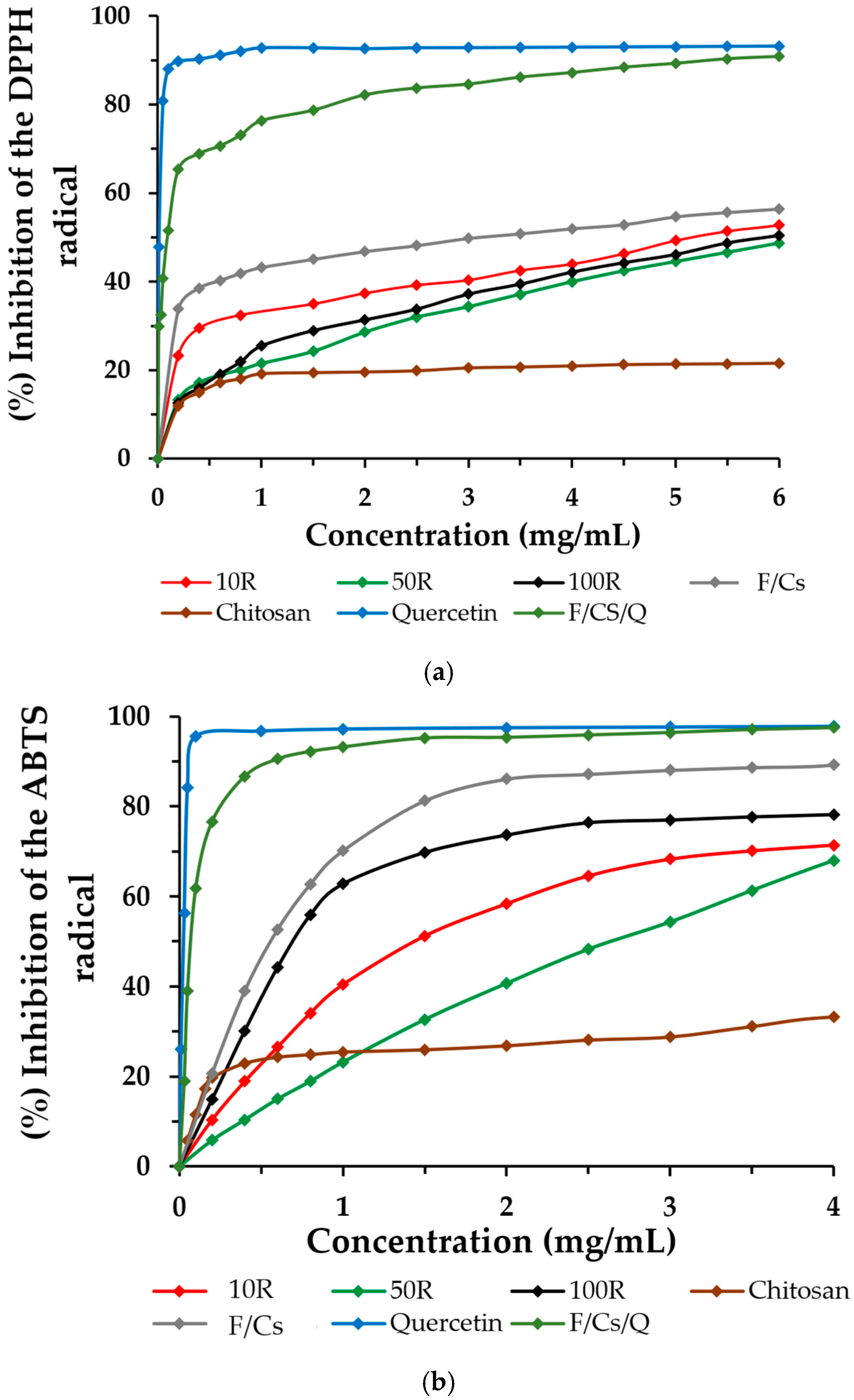
Figure 7 presents the concentration-dependent inhibition of DPPH and ABTS radicals by the tested samples, along with their corresponding EC
50 values, using ascorbic acid as the reference standard (
Table 5). In the DPPH assay, the fucoidan fractions alone exhibited rather modest antioxidant activity with EC
50 values ranging from 5.17 to 6.28 mg/mL. Notably, the 10R fraction of fucoidan demonstrated the highest scavenging activity within these samples. When fucoidan was combined with chitosan to form F/Cs particles, a marked enhancement in radical scavenging was observed; the EC
50 decreased to 2.54 mg/mL, indicating a synergistic effect of the polymeric matrix on antioxidant performance.
Free quercetin, as expected, showed the highest potency against DPPH radicals with an EC
50 value of 0.0131 mg/mL. However, upon encapsulation into the F/Cs system, the immediate availability of quercetin was partially restricted by the polymer matrix, resulting in an increased EC
50 to 0.094 mg/mL. This shift suggests that, while encapsulation (known to protect quercetin from degradation) slightly diminishes the immediate radical-scavenging capacity in the methanolic medium of the DPPH assay, the intrinsic antioxidant properties are preserved due to the integrity of quercetin’s hydroxylated structure, which enables efficient hydrogen donation and radical neutralization [
43,
44].
The ABTS assay, performed in an aqueous environment, reflected a generally higher antioxidant capacity for the polymer-based samples compared to the DPPH. Fucoidan fractions produced EC50 values between 0.697 and 2.66 mg/mL, with the 10R fraction displaying the highest potency. Similar to the DPPH assay, F/Cs particles showed improved performance with an EC50 of 0.556 mg/mL, indicative of enhanced electron-donation capability facilitated by water-soluble sulfate groups.
Quercetin-loaded F/Cs system exhibited an EC
50 of 0.0749 mg/mL in the ABTS assay. This value is comparable to the reference ascorbic acid under these assay conditions [
45]. The improved performance in ABTS correlates with the favorable solubility and dispersion of the fucoidan–chitosan matrix in water, which facilitates more efficient electron transfer during radical quenching. Additionally, the presence of sulfated groups in fucoidan likely contributes to radical scavenging via electron donation. Taken together, these findings demonstrate that fucoidan–chitosan matrix effectively preserves the antioxidant capacity of quercetin while enhancing its stability and solubility, supporting its application as a multifunctional photoprotective system.
The antioxidant performance of the quercetin-loaded fucoidan–chitosan system was assessed by two complementary assays that differ in their solvent environments and radical generation mechanisms. The DPPH assay, carried out in methanol, is often dominated by hydrogen-atom transfer (HAT), whereas the ABTS assay, conducted in an aqueous buffer, more readily reflects single-electron transfer (SET) reactions. In our study, free quercetin consistently exhibits the lowest EC50 values due to its direct interaction with the radicals; however, encapsulation within the F/Cs matrix introduced a controlled-release element that moderately elevated the EC50 in the DPPH system. This finding is consistent with earlier reports where polymer encapsulation provided protective benefits at the expense of immediate radical scavenging activity.
Mechanistically, the elevated EC50 observed in the DPPH assay for encapsulated quercetin may be attributed to several factors. First, the encapsulation, while protecting the labile quercetin from oxidation and photodegradation, limits its rapid diffusion into the methanolic medium, reducing the initial reaction rate with DPPH radicals. Second, solvent compatibility plays a significant role; the hydrophilic fucoidan–chitosan matrix disperses and releases quercetin less efficiently in methanol than in water, lowering apparent activity. By contrast, the aqueous environment of the ABTS assay allows the colloidal particles to swell, facilitating better quercetin release and allowing the sulfate groups of fucoidan to contribute to electron donation, thereby enhancing the overall antioxidant effect.
Another critical point is the nature of the polymer-drug interactions. Fucoidan and chitosan engage quercetin primarily through hydrogen bonding (and potentially electrostatic and hydrophobic contacts), which helps stabilize the encapsulated molecule. While these interactions ensure stability and protection, they can also delay the immediate availability of quercetin for radical scavenging. Thus, the trade-off between protection and instantaneous radical quenching is evident from the observed EC50 differences across assays. Notably, the ABTS results suggest that, despite a slight delay in immediate response, the encapsulated formulation achieves radical-scavenging levels that approach those of free quercetin. Such behavior is consistent with a sustained-release profile advantageous for in vivo applications, where prolonged antioxidant protection is desirable, and aligns with previous findings in sub-micron carrier systems.
While the present study offers valuable insights into the antioxidant dynamics of quercetin-loaded F/Cs matrix, both the DPPH and ABTS assays provide endpoint measurements that do not capture the temporal release kinetics of encapsulated quercetin. Future studies should incorporate time-course analyses and in vitro release profiles in both methanolic and aqueous environments, as well as simulated digestion experiments, to correlate release behavior with antioxidant performance and better predict biological relevance.
4. Conclusions
Fucoidan-chitosan colloidal particles were successfully synthesized via the polyelectrolyte self-assembly method. The optimal formulation, comprising a 1:1 mass ratio of fucoidan to chitosan at pH 5.0, yielded particle sizes in the 357–494 nm range and the lowest polydispersity index (PDI = 0.252), indicating a moderate and acceptable size distribution. Statistical analysis using a randomized complete block design (RCBD) demonstrated that both pH and the fucoidan–chitosan mass ratio significantly influenced particle size. Fourier-transform infrared (FTIR) spectroscopy confirmed that electrostatic interactions between the anionic sulfate groups of fucoidan and the cationic amino groups of chitosan were primarily responsible for polyelectrolyte complex formation.
Quercetin was effectively incorporated into the fucoidan–chitosan matrix, with the 1:1:0.5 (F/Cs/Q) formulation producing smaller and more moderately distributed particles (915 nm, PDI = 0.278) while maintaining good electrostatic stability (ζ-potential = +54.6 mV). UV–Vis spectral analysis revealed that both free and encapsulated quercetin provided broad-spectrum ultraviolet radiation absorption, underscoring their potential as natural UV-filtering agents. Moreover, the encapsulated quercetin retained substantial antioxidant activity, as evidenced by its strong radical scavenging capacity, suggesting that the system effectively preserved its bioactivity and could support controlled release.
Together, these findings highlight the potential of fucoidan–chitosan sub-micron carriers as a multifunctional delivery system for cosmetic and pharmaceutical applications. The integration of marine-derived polysaccharides with bioactive flavonoids, such as quercetin, offers a biodegradable, biocompatible, and environmentally sustainable platform with enhanced photoprotective and antioxidant properties, making it suitable for the development of next-generation topical formulations.