
Cytotoxic Potential of Diterpenoids from the Genus Croton Against Breast Cancer Cell Lines: A Comprehensive Review

 , , , and
Abstract
1. Introduction
2. Data Sources and Retrieval Strategy
2.1. Databases
2.2. Inclusion and Exclusion Criteria
2.3. Data Screening and Information Categorization
2.4. Data Analysis
3. Cytotoxic Potential of Diterpenoids
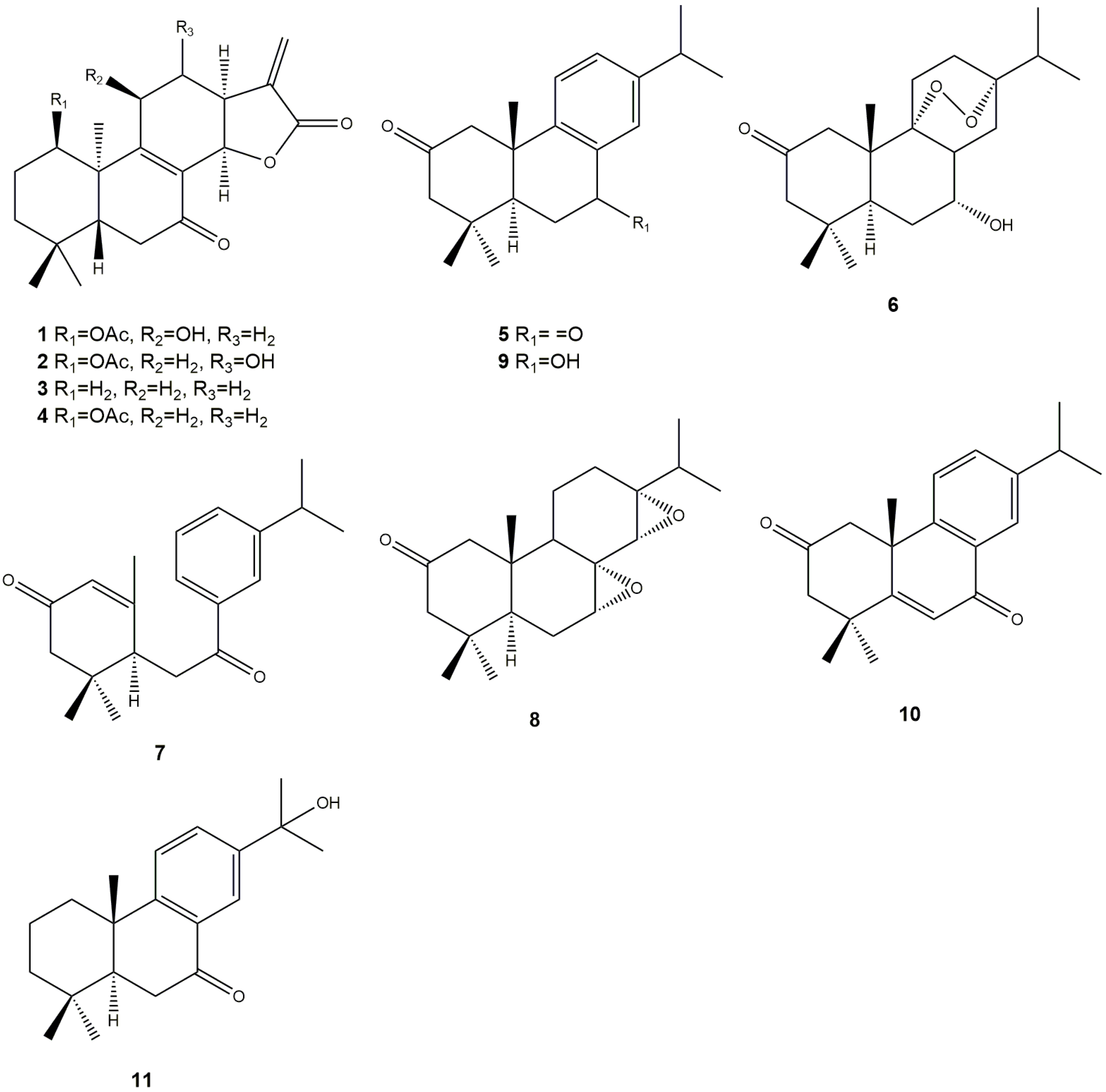
3.1. Abietane
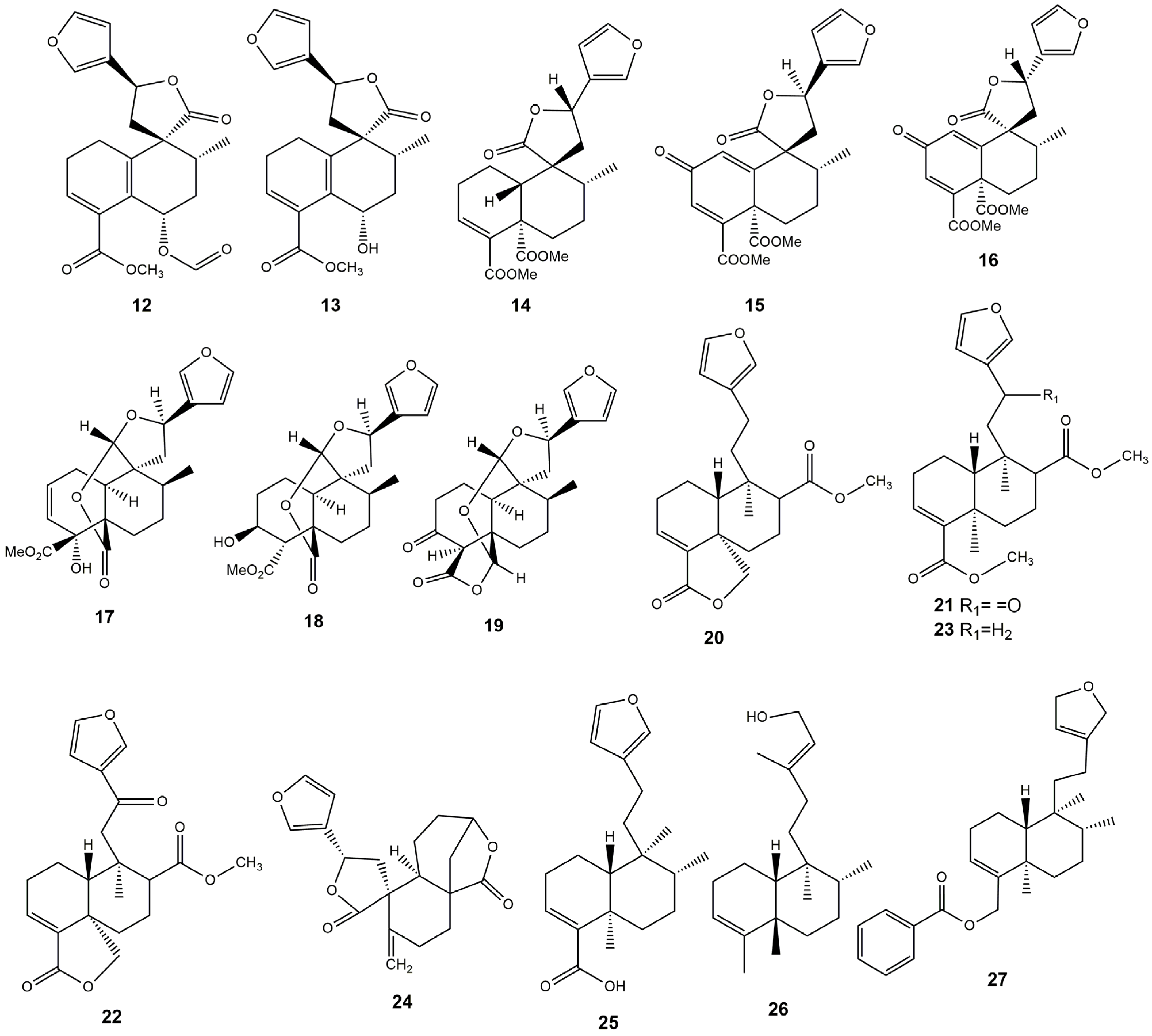
3.2. Clerodane
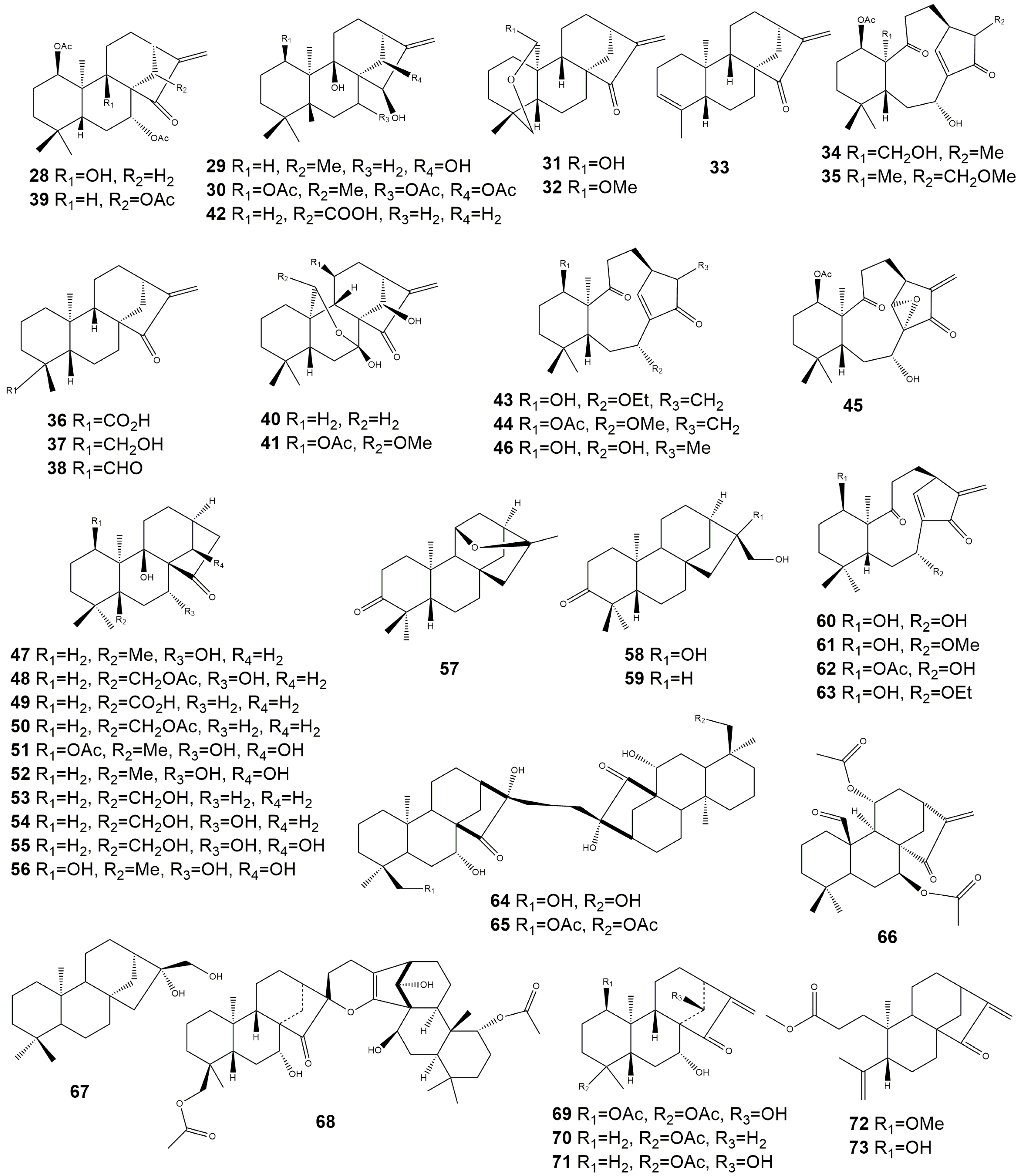
3.3. Kaurane
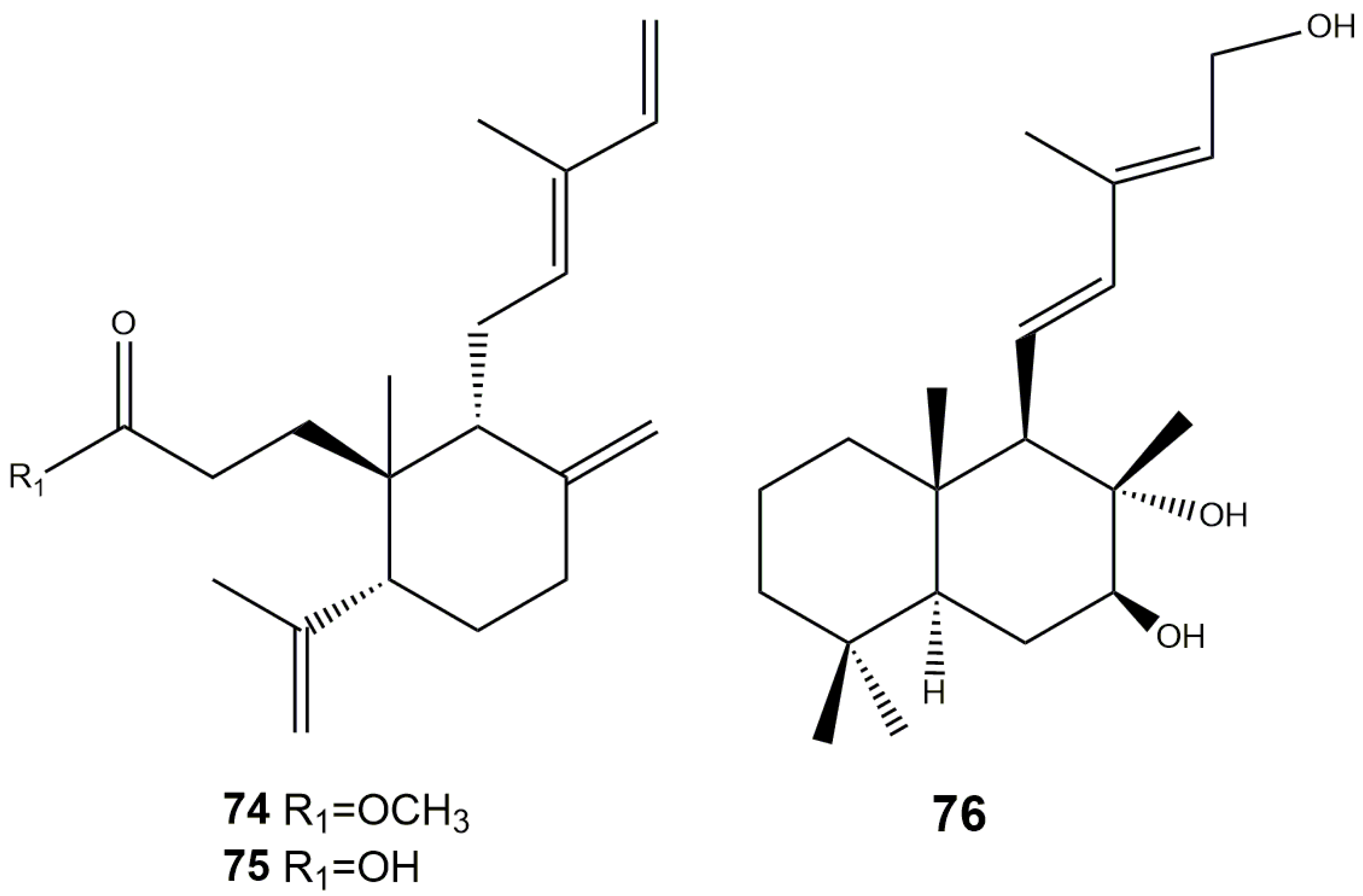
3.4. Labdane
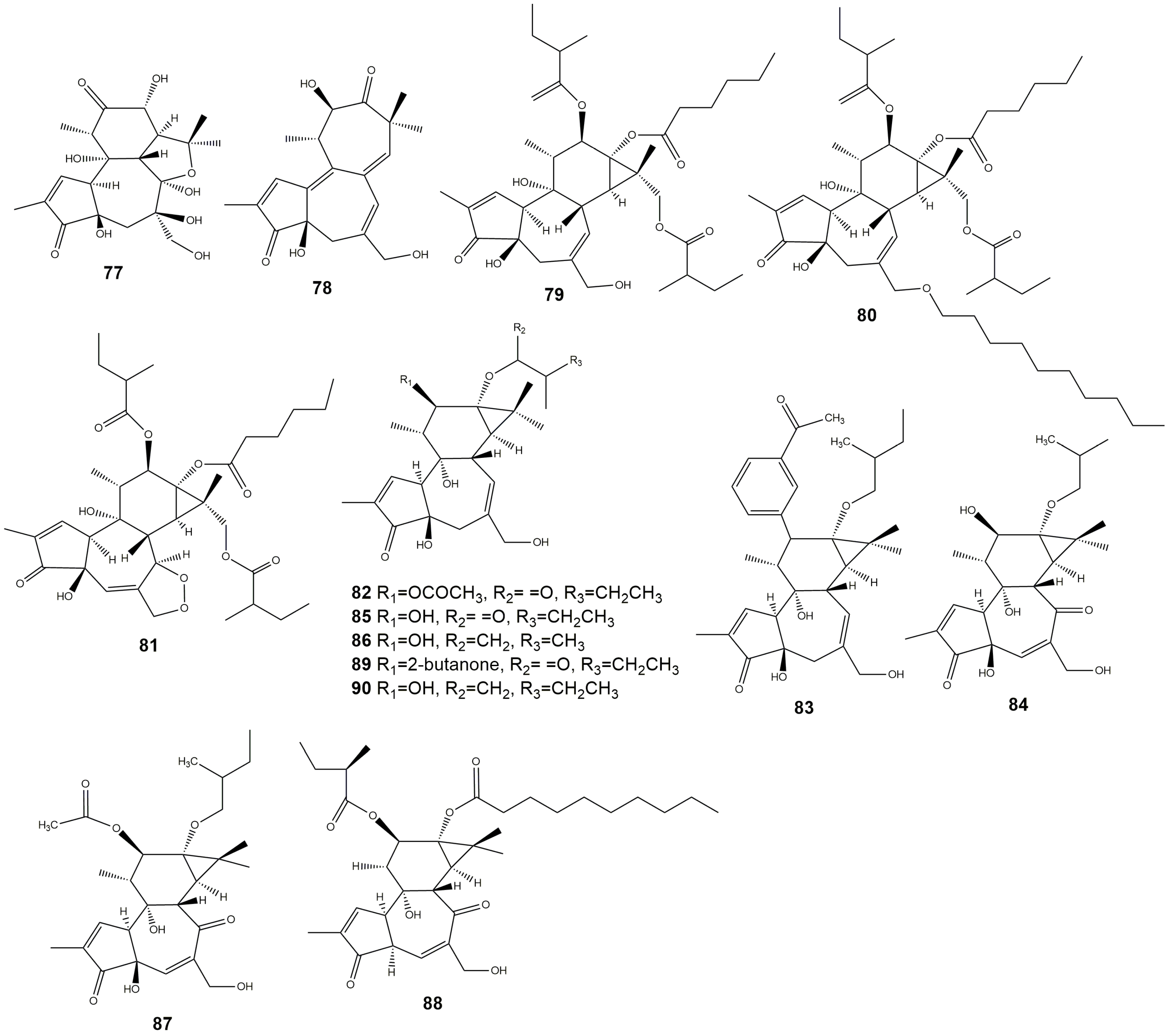
3.5. Tigliane
3.6. Casbane
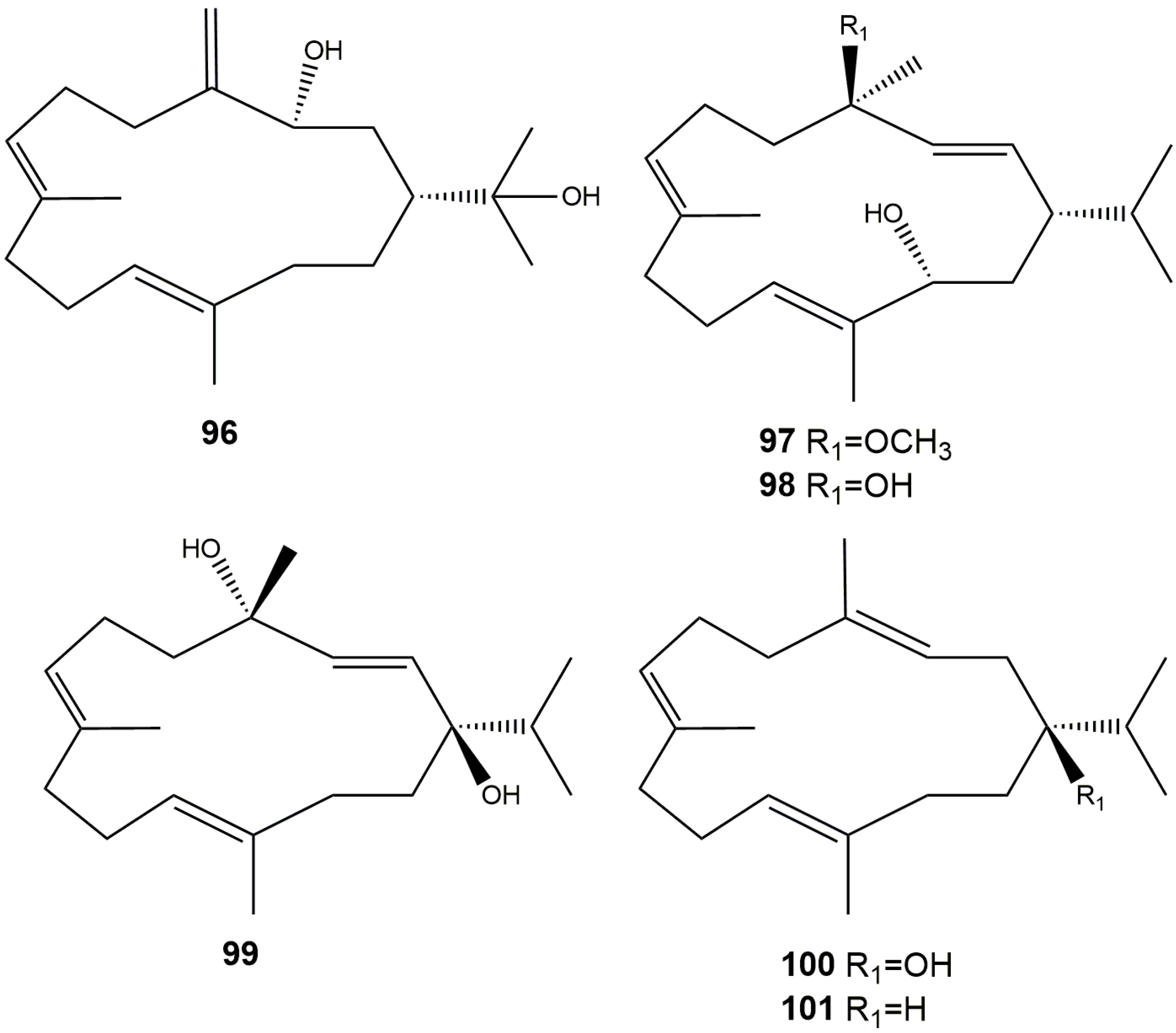
3.7. Cembrane
3.8. Crotofolane
3.9. Pimarane
3.10. Crotinsulidane
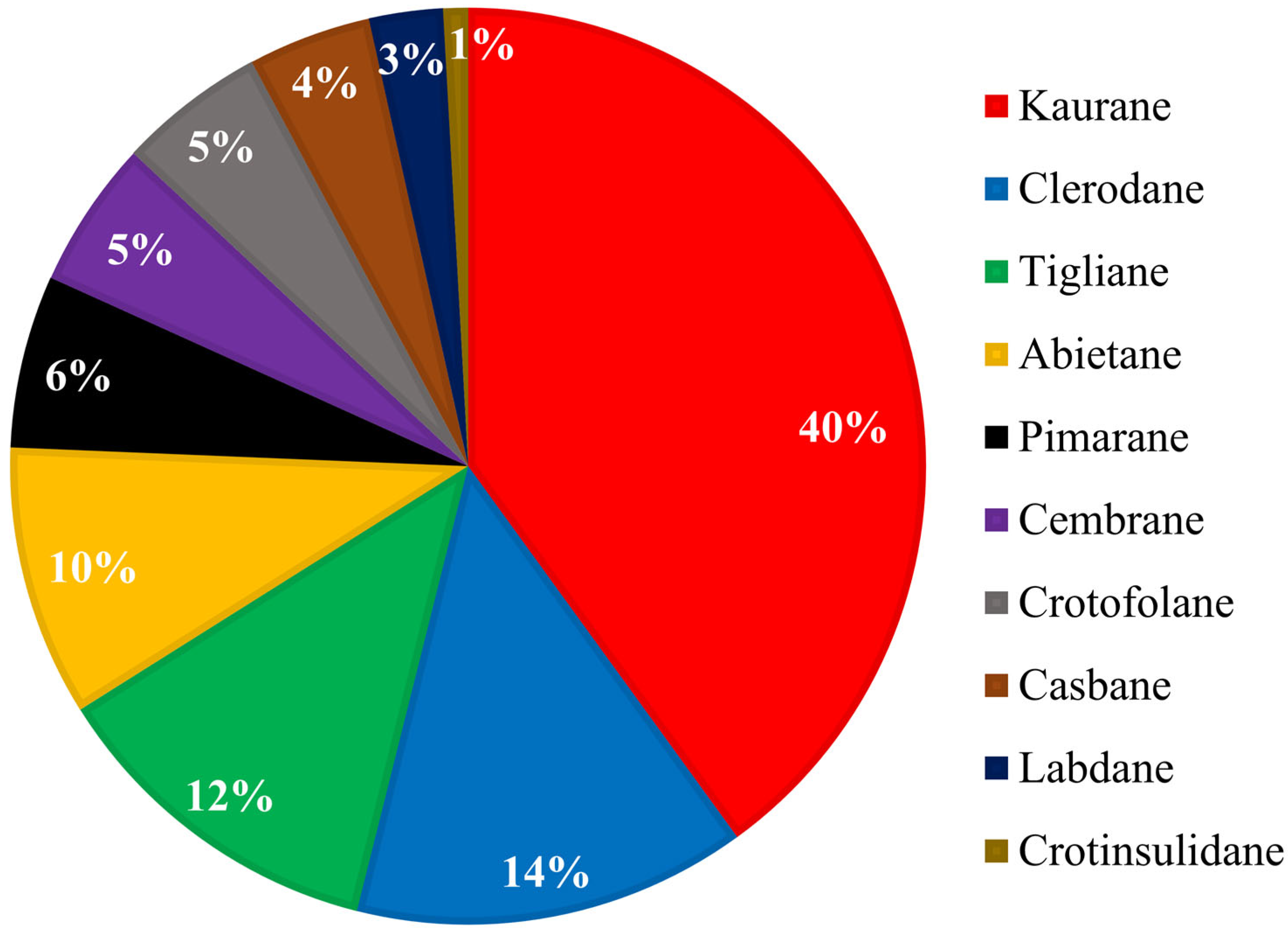
4. Discussion
5. Future Perspectives
6. Conclusions
Author Contributions
Funding
Institutional Review Board Statement
Informed Consent Statement
Data Availability Statement
Acknowledgments
Conflicts of Interest
Abbreviations
| CCK-8 | cell counting kit-8 |
| DNA | deoxyribonucleic acid |
| IC50 | concentration that causes 50% cell death |
| MTS | colorimetric assay |
| MTT | 3-(4,5-dimethylthiazol-2-yl)-2,5-diphenyltetrazolium bromide |
| ROS | reactive oxygen species |
| SRB | sulforhodamine B |
| WFO | world flora online |
References
- Xiong, X.; Zheng, L.W.; Ding, Y.; Chen, Y.F.; Cai, Y.W.; Wang, L.P.; Huang, L.; Liu, C.C.; Shao, Z.M.; Yu, K.D. Breast cancer: Pathogenesis and treatments. Sig. Transduct. Target. Ther. 2025, 10, 49. [Google Scholar] [CrossRef]
- Kim, J.; Harper, A.; McCormack, V.; Sung, H.; Houssami, N.; Morgan, E.; Mutebi, M.; Garvey, G.; Soerjomataram, I.; Fidler-Benaoudia, M.M. Global patterns and trends in breast cancer incidence and mortality across 185 countries. Nat. Med. 2025, 31, 1154–1162. [Google Scholar] [CrossRef]
- Liao, L. Inequality in breast cancer: Global statistics from 2022 to 2050. Breast 2025, 79, 103851. [Google Scholar] [CrossRef]
- Diao, X.; Guo, C.; Jin, Y.; Li, B.; Gao, X.; Du, X.; Chen, Z.; Jo, M.; Zeng, Y.; Ding, C.; et al. Cancer situation in China: An analysis based on the global epidemiological data released in 2024. Cancer Commun. 2025, 45, 178–197. [Google Scholar] [CrossRef] [PubMed]
- Jiang, D.; Wen, P.; Zhang, S.; Zhang, N.; Shao, Q.; Wang, G.; Wang, L.; Li, S.; Qin, Y.; Qu, F.; et al. Knowledge mapping of tumor microenvironment for breast cancer: A bibliometric analysis from 2014 to 2023. Front. Immunol. 2025, 16, 1550988. [Google Scholar] [CrossRef] [PubMed]
- Riggio, A.I.; Varley, K.E.; Welm, A.L. The lingering mysteries of metastatic recurrence in breast cancer. Br. J. Cancer 2021, 124, 13–26. [Google Scholar] [CrossRef]
- Zhang, J.; Wu, Y.; Li, Y.; Li, S.; Liu, J.; Yang, X.; Xia, G.; Wang, G. Natural products and derivatives for breast cancer treatment: From drug discovery to molecular mechanism. Phytomedicine 2024, 129, 155600. [Google Scholar] [CrossRef] [PubMed]
- Bangay, G.; Brauning, F.Z.; Rosatella, A.; Díaz-Lanza, A.M.; Domínguez-Martín, E.M.; Goncalves, B.; Hussein, A.A.; Efferth, T.; Rijo, P. Anticancer diterpenes of African natural products: Mechanistic pathways and preclinical developments. Phytomedicine 2024, 129, 155634. [Google Scholar] [CrossRef]
- Tomiotto-Pellissier, F.; Gonçalves, M.D.; Silva, T.F.; Concato, V.M.; Bortoleti, B.T.S.; Arakawa, N.S.; Conchon-Costa, I.; Pavanelli, W.R.; Panis, C. Plant-derived diterpenes for breast cancer treatment: New perspectives and recent advances. Stud. Nat. Prod. Chem. 2022, 74, 41–80. [Google Scholar] [CrossRef]
- Sharifi-Rad, J.; Quispe, C.; Patra, J.K.; Singh, Y.D.; Panda, M.K.; Das, G.; Adetunji, C.O.; Michael, O.S.; Sytar, O.; Polito, L.; et al. Paclitaxel: Application in modern oncology and nanomedicine-based cancer therapy. Oxid. Med. Cell Longev. 2021, 2021, 3687700. [Google Scholar] [CrossRef]
- Kemboi, D.; Siwe-Noundou, X.; Krause, R.W.; Langat, M.K.; Tembu, V.J. Euphorbia diterpenes: An update of isolation, structure, pharmacological activities and structure–activity relationship. Molecules 2021, 26, 5055. [Google Scholar] [CrossRef] [PubMed]
- Alves, A.L.V.; Silva, L.S.; Faleiros, C.A.; Silva, V.A.; Reis, R.M. The role of ingenane diterpenes in cancer therapy: From bioactive secondary compounds to small molecules. Nat. Prod. Commun. 2022, 17, 1–30. [Google Scholar] [CrossRef]
- Zhan, Z.J.; Li, S.; Chu, W.; Yin, S. Euphorbia diterpenoids: Isolation, structure, bioactivity, biosynthesis, and synthesis (2013–2021). Nat. Prod. Rep. 2022, 39, 2132–2174. [Google Scholar] [CrossRef]
- Souza, T.A.D.; Pereira, L.H.; Alves, A.F.; Dourado, D.; Lins, J.D.S.; Scotti, M.T.; Scotti, L.; Abreu, L.S.; Tavares, J.F.; Silva, M.S. Jatropha Diterpenes: An Updated Review Concerning Their Structural Diversity, Therapeutic Performance, and Future Pharmaceutical Applications. Pharmaceuticals 2024, 17, 1399. [Google Scholar] [CrossRef]
- Tu, V.L.; Quynh, T.T.T.; Van An, N.D.; Chi, N.L.L. Diterpenoids from Croton tonkinensis Gagnep as antitumor agents: A Systematic review. Eur. J. Integr. Med. 2025, 78, 102513. [Google Scholar] [CrossRef]
- Steinmann, V.W. A Synopsis of Croton (Euphorbiaceae) in Michoacán, Mexico. Taxonomy 2021, 1, 395–424. [Google Scholar] [CrossRef]
- Franco, M.S.; Cordero, C.P.; Morantes, S.J.; Aristizabal, F.; Osorio, C. Cytotoxic labdane diterpenoids isolated from the hexane fraction of the Croton stipuliformis stem bark. Vitae 2011, 18, 173–182. [Google Scholar] [CrossRef]
- Maslovskaya, L.A.; Savchenko, A.I.; Gordon, V.A.; Reddell, P.W.; Pierce, C.J.; Parsons, P.G.; Williams, C.M. EBC-316, 325–327, and 345: New pimarane diterpenes from Croton insularis found in the Australian rainforest. Aust. J. Chem. 2015, 68, 652–659. [Google Scholar] [CrossRef]
- Song, J.-T.; Liu, X.-Y.; Li, A.-L.; Wang, X.-L.; Shen, T.; Ren, D.-M.; Lou, H.-X.; Wang, X.-N. Cytotoxic abietane-type diterpenoids from twigs and leaves of Croton laevigatus. Phytochem. Lett. 2017, 22, 241–246. [Google Scholar] [CrossRef]
- Chen, Y.Y.; Yang, K.X.; Yang, X.W.; Khan, A.; Liu, L.; Wang, B.; Zhao, Y.-L.; Liu, Y.-P.; Li, Y.; Luo, X.-D. New cytotoxic tigliane diterpenoids from Croton caudatus. Planta Med. 2016, 82, 729–733. [Google Scholar] [CrossRef] [PubMed]
- Aziz, A.N.; Ismail, N.H.; Halim, S.N.A.; Looi, C.Y.; Anouar, E.H.; Langat, M.K.; Mulholland, D.; Awang, K. Laevifins A–G, clerodane diterpenoids from the Bark of Croton oblongus Burm. f. Phytochemistry 2018, 156, 193–200. [Google Scholar] [CrossRef] [PubMed]
- Zou, M.F.; Hu, R.; Liu, Y.X.; Fan, R.Z.; Xie, X.L.; Yin, S. Two highly oxygenated nor-clerodane diterpenoids from Croton caudatus. J. Asian Nat. Prod. Res. 2020, 22, 927–934. [Google Scholar] [CrossRef]
- Udomthawee, K.; Chainok, K.; Jiajaroen, S.; Nuntasaen, N.; Pompimon, W. New ent-kaurane-type diterpenoid with cytotoxic activity from Croton mekongensis. J. Asian Nat. Prod. Res. 2021, 23, 1001–1008. [Google Scholar] [CrossRef]
- Fan, R.Z.; Chen, L.; Su, T.; Li, W.; Huang, J.L.; Sang, J.; Tang, G.-H.; Yin, S. Discovery of 8,9-seco-ent-kaurane diterpenoids as potential leads for the treatment of triple-negative breast cancer. J. Med. Chem. 2021, 64, 9926–9942. [Google Scholar] [CrossRef]
- Morales, A.; Pérez, P.; Mendoza, R.; Compagnone, R.; Suarez, A.I.; Arvelo, F.; Ramírez, J.L.; Galindo-Castro, I. Cytotoxic and proapoptotic activity of ent-16β-17α-dihydroxykaurane on human mammary carcinoma cell line MCF-7. Cancer Lett. 2005, 218, 109–116. [Google Scholar] [CrossRef]
- Bezerra, J.J.L. Anticancer potential of essential oils from Croton L. species (Euphorbiaceae): A comprehensive review of ethnomedicinal, pharmacological, phytochemical, and toxicological evidence. S. Afr. J. Bot. 2024, 175, 180–192. [Google Scholar] [CrossRef]
- Brahemi, G.; Kona, F.R.; Fiasella, A.; Buac, D.; Soukupová, J.; Brancale, A.; Burger, A.M.; Westwell, A.D. Exploring the structural requirements for inhibition of the ubiquitin E3 ligase breast cancer associated protein 2 (BCA2) as a treatment for breast cancer. J. Med. Chem. 2010, 53, 2757–2765. [Google Scholar] [CrossRef] [PubMed]
- Zhu, Q.; Li, Y.; Wang, C.; Yu, J.; Yue, J.; Zhou, B. Cytotoxic diterpenoids from Croton kongensis inhibiting tumor proliferation and migration. Bioorg. Chem. 2024, 152, 107739. [Google Scholar] [CrossRef]
- Song, J.T.; Han, Y.; Wang, X.L.; Shen, T.; Lou, H.X.; Wang, X.N. Diterpenoids from the twigs and leaves of Croton caudatus var. tomentosus. Fitoterapia 2015, 107, 54–59. [Google Scholar] [CrossRef]
- Guetchueng, S.T.; Nahar, L.; Ritchie, K.J.; Ismail, F.M.D.; Evans, A.R.; Sarker, S.D. Ent-clerodane diterpenes from the bark of Croton oligandrus Pierre ex Hutch. and assessment of their cytotoxicity against human cancer cell lines. Molecules 2018, 23, 410. [Google Scholar] [CrossRef] [PubMed]
- Youngsa-ad, W.; Ngamrojanavanich, N.; Mahidol, C.; Ruchirawat, S.; Prawat, H.; Kittakoop, P. Diterpenoids from the roots of Croton oblongifolius. Planta Med. 2007, 73, 1491–1494. [Google Scholar] [CrossRef] [PubMed]
- Thuong, P.T.; Pham, T.H.M.; Le, T.V.T.; Dao, T.T.; Dang, T.T.; Nguyen, Q.T.; Oh, W.K. Symmetric dimers of ent-kaurane diterpenoids with cytotoxic activity from Croton tonkinensis. Bioorg. Med. Chem. Lett. 2012, 22, 1122–1124. [Google Scholar] [CrossRef] [PubMed]
- Kuo, P.C.; Shen, Y.C.; Yang, M.L.; Wang, S.H.; Thang, T.D.; Dung, N.X.; Chiang, P.-C.; Lee, K.-H.; Lee, E.-J.; Wu, T.-S. Crotonkinins A and B and related diterpenoids from Croton tonkinensis as anti-inflammatory and antitumor agents. J. Nat. Prod. 2007, 70, 1906–1909. [Google Scholar] [CrossRef] [PubMed]
- Quan, K.T.; Van Tuan, V.; Xuyen, P.T.; Tuan, N.Q.; Minh, P.T.H.; Ito, F.; Thuong, P.T. Asymmetric dimeric ent-kauranoids from Croton tonkinensis and their cytotoxicity. Tetrahedron Lett. 2019, 60, 1099–1102. [Google Scholar] [CrossRef]
- Suárez, A.I.; Chavez, K.; Mateu, E.; Compagnone, R.S.; Muñoz, A.; Sojo, F.; Arvelo, F.; Mijares, M.; De Sanctis, J.B. Cytotoxic activity of seco-entkaurenes from Croton caracasana on human cancer cell lines. Nat. Prod. Commun. 2009, 4, 1547–1550. [Google Scholar] [CrossRef]
- Yang, L.; Wu, Z.N.; Zhang, Y.B.; Chen, N.H.; Zhuang, L.; Li, Y.L.; Wang, G.C. Three new diterpenoids from Croton laui Merr. et Metc. Nat. Prod. Res. 2017, 31, 1028–1033. [Google Scholar] [CrossRef]
- Jia, R.L.; Liang, Q.; Hu, J.X.; Xie, S.D.; Su, X.M.; Xu, W.H. Tigliane diterpenoids with cytotoxic activities from Croton damayeshu. Phytochem. Lett. 2023, 57, 110–114. [Google Scholar] [CrossRef]
- Wang, J.; Qin, L.; Zhao, B.; Cai, L.; Zhong, Z.; Liu, Y.; Zhou, X. Crotonols A and B, two rare tigliane diterpenoid derivatives against K562 cells from Croton tiglium. Org. Biomol. Chem. 2019, 17, 195–202. [Google Scholar] [CrossRef]
- Wang, J.-F.; Yang, S.-H.; Liu, Y.-Q.; Li, D.-X.; He, W.-J.; Zhang, X.-X.; Liu, Y.-H.; Zhou, X.-J. Five new phorbol esters with cytotoxic and selective anti-inflammatory activities from Croton tiglium. Bioorg. Med. Chem. Lett. 2015, 25, 1986–1989. [Google Scholar] [CrossRef]
- Maslovskaya, L.A.; Savchenko, A.I.; Gordon, V.A.; Reddell, P.W.; Pierce, C.J.; Parsons, P.G.; Williams, C.M. The First casbane hydroperoxides EBC-304 and EBC-320 from the Australian rainforest. Chem. Eur. J. 2017, 23, 537–540. [Google Scholar] [CrossRef]
- Maslovskaya, L.A.; Savchenko, A.I.; Krenske, E.H.; Pierce, C.J.; Gordon, V.A.; Reddell, P.W.; Parsons, P.G.; Williams, C.M. EBC-219: A new diterpene skeleton, crotinsulidane, from the Australian rainforest containing a bridgehead double bond. Angew. Chem. 2014, 126, 7126–7129. [Google Scholar] [CrossRef]
- Maslovskaya, L.A.; Savchenko, A.I.; Pierce, C.J.; Gordon, V.A.; Reddell, P.W.; Parsons, P.G.; Williams, C.M. Unprecedented 1, 14-seco-Crotofolanes from Croton insularis: Oxidative Cleavage of Crotofolin C by a Putative Homo-Baeyer–Villiger Rearrangement. Chem. Eur. J. 2014, 20, 14226–14230. [Google Scholar] [CrossRef]
- Li, Q.; Xu, C.-S.; Yu, H.-L.; Zhang, Y.; Wang, J.; Shen, Y.-B.; Wu, H.-W.; Gu, M.-M.; Liao, Z.-X. A Tricyclo [4.3. 1] decane Diterpenoid Skeleton from Croton laui: Isolation and 1H NMR-Based Metabolomic Profiling. Org. Lett. 2025, 27, 4300–4304. [Google Scholar] [CrossRef]
- Li, D.; Li, C.; Li, L.; Chen, S.; Wang, L.; Li, Q.; Wang, X.; Lei, X.; Shen, Z. Natural product kongensin A is a non-canonical HSP90 inhibitor that blocks RIP3-dependent necroptosis. Cell Chem. Biol. 2016, 23, 257–266. [Google Scholar] [CrossRef] [PubMed]
- Chen, Y.; Hu, B.; Ni, F.; Han, Y.; Shu, S.; Xiong, L.; Shao, Z.; Wei, Y. Kongensin a attenuates intervertebral disc degeneration by inhibiting TAK1-mediated PANoptosis of nucleus pulposus cells. Int. Immunopharmacol. 2024, 129, 111661. [Google Scholar] [CrossRef] [PubMed]
- Morales, A.; Alvarez, A.; Arvelo, F.; Suárez, A.I.; Compagnone, R.S.; Galindo-Castro, I. The natural diterpene ent-16β-17α-dihydroxykaurane down-regulates Bcl-2 by disruption of the Ap-2α/Rb transcription activating complex and induces E2F1 up-regulation in MCF-7 cells. Apoptosis 2011, 16, 1245–1252. [Google Scholar] [CrossRef]
- Ashidi, J.S.; Houghton, P.J.; Hylands, P.J.; Efferth, T. Ethnobotanical survey and cytotoxicity testing of plants of South-western Nigeria used to treat cancer, with isolation of cytotoxic constituents from Cajanus cajan Millsp. leaves. J. Ethnopharmacol. 2010, 128, 501–512. [Google Scholar] [CrossRef] [PubMed]
- Polesna, L.; Polesny, Z.; Clavo, M.Z.; Hansson, A.; Kokoska, L. Ethnopharmacological inventory of plants used in coronel Portillo province of Ucayali department, Peru. Pharm. Biol. 2011, 49, 125–136. [Google Scholar] [CrossRef]
- Hajdu, Z.; Hohmann, J. An ethnopharmacological survey of the traditional medicine utilized in the community of Porvenir, Bajo Paraguá Indian Reservation, Bolivia. J. Ethnopharmacol. 2012, 139, 838–857. [Google Scholar] [CrossRef]
- Bieski, I.G.C.; Santos, F.R.; Oliveira, R.M.; Espinosa, M.M.; Macedo, M.; Albuquerque, U.P.; Martins, D.T.O. Ethnopharmacology of medicinal plants of the pantanal region (Mato Grosso, Brazil). Evid. Based Complement. Alternat. Med. 2012, 2012, 272749. [Google Scholar] [CrossRef]
- Ribeiro, R.V.; Bieski, I.G.C.; Balogun, S.O.; Martins, D.T.O. Ethnobotanical study of medicinal plants used by Ribeirinhos in the North Araguaia microregion, Mato Grosso, Brazil. J. Ethnopharmacol. 2017, 205, 69–102. [Google Scholar] [CrossRef] [PubMed]
- Ochwang’i, D.O.; Kimwele, C.N.; Oduma, J.A.; Gathumbi, P.K.; Mbaria, J.M.; Kiama, S.G. Medicinal plants used in treatment and management of cancer in Kakamega County, Kenya. J. Ethnopharmacol. 2014, 151, 1040–1055. [Google Scholar] [CrossRef] [PubMed]
- Kewessa, G.; Abebe, T.; Demessie, A. Indigenous knowledge on the use and management of medicinal trees and shrubs in Dale District, Sidama Zone, Southern Ethiopia. Ethnobot. Res. Appl. 2015, 14, 171–182. [Google Scholar] [CrossRef]
- Tesfaye, S.; Belete, A.; Engidawork, E.; Gedif, T.; Asres, K. Ethnobotanical study of medicinal plants used by traditional healers to treat cancer-like symptoms in eleven districts, Ethiopia. Evid. Based Complement. Alternat. Med. 2020, 2020, 7683450. [Google Scholar] [CrossRef]
- Tamene, S.; Negash, M.; Makonda, F.B.; Chiwona-Karltun, L. Influence of socio-demographic factors on medicinal plant knowledge among three selected ethnic groups in south-central Ethiopia. J. Ethnobiol. Ethnomed. 2024, 20, 29. [Google Scholar] [CrossRef]
- Macêdo, D.G.; Ribeiro, D.A.; Coutinho, H.D.; Menezes, I.R.; Souza, M.M. Práticas terapêuticas tradicionais: Uso e conhecimento de plantas do cerrado no estado de Pernambuco (Nordeste do Brasil). Bol. Latinoam. Caribe Plantas Med. Aromat. 2015, 14, 491–508. [Google Scholar]
- Segun, P.A.; Ogbole, O.O.; Ajaiyeoba, E.O. Medicinal plants used in the management of cancer among the Ijebus of Southwestern Nigeria. J. Herb. Med. 2018, 14, 68–75. [Google Scholar] [CrossRef]
- Valente, C.; Pedro, M.; Duarte, A.; Nascimento, M.S.J.; Abreu, P.M.; Ferreira, M.J.U. Bioactive Diterpenoids, a New Jatrophane and Two ent-Abietanes, and Other Constituents from Euphorbia pubescens. J. Nat. Prod. 2004, 67, 902–904. [Google Scholar] [CrossRef]
- Muangman, S.; Thippornwong, M.; Tohtong, R. Anti-metastatic effects of curcusone B, a diterpene from Jatropha curcas. In Vivo 2005, 19, 265–268. [Google Scholar]
- Liu, J.Q.; Yang, Y.F.; Wang, C.F.; Li, Y.; Qiu, M.H. Three new diterpenes from Jatropha curcas. Tetrahedron 2012, 68, 972–976. [Google Scholar] [CrossRef]
- Liu, J.-Q.; Yang, Y.-F.; Li, X.-Y.; Liu, E.-Q.; Li, Z.-R.; Zhou, L.; Li, Y.; Qiu, M.-H. Cytotoxicity of naturally occurring rhamnofolane diterpenes from Jatropha curcas. Phytochemistry 2013, 96, 265–272. [Google Scholar] [CrossRef]
- Liu, J.; Yang, Y.; Xia, J.; Li, X.; Li, Z.; Zhou, L.; Qiu, M. Cytotoxic diterpenoids from Jatropha curcas cv. nigroviensrugosus CY Yang Roots. Phytochemistry 2015, 117, 462–468. [Google Scholar] [CrossRef]
- Fernandes, E.D.S.; Rodrigues, F.A.; Tófoli, D.; Imamura, P.M.; Carvalho, J.E.; Ruiz, A.L.; Foglio, M.A.; Minguzzi, S.; Silva, R.C. Isolation, structural identification and cytotoxic activity of hexanic extract, cyperenoic acid, and jatrophone terpenes from Jatropha ribifolia roots. Rev. Bras. Farm. 2013, 23, 441–446. [Google Scholar] [CrossRef]
- Shadi, S.; Saeidi, H.; Ghanadian, M.; Rahimnejad, M.R.; Aghaei, M.; Ayatollahi, S.M.; Choudhary, M.I. New macrocyclic diterpenes from Euphorbia connata Boiss. with cytotoxic activities on human breast cancer cell lines. Nat. Prod. Res. 2015, 29, 607–614. [Google Scholar] [CrossRef]
- Kuang, X.; Li, W.; Kanno, Y.; Yamashita, N.; Nemoto, K.; Asada, Y.; Koike, K. ent-Atisane diterpenoids from Euphorbia fischeriana inhibit mammosphere formation in MCF-7 cells. J. Nat. Med. 2016, 70, 120–126. [Google Scholar] [CrossRef] [PubMed]
- Fatima, I.; El-Ayachi, I.; Taotao, L.; Lillo, M.A.; Krutilina, R.; Seagroves, T.N.; Radaszkiewicz, T.W.; Hutnan, M.; Bryja, V.; A Krum, S.; et al. The natural compound Jatrophone interferes with Wnt/β-catenin signaling and inhibits proliferation and EMT in human triple-negative breast cancer. PLoS ONE 2017, 12, e0189864. [Google Scholar] [CrossRef] [PubMed]
- Hu, R.; Gao, J.; Rozimamat, R.; Aisa, H.A. Jatrophane diterpenoids from Euphorbia sororia as potent modulators against P-glycoprotein-based multidrug resistance. Eur. J. Med. Chem. 2018, 146, 157–170. [Google Scholar] [CrossRef]
- Basu, P.; Meza, E.; Bergel, M.; Maier, C. Estrogenic, antiestrogenic and antiproliferative activities of Euphorbia bicolor (Euphorbiaceae) latex extracts and its phytochemicals. Nutrients 2019, 12, 59. [Google Scholar] [CrossRef]
- Yazdiniapour, Z.; Sohrabi, M.H.; Motinia, N.; Zolfaghari, B.; Mehdifar, P.; Ghanadian, M.; Lanzotti, V. Diterpenoids from Euphorbia gedrosiaca as potential anti-proliferative agents against breast cancer cells. Metabolites 2023, 13, 225. [Google Scholar] [CrossRef] [PubMed]
- Shari, K.; El Gedaily, R.A.; Allam, R.M.; Meselhy, K.M.; Khaleel, A.E.; Abdel-Sattar, E. Jatrophone: A cytotoxic macrocylic diterpene targeting PI3K/AKT/NF-κB pathway, inducing apoptosis and autophagy in resistant breast cancer cells. BMC Complement. Med. Ther. 2023, 23, 293. [Google Scholar] [CrossRef]
- Amaral, R.G.; Andrade, L.N.; Severino, P.; Araujo, S.S.; Santos, M.I.S.; Dias, A.S.; de Moraes Filhob, M.O.; do Ó Pessoab, C.; Carvalhoa, A.A.; Thomazzia, S.M.; et al. Investigation of the possible antioxidant and anticancer effects of Croton argyrophyllus (Euphorbiaceae). Chem. Eng. Trans. 2018, 64, 253–258. [Google Scholar] [CrossRef]
- de Oliveira, M.A.; Arruda, M.G.M.; da Silva, N.F.; da Cruz, R.C.D.; de Barros, S.C.L.; da Silva, M.S.; Souza, T.G.d.S.; de Oliveira, E.B.; Chagas, C.A.; Aguiar, J.d.S.; et al. Cytotoxic, acute oral toxicity, genotoxic and mutagenic assessment of the essential oil from fresh leaves of Croton argyrophyllus (Kunth.). J. Ethnopharmacol. 2024, 330, 118206. [Google Scholar] [CrossRef]
- Monteiro, P.A.; Zelioli, I.A.M.; Sousa, I.M.O.; Ruiz, A.L.T.G.; Vendramini-Costa, D.B.; Foglio, M.A.; Carvalho, J.E.D. Chemical composition and antiproliferative activity of Croton campestris A. St.-Hil. essential oil. Nat. Prod. Res. 2019, 33, 580–583. [Google Scholar] [CrossRef]
- Cândido, A.C.S.; Scalon, S.P.Q.; Silva, C.B.; Simionatto, E.; Morel, A.F.; Stüker, C.Z.; Matos, M.F.C.; Peres, M.T.L.P. Chemical composition and phytotoxicity of essential oils of Croton doctoris S. Moore (Euphorbiaceae). Braz. J. Biol. 2021, 82, e231957. [Google Scholar] [CrossRef] [PubMed]
- Cavalcanti, B.C.; Magalhães, I.L.; Rocha, D.D.; Barreto, F.S.; Andrade Neto, J.B.; Magalhães, H.I.F.; dos Santos, C.C.; de Moraes, M.O. In vitro evaluation of cytotoxic potential of essential oil extracted from leaves of Croton heliotropiifolius Kunth in human tumor cells. J. Toxicol. Environ. Health A 2024, 87, 91–107. [Google Scholar] [CrossRef] [PubMed]
- Suárez, A.I.; Vásquez, L.J.; Taddei, A.; Arvelo, F.; Compagnone, R.S. Antibacterial and cytotoxic activity of leaf essential oil of Croton malambo. J. Essent. Oil-Bear Plants 2008, 11, 208–213. [Google Scholar] [CrossRef]
- de Lima, E.J.S.P.; Alves, R.G.; D´elia, G.M.A.; da Anunciação, T.A.; Silva, V.R.; Santos, L.d.S.; Soares, M.B.P.; Cardozo, N.M.D.; Costa, E.V.; da Silva, F.M.A.; et al. Antitumor effect of the essential oil from the leaves of Croton matourensis Aubl. (Euphorbiaceae). Molecules 2018, 23, 2974. [Google Scholar] [CrossRef]
- Simionatto, E.; Bonani, V.F.; Peres, M.T.; Hess, S.C.; Candido, A.C.; Diraimo, D.L.; Poppi, N.R.; Matos, M.d.F.C.; Santos, E.C.; Oguma, P.M.; et al. Bioactivity and chemical composition of the essential oils of Croton urucurana Baillon (Euphorbiaceae). J. Essent. Oil-Bear Plants 2009, 12, 250–261. [Google Scholar] [CrossRef]
- Alqathama, A. Natural products as promising modulators of breast cancer immunotherapy. Front. Immunol. 2024, 15, 1410300. [Google Scholar] [CrossRef]
- Gupta, M.; Chandan, K.; Sarwat, M. Natural Products and Their Derivatives as Immune Check Point Inhibitors: Targeting Cytokine/Chemokine Signalling in Cancer. Semin. Cancer Biol. 2022, 86, 214–232. [Google Scholar] [CrossRef]
- Yap, K.M.; Sekar, M.; Fuloria, S.; Wu, Y.S.; Gan, S.H.; Mat Rani, N.N.I.; Subramaniyan, V.; Kokare, C.; Lum, P.T.; Begum, M.Y.; et al. Drug delivery of natural products through nanocarriers for effective breast cancer therapy: A comprehensive review of literature. Int. J. Nanomed. 2021, 16, 7891–7941. [Google Scholar] [CrossRef] [PubMed]
- Sharmila, A.; Bhadra, P.; Kishore, C.; Selvaraj, C.I.; Kavalakatt, J.; Bishayee, A. Nanoformulated Terpenoids in Cancer: A Review of Therapeutic Applications, Mechanisms, and Challenges. Cancers 2025, 17, 3013. [Google Scholar] [CrossRef] [PubMed]
- Attri, K.; Sharda, D.; Chudasama, B.; Mahajan, R.L.; Choudhury, D. A review on terpenes for treatment of gastric cancer: Current status and nanotechnology-enabled future. RSC Sustain. 2023, 1, 1109–1124. [Google Scholar] [CrossRef]
- Zhang, X.; Miao, J.; Song, Y.; Zhang, J.; Miao, M. Review on effects and mechanisms of plant-derived natural products against breast cancer bone metastasis. Heliyon 2024, 10, e37894. [Google Scholar] [CrossRef]






| Compound | Species | Plant Part | Cancer Cell Line | Method | Results | References |
|---|---|---|---|---|---|---|
| (1) Crokoabiegenoid A | Croton kongensis | Leaves, branches | MDA-MB-231, MCF-7 | MTT | IC50 = > 20 μM (MDA-MB-231), IC50 = > 20 μM (MCF-7) | Zhu et al. [28] |
| (2) Crokoabiegenoid B | Croton kongensis | Leaves, branches | MDA-MB-231, MCF-7 | MTT | IC50 = > 20 μM (MDA-MB-231), IC50 = > 20 μM (MCF-7) | Zhu et al. [28] |
| (3) Corokongenolide A | Croton kongensis | Leaves, branches | MDA-MB-231, MCF-7 | MTT | IC50 = > 20 μM (MDA-MB-231), IC50 = > 20 μM (MCF-7) | Zhu et al. [28] |
| (4) Crokongendin B | Croton kongensis | Branches | MDA-MB-231, MDA-MB-468, MCF-7 | MTT | IC50 = 1.77 μM (MDA-MB-231), IC50 = 0.116 μM (MDA-MB-468), IC50 = 1.24 μM (MCF-7) | Fan et al. [24] |
| Croton kongensis | Leaves, branches | MDA-MB-231, MCF-7 | MTT | IC50 = 14.9 μM (MDA-MB-231), IC50 = 4.93 μM (MCF-7) | Zhu et al. [28] | |
| (5) Crotolaevigatone B | Croton laevigatus | Leaves, branches | MDA-MB-231 | MTT | IC50 = 33.4 µM | Song et al. [19] |
| (6) Crotolaevigatone G | Croton laevigatus | Leaves, branches | MDA-MB-231 | MTT | IC50 = 32.7 µM | Song et al. [19] |
| (7) Crotontomentosin A | Croton caudatus | Leaves, branches | MDA-MB-231 | MTT | IC50 = 54.1 µM | Song et al. [29] |
| (8) Crotontomentosin B | Croton caudatus | Leaves, branches | MDA-MB-231 | MTT | IC50 = 28.7 µM | Song et al. [29] |
| (9) Crotontomentosin C | Croton caudatus | Leaves, branches | MDA-MB-231 | MTT | IC50 = > 100 µM | Song et al. [29] |
| (10) Crotontomentosin | Croton caudatus | Leaves, branches | MDA-MB-231 | MTT | IC50 = 49.3 µM | Song et al. [29] |
| (11) 15-Hydroxy-7-oxoabieta-8,11,13-triene | Croton caudatus | Leaves, branches | MDA-MB-231 | MTT | IC50 = 69.8 µM | Song et al. [29] |
| Compound | Species | Plant Part | Cancer Cell Line | Method | Results | References |
|---|---|---|---|---|---|---|
| (12) Crocleropene A | Croton caudatus | Leaves, branches | MCF-7 | MTT | IC50 = 35.8 µM | Zou et al. [22] |
| (13) Crocleropene B | Croton caudatus | Leaves, branches | MCF-7 | MTT | IC50 = 40.2 µM | Zou et al. [22] |
| (14) 12-epi-Crotocorylifuran | Croton oligandrus | Stem bark | MCF-7 | MTT | IC50 = > 200 μM | Guetchueng et al. [30] |
| (15) 12-epi-Megalocarpodolide D | Croton oligandrus | Stem bark | MCF-7 | MTT | IC50 = 171.3 μM | Guetchueng et al. [30] |
| (16) Megalocarpodolide D | Croton oligandrus | Stem bark | MCF-7 | MTT | IC50 = 136.2 µM | Guetchueng et al. [30] |
| (17) Laevifin A | Croton oblongus | Stem bark | MCF-7 | MTT | IC50 = 102 µM | Aziz et al. [21] |
| (18) Laevifin B | Croton oblongus | Stem bark | MCF-7 | MTT | IC50 = 115 µM | Aziz et al. [21] |
| (19) Laevifin G | Croton oblongus | Stem bark | MCF-7 | MTT | IC50 = 106 µM | Aziz et al. [21] |
| (20) Methyl 15,16-epoxy-3,13(16),14-ent-clerodatrien-18,19-olide-17-carboxylate | Croton oblongifolius | Root | MDA-MB-231 | Colorimetric assay | IC50 = 29.0 µM | Youngsa-ad et al. [31] |
| (21) Dimethyl-12-oxo-3,13(16),14-ent-clerodatriene-17,18-dicarboxylate | Croton oblongifolius | Root | MDA-MB-231 | Colorimetric assay | IC50 = 27.0 µM | Youngsa-ad et al. [31] |
| (22) Nasimalun A | Croton oblongifolius | Root | MDA-MB-231 | Colorimetric assay | IC50 = 40.0 µM | Youngsa-ad et al. [31] |
| (23) Nasimalun B | Croton oblongifolius | Root | MDA-MB-231 | Colorimetric assay | IC50 = 26.0 µM | Youngsa-ad et al. [31] |
| (24) Levatin | Croton oblongifolius | Root | MDA-MB-231 | Colorimetric assay | IC50 = > 50 µM | Youngsa-ad et al. [31] |
| (25) (−)-Hardwickiic acid | Croton oblongifolius | Root | MDA-MB-231 | Colorimetric assay | IC50 = 28.0 µM | Youngsa-ad et al. [31] |
| (26) 15-Hydroxy-cis-ent-cleroda-3,13(E)-diene | Croton oblongifolius | Root | MDA-MB-231 | Colorimetric assay | IC50 = 25.0 µM | Youngsa-ad et al. [31] |
| (27) Launine K | Croton laui | Aerial part | MCF-7 | Colorimetric assay | IC50 = 62.5 µM | Youngsa-ad et al. [31] |
| Compound | Species | Plant Part | Cancer Cell Line | Method | Results | References |
|---|---|---|---|---|---|---|
| (28) Crokokaugenoid A | Croton kongensis | Leaves, branches | MDA-MB-231, MCF-7 | MTT | IC50 = 2.52 μM (MDA-MB-231), IC50 = 3.30 μM (MCF-7) | Zhu et al. [28] |
| (29) Crokokaugenoid B | Croton kongensis | Leaves, branches | MDA-MB-231, MCF-7 | MTT | IC50 = > 20 μM (MDA-MB-231), IC50 = > 20 μM (MCF-7) | Zhu et al. [28] |
| (30) Crokokaugenoid C | Croton kongensis | Leaves, branches | MDA-MB-231, MCF-7 | MTT | IC50 = > 20 μM (MDA-MB-231), IC50 = > 20 μM (MCF-7) | Zhu et al. [28] |
| (31) Crokokaugenoid D | Croton kongensis | Leaves, branches | MDA-MB-231, MCF-7 | MTT | IC50 = 15.43 μM (MDA-MB-231), IC50 = 13.21 μM (MCF-7) | Zhu et al. [28] |
| (32) Crokokaugenoid E | Croton kongensis | Leaves, branches | MDA-MB-231, MCF-7 | MTT | IC50 = 6.57 μM (MDA-MB-231), IC50 = 9.55 μM (MCF-7) | Zhu et al. [28] |
| (33) Crokokaugenoid F | Croton kongensis | Leaves, branches | MDA-MB-231, MCF-7 | MTT | IC50 = > 20 μM (MDA-MB-231), IC50 = > 20 μM (MCF-7) | Zhu et al. [28] |
| (34) Crokokaugenoid G | Croton kongensis | Leaves, branches | MDA-MB-231, MCF-7 | MTT | IC50 = > 20 μM (MDA-MB-231), IC50 = > 20 μM (MCF-7) | Zhu et al. [28] |
| (35) Crokokaugenoid H | Croton kongensis | Leaves, branches | MDA-MB-231, MCF-7 | MTT | IC50 = > 20 μM (MDA-MB-231), IC50 = > 20 μM (MCF-7) | Zhu et al. [28] |
| (36) (4α)-15-Oxokaur-16-en-18-oic acid | Croton kongensis | Leaves, branches | MDA-MB-231, MCF-7 | MTT | IC50 = > 20 μM (MDA-MB-231), IC50 = > 20 μM (MCF-7) | Zhu et al. [28] |
| (37) ent-19-Hydroxykaur-16-en-15-one | Croton kongensis | Leaves, branches | MDA-MB-231, MCF-7 | MTT | IC50 = 18.02 μM (MDA-MB-231), IC50 = 19.48 μM (MCF-7) | Zhu et al. [28] |
| (38) ent-19-Oxo-kaur-16-en-15-one | Croton kongensis | Leaves, branches | MDA-MB-231, MCF-7 | MTT | IC50 = > 20 μM (MDA-MB-231), IC50 = > 20 μM (MCF-7) | Zhu et al. [28] |
| (39) Kongensin E | Croton kongensis | Leaves, branches | MDA-MB-231, MCF-7 | MTT | IC50 = 7.89 μM (MDA-MB-231), IC50 = 3.75 μM (MCF-7) | Zhu et al. [28] |
| (40) Serrin F | Croton kongensis | Leaves, branches | MDA-MB-231, MCF-7 | MTT | IC50 = 6.35 μM (MDA-MB-231), IC50 = 6.34 μM (MCF-7) | Zhu et al. [28] |
| (41) Isolushinin D | Croton kongensis | Leaves, branches | MDA-MB-231, MCF-7 | MTT | IC50 = 8.15 μM (MDA-MB-231), IC50 = 9.47 μM (MCF-7) | Zhu et al. [28] |
| (42) 15β-Hydroxy-(−)-kaur-16-en19-oic acid | Croton kongensis | Leaves, branches | MDA-MB-231, MCF-7 | MTT | IC50 = > 20 μM (MDA-MB-231), IC50 = > 20 μM (MCF-7) | Zhu et al. [28] |
| (43) Croyanhuin A | Croton kongensis | Leaves, branches | MDA-MB-231, MCF-7 | MTT | IC50 = 2.62 μM (MDA-MB-231), IC50 = 2.97 μM (MCF-7) | Zhu et al. [28] |
| (44) Kongeniod C | Croton kongensis | Leaves, branches | MDA-MB-231, MCF-7 | MTT | IC50 = 10.65 μM (MDA-MB-231), IC50 = 8.88 μM (MCF-7) | Zhu et al. [28] |
| (45) Kongensin B | Croton kongensis | Leaves, branches | MDA-MB-231, MCF-7 | MTT | IC50 = 9.38 μM (MDA-MB-231), IC50 = 7.75 μM (MCF-7) | Zhu et al. [28] |
| (46) ent-8,9-seco-1β,7α-Dihydroxy-8(14)-en-9,15-dione | Croton kongensis | Leaves, branches | MDA-MB-231, MCF-7 | MTT | IC50 = > 20 μM (MDA-MB-231), IC50 = > 20 μM (MCF-7) | Zhu et al. [28] |
| (47) ent-7β-Hydroxy-16-kauren-15-one | Croton tonkinensis | Whole plant | MCF-7 | MTS | EC50 = 1.47 µg/mL | Kuo et al. [33] |
| (48) ent-7β-Hydroxy-15-oxokaur-16-en-18-yl acetate | Croton tonkinensis | Whole plant | MCF-7 | MTS | EC50 = 0.65 µg/mL | Kuo et al. [33] |
| (49) ent-Kaur-16-en-15-one 18-oic acid | Croton tonkinensis | Whole plant | MCF-7 | MTS | EC50 = 2.69 µg/mL | Kuo et al. [33] |
| (50) ent-18-Acetoxykaur-16-en-15-one | Croton tonkinensis | Whole plant | MCF-7 | MTS | EC50 = 6.11 µg/mL | Kuo et al. [33] |
| (51) ent-1β-Acetoxy-7α,14β-dihydroxykaur-16-en15-one | Croton tonkinensis | Whole plant | MCF-7 | MTS | EC50 = 0.94 µg/mL | Kuo et al. [33] |
| Croton kongensis | Leaves, branches | MDA-MB-231, MCF-7 | MTT | IC50 = 5.02 μM (MDA-MB-231), IC50 = 6.52 μM (MCF-7) | Zhu et al. [28] | |
| (52) ent-7α,14β-Dihydroxykaur-16-en-15-one | Croton tonkinensis | Whole plant | MCF-7 | MTS | EC50 = 0.75 µg/mL | Kuo et al. [33] |
| Croton kongensis | Leaves, branches | MDA-MB-231, MCF-7 | MTT | IC50 = 2.96 μM (MDA-MB-231), IC50 = 3.36 μM (MCF-7) | Zhu et al. [28] | |
| (53) ent-18-Hydroxykaur-16-en-15-one | Croton tonkinensis | Whole plant | MCF-7 | MTS | EC50 = 4.31 µg/mL | Kuo et al. [33] |
| (54) ent-7β-Hydroxy-15-oxokaur-16-en-18-ol | Croton tonkinensis | Whole plant | MCF-7 | MTS | EC50 = 0.98 µg/mL | Kuo et al. [33] |
| Croton kongensis | Leaves, branches | MDA-MB-231, MCF-7 | MTT | IC50 = 14.03 μM (MDA-MB-231), IC50 = 14.30 μM (MCF-7) | Zhu et al. [28] | |
| (55) ent-18-Acetoxy-7α,14β-dihydroxykaur-16-en-15-one | Croton tonkinensis | Whole plant | MCF-7 | MTS | EC50 = 1.98 µg/mL | Kuo et al. [33] |
| (56) Crokongendin A | Croton kongensis | Branches | MDA-MB-231, MDA-MB-468, MCF-7 | MTT | IC50 = 0.153 μM (MDA-MB-231), IC50 = 0.116 μM (MDA-MB-468), IC50 = 0.248 μM (MCF-7) | Fan et al. [24] |
| (57) Euphoranginone D | Croton kongensis | Branches | MDA-MB-231, MDA-MB-468, MCF-7 | MTT | IC50 = > 5 µM (MDA-MB-231), IC50 = > 5 µM (MDA-MB-468), IC50 = > 5 μM (MCF-7) | Fan et al. [24] |
| (58) ent-Kaurane-3-oxo-16β,17-diol | Croton kongensis | Branches | MDA-MB-231, MDA-MB-468, MCF-7 | MTT | IC50 = > 5 µM (MDA-MB-231), IC50 = > 5 µM (MDA-MB-468), IC50 = > 5 μM (MCF-7) | Fan et al. [24] |
| (59) ent-16β-H-3-Oxokauran-17-ol | Croton kongensis | Branches | MDA-MB-231, MDA-MB-468, MCF-7 | MTT | IC50 = > 5 µM (MDA-MB-231), IC50 = > 5 µM (MDA-MB-468), IC50 = > 5 μM (MCF-7) | Fan et al. [24] |
| (60) Kongensin D | Croton kongensis | Branches | MDA-MB-231, MDA-MB-468, MCF-7 | MTT | IC50 = 0.0783 µM (MDA-MB-231), IC50 = 0.0716 µM (MDA-MB-468), IC50 = 0.113 μM (MCF-7) | Fan et al. [24] |
| Croton kongensis | Leaves, branches | MDA-MB-231, MCF-7 | MTT | IC50 = 17.74 µM (MDA-MB-231), IC50 = 9.82 μM (MCF-7) | Zhu et al. [28] | |
| (61) Kongeniod B | Croton kongensis | Branches | MDA-MB-231, MDA-MB-468, MCF-7 | MTT | IC50 = 0.185 µM (MDA-MB-231), IC50 = 0.121 µM (MDA-MB-468), IC50 = 0.215 μM (MCF-7) | Fan et al. [24] |
| (62) Kongensin A | Croton kongensis | Branches | MDA-MB-231, MDA-MB-468, MCF-7 | MTT | IC50 = 0.177 µM (MDA-MB-231), IC50 = 0.228 µM (MDA-MB-468), IC50 = 0.120 μM (MCF-7) | Fan et al. [24] |
| Croton kongensis | Leaves, branches | MDA-MB-231, MCF-7 | MTT | IC50 = 3.27 µM (MDA-MB-231), IC50 = 5.83 μM (MCF-7) | Zhu et al. [28] | |
| (63) Kongensin F | Croton kongensis | Branches | MDA-MB-231, MDA-MB-468, MCF-7 | MTT | IC50 = 0.677 µM (MDA-MB-231), IC50 = 0.236 µM (MDA-MB-468), IC50 = 0.266 μM (MCF-7) | Fan et al. [24] |
| Croton kongensis | Leaves, branches | MDA-MB-231, MCF-7 | MTT | IC50 = 5.23 µM (MDA-MB-231), IC50 = 5.15 μM (MCF-7) | Zhu et al. [28] | |
| (64) Crotonkinensin C | Croton tonkinensis | Leaves | MDA-MB-231, MCF-7 | MTT | IC50 = > 30 µM (MDA-MB-231), IC50 = > 30 μM (MCF-7) | Thuong et al. [32] |
| (65) Crotonkinensin D | Croton tonkinensis | Leaves | MDA-MB-231, MCF-7 | MTT | IC50 = 22.0 µM (MDA-MB-231), IC50 = 9.4 μM (MCF-7) | Thuong et al. [32] |
| (66) Crotonmekongenin A | Croton mekongensis | Aerial parts | MDB-MB-231 | SRB | ED50 = 0.55 µg/mL | Udomthawee et al. [23] |
| (67) ent-16β,17α-Dihydroxykaurane | Croton malambo | Bark | MCF-7 | MTT | IC50 = 12.5 µg/mL | Morales et al. [25] |
| (68) Crotonkinensin E | Croton tonkinensis | Leaves | MCF-7 | MTT | IC50 = 24.1 µg/mL | Quan et al. [34] |
| (69) ent-1β-Acetoxy-7α,14β-dihydroxykaur-16-en-15-one | Croton tonkinensis | Leaves | MCF-7 | MTT | IC50 = 7.3 µg/mL | Quan et al. [34] |
| (70) ent-18-Acetoxy-7α-hydroxykaur-16-en-15-one | Croton tonkinensis | Leaves | MCF-7 | MTT | IC50 = 6.0 µg/mL | Quan et al. [34] |
| Croton kongensis | Branches, leaves | MDA-MB-231, MCF-7 | MTT | IC50 = 4.32 µM (MDA-MB-231), IC50 = 4.21 μM (MCF-7) | Zhu et al. [28] | |
| (71) ent-18-Acetoxy-7α,14β-dihydroxykaur-16-en-15-one | Croton tonkinensis | Leaves | MCF-7 | MTT | IC50 = 4.5 µg/mL | Quan et al. [34] |
| Croton kongensis | Branches, leaves | MDA-MB-231, MCF-7 | MTT | IC50 = 2.86 µM (MDA-MB-231), IC50 = 3.87 μM (MCF-7) | Zhu et al. [28] | |
| (72) Caracasine | Croton caracasanus | Flowers | MCF-7 | MTT | IC50 = 15.7 µg/mL | Suárez et al. [35] |
| (73) Caracasine acid | Croton caracasanus | Flowers | MCF-7 | MTT | IC50 = 6.0 µg/mL | Suárez et al. [35] |
| Compound | Species | Plant Part | Cancer Cell Line | Method | Results | References |
|---|---|---|---|---|---|---|
| (74) 12E-3,4-seco-Labda-4(18),8(17),12,14-tetraen-3-oic acid methyl ester | Croton stipuliformis | Stem bark | MCF-7 | MTT | LC50 = 24.8 µg/mL | Franco et al. [17] |
| (75) 12E-3,4-seco-Labda-4(18),8(17),12,14-tetraen-3-oic acid | Croton stipuliformis | Stem bark | MCF-7 | MTT | LC50 = 16.0 µg/mL | Franco et al. [17] |
| (76) Labdinine N | Croton laui | Aerial parts | MCF-7 | MTT | IC50 = > 50 μM | Yang et al. [36] |
| Compound | Species | Plant Part | Cancer Cell Line | Method | Results | References |
|---|---|---|---|---|---|---|
| (77) Crotonol A | Croton tiglium | Leaves | MCF-7 | MTT | IC50 = 17.60 µM | Wang et al. [38] |
| (78) Crotonol B | Croton tiglium | Leaves | MCF-7 | MTT | IC50 = > 50 µM | Wang et al. [38] |
| (79) Crotusin A | Croton caudatus | Leaves, branches | MCF-7 | MTS | IC50 = 9.56 µM | Chen et al. [20] |
| (80) Crotusin B | Croton caudatus | Leaves, branches | MCF-7 | MTS | IC50 = 1.49 µM | Chen et al. [20] |
| (81) Crotusin C | Croton caudatus | Leaves, branches | MCF-7 | MTS | IC50 = 0.49 µM | Chen et al. [20] |
| (82) 12-O-Acetylphorbol-13-isobutyrate | Croton tiglium | Aerial parts | MCF-7 | CCK-8 | IC50 = 13 µM | Wang et al. [39] |
| (83) 12-O-benzoylphorbol-13-(2-methyl)butyrate | Croton tiglium | Leaves, branches | MCF-7 | CCK-8 | IC50 = 20 µM | Wang et al. [39] |
| (84) 12-O-Tiglyl-7-oxo-5-ene-phorbol-13-(2-methylbutyrate) | Croton tiglium | Aerial parts | MCF-7 | CCK-8 | IC50 = 20 µM | Wang et al. [39] |
| (85) 13-O-(2-Metyl)butyryl-4-deoxy-4ɑ-phorbol | Croton tiglium | Leaves, branches | MCF-7 | CCK-8 | IC50 = 24 µM | Wang et al. [39] |
| (86) 12-O-Tiglylphorbol-13-isobutyrate | Croton tiglium | Leaves, branches | MCF-7 | CCK-8 | IC50 = > 50 µM | Wang et al. [39] |
| (87) Tiglin A | Croton tiglium | Leaves, branches | MCF-7 | CCK-8 | IC50 = > 50 µM | Wang et al. [39] |
| (88) 12-O-(2-Methyl)butyryl-4-deoxy-4α-phorbol-13-decanoate | Croton damayeshu | Whole plant | MDA-MB-231 | MTT | IC50 = 1.992 µM | Jia et al. [37] |
| (89) 12-O-Tiglyl-4α-deoxyphorbol-13-(2-methyl)-butyrate | Croton damayeshu | Whole plant | MDA-MB-231 | MTT | IC50 = 16.41 µM | Jia et al. [37] |
| (90) 12-O-Tiglylphorbol-13-(2-methyl)butyrate | Croton damayeshu | Whole plant | MDA-MB-231 | MTT | IC50 = 14.59 µM | Jia et al. [37] |
| Compound | Species | Plant Part | Cancer Cell Line | Method | Results | References |
|---|---|---|---|---|---|---|
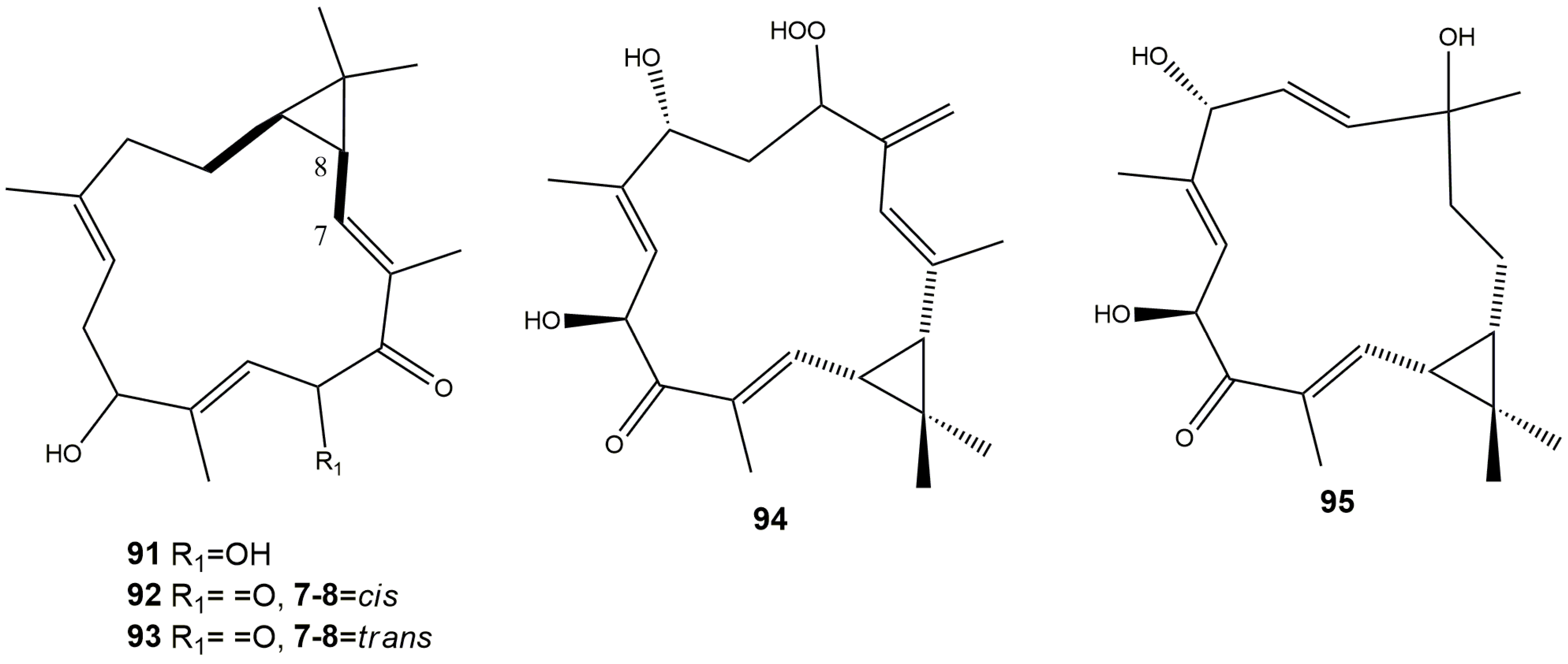
| (91) EBC-131 | Croton insularis | Stem | MCF-7 | MTS | IC50 = 60 µM | Maslovskaya et al. [41] |
| (92) EBC-180 | Croton insularis | Stem | MCF-7 | MTS | IC50 = 18 µM | Maslovskaya et al. [41] |
| (93) EBC-181 | Croton insularis | Stem | MCF-7 | MTS | IC50 = 30 µM | Maslovskaya et al. [41] |
| (94) EBC-304 | Croton insularis | Aerial parts | MCF-7 | MTS | IC50 = 5 µM | Maslovskaya et al. [40] |
| (95) EBC-320 | Croton insularis | Aerial parts | MCF-7 | MTS | IC50 = 3 µM | Maslovskaya et al. [40] |
| Compound | Species | Plant Part | Cancer Cell Line | Method | Results | References |
|---|---|---|---|---|---|---|
| (96) Launine O | Croton laui | Aerial parts | MCF-7 | MTT | IC50 = > 50 μM | Yang et al. [36] |
| (97) Launine P | Croton laui | Aerial parts | MCF-7 | MTT | IC50 = > 50 μM | Yang et al. [36] |
| (98) (1S,4R,13S)-Cembra-2E,7E,11-E-trien-4,13-diol | Croton laui | Aerial parts | MCF-7 | MTT | IC50 = > 50 μM | Yang et al. [36] |
| (99) Sarcophytol T | Croton laui | Aerial parts | MCF-7 | MTT | IC50 = > 50 μM | Yang et al. [36] |
| (100) Serratol | Croton laui | Aerial parts | MCF-7 | MTT | IC50 = > 50 μM | Yang et al. [36] |
| (101) Nephthenol | Croton laui | Aerial parts | MCF-7 | MTT | IC50 = > 50 μM | Yang et al. [36] |
| Compound | Species | Plant Part | Cancer Cell Line | Method | Results | References |
|---|---|---|---|---|---|---|
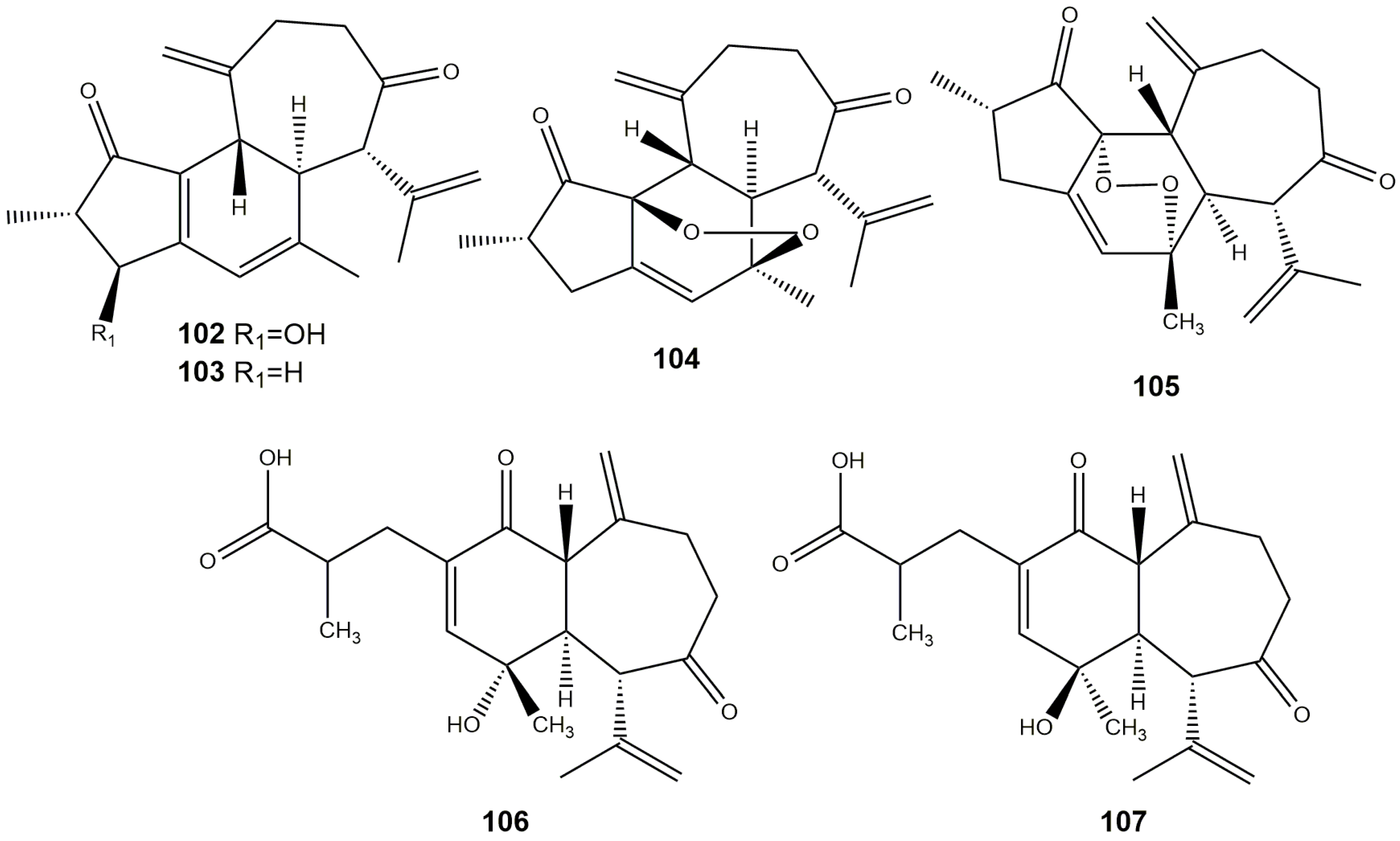
| (102) Crokocrotogenoid A | Croton kongensis | Leaves, branches | MDA-MB-231, MCF-7 | MTT | IC50 = > 20 μM (MDA-MB-231), IC50 = > 20 μM (MCF-7) | Zhu et al. [28] |
| (103) EBC-162 | Croton insularis | Stem | MCF-7 | MTS | IC50 = 30 µg/mL | Maslovskaya et al. [42] |
| (104) EBC-233 | Croton insularis | Stem | MCF-7 | MTS | IC50 = 20 µg/mL | Maslovskaya et al. [42] |
| (105) EBC-300 | Croton insularis | Stem | MCF-7 | MTS | IC50 = 100 µg/mL | Maslovskaya et al. [42] |
| (106) EBC-240 | Croton insularis | Stem | MCF-7 | MTS | IC50 = 50 µg/mL | Maslovskaya et al. [42] |
| (107) EBC-241 | Croton insularis | Stem | MCF-7 | MTS | IC50 = 40 µg/mL | Maslovskaya et al. [42] |
| Compound | Species | Plant Part | Cancer Cell Line | Method | Results | References |
|---|---|---|---|---|---|---|
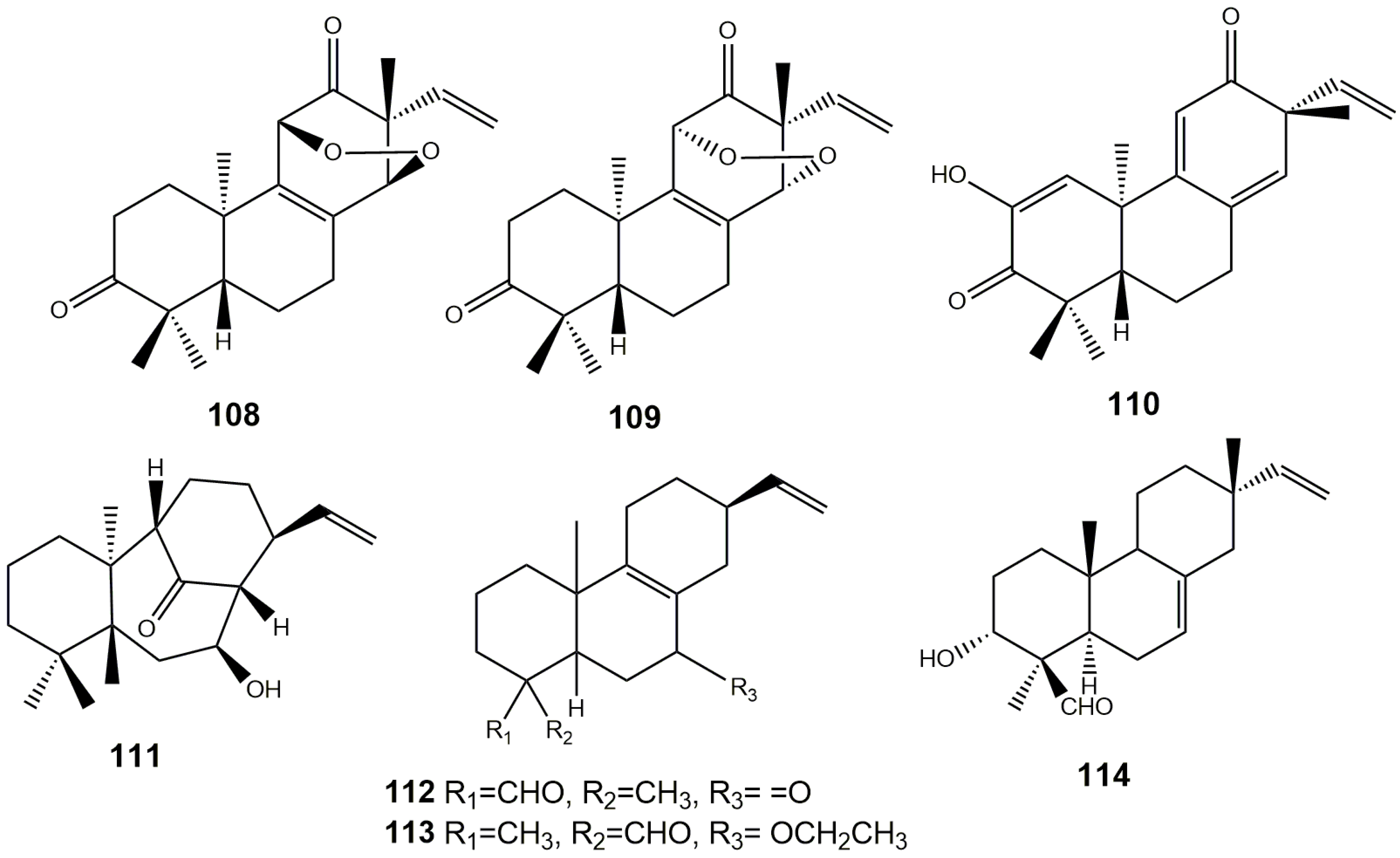
| (108) EBC-325 | Croton insularis | Stem | MCF-7 | MTS | IC50 = 20 µg/mL | Maslovskaya et al. [18] |
| (109) EBC-326 | Croton insularis | Stem | MCF-7 | MTS | IC50 = 14 µg/mL | Maslovskaya et al. [18] |
| (110) EBC-327 | Croton insularis | Stem | MCF-7 | MTS | IC50 = 10 µg/mL | Maslovskaya et al. [18] |
| (111) Lauicyclone A | Croton laui | Leaves | MCF-7 | MTT | IC50 = 36.7 µM | Li et al. [43] |
| (112) Lauicyclone B | Croton laui | Leaves | MCF-7 | MTT | IC50 = 24.6 µM | Li et al. [43] |
| (113) Lauicyclone D | Croton laui | Leaves | MCF-7 | MTT | IC50 = 38.8 µM | Li et al. [43] |
| (114) Lauicyclone E | Croton laui | Leaves | MCF-7 | MTT | IC50 = 49.3 µM | Li et al. [43] |
| Compound | Species | Plant Part | Cancer Cell Line | Method | Results | References |
|---|---|---|---|---|---|---|
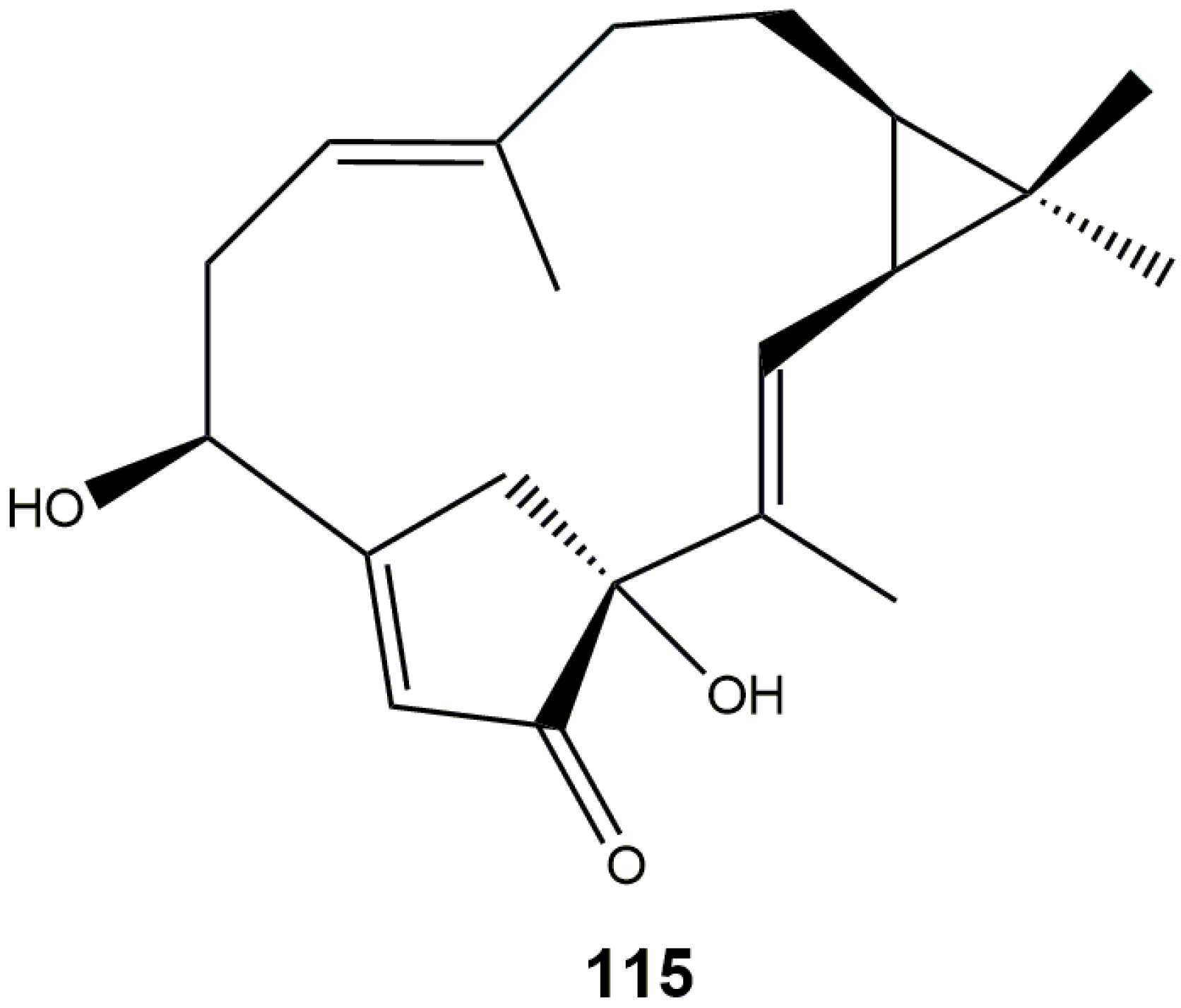
| (115) EBC-219 | Croton insularis | Stem | MCF-7 | MTS | IC50 = 80 µM | Maslovskaya et al. [41] |
Disclaimer/Publisher’s Note: The statements, opinions and data contained in all publications are solely those of the individual author(s) and contributor(s) and not of MDPI and/or the editor(s). MDPI and/or the editor(s) disclaim responsibility for any injury to people or property resulting from any ideas, methods, instructions or products referred to in the content. |
© 2026 by the authors. Published by MDPI on behalf of the Österreichische Pharmazeutische Gesellschaft. Licensee MDPI, Basel, Switzerland. This article is an open access article distributed under the terms and conditions of the Creative Commons Attribution (CC BY) license.
Share and Cite
Bezerra, J.J.L.; Luz, M.A.d.; Ferreira, A.P.; França, J.F.; Santos, T.P.; Pinheiro, A.A.V.; Torres, M.d.C.d.M. Cytotoxic Potential of Diterpenoids from the Genus Croton Against Breast Cancer Cell Lines: A Comprehensive Review. Sci. Pharm. 2026, 94, 24. https://doi.org/10.3390/scipharm94010024
Bezerra JJL, Luz MAd, Ferreira AP, França JF, Santos TP, Pinheiro AAV, Torres MdCdM. Cytotoxic Potential of Diterpenoids from the Genus Croton Against Breast Cancer Cell Lines: A Comprehensive Review. Scientia Pharmaceutica. 2026; 94(1):24. https://doi.org/10.3390/scipharm94010024
Chicago/Turabian StyleBezerra, José Jailson Lima, Mateus Araújo da Luz, Aline Peres Ferreira, Joseilton Franco França, Tatiana Porto Santos, Anderson Angel Vieira Pinheiro, and Maria da Conceição de Menezes Torres. 2026. "Cytotoxic Potential of Diterpenoids from the Genus Croton Against Breast Cancer Cell Lines: A Comprehensive Review" Scientia Pharmaceutica 94, no. 1: 24. https://doi.org/10.3390/scipharm94010024
APA StyleBezerra, J. J. L., Luz, M. A. d., Ferreira, A. P., França, J. F., Santos, T. P., Pinheiro, A. A. V., & Torres, M. d. C. d. M. (2026). Cytotoxic Potential of Diterpenoids from the Genus Croton Against Breast Cancer Cell Lines: A Comprehensive Review. Scientia Pharmaceutica, 94(1), 24. https://doi.org/10.3390/scipharm94010024