
Opinion

The Role of Lipid-Lowering Treatment in the Secondary Prevention of Ischemic Stroke
by
Alexandra Tsankof
and
Konstantinos Tziomalos
*
First Propedeutic Department of Internal Medicine, Medical School, Aristotle University of Thessaloniki, AHEPA Hospital, 54636 Thessaloniki, Greece
*
Author to whom correspondence should be addressed.
Diseases 2022, 10(1), 3; https://doi.org/10.3390/diseases10010003

Submission received: 31 October 2021 / Revised: 12 December 2021 / Accepted: 17 December 2021 / Published: 27 December 2021
(This article belongs to the Special Issue Lipids, Health, and Diseases: The Interplay)

Abstract

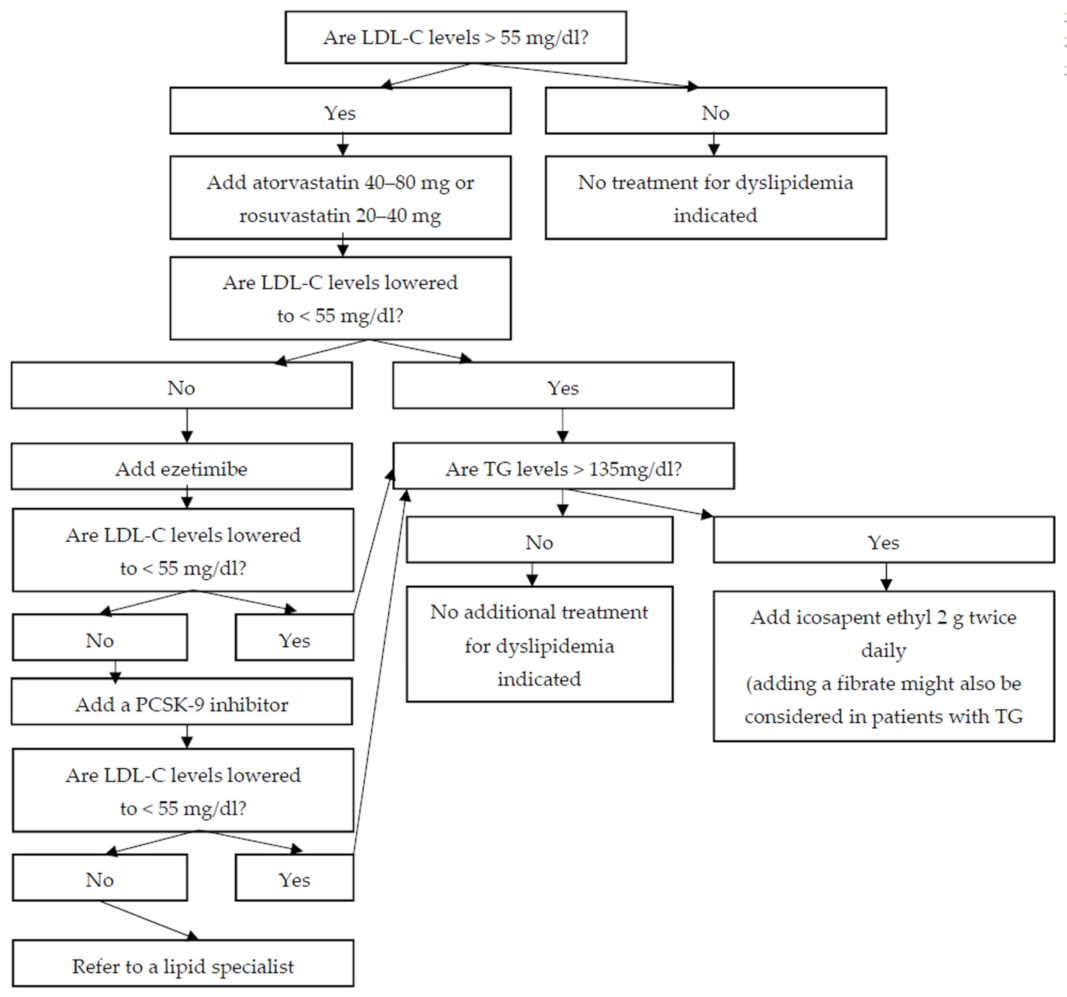
Dyslipidemia is a major modifiable risk factor for ischemic stroke. Treatment with statins reduces the incidence of recurrent ischemic stroke and also reduces coronary events in patients with a history of ischemic stroke. Therefore, statins represent an important component of secondary prevention of ischemic stroke. In patients who do not achieve low-density lipoprotein cholesterol (LDL-C) targets despite treatment with the maximal tolerated dose of a potent statin, ezetimibe should be added to their lipid-lowering treatment and also appears to reduce the risk of cardiovascular events. Selected patients who do not achieve LDL-C targets despite statin/ezetimibe combination are candidates for receiving proprotein convertase subtilisin/kexin type 9 (PCSK9) inhibitors. Finally, it appears that adding icosapent ethyl might also reduce cardiovascular morbidity in patients who have achieved LDL-C targets but have persistently elevated triglyceride levels.
Keywords: ischemic stroke; secondary prevention; lipids; statins; ezetimibe; proprotein convertase subtilisin/kexin type 9 inhibitors; icosapent ethyl ischemic stroke; secondary prevention; lipids; statins; ezetimibe; proprotein convertase subtilisin/kexin type 9 inhibitors; icosapent ethyl