Article

Real-Time Traffic Data Analysis on Resource-Constrained Edge Devices

1
Military Academy, University of Defence in Belgrade, 11042 Belgrade, Serbia
2
Faculty of Electronic Engineering, University of Niš, 18000 Niš, Serbia
3
Department of Information Technology, University of Criminal Investigation and Police Studies, 11080 Belgrade, Serbia
4
Center for Applied Mathematics and Electronics, 11000 Belgrade, Serbia
*
Author to whom correspondence should be addressed.
Electronics 2026, 15(8), 1703; https://doi.org/10.3390/electronics15081703
Submission received: 13 March 2026 / Revised: 11 April 2026 / Accepted: 14 April 2026 / Published: 17 April 2026

Abstract

This paper evaluates the feasibility of real-time traffic data analysis on resource-constrained edge devices using a hybrid processing approach. The proposed architecture integrates an LF Edge eKuiper complex event processing engine, deployed within Docker containers, with a native YOLO deep learning model for pedestrian detection. The model processes video frames at 480 × 240 resolution on CPU-only Raspberry Pi devices, achieving up to 30 FPS. The research specifically investigates the performance limits of Raspberry Pi 3 and Raspberry Pi 4 platforms when simultaneously processing high-throughput simulated traffic data from the SUMO simulator (Belgrade scenario, with vehicle distributions and densities adjusted for small, medium, and large traffic volumes) and live video streams, respectively. Experimental results indicate that while both platforms can process up to 2600 messages per second in the settings without image processing, the introduction of a camera sensor reveals a significant hardware bottleneck. The Raspberry Pi 4 maintains robust real-time performance with an average complex event detection latency of less than 500 ms. In contrast, the Raspberry Pi 3 exhibits severe performance degradation, with image processing delays exceeding 8 s, rendering it unsuitable for real-time safety alerts. The findings demonstrate that with appropriate hardware selection, edge-based complex event processing can successfully detect critical safety events, such as sudden vehicle acceleration near pedestrians, without relying on cloud infrastructure.

1. Introduction

In the domain of smart cities, real-time data processing has evolved from a technical advantage to a critical requirement for urban safety. Key trends such as decentralization and artificial intelligence (AI) integration are redefining system expectations, enabling context-aware systems capable of autonomously responding to environmental conditions. Energy-efficient communication technologies further support this paradigm by enabling reliable and long-lasting connectivity between devices, which is essential for scalable and sustainable smart city systems [1,2]. However, this shift has led to an explosion of high-volume data generated by Internet of Things (IoT) devices. The primary challenge is no longer just data collection, but processing these continuous streams within millisecond time windows to enable immediate action. This is of particular importance in Intelligent Transportation Systems (ITSs), where pedestrian safety depends on the system’s ability to detect and respond to risk situations and hazards in real time.
Traditional IoT architectures were typically divided into three layers: Things, Gateways, and Cloud [3]. However, as the volume of data grows, the centralized Cloud model introduces significant bottlenecks in terms of network bandwidth and latency. To mitigate these issues, Edge Computing that includes functionality and infrastructure of Things and Gateways has emerged as a paradigm shift [4]. In this context, Fog and Edge computing are often considered as referring to similar architectures that aim at moving data processing closer to the source to handle the influx of information from diverse and heterogeneous devices [5].
Thus, the strategy for data analysis is typically divided by its temporal value: edge analytics focuses on answering “what is happening now,” whereas cloud analytics aims to explain “why it happened” [5]. The integration of AI and, in particular, machine learning (ML) enables advanced capabilities such as real-time prediction and pattern recognition. While training ML models requires substantial computational resources found in the cloud, deploying inference models at the edge provides an effective solution for latency-sensitive applications [6]. However, implementing these capabilities on resource-constrained devices remains a significant engineering challenge. To maintain real-time performance, lightweight engines capable of performing Complex Event Processing (CEP) on affordable hardware are required to detect critical safety events as they occur [7]. Recent trends show that containerization, specifically using Docker, provides a flexible and scalable environment for deploying such analytics at the edge [8,9]; additionally, important directions in edge graph learning have recently received research attention [10].
This paper addresses this challenge by proposing an edge-based architecture designed to enhance pedestrian safety through the efficient processing of high-throughput data streams. Specifically, we investigate the feasibility of using a lightweight CEP engine on Raspberry Pi (RPi) platforms to process traffic data. Unlike generic IoT studies, this research utilizes a hybrid validation approach: traffic logic is simulated for the city of Belgrade using the SUMO (Simulation of Urban MObility) simulator, while pedestrian presence is integrated via live video stream analysis using a deep residual learning model [11].
The main contributions of this paper are:
  • To design a containerized edge architecture for real-time stream analytics based on a lightweight CEP engine, the Docker containers and the Message Queuing Telemetry Transport protocol (MQTT).
  • To implement a real-time complex event detection and analysis system on edge computing devices for traffic-related scenarios. We also aim to perform a comparative performance analysis between the Raspberry Pi 3 and Raspberry Pi 4 platforms, investigating the hardware limits of resource-constrained edge nodes when performing concurrent real-time video inference and complex event processing.
  • To validate the system’s ability to detect complex traffic events (e.g., sudden vehicle acceleration near pedestrians) with sub-500 ms latency.
The remainder of this paper is organized as follows. Section 2 provides an overview of related studies in edge analytics. Section 3 describes the research objectives and introduces the underlying edge computing architecture. Section 4 reports on the experimental settings and performance analysis. Finally, Section 5 concludes the paper.

2. Background and Related Work

The challenge of optimizing real-time data processing in smart-city environments has led to various approaches, ranging from simple data filtering to complex hybrid systems.

2.1. Edge Processing Architectures

Shifting the processing paradigm from the cloud to the edge is a primary strategy for mitigating network bandwidth bottlenecks, enhancing privacy protection and minimizing response latency. For example, Bezerra et al. [12] simulated a Smart Agriculture scenario involving 100 sensors and 20 fog nodes using Python and an MQTT to transmit 3600 messages in total. Their findings demonstrated that local processing can significantly reduce latency and network load. Silva et al. [5] demonstrate that while the cloud remains general purpose and scalable, the edge is superior for specialized, latency-sensitive tasks. The proposed architecture was evaluated using simulated sensors that transmitted data to an MQTT broker, utilizing Apache Edgent at the Gateway level to perform local filtering. Similarly, Xinwei et al. [13] conceptualize the edge as a distributed collection of gateways with lower processing capabilities, arguing that such devices should primarily handle basic operations like local aggregation. In their experimental setup, Apache Storm was deployed on a Raspberry Pi platform serving as an edge device, and they introduced custom algorithms to decouple threads and improve responsiveness. The decentralization of data management is further supported by microservice-based architectures. Bixio et al. [14] implement a layered approach using the Java OSGi standard, and demonstrate that adhering to the single responsibility principle enables three-dimensional scalability: horizontal, functional, and data partitioning. In their framework, the Siddhi Complex Event Processing engine was integrated to handle real-time streams, proving that modular nanoservices can effectively manage complex event logic at the network edge. Likewise, Jin et al. utilized [15] the EdgeX platform deployed on a Raspberry Pi platform as the edge devices leveraging the eKuiper engine. The experiments showed that multiple eKuiper instances can be deployed simultaneously to process different data streams, further reducing latency and enabling flexible resource management at the edge device level. Sreekumar et al. [16] focused on processing video from traffic cameras to monitor vehicle flow on edge devices. In their study, the hardware used included an Intel i7 CPU and an NVIDIA 1080 GTX GPU.

2.2. Complex Event Processing and Intelligence at the Edge

Accounting for temporal context in continuous data stream analysis is of fundamental importance for extracting useful insights into dynamic environments. Corral Plaza [17] demonstrates that isolated sensor readings are of a limited operational value when not processed within temporal windows, illustrating that event frequency rather than single observations can be used to trigger meaningful alerts. Ou et al. [18] investigated streaming data processing to predict the number of passengers in metro systems based on ticket sales. They developed a custom model capable of forecasting the passenger flow in real time. To optimize such processes on resource-constrained devices, Lan et al. [7] propose shifting the analytics closer to the network edge, and show that defining elementary event rules prior to higher-level complex event processing reasoning may significantly reduce bandwidth consumption and computational overhead. To move beyond mere detection toward proactive safety, Akbar et al. [19] integrate machine learning with complex event processing, thus enabling predictive event reasoning in IoT environments. The proposed architecture combined ingestion, stream management, and rule evaluation layers to demonstrate real-time traffic prediction using hybrid historical and live datasets. The focus on “event reasoning” is maintained in [20,21], considering, respectively, multimodal sensing frameworks in which lightweight vision inference is fused through complex event processing rules to trigger automated safety responses, and hybrid neural–pattern recognition pipelines for spatial–temporal reasoning. In general, those studies highlight the importance of stream-oriented infrastructures capable of processing continuous event flows. Stream processing engines support this functionality by enabling filtering, aggregation, joins, and window-based operations directly over transient data streams, thereby minimizing latency compared to storage-centric approaches. Uyanık et al. [22] report on a dedicated distributed complex event processing system based on Python, MongoDB, and MQTT. In the practical IoT edge deployments, the data sources typically correspond to sensors or brokers, while the sinks represent actuators or upstream aggregation layers. Complex event processing extends stream processing by allowing for correlation across multiple heterogeneous event sources using rule-based logic expressed through SQL-like query languages rather than storing data for retrospective analysis. Such systems continuously evaluate incoming events against predefined patterns to detect contextual situations in real time. Although inherently reactive, complex event processing can be enhanced through integration with machine learning models to support predictive reasoning and proactive responses in safety-critical environments [4,23,24,25,26].

2.3. Containerization and Video Analytics on Resource-Constrained Nodes

Docker has emerged as a key technology for managing complex analytics at the edge, providing environment isolation of modular processing layers. Related to the the Gateway component, two types of architecture can be distinguished based on where data processing occurs: fog computing and edge computing (including near-edge and far-edge). Containerization simplifies deployment, improves stability under variable workloads, and enables horizontal scalability on resource-constrained devices. In multi-node setups, a master node may host a local registry for Docker images, while peripheral nodes retrieve them locally, minimizing bandwidth usage [27,28]. A common platform for edge gateways is the Raspberry Pi, a compact single-board computer offering sufficient computational power for lightweight analytics while maintaining low cost and energy consumption [8,9,15,22,28,29,30,31,32]. A minimum configuration of Docker based edge applications generally includes a quad-core ARM Cortex-A53 CPU at 1.2 GHz and 1 GB of RAM [8,9,29]. Such platforms allow concurrent execution of analytics containers for data preprocessing, stream processing, and ML inference [28,30]. Several edge analytics platforms support IoT and real-time data processing. Apache Edgent provides local analytics to reduce the cloud bandwidth, though it is no longer actively maintained [33]. EdgeX Foundry, a microservices-based framework, can run on edge gateways using containerization and integrate rule-based engines, such as EMQX eKuiper, for high-throughput traffic and sensor event processing. EMQX eKuiper, a rule-based edge analytics engine, is integrated into the EdgeX ecosystem. Due to its lightweight footprint and SQL-like query capability, it is suitable for real-time stream processing directly on gateway devices [34]. Raspberry Pi and eKuiper allow modular, scalable, and reproducible deployment of stream processing engines and complex event processing e-based applications, making them suitable for experimentation with heterogeneous sensor data and vision-based event streams in smart city scenarios. In contrast to previous work, we propose an approach capable of processing high-volume of traffic messages in real time while detecting complex events on resource-constrained edge devices such as the Raspberry Pi. Our approach evaluates the system under three test cases with different workload intensities, where the message rate reaches up to 2400 messages per second, with each message containing 11 attributes. While the considered studies explore general edge architectures [5,13], hierarchical CEP optimizations [7], and isolated video analytics [11,29], there is a noticeable lack of research aimed at evaluating the performance limits and scalability of different hardware settings in the context of applying unified stream processing engines. Most of the existing studies either focus on simulation-based event processing on high-performance nodes or perform intensive video analytics on a single device, without assessing the overhead of concurrent, high-throughput data streams.

3. Research Objectives and Edge Computing Architecture

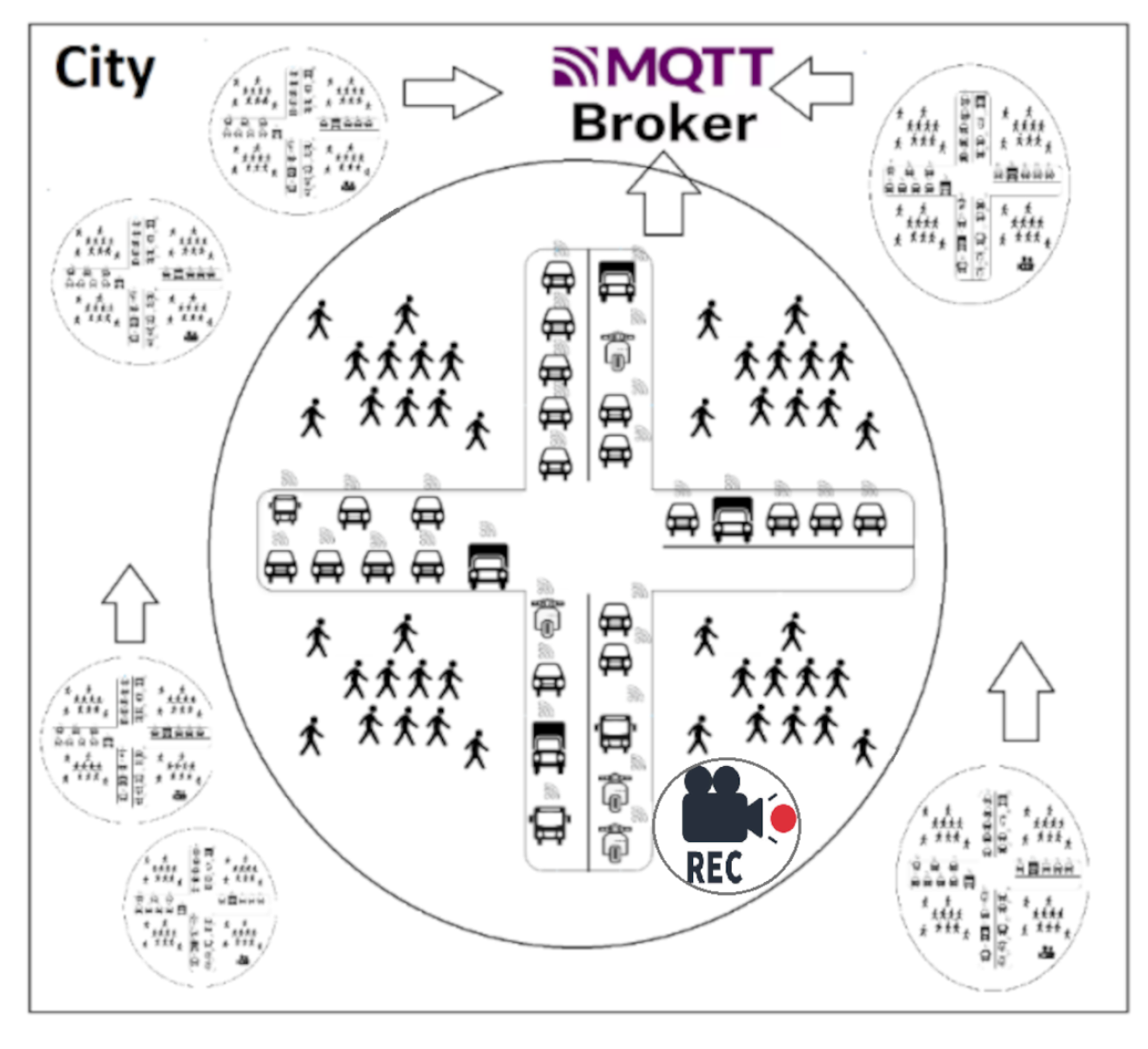
The primary objective of this research is to address this shortcoming of the related research by analyzing the capabilities of the Raspberry Pi 3 and Raspberry Pi 4 platforms for processing high-volume data within a hybrid environment. Unlike previous approaches, this work evaluates the performance of the LF Edge eKuiper engine as a unified processing layer, simultaneously handling simulated city-scale traffic data generated by the SUMO simulator (i.e., Belgrade, the capital of Serbia, scenario) and real-time vision-based events. By deploying a core analytical engine within Docker containers and integrating it with a native deep learning inference, we aim at quantifying the system latency and event detection accuracy, and determining the operational limits of resource-constrained devices in proactive smart-city safety scenarios. The reported comparative analysis provides practical insights into how different edge hardware settings scale when tasked with complex, multi-source event reasoning. The primary objective of this research is to evaluate the feasibility of large-volume data processing in real time on an edge device in a traffic safety context. The proposed data processing pipeline is based on a stream processing engine designed to operate on resource-constrained edge hardware, such as a Raspberry Pi. Data originating from multiple heterogeneous sources are transmitted to an MQTT broker, which acts as a central message broker. To emulate real-world conditions, the SUMO traffic simulator was used to generate vehicular traffic data. In addition, live video streams from EarthCam.com were used to simulate real-time camera input, from which the pedestrians are detected. Data from both the sources were forwarded to a dedicated MQTT broker. Based on these input streams, the system detects safety-relevant complex events in real time, such as abnormal vehicle speeds or unexpected movement patterns, while simultaneously maintaining situational awareness of pedestrian presence at a crossroad. The overall goal is to develop a smart crossroad system capable of monitoring vehicular movement across a wider area and pedestrian activity at an intersection in real time. A visual overview of the proposed scenario is presented in Figure 1.
One of the critical events detected by the proposed system is related to sudden (i.e., sharp) acceleration or deceleration. If a vehicle exhibits a sudden change in speed within a short time interval, pedestrians are warned of the increased risk associated with potentially dangerous driving behavior. All data processing is performed locally, at a single intersection, which serves as a representative model of the proposed edge computing architecture. The experiment evaluates whether large-volume heterogeneous data can be processed at the edge in a timely manner, without relying on a cloud-based infrastructure for deep analytics. To illustrate this idea, the research focuses on detecting a complex event that triggers an alert when vehicle acceleration occurs in the presence of pedestrians. Acceleration of vehicle i is defined as the change in velocity over a given time interval Δ t , where K is a preset threshold representing the maximum time interval (in seconds) between two subsequent events:
A ( i , t ) = Δ V Δ t ,
where 0 < Δ t < K and Δ V = V ( t ) V ( t Δ t ) .
The cumulative acceleration of single vehicle i over a period T is defined as the number of times vehicle i generates sudden acceleration, i.e., acceleration above a given threshold A t h r :
N 1 ( i , t 0 , T , A t h r ) = t = t 0 t 0 + T f ( i , t , A t h r ) ,
where:
f ( i , t , A t h r ) = 1 , if | A ( i , t ) | > A t h r 0 , otherwise .
Equation (4) calculates the number of vehicles in lane L which generates at least one sudden acceleration within a given period T:
N 2 ( L , t 0 , T , A t h r ) = i L g ( i , t 0 , T , A t h r ) ,
where:
g ( i , t 0 , T , A t h r ) = 1 , if N 1 ( i , t 0 , T , A t h r ) > 0 0 , otherwise .
In the reported study, we set the threshold parameter A t h r to 1. This particular value is selected keeping in mind that the vehicle speed is expressed in meters per second (m/s). It should be noted, however, that this value is taken only for the purpose of illustration. In general, it should be considered as a parameter which may be tailored according to given requirements.
A pseudocode condition for triggering the alert is defined as follows:
P ( t ) > 0 N 2 ( L , t , T , A t h r ) > 0 ( i L ) ( N 1 ( i , t , T , A t h r ) G ) ,
where P ( t ) represents the number of detected pedestrians at moment t, and G is a preset threshold representing the number of cumulative acceleration events for a single vehicle. It should be noted that Equation (6) is not given as a comprehensive alarm condition, but rather as condition applied to illustrate the overall functionality of the system. In general, the alarm condition may be tailored to particular requirements.

4. Experimental Evaluation and Performance Analysis

4.1. Experimental Setup

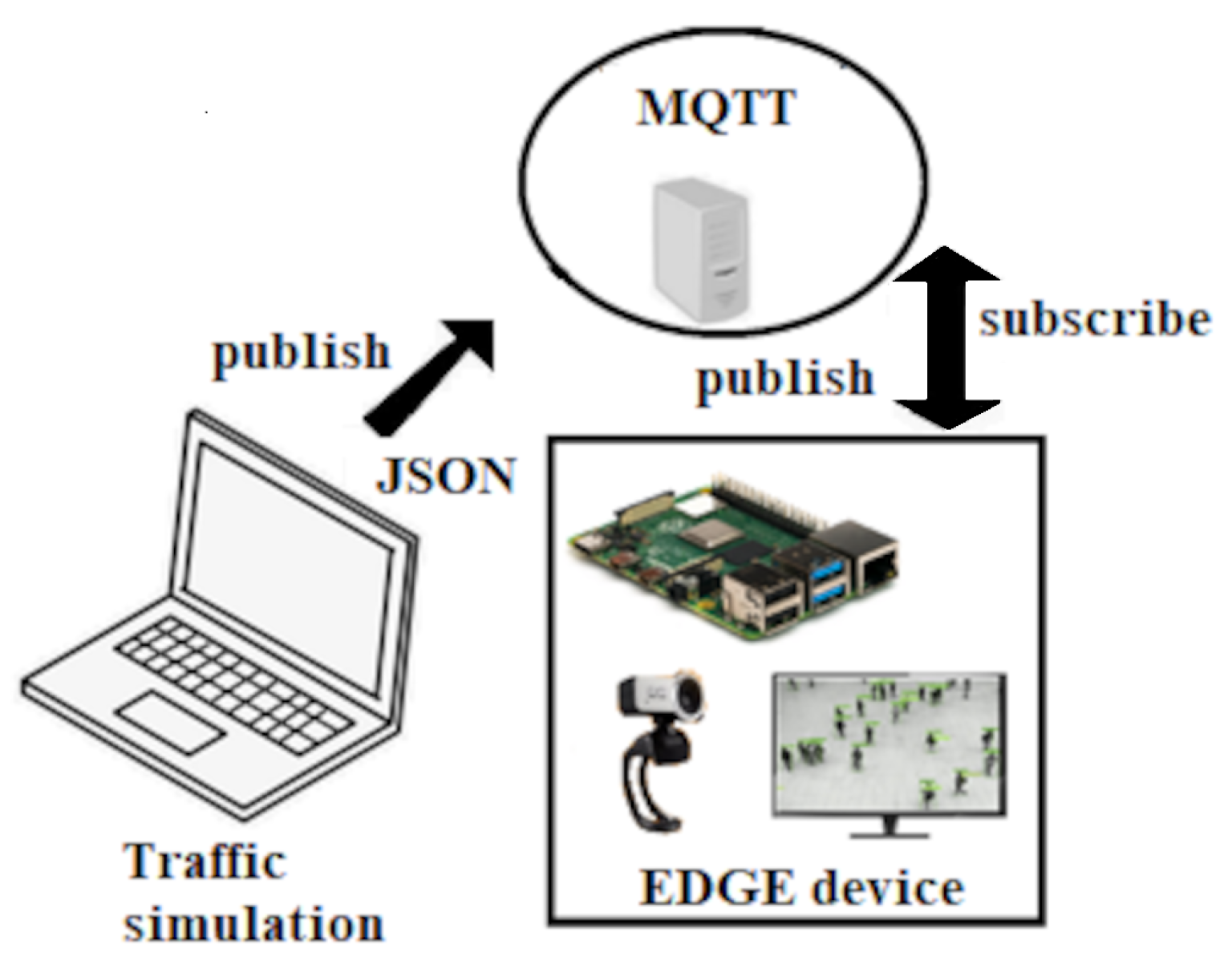
The overall setup for evaluating and testing the proposed edge computing infrastructure is illustrated in Figure 2, including a traffic simulation generator, an MQTT server, and an event detection service deployed on the edge device. The traffic simulation generator runs on a Dell Precision workstation configured with an Intel i9 CPU and 64 GB RAM. The data generated by the simulator are transmitted approximately every second via a dedicatedly developed custom application. The MQTT server is deployed on an HP workstation configured with an Intel i7 CPU and 32 GB RAM. The edge devices are based on Raspberry Pi platforms: Raspberry Pi 3 and Raspberry Pi 4.
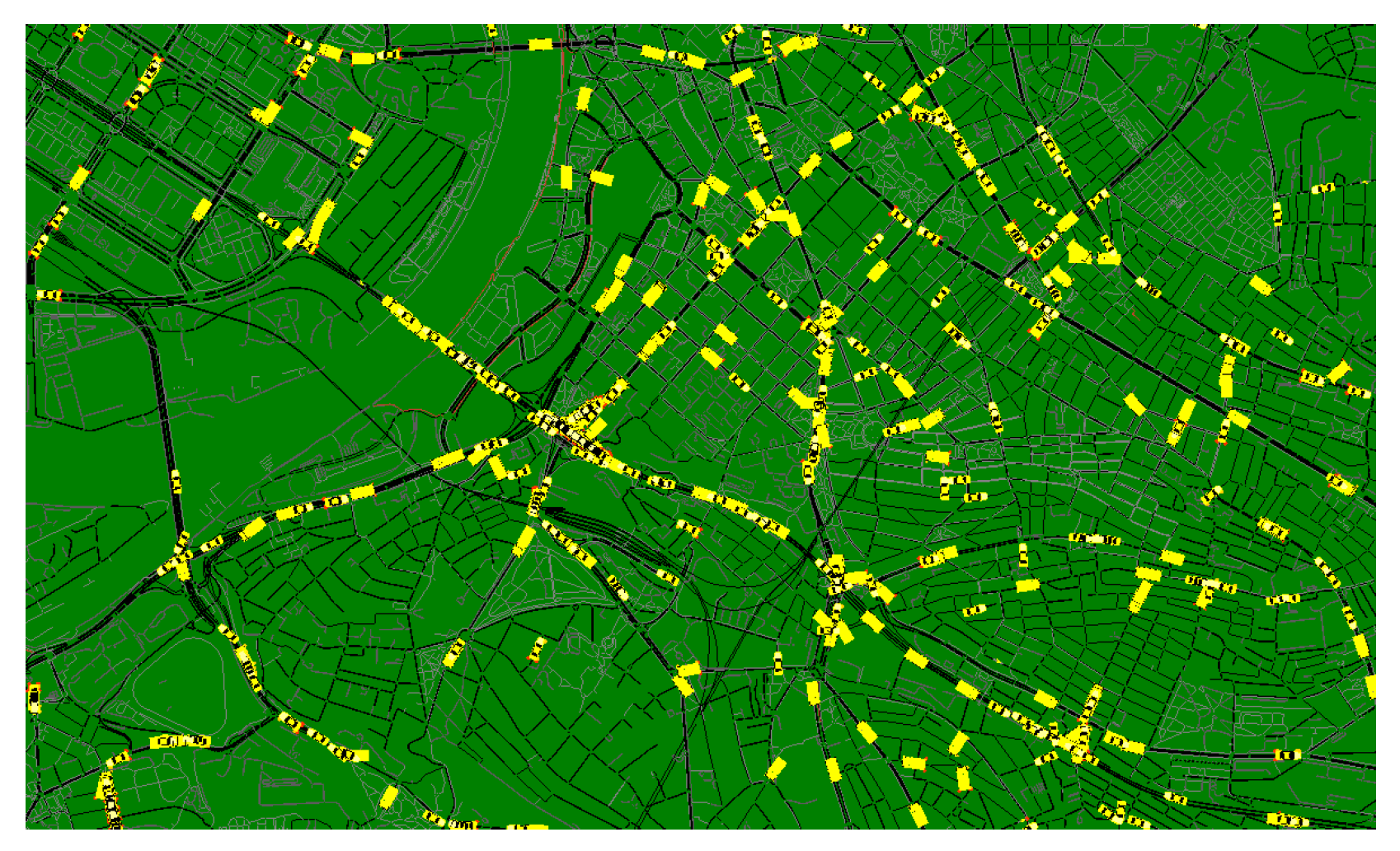
In the considered scenario, traffic data are generated using the SUMO simulator, focusing on one of the busiest areas of the city of Belgrade, Serbia. The map representation of the given urban area is given in Figure 3. The simulation runs for 7400 s (i.e., over two hours), during which a variable amount of data is produced each second. The SUMO simulation is configured using real-world map data extracted from OpenStreetMap for the entire urban area of Belgrade. Therefore, the simulation may be considered representative for the purpose of evaluation of the system performance under controlled yet realistic conditions. The traffic network is generated using the osmconvert software component, followed by the netconvert component to produce a net.xml file used in SUMO. The selected geographic area corresponds to the bounding box defined by coordinates (20.41648, 44.75332) and (20.51147, 44.82524).
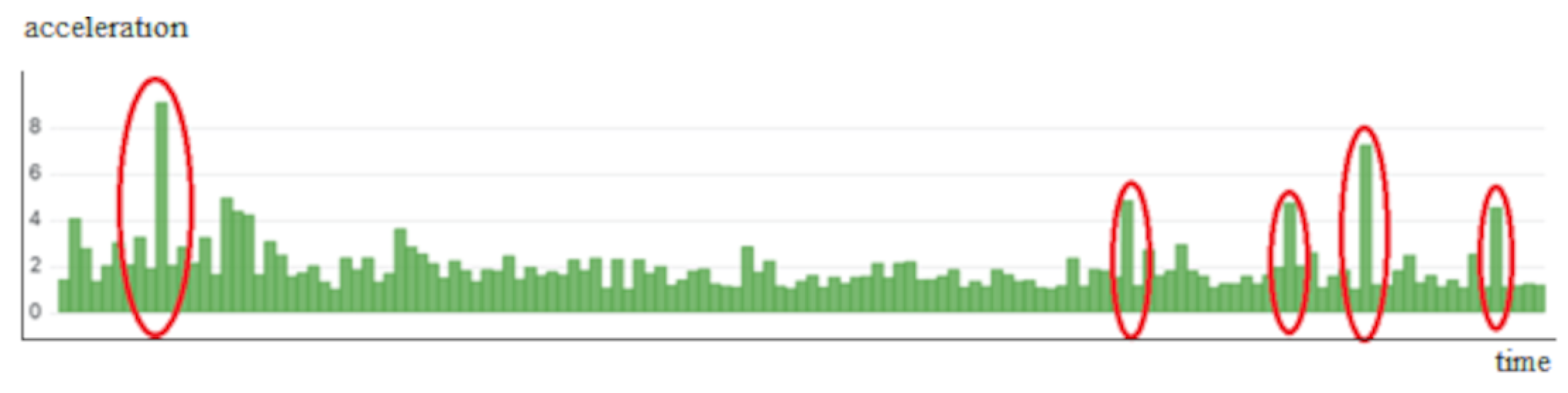
The dedicated custom application transmits the generated data to the MQTT broker (formatted as JSON files) in real time. The attributes of each message are summarized in Table 1. The MQTT broker is capable of handling more than 10,000 messages per second at the Quality of Service (QoS) level 0, even when deployed on devices with limited computational resources, such as Raspberry Pi platforms. Figure 4 illustrates the distribution of sudden accelerations of vehicle movements.
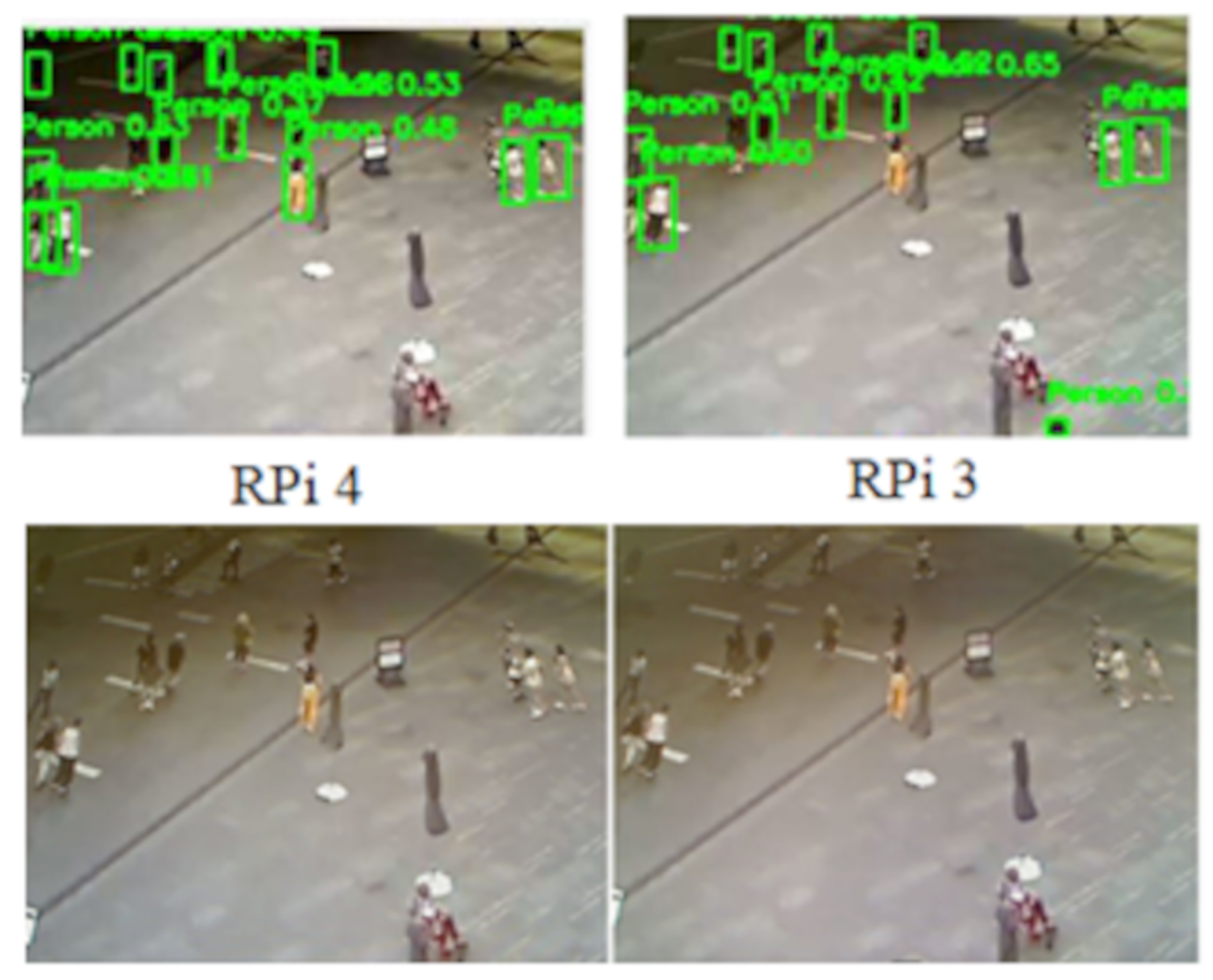
To integrate the information on real-time pedestrian presence, live video footage from one side of the monitored intersection, captured over a two-hour period, is analyzed using a YOLO model for real-time object detection deployed on a camera connected to an edge device. The primary objective of this monitoring is to extract information on pedestrian presence during different time intervals. The selected frames of this footage, with pedestrian detection results obtained from both the platforms, respectively, are given in Figure 5.
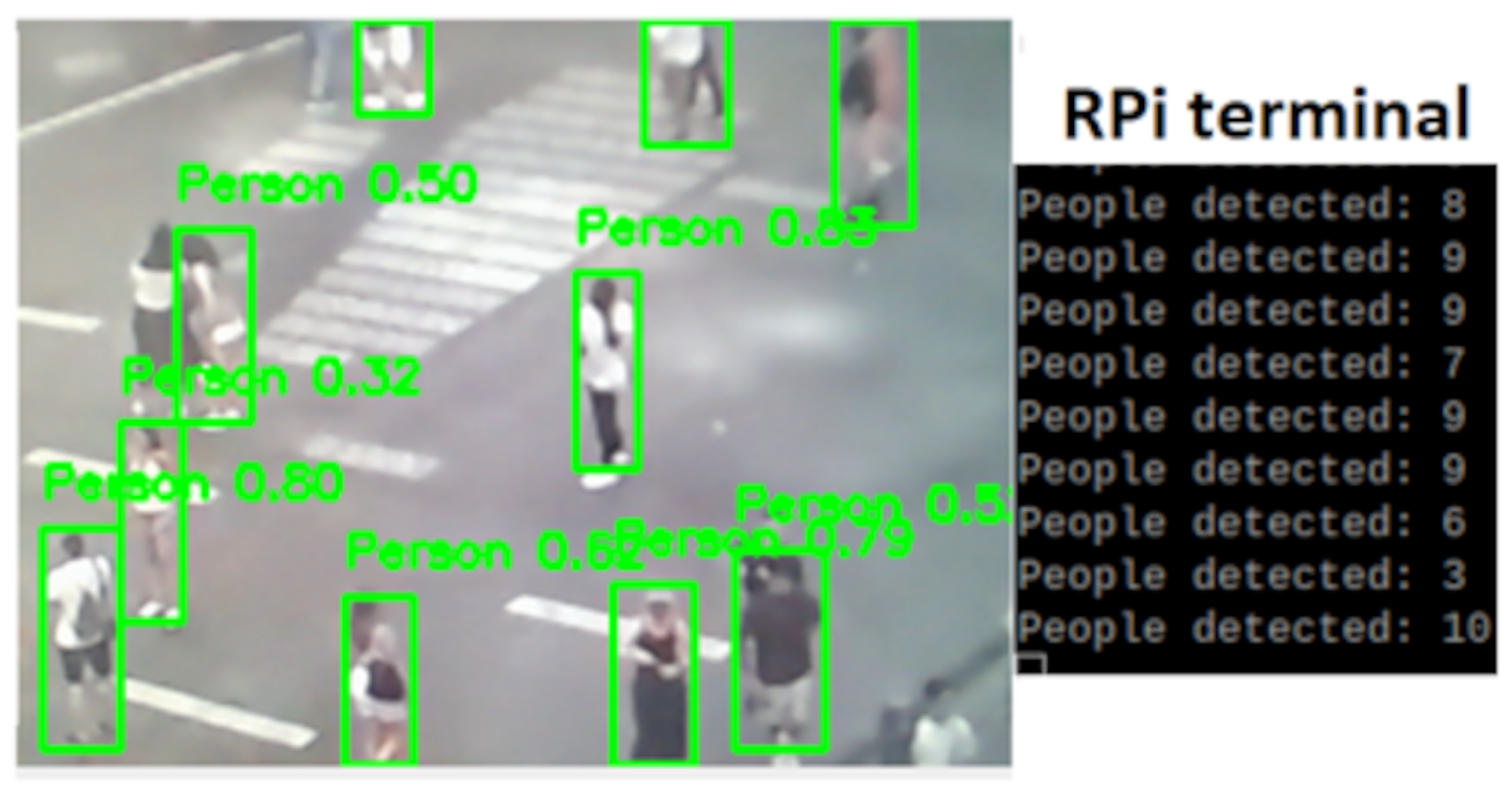
A Raspberry Pi platform was used with the Docker and Docker containers to manage and execute the required services. For the purpose of complex event processing, the EMQX Kuiper (eKuiper) engine was selected due to its lightweight architecture and compatibility with edge computing constraints. As described, live stream video data were captured and displayed on a screen. A camera was positioned to record the display and to detect pedestrians. For pedestrian detection and counting, the YOLOv8n model was employed, implemented within the OpenCV (cv2) framework. This model processes input frames at a resolution of 480 × 240 pixels, achieving a processing rate of 30 FPS. The inference is performed exclusively on CPU, without hardware acceleration. The environment was set up to monitor the central area of the considered crossroad. Figure 6 illustrates the camera view along with the detected pedestrian count.
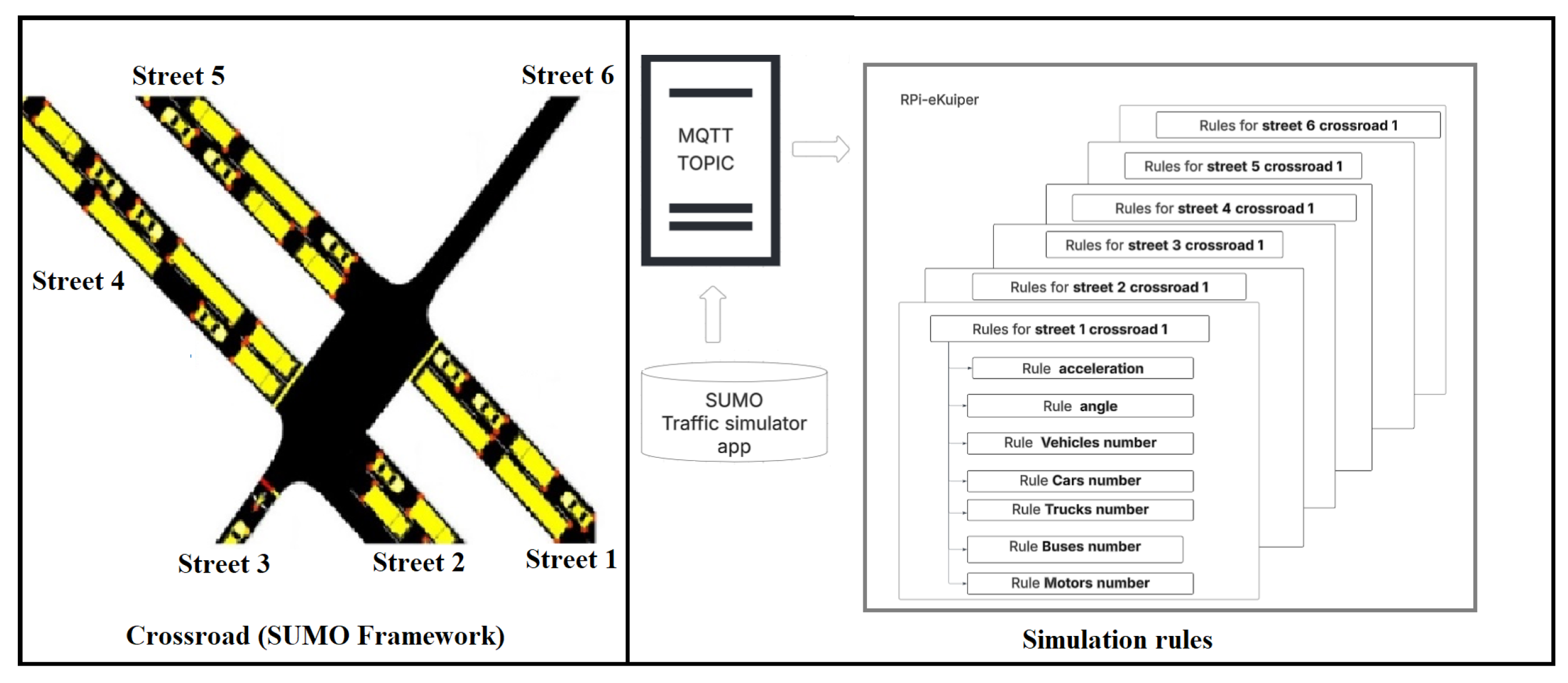
For real-time data stream processing from all the sources (i.e., the traffic data and live stream video data), a set of rules for monitoring driving behavior and pedestrian presence at a given crossroad have been implemented on the eKuiper engine. The layout of the intersection and the applied rules are illustrated in Figure 7. The considered intersection comprises six street segments.
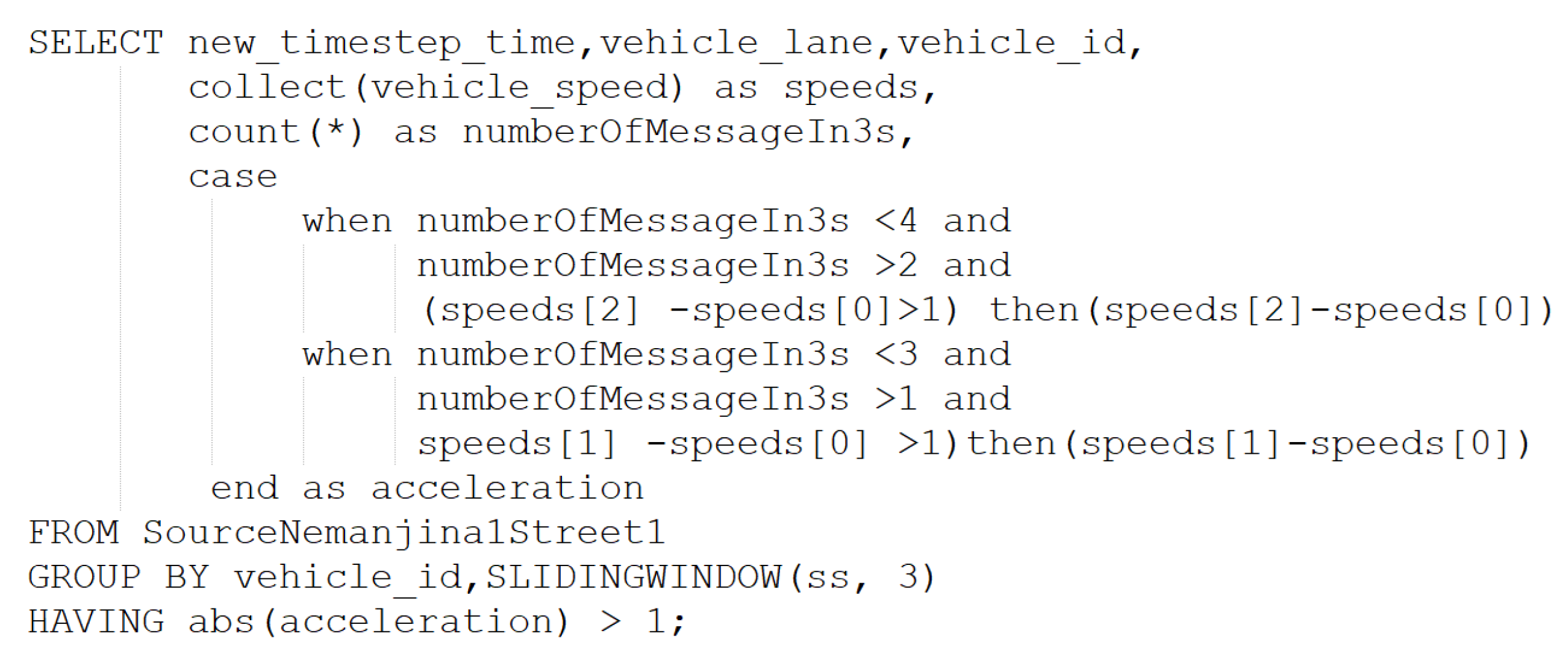
For each street segment, a separate set of rules determines the numbers and types of vehicles (e.g., cars, trucks, motorcycles, buses), their accelerations and changes in direction. Combined with the rules determining the number of pedestrians, complex traffic safety events are simulated. An example of an eKuiper rule illustrating the implementation of the proposed approach is shown in Figure 8.
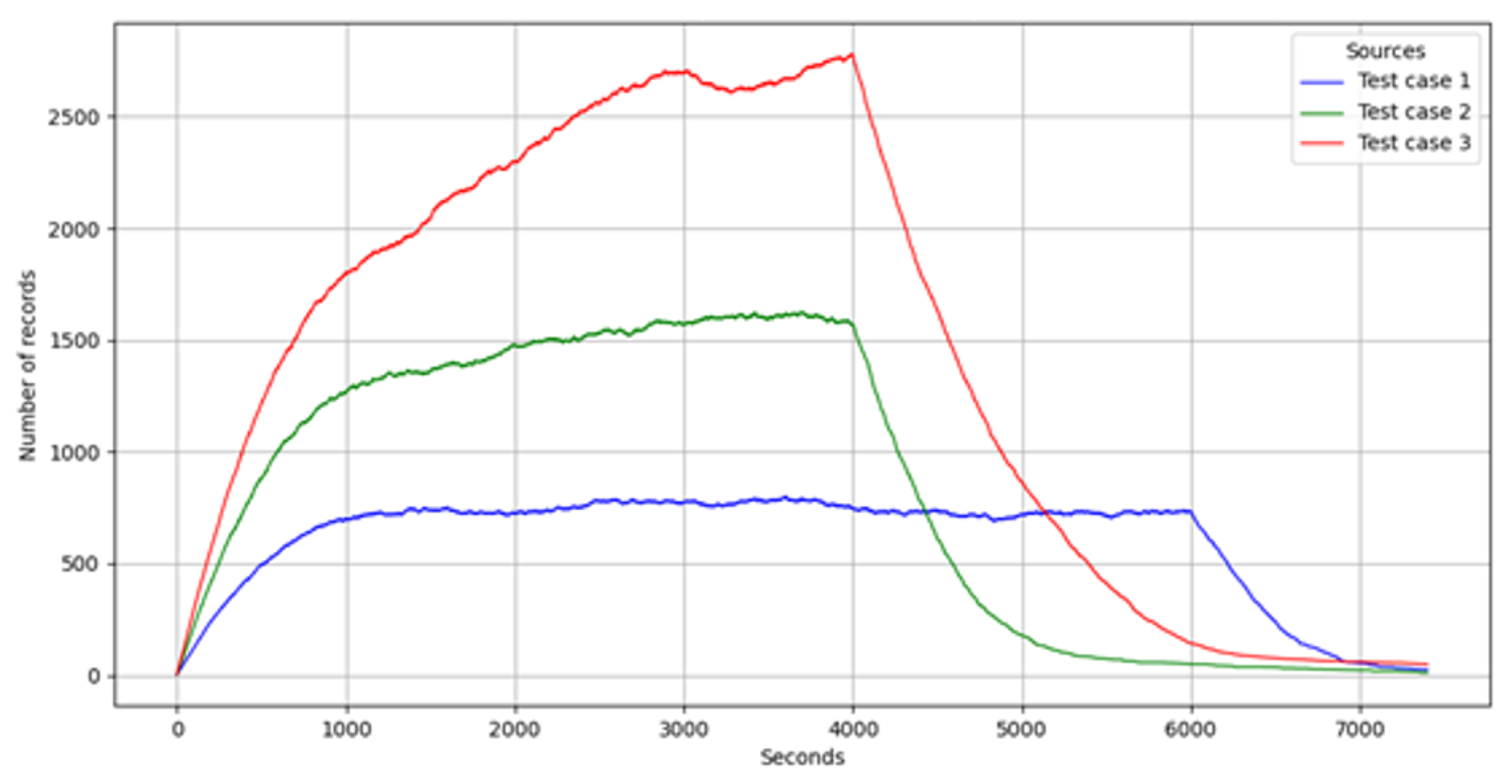
We consider a 3 × 2 × 2 experimental design. The first variable is related to traffic volume. Three distinct test cases were considered using the SUMO simulator for the given urban area, with different numbers of messages per second for each case, as illustrated in Figure 9. Test case 1 represents low traffic volume (i.e., the blue line), test case 2 medium traffic volume (i.e., the green line), and test case 3 high traffic volume (i.e., the red line). All three simulations lasted for 7400 s and were generated using different parameter settings, as summarized in Table 2.
The second variable is related to the Raspberry Pi platform. We applied two platforms: Raspberry Pi 3 (ARMv8, 64-bit, 1.4 GHz, 1 GB RAM, Gigabit Ethernet over USB 2.0) and Raspberry Pi 4 (ARMv8, 64-bit, 1.8 GHz, 4 GB RAM, Gigabit Ethernet over USB 2.0). The third variable is related to the computer vision workload, i.e., settings with or without a camera connected to the edge device. Multiple rules were executed on the devices, but the reported analysis focuses specifically on cases involving high vehicle acceleration. Parameters K and G, applied in Equations (2) and (6), are set to values 3 s and 2, respectively. Testing the hardware under image processing workloads was aimed at evaluating whether the additional computational load affects the performance of the system and determining whether the selected hardware and computer vision model can operate in real time.

4.2. Performance Evaluation and Analysis

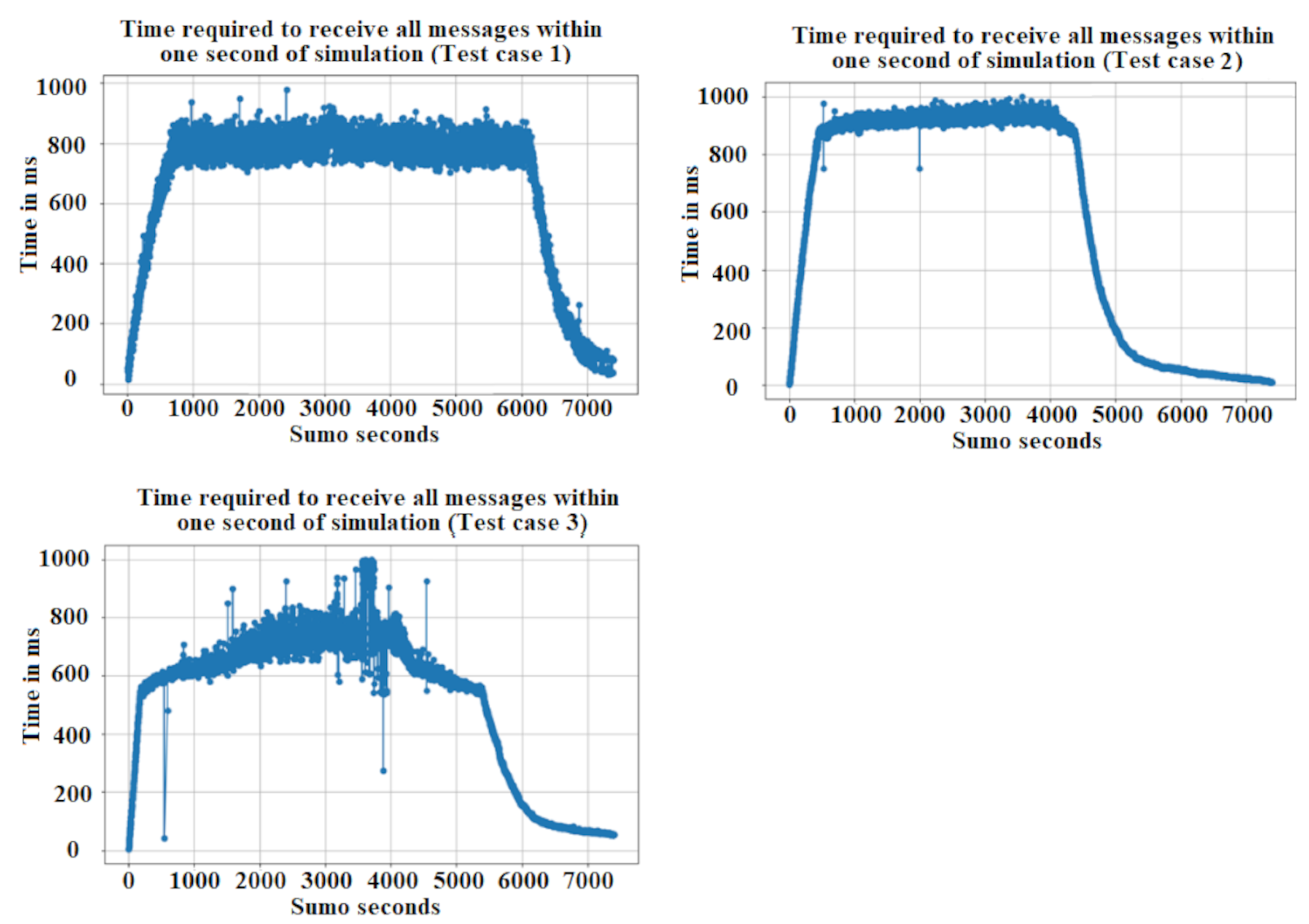
Prior to the experiment, it was necessary to test whether the developed custom application is capable of transmitting the required volume of simulated traffic data to support real-time performance. This capability is essential, as the primary objective of the system is to perform predictions based on live data streams. The obtained measurements confirm that records are transmitted in a manner consistent with their generation by the SUMO traffic simulator. An insight into the time required to transmit messages generated by the SUMO traffic simulator to the central sever in different test cases (of low-, middle- and high-traffic volume) is given in Figure 10.
For the purpose of the main experiment, the clocks of all system components, including both Raspberry Pi platforms, were synchronized using the NTP server, ensuring consistent timestamping required for the correct execution of the window-based rules. The results obtained in the experimental settings without the camera connected to the edge device are summarized in Table 3. Time is given in milliseconds and represented using the Unix timestamp format (HH:MM:SS.ms). For each test case, the table provides: the time at which the maximum acceleration was observed (T), the value of the maximum acceleration (M), the ID of the vehicle generating the maximum acceleration (I), and the total count of sharp acceleration events (C). All four parameters are recorded for each test case across four types of windows: Time Window (TW), Count Window (CW), Sliding Time Window (STW), and Sliding Count Window (SCW).
Table 4 presents the results obtained in the experimental settings with the camera connected to the edge device. Besides the corresponding rows defined above, this table contains two additional rows. The row N indicates the number of messages reporting the detected number of pedestrians, and the row A provides the average time, in milliseconds, between two consecutive messages delivering pedestrian count data.
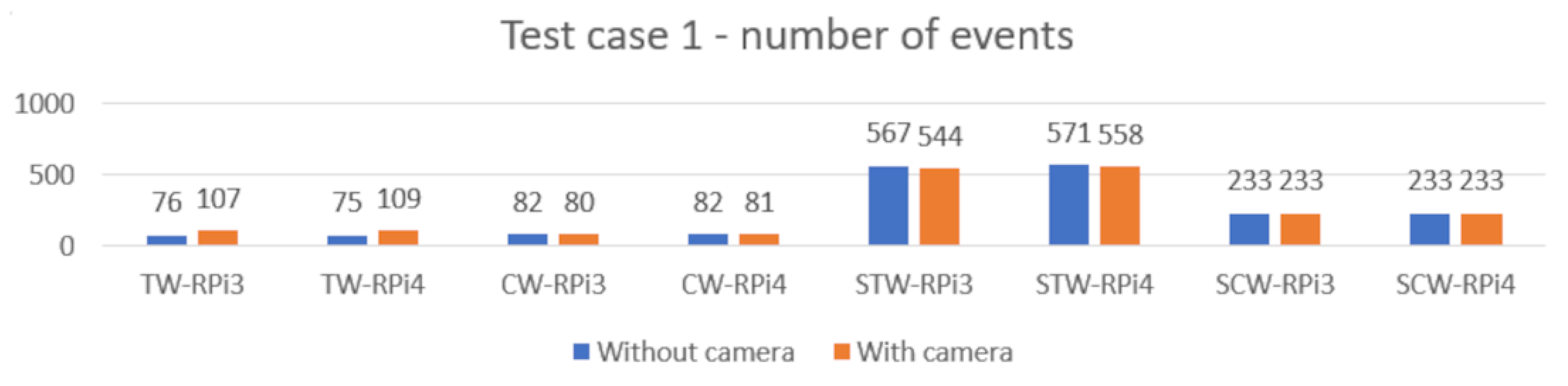
Based on the obtained results, it can be concluded that for Test Case 1 (TC1, low-traffic volume), the count of sharp acceleration events (C) is similar between the no-camera and camera scenarios on both the Raspberry Pi 3 and Raspberry Pi 4 platforms, except when using sliding time windows. Comparing TC1 results between the camera and no-camera scenarios on the same platform indicates that the greatest variation occurs when employing a time window or sliding time windows. The comparison results for TC1 are illustrated in Figure 11.
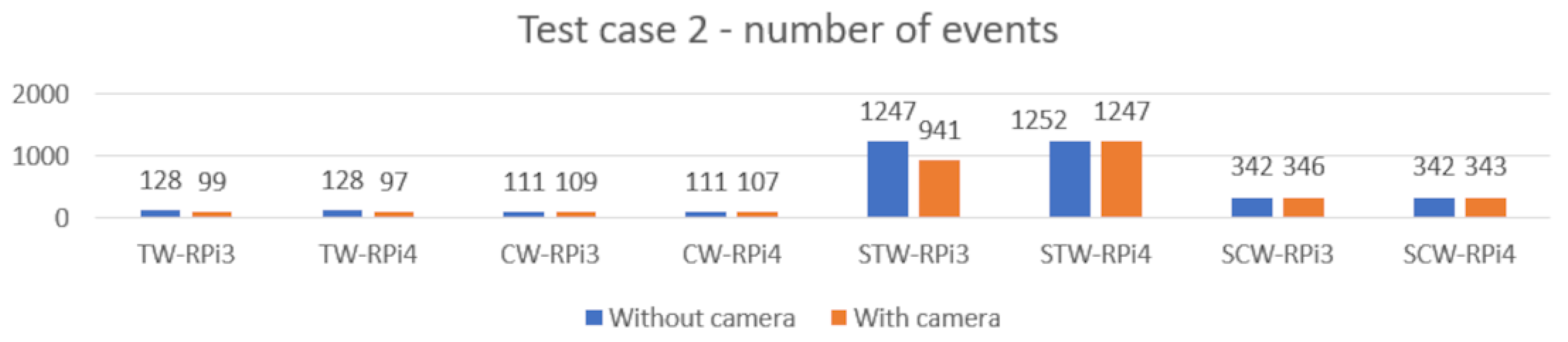
For Test Case 2 (TC2, middle-traffic volume), a conclusion similar to Test Case 1 was reached: both platforms produced the same results in no-camera settings. When using the camera, greater discrepancies were observed with sliding time windows, as the Raspberry Pi 3 platform generated 25% fewer events than the Raspberry Pi 4 platform, compared to the Test Case 1 where the difference was only 4%. The results for the Test Case 2 are presented in Figure 12.
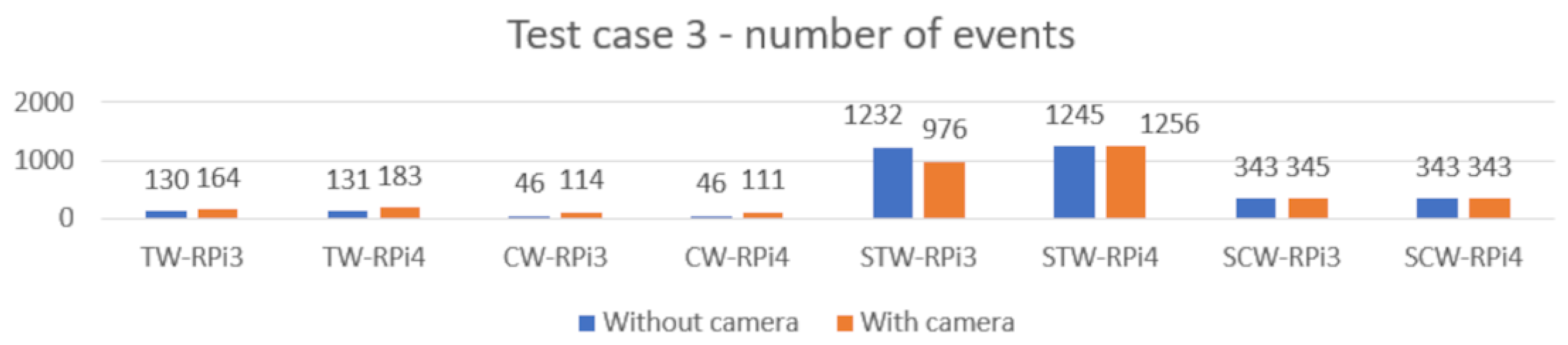
Considering the Test Case 3 (TC3, high-traffic volume), as shown in Figure 13, it was concluded that the obtained results were similar to those of the Test Case 2. Specifically, the sliding time window exhibited the largest discrepancy when using the camera, with the Raspberry Pi 3 platform generating 21% fewer events than the Raspberry Pi 4 platform.
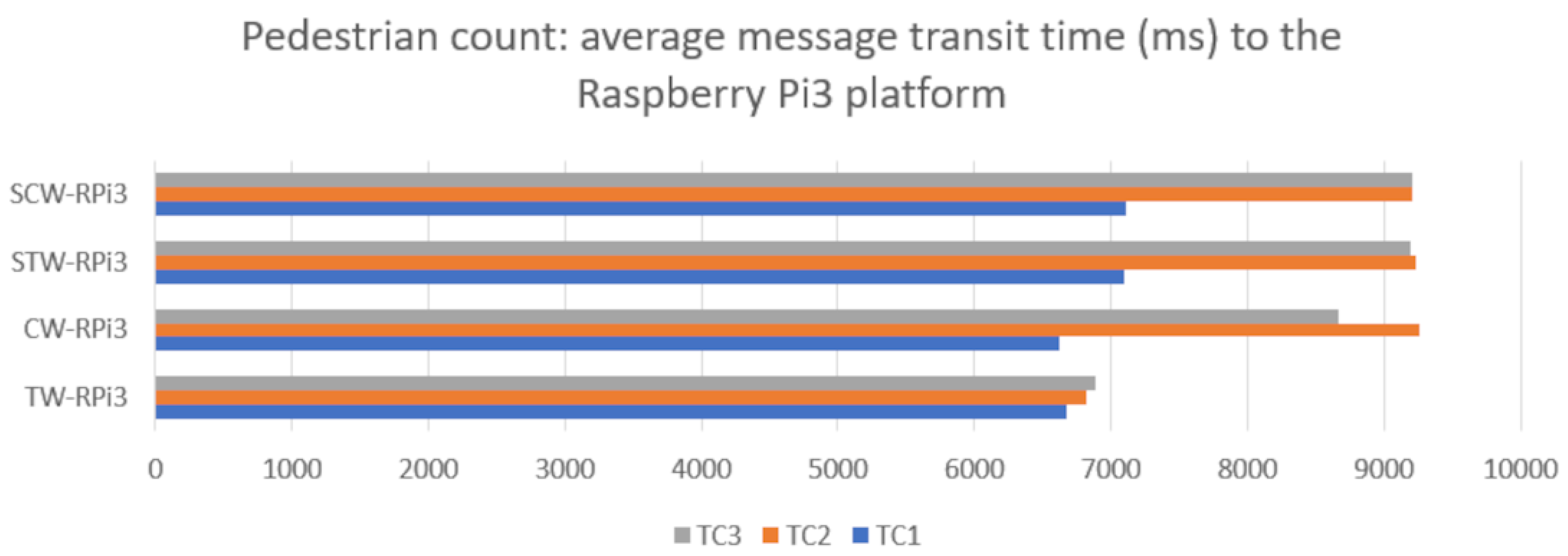
The information regarding the number of detected pedestrians was configured to be sent every second. Based on results summarized in Figure 14, it can be concluded that the transmission time on the Raspberry Pi 3 platform exceeded 6.6 s and increased further in test cases with a higher message rate per second. For the count window, the average time between consecutive transmissions reached 10 s.
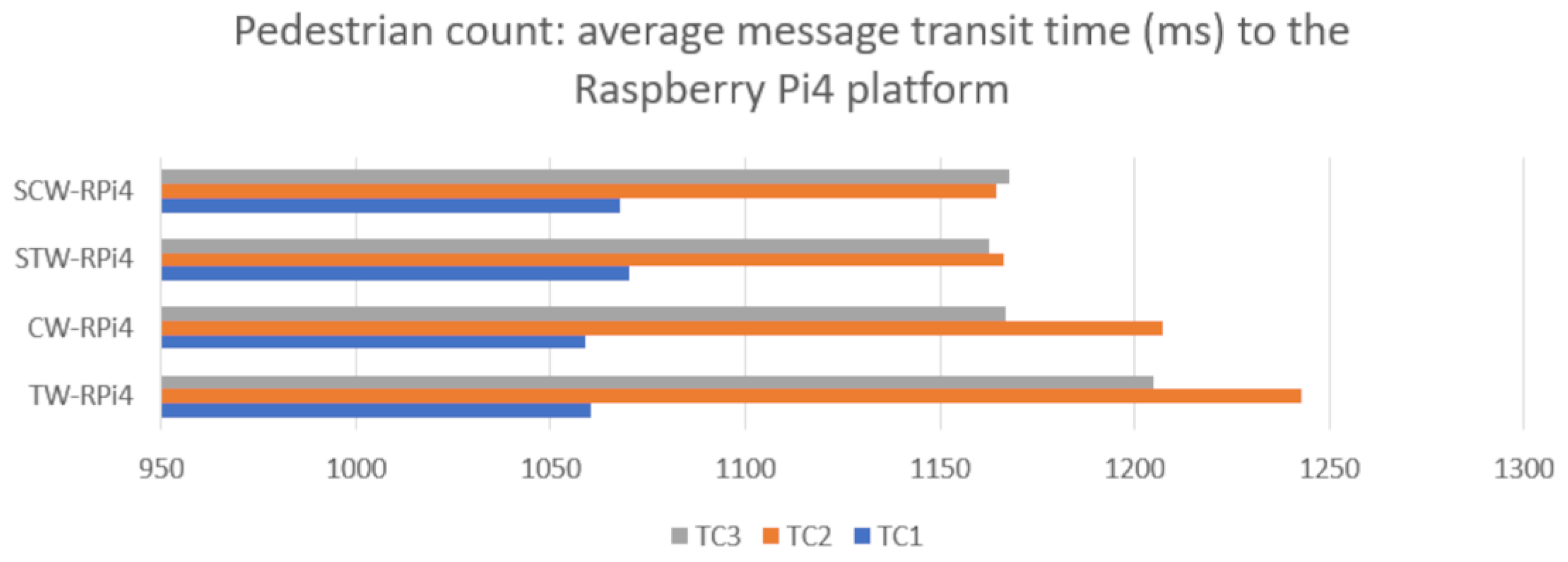
On the Raspberry Pi 4 platform, based on results summarized in Figure 15, it can be concluded that the average time for transmitting the message on the number of detected pedestrians ranged between 1.05 and 1.25 s between consecutive transmissions.
The maximum acceleration in the Test Case 1 was recorded by the vehicle with ID veh1145, measuring 4.97. This result was observed on both platforms (with and without the camera), but only when using the sliding time window. Although the same dataset was consistently used for this low-traffic volume test case, this event was not detected in every scenario. In all the considered scenarios, except for the count windows with the camera, events observed on the Raspberry Pi 3 were also detected on Raspberry Pi 4. The results are summarized in Table 5.
In the Test Case 2, vehicle moto929 exhibited the maximum acceleration, reaching 6.45. This event was detected on both platforms, with and without the camera, when using the STW and the SCW. It was also observed that the results for the TW and CW were identical when the camera was not used, consistently across both the platforms. The results are summarized in Table 6.
The Test Case 3 yielded the same sharp acceleration results as those observed in the Test Case 2. Furthermore, similar to the Test Case 2, the results for the TW and CW were consistent across both platforms when the camera was not used. The results are summarized in Table 7.
The detection times of sharp acceleration events were analyzed separately. Regarding timing, it can be concluded that the event detection time in the Test Case 1 (i.e., low-traffic volume) is identical or differs by less than 50 ms across both the Raspberry Pi platforms, with and without the camera. The results are summarized in Table 8.
In the Test Case 2 (i.e., middle-traffic volume), the detection times on both platforms without the camera were similar, with differences of less than 20 ms. Larger discrepancies occurred for the CW, STW, and SCW when using the camera, with differences reaching up to 7676 ms. The results are summarized in Table 9.
In the Test Case 3 (i.e., high-traffic volume), a difference of 63 ms was observed in the no-camera scenario when using the Time Window, while no differences were detected in the other test scenarios without camera. When the camera was included, differences exceeded 8 s. The results are summarized in Table 10.
A comprehensive analysis of CPU and memory utilization was conducted for both platforms across all experimental configurations, including scenarios with and without camera input, three levels of traffic intensity, and four window types. The results are summarized in Table 11 for Raspberry Pi3, and in Table 12 for Raspberry Pi4.
The obtained results indicate that, in the idle state, CPU utilization remains below 5% for Raspberry Pi 3 and below 3% for Raspberry Pi 4, while memory usage is approximately 346 MB and 692 MB, respectively. When the system is initialized without input data, CPU utilization remains largely unchanged, while memory usage increases by approximately 104 MB (Pi 3) and 146 MB (Pi 4). Under full workload with camera input, Raspberry Pi 3 exhibits CPU utilization exceeding 95%, indicating resource saturation. The memory usage in this case increases moderately but does not represent a limiting factor. This results in significant latency (i.e., exceeding 9 s), indicating that real-time processing is not achievable on this platform. In contrast, Raspberry Pi 4 maintains CPU utilization below 75%, enabling stable real-time processing with latency below 3 s.
To provide a more comprehensive evaluation, end-to-end latency is analyzed using multiple statistical measures, including the minimum, maximum, median, 95th percentile (P95), and average values. The obtained measurements are expressed in milliseconds and rounded to integer values. In the scenario without camera input, the total latency is calculated as the time difference between the detection of a sudden acceleration event and the timestamp of the last message describing the given event. With camera input, the total latency is calculated as the time difference between the detection of a complex event and the timestamp of the last message describing the underlying sudden acceleration event. The results are summarized in Table 13.
The results of complex event detection tests are given in Table 14. As observed above, Raspberry Pi 3 was unable to process both the image and the rules in real time; therefore, it was used exclusively for rule processing, while the computer vision task of pedestrian detection was handled separately. The number of pedestrians at the intersection was provided to the Raspberry Pi 3 by the Raspberry Pi 4. The delay was calculated as the difference in time (in milliseconds) between detection of two consecutive sudden accelerations of a vehicle in a lane (i.e., ( i L ) ( N 1 ( i , t , T , A t h r ) 2 ) , cf. Equation (2)) and detection of a complex event (cf. Equation (6)).

4.3. Discussion

The comparative analyses demonstrated that the Raspberry Pi 3 and Raspberry Pi 4 were capable of processing up to 2600 messages per second within the eKuiper CEP Docker when no computationally intensive image processing is involved. Under those conditions, the difference in response time between the platforms was less than 50 ms. When a camera was introduced as an additional sensor for continuous image processing, the experiment showed that only the Raspberry Pi 4 (with 4 GB of RAM) performed satisfactorily. The Raspberry Pi 3 exhibited significantly longer image processing times compared to the Raspberry Pi 4 platform. Additionally, the interval between successive event transmissions increased with higher message rates, ranging from approximately 1.06 s to 1.24 s.
Table 11 and Table 12 show that the window type had minimal impact on CPU and memory usage in the scenarios without camera input, i.e., the differences between CPU and memory usage for different windows remained under 3%. However, the hardware differences were pronounced: CPU utilization on Raspberry Pi 3 rose from 20% to around 60% (P95), whereas for Raspberry Pi 4 it remained stable between 11% and 23% (P95). This highlights the insight that the hardware configuration has greater influence than window setting.
The sliding windows detected the most events, emphasizing the importance of proper window selection. In addition, Table 11 and Table 12 show that the selection of window type does not critically interacts with hardware limits, implying that the preferred selection of sliding windows does not open additional hardware or safety requirements. Finally, it should be noted that the considered use case focused on pedestrian presence and sudden vehicle acceleration, but the reported architecture is rather general and can accommodate other traffic safety rules based on additional sensor input aimed at enhancing context-aware event detection (e.g., related to unexpected stops, congestion, vehicle proximity, heavy vehicle presence, weather and lighting conditions, etc.).

5. Conclusions

The development of smart systems, such as Smart Cities, requires real-time data processing that is aware of the temporal context in which events occur. This paper proposed a design of a containerized edge architecture based on a lightweight CEP engine, the Docker containers and the Message Queuing Telemetry Transport protocol (MQTT), aimed at real-time high-volume traffic data analytics. It also presented a comparative performance analysis between the Raspberry Pi 3 and Raspberry Pi 4 platforms, investigating the hardware limits of resource-constrained edge nodes when performing concurrent real-time video inference and complex event processing. The study demonstrated that low-cost edge devices, such as Raspberry Pi 4, can successfully support integrated stream processing and computer vision-based event detection, enabling timely alerts and enhancing traffic safety without relying on a cloud infrastructure. Future work will explore distributed resource management for multimedia data using platforms such as Apache NiFi and MiniFi, as well as dynamic adaptation of processing rules based on broader contextual factors, including city-wide conditions, time of day, and other environment-specific characteristics relevant to smart-city deployments.

Author Contributions

Conceptualization, D.B., D.S. and M.G.; Methodology, D.B., D.S. and M.G.; Software, D.B.; Writing—original draft, D.B., D.S. and M.G.; Investigation, D.B.; Resources, D.B.; Data curation, D.B.; Formal analysis, D.B., D.S. and M.G.; Supervision, D.S. and M.G.; Validation, I.T. and B.J.; Writing—review & editing, I.T. and B.J. All authors have read and agreed to the published version of the manuscript.

Funding

This work has been partially supported by the University of Defence in Belgrade and Ministry of Science, Technological Development and Innovation of the Republic of Serbia [Grant Number: 451-03-34/2026-03/200102].

Data Availability Statement

Research data are available from the authors upon request.

Acknowledgments

The authors declare that AI Tools were used solely for grammar checking and minor language refinement.

Conflicts of Interest

The authors declare no conflicts of interest.

References

  1. Zeng, F.; Pang, C.; Tang, H. Sensors on Internet of Things Systems for the Sustainable Development of Smart Cities: A Systematic Literature Review. Sensors 2024, 24, 2074. [Google Scholar] [CrossRef] [PubMed]
  2. D’Addato, M.; Antolini, A.; Renzini, F.; Elgani, A.; Perilli, L.; Franchi Scarselli, E.; Gnudi, A.; Magno, M.; Canegallo, R. Nanowatt clock and data recovery for ultra-low power wake-up receivers. In Proceedings of the International Conference on Embedded Wireless Systems and Networks (EWSN), Lyon, France, 17–19 February 2020; pp. 224–229. [Google Scholar]
  3. Sethi, P.; Sarangi, S.R. Internet of Things: Architectures, Protocols, and Applications. J. Electr. Comput. Eng. 2017, 9324035. [Google Scholar] [CrossRef]
  4. Shi, W.; Cao, J.; Zhang, Q.; Li, Y.; Xu, L. Edge computing: Vision and challenges. IEEE Internet Things J. 2016, 3, 637–646. [Google Scholar] [CrossRef]
  5. Silva, P.; Costan, A.; Antoniu, G. Investigating edge vs. cloud computing trade-offs for stream processing. In Proceedings of the 2019 IEEE International Conference on Big Data (BigData 2019); IEEE: Piscataway, NJ, USA, 2019; pp. 469–474. [Google Scholar] [CrossRef]
  6. Greco, L.; Percannella, G.; Ritrovato, P.; Tortorella, F.; Vento, M. Trends in IoT-based solutions for health care: Moving AI to the edge. Pattern Recognit. Lett. 2020, 135, 346–353. [Google Scholar] [CrossRef] [PubMed]
  7. Lan, L.; Shi, R.; Wang, B.; Zhang, L.; Jiang, N. A universal complex event processing mechanism based on edge computing for Internet of Things real-time monitoring. IEEE Access 2019, 7, 101865–101878. [Google Scholar] [CrossRef]
  8. Ismail, B.I.; Mostajeran Goortani, E.; Ab Karim, M.B.; Ming Tat, W.; Setapa, S.; Yuan Luke, J.; Hong Hoe, O. Evaluation of Docker as edge computing platform. In Proceedings of the 2015 IEEE Conference on Open Systems (ICOS); IEEE: Piscataway, NJ, USA, 2015; pp. 130–135. [Google Scholar] [CrossRef]
  9. Alam, M.; Rufino, J.; Ferreira, J.; Ahmed, S.H.; Shah, N.; Chen, Y. Orchestration of microservices for IoT using Docker and edge computing. IEEE Commun. Mag. 2018, 56, 118–123. [Google Scholar] [CrossRef]
  10. Liu, H.; Zhang, Y.; Wang, T.; Jiang, R.; Yu, Y. Weighted Graph Clustering via Scale Contraction and Graph Structure Learning. In Proceedings of the ACM Conference; Association for Computing Machinery (ACM): New York, NY, USA, 2026. [Google Scholar] [CrossRef]
  11. He, K.; Zhang, X.; Ren, S.; Sun, J. Deep residual learning for image recognition. In Proceedings of the 2016 IEEE Conference on Computer Vision and Pattern Recognition (CVPR); IEEE: Piscataway, NJ, USA, 2016; pp. 770–778. [Google Scholar] [CrossRef]
  12. Bezerra, S.F.; Costa, A.S.M.; Filho, F.C.; Delicato, F.C.; Rocha, A.R. Processing Complex Events in Fog-Based Internet of Things Systems for Smart Agriculture. Sensors 2021, 21, 7226. [Google Scholar] [CrossRef]
  13. Fu, X.; Ghaffar, T.; Davis, J.C.; Lee, D. EDGEWISE: A better stream processing engine for the edge. In Proceedings of the 2019 USENIX Annual Technical Conference (USENIX ATC ’19), Renton, WA, USA, 10–12 July 2019; USENIX Association: Berkeley, CA, USA, 2019; pp. 929–946. [Google Scholar]
  14. Bixio, L.; Delzanno, G.; Rebora, S.; Rulli, M. A flexible IoT stream processing architecture based on microservices. Information 2020, 11, 565. [Google Scholar] [CrossRef]
  15. Jin, W.; Hong, Y.-G.; Song, J.; Kim, J.; Kim, D. Transparent Rule Enablement Based on Commonization Approach in Heterogeneous IoT Edge Networks. Sensors 2023, 23, 8282. [Google Scholar] [CrossRef] [PubMed]
  16. Sreekumar, U.K.; Devaraj, R.; Li, Q.; Liu, K. Real-time Traffic Pattern Collection and Analysis Model for Intelligent Traffic Intersection. In Proceedings of the 2018 IEEE/ACM 5th International Conference on Edge Computing (EDGE); IEEE: Piscataway, NJ, USA, 2018; pp. 157–164. [Google Scholar] [CrossRef]
  17. Corral Plaza, D. Procesamiento de Datos Heterogéneos en el Internet de las Cosas. Ph.D. Thesis, Universidad de Cádiz, Cádiz, Spain, 2020. [Google Scholar]
  18. Ou, J.; Sun, J.; Zhu, Y.; Jin, H.; Liu, Y.; Zhang, F.; Huang, J.; Wang, X. STP-TrellisNets+: Spatial-Temporal Parallel TrellisNets for Multi-Step Metro Station Passenger Flow Prediction. IEEE Trans. Knowl. Data Eng. 2023, 35, 7526–7540. [Google Scholar] [CrossRef]
  19. Akbar, A.; Khan, A.; Carrez, F.; Moessner, K. Predictive analytics for complex IoT data streams. IEEE Internet Things J. 2017, 4, 1571–1582. [Google Scholar] [CrossRef]
  20. Ren, H.; Anicic, D.; Runkler, T. The synergy of complex event processing and tiny machine learning in industrial IoT. In Proceedings of the 15th ACM International Conference on Distributed and Event-Based Systems (DEBS); ACM: New York, NY, USA, 2021; pp. 126–135. [Google Scholar] [CrossRef]
  21. Xing, T.; Roig Vilamala, M.; Garcia, L.; Cerutti, F.; Kaplan, L.; Preece, A.; Srivastava, M. DeepCEP: Deep complex event processing using distributed multimodal information. In Proceedings of the 2019 IEEE International Conference on Smart Computing (SMARTCOMP); IEEE: Piscataway, NJ, USA, 2019; pp. 87–92. [Google Scholar] [CrossRef]
  22. Uyanık, H.; Ovatman, T. Multi-Flow Complex Event Optimization in the Edge: A Smart Street Scenario. Internet Things 2025, 6, 72. [Google Scholar] [CrossRef]
  23. Stonebraker, M.; Çetintemel, U.; Zdonik, S. The 8 requirements of real-time stream processing. ACM SIGMOD Rec. 2005, 34, 42–47. [Google Scholar] [CrossRef]
  24. Xhafa, F.; Kilic, B.; Krause, P. Evaluation of IoT stream processing at edge computing layer for semantic data enrichment. Future Gener. Comput. Syst. 2020, 105, 730–736. [Google Scholar] [CrossRef]
  25. Hasoon, J.N.; Hassan, A.P.D.R. Big data techniques: A survey. Iraqi J. Inf. Technol. 2019, 9, 135–146. [Google Scholar] [CrossRef]
  26. Carney, D.; Cetintemel, U.; Cherniack, M.; Convey, C.; Lee, S.; Seidman, G.; Stonebraker, M.; Tatbul, N.; Zdonik, S. Monitoring streams: A new class of data management applications. In Proceedings of the 28th International Conference on Very Large Data Bases (VLDB), Hong Kong, China, 20–23 August 2002; pp. 215–226. [Google Scholar]
  27. Hsieh, Y.C.; Hong, H.J.; Tsai, P.H.; Wang, Y.R.; Zhu, Q.; Uddin, M.Y.S.; Venkatasubramanian, N.; Hsu, C.H. Managed edge computing on Internet of Things devices for smart city applications. In Proceedings of the 2018 IEEE/IFIP Network Operations and Management Symposium (NOMS), Taipei, Taiwan, 23–27 April 2018; IEEE: Piscataway, NJ, USA, 2018; pp. 1–2. [Google Scholar] [CrossRef]
  28. Gore, R.; Banerjea, S.; Tyagi, N.; Saurav, S.; Acharya, D.; Verma, V. An efficient edge analytical model on Docker containers for automated monitoring of public restrooms in India. In Proceedings of the 2020 IEEE International Conference on Advanced Networks and Telecommunications Systems (ANTS), New Delhi, India, 14–17 December 2020; IEEE: Piscataway, NJ, USA, 2020; pp. 1–6. [Google Scholar]
  29. Mendki, P. Docker container based analytics at IoT edge: Video analytics use case. In Proceedings of the 2018 3rd International Conference on Internet of Things: Smart Innovation and Usages (IoT SIU), Bhimtal, India, 23–24 February 2018; pp. 1–4. [Google Scholar] [CrossRef]
  30. Dupont, C.; Giaffreda, R.; Capra, L. Edge computing in IoT context: Horizontal and vertical Linux container migration. In Proceedings of the 2017 Global Internet of Things Summit (GIoTS), Geneva, Switzerland, 6–9 June 2017; IEEE: Piscataway, NJ, USA, 2017; pp. 1–4. [Google Scholar] [CrossRef]
  31. Tansangworn, N. Development of IoT edge hub for wireless sensor networks based on Docker container. In Proceedings of the 2020 IEEE International Conference on Smart Internet of Things (SmartIoT), Beijing, China, 14–16 August 2020; IEEE: Piscataway, NJ, USA, 2020; pp. 356–357. [Google Scholar] [CrossRef]
  32. Vallurupalli, P.; Belidhe, S. Deploying Lightweight Neural Networks on Edge Devices Using Knowledge Transfer. J. Publ. Int. Res. Eng. Manag. 2025, 10, 1–6. [Google Scholar]
  33. Liu, F.; Tang, G.; Li, Y.; Cai, Z.; Zhang, X.; Zhou, T. A survey on edge computing systems and tools. Proc. IEEE 2019, 107, 1537–1562. [Google Scholar] [CrossRef]
  34. EdgeX Foundry. EdgeX Foundry Homepage. Available online: https://www.edgexfoundry.org (accessed on 16 February 2025).
Figure 1. Visual representation of a smart-crossroad scenario.
Electronics 15 01703 g001
Figure 2. Overview of the experimental setup.
Electronics 15 01703 g002
Figure 3. The map representation of the considered urban area.
Electronics 15 01703 g003
Figure 4. Distribution of sudden vehicle accelerations.
Electronics 15 01703 g004
Figure 5. The selected frames, with pedestrian detection results obtained from both the Raspberry Pi platforms, respectively.
Electronics 15 01703 g005
Figure 6. Camera view with detected pedestrian counts across several frames.
Electronics 15 01703 g006
Figure 7. Crossroad layout and simulation rules.
Electronics 15 01703 g007
Figure 8. Example of one eKuiper rule.
Electronics 15 01703 g008
Figure 9. Message rates in test cases.
Electronics 15 01703 g009
Figure 10. Analysis of the time taken to transmit messages generated by the SUMO traffic simulator.
Electronics 15 01703 g010
Figure 11. The comparison results for Test Case 1 (TC1, low-traffic volume).
Electronics 15 01703 g011
Figure 12. The comparison results for Test Case 2 (TC2, middle-traffic volume).
Electronics 15 01703 g012
Figure 13. The comparison results for Test Case 3 (TC3, high-traffic volume).
Electronics 15 01703 g013
Figure 14. Pedestrian count: average message transit time to the Raspberry Pi3 platform for the considered test cases.
Electronics 15 01703 g014
Figure 15. Pedestrian count: average message transit time to the Raspberry Pi4 platform for the considered test cases.
Electronics 15 01703 g015
Table 1. JSON message attributes.
JSON FieldType
new_timestep_timeLong
timestep_timeFloat
vehicle_angleFloat
vehicle_idString
vehicle_laneString
vehicle_posFloat
vehicle_slopeFloat
vehicle_speedFloat
vehicle_typeString
vehicle_xFloat
vehicle_yFloat
Table 2. SUMO configuration parameters.
SUMO VariablesTest Case 1 (Low)Test Case 2 (Medium)Test Case 3 (High)
P_MOTO5.3514463.3514463.051446
P_PASS1.9504821.0504820.750482
P_TRUCK2.9757231.5757231.075723
P_BUS5.0514463.3514462.751446
DURATION600040004000
END_TIME740074007400
Table 3. The results obtained in the experimental settings without the camera connected to the edge device.
Without CameraTWCWSTWSCW
RPi3 RPi4 RPi3 RPi4 RPi3 RPi4 RPi3 RPi4
Low-traffic
volume
T12:43:11
0.564
12:43:11
0.610
23:46:35
0.978
23:46:35
0.978
05:19:30
0.545
05:19:30
0.545
12:18:35
0.014
12:18:35
0.014
M4.824.824.54.54.974.974.824.82
Iveh1806veh1806veh341veh341veh1145veh1145veh1806veh1806
C76758282567571233233
Middle-traffic
volume
T18:53:38
0.548
18:53:38
0.564
23:34:18
0.889
23:34:18
0.889
12:30:26
0.370
12:30:26
0.355
07:53:57
0.108
07:53:57
0.092
M5.185.186.456.456.456.456.456.45
Imoto929moto929moto929moto929moto929moto929moto929moto929
C12812811111112471252342342
High-traffic
volume
T17:47:59
0.561
17:47:59
0.624
22:30:46
0.738
22:30:46
0.738
15:39:40
0.541
15:39:40
0.541
09:29:21
0.645
09:29:21
0.645
M5.185.184.114.116.456.456.456.45
Imoto929moto929veh19veh19moto929moto929moto929moto929
C130131464612321245343343
Table 4. The results obtained in the experimental settings with the camera connected to the edge device.
With CameraTWCWSTWSCW
RPi3 RPi4 RPi3 RPi4 RPi3 RPi4 RPi3 RPi4
Low-traffic
volume
T02:38:33
0.002
02:38:32
0.987
18:13:00
0.062
18:12:59
0.047
08:48:23
0.168
08:48:23
0.152
04:45:48
0.648
04:45:48
0.632
M4.974.974.614.824.974.974.824.82
Iveh1145veh1145veh194veh1806veh1145veh1145veh1806veh1806
C1071098081544558233233
N9536004972608296864189667338
A6681.381060.366627.671058.977096.311070.087109.211068.03
Middle-traffic
volume
T15:04:57
0.838
15:04:57
0.822
07:55:50
0.791
07:55:43
0.388
01:35:56
0.900
01:35:49
0.224
17:21:28
0.341
17:21:20
0.080
M4.614.615.186.456.456.456.456.45
Iveh194veh194moto929moto929moto929moto929moto929moto929
C99971091079411247346343
N10065521584417756644805674486
A6819.691242.679259.181207.409238.101166.419212.681164.66
High-traffic
volume
T10:13:17
0.569
10:13:08
0.520
06:03:53
0.540
06:03:48
0.357
22:05:59
0.364
22:05:50
0.930
08:51:12
0.811
08:51:04
0.133
M5.185.185.186.456.456.456.456.45
Imoto929moto929moto929moto929moto929moto929moto929moto929
C1641831141119761256345343
N9245283582431956944985684474
A6891.791205.098668.721166.779194.211162.669205.951167.81
Table 5. Results of testing TC1, max acceleration.
Low-Traffic
Volume
TWCWSTWSCW
RPi3 RPi4 RPi3 RPi4 RPi3 RPi4 RPi3 RPi4
Without
camera
4.824.824.54.54.974.974.824.82
veh1806veh1806veh341veh341veh1145veh1145veh1806veh1806
With
camera
4.974.974.614.824.974.974.824.82
veh1145veh1145veh194veh1806veh1145veh1145veh1806veh1806
Table 6. Results of testing TC2, max acceleration.
Middle-Traffic
Volume
TWCWSTWSCW
RPi3 RPi4 RPi3 RPi4 RPi3 RPi4 RPi3 RPi4
Without
camera
5.185.186.456.456.456.456.456.45
moto929moto929moto929moto929moto929moto929moto929moto929
With
camera
4.614.615.186.456.456.456.456.45
veh194veh194moto929moto929moto929moto929moto929moto929
Table 7. Results of testing TC3, max acceleration.
High-Traffic
Volume
TWCWSTWSCW
RPi3 RPi4 RPi3 RPi4 RPi3 RPi4 RPi3 RPi4
Without
camera
5.185.184.114.116.456.456.456.45
moto929moto929veh19veh19moto929moto929moto929moto929
With
camera
6.356.455.186.456.456.456.456.45
moto929moto929moto929moto929moto929moto929moto929moto929
Table 8. Differences in detection of max acceleration in TC1 on Raspberry Pi3 and Raspberry Pi4.
Low-Traffic VolumeTWCWSTWSCW
Time Δ Time Δ Time Δ Time Δ
Without
camera
RPi312:43:11.564−4623:46:35.978005:19:30.545012:18:35.0140
RPi412:43:11.61023:46:35.97823:46:35.97812:18:35.014
With
camera
RPi302:38:33.0021518:13:00.0621508:48:23.1681604:45:48.64816
RPi402:38:32.98718:12:59.04708:48:23.15204:45:48.632
Table 9. Differences in detection of max acceleration in TC2 on Raspberry Pi3 and Raspberry Pi4.
Middle-Traffic VolumeTWCWSTWSCW
Time Δ Time Δ Time Δ Time Δ
Without
camera
RPi318:53:38.548−1623:34:18.889012:30:26.3701507:53:57.10816
RPi418:53:38.56423:34:18.88912:30:26.35507:53:57.092
With
camera
RPi315:04:57.8381607:55:50.791740301:35:56.900767617:21:28.3418261
RPi415:04:57.82207:55:43.38801:35:49.22417:21:20.080
Table 10. Differences in detection of max acceleration in TC3 on Raspberry Pi3 and Raspberry Pi4.
High-Traffic VolumeTWCWSTWSCW
Time Δ Time Δ Time Δ Time Δ
Without
camera
RPi317:47:59.561−6322:30:46.738015:39:40.541009:29:21.6450
RPi417:47:59.62422:30:46.73815:39:40.54109:29:21.645
With
camera
RPi310:13:17.569904906:03:53.540518322:05:59.364843408:51:12.8118678
RPi410:13:08.52006:03:48.35722:05:50.93008:51:04.133
Table 11. Results of testing CPU and RAM on RPi3.
CaseCameraVolumeCPU (%)RAM (MB)
MIN MAX N95 AVG MIN MAX N95 AVG
NothingNO/2.5023.104.803.64335349346342.90
RunningNO/2.3017.104.803.54430452450443.89
TWNOLow2.5033.3020.1016.16475488486481.73
TWNOMiddle2.5077.7058.9039.11475489487482.85
TWNOHigh2.7065.9058.1339.51476490487483.18
CWNOLow2.5032.9021.1516.04470486483479.30
CWNOMiddle2.3065.7059.4039.51470487485480.80
CWNOHigh2.5065.2060.1440.51473487485481.07
STWNOLow3.2029.0020.7016.62476489487482.52
STWNOMiddle2.5067.8060.0040.22477490488484.00
STWNOHigh2.5066.7059.5039.14477491488483.83
SCWNOLow2.3033.3021.0616.38474487484480.49
SCWNOMiddle2.1067.2059.4035.17473489486481.55
SCWNOHigh2.5066.7060.0338.95474489486481.78
TWYESLow88.4095.0092.0494.10531571540536.22
TWYESMiddle87.9097.1097.0794.58525574546536.88
TWYESHigh88.8098.2097.6994.72528583548539.33
CWYESLow89.6095.1094.7093.25494516513502.29
CWYESMiddle89.5098.2098.0096.48494514510503.19
CWYESHigh91.2098.4098.0096.57498513512504.99
STWYESLow88.5095.4094.2692.37526574540535.72
STWYESMiddle89.7098.3097.8196.67527549548542.37
STWYESHigh90.8098.3097.8096.46530575550542.44
SCWYESLow83.9097.4096.4093.29532618582550.55
SCWYESMiddle89.6098.6098.0096.55527585550543.36
SCWYESHigh89.1098.3097.9696.27533584548542.57
Table 12. Results of testing CPU and RAM on RPi4.
CaseCameraVolumeCPU (%)RAM (MB)
MIN MAX N95 AVG MIN MAX N95 AVG
NothingNO/0.5015.202.502.10680710692683.22
RunningNO/0.5015.502.902.25824865838829.35
TWNOLow2.0022.3011.409.20908934922914.03
TWNOMiddle2.0030.8021.8016.30909935924915.07
TWNOHigh2.2030.6022.0016.48913943925916.22
CWNOLow1.7021.5011.409.04905946924914.53
CWNOMiddle2.0031.7022.2016.93908939921914.47
CWNOHigh1.2032.2022.3917.20912941926915.98
STWNOLow2.2022.3011.509.28914940926917.02
STWNOMiddle2.2030.2022.4016.94914941925916.95
STWNOHigh1.0033.2022.0016.63913938923916.38
SCWNOLow2.2021.8011.609.31913939925916.74
SCWNOMiddle1.0030.2022.6014.68913943924916.66
SCWNOHigh2.0033.6022.3016.04909936921914.57
TWYESLow56.9072.3064.2061.24995106410381019.36
TWYESMiddle56.9079.1070.0762.78995107110421021.49
TWYESHigh57.1077.6066.0871.00995105910411022.42
CWYESLow57.5074.0064.4062.971047110410881069.05
CWYESMiddle58.5078.7071.6069.311045109310801064.33
CWYESHigh59.3080.2072.6070.141044109510801064.19
STWYESLow57.4072.0064.8062.611001107110441026.72
STWYESMiddle57.5078.1070.8068.20998105210391023.01
STWYESHigh57.2076.3069.7067.171000106110401022.90
SCWYESLow56.8072.3063.7062.061005106710501029.78
SCWYESMiddle57.2076.7069.4067.021003107510431026.01
SCWYESHigh57.6078.4070.5067.651002106310441026.38
Table 13. Results of comparing latency on RPi3 and RPi4.
CaseCameraVolumePRi3-SUMO-CEP-LatencyPRi4-SUMO-CEP-Latency
MIN MAX N95 MED AVG MIN MAX N95 MED AVG
TWNOLow912197317639621081912197317539611078
TWNOMiddle94127801899102812309252765188810101219
TWNOHigh94928081905103812379492792189410331231
TWYESLow154716,36113,0836994721215753004300122432160
TWYESMiddle171218,23414,9457727788416547082465521172478
TWYESHigh178920,65816,3178042855616627010386424442622
CWNOLow961197619629761163961196219609691190
CWNOMiddle96828151905103712439612799188510271237
CWNOHigh97728221911104512489622822190510391244
CWYESLow146417,63914,5277453764115102325299721232158
CWYESMiddle163721,97317,7529584981815916111385521442280
CWYESHigh181223,15618,8349741992616237107312023042393
STWNOLow1064211019161105122710642110191611031226
STWNOMiddle1018298720621175137710182987203411671366
STWNOHigh1030296020631178138310152960205511731377
STWYESLow194718,32215,2148136832824055405378122072398
STWYESMiddle201222,55118,33810,17110,39321643547348322502404
STWYESHigh208623,84319,52110,42910,61422686935381224782699
SCWNOLow96720321840101411389672017184010101136
SCWNOMiddle96828691956108012839792869194510711272
SCWNOHigh96128701960109112909612870195210661280
SCWYESLow259117,40814,1318043826716873426332020642206
SCWYESMiddle265420,27916,9929778993117885335367026452641
SCWYESHigh253222,61118,264999710,50319586554323923822425
Table 14. Results of testing detection of CEP on Raspberry Pi3 (without camera) and Raspberry Pi4 (with camera).
Case VolumePRi3-CEP-with no CameraPR4i-CEP-with no Camera
Num. E. MIN MAX N95 MED AVG Num. E. MIN MAX N95 MED AVG
TWLow7672794753396403761748547197219
TWMiddle1211612341086484531122161079969305384
TWHigh1906112111094688661190321203951492464
CWLow73311078103945553474321281949250371
CWMiddle1081241081984533544109161053922486497
CWHigh208311046966504521210161141986422486
STWLow8762118811278467219047879826481461
STWMiddle2056211571149640615208311015953453487
STWHigh2081512811163445526217151078938453487
SCWLow90140109710666576269047906786428426
SCWMiddle2034711901125751696204161234987490495
SCWHigh212319218634784792161510991037485493
Disclaimer/Publisher’s Note: The statements, opinions and data contained in all publications are solely those of the individual author(s) and contributor(s) and not of MDPI and/or the editor(s). MDPI and/or the editor(s) disclaim responsibility for any injury to people or property resulting from any ideas, methods, instructions or products referred to in the content.