Article

Research on Adaptive Reconfigurable Control Strategy for EV Charging Stack in Complex Scenarios

by
Si-Yang Hu
1,
Ping Liu
2,*,
Zheng Lan
1 and
Xuan-Yi Tang
1
1
College of Traffic and Electrical Engineering, Hunan University of Technology, Zhuzhou 412007, China
2
College of Electrical and Information Engineering, Hunan University, Changsha 410082, China
*
Author to whom correspondence should be addressed.
Electronics 2026, 15(8), 1670; https://doi.org/10.3390/electronics15081670
Submission received: 21 March 2026 / Revised: 13 April 2026 / Accepted: 14 April 2026 / Published: 16 April 2026

Abstract

This study proposes an adaptive variable structure control strategy for charging stacks to address the issues of reduced conversion efficiency during wide-voltage-range operation and insufficient module allocation flexibility in multi-vehicle scenarios. By dynamically adjusting the number and series/parallel configurations of modules, the strategy ensures that modules consistently operate in high-efficiency regions, thereby achieving high energy conversion efficiency across a wide voltage range. First, the operational characteristics of the three-phase PWM rectifier and the dual active bridge (DAB) converters are analyzed, and their corresponding mathematical and loss models are established. Subsequently, the charging demands acquired by the charging stack are analyzed, and an adaptive variable structure control strategy is designed based on the module margin of the charging stack. When modules are surplus, the feasible range of series/parallel configurations for each port is constrained, and module combinations are optimized with the objective of minimizing system losses. When modules are insufficient, an adaptive module reservation scheduling strategy is employed to ensure temporal fairness in vehicle connection order while supplying power to multiple vehicles, effectively reducing the average charging time. Finally, the effectiveness of the proposed control strategy is validated through simulations conducted on the Matlab/Simulink platform. Results demonstrate that compared to traditional fixed-structure systems, the proposed strategy improves peak efficiency by up to 2.53% at 400 V and 1.12% at 800 V, while reducing the average charging time by 3.07% in the disconnection scenario and 12.1% in the asynchronous access scenario.

1. Introduction

To meet the growing demand for diversified and efficient energy replenishment for new energy vehicles, including battery electric vehicles (EVs) [1] and fuel cell vehicles (FCVs) [2], charging stacks—with their centralized management, flexible power distribution, and excellent scalability [3,4]—are emerging as a critical technology to overcome the performance bottlenecks of current charging systems. Particularly, in charging stack systems built with isolated modular converters and matrix switch networks, this flexibility becomes even more prominent. Their core function is to serve as a power dispatch center for centralized EV charging, aiming to optimize system performance in terms of energy efficiency, fairness, and economy. As the dispatch core, the control strategy enables dynamic resource scheduling, precise power allocation, and optimized operation, directly determining the system’s responsiveness under complex operating conditions and, consequently, the user experience. Without effective control, a charging stack cannot handle the uncertainties arising from random vehicle connections and time-varying charging demands in real-world scenarios, thus failing to deliver its performance advantages of flexible power supply and wide voltage compatibility [5,6,7].
To address these uncertainties, in recent years, modern control and optimization methods have been widely adopted to enhance EV charging management. Approaches such as Model Predictive Control (MPC) [8], meta-heuristic optimization algorithms [9], and Artificial Intelligence (AI)-based reinforcement learning [10] have shown great potential in handling the uncertainties arising from random vehicle connections and time-varying charging demands. Furthermore, recent studies have utilized fuzzy logic to optimize EV charging under uncertainties and unknown parameters [11]. These purely algorithmic optimizations excel at macroscopic power dispatch, long-term energy management, and handling parameter uncertainty. However, these advanced algorithms are typically based on fixed circuit structures and struggle to fundamentally resolve the efficiency degradation when charging modules operate over a wide voltage range. Therefore, distinct from purely algorithmic optimizations, this paper focuses on dynamic structural reconfiguration, aiming to break through the system efficiency bottlenecks under wide-voltage conditions.
Conventional research is often limited to idealized scenarios such as single-vehicle charging, fixed topologies, or abundant resources. However, practical applications face severe challenges in complex scenarios: on one hand, they must address highly differentiated charging demands arising from varying vehicle types and initial battery states [12]; on the other hand, they must adapt to real-time changes in the status of internal module resources. This leads to a series of issues, including the lack of dynamic allocation strategies, low overall system efficiency, insufficient module utilization [13], and decreased module efficiency due to wide-voltage-range operation.
To address the challenge of wide-voltage-range operation in charging modules, traditional solutions mainly include variable bus voltage [14,15], additional DC/DC regulation circuits [16], and variable structure topologies [17,18]. Among these, the variable bus voltage approach struggles to meet the parallel output demands of multiple vehicles with different voltage levels. Adding DC/DC regulation circuits, while broadening the output range, significantly increases system complexity and additional losses. In contrast, variable structure topologies achieve wide-range high-efficiency operation simply through switch reconfiguration, offering significant advantages in improving system efficiency and module utilization, thus making them more suitable for charging stack systems [19]. A method that detects the EV’s charging voltage demand in real time to determine whether the charger operates in series or parallel mode is proposed in [20]. In [21], chargers are pre-configured into series or parallel mode based on the EV’s rated charging voltage and employ a fixed structure for charging. However, these methods still have notable shortcomings in complex charging scenarios: on one hand, they fail to establish a unified control framework adaptable to changes in module resource status; on the other, insufficient research on dynamic structural reconfiguration of multi-module systems makes it difficult to leverage the power supply flexibility and efficiency advantages of charging stacks in complex scenarios.
Regarding the structural optimization of multi-module systems, existing research has primarily focused on improving operating efficiency at specific operating points by adjusting the number of parallel modules. In [22], the efficiency of boost converters with different phase numbers is compared under various input currents to determine the optimal phase count for maximum efficiency, and a phase number switching method is introduced to ensure the circuit consistently operates at maximum efficiency. In [23], multi-phase parallel converters are addressed by appropriately reducing the number of parallel modules according to the degree of load reduction, thereby achieving high-efficiency operation across the converter’s full load range. It is evident that existing structural optimization studies mainly concentrate on adjusting the number of phases in parallel systems under the premise of sufficient module resources, rendering them inapplicable to real-world complex scenarios.
On the other hand, at the level of power allocation strategies for charging stack systems, existing approaches also struggle to balance system operational efficiency with user fairness. For instance, the average allocation strategy proposed in [24] fails to accommodate differentiated charging demands, easily leading to low module utilization and power wastage. While the allocation method based on the first-come, first-served principle in [25] ensures temporal fairness, its rigid queuing mechanism reduces module utilization efficiency and prolongs user waiting times. Moreover, both of the aforementioned strategies assume sufficient module resources, neglecting the evolution of internal states—such as dynamic changes in module resources and performance variations—in complex scenarios.
In summary, a critical scientific gap remains in the current literature: existing studies generally treat topological optimization (for wide-voltage operation) and power scheduling (for multi-vehicle allocation) as isolated problems. There lacks a unified control framework capable of adapting to both highly differentiated vehicle charging demands and real-time internal module resource constraints.
To bridge this gap, this paper proposes an adaptive variable structure control strategy for electric vehicle charging stacks in complex scenarios. The original contributions of this study are mainly reflected in the following two aspects:
(1)
A unified control framework that couples the optimization of series/parallel connections with an adaptive reservation scheduling algorithm. This framework can adaptively handle both module surplus and module insufficiency—a critical aspect often overlooked in existing literature.
(2)
Dynamic optimization of series–parallel configurations throughout the entire charging cycle. Compared with the variable structure scheme based on instantaneous voltage demand and the fixed-structure scheme based on voltage levels, the proposed strategy dynamically adjusts the number of series/parallel module connections according to the real-time state of charge, ensuring that modules consistently operate in their high-efficiency region and thereby achieving lower system losses.

2. Charging Stack Topologies and Mathematical Models

2.1. Charging Stack Architecture

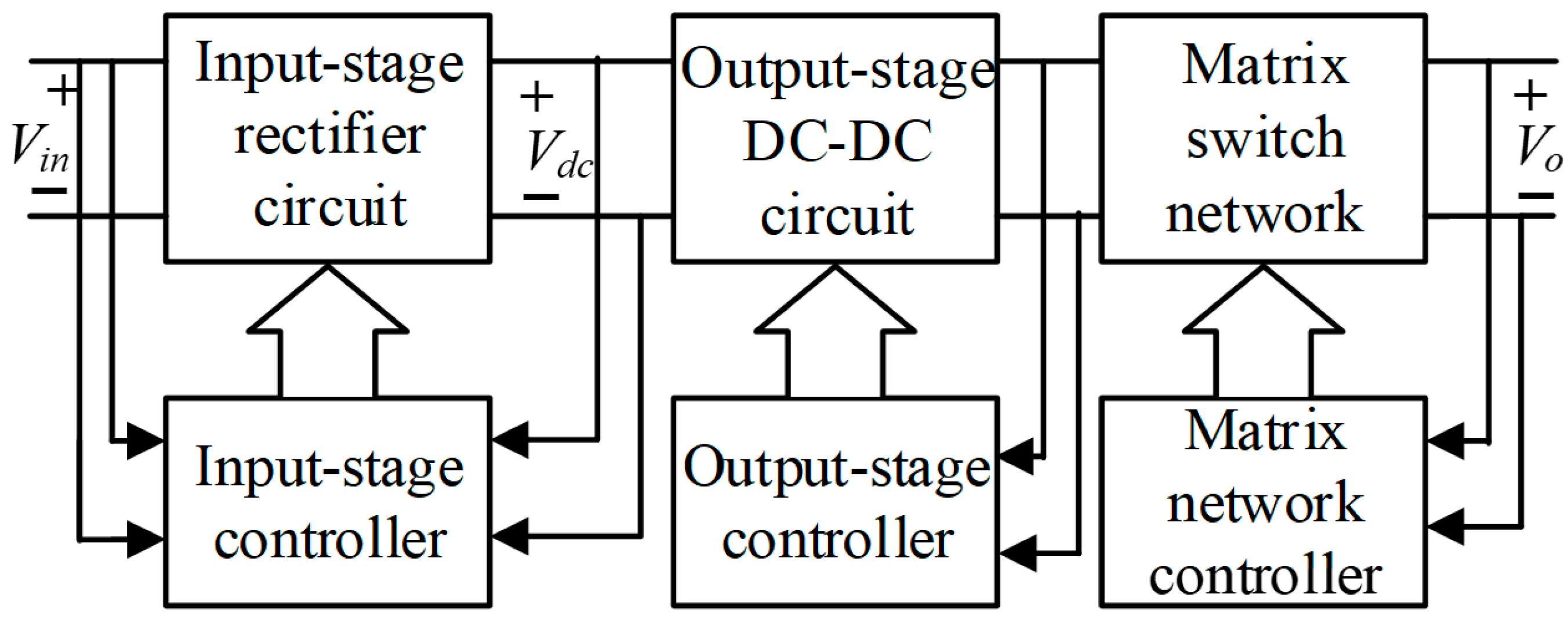
As shown in Figure 1, the proposed EV charging stack topology consists of a three-phase voltage-source PWM rectifier as the front end and multiple modular DAB (Dual Active Bridge) converters in the rear stage. The input terminals of each DAB module are connected in parallel to the DC bus, while the output terminals are linked to multiple charging ports through a hybrid the serial and parallel matrix switch network. This switch network is built with fully controlled semiconductor devices, specifically including parallel switches between the positive/negative output terminals of each DAB module and any charging port, as well as series switches between the positive and negative output terminals of different DAB modules. For a charging stack with M DAB modules and N charging ports, the total number of parallel switches is 2 × M × N, and the total number of series switches is M. The charging stack system can dynamically reconfigure the power transmission paths based on the real-time charging demands of each port, enabling flexible configuration of DAB modules. This approach ensures a wide output voltage range and enables flexible power distribution across all charging ports.

2.2. PWM Mathematical Model

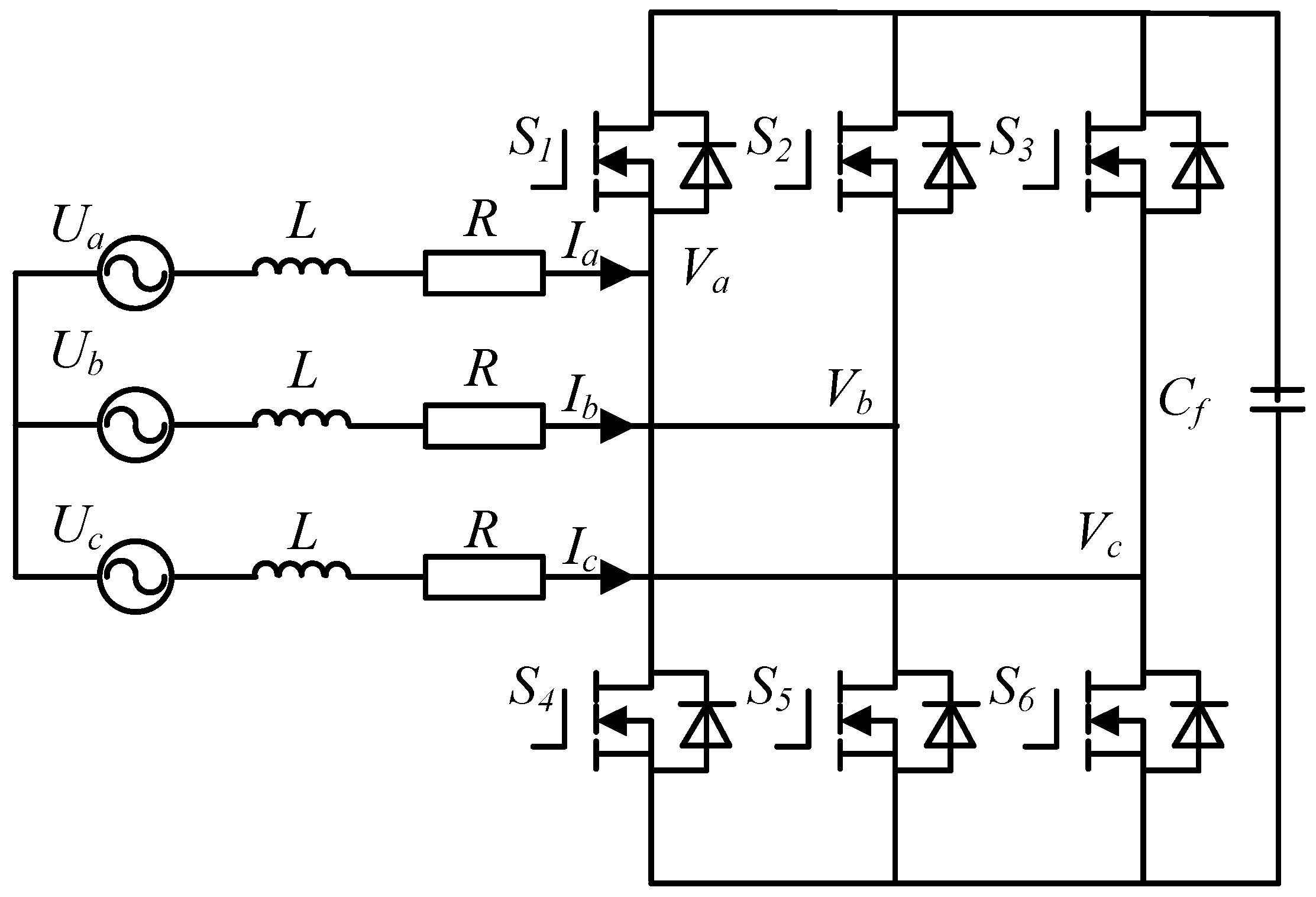
The three-phase voltage-source PWM rectifier, whose structure is shown in Figure 2, consists of three bridge arms implemented with six MOSFETs (S1S6). The DC-link capacitor C d c is employed to ensure unity power factor operation on the grid side and to maintain a stable DC bus voltage.
To establish the mathematical model of a three-phase voltage-source PWM rectifier, the following assumptions are made: the three-phase grid voltages are balanced and sinusoidal; the switching devices are treated as ideal switches, with their conduction voltage drops and switching transients neglected; the DC-link voltage remains constant within one switching period; the filter inductors operate in the linear region without magnetic saturation; the grid-side power factor is unity. Based on Kirchhoff’s laws and coordinate transformation, the mathematical model of the rectifier in the synchronous rotating dq reference frame is established as follows [26]:
L d i d d t = e d R i d + ω L i q V d L d i q d t = e q R i q + ω L i d V q C d c d V d c d t = S d i d + S q i q i L
where U a , U b , U c are the three-phase balanced power supply voltages on the AC side; V a , V b , V c are the three-phase input voltages on the rectifier side; I a , I b , I c are the three-phase AC currents; R and L represent the equivalent line resistance and the equivalent filter inductance, respectively; C d c is the DC-link capacitance; and U d c is the voltage across the DC-link capacitor.

2.3. Mathematical Model of the DAB Converter

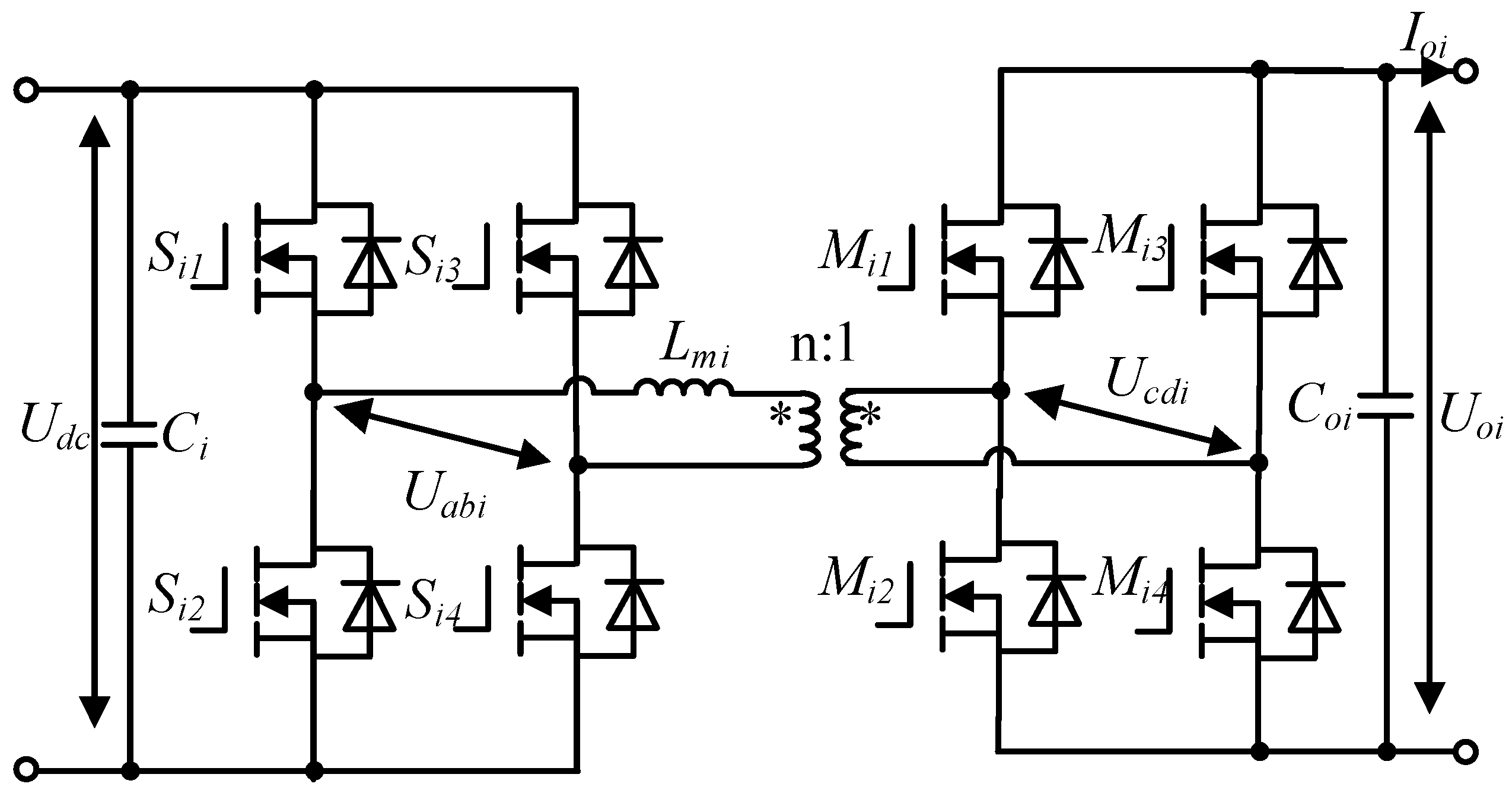
The DAB converter consists of an input H-bridge, an output H-bridge, and a high-frequency transformer, with its structure illustrated in Figure 3. In this configuration, U d c denotes the input voltage of the DAB module; U o i (i = 1, 2, …, N) represents the output voltage of the i-th DAB converter; Lmi is the sum of the transformer leakage inductance and the auxiliary inductance of the i-th DAB module; C i and C o i are the input-side DC-link capacitor and the output-side filter capacitor of the i-th DAB module, U a b i and U c d i denote the output voltages of the input-side H-bridge and the output-side H-bridge of the i-th DAB module, respectively; and the transformer has a turns ratio of n:1.
Among the control strategies for DAB converters, phase-shift control and pulse-width modulation (PWM) are two commonly employed methods. Due to its simple implementation and ease of control, phase-shift control has become the most widely adopted modulation technique for DAB applications. Taking single-phase-shift modulation as an example, during operation, both H-bridges switch at the same frequency and generate square-wave voltages U a b and U c d with a 50% duty cycle. When the phase of U a b leads that of U c d , power is transferred in the forward direction; conversely, power is transferred in the reverse direction. Thus, by adjusting the phase shift angle between the two square-wave voltages, both the magnitude and direction of power flow can be regulated. Under the premise of neglecting leakage flux, excitation current, and DC bias, and assuming continuous inductor current, the inductor current expression of the DAB converter under single-phase-shift modulation is as follows [27]:
i L = i L ( t 0 ) = n U o i ( 1 k 2 D ) 4 f s L i L ( t 1 ) = n U o i ( 2 k D k + 1 ) 4 f s L i L ( t 2 ) = n U o i ( 2 D + k 1 ) 4 f s L i L ( t 3 ) = n U o i ( k 2 k D 1 ) 4 f s L
where k = U d c / U o i represents the voltage matching ratio between the input and output sides. Studies indicate that the analysis for the case k > 1 is consistent with that for k < 1; therefore, this paper only considers the scenario where k < 1. Based on Equation (2), the expression for the transmission power P can be further derived as
P = 1 2 T h s 0 2 T h s u d c ( t ) i L ( t ) d t = k U d c U o i 2 f s L m i D ( 1 D )
As can be seen from Equation (3), the inductor current exhibits an irregular waveform under single-phase-shift modulation. To facilitate the subsequent calculation of transformer losses, the RMS value of the inductor current I r m s can be derived as
I r m s = 1 2 T h s 0 t 1 ( i L ( t ) ) 2 d t + t 1 t 2 ( i L ( t ) ) 2 d t = U d c 4 f s L s ( 1 k ) 2 + 4 D 2 k ( 3 2 D ) 3

2.4. Loss Model for DAB Converters

The total losses of the DAB converter primarily consist of the conduction losses and switching losses of semiconductor devices, as well as the losses in electromagnetic components (the transformer and leakage inductance) [28].

2.4.1. Conduction Loss

The conduction losses of the DAB converter include both the conduction losses of the MOSFETs and those of the freewheeling diodes. These losses are not only influenced by the switching frequency but are also related to the number of switching devices conducting in each time interval and the RMS value of the current flowing through them. The conduction losses of the MOSFETs and the freewheeling diodes are given by, respectively:
P C O N D _ T = R D S _ o n T s i = 1 m t o n t o f f i L 2 ( t ) d t
P C O N D _ D = 1 T s i = 1 m t o n t o f f i L ( t ) V D d t
where ton and toff are the turn-on and turn-off instants of the MOSFETs, respectively; V D is the forward voltage drop of the freewheeling diode; i L ( t ) is the inductor current, which corresponds to the current flowing through the MOSFET during its conduction interval; and R D S ( o n ) is the on-resistance of the MOSFET. The total conduction loss P C O N D is equal to the sum of the conduction losses of the MOSFET and the diode, expressed as
P C O N D = P C O N D _ T + P C O N D _ D

2.4.2. Switching Loss

Under ideal operating conditions, all switching devices in a DAB converter can achieve ZVS (Zero Voltage Switching) [29]; therefore, the turn-off losses of the DAB converter alone are
P s w = t s w _ o f f T s i = 1 m V i I i
where T s is the switching period; t s w _ o f f is the duration of the switching device’s turn-off operation; m is the number of turn-off events per switching period; V i   and I i are the average voltage and current in the switching device during the i-th turn-on event, respectively.
P c u = I r m s 2 R t r

2.4.3. Magnetic Component Loss

The core loss of the transformer is commonly calculated using the Steinmetz equation [30]:
P c o r e = C F e f α B m β V e
where C F e is the core loss coefficient; V e is the core volume; α and β are constant coefficients, with α ranging from 1 to 2 and β ranging from 2 to 3; and B peak is the peak magnetic flux density, which can be calculated according to Faraday’s law as
B = 1 N A e 0 t U ( t ) d t

3. Charging Stack Control Strategy

3.1. Adaptive Variable Structure Control Strategy

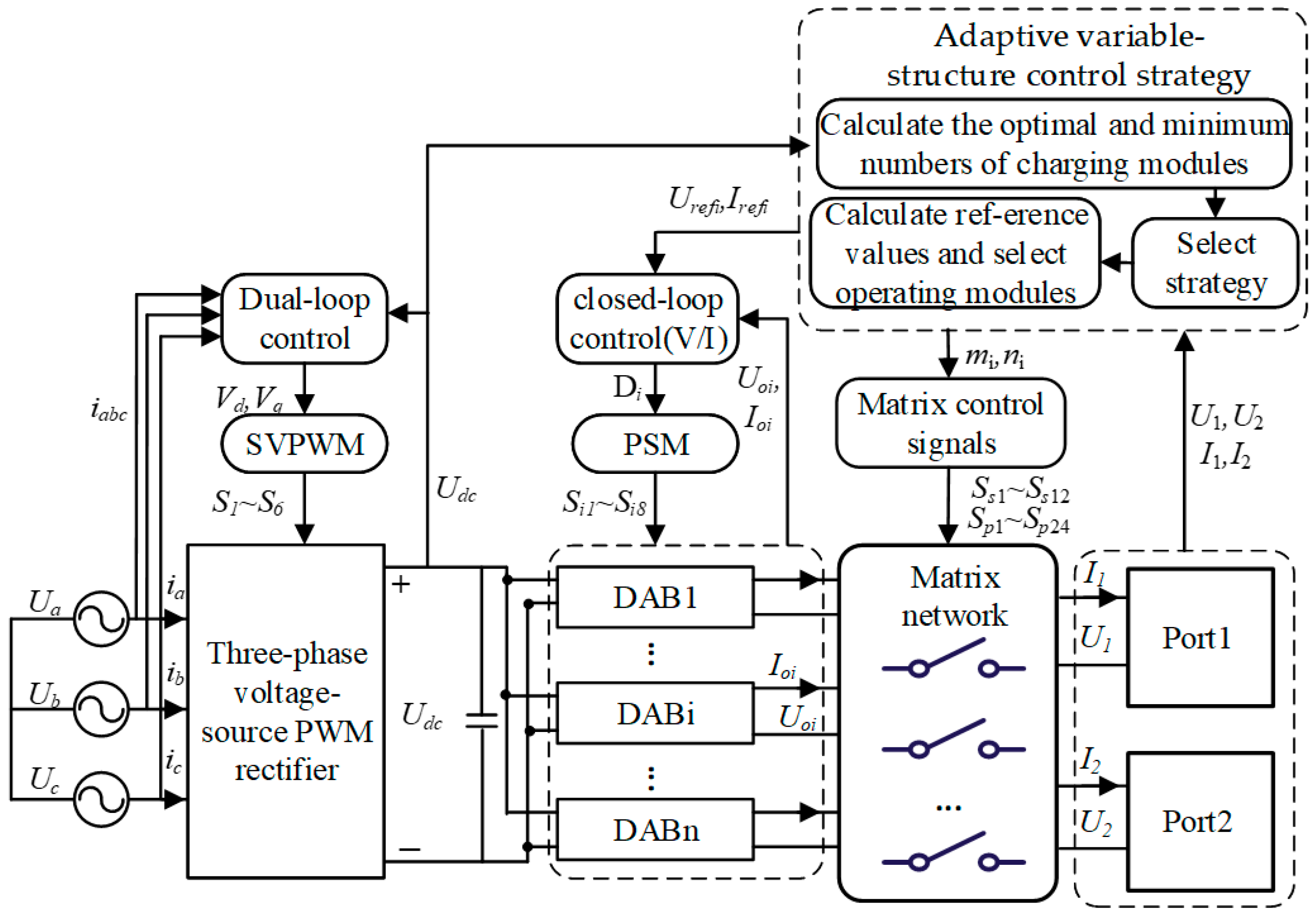
The overall control strategy for the charging stack system is shown in Figure 4. The control system consists of a two-tier control structure. The upper-level control system is a variable structure control unit responsible for receiving charging demands from each charging port, calculating the system’s operating state and determining the operating mode, allocating charging modules and power to each port, and sending action commands and output setpoints for each module to the lower-level controller. The lower-level control is implemented by the control units of each converter, responsible for achieving control objectives such as stable output and bus voltage regulation.
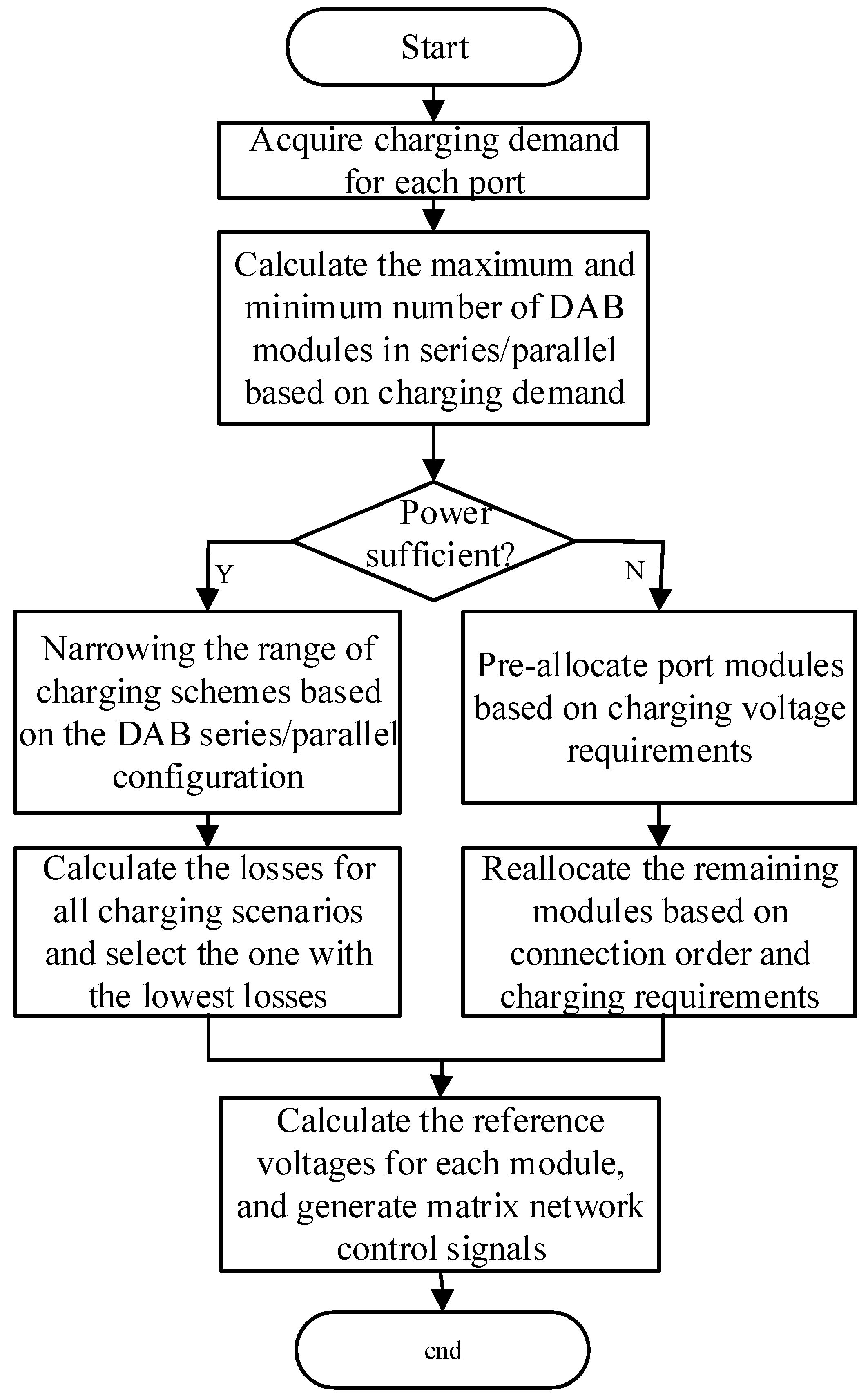
The flowchart of the upper-level adaptive variable structure control strategy is shown in Figure 5. First, the charging demands of each port are obtained, and the required maximum and minimum numbers of DAB modules in series, m i _ m i n and m i _ m a x , and in parallel, n i _ m i n and n i _ m a x are calculated as
m i _ min = V o i U D A B _ max
m i _ max = V o i U D A B _ min
n i _ min = P o i m i _ min I o i V o i
n i _ min = P o i m i _ max I o i V o i
where U D A B _ m a x and U D A B _ m i n represent the upper and lower limits of the DAB module output voltage range, respectively, while P , I o i , V o i and P denote the charging power demand, current demand, voltage demand, and port power demand transmitted by the BMS system; and O represents the total number of modules required for the current charging stack.
O = m i n i
Next, depending on whether the charging stack module can meet the charging demand, two scenarios can be distinguished: module surplus and module insufficiency.

3.1.1. Module Surplus

When the total module demand required for charging is less than the available capacity of the charging stack system, the optimization aims to minimize the total system loss by configuring the series/parallel combinations of modules assigned to each port. First, based on the required maximum and minimum number of DAB modules in series, denoted as m i _ m i n and m i _ m a x , and the required maximum and minimum number in parallel, denoted as n i _ m i n and n i _ m a x , the feasible range of series/parallel configurations for each port is constrained. This helps reduce the search space of the optimization problem and improves computational efficiency. Subsequently, based on the loss model of the DAB converters, the total system loss under all feasible combinations is enumerated. Finally, the series/parallel configuration of DAB modules for each port that corresponds to the lowest total loss is selected as the optimal charging solution. The corresponding objective function and constraints are as follows:
min { P _ l o s s }
s . t . m i _ min m i m i _ max , n i _ min n i n i _ max , m i · n i O
Based on the minimum-loss configuration described above, the series/parallel numbers of DAB modules for each charging port are ultimately determined. Subsequently, the voltage reference for the i-th charging port under constant-voltage (CV) mode and the current reference under constant-current (CC) mode can be obtained as follows:
U r e f i = V o m i
I r e f i = I o n i

3.1.2. Module Insufficiency

When the number of modules required to meet the charging demand of a charging stack exceeds the stack’s capacity, an adaptive module reservation scheduling strategy is applied to the DAB modules at each port based on the vehicle connection sequence. This strategy, which takes into account the number and capacity of the stack’s available DAB modules, ensures that basic charging requirements are satisfied while dynamically adjusting the constant-current (CC) charging phase to improve both energy efficiency and module utilization.
Module pre-allocation is first performed: based on the voltage requirements of each charging port, the basic charging demand for each port is defined as the minimum number of series modules m i _ m i n to satisfy the voltage requirement and one parallel module. After this initial allocation, if surplus modules remain in the system, additional modules are assigned to vehicles that connected earlier, according to their current and voltage gaps and the order of vehicle connection, thereby increasing their charging current. The total number of DAB modules allocated to each port is then finalized. In constant-voltage (CV) charging mode, the voltage reference for each module is given by Equation (20); in constant-current (CC) mode, the current reference is given by
I r e f i = m i P DAB _ max U b a t
where P D A B _ m a x denotes the rated power of a single DAB module. The output voltage and current values of the DAB module under constant-voltage (CV) and constant-current (CC) modes, for both surplus and insufficient capacity scenarios of the charging stack, are summarized in Table 1. In the table, U c v and I c c represent the constant-voltage charging voltage and constant-current charging current set for the EV battery, respectively, while U b a t and   I b a t denote the actual charging voltage and current of the EV battery during the charging process.
After determining the number of charging modules, operating modes, and corresponding reference values for each charging port, the matrix switch network is activated to charge the EVs. This achieves the following: when the charging stack has surplus modules, the total losses throughout the entire charging process are minimized, thereby reducing charging costs; when the system has insufficient modules, it ensures temporal fairness in power allocation, improves module utilization, shortens charging time, and enhances user satisfaction.
To provide a clear overview of the proposed adaptive logic, the complete execution process of the variable structure control strategy is formalized in Algorithm 1. This algorithm bridges the upper-level mode selection with the lower-level execution.
Algorithm 1: Adaptive Variable Structure Control Strategy
Input :   Charging   demands   ( P i ,   I o i ,   V o i ) ,   System   capacity   ( N t o t a l )   Output :   Optimal   module   configuration   ( m i , n i ) ,   Reference   setpoints   ( V r e f ,   I r e f )
1: Initialization: Obtain real-time BMS demands for each port i.
2: Requirement   Calculation :
3: Calculate   min / max   series   modules   m i _ m i n   and   m i _ m a x via (12)–(13).
4: Calculate   min / max   parallel   modules   n i _ m i n   and   n i _ m a x via (14)–(15).
5: Calculate   total   required   modules   O = m i _ m i n n i _ m i n .
6: Scenario Branching:
7: If   O N t o t a l   and   P i N t o t a l P D A B _ m a x Δ P (Module Surplus) Then
8: Optimization :   Enumerate   all   feasible   ( m i , n i ) combinations within constraints.
9: Objective :   Minimize   total   system   loss   P L o s s _ t o t a l via (17).
10: Select the configuration with the lowest loss.
11: Else (Module Insufficiency) Then
12: Pre-allocation :   Assign   m i _ m i n modules to each port for basic demand.
13: Adaptive Scheduling: Allocate surplus modules based on vehicle connection order.
14: End If
15: Execution :   Update   matrix   switch   states   and   send   V r e f ,   I r e f to lower-level PI controllers.
The operational stability of the proposed adaptive variable structure strategy is guaranteed by the hysteresis logic and the decoupling of time scales. As formalized in Algorithm 1, the introduction of a hysteresis margin ΔP prevents the system from undergoing frequent configuration switching caused by minor power fluctuations, thereby eliminating control chattering. Furthermore, this discrete decision-making framework, combined with the hysteresis buffer, provides intrinsic robustness against measurement uncertainties and parameter fluctuations. Since the performance gaps between different discrete configurations are typically larger than sensor noise, the optimal selection remains stable under non-ideal conditions. From a system stability perspective, the discrete reconfiguration events occur at a significantly lower frequency than the sampling and control cycles of the converter units. This allows the closed-loop controllers to restore the system to a steady state rapidly after each reconfiguration event, maintaining stability throughout the charging profile.
Regarding computational requirements and real-time performance, the strategy is optimized for execution on standard digital control platforms. For a system with a fixed number of modular units (e.g., 6 modules in this study), the computational complexity is effectively O(1), as the optimization involves a finite and small-scale search space. This minimal computational overhead ensures that the logic can be executed within a single control interrupt cycle without compromising the execution of inner-loop regulation, satisfying the stringent real-time requirements of industrial charging systems.

3.2. Closed-Loop Control Strategy for Different Charging Stages

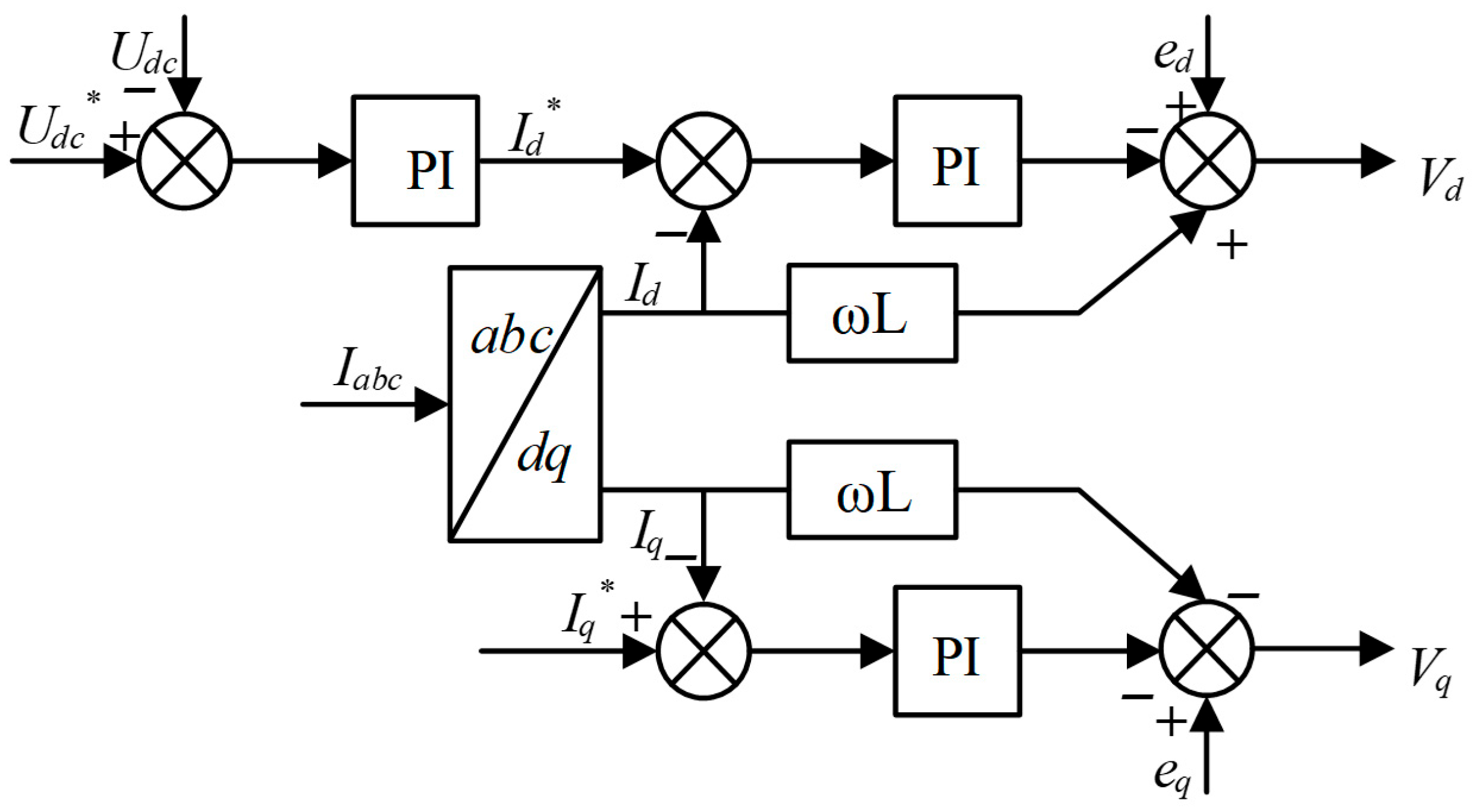
The control algorithm block diagram of the rectifier in the charging stack system is shown in Figure 6. First, the rectifier output voltage U d c and the grid-side current I a b c are detected. The difference between U d c and its reference value is processed through a proportional–integral (PI) controller to obtain I d . Simultaneously, the detected grid-side current I a b c is transformed via coordinate transformation to obtain I d and I q . These are then compared with their respective reference values, and the outputs of the PI controllers, together with the two-phase voltages, are used to achieve feedforward decoupling based on Equation (1), yielding:
u d = ( K i p + K i I s ) ( i d i d ) + ω L i q + E d u d = ( K i p + K i I s ) ( i q i q ) + ω L i d + E q
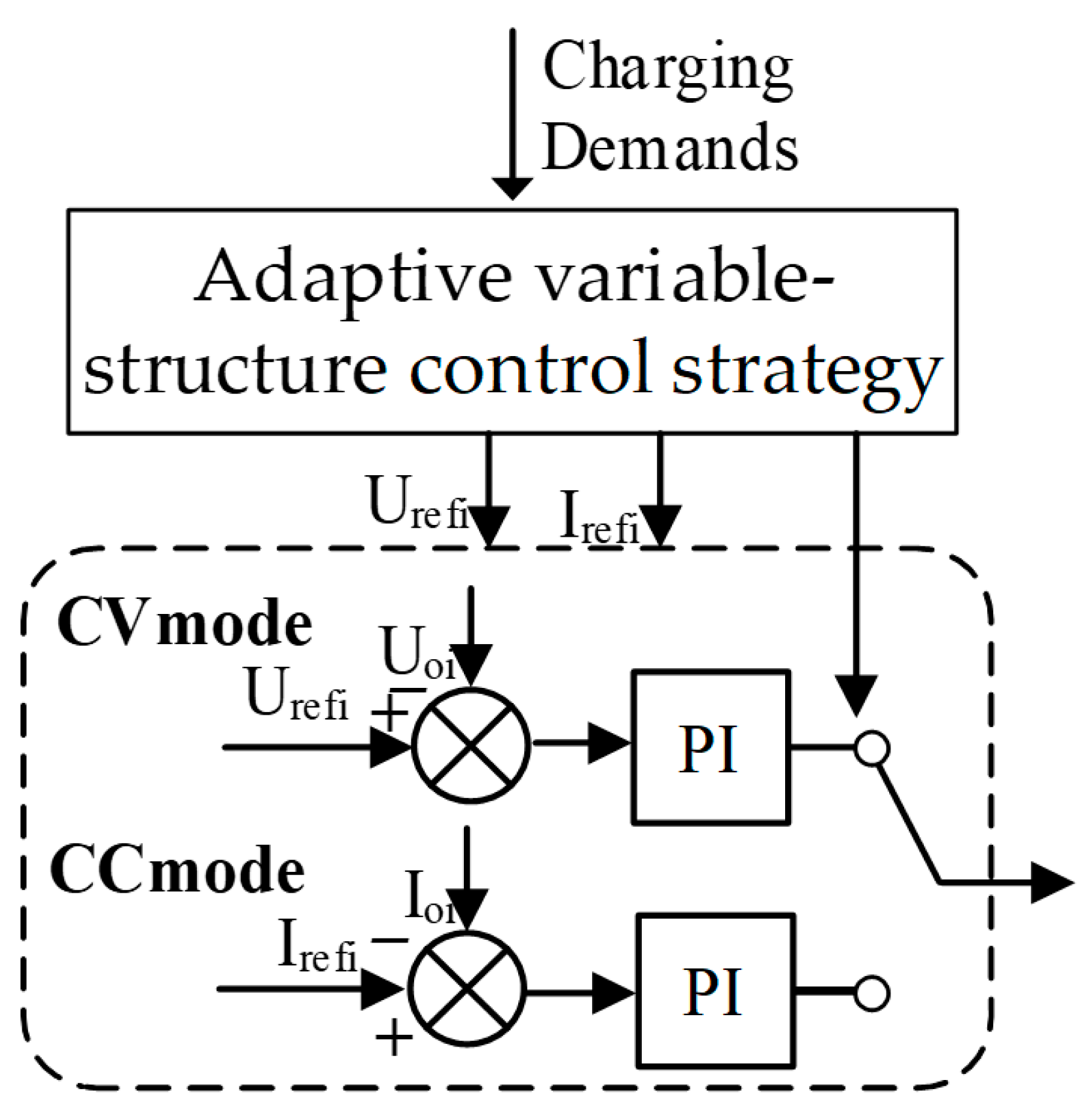
The DAB module of the proposed charging stack supports both constant-voltage (CV) and constant-current (CC) charging modes. Accordingly, whether the controller is activated and which operating mode is selected depend on the charging demands and the real-time system status. The DAB Module Control Strategy is shown in Figure 7.
Taking the i-th DAB converter as an example, the operating mode and reference values are first determined based on the signals received from the adaptive variable structure control strategy module. The output voltage U o i and output current I o i   are then sampled and compared with their respective reference values. The errors are processed through a PI controller to generate the duty cycle D i .

4. Results

To verify the effectiveness of the proposed adaptive variable structure control strategy for the charging stack and its wide-range operation capability, simulation experiments are conducted in MATLAB R2022a/Simulink to validate the optimal charging scheme under module surplus conditions and the adaptive module reservation scheduling strategy for power allocation under module insufficiency conditions. The parameters of the charging stack are listed in Table 2.

4.1. Minimum-Loss Charging Scheme Validation

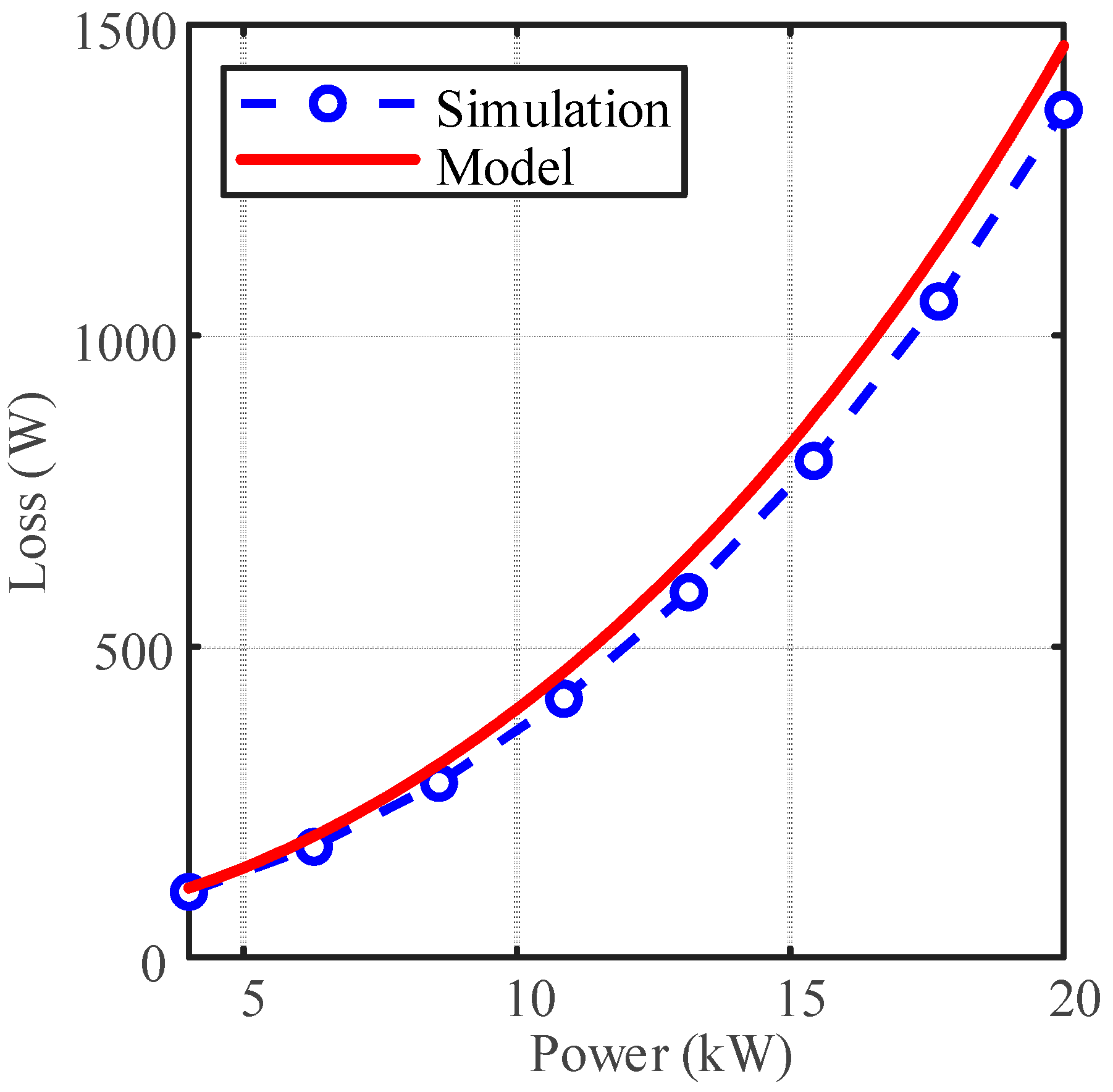
To ensure the reliability of the proposed optimization framework, the analytical loss model is first validated against simulation measurements. The verification is conducted on a single DAB module operating at a constant output voltage of 250 V. This voltage level is specifically selected to maintain a unity voltage conversion ratio, thereby ensuring optimal zero-voltage switching (ZVS) performance through voltage matching. The charging power is swept from 4 kW to 20 kW to cover the typical load range. The key system parameters are consistent with the specifications listed in Table 2.
As illustrated in Figure 8, the total system losses calculated using Equation (17) are compared with the discrete simulation data points. Although a maximum absolute deviation of less than 10% is observed—attributable to the idealized representation of switching transients in the analytical formulation—the calculated curve accurately captures the loss trend across the entire power range. It is evident from the results that the efficiency discrepancies among different discrete configurations are significantly larger than this modeling tolerance. Consequently, the analytical framework offers sufficient accuracy to serve as a reliable basis for guiding the discrete series–parallel configuration switching logic.

4.2. Minimum-Loss Charging Scheme Validation

4.2.1. 400 V EV

To ensure a fair and rigorous evaluation, all compared methods [15,16] were simulated under strictly identical conditions. The simulation and circuit parameters of the charging stack align completely with Table 2, while the initial battery states and charging profiles match the parameters detailed in Table 3.
Since the physical topology of the converters remains identical across all comparison groups, the differences among the evaluated schemes lie entirely in their upper-level scheduling logic. In the proposed method, module configurations are dynamically adjusted based on real-time optimal loss calculations. Conversely, the variable structure scheme from [15] triggers a module switch only when the charging power drops below the capacity limit of a single module. Meanwhile, the fixed-structure scheme from [16] locks exactly two modules in parallel throughout the entire evaluated charging cycle, regardless of load variations.
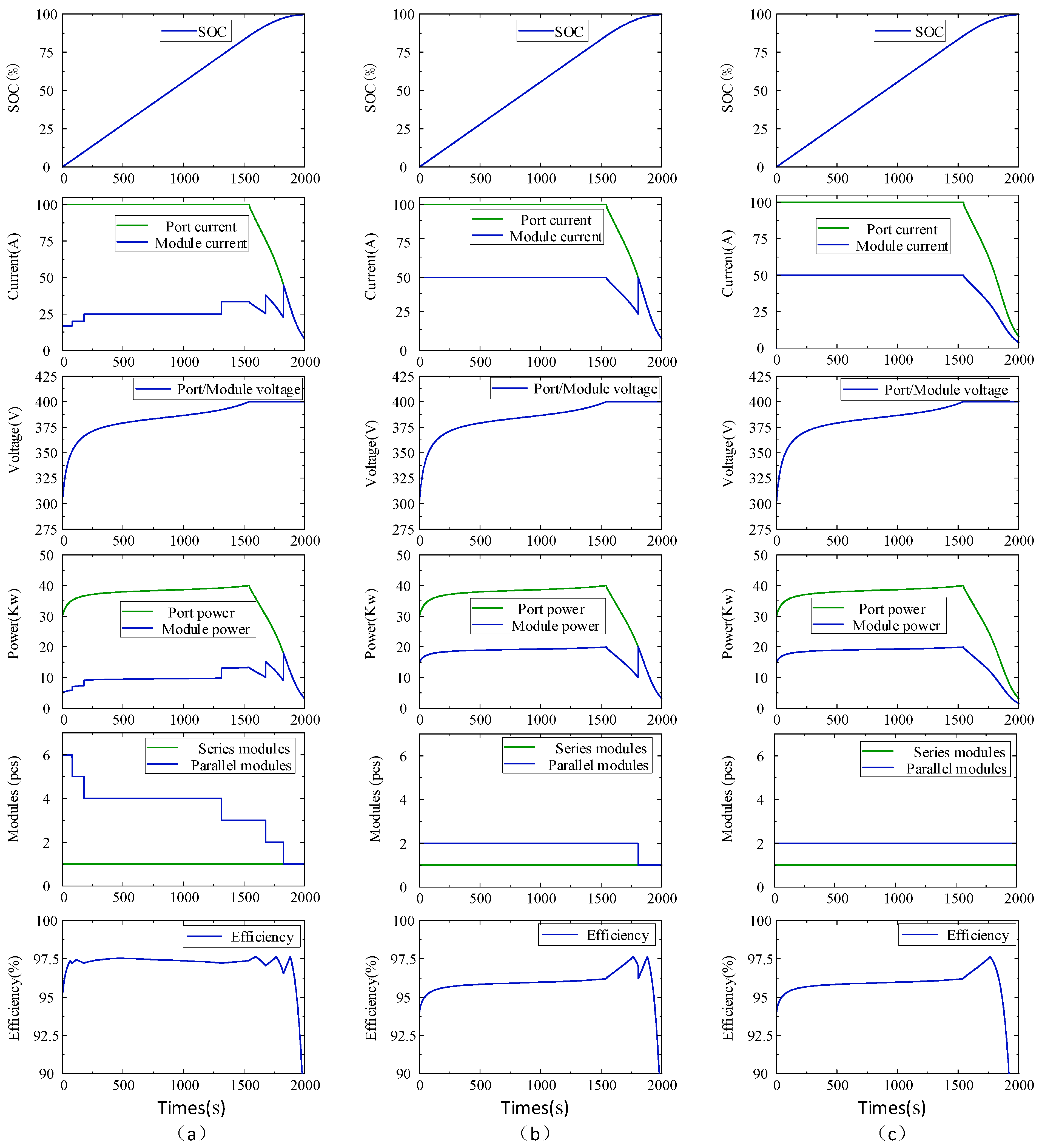
Figure 9a–c sequentially present the simulation results of the minimum-loss charging scheme proposed in this paper, as well as the charging schemes adopted in [15,16], for a 400 V EV platform. The EV battery parameters used in the simulations are consistent with those of EV1 listed in Table 3. At the initial stage of charging, the EV battery voltage is 300.6 V. Under this condition, the DAB modules in the charging stack achieve voltage matching and realize global soft-switching under light-load conditions. By paralleling multiple modules, the inductor current is reduced, which decreases conduction losses and improves energy conversion efficiency.
As the charging process progresses, the battery state of charge (SOC) increases, and the charging voltage gradually rises. Consequently, the power range over which the DAB modules can achieve soft-switching narrows. If an excessive number of modules remain connected in parallel, each module operates at a low output power, leading to loss of soft-switching capability and increased switching losses, which ultimately reduces energy conversion efficiency. To address this, in the proposed scheme shown in Figure 9a, the number of parallel modules is dynamically adjusted as charging proceeds. Specifically, at 80 s (351.4 V, 100 A), 178 s (366.1 V, 100 A), 1314 s (392.1 V, 100 A), 1544 s (400 V, 99.9 A), 1676 s (400 V, 76.3 A), 1823 s (400 V, 45.7 A), and 1862 s (400 V, 35.1 A), the number of parallel modules is successively reduced to 6, 5, 4, 3, 2, and 1, respectively. This strategy significantly improves energy conversion efficiency when the EV battery SOC is in the low-to-medium range, while the voltage and current relationships at the DAB module outputs and charging ports remain consistent with Table 1, satisfying the full-cycle charging requirements of electric vehicles.
In contrast, the strategy in [15], shown in Figure 9, adjusts the configuration based solely on output boundary conditions. It initially operates with only two modules and switches to a single module only when the total power falls below the capacity of one module. This logic forces each module to handle a much higher current load, resulting in significantly elevated resistive losses compared to the proposed scheme. Similarly, the strategy in [16] employs a fixed number of parallel modules, as shown in Figure 9c. While its performance is comparable to [15] in the early stages, the fixed structure becomes an efficiency bottleneck during the constant-voltage stage. As the current demand drops, the redundant modules quickly enter light-load conditions, causing a loss of soft-switching and a subsequent surge in switching losses. These results demonstrate that by dynamically matching the module count to the demand, the proposed strategy effectively suppresses resistive losses at high loads and maintains soft-switching at light loads.
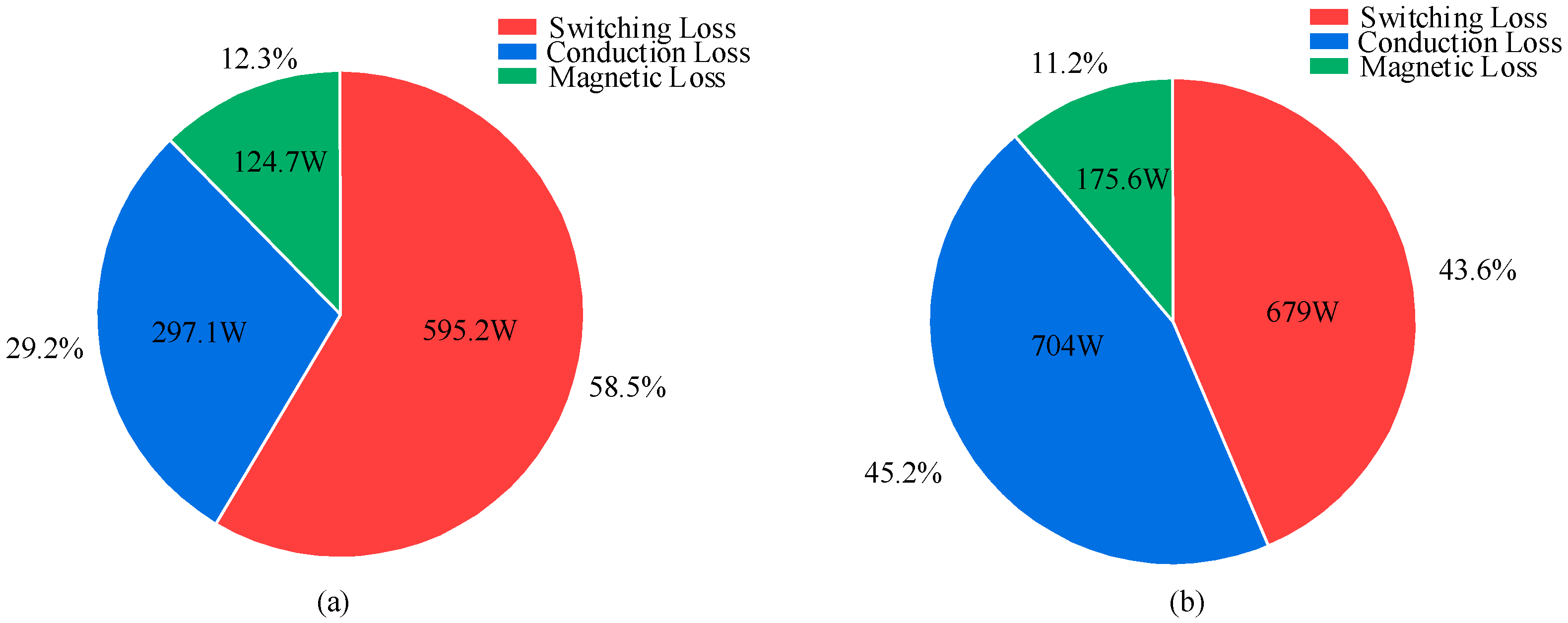
To analyze the reasons for efficiency improvement, a comparative breakdown of total system losses was performed at t = 1000 s for the 400 V charging process. This analysis evaluates the proposed strategy (4-parallel modules) against the comparison schemes (2-parallel modules), as shown in Figure 10. At this operating point, the total loss of the proposed strategy is 1017 W, a reduction of 34.7% compared to the 1558.6 W produced by the comparison methods.
Analyze Figure 10 shows that at t = 1000 s, the RMS current per individual module is the decisive factor for efficiency. The proposed strategy effectively lowers the current load per module by increasing the parallel count from two to four. Given that conduction losses and transformer copper losses satisfy a quadratic relationship with the RMS current, the total conduction loss is reduced from 704 W to 297.1 W, and magnetic component losses also decrease significantly. Although the increased number of modules leads to a rise in total switching loss, the system efficiency is significantly improved due to the massive reduction in the dominant conduction and magnetic losses. This indicates that the adaptive scheduling strategy suppresses dominant resistive losses by optimizing module allocation, effectively improving the operational efficiency of the system.

4.2.2. 800 V EV

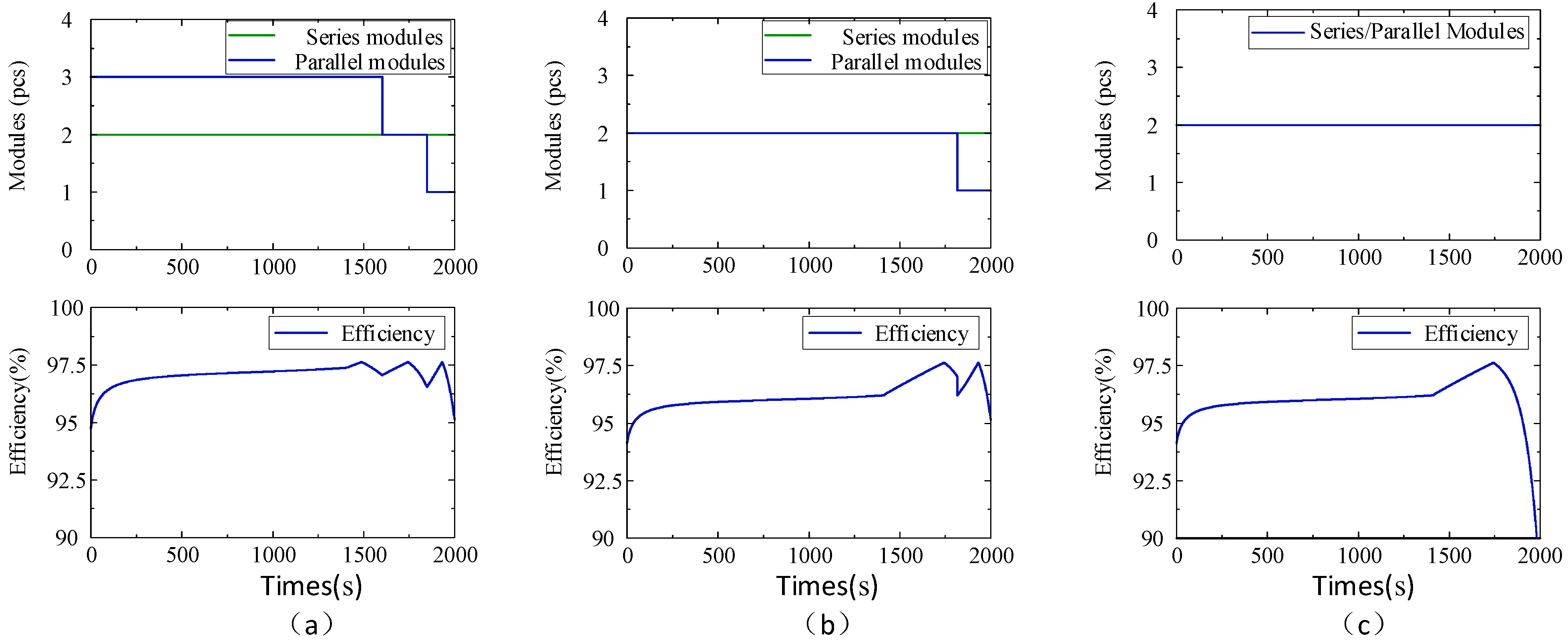
To verify the universality of the proposed strategy across different types of EVs, and given that the underlying principles are consistent, the analysis process is omitted here for brevity; only the key results are presented. Figure 11a–c sequentially show the simulation results of the proposed charging scheme, as well as the schemes from [15,16], for an 800 V EV platform. The EV battery parameters used in these results are consistent with those of EV2 listed in Table 3. In the proposed scheme shown in Figure 11a, as charging proceeds, the number of parallel modules is dynamically adjusted at 1415 s, 1606 s, and 1842 s, successively reducing to 3, 2, and 1, respectively.
A comparison of the efficiency curves reveals that both conventional strategies in [15,16] suffer from excessive resistive losses during the early and middle charging stages due to their insufficient parallel module count. Furthermore, because these methods employ a fixed or inflexible structure, they maintain redundant modules as the charging current drops. This forces individual modules into light-load conditions prematurely, causing efficiency degradation due to the loss of soft-switching. In contrast, the proposed strategy significantly improves the conversion efficiency across the low-to-medium SOC range by optimizing the module allocation.
The results show that the minimum-loss charging scheme enabled by the proposed variable structure control strategy for the charging stack achieves system efficiency optimization for both 400 V and 800 V EV platforms, demonstrating good universality. Additionally, since the loss-reduction principles and the effectiveness of the adaptive strategy for the 800 V platform are fundamentally consistent with the 400 V case, the detailed loss component analysis is omitted here for conciseness.

4.3. Adaptive Module Reservation Scheduling Strategy Validation

To verify the effectiveness of the proposed adaptive module reservation scheduling strategy when the charging stack has insufficient modules, the vehicles connected to each port are listed in Table 4, which provides the charging parameters, battery status, and connection port for each vehicle, where EV1 is connected to Port 1 first.
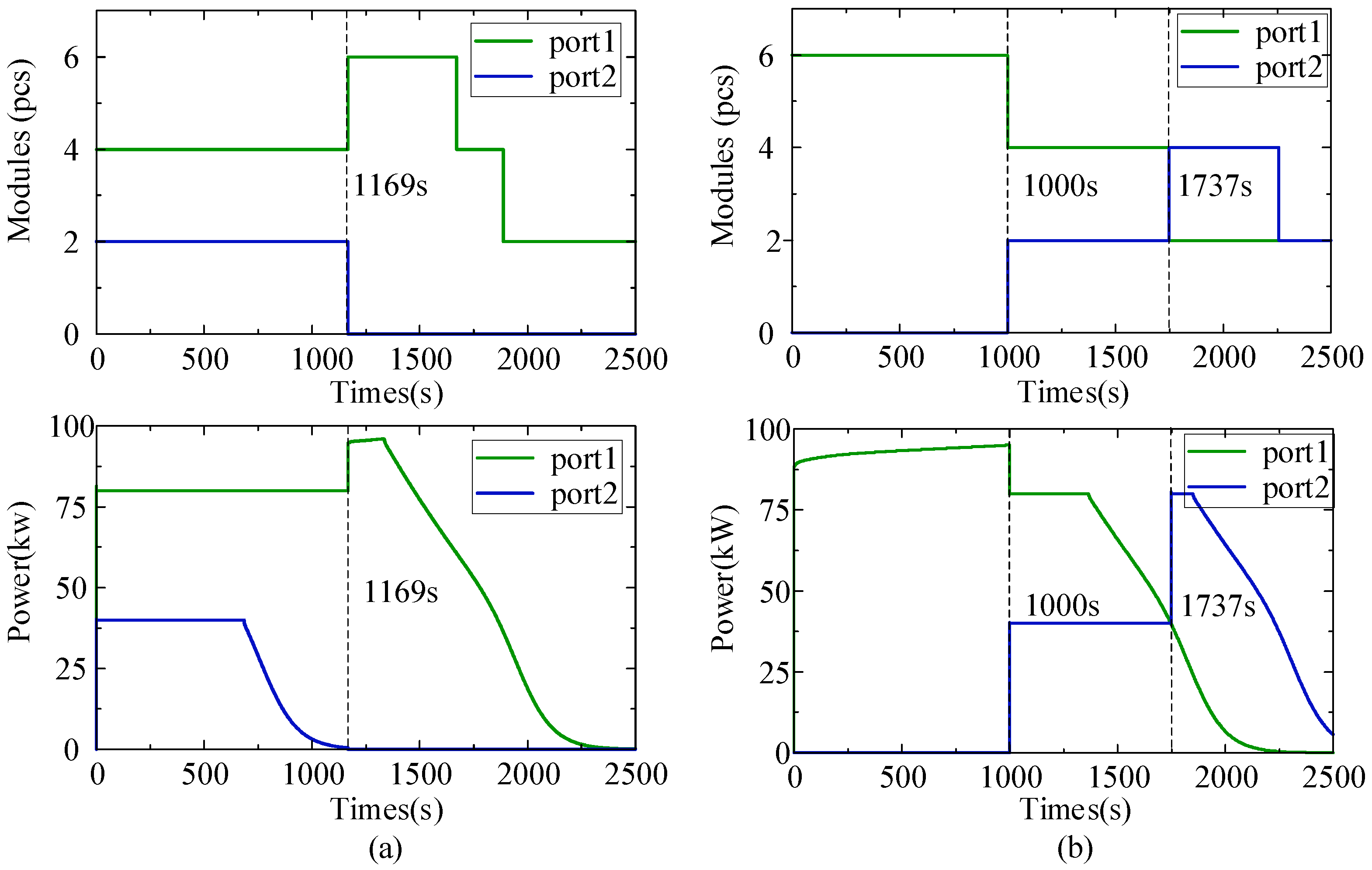
Based on the DAB module output voltage range in Table 2 and the EV charging voltages in Table 4, at least two DAB modules connected in series are required to satisfy the basic charging voltage requirement for any given port. To comprehensively validate the scheduling capability of the charging stack under insufficient module conditions and highly dynamic demands, the analysis is conducted across two scenarios: a vehicle disconnection scenario shown in Figure 12a and an asynchronous connection scenario shown in Figure 12b.
In the disconnection scenario of Figure 12a, the system experiences a module shortage. The proposed adaptive module reservation scheduling strategy, based on the connection sequence, reserves two modules for the later-connected Port 2 while allocating four modules to EV1 at Port 1. All modules operate at their rated power. At 1169 s, EV2 completes charging and disconnects, transitioning the system to a module surplus state, after which the minimum-loss scheme is adopted.
To further demonstrate the dynamic reallocation capability, Figure 12b introduces an asynchronous connection scenario where EV2 connects at 1000 s. From 0 s to 1000 s, only EV1 is connected and occupies all six modules. When EV2 connects at 1000 s, the strategy ensures temporal fairness by allocating the minimum required two modules to EV2, while EV1 retains four modules. As EV1’s SOC increases and its current demand naturally drops at 1737 s, the proposed strategy immediately detects the surplus and dynamically transfers the freed modules to EV2, significantly accelerating its charging process. After 2277 s, as EV2 approaches full charge, its module count is reduced back to two.
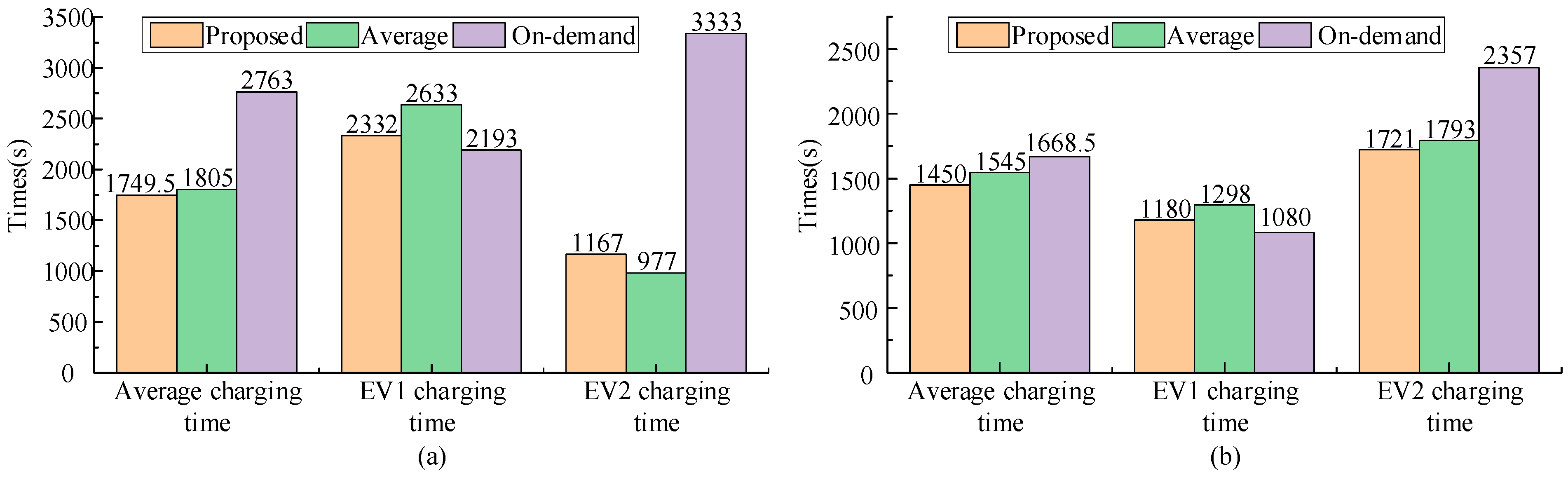
Figure 13 presents a detailed comparative analysis of the proposed adaptive strategy against traditional on-demand and average allocation strategies, with Figure 13a,b corresponding to the two scenarios. As shown in Figure 13a for the disconnection scenario, although the on-demand allocation strategy reduces the charging time of EV1 by approximately 1.75% compared to the proposed strategy, it causes a severe resource shortage for EV2, whose average charging time is prolonged by 36.67%. Furthermore, compared to the average allocation strategy, the proposed strategy further reduces the average charging time by 3.07%.
As shown in Figure 13b for the asynchronous connection scenario, the statistical data demonstrate that the proposed strategy reduces the overall average charging time by 12.1% compared to the on-demand method. Although the on-demand allocation strategy allows EV1 to charge 8.47% faster, it leads to an unreasonable waiting period for later-connected vehicles. When compared to the average allocation strategy, the proposed strategy shortens the average charging time by 6.15% and reduces the charging time of EV1 by 9.09%. These results prove that the proposed adaptive strategy maintaining strict temporal fairness while maximizing module utilization efficiency through seamless cross-port resource transfer.

5. Discussion

The practical implementation of the proposed adaptive variable structure strategy is primarily defined by its physical operational boundaries and computational efficiency. Regarding implementation limitations, the system’s operational envelope is constrained by the total number of available modules Ntotal and the individual module output capability boundaries. These physical factors, along with the maximum switching frequency allowed by the semiconductor matrix network, define the dynamic response limit of the reconfiguration logic. The control architecture accounts for these constraints by ensuring that the synthesized charging demands remain within the physical power saturation limits of the modular units, while maintaining a reconfiguration frequency that ensures system reliability.
In terms of computational requirements and scalability, the algorithm maintains a constant complexity of O(1) for the current system scale. For future applications involving a massive number of modular units, the computational overhead can be further managed by employing a hierarchical grouping strategy. By partitioning the total pool of modules into functional clusters based on real-time port requirements, the strategy effectively prevents the exponential expansion of the optimization search space. This approach ensures that the resource allocation remains efficient without the need for complex, time-consuming iterative solvers. Regarding multi-vehicle coordination, the priority-based mechanism ensures temporal fairness and high resource utilization as the system scales, demonstrating the proposed method’s potential for high-density industrial charging stacks.
Although validated through high-fidelity simulations, this study is limited by the absence of experimental verification. Simulations inherently idealize real-world hardware constraints such as parasitic parameters, sensor inaccuracies, and communication delays. To ensure the integrity of the proposed logic, the analysis includes a challenging asynchronous access scenario to test the dynamic scheduling process under complex demands. Future work will prioritize the development of a hardware prototype to evaluate the strategy’s robustness and real-time performance under practical industrial constraints.

6. Conclusions

The adaptive variable structure control strategy proposed in this paper effectively addresses the issues of reduced system conversion efficiency across a wide voltage range and insufficient module allocation flexibility in multi-vehicle scenarios. Through simulation analysis, the following conclusions can be drawn:
  • The proposed adaptive module reservation scheduling strategy enables flexible module allocation while ensuring temporal fairness, thereby shortening the average charging time and improving user satisfaction.
  • The proposed minimum-loss charging scheme effectively reduces the total energy loss throughout the entire charging process of the charging stack, improves energy conversion efficiency, and lowers charging costs.
Although validated through simulations, this study is limited by the absence of experimental verification. Simulations inherently idealize real-world hardware constraints, such as parasitic parameters, sensor inaccuracies, and communication delays. Future work will prioritize developing a hardware prototype to validate the real-time robustness and practical performance of the proposed strategy.

Author Contributions

Conceptualization, S.-Y.H. and P.L.; methodology, S.-Y.H.; software, S.-Y.H.; validation, S.-Y.H., P.L. and X.-Y.T.; formal analysis, P.L.; investigation, X.-Y.T.; resources, P.L.; data curation, X.-Y.T.; writing—original draft preparation, S.-Y.H.; writing—review and editing, S.-Y.H.; visualization, X.-Y.T.; supervision, P.L. and Z.L.; project administration, P.L.; funding acquisition, P.L. All authors have read and agreed to the published version of the manuscript.

Funding

This research was funded by New Technologies for Autonomous Regulation and Flexible Control of Power Quality in Source-Grid-Load Systems, grant number 2023YFB2407603.

Data Availability Statement

The original contributions presented in the study are included in the article. Further inquiries can be directed to the corresponding author.

Conflicts of Interest

The authors declare no conflicts of interest.

Abbreviations

The following abbreviations are used in this manuscript:
DABdual active bridge
CCConstant-current
CVConstant-voltage

References

  1. Jiao, Z.; Li, K.; Meng, H.; Guo, Y.; Zhou, J.; Zhang, C.; Huang, Z. A methodology for lithium-ion battery state of health estimation using random constraints of state of charge. J. Energy Storage 2026, 154, 121349. [Google Scholar] [CrossRef]
  2. Jia, C.; Liu, W.; Chau, K.; He, H.; Zhou, J.; Niu, S. Passenger-aware reinforcement learning for efficient and robust energy management of fuel cell buses. eTransportation 2026, 27, 100537. [Google Scholar] [CrossRef]
  3. Han, T.; Li, J.; Liu, R.; Ruan, Y. New energy charging pile installation layout method based on terminal load demand fusion processing. Int. J. Energy Technol. Policy 2025, 20, 51–65. [Google Scholar] [CrossRef]
  4. Liu, S.; Zhou, Y.; Lu, Y.; Liu, Y.; Li, Q. Load coordination control method of new energy vehicle charging pile based on Markov chain. Int. J. Energy Technol. Policy 2024, 19, 105–119. [Google Scholar] [CrossRef]
  5. Niu, L.; Zhang, P.; Wang, X. Hierarchical power control strategy on small-scale electric vehicle fast charging station. J. Clean. Prod. 2018, 199, 1043–1049. [Google Scholar] [CrossRef]
  6. Cheng, Q.; Chen, L.; Sun, Q.; Wang, R.; Ma, D.; Qin, D. A smart charging algorithm based on a fast charging station without energy storage system. CSEE J. Power Energy Syst. 2021, 7, 850–861. [Google Scholar]
  7. Zahedmanesh, A.; Muttaqi, K.M.; Sutanto, D. Active and reactive power control of PEV fast charging stations using a consecutive horizon-based energy management process. IEEE Trans. Ind. Inform. 2021, 17, 6742–6753. [Google Scholar] [CrossRef]
  8. Tkac, M.; Kajanova, M.; Bracinik, P. A Review of Advanced Control Strategies of Microgrids with Charging Stations. Energies 2023, 16, 6692. [Google Scholar] [CrossRef]
  9. Zhou, B.; Zhang, Z.; Xi, C.; Liu, B. A Novel Two-Stage, Dual-Layer Distributed Optimization Operational Approach for Microgrids with Electric Vehicles. Mathematics 2023, 11, 4563. [Google Scholar] [CrossRef]
  10. Zad, H.S.; Ulasyar, A.; Zohaib, A.; Irfan, M.; Yaqoob, Z.; Haider, S.A. Robust & Optimal Predictive Current Control for Bi-Directional DC-DC Converter in Distributed Energy Storage Systems. Eng. Proc. 2024, 75, 26. [Google Scholar]
  11. Ahmed, M.U.; Qays, M.O.; Lachowicz, S.; Mahmud, P. Optimizing EV Battery Charging Using Fuzzy Logic in the Presence of Uncertainties and Unknown Parameters. Electronics 2025, 15, 177. [Google Scholar] [CrossRef]
  12. Tu, H.; Feng, H.; Srdic, S.; Lukic, S. Extreme Fast Charging of Electric Vehicles: A Technology Overview. IEEE Trans. Transp. Electrif. 2019, 5, 861–878. [Google Scholar] [CrossRef]
  13. Sharida, A.; Kamal, N.F.; Bayhan, S.; Abu-Rub, H.; Fesli, U. Novel Adaptive Energy Management Technique for Multi-Port Fast EV Chargers. IEEE Trans. Ind. Electron. 2025, 72, 559–569. [Google Scholar] [CrossRef]
  14. He, Y.; Liu, H.; Zhang, J.; Shen, C.; Xie, X.; Hang, L. A Compact Single-Phase Cascaded Three-Level AC/DC Converter With Variable DC Bus Voltage and Low CM Noise. IEEE Trans. Power Electron. 2024, 39, 398–408. [Google Scholar] [CrossRef]
  15. Zhao, S.; Kempitiya, A.; Chou, W.T.; Palija, V.; Bonfiglio, C. Variable DC-Link Voltage LLC Resonant DC/DC Converter With Wide Bandgap Power Devices. IEEE Trans. Ind. Appl. 2022, 58, 2965–2977. [Google Scholar] [CrossRef]
  16. Lu, Z.; Xu, G.; Xiong, W.; Sun, Y.; Su, M. A Quasi-Two-Stage Isolated Bidirectional Buck-DAB Converter for Wide Input Voltage Range. IEEE Trans. Power Electron. 2023, 38, 1384–1390. [Google Scholar] [CrossRef]
  17. Li, H.; Zhang, Z.; Wang, S.; Tang, J.; Ren, X.; Chen, Q. A 300-kHz 6.6-kW SiC Bidirectional LLC Onboard Charger. IEEE Trans. Ind. Electron. 2022, 2, 1435–1445. [Google Scholar] [CrossRef]
  18. Sun, P.; Zhou, L.; Smedley, K.M. A Reconfigurable Structure DC–DC Converter With Wide Output Range and Constant Peak Power. IEEE Trans. Power Electron. 2011, 26, 2925–2935. [Google Scholar]
  19. Shen, C.; Wu, H.; Liu, T.; Li, M. A Three-Phase Asymmetrical Dual-Active-Bridge Converter With Series/Parallel-Reconfigurable Output for Wide Voltage Range Applications. IEEE Trans. Ind. Electron. 2021, 68, 7714–7724. [Google Scholar] [CrossRef]
  20. Forouzesh, M.; Liu, Y.-F.; Sen, P.C. A Reconfigurable Single-Stage Three-Phase Electric Vehicle DC Fast Charger Compatible With Both 400V and 800V Automotive Battery Packs. In Proceedings of the 2022 24th European Conference on Power Electronics and Applications (EPE’22 ECCE Europe), Hanover, Germany, 5–9 September 2022; pp. 1–11. [Google Scholar]
  21. Ma, K.W. Adaptable EV DC charger station design using matrix switch network with series connection. In Proceedings of the 2023 IEEE Transportation Electrification Conference and Expo, Asia-Pacific (ITEC Asia-Pacific), Chiang Mai, Thailand, 28 November–1 December 2023; pp. 1–8. [Google Scholar]
  22. Yang, X.; Gao, X.; Du, Y.; Xie, D.; Yao, J.; Wang, L. Optimisation of ZVS-controlled Inverter Range for Light Load Section of N-phase Interleaved Parallel Three-level Bidirectional Buck/Boost Converter. In Proceedings of the 2024 IEEE 5th International Conference on Advanced Electrical and Energy Systems (AEES), Lanzhou, China, 29 November–1 December 2024; pp. 92–99. [Google Scholar]
  23. Che, Z.; Shi, Y.; Liu, X. Research on Phase-number Switching Method of Interleaved Parallel Boost Circuit Based on Current Ripple Cancellation Technology. In Proceedings of the 2023 IEEE 6th International Electrical and Energy Conference (CIEEC), Hefei, China, 12–14 May 2023; pp. 1643–1646. [Google Scholar]
  24. Zhao, M.; Chen, J.; Han, W. A frequency variation range reduction method for multi-phase parallel interleaved Buck/Boost ZVS converter under TCM control. Proc. CSEE 2022, 42, 8265–8276. [Google Scholar]
  25. Chen, L.; Huang, X.; Chen, Z.; Jin, L. Study of a new quick-charging strategy for electric vehicles in highway charging stations. Energies 2016, 9, 744. [Google Scholar] [CrossRef]
  26. Danner, D.; de Meer, H. Quality of service and fairness for electric vehicle charging as a service. Energy Inform. 2021, 4, 16. [Google Scholar] [CrossRef]
  27. Yang, H.; Zhang, Y.; Zhang, N.; Walker, P.D.; Gao, J. A voltage sensorless finite control set-model predictive control for three-phase voltage source PWM rectifiers. Chin. J. Electr. Eng. 2016, 2, 52–59. [Google Scholar]
  28. Shao, S.; Chen, L.; Shan, Z.; Gao, F.; Chen, H.; Sha, D.; Dragičević, T. Modeling and Advanced Control of Dual-Active-Bridge DC–DC Converters: A Review. IEEE Trans. Power Electron. 2022, 37, 1524–1547. [Google Scholar] [CrossRef]
  29. Morsali, P.; Dey, S.; Mallik, A.; Akturk, A. Switching Modulation Optimization for Efficiency Maximization in a Single-Stage Series Resonant DAB-Based DC–AC Converter. IEEE J. Emerg. Sel. Top. Power Electron. 2023, 11, 5454–5469. [Google Scholar] [CrossRef]
  30. Wang, Z.; Sun, X.; Song, W.; Wheeler, P.; Ren, B.; Liu, S. Reducing Turn-OFF Losses in DAB Converters by Minimizing Voltage–Current Overlap Under ZVS Operation. IEEE Trans. Power Electron. 2025, 40, 16611–16625. [Google Scholar] [CrossRef]
Figure 1. Proposed charging stack architecture.
Electronics 15 01670 g001
Figure 2. Topology of a three-phase voltage-source PWM rectifier.
Electronics 15 01670 g002
Figure 3. Topology of the DAB converter.
Electronics 15 01670 g003
Figure 4. Block Diagram of the Charging Stack System.
Electronics 15 01670 g004
Figure 5. Adaptive variable structure control strategy.
Electronics 15 01670 g005
Figure 6. Block Diagram of a Voltage-Mode PWM Rectifier.
Electronics 15 01670 g006
Figure 7. DAB Module Control Strategy.
Electronics 15 01670 g007
Figure 8. Validation of the analytical loss model against simulation results for a single DAB module at 250 V output.
Electronics 15 01670 g008
Figure 9. Validation on a 400 V EV platform: (a) Proposed minimum-loss charging scheme; (b) Charging scheme from [15] with variable structure based on instantaneous voltage demand; (c) Charging scheme from [16] with fixed structure based on voltage level.
Electronics 15 01670 g009
Figure 10. System loss breakdown at t = 1000: (a) Proposed strategy; (b) Comparison strategy.
Electronics 15 01670 g010
Figure 11. Validation on an 800 V EV platform: (a) Proposed minimum-loss charging scheme; (b) Charging scheme from [15] with variable structure based on instantaneous voltage demand; (c) Charging scheme from [16] with fixed structure based on voltage level.
Electronics 15 01670 g011
Figure 12. Port module and power allocation of the proposed strategy: (a) EV exit; (b) EV access.
Electronics 15 01670 g012
Figure 13. Comparison of charging times among three schemes: (a) EV exit; (b) EV access.
Electronics 15 01670 g013
Table 1. Output values of DAB modules under different charging scenarios and operating modes.
Module SurplusModule Insufficiency
Charging VoltageCharging CurrentCharging VoltageCharging Current
CV U c v m I b a t n U c v m I b a t n
CC U b a t m I c c n U b a t m m P D A B _ m a x U b a t
Table 2. Main parameters of the charging stack.
ParameterValue
AC input voltage/V380
DC bus voltage/V800
Output voltage range/V200–1000
Number of DAB modules6
DAB rated power/kw20
Switching frequency/kHz10
Filter inductance/mH4.2
DC bus capacitance/μF2300
DAB switching frequency/kHz100
Transformer turns ratio n3.2
Leakage inductance/μH20
Input/output capacitance/μF500
Table 3. EV battery parameters.
EV1EV2
Voltage/V400800
Current/A100100
Power/kW4080
Capacity/AH5050
Table 4. EV charging parameters, battery status, and connection port.
EV1EV2
Connected port12
Power rating/kW9696
CC value/A120120
CV value/V800800
Battery capacity/Ah6060
Initial SOC/%1070
Disclaimer/Publisher’s Note: The statements, opinions and data contained in all publications are solely those of the individual author(s) and contributor(s) and not of MDPI and/or the editor(s). MDPI and/or the editor(s) disclaim responsibility for any injury to people or property resulting from any ideas, methods, instructions or products referred to in the content.