Article

Optimal Capacity Configuration of Photovoltaic-Storage Power Stations Based on an Improved Sparrow Search Algorithm

1
College of Transportation and Information Engineering, Hunan University of Technology, Zhuzhou 412007, China
2
State Grid Zhuzhou Power Supply Company, Zhuzhou 412000, China
*
Author to whom correspondence should be addressed.
Electronics 2026, 15(3), 656; https://doi.org/10.3390/electronics15030656
Submission received: 22 December 2025 / Revised: 19 January 2026 / Accepted: 27 January 2026 / Published: 2 February 2026

Abstract

To address the issues of high electricity costs for industrial loads in enterprise parks, significant peak-valley price differences, and insufficient utilization of renewable energy, a multi-objective capacity optimization method for photovoltaic and energy storage systems has been proposed, incorporating price-based demand response (PDR) and cycle life constraints. Firstly, a multi-objective function was constructed by integrating the aforementioned constraints, aiming to minimize the equivalent annualized comprehensive cost and the energy imbalance rate. Then, to overcome the limitations of the traditional sparrow search algorithm (SSA), such as low convergence speed, limited precision, and the tendency to fall into local optima, an improved SSA was proposed. This improved algorithm was enhanced by the integration of chaotic mapping, adaptive inertia weight, Harris Hawks encircling, and predation strategies. Through these improvements, both the convergence speed and accuracy in solving high-dimensional problems were significantly improved. Finally, a case study was conducted using real load data from an enterprise park in Zhuzhou City. The proposed algorithm achieves a maximum economic benefit improvement of 7.32% over conventional intelligent algorithms while further enhancing power supply reliability.

1. Introduction

With the accelerated advancement of global industrialization, the industrial sector has been confronted with increasingly severe pressure arising from rising electricity costs. Meanwhile, the concentration of electricity consumption in numerous enterprise industrial parks has posed new challenges to the safe and stable operation of power systems on the grid side [1]. Under such circumstances, the high dependency of certain enterprise parks on the main grid has not been effectively mitigated. Therefore, the construction of a photovoltaic–energy storage integrated system (PV–ES integrated system) is of considerable significance in alleviating the current pressure associated with industrial electricity consumption [2,3].
On the premise that a stable electricity supply for industrial loads in enterprise parks is ensured, optimal capacity configuration can be carried out to reduce electricity costs and enhance system stability. Capacity optimization generally consists of two components: objective model formulation and model solution. In recent years, extensive research has been conducted on the modeling of PV–ES systems [4]. In [5], a hybrid energy storage capacity configuration method was proposed based on wind power accommodation requirements and user electricity demand, where a multi-objective model was established and solved using a particle swarm optimization algorithm. In [6], an energy storage lifetime equivalent full-cycle model was introduced, and a coordinated optimal scheduling model was proposed in which the operating cost of energy storage systems, the operating costs of various equipment, and energy losses were comprehensively considered. In the case study, the actual utilization duration of the energy storage device was extended by 162.28%, while the total charging and discharging energy of the storage system was increased by 27%. In [7], a novel energy storage cycle life evaluation model was developed on the basis of which an economic operation strategy was proposed. In [8], system price-based demand response, the levelized cost of electricity of the energy storage system, and time-of-use electricity tariffs were comprehensively considered to construct the objective function, which was solved using a multi-strategy improved sparrow search algorithm (ISSA). The overall cost was reduced by more than 6.39% compared with traditional algorithms, thereby verifying the superior performance of the proposed method.
Although the optimization modeling of energy storage configuration in multi-source microgrid systems has reached a relatively mature stage [9], studies focusing specifically on enterprise industrial parks remain limited. Traditional intelligent algorithms have been widely applied to capacity optimization problems [10]. In [11], chaotic sequences were employed to enhance the diversity of the initial population, while an orthogonal centroid direction learning strategy was introduced to strengthen the global search capability of the salp swarm algorithm, thereby alleviating the problem of premature convergence and entrapment in local minima. In addition, electric vehicles were incorporated into the objective model formulation. The results demonstrated that the improved algorithm achieved a maximum reduction of up to 20% in operating cost compared with conventional algorithms. In [12], an improved bald eagle search algorithm (IBES) integrating opposition-based learning and Cauchy mutation was proposed to address the issue of low solution accuracy. Although these improved methods have enhanced the optimization performance of traditional algorithms to some extent, issues such as slow convergence speed, insufficient solution accuracy, and susceptibility to local optima remain worthy of further investigation.
In summary, to address the capacity optimization configuration problem of photovoltaic–energy storage integrated systems in enterprise parks, a mathematical modeling framework for distributed photovoltaic–energy storage systems applicable to general industrial parks is proposed in this study. First, on the basis of considering price-based demand response and the cycle lifetime of energy storage, the equivalent annual comprehensive cost and the energy imbalance rate are selected as objective functions for capacity optimization. Second, in view of the limitations of the conventional sparrow search algorithm (SSA), including insufficient convergence accuracy, slow convergence speed, and susceptibility to being trapped in local minima [13,14], an improved sparrow search algorithm integrating chaotic mapping, adaptive inertia weight, and the Harris Hawks encircling predation strategy, namely the Harris Hawks Optimization Enhanced Sparrow Search Algorithm (HESSA), is developed. Finally, the proposed algorithm is compared with the conventional SSA grey wolf optimization algorithm and the particle swarm optimization algorithm to verify its effectiveness. Furthermore, field survey data from an industrial park in Zhuzhou City are employed for energy storage capacity optimization, thereby validating the feasibility of the proposed model and algorithm.

2. Capacity Configuration Model of a Photovoltaic–Energy Storage Power Station

To address the investment cost considerations and power supply reliability requirements associated with the deployment of photovoltaic–energy storage systems in enterprise industrial parks, this study seeks to identify an optimal capacity configuration scheme under the premise that the normal operation of the PV–energy storage power station is ensured. The proposed scheme is obtained by jointly minimizing the overall economic cost while maximizing the level of power supply reliability. In this model, the decision variables are defined as the installed capacity and rated power of the energy storage system, whereas the optimization objectives are formulated as the minimization of the equivalent annual comprehensive operating cost and the maximization of user satisfaction.

2.1. Equivalent Full-Cycle Lifetime Model of Energy Storage

As the core component of the energy storage system, the accurate estimation of the cycle lifetime of energy storage equipment is a prerequisite for evaluating the comprehensive operating cost of the system. In practical operation, frequent charging and discharging processes tend to aggravate the degradation of energy storage devices to a certain extent, thereby significantly increasing the total life-cycle cost. Accordingly, a calculation method for the cycle lifetime of energy storage is introduced in this study [15]:
Y r = N f a i l d N d
where N f a i l ( d ) denotes the total number of cycles of the energy storage system at a depth of discharge d (times), and N ( d ) represents the number of cycles per day (times). Under normal circumstances, the cycle lifetime Y r of the energy storage system is determined by the daily number of cycles N ( d ) (days). However, in practical operation, the depth of discharge varies continuously. Therefore, N ( d ) is converted into an equivalent number of cycles N e q under a 100% charge–discharge depth (times), which is calculated as follows:
N e q = N d d k p
where k p is a constant within the range [ 0.8 , 2.1 ] [15].
To improve the accuracy of measuring the number of charge–discharge cycles of the energy storage system, a half-cycle lifetime evaluation method is introduced [16]. In this approach, the state interval between two adjacent local extrema of the state of charge (SOC) is regarded as one half-cycle, and the accumulated energy E a ( t ) of each half-cycle is calculated using Equation (3).
E α t = 1 g t E α t 1 + η P c h t + η 1 P d c h t Δ t
where g t   =   ( u t     u ( t     1 ) ) 2 and u ( t ) denote the charging and discharging states of the energy storage system at time t , respectively; P c h ( t ) represents the charging power of the energy storage system at time t (kW); P d c h ( t ) denotes the discharging power at time t (kW); and η is the charge–discharge efficiency. The corresponding depth of discharge d ( t ) is calculated as follows:
d t = E a t E e s s
where E e s s denotes the installed capacity of the energy storage system. Accordingly, the cumulative number of equivalent cycles per day under a 100% depth of discharge is calculated as follows:
N e q . d a y = t = 1 T [ N e q ( t ) ( 1 g t ) N e q ( t 1 ) ]
where N e q ( t ) denotes the number of equivalent cycles at a 100% depth of discharge during time interval t .

2.2. Demand Response Model Considering a Real-Time Electricity Pricing Mechanism

The introduction of a load response model to electricity prices is beneficial for further exploiting the potential of user demand response. In [17], loads at time period t are categorized into three main types according to their responsiveness to real-time electricity prices: shiftable loads P L I , substitutable loads P L I I , and inflexible loads P L I I I .
The first type, shiftable loads, is characterized by loads whose operation timing can be adjusted while the total energy consumption remains unchanged. Examples include central air-conditioning systems with thermal storage and energy storage charging.
P L I t = P L I t k J Δ P L I t , k    t I P L I t = P L I t k I Δ P L I k , t    t J
where I   =   { i 1 , i 2 , , i m } and m denote the number of periods during which the electricity price rises; J   =   { j 1 , j 2 , , j n } and n denote the number of periods during which the electricity price falls; P L I ( t ) represents the level of Type I load after demand response in period t (kW); and P L I ( i , j ) indicates the amount of energy shifted from period i to period j (kW).
The second type, substitutable loads, is characterized by loads whose total energy consumption can be reduced and whose energy can be reallocated across periods. Typical examples include lighting systems and office equipment.
P L I I t = P L I I t + Δ P L I I t    t = 1 , 2 , , T
P L I I I t = P L I I I t
In the equation, P L I I ( t ) denotes the change in load during period t (kW).
The third type of load is unaffected by real-time electricity prices. Its characteristics are that it is non-interruptible and non-adjustable, with typical examples, including industrial production lines and fire-fighting facilities.

2.3. Objective Function

The overall objective function consists of the annual comprehensive cost function and the power supply reliability function [18]. Using the weighting method, the multi-objective function is converted into a single-objective function for a linear solution. The formulation of the overall objective function F is expressed as follows:
min F = λ c f 1 + λ u f 2
where f 1 denotes the annual average comprehensive cost function, f 2 represents the power supply reliability, and λ c and λ u are the weighting coefficients.

2.3.1. Minimization of Comprehensive Cost

The annual average comprehensive cost is composed of the annual photovoltaic comprehensive cost C P V (104 CNY), the annual energy storage comprehensive cost C E S S (104 CNY), and the energy exchange cost between the storage system and the grid C g r i d (104 CNY).
min f 1 = C P V + C E S S + C G r i d
The annual photovoltaic comprehensive cost C P V (104 CNY) is composed of the initial investment cost of the photovoltaic system C P V . I N V (104 CNY), the operation and maintenance cost C P V . O M (104 CNY), and the depreciation cost of the photovoltaic equipment C P V . D P (104 CNY).
C P V = C P V . I N V + C P V . O M + C P V . D P C P V . I N V = C p v , c λ p v , p c C P V . O M = t = 1 T K p v . o m P p v t Δ t C P V . D P = t = 1 T C p v . i n v T f p v . c r 1 + r j 1 + r j 1 P p v t Δ t
where C p v . c denotes the installed capacity of the photovoltaic system (kWh), λ p v . p c represents the unit capacity cost of the photovoltaic system (104 CNY/kWh), K p v . o m is the annual maintenance cost coefficient, P p v ( t ) is the photovoltaic output at time t (kW), t represents the time interval (h), f p v . c is the capacity factor of the photovoltaic system, r is the annual interest rate, and j denotes the lifetime of the photovoltaic equipment in years.
The comprehensive cost of the energy storage system C E S S (104 CNY) is composed of the energy storage acquisition cost C E S S . I N V (104 CNY), the operation and maintenance cost C E S S . O M (104 CNY), and the depreciation cost C E S S . D P (104 CNY).
C E S S = C E S S . I N V + C E S S . O M + C E S S . D P C E S S . I N V = P e s s λ e s s , p + E e s s λ e s s , c C E S S . O M = t = 1 T K e s s . o m P e s s t Δ t C E S S . D P = t = 1 T C e s s . i n v T f e s s . c r 1 + r Y r 1 + r Y r 1 P e s s t Δ t
where P e s s denotes the energy storage power (kW), λ e s s . p represents the unit investment cost of energy storage power (104 CNY/kWh), λ e s s . c is the unit investment cost of energy storage capacity (104 CNY/kWh), K e s s . o m denotes the annual maintenance cost coefficient of the energy storage system (kW), P e s s ( t ) is the charge–discharge power of the energy storage system at time t (kW), f e s s . c represents the capacity factor of the energy storage system, and Y r is the lifetime of the energy storage system in years.
Due to the existence of a two-part electricity tariff, the electricity cost for the industrial park consists of the demand charge C d (104 CNY) and the energy charge C e (104 CNY) [19]. The monthly demand charge is determined by the maximum demand in that month and is independent of the actual electricity consumption. Under these conditions, the energy exchange cost C g r i d between the storage system and the grid is calculated as follows:
C g r i d = C e + C d C P V G C C e = t = 1 T C p r i c e P G r i d t C d = C m E m , P p e a k 1.02 E m C m E m + 2 C m P p e a k 1.02 E m , P p e a k > 1.02 E m C P V G C = 0 ,   P p v < P l o a d C P V G P p v P l o a d ,   P p v P l o a d
where P G r i d ( t ) denotes the grid-interactive power at time t (kW), C p r i c e represents the real-time electricity price (104 CNY), C m is the basic electricity price for the current month (104 CNY), E m denotes the maximum grid-side demand in the current month (kWh), P p e a k is the value of the maximum demand for the month (kW), C P V G C represents the surplus revenue from photovoltaic power fed into the grid (104 CNY), C P V G is the feed-in tariff for photovoltaic electricity (104 CNY/kWh), and P l o a d denotes the load power (kW).

2.3.2. Power Supply Reliability

As industrial parks are generally grid-connected, surplus photovoltaic generation can be fed into the grid to obtain revenue; therefore, the issue of photovoltaic curtailment is not considered in this study. However, when both the energy storage system and the grid are supplying power at their maximum capacities and the load demand is still not fully met, power shortages occur. In such cases, the power supply reliability is quantified using the energy imbalance rate, which is calculated as follows [20]:
f 2 = 1 t = 1 T P l o s s t t = 1 T P l o a d t
P l o s s t = P l o a d t P p v t P e s s . max P G r i d . max
where P l o s s ( t ) denotes the unmet electricity demand at time t (kW), P l o a d ( t ) represents the load deficit at time t (kW), P e s s . m a x is the maximum output power of the energy storage system (kW), and P G r i d . m i n is the maximum output power of the grid (kW).

2.4. Constraints

(1) Power Balance Constraint:
P l o a d t + P e s s t = P p v t + P G r i d t
where P l o a d ( t ) denotes the load power at time t (kW), and P g r i d ( t ) represents the grid-side power at time t (kW).
(2) Energy Storage Constraints:
S O C min S O C t S O C max P e s s . min P e s s t P e s s . max
where S O C m i n and S O C m a x denote the lower and upper limits of the state of charge of the energy storage system, and P e s s . m i n and P e s s . m a x represent the lower and upper limits of the energy storage power (kW).
(3) Grid-Side Power Constraints:
P G r i d . min P G r i d t P G r i d . max
where P G r i d . m i n and P G r i d . m a x denote the lower and upper limits of the grid-side power (kW).
(4) Generation Capacity Quantity Constraints:
0 N b N b . max
where N b denotes the number of configured energy storage units (units), and N b . m a x denotes the maximum installed capacity of the energy storage system (units).
(5) Energy Imbalance Rate Constraint:
C s p = P l o s s P l o a d C s p C s p . max
where C s p denotes the energy imbalance rate, and C s p . m a x represents its maximum allowable value.

3. Operation Strategy

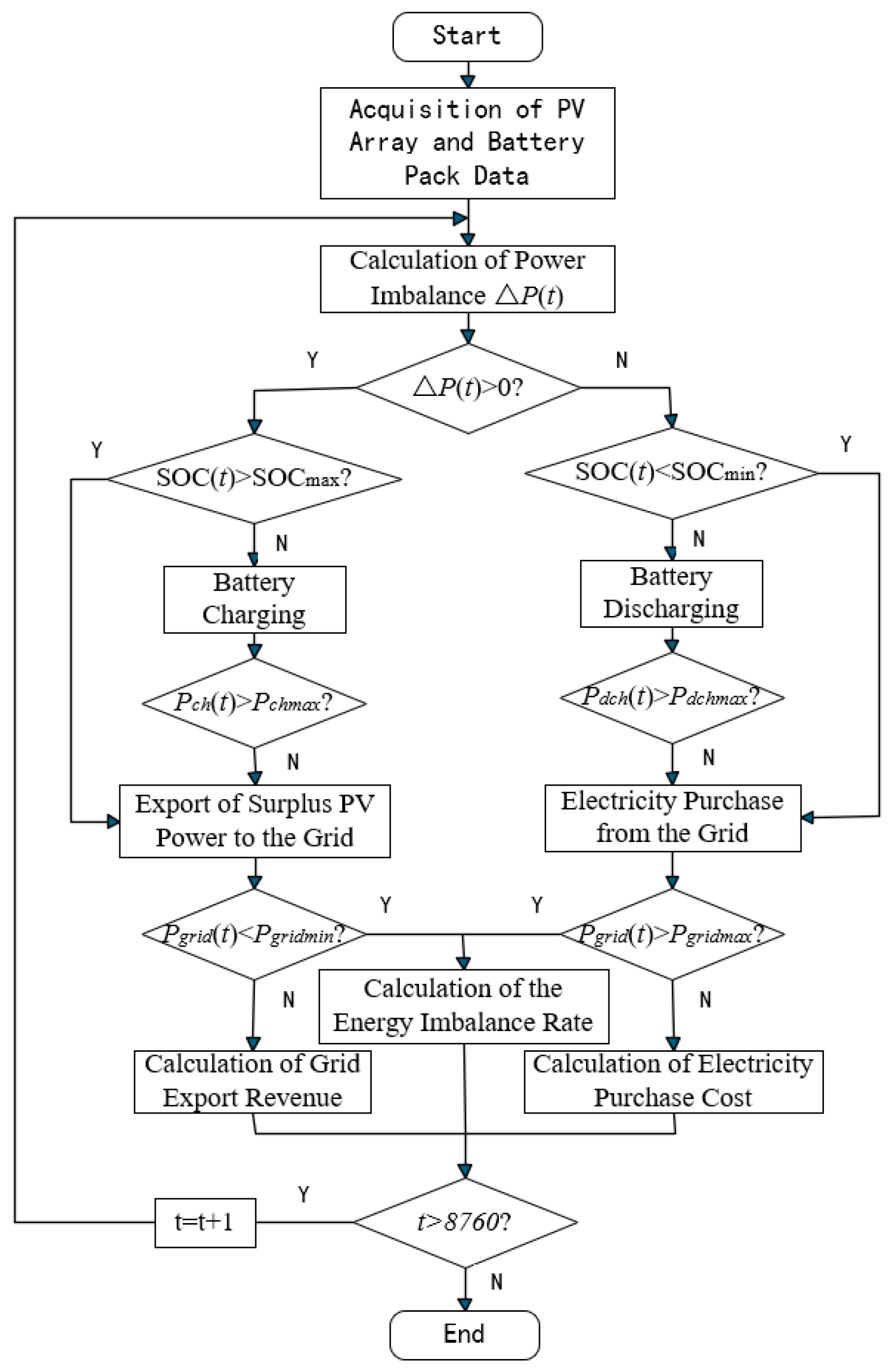
Due to the highly concentrated and energy-intensive characteristics of industrial parks, greater emphasis is placed on economic efficiency and reliability in energy storage configuration. Most industrial users adopt a two-part electricity tariff. Moreover, owing to the concentrated and large-scale loads in the park, the inrush currents generated by the start-up of large motors require substantial energy storage to smooth such transient loads, which in turn increases investment costs. Therefore, the primary objective of energy storage configuration in industrial parks is to maximize electricity cost savings for enterprises, thereby achieving cost reduction and efficiency improvement. According to relevant laws and regulations in the Zhuzhou area, surplus photovoltaic power can be fed into the grid to obtain additional revenue. In this model, photovoltaic output is prioritized to meet user load deficits, while surplus photovoltaic generation is fed into the grid to enhance economic benefits. The operational scheduling strategy is illustrated in Appendix A, Figure A1.
The expression for the unbalanced power is given as:
Δ P t = P P V t P l o a d t

4. Improved SSA Algorithm

The traditional sparrow search algorithm (SSA) is a swarm intelligence algorithm inspired by the foraging and anti-predation behaviors of sparrows in nature [21]. In the algorithm, the sparrow population is divided into three types—discoverers, followers, and sentinels—with each sparrow’s position representing a potential solution. Individuals with better fitness values are designated as discoverers, who guide the search for the entire population throughout the iteration process. Followers forage by following discoverers to obtain better fitness values. To improve foraging efficiency, sentinel individuals monitor the discoverers’ behavior and immediately perform anti-predation actions if a threat is detected.

4.1. Improved Sparrow Search Algorithm

4.1.1. Tent Mapping and Opposition-Based Learning for Population Initialization

In the traditional SSA, the initial population is generated using pseudo-random methods. This distribution does not necessarily guarantee uniform coverage, and the initial population distribution can affect the convergence speed and solution accuracy in subsequent iterations. Therefore, in this study, Tent mapping and opposition-based learning strategies are employed to generate the initial population, enhancing the population’s exploratory capability. The Tent chaotic mapping is defined as follows:
z i + 1 = z i α , x i [ 0 , α ) 1 z i 1 α , x i [ α , 1 ]
where z i denotes the current Tent chaotic sequence and z i + 1 represents the next-level chaotic sequence. α is a constant with a value of 0.3. The population is distributed as follows:
x i = l b + ( u b l b ) z i
where x i represents the current position of a sparrow individual, l b denotes the lower bound of the population individuals, and u b indicates the upper bound of the population. Subsequently, an opposition-based learning strategy is adopted, and the solution of the opposite population o i is expressed as shown in Equation (24).
o i = r t ( x max + x min ) x i
where r t is a random vector within the interval 0 1 , and x m a x and x m i n denote the maximum and minimum values of the population x , respectively. Finally, the population x i and the opposite population o i are integrated, ranked according to their fitness values, and the top N solutions with superior fitness are selected as the initial sparrow population.

4.1.2. Adaptive Inertia Weight

In the conventional sparrow search algorithm, the exploration behavior of individuals during the iterative process lacks effective regulation. When high-quality individuals are identified, other population members tend to rapidly converge towards the current optimal individual, which may cause the algorithm to fall into a local minimum. To address this issue, an adaptive inertia weight updating strategy based on the Euclidean distance to the optimal solution is designed and introduced in this study [22]. This strategy enables the algorithm to maintain sufficiently large step sizes during the early and middle stages to explore unknown regions, while adopting smaller step sizes in the later stage for local exploitation, thereby improving the search accuracy. The calculation formula of the inertia weight is given in Equation (25).
ω = 1 1 2 arctan 2 t 1 2 T π / e D / 10 D = 1 N i = 1 N x i x b e s t
where T denotes the maximum number of iterations, t represents the current iteration number, D is the Euclidean distance between the individual x i and the global optimal individual x b e s t , and N denotes the dimensionality.
The inertia weight ω is adaptively adjusted according to the Euclidean distance between the current individual and the global optimal individual, enabling the algorithm to maintain a balance between global exploration and local exploitation, and thus to progressively approach the optimal solution. After the introduction of the adaptive inertia weight, the update formula for the discoverers is expressed as follows:
x i , j t + 1 = x i , j t ω , R 2 < M s x i , j t + Q , R 2 M s
where x i , j t denotes the position of the i -th individual in the j -th dimension at the t -th iteration, M s represents the safety threshold, and M s   =   [ 0.5 , 1 ] and Q are random numbers following a normal distribution.

4.1.3. Follower Update Strategy Incorporating Harris Hawks Local Encircling Predation

In the conventional sparrow search algorithm, the optimization capability of followers with relatively poor fitness during the position update process is limited, which to some extent, affects the local exploitation speed and search accuracy of the algorithm. By contrast, the Harris Hawks optimization algorithm is able to rapidly approach the optimal solution during local exploitation. Its four local exploitation strategies exhibit faster convergence speed and higher search accuracy. Moreover, after integrating the local encircling predation strategy, the issue in the sparrow search algorithm, whereby followers with poor fitness are directly reset near the initial position during the position update process, can be more effectively addressed.
In the Harris Hawks optimization algorithm, different exploitation strategies are adopted according to the escape energy of the prey [23]. The escape energy E of the prey is calculated as shown in Equation (27).
E = E 0 ( 1 t T )
where E 0 denotes the initial escape energy of the prey and is defined as a random number within the interval 1,1 . Meanwhile, the Harris Hawks determine the exploitation strategy to be adopted according to a random number r uniformly distributed in the interval 0 1 .
(1) Soft encircling: when E     0.5 ,   r     0.5 , the position update formula is given as follows:
X i , j t + 1 = Δ X i , j t E J X b , j t X i , j t Δ X i , j t = X b , j t X i , j t
where X i , j t represents the movement of the i -th individual in the j -th dimension at time t , J denotes the random jump strength during the prey’s escape process, and J = 2 1 r 5 and r 5 are random numbers uniformly distributed in the interval 0 1 .
(2) Hard encircling: when E   <   0.5 ,   r     0.5 , the position update formula is given in Equation (11), where A + is a random matrix 1   ×   d whose elements take values of 1 or 1 .
X i , j t + 1 = X b , j t + X i , j t X b , j t + 1 A +
(3) Rapid dive soft encircling: when E     0.5 ,   r   <   0.5 , the position update formula is expressed as follows:
X i , j t + 1 = Y 1 , f Y 1 < f ( X i , j t ) Z 1 , f Z 1 < f ( X i , j t ) Y = X b , j t E J X b , j t X i , j t Z = Y + S L F D
where S denotes a multi-dimensional random vector, and L F ( D ) represents the Lévy flight step size.
(4) Rapid dive hard encircling: when E   <   0.5 ,   r   <   0.5 , the position update strategy is similar to that of Strategy (3), and the update formula for the adjusted value Y is given as follows:
Y = X b , j t E J X b , j t X m t
When the fitness of Y is not improved, the update scheme of Z in Strategy (3) is adopted.

4.2. Algorithm Testing

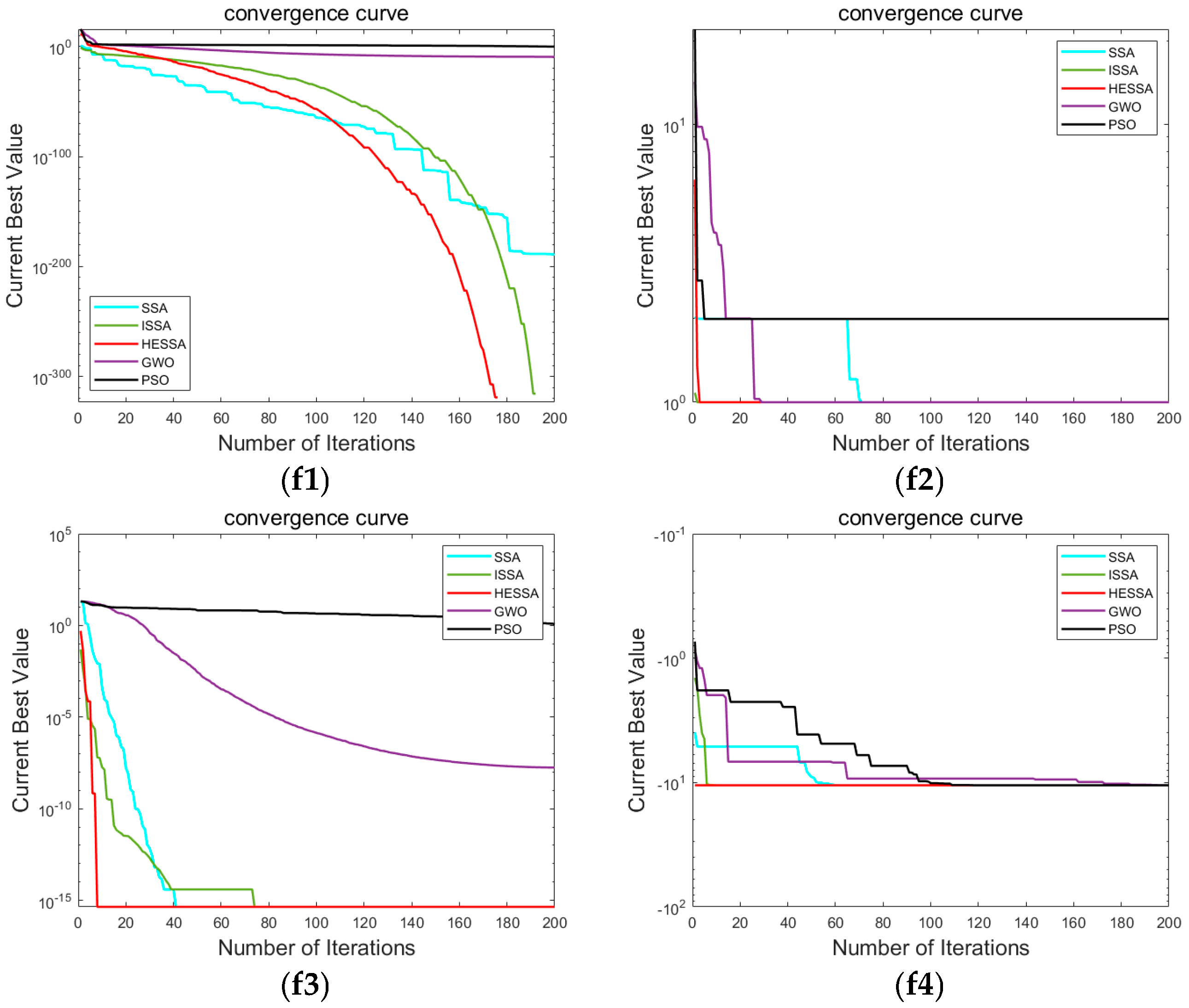
To verify the superiority and feasibility of the proposed HESSA in terms of solution performance, four groups of standard benchmark functions, as listed in Table 1, are employed in this study. These functions are designed to evaluate the optimization capability of the algorithms from multiple perspectives, including low-dimensional and high-dimensional problems, unimodal and multimodal landscapes, as well as zero-solution and non-zero-solution cases. In addition, several commonly used traditional intelligent optimization algorithms are introduced for comparative experiments. The detailed information of the benchmark functions is presented in Table 1.
In the experiments, the population size is set to N   =   30 , and the maximum number of iterations is set to 500. To reduce the influence of randomness, each algorithm is independently executed 30 times for each test function, and the mean value and standard deviation of the results are extracted as the evaluation criteria. Two ablation-based comparative experiments are conducted: the control group (ISSA) adopts the original follower update strategy, whereas the experimental group (HESSA) employs the optimized algorithm with the follower update strategy incorporating the Harris Hawks encircling predation mechanism. The optimization results of the benchmark functions are summarized in Table 2.
The convergence curves of the benchmark functions are illustrated in Figure 1. It can be observed that, compared with the other algorithms, the HESSA demonstrates superior performance across various benchmark functions. In particular, for both low-dimensional and high-dimensional non-zero-solution test functions, the proposed algorithm exhibits faster convergence speed and higher convergence accuracy. Moreover, after integrating the Harris Hawks encircling predation strategy into the follower update mechanism, the convergence performance of HESSA is further improved compared with that of ISSA without this enhancement, as reflected in the convergence rates for multiple benchmark functions.
The test results are summarized in Table 2. It can be observed that the HESSA exhibits higher convergence accuracy and stronger stability than the comparative algorithms. From the outcomes of 30 independent runs, it is evident that, for all four representative benchmark functions, the mean values obtained by HESSA are consistently close to the theoretical optimal solutions, while the corresponding standard deviations are the lowest. Overall, the HESSA incorporating multiple improvement strategies demonstrates superior performance across diverse scenarios and various types of optimization problems.

5. Case Study Analysis

5.1. Simulation Data and Parameter Settings

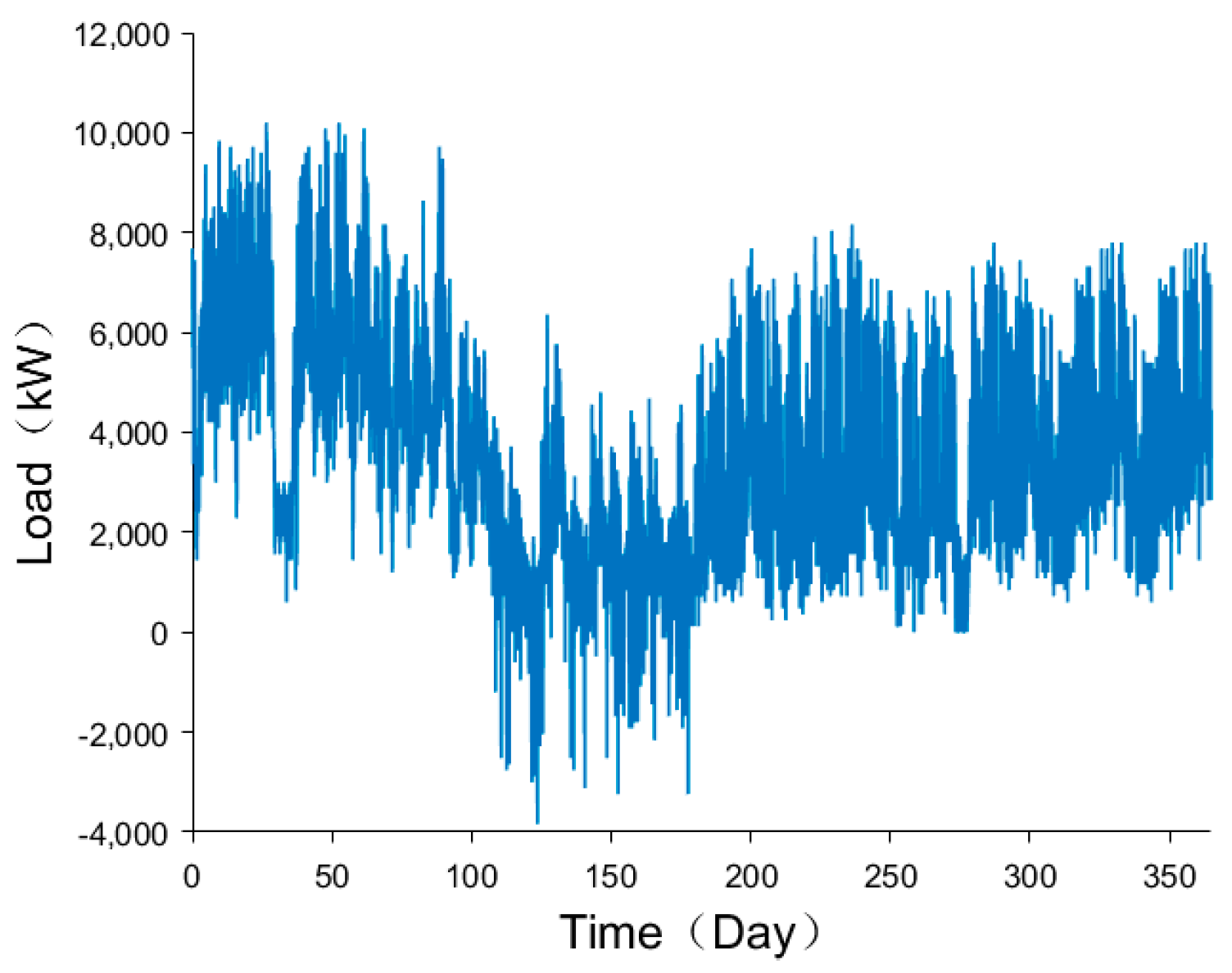
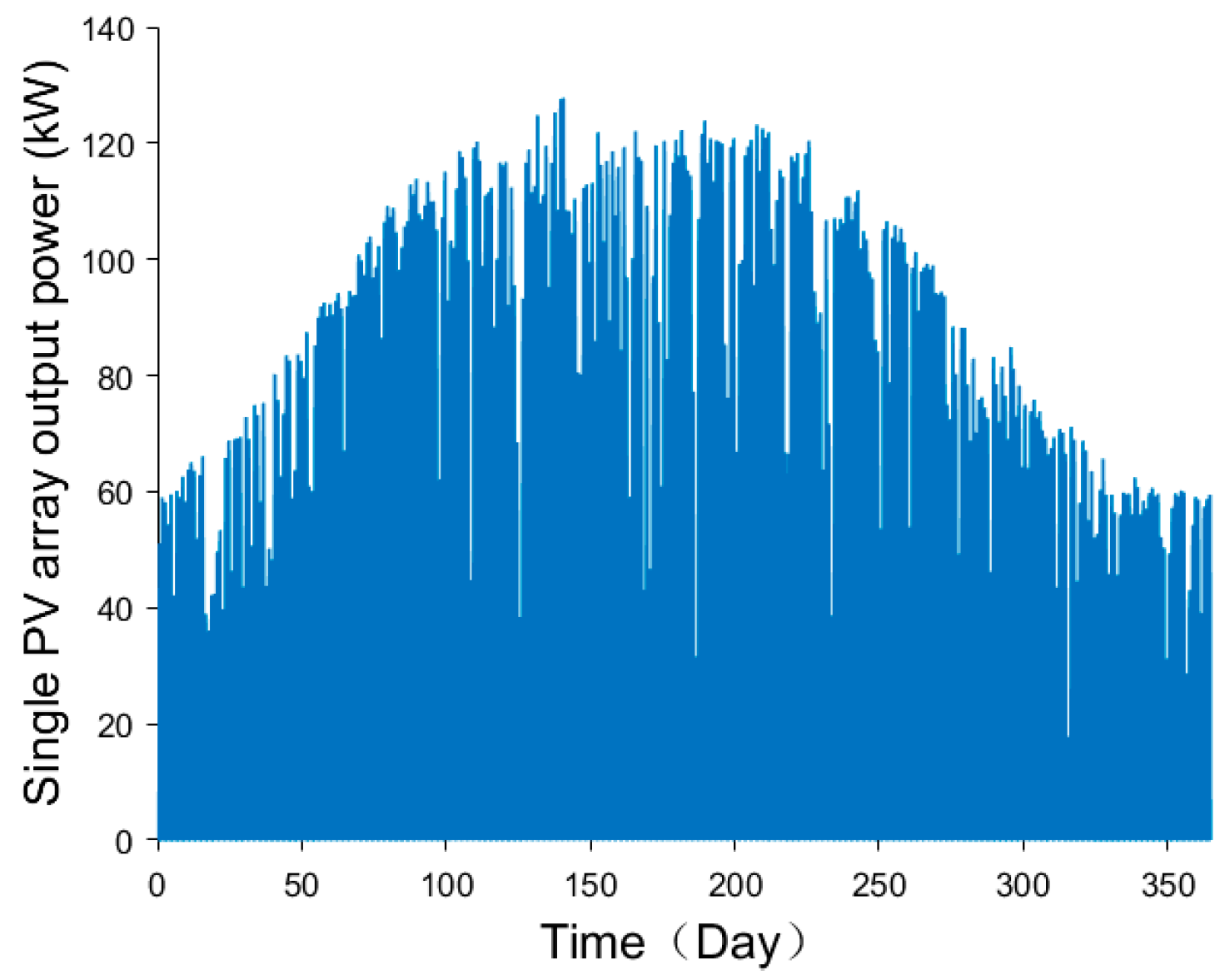
Based on the meteorological data of the Sifen Photovoltaic Power Plant along the Sidi Line in Zhuzhou City and the load data of a large enterprise industrial park in Zhuzhou, the objective function is established using the PV–energy storage capacity optimization model proposed in this paper. The capacity of the PV–energy storage system for the enterprise park is then optimized using the HESSA. The local meteorological data and load profiles are illustrated in Figure 2 and Figure 3, respectively, while the time-of-use electricity prices are listed in Table 3.
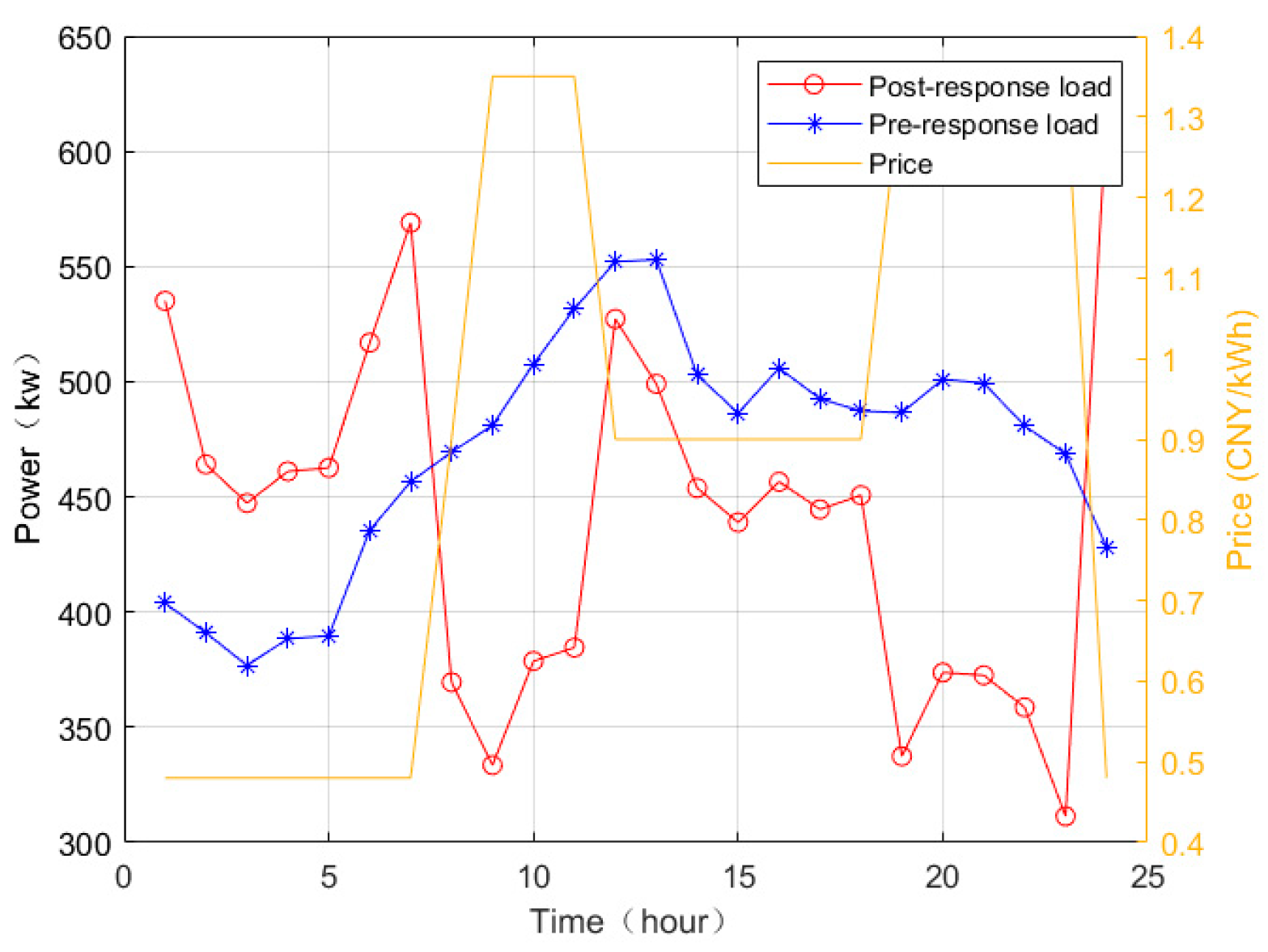
The annual electricity consumption of the enterprise industrial park amounts to 7882.53 MWh, with an average load of 3599.33 kW. Industrial electricity demand constitutes the dominant share of the total consumption, accounting for 85.3%. After incorporating demand response, the load power during off-peak periods is increased to 4415.87 kW, whereas the load power during peak periods is reduced to 6931.2 kW. The optimized load profile after demand response is shown in Figure 4.
The parameters of the PV and energy storage equipment considered in this study are listed in Table 4. Lithium iron phosphate batteries are adopted as the energy storage technology. The discount rate r is set to 0.05, and both the charging and discharging efficiencies of the energy storage system are assumed to be 0.95. The normal operating range of the state of charge (SOC) is constrained to 10–90%. The maximum installed capacity of the battery bank is limited to 200 units, the maximum transmission power of the grid-side tie line is 5000 kW, and the maximum allowable energy surplus rate is set to 5%. In addition, the population size is set to 300, and the maximum number of iterations is set to 200.

5.2. Simulation Results Analysis

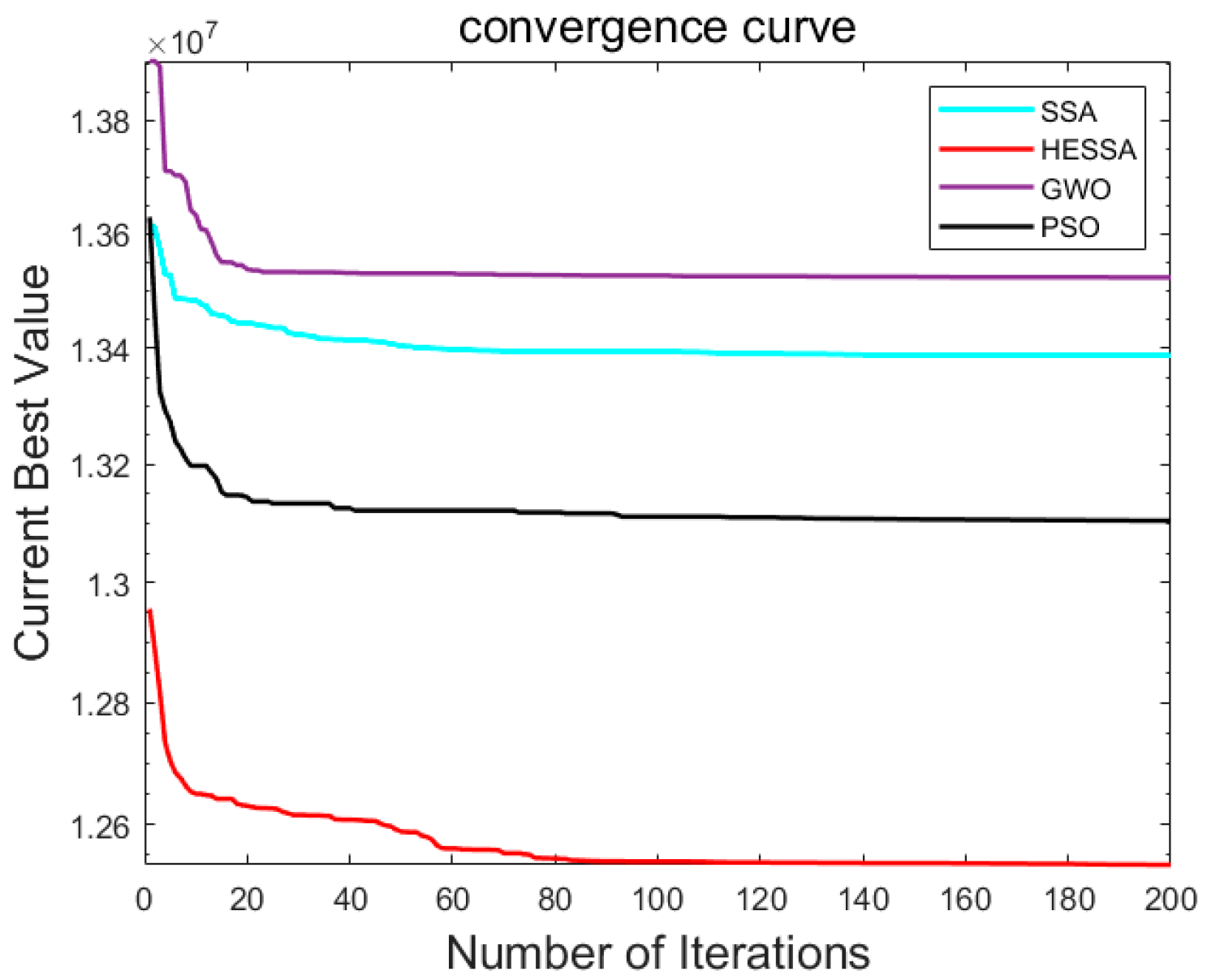
Based on the above data and parameter settings, the population size is set to 100 and the maximum number of iterations is set to 200. Four algorithms—HESSA, SSA, GWO, and PSO—are employed to conduct comparative experiments on the proposed PV–energy storage capacity optimization model. The corresponding results are presented in Table 5. It can be observed that, within 200 iterations, the HESSA is capable of identifying an energy storage configuration scheme with a lower energy imbalance rate while maintaining a relatively low comprehensive cost, thereby demonstrating superior optimization performance compared with the other algorithms.
Based on the above algorithmic framework, when compared with the conventional SSA, the HESSA algorithm was found to reduce the annual average comprehensive cost of the objective function and the energy imbalance rate by 855,925 CNY and 1.28 percentage points, respectively, leading to an improvement of 7.32% in economic performance. This result is superior to the 6.39% performance improvement reported in Ref. [8], thereby further demonstrating that the proposed enhancement scheme exhibits better fitness than the traditional sparrow search algorithm.
The convergence curves of the four algorithms are presented in Figure 5. It can be observed that the improved ISSA algorithm achieves higher convergence speed and convergence accuracy than the other conventional optimization algorithms, which confirms the effectiveness of the proposed method.

6. Conclusions

The scheduling cost of energy storage devices in enterprise park photovoltaic–energy storage power station scenarios is considered in this study, and an optimal configuration model for photovoltaic–energy storage systems incorporating energy storage cycle lifetime and user-side demand response cost is established. An operational control strategy based on annual comprehensive cost and power supply reliability is proposed. Furthermore, the conventional sparrow search algorithm is enhanced by introducing strategies such as the Harris Hawks encircling predation mechanism, enabling high-precision, high-stability, and engineering-feasible optimization of energy storage capacity configuration to be achieved.
To address the issues of insufficient convergence accuracy and slow convergence speed associated with the conventional SSA, an improved sparrow search algorithm integrating chaotic mapping, adaptive inertia weight, and the Harris Hawks encircling predation strategy is proposed. When compared with several traditional algorithms, including SSA, GWO, and PSO, the proposed HESSA demonstrates an average performance improvement of more than one-fold across four categories of benchmark test functions, with an error reduction level approaching 100%. Moreover, in complex multimodal functions and high-precision test scenarios, stable convergence towards the theoretical optimum is achieved by HESSA, indicating stronger global optimization capability and enhanced robustness.
With regard to algorithm validation, the proposed HESSA is applied to the developed energy storage capacity optimization model. The results indicate that, in comparison with conventional algorithms, an additional reduction of approximately 7.32% in the comprehensive cost index is achieved, while the power supply reliability index is improved by about 1.28%. Meanwhile, the utilization of the equivalent cycle lifetime of the energy storage system is rendered more reasonable, and the overall system operation exhibits improved stability and robustness. These results fully demonstrate the feasibility and superiority of the proposed model and algorithm in practical engineering scenarios, and provide an efficient and reliable solution framework for capacity planning problems in complex energy systems.

Author Contributions

Conceptualization, L.Z. and W.Z.; methodology, L.Z.; software, L.Z.; validation, L.Z., W.Z. and J.L.; formal analysis, L.Z.; investigation, L.Z.; resources, W.Z.; data curation, L.Z.; writing—original draft preparation, L.Z.; writing—review and editing, L.Z.; visualization, L.Z.; supervision, J.L.; project administration, J.Z.; funding acquisition, J.Z. All authors have read and agreed to the published version of the manuscript.

Funding

This research received no external funding.

Data Availability Statement

The dataset used in this study contains private information of electricity consumers and therefore cannot be made publicly available at this time due to privacy concerns.

Conflicts of Interest

Author Wei Zhao is employed by State Grid Zhuzhou Power Supply Company The remaining authors declare that the research was conducted in the absence of any commercial or financial relationships that could be construed as potential conflicts of interest.

Abbreviations

The following abbreviations are used in this manuscript:
SSASparrow Search Algorithm
ISSAImproved Sparrow Search Algorithm
HESSAHarris Hawks Optimization Enhanced Sparrow Search Algorithm
GWOGrey Wolf Optimizer
PSOParticle Swarm Optimization

Appendix A

Figure A1. Operation scheduling strategy for the photovoltaic-storage system.
Electronics 15 00656 g0a1

References

  1. Yang, J.; Su, C. Robust optimization of microgrid based on renewable distributed power generation and load demand uncertainty. Energy 2021, 223, 120043. [Google Scholar] [CrossRef]
  2. Huang, D.W.; Yin, H.; Cao, X.D.; Yang, M. Capacity allocation of rooftop integrated photovoltaic-storage systems considering source-load uncertainty. Acta Energiae Solaris Sin. 2024, 45, 363–372. [Google Scholar]
  3. Zhang, Y.Y.; Liu, Z.Y.; Meng, J.J.; Bi, Y.; Sun, W. Research on optimal configuration and operation control of distributed photovoltaic energy storage systems. Energy Storage Sci. Technol. 2025, 14, 3917–3919. [Google Scholar]
  4. Li, J.L.; Di, W.F.; Li, Y.X.; Guo, Y.J.; Yuan, X.D. Partitioned optimal allocation of energy storage in distribution networks with high PV penetration. J. Electr. Eng. 2024, 19, 13–23. [Google Scholar]
  5. Meng, X.; Guo, Q.M.; Li, Y.H.; Liu, J.C. Multi-objective optimal allocation of hybrid energy storage capacity considering bidirectional demand. Acta Energiae Solaris Sin. 2023, 44, 45–53. [Google Scholar]
  6. Yang, X.Y.; Yang, C.; Peng, J.; Miu, G.; Yuan, S.W. Coordinated optimal dispatch method of wind-thermal-storage system considering cycling mileage cost of energy storage. Acta Energiae Solaris Sin. 2024, 45, 122–130. [Google Scholar]
  7. Chen, J.W.; Shan, X.; Wang, J.F.; Sun, X.C.; Jiang, Y.J. Optimal configuration of user-side energy storage considering demand response under time-of-use electricity pricing. J. Shaanxi Univ. Sci. Technol. 2024, 42, 167–176. [Google Scholar]
  8. Li, S.Q.; Gao, Z.H.; Qiao, J.X.; Wu, J.H. Capacity optimization configuration of microgrid based on improved sparrow search algorithm. Acta Energiae Solaris Sin. 2025, 5, 1–10. [Google Scholar]
  9. Xiao, X.Y.; Fan, C.G.; Guo, F.; Yang, T.X.; Wang, D.; Huang, Y.H. Research on optimal configuration of energy storage station sizing and siting based on improved multi-objective particle swarm optimization algorithm. Energy Storage Sci. Technol. 2024, 13, 503–514. [Google Scholar]
  10. Lai, J.J.; Wen, X.L.; Zhang, Q.; Wang, J. Capacity optimization configuration of DC microgrid based on improved sparrow search algorithm. Acta Energiae Solaris Sin. 2023, 44, 157–163. [Google Scholar]
  11. Zhao, C.; Fu, B.; Lin, L. Economic optimal scheduling of microgrid with electric vehicles based on improved salp swarm algorithm. Control Theory Appl. 2025, 42, 167–180. [Google Scholar]
  12. Zhou, H.; Zhang, Y.; Xiao, L.X.; Zhao, G.H. Economic optimal scheduling of microgrid clusters based on improved bald eagle search algorithm. Acta Energiae Solaris Sin. 2024, 45, 328–335. [Google Scholar]
  13. Liu, Y.W.; Sun, J.; Shang, Y.L.; Zhang, X.; Ren, S.; Wang, D. A novel remaining useful life prediction method for lithium-ion battery based on long short-term memory network optimized by improved sparrow search algorithm. J. Energy Storage 2023, 61, 106645. [Google Scholar] [CrossRef]
  14. Li, Z.; Guo, J.F.; Gao, X.Y.; Yang, X.; He, Y.-L. A multi-strategy improved sparrow search algorithm of large-scale refrigeration system: Optimal loading distribution of chillers. Appl. Energy 2023, 349, 121623. [Google Scholar] [CrossRef]
  15. Duggal, I.; Venkatesh, B. Short-term scheduling of thermal generators and battery storage with depth of discharge-based cost model. IEEE Trans. Power Syst. 2015, 30, 2110–2118. [Google Scholar] [CrossRef]
  16. Wang, Z.S.; Chen, J.J.; Zhu, J.Q.; Ye, H.F. Optimal allocation and operation strategy of energy storage considering cycle life. Electr. Power Autom. Equip. 2021, 41, 75–81. [Google Scholar]
  17. Chen, A.W.; Hua, H.R.; Li, P.; Su, Y.F. Optimal operation method of AC/DC hybrid microgrid under real-time pricing mechanism. Power Syst. Prot. Control 2017, 45, 13–20. [Google Scholar]
  18. Xing, Y.H.; Ren, T.T. Application of improved MOPSO in optimal scheduling of microgrid. Acta Energiae Solaris Sin. 2024, 45, 191–200. [Google Scholar]
  19. Liu, J.; Ding, T.X.; Du, T.; Du, J.; Zhang, Y.; Bai, Z.; Yang, L.; Chen, F. An economic dispatch model for industrial parks considering energy storage battery life. Power Syst. Clean Energy 2024, 40, 105–112. [Google Scholar]
  20. Ding, Y.S. Research on Optimal Configuration and Coordinated Operation of DC Microgrid. Ph.D. Thesis, Harbin Institute of Technology, Harbin, China, 2017. [Google Scholar]
  21. Xue, J.K.; Shen, B. A novel swarm intelligence optimization approach: Sparrow search algorithm. Syst. Sci. Control Eng. 2020, 8, 22–34. [Google Scholar] [CrossRef]
  22. Zhang, L.; Liu, Q.L.; Ai, H.T.; Zhang, T.; Zhang, H. Research on optimal scheduling algorithm for household loads based on demand response. Acta Energiae Solaris Sin. 2024, 45, 131–139. [Google Scholar]
  23. Heidari, A.A.; Mirjalili, S.; Faris, H.; Aljarah, I.; Mafarja, M.; Chen, H. Harris hawks optimization: Algorithm and applications. Future Gener. Comput. Syst. 2019, 97, 849–872. [Google Scholar] [CrossRef]
Figure 1. Convergence curves of the benchmark functions.
Electronics 15 00656 g001
Figure 2. Annual hourly output power of a single PV array.
Electronics 15 00656 g002
Figure 3. Hourly electricity load profile over one year.
Electronics 15 00656 g003
Figure 4. Optimized load profile under demand response.
Electronics 15 00656 g004
Figure 5. Convergence curve of annual comprehensive operating cost results.
Electronics 15 00656 g005
Table 1. Standard benchmark functions.
Function TypeBenchmark FunctionDimensionSearch RangeOptimal Value
High-dimensional unimodal f 1 x = t = 1 n x i + t = 1 n x i 30[−10, 10]0
Low-dimensional multimodal f 2 x = 1 500 + j = 1 25 1 j + i = 2 2 x i α i j 6 2[−65, 65]1.0000
High-dimensional multimodal f 3 x = 20 exp 0.2 1 n i = 1 n x i 2 exp 1 n i = 1 n cos 2 π x i + 20 + e 30[−32, 32]0
Low-dimensional multimodal f 4 x = i = 1 10 X α i X α i T + c i 1 4[0, 10]−10.5363
Table 2. Benchmark test results.
Function AlgorithmBest ValueMean ValueStandard Deviation
F1SSA2.0775 × 10−382.5556 × 10−367.9125 × 10−37
ISSA000
HESSA000
GWO1.7217 × 10−337.3725 × 10−331.5528 × 10⁻³²
PSO9.0244 × 10−169.6687 × 10−151.0479 × 10⁻¹⁴
F2SSA4.3724.02883.1136
ISSA0.9980.9980.5616
HESSA0.9980.9980
GWO4.2684.29543.8882
PSO1.9923.6263.3735
F3SSA4.4409 × 10−164.4409 × 10−160
ISSA4.4409 × 10−164.4409 × 10−160
HESSA4.4409 × 10−164.4409 × 10−160
GWO7.8604 × 10−141.0110 × 10−131.6176 × 10⁻¹⁴
PSO0.326220.362230.63916
F4SSA−5.1285−9.09432.5206
ISSA−10.5364−10.53640.98735
HESSA−10.5364−10.53642.07 × 10−11
GWO−10.5347−10.26478.5116 × 10−4
PSO−10.5364−9.82012.7263
Table 3. Time-of-use electricity prices.
PeriodTime IntervalPurchase Price (CNY/kWh)Selling Price (CNY/kWh)
Off-peak period23:00–07:000.480.68
Peak period09:00–11:00
19:00–23:00
1.35
Flat period08:00–09:00
12:00–18:00
0.90
Table 4. Parameters of PV and energy storage equipment.
SourceRated Parameter (System Voltage)Investment Cost (104 CNY)O&M Cost (104 CNY)Replacement Cost (104 CNY)Lifetime (Years)
Photovoltaic1 kW0.300.0020.2020
Battery energy storage96 V, 280 Ah3.200.042.8010
Table 5. Results of capacity optimization configuration.
Optimization AlgorithmNumber of PV ModulesNumber of Battery PacksAnnual Equivalent Comprehensive Cost (104 CNY)Energy Imbalance Rate (%)
SSA6471131338.62183.74
HESSA5831021253.02932.46
GWO6431051352.43304.87
PSO5501221310.42035.43
Disclaimer/Publisher’s Note: The statements, opinions and data contained in all publications are solely those of the individual author(s) and contributor(s) and not of MDPI and/or the editor(s). MDPI and/or the editor(s) disclaim responsibility for any injury to people or property resulting from any ideas, methods, instructions or products referred to in the content.