Article

SemiWaferNet: Efficient Semi-Supervised Hybrid CNN–Transformer Models for Wafer Defect Classification and Segmentation

1
School of Integrated Circuits and Electronics, Beijing Institute of Technology, Beijing 100081, China
2
College of Intelligent Robotics and Advanced Manufacturing, Fudan University, Shanghai 200433, China
3
Marine Science and Technology Domain, Beijing Institute of Technology (Zhuhai), Zhuhai 519088, China
4
Tangshan Research Institute of Beijing Institute of Technology, Tangshan 063000, China
*
Author to whom correspondence should be addressed.
Electronics 2026, 15(7), 1437; https://doi.org/10.3390/electronics15071437
Submission received: 24 February 2026 / Revised: 23 March 2026 / Accepted: 26 March 2026 / Published: 30 March 2026
(This article belongs to the Section Artificial Intelligence)

Abstract

Wafer defect analysis is important for semiconductor manufacturing, but labeled data are limited, and class distributions are highly imbalanced. We present a semi-supervised framework with two lightweight hybrid CNN–Transformer models for wafer defect classification and segmentation. For classification, HybridCNN-ViT combines CNN-based local feature extraction with Transformer-based global context modeling, and adopts a three-stage progressive pseudo-labeling strategy to leverage unlabeled samples. The pseudo-label selection mechanism is systematically calibrated to improve pseudo-label reliability under limited labeled data. For segmentation, ConvoFormer-UNet integrates convolution-enhanced embeddings with Transformer blocks to balance boundary detail and global context. On the public WM-811K dataset, HybridCNN-ViT achieves 98.72% accuracy and 0.9985 macro-AUC under the semi-supervised setting for classification, while ConvoFormer-UNet reaches 99.19% IoU for segmentation with fewer parameters than several baselines. We also report efficiency on a single GPU to illustrate practical inference speed.

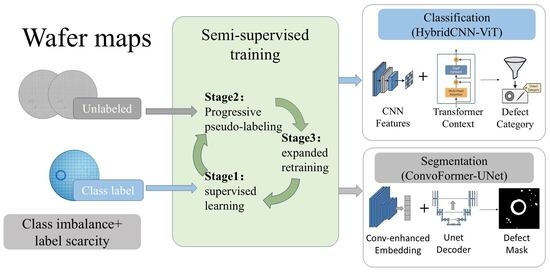
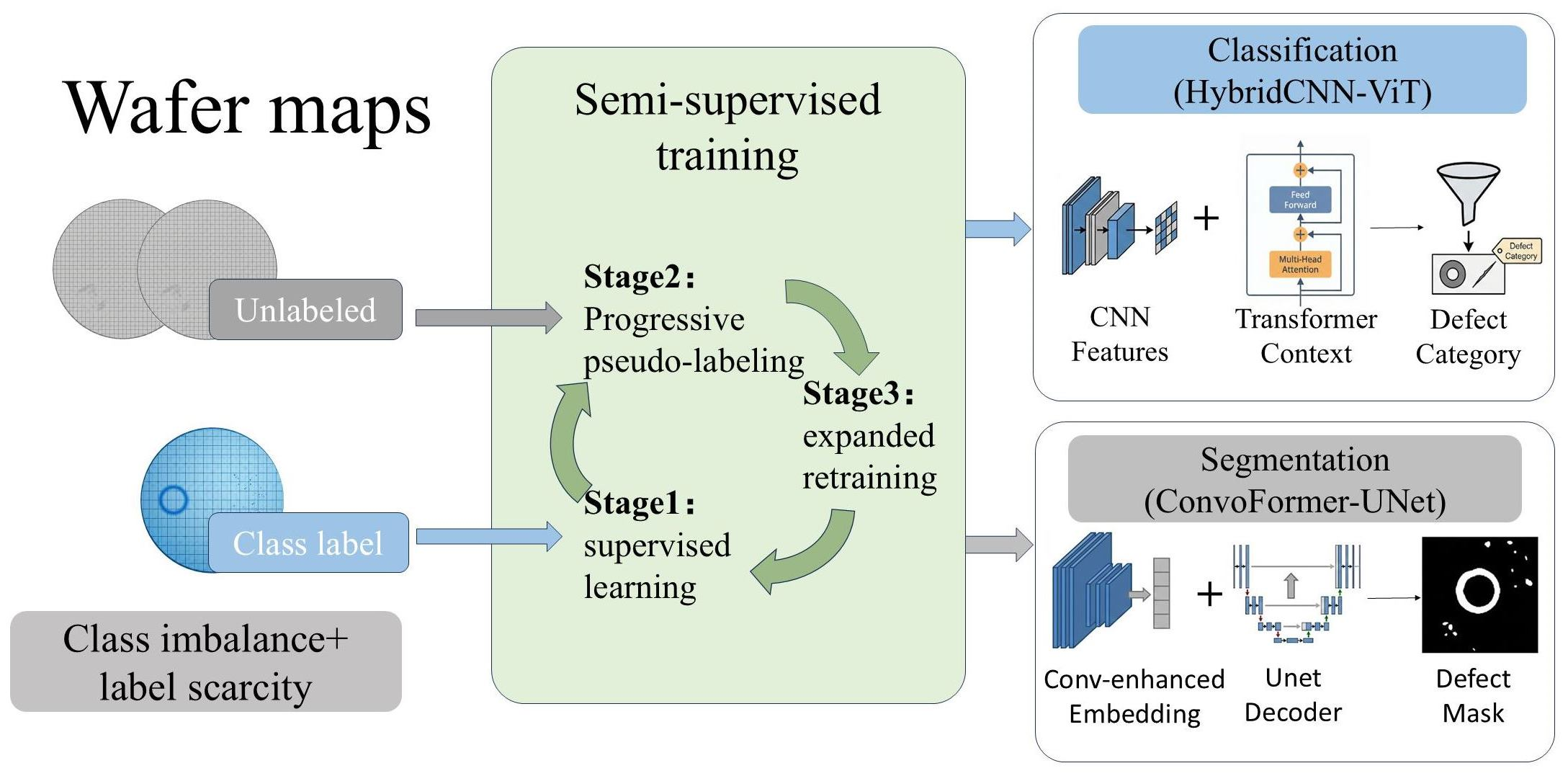
Graphical Abstract

1. Introduction

Wafer defects are inevitable in semiconductor manufacturing and typically appear as spatial patterns associated with process variations or equipment issues. For example, cluster patterns may relate to deposition problems, edge rings to etching issues, and linear scratches to mechanical handling errors [1]. Accurate Automatic Defect Classification (ADC) can support root-cause analysis and yield improvement.
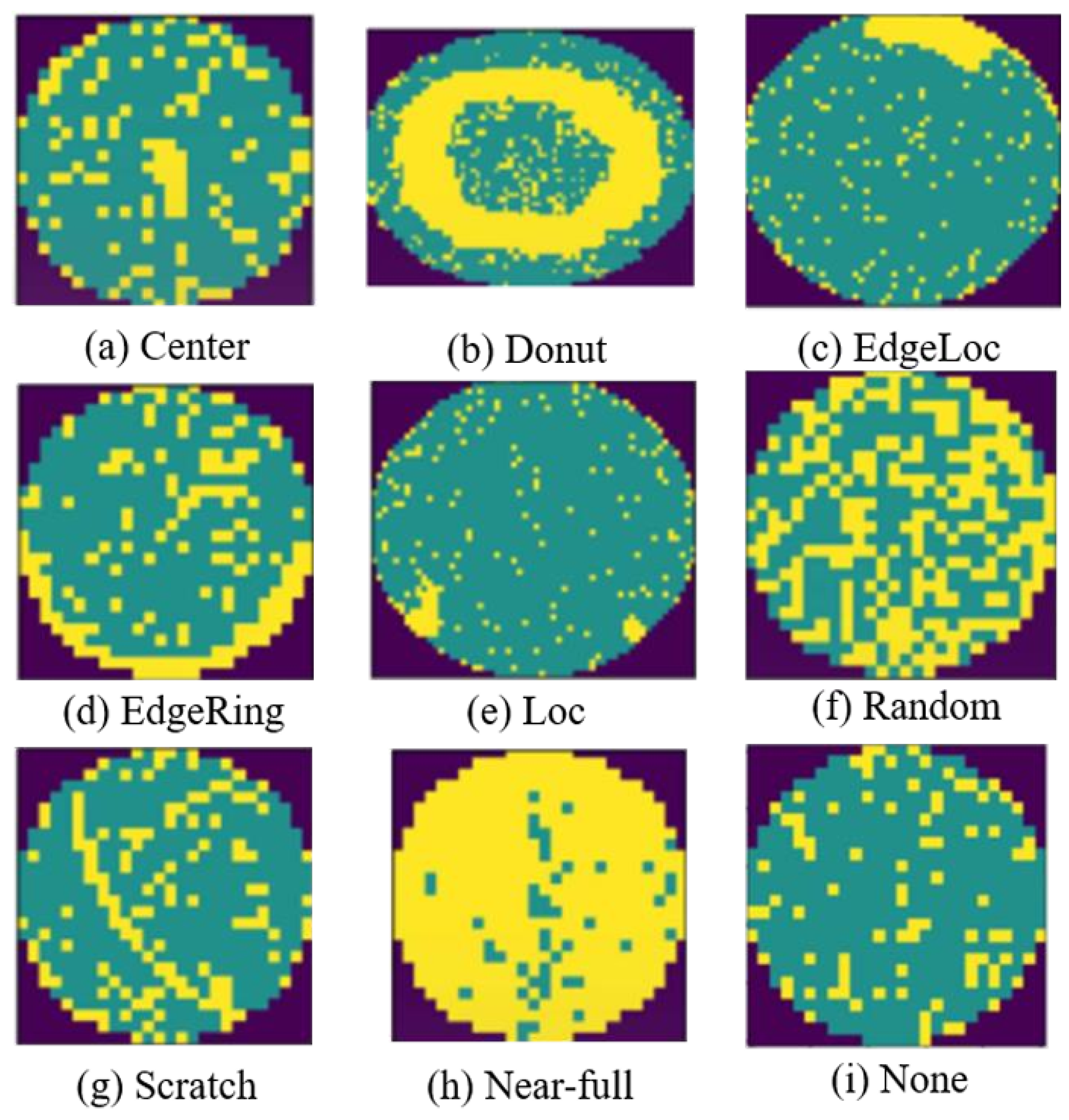
We study this problem on the WM-811K dataset [2], a widely used benchmark for wafer map analysis. It contains 811,457 wafer maps across nine pattern types (Center, Donut, Edge-Loc, Edge-Ring, Loc, Near-full, Random, Scratch, and None; Figure 1). Only 172,950 maps are labeled with severe class imbalance, while 638,507 samples are unlabeled, naturally motivating semi-supervised learning (SSL) [3].
Early wafer defect analysis relied on rule-based or statistical process control methods [4], which often struggled with complex patterns and noisy data. Classical machine learning approaches then used handcrafted features with classifiers such as SVMs [1] and Radon transform-based pipelines with decision trees [5] or voting ensembles [6]. However, these pipelines typically required extensive feature engineering and could generalize poorly on high-dimensional, imbalanced wafer data [7,8].
Deep learning, especially Convolutional Neural Networks (CNNs), improves representation learning by automating feature extraction [9,10]. For instance, Kyeong and Kim [11] reported 98% accuracy, and Wang et al. [12] achieved 93% using deformable convolutions. Nonetheless, CNNs can be limited by local receptive fields, making it difficult to capture long-range dependencies needed for certain defect morphologies [13].
Vision Transformers (ViTs) [14] model global relationships via self-attention and have motivated hybrid CNN–Transformer architectures. Examples include MSF-Trans [15] and DeepSEM-Net [16]. However, such hybrids may increase computational cost and model size and can be sensitive to class imbalance, with reduced precision on underrepresented patterns [17,18]. To alleviate label scarcity, SSL methods have been explored [19], including SWaCo [20] and GAN-based approaches [21]; yet their effectiveness often depends on pseudo-label reliability and the design of sample selection strategies, and some methods may introduce additional training overhead [22].
For pixel-level defect localization, U-Net [23] and Transformer-based variants such as TransUNet [24] combine localization with broader context. WaferSegClassNet (WSCN) [25] further improves efficiency, but deployment can still be challenged by latency constraints, imbalance robustness, and generalization to unseen variations [26].
Existing approaches, including models such as MSF-Trans [15] and SSL methods such as SWaCo [20], still face difficulty in simultaneously balancing accuracy, efficiency, and robustness in data-scarce and imbalanced settings. Under limited labeled data, the practical benefit of semi-supervised learning depends not only on model architecture but also on the reliability and reproducibility of pseudo-label generation and filtering. Therefore, this study develops lightweight hybrid models together with a progressively refined pseudo-labeling strategy to improve performance while maintaining computational efficiency and practical robustness.
Compared with existing CNN–Transformer hybrid methods that mainly emphasize stronger representation capacity, the proposed HybridCNN-ViT is designed as a lightweight classifier that combines CNN-based local feature extraction, a compact ViT encoder, and a systematically calibrated semi-supervised pseudo-label selection strategy for imbalanced wafer defect recognition. For segmentation, ConvoFormer-UNet integrates convolution-enhanced patch embedding and local convolutional enhancement within Transformer processing, which helps preserve boundary-sensitive defect patterns under a compact parameter budget.
The main contributions of this paper are summarized as follows:
  • A lightweight semi-supervised framework for wafer defect classification that combines CNN-based local feature extraction, a compact ViT encoder, and a three-stage progressive pseudo-labeling strategy. The pseudo-label selection process is systematically calibrated to improve pseudo-label reliability under limited labeled data, leading to strong classification performance on WM-811K.
  • A lightweight hybrid segmentation architecture, ConvoFormer-UNet, that integrates convolution-enhanced patch embedding and local convolutional enhancement within Transformer blocks to better preserve defect boundary details and global context. This design achieves strong segmentation performance on WM-811K while maintaining a favorable accuracy–efficiency trade-off, with 73% fewer parameters than DeepLabv3+.

2. Proposed Methodology for Wafer Defect Classification

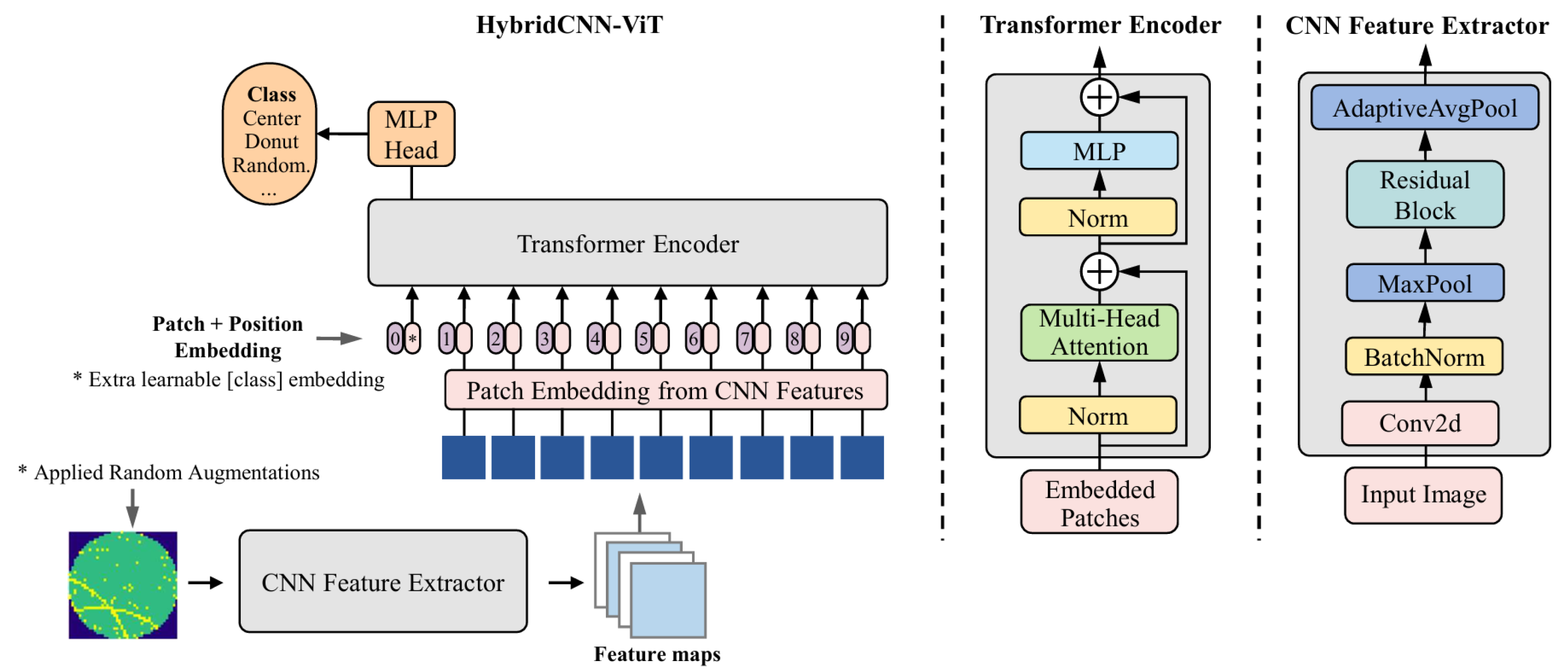
This section presents HybridCNN-ViT to address two challenges in wafer map classification: capturing both local detail and global context, and exploiting unlabeled data under limited annotations. The overall architecture is shown in Figure 2.

2.1. HybridCNN-ViT Architecture

HybridCNN-ViT combines a CNN backbone for hierarchical local feature extraction with a lightweight Vision Transformer (ViT) encoder for long-range dependency modeling, aiming to improve discrimination for spatially distributed and visually similar defect patterns. Unlike heavier hybrid architectures that mainly rely on scaling Transformer capacity, the proposed HybridCNN-ViT adopts a lightweight CNN–Transformer design for wafer defect classification. In our framework, this compact hybrid encoder is further combined with a systematically calibrated semi-supervised pseudo-label selection strategy to improve pseudo-label reliability under limited labeled data.
Given an input image X R 3 × H × W , the CNN module extracts and progressively downsamples feature maps. The first stage applies a convolutional block:
F 1 = MaxPool ReLU BN Conv 64 3 × 3 ( X )
Here, the 3 × 3 convolution uses a stride of 1 and a padding of 1, so the spatial resolution is preserved before pooling. The subsequent max-pooling layer uses kernel size 2 and stride 2, yielding F 1 R 64 × H / 2 × W / 2 .
A residual block is then used:
y = F ( x , W i ) + T ( x )
where T ( x ) denotes the shortcut branch. When the input and output dimensions are unchanged, T ( x ) is an identity mapping; otherwise, it is implemented as a projection shortcut using a 1 × 1 convolution followed by batch normalization to match the channel number and spatial resolution. In our setting, the residual block performs a 64 128 channel expansion with a stride of 2:
F 2 = ResBlock ( F 1 , 64 128 , stride = 2 )
Thus, F 2 R 128 × H / 4 × W / 4 . Under the classification input size of 32 × 32 used in this work, the resulting feature map is F 2 R 128 × 8 × 8 .
Adaptive average pooling is then applied to maintain a fixed spatial size, yielding F c R 128 × 8 × 8 under our experimental setting. The pooled feature map is flattened into N = 64 tokens and linearly projected into a D-dimensional embedding space with D = 128 . Learnable positional embeddings are added, and a learnable class token z cls is prepended to the token sequence. A dropout layer with a rate of 0.5 is applied before the Transformer encoder.
The Transformer encoder consists of L = 4 layers of multi-head self-attention and feed-forward blocks with residual connections, following standard ViT practice [14]. In the implementation used in this work, each encoder layer uses 8 attention heads, an embedding dimension of 128, a feed-forward dimension of 256, GELU activation, and dropout with a rate of 0.2 . We set L = 4 based on validation results to balance accuracy and computation; increasing to L = 6 yields a small accuracy gain (0.37%) but increases computation by 48% under our setting. The final class token is fed to a linear head:
y ^ = Softmax W cls z cls + b cls

2.2. Semi-Supervised Training Strategy

To leverage unlabeled data while reducing confirmation bias, we adopt a three-stage progressive pseudo-labeling strategy that combines class-adaptive confidence thresholding with uncertainty-aware filtering. The overall design aims to improve pseudo-label reliability in a reproducible manner rather than relying on a fixed global threshold.
We denote the training stage by s { 1 , 2 , 3 } and the number of Monte Carlo stochastic forward passes by M = 20 . Stage 1 trains the classifier using only the labeled set D l , producing an initial teacher model. Stages 2 and 3 progressively expand the training data with pseudo-labeled samples selected from the unlabeled set D u . Specifically, Stage 2 uses the best teacher from Stage 1 to generate the initial pseudo-labeled subset, while Stage 3 uses the updated teacher from Stage 2 to refresh pseudo-labels and further refine the accepted sample set.
For each unlabeled sample x D u , we perform M = 20 stochastic forward passes with dropout enabled and obtain predictive probabilities { p c ( m ) ( x ) } m = 1 M for class c. The mean predictive probability is
p ¯ c ( x ) = 1 M m = 1 M p c ( m ) ( x ) ,
and the candidate pseudo-label together with its confidence score is defined as
y ^ ( x ) = arg max c p ¯ c ( x ) , q ( x ) = max c p ¯ c ( x ) .
To characterize stage-wise class reliability, we define the candidate set for class c at stage s as
U c ( s ) = { x D u y ^ ( x ) = c } .
On this candidate set, the mean and standard deviation of the confidence scores are computed as
μ c ( s ) = 1 | U c ( s ) | x U c ( s ) q ( x ) ,
σ c ( s ) = 1 | U c ( s ) | x U c ( s ) q ( x ) μ c ( s ) 2 .
Here, μ c ( s ) reflects the average confidence of class-c candidates at stage s, whereas σ c ( s ) measures the dispersion of their confidence scores. The ratio σ c ( s ) / μ c ( s ) is used as a stage-wise indicator of class reliability and is recomputed whenever pseudo-labels are refreshed.
Based on these class-wise statistics, we define a class-adaptive confidence threshold:
τ c ( s ) ( x ) = τ base + α · σ c ( s ) μ c ( s ) + β · 1 Entropy ( x ) ,
where τ base , α , and β control the baseline confidence level, the class-reliability adjustment, and the entropy-based sample-level adjustment, respectively. The threshold is clipped to the interval [ 0 , 1 ] after computation. In this formulation, the term σ c ( s ) / μ c ( s ) makes the threshold responsive to stage-wise class reliability, while the entropy-dependent term provides a soft correction according to the concentration of the current predictive distribution.
We estimate predictive uncertainty using Monte Carlo Dropout [27]. Dropout is activated in the ViT branch during pseudo-label generation, including the token sequence before the Transformer encoder (rate 0.5 ) and the Transformer encoder layers (rate 0.2 ), so that stochastic forward sampling can be performed without changing the deterministic training objective. The predictive entropy and mutual information are computed as
Entropy ( x ) = c = 1 C p ¯ c ( x ) ln p ¯ c ( x ) ,
MI ( x ) = Entropy ( x ) 1 M m = 1 M c = 1 C p c ( m ) ( x ) ln p c ( m ) ( x ) .
Predictive entropy measures the overall uncertainty of the averaged predictive distribution, whereas mutual information captures the inconsistency of predictions under stochastic model perturbations. Using both quantities allows us to reject samples with either diffuse predictions or unstable stochastic behavior.
A pseudo-label is accepted only if it satisfies both the adaptive confidence condition and the uncertainty constraints:
q ( x ) τ y ^ ( x ) ( s ) ( x ) , Entropy ( x ) < ϵ entropy , MI ( x ) < ϵ MI .
Here, the confidence threshold provides a soft selection mechanism, while the entropy and mutual information constraints serve as hard rejection gates for uncertain predictions.
The five hyperparameters involved in pseudo-label selection, namely τ base , α , β , ϵ entropy , and ϵ MI , are systematically calibrated on a held-out pseudo-evaluation subset that is not used to fit the teacher or student models. The final configuration is selected by jointly considering pseudo-label macro-F1, sample acceptance rate, and uncertainty filtering effectiveness. The final values used in all experiments are τ base = 0.94 , α = 0.08 , β = 0.02 , ϵ entropy = 0.08 , and ϵ MI = 0.12 .
The three training stages are defined as follows. Stage 1 performs supervised warm-up using only D l . Stage 2 uses the best teacher from Stage 1 to infer pseudo-labels on D u , computes the corresponding class-wise statistics μ c ( 2 ) and σ c ( 2 ) , applies adaptive thresholding and uncertainty-aware filtering, and forms the accepted pseudo-labeled subset D pseudo ( 2 ) . The classifier is then trained on D l D pseudo ( 2 ) . Stage 3 repeats this procedure using the updated teacher from Stage 2. Pseudo-labels are regenerated on D u , the class-wise statistics and adaptive thresholds are recomputed, the accepted pseudo-labeled subset is refreshed to obtain D pseudo ( 3 ) , and the final classifier is trained on D l D pseudo ( 3 ) . Therefore, Stage 3 is not merely an additional round of training; the teacher model, class-wise statistics, adaptive thresholds, and accepted pseudo-label set are all updated.
We found three stages to be a practical trade-off, as adding more refresh stages yielded only marginal improvement while substantially increasing training cost.

The complete stage-wise training and pseudo-label refresh procedure is provided in the Supplementary Material (Algorithm S1). For completeness, the training procedure of ConvoFormer-UNet is also provided in the Supplementary Material (Algorithm S2).

2.3. Optimization Objective

To address class imbalance in WM-811K, we use weighted cross-entropy:
L = 1 B i = 1 B w y i log exp ( z y i ) j = 1 9 exp ( z j )
with inverse square-root weights w c = 1 / n c . In our preliminary comparison, this choice yielded a 2.1% higher F1-score on minority classes than focal loss under the same training setup. We attribute this to the fact that focal loss down-weights easy samples and can be less effective when rare classes contain mostly hard examples.

3. Proposed Methodology for Wafer Defect Segmentation

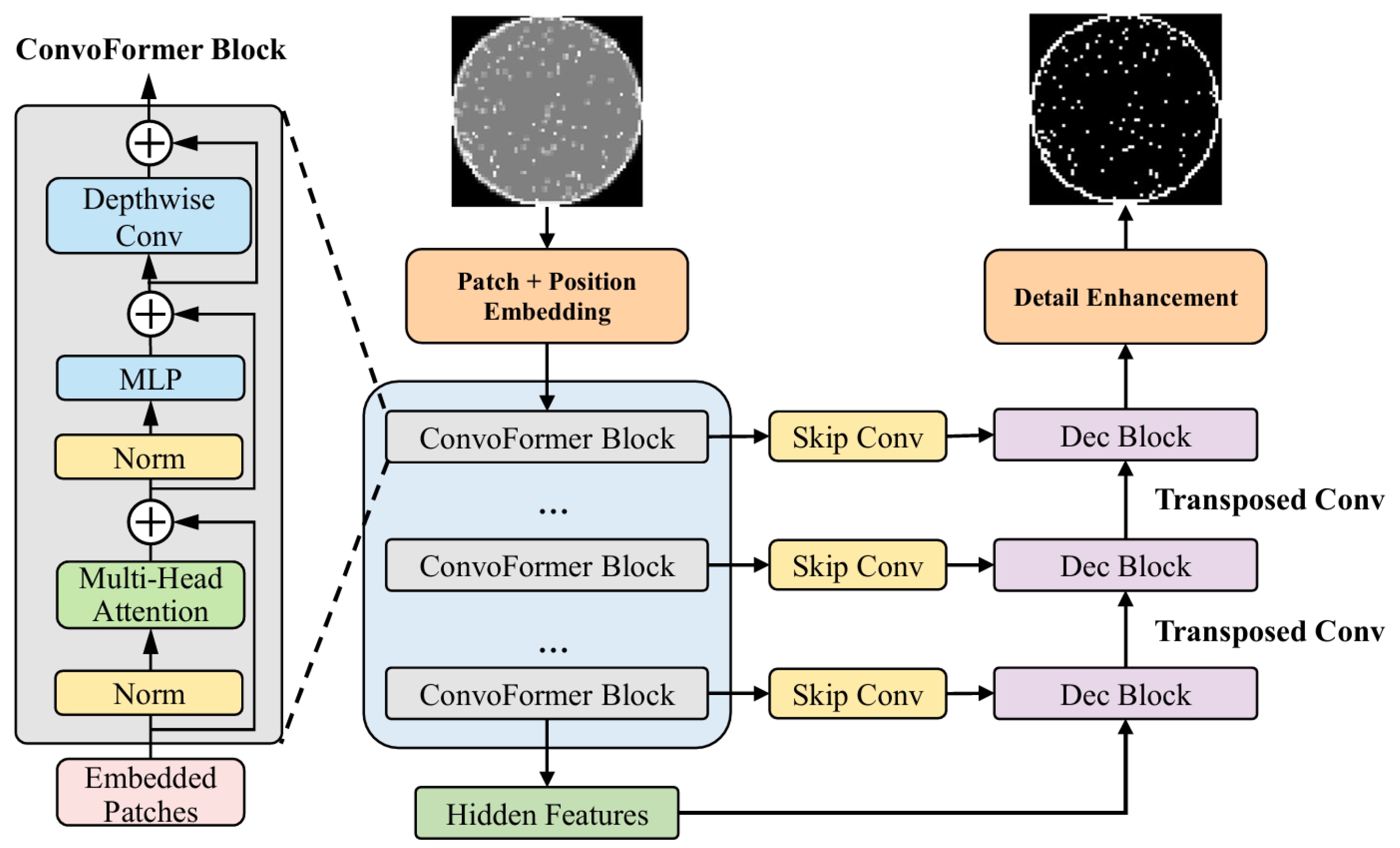
This section presents ConvoFormer-UNet, a lightweight hybrid architecture for wafer defect segmentation. The design aims to preserve boundary detail while integrating multi-scale context under practical computational budgets. The architecture is shown in Figure 3.
The complete training procedure for ConvoFormer-UNet is provided in the Supplementary Material (Algorithm S2) to support reproducibility without expanding the main text.

3.1. ConvoFormer-UNet Architecture

3.1.1. Overview and Encoder Design

ConvoFormer-UNet follows an encoder–decoder structure. The encoder adopts a convolution-enhanced embedding prior to Transformer processing, aiming to preserve low-level cues that are critical for boundary-sensitive segmentation. This design differs from standard Transformer-based U-Net variants by explicitly injecting local convolutional priors both before and within Transformer processing, which is particularly beneficial for boundary-sensitive wafer defect masks.
Compared with a pure linear patch projection, we first apply a 3 × 3 convolution to extract localized features from the input image X R 1 × H × W (with H = W = 64 ). This kernel size is a common design choice for efficient spatial modeling [28]. We use the GELU activation, GELU ( x ) = x · Φ ( x ) , to provide smooth gradients [29]. An 8 × 8 convolution with stride 8 then projects the features into the Transformer embedding space, producing an 8 × 8 token grid (i.e., N = 64 tokens) while retaining spatial cues.

3.1.2. Hybrid Fusion and Decoder

Within each Transformer layer, we fuse a global self-attention path with a local enhancement path (a depthwise 3 × 3 convolution) to capture long-range context while preserving boundary details:
Z l = MSA LN ( Z l ) + Conv 3 × 3 dw ( Z l ) ,
where LN ( · ) denotes Layer Normalization and Conv 3 × 3 dw ( · ) denotes a depthwise 3 × 3 convolution.
The decoder progressively upsamples features using transposed convolutions, and reduces the semantic gap via 1 × 1 convolutions before fusing encoder and decoder features. Skip connections preserve high-resolution information, while multi-scale fusion at each decoding stage propagates coarse-to-fine cues to handle defects of different sizes.

3.2. Model Optimization Strategies

Loss and Multi-Scale Supervision

Pixel-level defect segmentation is typically imbalanced because defect pixels occupy only a small fraction of the image. We therefore optimize a hybrid loss:
L seg = L Dice + 0.5 L focal ,
where Dice loss emphasizes the overlap between prediction and ground truth, and focal loss down-weights easy background pixels to focus learning on harder regions. We additionally apply deep supervision by attaching auxiliary heads to intermediate decoder layers:
L total = L main + 0.3 L aux 1 + 0.2 L aux 2 .
This encourages intermediate layers to produce meaningful predictions at multiple scales.
A limitation of this formulation is that the weighting between the Dice/focal components and auxiliary losses is task-dependent; suboptimal weights may reduce performance under varying defect sizes or noise levels. Moreover, boundary quality can still degrade for extremely small or low-contrast defects, where supervision signals are weak and mask annotation errors have a larger relative impact.

4. Experimental Results and Analysis

This section reports the experimental setup and evaluates HybridCNN-ViT and ConvoFormer-UNet on WM-811K. We include baseline comparisons, ablation studies, and additional validation.

4.1. Dataset, Preprocessing, and Implementation

Experiments are conducted on the public WM-811K dataset [2], which contains 811,457 wafer maps in total, including 172,950 labeled samples from nine pattern classes and 638,507 unlabeled samples. To clarify the data protocol for both tasks, task-specific subsets are constructed for classification and segmentation from the same WM-811K source. Invalid or malformed entries are removed before constructing the task-specific subsets.
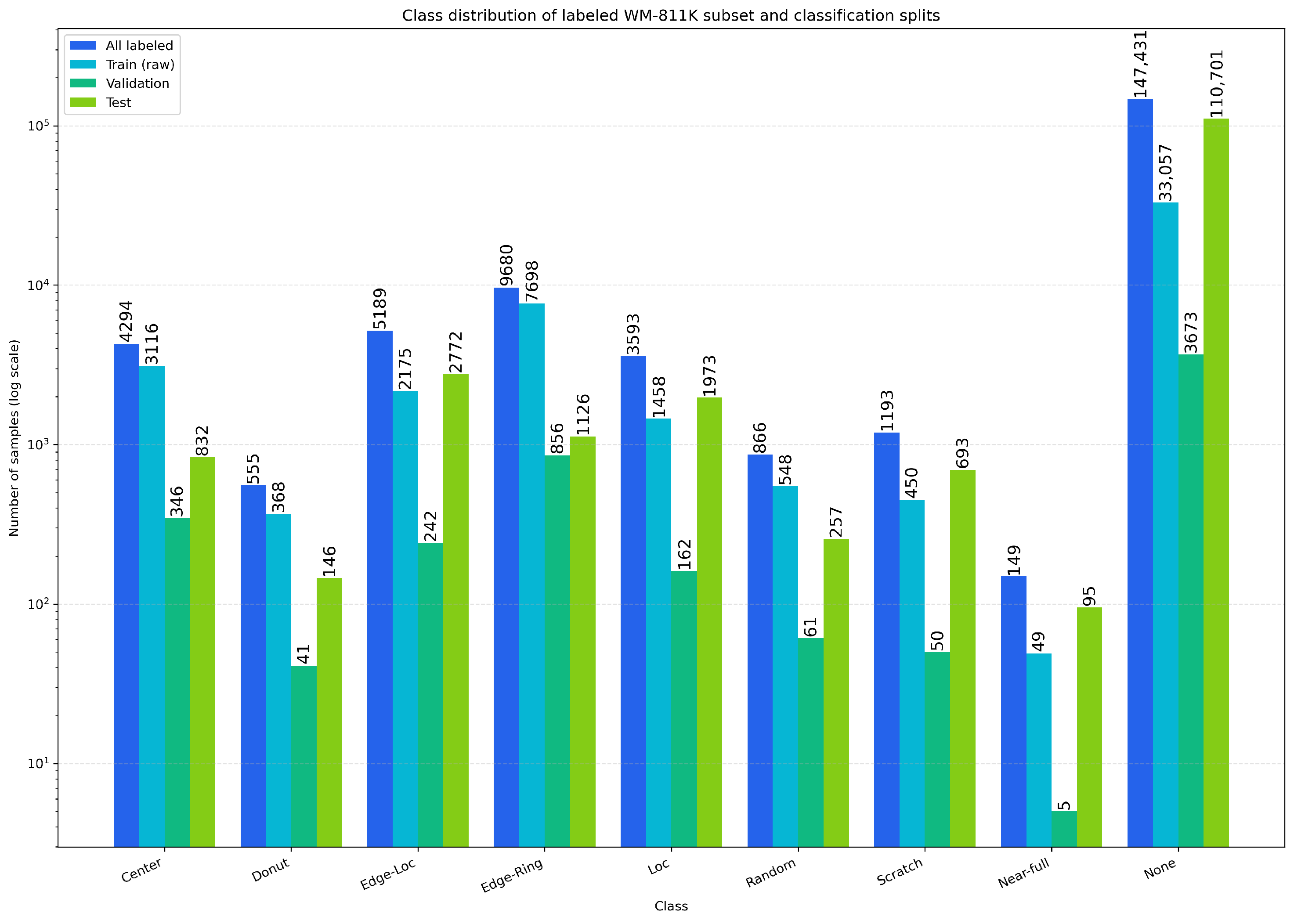
For classification, we use the labeled subset together with the official training/test partition provided in WM-811K. A validation subset is further split from the official training portion before any re-sampling is applied. The class distributions of the labeled subset and the resulting train/validation/test splits are reported in Table 1, and the corresponding imbalance is visualized in Figure 4. For model training, a balanced labeled training set is constructed via hybrid sampling by downsampling the majority None class and applying SMOTE to minority classes, while the validation and test sets are kept in the original imbalanced distribution to better reflect practical evaluation settings.
For semi-supervised classification, 150,000 unlabeled samples are added to the balanced labeled training set. This size is selected based on a preliminary trade-off between computational cost and validation performance. Compared with using labeled data only, it improves accuracy by more than 2%, whereas larger unlabeled sets (e.g., 200,000 or more) provide smaller gains (less than 0.5%) at higher training cost. In addition, a small held-out pseudo-evaluation subset is separated from the labeled training portion. It is not used to fit the teacher or student models and is used only for pseudo-label quality evaluation and hyperparameter calibration. Wafer maps used for classification are resized to 32 × 32 , with dynamic augmentation applied during training.
For segmentation, we do not rely on an external pixel-annotation dataset. Instead, the segmentation subset is derived from labeled defect-present wafers in WM-811K after excluding the None and Random classes, and its exact size and distribution by defect type are summarized in Table 2. Ground-truth masks are generated deterministically from the original wafer maps by assigning mask value 1 to locations where waferMap equals 2 (defective die), and 0 otherwise. This produces a die-level binary defect mask rather than a manually delineated pixel-accurate contour. No additional human annotation is introduced in this process.
For segmentation preprocessing, wafer maps are resized to 64 × 64 , and the corresponding binary masks are resized using nearest-neighbor interpolation to preserve label consistency. Under this protocol, annotation uncertainty mainly arises from inherited die-state noise and resampling effects rather than inter-annotator variability. In particular, sparse or very small defects are more sensitive to small label perturbations, and their IoU may therefore be affected more strongly than that of large-area defect patterns.
All models are implemented in PyTorch 2.5.1 and trained on an NVIDIA GeForce RTX 3060 Laptop GPU using AdamW. HybridCNN-ViT is trained for 50 epochs with a three-stage semi-supervised pipeline (batch size 256, learning rate 5 × 10 5 , weight decay 4 × 10 4 ). The hyperparameters involved in pseudo-label selection are calibrated on the held-out pseudo-evaluation subset and fixed across all experiments. The final values are τ base = 0.94 , α = 0.08 , β = 0.02 , ϵ entropy = 0.08 , and ϵ MI = 0.12 . ConvoFormer-UNet is trained for 50 epochs (batch size 32, learning rate 1 × 10 4 , weight decay 0.01 ) using the hybrid loss with deep supervision.

4.2. Defect Classification Results

4.2.1. Overall Performance

As shown in Table 3, HybridCNN-ViT achieves an average accuracy of 98.35% on WM-811K. The model performs strongly on structurally complex categories such as Donut, Edge-Loc, and Loc, suggesting that combining local CNN cues with global context is beneficial for these patterns. Compared with methods that report higher accuracy on the majority None class, our results indicate a more balanced performance across defect-present classes, which may reflect a different trade-off between false positives and false negatives under the imbalanced test distribution.
We further compare HybridCNN-ViT with CNN-WDI using paired t-tests over 10 independent runs. The differences are statistically significant for overall accuracy ( p < 0.001 ), and also for Scratch ( p < 0.01 ) and Edge-Loc ( p < 0.005 ), indicating that the observed gains are consistent across runs.

4.2.2. Error Analysis and Limitations

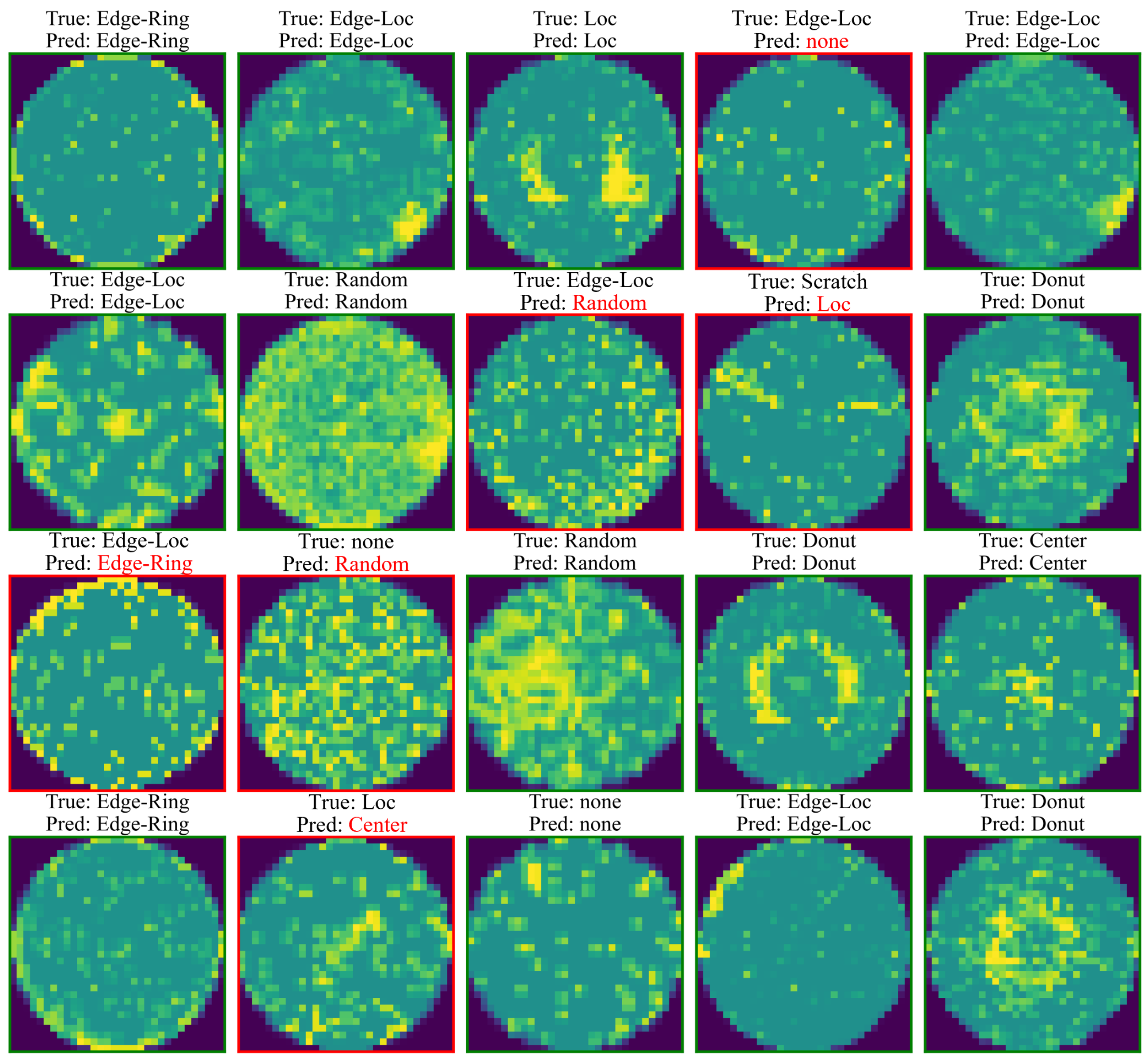
Misclassifications mainly occur in three situations: defects with large within-image scale variation (e.g., fragmented Scratch), low-contrast or discontinuous boundary patterns (e.g., sparse Edge-Loc), and visually similar peripheral categories (Edge-Loc/Edge-Ring/Loc). These cases suggest that multi-scale fusion can be imperfect when fine fragments and global structures must be integrated jointly. They also indicate that subtle boundary cues may be underweighted relative to background regions. Transitional or hybrid morphologies can further reduce separability among closely related classes. Representative correct predictions and typical failure cases illustrating these error modes are shown in Figure 5.
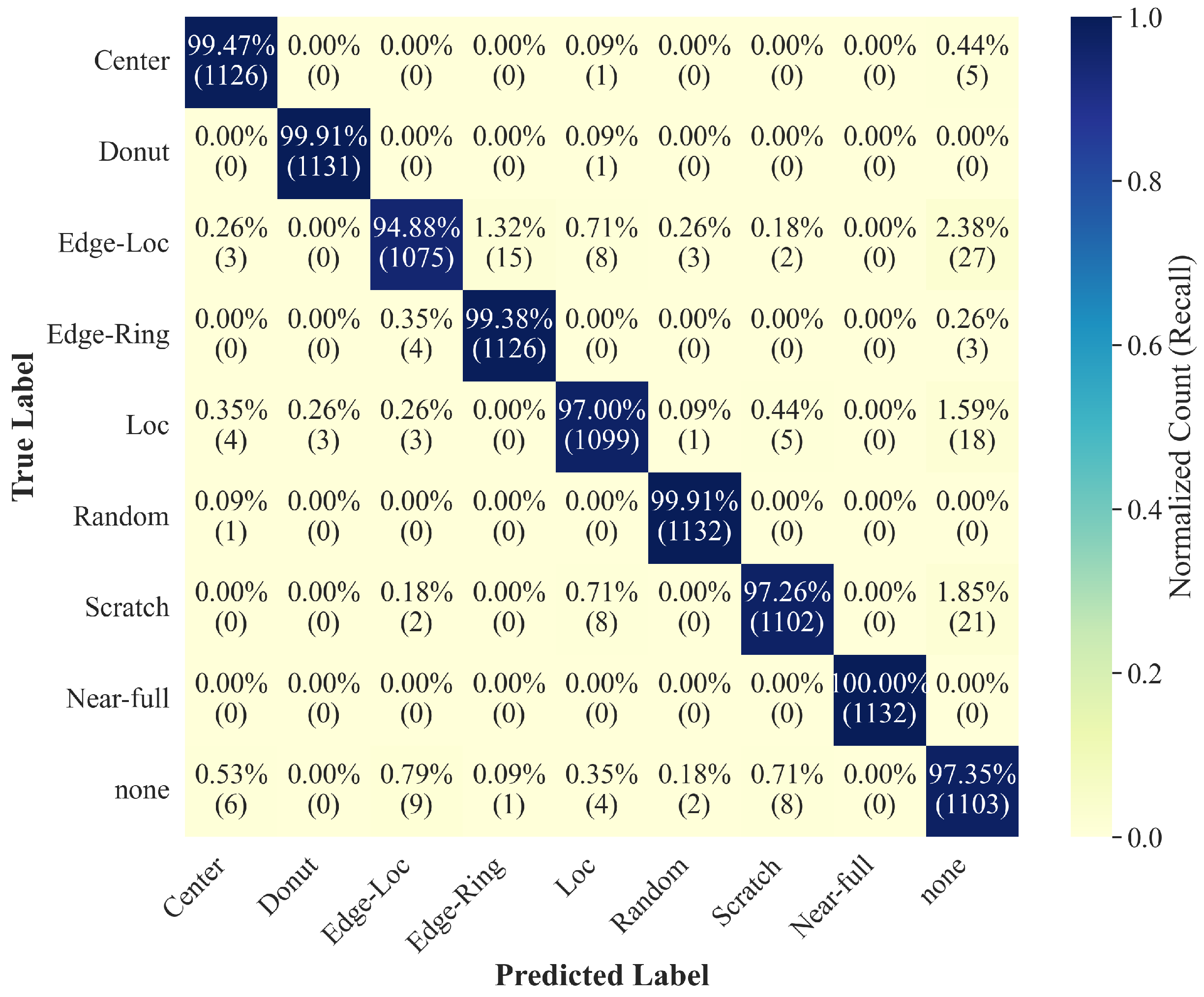
As further indicated by the confusion matrix in Figure 6, the most persistent errors occur among visually similar peripheral categories. In particular, Edge-Loc is occasionally confused with None or Edge-Ring, while Loc may also be predicted as None when the defect response is weak or spatially sparse. These error patterns suggest that, for peripheral and weakly localized defects, the boundary contrast and defect extent can be insufficient for stable separation, especially when the morphology is transitional between localized and edge-concentrated patterns. This observation is consistent with the class-wise improvements reported in Section 4.2.3, where larger gains are observed on Loc, Edge-Loc, and Edge-Ring after improving pseudo-label quality control.
In addition, the semi-supervised pipeline depends on pseudo-label quality; rare or ambiguous samples may still receive noisy pseudo-labels, limiting gains on the most confusing categories. These observations motivate scale-aware fusion, boundary-sensitive cues, and objectives that explicitly enhance separability among similar defect types.

4.2.3. Efficiency, Ablation, and Additional Validation

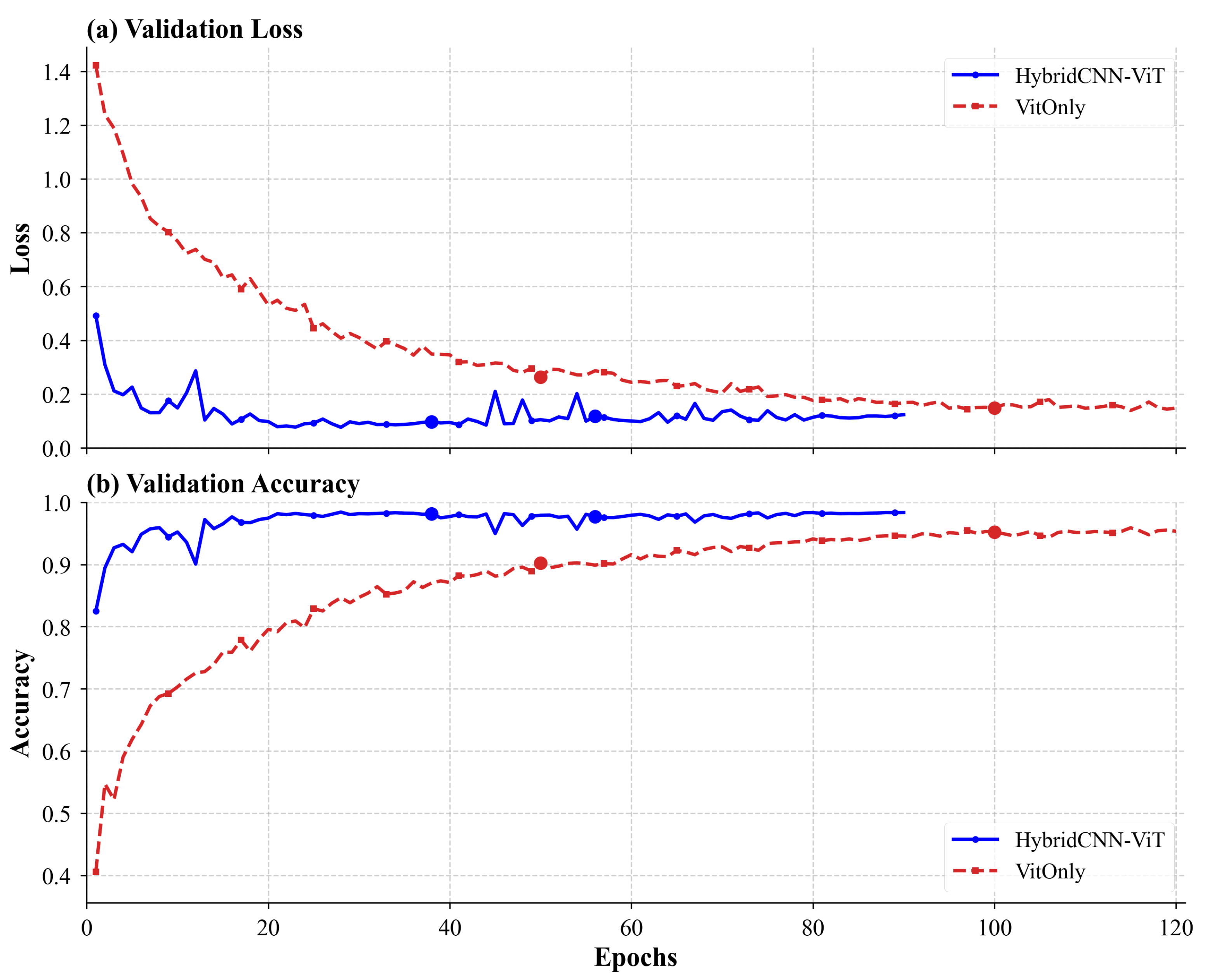
The trained HybridCNN-ViT model size is 4.97 MB. On an NVIDIA GeForce RTX 3060 Laptop GPU, the average inference time is 3.33 ms per image (approximately 300 images/s) under our implementation; throughput may vary with batch size, hardware, and system overhead. Training dynamics are shown in Figure 7. Replacing the ViT-only baseline with the hybrid encoder improves accuracy (0.9835 vs. 0.9598), and adding SSL further improves accuracy to 0.9872 under the same protocol. This gain is also reflected in Macro-F1 (0.9835 to 0.9861) and Cohen’s Kappa (0.9815 to 0.9854), indicating that the improvement is not merely due to increased model capacity but also benefits from leveraging unlabeled data.
Beyond the overall SSL gain, we further evaluate the pseudo-label selection mechanism used in the proposed semi-supervised pipeline. Pseudo-label quality is assessed on the held-out pseudo-evaluation subset by comparing pseudo labels with ground-truth labels under the same teacher/student setting. To avoid relying on arbitrary threshold choices, the five hyperparameters involved in adaptive thresholding and uncertainty filtering are systematically calibrated on a held-out pseudo-evaluation subset that is not used for model training (Section 4.1). We then compare the calibrated adaptive strategy with a fixed-threshold pseudo-labeling baseline under the same teacher–student setting and pseudo-label generation protocol.
The results show that the proposed selection mechanism improves pseudo-label reliability at both stages and remains stable after pseudo-label refresh. At Stage 2, the calibrated adaptive strategy achieves a Macro-F1 of 97.78%, compared with 96.73% for the fixed-threshold baseline. After pseudo-label refresh, the Stage 3 Macro-F1 further improves to 98.13%, whereas the fixed-threshold baseline drops to 95.64%. In other words, our method gains 0.35 percentage points from Stage 2 to Stage 3, while the fixed-threshold baseline degrades by 1.09 percentage points. The performance gap between the two methods therefore widens from 1.05 percentage points at Stage 2 to 2.49 percentage points at Stage 3. Table 4 summarizes this stage-wise comparison of pseudo-label quality between the two methods.
In addition to Macro-F1, the experiments provide a more complete view of pseudo-label behavior. The uncertainty-aware filtering mechanism rejects a non-trivial fraction of otherwise high-confidence but unstable predictions, with rejection rates of 4.58% at Stage 2 and 3.42% at Stage 3. Meanwhile, the accepted pseudo-label rate remains competitive, increasing from 84.01% at Stage 2 to 87.27% at Stage 3. This indicates that the proposed strategy improves pseudo-label quality without excessively sacrificing usable samples.
The improvements are also more pronounced in challenging classes. At Stage 3, the calibrated adaptive strategy yields F1 gains of approximately +6.89% for Loc, +4.79% for Donut, +3.70% for Edge-Loc, and +2.86% for Edge-Ring relative to the fixed-threshold baseline. These class-wise gains suggest that improved pseudo-label quality control is particularly beneficial for categories that are more difficult or more sensitive to noisy pseudo-labels.
Taken together, these results suggest that the proposed pseudo-label selection strategy improves pseudo-label reliability while maintaining a competitive acceptance rate. The unlabeled-set size selection is described in Section 4.1. Table 5 reports the per-class impact of introducing the CNN feature extractor, while Table 6 summarizes the overall impact of adding SSL. As shown in Table 6, the SSL stage improves not only accuracy but also Macro-F1 (0.9835 to 0.9861) and Cohen’s Kappa (0.9815 to 0.9854).
We perform 5-fold stratified cross-validation (Table 7) to assess robustness. The mean accuracy is 98.54% with a standard deviation of ± 0.25 % , suggesting stable performance across folds.

4.3. Defect Segmentation Results

4.3.1. Overall Performance, Qualitative Results, and Efficiency

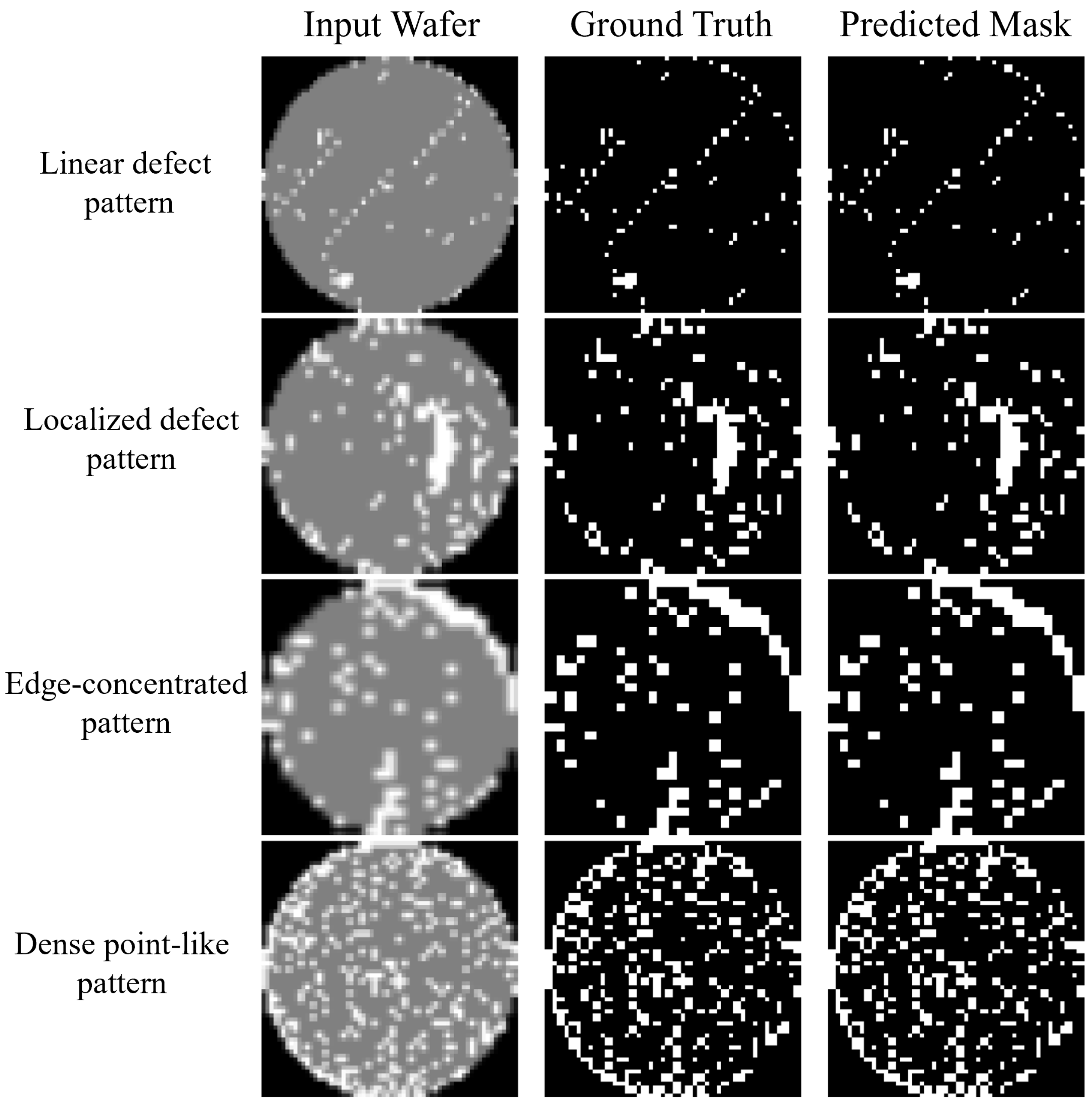
For segmentation, we compare ConvoFormer-UNet with U-Net [23], TransUNet [24], DeepLabv3+ [31], and MiniUNet [32]. As shown in Table 8, ConvoFormer-UNet achieves an IoU of 99.19% with 7.11M parameters. Compared with TransUNet, it improves IoU (99.19% vs. 99.02%) with 20.5% fewer parameters, and uses substantially fewer parameters than DeepLabv3+ while maintaining comparable IoU. Figure 8 shows representative predictions, including point defects and linear scratches. On the specified GPU, the average inference time is 8.12 ms per image (about 123 images/s) under our implementation.

4.3.2. Ablation Study and Limitations

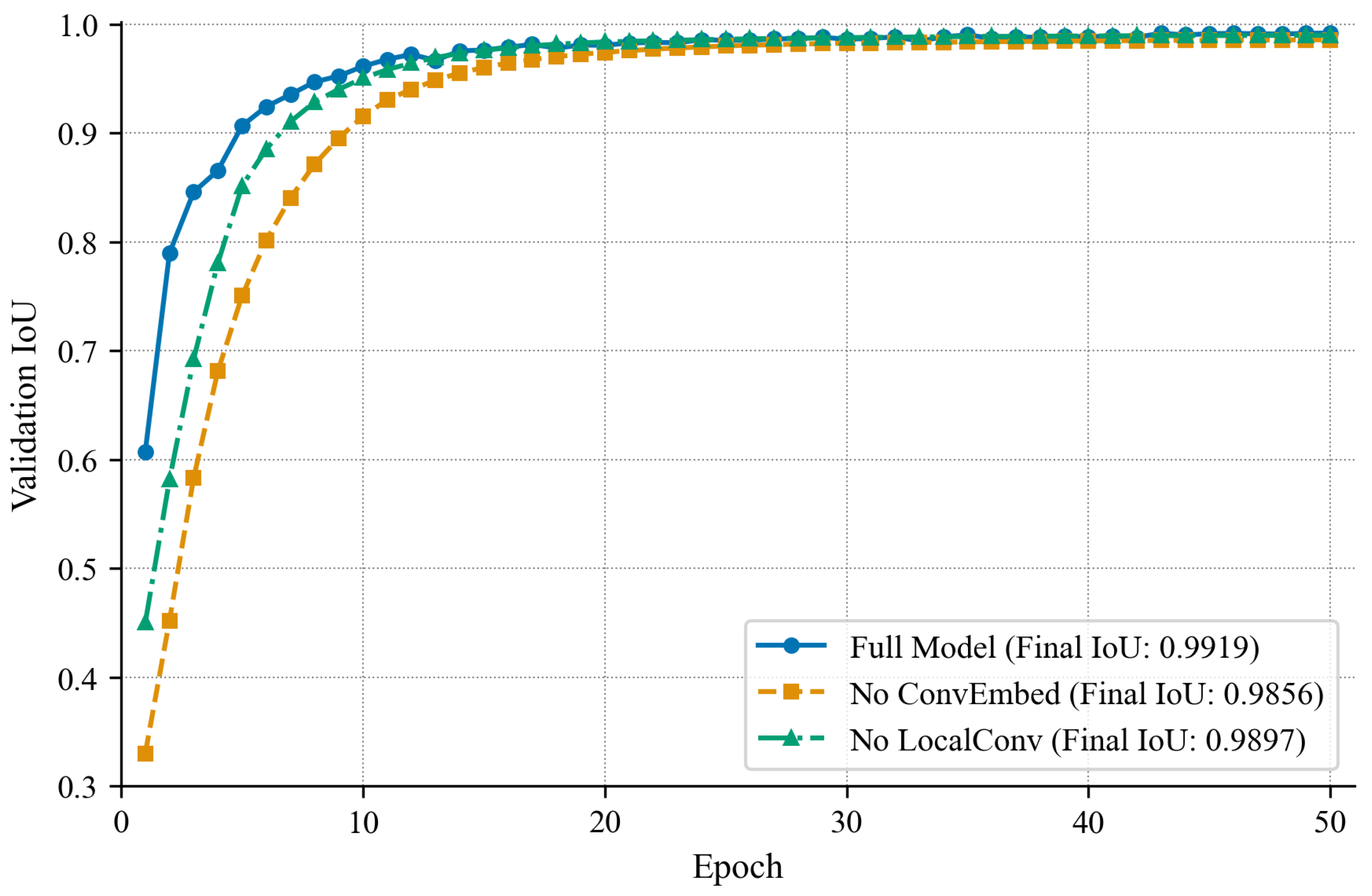
We ablate the convolution-enhanced patch embedding (ConvEmbed) and the local convolution within Transformer blocks (LocalConv). As shown in Figure 9, removing ConvEmbed yields the largest drop (IoU 98.56%), whereas removing LocalConv reduces IoU to 98.97%. These results indicate that both components contribute under our evaluation setting. A limitation is that the relative contributions may change under different resolutions, noise characteristics, or defect morphologies, and very small or low-contrast defects remain challenging when boundary signals are weak.

5. Conclusions

This paper addresses key challenges in wafer defect analysis, including diverse defect patterns and limited annotations. We propose a unified framework with two hybrid models for classification and segmentation, together with a semi-supervised training strategy.
For classification, HybridCNN-ViT combines CNN-based local feature extraction with Transformer-based global context modeling. With a three-stage semi-supervised pipeline, it achieves 98.72% accuracy and 0.9985 Macro AUC, and shows stable performance under 5-fold cross-validation (98.54% ± 0.25%). The model is compact (4.97 MB) and achieves 3.33 ms per image (about 300 images/s) under our implementation.
For segmentation, ConvoFormer-UNet enhances local perception and multi-scale fusion within an encoder–decoder design. It achieves 99.19% IoU with 7.11M parameters, offering a favorable accuracy–efficiency trade-off relative to common baselines.
Ablation studies support the contributions of key components in both models. Future work will focus on improving multi-scale and boundary-sensitive modeling for difficult cases (e.g., fragmented Scratch and visually similar edge-related classes), strengthening pseudo-label reliability under distribution shift, and evaluating deployment performance across diverse hardware and mixed-type defect scenarios.

Supplementary Materials

The following supporting information can be downloaded at: https://www.mdpi.com/article/10.3390/electronics15071437/s1, Supplementary Algorithms: Algorithm S1 (HybridCNN-ViT training/pseudo-labeling pipeline) and Algorithm S2 (ConvoFormer-UNet training procedure).

Author Contributions

Conceptualization, R.S. and Z.Z.; Methodology, R.S., R.L., Z.Z. and X.Z.; Software, R.L.; Investigation, R.S. and R.L.; Data curation, R.S.; Formal analysis, R.S. and R.L.; Validation, R.S. and R.L.; Visualization, R.S.; Writing—original draft preparation, R.S. and R.L.; Writing—review and editing, R.L., Z.Z. and X.Z.; Supervision, Z.Z. and X.Z. All authors have read and agreed to the published version of the manuscript.

Funding

This research received no external funding.

Data Availability Statement

The data that support the findings of this study are available via the WM-811K wafer map dataset. The original related publication is available at doi:10.1109/TSM.2014.2364237, and a public copy of the dataset is available at: https://www.kaggle.com/datasets/qingyi/wm811k-wafer-map (accessed on 25 March 2026). Code is available from the corresponding author upon reasonable request.

Conflicts of Interest

The authors declare no conflicts of interest. The funders had no role in the design of the study; in the collection, analyses, or interpretation of data; in the writing of the manuscript; or in the decision to publish the results.

References

  1. Xie, L.; Huang, R.; Gu, N.; Cao, Z. A novel defect detection and identification method in optical inspection. Neural Comput. Appl. 2014, 24, 1953–1962. [Google Scholar]
  2. Wu, M.J.; Jang, J.S.R.; Chen, J.L. Wafer map failure pattern recognition and similarity ranking for large-scale data sets. IEEE Trans. Semicond. Manuf. 2014, 28, 1–12. [Google Scholar] [CrossRef]
  3. Chapelle, O.; Schölkopf, B.; Zien, A. (Eds.) Semi-Supervised Learning; MIT Press: Cambridge, MA, USA, 2006. [Google Scholar]
  4. Spanos, C.J. Statistical process control in semiconductor manufacturing. Proc. IEEE 1992, 80, 819–830. [Google Scholar] [CrossRef]
  5. Piao, M.; Jin, C.H.; Lee, J.Y.; Byun, J.Y. Decision tree ensemble-based wafer map failure pattern recognition based on radon transform-based features. IEEE Trans. Semicond. Manuf. 2018, 31, 250–257. [Google Scholar] [CrossRef]
  6. Saqlain, M.; Jargalsaikhan, B.; Lee, J.Y. A voting ensemble classifier for wafer map defect patterns identification in semiconductor manufacturing. IEEE Trans. Semicond. Manuf. 2019, 32, 171–182. [Google Scholar] [CrossRef]
  7. Ma, J.; Zhang, T.; Yang, C.; Cao, Y.; Xie, L.; Tian, H.; Li, X. Review of wafer surface defect detection methods. Electronics 2023, 12, 1787. [Google Scholar] [CrossRef]
  8. Zhang, G.; Pan, Y.; Zhang, L. Semi-supervised learning with GAN for automatic defect detection from images. Autom. Constr. 2021, 128, 103764. [Google Scholar] [CrossRef]
  9. LeCun, Y.; Bengio, Y.; Hinton, G. Deep learning. Nature 2015, 521, 436–444. [Google Scholar] [CrossRef] [PubMed]
  10. Li, R.; Kang, Z. Deep Learning for Wafer Map Defect Detection: A Review. In Proceedings of the 2023 Global Reliability and Prognostics and Health Management Conference (PHM-Hangzhou), Hangzhou, China, 12–15 October 2023; IEEE: Piscataway, NJ, USA, 2023; pp. 1–6. [Google Scholar]
  11. Kyeong, K.; Kim, H. Classification of mixed-type defect patterns in wafer bin maps using convolutional neural networks. IEEE Trans. Semicond. Manuf. 2018, 31, 395–402. [Google Scholar] [CrossRef]
  12. Wang, J.; Xu, C.; Yang, Z.; Zhang, J.; Li, X. Deformable convolutional networks for efficient mixed-type wafer defect pattern recognition. IEEE Trans. Semicond. Manuf. 2020, 33, 587–596. [Google Scholar] [CrossRef]
  13. Hu, Z.; Wu, Y. Survey of semiconductor wafer defect detection method based on machine vision. J. Image Graph. 2025, 30, 25–50. [Google Scholar] [CrossRef]
  14. Dosovitskiy, A. An image is worth 16x16 words: Transformers for image recognition at scale. arXiv 2020, arXiv:2010.11929. [Google Scholar]
  15. Wei, Y.; Wang, H. Mixed-type wafer defect recognition with multi-scale information fusion transformer. IEEE Trans. Semicond. Manuf. 2022, 35, 341–352. [Google Scholar] [CrossRef]
  16. Qiao, Y.; Mei, Z.; Luo, Y.; Chen, Y. DeepSEM-Net: Enhancing SEM defect analysis in semiconductor manufacturing with a dual-branch CNN-Transformer architecture. Comput. Ind. Eng. 2024, 193, 110301. [Google Scholar] [CrossRef]
  17. Fan, S.K.S.; Chiu, S.H. A new ViT-Based augmentation framework for wafer map defect classification to enhance the resilience of semiconductor supply chains. Int. J. Prod. Econ. 2024, 273, 109275. [Google Scholar] [CrossRef]
  18. Zhang, X.; Liang, X.; Zhang, Y.; Li, J.; Wei, S. MLR-WM-ViT: Global high-performance classification of mixed-type wafer map defect using a multi-level relay Vision Transformer. Expert Syst. Appl. 2025, 277, 127121. [Google Scholar] [CrossRef]
  19. Wang, Y.; Ni, D.; Huang, Z.; Chen, P. A self-supervised learning framework based on masked autoencoder for complex wafer bin map classification. Expert Syst. Appl. 2024, 249, 123601. [Google Scholar] [CrossRef]
  20. Kwak, M.G.; Lee, Y.J.; Kim, S.B. SWaCo: Safe Wafer Bin Map Classification With Self-Supervised Contrastive Learning. IEEE Trans. Semicond. Manuf. 2023, 36, 416–424. [Google Scholar] [CrossRef]
  21. Nero, M.; Shan, C.; Wang, L.C.; Sumikawa, N. Concept recognition in production yield data analytics. In Proceedings of the 2018 IEEE International Test Conference (ITC), Phoenix, AZ, USA, 29 October–1 November 2018; IEEE: Piscataway, NJ, USA, 2018; pp. 1–10. [Google Scholar]
  22. Sheng, Y.; Yan, J.; Piao, M. Improved wafer map defect pattern classification using automatic data augmentation based lightweight encoder network in contrastive learning. J. Intell. Manuf. 2025, 36, 4129–4141. [Google Scholar] [CrossRef]
  23. Ronneberger, O.; Fischer, P.; Brox, T. U-net: Convolutional networks for biomedical image segmentation. In Proceedings of the Medical Image Computing and Computer-Assisted Intervention–MICCAI 2015: 18th International Conference, Munich, Germany, 5–9 October 2015; Springer: Cham, Switzerland, 2015; pp. 234–241. [Google Scholar]
  24. Chen, J.; Lu, Y.; Yu, Q.; Luo, X.; Adeli, E.; Wang, Y.; Lu, L.; Yuille, A.L.; Zhou, Y. Transunet: Transformers make strong encoders for medical image segmentation. arXiv 2021, arXiv:2102.04306. [Google Scholar] [CrossRef]
  25. Nag, S.; Makwana, D.; R, S.C.T.; Mittal, S.; Mohan, C. WaferSegClassNet—A Light-weight Network for Classification and Segmentation of Semiconductor Wafer Defects. Comput. Ind. 2022, 142, 103720. [Google Scholar] [CrossRef]
  26. Yin, S.; Zhang, Y.; Wang, R. Contrastive Learning with Global and Local Representation for Mixed-Type Wafer Defect Recognition. Sensors 2025, 25, 1272. [Google Scholar] [CrossRef]
  27. Gal, Y.; Ghahramani, Z. Dropout as a bayesian approximation: Representing model uncertainty in deep learning. In Proceedings of the International Conference on Machine Learning, PMLR, New York, NY, USA, 20–22 June 2016; pp. 1050–1059. [Google Scholar]
  28. Simonyan, K.; Zisserman, A. Very deep convolutional networks for large-scale image recognition. arXiv 2014, arXiv:1409.1556. [Google Scholar]
  29. Hendrycks, D.; Gimpel, K. Gaussian error linear units (gelus). arXiv 2016, arXiv:1606.08415. [Google Scholar]
  30. Saqlain, M.; Abbas, Q.; Lee, J.Y. A deep convolutional neural network for wafer defect identification on an imbalanced dataset in semiconductor manufacturing processes. IEEE Trans. Semicond. Manuf. 2020, 33, 436–444. [Google Scholar] [CrossRef]
  31. Chen, L.C.; Papandreou, G.; Kokkinos, I.; Murphy, K.; Yuille, A.L. Deeplab: Semantic image segmentation with deep convolutional nets, atrous convolution, and fully connected crfs. IEEE Trans. Pattern Anal. Mach. Intell. 2017, 40, 834–848. [Google Scholar] [CrossRef]
  32. Liu, J.; Li, Q.; Cao, R.; Tang, W.; Qiu, G. MiniNet: An extremely lightweight convolutional neural network for real-time unsupervised monocular depth estimation. ISPRS J. Photogramm. Remote Sens. 2020, 166, 255–267. [Google Scholar] [CrossRef]
Figure 1. Examples of the nine wafer defect patterns from the WM-811K dataset, a widely used benchmark for wafer map analysis.
Electronics 15 01437 g001
Figure 2. Overall architecture of HybridCNN-ViT. A three-stage semi-supervised pipeline iteratively incorporates high-confidence pseudo-labels from unlabeled data.
Electronics 15 01437 g002
Figure 3. The proposed ConvoFormer-UNet for wafer defect segmentation, including a hybrid encoder with convolutional embedding and a progressive decoder with multi-scale skip connections.
Electronics 15 01437 g003
Figure 4. Class distribution of the labeled WM-811K subset and the raw train/validation/test splits used for classification. The y-axis is shown in log scale to make minority classes visible alongside the dominant None class.
Electronics 15 01437 g004
Figure 5. Representative classification examples from the test set, including both correct predictions and typical failure cases. Correct classifications are bordered in green, while incorrect ones are bordered in red. Several failure cases involve visually similar categories such as Edge-Loc, Edge-Ring, and Loc.
Electronics 15 01437 g005
Figure 6. Confusion matrix for HybridCNN-ViT. The main residual confusion occurs among visually similar peripheral classes, especially Edge-Loc, Edge-Ring, and Loc, which motivates the subsequent error analysis.
Electronics 15 01437 g006
Figure 7. Validation loss and accuracy curves comparing the HybridCNN-ViT and ViT-Only models.
Electronics 15 01437 g007
Figure 8. Representative qualitative results for wafer defect segmentation, including sparse defects, point-like defects, and linear scratches. Each row shows the input wafer map, the generated ground-truth mask, and the predicted mask.
Electronics 15 01437 g008
Figure 9. Ablation study of key components in ConvoFormer-UNet on validation-set IoU.
Electronics 15 01437 g009
Table 1. Class distribution of the labeled WM-811K subset and the raw train/validation/test splits used for classification.
ClassAll LabeledTrain (Raw)ValidationTest
Center4294 (2.48%)3116 (6.37%)346 (6.36%)832 (0.70%)
Donut555 (0.32%)368 (0.75%)41 (0.75%)146 (0.12%)
Edge-Loc5189 (3.00%)2175 (4.45%)242 (4.45%)2772 (2.34%)
Edge-Ring9680 (5.60%)7698 (15.74%)856 (15.75%)1126 (0.95%)
Loc3593 (2.08%)1458 (2.98%)162 (2.98%)1973 (1.66%)
Random866 (0.50%)548 (1.12%)61 (1.12%)257 (0.22%)
Scratch1193 (0.69%)450 (0.92%)50 (0.92%)693 (0.58%)
Near-full149 (0.09%)49 (0.10%)5 (0.09%)95 (0.08%)
None147,431 (85.24%)33,057 (67.57%)3673 (67.57%)110,701 (93.34%)
Total172,950 (100.00%)48,919 (100.00%)5436 (100.00%)118,595 (100.00%)
Note: The train split shown here is the raw split before hybrid sampling. During classification training, the majority None class is downsampled and SMOTE is applied to minority classes, while validation and test remain imbalanced. Percentages are computed within each column.
Table 2. Distribution of the segmentation subset derived from labeled defect-present wafers in WM-811K after excluding the None and Random classes.
MetricCenterDonutEdge-LocEdge-RingLocScratchNear-FullTotal
Count4294555518996803593119314924,653
Percentage17.42%2.25%21.05%39.26%14.57%4.84%0.60%100.00%
Table 3. Performance comparison of different classification models on the WM-811K dataset (accuracy, %). Column abbreviations: E-Loc = Edge-Loc, E-Ring = Edge-Ring, N-full = Near-full.
ModelCenterDonutE-LocE-RingLocRandomScratchN-FullNoneAvg.
Modified ViT97.3885.0491.9897.7075.1486.9957.7285.1490.73
CNN-WDI [30]98.0098.3093.1091.7090.3096.5098.7099.9099.7096.20
WMFPR [2]84.9074.0085.1079.7068.5079.8082.4097.9095.7083.10
WMDPI [6]86.0077.0077.0095.0060.0094.0034.0097.00100.0080.00
DTE-WMFPR [5]95.8092.2083.5086.8083.5095.8086.00N/A100.0090.40
HybridCNN-ViT (Ours)98.7799.9194.8899.3897.0099.9197.26100.0097.3598.35
Note: N/A: not available in the original publication. –: not reported/not applicable.
Table 4. Comparison of pseudo-label quality under fixed-threshold and calibrated adaptive selection.
MethodStageMacro-F1 (%)Gain (pp)Stage Trend
Fixed thresholdStage 296.73
Calibrated adaptive + uncertainty filteringStage 297.78+1.05
Fixed thresholdStage 395.64 1.09 vs. Stage 2
Calibrated adaptive + uncertainty filteringStage 398.13+2.49 + 0.35 vs. Stage 2
Note: Pseudo-label quality is measured on a held-out pseudo-evaluation subset using Macro-F1. Gain is reported as the absolute difference in Macro-F1 (percentage points) with respect to the fixed-threshold baseline at the same stage.
Table 5. Ablation study: per-class impact of the CNN feature extractor.
ClassViT-OnlyHybridCNN-ViT
PRF1PRF1
Center97.2298.7697.9898.7799.4799.12
Donut99.04100.0099.5299.7499.9199.82
Edge-Loc94.0892.5093.2898.3594.8896.59
Edge-Ring96.6398.7697.6998.6099.3898.99
Loc95.2389.8592.4698.0497.0097.52
Random98.9599.6599.3099.4799.9199.69
Scratch90.3395.5992.8898.6697.2697.96
Near-full99.91100.0099.96100.00100.00100.00
None92.4688.7090.5493.7197.3595.50
Macro Avg95.9895.9895.9698.3798.3598.35
Note: P: Precision; R: Recall; F1: F1-score.
Table 6. Ablation study: Overall impact of semi-supervised learning (SSL) (metrics in %).
Model ConfigurationAccMacro F1Macro AUCCohen Kappa
ViT-Only (Supervised)95.9895.9699.7895.48
HybridCNN-ViT (Supervised)98.3598.3599.8298.15
HybridCNN-ViT + SSL (Ours)98.7298.6199.8598.54
Table 7. Cross-validation results for the HybridCNN-ViT model.
FoldAcc. (%)Prec.Rec.F1
Fold 198.420.98410.98420.9841
Fold 298.650.98630.98650.9864
Fold 398.230.98210.98230.9822
Fold 498.870.98850.98870.9886
Fold 598.540.98520.98540.9853
Mean98.54 ± 0.250.9852 ± 0.00250.9854 ± 0.00250.9853 ± 0.0025
Table 8. Performance Comparison of Different Segmentation Models.
ModelParameters (M)IoU (%)Inf. (ms)
U-Net [23]7.7698.816.85
TransUNet [24]8.9599.029.47
DeepLabv3+ [31]26.899.2318.23
MiniUNet [32]0.02698.372.41
ConvoFormer-UNet (Ours)7.1199.198.12
Disclaimer/Publisher’s Note: The statements, opinions and data contained in all publications are solely those of the individual author(s) and contributor(s) and not of MDPI and/or the editor(s). MDPI and/or the editor(s) disclaim responsibility for any injury to people or property resulting from any ideas, methods, instructions or products referred to in the content.