Article

Refined Modeling and Failure Mechanisms of Distribution Pole–Line Systems Considering Nonlinear Wind–Rain Coupling

1
Economic and Technology Institute, State Grid Fujian Electric Power Co., Ltd., Fuzhou 350013, China
2
School of Electrical Engineering and Automation, Harbin Institute of Technology, Harbin 150001, China
*
Author to whom correspondence should be addressed.
Electronics 2026, 15(6), 1314; https://doi.org/10.3390/electronics15061314
Submission received: 27 January 2026 / Revised: 13 March 2026 / Accepted: 19 March 2026 / Published: 21 March 2026

Abstract

Existing standards for distribution network safety under combined typhoon–rain hazards often overlook the nonlinear coupling effects induced by rain impact. To address this issue, this paper proposes a refined modeling and threshold-based failure assessment framework for distribution pole–line systems under coupled wind–rain loading. A full dynamic model is established by integrating a multi-point spatiotemporally coherent wind field with raindrop impact effects, and the coupled time-domain response of the system is then simulated. The results indicate that wind–rain coupling significantly amplifies the dynamic response, with nonlinear energy accumulation occurring at the pole base. Under the analyzed extreme case, this amplification causes the pole-base stress to first exceed the collapse threshold within the simulated duration, indicating that neglecting rain loads may lead to a non-conservative assessment of system safety. In addition, the results reveal differentiated failure characteristics among components: conductors are primarily associated with functional flashover risk, whereas poles are more directly exposed to structural failure demand. These findings provide a preliminary analytical basis for the differential reinforcement and resilience enhancement of coastal distribution networks.

1. Introduction

In a warming climate, extreme precipitation events are becoming more frequent and more intense over most land regions, and heavy precipitation associated with tropical cyclones is also expected to increase; the probability of compound extreme events has likewise risen and is projected to continue increasing [1]. These trends pose growing challenges to the safe and reliable operation of electric power infrastructure, especially in coastal regions exposed to typhoons and extreme rainstorms. As the “last mile” connecting the main grid to end users, distribution networks are particularly vulnerable because of their broad spatial exposure, complex topology, and generally lower structural robustness compared with transmission systems [2,3]. Therefore, refined modeling and resilience-oriented assessment of distribution networks under compound typhoon hazards have become increasingly important in both research and engineering practice. Existing studies on distribution-network disaster prevention have mainly focused on outage prediction, resilience planning, and fragility-based risk assessment under wind-dominated hazards. Data-driven and hybrid approaches have substantially improved pre-event outage forecasting and hardening analysis, while physics-based or probabilistic studies have clarified the wind fragility of poles and pole–wire systems under hurricanes and other extreme wind events [4,5,6,7,8]. However, these studies are still primarily centered on wind-only loading, wind-induced outages, or deterioration-aware reliability analysis. The explicit treatment of compound wind–rain loading in distribution pole–line systems, especially the transfer of coupled demand from conductor motion to insulator force and then to pole-base failure, remains limited. Heavy rainfall should not be regarded merely as a meteorological accompaniment. Studies on transmission-line conductors have shown that rain can alter conductor aerodynamics through rivulet formation, trigger rain–wind-induced instability, and increase swing amplitude as well as support reactions under combined loading [9,10,11,12]. In particular, Zhou et al. showed that the peak swing amplitude of overhead conductors under rain–wind conditions is larger than that under wind-only loading and emphasized that rain loads should not be neglected [10], while Sun et al. reported larger conductor displacements and support reactions in a multiscale wind-driven-rain simulation of transmission lines during Super Typhoon Lekima [12]. Nevertheless, direct extrapolation of these findings to medium-voltage distribution pole–line systems is not straightforward. Compared with transmission structures, distribution systems generally have shorter spans, smaller electrical clearances, lower stiffness reserves, and concrete-pole foundations that are more sensitive to localized bending-moment concentration and overturning demand. Accordingly, the contribution of the present study lies not in claiming entirely new wind–rain physics, but in developing an integrated modeling and failure-mechanism framework tailored to distribution pole–line systems under compound typhoon–rain loading. To further clarify the position of the present study relative to representative existing work, Table 1 summarizes the main differences in target system, hazard treatment, and failure-assessment focus.
To address the above gap, this paper proposes a refined nonlinear dynamic framework for distribution pole–line systems considering wind–rain coupling. The framework integrates a non-stationary typhoon wind field, a multi-point spatiotemporally coherent fluctuating wind model, and raindrop-impact loading into a unified finite-element analysis. On this basis, the coupled response amplification, pole-base overstress evolution, and failure-transfer path within the conductor–insulator–pole system are examined under a critical typhoon window. Additional sensitivity analyses, mesh-independence verification, load-magnitude comparison, and qualitative comparison with representative published studies are further used to assess the robustness and physical plausibility of the proposed framework.

2. Materials and Methods

2.1. Simulation of Typhoon–Rainstorm Compound Environment

2.1.1. Reconstruction of Typhoon Wind Field

Typhoon wind speeds exhibit significant non-stationary characteristics and can be decomposed into time-varying mean wind speed and fluctuating wind speed. The Batts model [13] is first employed to reconstruct the time-varying mean wind field during typhoon passage, obtaining the 10 min mean wind speed V 10 at any location 10 m above ground:
V 10 = V r max r r max , r r max V r max r max r b , r > r max
where r is the distance between the line and the typhoon center; V r max is the wind speed at r max . b is a random parameter describing the radial decay of typhoon intensity, ranging from 0.5 to 0.7, which follows a Gaussian distribution influenced by geographical and meteorological conditions.
Considering the influence of surface roughness on the wind profile, the height and terrain correction coefficient α is introduced according to the ESDU 85020 standard [14] to obtain the gradient mean wind speed V w along the line:
V w = V 10 H 10 α
where H is the corresponding height.
The critical time window associated with the highest mean wind speed during the typhoon passage was then selected for refined dynamic time-history simulation, and the fluctuating wind component within this window was generated separately using the spatiotemporal coherence model described below.

2.1.2. Simulation of Multi-Point Spatiotemporal Coherent Fluctuating Wind

Within the selected 300 s critical window, the fluctuating wind speeds at different pole locations are not mutually independent but remain strongly spatially correlated; accordingly, the fluctuating wind component is modeled as a multivariate stationary Gaussian stochastic process to represent the spatiotemporal evolution of the wind field along the line corridor.
First, the Davenport power spectral density function S v ( f ) is adopted to describe the frequency-domain energy distribution of single-point wind speed [15]. On this basis, the Davenport spatial coherence function is introduced to quantify the statistical correlation between any two points i and j with an arbitrary spacing d i j at frequency f, expressed as
C o h i j ( f , d i j ) = exp C γ · f · d i j V a v g
where C γ is the coherence decay coefficient, reflecting the dissipation characteristics of vortices in space; V a v g is the mean wind speed between the two points.
Based on the above coherence function, the cross-power spectral density matrix S ( f ) for m simulation points is constructed. The off-diagonal elements S i j ( f ) of this matrix are coupled by the auto-power spectrum and the coherence function. To achieve numerical decoupling of correlations between nodes, the Cholesky decomposition is performed on the spectral matrix to transform it into a lower triangular matrix H ( f ) .
On this basis, the harmonic superposition method is adopted to generate multi-dimensional stochastic wind speed samples. The frequency interval is discretized into N f frequency points, and a set of random phase angles ψ i k uniformly distributed in the interval [ 0 ,   2 π ] is introduced to endow the process with randomness. The fluctuating wind speed time history v w i ( t ) at the i-th measurement point is finally expressed as the superposition of cosine waves of various frequency components:
v w i ( t ) = j = 1 i k = 1 N f | H i j ( f k ) | 2 Δ f cos 2 π f k t + θ i j ( f k ) + ψ j k
where | H i j ( f k ) | and θ i j ( f k ) are the modulus and complex angle of the lower triangular matrix elements, respectively; Δ f is the frequency increment.
Therefore, based on the time-varying mean wind speed, the instantaneous typhoon wind speed can be further expressed as
V ( t ) = V w ( t ) + v w i ( t )

2.1.3. Rain Load Model

The raindrop spectrum adopts the Marshall and Palmer exponential distribution [16], expressed as
N ( D ) = n 0 exp ( Λ D ) = n 0 exp ( 4.1 I 0.21 D )
where n 0 = 8 × 10 3 ; I is the rainfall intensity (mm/h); and D is the raindrop diameter (mm). Considering the physical upper limit of natural raindrops, the diameter range is set to D ( 0 ,   7 ] mm.
The momentum flux generated by wind-driven raindrops is converted into equivalent horizontal and vertical rain pressures acting on the conductor and pole surfaces. When a raindrop of diameter D falls, the horizontal rain pressure P r h and vertical rain pressure P r v can be respectively expressed as [17]
P r = P r h ( V , D , H , α ) = 102 ρ r S r n r V r h 3 D 3 P r v ( V , D , H , α ) = 102 ρ r S r n r V r v 3 D 3
where ρ r is the raindrop density (taken as 1000 kg/m3); n r denotes the raindrop number concentration within the corresponding diameter interval, and S r represents the integration of the normalized impact regularization curve over the impact duration. Under the dimensional system adopted in [17], the coefficient is taken as 102, so that the resulting P r retains the unit of pressure. V r h and V r v are the horizontal and vertical components of the instantaneous velocity of raindrops hitting the conductor or pole [18]:
V r h = γ V V r v = 9.4 × 1 exp 0.557 D 1.15
where γ is the velocity ratio factor:
γ = ( 0.2373 H 0.5008 0.0167 ) D 3 0.8 α 0.12 + 1 H 150 m 1 H > 150 m
S r represents the integration of the normalized regularization curve from 0 to Δ t , where Δ t can be expressed as
Δ t = 2 V r h 0 7 n r d D 3

2.2. Mechanical Response of Pole–Line System

2.2.1. Conductor Mechanical Model

First, the impact of combined typhoon–rainstorm disasters on conductors is analyzed. Under these conditions, in addition to its own gravity, the conductor withstands typhoon and rainstorm loads.
The wind load F w , l acting on the conductor is expressed as
F w , l = V 2 1.6 ε μ z μ s c Q L H sin 2 θ
where ε is the wind pressure non-uniformity coefficient (taken as 0.61 in this paper); μ z is the wind pressure height variation coefficient (taken as 1); μ s c is the conductor shape coefficient; Q is the conductor outer diameter; L H is the horizontal span; and θ is the angle between the wind direction and the conductor.
The term V 2 / 1.6 corresponds to the pressure-based expression of the reference basic wind pressure after unit conversion from the conventional form V 2 /1600 (kN/m2). Therefore, it is not an empirical fitting constant, but the direct wind-speed-to-pressure conversion used in the adopted wind-load formulation. The adopted coefficient values follow the corresponding code/manual provisions for overhead line and pole structures.
The rain load on the conductor is divided into horizontal and vertical components. By integrating the rain pressure described in the previous section, the rain load F r , l on the conductor is obtained as
F r , l = F r h + F r v = π Q L H 0 7 ( P r h + P r v ) d D
where F r h and F r v are the horizontal and vertical rain loads, respectively.

2.2.2. Pole Mechanical Model

Under the action of typhoons and rainstorms, in addition to its own gravity load, the pole primarily withstands wind and rain loads on the pole body, as well as conductor loads. The wind load on the pole body F w , t is given by
F w , t = V 2 1.6 β μ z μ s A t
where F w , t is the wind load on the pole; β is the wind vibration coefficient; μ s is the pole shape coefficient; and A t is the projected area of the windward surface.
During rainfall, since both the front and rear surfaces of the pole collide with raindrops, the raindrop impact area is considered as 2 A t . By integrating the rain pressure formula, the rain load on the pole body F r , t can be obtained as
F r , t = 2 0 7 P r A t d D
In addition to its own wind and rain loads, the pole also withstands loads generated by the wind–rain excitation of the overhead conductors. The conductor loads mainly consist of the gravity load from the conductors on both sides of a single pole, the tensile stress on the pole after the conductors are subjected to wind and rain loads, and the tensile stress along the conductor direction. The total load exerted by the conductors on the pole can be expressed as
F L T = ( F 1 + F 2 ) 2 + F σ 1 + F σ 2 + G
where F 1 and F 2 are the sums of wind and rain loads on the conductors on both sides of the pole, respectively; F σ 1 and F σ 2 are the tensile stresses along the line direction on both sides of the pole, respectively; and G is the gravity load of the line acting on the pole.

2.3. Failure Assessment Framework and Dynamic Vulnerability Indicators

No stationary Gaussian assumption is imposed on the structural response in the proposed failure assessment framework. Instead, failure is characterized using three complementary indicators: the threshold-based overload factor K O L , the first failure time T f a i l obtained from the simulated stress history, and the Energy Amplification Factor (EAF).

2.3.1. Threshold-Based Damage and Collapse Criteria

For static screening of structural demand under extreme typhoon–rain loading, this study adopts a threshold-based stress assessment rather than a probabilistic stress–strength interference formulation. Two physically motivated limit states are introduced to distinguish crack initiation from collapse-level demand: the damage threshold σ c r and the collapse threshold σ u . This treatment preserves a direct correspondence between the simulated nonlinear stress history and the inferred structural state, while avoiding additional distributional assumptions for the structural response.
However, because reinforced concrete poles exhibit pronounced brittleness and tension–compression asymmetry, a single stress limit is insufficient to distinguish the progressive transition from crack initiation to collapse-level demand.
  • Damage Threshold ( σ c r ): Taken as the tensile strength limit of concrete. When the maximum tensile stress at the pole base exceeds this value, it indicates that the concrete matrix has cracked, and the structure exits the ideal linear elastic stage and enters a crack-dominated nonlinear damage state.
  • Collapse Threshold ( σ u ): Taken as the ultimate compressive strength design value of C50 concrete. When the cross-sectional stress response exceeds this value, the compression zone is considered to approach its ultimate state, and the section is regarded as reaching collapse-level demand in the present assessment framework.
For this reason, the Static Overload Factor is adopted as the primary indicator for preliminary demand screening under extreme typhoon–rain loading:
K O L = S m a x σ c r
where S m a x is the maximum stress response value under pure wind or wind–rain conditions. When K O L > 1 , the stress response exceeds the damage threshold and the section enters a crack-dominated nonlinear state; larger values of K O L indicate more severe demand amplification and a smaller margin relative to the collapse threshold.

2.3.2. Time-Dependent Failure Identification Based on Simulated Histories

The first failure time is identified directly from the simulated pole-base stress history. For a response record of duration T, the first failure time is defined as
T f a i l = min t [ 0 , T ] | S ( t ) σ u
If the stress history does not exceed the collapse threshold within the observation window, the system is considered to remain intact over the analyzed duration, and T f a i l is taken to be greater than T. This threshold-crossing approach preserves the temporal evolution of the nonlinear finite-element response without imposing any additional stationary Gaussian assumption on the structural response. Accordingly, the time-dependent risk is characterized by the survival duration and the onset of collapse-threshold exceedance.

2.3.3. Energy Amplification Factor and Bottleneck Identification

To further interpret the coupled response mechanism from the perspective of energy transfer, the Energy Amplification Factor (EAF) is introduced as a supplementary indicator. This metric quantifies the degree of gain in the variance of the dynamic response of system components under wind–rain coupling conditions compared to pure wind conditions:
EAF = Var ( S W i n d + R a i n ) Var ( S W i n d O n l y )
where Var ( · ) represents the variance of the response time history.
If EAF > 1 , it indicates that rainfall has injected additional turbulence energy into the system. By comparing the EAF values of different components, the “dynamic bottleneck” of energy accumulation can be identified. If the EAF of a given component is significantly higher than that of others, this suggests that nonlinear energy accumulation is concentrated at that location and that the component may serve as a critical response-transfer node within the system. Compared with peak-response amplification, the EAF reflects the cumulative persistence of response energy over the entire loading history. It is therefore adopted in this study as a supplementary indicator to provide additional insight into the response mechanism, alongside the threshold-based failure indicators introduced above.

3. Results

3.1. Case Study Parameter Settings

To illustrate the application of the proposed framework, a three-dimensional refined finite-element model of a 10 kV distribution line containing three reinforced concrete poles and two tension sections was established in ANSYS APDL 2022 R1. The conductor alignment follows the Z-axis, with a total length of 120 m over two continuous spans. The principal geometric, material, and operating parameters adopted in the case study are summarized in Table 2. Unless otherwise stated, the component types, geometric dimensions, and layout parameters were selected to represent a typical coastal 10 kV distribution pole–line system in southeastern China, while the material properties and conductor specifications were adopted from commonly used engineering reference values and standard product data.

3.2. Simulation Results of Multi-Point Spatiotemporal Coherent Wind Field

Given the non-stationary characteristics of the typhoon process and the efficiency requirements of structural dynamic analysis, this study adopts a quasi-steady approximation strategy. The most unfavorable time window associated with the highest mean wind speed during typhoon passage is first selected for refined dynamic time-history simulation. Within this window, only the fluctuating wind component is modeled using the stationary stochastic framework described in Section 2.1, while the structural response is obtained directly from nonlinear time-history analysis.
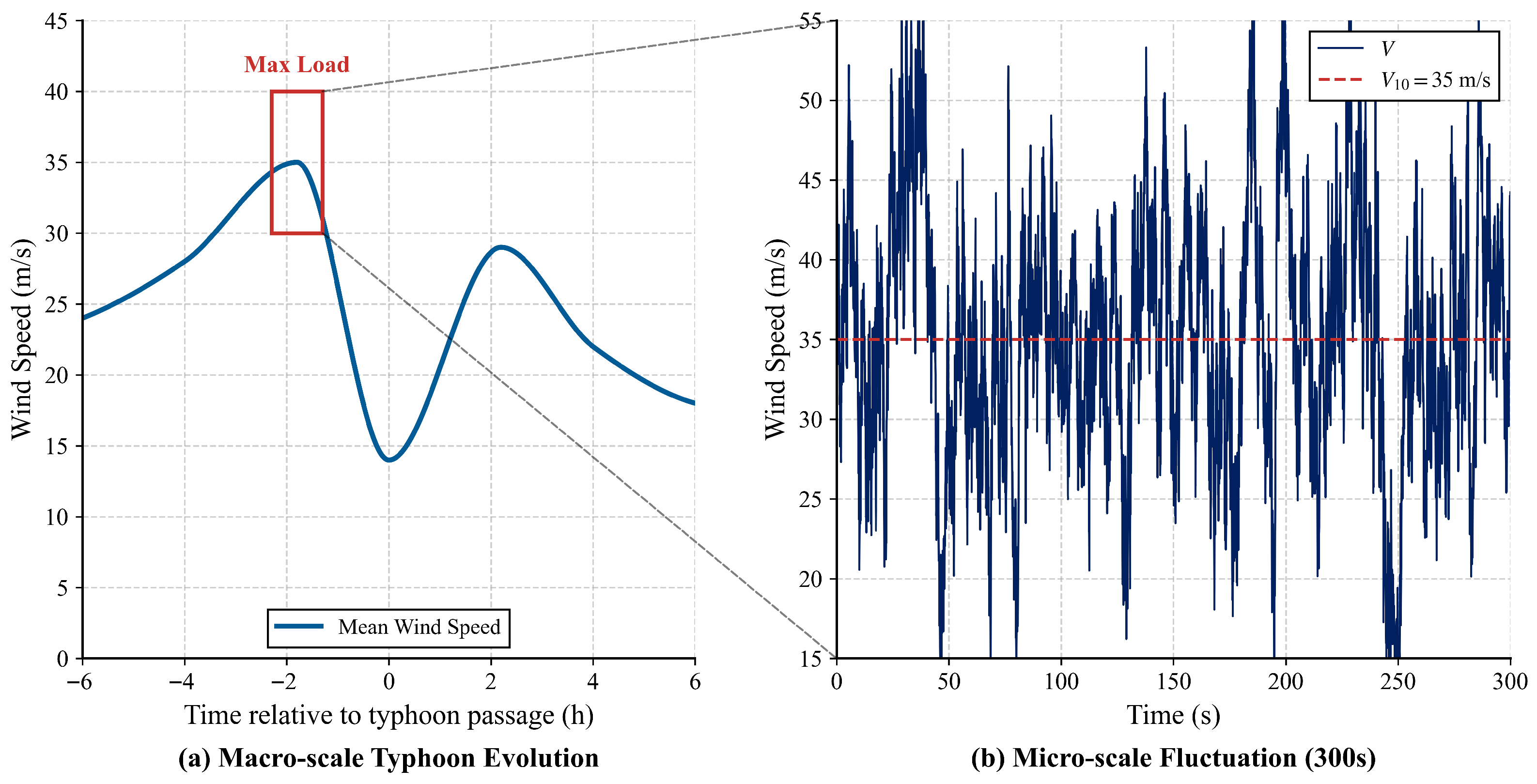
First, the mean wind speed evolution curve over the entire typhoon passage was reconstructed based on the Batts model, as shown in Figure 1a. The results indicate that the regional wind speed exhibits a typical asymmetric bimodal pattern, corresponding to the successive passage of the eyewall high-wind region, the relatively calm eye region, and the return-flow zone. Among them, the maximum mean wind speed V 10 reaches 35 m/s.
Subsequently, taking this most unfavorable wind-speed state as the baseline input condition, the multi-point fluctuating wind-speed histories over 300 s were simulated using the Davenport spectrum and the harmonic superposition method. As shown in the enlarged view in Figure 1b, the simulated total wind-speed history fluctuates markedly around the mean value of 35 m/s. These short-term gust fluctuations provide the primary dynamic excitation responsible for response amplification in the distribution pole–line system.
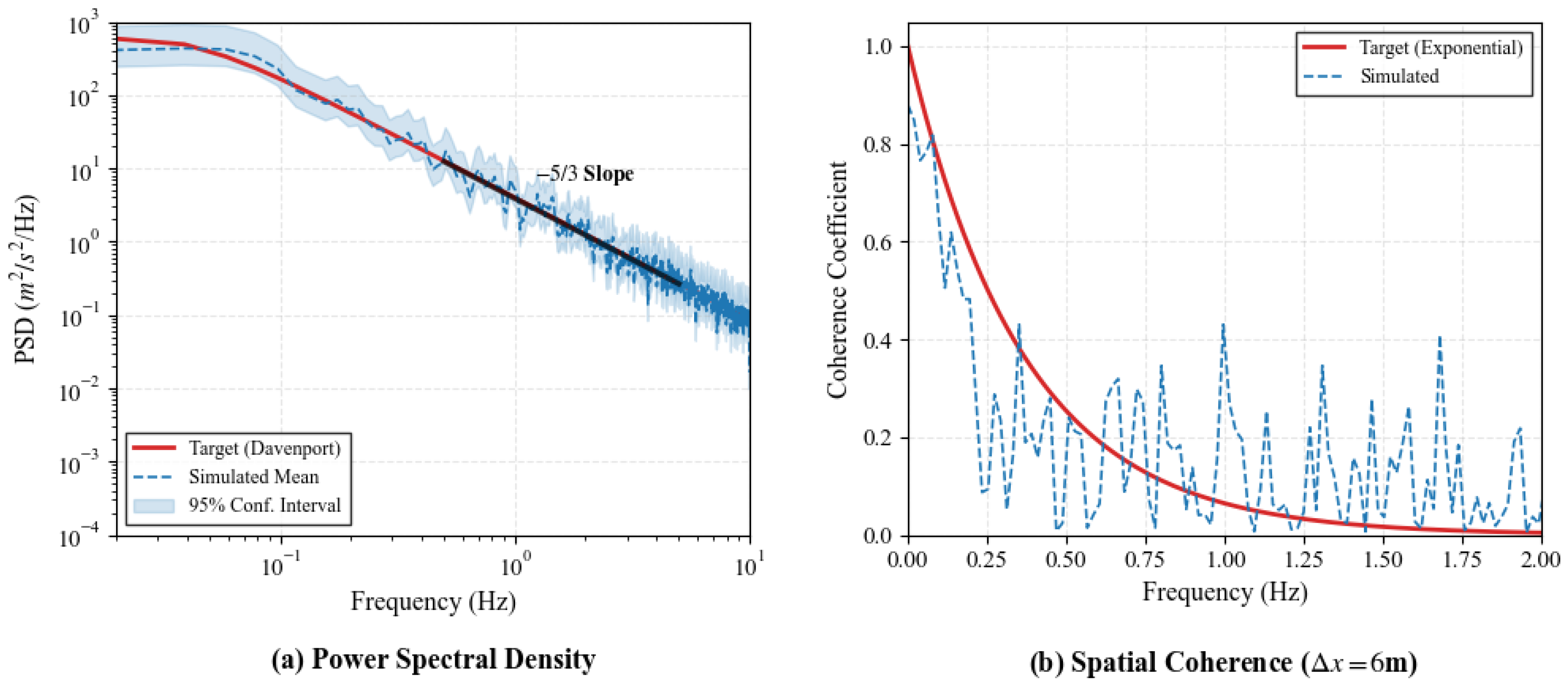
To further assess the quality of the simulated wind field, Figure 2 presents statistical verification results from the two complementary perspectives of frequency-domain energy distribution and spatial correlation.
Figure 2a presents the Power Spectral Density (PSD) analysis results of the fluctuating wind speed. The comparison shows that the simulated spectrum aligns closely with the target Davenport spectrum within the principal frequency band relevant to the distribution pole–line system, and the simulated results remain within the 95% confidence interval. In addition, in the high-frequency range, the simulated spectrum reproduces the characteristic 5 / 3 decay associated with turbulent energy cascade, indicating that the generated wind-speed history provides a physically reasonable frequency-domain representation.
Figure 2b further verifies the spatial coherence between adjacent pole nodes. The results indicate that the simulated coherence coefficient exhibits the expected oscillatory decay as the frequency increases, and its overall trend matches the target exponential decay curve well. These results indicate that the model reproduces both the single-point spectral characteristics and the spatial correlation structure of the wind field along the line corridor, thereby providing an adequate basis for the subsequent refined dynamic analysis.

3.3. Coupled Wind–Rain Dynamic Response Analysis of the Pole–Line System

Based on the constructed multi-point spatiotemporal coherent wind field and the combined wind–rain load model, a nonlinear transient dynamic simulation with a duration of 300 s was performed on the distribution pole–line system. The wind direction angle was set to 90 (perpendicular to the line direction). Under this condition, the projected windward area of the line is maximized, making it the most unfavorable loading orientation among the cases considered. To examine the robustness of this case selection, supplementary sensitivity analyses covering multiple wind directions and rainfall intensities were conducted, as presented in Section 3.3.1.

3.3.1. Sensitivity Analysis of Wind Direction and Rainfall Intensity

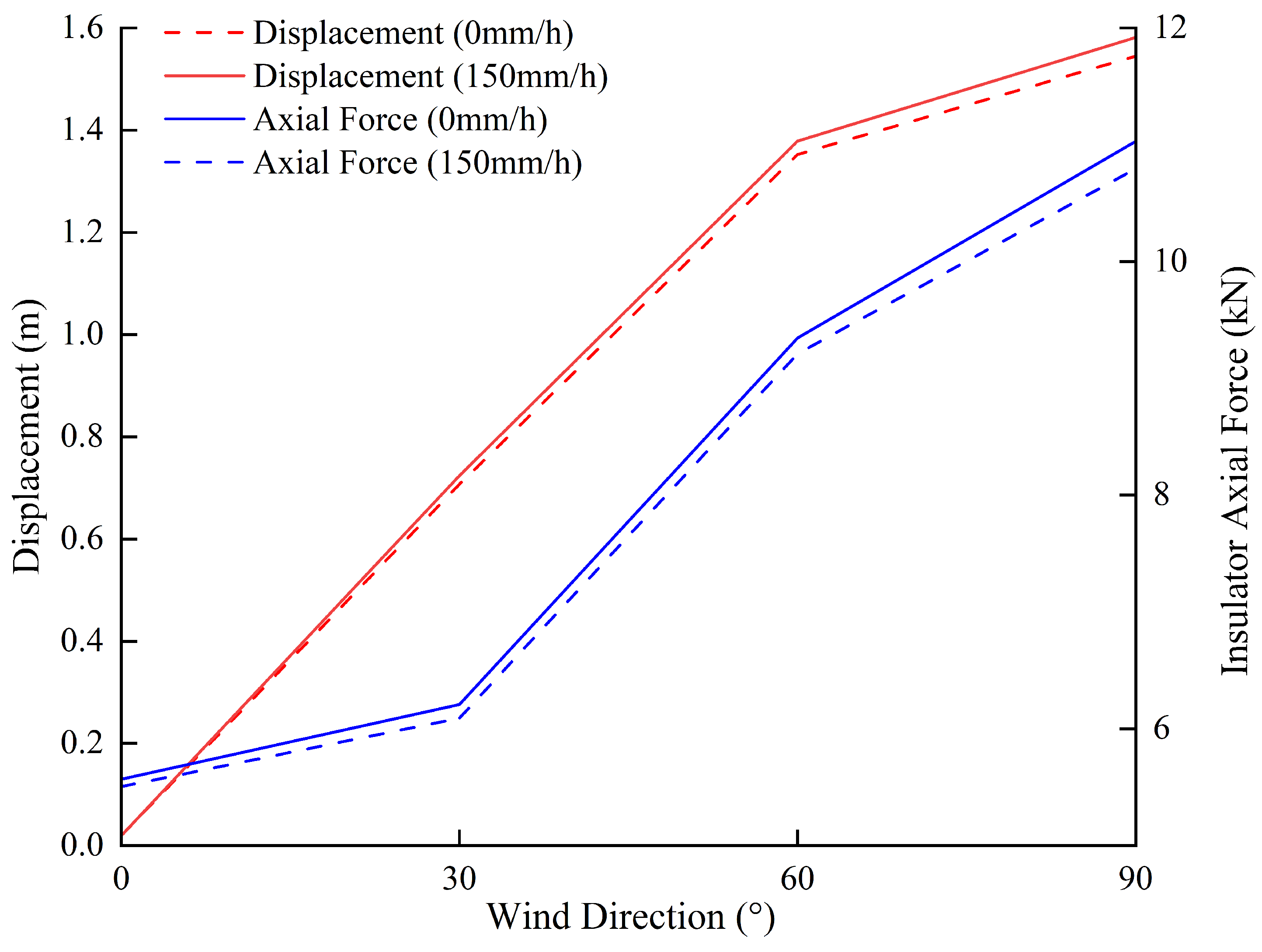
To verify that the selected 90 wind direction represents the most unfavorable loading orientation for the present model, additional simulations were performed for wind directions of 0 , 30 , 60 , and 90 under rainfall intensities of 0 and 150 mm/h. Figure 3 compares the peak mid-span displacement and insulator axial force extracted from these cases. Both response quantities increase monotonically with wind direction, and the largest values are consistently obtained at 90 under both dry and rainy conditions. For example, the peak conductor displacement increases from 1.54 m at 90 and 0 mm/h to 1.58 m at 90 and 150 mm/h, while the corresponding peak insulator axial force increases from 10.80 kN to 11.03 kN. The same critical orientation is also observed in the pole-related response indices, for which the maximum pole-base stress, R M x , and R M z at 90 and 150 mm/h reach 25.13 MPa, 20.26 kN·m, and 76.36 kN·m, respectively. These results confirm that the wind-normal attack angle governs the most adverse response state, and therefore the subsequent detailed mechanism analysis focuses on the representative case of 90 –150 mm/h.
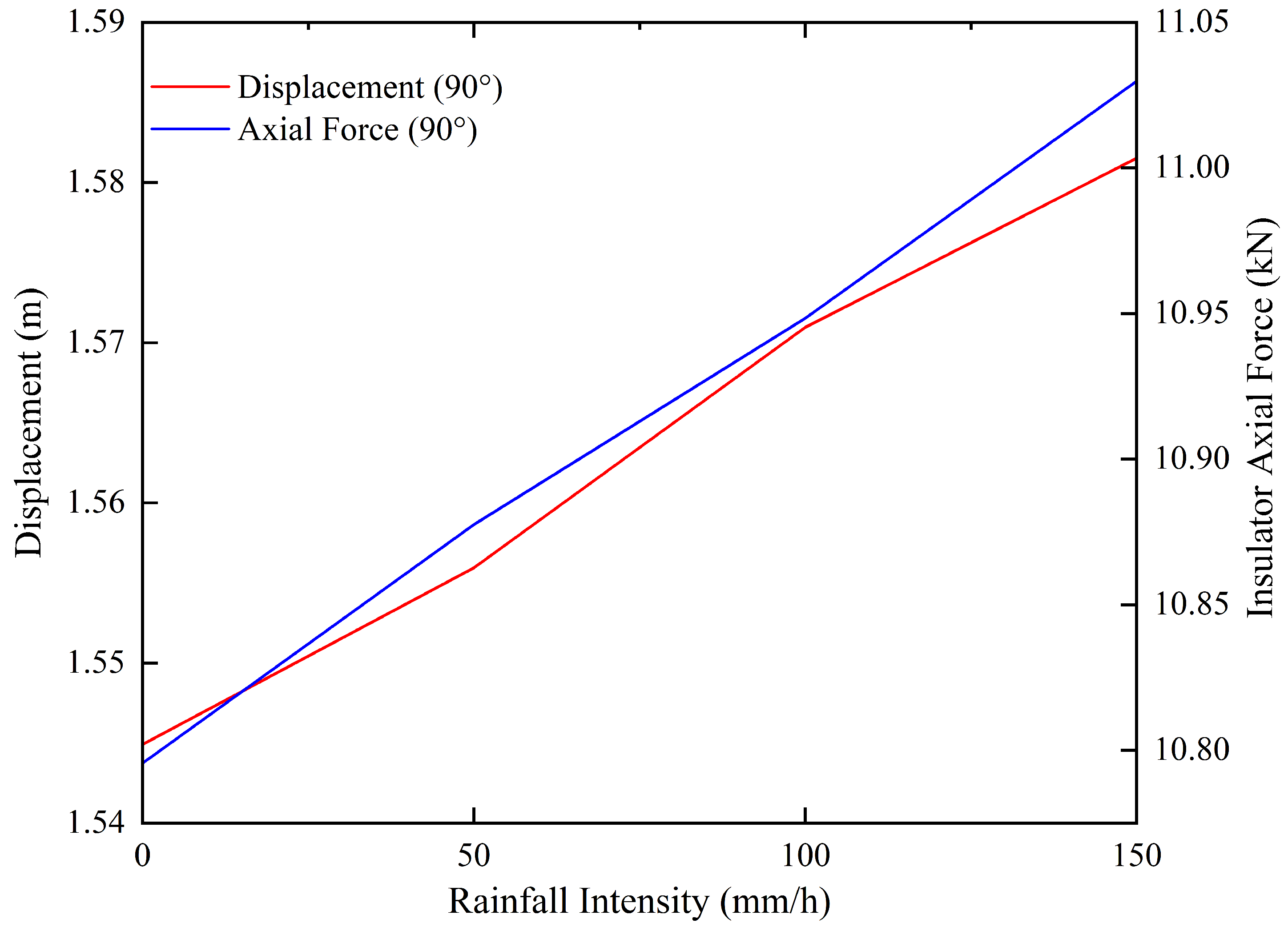
A complementary rainfall-intensity study was carried out at the critical wind direction of 90 by considering 0, 50, 100, and 150 mm/h. As shown in Figure 4, both the peak displacement and the peak insulator axial force increase steadily with rainfall intensity. From 0 to 150 mm/h, the peak displacement rises from 1.545 m to 1.582 m (+2.37%) and the peak axial force rises from 10.80 kN to 11.03 kN (+2.17%). The pole-related indices exhibit slightly stronger sensitivity: the peak pole-base stress increases from 23.98 MPa to 25.13 MPa (+4.81%), R M x increases from 19.23 to 20.26 kN·m (+5.35%), and R M z increases from 73.03 to 76.36 kN·m (+4.57%). This indicates that rainfall intensification does not change the critical wind direction, but it does further amplify the already adverse load transfer toward the pole base.

3.3.2. Time-Varying Response Characteristics of Multi-Physical Quantities at Key Nodes

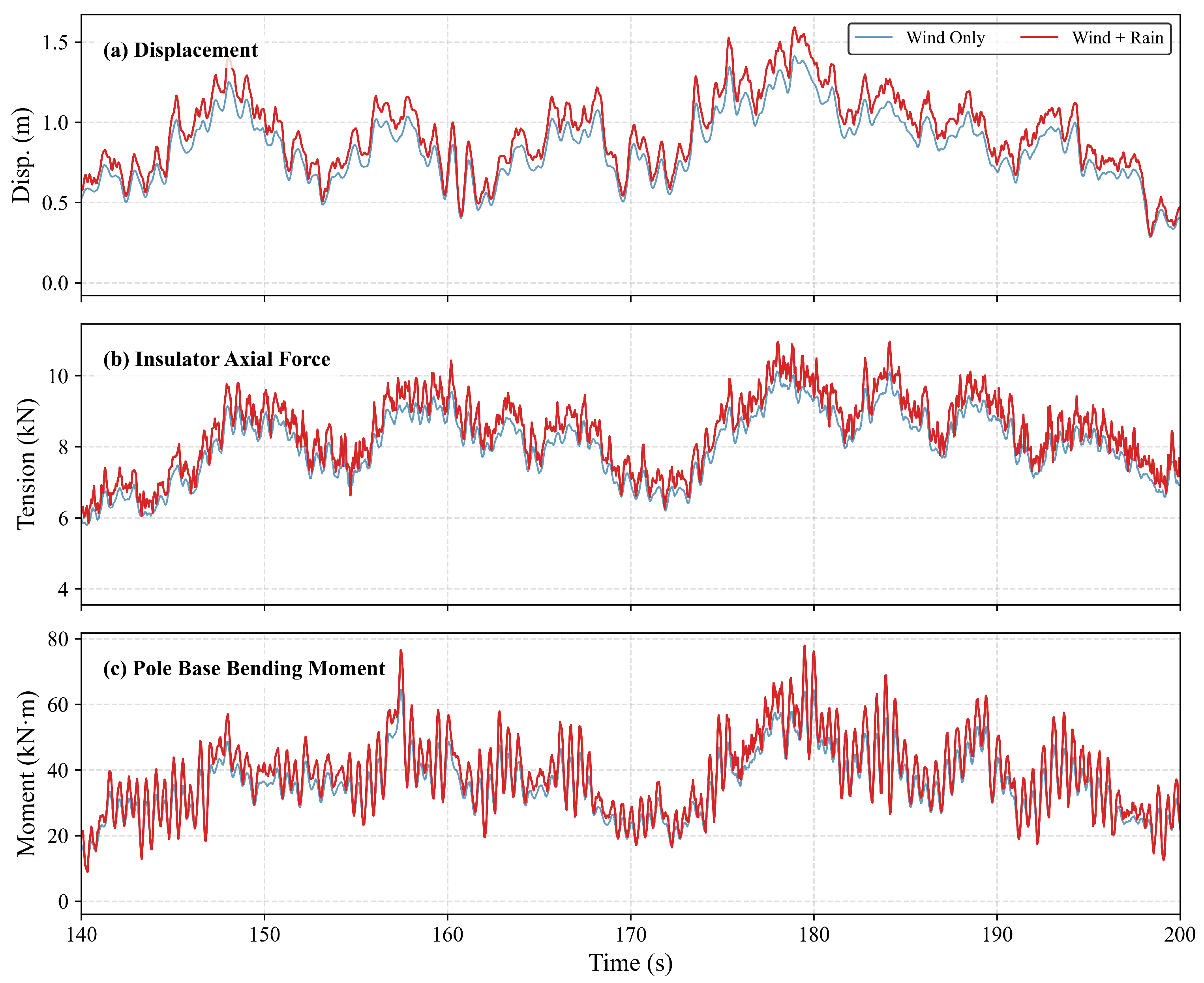
Figure 5 presents the time-history responses of the key physical quantities, from which the nonlinear excitation effect of wind–rain coupling can be identified.
During the 300 s typical typhoon period, under the influence of continuous raindrop impact, the peak mid-span displacement of the conductor increased from 1.41 m (pure wind condition) to 1.59 m, resulting in a response increment of 12.7%. This large-amplitude swing was nonlinearly transmitted through the insulator string, causing dual changes in static and dynamic axial tensile forces. Its time-history mean and instantaneous peak climbed from 7.49 kN and 10.42 kN to 7.88 kN and 11.11 kN, respectively, corresponding to a static drift of 5.3% and a dynamic increase of 6.6%.
The pole-base bending moment exhibits the strongest amplification, increasing from 64.55 kN·m to 77.85 kN·m, corresponding to a relative increase of 20.6%. This increase exceeds those of the conductor displacement (12.7%) and the insulator tension (6.6%), indicating that response amplification under coupled wind–rain loading is progressively enhanced along the conductor–insulator–pole load-transfer path.

3.3.3. Displacement–Moment Phase Plane Trajectory and Energy Dissipation Mechanism

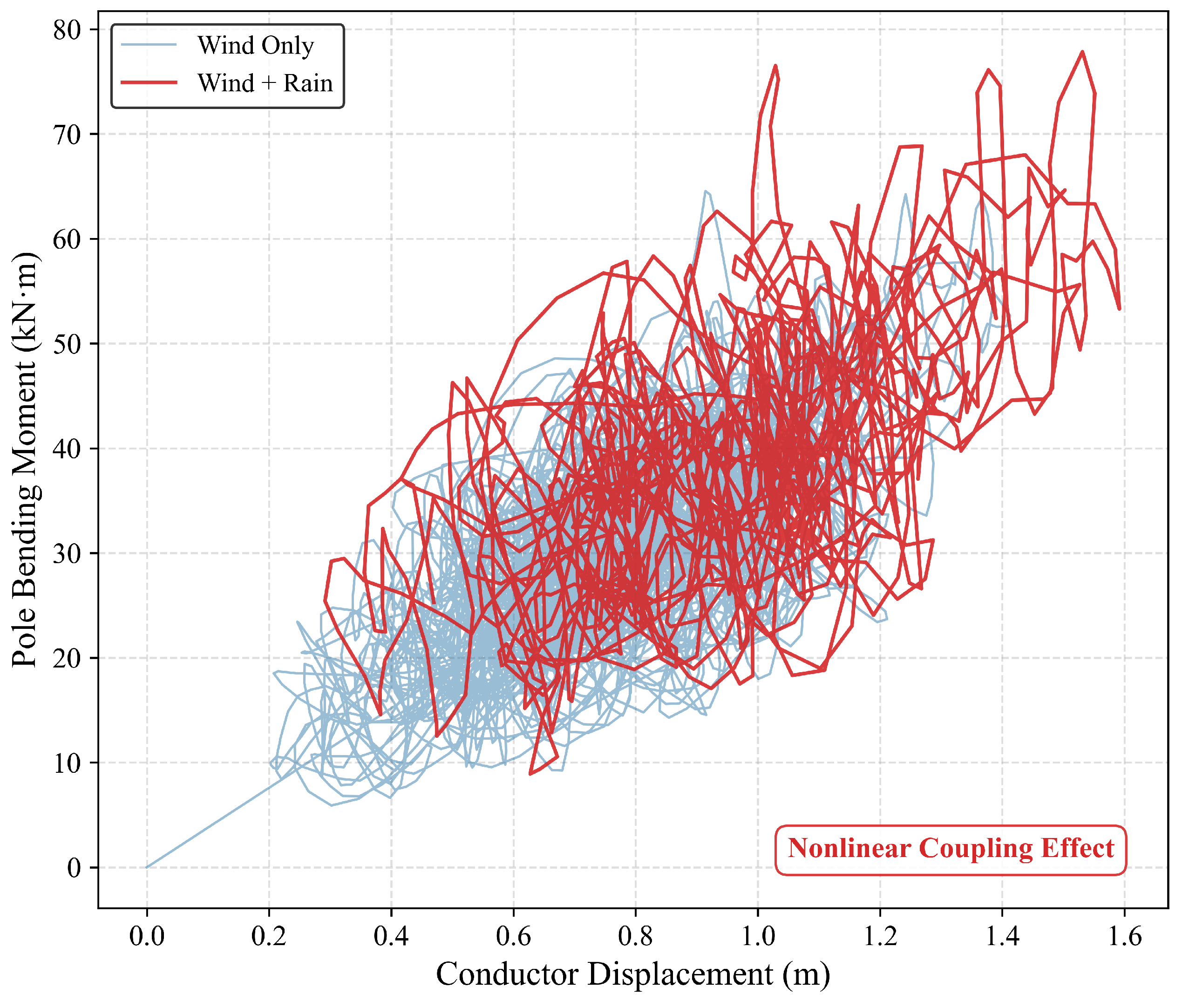
The phase plane trajectory in Figure 6 quantitatively reveals the nonlinear evolution path of the system. The data shows that under coupled wind–rain conditions, the phase trajectory boundaries expanded by 0.18 m along the displacement axis and 13.30 kN·m along the bending moment axis, respectively. The enclosed trajectory area increases markedly, indicating that the system undergoes larger-amplitude nonlinear oscillations under compound loading.
Furthermore, the standard deviation of the bending moment response rose from 9.20 kN·m to 11.06 kN·m, an increase of 20.2%. This indicates that wind–rain coupling significantly intensified the dispersion degree and fluctuation severity of the system response.

3.3.4. Numerical Robustness and Physical Plausibility Checks

It should be clarified that the following analyses are intended to provide multi-level support for the numerical robustness and physical plausibility of the proposed framework, rather than to claim full independent experimental or field validation. In the absence of dedicated benchmark measurements for the present distribution pole–line system under coupled typhoon–rain loading, the model support in this study is established from three complementary aspects: (i) numerical verification of the implemented procedure, (ii) physical plausibility checks on load magnitude and response trends, and (iii) external consistency evaluation against representative published studies.
Specifically, the support chain includes mesh-independence analysis for numerical verification, rain–wind load magnitude comparison for physical plausibility assessment, and qualitative comparison with representative published studies for external benchmarking.
Table 3 summarizes the mesh-independence results for the representative case of 90 –150 mm/h. The peak responses obtained with the normal and fine meshes are in close agreement for all monitored quantities. The maximum relative difference among the five indicators is 2.75%, indicating that the adopted mesh density provides stable predictions for the response quantities considered. Further refinement is therefore not expected to alter the main response trends or the associated failure-assessment conclusions in a material way.
To assess the physical significance of the implemented rain load, the wind-load outputs and rain-load outputs were compared at two representative locations within the conductor–insulator region, as summarized in Table 4. The results show that the mean rain load over the time history is approximately 6.6% of the corresponding wind load at these critical points, whereas the peak rain load reaches 16.68–18.41% of the peak wind load. These observations indicate that, although the rain load remains smaller than the aerodynamic load in terms of absolute magnitude, it is still non-negligible and can materially affect the coupled dynamic response through geometric nonlinearity and load-transfer amplification.
A qualitative comparison with representative published studies on rain–wind effects in overhead line systems is further provided in Table 5. Although these studies concern transmission lines rather than the present distribution pole–line system, both report amplified line motion under combined wind–rain loading and emphasize that rain effects should not be neglected. The consistency in overall response trend provides supporting evidence for the physical plausibility of the present model, while this comparison should be interpreted as qualitative rather than as a one-to-one numerical validation because of differences in structural scale, rainfall treatment, and response definition.

3.4. Refined Failure Assessment and Dynamic Vulnerability Characterization

Based on the constructed two-level failure criterion and the multi-dimensional assessment framework, this section quantitatively analyzes the failure behavior of the distribution pole–line system under typhoon–rainstorm compound disasters from three physical dimensions: static overload, time-varying survival window, and energy-transfer characteristics.

3.4.1. Static Overload Assessment Based on Damage Threshold

First, using the Static Overload Factor ( K O L ) and taking the damage threshold as the baseline, the damage state of each system component is statically identified. The results reveal pronounced differences in demand-to-capacity characteristics among the components:
For the conductor, even under the extreme condition of wind–rain coupling, its maximum dynamic tension remains far below the mechanical breaking threshold. The overload factor is only 0.23, indicating that the conductor body possesses a sufficient strength safety margin. Its primary risk is manifested as electrical flashover induced by large-amplitude galloping.
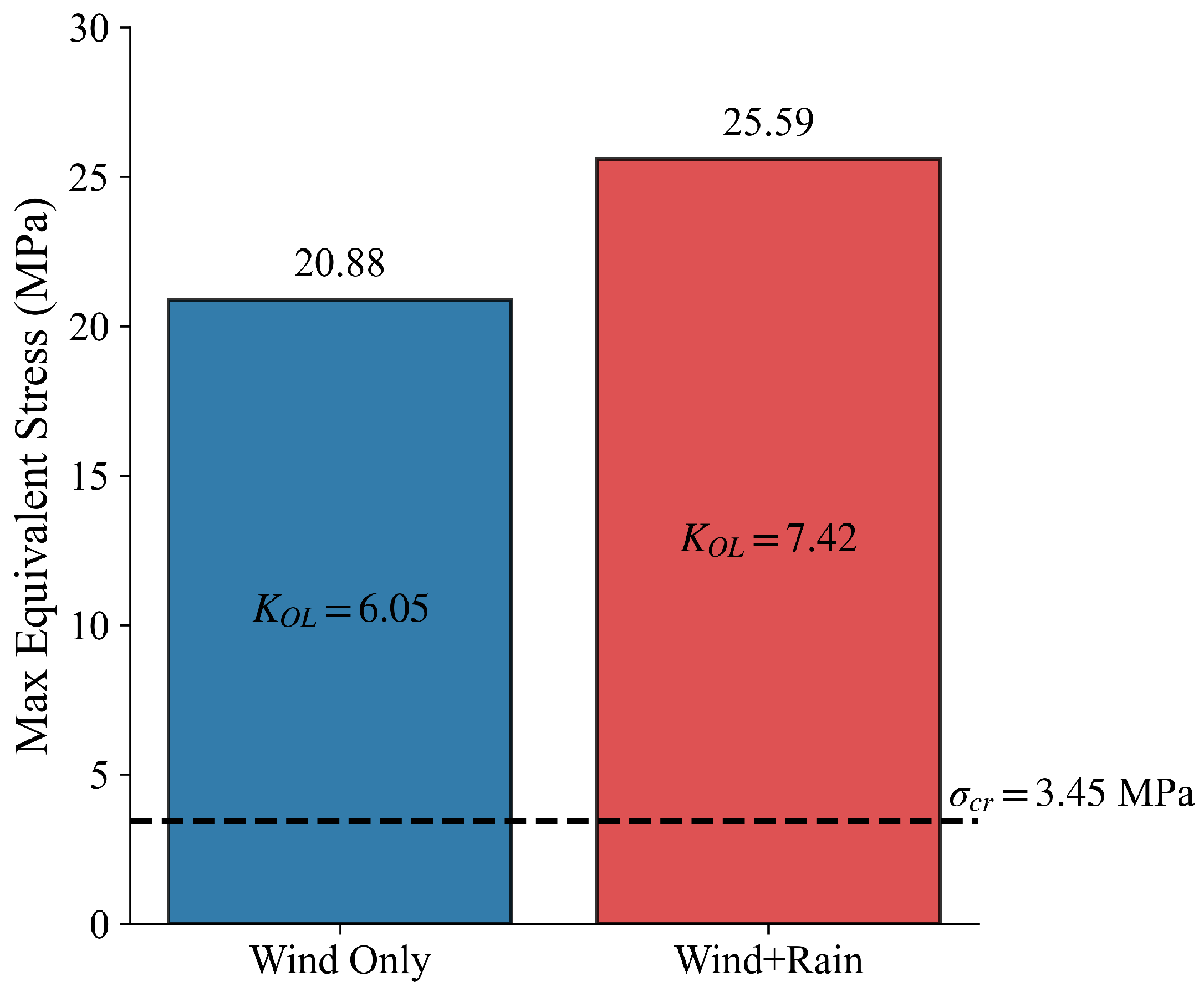
In sharp contrast, the concrete pole base exhibits a pronounced deficiency in capacity reserve. As shown in Figure 7, the overload factor at the pole base increases from 6.05 under wind-only loading to 7.42 under coupled wind–rain loading. According to the failure criterion defined above, this markedly elevated K O L indicates that the pole-base stress substantially exceeds the damage threshold. This suggests that the section has left the ideal linear-elastic range and entered a crack-dominated nonlinear damage state. Although collapse-level demand is not yet reached at this stage, the accumulated damage indicates a reduced reserve against subsequent deterioration.

3.4.2. Time-Varying Survival Window Analysis Based on Collapse Threshold

To further explore the evolution process of the structure from crack initiation to collapse-level demand, the collapse threshold is introduced to analyze the system’s time-varying survival window.
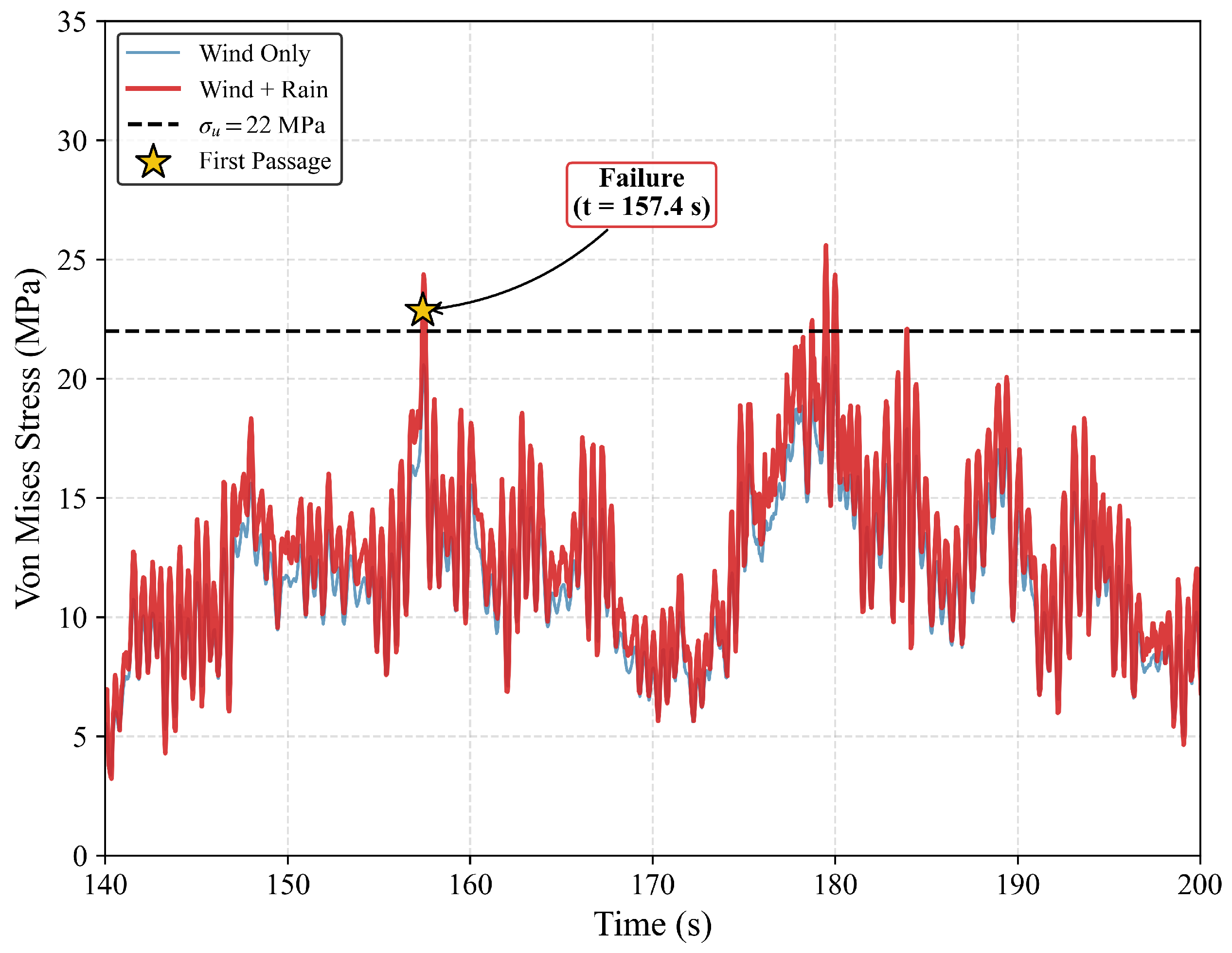
As shown in Figure 8, the stress histories under the two loading conditions differ not only in amplitude but also in their proximity to the collapse threshold. Under wind-only loading, the peak pole-base stress reaches 20.88 MPa during the 300 s simulation. This value exceeds the damage threshold but remains below the collapse threshold of 22 MPa, indicating that the section enters a cracked yet non-collapsed state within the analyzed duration.
Under coupled wind–rain loading, the pole-base stress first exceeds 22 MPa at t = 157.4 s, indicating the onset of collapse-level demand in the present threshold-based assessment. Relative to the wind-only case, wind–rain coupling therefore shortens the available survival window and advances the occurrence of severe pole-base overstress during the early stage of typhoon impact.

3.4.3. Frequency-Domain Energy Injection and Transmission Bottlenecks

To reveal the dynamic causes behind the aforementioned time-domain failure characteristics, the disaster-causing mechanism is further analyzed from the perspective of frequency-domain energy flow.
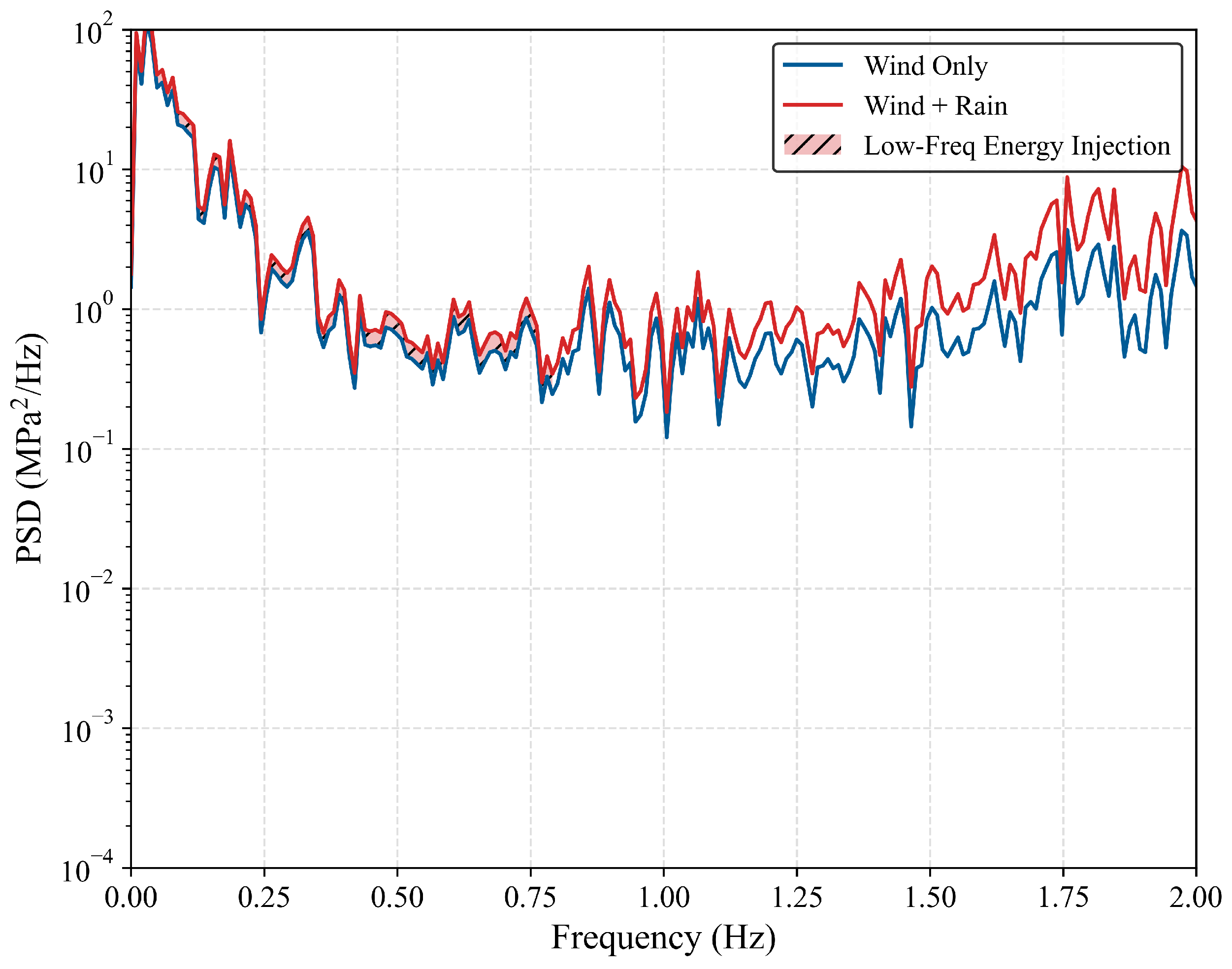
As shown in Figure 9, the stress spectrum under coupled wind–rain conditions exhibits a pronounced increase in spectral energy within the low-frequency band of 0.2 Hz to 0.8 Hz, which coincides with the main frequency range of conductor galloping. This suggests that rainfall not only modifies the aerodynamic environment but also contributes additional low-frequency excitation to the pole system by promoting large-amplitude conductor galloping.
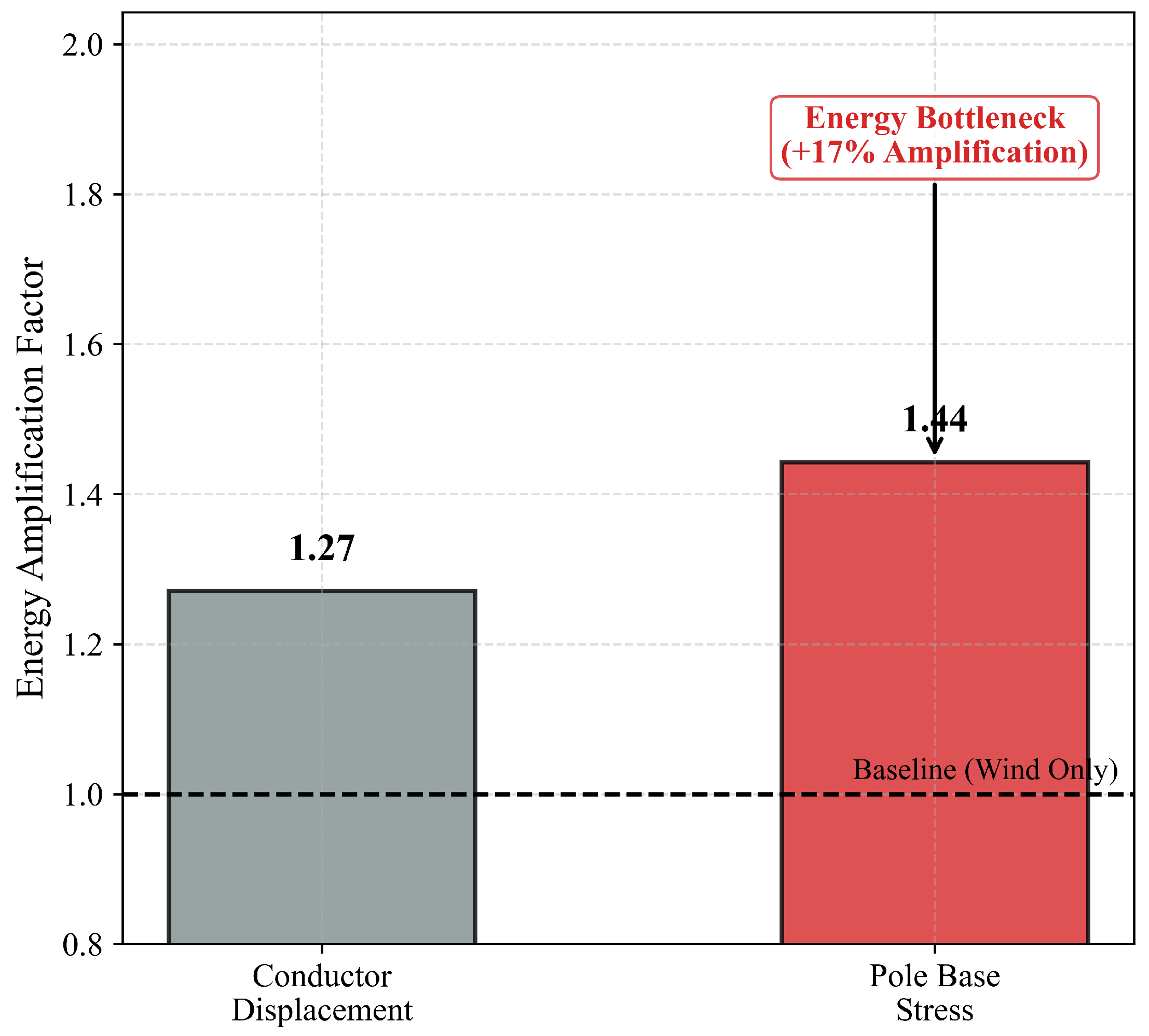
On this basis, this paper quantitatively evaluates the accumulation characteristics of disaster-causing energy within the system using the Energy Amplification Factor (EAF) metric. As shown in Figure 10, the EAF of the conductor mid-span displacement is 1.27, indicating that the additional momentum brought by raindrop impact increases the kinetic energy of the conductor system by approximately 27%. In contrast, the stress EAF at the pole base reaches 1.44, exceeding the displacement-based value at the conductor. This contrast between the response-input end and the structural-support end is consistent with an energy-transfer concentration mechanism within the system.
Further analysis of the frequency content and structural modes suggests that this energy accumulation is governed not by resonance of the pole itself, but by spectral separation and impedance mismatch between the flexible conductor and the comparatively rigid pole. Specifically, the rain-induced conductor galloping is concentrated in the low-frequency range of 0.2–0.8 Hz, well below the first natural frequency of the concrete pole. Under this condition, the pole responds primarily in a quasi-static forced-vibration manner. The pole therefore behaves effectively as a cantilever with a large lever arm, transforming the conductor-transmitted dynamic tension into pronounced bending-demand fluctuations at the base. Because the pole does not possess flexible modes capable of efficiently dissipating this low-frequency input, the response energy tends to accumulate near the geometrically constrained pole base. In the present model, this mechanism causes the pole base to emerge as the most critical vulnerability location within the conductor–insulator–pole load-transfer chain.

4. Discussion and Conclusions

This study established a refined nonlinear dynamic framework for evaluating the behavior of distribution pole–line systems under compound typhoon–rain loading. Based on the results presented in Section 3, including the sensitivity analyses, mesh-independence verification, order-of-magnitude comparison between rain and wind loads, and qualitative comparison with representative published studies, the main findings and their engineering implications are summarized as follows:
1.
Coupled-response amplification and failure-transfer mechanism: The results indicate that the wind–rain effect cannot be adequately represented by a simple linear superposition of aerodynamic and rain-induced loads. Under compound loading, the additional rain-induced excitation amplifies conductor motion and intensifies the dynamic force transmitted through the insulator to the supporting pole, thereby aggravating stress concentration at the pole base. The observed peak-response amplification, the increased dispersion in the response histories, and the EAF comparison consistently support this interpretation. In this sense, the “energy bottleneck” identified in the present study should be interpreted as a mechanism of response transfer and accumulation within the conductor–insulator–pole system, rather than as a direct surrogate for structural failure probability.
2.
Engineering implications of neglecting rain load: For the baseline case with a wind direction of 90 and a rainfall intensity of 150 mm/h, the pole-base overload factor increases from 6.05 under wind-only loading to 7.42 under compound loading, and the first failure time is identified at 157.4 s. Together with the supplementary wind-direction and rainfall-intensity analyses, these results indicate that neglecting rain impact may lead to a non-conservative underestimation of structural demand and an overestimation of the available safety margin. From an engineering perspective, post-landfall risk assessment should therefore place particular emphasis on early-stage pole-base overstress and the compression of the survival window, rather than focusing solely on conductor displacement or equivalent wind-pressure amplification.
3.
Differentiated mitigation strategies and scalable engineering application: The identified failure characteristics suggest that uniform reinforcement strategies may not represent the most efficient use of mitigation resources. On the conductor side, measures such as anti-galloping devices or supplemental damping systems may be selectively considered in spans exposed to unfavorable wind directions, elevated clearance risk, or historically high outage vulnerability. On the pole side, strengthening efforts should focus on the pole base and the pole–foundation connection, where bending demand is concentrated. Meanwhile, the present high-fidelity nonlinear framework remains computationally demanding for feeder-scale application. A practical implementation strategy is therefore to use the model as an offline calibration tool for deriving simplified screening indicators, such as critical wind directions, rainfall-intensity amplification factors, and pole-base demand envelopes, while reserving detailed nonlinear simulations for representative or high-risk sections.
4.
Limitations, applicability, and future work: Several limitations should be noted. First, the pole base was modeled as fixed in order to isolate the superstructure response within the selected critical time window. Although this assumption is acceptable for a first-order assessment of above-ground load transfer, it may overconstrain foundation rotation under extreme rainfall conditions. If soil–structure interaction and rainfall-induced soil softening are considered, part of the response energy may be redistributed into foundation deformation, which could in turn alter the EAF level, the stress concentration pattern, and even the identification of the weakest link. Second, the rain-load model adopts a continuous momentum-transfer representation of raindrop impact for engineering-scale dynamic analysis; the influence of discrete stochastic impacts and parameter uncertainty still requires further investigation. Third, although the present study incorporates sensitivity analyses, mesh-independence verification, load-magnitude comparison, and literature-based qualitative comparison, additional field observations or laboratory benchmarks are still required before the present framework can be generalized into broader design recommendations.
Overall, the present study shows that explicitly incorporating rain impact into nonlinear time-history analysis modifies not only the response amplitude of the distribution pole–line system, but also the inferred failure-transfer path and the engineering prioritization of mitigation measures. These findings provide a physically interpretable basis for identifying vulnerable components and for improving resilience-oriented assessment of distribution networks exposed to compound typhoon hazards.

Author Contributions

Conceptualization, B.C. and Y.G.; methodology, B.C. and H.C.; software, B.C. and L.Q.; validation, B.C. and N.Z.; formal analysis, B.C. and X.Z.; writing—original draft preparation, B.C. and J.Z.; writing—review and editing, Y.G.; supervision, Y.G.; funding acquisition, B.C. All authors have read and agreed to the published version of the manuscript.

Funding

This research was funded by the State Grid Corporation of China, grant number B3130N25Z003.

Data Availability Statement

Data is contained within the article.

Conflicts of Interest

Authors Bin Chen, Hao Chen and Naixuan Zhu were employed by the company State Grid Fujian Electric Power Co., Ltd. The remaining authors declare that the research was conducted in the absence of any commercial or financial relationships that could be construed as a potential conflict of interest.

Abbreviations

The following abbreviations are used in this manuscript:
APDLANSYS Parametric Design Language
PDFProbability Density Function
PSDPower Spectral Density
EAFEnergy Amplification Factor
SSISoil–Structure Interaction

References

  1. Seneviratne, S.I.; Zhang, X.; Adnan, M.; Badi, W.; Dereczynski, C.; Di Luca, A.; Ghosh, S.; Iskandar, I.; Kossin, J.; Lewis, S.; et al. Weather and Climate Extreme Events in a Changing Climate. In Climate Change 2021: The Physical Science Basis; Masson-Delmotte, V., Zhai, P., Pirani, A., Connors, S.L., Péan, C., Berger, S., Caud, N., Chen, Y., Goldfarb, L., Gomis, M.I., et al., Eds.; Cambridge University Press: Cambridge, UK, 2021; pp. 1513–1766. [Google Scholar]
  2. Chen, D.; Cai, Z.; Wu, H.; Guo, C. Review of distribution network’s resilience based on typhoon disaster. Energy Rep. 2022, 8, 876–888. [Google Scholar] [CrossRef]
  3. Hou, H.; Zhang, Z.; Wei, R.; Huang, Y.; Liang, Y.; Li, X. Review of failure risk and outage prediction in power system under wind hazards. Electr. Power Syst. Res. 2022, 210, 108098. [Google Scholar] [CrossRef]
  4. Arora, P.; Ceferino, L. Probabilistic and machine learning methods for uncertainty quantification in power outage prediction due to extreme events. Nat. Hazards Earth Syst. Sci. 2023, 23, 1665–1683. [Google Scholar] [CrossRef]
  5. Bjarnadottir, S.; Li, Y.; Stewart, M.G. Hurricane risk assessment of power distribution poles considering impacts of a changing climate. J. Infrastruct. Syst. 2013, 19, 12–24. [Google Scholar] [CrossRef]
  6. Teoh, Y.E.; Alipour, A.; Cancelli, A. Probabilistic performance assessment of power distribution infrastructure under wind events. Eng. Struct. 2019, 197, 109199. [Google Scholar] [CrossRef]
  7. Lee, S.; Ham, Y. Probabilistic framework for assessing the vulnerability of power distribution infrastructures under extreme wind conditions. Sustain. Cities Soc. 2021, 65, 102587. [Google Scholar] [CrossRef]
  8. Lu, Q.; Zhang, W. Integrating dynamic Bayesian network and physics-based modeling for risk analysis of a time-dependent power distribution system during hurricanes. Reliab. Eng. Syst. Saf. 2022, 220, 108290. [Google Scholar] [CrossRef]
  9. Zhou, C.; Liu, Y.; Ma, Z. Investigation on aerodynamic instability of high-voltage transmission lines under rain-wind condition. J. Mech. Sci. Technol. 2015, 29, 131–139. [Google Scholar] [CrossRef]
  10. Zhou, C.; Yin, J.; Liu, Y. Large Swing Behavior of Overhead Transmission Lines under Rain-Load Conditions. Energies 2018, 11, 1092. [Google Scholar] [CrossRef]
  11. Zhou, C.; Yin, J.; Liu, Y. Effects of wind and rain on the motion of the high-voltage conductor in a simplified valley terrain. Electr. Power Syst. Res. 2019, 173, 153–163. [Google Scholar] [CrossRef]
  12. Sun, J.; Huang, M.; Liao, S.; Lou, W. Precipitation Simulation and Dynamic Response of a Transmission Line Subject to Wind-Driven Rain during Super Typhoon Lekima. Appl. Sci. 2024, 14, 4818. [Google Scholar] [CrossRef]
  13. Batts, M.E.; Cordes, M.R.; Russell, L.R.; Shaver, J.R.; Simiu, E. Hurricane Wind Speeds in the United States; NBS Building Science Series 124; National Bureau of Standards: Washington, DC, USA, 1980. [Google Scholar]
  14. Engineering Sciences Data Unit (ESDU). ESDU 85020: Characteristics of Atmospheric Turbulence Near the Ground. Part II: Single Point Data for Strong Winds (Neutral Atmosphere); ESDU: London, UK, 2001. [Google Scholar]
  15. Davenport, A.G. The spectrum of horizontal gustiness near the ground in high winds. Q. J. R. Meteorol. Soc. 1961, 87, 194–211. [Google Scholar] [CrossRef]
  16. Marshall, J.S.; Palmer, W.M.K. The Distribution of Raindrops with Size. J. Atmos. Sci. 1948, 5, 165–166. [Google Scholar] [CrossRef]
  17. Fu, X.; Li, H.N.; Yi, T.H. Research on motion of wind-driven rain and rain load acting on transmission tower. J. Wind Eng. Ind. Aerodyn. 2015, 139, 27–36. [Google Scholar] [CrossRef]
  18. Testik, F.Y.; Bolek, A. Wind and Turbulence Effects on Raindrop Fall Speed. J. Atmos. Sci. 2023, 80, 1065–1086. [Google Scholar] [CrossRef]
Figure 1. Simulation of macro-scale wind speed evolution and micro-scale fluctuating wind speed time history during typhoon passage. (a) Macro-scale typhoon mean wind speed evolution process. (b) Instantaneous total wind speed time history at the extreme moment.
Electronics 15 01314 g001
Figure 2. Statistical verification of simulated fluctuating wind field. (a) Consistency test of Power Spectral Density. (b) Verification of spatial coherence function.
Electronics 15 01314 g002
Figure 3. Wind-direction sensitivity analysis of peak conductor displacement and insulator axial force under rainfall intensities of 0 and 150 mm/h.
Electronics 15 01314 g003
Figure 4. Supplementary rainfall-intensity sensitivity analysis of peak conductor displacement and insulator axial force at a wind direction of 90 .
Electronics 15 01314 g004
Figure 5. Dashboard of multi-physical dynamic responses at key nodes of the distribution pole–line system during a typical typhoon period. (a) Mid-span displacement of the conductor. (b) Force at the insulator root. (c) Bending moment at the pole base.
Electronics 15 01314 g005
Figure 6. Phase plane trajectory of conductor displacement vs. pole bending moment and nonlinear coupling characteristics.
Electronics 15 01314 g006
Figure 7. Comparison of maximum equivalent stress and overload factor at the pole base under different conditions.
Electronics 15 01314 g007
Figure 8. Stress time history at key nodes of the pole and failure determination under wind–rain loads.
Electronics 15 01314 g008
Figure 9. Frequency-domain characteristic analysis of structural stress response under wind–rain excitation.
Electronics 15 01314 g009
Figure 10. Comparativeanalysis of energy amplification factors for displacement and stress responses.
Electronics 15 01314 g010
Table 1. Structured comparison between representative existing studies and the present work.
StudyTarget SystemHazard TreatmentMain Limitation/Relevance
Distribution-network studies [5,6,7,8]Distribution poles/
infrastructures
Extreme wind/hurricane loadingFragility and outage studies under wind-dominated hazards; no explicit wind–rain coupling.
Zhou et al. [9]Transmission conductorRain–wind aerodynamic instabilityConductor aerodynamics only; no distribution pole–line failure analysis.
Zhou et al. [10]Overhead transmission lineRain-load-induced swing responseSwing amplification identified, but pole-base failure is not considered.
Sun et al. [12]Transmission line systemTyphoon wind-driven rainLarger displacement/support reaction reported, but for a different structural system.
This studyDistribution pole–line systemCompound typhoon–rain loadingIntegrated response-transfer and pole-base failure-mechanism assessment with threshold-based criteria.
Table 2. Key simulation parameters of the distribution pole–line system.
ComponentParameter NameValue/Specification
PoleType12 m tapered reinforced concrete pole;
C50 concrete
DimensionsHeight 12 m; Tip diameter 250 mm;
Root diameter 350 mm; Wall thickness 50 mm
Material PropertiesElastic modulus 34.5 GPa;
Poisson’s ratio 0.2; Density 2500 kg/m3
ConductorModelJL/G1A-150/20
Geometric PropertiesCross-sectional area 164 mm2;
Outer diameter 16.6 mm
Physical PropertiesMass per unit length 0.549 kg/m;
Elastic modulus 70.5 GPa
Initial Tension8000 N
Cross-armSpecificationL75 × 8 Angle steel
PropertiesLength 1.8 m;
Elastic modulus 206 GPa;
Density 7850 kg/m3
InsulatorTypePin insulator
Note: The adopted pole–line configuration is intended to represent a typical 10 kV coastal distribution line in southeastern China. The pole type, conductor model, and line-layout assumptions were selected with reference to GB/T 4623-2014, GB/T 1179-2017, and DL/T 5220-2021, while the material properties were taken from commonly used engineering values for structural analysis.
Table 3. Mesh-independence verification for the representative case of 90 –150 mm/h.
IndicatorNormal Mesh PeakFine Mesh PeakRelative Difference (%)
Conductor displacement (m)1.58151.59510.86
Insulator axial force (kN)11.029811.12810.89
Pole-base R M x (kN·m)20.257920.70142.19
Pole-base R M z (kN·m)76.359878.46052.75
Pole-base stress (MPa)25.132324.90710.90
Table 4. Order-of-magnitude comparison between wind load and rain load at representative locations.
Location F ¯ wind (N) F ¯ rain (N) F ¯ rain / F ¯ wind (%) F wind max (N) F rain max (N) F rain max / F wind max (%)
Conductor–insulator connection35.362.336.5960.3710.0716.68
Mid-span conductor35.402.346.6163.4211.6718.41
Table 5. Qualitative comparison with representative published studies.
ReferenceSystem/MethodReported ObservationConsistency with the Present Study
Zhou et al. [10]Overhead transmission line; finite element model including rainfall rate and rain loadPeak swing amplitude under rain–wind conditions is larger than that under wind only; rain loads cannot be neglectedThe present rainfall-intensity study shows monotonic increases in displacement, insulator axial force, pole-base moment, and pole-base stress, which is consistent with the reported amplification trend
Sun et al. [12]Full-scale transmission line; WRF–CFD–FEM wind-driven-rain frameworkHorizontal displacement under coupled wind and rain is approximately 17–18% larger than that under wind onlyThe present model also predicts a non-negligible amplification of conductor motion under coupled loading and further indicates that this amplified response is transferred to the pole base, thereby intensifying structural demand
Disclaimer/Publisher’s Note: The statements, opinions and data contained in all publications are solely those of the individual author(s) and contributor(s) and not of MDPI and/or the editor(s). MDPI and/or the editor(s) disclaim responsibility for any injury to people or property resulting from any ideas, methods, instructions or products referred to in the content.