Article

Coordinated Optimization of Distribution Networks and Smart Buildings Based on Anderson-Accelerated ADMM

1
College of Electrical Engineering, Zhejiang University, Hangzhou 310027, China
2
Guangzhou Power Supply Bureau, Guangdong Power Grid Co., Ltd., Guangzhou 510620, China
*
Author to whom correspondence should be addressed.
Electronics 2026, 15(6), 1313; https://doi.org/10.3390/electronics15061313
Submission received: 12 February 2026 / Revised: 15 March 2026 / Accepted: 19 March 2026 / Published: 20 March 2026
(This article belongs to the Special Issue Renewable Energy Integration and Energy Management in Smart Grid)

Abstract

With the widespread integration of smart buildings equipped with distributed photovoltaics (PV) and electric vehicles (EVs), distribution networks face significant challenges arising from source-load fluctuations. Conventional centralized dispatch approaches are constrained by communication bottlenecks and data privacy requirements. These limitations make it difficult to achieve global coordination while preserving the autonomy of individual entities. This paper proposes a hierarchical coordination framework for the coordinated operation of distribution networks and smart buildings. The distribution management system (DMS) and building energy management systems (BEMSs) perform independent optimization within their respective domains. Only aggregated boundary power information is exchanged to protect data privacy, enabling cross-entity coordination under information boundary constraints. Building-side models incorporating thermal dynamics, EV charging and discharging, and PV generation are developed, along with a distribution network power flow model. To solve the coordinated optimization problem, an Anderson-accelerated alternating direction method of multipliers (AA-ADMM) is introduced. A safeguarding mechanism based on combined residuals is incorporated to enhance convergence efficiency and stability. Case studies on the IEEE 33-bus test system demonstrate that compared with the uncoordinated baseline, the proposed method reduces network loss by 12.1% and lowers PV curtailment from 9.20% to 0.52%, while improving voltage profiles without significantly compromising occupant comfort or EV travel requirements. In addition, AA-ADMM achieves convergence with up to 66% fewer iterations than standard ADMM.

1. Introduction

The rapid advancement of dual carbon goals and building electrification has driven the widespread adoption of distributed photovoltaics (PV), electric vehicles (EVs), and energy storage systems (ESSs) in the building sector. This trend transforms buildings from traditional energy consumption terminals into integrated energy units capable of coordinated generation-consumption and flexible regulation, thereby strengthening the coupling and interaction between buildings and distribution networks [1,2]. Buildings account for approximately 30% of global energy consumption [3]. Although often regarded as inflexible loads, buildings inherently possess significant thermal inertia and energy storage characteristics [4]. Converting buildings from passive consumers to active grid resources through appropriate regulation, without compromising occupant comfort, has become a critical pathway for alleviating grid balancing pressure [5]. Therefore, developing a coordinated optimization framework for distribution networks and smart buildings, along with efficient solution methods, is of significant importance.
As integrated energy carriers, buildings typically incorporate multiple distributed resources such as air conditioning (AC) systems, PV, ESS, and EVs. Their flexibility manifests both in load shifting or curtailment and in the coupled complementarity among diverse resources [6]. To characterize such flexibility, Ref. [7] abstracts building loads into shiftable, curtailable, and interruptible categories for demand response optimization. While this modeling approach facilitates unified representation and rapid computation, it struggles to capture the physical constraints and heterogeneity of different devices. Thermal dynamic modeling of AC systems is commonly based on resistance–capacitance (RC) network models, which have been further developed into grey-box state-space models via parameter identification [8] and machine learning black-box models using operational measurement data [9]. In comparison, RC models achieve a balance between modeling fidelity and computational tractability for optimization [10,11]. For instance, Ref. [12] employs a standardized 5R1C thermal network to approximate heating demand within a rolling optimization framework for building energy systems, and validates the model and optimization results using high-fidelity building simulation tools such as IDA ICE; quantitatively, the Jensen–Shannon divergence between the 5R1C-based results and IDA ICE remains low, with 0.001–0.004 for indoor temperature and 0.047–0.291 for heating demand, indicating acceptable accuracy alongside computational feasibility.
The integration of EVs introduces additional complexity to building energy management, requiring the optimization of charging schedules subject to vehicle arrival and departure windows, departure state-of-charge requirements, and charging power constraints. Ref. [13] develops a charging scheduling model combined with time-of-use pricing for office building scenarios, demonstrating reduced charging costs compared to first-come–first-served strategies, achieving 6.07–35.83% savings under representative daylighting control scenarios. Building upon this, Ref. [14] proposes a two-layer model predictive control (MPC) framework that incorporates vehicle arrival and departure uncertainty, renewable generation, and electricity price forecast errors into rolling optimization, thereby reducing overall operating costs by up to 30% and enhancing adaptability to uncertainties while satisfying departure energy requirements.
Meanwhile, building-side ESS scheduling for peak shaving and economic objectives has also received extensive attention [15,16], and has been progressively integrated with prediction–optimization frameworks to improve demand charge management and electricity cost savings under load and PV uncertainties [17,18]. The aforementioned studies, starting from key components such as AC, EVs, and ESS, model device-level physical constraints and uncertainty factors, thereby enhancing the feasibility and interpretability of building energy management strategies. However, these building optimization approaches typically focus on a single building type, lacking characterization of load patterns and operational schedule differences across heterogeneous building types.
With the large-scale integration of building flexible resources, research has shifted from treating buildings as exogenous loads toward the coupled modeling and coordinated scheduling of building-distribution network integration, aiming to simultaneously satisfy building-side comfort and economic objectives along with grid-side operational security constraints. Existing integrated studies predominantly adopt centralized joint optimization approaches. Ref. [19] proposes a Buildings-to-Grid (BtG) integration framework that unifies building thermal dynamics and power flow constraints, solving at a central level to obtain globally optimal solutions, achieving a total system cost reduction of up to 43% compared to a decoupled design. Building upon this, Ref. [20] further develops the Buildings-to-Distribution-Network (B2DN) paradigm, which uniformly models heterogeneous building flexible loads, distributed PV, and distribution network voltage constraints, with solutions also relying on centralized information aggregation and coordinated computation. It achieves about a 63.1% average loss reduction and a 0.02 p.u. increase in the minimum nodal voltage in the 13-bus case.
However, as the number of buildings increases and building types diversify, centralized paradigms often encounter communication and privacy constraints as well as computational bottlenecks for large-scale problem solving. This has motivated a limited body of work to explore distributed coordination approaches. Distributed coordination is typically achieved through the alternating direction method of multipliers (ADMM), which enables alternating coordination between the grid side and building side. Ref. [21] formulates the scheduling of active distribution networks with aggregated office buildings as a decomposable problem, employing ADMM for iterative coordination between grid and building subsystems to achieve system-wide optimization while preserving local information privacy, reducing network losses by about 3.96% and external grid purchases by about 6.5% in the reported case studies.
Although ADMM has been enhanced through variants such as adaptive penalty parameters [22] and proximal and semi-proximal ADMM with proximal terms [23], it fundamentally remains a fixed-point iteration process. Its convergence rate is often sensitive to penalty parameter selection and problem scaling, and in scenarios with strong coupling between distribution network operational constraints and heterogeneous building models, slow residual reduction and parameter tuning difficulties are commonly observed. To address this, we introduce the Anderson acceleration technique, which leverages multi-step historical iteration information to construct extrapolated updates, thereby enhancing the convergence efficiency of ADMM.
In summary, with the large-scale integration of heterogeneous building types, existing methods still have room for improvement in establishing privacy-preserving hierarchical coordination mechanisms and enhancing the convergence robustness and acceleration capability of distributed algorithms. This paper investigates the coordinated operation of distribution networks and smart buildings. The main contributions are as follows:
  • A hierarchical coordination framework between the distribution management system (DMSs) and building energy management systems (BEMSs) is proposed. The grid side and building side perform independent modeling and local decision making, exchanging only aggregated signals such as boundary power for coupled coordination. This avoids transmitting sensitive data such as internal building loads and occupant behavior, achieving privacy protection at the architectural level and enhancing the practical deployability of cross-entity coordination.
  • A day-ahead coordinated optimization model is established under the proposed framework. The model captures building thermal dynamics, EV travel patterns and charging and discharging behavior, rooftop PV generation, as well as distribution network power flow and operational security constraints. For scenarios involving multiple building types, the differences in load profiles and operational characteristics between office and commercial buildings are distinguished. The results verify that the model can implement differentiated regulation according to different load peak-valley characteristics, effectively smoothing system net load fluctuations. Under the premise of ensuring occupant comfort, coordinated improvements in network loss reduction, voltage profile enhancement, and efficient PV utilization are achieved.
  • At the distributed solution level, the Anderson-accelerated ADMM (AA-ADMM) is applied to solve the coordinated optimization problem. A safeguarding mechanism based on combined residuals is adopted to suppress unstable extrapolation and ensure iteration robustness. The convergence properties are theoretically explained and discussed from a fixed-point perspective, demonstrating the effectiveness of AA-ADMM in this application scenario.
The remainder of this paper is organized as follows. Section 2 introduces the hierarchical coordination framework for distribution networks and smart buildings. Section 3 presents the coordinated optimization model, including smart building models and distribution network power flow constraints. Section 4 develops the AA-ADMM algorithm and discusses its convergence properties. Section 5 provides case studies and result analysis. Section 6 concludes the paper.

2. Coordinated Optimization Framework for Distribution Networks and Smart Buildings

In current operational systems, the distribution network side and building side inherently constitute two independent management systems. The distribution network side is managed by the distribution management system (DMS), which is responsible for scheduling upstream power sources, distributed generation output, and distribution network operating modes, with decision variables primarily including various generation outputs. The building side is independently managed by building energy management systems (BEMS), which control AC systems, EV charging stations, and conventional electrical loads, with specific control over AC power, charging and discharging power, and the operational status of shiftable loads. These two management systems typically belong to different entities, and their data are not fully shared. Interaction occurs only through limited yet essential information such as power schedules, boundary conditions, or price or incentive signals. Therefore, in practical engineering applications, distribution networks and buildings perform fine-grained modeling and optimization within their respective systems, rather than being centrally modeled and controlled on a unified platform.
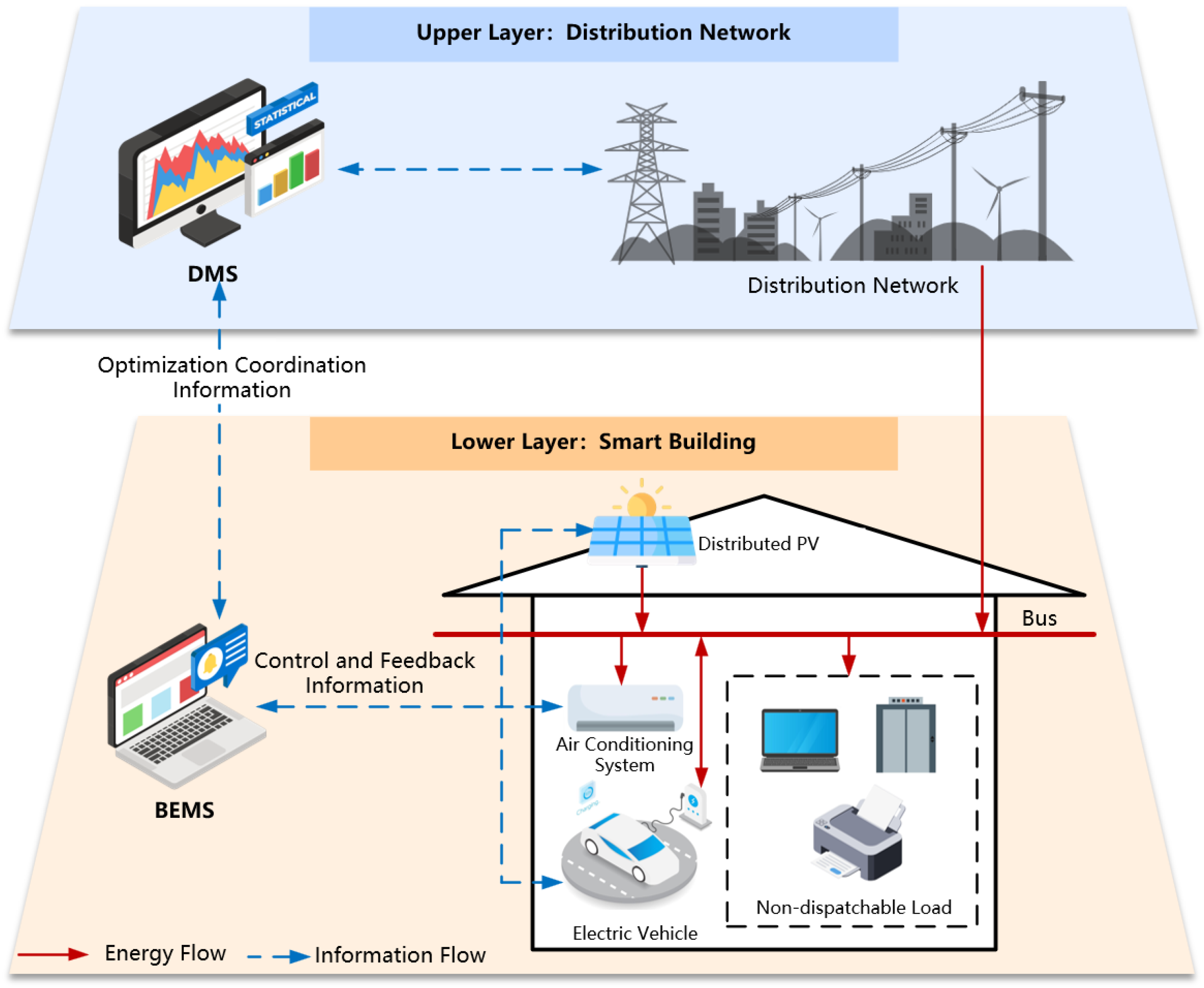
Given these management structures and information constraints, simply merging distribution network models with multiple building models into a centralized large-scale optimization problem neither conforms to the practical division of responsibilities nor avoids challenges related to data privacy, communication overhead, and computational complexity. For these reasons, the coordinated optimization of distribution networks and smart buildings is better suited to a vertically layered coordination architecture with limited information exchange. Figure 1 illustrates the overall architecture adopted in this paper. The upper layer consists of the distribution management system on the network side, responsible for optimizing distribution network operation. The DMS ensures voltage and branch current limits, with primary inputs including network parameters, operational constraints, upstream boundary conditions, and non-building load forecasts. The lower layer comprises multiple building energy management systems on the building side. Each BEMS coordinates internal resources including HVAC, EV, and PV under comfort and mobility requirements, with primary inputs including building thermal parameters and device parameters, ambient and load forecasts, and comfort ranges. The two layers are coupled through a small number of aggregated variables. The distribution management system dispatches coordination information such as power boundaries to the building side, while the building side returns time-series power schedules for each node. The interaction is limited to these aggregated coupling variables, while internal operational details remain local to preserve privacy and reduce communication overhead. Based on this hierarchical architecture, the following sections will develop the distribution network model and smart building model, and subsequently design a distributed coordinated optimization algorithm for distribution network and smart building coordination.

3. Coordinated Optimization Model for Distribution Networks and Smart Buildings

3.1. Smart Building Model

As typical aggregates of controllable loads, smart buildings commonly integrate distributed resources such as distributed PV, AC systems, and EV charging facilities [24]. These resources provide demand-side regulation potential for power balancing and fluctuation mitigation under distribution network operational constraints. Based on the characteristics of various building resources, the following constraints are formulated, including building thermal dynamics, EV charging and discharging, PV output, and building cluster power balance.

3.1.1. Building Thermal Dynamics Constraints

At the thermal zone level, indoor temperature must be maintained within the comfort range while flexibly regulating AC system loads. Equation (1) represents the AC system operational constraints, where this paper adopts a power regulation control strategy for AC equipment. Equation (2) defines the indoor temperature comfort range constraint.
0 P AC , n , r , t P AC , max
T room , min T room , n , r , t T room , max
where P AC , n , r , t denotes the AC electrical power of zone r in building n at time t. P AC , max is the maximum AC power. T room , n , r , t is the indoor temperature. T room , max and T room , min are the upper and lower limits of the indoor temperature comfort range, respectively.
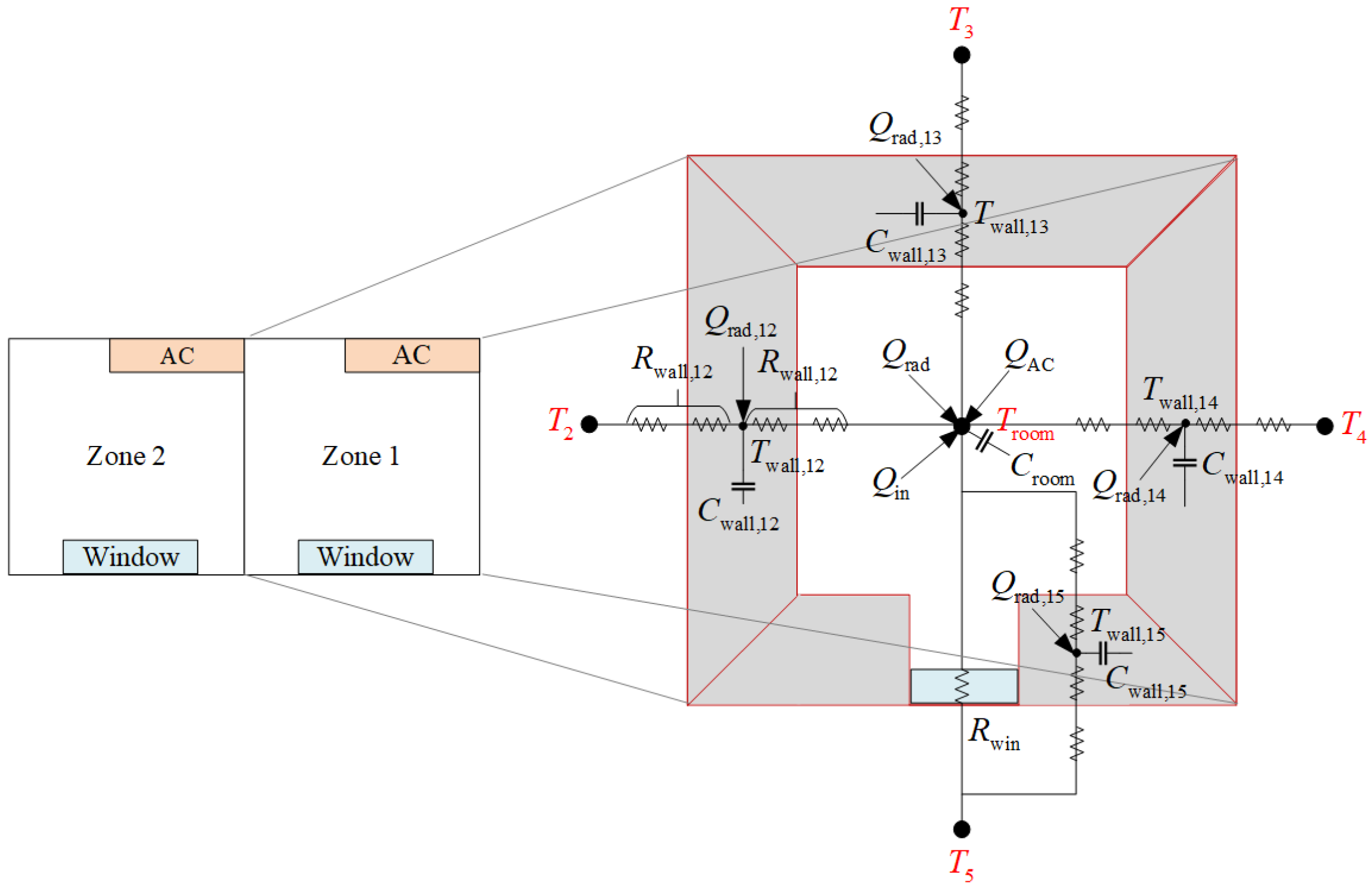
Building thermal dynamics are commonly described using resistance–capacitance (RC) network models [25], which introduce thermal resistance and thermal capacitance concepts to incorporate heat conduction and heat storage capabilities into the building mathematical model. As shown in Figure 2, the RC network model for an indoor zone (with one window) in a building consists of five nodes, including four wall nodes and one indoor node. This model transfers heat through thermal resistances and stores heat through thermal capacitances. The heating and cooling demand of the indoor space is met by the building’s AC system.
Based on this RC topology, the thermal balance constraint for wall nodes is formulated as:
C wall , i j T wall , n , r , i j , t + 1 T wall , n , r , i j , t = Δ t j N wall T n , r , j , t T wall , n , r , i j , t R wall , i j + q i j v i j A wall , i j Q rad , n , r , i j , t
where C wall , i j and R wall , i j denote the thermal capacitance and thermal resistance of the wall node, respectively. T wall , n , r , i j , t and T n , r , j , t are the wall temperature and adjacent node temperature at time t, respectively. N wall is the set of nodes connected to the wall. q i j indicates whether the wall surface receives solar radiation. v i j is the solar heat gain coefficient. A wall , i j is the wall area. Q rad , n , r , i j , t is the solar radiation intensity.
The thermal balance constraint for indoor temperature is formulated as:
C room , r T room , n , r , t + 1 T room , n , r , t = Δ t [ j N room T wall , n , r , i j , t T room , n , r , t R wall , i j + Q in , n , r , t   + π i j j N room T n , r , j , t T room , n , r , t R win , i j + π i j w i j A win , i j Q rad , n , r , i j , t E EER P AC , n , r , t ]
where C room , r and T room , n , r , t are the thermal capacitance and temperature of zone r, respectively. N room is the set of nodes adjacent to the room. R win , i j is the window thermal resistance. Q in , n , r , t represents the sensible heat gains from occupants and appliances. π i j indicates whether the wall contains a window. w i j and A win , i j are the window transmittance coefficient and area, respectively. E EER is the energy efficiency ratio for cooling.

3.1.2. EV Charging/Discharging Constraints

This study considers vehicle-to-building (V2B) operation, where EVs charge during off-peak or low-price periods and discharge to supply building loads during peak demand. This bidirectional capability enhances operational flexibility while meeting travel requirements. The EV charging and discharging model is formulated as follows:
SOC n , e , t = ( 1 τ ) SOC n , e , t 1 + η c · P EV , n , e , t c P EV , n , e , t d η d Δ t E B n , e
SOC min SOC n , e , t SOC max
0 P EV , n , e , t c P EV , max c · α n , e , t c
0 P EV , n , e , t d P EV , max d · α n , e , t d
α n , e , t c + α n , e , t d 1
where SOC n , e , t denotes the state of charge of EV e at time t. τ is the self-discharge coefficient. η c and η d are the charging and discharging efficiencies, respectively. P EV , n , e , t c and P EV , n , e , t d are the charging and discharging power of EV e at time t, respectively. P EV , max c and P EV , max d are the maximum charging and discharging power limits. α n , e , t c and α n , e , t d are binary variables, where a value of 1 indicates that the EV is in charging (or discharging) state. Equation (9) ensures that the EV cannot be in charging and discharging states simultaneously.
From the above model, the net power of the EV is obtained as:
P EV , n , e , t = P EV , n , e , t c P EV , n , e , t d

3.1.3. PV Output Constraints

The actual PV output from rooftop installations must not exceed the forecasted maximum available output. The model permits active curtailment of PV generation during optimization to accommodate distribution network operational constraints or building-side consumption limitations.
0 P PV , n , t P ¯ PV , n , t
where P PV , n , t and P ¯ PV , n , t are the actual and forecasted PV output, respectively.

3.1.4. Building Cluster Power Balance Constraints

Each building cluster must satisfy power balance at every time step.
P ex , n , t + P PV , n , t = r R P AC , n , r , t + e E P EV , n , e , t + P rg , n , t
where P ex , n , t denotes the net power exchange at node n at time t. P rg , n , t is the conventional load power.

3.2. Distribution Network Model

3.2.1. Distribution Network Model Based on Second-Order Cone Relaxation

Considering a radial distribution network, the voltage, current, and power distribution are described using a branch-based power flow model [26]. For any branch ( m , n ) connecting node m and node n, the branch power flow relationship between voltage, current, active power, and reactive power at time t is given by:
V n , t 2 = V m , t 2 2 ( r m n P m n , t + x m n Q m n , t ) + ( r m n 2 + x m n 2 ) I m n , t 2
p n , t = m : m n P m n , t r m n I m n , t 2 l : n l P n l , t
q n , t = m : m n Q m n , t x m n I m n , t 2 l : n l Q n l , t
V m , t 2 I m n , t 2 = P m n , t 2 + Q m n , t 2
where V m , t and V n , t denote the voltage magnitudes at nodes m and n at time t, respectively. I m n , t is the current on branch ( m , n ) . P m n , t and Q m n , t are the active and reactive power flowing from node m to node n. P n l , t and Q n l , t represent the active and reactive power flowing from node n to its downstream nodes. p m , t , q m , t and p n , t , q n , t are the active and reactive power injections at nodes m and n, respectively, (including loads and distributed generation). r m n and x m n are the resistance and reactance parameters of branch ( m , n ) .
The original branch power flow equations contain product terms of voltage, current, and power. To reduce complexity while maintaining acceptable accuracy, variable substitutions are performed and second-order cone relaxation (SOCR) is applied to transform Equation (16):
2 P m n , t 2 Q m n , t I ˜ m n , t V ˜ m , t 2 I ˜ m n , t + V ˜ m , t
where V ˜ m , t = V m , t 2 and I ˜ m n , t = I m n , t 2 .

3.2.2. Operational Security Constraints

The voltage and current of the distribution network must be maintained within their limits:
( V m , min ) 2 V ˜ m , t ( V m , max ) 2
0 I ˜ m n , t ( I m n , max ) 2
where V m , min and V m , max are the minimum and maximum voltage limits at node m. I m n , max is the maximum current limit for branch ( m , n ) .

3.3. Objective Function

In the coordinated optimization model of distribution network and smart buildings, the objective on the distribution network side is to minimize network losses and nodal voltage deviations. The objective on the building side is to minimize occupant dissatisfaction with thermal comfort and travel requirements, while simultaneously reducing PV curtailment.
min F = w 1 t T ( m , n ) L r m n I m n , t 2 + w 2 t T n N V n , t V ref 2 + α J T + β J EV + C PV n t P ¯ PV , n , t P PV , n , t
where w 1 and w 2 denote the weighting coefficients for the network-loss term and the voltage-deviation term, respectively; α and β denote the penalty weights for thermal comfort dissatisfaction and EV travel requirement dissatisfaction, respectively; and C PV denotes the weighting coefficient for PV curtailment. To reduce the influence of subjective weight assignment, the CRITIC method is adopted to determine these weights objectively [27]. Specifically, an evaluation matrix is first constructed using the sample values of the unweighted objective terms under the baseline operating condition and representative operating scenarios, followed by normalization. The information content of each term is then quantified by jointly considering its dispersion and its correlation with the other terms, and the final weights are obtained through normalization.
The thermal comfort dissatisfaction is characterized by the deviation between indoor temperature and the optimal comfort temperature. A larger deviation corresponds to stronger subjective discomfort. Therefore, the squared deviation is incorporated as a penalty term in the objective function. A smaller value of this term indicates that the room temperature is closer to the optimal comfort level and that thermal comfort is better satisfied.
J T = n r t ( T room , n , r , t T room ref ) 2
The travel requirement dissatisfaction is characterized by the deviation between the actual state of charge and the expected state of charge when the user departs with the EV. Similarly, a squared deviation penalty term is constructed to reflect the impact of insufficient charge on user travel. A smaller value of this term indicates that the departure SOC is closer to the expected value and that EV travel requirements are better satisfied.
J EV = n e max 0 , SOC n , e , t dep expect SOC n , e , t dep · E B n , e 2
To eliminate the nonsmooth max operator in (22), a nonnegative auxiliary variable u n , e is introduced to represent the departure energy deficit of EV e at node n. The original max term is equivalently reformulated as the following linear constraints:
u n , e 0 , u n , e SOC n , e , t dep expect SOC n , e , t dep
Since u n , e is minimized through the objective function, it takes the value of the original max expression at optimality. Accordingly, Equation (22) can be written as
J EV = n e E B n , e · u n , e 2
After reformulating the max term in Equation (22), the original problem can be characterized as a nonconvex mixed-integer program (MIP). The nonconvexity and mixed-integer characteristics mainly originate from the binary variables corresponding to the EV operating modes.

4. Distributed Coordinated Optimization Algorithm

4.1. Distributed Optimization Model for Distribution Networks and Smart Buildings Based on ADMM

Given that the distribution network and smart buildings belong to different systems and management entities, and both have independent requirements for data privacy and decision-making autonomy, this paper employs the ADMM algorithm to solve the distributed coordinated optimization model of distribution network and smart buildings. During the iterative process, the distribution management system and each building energy management system only need to exchange a small amount of aggregated information such as boundary power at interconnection nodes and corresponding Lagrangian multipliers. Internal building energy consumption data does not need to be transmitted directly to the distribution network side, thereby achieving cross-system coordinated decision making while ensuring privacy. By imposing global consistency constraints on coupling variables, consistency between the distribution network side and building side on key coupling quantities such as boundary power can be ensured. The distributed optimization model for distribution networks and smart buildings is formulated as:
min F = F DN + F SB s . t . x DN z = 0 , x SB z = 0
where x DN and x SB are the boundary power variables on the distribution network side and building cluster side, respectively. z is the global variable for boundary power.
Based on the above formulation, the augmented Lagrangian function is constructed as:
L ρ ( x , z , λ ) = F DN + λ DN T ( x DN z ) + ρ 2 x DN z 2 2 + F SB + λ SB T ( x SB z ) + ρ 2 x SB z 2 2
where λ DN and λ SB are the Lagrangian multiplier vectors for the distribution network side and building side, respectively. ρ is the penalty parameter. By decomposing the decision variables of the distribution network and smart buildings, the augmented Lagrangian function can be split into upper-level and lower-level subproblems.

4.1.1. Distribution Network Side Subproblem

With the DistFlow second-order cone relaxation, the DN subproblem can be formulated as a convex second-order cone program (SOCP).
min F DN k = F DN + λ DN k T ( x DN z ) + ρ 2 x DN z 2 2
where the superscript k denotes the iteration index. The constraints are Equations (13)–(19). The upper-level subproblem is solved by the computational server of the distribution management system.

4.1.2. Building Side Subproblem

The building subproblem is a nonconvex mixed-integer quadratic program (MIQP).
min F SB k = F SB + λ SB k T ( x SB z ) + ρ 2 x SB z 2 2
The constraints are Equations (1)–(12). The lower-level subproblem is solved by the distributed computing devices of each building energy management system.

4.2. Anderson-Accelerated ADMM

Although ADMM possesses good generality and engineering applicability, it also has certain limitations in practical applications. Typically, ADMM converges relatively fast in early iterations, but the convergence rate slows down significantly when approaching the optimal solution. Obtaining high-precision solutions usually requires a large number of iterations [28]. Therefore, for problems requiring high accuracy, standard ADMM alone often fails to achieve the desired precision within acceptable time, motivating the introduction of acceleration mechanisms.
Within the augmented Lagrangian framework, ADMM alternately updates primal variables, consensus variables, and dual variables. The variable iteration update rules for the above distributed optimization model based on ADMM are shown in Equations (29)–(31):
x i k + 1 = arg min x i F i ( x i ) + ( λ i k ) T x i + ρ 2 x i z k 2 2 , i = { DN , SB }
z k + 1 = x DN k + 1 + x SB k + 1 2
λ i k + 1 = λ i k + ρ ( x i k + 1 z k + 1 ) , i = { DN , SB }
Note that x k + 1 depends only on z k and λ k . Thus, this ADMM iteration can be viewed as a fixed-point iteration on ( z , λ ) :
( z k , λ k ) = f ( z k 1 , λ k 1 )
On this basis, Anderson acceleration can be introduced to the iteration sequence ( z k , λ k ) to improve convergence speed. The idea of Anderson acceleration is as follows [29]:
First, a parameter m is set, which represents storing iteration information from the previous m steps of boundary values. After the current iteration value is solved, the current value is corrected by combining the boundary iteration information from the previous m steps. Since cases where the iteration count is less than m need to be considered, the correction information dimension m n is defined as:
m n = min { m , n } , n > 0
where n denotes the iteration index.
Define the boundary interaction variable v k = [ z k , λ k ] , where v ^ k + 1 is the accelerated boundary interaction variable, obtained by weighting the previous m n iteration values and the current boundary variable v k + 1 :
v ^ k + 1 = τ = 0 m n α τ k f v ( k m n + τ )
where α τ k is the weighting coefficient for the k-th iteration.
Let the general form g ( x ) = x f ( x ) denote the iteration residual. Then, α τ k can be obtained by solving an optimization problem that minimizes the residual:
min τ = 0 m n α τ k g v ( k m n + τ ) s . t . τ = 0 m n α τ k = 1
For the ease of the solution, this optimization problem can be transformed into an unconstrained least-squares model through a linear variable transformation. Let the coefficient vector for the k-th iteration be β k = [ β 0 k , β 1 k , , β m n 1 k ] , satisfying:
α 0 k = β 0 k , τ = 0 α τ k = β τ k β τ 1 k , 1 τ m n 1 α m n k = 1 β m n 1 k , τ = m n
Then, the original problem in Equation (35) can be transformed into:
min g k Y k β
where
g k = g ( v k ) Y k = [ y k m n , y k m n + 1 , , y k 1 ] y τ = g τ + 1 g τ
where y τ is the difference between the variable residuals at iteration τ + 1 and iteration τ .
If the matrix Y k is invertible, the solution to Equation (37) is:
β k = ( Y k T Y k ) 1 Y k T g k
Let S k = [ s k m n , s k m n + 1 , , s k 1 ] , where the difference between adjacent iteration variables is s τ = v ( τ + 1 ) v ( τ ) . Then, Equation (34) can be expressed as:
v ^ k + 1 = f ( v k ) ( S k Y k ) ( Y k T Y k ) 1 Y k T g k
In summary, the matrices S k and Y k store the differences of iteration variables and the differences of residuals from the previous m n iterations, respectively. Each time the distribution network and building cluster performs an optimization computation, S k and Y k are updated once, and then a new iteration value is computed according to Equation (40).
However, it should be noted that Anderson acceleration itself is not always stable, and its convergence is typically only locally guaranteed. Therefore, it is necessary to design a safeguarding mechanism to determine whether the current iteration step should adopt the extrapolation result from Anderson acceleration. In engineering practice, a common approach following Ref. [30] is to compare whether the combined residual is simultaneously smaller than a preset tolerance threshold to determine whether ADMM has reached a converged state. The combined residual can be defined as:
r c k = ρ x k + 1 z k + 1 2 + ρ z k + 1 z k 2
If the combined residual is smaller than that of the previous iteration, the result is accepted; otherwise, the algorithm reverts to the previous step. The pseudocode for the Anderson-accelerated ADMM Algorithm 1 is as follows:
Algorithm 1 Anderson-Accelerated ADMM Algorithm
  1:
x d = x 0 ; z d = z 0 ; λ d = λ 0 ;
  2:
r prev = + ; j = 0 ; reset = TRUE ; k = 0 ;
  3:
while TRUE do
  4:
   // Run one step of ADMM
  5:
    x * arg min x L ρ ( x , λ k , z k ) ;
  6:
    z * arg min z L ρ ( x * , λ k , z ) ;
  7:
    λ * = λ k + ρ ( x * z * ) ;
  8:
   // Compute combined residual
  9:
    r = ρ x * z * 2 + ρ z * z k 2 ;
10:
   if  reset = = TRUE or r < r prev  then
11:
    // Record accepted iteration
12:
     x d = x * ; z d = z * ; λ d = λ * ;
13:
     r prev = r ; reset = FALSE ;
14:
    // Compute Anderson acceleration solution
15:
     f j = ( z * , λ * ) ; g j = ( z * z k , λ * λ k ) ;
16:
     j = j + 1 ; m ˜ = min ( m 1 , j ) ;
17:
     ( z k + 1 , λ k + 1 ) = AA ( [ f j , , f j m ˜ ] , [ g j , , g j m ˜ ] ) ;
18:
     k = k + 1 ;
19:
   else
20:
    // Revert to previous iteration
21:
     z k = z d ; λ k = λ d ; reset = TRUE ;
22:
   end if
23:
   if  k I max or r < ε  then
24:
    // Check termination condition return  x d ; // Return the last accepted x
25:
   end if
26:
end while

4.3. Convergence of Anderson-Accelerated ADMM

Regarding theoretical convergence, Anderson acceleration is typically viewed as an outer-layer acceleration applied to fixed-point iterations. Therefore, its convergence analysis can be conducted within the fixed-point theory framework. Ref. [31] provides local convergence results for Anderson acceleration from a mathematical perspective. When the fixed-point mapping satisfies contractivity conditions and the linear combination coefficients in the acceleration process satisfy boundedness assumptions, Anderson acceleration can guarantee convergence within a neighborhood of the fixed point. This provides a foundation for discussing local convergence when applying Anderson acceleration to ADMM. Furthermore, Ref. [32] theoretically proves that for linearly convergent fixed-point iterations, Anderson acceleration can significantly improve the local convergence rate by optimizing first-order information, explaining the acceleration phenomena commonly observed in numerical experiments.
Regarding the combination of Anderson acceleration with ADMM, Ref. [33] further investigates the asymptotic convergence characteristics of ADMM, analyzing the asymptotic linear convergence properties of AA-ADMM under stationary Anderson acceleration. By comparing the spectral characteristics of Jacobian matrices at fixed points between ADMM and AA-ADMM, this work quantitatively characterizes the improvement in convergence factors during ADMM’s linear convergence phase due to Anderson acceleration, and provides a basis for estimating convergence rates of the more commonly used non-stationary acceleration strategies in practice.
In terms of global convergence and stability, Ref. [34] provides global convergence and stabilization proofs for Anderson-accelerated Douglas–Rachford splitting (DRS) under the convex optimization framework. Due to the close relationship between DRS and ADMM, the above theory also provides transferable analytical insights for convergence guarantees of AA-ADMM. However, when the problem involves non-convex optimization, the convergence of ADMM itself often depends on additional conditions, and the extrapolation steps in Anderson acceleration may introduce instability or even divergence risks. To address this, Ref. [35] constructs a lower-dimensional fixed-point iteration form by exploiting the equivalence between ADMM and DRS, and introduces acceleration evaluation functions (merit functions) based on the DR envelope or primal residual norm as criteria. An accept–reject strategy is implemented for acceleration, thereby establishing convergence analysis and stabilization guarantee mechanisms for non-convex scenarios.

5. Case Studies

5.1. Case Setup

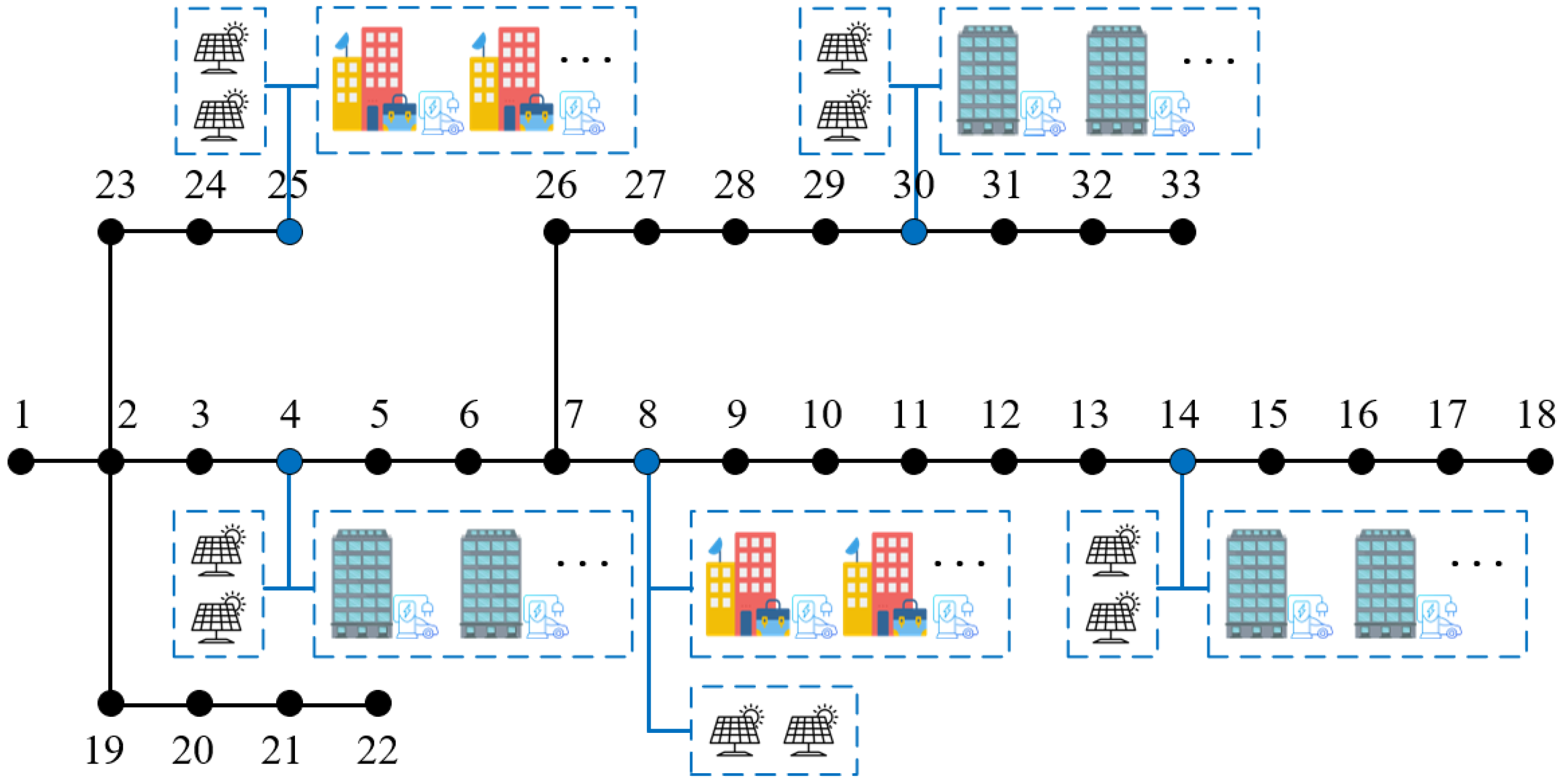
The simulation adopts typical summer meteorological conditions in Guangzhou [36] for cooling operation analysis. The optimization model is solved using CPLEX 12.10 via the YALMIP toolbox (version 20230622) in MATLAB R2023b on a PC equipped with an Intel® Core™ i9-14900 2.00 GHz processor and 32 GB RAM. The scheduling horizon is set to 24 h using a day-ahead scheduling mode with a time step of 1 h. The parameters for smart buildings, AC systems, and electric vehicles are referenced from [37,38,39,40], with specific parameters listed in Table 1. The distribution network adopts the IEEE 33-bus system. Smart buildings and PV generation units are connected to nodes 4, 8, 14, 25, and 30, where nodes 4, 14, and 30 are configured as office buildings, while nodes 8 and 25 are configured as commercial buildings. The topology is shown in Figure 3. It is assumed that each connection node is linked to five smart buildings, each building contains 10 thermal zones, and 10 electric vehicles are configured in the attached parking lot.
To verify the effectiveness of the proposed coordinated method, the following three scheduling schemes are designed:
Scheme 1: Baseline uncoordinated operation mode. Smart buildings adopt constant temperature AC control and plug-and-play EV charging strategies. The distribution network passively accepts building loads.
Scheme 2: Decoupled optimization mode. The building side performs day-ahead local optimization, coordinating AC, EV, PV, and other resources. The distribution network passively accepts building loads.
Scheme 3: Coordinated optimization of distribution network and buildings. The distribution network side and smart building side solve their respective optimization problems separately, achieving consistency coordination through boundary interaction variables.

5.2. Optimization Results Analysis

Table 2 compares the system operation indices under the three scheduling schemes. Scheme 1 adopts constant temperature settings and plug-and-play EV charging, lacking coordinated PV output utilization, resulting in the highest network loss and voltage deviation, and severe PV curtailment. Scheme 2 improves PV utilization through local building-side optimization, partially reducing network loss, but without awareness of distribution network power flow and voltage constraints, the improvement in network operation is limited. In contrast, Scheme 3 achieves the best overall performance by coordinating distribution network and building optimization, with only minimal user-side deviation. Specifically, network loss is reduced by approximately 12.1% and 5.9% compared to Schemes 1 and 2, respectively, and voltage deviation is minimized, while maintaining a high PV utilization rate. These results demonstrate that the proposed coordinated strategy can effectively improve the economic and secure operation of the distribution network while ensuring user comfort.
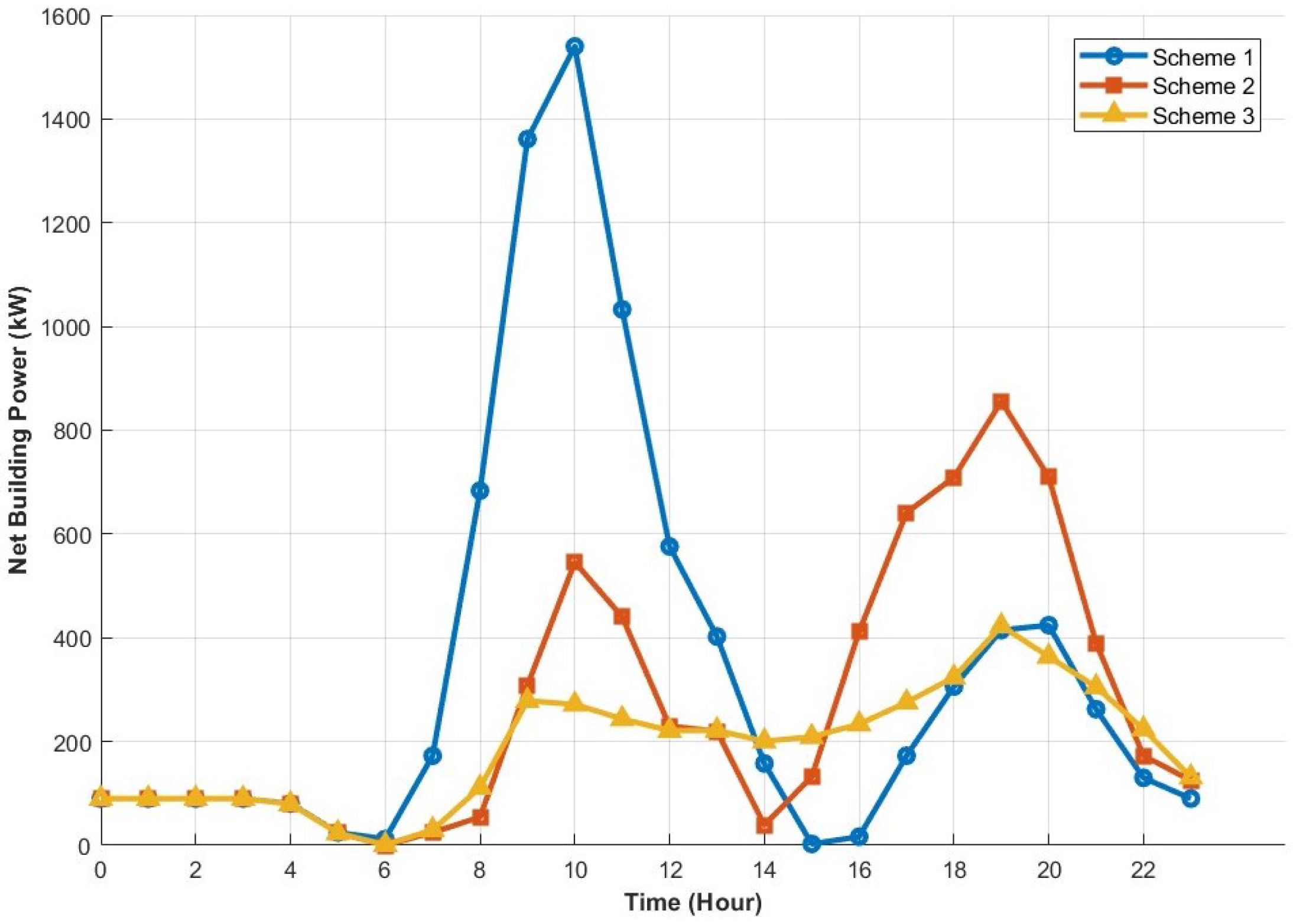
Figure 4 compares the net power profiles of the smart building cluster under the three scheduling schemes. Scheme 1 is dominated by uncoordinated electricity consumption patterns, exhibiting pronounced peak–valley fluctuations in net power. Around 10:00 in the morning, the concurrent connection of commuting vehicles combined with rising AC loads creates a daily maximum peak of approximately 1550 kW. Subsequently, net power drops rapidly during midday when PV output increases, and a second local peak emerges around 19:00 due to the combined effects of PV ramp-down and evening commercial loads, reflecting the pressure imposed on the distribution network by the temporal mismatch between generation and load. Scheme 2 mitigates the morning peak through building-side local optimization. However, since it is not coupled with distribution network operational constraints and the charging strategy tends to charge EVs to higher energy levels, part of the charging demand is deferred and released intensively in the evening, resulting in a significant load rebound of approximately 850 kW at 19:00. In contrast, Scheme 3 coordinates building-side flexible resources under the coordinated optimization framework of distribution network and buildings, guiding EV charging more intensively toward periods of high PV output while simultaneously suppressing power surges during morning and evening peak hours. This results in a smoother overall net power profile with lower peak levels, thereby enhancing distribution network operational security margins and local PV utilization.
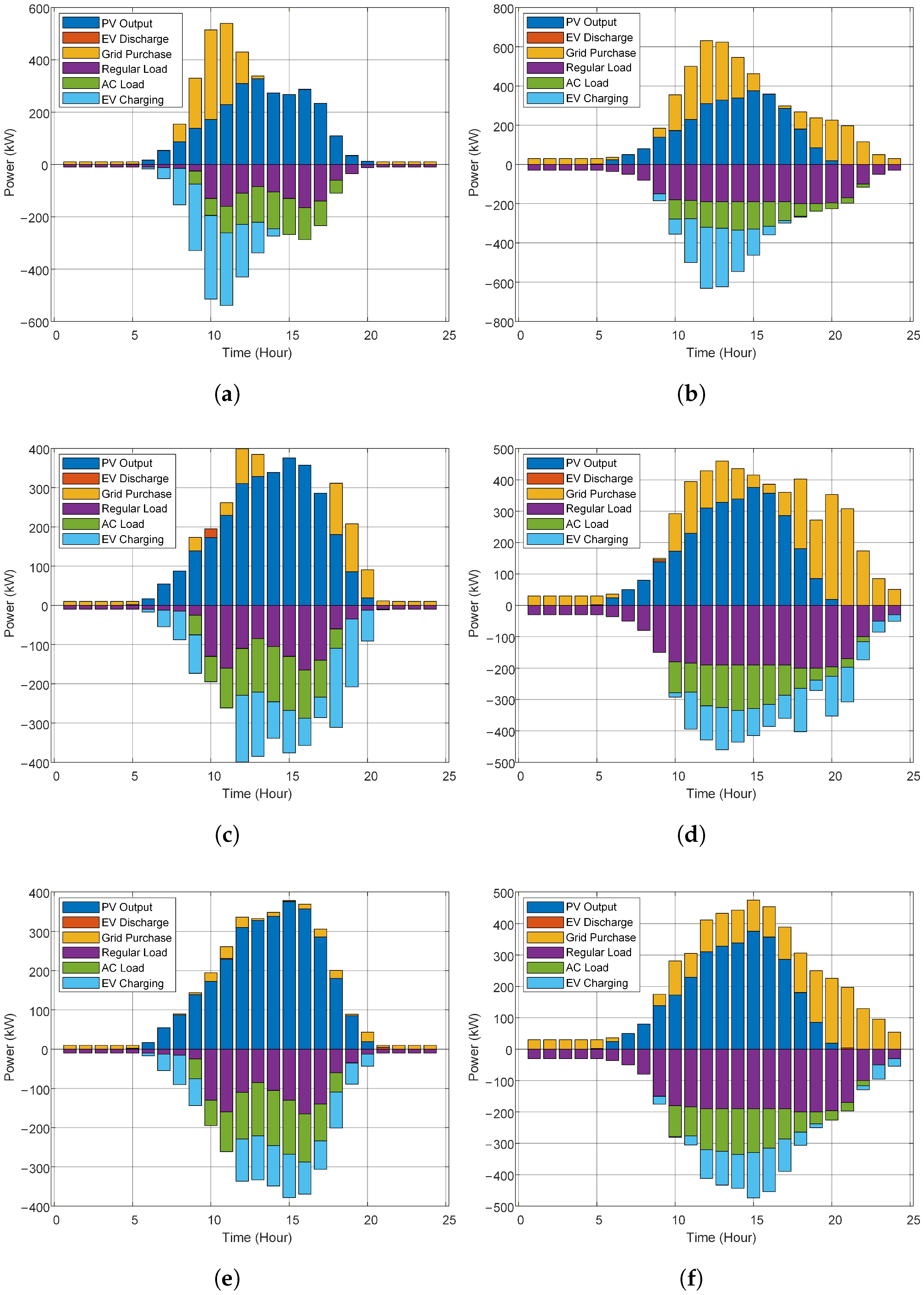
Figure 5 presents a detailed illustration of the energy balance for office buildings and commercial buildings under the three schemes. A vertical comparison across the three schemes reveals that Scheme 1 exhibits typical passive operation characteristics. EV charging loads are primarily concentrated during the morning commute peak from 08:00 to 11:00, highly overlapping with the ramp-up period of conventional loads and AC loads. During this period, PV generation is still in its ramp-up phase, and the temporal mismatch between supply and demand forces the system to incur substantial grid power purchases, imposing significant instantaneous supply pressure on the distribution network. In contrast, both Scheme 2 and Scheme 3 achieve load shifting by guiding EV charging more toward the high PV output period from 11:00 to 16:00, aligning the temporal distribution of charging loads more closely with PV generation, thereby effectively reducing grid power purchase requirements. Furthermore, the advantage of Scheme 3 over Scheme 2 lies in the smoother allocation of charging power, enabling the energy absorption process to follow and adapt more reasonably to PV output variations. This approach satisfies travel energy requirements while mitigating the risk of localized power congestion, demonstrating superior grid interaction characteristics.
A horizontal comparison across different building types reveals that coordinated optimization can adopt differentiated regulation strategies tailored to distinct load temporal characteristics. Office buildings exhibit concentrated loads during working hours with rapid morning ramp-up. Scheme 3 focuses on suppressing intra-day peak values and ramp rates, utilizing EV parking windows to allocate charging power across different time periods, enabling the greater absorption of daytime surplus PV and thereby reducing net load peaks during working hours. In contrast, commercial buildings feature long-tail load characteristics that persist into the evening. Scheme 3 places greater emphasis on evening pressure management by shifting dispatchable energy demand forward and limiting the superposition of new charging loads at night, thereby reducing evening peak grid purchase intensity and smoothing the net load profile.

5.3. Model and Algorithm Validation

5.3.1. SOCR Relaxation Gap Analysis

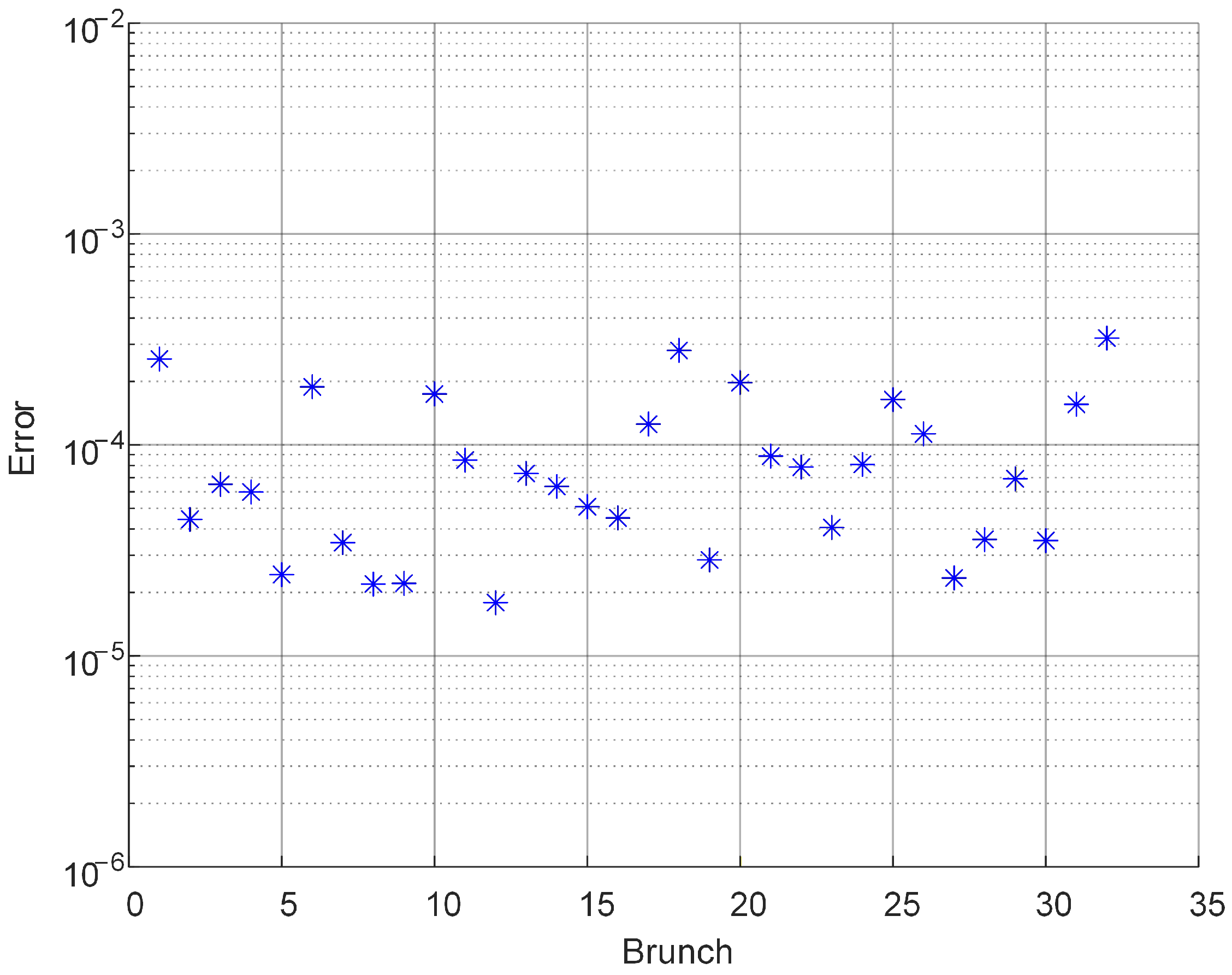
To evaluate the tightness of the adopted SOCR, a relaxation-gap analysis is conducted for Scheme 3. The SOCR gap is defined as ϵ m n , t = P m n , t 2 + Q m n , t 2 I ˜ m n , t V ˜ m , t , i.e., the absolute mismatch between the two sides of Equation (16). As shown in Figure 6, all reported gap values remain below 10 3 and are concentrated near zero, indicating that the SOCR is tight in the tested case and introduces negligible relaxation error.

5.3.2. Accuracy Analysis

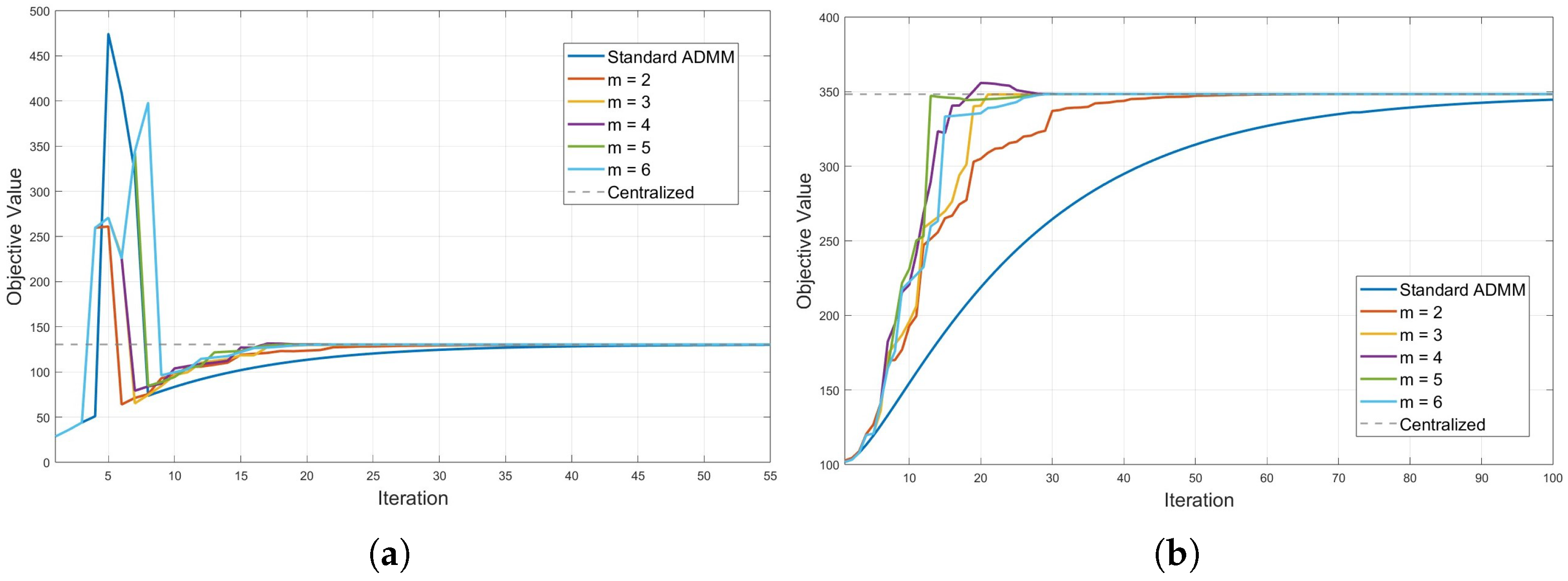
To evaluate the accuracy of the proposed method, the computational results of AA-ADMM, standard ADMM, and centralized scheduling algorithms are compared. The centralized scheduling algorithm refers to solving the optimization problem by directly concatenating the distribution network model and smart building models. Although this approach suffers from data privacy concerns and numerical stability problems, making it impractical for real-world applications, it can compute the exact solution and thus serves as a benchmark for other algorithms. Meanwhile, to further validate the performance of the proposed method in a large-scale system under a real urban distribution network scenario, it is tested on a 67-node distribution network in Guangzhou, where 10 nodes are connected to building clusters, with 10 buildings at each node; this configuration is treated as Case 2. Figure 7 presents the objective function convergence of the three algorithms under the test cases. The results indicate that the optimal scheduling outcomes of all three algorithms are consistent within the allowable precision tolerance, thereby validating the accuracy of the proposed method.

5.3.3. Convergence Analysis

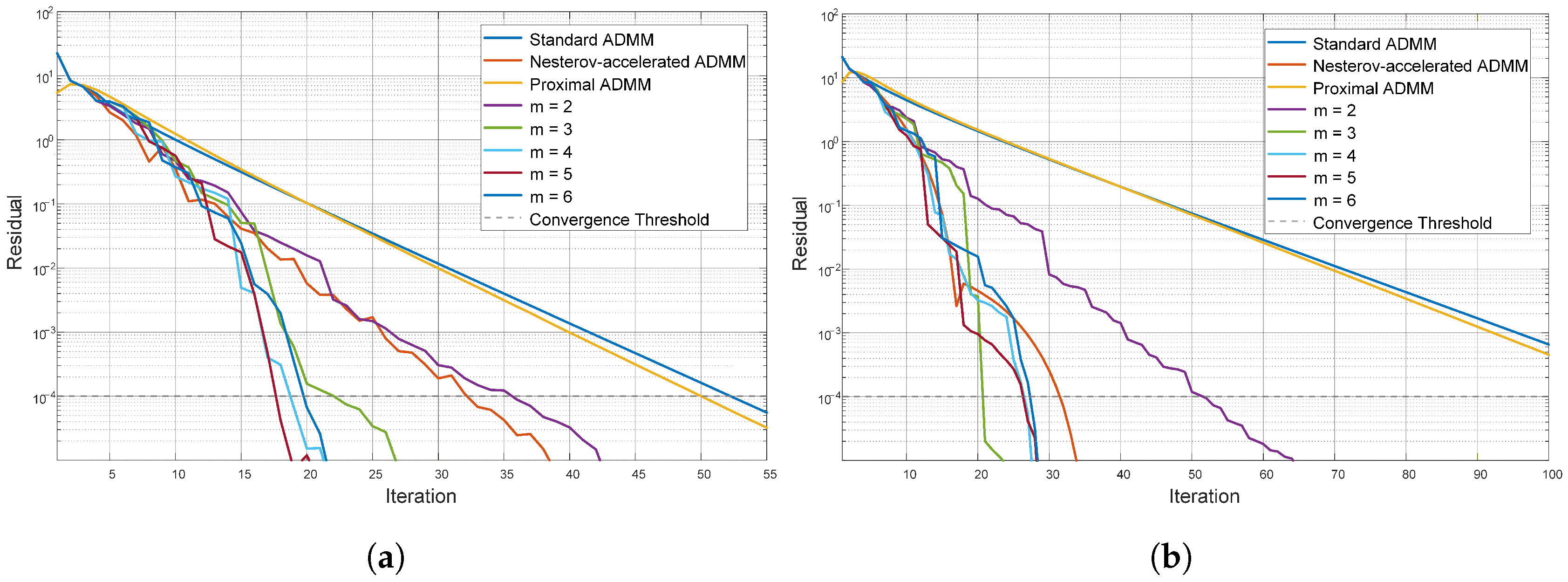
To further compare the convergence performance of different algorithms, Figure 8 presents the combined residual convergence curves for the standard ADMM, Nesterov-accelerated ADMM, Proximal ADMM, and the AA-ADMM algorithm under different information dimensions m for different test cases. The iteration counts required to reach the convergence threshold and the corresponding computation times are summarized in Table 3. It should be noted that, due to the limitation of the simulation environment, the subproblems cannot be solved in parallel in each iteration. Therefore, the reported computation time is defined as the sum, over all iterations, of the maximum solution time among all subproblems in each iteration.
As shown in Figure 8, for a reasonable information dimension ( m = 3 –6), AA-ADMM consistently achieves a faster reduction in the combined residual and exhibits superior convergence behavior than the other ADMM-based algorithms across different test cases. In contrast, when m = 2 , the convergence advantage becomes less pronounced, possibly because the limited historical information weakens the extrapolation effect. Meanwhile, the residual trajectories decrease steadily without sustained oscillation or divergence, suggesting that the accept–reject mechanism effectively mitigates extrapolation-induced instability and preserves the stability of the iterative process.
Table 3 indicates that, as the problem size increases, all algorithms generally require more iterations and longer solution times. Nevertheless, AA-ADMM continues to exhibit a clear computational efficiency advantage over the other ADMM-based algorithms. In Case 1, the minimum iteration count is achieved at m = 5 , representing a 66% reduction compared with the standard ADMM, which also contributes to its time-saving advantage. These results confirm that Anderson acceleration can substantially reduce the iterative burden and improve convergence efficiency, thereby enhancing the computational performance of the distributed coordinated optimization for distribution networks and smart buildings.

5.3.4. ρ Sensitivity Analysis

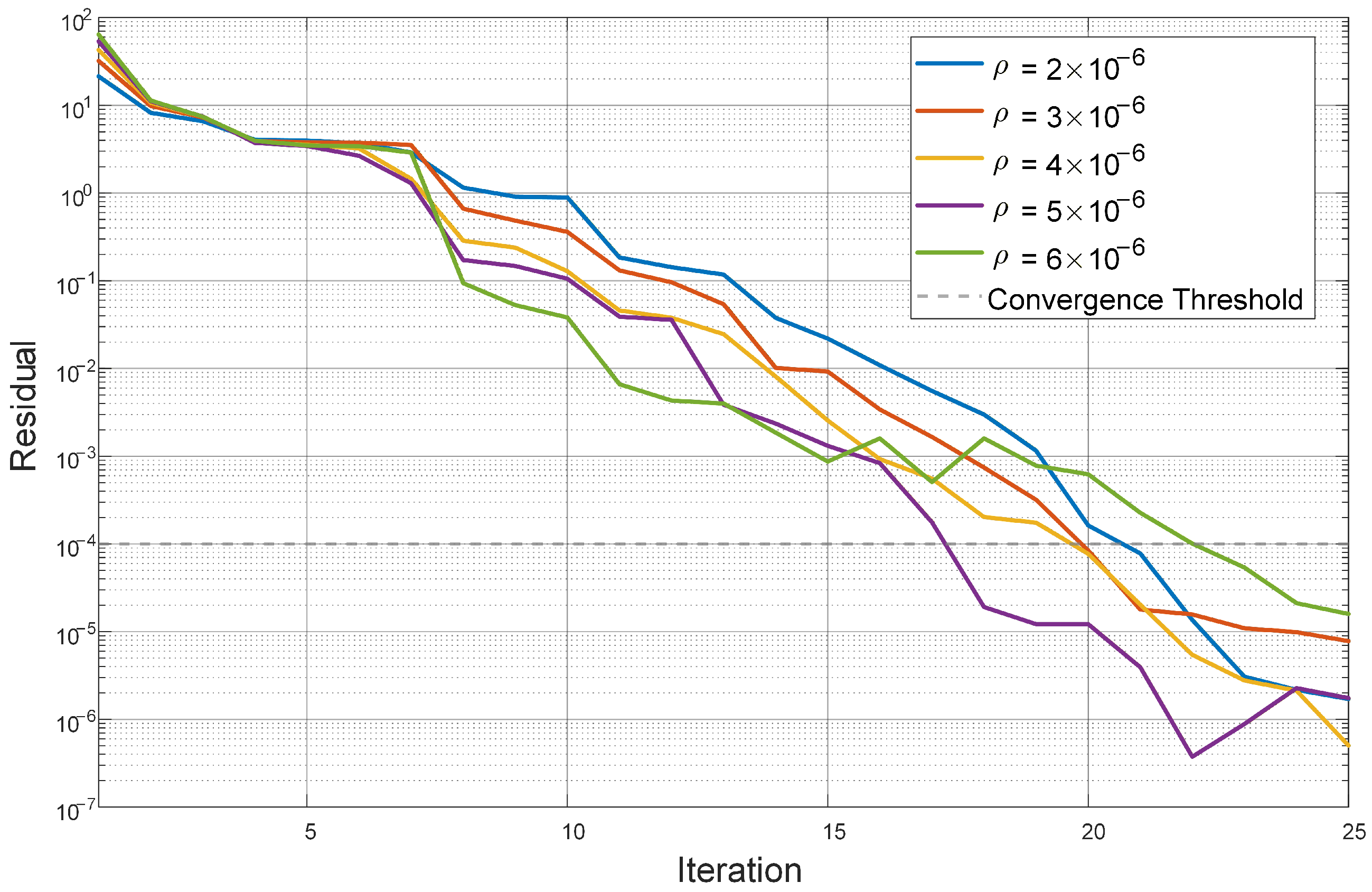
To further evaluate the dependence of the proposed method on the penalty parameter ρ , a sensitivity analysis was conducted over the range from 2 × 10 6 to 6 × 10 6 . This range was selected to be consistent with the numerical scale of the interaction variables in the coordination problem and therefore represents a reasonable magnitude for the present model. As shown in Figure 9, within the tested range, the residual curves under all ρ values decrease steadily and eventually reach the preset convergence threshold, indicating that the proposed method has good robustness. Overall, although different ρ values have some influence on the convergence speed, the effect is limited: the numbers of iterations required to reach the convergence threshold remain at a similar level, generally around 20 iterations, without obvious convergence deterioration or a substantial increase in iteration count caused by parameter variation. These results demonstrate that the proposed method exhibits stable convergence over a reasonable parameter range, which helps reduce the tuning burden in practical deployment.

6. Conclusions

This paper aims to address the coordinated operation problem of distribution networks and smart buildings under data privacy and limited information-sharing constraints. To this end, a hierarchical DMS–BEMS coordination method is proposed, in which a day-ahead coordinated optimization model integrating building thermal dynamics, EV charging and discharging, PV generation, and distribution network operation constraints is established, and an Anderson-accelerated ADMM with a safeguarding mechanism is adopted for efficient distributed solution.
The main contributions of this paper are as follows:
1.
The hierarchical DMS–BEMS coordination framework enables effective coordination between the distribution network side and the building side under independent modeling and local decision making. Within this framework, only limited aggregated information, such as boundary power, is exchanged between the two sides, which makes it well suited for cross-entity coordinated optimization under data privacy and limited information-sharing constraints.
2.
The day-ahead coordinated optimization model, which jointly considers network-side security constraints and building-side flexible resources, fully exploits the load heterogeneity of different building types and enables differentiated spatiotemporal responses of flexible resources. Compared with the uncoordinated baseline and the building-side local optimization scheme, the proposed coordinated strategy achieves network loss reductions of about 12.1% and 5.9%, respectively, while further improving voltage profiles and maintaining a high PV utilization rate.
3.
The application of Anderson-accelerated ADMM further improves the efficiency of distributed coordinated optimization for distribution networks and smart buildings. Compared with standard ADMM, Nesterov-accelerated ADMM, and Proximal ADMM, AA-ADMM generally exhibits faster residual decay and better convergence performance under appropriate information dimension settings, reducing the number of iterations by up to 66% in the IEEE 33-bus test system.
Future work will enhance the applicability and robustness of the proposed framework in practical operation in two directions: first, integrating day-ahead coordination with intraday and real-time rolling optimization to update key controllable variables using the latest measurements and forecasts; second, incorporating uncertainty-aware formulations such as stochastic optimization, robust optimization, and chance constraints within the hierarchical framework to explicitly model forecast errors in user behavior and weather conditions, thereby improving feasibility and robustness under uncertainty.

Author Contributions

Conceptualization, Y.J. and S.D.; methodology, Y.J. and S.D.; software, Y.J. and Z.W. (Zhenchong Wu); validation, Y.J. and Z.W. (Zhaoyan Wang); formal analysis, Y.J. and S.D.; investigation, Y.J. and D.X.; resources, D.X.; data curation, Z.W. (Zhaoyan Wang); writing—original draft preparation, Y.J.; writing—review and editing, Y.J., Z.W. (Zhenchong Wu), and S.D.; visualization, Y.J.; supervision, S.D.; funding acquisition, Z.W. (Zhaoyan Wang) and D.X. All authors have read and agreed to the published version of the manuscript.

Funding

This work was supported by Guangzhou Power Supply Bureau of Guangdong Power Grid Co., Ltd.’s technology project: Research and Demonstration of Grid-friendly Interaction Technologies and Green Evaluation Mechanisms for Smart Buildings (Subtopic 1: Research and Demonstration of Grid-friendly Interaction Technologies for Smart Buildings) (GDKJXM20241304).

Data Availability Statement

Data are contained within the article.

Conflicts of Interest

Authors Zhaoyan Wang and Da Xu were employed by the company Guangzhou Power Supply Bureau, Guangdong Power Grid Co., Ltd. The remaining authors declare that the research was conducted in the absence of any commercial or financial relationships that could be construed as a potential conflict of interest.

Abbreviations

The following abbreviations are used in this manuscript:
AA-ADMMAnderson-Accelerated ADMM
ACAir Conditioning
ADMMAlternating Direction Method of Multipliers
BEMSBuilding Energy Management System
DMSDistribution Management System
EEREnergy Efficiency Ratio
ESSEnergy Storage System
EVElectric Vehicle
MPCModel Predictive Control
PVPhotovoltaics
RCResistance–Capacitance
SOCState of Charge
SOCRSecond-Order Cone Relaxation

References

  1. Fresia, M.; Bracco, S. Electric Vehicle Fleet Management for a Prosumer Building with Renewable Generation. Energies 2023, 16, 7213. [Google Scholar] [CrossRef]
  2. Feizi, M.R.; Khodayar, M.E.; Li, J. Data-Driven Distributionally Robust Unbalanced Operation of Distribution Networks with High Penetration of Photovoltaic Generation and Electric Vehicles. Electr. Power Syst. Res. 2022, 210, 108001. [Google Scholar] [CrossRef]
  3. International Energy Agency. Buildings. Available online: https://www.iea.org/topics/buildings (accessed on 27 December 2025).
  4. Zhou, Y.; Cao, S.; Hensen, J.L.M.; Lund, P.D. Energy Integration and Interaction between Buildings and Vehicles: A State-of-the-Art Review. Renew. Sustain. Energy Rev. 2019, 114, 109337. [Google Scholar] [CrossRef]
  5. Bayasgalan, A.; Park, Y.S.; Koh, S.B.; Son, S.-Y. Comprehensive Review of Building Energy Management Models: Grid-Interactive Efficient Building Perspective. Energies 2024, 17, 4794. [Google Scholar] [CrossRef]
  6. Toderean, L.; Cioara, T.; Anghel, I.; Sarmas, E.; Michalakopoulos, V.; Marinakis, V. Demand Response Optimization for Smart Grid Integrated Buildings: Review of Technology Enablers Landscape and Innovation Challenges. Energy Build. 2025, 326, 115067. [Google Scholar] [CrossRef]
  7. Sharma, I.; Bhattacharya, K.; Cañizares, C. Smart Distribution System Operations with Price-Responsive and Controllable Loads. IEEE Trans. Smart Grid 2015, 6, 795–807. [Google Scholar] [CrossRef]
  8. Klanatsky, P.; Veynandt, F.; Salenbien, R. Grey-Box Model for Model Predictive Control of Buildings. Energy Build. 2023, 300, 113624. [Google Scholar] [CrossRef]
  9. Stoffel, P.; Berktold, M.; Müller, D. Real-Life Data-Driven Model Predictive Control for Building Energy Systems Comparing Different Machine Learning Models. Energy Build. 2024, 305, 113895. [Google Scholar] [CrossRef]
  10. Bruno, R.; Pizzuti, G.; Arcuri, N. The Prediction of Thermal Loads in Building by Means of the EN ISO 13790 Dynamic Model: A Comparison with TRNSYS. Energy Procedia 2016, 101, 192–199. [Google Scholar] [CrossRef]
  11. Michalak, P. The Simple Hourly Method of EN ISO 13790 Standard in Matlab/Simulink: A Comparative Study for the Climatic Conditions of Poland. Energy 2014, 75, 568–578. [Google Scholar] [CrossRef]
  12. Yu, S.; Mascherbauer, P.; Haupt, T.; Skorna, K.; Rickmann, H.; Kochanski, M.; Kranzl, L. Modeling Households’ Behavior, Energy System Operation, and Interaction in the Energy Community. Energy 2025, 328, 136338. [Google Scholar] [CrossRef]
  13. Liu, S.; Vlachokostas, A.; Si, C.; Kontou, E. Coupled Management of Electric Vehicle Workplace Charging and Office Building Loads. Transp. Res. Part D Transp. Environ. 2024, 134, 104317. [Google Scholar] [CrossRef]
  14. Truong, V.B.; Le, L.B. Building Energy Management and Electric Vehicle Charging Considering Battery Degradation and Random Vehicles’ Arrivals and Departures. J. Energy Storage 2023, 64, 107141. [Google Scholar] [CrossRef]
  15. Goldsworthy, M.; Moore, T.; Peristy, M.; Grimeland, M. Cloud-Based Model-Predictive-Control of a Battery Storage System at a Commercial Site. Appl. Energy 2022, 327, 120038. [Google Scholar] [CrossRef]
  16. Zhang, K.; Prakash, A.; Paul, L.; Blum, D.; Alstone, P.; Zoellick, J.; Brown, R.; Pritoni, M. Model Predictive Control for Demand Flexibility: Real-World Operation of a Commercial Building with Photovoltaic and Battery Systems. Adv. Appl. Energy 2022, 7, 100099. [Google Scholar] [CrossRef]
  17. Rafayal, S.; Alnaggar, A.; Cevik, M. Optimizing Electricity Peak Shaving through Stochastic Programming and Probabilistic Time Series Forecasting. J. Build. Eng. 2024, 88, 109163. [Google Scholar] [CrossRef]
  18. Yang, Z.; Kong, D.; Chen, Z.; Zhang, Z.; Du, D.; Zhu, Z. A Data-Driven Battery Energy Storage Regulation Approach Integrating Machine Learning Forecasting Models for Enhancing Building Energy Flexibility—A Case Study of a Net-Zero Carbon Building in China. Buildings 2025, 15, 3611. [Google Scholar] [CrossRef]
  19. Taha, A.F.; Gatsis, N.; Dong, B.; Pipri, A.; Li, Z. Buildings-to-Grid Integration Framework. IEEE Trans. Smart Grid 2019, 10, 1237–1249. [Google Scholar] [CrossRef]
  20. Fontenot, H.; Ayyagari, K.S.; Dong, B.; Gatsis, N.; Taha, A.F. Buildings-to-Distribution-Network Integration for Coordinated Voltage Regulation and Building Energy Management via Distributed Resource Flexibility. Sustain. Cities Soc. 2021, 69, 102832. [Google Scholar] [CrossRef]
  21. Li, Z.; Su, S.; Jin, X.; Chen, H. Distributed Energy Management for Active Distribution Network Considering Aggregated Office Buildings. Renew. Energy 2021, 180, 1073–1087. [Google Scholar] [CrossRef]
  22. He, B.S.; Yang, H.; Wang, S.L. Alternating Direction Method with Self-Adaptive Penalty Parameters for Monotone Variational Inequalities. J. Optim. Theory Appl. 2000, 106, 337–356. [Google Scholar] [CrossRef]
  23. Zhang, N.; Wu, J.; Zhang, L. A Linearly Convergent Majorized ADMM with Indefinite Proximal Terms for Convex Composite Programming and Its Applications. Math. Comp. 2020, 89, 1867–1894. [Google Scholar] [CrossRef]
  24. Jiao, X.; Wang, J.; Xu, Z.; Han, X.; Wang, J.; Xu, D.; Xu, G.; Li, K.; Zhang, J.; Jiao, Q. Integrating Energy Systems for Zero-Carbon Residential Buildings: A Case Study on Design and Performance. Oxf. Open Energy 2024, 3, oiae013. [Google Scholar] [CrossRef]
  25. Razmara, M.; Maasoumy, M.; Shahbakhti, M.; Robinett, R.D. Optimal Exergy Control of Building HVAC System. Appl. Energy 2015, 156, 555–565. [Google Scholar] [CrossRef]
  26. Farivar, M.; Low, S.H. Branch Flow Model: Relaxations and Convexification—Part I. IEEE Trans. Power Syst. 2013, 28, 2554–2564. [Google Scholar] [CrossRef]
  27. Diakoulaki, D.; Mavrotas, G.; Papayannakis, L. Determining Objective Weights in Multiple Criteria Problems: The CRITIC Method. Comput. Oper. Res. 1995, 22, 763–770. [Google Scholar] [CrossRef]
  28. Boyd, S.; Parikh, N.; Chu, E.; Peleato, B.; Eckstein, J. Distributed Optimization and Statistical Learning via the Alternating Direction Method of Multipliers. Found. Trends Mach. Learn. 2011, 3, 1–122. [Google Scholar] [CrossRef]
  29. Walker, H.F.; Ni, P. Anderson Acceleration for Fixed-Point Iterations. SIAM J. Numer. Anal. 2011, 49, 1715–1735. [Google Scholar] [CrossRef]
  30. Zhang, J.; Peng, Y.; Ouyang, W.; Deng, B. Accelerating ADMM for Efficient Simulation and Optimization. ACM Trans. Graph. 2019, 38, 163. [Google Scholar] [CrossRef]
  31. Toth, A.; Kelley, C.T. Convergence Analysis for Anderson Acceleration. SIAM J. Numer. Anal. 2015, 53, 805–819. [Google Scholar] [CrossRef]
  32. Evans, C.; Pollock, S.; Rebholz, L.G.; Xiao, M. A Proof That Anderson Acceleration Improves the Convergence Rate in Linearly Converging Fixed-Point Methods (But Not in Those Converging Quadratically). SIAM J. Numer. Anal. 2020, 58, 788–810. [Google Scholar] [CrossRef]
  33. Wang, D.; He, Y.; De Sterck, H. On the Asymptotic Linear Convergence Speed of Anderson Acceleration Applied to ADMM. J. Sci. Comput. 2021, 88, 38. [Google Scholar] [CrossRef]
  34. Fu, A.; Zhang, J.; Boyd, S. Anderson Accelerated Douglas–Rachford Splitting. SIAM J. Sci. Comput. 2020, 42, A3560–A3583. [Google Scholar] [CrossRef]
  35. Ouyang, W.; Peng, Y.; Yao, Y.; Zhang, J.; Deng, B. Anderson Acceleration for Nonconvex ADMM Based on Douglas–Rachford Splitting. Comput. Graph. Forum 2020, 39, 221–239. [Google Scholar] [CrossRef]
  36. Wang, P.; Zhuang, J. A Field Measurement and Thermal Environment Analysis on the Central Business District of Guangzhou City. J. Dongguan Univ. Technol. 2017, 24, 73–83. [Google Scholar]
  37. Yang, W.; Miao, S.; Liu, Z.; Tu, Q.; Lin, Y. Multi-Time-Scale Model Predictive Control of Inverter Air Conditioner Cluster for Distributed Power Fluctuation Stabilization. Trans. China Electrotech. Soc. 2022, 37, 4848–4861. [Google Scholar]
  38. Wang, Q.; Tian, Y.; Wang, J.; Hu, F.; Zhou, N. Coordinated Day-Ahead and Real-Time Optimization Model for Distribution Network Considering Reactive Power Compensation of Charging Station. Autom. Electr. Power Syst. 2021, 45, 27–34. [Google Scholar]
  39. Wang, Y.; Zheng, Y.; Ren, Y.; Wu, H.; Wang, Y. Application Technology for Air Conditioning Operation Considering Human Thermal Comfort. Heat. Vent. Air Cond. 2025, 55, 75–81. [Google Scholar]
  40. Li, Z.; Su, S.; Jin, X.; Xia, M.; Chen, Q.; Yamashita, K. Stochastic and Distributed Optimal Energy Management of Active Distribution Networks within Integrated Office Buildings. CSEE J. Power Energy Syst. 2024, 10, 504–517. [Google Scholar]
Figure 1. Hierarchical coordinated optimization architecture for distribution networks and smart buildings.
Electronics 15 01313 g001
Figure 2. RC network model for a single thermal zone with AC system.
Electronics 15 01313 g002
Figure 3. System topology.
Electronics 15 01313 g003
Figure 4. Net power profiles of smart buildings under the three schemes.
Electronics 15 01313 g004
Figure 5. Energy balance of office and commercial buildings under the three schemes. (a) Office building under Scheme 1. (b) Commercial building under Scheme 1. (c) Office building under Scheme 2. (d) Commercial building under Scheme 2. (e) Office building under Scheme 3. (f) Commercial building under Scheme 3.
Electronics 15 01313 g005
Figure 6. SOCR relaxation-gap distribution.
Electronics 15 01313 g006
Figure 7. Objective function convergence curves. (a) Case 1; (b) Case 2.
Electronics 15 01313 g007
Figure 8. Convergence comparison of different algorithms. (a) Case 1. (b) Case 2.
Electronics 15 01313 g008
Figure 9. Sensitivity analysis of penalty parameter ρ .
Electronics 15 01313 g009
Table 1. Parameters of smart buildings, AC systems, and electric vehicles.
ParameterValueParameterValueParameterValue
R wall 0.06 (K/W) T room , max 299.15 (K) P EV , max c 7 (kW)
R wall (with window)0.02 (K/W) T room , min 295.15 (K) P EV , max d 7 (kW)
R win 0.08 (K/W) P AC , max 1.8 (kW) E B 60 (kWh)
C wall 7.9 × 10⁵ (J/K) SOC max 0.90 η c 0.95
C room 2.5 × 10⁵ (J/K) SOC min 0.20 η d 0.95
E EER 3.0
Table 2. Comparison of system operation indices under the three scheduling schemes.
SchemeNetwork Loss (kWh)Voltage Deviation (kV)Avg. Room Temp. Deviation (K)Uncharged EVs (Total Deficit)PV Curtailment (kWh)
12461.38280.4651001376.29 (9.20%)
22300.13130.45300077.58 (0.52%)
32163.74760.44040.011 (0.01 kWh)77.63 (0.52%)
Table 3. Iteration counts and computation times of different algorithms.
Standard ADMMProximal ADMMNesterov-Accelerated ADMM m = 2 m = 3 m = 4 m = 5 m = 6
Case 1Iterations5351333623191820
Time (s)4556410716472070915625569692
Case 2Iterations>100>100325221272728
Time (s)//505415,4672394323133903536
Disclaimer/Publisher’s Note: The statements, opinions and data contained in all publications are solely those of the individual author(s) and contributor(s) and not of MDPI and/or the editor(s). MDPI and/or the editor(s) disclaim responsibility for any injury to people or property resulting from any ideas, methods, instructions or products referred to in the content.