Article

Research on Sheet Electron Beam Quadrupole Permanent Magnet Focusing System for Terahertz Vacuum Devices

National Key Laboratory of Vacuum Electronics, Beijing Vacuum Electronics Research Institute, Beijing 100015, China
*
Authors to whom correspondence should be addressed.
Electronics 2026, 15(6), 1174; https://doi.org/10.3390/electronics15061174
Submission received: 4 February 2026 / Revised: 5 March 2026 / Accepted: 10 March 2026 / Published: 11 March 2026
(This article belongs to the Section Microelectronics)

Abstract

Practical development of terahertz technology requires higher power radiation sources. The sheet electron beam vacuum device is an effective solution of increasing the output power of terahertz radiation sources, but faces the difficulty of stable transmission of the beam. In this paper, a compact quadrupole permanent magnet (QPM) focusing system for terahertz sheet beam devices is designed, and a practical focusing system is constructed into a prototype for beam transmission verification. In the experiment, 16 pieces of high-performance NdFeB permanent magnets were adopted with a total weight of about 10 kg. The magnetic field test of the system was carried out and the results show that the system can provide a uniform high-intensity magnetic field of over 0.95 T within an axial length of 20 mm. With the tested QPM magnetic field configuration, PIC simulation of the sheet beam transmission was implemented, indicating that a sheet electron beam with a 20 kV voltage and 15 mA current can travel through a beam tunnel of a cross-section 0.1 mm × 0.05 mm, with a transmission ratio of 98.5%.

1. Introduction

When the frequency turns to the terahertz band, it means higher communication rates and better detection resolution [1,2,3]. With the continuous development of vacuum electronic technology, higher power and higher frequency have become the development goals of most vacuum electronic devices with compactness. The 1.03 THz traveling wave tube (TWT) amplifier [4] produces an output power of 29 mW, adopting a pencil electron beam of 2.3 mA. However, its output power still has a considerable gap from engineering applications which require watt-level output power. Therefore, how to enhance the output power of the device is the key issue that needs to be improved. Raising the operation voltage, beam current or beam density, and interaction efficiency are common methods to improve the output power of the device. In addition, raising coupling impedance and decreasing the transmission loss are feasible methods.
The sheet electron beam is an effective method to enhance the power of devices through significantly increasing the beam current. By increasing the size of the beam, the device can generate higher output power on the condition of similar beam density, which decreases the difficulties of the voltage-withstanding performance of the material adopted in the device. Combined with the corresponding slow-wave structure, a power increase of 2 to 5 times can be obtained compared to pencil beam devices. The typical examples are sheet beam klystrons [5,6] and EIKs [7]. For low-frequency TWTs, the periodical permanent magnetic focusing systems are widely used. However, for sheet beam TWT, especially terahertz band sheet beam TWT, the periodical permanent magnetic field cannot meet the requirement of beam focusing. Thus, “wiggler” magnetic focusing systems [8], PCM magnetic focusing systems [9], and uniform magnetic focusing systems [4] are applied in the research of the device. The QPM magnetic focusing system is a kind of uniform magnetic focusing system.
The QPM magnetic focusing system is an essential component for electron beam focusing in vacuum electronic devices. At present, magnetic focusing systems are mainly divided into two types: electro-magnetic coil focusing systems and permanent magnet focusing systems. Electro-magnetic coils can generate a focusing magnetic field of up to several Teslas, making them a preferred choice for high-current-density electron beam focusing. However, due to the continuous consumption of electrical energy during the operation process, they are not conducive to improving the overall efficiency of the system [10]. Permanent magnet focusing systems can be divided into two types: periodic magnetic focusing systems and uniform magnetic focusing systems. At present, the peak value of the periodical permanent magnetic field made of SmCo materials can only reach about 8000 Gauss, while the average magnetic field is about 8000 / 2 5657 Gauss [11], which is difficult to meet the demand of focusing the THz band sheet beam traveling wave tube (TWT). As a comparison, the QPM system we proposed can generate a magnetic field about 1 T, which is suitable for the focusing of the sheet electron beam.
Research of quadrupole permanent magnets has been carried out in recent years. A permanent magnet quadrupole doublet lens with strong-focusing is designed and manufactured to solve the problem of irregular beam spots produced by the weak focusing of conventional solenoid-focusing systems in low-energy electron irradiation accelerators [12]. By introducing a pair of centimeter-sized PMQs in front of the EMQs for beam prefocusing, the beam’s transverse size is quickly compressed, enabling the transmission of highly divergent protons in the compact laser plasma accelerator [13]. Using a superposition of solenoid and sextupole fields, the electron confinement in the quadrupole field is weaker than in conventional ECR ion sources in plasma breakdown and decay transient measurements of the bremsstrahlung power flux [14]. A permanent magnet, based on the quadrupole magnet, is designed to replace different sizes of quadrupole magnets in accelerators, greatly improving systematization [15]. A Halbach-2 type quadrupole magnet was designed as a final focus lens for colliders and similar projects [16]. As compared to traditional magnets, permanent magnets can effectively reduce energy consumption and eliminate the impact of current ripple and the water cooling system on beam current [17], which are the main advantages of the usage of quadrupole permanent magnets in accelerators, colliders, and electron cyclotron resonance ion sources.
The new requirement for the QPM exists to confine the tiny electron beam, with high current density up to 400 A/cm2, to obtain high beam transmission ratio, and then high power output from the TWTs. In this paper, our new design lies in the uniform focusing magnetic field of a terahertz band sheet beam TWT, which is different from the previous scheme.
A 1.1 THz sheet beam TWT is being developed, with an output power of 200 mW, operating voltage of 20 kV, and current of 15 mA; beam tunnel 0.1 mm × 0.05 mm. To focus the sheet electron beam and make it travel through the 20-mm-long electron beam channel stably, a QPM focusing system is developed. The QPM focusing system provides an improved magnetic field, which can focus a larger current beam and achieve a higher output power.

2. QPM Design and Test

As the frequency increases, the structural parameters of the electron beam tunnel decreases, which leads to a lower electron beam transmission ratio. On the one hand, electrons impacting with the surface of the structure release heat and can easily cause thermal management difficulties under a high duty cycle, which is not conducive to the long-term stable operation of the device. On the other hand, a lower electron transmission ratio will lead to the decrease in current failings to reach the designed device value, thereby affecting the working performance of the device. Both of the above aspects are serious obstacles to the engineering application of terahertz band devices.
The equation of the paraxial trajectory of electrons in an axisymmetric magnetic field [18] is:
d 2 r d z 2 + η B 2 ( z ) r 8 U ( 1 K 2 ) I 4 2 η π ε 0 r U 3 / 2 = 0
where half of the narrow side r = 0.025 mm, operating voltage U = 20 kV, beam current I = 0.015 A, the shielding coefficient is K = B c r c 2 B ( z ) r 2 , z direction is the direction of electron transmission, the magnetic field on the cathode surface Bc = 0.6 T, and the cathode radius rc = 0.175 mm. The Brillouin magnetic field Bmin can be calculated as 0.64 T through the following formula [18]:
B min = I ( 510 + U 510 ) 2 1 369 2 r 2 + B c 2 r c 4 r 4
In practical applications, considering factors such as the initial thermal velocity of electrons; therefore, in order to ensure the stiffness of the electron beam, the magnetic field value in the z direction of the system is taken as 1.5 times Bmin, approximately 0.95 T.
According to the design experience of the magnetic focusing system of circular electron beam, when the magnetic field of the system reaches more than 1.5 times of Brillouin magnetic field, the fluctuation amplitude of the edge of electron beam will be significantly reduced, which is beneficial to the stable transmission of electron beam. Due to the magnet manufacturing and assembling technology, it is difficult to achieve 1.2 to 1.3 T magnetic field (2 times of Brillouin magnetic field) based on NdFeB materials of conventional brands under the current magnetic system structure. Moreover, we have tried to calculate the focusing effect of electron beam under 2 times of Brillouin magnetic field, which is improved to some extent compared with that of 1.5 times. However, at present, the focusing effect of 1.5 times of Brillouin magnetic field magnetic system can meet the design requirements.
Considering the position of terahertz devices inside the magnet, the length of the uniform zone of this magnetic system needs to be 20 mm based on the simulation. When the repulsive force of the space charge on the sheet beam envelope is approximately equal in magnitude and opposite in direction to the focusing force provided by the quadrupole permanent magnet focusing system along the beam envelope, matching between electromagnetic force and space charge force in transverse direction is achieved [19].
F ( x , z ) = e B ( y , z ) v z
F ( y , z ) = e B ( x , z ) v z
F = e γ 2 E x y s i d e
F = e γ 2 E y x s i d e
A typical solution is a relatively large magnetic field in the direction of electron transmission (z direction) to suppress the outward divergence of the beam, while applying a tiny magnetic field in the transverse direction [9], which can mitigate the distortion and rotation of electron beam during the transmission process.
B y , side a , 0 = J 0 b 2 η ε 0 V 0 E x a , 0
B x , side 0 , b = J 0 a 2 η ε 0 V 0 E y 0 , b
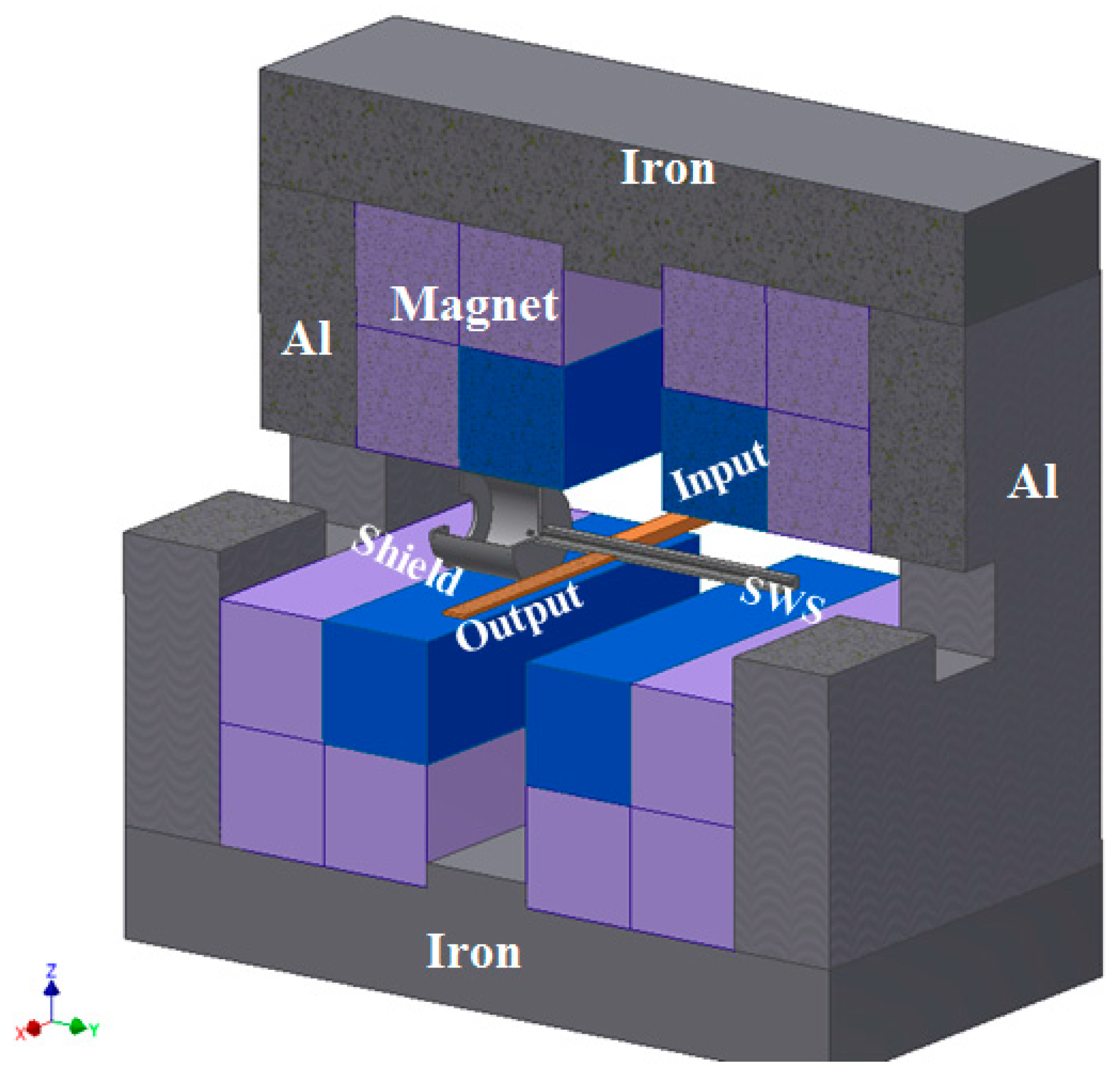
The magnetic system structure of the quadrupole permanent magnet focusing system, designed based on the above conditions, is shown in Figure 1, together with a shielded electron gun structure, which includes the composition (cathode, guide, anode, and slow wave structure) and connection structure (input and output waveguide) of the sheet beam TWT. The shell material of the electron gun is made of Fe-Co-Ni Kovar alloy (4J33), which has remarkable magnetism and can shield part of the magnetic field from entering the gun area. At the junction of the gun and the slow wave structure, a ring-shaped soft iron material component was adopted, which can shield the transverse magnetic field generated by the QPM system.
In terms of the transverse magnetic field, the device is placed in the center of the x direction and the y direction of the magnetic system. However, due to the manufacturing and assembling process of the magnets, the transverse magnetic field generated by the QPM system cannot be completely eliminated. Test results show that the maximum magnetic field along the x direction is 180 Gauss, while that along the y direction is 290 Gauss. Therefore, the annular soft iron material is used in the gun area of the device to shield the transverse magnetic field at the edge of the electron beam, and it can be predicted by the simulation result that only tens of Gauss remain in the transverse magnetic field in the gun area after shielding.
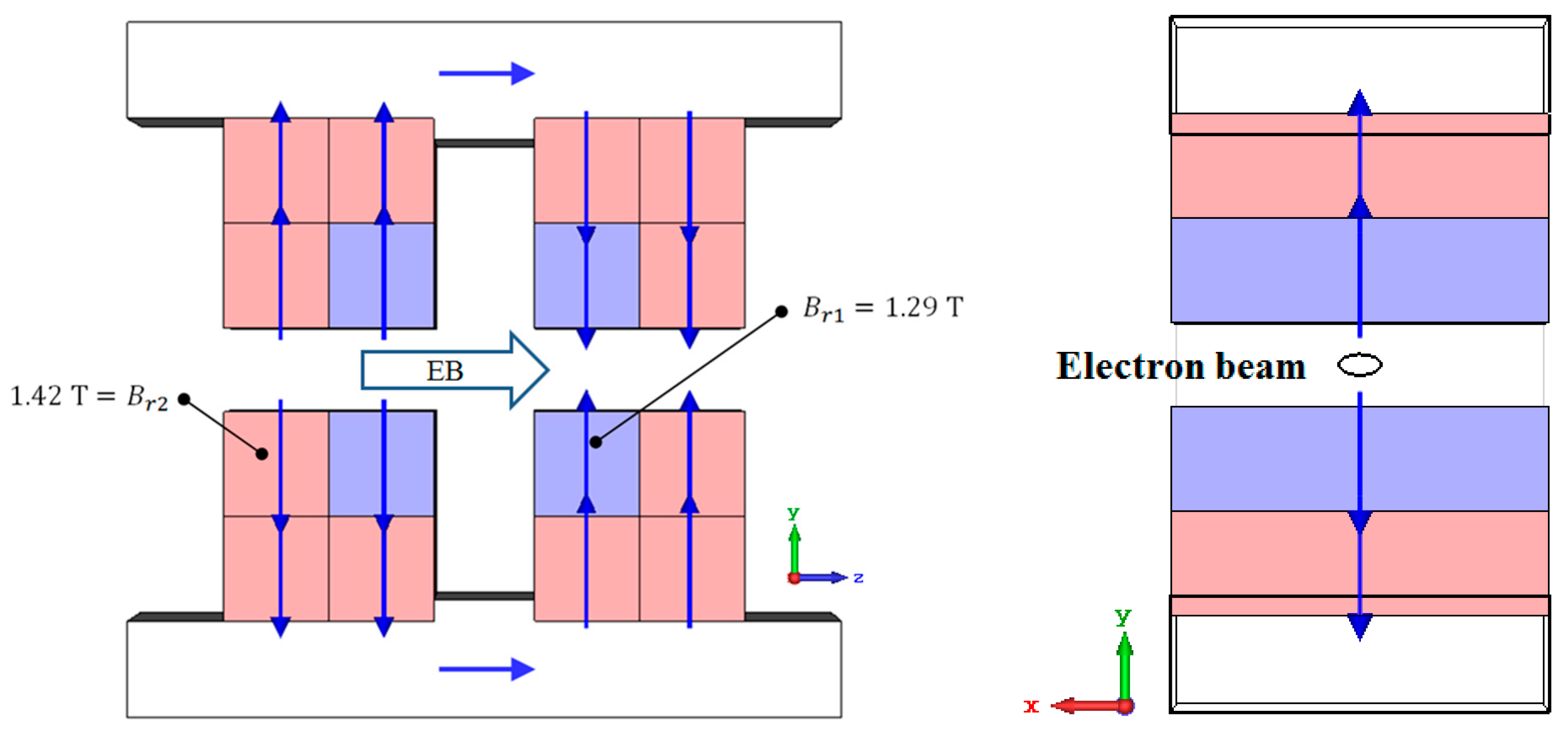
To maintain magnetic system structural stability, aluminum spacers are added between the magnetic poles, and aluminum partitions are set on both sides of two main magnets as shown in Figure 2. The schematic diagram of the sheet beam applied is shown in the right part, but actually, the beam size is too small to be recognized. Square holes are set in the partitions on both sides for the location of the terahertz devices, and the input and output structures can be connected from both sides of the magnetic system. To decrease the ripple of the magnetic field ( δ = B z max B z min B z ¯ × 100 % ) in the required strong magnetic region, two kinds of magnetic materials with residual magnetivities (Br) of 1.29 T and 1.42 T were selected. Taking into account Br, coercive force (Hc), maximum magnetic energy product (BH)max, and other indicators of permanent magnetic materials comprehensively, NdFeB materials with grades N42H and N50H are selected; Br is 1.28–1.32 T and 1.40–1.44 T, Hc is 955 kA/m and 1065 kA/m, and (BH)max is 318–334 kJ/m3 and 374–406 kJ/m3, respectively.
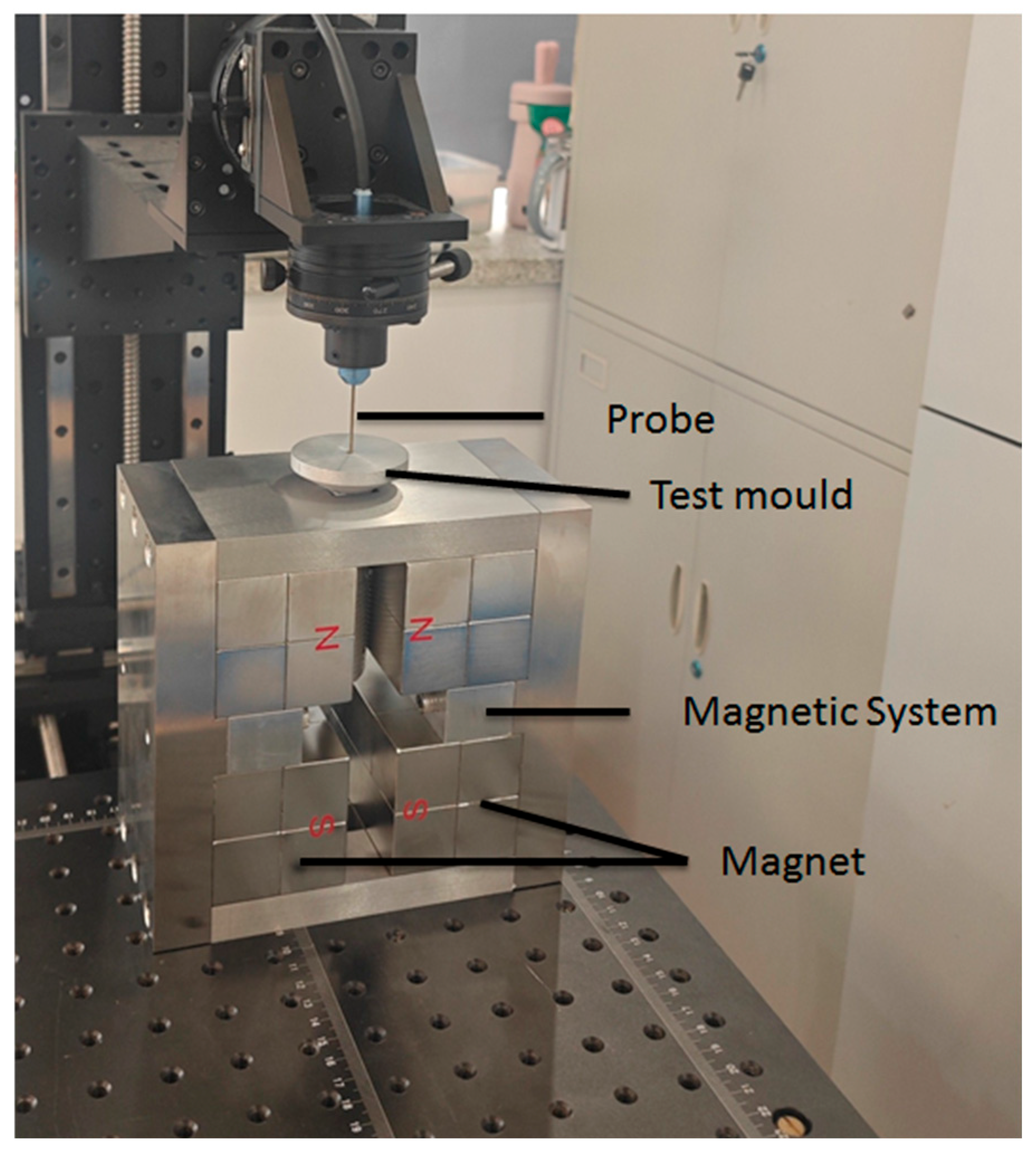
The designed magnetic system was assembled and tested. The test system of the magnetic system is shown in Figure 3. The total mass of this magnetic system (including magnets, iron, and aluminum structures) is approximately 10 kg. A magnetic field test mold that is compatible with the square hole was processed for the placement and positioning of the Gauss meter 3D-Hall-Sensor probe [20]. The probe was set through the x = 0, y = 0 line along the z direction, and the step length of the test along z direction is 0.1 mm.
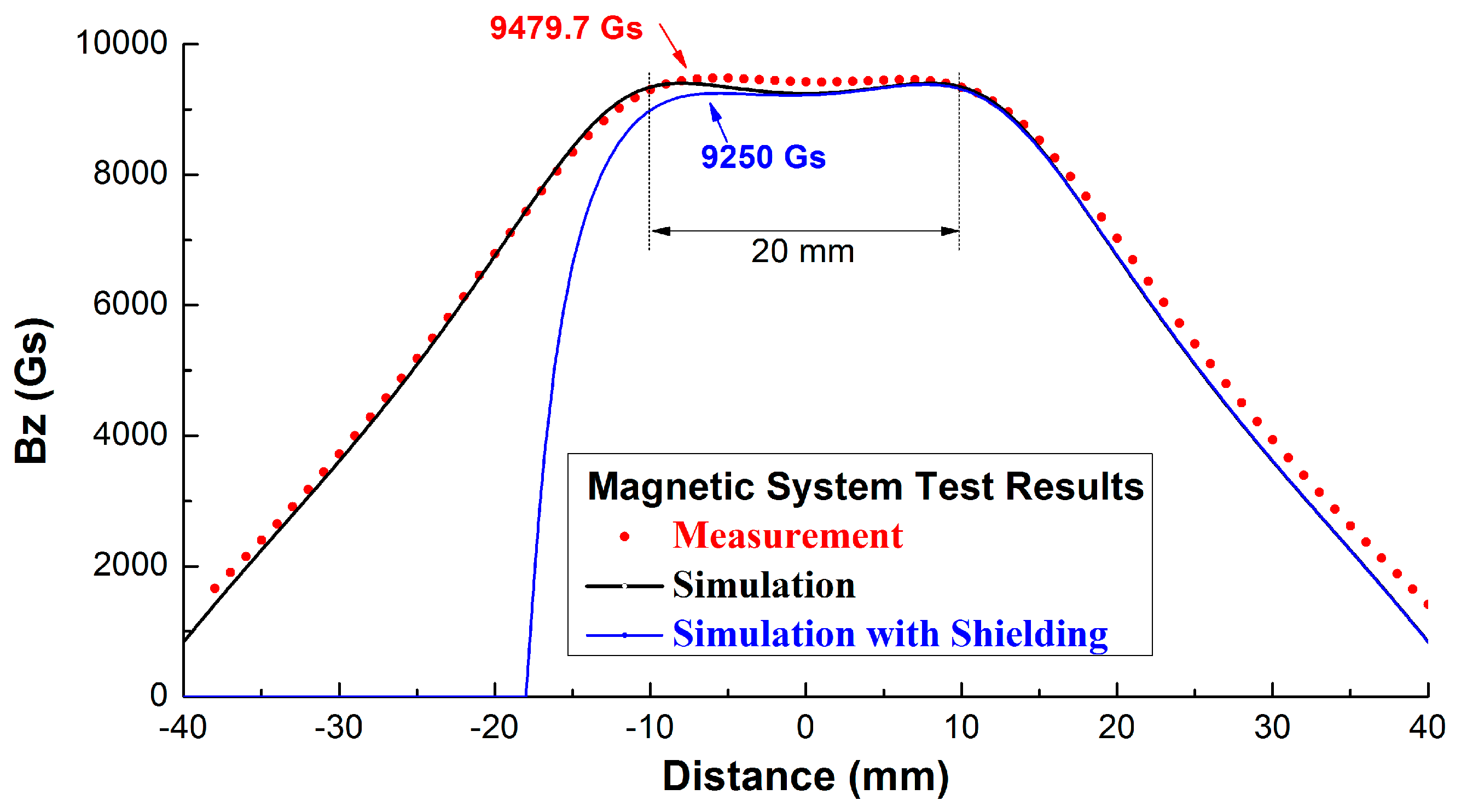
Figure 4 shows the comparison between the design results and the test results of the magnetic system along the z direction. The black line shows the designed magnetic field and the red dot shows the measured magnetic field. The blue line shows the magnetic field in the shielded electron beam tunnel. To improve the uniformity of the magnetic field in the main focusing area (B > 0.9 T), a slight compensation was made to the Br = 1.42 T magnets on both sides of the Br = 1.29 T magnets in Figure 2 during magnetization.
For the specific design strategy and the underlying mechanism, space must be reserved for the input and output systems of TWT, which leads to a disconnection area in the system. Thus, a “valley” will exist in the middle of the magnetic field, as shown in Figure 4 (z = 0). Instead of one magnetic field loop in the traditional system, two kinds of residual magnetivities materials are used to improve the uniformity of the magnetic field. When two kinds of NdFeB materials with different residual magnetivities are used, an additional auxiliary magnetic field loop is constructed inside the main magnetic field loop, which can make up for the disconnection effect in the space area and improve the “valley”, making the magnetic field uniform area longer.
The error is caused by the manufacturing and assembling of the magnetic system. The whole magnetic system is formed by splicing such that the magnetic declination angle of each magnet cannot be completely horizontal or vertical, and so, a deviation of about 5% is produced, which meets our expectations. Because of the “valley” in the magnetic field, the electron beam will expand slightly at the “valley” point; the expansion in the x direction is about 1.8%, while that in the y direction is about 8.7%. The final result shows that the expanded beam can travel through the beam channel, with some under-control fluctuations.
This also results in the measured values in the non-main focusing area in Figure 5 being slightly larger than the designed ones. The test results show that within a uniform length of 24.5 mm, the ripple of the magnetic field ( δ = B z max B z min B z ¯ × 100 % = 0.94797 0.93011 0.94391 × 100 % ) is less than 4.9%.

3. Simulation of Sheet Electron Beam Transmission

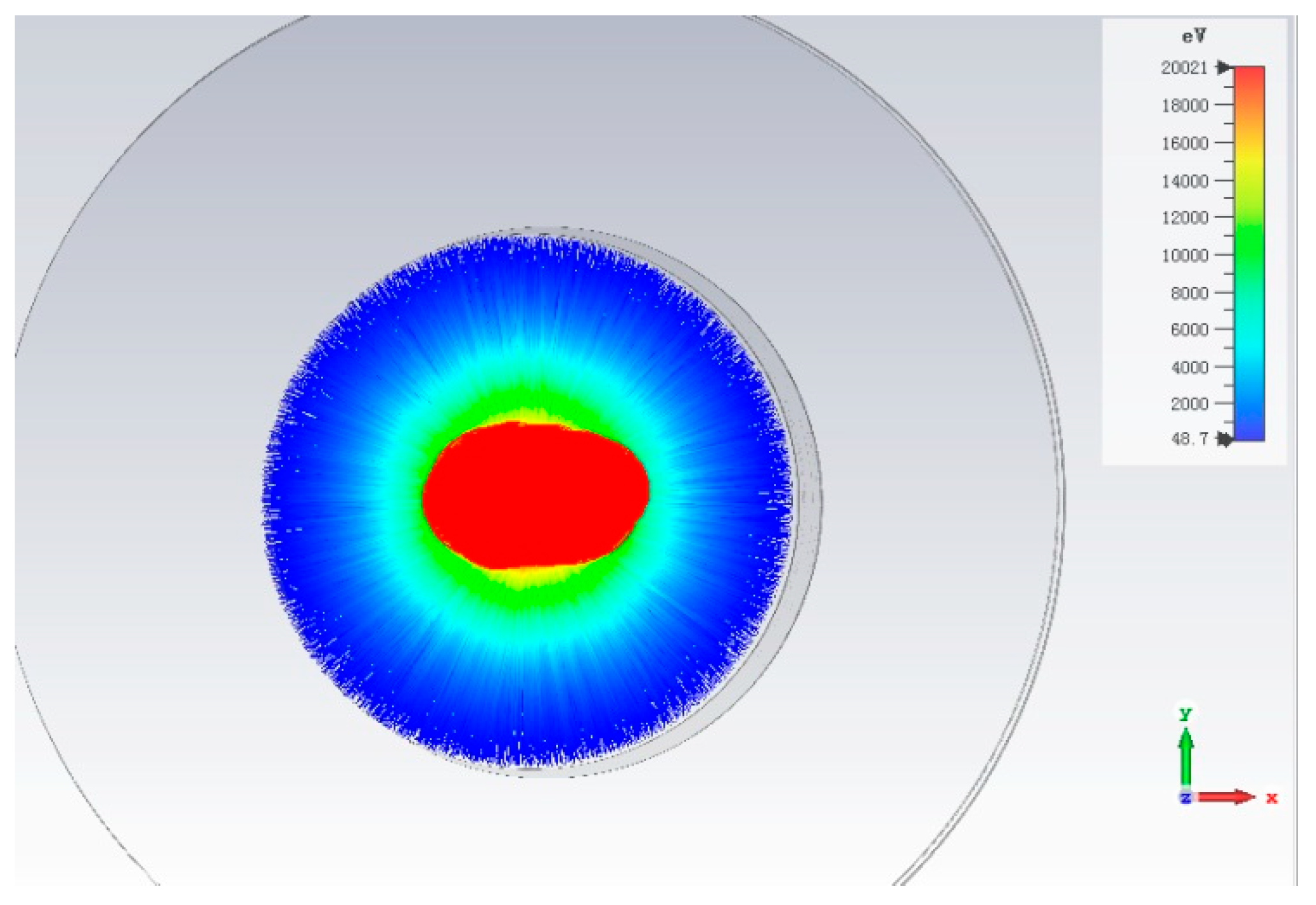
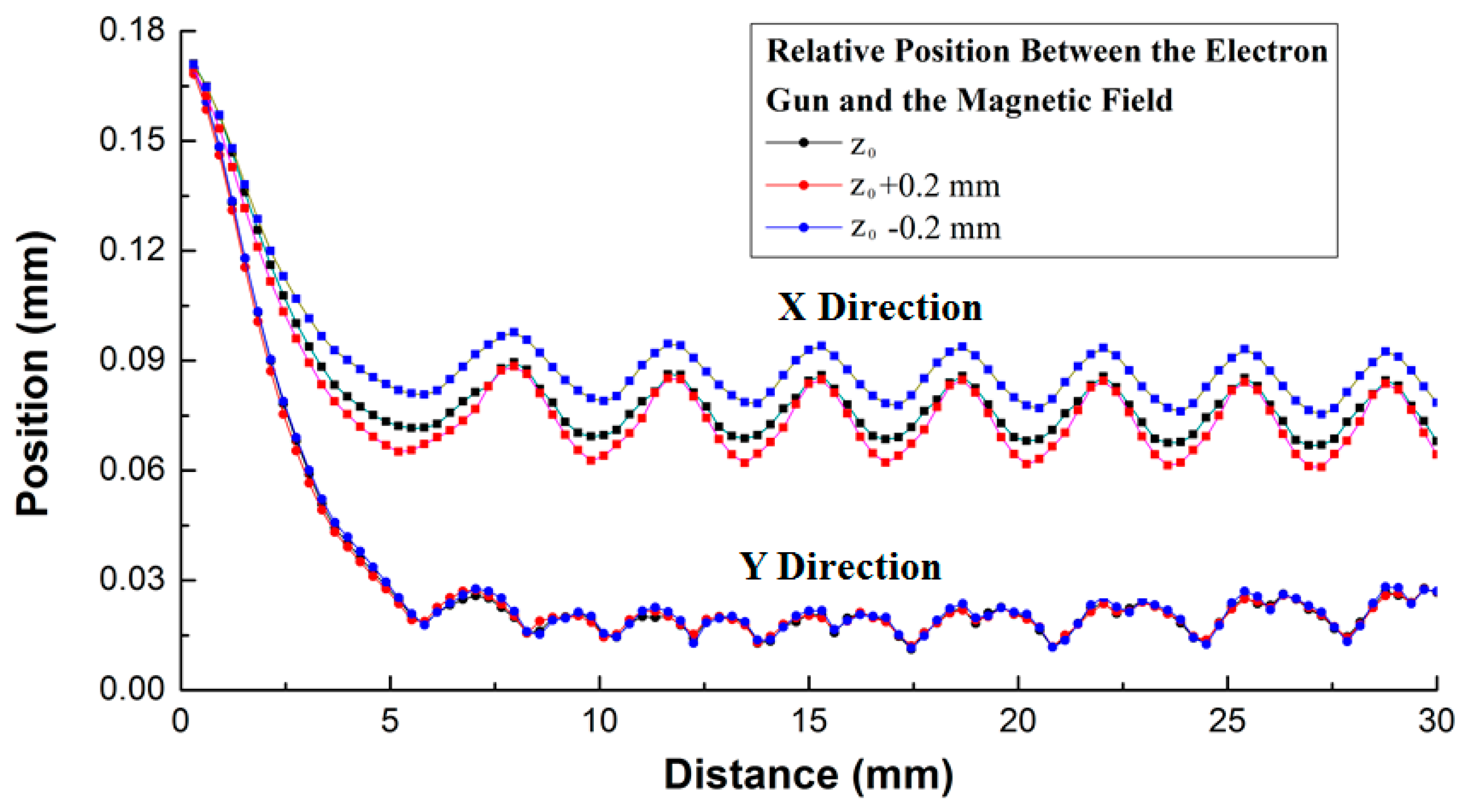
The transmission process of the sheet electron beam applied (20 kV, 15 mA) in this magnetic system was calculated through a tracking module. Figure 5 shows the electron beam trajectory in a PIC simulation. The long edge of the sheet beam is along the x direction, while the short edge of the beam is along the y direction, corresponding with the directions of the QPM system. The envelope of the beam trajectory is shown in Figure 6, whereby z0 is the exact device position set, and the other two lines show the envelope of the beam trajectory when the device is set ±0.2 mm shift away from the exact position along the z direction. The simulation results show that the sheet electron beam can be stably transmitted in the focusing magnetic system with relatively small fluctuations and that it has good laminar flow characteristics, with a transmission ratio of 98.5%.
For the direction of the electron beam transmission, the magnetic field in the electron gun area and the magnetic field outside the gun have great changes under the action of the magnetic shield of the gun. When traveling through the anode, the electrons will be immediately converged by a strong magnetic field, as shown in Figure 4. The strong magnetic compression will make the electrons instantly converge, leading to the primary compression of the electron beam, and the beam is limited in the beam tunnel. Similar design methods can be found in the documents [21,22,23].

4. Conclusions

A QPM focusing system for terahertz sheet electron beam devices was developed. Based on the analysis results, the structure of the quadrupole magnetic focusing system and the parameters of the magnets were designed and tested, and the simulation of the beam transmission process was completed. The test results show that within a uniform length of 24.5 mm, the ripple of the magnetic field along the axial direction is less than 4.9%, which enables the focusing of the sheet electron beam at an operating voltage of 20 kV and a current of 15 mA, which verifies the feasibility of focusing sheet electron beams in a quadrupole magnetic system and lays a foundation for the subsequent development of terahertz sheet electron beam devices.

Author Contributions

Writing—original draft, S.S.; Writing—review and editing, K.Z.; Investigation, Y.L.; Resources, P.P.; Project administration, J.F. All authors have read and agreed to the published version of the manuscript.

Funding

This work was funded by the National Natural Science Foundation of China (No. 62131006).

Data Availability Statement

The original contributions presented in this study are included in the article. Further inquiries can be directed to the corresponding author.

Conflicts of Interest

The authors declare no conflicts of interest.

References

  1. Yu, X.; Jia, S.; Hu, H.; Galili, M.; Morioka, T.; Jepsen, P.U.; Oxenløwe, L.K. 160 Gbit/s Photonics Wireless Transmission in the 300–500 GHz Band. Apl Photonics 2016, 1, 371–380. [Google Scholar] [CrossRef]
  2. Petrov, V.; Pyattaev, A.; Moltchanov, D.; Koucheryavy, Y. Terahertz Band Communications: Applications, Research Challenges, and Standardization Activities. In Proceedings of the International Congress on Ultra Modern Telecommunications and Control Systems and Workshops, Lisbon, Portugal, 18–20 October 2016; pp. 183–190. [Google Scholar]
  3. Angrisani, L.; Bonavolontà, F.; Moriello, R.S.L.; Andreone, A.; Casini, R.; Papari, G.; Accardo, D. First Steps Towards an Innovative Compressive Sampling Based-THz Imaging System for Early Crack Detection on Aerospace Plates. In Proceedings of the Metrology for Aerospace 2014, Benevento, Italy, 29–30 May 2014. [Google Scholar]
  4. Tucek, J.C.; Basten, M.A.; Gallagher, D.A.; Kreischer, K.E. Operation of a compact 1.03 THz power amplifier. In Proceedings of the 2016 IEEE International Vacuum Electronics Conference (IVEC), Monterey, CA, USA, 19–21 April 2016. [Google Scholar] [CrossRef]
  5. Cusick, M.; Atkinson, J.; Balkcum, A.; Caryotakis, G.; Gajaria, D.; Grant, T.; Meyer, C.; Lind, K.; Perrin, M.; Scheitrum, G.; et al. X-band sheet beam klystron (XSBK). In Proceedings of the 2009 IEEE International Vacuum Electronics Conference, Rome, Italy, 28–30 April 2009; pp. 296–297. [Google Scholar]
  6. Zhao, D.; Lu, X.; Liang, Y.; Yang, X.; Ruan, C.; Ding, Y. Researches on an X-band sheet beam klystron. IEEE Trans. Electron Devices 2014, 61, 151–158. [Google Scholar] [CrossRef]
  7. Pasour, J.; Wright, E.; Nguyen, K.T.; Balkcum, A.; Wood, F.N.; Myers, R.E.; Levush, B. Demonstration of a multikilowatt, solenoidally focused sheet beam amplifier at 94 GHz. IEEE Trans. Electron Devices 2014, 61, 1630–1636. [Google Scholar] [CrossRef]
  8. Booske, J.H.; Radack, D.J.; Antonsen, T.M.; Bidwell, S.W.; Carmel, Y.; Destler, W.W.; Freund, H.P.; Granatstein, V.L.; Latham, P.E.; Levush, B.; et al. Design of high-average-power near-millimeter free electron laser oscillators using short period wigglers and sheet electron beams. IEEE Trans. Plasma Sci. 1990, 18, 399–415. [Google Scholar] [CrossRef][Green Version]
  9. Zhang, C.; Feng, J.; Cai, J.; Pan, P.; Su, S.; Gong, Y. Focusing of the Sheet Electron Beam With Two-Plane Periodic Cusped Magnetic System for Terahertz TWTs. IEEE Trans. Electron Devices 2021, 68, 3056–3062. [Google Scholar] [CrossRef]
  10. Electronic Tube Design Handbook Editorial Committee. Microwave Electron Tube Magnetic Circuit Design Handbook; National Defense Industry Press: Beijing, China, 1984. [Google Scholar]
  11. Mihara, T.; Iwashita, Y.; Kumada, M.; Spencer, C.M. Variable Permanent Magnet Quadrupole. IEEE Trans. Appl. Supercond. 2006, 16, 224–227. [Google Scholar] [CrossRef]
  12. Zhou, Z.; Sheng, K.; Zou, J.; Chen, T.; Huang, J. Study of irregular electron beam correcting permanent-magnet-quadrupole doublet lens for irradiation accelerator. Rev. Sci. Instrum. 2023, 94, 023301. [Google Scholar] [CrossRef] [PubMed]
  13. Yan, Y.; Cheng, H.; Li, Y.; Fang, Y.; Xia, Y.; He, Q.; Li, C.; Li, F.; Guo, Z.; Yan, Y.; et al. High transmission efficiency collection system for laser-accelerated proton beams based on permanent magnet quadrupoles prefocusing. Phys. Rev. Accel. Beams 2024, 27, 052801. [Google Scholar] [CrossRef]
  14. Tarvainen, O.; Toivanen, V.; Kalvas, T.; Koivisto, H.A.; Kosonen, S. Bremsstrahlung Emission of an X-Band Permanent Magnet Minimum-B Quadrupole Electron Cyclotron Resonance Ion Source. IEEE Trans. Plasma Sci. 2024, 52, 753–762. [Google Scholar] [CrossRef]
  15. Dong, S.; Zhang, B.; Feng, G. Development of a new type adjustable strength permanent quadrupole magnet. Nucl. Instrum. Methods Phys. Res. Sect. Accel. Spectrometers Detect. Assoc. Equip. 2025, 1072, 170111. [Google Scholar] [CrossRef]
  16. Antokhin, E.I.; Eliseev, V.S.; Zuev, V.V.; Mikayilov, A.I.; Butsykina, M.D.; Pakhomov, A.Y.; Zhilyaev, K.V.; Vostrikov, V.A.; Derbysheva, T.R. Permanent Magnet Quadrupole for the Final Focus. Sib. J. Phys. 2024, 19, 72–80. [Google Scholar] [CrossRef]
  17. Dong, S.X.; Li, B.; Zhang, B.S.; Wang, X.Q.; Feng, G.Y. Design of A Permanent Quadrupole Magnet with Adjustable Magnetic Field Gradient. J. Phys. Conf. Ser. 2024, 2687, 022029. [Google Scholar] [CrossRef]
  18. Zeng, C.; Xue, Y.; Du, C. Preliminary design of reverse permanent magnet guidance system for E-type waveguide oscillator. High Power Laser Part. Beams 2023, 35, 073002. [Google Scholar]
  19. Du, G.; Qian, B. The Space-Charge Limiting Current of a Sheet Relativistic Electron Beam in a Rippled Rectangular Waveguide. Phys. Plasmas 2009, 16, 083106. [Google Scholar] [CrossRef]
  20. Heyder, A.; Tenner, M.; Meyer, A.; Abersfelder, S.; Franke, J. Magnetic stray field measurement of magnetic specimen. In Proceedings of the 2016 6th International Electric Drives Production Conference (EDPC), Nuremberg, Germany, 30 November–1 December 2016; pp. 312–316. [Google Scholar]
  21. Wang, J.; Wan, Y.; Li, X.; Liu, Q.; Li, H.; Yao, Y.; Zheng, Q.; Wu, Z.; Jiang, W.; Liu, G.; et al. Continuous wave operation of a ka-band broadband high-power sheet beam traveling-wave tube. IEEE Electron Device Lett. 2021, 42, 1069–1072. [Google Scholar] [CrossRef]
  22. Li, X.; Wang, J.; Wan, Y.; Jiang, W.; Wu, Z.; Liu, G.; Luo, Y. A wideband high-voltage longitudinal output structure for ka-band sheet beam traveling-wave tubes. IEEE Trans. Microw. Theory Tech. 2021, 69, 2042–2047. [Google Scholar] [CrossRef]
  23. Yin, P. Research on the Sheet Electron Beam Optical System of Traveling Wave Tube. Ph.D. Thesis, University of Electronic Science and Technology of China, Chengdu, China, 2022. [Google Scholar]
Figure 1. The structural diagram of the magnetic system. Purple and blue for magnets, gray for iron and aluminum. The shielded electron gun structure, which includes cathode, guide, anode, slow wave structure, and connection structure (input and output waveguide) of the sheet beam TWT.
Electronics 15 01174 g001
Figure 2. Magnetism parameter diagram of the magnetic system. The residual magnetism of the pink part of the magnet is 1.42 T, and that of the blue part is 1.29 T. The schematic diagram of the sheet beam is shown in the right part; long edge along x direction, short edge along y direction.
Electronics 15 01174 g002
Figure 3. The test setup of the QPM system.
Electronics 15 01174 g003
Figure 4. Comparison of designed (black line) and measured (red dot) magnetic fields. The blue line shows the magnetic field in the shielded electron beam tunnel.
Electronics 15 01174 g004
Figure 5. The cross section of the electron beam trajectory in tracking module.
Electronics 15 01174 g005
Figure 6. The envelope of the beam trajectory in the quadrupole magnetic focusing system. z0 is the exact device position set (black squares), and the other two lines (blue and red squares) show the envelope of the beam trajectory when the device is set ±0.2 mm shift away from the exact position along z direction.
Electronics 15 01174 g006
Disclaimer/Publisher’s Note: The statements, opinions and data contained in all publications are solely those of the individual author(s) and contributor(s) and not of MDPI and/or the editor(s). MDPI and/or the editor(s) disclaim responsibility for any injury to people or property resulting from any ideas, methods, instructions or products referred to in the content.