1. Introduction
With the continuous development of renewable energy technologies, the generation costs of various renewable energy sources such as photovoltaic (PV) and wind power have rapidly decreased, which has significantly promoted the penetration of renewable energy in power systems [
1,
2]. However, the large-scale integration of renewable energy has brought considerable challenges to voltage stability of power systems. The power output of renewable energy sources is highly affected by natural environmental conditions, exhibiting pronounced randomness and intermittency, which may result in reactive power imbalance and voltage violations [
3,
4,
5].
Traditional reactive power support technologies mainly rely on conventional reactive power compensation devices, such as on-load tap-changing transformers, shunt capacitors, shunt reactors, static var compensators (SVCs), and static synchronous compensators (STATCOMs), to regulate system voltage [
6]. In practical applications, fixed-value control, stepwise control, and time-based control strategies are commonly adopted to maintain voltage stability of the power grid. Although these methods feature simple control structures and mature engineering implementation, their response speed is relatively slow, and both the regulation range and accuracy are limited, making them inadequate for coping with the rapid voltage fluctuations caused by renewable energy integration.
Compared with conventional voltage support schemes based on dedicated reactive power compensation devices, renewable energy sources are capable of operating not only in maximum power point tracking (MPPT) mode but also as power-controllable flexible resources [
7], which provides new possibilities for supporting stable operation of power grids. The development and application of renewable energy grid-connected systems based on virtual synchronous generator (VSG) technology serve as a representative example of this approach [
8,
9]. However, such voltage control strategies are typically implemented using a single type of renewable energy generation unit, whose regulation capability is inherently limited and highly dependent on installation locations and environmental conditions, thereby making it difficult to achieve globally optimal voltage support at the system level [
10,
11].
To further enhance voltage support in power grids with high renewable penetration, a variety of optimization algorithm-based multi-resource coordinated voltage support strategies have been proposed in recent years [
12,
13,
14,
15,
16,
17]. With the rapid advancement of artificial intelligence, data-driven approaches such as deep learning (DL) and reinforcement learning (RL) have attracted growing attention in power system optimization. Wu and Liu developed a DL-based fast generation method for multi-objective reactive power optimization, achieving a 7.7% reduction in line losses and a 0.38% reduction in voltage deviation on the IEEE 33-bus system [
12]. Shen et al. proposed a reactive power optimization method that combines EV charging load forecasting with a DDQN framework on the IEEE 33-bus system; this method reduced the average network loss from 0.3799 MW to 0.1696 MW and achieved a voltage-deviation improvement rate of 67.81% [
13]. However, these methods typically depend on large historical datasets and entail high training costs. Consequently, frequent retraining is often required as network operating conditions and model parameters vary over time, which limits their direct deployment in practical distribution networks. In parallel, emerging bio-inspired intelligent algorithms have also received increasing research interest. Kamel et al. applied multi-objective whale optimization algorithms (WOA) to distributed generation planning on the IEEE 33- and 69-bus systems. For the IEEE 33-bus case, active power loss decreased from 202.67 kW to 76.72 kW, while voltage deviation was reduced from 0.1171 p.u. to 0.0045 p.u. [
14]. Alabi et al. applied WOA to the Nigerian Malali 34-bus distribution network, reducing active power loss from 111.6 kW to 26.13 kW, representing a 76.91% reduction, and increasing the minimum bus voltage from 0.95 p.u. to 0.98 p.u. [
15]. Nevertheless, WOA still faces challenges in balancing global exploration and local exploitation, handling high-dimensional discrete decision variables, and achieving high computational efficiency. Classical evolutionary algorithms such as genetic algorithms (GA) have also been widely investigated. Barrera et al. employed GA for the optimal sizing and siting of capacitor banks in the IEEE 33-bus distribution network for reactive power compensation, increasing the minimum bus voltage from 0.929 p.u. to 0.939 p.u. while reducing active power losses by approximately 25% [
16]. However, slow convergence and sensitivity to parameter settings often prevent GA from meeting the real-time requirements of fast voltage support. In contrast, particle swarm optimization (PSO), owing to its fast convergence and relatively few tuning parameters, has become one of the most widely used benchmark algorithms in the IEEE power systems literature. For example, Asabere et al. employed PSO to determine the placement and sizing of reactive power compensation devices in a distribution network, increasing the minimum bus voltage from 0.817 p.u. to 0.95 p.u. and reducing active power losses by 58.7% [
17], thereby demonstrating the effectiveness of PSO for voltage support and loss minimization.
However, practical deployment remains challenging due to the heterogeneity, scale, and coupling of controllable resources in modern distribution systems [
18]. This leads to a high-dimensional and nonconvex reactive power allocation problem that typically involves both continuous and discrete control variables, making fast and reliable system-wide regulation difficult, particularly under renewable generation uncertainty [
19,
20]. In addition, existing optimization-algorithm-based voltage support schemes still face the problems of inconsistent solution quality due to random initialization and a lack of adaptive parameter adjustment capability, which limits their application in rapid voltage support [
21].
Motivated by these issues, this paper proposes a multi-resource cooperative voltage support strategy based on an improved PSO algorithm. A sensitivity-matrix-guided initialization strategy is developed to improve feasibility and accelerate early-stage convergence, and an adaptive parameter adjustment mechanism is introduced to enhance search efficiency and robustness. The proposed method enables efficient reactive power allocation among multiple resources, reduces system losses, and improves nodal voltage profiles in renewable-rich power grids.
The remainder of this paper is organized as follows:
Section 2 presents the optimization model,
Section 3 describes the improved PSO algorithm,
Section 4 provides simulation results, and
Section 5 concludes the paper.
2. Reactive Power Optimization Model of Distribution Networks with Multi-Type Controllable Resources
To achieve cooperative voltage support in distribution networks with the participation of multi-type controllable resources, it is necessary to first establish a reactive power optimization model that considers operational constraints and optimization objectives, which serves as the basis for subsequent solution using optimization algorithms.
The operational constraints ensure that power flow balance, node voltage limits, and reactive power capacity limits are satisfied, while the optimization objective is to minimize voltage deviations and network losses through optimal reactive power allocation among multiple controllable resources. Mathematically, the reactive power optimization objective can be formulated as:
where
Q represents the decision variable vector,
F(
Q) is the comprehensive fitness function;
ffeas denotes the voltage feasibility penalty term;
fdev represents the voltage deviation sub-objective;
floss denotes the network loss sub-objective;
wv and
wl are the weighting coefficients for voltage deviation and network loss, respectively.
2.1. Operational Constraints and Power Flow Equations
In the constructed reactive power optimization model, system operation must satisfy power flow balance relationships as well as operational constraints on node voltages and controllable resource outputs.
According to [
22], the steady-state operation of a distribution network must satisfy nodal power balance conditions. The apparent power balance at node
i can be expressed as:
where
Si,
Pi, and
Qi denote the apparent power, active power, and reactive power at node
i, respectively; and
and
represent the voltage and current phasors at node
i.
This equation establishes the fundamental relationship between power flow and electrical quantities at each node based on the principle of energy conservation. The apparent power Si is expressed as the product of the voltage phasor and the conjugate of the current phasor, which can be decomposed into the active power Pi representing the real power transfer and the reactive power Qi representing the power oscillation between inductive and capacitive elements. This formulation serves as the basis for deriving the detailed power flow equations in the subsequent analysis.
Based on this, nodal active and reactive power balance equations are introduced to characterize the nonlinear relationship between nodal power injections and network voltage states according to [
23], which can be expressed as:
where
Gij and
Bij are the real and imaginary parts of the elements of the nodal admittance matrix, respectively;
θij denotes the voltage phase angle difference between node
i and node
j;
N represents the set of system nodes.
These equations represent the standard AC power flow equations that govern the steady-state behavior of the distribution network. The active power Pi and reactive power Qi at each node are determined by the summation of power flows from all connected nodes, which depend on voltage magnitudes, phase angle differences, and network admittance parameters. The nonlinear nature of these equations arises from the trigonometric functions and voltage magnitude multiplications, ensuring that power injections from controllable resources are balanced with power flows through network branches.
- 2.
Node Voltage Constraints
To satisfy power quality standards and ensure safe operation of electrical equipment, the voltage magnitude at each node must be constrained within an allowable range, which can be expressed as:
where
Vi,min and
Vi,max denote the minimum and maximum allowable voltage magnitudes at node
i, respectively.
This constraint ensures that all nodal voltages remain within the permissible operating range to prevent equipment damage and maintain power quality.
- 3.
Reactive Power Capacity Constraints
The reactive power output capability of controllable reactive power resources is limited by their physical capacities. To prevent equipment overloading, the reactive power output must satisfy the following constraint:
where
QG,i denotes the reactive power output of the controllable resource at node
i;
Qi,min and
Qi,max represent the lower and upper limits of reactive power output of the resource, respectively;
R denotes the set of nodes equipped with controllable reactive power resources.
This constraint ensures that each controllable resource operates within its rated capacity limits, preventing equipment damage and ensuring safe operation.
2.2. Multi-Objective Optimization Function
Under the above constraints, a multi-objective fitness function that simultaneously considers voltage quality and network losses is constructed. The fitness function consists of a voltage feasibility penalty term, a voltage deviation term, and a network loss term, which together guide the particle swarm search.
First, a voltage feasibility sub-objective function is introduced to quantify the degree to which nodal voltages deviate from the acceptable range, which can be expressed as:
where
Vi denotes the actual voltage at node
i. When
Vi exceeds the allowable limits, a quadratic penalty is imposed on the violation magnitude to ensure voltage feasibility with higher priority.
Based on the voltage feasibility requirement, a voltage deviation sub-objective function is further introduced to characterize the deviation of the overall system voltage level from the reference voltage, which can be expressed as:
where
Vref denotes the reference voltage;
kover represents the weighting coefficient for overvoltage deviation. Considering the adverse impact of overvoltage operation on equipment safety, a higher weight is assigned to overvoltage deviation in the objective function.
If voltage deviation alone is adopted as the optimization objective, excessive reactive power regulation may occur, which can increase line currents and consequently aggravate active power losses in the network. To achieve coordinated optimization between voltage quality and operational efficiency, a network loss sub-objective function is introduced, which can be expressed as:
where
εon denotes the set of effective branches considered in the loss calculation;
Psend,ℓ and
Precv,ℓ represent the active power at the sending and receiving ends of branch
ℓ, respectively.
3. Reactive Power Optimization Solution Method Based on Improved PSO
In view of the nonlinear, high-dimensional, and strongly constrained characteristics of the above reactive power optimization model, an improved solution method based on PSO is designed.
3.1. Principle of the Standard PSO Algorithm
PSO is a population-based swarm intelligence method that searches for an optimal solution by iteratively updating particle positions in the solution space. In this study, each particle represents a candidate solution for reactive power optimization, and its position vector collects the reactive power decision variables of controllable resources.
The search process of PSO is realized through iterative updates of particle positions and velocities, and the standard update equations are given as follows:
where
vi,t and
vi,t+1 denote the velocity vectors of particle
i at iterations
t and
t + 1, respectively;
xi,t and
xi,t+1 denote the position vectors of particle
i at iterations
t and
t + 1, respectively;
ω represents the inertia weight;
c1 and
c2 denote the cognitive learning factor and social learning factor, respectively;
r1 and
r2 are random numbers uniformly distributed in the interval [0, 1]; and
pbest,i,t and
gbest,t represent the personal best position of particle
i and the global best position of the swarm, respectively.
Particle positions represent candidate solutions, while velocities control the search direction and step size. At each iteration, particles update their velocities and positions based on the personal best and global best solutions, and the fitness function is evaluated to update these best values. This iterative process continues until convergence to an optimal or near-optimal solution.
3.2. Design of the Improved PSO Algorithm
The standard PSO algorithm tends to suffer from premature convergence and local optimality in high-dimensional, highly constrained, and multi-modal optimization problems. To address the characteristics of high-dimensional decision variables and nonlinear constraints in the reactive power optimization of multi-type controllable resources, this paper improves the PSO algorithm in four aspects—initialization, parameter adaptation, diversity maintenance, and constraint handling with boundary repair—to enhance global search capability and convergence stability.
3.2.1. Sensitivity-Matrix-Guided Initialization Strategy
The standard PSO algorithm typically uses a uniform random method to initialize particle positions and velocities. While simple to implement, this approach can lead to particle concentration in local regions in high-dimensional or multi-modal problems, thereby reducing the coverage ability of the initial population in the solution space and increasing the risk of the algorithm falling into local optima.
Therefore, to enhance the targeting of the initialization phase, this paper introduces a sensitivity-matrix-guided initialization method. First, a reference point,
xref, is selected, and the system response is linearized within its neighborhood to obtain the sensitivity matrix:
where
x represents the decision variable vector to be optimized;
y represents the response vector related to the optimization objective; and
S is the sensitivity matrix.
Since the analytical expression for sensitivity is difficult to solve directly, the finite difference method is used to approximate the sensitivity calculation:
where
Skd represents the sensitivity of the
k-th response to the
d-th decision variable;
δ is the perturbation step size;
ed is the unit vector in the
d-th dimension.
To characterize the relative impact of different decision variables on system responses, this paper defines the comprehensive sensitivity index as the 2-norm of the corresponding column vector of the sensitivity matrix for each decision variable:
where
Sd is the sensitivity vector of the
d-th decision variable to all system responses.
Based on this, a normalized weighting coefficient is introduced:
where
αd is the weight coefficient for the
d-th decision variable;
ε is a small positive number to prevent division by zero. A larger
αd indicates that the variable has a more significant impact on the key response and thus should receive more perturbation during initialization. Conversely, a smaller
αd indicates less disturbance to reduce ineffective exploration.
Based on this weighting mechanism, the initial position of each particle is generated by perturbing the reference point neighborhood according to the sensitivity-weighted disturbance:
where
is the initial position of particle
i in the
d-th dimension; and
Ld and
Ud are the lower and upper bounds of the
d-th variable.
η is the global disturbance coefficient within the range (0, 1] used to control the overall dispersion of the initial population. The value of
η directly affects the balance between exploration and exploitation in the initialization phase. When
η is adjacent to 0, the initial particles are highly concentrated around the reference point
xref with minimal diversity, which enables rapid convergence if
xref is near the optimal solution but increases the risk of being trapped in local optima. Conversely, when
η is adjacent to 1, the particles are distributed across the entire feasible domain with maximum dispersion, equivalent to traditional random initialization, which provides strong global exploration capability but may result in slower convergence. In this study, an intermediate value between 0 and 1 is selected to achieve a balance between leveraging sensitivity information and maintaining sufficient population diversity. clip(·) is the boundary clipping operator to ensure that the particle remains within the variable bounds.
This initialization strategy enhances the search efficiency in the early stages by maintaining diversity while strengthening the disturbance of key variables.
3.2.2. Time-Varying Adjustment Mechanism for Inertia Weight and Learning Factors
To balance global exploration and local convergence performance during the search process, this paper introduces a time-varying adjustment mechanism for the inertia weight ω and the learning factors c1,2.
The inertia weight
ω follows a nonlinear decay strategy:
where
t is the current iteration number;
T is the maximum number of iterations;
ωmin and
ωmax are the lower and upper bounds of the inertia weight; and
α is the nonlinear decay coefficient.
The parameters ωmin, ωmax, and α play crucial roles in controlling the search behavior of particles. The upper bound ωmax determines the initial exploration capability: a larger ωmax allows particles to maintain higher velocities and explore a wider search space but may lead to overshooting and oscillation around optimal solutions, while a smaller ωmax reduces exploration ability and may cause premature convergence. The lower bound ωmin controls the final exploitation intensity: a larger ωmin maintains stronger global search capability in later iterations but weakens local refinement, whereas a smaller ωmin enhances convergence precision but may reduce the ability to escape from local optima. The nonlinear decay coefficient α adjusts the transition speed from exploration to exploitation: a larger α results in rapid decay of inertia weight and early convergence, while a smaller α maintains exploration capability for more iterations at the cost of slower convergence. In this study, appropriate intermediate values are selected to balance global exploration in early iterations and local exploitation in later iterations.
This strategy maintains a larger inertia weight in the early stages of iteration to facilitate a broader search range. As the iterations progress, the inertia weight gradually decreases to enhance the particle’s convergence ability near the optimal region.
At the same time, the individual learning factor
c1 and the social learning factor
c2 follow a linear scheduling approach:
where
c1,min and
c1,max are the lower and upper bounds of the individual learning factor, respectively; and
c2,min and
c2,max are the lower and upper bounds of the social learning factor.
These learning factor bounds determine the balance between individual cognition and social cooperation. A larger c1 strengthens the particle’s reliance on its own experience, promoting independent exploration, while a smaller c1 increases dependence on swarm information. Conversely, a larger c2 enhances attraction toward the global best position, accelerating convergence but risking premature convergence, while a smaller c2 reduces swarm cooperation and may slow convergence. In this study, appropriate bounds are selected to ensure a smooth transition from individual-oriented exploration to swarm-based exploitation throughout the optimization process.
This parameter adjustment method allows particles to rely more on individual exploration in the early stages of the search, while gradually enhancing the cooperative effect of the swarm in later stages, thus ensuring a smooth transition in the search strategy.
3.2.3. Maintaining Swarm Diversity
During the iteration process of the particle swarm, as particles gradually converge toward the optimal solution region, the diversity of the swarm may significantly decrease, which can lead to the algorithm stagnating at a local optimum. To address this issue, a random disturbance mechanism is introduced during the algorithm’s iterations.
If the fitness improvement of
gbest over
τ consecutive generations is smaller than a threshold Δ
f, Gaussian disturbance is applied to the positions of some particles:
where
N(0,
σ2) denotes a Gaussian random disturbance with mean 0 and variance
σ2;
σ represents the disturbance strength.
The disturbance strength
σ decays gradually as the iterations progress to prevent excessive disturbance in later stages:
where
σ0 is the initial disturbance strength.
This mechanism effectively enhances the search diversity in the early stages of the algorithm while gradually reducing the disturbance amplitude in the later stages to avoid overly affecting the convergence process of the algorithm.
3.2.4. Constraint Handling and Boundary Repair Mechanism
During particle updates, the velocity and position may exceed the allowable range, leading to invalid fitness or oscillations. Therefore, this paper introduces constraint handling for both the velocity and position of the particles.
First, a velocity limiting strategy is applied to the particles:
where
κ is the velocity limiting coefficient, which follows a uniform distribution in the range (0, 1];
is the maximum allowed velocity for the
d-th dimension.
Next, a boundary repair strategy is applied to the particle positions. When a particle’s position exceeds the allowed range, it is clipped to the allowable limits to reduce the tendency of continuous boundary violations:
Through the above constraint and boundary handling strategies, the particle search process is effectively ensured to stay within the feasible region, improving the stability and robustness of the algorithm under complex constraint conditions.
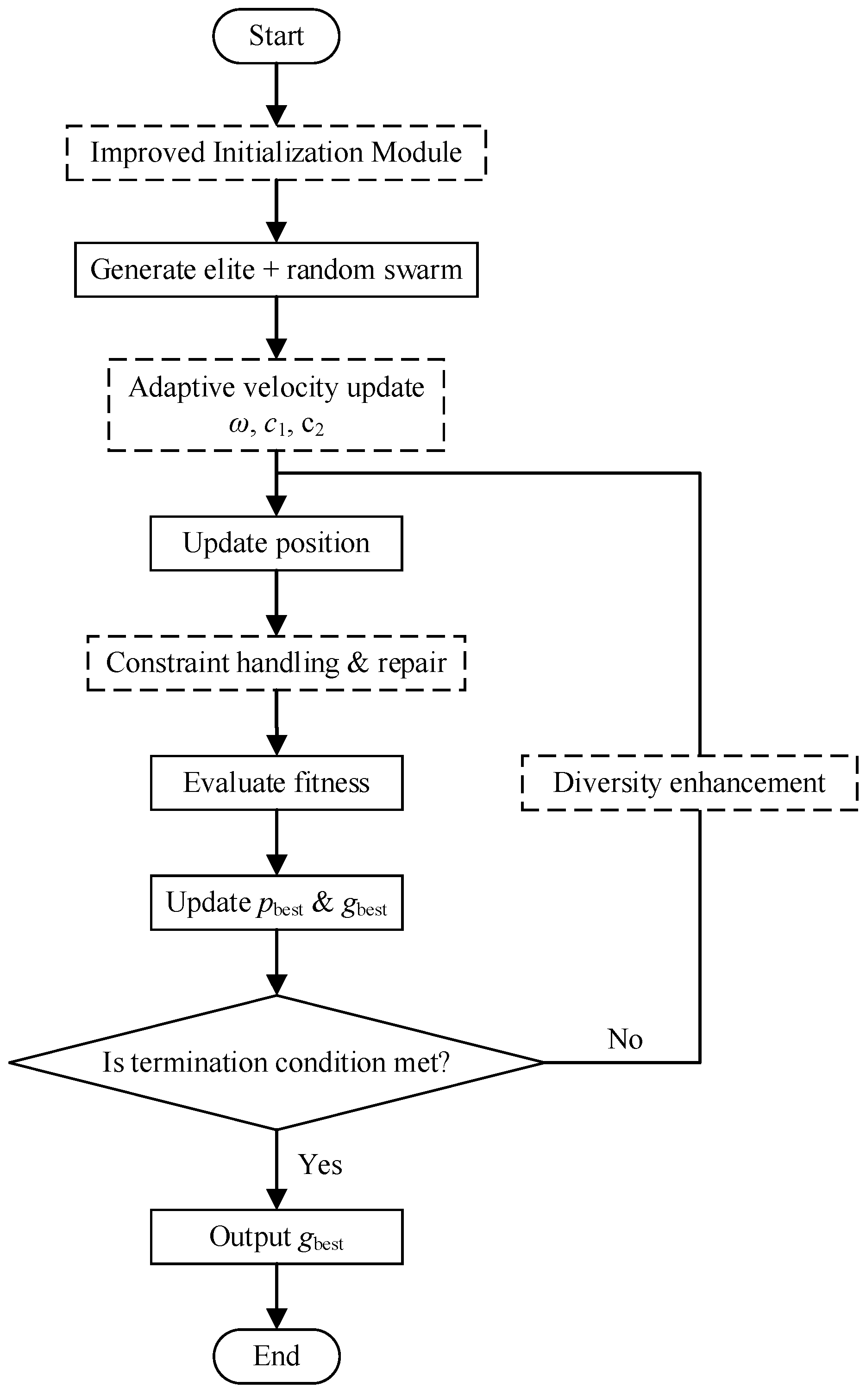
The flowchart of the improved PSO algorithm is shown in
Figure 1, where the dashed boxes indicate the improvement mechanisms introduced compared with the standard PSO.
4. Simulation and Results Analysis
To verify the effectiveness and applicability of the proposed multi-resource cooperative voltage support control strategy based on the improved particle swarm optimization algorithm, simulation studies are carried out on the MATPOWER platform using two IEEE standard distribution network test systems of different scales, namely the IEEE 33-bus and IEEE 69-bus networks. In the case studies, four types of controllable resources are integrated, including wind power, photovoltaic generation, energy storage systems, and voltage source converter-based high-voltage direct current (VSC-HVDC) transmission systems, thereby forming a multi-resource cooperative voltage support scenario.
To ensure a clear and progressive validation procedure, a two-stage evaluation framework is adopted: the proposed method is first tested on the smaller benchmark system to confirm its basic feasibility and effectiveness, and then further assessed on the larger system to provide a more rigorous evaluation, together with in-depth performance analysis and mechanism investigation.
4.1. IEEE 33-Bus Distribution Network Case Study
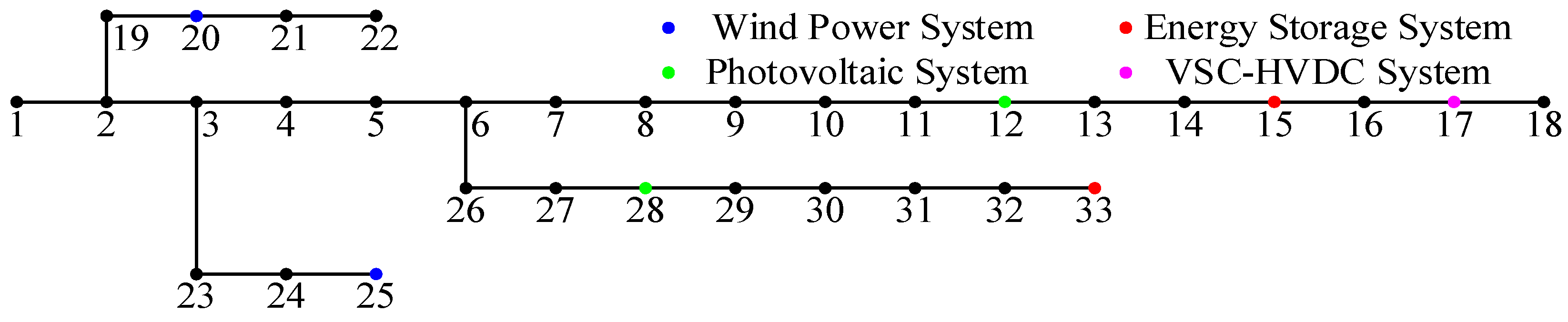
To begin with, the IEEE 33-bus distribution network is adopted as the test system, with a base voltage of 12.66 kV and a base power of 100 MVA. The network consists of 33 buses and 32 branches. The system topology and the installation locations of different controllable resources are shown in
Figure 2.
To reflect practical operating conditions of multi-resource coordinated control, all controllable resources except the energy storage system are operated with fixed active power outputs. The relevant parameters are listed in
Table 1.
The main parameter settings of the improved PSO algorithm used in the simulations are given in
Table 2.
Based on the above simulation setup,
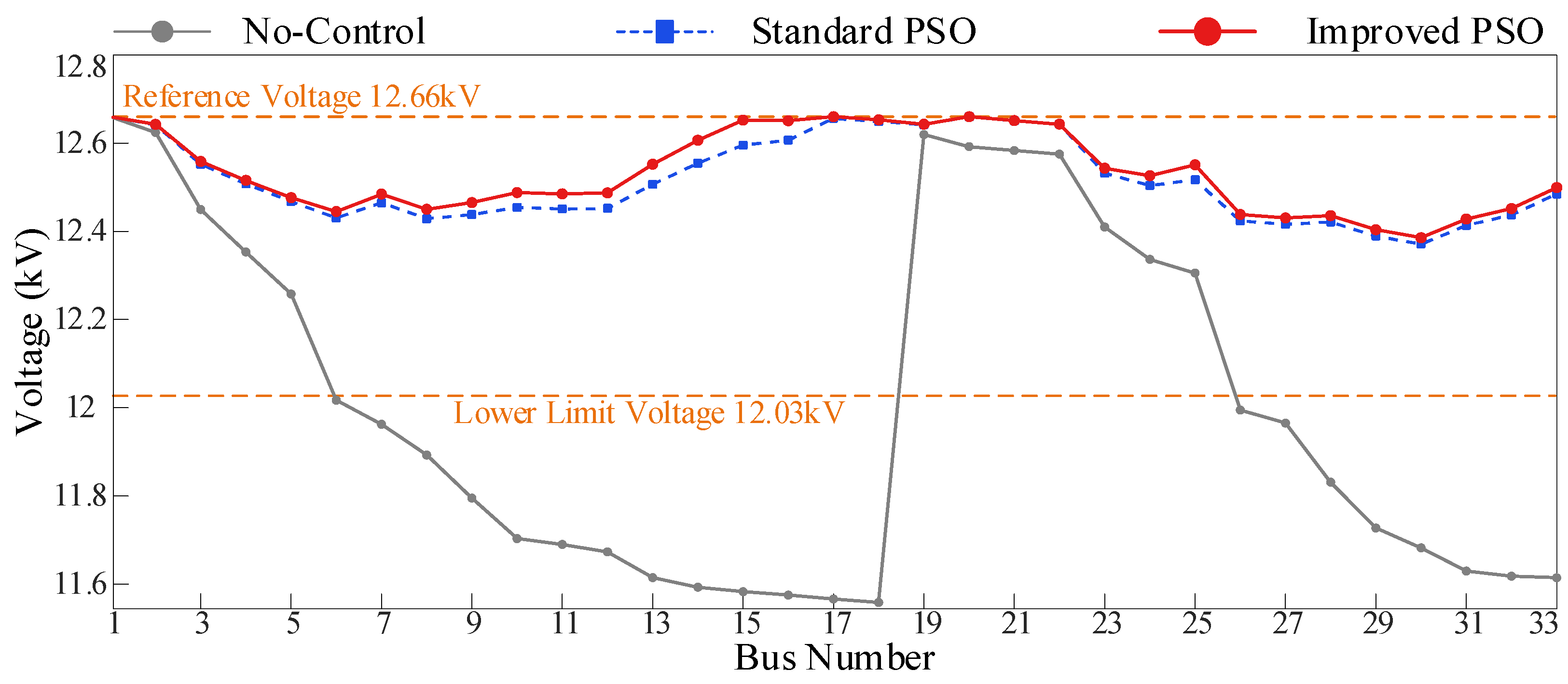
Figure 3 illustrates the bus voltage distribution under three scenarios: the no-control base case, the standard PSO algorithm, and the improved PSO algorithm. The results indicate that both optimization algorithms can improve the voltage distribution of the system to different extents, bringing the bus voltages back into the permissible operating range.
Further comparison shows that, under the improved PSO algorithm, the voltage deviations of buses 6 to 16 are generally smaller. At the terminal section of the system, namely buses 26 to 33, the voltage levels are also slightly higher than those obtained using the standard PSO algorithm.
Overall, the improved PSO algorithm achieves a more uniform voltage distribution on the IEEE 33-bus system, indicating its effectiveness in reducing voltage deviations. These results provide a preliminary validation of the proposed strategy. To further assess its performance and underlying optimization behavior under a larger scale and more complex topology, the study is extended to the IEEE 69-bus test system in
Section 4.2.
4.2. IEEE 69-Bus Distribution Network Case Study
To further verify the proposed multi-resource cooperative voltage support control strategy based on the improved PSO algorithm, a simulation model of the IEEE 69-bus distribution network with multiple controllable resources is developed on the MATPOWER platform.
For the IEEE 69-bus system, the base voltage is set to 12.66 kV, the base power is 100 MVA, and the network topology comprises 69 buses interconnected by 68 branches.
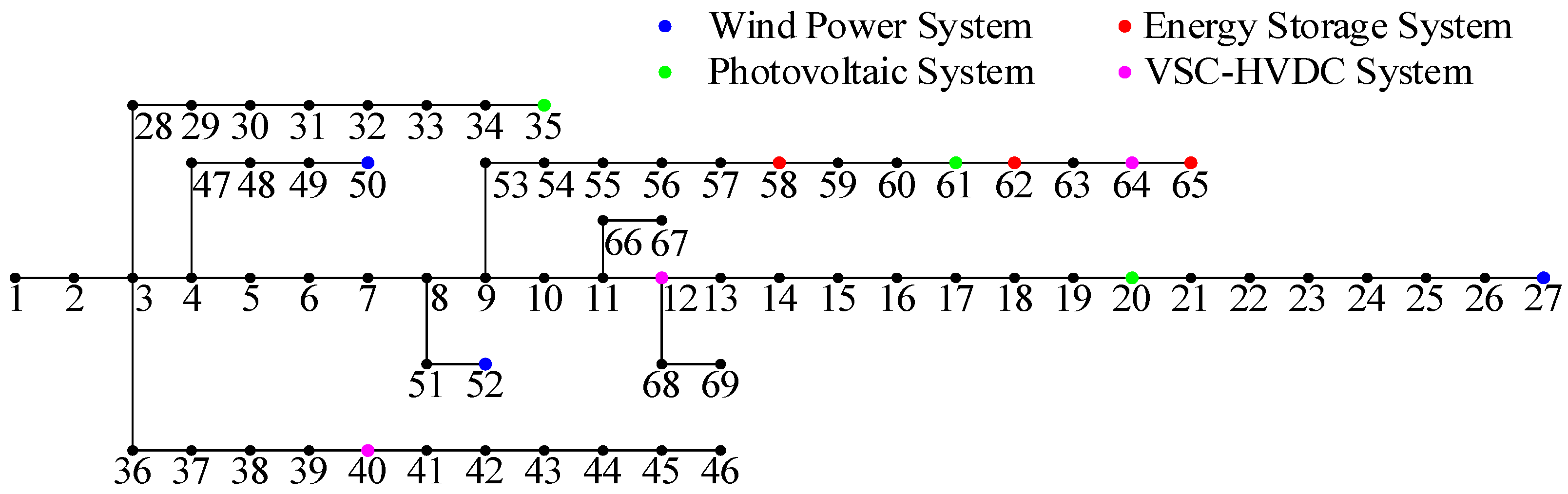
Similarly, the IEEE 69-bus test system incorporates four types of controllable resources to form a multi-resource cooperative voltage support scenario. The deployment of these resources is shown in
Figure 4.
To reflect practical operating conditions of multi-resource coordinated control, all controllable resources except the energy storage system are operated with fixed active power outputs. The relevant parameters are listed in
Table 3.
The main parameter settings of the improved PSO algorithm used in the simulations are given in
Table 4.
4.2.1. Analysis of Bus Voltage Distribution Characteristics
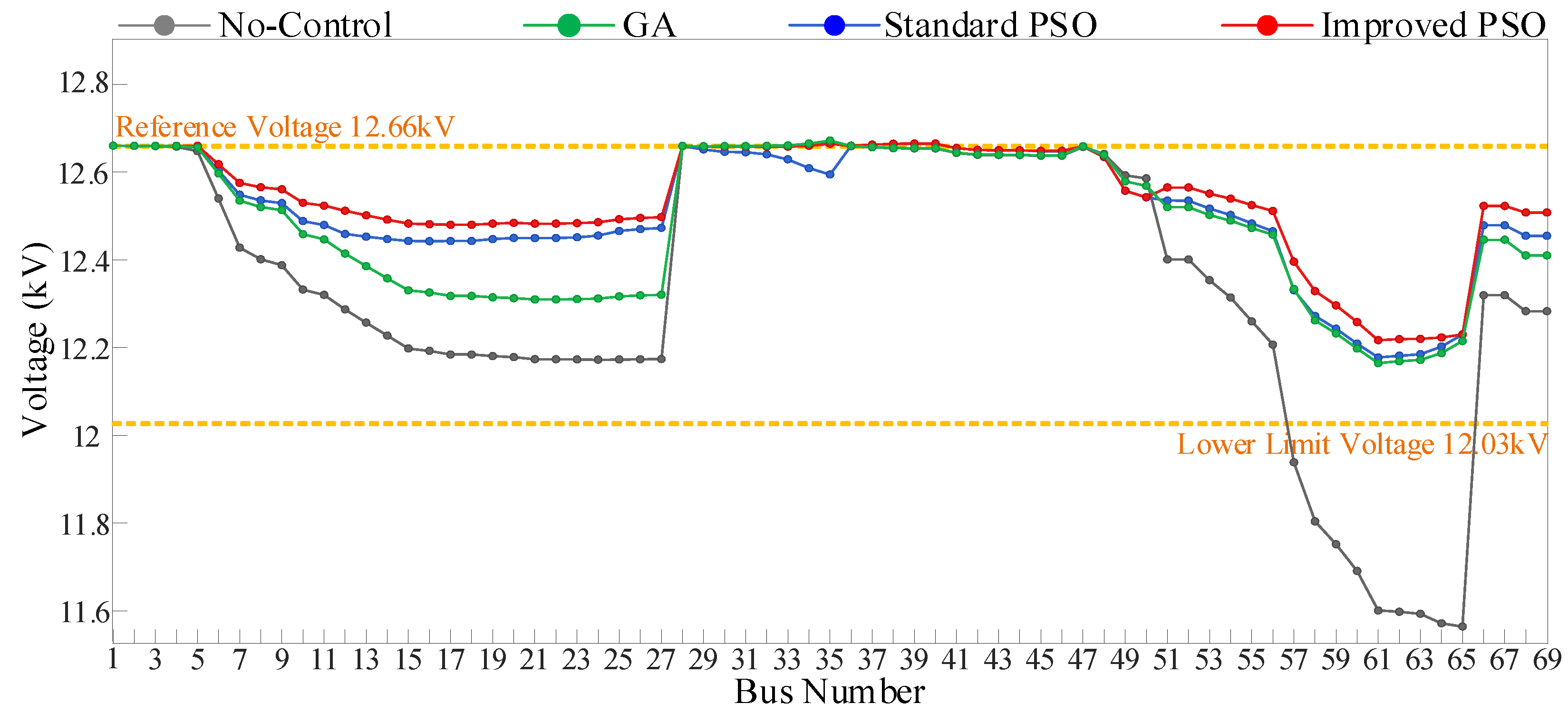
Figure 5 illustrates the bus voltage distribution under four scenarios: the no-control base case, the genetic algorithm, the standard PSO algorithm, and the improved PSO algorithm. The results indicate that all three optimization algorithms can improve the voltage distribution of the system to different extents, bringing the bus voltages back into the permissible operating range.
Quantitative analysis of the no-control base case reveals that the most critical voltage drop occurs at bus 65, where the voltage magnitude reaches a minimum of 0.9135 p.u. In the weak bus region spanning from bus 57 to bus 65, a significant voltage deterioration of 2.95 percentage points is observed, with voltages declining from 0.9430 p.u. to 0.9135 p.u.
Upon application of the three optimization algorithms, differentiated performance improvements are achieved. The genetic algorithm elevates the voltage at bus 65 to 0.9627 p.u., yielding an improvement of 4.92 percentage points over the base case. The standard PSO algorithm demonstrates enhanced performance, raising the voltage at bus 65 to 0.9658 p.u., which corresponds to a 5.23 percentage point improvement. The improved PSO algorithm exhibits superior voltage regulation capability, particularly in the weak bus region. At bus 57, the improved PSO attains a voltage level of 0.9793 p.u., surpassing the standard PSO by 0.55 percentage points. Similarly, at bus 61, the improved PSO achieves 0.9650 p.u., representing a 0.33 percentage point enhancement compared to the standard PSO.
In terms of voltage profile uniformity, the improved PSO algorithm demonstrates notable advantages. Within the main feeder section from bus 10 to bus 20, the improved PSO maintains voltage variations within a narrow range of 0.25 percentage points, whereas the standard PSO exhibits variations of 0.36 percentage points and the genetic algorithm shows fluctuations of 0.85 percentage points. This indicates that the improved PSO achieves more balanced reactive power allocation among multiple controllable resources.
Overall, the improved PSO algorithm exhibits superior comprehensive performance in terms of voltage distribution uniformity, voltage level enhancement, and voltage security margin improvement across the entire IEEE 69-bus distribution network.
4.2.2. Comparison of Comprehensive Voltage Performance Indices
To further evaluate system performance from multiple operational perspectives,
Table 3 summarizes several indices under the four operating scenarios, including average voltage deviation, maximum voltage deviation, voltage standard deviation, voltage qualification rate, and network losses.
As shown in
Table 5, compared with the no-control base case, the genetic algorithm reduces the average voltage deviation from 0.0248 to 0.0145, corresponding to a reduction of 41.5%, and increases the voltage qualification rate from 86.96% to 100%. The standard PSO algorithm demonstrates further improvement, reducing the average voltage deviation to 0.0117, which represents a 52.8% reduction relative to the base case. On this basis, the improved PSO algorithm achieves the lowest average voltage deviation of 0.0096, representing an additional reduction of 17.9% compared with the standard PSO and a total reduction of 61.3% relative to the base case.
In terms of maximum voltage deviation, the improved PSO algorithm attains a value of 0.0350, which is 4.6% lower than the standard PSO value of 0.0367 and 2.2% lower than the GA value of 0.0358. For voltage standard deviation, the improved PSO achieves 0.01005, representing reductions of 4.4% compared with the standard PSO and 23.0% compared with GA. These results indicate that the improved PSO algorithm provides superior suppression of overall voltage fluctuations.
Regarding network losses, an interesting trade-off is observed. All three optimization algorithms result in increased network losses compared to the base case of 213.15 kW. The GA achieves 277.30 kW, the standard PSO exhibits 265.25 kW, and the improved PSO achieves 249.59 kW. Notably, the improved PSO demonstrates the smallest increase among the three algorithms and achieves a 5.9% reduction compared with the standard PSO, demonstrating better coordination between voltage quality and economic efficiency. This phenomenon occurs because the PSO-based algorithms prioritize voltage quality objectives through more aggressive reactive power compensation, which inevitably increases line currents and associated losses. Nevertheless, the voltage security margins achieved by these algorithms justify the modest increase in operational costs.
Overall, the improved PSO algorithm achieves a well-balanced trade-off between voltage performance and economic efficiency, delivering the best voltage quality indices while maintaining network losses at an acceptable level.
4.2.3. Voltage Improvement Analysis at Typical Weak Buses
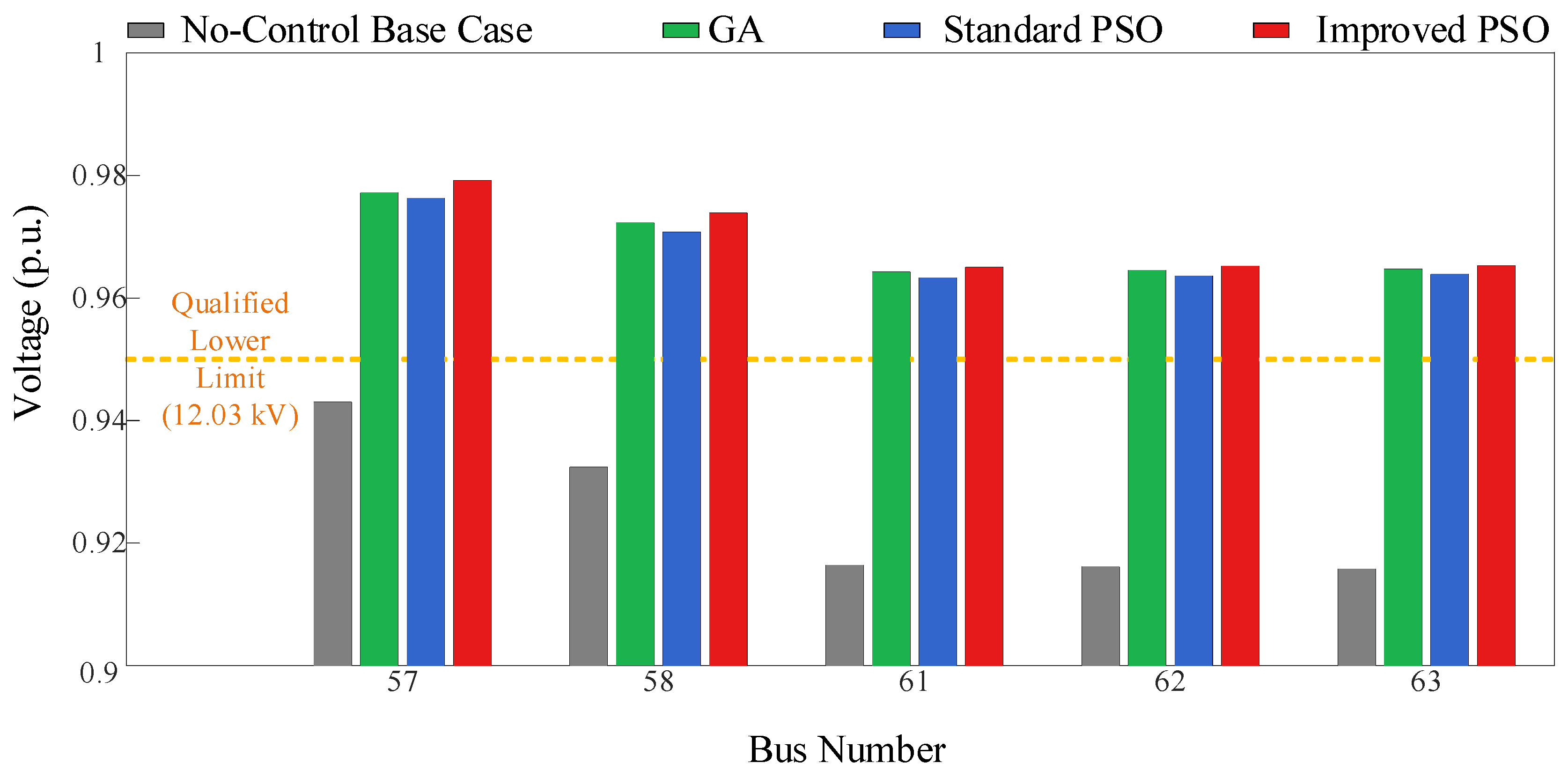
Voltage problems in distribution networks are typically concentrated at a small number of weak buses. To analyze the regulation effect of the improved PSO algorithm on low-voltage buses, five buses with the lowest voltages in the no-control base case, namely buses 57, 58, 61, 62, and 63, are selected for comparative analysis. The results are shown in
Figure 6 and
Table 6.
In the no-control base case, the voltages of these buses are concentrated in the range of 0.916 to 0.943 p.u., among which bus 63 has the lowest voltage of 0.9158 p.u., falling below the acceptable voltage limit. After applying the genetic algorithm, the voltages of all weak buses are significantly improved, with the average voltage increasing from 0.9247 p.u. to 0.9685 p.u., representing an improvement of 4.74%. The standard PSO algorithm achieves a similar performance, elevating the average voltage to 0.9676 p.u., corresponding to a 4.64% improvement over the base case.
On this basis, the improved PSO algorithm further enhances the voltage levels of all weak buses. As shown in
Table 6, the improved PSO achieves an average voltage of 0.9697 p.u., representing a total improvement of 4.87% relative to the base case and an additional improvement of 0.22% compared with the standard PSO. At the most critical bus 63, the voltage increases from 11.594 kV in the base case to 12.220 kV under the improved PSO, corresponding to an improvement of 5.39%. Notably, at bus 57, the improved PSO attains 0.9792 p.u., which is 0.29 percentage points higher than the standard PSO, demonstrating the most significant improvement among all selected weak buses.
In summary, the simulation results demonstrate that, under conditions of multi-resource integration, the proposed improved PSO algorithm can effectively improve the voltage distribution characteristics of the distribution network. Compared with the standard PSO algorithm, the improved PSO algorithm exhibits superior comprehensive performance in overall voltage deviation control and voltage regulation at weak buses. In addition, the improved PSO shows faster convergence behavior and requires fewer iterations to reach a stable solution, further validating its applicability in multi-resource reactive power coordinated optimization scenarios.
4.2.4. Convergence Characteristics Analysis of the Optimization Algorithms
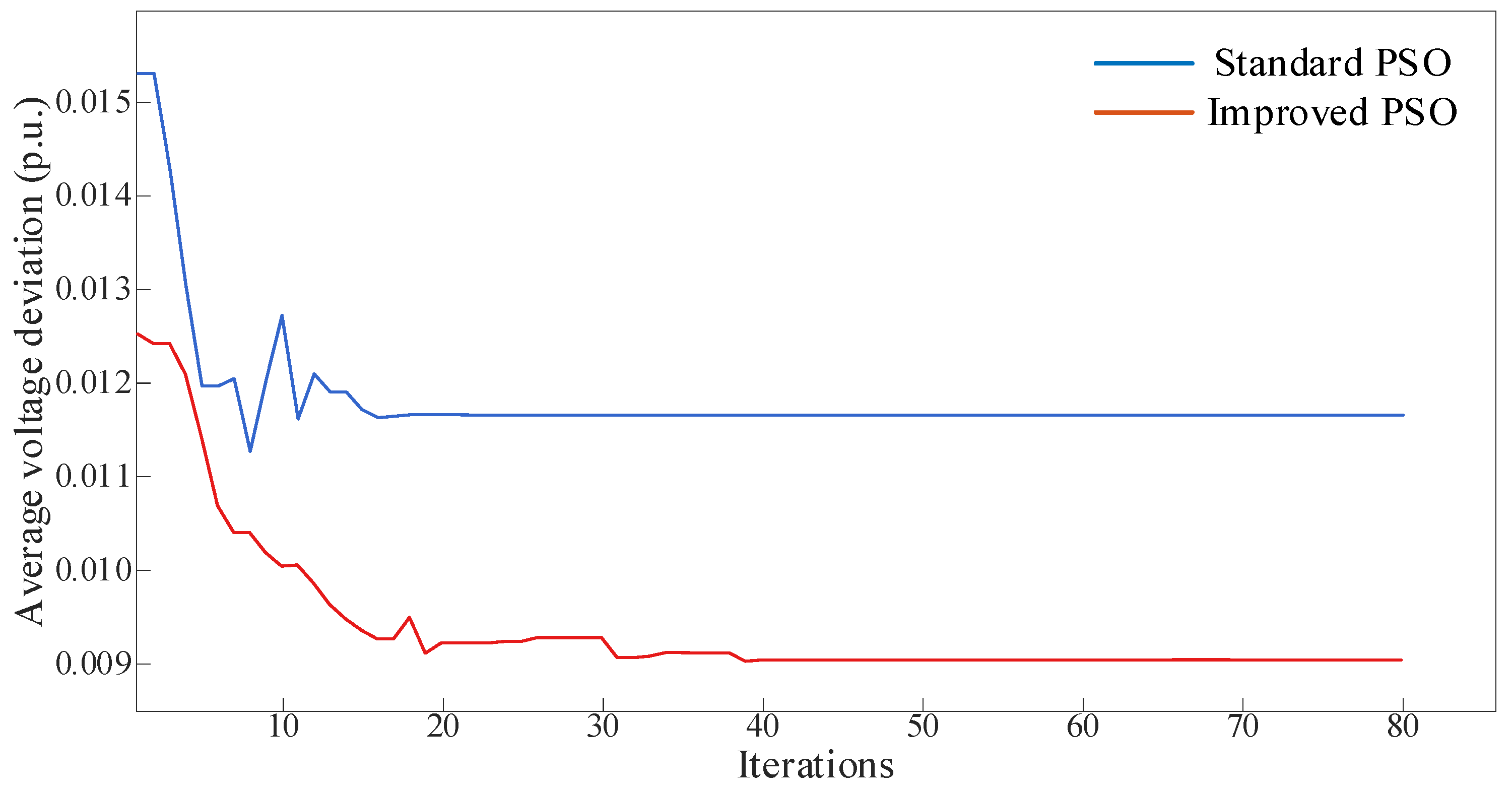
Figure 5 illustrates the convergence behaviors of the standard PSO algorithm and the proposed improved PSO algorithm in terms of average voltage deviation during the iterative optimization process.
As illustrated in
Figure 7, the improved PSO algorithm achieves a lower initial average voltage deviation at the early stage of the iteration process and exhibits a faster decreasing trend compared with the standard PSO. Moreover, the convergence curve of the improved PSO stabilizes within a smaller number of iterations, indicating that a high-quality solution can be obtained with reduced computational effort.
This behavior can be attributed to two main factors. On the one hand, the sensitivity-matrix-guided initialization strategy enhances the quality of the initial population, thereby narrowing the effective search region and providing a more favorable starting point for subsequent optimization. On the other hand, the adaptive parameter scheduling mechanism facilitates a smooth transition from global exploration to local exploitation, promoting stable convergence toward the global optimum in the later stages of the iteration process.
4.2.5. Evolution of Sub-Objective Function Values During Iterations
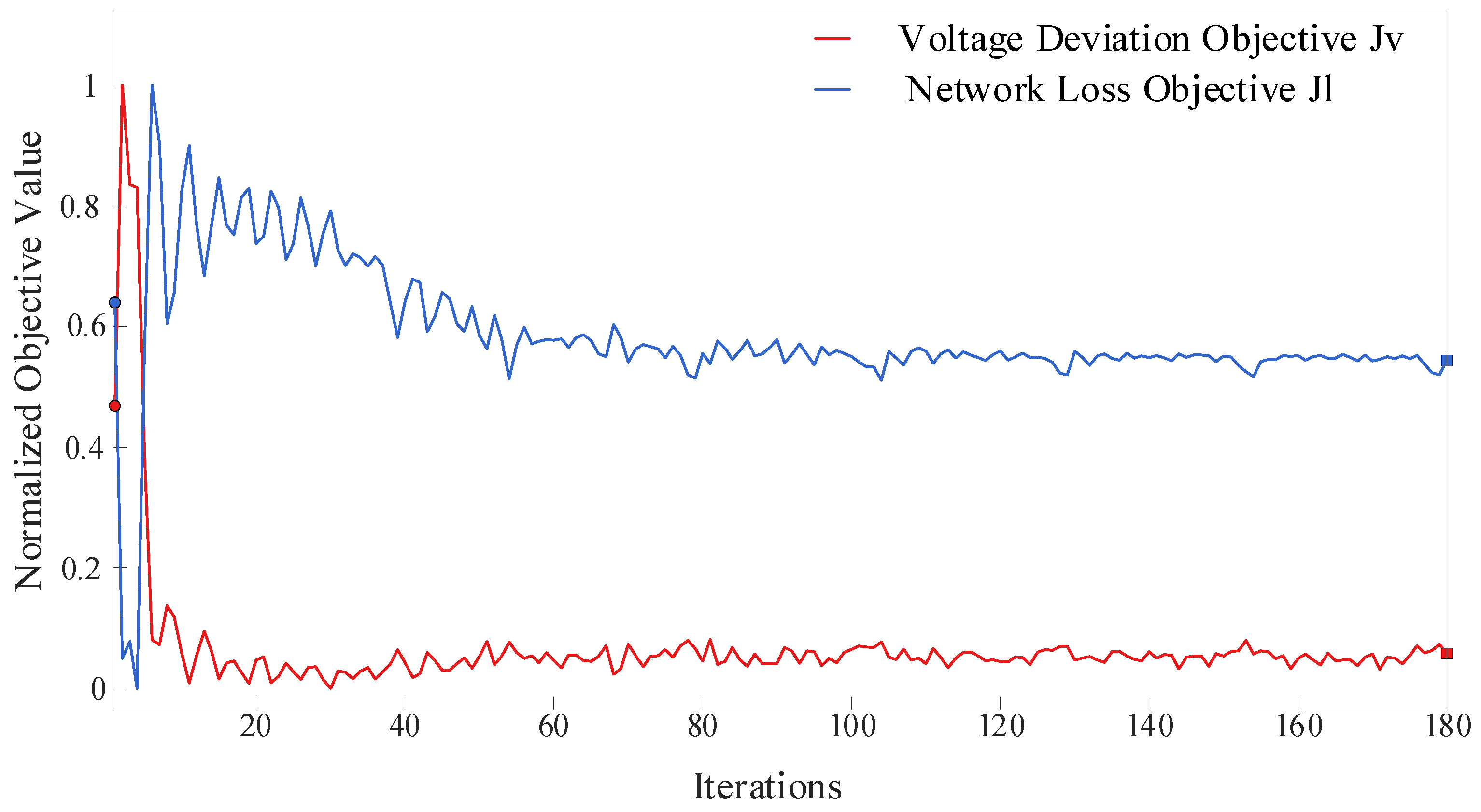
To further illustrate the internal optimization mechanism of the improved PSO algorithm,
Figure 8 presents the evolution of two representative sub-objective functions during the iterative process, namely the voltage deviation objective Jv and the network loss objective Jl. These two objectives are selected as they effectively characterize the algorithm’s capability in balancing voltage quality improvement and operational efficiency.
As shown in
Figure 8, the two sub-objective functions exhibit distinct evolution patterns that reveal the multi-objective optimization characteristics of the improved PSO algorithm. The voltage deviation objective Jv demonstrates a rapid decrease from an initial value of 0.9472 to approximately 0.10 within the first 20 iterations, indicating effective voltage quality improvement in the early stage. Subsequently, Jv continues to decline gradually and stabilizes at a final value of 0.0634 after 180 iterations, representing a total reduction of 93.3% compared to the initial value.
In contrast, the network loss objective Jl exhibits more pronounced fluctuations throughout the optimization process, with values oscillating between 0.5 and 0.9 during the early and middle stages. This fluctuation pattern reflects the inherent trade-off between voltage quality enhancement and loss minimization, as aggressive reactive power compensation for voltage support inevitably increases line currents and associated losses. As the iteration progresses, Jl gradually converges to a stable value of approximately 0.55, demonstrating that the algorithm successfully achieves a balanced compromise between the two competing objectives.
The contrasting evolution patterns of these two objectives provide valuable insights into the optimization dynamics. The monotonic decreasing trend of Jv indicates consistent progress toward voltage quality improvement, while the oscillatory behavior of Jl reveals the algorithm’s exploration process in seeking the optimal trade-off point. These characteristics validate the effectiveness of the improved PSO algorithm in coordinating multiple optimization objectives and achieving superior overall performance.
5. Conclusions
This paper investigated cooperative voltage support in renewable-rich distribution networks by coordinating heterogeneous controllable resources for optimal reactive power allocation. An improved PSO algorithm was developed by combining sensitivity-matrix-guided initialization with adaptive parameter adjustment to enhance feasibility and accelerate convergence under voltage and reactive power constraints. The proposed strategy was validated on an IEEE 69-bus distribution network in MATPOWER.
Simulation results confirm the effectiveness of the proposed approach. Compared with the no-control case, it increases the voltage qualification rate from 86.96% to 100% and reduces the average voltage deviation by 61.3%, from 0.0248 to 0.0096. The maximum voltage deviation decreases from 0.0865 to 0.0350, and the voltage at the most critical bus 63 improves from 0.9158 p.u. to 0.9652 p.u. In terms of network losses, the proposed method achieves lower losses than standard PSO, decreasing them from 265.25 kW to 249.59 kW, indicating a better balance between voltage performance and economic efficiency. Compared with representative optimization-based voltage regulation approaches widely adopted in the literature, such as GA and standard PSO, the proposed method achieves the best overall voltage-quality indices while mitigating the loss penalty, which highlights its practical value for multi-resource coordinated voltage support in renewable-rich distribution networks.
However, the current study is validated mainly on a steady-state IEEE 69-bus test system under ideal measurement and communication assumptions, which limits its applicability to more complex real-world scenarios. Therefore, future work will extend the method to larger-scale systems and time-series scenarios with uncertainty, incorporate more practical device constraints and discrete actions, and investigate distributed or real-time implementations considering communication delays and measurement errors.