Article

Comprehensive Enhancements of GaN Ultraviolet Photodiodes via Indium-Surfactant-Assisted Mg-δ-Doped p-Type GaN


1
School of Engineering and Technology, Guangdong Open University & Guangdong Polytechnic Institute, Guangzhou 510091, China
2
State Key Laboratory of Optoelectronic Materials and Technologies, School of Electronics and Information Technology, Sun Yat-sen University, Guangzhou 510275, China
*
Author to whom correspondence should be addressed.
Electronics 2026, 15(5), 908; https://doi.org/10.3390/electronics15050908
Submission received: 12 November 2025 / Revised: 8 February 2026 / Accepted: 13 February 2026 / Published: 24 February 2026
(This article belongs to the Special Issue Advances in Semiconductor GaN and Applications)

Abstract

Front-illuminated GaN-based p-i-n photodiodes (PDs) incorporating indium-surfactant -assisted (ISA) Mg-δ-doped p-GaN were fabricated and systematically characterized. Hall-effect measurements at room temperature revealed a hole concentration of~1.5 × 1018 cm−3 in the ISA Mg-δ-doped p-GaN, significantly higher than that of uniformly Mg-doped p-GaN (~3.7 × 1017 cm−3). Devices employing ISA Mg-δ-doped p-GaN exhibited reduced leakage current, enhanced responsivity, faster response speed, improved reliability, and lower noise current compared to control PDs. These comprehensive performance enhancements, attributed to the improved crystalline quality and the optimized electric field distribution, suggest significant potential in practical UV applications.

1. Introduction

Over the past decades, GaN-based materials have garnered significant attention for their outstanding optoelectronic properties, particularly in the blue and ultraviolet (UV) spectral regions. GaN-based photodetectors (PDs) are widely employed in scientific, medical, and military applications that demand UV sensitivity and internal gain capabilities [1,2,3]. Continued advancements in GaN epitaxy and device fabrication have enabled the development of various high-performance UV PD architectures, including p-i-n photodiodes (PDs) [4], Schottky barrier PDs [5], metal–insulator–semiconductor (MIS) PDs [6], and metal–semiconductor–metal (MSM) PDs [7]. Among these, p-i-n PDs offer distinct advantages over Schottky and MIS counterparts. Numerous strategies have been explored to enhance their performance; however, a key challenge remains: the low doping efficiency of p-type GaN [3,8]. Given a fixed intrinsic region width, insufficient hole concentration in the p-GaN layer weakens the built-in electric field, adversely affecting device performance.
This inefficiency stems from the high ionization energy of Mg acceptors (~125–215 meV) [9], which limits hole activation to only a few percent. Increasing Mg incorporation can raise hole concentration, but excessive doping (>2 × 1019 cm−3) often degrades crystal quality and induces self-compensation. δ-doping has shown promise in improving p-GaN conductivity [10,11,12], yet the enhancements remain modest.
In this work, we report improved p-type GaN p-i-n PDs using an indium-surfactant-assisted (ISA) Mg-δ-doping technique. A hole concentration of 1.5 × 1018 cm−3 was achieved with a Mg incorporation level of ~1.2 × 1019 cm−3, corresponding to a doping efficiency of ~12%. For comparison, control devices with uniformly Mg-doped p-GaN were fabricated using identical structural parameters.

2. Experiment

GaN-based p-i-n photodiode samples were grown on sapphire substrates using a Thomas Swan 3 × 2-inch close-coupled showerhead (CCS) metal-organic chemical vapor deposition (MOCVD) reactor (Thomas Swan Scientific Equipment, Cambridge, UK). The epitaxial template comprised a 2.5 μm high-quality undoped GaN layer atop a 25 nm low-temperature GaN nucleation layer. The device structure consisted of a 1 μm Si-doped n-GaN layer, a 200 nm unintentionally doped intrinsic GaN (i-GaN) layer, and a 50 nm Mg-doped p-GaN layer. Two variants were fabricated: one employing indium-surfactant-assisted (ISA) Mg-δ-doping for the p-type region, and the other using conventional uniform Mg doping. A thin p-type layer was used to maximize light absorption in the i-GaN region, thereby enhancing responsivity. To reduce p-contact resistance and improve carrier collection, an additional 8 nm heavily Mg-doped p-GaN layer was deposited atop the p-i-n structure.
At a growth temperature of 920 °C under a hydrogen atmosphere, the p-type GaN layer was deposited using the indium-surfactant-assisted (ISA) Mg-δ-doping method. The ISA Mg-δ-doping cycle was implemented as follows: (1) a 20 nm GaN layer was grown with indium surfactant, (2) the TMGa and TMIn flows were interrupted and the surface was nitridized for 30 s, and (3) Cp2Mg was introduced for 48 s. After the dopant flow was terminated, TMGa and TMIn were resumed to initiate the next GaN growth cycle. For comparison, the conventional uniformly Mg-doped p-GaN layer was grown by co-supplying TMGa and Cp2Mg. Further details of the ISA Mg-δ-doping technique are provided elsewhere [10].
Circular mesa diodes with a diameter of 150 μm were fabricated. Device processing began with two-step mesa definition using inductively coupled plasma (ICP) dry etching. The first etch exposed the n-GaN layer, while the second retained a ~36 nm p-GaN layer above the i-GaN to form a surface depletion region. To mitigate ICP-induced damage, samples were immersed in boiling KOH solution (0.1 mol/L) for 80 s. Ohmic contacts comprising Ti/Al/Ni/Au (15/80/20/60 nm) were deposited via electron-beam evaporation and annealed at 830 °C for 30 s in N2 atmosphere using rapid thermal annealing (RTA). For the p-type contacts, Ni/Au (20/60 nm) layers were similarly deposited and annealed at 500 °C for 120 s in O2 atmosphere. No antireflective coating or surface passivation was applied to the devices.

3. Results and Discussion

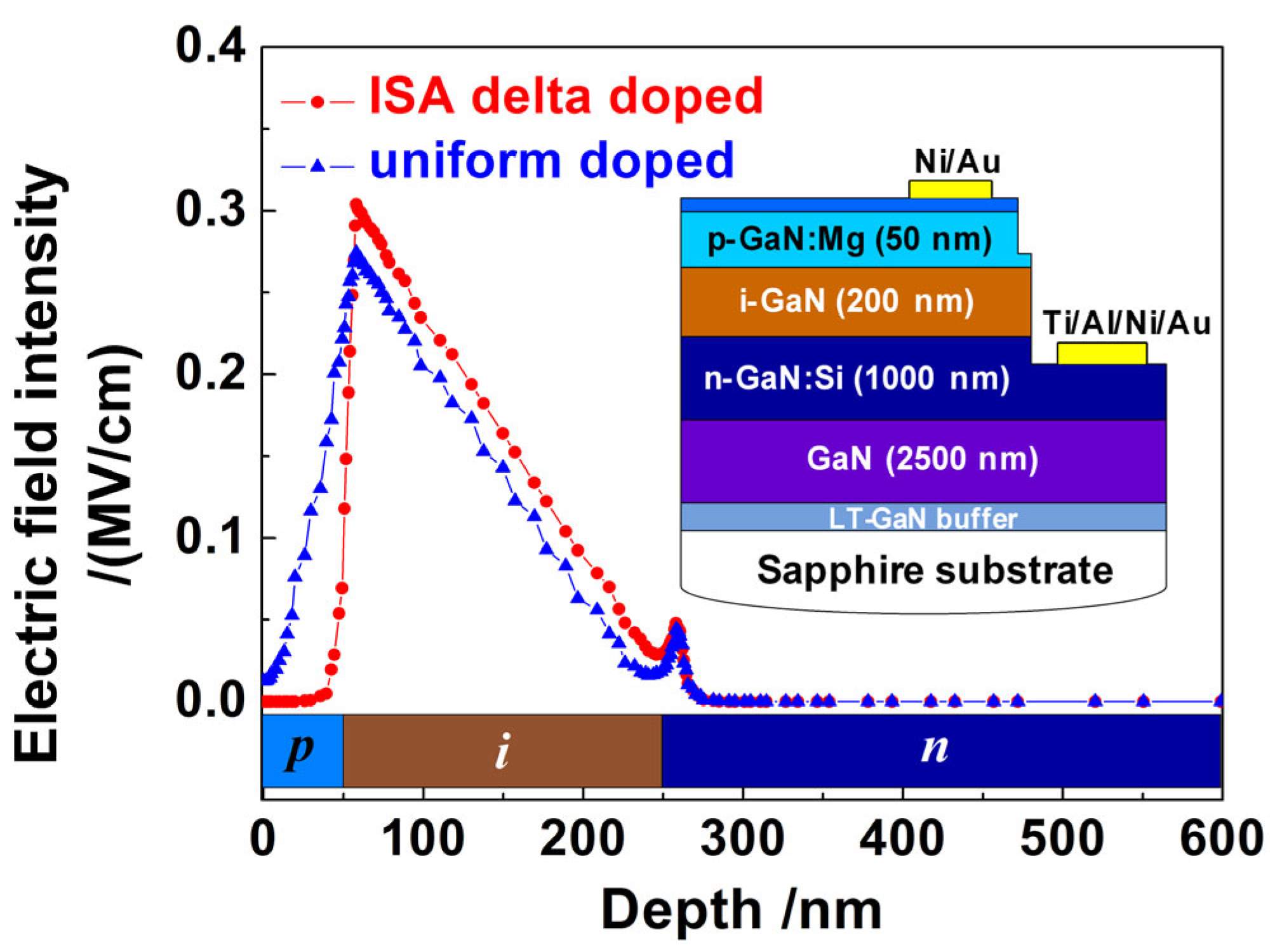
The full device structure and electric field profile, simulated using Sentaurus TCAD, are presented in Figure 1. The key material parameters and model coefficients were obtained from the published literature [13,14,15,16]. At zero bias, the built-in electric field in ISA Mg-δ-doped p-i-n photodiodes (PDs) is primarily confined to the i-GaN layer, with only ~15 nm of field penetration into the adjacent p-GaN. In contrast, the uniformly Mg-doped PDs exhibit a field distribution across both the i-GaN and the entire p-GaN layer. In both devices, the peak electric field occurs at the p-GaN/i-GaN interface, with the ISA Mg-δ-doped sample showing a 10% higher peak field strength. Within the i-GaN layer, the ISA Mg-δ-doped device exhibits an average field strength ~30% greater than its uniformly doped counterpart.
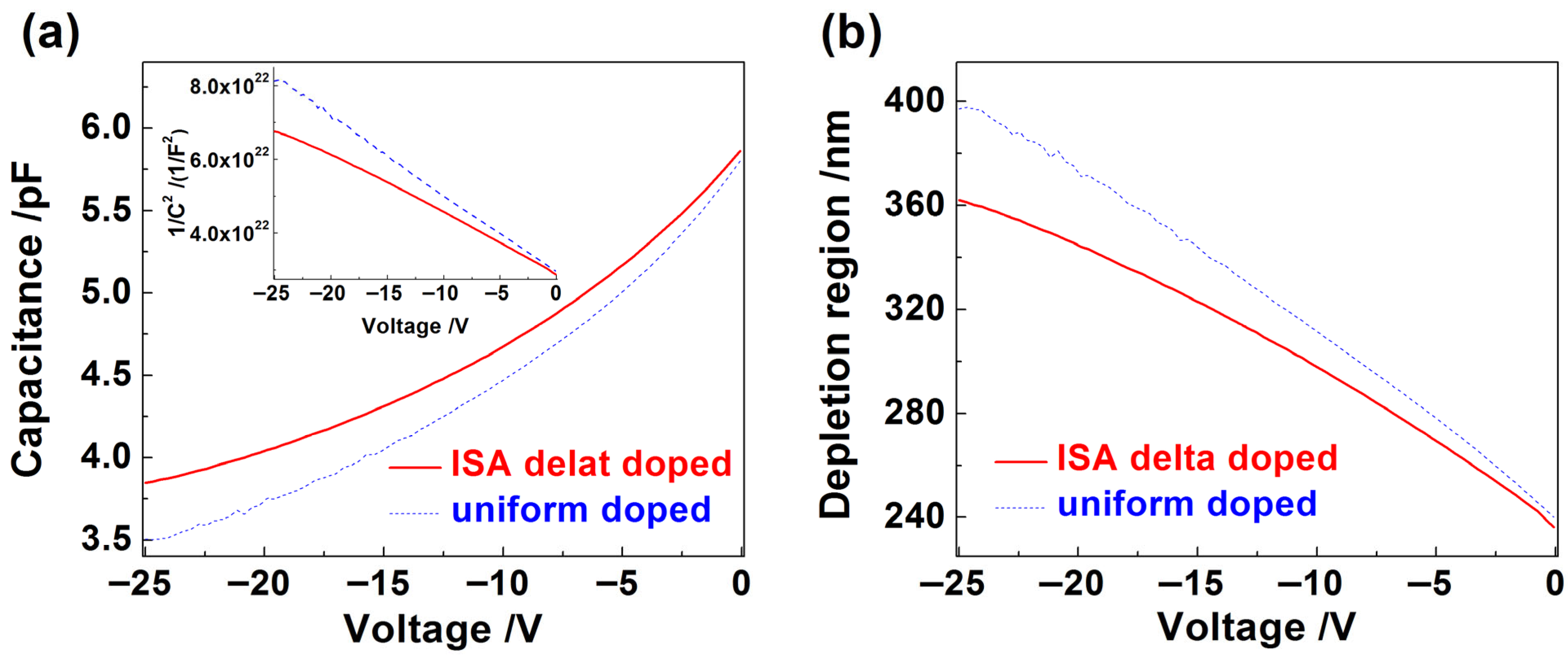
Figure 2a shows the reverse-biased small-signal capacitance-voltage (C–V) characteristics measured in the dark using an Agilent B1505A semiconductor analyzer (Agilent Technologies, Santa Clara, CA, USA) at 1 MHz, with reverse bias up to −25 V. The inset displays the corresponding 1/C2–V plots for both samples, while Figure 2b presents the depletion width characteristics. Capacitance decreases monotonically with increasing reverse voltage, indicating expansion of the depletion region. The ISA Mg-δ-doped sample consistently exhibits a narrower depletion width than the uniformly doped sample. At zero bias, the depletion widths are 235 nm and 240 nm for the ISA and uniform samples, respectively. Considering the total thickness of the p-GaN and i-GaN layers, the ISA Mg-δ-doped sample demonstrates superior control over electric field distribution. The 1/C2–V plots are nearly linear across the 0 to −25 V range. Given the identical i-GaN and n-GaN layers in both samples, the smaller slope observed for the ISA sample indicates a higher hole concentration in its p-GaN layer.
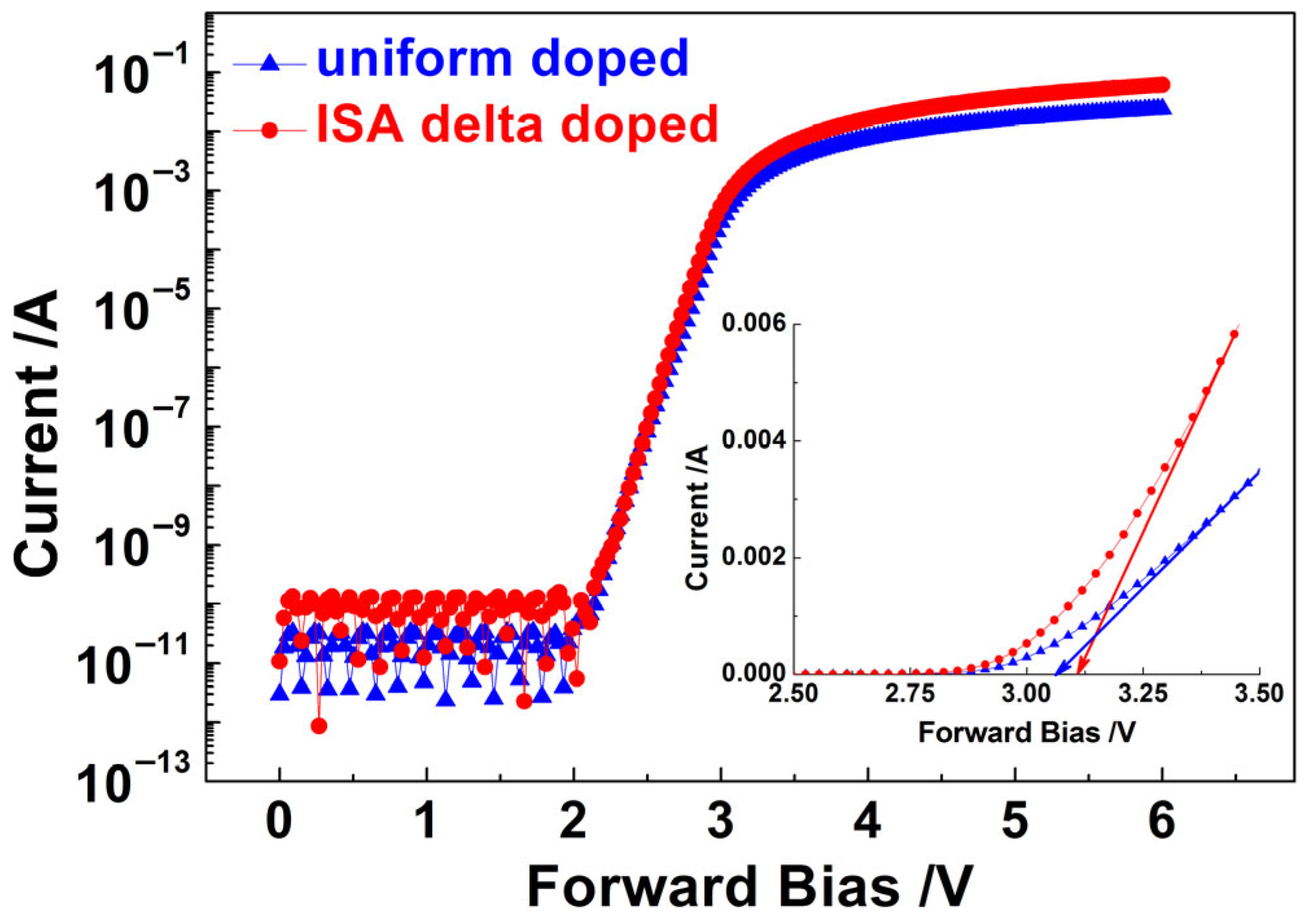
Current–voltage (I–V) characteristics were measured using a Keithley 4200-SCS (Keithley Instruments, Solon, OH, USA) system under both dark and illuminated conditions at room temperature. Figure 3 displays typical forward-biased I–V curves in the dark. Below 2 V, both samples exhibit dark currents below the 100 pA detection limit. Turn-on voltages are 3.11 V and 3.05 V for the ISA and uniform samples, respectively. Fitting the forward bias data using the ideal diode equation [17,18] yields ideality factors and series resistances of n = 1.97, Rs = 50.5 Ω (ISA) and n = 2.14, Rs = 110.2 Ω (uniform). The ideality factor near 2 suggests recombination-dominated current in the depletion region [17,19]. The lower ideality factor and series resistance in the ISA sample indicate improved crystalline quality, attributed to enhanced Mg activation and reduced defect density via ISA Mg-δ-doping.
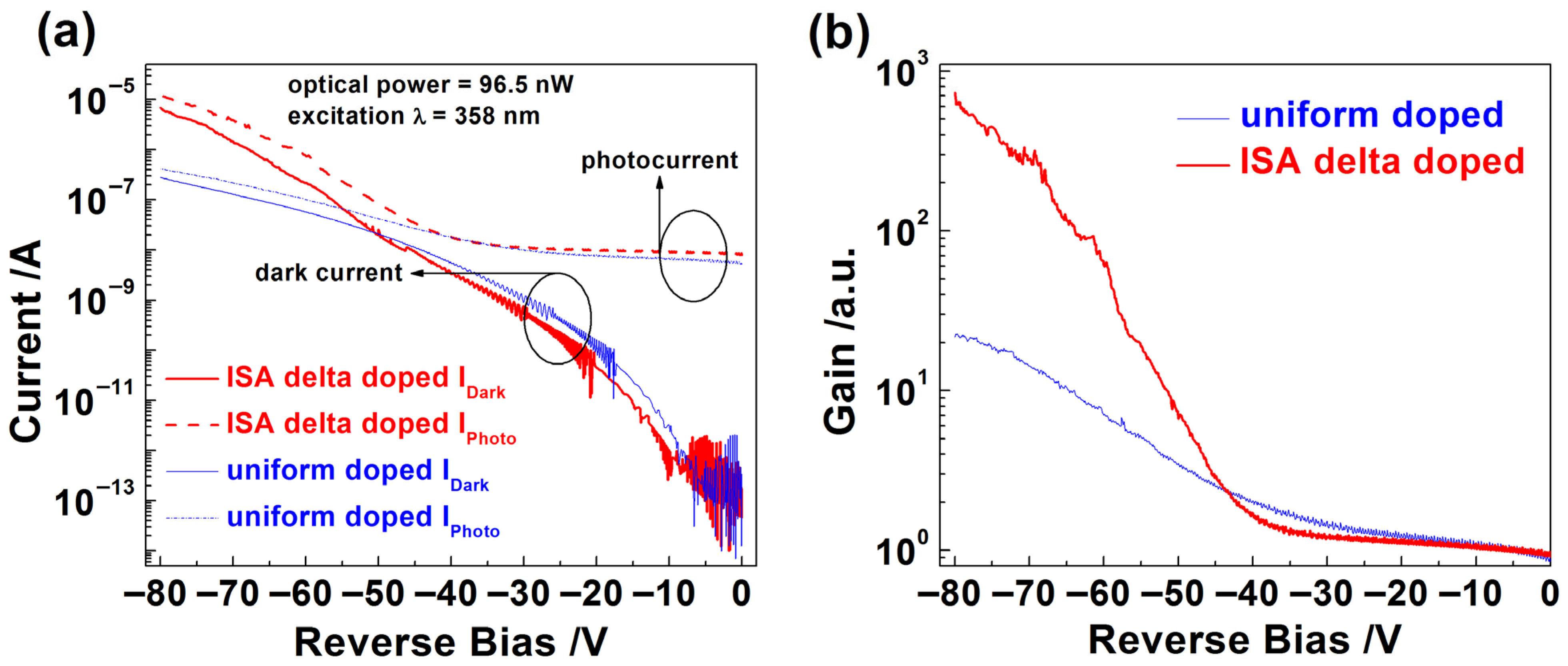
Figure 4 presents reverse-biased I–V characteristics, revealing strong rectification behavior. The ISA Mg-δ-doped sample shows an eleven-order magnitude contrast between ±5 V, compared to ten orders for the uniform sample. Beyond −10 V, dark current increases exponentially. At −10 V and −40 V, the ISA sample exhibits dark currents of 9.91 × 10⁻¹³ A and 3.30 × 10⁻⁹ A, respectively, compared to 3.18 × 10⁻¹² A and 5.54 × 10⁻⁹ A for the uniform sample. Within the −1 V range, average dark currents are 2.14 × 10⁻¹³ A (ISA) and 5.51 × 10⁻¹³ A (uniform), representing a 61% reduction. Simulations suggest that increased hole concentration in the ISA sample reduces depletion width, accounting for only ~14% of the dark current reduction—highlighting the role of improved p-GaN quality in suppressing leakage.
Under UV illumination, photocurrent remains flat below −40 V. At −10 V, the signal-to-noise ratio (SNR) is 9.25 × 10³ for the ISA sample and 2.7 × 10³ for the uniform sample. A gain phenomenon is observed in both samples with increasing bias voltage. This is suggested to be avalanche multiplication, which is particularly pronounced in the ISA sample. Multiplication gain (M) was calculated using the following:
M   =   I p h I d a r k I u g
where Iug is the unity-gain photocurrent [20], defined from the flat region between −1 V and −10 V. As shown in Figure 4b, the ISA sample reaches a maximum gain of 730 at −80 V, over 30 times higher than that of the uniform sample. Breakdown voltages are −45 V (ISA) and −52 V (uniform), with the lower value in the ISA sample attributed to stronger electric field confinement due to higher hole concentration. Notably, when the reverse bias exceeds −50 V, the dark current of the ISA sample increases sharply and surpasses that of the uniform sample. This behavior is attributed to the stronger built-in electric field in the ISA device, which renders the depletion region more susceptible to band-to-band tunneling [21]. The tunneling current is further amplified under avalanche multiplication.
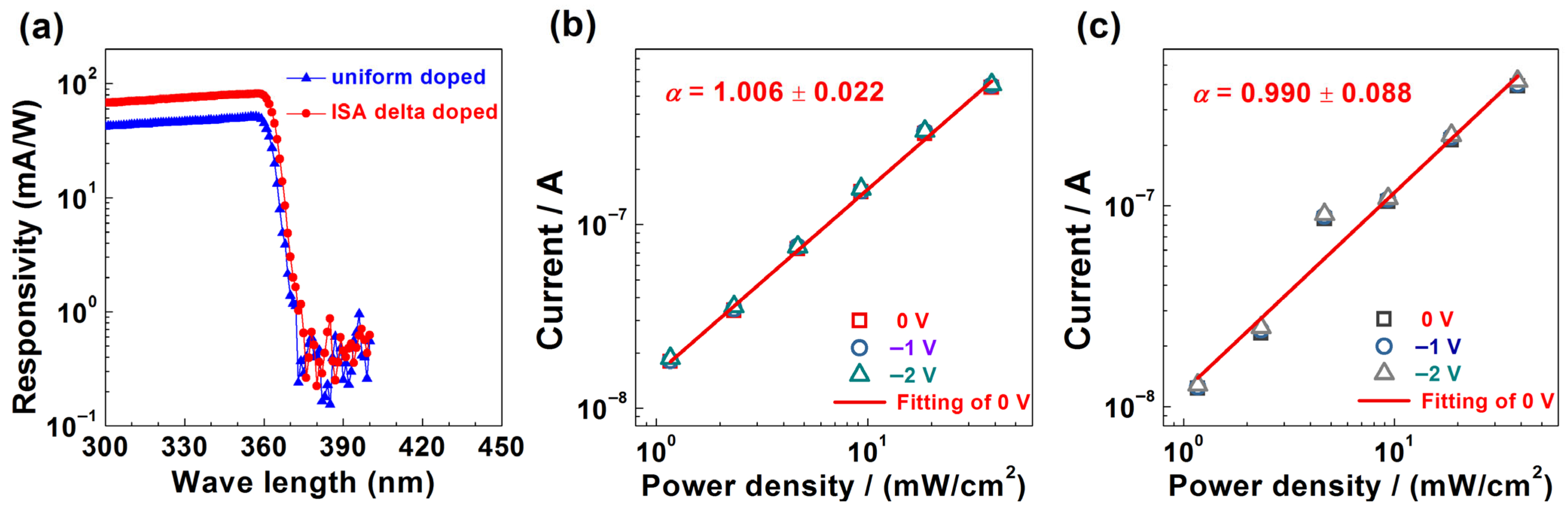
Figure 5a shows the zero-biased spectral response at room temperature. Measurements employed a deuterium/xenon lamp source, a 1200 g/mm monochromator, and UV-grade optics, with calibrated silicon photodetectors spanning 200–500 nm. Both samples exhibit a sharp cutoff near 360 nm, with responsivity dropping by two orders of magnitude from 360 to 380 nm. Within the band edge, responsivity slightly decreases with shorter wavelengths. The ISA sample achieves a peak responsivity of 82.1 mA/W at 358 nm (EQE = 28.5%), compared to 51.1 mA/W at 357 nm (EQE = 17.8%) for the uniform sample. UV to visible rejection ratios are 367 (ISA) and 125 (uniform), with the ISA sample showing a threefold improvement due to enhanced p-GaN quality and stronger electric fields that efficiently sweep photogenerated carriers.
Figure 5b,c shows the photocurrent of both samples as a function of optical power spanning several orders of magnitude. The dependence of photocurrent on incident optical power density can be expressed as Iph = APα, where A is a characteristic constant at a given optical wavelength, and α is the power-law factor associated with carrier generation, recombination, and trapping processes [22]. As the optical power density increases from 1.166 to 38.495 mW·cm−2, the photocurrent of both samples under different bias voltages exhibits linear behavior on a double-logarithmic scale. The fitted power-law exponents α for the ISA and uniform samples are 1.006 and 0.990 at 0 V bias, 1.009 and 0.990 at −1 V, and 1.004 and 0.991 at −2 V, respectively. The ISA sample demonstrates improved linearity and stability under varying optical power across all tested bias conditions. This improvement is reflected in its power-law exponent α being closer to unity compared to the uniform sample, signifying suppressed recombination and trapping processes and confirming the superior crystalline quality of its p-GaN layer.
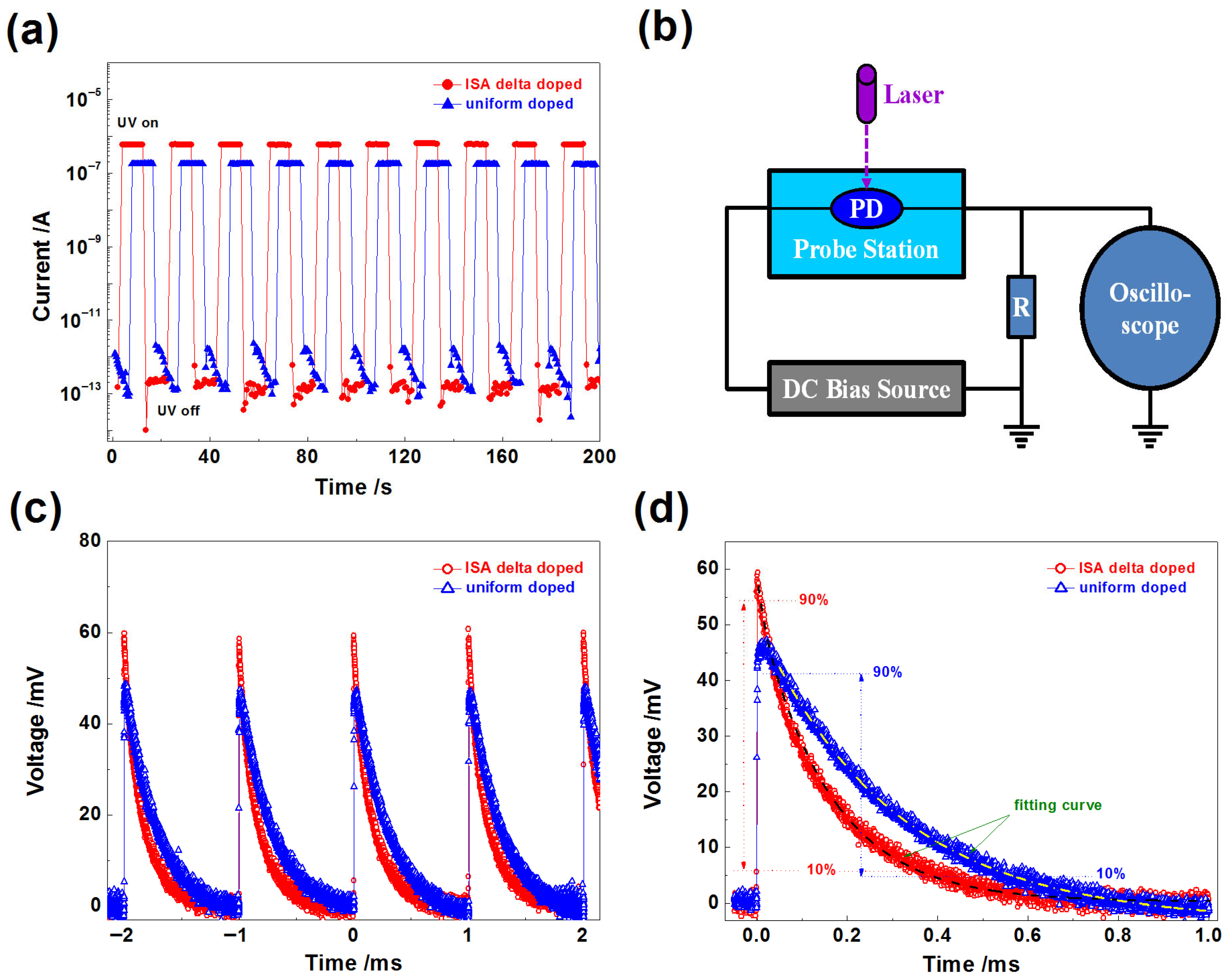
Figure 6a presents the time-dependent photoresponse behavior of both samples, measured with an optical pulse width of 10 s and a period of 20 s. Under 358 nm UV illumination at zero bias, the photocurrents of both samples remained nearly identical over 10 cycles, demonstrating excellent reproducibility and stability. When the light was turned off, the ISA sample exhibited an obviously faster recovery of the dark current than the uniform one, indicating fewer defects in its p-GaN layer. However, owing to the limited opening/closing time of the optical shutter, the photocurrent rise and fall of both samples were too rapid to be resolved accurately. A faster transient photoresponse measurement system using a pulsed laser source is therefore required to precisely evaluate their response speeds.
As shown in Figure 6b, a pulsed laser (Brightsolutions WHF-266nm) (Brightsolutions, Milan, Italy) with a wavelength of 266 nm, a pulse width of 625 ps, and a repetition rate of 1 kHz was employed as the excitation source in the fast transient photoresponse measurement system. The bias voltage was supplied by an electrometer (Keithley 6517B) (Keithley Instruments, Solon, OH, USA), and the transient photoresponse characteristics were recorded using a digital oscilloscope (Keysight DSOS604A) (Keysight Technologies, Santa Rosa, CA, USA). During the measurements, the sample was connected in series with a load resistor of 1 MΩ, and the voltage signal across the load resistor was acquired by the oscilloscope. As illustrated in Figure 6c, under zero bias, the relative standard deviations of the response peak amplitudes for the ISA sample and the uniform sample are 1.23% and 0.98%, respectively, demonstrating good stability of the photoresponse. The ISA sample exhibits a stronger pulsed response, with an average peak voltage of 59.7 mV, which is 26.5% higher than that of the uniform one. As presented in Figure 6d, the rise and fall times of the samples are defined as the time intervals between the 10% and 90% levels of the signal peak. The rise and fall times are 250 ns and 324 μs for the ISA sample, while the corresponding values for the uniform sample are 750 ns and 481 μs. Notably, a clear difference in the rise and fall times is observed between the two samples. To investigate the dominant mechanism governing the response speed, the decay curves of the ISA and uniform samples were fitted with an exponential function y = A exp(−t/τ) + y0, yielding relaxation time constants τ of 130.55 μs and 300.48 μs, respectively [23]. These results suggest a correlation with the persistent photoconductivity (PPC) effect in the samples [24,25,26]. In the GaN epitaxial layer, deep-level trap states induced by defects capture and release carriers, leading to prolonged carrier lifetime and recovery time, thereby limiting the response speed of the samples. The improved response speed of the ISA sample is mainly attributed to the enhanced built-in electric field resulting from increased hole concentration, as well as the improved crystalline quality. These findings are consistent with previous I–V characteristics and spectral responsivity measurements.
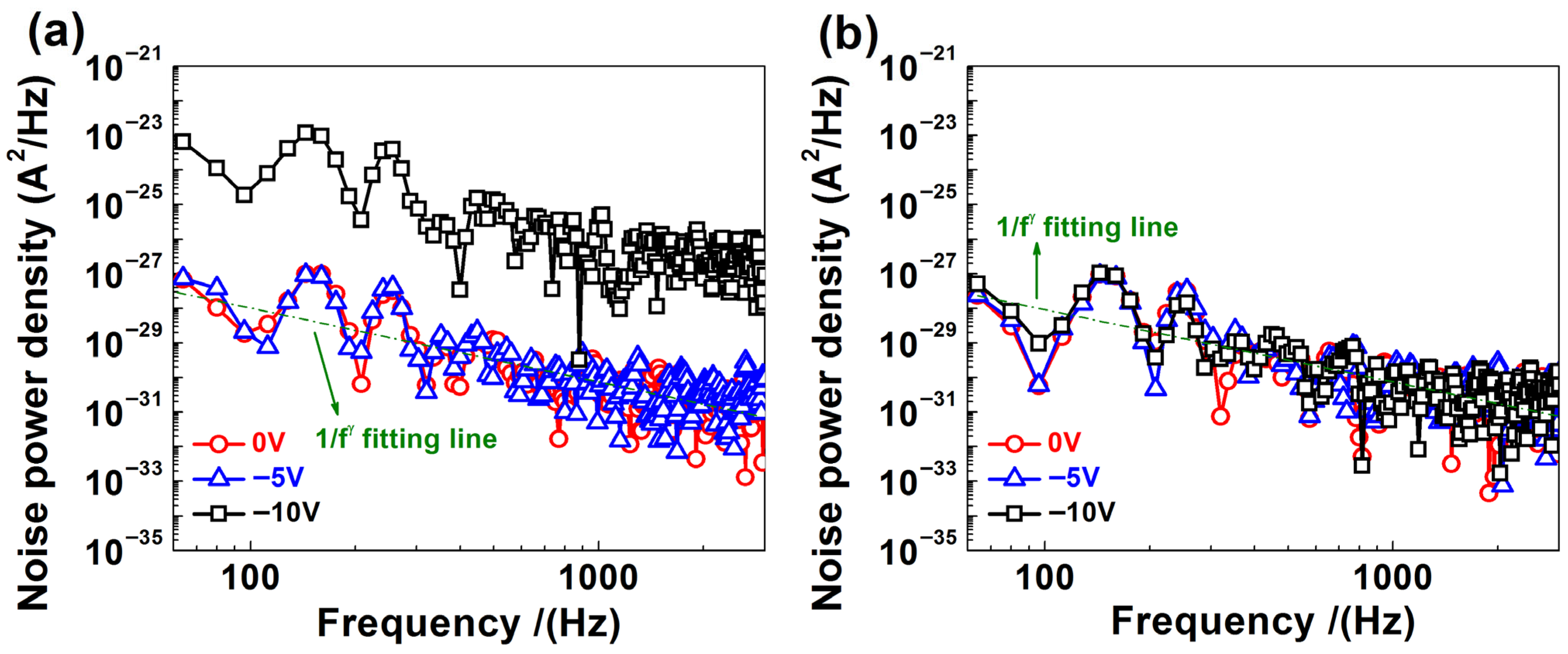
Figure 7 presents the noise power density as a function of frequency from 64 Hz to 3000 Hz for both samples under different reverse bias voltages, measured using a SR785 dynamic signal analyzer (Stanford Research Systems, Sunnyvale, CA, USA). Noise in photodetectors typically comprises thermal noise, shot noise, generation–recombination (g–r) noise, and flicker noise. Thermal and shot noise are frequency-independent, whereas flicker noise scales as 1/f and g–r noise as 1/f2. The noise power density of both samples increases with bias voltage. At 0 V bias, the frequency dependence follows a 1/fγ trend, with γ values of 2.09 and 2.14 for the ISA and uniform samples, respectively. This suggests that the low-frequency noise in both samples originates from g–r noise [27,28,29]. At 80 Hz, the noise power densities of the ISA sample under 0, −5, and −10 V reverse bias are 2.947 × 10⁻²⁹, 4.553 × 10⁻²⁹, and 8.246 × 10⁻²⁹ A2·Hz−1, compared to 1.046 × 10⁻²⁸, 3.810 × 10⁻²⁸, and 1.121 × 10⁻²⁴ A2·Hz−1 for the uniform sample. The noise equivalent power (NEP) and specific detectivity (D*) were calculated using the following:
N E P = i n 2 R
D * = R A f i n 2 = A f N E P
where i n 2 is the mean noise current, R is the responsivity, A is the optical sensitive area, and Δf is the bandwidth. Within 64 ~ 2400 Hz, the average noise currents i n 2 were 4.096 × 10⁻²⁶ A (ISA) and 4.787 × 10⁻²⁶ A (uniform). The corresponding NEP and D* values were 2.465 × 10⁻¹² W and 1.71 × 1011 cm·Hz1/2·W−1 for the ISA sample, compared to 4.283 × 10⁻¹² W and 9.82 × 1010 cm·Hz1/2·W−1 for the uniform sample. The superior NEP and D* performance of the ISA device is attributed to the improved epitaxial crystalline quality of its p-GaN layer.
To further validate these advantages, a comparative analysis with reported photodetectors based on GaN, Ga2O3, ZnO, and related heterojunctions was conducted, with results summarized in Table 1. Compared with previously reported ultraviolet photodetectors, the ISA sample demonstrates superior overall performance, achieving ultra-low dark current, high responsivity, and competitive detectivity under zero bias. These findings confirm that ISA Mg-δ-doping effectively enhances the optoelectronic properties of GaN-based p-i-n ultraviolet photodiodes, underscoring their potential for UV detection applications.

4. Conclusions

In summary, GaN-based front-illuminated p-i-n photodiodes incorporating high-quality ISA Mg-δ-doped and uniformly Mg-doped p-GaN layers were demonstrated. Simulations and C–V measurements reveal that the ISA Mg-δ-doped sample exhibits a more confined built-in electric field within the i-GaN region, with a peak field strength 30% higher under zero bias compared to the uniformly doped counterpart. Forward I–V analysis shows that the ISA sample achieves an ideality factor of 1.97 and a series resistance of 50.5 Ω, both lower than those of the uniformly doped device (n = 2.14, Rs = 110.2 Ω). Reverse I–V characteristics confirm superior rectification in the ISA sample, with an 11-order magnitude current ratio between +5 V and −5 V, a lower dark current of 9.91× 10⁻¹³ A at −10 V, a higher signal-to-noise ratio of 9.25 × 10³, and a multiplication gain of 730 at −80 V. Spectral photoresponse measurements indicate sharp band-edge behavior near 360 nm for both devices. Under zero bias, the ISA Mg-δ-doped sample achieves a peak responsivity of 82.1 mA/W at 358 nm (EQE = 28.5%), outperforming the uniformly doped sample (51.1 mA/W at 357 nm, EQE = 17.8%). The photoresponse linearity tests demonstrate that the ISA sample exhibits superior linearity and stability under varying optical power across all tested bias conditions. Transient photoresponse measurements indicate stable operation for both samples, with the ISA sample exhibiting faster rise/fall times and a stronger peak response. Noise power density analysis reveals that the dominant low-frequency noise in both samples originates from g–r processes and further confirms a lower density of g–r centers in the depletion region of the ISA one. At zero bias under 358 nm illumination, the ISA sample shows a NEP of 2.465 × 10⁻¹² W and a specific D* of 1.71 × 1011 cm·Hz1/2·W−1, compared to the uniformly doped device’s NEP of 4.283 × 10⁻¹² W and D* of 9.82 × 1010 cm·Hz1/2·W−1. These enhancements are attributed to the higher hole concentration and improved p-GaN crystalline quality enabled by the ISA Mg-δ-doping technique.

Author Contributions

Methodology, B.L. and H.J.; investigation, B.L., H.W. and Y.C.; writing—original draft preparation, B.L.; writing—review and editing, H.J.; supervision, H.J.; funding acquisition, H.J. All authors have read and agreed to the published version of the manuscript.

Funding

This research was funded by the National Natural Science Foundation of China, grant number 62305398; the Natural Science Foundation of Guangdong Province, grant number 2024A1515012163; the Natural Science Foundation of Guangdong Province, grant number 2025A1515011745.

Data Availability Statement

The original contributions presented in this study are included in the article. Further inquiries can be directed to the corresponding author.

Conflicts of Interest

The authors declare no conflicts of interest.

References

  1. Monroy, E.; Omnès, F.; Calle, F. Wide-bandgap semiconductor ultraviolet photodetectors. Semicond. Sci. Technol. 2003, 18, 33–51. [Google Scholar] [CrossRef]
  2. Lei, Q.; Li, L.; Lu, W.; Tao, J.; Ling, R.; Zhang, L.; Chen, X.; Wu, S.; Li, S.; Li, S.; et al. Preparation and research progress of GaN-based avalanche photodetectors. Microstructures 2025, 5, 2025079. [Google Scholar] [CrossRef]
  3. Cai, Q.; You, H.; Guo, H.; Wang, J.; Liu, B.; Xie, Z.; Chen, D.; Lu, H.; Zheng, Y.; Zhang, R. Progress on AlGaN-based solar-blind ultraviolet photodetectors and focal plane arrays. Light-Sci. Appl. 2021, 10, 94. [Google Scholar] [CrossRef]
  4. Butun, B.; Tut, T.; Ulker, E.; Yelboga, T.; Ozbay, E. High-performance visible-blind GaN-based p-i-n photodetectors. Appl. Phys. Lett. 2008, 92, 7433. [Google Scholar] [CrossRef]
  5. Maeda, T.; Okada, M.; Ueno, M.; Yamamoto, Y.; Kimoto, T.; Horita, M.; Suda, J. Temperature dependence of barrier height in Ni/n-GaN Schottky barrier diode. Appl. Phys. Express 2017, 10, 051002. [Google Scholar] [CrossRef]
  6. Ren, B.; Liao, M.; Sumiya, M.; Su, J.; Liu, X.; Koide, Y.; Sang, L. High-quality SiNx/ p-GaN metal-insulator-semiconductor interface with low-density trap states. J. Phys. D Appl. Phys. 2019, 52, 085105. [Google Scholar] [CrossRef]
  7. Chang, S.; Chang, M.; Yang, Y. Enhanced responsivity of GaN metal-semiconductor-metal (MSM) photodetectors on GaN substrate. IEEE Photonics J. 2017, 9, 1–7. [Google Scholar] [CrossRef]
  8. Chen, Y.; Wu, H.; Yue, G.; Chen, Z.; Zheng, Z.; Wu, Z.; Wang, G.; Jiang, H. Analysis on the enhanced hole concentration in p-type GaN grown by indium-surfactant-assisted Mg delta doping. Phys. Status Solidi B 2015, 252, 1109–1115. [Google Scholar] [CrossRef]
  9. Bayram, C.; Pau, J.L.; McClintock, R.; Razeghi, M. Delta-doping optimization for high quality p-type GaN. J. Appl. Phys. 2008, 104, 199–471. [Google Scholar] [CrossRef]
  10. Chen, Y.; Wu, H.; Yue, G.; Chen, Z.; Zheng, Z.; Wu, Z.; Wang, G.; Jiang, H. Enhanced Mg Doping Efficiency in P-Type GaN by Indium-Surfactant-Assisted Delta Doping Method. Appl. Phys. Express 2013, 6, 041001. [Google Scholar] [CrossRef]
  11. Zhao, Y.; Xu, S.; Tao, H.; Zhang, Y.; Zhang, C.; Feng, L.; Peng, R.; Fan, X.; Du, J.; Zhang, J.; et al. Enhanced P-type GaN conductivity by Mg delta doped AlGaN/GaN superlattice structure. Materials 2020, 14, 144. [Google Scholar] [CrossRef]
  12. Lang, R.; Lei, M.; Li, S.; Chen, H.; Zong, H.; Jiang, S.; Yu, G.; Chen, W.; Hu, X. Improvement of p-type ohmic contact of GaN laser diodes by using delta-doped p-GaN contact layer. Micro Nanostruc. 2024, 193, 207899. [Google Scholar] [CrossRef]
  13. Wang, X.; Hu, W.; Pan, M.; Hou, L.; Xie, W.; Xu, J.; Li, X.; Chen, X.; Lu, W. Study of gain and photoresponse characteristics for back-illuminated separate absorption and multiplication GaN avalanche photodiodes. J. Appl. Phys. 2014, 115, 013103. [Google Scholar] [CrossRef]
  14. You, H.; Shao, Z.; Wang, Y.; Hu, L.; Chen, D.; Lu, H.; Zhang, R.; Zheng, Y. Fine Control of the Electric Field Distribution in the Heterostructure Multiplication Region of AlGaN AvalanchePhotodiodes. IEEE Photonics J. 2017, 9, 1–7. [Google Scholar]
  15. Zhang, Z.; Sun, L.; Chen, M.; Qiu, X.; Li, B.; Jiang, H. Separate Absorption and Multiplication AlGaN Solar-Blind Avalanche Photodiodes With High-low-Doped and Heterostructured Charge Layer. J. Electron. Mater. 2020, 49, 2343–2348. [Google Scholar] [CrossRef]
  16. Muhammad, Z.; Munir, T.; Naseem, S. Electrical and optical transient behavior of n-GaN metal-semiconductor-metal (MSM) photodetector. Energy Environ. Focus 2013, 2, 222–226. [Google Scholar] [CrossRef]
  17. Kung, P.; McClintock, R.; Vizcaino, J.; Minder, k.; Bayram, C.; Razeghi, M. III-nitride avalanche photodiodes. Quantum Sens. Nanophotonic Devices IV SPIE 2007, 6479, 276–287. [Google Scholar]
  18. Lu, A.; Pan, X.; Zhou, X.; Li, Y.; Wang, X.; Ao, J.; Yan, D. Forward leakage currents in GaN pin diodes. Solid-State Electron. 2024, 217, 108936. [Google Scholar] [CrossRef]
  19. Shah, J.M.; Li, Y.L.; Gessmann, T.; Schubert, E.F. Experimental analysis and theoretical model for anomalously high ideality factors (n≫ 2.0) in AlGaN/GaN pn junction diodes. J. Appl. Phys. 2003, 94, 2627–2630. [Google Scholar] [CrossRef]
  20. Huang, Z.; Li, J.; Zhang, W.; Jiang, H. AlGaN solar-blind avalanche photodiodes with enhanced multiplication gain using back-illuminated structure. Appl. Phys. Express 2013, 6, 054101. [Google Scholar] [CrossRef]
  21. Cai, Q.; Li, Q.; Li, M.; Tang, Y.; Wang, J.; Xue, J.; Chen, D.; Lu, H.; Zhang, R.; Zheng, Y. Performance modulation for back-illuminated AlGaN ultraviolet avalanche photodiodes based on multiplication scaling. IEEE Photonics J. 2019, 11, 1–7. [Google Scholar] [CrossRef]
  22. Lv, Z.; Guo, Y.; Zhang, S.; Wen, Q.; Jiang, H. Polarization engineered InGaN/GaN visible-light photodiodes featuring high responsivity, bandpass response, and high speed. J. Mater. Chem. C. 2021, 9, 12273–12280. [Google Scholar] [CrossRef]
  23. Monroy, E.; Munoz, E.; Sánchez, F.J.; Calle, F.; Calleja, E.; Beaumont, B.; Gibart, P.; Muñoz, J.A.; Cussó, F. High-performance GaN pn junction photodetectors for solar ultraviolet applications. Semicond. Sci. Technol. 1998, 13, 1042. [Google Scholar] [CrossRef]
  24. Wang, S.; Li, T.; Reifsnider, J.M.; Yang, B.; Collins, C.; Holmes, A.L.; Campbell, J.C. Schottky metal-semiconductor-metal photodetectors on GaN films grown on sapphire by molecular beam epitaxy. IEEE J. Quantum Electron. 2000, 36, 1262–1266. [Google Scholar] [CrossRef]
  25. Wang, H.; You, H.; Xu, Y.; Sun, X.; Wang, Y.; Pan, D.; Ye, J.; Liu, B.; Chen, D.; Lu, H.; et al. High-responsivity and fast-response ultraviolet phototransistors based on enhanced p-GaN/AlGaN/GaN HEMTs. ACS Photonics 2022, 9, 2040–2045. [Google Scholar] [CrossRef]
  26. Hou, M.; So, H.; Suria, A.J.; Yalamarthy, A.S.; Senesky, D.G. Suppression of persistent photoconductivity in AlGaN/GaN ultraviolet photodetectors using in situ heating. IEEE Electron Device Lett. 2017, 38, 56–59. [Google Scholar] [CrossRef]
  27. Lin, T.S.; Lee, C.T. Performance investigation of p-i-n ZnO-based thin film homojunction ultraviolet photodetectors. Appl. Phys. Lett. 2012, 101, 221118. [Google Scholar] [CrossRef]
  28. Lee, C.T.; Lin, T.S.; Lee, H.Y. Mechanisms of low noise and high detectivity of p-GaN/i-ZnO/n-ZnO: Al-heterostructured ultraviolet photodetectors. IEEE Photonics Technol. Lett. 2010, 22, 1117–1119. [Google Scholar] [CrossRef]
  29. Kuryatkov, V.V.; Temkin, H.; Campbell, J.C.; Dupuis, R.D. Low-noise photodetectors based on heterojunctions of AlGaN–GaN. Appl. Phys. Lett. 2001, 78, 3340–3342. [Google Scholar] [CrossRef]
  30. Wang, J.; Jiao, H.; Wang, X.; Liu, F.; Diao, Z.; Liu, M.; Li, W.; Wang, L.; Chen, Y.; Lin, T.; et al. High-sensitivity GaN UV photodetector integrated with graphene. Appl. Phys. Lett. 2025, 126, 173503. [Google Scholar] [CrossRef]
  31. Chen, W.; Xu, X.; Li, M.; Kuang, S.; Zhang, K.H.L.; Cheng, Q. A fast self-powered solar-blind ultraviolet photodetector realized by Ga2O3/GaN PIN heterojunction with a fully depleted active region. Adv. Opt. Mater. 2023, 11, 2202847. [Google Scholar] [CrossRef]
  32. Mohammad, F.K.; Ramizy, A.; Ahmed, N.M.; Yam, F.K.; Hassan, Z.; Beh, K.P. Fabrication and photoresponsive characteristics of ultraviolet GaN pin photodetector based AlN: Al2O3 passive layer. Opt. Mater. 2024, 149, 115055. [Google Scholar] [CrossRef]
  33. Lin, J.C.; Su, Y.K.; Chang, S.J.; Lan, W.H.; Huang, K.C.; Chen, W.R.; Huang, C.Y.; Lai, W.C.; Lin, W.J.; Cheng, Y.C. High responsivity of GaN p-i-n photodiode by using low-temperature interlayer. Appl. Phys. Lett. 2007, 91, 173502. [Google Scholar] [CrossRef]
  34. Reddeppa, M.; Park, B.G.; Pasupuleti, K.S.; Nam, D.J.; Kim, S.G.; Oh, J.E.; Kim, M.D. Current–voltage characteristics and deep-level study of GaN nanorod Schottky-diode-based photodetector. Semicond. Sci. Technol. 2021, 36, 035010. [Google Scholar] [CrossRef]
  35. Janardhanam, V.; Jyothi, I.; Zumuukhorol, M.; Yuk, S.H.; Shim, K.H.; Choi, C.J. High gain GaN ultraviolet Schottky photodetector with Al-doped ZnO interlayer. Surf. Interfaces 2021, 27, 101405. [Google Scholar] [CrossRef]
  36. Carrano, J.C.; Lambert, D.J.H.; Eiting, C.J.; Collins, C.J.; Li, T.; Wang, S.; Yang, B.; Beck, A.L.; Dupuis, R.D.; Campbell, J.C. GaN avalanche photodiodes. Appl. Phys. Lett. 2000, 76, 924. [Google Scholar] [CrossRef]
Figure 1. Electric field profile calculated at zero bias in the p-i-n PDs. The inset displays a cross-sectional sketch of the basic structure of the device.
Electronics 15 00908 g001
Figure 2. (a) Small-signal capacitance and (b) equivalent depletion region width plots for both samples. The inset in (a) shows the corresponding 1/C2–V curve.
Electronics 15 00908 g002
Figure 3. Forward I-V characteristic of p-i-n PDs with ISA Mg-δ-doped and uniformly Mg-doped p-GaN in logarithmic and linear (inset) scale.
Electronics 15 00908 g003
Figure 4. (a) Reverse I-V characteristic of p-i-n PDs with ISA Mg-δ-doped and uniformly Mg-doped p-GaN. (b) Avalanche photocurrent gain of both samples.
Electronics 15 00908 g004
Figure 5. (a) Responsivity characteristics of the two samples under zero bias. Photocurrents vs. power density of 358 nm illumination under the different bias voltages, (b) for ISA Mg-δ-doped, (c) for uniformly Mg-doped.
Electronics 15 00908 g005
Figure 6. (a) Time-dependent photoresponse and (c) transient response of both samples. (b) Schematic diagram of the transient response test, and (d) magnified view of the transient photoresponse within the 0–1 ms range.
Electronics 15 00908 g006
Figure 7. Low-frequency noise spectra of uniformly Mg-doped (a) and ISA Mg-δ-doped (b) samples under various bias voltages.
Electronics 15 00908 g007
Table 1. Comparison of key performance parameters of ultraviolet photodetectors.
StructureMatreialIdark (A)GainResponsivity
(A/W)
Rise/Fall Time (ms)Detectivity
(cm·Hz1/2·W−1)
Ref.
p-i-nGraphene/GaN2.68 × 10−13-20.62/3* 2.0 × 1012[30]
p-i-nGa2O3/GaN--7.2 × 10−27/19* 3.22 × 1012[31]
p-i-nSi/Al2O3/GaN~2 × 10−7-5.37 × 10−5700* 9.5 × 1012[32]
p-i-nGaN1.43 × 10−10131.6 × 10−1--[33]
MSGaN~1 × 10⁻⁸-4.7 × 10⁻³~500/200* 1.24 × 1010[34]
MISGaN~3 × 10−10391.6 × 10−1203/293* 1.04 × 1012[35]
p-i-nGaN~3 × 10−1325---[36]
p-i-nGaN3.20 × 10−147308.21 × 10−22.5 × 10⁻⁴/3.24 × 10−11.71 × 1011This work
* The detectivity was estimated from the dark current of the device.
Disclaimer/Publisher’s Note: The statements, opinions and data contained in all publications are solely those of the individual author(s) and contributor(s) and not of MDPI and/or the editor(s). MDPI and/or the editor(s) disclaim responsibility for any injury to people or property resulting from any ideas, methods, instructions or products referred to in the content.