1. Introduction
Rooftop solar photovoltaic (PV) systems have transformed the operation of distribution networks over the past decade. Australia is now a global leader in residential rooftop PV deployment, with more than 3 million small-scale PV systems installed, among the highest per capita rooftop PV penetration worldwide [
1,
2,
3]. Globally, cumulative PV capacity exceeded 1 TW in 2022 and continues to grow rapidly, driven largely by falling technology costs and supportive policy frameworks [
4].
While widespread deployment of PV brings clear environmental and economic benefits, it also introduces technical challenges for distribution network service providers. High penetration of single-phase rooftop PV on low voltage (LV) feeders can lead to voltage rise, increased phase unbalance, neutral-to-ground voltage issues, and reverse power flows, particularly in lightly loaded residential networks [
5,
6,
7]. These impacts are exacerbated in four-wire LV networks with multiple earthed neutral (MEN) configuration, where neutral currents and neutral-to-ground potentials are strongly influenced by unbalanced load and PV allocation across phases [
8,
9,
10,
11].
A wide body of literature has investigated PV hosting capacity, voltage regulation, and power-quality issues in LV networks using detailed three-phase power-flow and time-series simulation tools [
5,
6,
7,
10]. Early work focused on quantifying the impact of PV penetration on voltage profiles and loss performance in residential feeders [
5,
6]. Subsequent studies extended this to more realistic unbalanced three-phase models; however, explicit representation of neutral conductors was often neglected [
9]. More recent contributions have highlighted the need to model neutral and ground explicitly, particularly in multi-grounded four-wire systems, to correctly capture neutral currents, neutral-to-ground voltages and associated safety margins [
8,
9,
10,
11].
A range of mitigation strategies has also been proposed to address voltage and power-quality issues in PV-rich LV networks. These include on-load tap-changing transformers (OLTCs) and voltage regulators, coordinated control of smart PV inverters, capacitor banks, distribution-level energy storage and flexible AC transmission devices such as static synchronous compensators (STATCOMs) [
5,
8,
12,
13]. Recent studies have demonstrated the potential of community energy storage with optimization-based control to simultaneously improve voltage profiles and feeder economics [
8,
13], while other work has investigated advanced power-electronic and superconducting solutions to support grids with high renewable penetration [
12,
14].
From a control architecture perspective, the voltage regulation approaches discussed in this paper can be grouped into three broad categories: (i) local device level schemes, including OLTC and low voltage regulator settings and autonomous inverter Volt-VAr and Volt-Watt modes based on local measurements; (ii) centralized or hierarchical schemes, in which a feeder level or system level controller coordinates multiple devices using network measurements, forecasts or optimization; and (iii) distributed or multi agent schemes, where individual devices or agents exchange limited information with neighbours in order to achieve a coordinated response. This classification is introduced here to provide a consistent framework for interpreting the mitigation options described in
Section 2 and for comparing their practical implementation in existing LV distribution networks.
Against this background, and building on previous review papers that have mainly addressed generic LV regulation issues without explicit four-wire MEN modelling or detailed LV–MV time series impact studies, there remains a need for systematic assessment of the combined impacts of high rooftop PV penetration on four-wire MEN LV feeders, including voltage regulation, phase unbalance, neutral-to-ground potential and reverse power flow under realistic operating conditions. Building on previous work by the authors, which examines three-phase unbalanced power flow analysis, neutral-to-ground voltage behaviour and community energy storage control in PV-rich LV networks [
10,
11,
13,
15], this paper also provides a detailed impact assessment for a representative residential distribution feeder that is embedded in its upstream 11 kV network. The study focuses on quantifying how increasing levels of rooftop PV affect key distribution network performance indices and identifies the conditions under which additional LV regulation or mitigation measures become necessary.
The main contributions of this paper are as follows:
An organized, control architecture-based synthesis of voltage regulation challenges and mitigation options for PV-rich residential LV distribution networks, explicitly grouping existing methods into local, centralized, and distributed schemes and focusing on their applicability to four-wire MEN LV feeders under Australian DNSP operating conditions.
Development of a three-phase four-wire LV–MV modelling framework that explicitly represents the neutral conductor and MEN grounding, enabling realistic assessment of voltage rise, phase unbalance, neutral-to-ground potentials, line losses, and OLTC operation under high rooftop PV penetration.
Application of this framework in a 24 h time-series case study of a representative Australian residential LV feeder to quantify the impacts of increasing rooftop PV penetration on key performance indices, and to identify conditions under which additional voltage-management measures become necessary.
The remainder of this paper is organized as follows:
Section 2 reviews voltage regulation challenges in PV-rich LV networks and surveys conventional and emerging mitigation options.
Section 3 describes the proposed LV–MV modelling framework, including the representation of the four-wire MEN LV feeder, customer loads and rooftop PV systems.
Section 4 presents the case study setup, simulation results, and subsequent discussion, focusing on voltage profiles, neutral-to-ground potentials, losses and OLTC tap operations under different PV penetration levels.
Section 5 concludes the paper and highlights implications for DNSPs and directions for future work.
2. Review of Voltage Issues in Distribution Networks
At the time of writing, Australia has one of the highest penetrations of solar PV installations across the world, with 29% of South Australian and 28% of Queensland residential customers already having a rooftop solar PV system installed [
16]. This rise in solar PV installations has been driven by government subsidies and high feed-in tariffs offered by energy retailers. Although PV-based distributed energy resources (DERs) reduce the amount of power consumed from fossil fuel-powered generation, they often create some adverse technical challenges in terms of operation of LV distribution networks, which are often also transferred to the upstream MV and HV networks, as discussed in the literature [
17,
18,
19].
Distribution networks were originally developed with the assumption that power primarily flows downstream from the upstream generation and transmission sectors to customer loads. DERs allow a significant proportion of LV load to be supplied locally, which can reduce the overall demand on upstream MV networks from individual households. However, with a high penetration of single-phase PV injection in the three-phase system, the power generated from local PV generators may exceed the load demand, which in turn may introduce issues such as reverse power flow in the network. In the literature [
20,
21,
22], midday voltage rise, component overloading and voltage unbalance have been reported as the major areas of concern as more PV systems are connected in distribution networks. The voltage rise issue would be particularly severe in weak distribution networks with a high R/X ratio [
23]. DNSPs are bound by strict rules to regulate supply voltage magnitudes to within a certain range. The Australian Standard AS 61000.3.100 [
24] requires the voltage at the consumer point of supply to be within −6% and +10% of the 230 V nominal for single-phase LV customers (216.2 V–253 V).
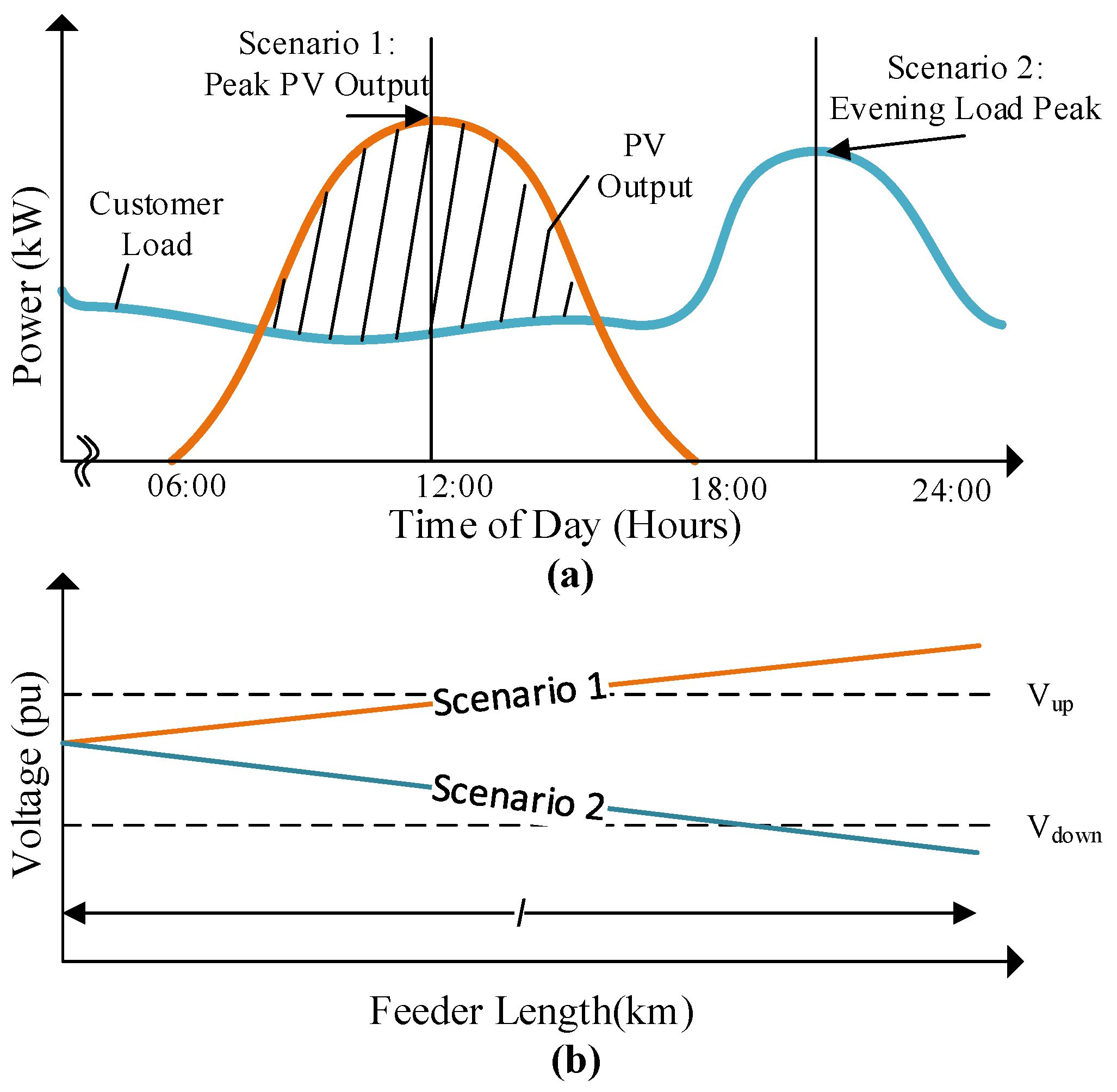
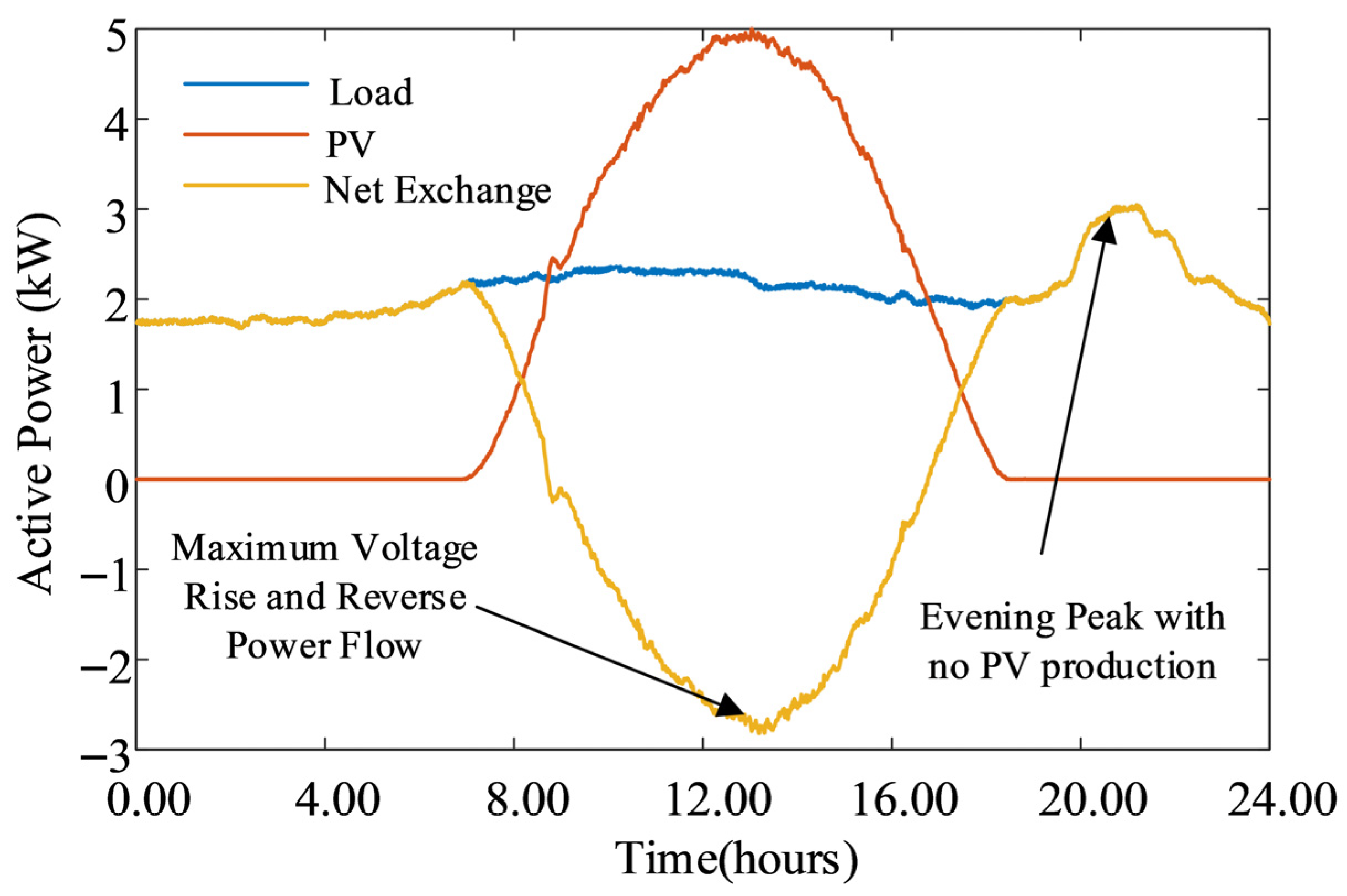
Figure 1a depicts the active power variations in a nominal residential LV feeder load and PV output for a typical clear sunny day. Considering a future network scenario where all residential connections incorporate a rooftop solar PV generation system, it is evident that LV feeders will experience a maximum voltage increase corresponding to Scenario 1 and a maximum voltage decrease corresponding to Scenario 2.
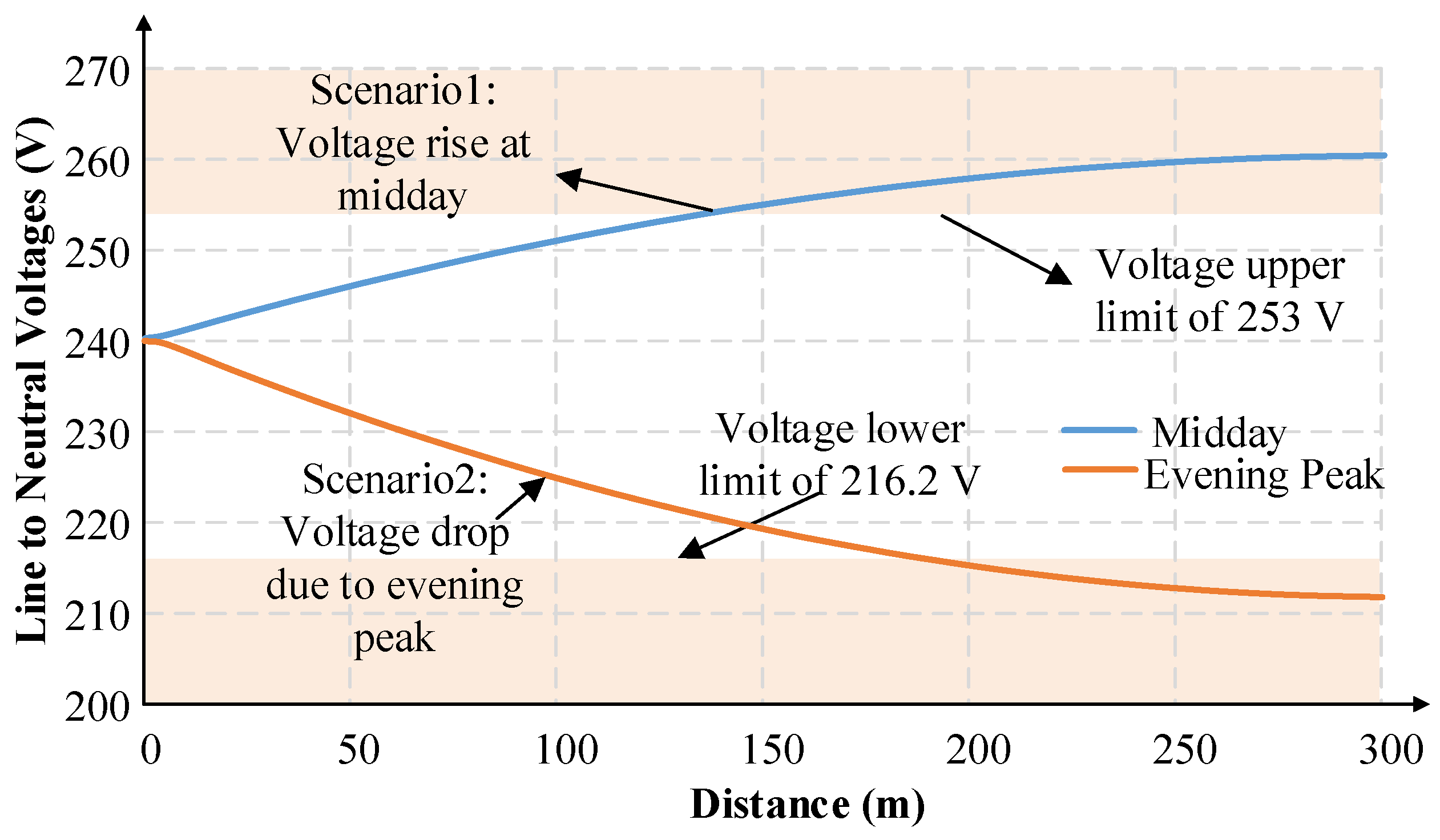
Figure 1b shows the indicative voltage profiles along a typical LV feeder for the above two scenarios (assuming uniformly distributed PV generation systems and loads). Depending on the impedance of the conductor and the loading level, the feeder voltage profile may fall outside the mandated voltage limits.
In addition to the overall voltage magnitude, the balance of individual phase voltages is also often important to LV distribution customers, especially to ensure the efficient operation of three-phase induction motors and similar loads requiring balanced three-phase voltages at their point of supply. Compared to HV and MV networks, LV networks experience more variable loads and have a higher level of inherent unbalance due to their overhead four-wire feeder configuration and connection of predominantly single-phase loads and PV generators. To quantify the voltage unbalance in such a system, the definition of the voltage unbalance factor (
VUF) according to IEC/TR 61000-3-13 [
25] will be utilized in this paper. This is defined as:
where
Vab, Vbc, and Vca correspond to the magnitudes of the line-line voltages for the three-phase system. The use of (1) enables a convenient way of estimating the negative to positive sequence ratio (the IEC unbalance factor) from field measurements and/or simulation results where the phase-to-phase voltage magnitudes are more readily available than the individual phase magnitudes and their respective phase angles.
2.1. Importance of Detailed Modelling of LV Feeders
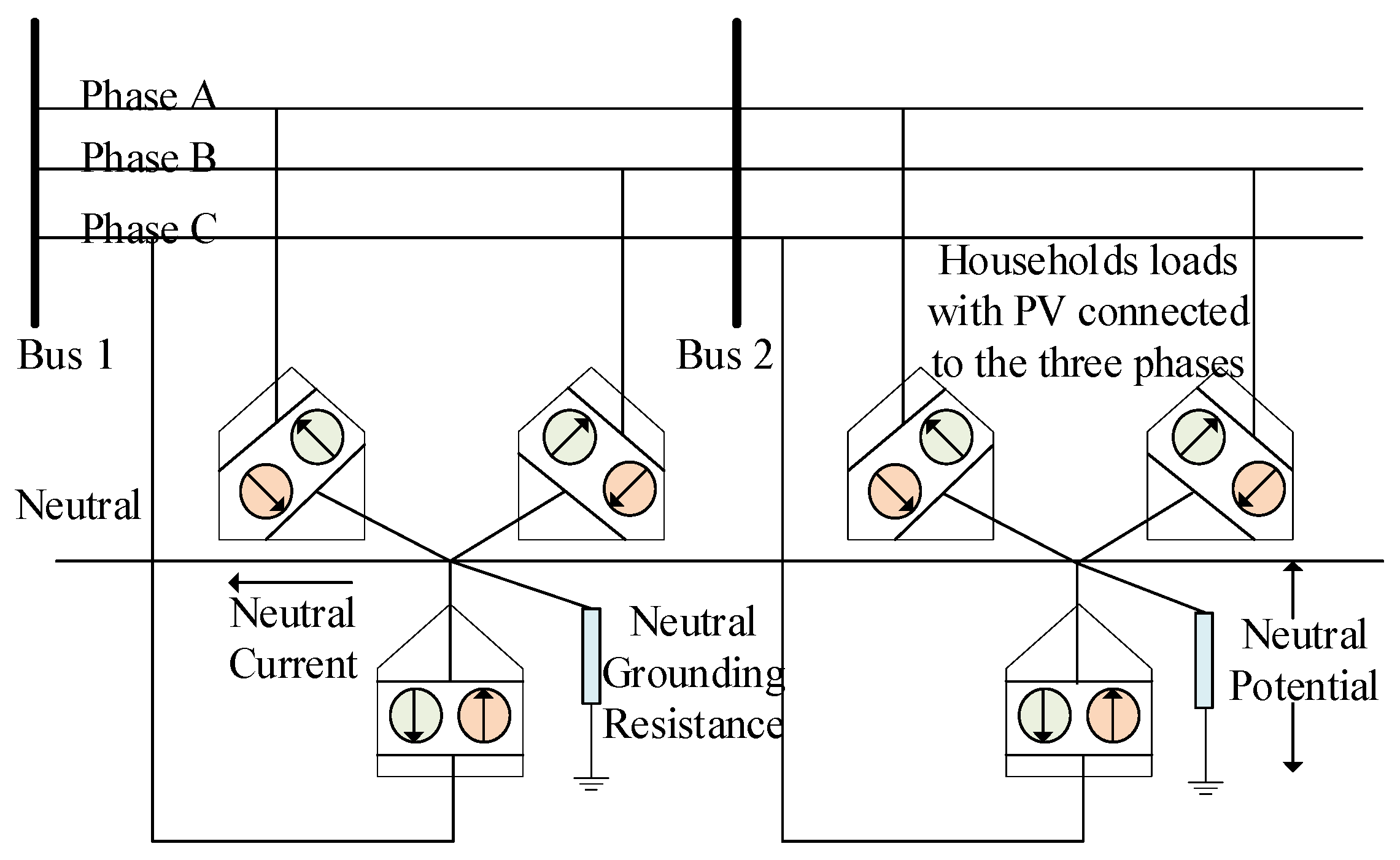
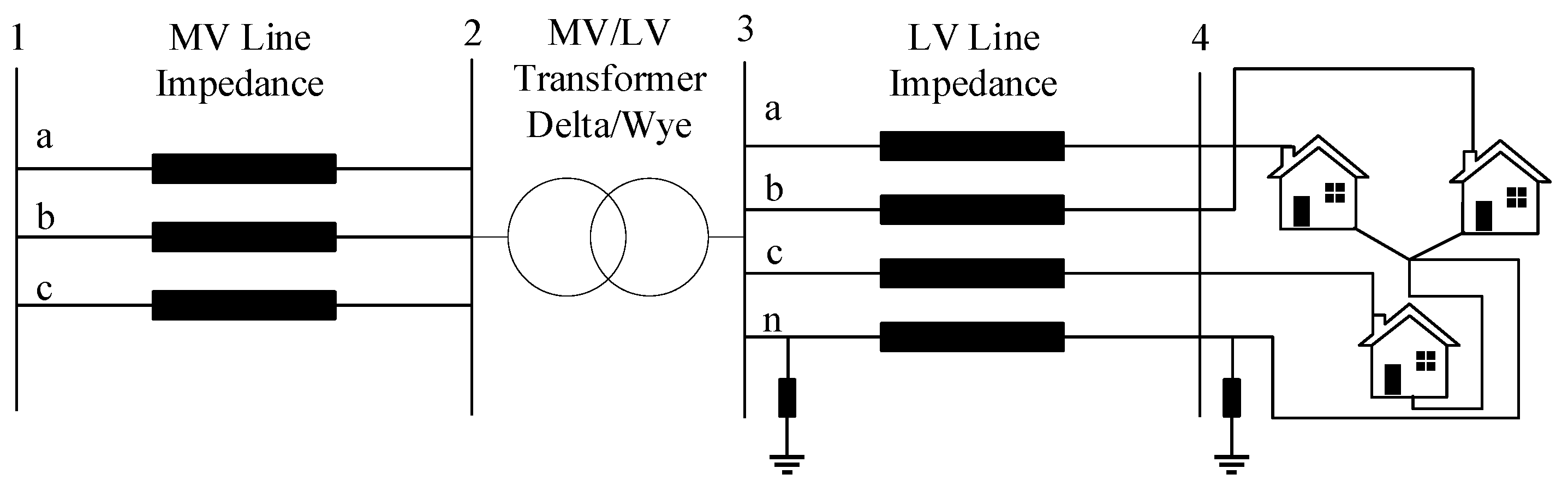
In typical distribution networks, the MV and LV lines are usually modelled with a three-wire and a four-wire configuration respectively, as physically configured. The neutral wire of the LV feeder is generally grounded at multiple points along the feeder.
Figure 2 illustrates the basic connection philosophy of this four-wire MEN system. This section will discuss the importance of explicitly modelling four-wire LV feeders and why the information on the neutral conductor is required to ascertain an accurate representation of the operation of LV distribution networks.
In many conventional distribution network studies, the LV neutral conductor is not modelled explicitly. Instead, its effect is absorbed into the phase impedance matrix using Kron reduction [
26], or the neutral is assumed to be solidly grounded and therefore omitted from the network model. In practice, this assumption is often not valid because the resistance of neutral earth connections can range from a few ohms to several tens of ohms [
27,
28,
29]. Field investigations in Australian LV networks show that neutral grounding resistances are frequently higher than the design values adopted by network operators due to interactions with underground metallic infrastructure and changes in water-reticulation materials [
30]. As a result, traditional three-phase power-flow tools that neglect an explicit neutral conductor cannot accurately capture the operation and grounding behaviour of four-wire MEN LV feeders and are therefore not well suited for detailed LV analysis.
In unbalanced LV networks, neutral currents can exceed the current in one or more phase conductors, as reported in reference [
9] (using a Backward–Forward substitution-based modelling approach). Large neutral currents arising from phase unbalance can create safety concerns for people and animals and may adversely affect overall network performance. Potential impacts include overloading of the neutral conductor, electromagnetic interference with nearby communication systems, reduced sensitivity of protection devices and an increase in neutral-to-ground (N-G) voltage. Elevated N-G potentials can appear as a noise source for sensitive electronic equipment and may lead to maloperation of devices that require a clean sinusoidal supply. An integrated three-wire/four-wire modelling approach for assessing N-G voltages in multi-grounded LV networks was proposed in reference [
31], where the influence of LV neutral behaviour on the upstream network was also examined. The study considered grounding resistances of approximately 5 Ω and used a 0.5 V N-G voltage limit as the common-mode threshold for sensitive equipment [
32], showing that unbalanced PV connection patterns can drive N-G voltages above this level.
Several previous studies have examined neutral conductor modelling and N-G voltages in more detail. General four-wire power flow formulations for distribution networks have been presented in the literature [
8,
31], while reference [
9] applied a four-wire model to assess neutral currents and N-G potentials in LV MEN feeders with unbalanced rooftop PV allocation. Other work has investigated integrated three-wire/four-wire approaches for multi-grounded LV networks and highlighted how neutral grounding resistance and unbalanced loading can drive N-G voltages above common mode limits for sensitive equipment [
31,
32]. These contributions demonstrate the importance of representing the neutral conductor explicitly when analyzing LV MEN systems. This paper builds on this earlier work by embedding a four-wire LV model within a combined LV–MV framework and by carrying out a 24 h time series impact study that simultaneously evaluates phase voltages, N-G voltages, losses and OLTC operation under increasing rooftop PV penetration.
2.2. Voltage Regulation in Distribution Networks
2.2.1. Limitations of Traditional Voltage Regulation Techniques
Traditional methods used by DNSPs to mitigate issues with voltage regulation in networks with a low level of automation include network upgrades (replacing transformers and conductors), use of on-load and/or off-load taps on transformers, and capacitor banks for reactive power support. Upgrading of problematic networks has historically been used to solve long-term voltage regulation issues in distribution networks. Although new, higher-rated components may solve voltage issues and increase the hosting capacity of the network, these solutions are often expensive, and the extent of added advantage offered does not necessarily make these solutions an economically viable solution to be implemented on a large scale.
On-load tap changers (OLTCs) are commonly found in zone substations where the tap position is controlled to regulate the MV voltage feeder profiles. However, due to their slow response time (at least 1 min before operation), the tap changes may not be adequate to compensate for voltage variations caused by the intermittency of PV power. Furthermore, the additional tap changes in OLTCs when operated in a PV-rich distribution network also decrease the lifetime and increase the maintenance cost of the device, as discussed in reference [
33]. Another option is changing the position of the off-load tap, typically found in LV feeder transformers. However, off-load tap changers need manual intervention (labour and outages), and this approach may not be practically feasible in distribution networks with bidirectional power flow where both undervoltage and overvoltage conditions may be induced as PV penetration increases [
34]. Fixed and switched capacitor banks have also successfully been used to mitigate undervoltage issues under high load conditions. However, as capacitors boost the voltage by injecting reactive power, fixed capacitors can exacerbate overvoltage conditions during high reverse power flow. Although switched capacitors can regulate the amount of reactive power injected in discrete steps, it is not a viable option to mitigate overvoltage problems with varying load patterns as these devices do not have the capability to decrease the voltage.
Network reconfiguration is another method used by DNSPs to mitigate voltage regulation issues and increase reliability. Reference [
35] discusses various mathematical approaches that can be applied for optimized network reconfiguration, including metaheuristic methods such as genetic algorithm and particle swarm optimization (PSO). However, voltage regulation issues will be observed mainly in non-urban radial structured residential overhead conditions, and in most of these network structures, multiple transformers are often not available to reconfigure the network.
2.2.2. Solar PV Inverter Control
With the advancements of semiconductor-based devices, modern power converters can now be equipped with advanced control functions that can be used for distribution network voltage regulation. In the past, international standards such as IEEE 1547 (pre-2018) [
36] and grid codes across the world required inverters to operate at unity power factor and hence they could not be used to provide local voltage regulation support. However, recently, standards have been redefined to allow inverters to contribute to voltage control through active and reactive power regulation. For example, IEEE 1547 (2018 version) [
37] and Australian Standard 4777.2:2020 [
36] mandate local voltage regulation through the operation of inverter power quality response modes. Modern inverters have the capability to implement a range of different voltage regulation functions [
38]. Some of the PV inverter modes commonly studied in the literature include:
Constant Power Factor;
Q(V) Control—where the reactive power is regulated through a function of the measured terminal voltage, commonly referred to as Volt-VAr control;
PF(P) and PF(V) Modes—where the inverter operating power factor is controlled as functions of real power and local voltage;
P(V) Mode—where the inverter’s real power is curtailed when the measured voltage is high, commonly referred to as the Volt-Watt mode.
Among the above-discussed modes, Q(V) is the most implemented inverter control function.
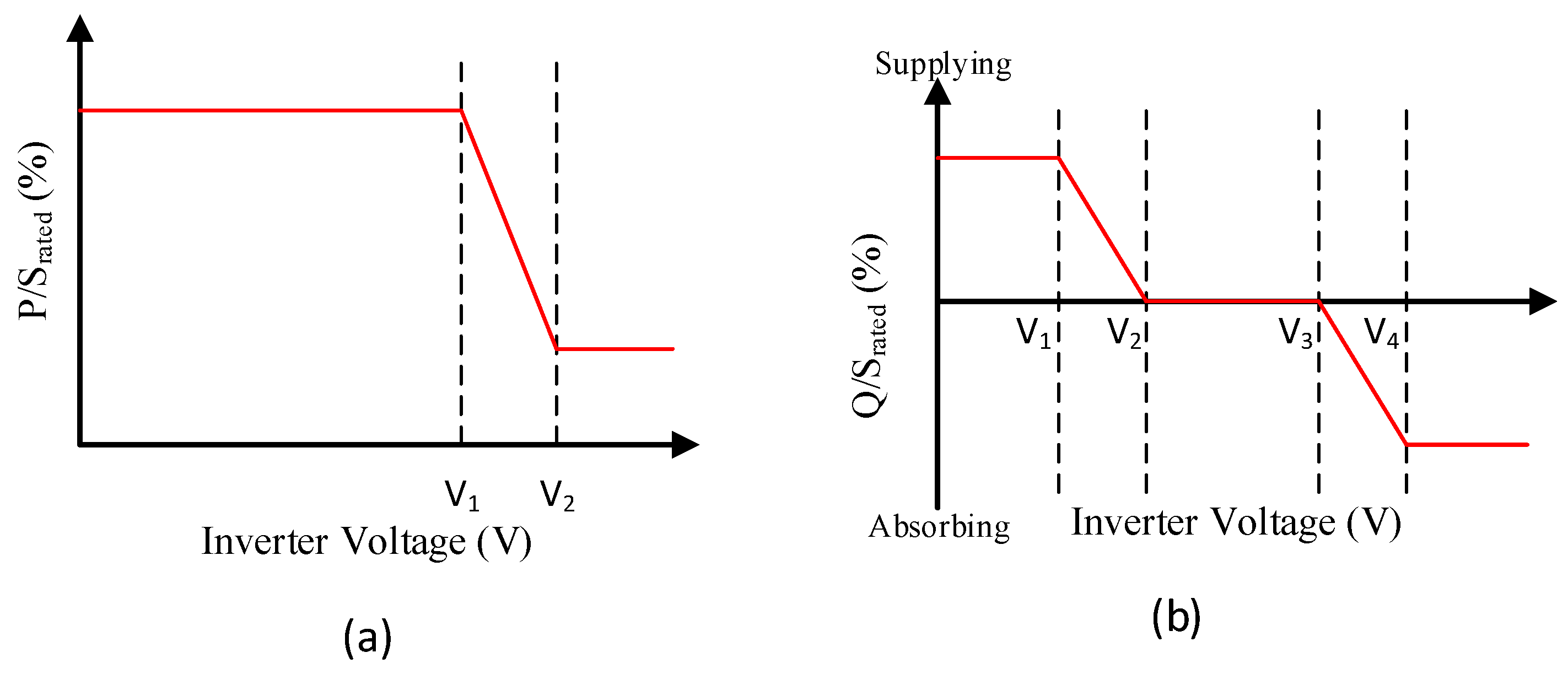
Figure 3 shows the droop curves defined in AS 4777.2:2020 for the operation of the Volt-Watt and Volt-VAr functions. Droop control is implemented in these curves, which allow VAr injection/absorption depending on the voltage for the Q(V) function and active power curtailment for high voltages in the P(V) functions. Recent studies have investigated the performance of the distribution network when these voltage regulation techniques are implemented. The simulation study performed on a Hawaiian distribution network [
39] concludes that both Volt-Watt and Volt-VAr controls can regulate the voltage in both urban and rural distribution networks. Reference [
40] investigates the use of smart inverter functions for 18 distribution feeders. Not only does the study confirm that inverter control is successful in maintaining distribution network voltage levels, but it also discusses how these advanced settings also have the capability to increase the hosting capacity of feeder. Furthermore, the authors conclude that more research is required to determine the optimized setting for the inverter depending on the feeder characteristics and configuration.
Some of the main challenges when utilizing PV inverters for voltage regulation include customer revenue loss due to active power curtailment, increased apparent power flow and inequity for customers at different points of connection in the network. Active power curtailment due to inverter smart control reduces the instantaneous overall power output of the PV system during periods of overvoltages. While this would tend to suggest that customer revenue from grid feed-in tariffs would be reduced, recent studies have demonstrated that significant losses are not imposed by smart inverter control. In an Australian study [
41], the results demonstrated that only 2% of energy curtailment was caused by the activation of Volt/Watt and Volt/VAr modes. Activation of reactive power support from inverters also requires higher power ratings for inverters (or reductions in real power output) to supply the required reactive power. In addition, the extra reactive power in the network, while fundamental to the ability to mitigate voltage, results in higher apparent power flow in the feeder, increasing the losses and utilization of the network assets [
41]. Currently, most residential PV units are customer-owned, introducing inverter settings compliance issues. In reference [
42], it is shown that only a fraction of new PV installations are properly audited and they are often found not be compliant with the required grid standard. The analysis in reference [
42] also discusses the issue of inequity between customers connected at different nodes in a feeder. For example, if Volt-Watt is activated, the customers towards the end of the feeder will experience more active power curtailment than customers connected near the distribution transformer, introducing inequity between the individual PV systems.
2.2.3. Demand Response
While demand response (DR) techniques are commonly used by DNSPs to reduce evening peak load, with recent problems associated with voltage regulation, there has been an increased interest in utilizing DR technologies for the mitigation of voltage variation [
43]. A recent project by an Australian DNSP applied conservation voltage reduction (CVR) to manage voltage levels in distribution network feeders [
44]. CVR was implemented through the tap operation of OLTCs controlled by trigger responses from smart inverters. The method of utilizing smart inverters proved to be effective as the voltage information at each connection was available to trigger the required CVR operation. Large-scale application of this technique is still not an economically feasible option as many distribution networks are not equipped with smart metering technology. An interesting outcome of the trial of CVR revealed that it was more effective in winter compared to summer. The load sensitivity to voltage obtained was 0.75% in winter compared to 0.69% in summer. The authors discussed that this could be due to the presence of a more resistive heating load in winter seasons.
Another DR technique often used by Australian DNSPs to reduce the peak load is the application of audio frequency injection control (AFIC) signals to control residential loads, such as water heating and network loads such as streetlights [
45]. AFIC signalling is implemented by injecting high-frequency voltage signals onto the 50 Hz supply, which can be detected by relays, allowing certain loads to be controlled remotely. The main advantage of the AFIC DR method is that it does not require additional communication infrastructure. Recently, researchers have investigated the possible application of AFIC signals for voltage regulation. In reference [
46], the authors proposed the use of DR management in a future distribution network scenario where all the customers are equipped with a PV system and EVs. A multimodal control strategy is proposed to regulate the EV charging (with V2G activated) to ensure the grid assets are better utilized and the distribution networks are utilized. The results demonstrated that the proposed technique was successful in maintaining the distribution network voltage levels within the desired threshold. The study, however, did not consider the PQ issues introduced when using the high-frequency control signals. Another study investigated the harmonic PQ impacts on PV inverters with AFIC signalling, highlighting the requirement of filtering the AFIC signal to protect the inverters [
47].
2.2.4. Low Voltage Regulators
The final voltage regulation technique to be discussed in this section is the use of low voltage regulators (LVR). LVRs have the capability to both increase and decrease the voltage of LV feeders and they are designed with bidirectional capabilities. Typical LVRs can operate within a range of 13% about the nominal voltage with an accuracy of 1 V [
48]. The basic design of LVRs includes a tap changer and an electronic controller measuring the voltage in both directions to calculate the required tap setting. The main advantage of an LVR is that it can be installed at different locations of an LV feeder where voltage issues are expected. LVRs are quite expensive and may not be economically feasible for low density LV feeders; however, they would be effective to mitigate voltage issues in long feeders with a large difference in voltage between the start and end of the feeder. The findings of a trial of LVRs in an Australian distribution network are presented in reference [
49]. Although the project presented promising outcomes, there were scenarios where the LVR operation worsened the voltage conditions. For example, the VUF was higher when the LVR operated in situations where only one or two phases were measured to be outside the allowable voltage.
2.3. Role of Energy Storage in Future Distribution Networks
Energy storage (ES) systems are expected to play a key role in alleviating the main issues related to high penetration of distributed renewable sources such as rooftop solar PVs. With the price of ES devices or battery energy storage systems (BESS) decreasing, they have the potential to dominate the future power industry along with PV systems. With effective control, batteries can alleviate voltage variations by storing excess energy when generation exceeds load and utilizing stored energy to reduce peak load [
50]. As such, the control of the battery power in distribution networks is a topic of increasing interest. The implementation of BESS in distribution networks can be divided into two main topologies: (i) distributed ES systems where the individual batteries are for each PV system, and (ii) central or community energy storage (CES) with larger storage capacities, which can be applied for an entire LV network. Some of the major works on EVs (an alternate form of energy storage) focusing on distribution network voltage regulation are also reviewed in this section.
2.3.1. Distribution BESS
For a typical distributed BESS implementation, the charging/discharging rate is controlled by the local power conditioning system. Customer-owned BESSs are often referred to as ‘off the shelf’ (OTS) BESS. Numerous examples of customer-owned distributed (behind the metre) ES devices are documented in references [
51,
52,
53,
54]. Typical charging algorithms include the rule-based approach via detection of the net power flow at the point of common coupling (PCC), where the battery is charged if the PV production is higher than the load. From the customer’s perspective, the OTS BESS can bring significant benefits, as the power imported from the grid is greatly reduced. However, sometimes the BESS may prematurely be fully charged/discharged under light load or cloudy days, not allowing them to provide local support when the voltage levels are at their worst. Thus, from the perspective of the DNSPs, OTS BESS may not be beneficial if the BESS power is not optimally managed. Significant work can be found in the literature addressing the control issues for distributed BESS. In reference [
55], the authors controlled the individual BESS units in an LV feeder through a centralized controller. The results demonstrate that if properly managed, distributed BESS can also be used to mitigate PV-related voltage issues in distribution networks. Modern OTS BESSs also have the capability of reactive power support. In reference [
56], a four-quadrant BESS control approach is utilized to increase the PV hosting capacity of LV feeders.
2.3.2. Community Energy Storage
Compared to customer-owned BESS, CES provides freedom for the DNSP to utilize the storage device as required by the distribution network. This makes CES a viable option for the DNSP to invest in as a distribution network support device. Several studies investigate the application of CES in relation to voltage regulation in distribution networks. In reference [
8], a CES is applied in an LV feeder to mitigate a neutral potential rise issue and provide voltage support for the distribution network. In [
57], integration of DNSP-owned community BESSs was applied to maximize the hosting capacity of the feeder while ensuring the voltage levels were maintained. The proposed solution utilized a cost-based multi-objective strategy considering both distribution system and battery recycling costs and three different BESS service functions, including voltage regulation, loss reduction, and peak reduction. Furthermore, the optimal size and location of a CES have been investigated in reference [
58] for a BESS system with four-quadrant power control, enabling control of both active and reactive power. The effect of battery and converter sizes on current and power losses is studied, and the placement of the CES was determined to be an important factor with respect to their overall performance to improve network performance.
2.3.3. Electric Vehicles
The recent increase in the popularity of EVs has raised an unresolved question on how networks must adapt to cope with the significant increase in load, especially because of the unpredictable dynamic behaviour of the load. It is evident from the literature [
59,
60,
61,
62] that the uncontrolled charging of EV load has the potential to severely affect the normal operation of the grid. Currently, SAE J122 is the most popular among the charging standards used commercially that can support the three levels of plug-in EV charging [
59]. EVs will be generally charged during the evening as people return home from work. It is at this time that the collective charging can impose a severe burden on the hosting capacity of the grid. In reference [
63], a simulation-based study concluded that an increase of 10% in EV numbers has the potential to increase the peak load by 18% due to residential Level 1 AC uncontrolled charging.
However, researchers have identified the potential to use EVs as a method of supporting grids with high penetrations of renewables. According to the driving behaviour data provided in reference [
64], a majority of vehicles are travelling for only a small amount of time during most days, with the vehicles remaining parked either at home or a workplace for a much larger portion of time. The amount of parked time is even greater if there is a second car within a household. As the number of EVs is increasing at an exponential rate, the available battery power could be utilized to support the grid using the concept known as V2G (Vehicle to Grid). During peak evening load, vehicle batteries can be used as peak shaving support. In reference [
65], a V2G charging algorithm is proposed where the charging current is controlled depending on the power generated from the PV unit in comparison with the load, and the current is discharged using a triangular function.
2.4. Utilization of FACT Devices in Distribution Network
Flexible AC transmission (FACT) system devices are widely used by transmission system operators. Recent works have investigated the possibility of using these well-known devices in distribution networks. Some of the common FACT devices considered to solve voltage regulation issues in distribution networks include dynamic voltage restorer (DVR), static VAr compensator (SVC), static compensator (STATCOM) and unified power flow controller (UPFC). The use of FACTs in distribution networks is an ongoing research topic; some of the major work completed for voltage regulation, loss minimization and PQ improvement on this topic can be found in the literature [
66,
67,
68,
69].
Of the above-mentioned FACT devices, STATCOMs show great promise for distribution network applications due to their capability to inject/absorb reactive power. Smaller-sized STATCOMs are currently being trialled by DNSPs in Australia. Reference [
70] summarizes the findings from trials by an Australian DNSP, where a combination of 5 kVAr single-phase and 20 kVAr three-phase systems was applied in LV feeders. This paper concentrates on STATCOMs as one of the possible FACT devices that have the potential to be widely employed in LV feeders for voltage regulation. Compared to reactive power support from smart inverter functions, the main advantage of STATCOM is its ability to provide a higher level of VAr support from a single device. Furthermore, the device can be optimally placed at a specific location in the LV feeder where the line losses can also be reduced. During their operation, STATCOMs also have the capability to improve the transient stability of the system when the system experiences disturbances [
71]. The deployment of STATCOMs in distribution networks has become increasingly feasible due to advances in power electronic converters and associated cost reductions, and they can be used to mitigate a range of power quality issues. Several studies have shown that distribution-level STATCOMs are effective in reducing voltage fluctuations caused by load variations through local reactive power control [
72,
73]. Other work has examined coordinated schemes in which STATCOMs are combined with OLTCs to support voltage profiles along radial MV feeders [
74] and has investigated placement strategies to identify locations that maximize voltage improvement and minimize feeder losses [
75,
76].
2.5. Advanced Voltage Regulation Approaches
2.5.1. Coordinated Voltage Control
This section will present some of the more advanced and novel voltage regulation approaches proposed for optimized distribution network voltage regulation. Reference [
77] provides an extensive review of some of the advanced voltage regulation techniques that can be applied in distribution networks, which includes various centralized, distributed and decentralized methods. The work also discusses the fact that although some of the modern techniques may demonstrate excellent performance, many of these methods are not practical solutions due to the absence of communication infrastructure and/or associated costs involved. Significant work can also be found in the literature focusing on the coordination of multiple voltage regulation devices. Reference [
78] proposes a distribution network voltage regulation scheme utilizing both OLTCs and distributed ES. The study presented in reference [
79] focuses on the coordination between smart inverters and distributed ES, while reference [
80] proposes a centralized voltage regulation method regulating the combined tap operation of OLTCs and LVRs. Researchers have also proposed the use of dynamic control of inverters utilizing a centralized controller. Currently, most commercial inverters can only obtain the local feeder information, not allowing them to respond to disturbances at other points in the network. Assuming more extensive information will be available in future smart grids through a central controller, reference [
81] proposes the implementation of a dynamic inverter control coordination strategy allowing multiple inverters to be controlled at the same time for improved performance. Even if the required communication infrastructure is available, some issues have still not been addressed extensively in the literature. For example, proper incentive structures need to be developed before these methods can be applied in real life and more work needs to be done with respect to how the new information can be incorporated into the existing SCADA.
2.5.2. Optimized Control of ES for Distribution Network Voltage Regulation
Another emerging research topic on voltage regulation is the application of modern optimal theory-based control, such as model predictive control (MPC), to regulate the charging/discharging power of ES devices for distribution network voltage regulation. MPC or receding horizon optimization is based on optimizing an objective variable with a prediction of future loads and PV generation. The major advantages of utilizing MPC for ES control, as discussed in reference [
82], are as follows:
The ability to include physical constraints in the objective function, such as the maximum and minimum state of charge (SoC) levels for the ES device.
The ability to utilize demand, generation, and price forecasting data.
The ability to incorporate multiple objectives to mitigate other distribution network issues, including voltage regulation.
Although simple rule-based strategies for controlling the power of energy storage (ES) units are easy to design and implement [
51], they rarely deliver truly optimal performance [
83]. Fixed rules, such as charging when the voltage exceeds a threshold or discharging when it falls below another, cannot anticipate future changes in load or PV generation and offer only a limited scope to enforce operating limits such as state-of-charge and inverter ratings [
84]. In contrast, model predictive control (MPC) formulates the ES control problem as an optimization over a finite prediction horizon using forecasts of demand and PV output [
85]. This enables multiple objectives and constraints to be handled explicitly and allows the ES schedule to be tailored to improve voltage profiles, reduce losses, and respect both device and network limits [
86,
87,
88,
89]. These benefits come at the expense of higher computational effort and a requirement for reliable measurements, forecasting, and communication infrastructure, which can pose challenges for large-scale deployment in LV networks.
2.6. Summary of Voltage Regulation Techniques
This section provides the literature review related to voltage regulation in PV-rich distribution networks. The primary goal of this section was to review both traditional and novel voltage regulation technologies available in the literature. In the first part of the section, the main contributing factors that cause voltage regulation issues are introduced, along with the importance of detailed four-wire modelling of the LV feeder. The limitations of existing voltage regulation techniques and some of the associated implementation challenges are discussed. The main voltage regulation techniques discussed include smart inverter control, the use of energy-storage devices and FACTS devices, and other modern advanced voltage regulation approaches.
While the literature survey demonstrates significant progress in regulating distribution network voltages, most solutions are found to concentrate on the application of voltage management devices in MV and HV networks, and this paper seeks to address this research gap by focusing on voltage regulation techniques in LV feeders. This focus helps ensure that voltage regulation issues are mitigated locally and are not simply transferred to upstream networks. It was also found that distribution network studies often neglect the detailed network modelling of the LV feeder, leading to errors or non-indicative results, which will be addressed in this paper. The main thrust of distribution network studies concentrates on control and the internal operation of related devices through power electronics. There exists a gap in the literature addressing the long-term performance of PV-rich networks, especially within LV networks. The case studies to be provided in this paper presents 24 h time series simulation to investigate the performance with varying load and PV generation. Most of the modern voltage regulation techniques found in the literature also do not fully consider the limitations of practical distribution networks (e.g., communication constraints) and the relevant standards for DNSPs, which are discussed in the context of the present study.
In recent years, research on voltage regulation in PV-rich LV distribution networks has increasingly focused on coordinated and data-driven control strategies. Recent works have proposed robust central or hierarchical schemes that jointly control PV inverters, OLTCs, and energy storage systems in order to maintain voltages within limits under high PV penetration [
90,
91,
92]. Other studies have developed distributed multi-agent voltage control approaches for LV feeders, where smart inverters share reactive power support based on local measurements and limited information exchange [
93,
94]. In parallel, probabilistic hosting capacity assessment methods and probabilistic load flow tools have been introduced to quantify the impact of high PV penetration on voltage profiles in large sets of realistic LV networks [
95,
96]. These recent contributions underline the importance of coordinated smart inverter control, community or distributed energy storage, and probabilistic analysis in planning and operating future PV-rich LV distribution systems. To summarize,
Table 1 highlights the main voltage regulation approaches discussed in this section, grouped by control architecture and device type, together with representative references.
3. Modelling of Distribution Network Performance with High Penetration of Rooftop PV Systems
3.1. Importance of LV Distribution Network Analysis Tool
In future distribution networks, excess PV generation may lead to reverse power flow and increase the magnitude of the supply voltage at the consumer’s point of connection. This voltage rise issue, along with voltage unbalance, makes it essential to perform a comprehensive reassessment of distribution system performance in order to find solutions and propose strategies to address these issues. As distribution systems operate at different voltage levels, the analysis tool developed in this paper is designed to appropriately model three-wire MV and four-wire LV networks. The tool is also capable of modelling how PQ problems introduced in LV propagate to the upstream MV network, and the impact of high penetration of PV on the operation of the on-load tap changer (OLTC) systems applied in MV and HV substations.
A power-flow study is a fundamental tool for planning and operating distribution networks. Over the years, a range of algorithms has been developed for power-system analysis [
9,
97,
98,
99], including the Newton–Raphson, Gauss–Seidel, fast-decoupled and backward–forward sweep methods. The backward–forward sweep algorithm [
9] is known to perform very well in radial distribution feeders with relatively high R/X ratios, but it is not generally suitable for meshed network topologies. Because most rooftop PV systems are connected as single-phase units, a full three-phase power-flow formulation is required to assess voltage unbalance in LV feeders. In this paper, a three-phase power-flow method based on the current-injection mismatch variant of the Newton–Raphson algorithm [
97] is employed. This approach can be applied to both radial and weakly meshed networks, and the current-injection formulation provides a convenient way to model the combined effect of loads, rooftop PV systems and other devices connected at different nodes of the distribution network.
3.2. Distribution Network System Modelling
Electricity distribution systems commonly operate at multiple voltage levels, with medium voltage (MV) feeders supplying low voltage (LV) networks via distribution transformers, as illustrated in
Figure 4.
3.2.1. Development of Distribution Line Models
In many distribution studies, MV and LV line sections are represented by a 3 × 3 phase admittance matrix, where the diagonal elements contain the self-admittances and the off-diagonal elements represent mutual coupling between phases. For LV feeders, the effect of the neutral conductor is often eliminated by applying Kron reduction to obtain this three-phase representation [
100]. However, with increased network unbalance due to single-phase PV injections, it is essential to investigate the effect of solar PV on the neutral voltage and currents. If the neutral wire needs to be expressed explicitly, the LV network impedance can be represented using a 4 × 4 admittance matrix, where the neutral grounding impedance can be added. This is quite often not explicitly modelled in commercially available distribution network analysis tools. For LV feeders in most countries, a multi-grounded approach is utilized, and this is applied for modelling the 4th neutral conductor. The matrices used to model the LV and MV lines can be expressed as:
where the diagonal elements,
,
and y
cc, are the self-admittances of the three phases of the lines and the off-diagonal elements represent the mutual coupling admittances between the phases a, b and c. The subscripts n and g refer to the neutral and ground phase respectively. The numerical values of the individual admittances can be obtained using Carson’s Line equation with the per unit length impedances or obtained from DNSPs for practical system modelling.
3.2.2. Modelling of Distribution Line Models
Transformers play a vital role in distribution networks because they interconnect circuits operating at different voltage levels and with different winding configurations. For the four-wire LV networks considered in this paper, the distribution transformers are represented using ABCD parameters, and the relationship between primary and secondary voltages and currents is given in (4) [
101,
102].
In (5), y
t represents the leakage admittance of the individual phases. To incorporate the neutral phase in the combined modelling of MV and LV, a 4th zero row and column can be added, resulting in 4 × 4 matrices.
Table 2 presents the primitive admittance matrix depending on the connection type of the three-phase transformer being used. The superscript ‘T’ represents the transpose matrix operator. The overall structure of the transformer admittance matrix can be expressed as:
3.2.3. Modelling of Loads
Modelling the overall load in distribution network studies is commonly done using an aggregate representation that combines constant impedance, constant current and constant power components, often referred to as the ZIP load model. In this work, the active and reactive power demand at each LV node is described using such a ZIP formulation, where the proportions of each component are chosen to reflect typical residential load behaviour [
103]. The resulting relationship between bus voltage and complex power demand can be expressed by the following equation:
where,
and,
,
and
are the active power contributions from the constant impedance, constant current and constant power. V and V
0 are the line-to-neutral voltage of the customer supply and the nominal voltage respectively. The reactive power components can be expressed similarly. Additionally, the time series use of power varies from one customer to another.
3.2.4. Modelling of PV Systems
Each rooftop PV installation is modelled as a DC source (PV array) connected to the LV network through a grid-interactive inverter. The PV array converts incident solar irradiance into DC power, while the inverter injects AC current into the feeder. Under normal conditions, the inverters are assumed to operate close to unity power factor; however, they are represented with the capability to inject or absorb reactive power up to their apparent power rating when required for voltage support. This structure allows the same PV model to be used both for impact analysis and for studies that include reactive power control modes. In the injection-based load flow formulation adopted in this paper, the inverter at each PV node is represented by an equivalent current source. The complex current injected by the inverter is obtained from its active and reactive power output and the local phase-to-neutral voltage, as expressed in (7).
where the subscript
inv for
I,
P and
S describes the inverter’s current, real power and apparent power respectively; the j operator represents the imaginary section in Cartesian coordinates; and ‘*’ is the complex conjugate operator.
Derating factors have also been considered to relate the inverter’s real power and DC power produced from the PV panels. These derating factors consider aspects such as the efficiency of the inverter, impacts of dirt on panels and power mismatch due to multiple panel coordination. The level of reactive power support from the PV system is controlled by the apparent power rating of the inverter. The DC power from the maximum power point tracking (MPPT) algorithm can be obtained from the characteristic graph of current (
) versus the operating voltage
of the individual panels. The functions of the voltages and currents from the panels can be mathematically represented as a function of the following parameters [
104]:
In Equation (11), f is a function to calculate the operating voltage of the PV panel from the irradiance data, t represents the operating temperature, and p corresponds to a matrix of the various PV electrical parameters such as short circuit current, voltage and current coefficients, and the internal resistances of the modules. In Equation (12), ɡ is a function to determine the panel output DC current from the ambient conditions and the implementation of the MPPT algorithm. The G in Equation (12) represents the irradiance level of the sun at any instance.
3.3. Power Flow Algorithm
A three-phase four-wire power flow algorithm based on a current injection mismatch formulation is used to solve the combined LV–MV network.
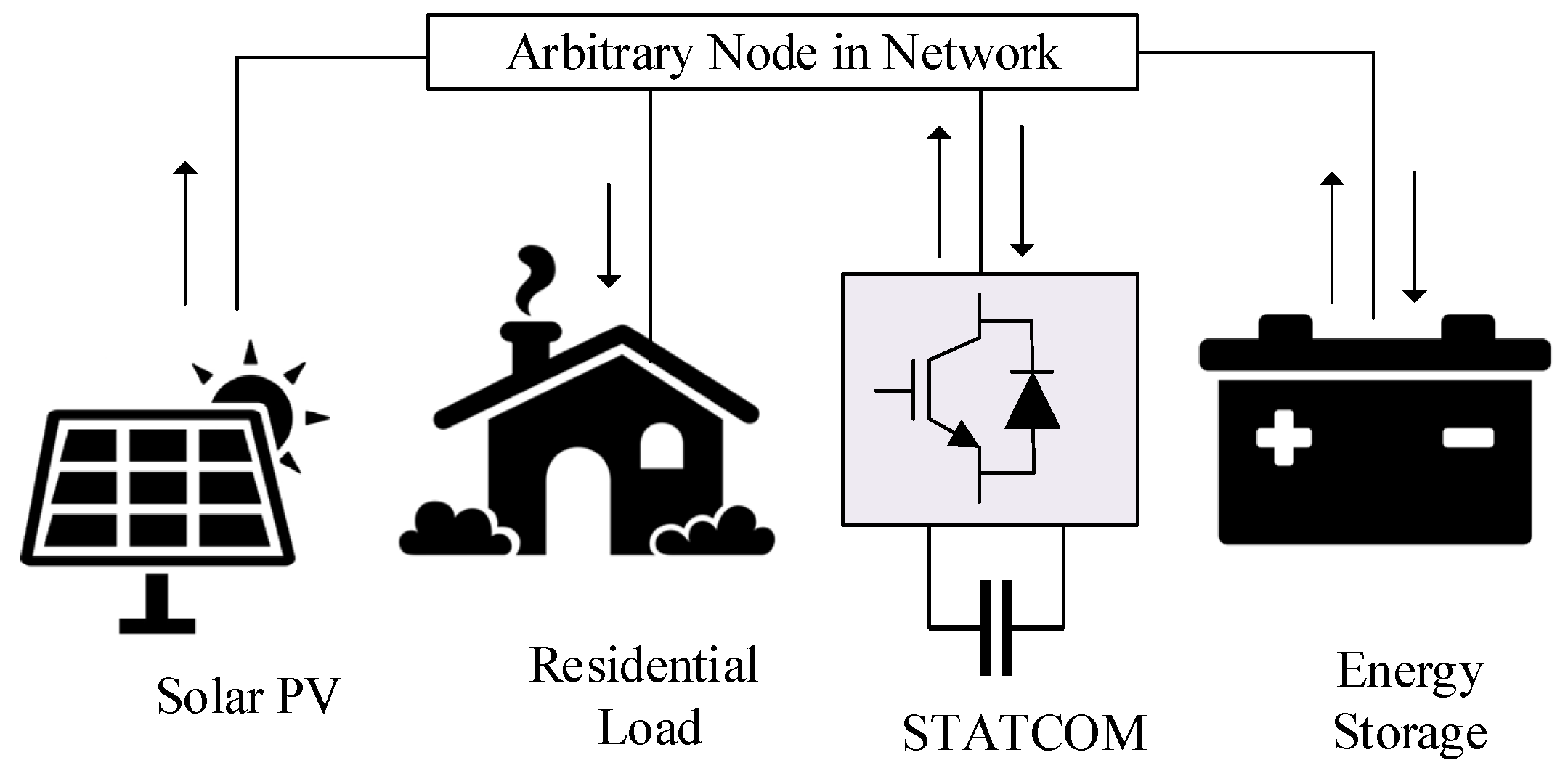
Figure 5 illustrates the different components that contribute to the specified current at each node, namely customer loads, rooftop PV inverters, STATCOMs, and, where present, energy storage systems. For a given operating point, the complex current injection at a node is obtained from the net complex power of all devices connected at that bus and the local bus voltage. The network admittance matrix is then used to relate bus voltages and currents, and the difference between the specified and calculated nodal currents forms the mismatch vector that is driven towards zero by the Newton–Raphson iterations.
The current mismatch variable represented by Δ
I can be expressed as:
here,
and
are the vectors of the three-phase specified and calculated currents respectively, at a bus. The specified current in a bus can be calculated from the apparent power and the bus voltage of the load,
PV system and the storage component. The individual contributions from the different components of a customer can be used to mathematically obtain the specified current from:
In Equation (14),
,
,
and
are the bus current injections from the load, the PV system, the energy storage system and STATCOM respectively. The load current has been expressed with a negative sign to illustrate that it is drawing current from the grid. As storage devices and STATCOM will be investigated as a mitigation strategy, the current contribution from batteries (
) and reactive current from STATCOM
are also included. When the battery is charging, it behaves as a load and its current is taken as negative, whereas during discharge for evening peak support, the battery current is positive. The three-phase currents at an arbitrary node
m are obtained from the general network current–voltage relationship given by:
Here
Y denotes the admittance element between buses
m and
n, and
k is the total number of buses in the system. Equation (15) can then be rewritten to express the current mismatch at bus
m in terms of its real and imaginary components, as shown in the following equations:
In Equations (16) and (17), the superscripts
Re and
Im represent the real and imaginary components of the corresponding current and voltage vectors.
Gmn and
Bmn are 4 × 4 matrices that represent the real and imaginary magnitudes of the admittance matrix. The individual current, voltage, real and reactive power elements in (13) and (14) are 4 × 1 matrices where each row corresponds to individual phase measurements. The fourth element corresponds to the neutral conductor in MEN systems. At each bus, the net real and reactive power is obtained by combining the contributions from the PV generation, the local load demand, and the energy storage system. After the current mismatch vectors have been calculated for all buses, they are used to form the voltage correction vector within the Newton–Raphson iterative process. A key benefit of using a current-mismatch formulation in Cartesian coordinates is that the resulting Jacobian matrix closely resembles the network admittance matrix, with only the diagonal elements needing to be updated at each iteration. The relationship between the voltage update vector and the current mismatch vector can be written as:
where
J is the 8 × 8 Jacobian element. Here, each bus is defined with four wires (three phases and neutral), and all the elements are represented using both real and imaginary components, making the
J matrix 8 × 8. The imaginary and real components of the current mismatch matrix are inverted using the formation of the Jacobian matrix, which only requires an update in the diagonal elements. This simplifies the power flow solution. The details on how to calculate the Jacobian are provided in reference [
97], and this method is utilized in this paper. To find the solution for the power flow, the voltages in the buses are updated iteratively until the current mismatch vector reaches a predefined tolerance.
3.4. Case Study Parameters
3.4.1. LV Feeder Modelling
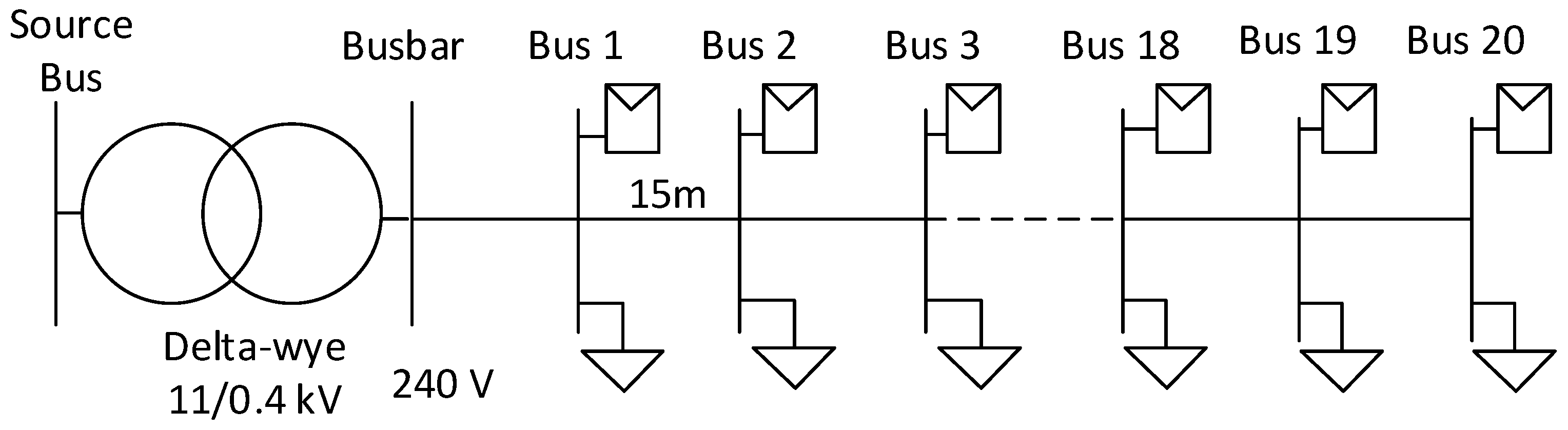
To demonstrate the voltage issue due to the integration of solar PV in LV feeders, a typical overhead four-wire feeder from NSW, Australia, has been modelled. In practice, LV feeders have an almost infinite range of configurations, including underground networks in city centres. Overhead feeder parameters are used as the overhead network is commonly used in residential networks. In addition, the high R/X ratio associated with overhead network construction means the worst voltage scenarios can be expected in overhead systems. The case study feeder length is 300 m, and it is supplied by an 11 kV/400 V delta-star distribution transformer with 4% reactance (200 kVA transformer). The line-to-neutral voltage at the distribution transformer busbar is set to 240 V, which is 10 V above the Australian nominal value of 230 V. To represent a worst-case operating condition, the LV feeder is assumed to be heavily loaded, with 60 customer loads distributed evenly across the three phases. For a feeder length of 300 m, this corresponds to an average spacing of 15 m between consecutive loads, based on 20 connections per phase. Each customer is assigned a peak demand of 3 kW, and a 5 kW single-phase rooftop PV system is installed at every load point.
Figure 6 shows the basic single line structure of the radial LV feeder to be used for the case study.
For four-wire modelling, a 4 × 4 matrix was defined for the line impedance, and as such, the case study explicitly models the neutral conductor. To model the earth explicitly, a five-wire approach needs to be used; however, this homogenous system would not produce significant changes in the obtained voltages of the floating neutral. The conductor used for forming the network had a positive sequence resistance and reactance of 0.583 Ω/km and 0.3523 Ω/km (cable type- Banana-6/3.75ACSRGZ) respectively, giving an overall R/X ratio of 1.65. A grounding resistance of 0.5 Ω was used to model the neutral-to-ground connection [
8]. The cable impedance, line geometry and grounding resistance values were used to form the 4 × 4 impedance matrix in order to model the four-wire system using Carson’s equations [
23].
Table 3 summarizes the key parameters used in the model, where each customer is assigned a peak demand of 3 kW, and a 5 kW single-phase rooftop PV system is installed at every load point, connected to the same phase as the corresponding load, so that 20 PV systems are connected on each of the three phases.
3.4.2. MV Feeder Modelling
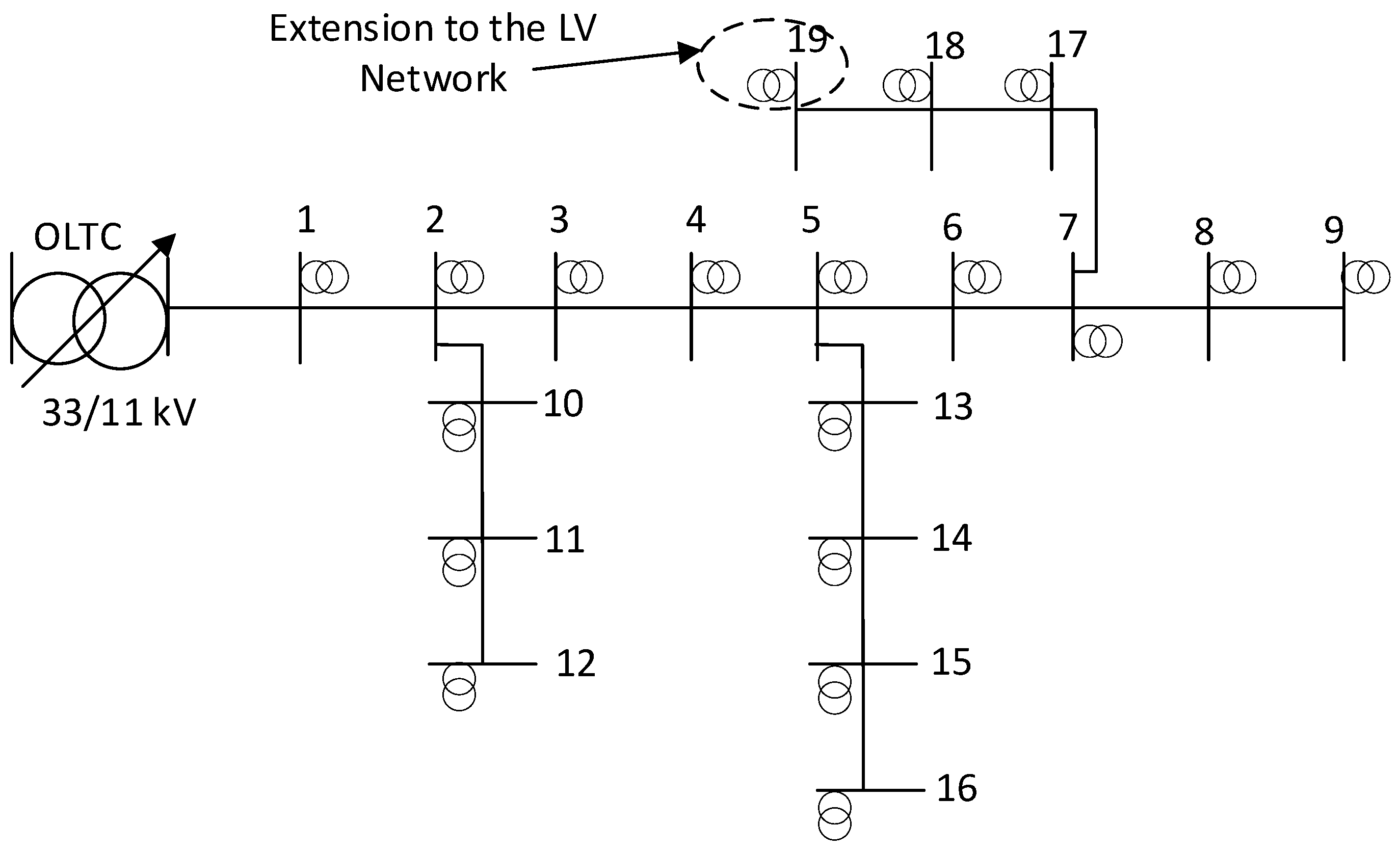
Figure 7 illustrates the single line diagram of the network structure used to model the MV components applied in the case study. The system parameters have been selected to replicate an Australian 11 kV distribution system. The above-described LV feeders are connected in the numbered nodes in the network as shown. The conductor used for forming the network had a positive sequence resistance and reactance of 0.31 Ω/km and 0.35 Ω/km respectively, respectively. This leads to a lower R/X ratio compared to the conductor and lines used in the LV feeder. The distance between each node was set to 750 m, giving a total MV network length of 14.25 km. Combined modelling of MV and LV networks allows the impact of LV PV systems on the immediate upstream network operation to be evaluated. The mitigation strategies discussed in this paper are also tested in the MV network to analyze overall system performance.
OLTCs are typically used in zone substation transformers (HV/MV) to regulate the distribution network voltage levels within the statutory limits. In NSW, OLTCs are used to step down the voltage from 66 kV/33 kV to the 11 kV used in most MV networks. A star-star connection is generally deployed in these zone substation transformers. The target voltage, bandwidth and time delay are the key parameters in the operation of the OLTC. Zone substation transformers traditionally have 7× −1.5% taps and 14× +1.5% taps, as distribution systems historically require boosting the voltage for downstream power flow. According to reference [
105], the time delay used by Australian DNSPs is 60 s to ensure the OLTC does not operate during transient events. The voltage bandwidth used in the modelling is 2.8% and the tap position is varied if the secondary voltage is not within the bandwidth set. The time delay setting needs to be lower than the delay set at the transmission level to avoid instability in the tap changing operation.
4. Australian LV–MV Case Study Under High Rooftop PV Penetration
4.1. PV Impact on LV Networks
4.1.1. Voltage Profiles in PV-Rich LV Feeders
Modelling the overall load of a customer is a complex task because a typical house contains a range of different electrical appliances and ratings, types, and operating principles, and the time of use needs to be considered. As discussed, voltage regulation issues in distribution networks are expected to be worse in residential overhead LV and MV feeders. Hence, the load data to be used in this paper has been selected to imitate a typical residential household. Although a typical household would have more step (on/off) type loads, the household load is represented by a curve which closely matches an aggregate of households (statistical representation of a household) to ensure the resulting voltage profile aligns with results presented in field data from references. To demonstrate the performance of DNs in terms of varying loads and PV output, a 24 h time series simulation is used for the case study LV feeder. The data used for the simulations was 1 min interval data provided by a DNSP in NSW, Australia, measured at the MV/LV distribution transformer. The load data used had a peak value of 3 kW, and the rooftop PV system had a rating of 5 kW. The irradiance data was configured to represent the characteristics of a summer day, without cloud passing events. No cloud passing events were introduced, as this paper focuses on steady state voltage regulation.
Figure 8 shows the active power variation in the load and PV output throughout the day. Although some modern loads may be capacitive in nature, the load was operated at a lagging power factor of 0.95. The PV system was operated at unity power factor to demonstrate the voltage rise situation without any smart inverter functions operational. It was assumed that the loads in the LV feeder are uniformly distributed. This may not imitate a real-life scenario, but it is a common technique used for distribution network analysis, as the worst-case scenarios of voltage rise and drop can be demonstrated [
31]. The general patterns for the time series power flow can also be observed, highlighting the time of day when these issues are to be expected. In this study, a single high PV penetration level is considered, where each of the 60 customers has a 5 kW rooftop PV system and a 3 kW peak load, so that the total installed PV capacity of 300 kW corresponds to 167% of the 180 kW peak feeder load.
According to Australian Standard AS 61000.3.100 [
24], the line-to-neutral voltage at LV should be within 0.94 and 1.10 pu of the 230 V nominal value. This allows the individual line-neutral voltages to vary between 216.2 V and 253 V. Two scenarios have been identified in the plot shown in
Figure 8 to investigate the most extreme voltage deviations during maximum reverse power flow and the evening peak load. They can be described as:
Midday, where there is maximum PV production and minimum load. Here, the PV systems are operated at 5 kW and the load is at 55% of its peak value. The value of 55% was selected based on the load data shape provided by a DNSP in NSW, Australia. This represents the maximum voltage rise scenario with significant reverse power flow in the network.
Evening Peak with the load with no PV production. Here, each load is operated at 3 kW (at 0.95 lagging) and there is no production from the PV systems. This represents the maximum voltage drop scenario.
Figure 9 illustrates the voltage profile along the feeder for the two scenarios, where the blue line and orange line plot Scenario 1 and Scenario 2 respectively. As a uniform loading approach was utilized (i.e., loads are distributed uniformly along the feeder length), the node at the end of the feeder experienced the maximum voltage variations. In addition, for this modelling scenario, more than half of the customers connected to this feeder will experience overvoltage conditions at midday. For both cases, the voltages towards the end of the feeder are shown to be well outside the allowable range. The maximum voltage observed is 259.2 V for maximum PV production and the voltage decreased to 212.1 V during the maximum evening load.
4.1.2. Impact of PV in Practical Networks
In this section, the 99th percentile voltage recorded in LV feeders will be presented to highlight the capability of PV to change the trend of the future voltage profile. The data was provided by a DNSP in NSW for the Power Quality Compliance Audit project [
106]. Since the current penetration levels in many feeders may not be high enough to cause significant reverse power flows, voltage rise is not apparent from real-life network data. In many cases, the monitored data are in strong parts of the distribution network, where the network impedance may not be high enough to induce a significant voltage rise.
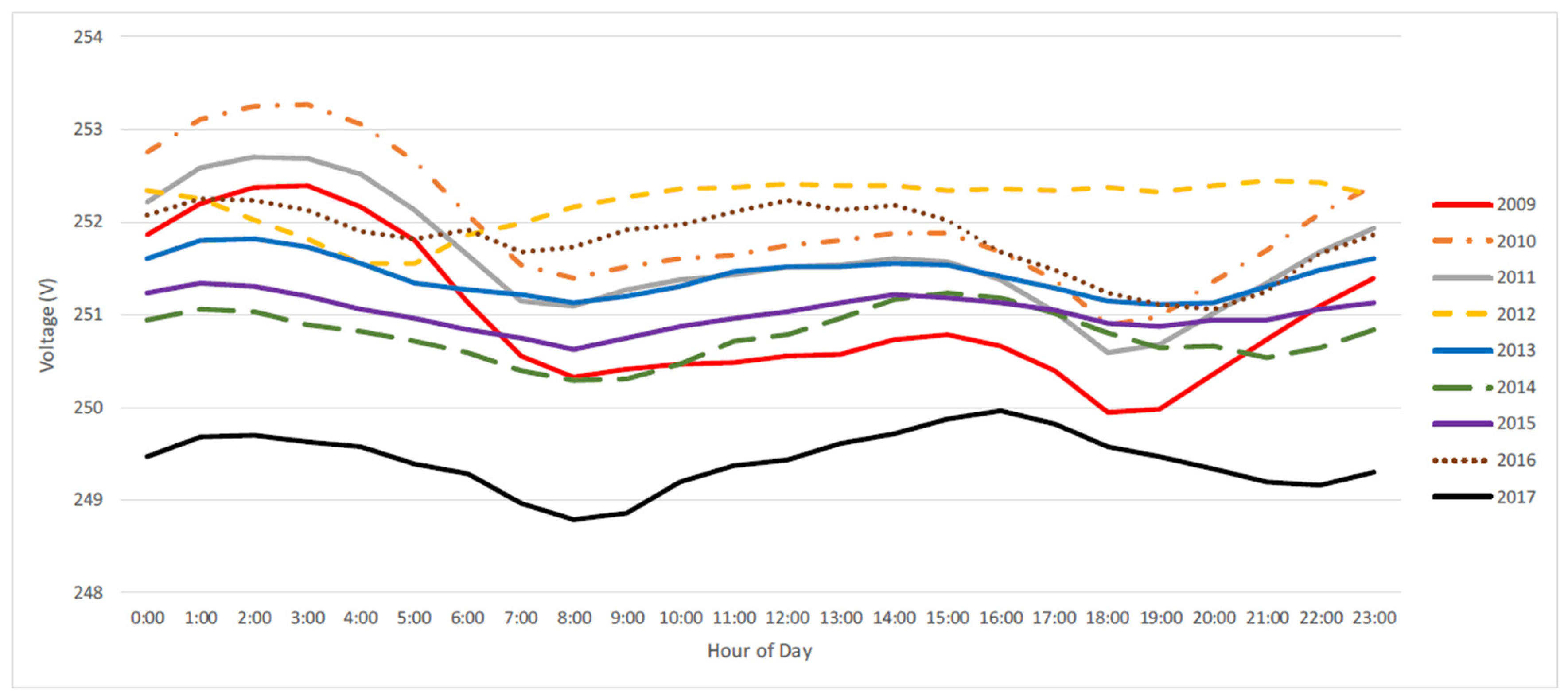
Figure 10 depicts the average 99th percentile voltage profile of an LV feeder from 2009 to 2017. It can be observed that over the years the shape of the profile is changing, with significantly higher voltages recorded during PV generation (midday) in comparison to light load periods (early morning), indicating the generation from PV units at daytime. However, if the voltage magnitudes are considered only, there has been little increase in the overall magnitude of the voltage, other than where there is a step decrease for 2017. This is mainly because the nominal voltage in LV feeders is being gradually adjusted from 240 V to 230 V. Recently, DNSPs have also introduced aggressive voltage regulation to facilitate the rooftop PV systems. Some of the techniques applied include adjustment to the fixed tap of the MV/LV distribution transformer and decreasing the MV voltage set points. This method may not be sustainable since the peak load in distribution networks is also on the rise and a reduction in the distribution transformer voltage may introduce significant under-voltage periods.
The impact of PV generation on voltage is further analyzed by observing the time of day when the maximum voltage occurs.
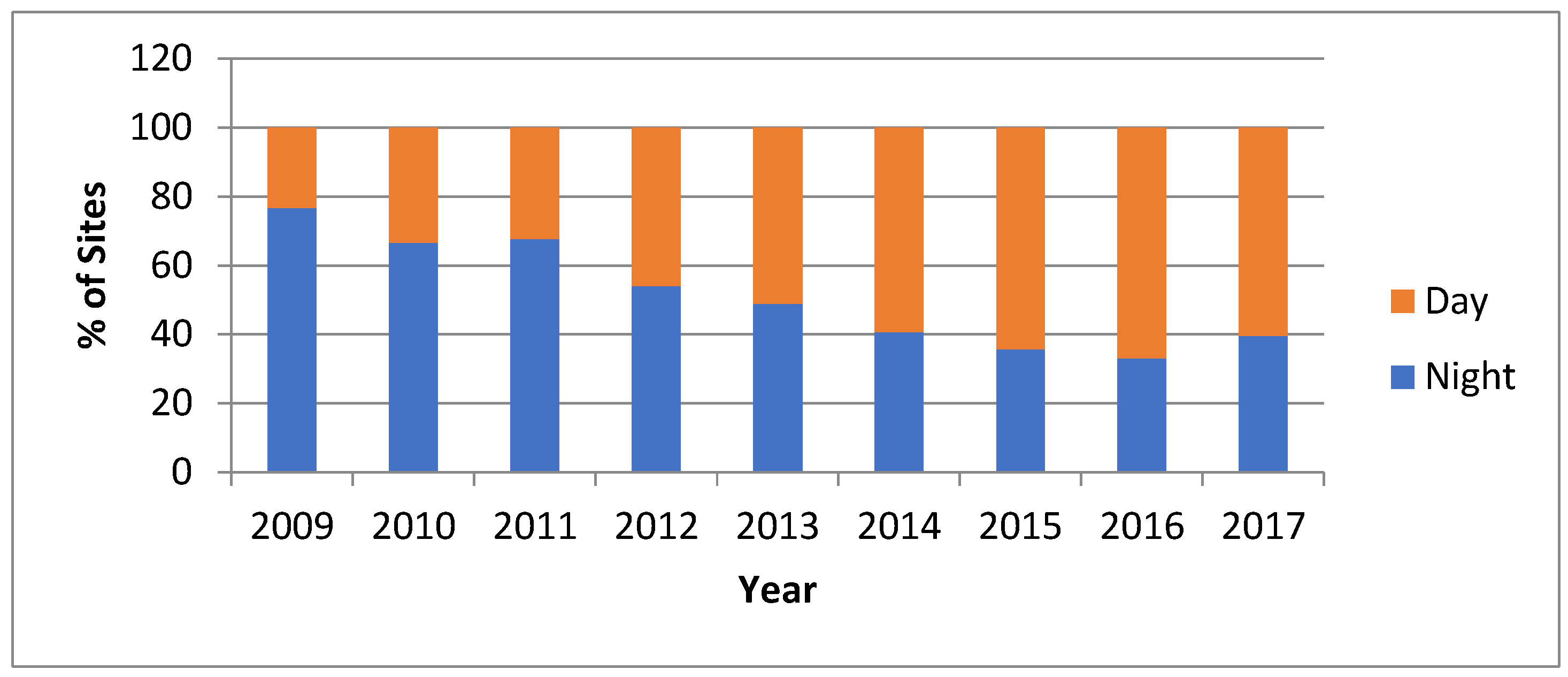
Figure 11 shows the time of day when the maximum voltage of the sites was recorded from 2009 to 2017. The overall trend is apparent here, as in 2019, only 23% of the sites recorded maximum voltage during the day, whereas in 2017, 60% of the sites recorded their maximum voltage during the day. The results here highlight the observation made above that the overall voltage profile of LV feeders is changing with the uptake of rooftop PV units. In the future, as the penetration levels increase, significant voltages rises are expected to be observed and the simulation results presented in this chapter will aim to highlight such a scenario.
4.1.3. Three-Phase Time Series LV Performance Analysis
LV Feeder Loading and PV Generation
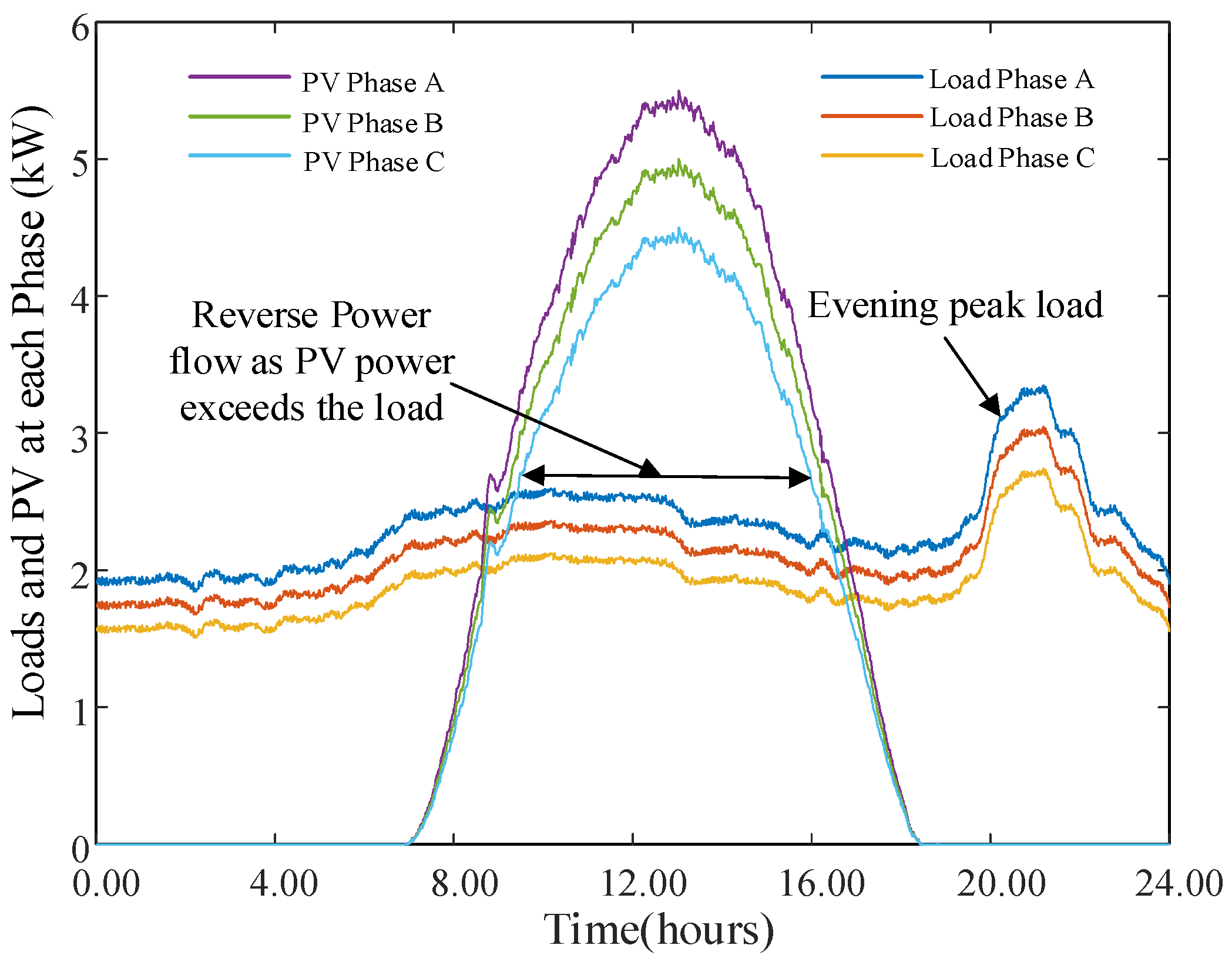
DNSPs typically aim to distribute the load equally in the three phases, but due to the randomness in the electricity usage from customer to customer, this can result in an unbalanced factor. To illustrate the effect of unbalanced PV allocation in the network, the load and PV size in each household were increased by 10% in phase A and decreased by 10% in phase C. This resulted in the PV size being 5.5 kW, 5 kW and 4.5 kW and peak load being 3.3 kW, 3 kW and 2.7 kW in phases A, B and C respectively.
Figure 12 shows the active power time series variations in the load and PV power in the three phases of the distribution network. Since both the load and PV production is highest in phase A, it is expected that both the overvoltage and undervoltage conditions will be worse in phase A compared to phases B and C; this is reflected in the graphic.
The LV feeder considered in this study has 20 nodes with a spacing of 15 m between the individual loads. As per
Section 3.4, this results in the feeder supplying power to 60 individual households.
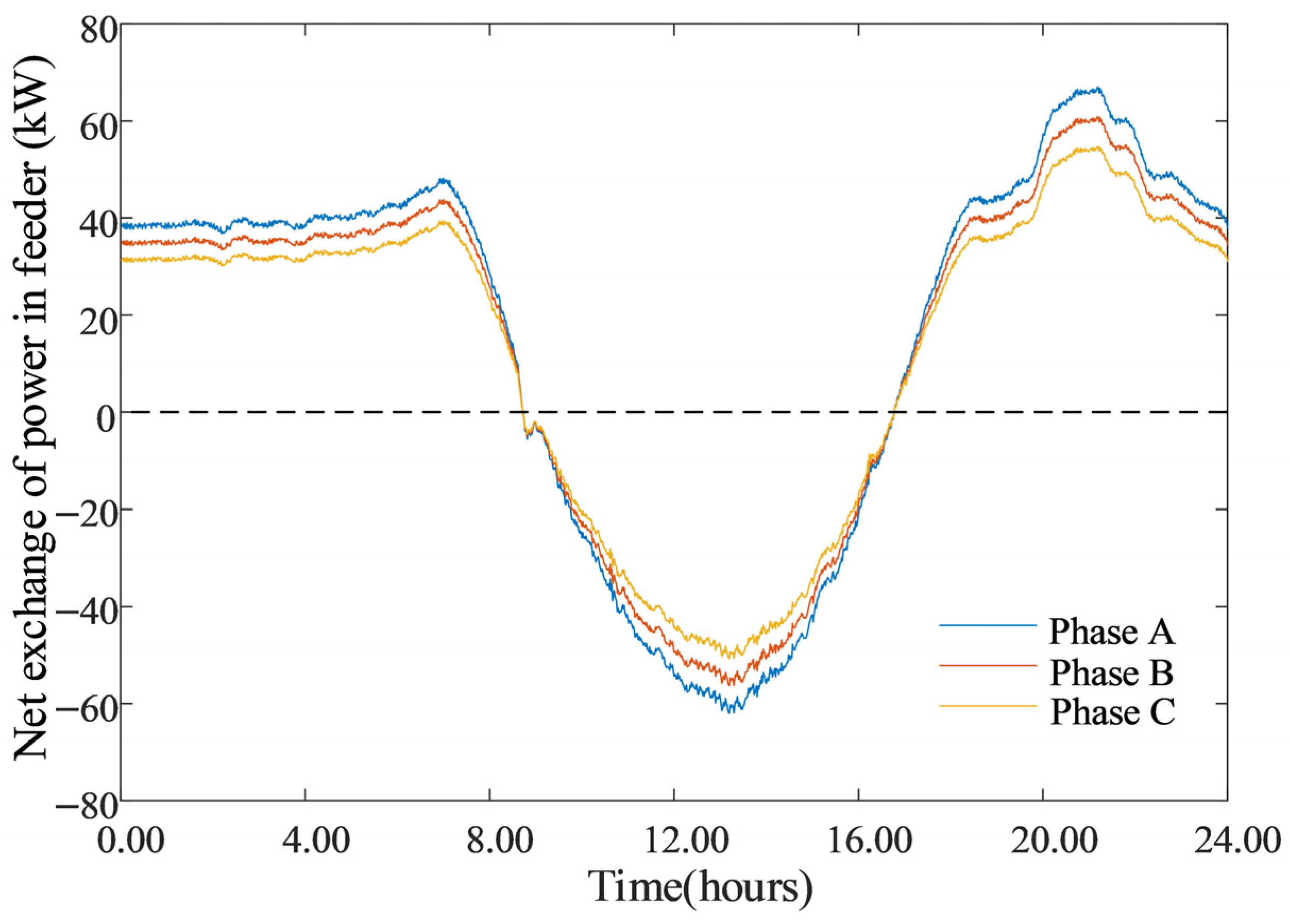
Figure 13 plots the net exchange of real power in the individual phases based on time of day. As expected, for both forward and reverse power flow, the peaks were observed in phase A. This refers to the overall active power measured at the distribution transformer. The general phenomenon of modelling the PV generation as a negative load was applied here. The plot also demonstrates the multidirectional power flow that will be a feature of future distribution networks. During a significant proportion of the day, there was a reverse power flow in the network. For both forward and reverse power flow, the peak power at the LV transformer was measured to be approximately 60 kW in each phase. The plot in
Figure 13 also demonstrates that PV systems do not reduce the overall peak power in the feeder, as PV generation is not present during the evening when peak loads are most common. In terms of power unbalance, both before and after the maximum reverse power flow, the difference in power between the phases decreased as the PV production varied.
LV Feeder Performance with Rooftop PV
As observed from the plot of the voltage profile (
Figure 9), it is evident that the voltage at the end of the feeder experiences the maximum voltage deviation as power is carried to and from the individual households along the feeder.
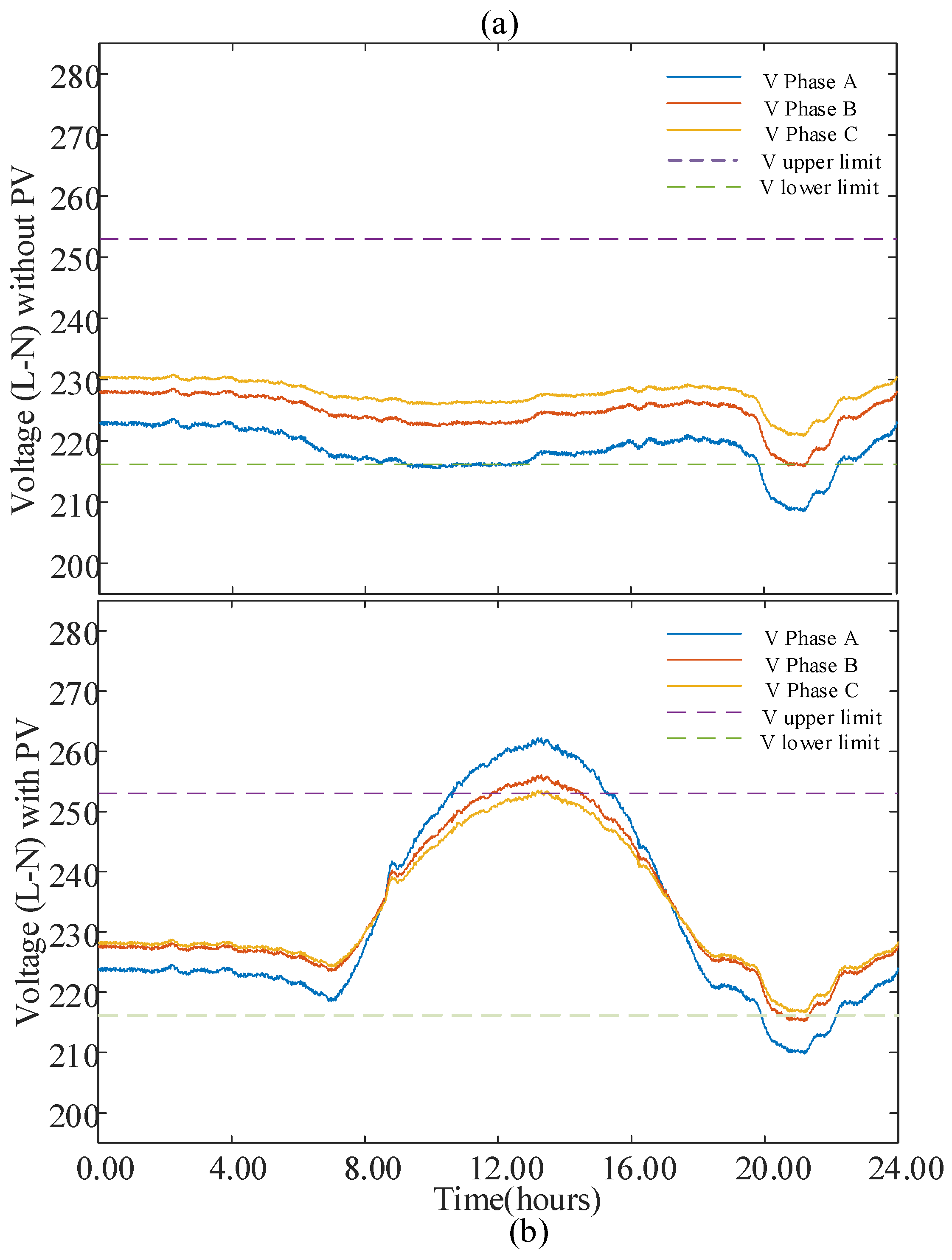
Figure 14 illustrates the variations in the steady state 24 h node voltages at the end of the feeder, where the time series power flow simulations were undertaken both with and without PV systems.
Without PV systems, the traditional voltage regulation issue in radial LV feeders is observed in
Figure 14a. With the highest loading, phase A experienced the maximum voltage drop during the peak evening load, when the voltage was observed to be 209.3 V. This is significantly below the lower voltage limit of 216.2 V as prescribed by AS 61000.3.100. However, this can be easily solved by DNSPs by setting the tap of the off-load tap changer to increase voltage at the start of the feeder. The recommended setting of 240 V was used for the simulations, which can be increased to ensure the voltage at the end of the feeder does not fall below 216.2 V. Capacitor banks are often used to boost the end-of-feeder voltage as well.
With PV systems connected throughout the feeder, multidirectional power flow induces both overvoltage and undervoltage in the system, as seen in
Figure 14b. In phase A, the highest line-to-neutral voltage recorded was 262.1 V (which exceeds the Australian upper limit of 253 V) and during peak load, the voltage decreased to 209.3 V. This results in a total voltage deviation of 52.8 V (in excess of the range of 37 V). This demonstrates the need for a dynamic voltage regulation device capable of both buck and boost the feeder voltage if successful mitigation of voltage variation is to be achieved. It is also evident that due to the large difference in the sending and receiving end voltage, devices operating by stepping the voltage profile, such as OLTCs and LVRs, may not be a long-term solution to the voltage regulation problem.
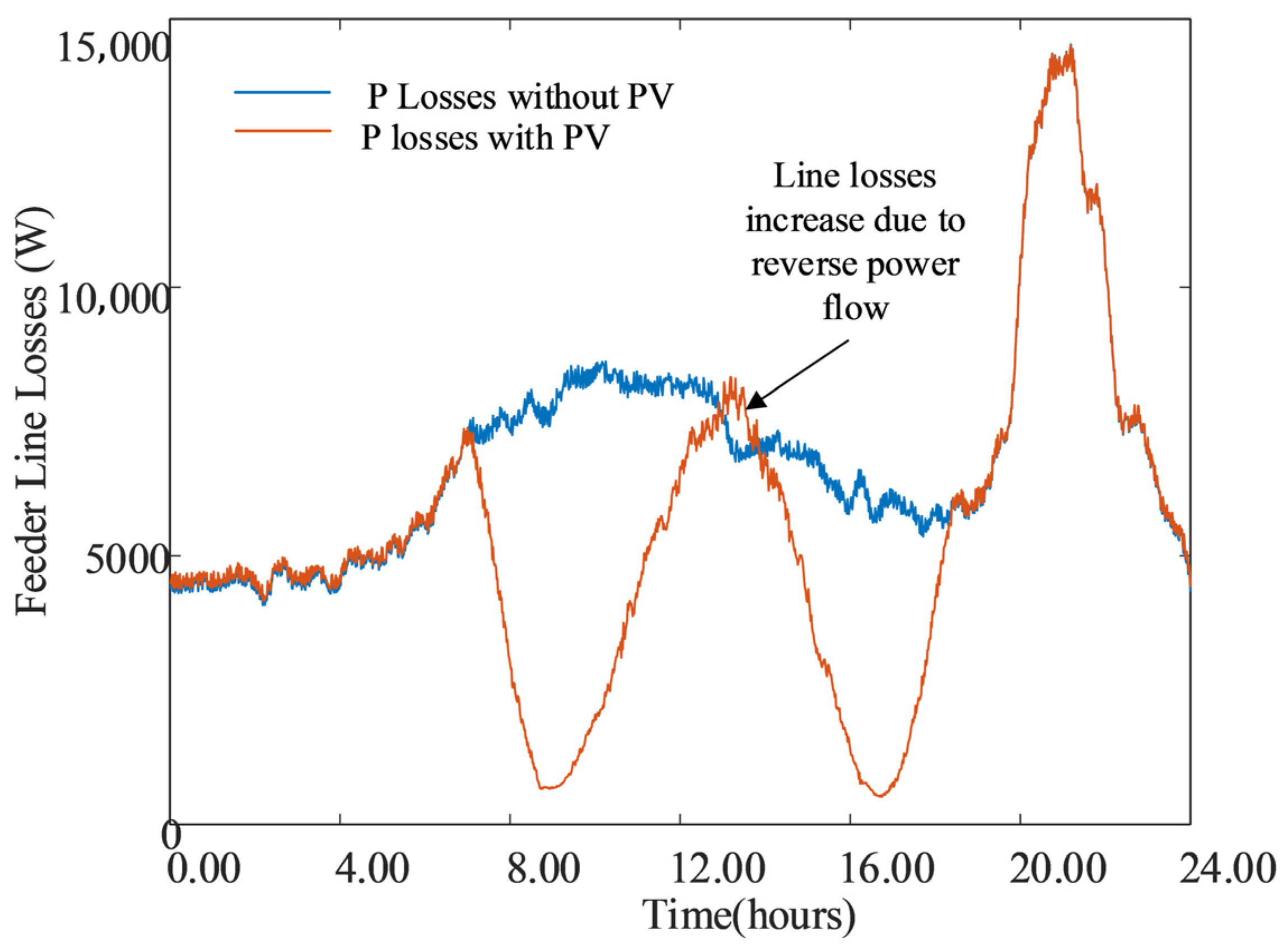
Figure 15 shows variations in the feeder line losses with and without rooftop PV, which illustrates how the overall line losses vary throughout the day. As the PV production increases, the loads can be supplied locally, and hence it can be seen that the line losses decrease as power is not required to be carried by the feeder conductor. However, during maximum reverse power flow at midday, the feeder must carry the excess power from the households to the upstream MV network, and hence the line losses increase as seen from the orange plot. Without any production from PV, the feeder line losses are identical with and without rooftop PV systems in the LV network. For the 24 h case study presented, the total energy lost from line losses without PV was 203 kWh, and with PV it was 132 kWh. In terms of distribution network performance, this reduction of 35% of the line losses is one of the key advantages of distributed rooftop PV systems, as the loads can be supplied locally for a significant proportion of the day.
To quantify the voltage unbalance in the system, the definition of the voltage unbalance factor (VUF) according to the IEC/TR 61000-3-13 [
25] will be utilized. This has already been defined in Equation (1) of
Section 2.
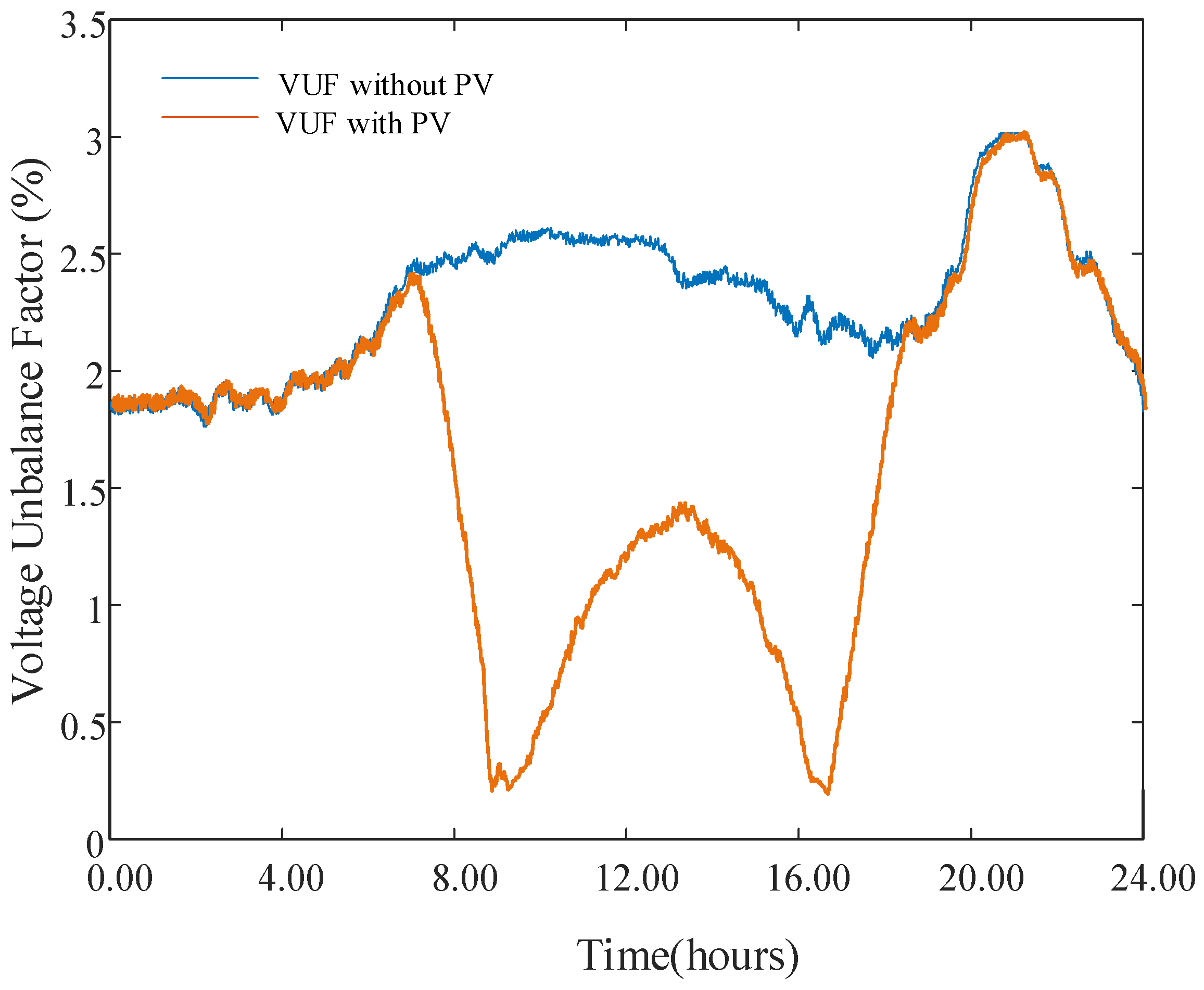
Figure 16 plots the variations in VUF measured at the end of the feeder, where the voltage difference between the phases was measured to be highest. The maximum VUF was measured to be 3% during the peak evening load. It was found that the VUF decreased when the PV was operating. This is because when the loads are supplied with the power produced from the PV units, there is a decrease in the distance that the power being carried by the feeder has to flow, and hence the deviation of the voltage between the phases decreases. During midday, the VUF with PV increased to around 1%, which was lower than the VUF obtained without any rooftop PV units installed. This reduction is therefore an expected outcome for the relatively uniform PV deployment scenario studied here, in which PV generation reduces both the magnitude and the relative differences in phase currents. In LV networks where PV uptake is more uneven or randomly distributed between phases, the VUF may conversely increase with PV penetration, and a systematic sensitivity study of VUF with respect to PV phase allocation is identified as an area for future work.
The influence of rooftop PV on the neutral-to-ground (N-G) voltage in a four-wire LV MEN system has been examined. When the phase currents are significantly unbalanced, the resulting N-G voltage can become a serious concern. An elevated neutral potential may act as a noise source for sensitive equipment and can lead to the malfunction of devices that require a clean sinusoidal supply. In many traditional distribution network studies, the neutral conductor is either eliminated using Kron reduction or assumed to be perfectly grounded. From a practical point of view, this is often unrealistic, particularly in networks with a high level of unbalance. Field measurements have also shown that neutral grounding resistances are frequently higher than the design values specified by the distribution network operator, partly due to coupling with underground metallic infrastructure such as water pipes. Unlike the phase voltages, which usually reach their maximum at the end of the feeder, the N-G voltage tends to be largest near the sending end, where neutral currents are highest.
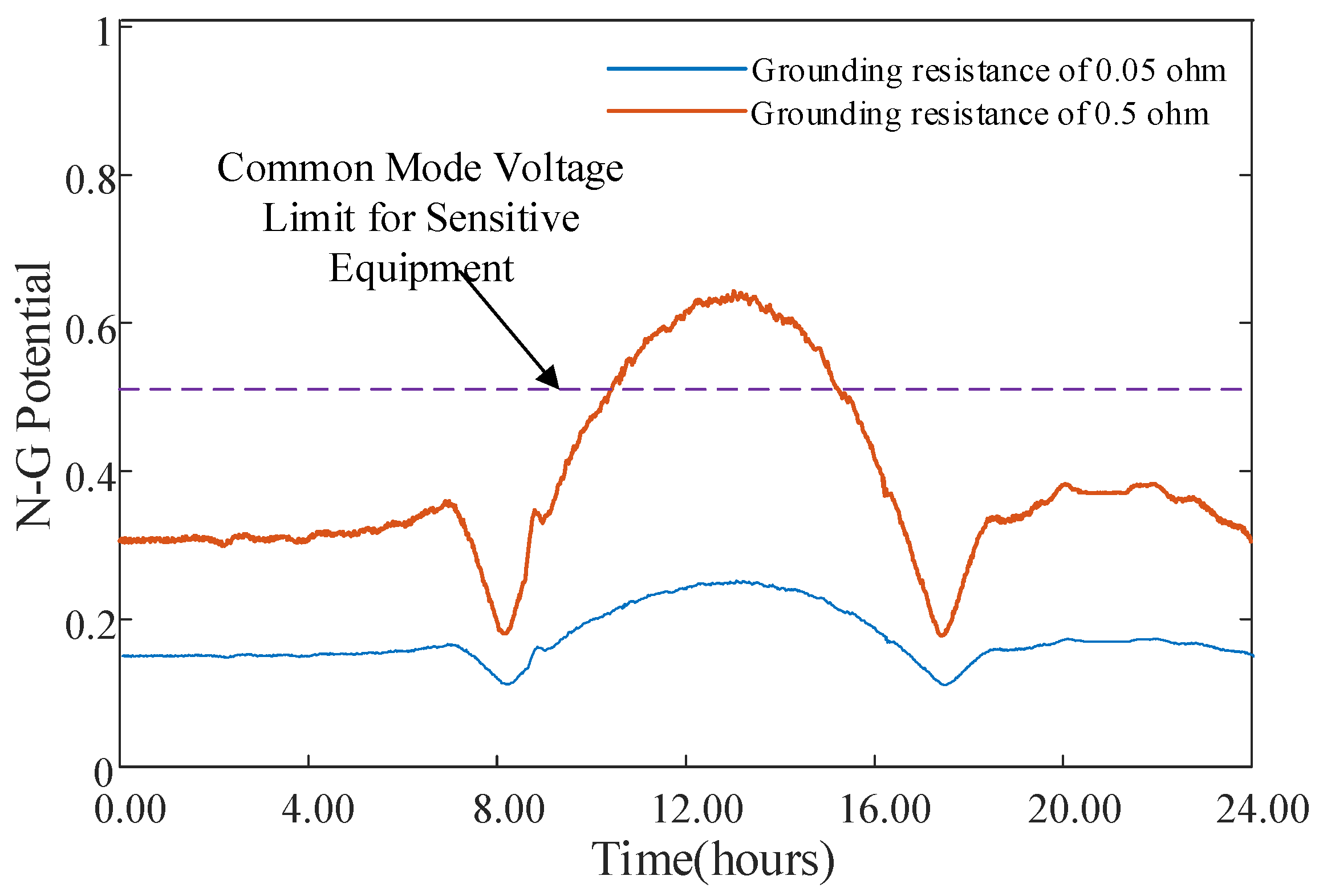
Figure 17 presents the variation in the neutral-to-ground potential at the 400 V busbar of the 11 kV/400 V transformer supplying the feeder for grounding resistances of 0.05 Ω and 0.5 Ω. For an almost solidly grounded neutral design, the N-G voltage does not exceed 0.2 V, which is well below the maximum allowable N-G threshold for most sensitive equipment. However, if the grounding resistance is assumed to be 0.5 Ω, the unbalance due to the PV and load may increase the N-G potential to exceed 0.5 V as seen from the orange plot in
Figure 17. When analyzing the capabilities of different voltage mitigation techniques, N-G voltage is one metric able to be used to quantify the improvement in network unbalance.
4.2. MV Simulation Results
4.2.1. MV Network Setup
In this section, the performance of the MV network will be analyzed to investigate if the issues introduced due to PV integration in LV networks can be propagated to the upstream distribution network. The MV network described in
Section 3.4.2 has been used for the power flow simulations presented in this section. The 11 kV network replicating a practical MV network has a total length of 14.25 km, with 750 m between the buses. As seen from the MV network in
Figure 7, there were 19 buses in total with an OLTC connected at the zone substation to regulate the voltage. For the simulation, the 300 m LV feeder previously described was connected to each bus of the network. This led to a total of 19 LV feeders connected to the MV network through a delta-star 11 kV/400 V step-down transformer. The peak rated power for the MV network was 3.42 MW. The zone substation OLTC transformer used for the analysis in this section consists of 7× −1.5% taps and 14× +1.5% taps. The parameters of the OLTC used for the MV network simulation replicate those of a typical OLTC used in Australian MV networks. The presence of more taps available to boost the voltage demonstrates that traditional distribution systems mostly require boost functionality to account for the voltage drop due to downstream power flow.
4.2.2. Voltage Levels in 11 kV MV Feeder
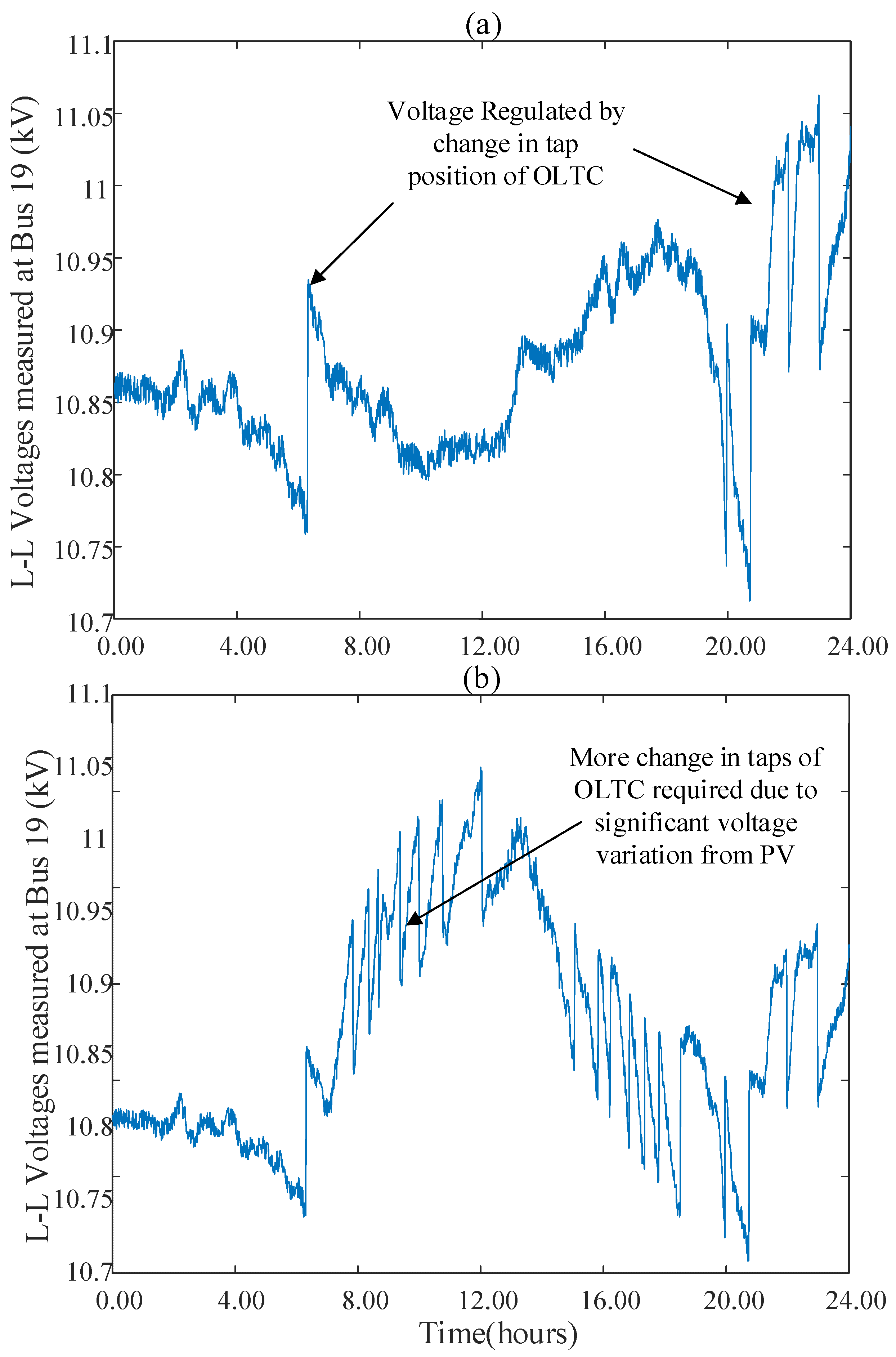
Figure 18 shows the line-line voltages in the MV network with and without rooftop PV systems in the residential case study distribution network. Here, the line-line (L-L) voltages were measured at bus 19, as this is the bus that experiences the maximum voltage variations in the MV network. This is because bus 19 is furthest from the zone substation. For both the scenarios considered in this case study, the L-L voltages were observed to be maintained within the allowable threshold of ±10% of the nominal 11 kV. Without PV systems, the tap changing operation can be observed from the sudden change in voltage levels as identified in
Figure 18a.
Figure 18b shows that during the daytime, when there is significant generation from the 5 kW PV sources installed at the individual LV customers, the MV L-L voltages during the daytime increased significantly. This demonstrates that reverse power flow from LV feeders does have the capability to cause a voltage rise in the upstream MV network. The increased number of steps in the measured voltage also demonstrates that the OLTC is forced to operate more frequently to maintain the voltages within the tolerance band within the MV network. It is well known that the utilization of an increased number of taps of the OLTC will decrease its overall lifetime and may require early replacement or maintenance, as they were not designed to operate in a multidirectional distribution network. This increased operation of the OLTC and the corresponding required increases in maintenance and possible loss of life further emphasize that the issues introduced due to PV integration in the LV network need to be addressed locally to ensure the MV network operation is not impacted.
4.2.3. Analyzing the Changes in OLTC Operation
In this section, the tap position of the OLTC will be further analyzed to gain a quantitative understanding of the degree to which the operation of a zone substation OLTC may change in future PV-rich distribution networks.
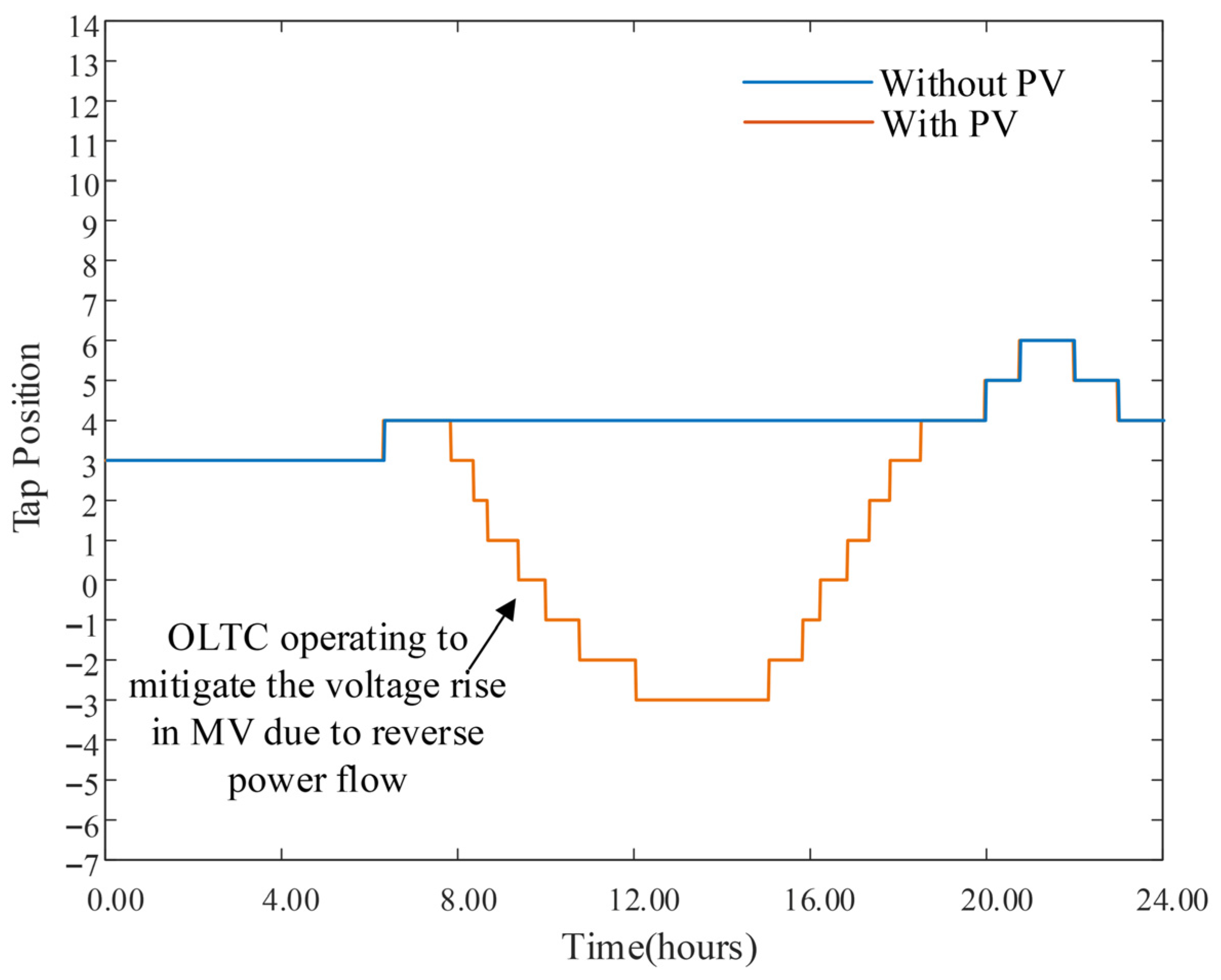
Figure 19 plots the tap position of the OLTC transformer; the blue plot shows the operation of the OLTC in a traditional system with only loads, and the orange plot shows the variations in the tap changes when the customers at LV were fitted with rooftop PV systems. It is seen that when there is no production from PV at night the tap position of both the case study scenarios are the same (i.e., there is overlapping of the plots). However, as the PV generation increases during the daytime, the OLTC needs to lower its tap position to buck the voltage levels. Without PV systems, the OLTC required five tap changes as seen from the blue plot. With PV systems, the OLTC needed to make 14 tap changes. This led to a total of 19 tap changes required by the OLTC. Overall, this is an increase of almost four times compared to the scenario without PV generation. Traditional OLTCs were not designed to operate this frequently and this demonstrates that increased OLTC maintenance will be required and/or loss of life may be encountered.
4.3. Discussion
The results presented in
Section 4.1 and
Section 4.2 highlight the combined LV–MV impacts of high rooftop PV penetration in a four-wire MEN residential feeder representative of Australian distribution networks. Under the considered high penetration level, the feeder experiences increased phase voltages during midday PV generation, elevated voltage unbalance in biased allocation scenarios and noticeable neutral-to-ground (N-G) voltage magnitudes when higher grounding resistance is assumed. These findings confirm that voltage rise is not the only technical concern in PV-rich LV networks; unbalance and neutral potential behaviour must also be considered.
Importantly, the N-G voltage results demonstrate the value of explicit four-wire modelling. In a conventional three-wire representation, the neutral potential would be fixed to ground and these effects would not be observable. The integrated LV–MV analysis further shows that high PV penetration influences upstream OLTC operation and transformer loading, reinforcing the need for coordinated voltage management across voltage levels rather than isolated LV-only assessments.
From a planning and operational perspective, the case study indicates that feeders with high PV-to-load ratios may require a combination of inverter-based voltage control, appropriate OLTC settings, and, where necessary, additional reactive power support or storage-based solutions. These observations are consistent with the mitigation strategies reviewed in
Section 2 and emphasize the importance of detailed modelling when assessing future DER-rich distribution systems.
5. Conclusions
This paper has examined voltage regulation challenges in PV-rich Australian residential distribution networks through a combination of the literature review and detailed modelling and case study analysis. The review has shown that high penetrations of rooftop PV led to characteristic changes in LV feeder behaviour, including midday voltage rise, increased voltage unbalance, elevated neutral-to-ground potentials in MEN systems and altered operating duties for on-load tap changers (OLTCs). A range of mitigation options has been identified, spanning traditional network reinforcement, smart inverter functions, demand response, low voltage regulators, energy storage, and FACTS devices, as well as more advanced coordinated and optimization-based control schemes.
A three-phase four-wire LV–MV power-flow framework was developed that explicitly represents the LV neutral conductor and MEN earthing arrangement. This framework was applied to a representative Australian LV overhead feeder with high rooftop PV penetration and to its upstream 11 kV network. Time-series simulations over a 24 h period demonstrated that, under worst-case conditions, a substantial proportion of LV customers can experience voltages outside the AS 61000.3.100 limits, with maximum voltages exceeding 253 V during periods of high PV generation and minimum voltages below 216.2 V during evening peak demand. The results also showed significant changes in line losses, neutral-to-ground potentials, and OLTC operation, including an approximately four-fold increase in daily tap-change counts when rooftop PV is present.
From a planning and operational perspective, these findings emphasize the need for voltage-management solutions that can maintain LV within statutory limits while containing line losses, neutral-to-ground voltages and OLTC wear, thereby helping DNSPs identify feeders at greatest risk under high rooftop PV penetration and prioritize where additional LV-management measures or monitoring may be required.
Future work should extend the analysis to a broader set of feeder topologies and operating conditions, including feeders with mixed underground and overhead construction, different levels of PV diversity, and the presence of electric vehicles and other emerging loads. Integration of realistic measurement uncertainty, communication constraints and DNSP operational practices would further support the translation of proposed voltage-management strategies into practical deployment in Australian LV networks.
Author Contributions
Conceptualization, O.R., S.E. and D.A.R.; methodology, O.R.; writing—original draft preparation, O.R.; writing—review and editing, S.E. and D.A.R. All authors have read and agreed to the published version of the manuscript.
Funding
This research received no external funding.
Data Availability Statement
The original contributions presented in the study are included in the article, further inquiries can be directed to the corresponding author.
Conflicts of Interest
The authors declare no conflicts of interest.
Abbreviations
The following abbreviations are used in this manuscript:
| AC | Alternating Current |
| AFIC | Audio Frequency Injection Control |
| AS | Australian Standard |
| BESS | Battery Energy Storage System |
| CES | Community Energy Storage |
| CVR | Conservation Voltage Reduction |
| DC | Direct Current |
| DER | Distributed Energy Resource |
| DNSP | Distribution Network Service Provider |
| DR | Demand Response |
| DVR | Dynamic Voltage Restorer |
| ES | Energy Storage |
| EV | Electric Vehicles |
| FACTS | Flexible AC Transmission Systems |
| HV | High Voltage |
| IEC | International Electrotechnical Commission |
| IEEE | Institute of Electrical and Electronics Engineers |
| J122 | SAE J122 Plug-in Electric Vehicle Charging Standard |
| LV | Low Voltage |
| LVR | Low Voltage Regulator |
| MEN | Multiple Earthed Neutral |
| MPC | Model Predictive Control |
| MPPT | Maximum Power Point Tracking |
| MV | Medium Voltage |
| OLTC | On-Load Tap Changer |
| OTS | Off-the-shelf |
| PCC | Point of Common Coupling |
| PF | Power Factor |
| PQ | Power Quality |
| PSO | Particle Swarm Optimization |
| PV | Photovoltaic |
| SAE | Society of Automotive Engineers |
| SCADA | Supervisory Control and Data Acquisition |
| SoC | State of Charge |
| STATCOM | Static Synchronous Compensator |
| SVC | Static VAr Compensator |
| UPFC | Unified Power Flow Controller |
| V2G | Vehicle to Grid |
| VUF | Voltage Unbalance Factor |
List of Symbols
| Electrical Network Parameters |
| Symbol | Description | Unit |
| Vm | Complex Voltage at bus m | V |
| Vre, Vim | Real and imaginary components of bus voltage | V |
| Im | Complex current injection at bus m | A |
| Ire, Iim | Real and imaginary components of bus current | A |
| Ymn | Admittance between buses m and n | S |
| Gmn | Conductance between buses m and n | S |
| Bmn | Susceptance between buses m and n | S |
| Z | Line impedance | Ω |
| R | Line resistance | Ω |
| X | Line reactance | Ω |
| Rg | Neutral grounding resistance | Ω |
| VNG | Neutral-to-ground voltage | V |
| Power and Energy Variables |
| Symbol | Description | Unit |
| P | Active (real) power | kW |
| Q | Reactive power | kVAr |
| S | Apparent power | kVA |
| PPV | Active power output of PV system | kW |
| QPV | Reactive power output of PV system | kVAr |
| Pload | Active load demand | kW |
| Qload | Reactive load demand | kVAr |
| PES | Active power of energy storage system | kW |
| QES | Reactive power of energy storage system | kVAr |
| Numerical and Modelling Variables |
| Symbol | Description | Unit |
| ∆I | Current mismatch vector | A |
| ∆V | Voltage update vector | V |
| J | Jacobian matrix | N/A |
| k | Total number of buses in the system | N/A |
| m, n | Bus indices | N/A |
| t | Time | h |
References
- Dodd, T.; Nelson, T. Australian household adoption of solar photovoltaics: A comparative study of hardship and non-hardship customers. Energy Policy 2022, 160, 112674. [Google Scholar] [CrossRef]
- Fuentes, P.M.J.; Khalilpour, K.; Voinov, A. Solar energy surge: The socio-economic determinants of the photovoltaic systems growth in Australia. Energy Res. Soc. Sci. 2024, 116, 103695. [Google Scholar] [CrossRef]
- Mwampashi, M.M.; Nikitopoulos, C.S.; Rai, A.; Konstandatos, O. Large-scale and rooftop solar generation in the NEM: A tale of two renewables strategies. Energy Econ. 2022, 115, 106372. [Google Scholar] [CrossRef]
- Jäger-Waldau, A. Snapshot of Photovoltaics—May 2023. EPJ Photovolt. 2023, 14, 23. [Google Scholar] [CrossRef]
- Gholami, K.; Islam, M.R.; Rahman, M.M.; Azizivahed, A.; Fekih, A. State-of-the-art technologies for volt-var control to support the penetration of renewable energy into the smart distribution grids. Energy Rep. 2022, 8, 8630–8651. [Google Scholar] [CrossRef]
- Haque, M.M.; Wolfs, P. A review of high PV penetrations in LV distribution networks: Present status, impacts and mitigation measures. Renew. Sustain. Energy Rev. 2016, 62, 1195–1208. [Google Scholar] [CrossRef]
- Protopapadaki, C.; Saelens, D. Heat pump and PV impact on residential low-voltage distribution grids as a function of building and district properties. Appl. Energy 2017, 192, 268–281. [Google Scholar] [CrossRef]
- Alam, M.J.E.; Muttaqi, K.M.; Sutanto, D. Community Energy Storage for Neutral Voltage Rise Mitigation in Four-Wire Multigrounded LV Feeders with Unbalanced Solar PV Allocation. IEEE Trans. Smart Grid 2015, 6, 2845–2855. [Google Scholar] [CrossRef]
- Ciric, R.; Padilha-Feltrin, A.; Ochoa, L. Power flow in four-wire distribution networks—General approach. IEEE Trans. Power Syst. 2003, 18, 1283–1290. [Google Scholar] [CrossRef]
- Rahman, O.; Muttaqi, K.M.; Sutanto, D. Three Phase Power Flow Analysis of Distribution Network Performance with High Penetration of Single Phase PV units Integrated with Energy Storage System. In 2018 Australasian Universities Power Engineering Conference (AUPEC), 27–30 November 2018; IEEE: Auckland, New Zealand, 2018; pp. 1–6. [Google Scholar] [CrossRef]
- Rahman, O.; Muttaqi, K.M.; Sutanto, D. Time Series Variations of the Neutral-to-Ground Potential in a 4-Wire LV Network under Unbalanced Allocation of Rooftop Solar PV and Mitigation using Energy Storage. In 2019 IEEE Power & Energy Society General Meeting (PESGM), 4–8 August 2019; IEEE: Atlanta, GA, USA, 2019; pp. 1–5. [Google Scholar] [CrossRef]
- Rahman, O.; Robinson, D.; Elphick, S. Mitigation of Solar PV Impact in Four-Wire LV Radial Distribution Feeders Through Reactive Power Management Using STATCOMs. Electronics 2025, 14, 3063. [Google Scholar] [CrossRef]
- Rahman, O.; Robinson, D.A.; Elphick, S.; Perera, S. Dual-Objective MPC of Community Energy Storage in LV Distribution Feeders with Rooftop Solar PV. In 2021 IEEE PES Innovative Smart Grid Technologies—Asia (ISGT Asia), 5–8 December 2021; IEEE: Brisbane, Australia, 2021; pp. 1–5. [Google Scholar] [CrossRef]
- Rahman, O.; Muttaqi, K.M.; Sutanto, D. High Temperature Superconducting Devices and Renewable Energy Resources in Future Power Grids: A Case Study. IEEE Trans. Appl. Supercond. 2019, 29, 1–4. [Google Scholar] [CrossRef]
- Rahman, O. Impact Analysis and Mitigation of Voltage Regulation Issues in PV Rich Low Voltage Residential Distribution Networks. Ph.D. Thesis, University of Wollongong, Wollongong, Australia, 2022. [Google Scholar]
- REN21. Renewables 2018 Global Status Report; REN21: Paris, France, 2018. [Google Scholar]
- Dinh Hieu, N.; Negnevitsky, M. Probabilistic risk-based security assessment for power systems with wind power generation. In 2013 IEEE Power & Energy Society General Meeting, 21–25 July 2013; IEEE: Vancouver, BC, Canada, 2013; pp. 1–5. [Google Scholar] [CrossRef]
- Liang, X. Emerging Power Quality Challenges Due to Integration of Renewable Energy Sources. IEEE Trans. Ind. Appl. 2017, 53, 855–866. [Google Scholar] [CrossRef]
- Wong, P.K.C.; Kalam, A.; Barr, R. Modelling and analysis of practical options to improve the hosting capacity of low voltage networks for embedded photo-voltaic generation. IET Renew. Power Gener. 2017, 11, 625–632. [Google Scholar] [CrossRef]
- Canova, A.; Giaccone, L.; Spertino, F.; Tartaglia, M. Electrical Impact of Photovoltaic Plant in Distributed Network. IEEE Trans. Ind. Appl. 2009, 45, 341–347. [Google Scholar] [CrossRef]
- Thomson, M.; Infield, D.G. Network Power-Flow Analysis for a High Penetration of Distributed Generation. IEEE Trans. Power Syst. 2007, 22, 1157–1162. [Google Scholar] [CrossRef]
- Walling, R.A.; Saint, R.; Dugan, R.C.; Burke, J.; Kojovic, L.A. Summary of Distributed Resources Impact on Power Delivery Systems. IEEE Trans. Power Deliv. 2008, 23, 1636–1644. [Google Scholar] [CrossRef]
- Kersting, W.H. Distribution system modeling and analysis. In Electric Power Generation, Transmission, and Distribution, 3rd ed.; CRC Press: Boca Raton, FL, USA, 2012; Available online: https://www.taylorfrancis.com/chapters/edit/10.1201/9781315222424-27/distribution-system-modeling-analysis-william-kersting (accessed on 12 November 2025). (In English)
- AS 61000.3.100; Electromagnetic Compatibility (EMC)—Part 3.100: Limits-Steady State Voltage Limits in Public Electricity Systems. Standards Australia: Sydney, Australia, 2016.
- IEC/TR 61000-3-13; Electromagnetic Compatibility (EMC)—Limits—Assessment of Emission Limits for the Connection of Unbalanced Installations to MV, HV and EHV Power Systems. International Electrotechnical Commission: Geneva, Switzerland, 2008.
- Tsai-Hsiang, C.; Wen-Chih, Y. Analysis of multi-grounded four-wire distribution systems considering the neutral grounding. IEEE Trans. Power Deliv. 2001, 16, 710–717. [Google Scholar] [CrossRef]
- IEEE Std 3003.2-2014; Recommended Practice for Equipment Grounding and Bonding in Industrial and Commercial Power Systems. IEEE: New York, NY, USA, 2014. [CrossRef]
- Ausgrid. NS114 Electrical Design and Construction Standards for Chamber Type Substations. Available online: https://www.ausgrid.com.au/-/media/Documents/Technical-Documentation/NS/NS114.pdf (accessed on 12 November 2025).
- Ergon Energy. Distribution System Earthing Guidelines. Available online: https://www.ergon.com.au/__data/assets/pdf_file/0007/1099051/Guideline-for-Adoption-of-CMEN-Earthing-System-2916850.pdf (accessed on 12 November 2025).
- Werda, J.; Chan, J.; Freeman, P. Electrical Earthing—Risk Management Strategies for the Water Industry. Available online: https://wioa.org.au/wp-content/uploads/2024/06/WIOA-Annual-Review-2010.pdf (accessed on 12 November 2025).
- Alam, M.J.E.; Muttaqi, K.M.; Sutanto, D. A Three-Phase Power Flow Approach for Integrated 3-Wire MV and 4-Wire Multigrounded LV Networks with Rooftop Solar PV. IEEE Trans. Power Syst. 2013, 28, 1728–1737. [Google Scholar] [CrossRef]
- Gruzs, T.M. A survey of neutral currents in three-phase computer power systems. IEEE Trans. Ind. Appl. 1990, 26, 719–725. [Google Scholar] [CrossRef]
- Gan, C.; Lau, C.Y.; Baharin, K.A.; Pudjianto, D. Impact of the photovoltaic system variability on transformer tap changer operations in distribution networks. CIRED—Open Access Proc. J. 2017, 2017, 1818–1821. [Google Scholar] [CrossRef]
- Ciocia, A.; Chicco, G.; Spertino, F. Benefits of On-Load Tap Changers Coordinated Operation for Voltage Control in Low Voltage Grids with High Photovoltaic Penetration. In 2020 International Conference on Smart Energy Systems and Technologies (SEST), 7–9 September 2020; IEEE: New York, NY, USA, 2020; pp. 1–6. [Google Scholar]
- Badran, O.; Mekhilef, S.; Mokhlis, H.; Dahalan, W. Optimal reconfiguration of distribution system connected with distributed generations: A review of different methodologies. Renew. Sustain. Energy Rev. 2017, 73, 854–867. [Google Scholar] [CrossRef]
- AS/NZS 4777.2: 2015; Grid Connection of Energy Systems via Inverters. Standards Australia: Sydney, Australia, 2017.
- IEEE Std 1547–2018; IEEE Standard for Interconnection and Interoperability of Distributed Energy Resources with Associated Electric Power Systems Interfaces. Revision of IEEE Std 1547–2003. IEEE: New York, NY, USA, 2018. [CrossRef]
- Rahman, O.; Elphick, S.; Robinson, D.A. Comparative Study of Voltage Regulation Techniques in PV Rich LV Feeders. In 2024 21st International Conference on Harmonics and Quality of Power (ICHQP), 15–18 October 2024; IEEE: Chengdu, China, 2024; pp. 277–282. [Google Scholar] [CrossRef]
- Giraldez, J.; Hoke, A.; Gotseff, P.; Wunder, N.; Blonsky, M.; Emmanuel, M.; Latif, A.; Ifuku, E.; Asano, M.; Aukai, T. Advanced Inverter Voltage Controls: Simulation and Field Pilot Findings; National Renewable Energy Laboratory: Golden, CO, USA, 2018.
- Palmintier, B.; Broderick, R.; Mather, B.; Coddington, M.; Baker, K.; Ding, F.; Reno, M.; Lave, M.; Bharatkumar, A. On the Path to SunShot: Emerging Issues and Challenges in Integrating Solar with the Distribution System; National Renewable Energy Laboratory: Golden, CO, USA, 2016.
- Procopiou, A.; Petrou, K.; Ochoa, L. Deliverable 3 “Traditional Solutions”. 2020. Available online: https://arena.gov.au/assets/2019/02/advanced-planning-of-pv-rich-distribution-networks-deliverable-3-traditional-solutions.pdf (accessed on 12 November 2025).
- ARENA. The Role of Decentralised Control for Managing Network Constraints for DER on Regional, Rural, and Remote Networks Dynamic Limits; AEMC: Sydney, Australia, 2020.
- Palmintier, B.; Giraldez, J.; Gruchalla, K.; Gotseff, P.; Nagarajan, A.; Harris, T.; Bugbee, B.; Baggu, M.; Gantz, J.; Boardman, E. Feeder Voltage Regulation with High Penetration PV Using Advanced Inverters and a Distribution Management System: A Duke Energy Case Study; National Laboratory of the Rockies (NLR): Golden, CO, USA, 2016.
- United Energy. Demand Response—Final Project Performance Report; United Energy: Mount Waverley, Australia, 2020. [Google Scholar]
- Rahman, O.; Elphick, S.; Muttaqi, K.M.; David, J. Investigation of LED Lighting Performance in the Presence of Ripple Injection Load Control Signals. In 2018 IEEE Industry Applications Society Annual Meeting (IAS), 23–27 September 2018; IEEE: New York, NY, USA, 2018; pp. 1–7. [Google Scholar] [CrossRef]
- Rahman, O.; Muttaqi, K.M.; Sutanto, D. High Frequency Ripple Injection Signals for the Effective Utilization of Residential EV Storage in Future Power Grids with Rooftop PV System. In 2020 IEEE Industry Applications Society Annual Meeting, 10–16 September 2020; IEEE: New York, NY, USA, 2020; pp. 1–5. [Google Scholar] [CrossRef]
- David, J.; Elphick, S.; Ciufo, P.; Perera, S. The impact of PV inverters on audio frequency injection load control signals. In 2018 18th International Conference on Harmonics and Quality of Power (ICHQP), 13–16 May 2018; IEEE: New York, NY, USA, 2018; pp. 1–6. [Google Scholar] [CrossRef]
- City Power Consulting. Future Grid for Distributed Energy-Appendices; City Power Consulting: Johannesburg, South Africa, 2020. [Google Scholar]
- Australian Power Quality Research Centre (University of Wollongong). Management of Voltages in LV Networks; University of Wollongong: Wollongong, Australia, 2020. [Google Scholar]
- Olivares, D.E.; Mehrizi-Sani, A.; Etemadi, A.H.; Cañizares, C.A.; Iravani, R.; Kazerani, M.; Hajimiragha, A.H.; Gomis-Bellmunt, O.; Saeedifard, M.; Palma-Behnke, R.; et al. Trends in Microgrid Control. IEEE Trans. Smart Grid 2014, 5, 1905–1919. [Google Scholar] [CrossRef]
- Alam, M.J.E.; Muttaqi, K.M.; Sutanto, D. Distributed energy storage for mitigation of voltage-rise impact caused by rooftop solar PV. In 2012 IEEE Power and Energy Society General Meeting, 22–26 July 2012; IEEE: San Diego, CA, USA, 2012; pp. 1–8. [Google Scholar] [CrossRef]
- Azizivahed, A.; Arefi, A.; Ghavidel, S.; Shafie-khah, M.; Li, L.; Zhang, J.; Catalão, J.P.S. Energy Management Strategy in Dynamic Distribution Network Reconfiguration Considering Renewable Energy Resources and Storage. IEEE Trans. Sustain. Energy 2020, 11, 662–673. [Google Scholar] [CrossRef]
- Horiba, T. Lithium-Ion Battery Systems. Proc. IEEE 2014, 102, 939–950. [Google Scholar] [CrossRef]
- Nick, M.; Cherkaoui, R.; Paolone, M. Optimal Planning of Distributed Energy Storage Systems in Active Distribution Networks Embedding Grid Reconfiguration. IEEE Trans. Power Syst. 2018, 33, 1577–1590. [Google Scholar] [CrossRef]
- Marra, F.; Fawzy, Y.T.; Bülo, T.; Blažic, B. Energy storage options for voltage support in low-voltage grids with high penetration of photovoltaic. In 2012 3rd IEEE PES Innovative Smart Grid Technologies Europe (ISGT Europe), 14–17 October 2012; IEEE: Berlin, Germany, 2012; pp. 1–7. [Google Scholar] [CrossRef]
- Alam, M.J.E.; Muttaqi, K.M.; Sutanto, D. Mitigation of Rooftop Solar PV Impacts and Evening Peak Support by Managing Available Capacity of Distributed Energy Storage Systems. IEEE Trans. Power Syst. 2013, 28, 3874–3884. [Google Scholar] [CrossRef]
- Jayasekara, N.; Masoum, M.A.S.; Wolfs, P.J. Optimal Operation of Distributed Energy Storage Systems to Improve Distribution Network Load and Generation Hosting Capability. IEEE Trans. Sustain. Energy 2016, 7, 250–261. [Google Scholar] [CrossRef]
- Divshali, P.H.; Söder, L. Improving Hosting Capacity of Rooftop PVs by Quadratic Control of an LV-Central BSS. IEEE Trans. Smart Grid 2019, 10, 919–927. [Google Scholar] [CrossRef]
- Bohn, T.; Chaudhry, H. Overview of SAE standards for plug-in electric vehicle. In 2012 IEEE PES Innovative Smart Grid Technologies (ISGT), 16–20 January 2012; IEEE: Washington, DC, USA, 2012; pp. 1–7. [Google Scholar] [CrossRef]
- Clement-Nyns, K.; Haesen, E.; Driesen, J. The Impact of Charging Plug-In Hybrid Electric Vehicles on a Residential Distribution Grid. IEEE Trans. Power Syst. 2010, 25, 371–380. [Google Scholar] [CrossRef]
- Dharmakeerthi, C.H.; Mithulananthan, N.; Saha, T.K. Overview of the impacts of plug-in electric vehicles on the power grid. In 2011 IEEE PES Innovative Smart Grid Technologies, 13–16 November 2011; IEEE: Perth, Australia, 2011; pp. 1–8. [Google Scholar] [CrossRef]
- Dharmakeerthi, C.H.; Mithulananthan, N.; Saha, T.K. Planning of electric vehicle charging infrastructure. In 2013 IEEE Power & Energy Society General Meeting, 21–25 July 2013; IEEE: Vancouver, BC, Canada, 2013; pp. 1–5. [Google Scholar] [CrossRef]
- Putrus, G.A.; Suwanapingkarl, P.; Johnston, D.; Bentley, E.C.; Narayana, M. Impact of electric vehicles on power distribution networks. In 2009 IEEE Vehicle Power and Propulsion Conference, 7–10 September 2009; IEEE: Dearborn, MI, USA, 2009; pp. 827–831. [Google Scholar] [CrossRef]
- Wu, D.; Aliprantis, D.C.; Gkritza, K. Electric Energy and Power Consumption by Light-Duty Plug-in Electric Vehicles. IEEE Trans. Power Syst. 2011, 26, 738–746. [Google Scholar] [CrossRef]
- Alam, M.J.E.; Muttaqi, K.M.; Sutanto, D. Effective Utilization of Available PEV Battery Capacity for Mitigation of Solar PV Impact and Grid Support with Integrated V2G Functionality. IEEE Trans. Smart Grid 2016, 7, 1562–1571. [Google Scholar] [CrossRef]
- Gandoman, F.H.; Ahmadi, A.; Sharaf, A.M.; Siano, P.; Pou, J.; Hredzak, B.; Agelidis, V.G. Review of FACTS technologies and applications for power quality in smart grids with renewable energy systems. Renew. Sustain. Energy Rev. 2018, 82, 502–514. [Google Scholar] [CrossRef]
- Ganguly, S.; Lakshmi, S. Simultaneous Optimization of Photovoltaic Hosting Capacity and Energy Loss of Radial Distribution Networks with Open Unified Power Quality Conditioner Allocation. IET Renew. Power Gener. 2018, 12, 1382–1389. [Google Scholar] [CrossRef]
- Jiang, F.; Chen, L.; Tu, C.; Guo, Q.; Zhu, R.; Liserre, M. Operations and Coordination of Dual-Functional DVR and Recloser in a Power Distribution System. IEEE Access 2019, 7, 140908–140921. [Google Scholar] [CrossRef]
- Sayed, M.A.; Takeshita, T. All nodes voltage regulation and line loss minimization in loop distribution systems using UPFC. In 2009 IEEE Energy Conversion Congress and Exposition, 20–24 September 2009; IEEE: San Jose, CA, USA, 2009; pp. 2719–2726. [Google Scholar] [CrossRef]
- Condon, D.; McPhail, D.; Ingram, D. Application of low voltage statcom to correct voltage issues caused by inverter energy systems. In 2016 Australasian Universities Power Engineering Conference (AUPEC), 25–28 September 2016; IEEE: Queensland, Australia, 2016; pp. 1–6. [Google Scholar] [CrossRef]
- Hingorani, N.; Gyugyi, L. Static Shunt Compensators: SVC and STATCOM. In Understanding FACTS: Concepts and Technology of Flexible AC Transmission Systems; IEEE: New York, NY, USA, 2009; pp. 135–207. [Google Scholar] [CrossRef]
- Enderle, T.P.; Silva, G.S.d.; Fischer, C.; Beltrame, R.C.; Schuch, L.; Montagner, V.F.; Rech, C. D-STATCOM applied to single-phase distribution networks: Modeling and control. In IECON 2012—38th Annual Conference on IEEE Industrial Electronics Society, 25–28 October 2012; IEEE: Montreal, QC, Canada, 2012; pp. 321–326. [Google Scholar] [CrossRef]
- Murugesan, K.; Muthu, R. Modeling and simulation of D-STATCOM for voltage regulations. In 2011 1st International Conference on Electrical Energy Systems, 3–5 January 2011; IEEE: Chennai, Tamilnadu, India, 2011; pp. 1–5. [Google Scholar] [CrossRef]
- Zad, B.B.; Lobry, J.; Vallée, F. Coordinated control of on-load tap changer and D-STATCOM for voltage regulation of radial distribution systems with DG units. In 2013 3rd International Conference on Electric Power and Energy Conversion Systems, 2–4 October 2013; IEEE: New York, NY, USA, 2013; pp. 1–5. [Google Scholar] [CrossRef]
- Gupta, A.; Jain, A.; Kumar, A. Optimal D-STATCOM placement in radial distribution system based on power loss index approach. In 2015 International Conference on Energy, Power and Environment: Towards Sustainable Growth (ICEPE); IEEE: New York, NY, USA, 2015; pp. 1–5. [Google Scholar]
- Jain, A.; Gupta, A.R.; Kumar, A. An efficient method for D-STATCOM placement in radial distribution system. In 2014 IEEE 6th India International Conference on Power Electronics (IICPE), 8–10 December 2014; IEEE: Kurukshetra, India, 2014; pp. 1–6. [Google Scholar]
- Antoniadou-Plytaria, K.E.; Kouveliotis-Lysikatos, I.N.; Georgilakis, P.S.; Hatziargyriou, N.D. Distributed and Decentralized Voltage Control of Smart Distribution Networks: Models, Methods, and Future Research. IEEE Trans. Smart Grid 2017, 8, 2999–3008. [Google Scholar] [CrossRef]
- Liu, X.; Aichhorn, A.; Liu, L.; Li, H. Coordinated Control of Distributed Energy Storage System with Tap Changer Transformers for Voltage Rise Mitigation Under High Photovoltaic Penetration. IEEE Trans. Smart Grid 2012, 3, 897–906. [Google Scholar] [CrossRef]
- Zeraati, M.; Golshan, M.E.H.; Guerrero, J.M. A Consensus-Based Cooperative Control of PEV Battery and PV Active Power Curtailment for Voltage Regulation in Distribution Networks. IEEE Trans. Smart Grid 2019, 10, 670–680. [Google Scholar] [CrossRef]
- Muttaqi, K.M.; Le, A.D.T.; Negnevitsky, M.; Ledwich, G. A Coordinated Voltage Control Approach for Coordination of OLTC, Voltage Regulator, and DG to Regulate Voltage in a Distribution Feeder. IEEE Trans. Ind. Appl. 2015, 51, 1239–1248. [Google Scholar] [CrossRef]
- Chakraborty, S.; Hoke, A.; Lundstrom, B. Evaluation of multiple inverter volt-VAR control interactions with realistic grid impedances. In 2015 IEEE Power & Energy Society General Meeting, 26–30 July 2015; IEEE: Denver, CO, USA, 2015; pp. 1–5. [Google Scholar] [CrossRef]
- Bandfield, B.J. Model Predictive Control of Distributed Energy Resources in Smart Buildings and Grids. Ph.D Thesis, University of Wollongong, Wollongong, Australia, 2021. [Google Scholar]
- Mohy-ud-din, G.; Muttaqi, K.M.; Sutanto, D. Adaptive and Predictive Energy Management Strategy for Real-Time Optimal Power Dispatch from VPPs Integrated with Renewable Energy and Energy Storage. IEEE Trans. Ind. Appl. 2021, 57, 1958–1972. [Google Scholar] [CrossRef]
- Banfield, B.; Robinson, D.; Agalgaonkar, A. Comparison of economic model predictive control and rule-based control for residential energy storage systems. IET Smart Grid 2020, 3, 549–748. [Google Scholar] [CrossRef]
- Banfield, B.; Robinson, D.; Agalgaonkar, A.P. Distributed MPC of Residential Energy Storage for Voltage Regulation and Peak Shaving Along Radial Distribution Feeders. IEEE Trans. Energy Convers. 2020, 36, 1413–1424. [Google Scholar] [CrossRef]
- Carli, R.; Dotoli, M.; Jantzen, J.; Kristensen, M.; Ben Othman, S. Energy scheduling of a smart microgrid with shared photovoltaic panels and storage: The case of the Ballen marina in Samsø. Energy 2020, 198, 117188. [Google Scholar] [CrossRef]
- Lv, C.; Yu, H.; Li, P.; Wang, C.; Xu, X.; Li, S.; Wu, J. Model predictive control based robust scheduling of community integrated energy system with operational flexibility. Appl. Energy 2019, 243, 250–265. [Google Scholar] [CrossRef]
- Pezeshki, H.; Wolfs, P.; Ledwich, G. A model predictive approach for community battery energy storage system optimization. In 2014 IEEE PES General Meeting|Conference & Exposition, 27–31 July 2014; IEEE: Washington, DC, USA, 2014; pp. 1–5. [Google Scholar] [CrossRef]
- Pippia, T.; Sijs, J.; Schutter, B.D. A Single-Level Rule-Based Model Predictive Control Approach for Energy Management of Grid-Connected Microgrids. IEEE Trans. Control Syst. Technol. 2020, 28, 2364–2376. [Google Scholar] [CrossRef]
- Gui, Y.; Nainar, K.; Ciontea, C.-I.; Bendtsen, J.D.; Iov, F.; Shahid, K.; Stoustrup, J. Automatic voltage regulation application for PV inverters in low-voltage distribution grids—A digital twin approach. Int. J. Electr. Power Energy Syst. 2023, 149, 109022. [Google Scholar] [CrossRef]
- Khan, H.A.; Rihan, M. Real-time coordinated control of voltage regulation devices in a high PV penetrated weak distribution network. Comput. Electr. Eng. 2023, 110, 108872. [Google Scholar] [CrossRef]
- Li, S.; Liu, B.; Li, X. A robust and optimal voltage control strategy for low-voltage grids utilizing group coordination of photovoltaic and energy storage systems via consensus algorithm. Int. J. Hydrogen Energy 2024, 78, 1332–1343. [Google Scholar] [CrossRef]
- Dong, Q.; Song, X.; Gong, C.; Hu, C.; Rui, J.; Wang, T.; Xia, Z.; Wang, Z. Voltage Regulation Strategies in Photovoltaic-Energy Storage System Distribution Network: A Review. Energies 2025, 18, 2740. [Google Scholar] [CrossRef]
- Wu, Z.; Li, Y.; Zhang, X.; Zheng, S.; Zhao, J. Distributed voltage control for multi-feeder distribution networks considering transmission network voltage fluctuation based on robust deep reinforcement learning. Appl. Energy 2025, 379, 124984. [Google Scholar] [CrossRef]
- Qammar, N.; Arshad, A.; Miller, R.J.; Mahmoud, K.; Lehtonen, M. Probabilistic hosting capacity assessment towards efficient PV-rich low-voltage distribution networks. Electr. Power Syst. Res. 2024, 226, 109940. [Google Scholar] [CrossRef]
- Wohlfart, P.; Renner, H. Probabilistic load flow analysis for evaluation of photovoltaic grid connection applications. Elektrotech. Inftech. 2024, 141, 468–475. [Google Scholar] [CrossRef]
- Garcia, P.A.N.; Pereira, J.L.R.; Carneiro, S.; Costa, V.M.d.; Martins, N. Three-phase power flow calculations using the current injection method. IEEE Trans. Power Syst. 2000, 15, 508–514. [Google Scholar] [CrossRef]
- Stott, B.; Alsac, O. Fast Decoupled Load Flow. IEEE Trans. Power Appar. Syst. 1974, PAS-93, 859–869. [Google Scholar] [CrossRef]
- Zhu, Y.; Tomsovic, K. Adaptive power flow method for distribution systems with dispersed generation. IEEE Trans. Power Deliv. 2002, 17, 822–827. [Google Scholar] [CrossRef]
- Kersting, W.H.; Phillips, W.H. Distribution feeder line models. IEEE Trans. Ind. Appl. 1995, 31, 715–720. [Google Scholar] [CrossRef]
- Bazrafshan, M.; Gatsis, N. Comprehensive Modeling of Three-Phase Distribution Systems via the Bus Admittance Matrix. IEEE Trans. Power Syst. 2018, 33, 2015–2029. [Google Scholar] [CrossRef]
- Chen, T.; Chen, M.; Inoue, T.; Kotas, P.; Chebli, E.A. Three-phase cogenerator and transformer models for distribution system analysis. IEEE Trans. Power Deliv. 1991, 6, 1671–1681. [Google Scholar] [CrossRef]
- Schneider, K.P.; Fuller, J.C. Detailed end use load modeling for distribution system analysis. In IEEE PES General Meeting, 25–29 July 2010; IEEE: Minneapolis, MN, USA, 2010; pp. 1–7. [Google Scholar] [CrossRef]
- Masters, G.M. Renewable and Efficient Electric Power Systems; Wiley IEEE Press: Hoboken, NJ, USA, 2004. [Google Scholar]
- Baitch, A. Voltage Control for Distribution Networks and the 230V/400V Standard. 2000. Available online: http://besaust.com.au/wp-content/uploads/EESA-Aug-2000-Paper-Baitch-Voltage-Control-VOLTS_15.pdf (accessed on 12 November 2025).
- University of Wollongong. Power Quality Complaince Audit. Available online: https://powerqualityaustralia.com.au/pqca (accessed on 12 November 2025).
Figure 1.
(a) Time series variation in load and PV output, (b) voltage profiles in a typical LV feeder.
Figure 1.
(a) Time series variation in load and PV output, (b) voltage profiles in a typical LV feeder.
Figure 2.
Basic four-wire connection in LV feeders.
Figure 2.
Basic four-wire connection in LV feeders.
Figure 3.
Inverter control functions: (a) Volt-Watt, (b) Volt-VAr.
Figure 3.
Inverter control functions: (a) Volt-Watt, (b) Volt-VAr.
Figure 4.
General structure of distribution networks in Australia.
Figure 4.
General structure of distribution networks in Australia.
Figure 5.
Current injection visualization in future households.
Figure 5.
Current injection visualization in future households.
Figure 6.
LV feeder to be used for the simulations.
Figure 6.
LV feeder to be used for the simulations.
Figure 7.
An 11 kV MV network to analyze the impact on upstream networks.
Figure 7.
An 11 kV MV network to analyze the impact on upstream networks.
Figure 8.
Time series variation in load and PV output.
Figure 8.
Time series variation in load and PV output.
Figure 9.
Voltages along the LV feeder.
Figure 9.
Voltages along the LV feeder.
Figure 10.
Average 99th percentile voltage profiles from 2009 to 2017.
Figure 10.
Average 99th percentile voltage profiles from 2009 to 2017.
Figure 11.
Time of day when the maximum 99th percentile voltage is observed.
Figure 11.
Time of day when the maximum 99th percentile voltage is observed.
Figure 12.
Time series load and PV variations per phase.
Figure 12.
Time series load and PV variations per phase.
Figure 13.
Net exchange of power in LV feeder.
Figure 13.
Net exchange of power in LV feeder.
Figure 14.
Time series voltage variations for a 24 h simulation: (a) without PV, (b) with PV.
Figure 14.
Time series voltage variations for a 24 h simulation: (a) without PV, (b) with PV.
Figure 15.
Variations in the feeder line losses with and without rooftop PV.
Figure 15.
Variations in the feeder line losses with and without rooftop PV.
Figure 16.
Impact of rooftop PV on voltage unbalance.
Figure 16.
Impact of rooftop PV on voltage unbalance.
Figure 17.
Daily variation in the neutral-to-ground voltage.
Figure 17.
Daily variation in the neutral-to-ground voltage.
Figure 18.
Variation in the MV line-line voltage: (a) without PV systems, (b) with PV systems.
Figure 18.
Variation in the MV line-line voltage: (a) without PV systems, (b) with PV systems.
Figure 19.
Change in tap operation of the OLTC with and without PV systems.
Figure 19.
Change in tap operation of the OLTC with and without PV systems.
Table 1.
Summary of voltage regulation approaches for PV-rich LV distribution networks.
Table 1.
Summary of voltage regulation approaches for PV-rich LV distribution networks.
| Category | Approach | Main Purpose | Representative References |
|---|
| Local Device Control | OLTC/LVR | Maintain feeder voltage within statutory limits | [16,17,18,19,20] |
| Local Inverter Control | Volt-VAr/Volt-Watt Control | Mitigate voltage rise from rooftop PV | [21,22,23,24,25,26,27,28,29,30] |
| Coordinated/Centralized Control | OLTC/Inverter coordination | Improved hosting capacity and voltage profile | [34,35,36,37,38,39,40,41] |
| Storage-Based Solution | Community Energy Storage | Peak shaving and voltage support | [10,11,13,15,42,43,44,45,46,47,48] |
| EV-Based Control | Controlled charging/V2G | Load shaping and voltage management | [60,61,62,63,64,65,66] |
| FACT Devices | STATCOM | Fast reactive power support and voltage stabilization | [72,73,74,75,76] |
| Probabilistic/Advanced Methods | Hosting capacity and probabilistic load flow | Planning under high PV uncertainty | [90,91,92,93,94,95,96] |
Table 2.
Admittance matrix of typical transformer connections.
Table 2.
Admittance matrix of typical transformer connections.
| Connection | YPP | YPS | YSP | YSS |
|---|
| Wye-G | Wye-G | Y1 | Y1 | Y1 | Y1 |
| Wye-G | Wye | Y2 | Y2 | Y2 | Y2 |
| Wye-G | Delta | Y1 | −Y3 | Y2 | −Y3T |
| Wye | Wye | Y2 | Y2 | Y2 | Y2 |
| Wye | Delta | Y2 | −Y3 | Y2 | −Y3T |
| Delta | Delta | Y2 | Y2 | Y2 | Y2 |
Table 3.
Simulation parameters.
Table 3.
Simulation parameters.
| Peak Load | 3 kW at 0.95 pf |
| PV System | 5 kW default unity pf |
| Length of Feeder | 300 m with 15 m between load connections |
| Line Impedance | 0.583 + j0.3523 Ω/km |
| Grounding Impedance | 0.5 Ω |
| Disclaimer/Publisher’s Note: The statements, opinions and data contained in all publications are solely those of the individual author(s) and contributor(s) and not of MDPI and/or the editor(s). MDPI and/or the editor(s) disclaim responsibility for any injury to people or property resulting from any ideas, methods, instructions or products referred to in the content. |