Wide and Ultrawide Bandgap Power Semiconductors: A Comprehensive System-Level Review

 ,
,  ,
,  ,
,  and
and 
Abstract
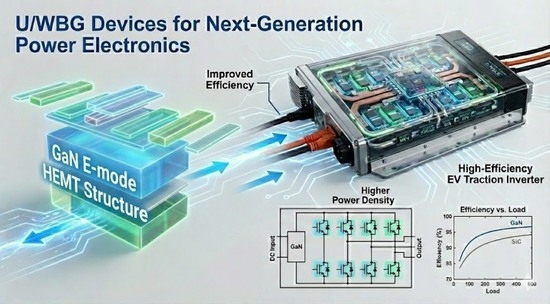
1. Introduction
1.1. Literature Review Methodology
1.1.1. Search Strategy and Databases
- Primary keywords: “wide bandgap semiconductors”, “silicon carbide power devices”, “gallium nitride HEMT”, “SiC MOSFET”, “GaN power electronics”;
- Secondary keywords: “ultrawide bandgap”, “power converter topology”, “electric vehicle inverter”, “DC–DC converter”, “gate driver design”;
- Emerging technology keywords: “vertical GaN”, “bidirectional switch”, “gallium oxide power”, “diamond semiconductor”, “aluminum nitride”;
- Application keywords: “traction inverter”, “on-board charger”, “solar inverter”, “data center power supply”.
1.1.2. Screening and Selection Process
1.1.3. Inclusion and Exclusion Criteria
1.2. Comparison with Existing Review Literature and Added Value
1.2.1. Unique Contributions and Added Value
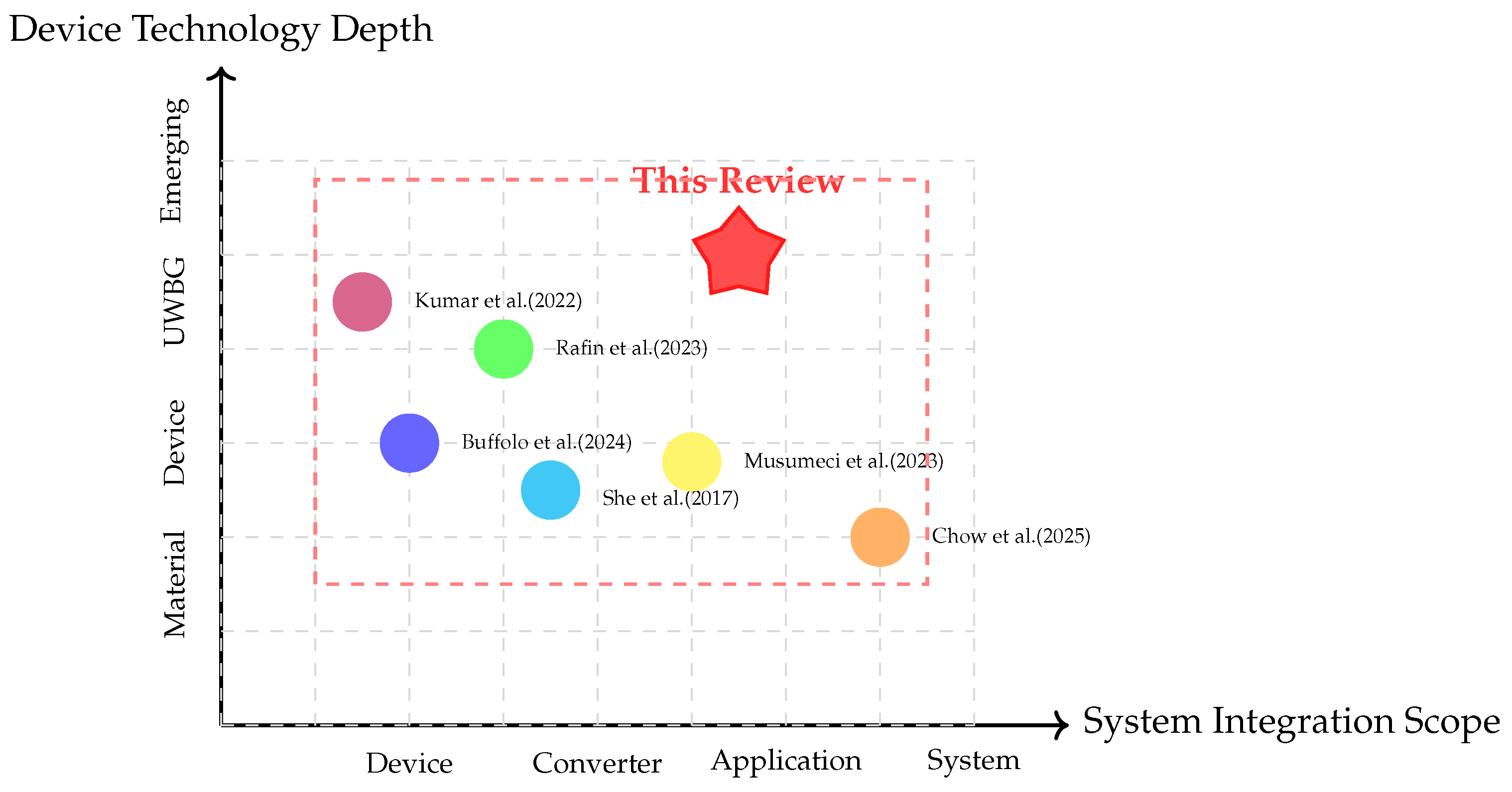
- Comprehensive Topology-by-Topology SiC vs. GaN Comparison: Unlike previous reviews that focus primarily on device-level characteristics, this work provides detailed design guidelines for device selection across all major converter topologies (Section 6), enabling practicing engineers to make informed technology choices based on specific application requirements. While She et al. [17] and Musumeci and Barba [18] address converter applications, neither provides systematic topology-level selection criteria spanning both SiC and GaN with quantitative metrics.
- Emerging Device Technologies: This review provides the first comprehensive coverage of vertical GaN power devices and monolithic bidirectional switches (BDSs) in the context of converter topologies. While Buffolo et al. [8] acknowledge these technologies, our work provides a detailed analysis of their impact on specific topologies, including matrix converters, Vienna rectifiers, and current-source inverters—an analysis absent from all prior reviews.
- Bottom-Up Systematic Approach: This review uniquely employs a bottom-up methodology (Materials→Devices→Converters→Systems), providing clear traceability from fundamental material properties through figures of merit to system-level KPIs. This approach enables readers to understand why specific devices excel in particular applications—a framework absent from prior works that typically separate device physics from application discussions.
- Quantitative System-Level Benefits:Section 8 provides quantified economic analysis with payback periods for each application sector–data largely absent from device-focused reviews. While Chow et al. [15] discuss system-level sustainability, they do not provide the sector-specific economic quantification presented here.
- Practical Design Constraints: The review addresses real-world implementation challenges, including dynamic degradation mechanisms, threshold voltage instability, and gate driver optimization requirements (Section 6.5.2) that are often overlooked in material-focused surveys. Although Akbar et al. [25] address SiC reliability, and Musumeci and Barba [18] discuss GaN challenges, neither integrates these constraints with topology-specific design guidelines, as presented here.
1.2.2. Research Gap Analysis
2. Material Properties and Comparative Analysis
2.1. Intrinsic Material Characteristics
2.2. Quantitative Performance Metrics: Figures of Merit
3. Emerging UWBG Materials: Development Status and Commercialization
3.1. Beta-Gallium Oxide (-Ga2O3)
3.2. Aluminum Nitride (AlN)
3.3. Diamond
3.4. Cubic Boron Nitride (c-BN)
4. WBG Device Architectures: SiC and GaN
4.1. SiC Device Configurations
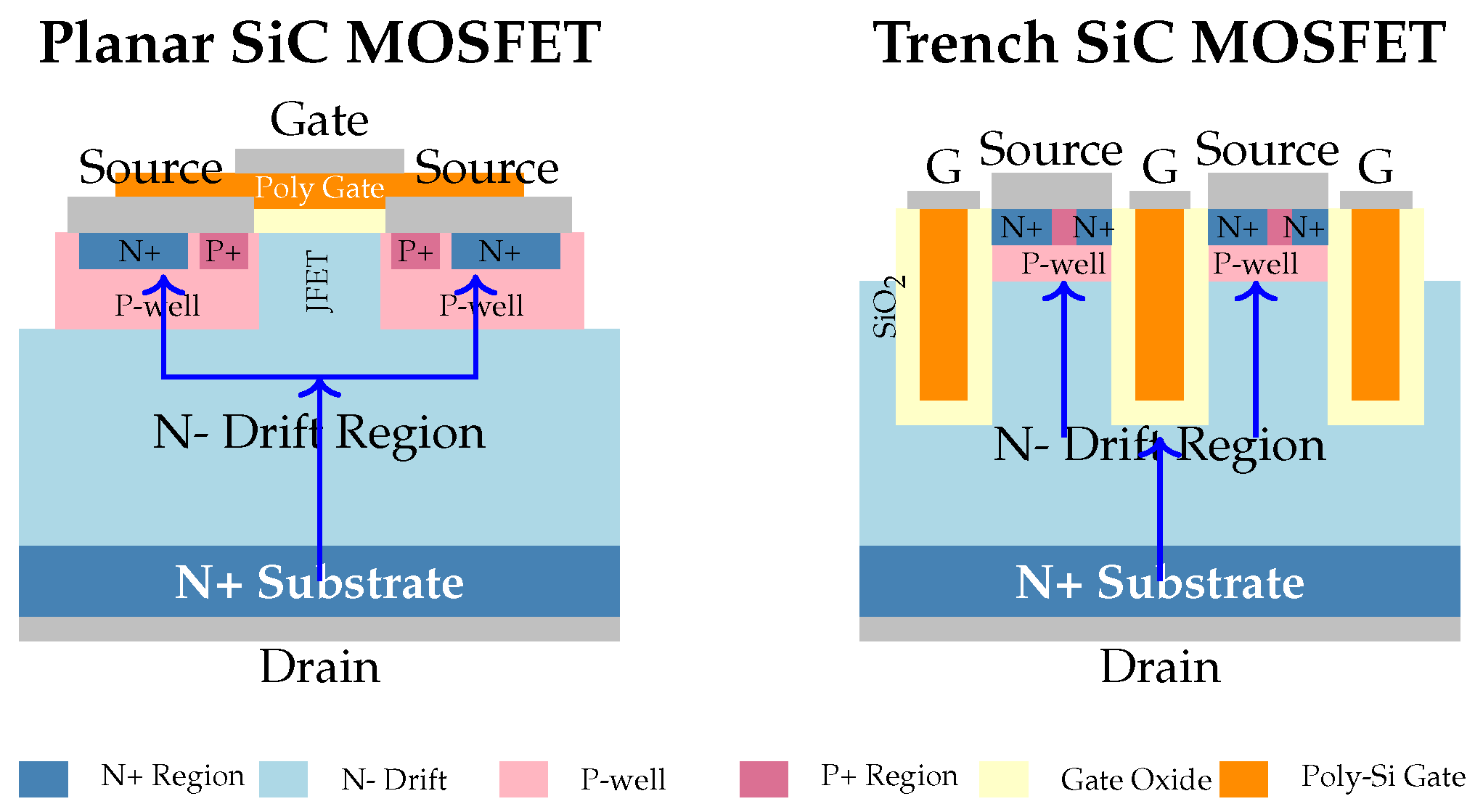
SiC MOSFET Structure
4.2. SiC Device Selection Criteria and Loss Models
4.3. GaN Device Configurations
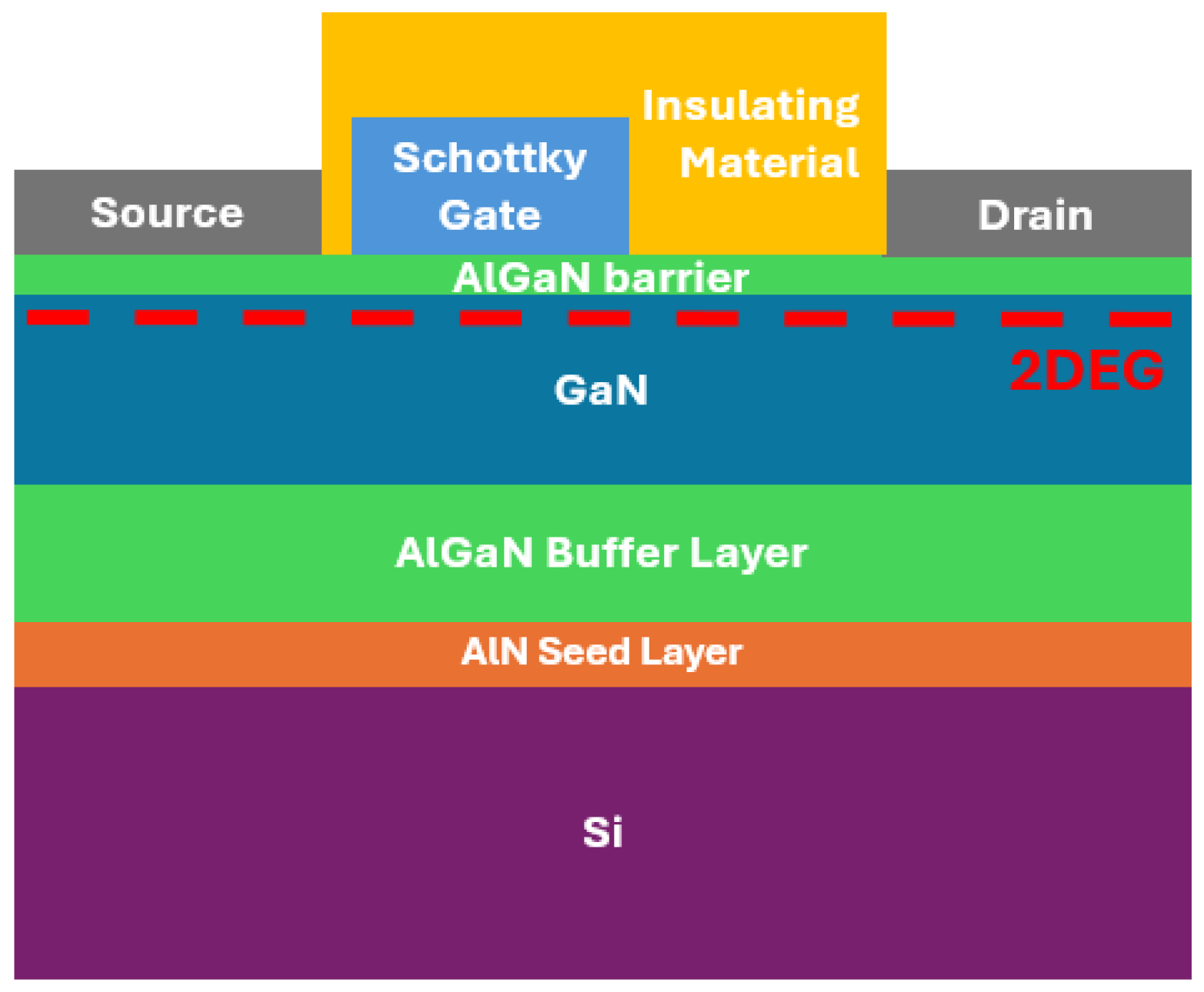
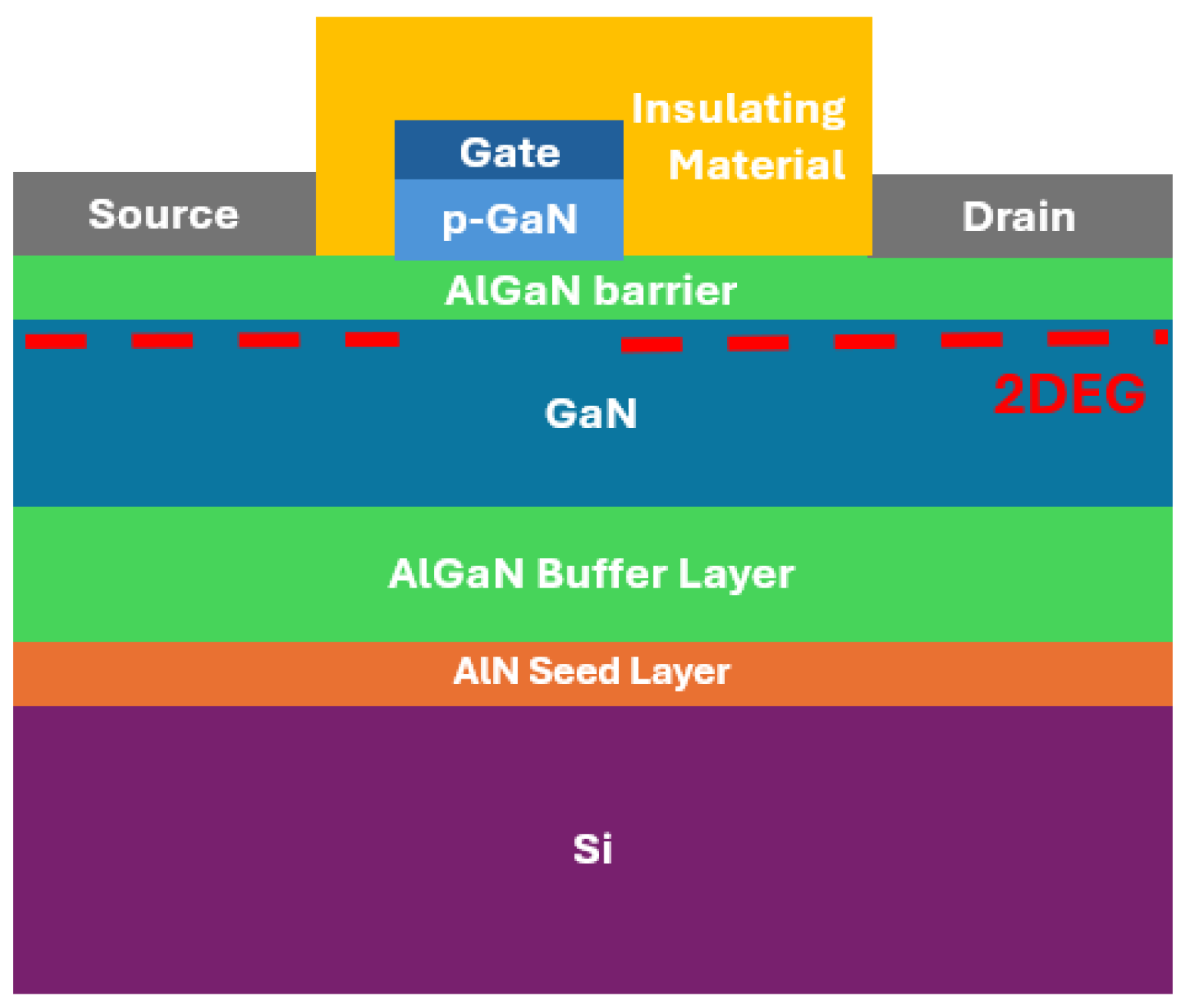
4.3.1. Depletion-Mode (D-Mode) GaN HEMTs
4.3.2. Enhancement-Mode (E-Mode) GaN HEMTs
4.4. GaN Device Selection Criteria and Loss Models
4.5. Vertical GaN Power Devices
4.6. GaN Bidirectional Switches (BDS)
5. Converter Topologies for WBG Devices
5.1. SiC Converter Topologies
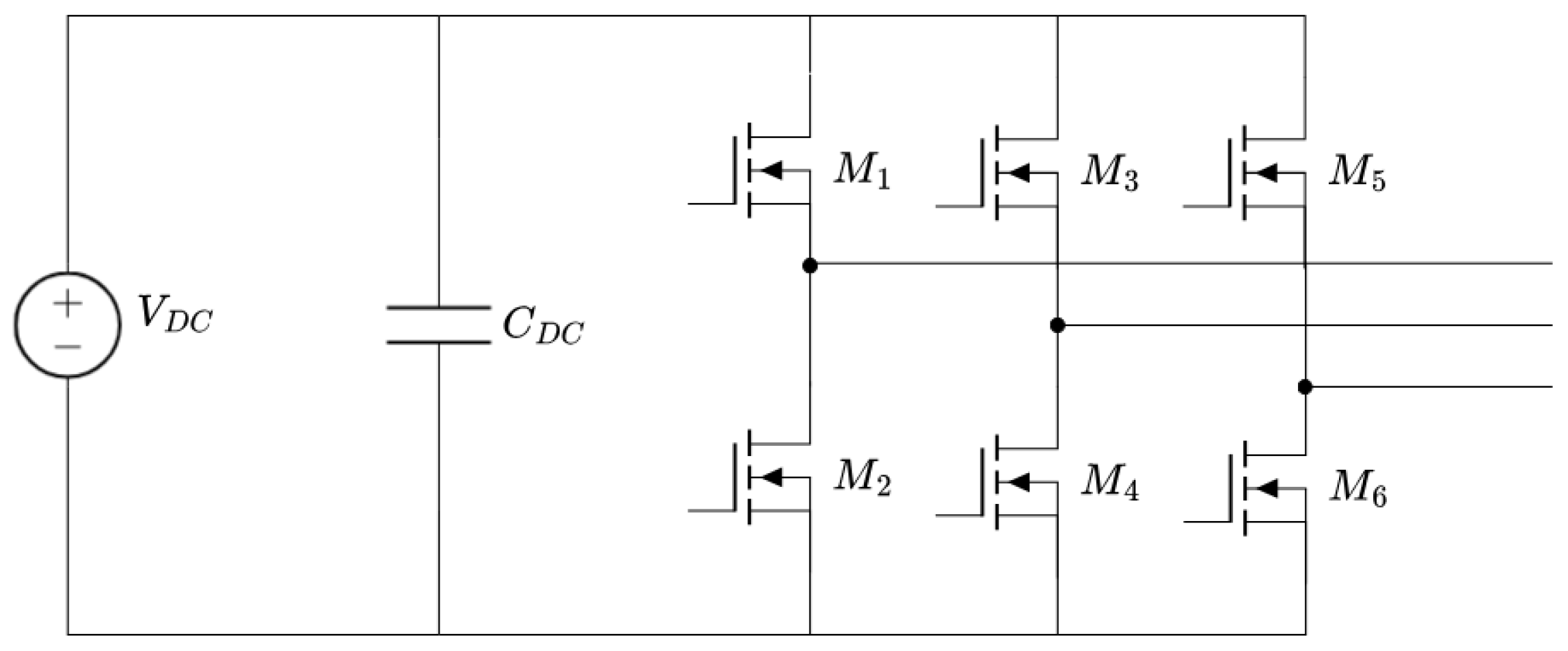
5.1.1. Three-Phase Traction Inverter
5.1.2. DC Fast Charging Converter
5.1.3. Grid-Tied Solar Inverter
5.2. GaN Converter Topologies
5.2.1. Buck Converters
5.2.2. Interleaved Buck Converters
5.2.3. Dual Active Bridge Converters
5.2.4. Multilevel DAB Topologies
5.3. GaN Technology Evolution: Vertical GaN and BDS for Converter Topologies
5.3.1. Vertical GaN: Challenging SiC in Medium-Voltage Applications
- Voltage scaling through drift layer thickness rather than lateral area;
- No dynamic degradation (no surface traps);
- Avalanche capability similar to SiC MOSFETs;
- Reduced chip area for given voltage/current rating.
- Limited substrate availability (2–4 inch GaN-on-GaN);
- Higher substrate cost compared to SiC or GaN-on-Si;
- Manufacturing maturity gap (TRL 4–5 vs. TRL 8–9 for SiC);
- Projected commercialization: 2026–2028 for 1.2 kV class.
5.3.2. Bidirectional GaN Switches: Enabling Single-Stage Power Conversion
- A 40–50% size reduction in EV on-board chargers;
- Elimination of electrolytic capacitors (improved reliability);
- Inherent bidirectional power flow (V2G capability);
- Higher efficiency through single-stage conversion.
- Variable-frequency motor drives;
- Solid-state transformers;
- Grid frequency conversion.
- A 50% reduction in on-resistance for bidirectional current path;
- Simplified gate drive (two isolated channels vs. four);
- Higher switching frequency capability (>100 kHz vs. 30–50 kHz);
- Reduced PCB complexity and parasitic inductance.
5.3.3. Design Guidelines for Technology Selection
5.3.4. Market and Technology Outlook
- In 2025: Commercial 650 V GaN BDS devices (Infineon (Neubiberg, Germany), Navitas (Torrance, CA, USA)); initial vertical GaN sampling at 700–1200 V;
- In 2026–2027: Production of vertical GaN for EV traction; BDS adoption in solar microinverters;
- In 2028–2030: Vertical GaN challenging SiC in medium-voltage segments; matrix converters becoming mainstream;
- In 2030+: Potential vertical GaN extension to 3.3 kV for grid applications.
6. SiC vs. GaN: Comprehensive Comparison
6.1. Topology-Specific Comparison
6.2. Thermal Stability Considerations
6.3. Efficiency and Loss Comparison
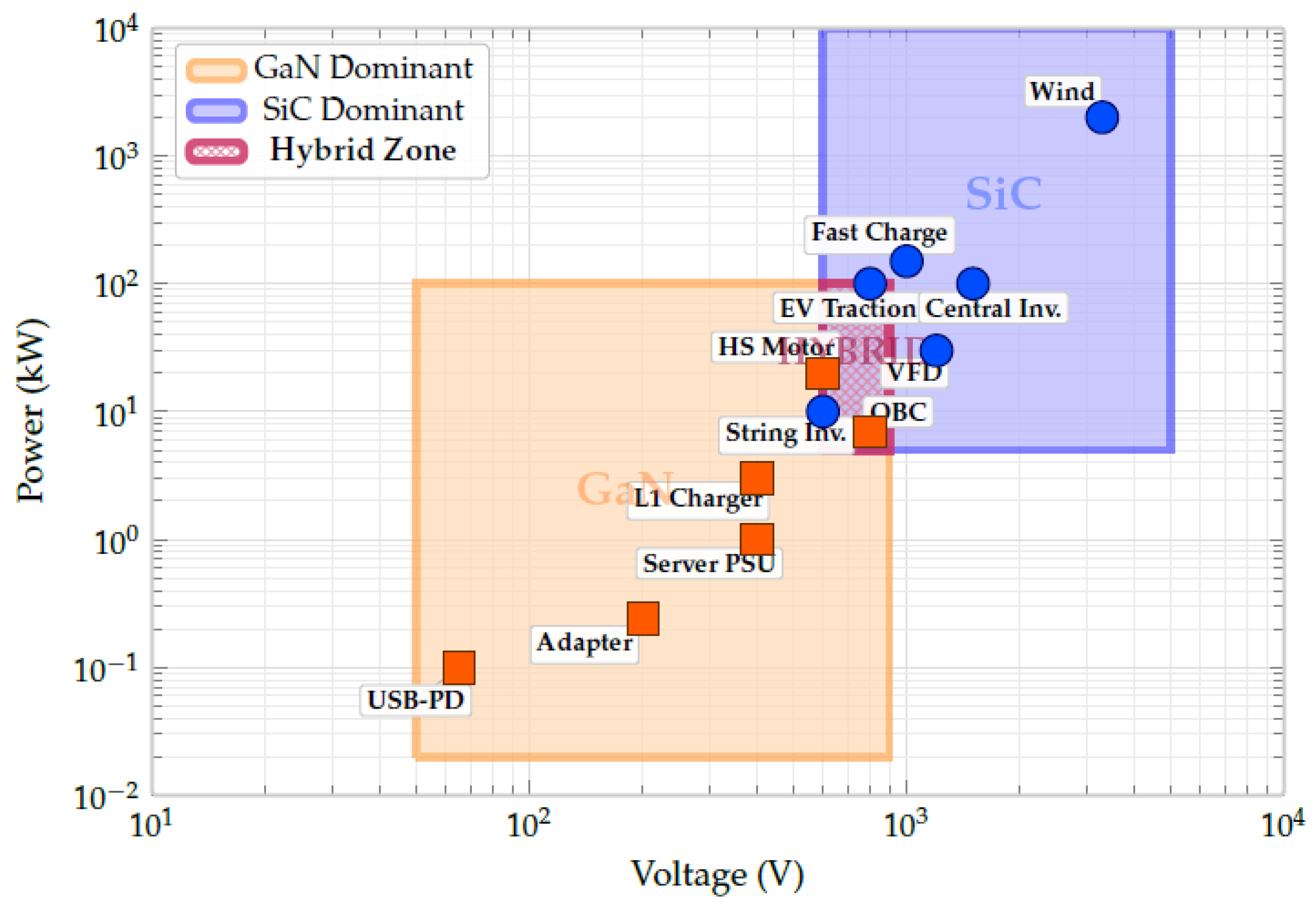
6.4. Application-Specific Recommendations
6.5. Gate Driver Requirements
6.5.1. SiC MOSFET Gate Drive Considerations
6.5.2. GaN HEMT Gate Drive Considerations
6.6. Topology-Level Comparison: V-GaN, BDS and SiC
6.7. Double Pulse Test Circuit for Device Characterization
6.8. Analytical Equations for Switching Transient Validation
6.9. Technology-Specific Switching Characteristics
6.10. Comparative Performance Summary
7. System-Level Dynamic Validation: GaN vs. SiC
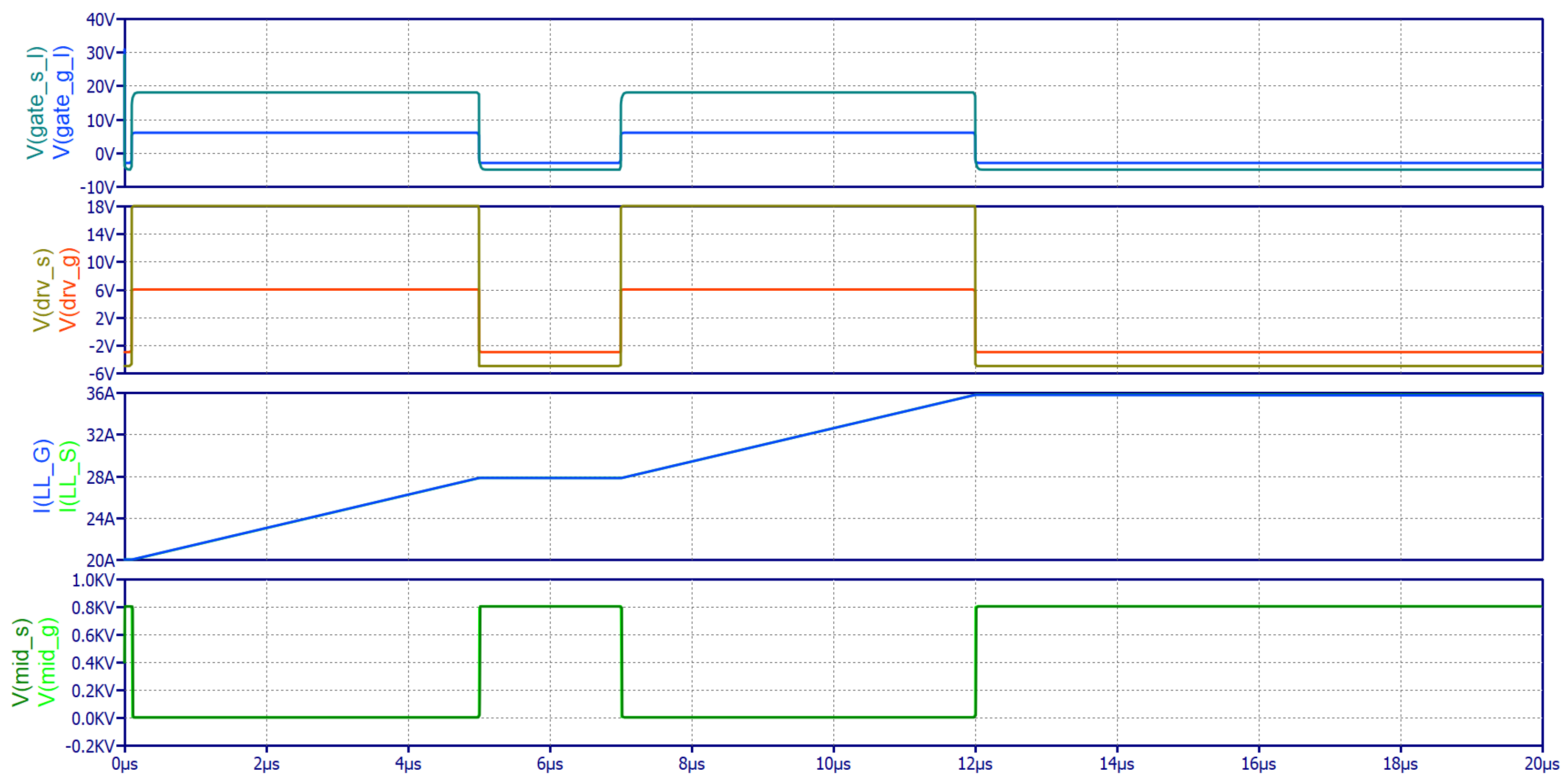
7.1. Simulation Methodology
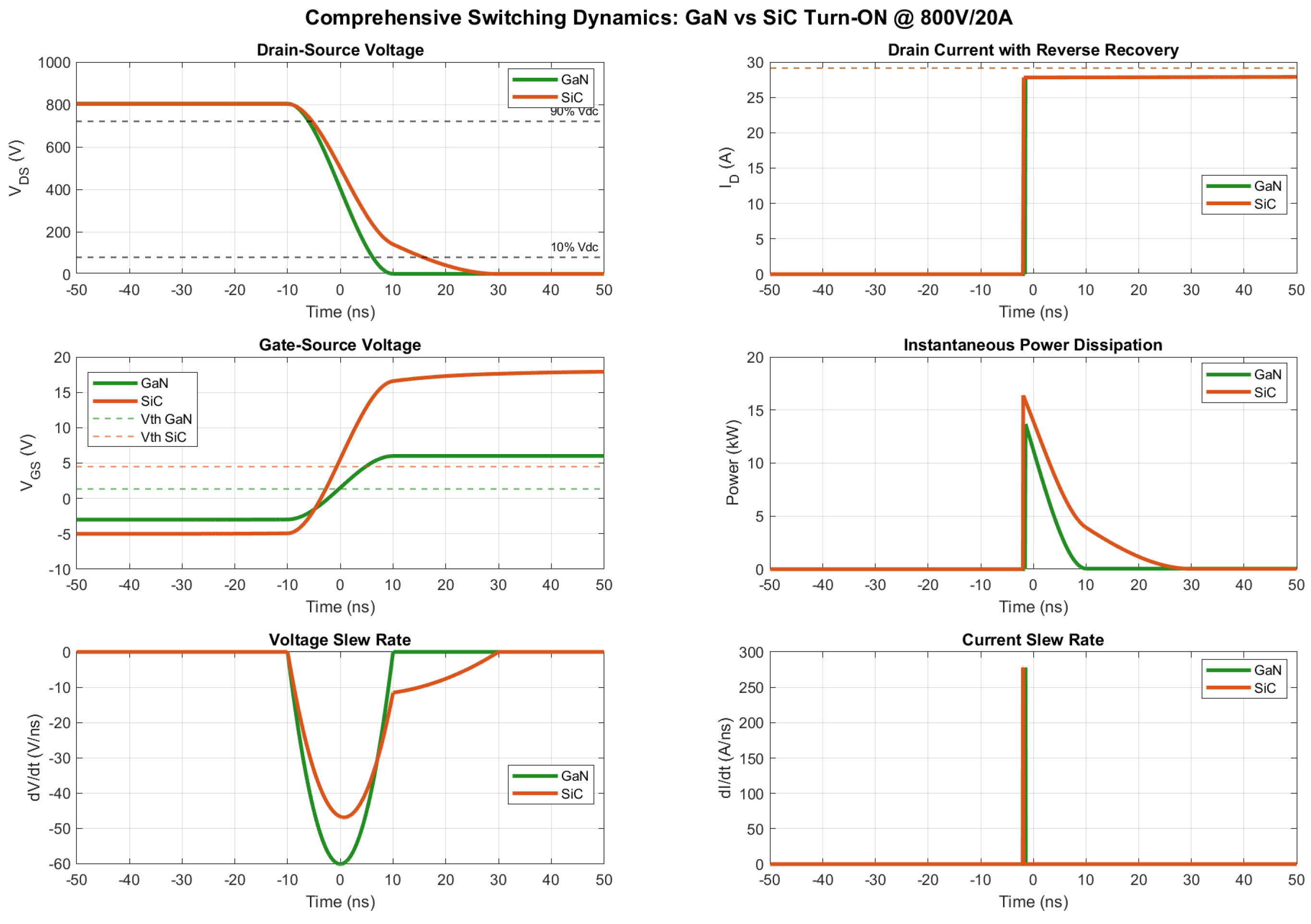
7.2. Switching Waveform Analysis
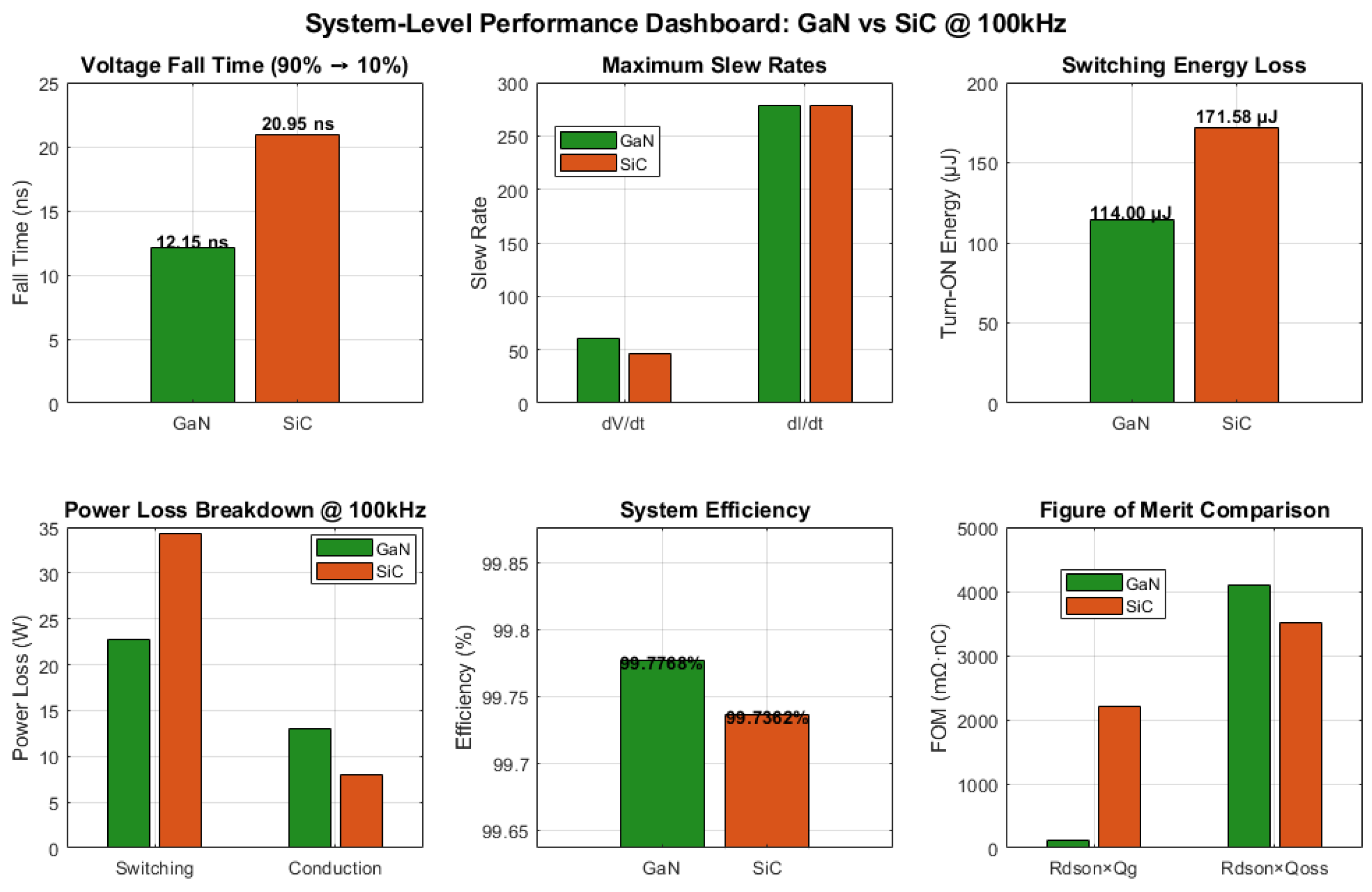
7.3. Performance Metrics Comparison
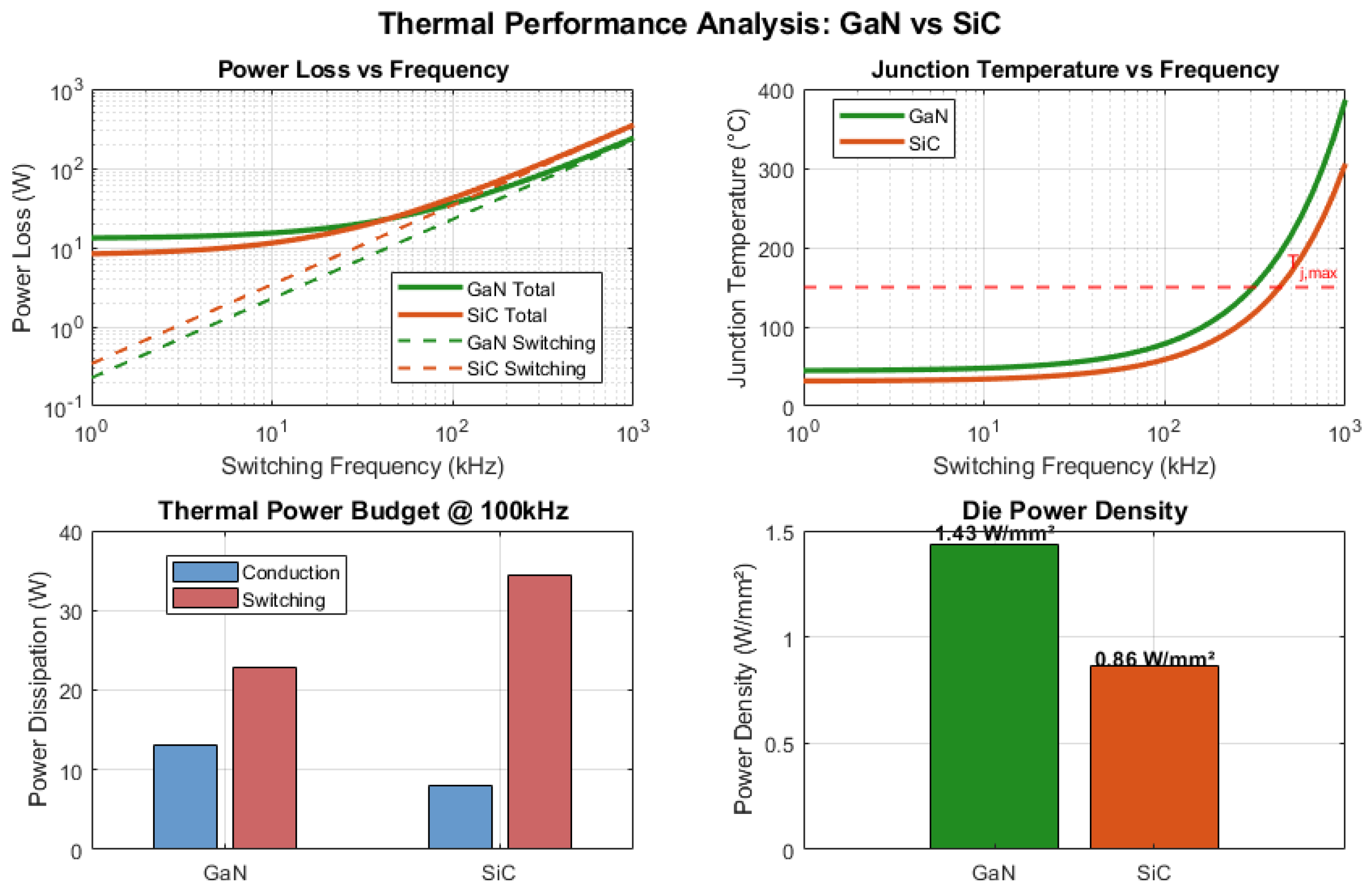
7.4. Thermal Implications
7.5. Design Implications
- GaN-optimal regime: Applications prioritizing switching frequency (>100 kHz), power density, or gate driver simplicity benefit from GaN’s 17× superior gate-charge FOM and 1.7× faster switching.
- SiC-optimal regime: High-current applications with moderate switching frequencies (<50 kHz) favor SiC’s 38% lower conduction losses and superior thermal margins.
- Crossover frequency: At approximately 100 kHz and 20 A load current, GaN provides 15% lower total losses, with the advantage increasing at higher frequencies.
8. System-Level Implications and Benefits
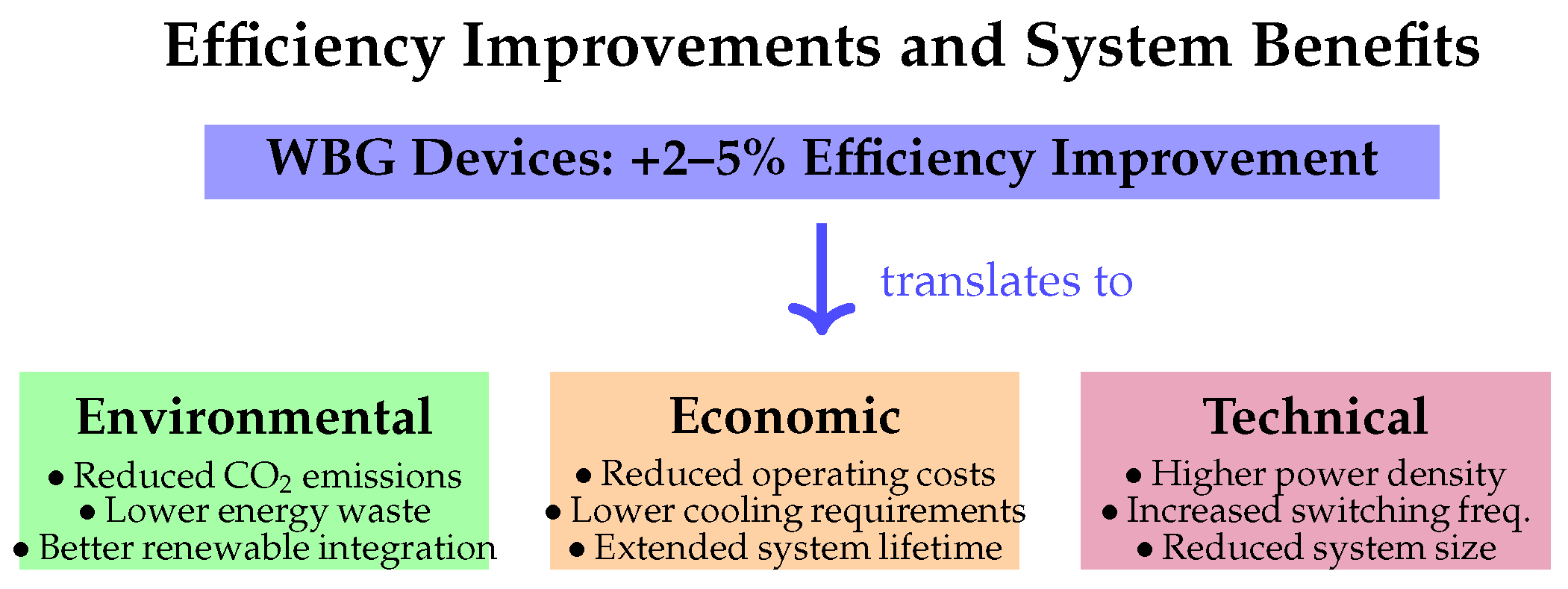
8.1. Efficiency Improvements and Economic Impact
8.2. Passive Component Reduction
8.3. Key Performance Indicator Comparison
8.4. Hidden Costs of High-Frequency Operation
8.5. SiC System Benefits
9. Application Landscape and Case Studies
9.1. Automotive and Transportation Applications
9.2. Consumer Electronics and Power Delivery
10. Reliability and Practical Constraints
10.1. SiC Technology Challenges
10.2. GaN Technology Challenges
10.2.1. Dynamic On-Resistance
10.2.2. Short Circuit and Overcurrent Protection
10.3. Common Reliability Considerations
10.3.1. Threshold Voltage Instability
10.3.2. Electromagnetic Interference Challenges
10.3.3. Packaging and Thermal Management
11. Conclusions and Future Perspectives
Author Contributions
Funding
Institutional Review Board Statement
Informed Consent Statement
Data Availability Statement
Conflicts of Interest
Abbreviations
| 2DEG | Two-Dimensional Electron Gas | AlN | Aluminum Nitride | ANPC | Active Neutral Point Clamped |
| BDS | Bidirectional Switch | BFOM | Baliga Figure of Merit | BHFFOM | Baliga High-Frequency FOM |
| BJT | Bipolar Junction Transistor | CAGR | Compound Annual Growth Rate | CAVET | Current Aperture Vertical Electron Trans. |
| c-BN | Cubic Boron Nitride | CCM | Continuous Conduction Mode | CHFFOM | Combined High-Freq. FOM |
| CMTI | Common-Mode Transient Immun. | CSI | Current Source Inverter | CTE | Coeff. of Thermal Expansion |
| CVD | Chemical Vapor Deposition | CZ | Czochralski | DAB | Dual Active Bridge |
| DFN | Dual Flat No-lead | D-mode | Depletion Mode | DOE | Department of Energy |
| DPD | Distributed Polarization Doping | EFG | Edge-defined Film-fed Growth | EMI | Electromagnetic Interference |
| E-mode | Enhancement Mode | ESR | Equivalent Series Resistance | ETRI | Korea Elec. & Telecom. Res. Inst. |
| EV | Electric Vehicle | FET | Field-Effect Transistor | FOM | Figure of Merit |
| FZ | Floating Zone | GaN | Gallium Nitride | h-BN | hexagonal Boron Nitride |
| HEMT | High Electron Mobility Trans. | HERIC | Highly Eff. & Reliable Inv. Concept | HPHT | High-Pressure High-Temp. |
| HVDC | High-Voltage Direct Current | IEDM | Intl. Electron Devices Meeting | IGBT | Insulated-Gate Bipolar Trans. |
| JAXA | Japan Aerospace Expl. Agency | JFET | Junction Field-Effect Trans. | JFOM | Johnson’s Figure of Merit |
| KFOM | Keyes’ Figure of Merit | KPI | Key Performance Indicator | LGA | Land Grid Array |
| MOSFET | Metal-Oxide-Semicond. FET | NIMS | Natl. Inst. for Materials Sci. | NPC | Neutral Point Clamped |
| OBC | On-Board Charger | OEM | Original Equip. Manufacturer | PCB | Printed Circuit Board |
| PFC | Power Factor Correction | PLA | Pulsed Laser Annealing | PRISMA | Pref. Rep. Items for Syst. Rev. |
| PSU | Power Supply Unit | PV | Photovoltaic | PWM | Pulse Width Modulation |
| QFN | Quad Flat No-lead | RF | Radio Frequency | SBD | Schottky Barrier Diode |
| SiC | Silicon Carbide | SMD | Surface Mount Device | TFOM | Thermal Figure of Merit |
| THD | Total Harmonic Distortion | TRL | Technology Readiness Level | UVLO | Under-Voltage Lockout |
| UWBG | Ultrawide-Bandgap | V2G | Vehicle-to-Grid | VFD | Variable Frequency Drive |
| VSI | Voltage Source Inverter | WBG | Wide-Bandgap | ZVS | Zero Voltage Switching |
Appendix A. PRISMA 2020 Checklist

| Section and Topic | Item # | Checklist Item | Location Where Item Is Reported |
|---|---|---|---|
| TITLE | |||
| Title | 1 | Identify the report as a systematic review. | Page 1, Title: labeled as “Systematic Review” |
| ABSTRACT | |||
| Abstract | 2 | See the PRISMA 2020 for Abstracts checklist. | Page 1, Lines 1–28 |
| INTRODUCTION | |||
| Rationale | 3 | Describe the rationale for the review in the context of existing knowledge. | Section 1 (Introduction), Pages 1–3, Lines 29–89; discusses CO2 emissions, efficiency demands, and WBG technology transition |
| Objectives | 4 | Provide an explicit statement of the objective(s) or question(s) the review addresses. | Section 1 (Introduction), Pages 2–3, Lines 76–89; comprehensive analysis of WBG/UWBG semiconductors using bottom-up approach |
| Eligibility criteria | 5 | Specify the inclusion and exclusion criteria for the review and how studies were grouped for the syntheses. | Section 1.1.3, Page 4, Lines 115–124; four inclusion criteria and four exclusion criteria specified |
| Information sources | 6 | Specify all databases, registers, websites, organisations, reference lists and other sources searched or consulted to identify studies. Specify the date when each source was last searched or consulted. | Section 1.1.1, Pages 3–4, Lines 94–110; IEEE Xplore, ScienceDirect, Web of Science, Scopus, Google Scholar; January 2014 to December 2025 |
| Search strategy | 7 | Present the full search strategies for all databases, registers and websites, including any filters and limits used. | Section 1.1.1, Pages 3–4, Lines 99–110; primary, secondary, emerging technology, and application keywords with Boolean combinations listed |
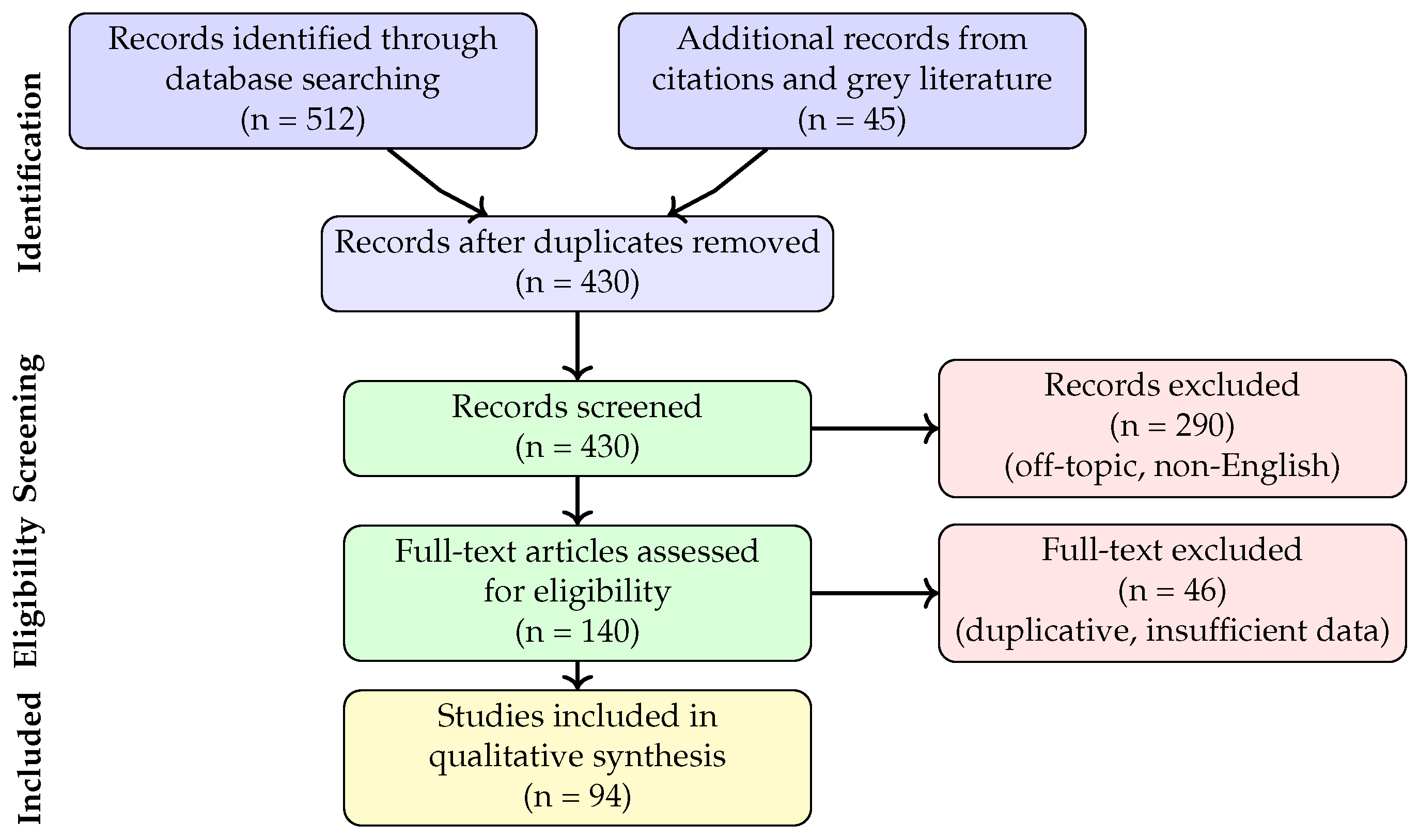
| Selection process | 8 | Specify the methods used to decide whether a study met the inclusion criteria of the review, including how many reviewers screened each record and each report retrieved, whether they worked independently, and if applicable, details of automation tools used in the process. | Section 1.1.2, Page 4, Lines 111–113; PRISMA flow diagram (Figure 3) shows screening process: 512 records identified, 430 after duplicates removed, 140 full-text assessed, 94 included |
| Data collection process | 9 | Specify the methods used to collect data from reports, including how many reviewers collected data from each report, whether they worked independently, any processes for obtaining or confirming data from study investigators, and if applicable, details of automation tools used in the process. | Section 1.1.2, Page 4, Table 1; data categorized into 8 categories (SiC Device Technology, GaN HEMT Technology, Converter Topologies, etc.) |
| Data items | 10a | List and define all outcomes for which data were sought. Specify whether all results that were compatible with each outcome domain in each study were sought, and if not, the methods used to decide which results to collect. | Section 1.2, Pages 5–7, Table 2 and Table 3; quantitative data on device performance, converter efficiency, system-level benefits, and Key Performance Indicators sought |
| 10b | List and define all other variables for which data were sought. Describe any assumptions made about any missing or unclear information. | Table 4 and Table 5 (material properties, FOMs), Table 7, Table 9, Table 10, Table 11, Table 12, Table 13, Table 14 and Table 15 (device characteristics, thermal properties, economic benefits); data extracted from manufacturer datasheets and peer-reviewed publications | |
| Study risk of bias assessment | 11 | Specify the methods used to assess risk of bias in the included studies, including details of the tool(s) used, how many reviewers assessed each study and whether they worked independently, and if applicable, details of automation tools used in the process. | Not explicitly addressed; this is a technology review rather than clinical systematic review—formal risk of bias assessment not applicable to engineering literature |
| Effect measures | 12 | Specify for each outcome the effect measure(s) used in the synthesis or presentation of results. | Section 2.2, 8 (Pages 9–10, 33–34); Figures of Merit (BFOM, BHFFOM, JFOM, KFOM, CHFFOM, TFOM), efficiency percentages, power density ratios, cost comparisons |
| Synthesis methods | 13a | Describe the processes used to decide which studies were eligible for each synthesis. | Section 1.1.2 and Section 1.1.3, Page 4; Table 1 shows distribution by category; Figure 3 PRISMA flow diagram |
| 13b | Describe any methods required to prepare the data for presentation or synthesis, such as handling of missing summary statistics, or data conversions. | Section 2.2, Pages 9–10; FOM values normalized relative to silicon (Si = 1); Table 5 | |
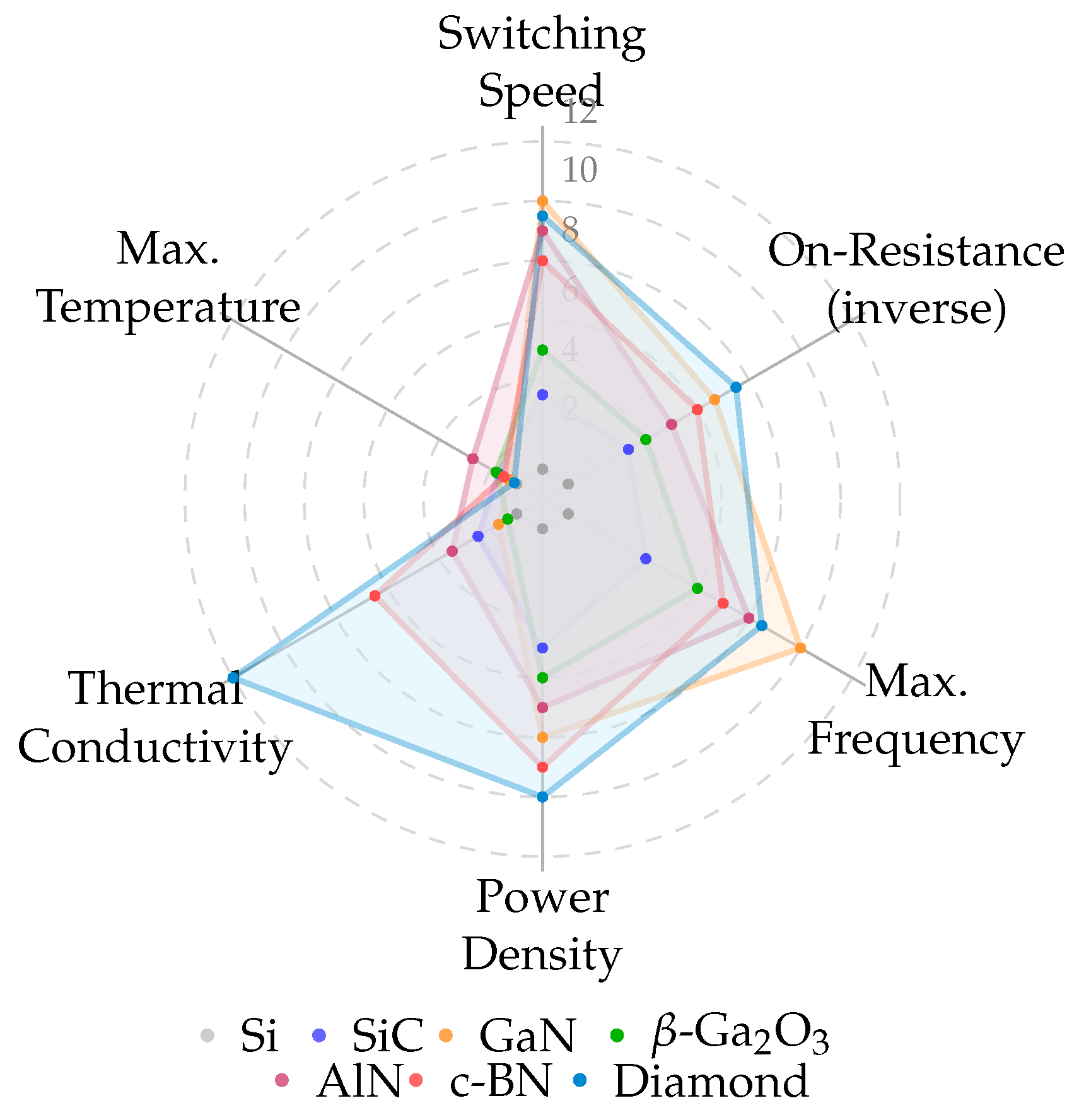
| 13c | Describe any methods used to tabulate or visually display results of individual studies and syntheses. | Throughout paper: 19 tables, 20 figures including radar charts (Figure 5), flow diagrams (Figure 3), application landscape plots (Figure 20), and DPT simulation results (Figure 16, Figure 17, Figure 18 and Figure 19) | |
| 13d | Describe any methods used to synthesize results and provide a rationale for the choice(s). If meta-analysis was performed, describe the model(s), method(s) to identify the presence and extent of statistical heterogeneity, and software package(s) used. | Qualitative synthesis with bottom-up methodology (Materials → Devices → Converters → Systems); Section 7 describes QSPICE simulation methodology for DPT validation; no meta-analysis performed | |
| 13e | Describe any methods used to explore possible causes of heterogeneity among study results. | Section 6 (SiC vs. GaN Comparison), Table 9, Table 10, Table 11, Table 12 and Table 13; topology-specific comparisons exploring technology-dependent performance variations | |
| 13f | Describe any sensitivity analyses conducted to assess robustness of the synthesized results. | Section 7 (System-Level Dynamic Validation), Pages 30–33; Double Pulse Test simulations comparing GaN and SiC under identical conditions (800 V, 20 A, 100 kHz) | |
| RESULTS | |||
| Reporting bias assessment | 14 | Describe any methods used to assess risk of bias due to missing results in a synthesis (arising from reporting biases). | Not explicitly addressed; grey literature included (n = 45 additional records); manufacturer datasheets and technical reports supplemented peer-reviewed sources |
| Certainty assessment | 15 | Describe any methods used to assess certainty (or confidence) in the body of evidence for an outcome. | Section 3, Table 6; Technology Readiness Levels (TRL 2–6) per Horizon 2020 definitions used to assess UWBG material development status; commercialization projections qualified with confidence statements |
| Study selection | 16a | Describe the results of the search and selection process, from the number of records identified in the search to the number of studies included in the review, ideally using a flow diagram. | Section 1.1.2, Page 4, Figure 3; 512 records identified → 430 after duplicates → 140 full-text assessed → 94 studies included |
| 16b | Cite studies that might appear to meet the inclusion criteria, but which were excluded, and explain why they were excluded. | Section 1.1.2, Page 4, Figure 3; 290 records excluded (off-topic, non-English); 46 full-text excluded (duplicative, insufficient data) | |
| Study characteristics | 17 | Cite each included study and present its characteristics. | References section, Pages 43–46 (94 references cited); Table 1 categorizes studies; Table 2 compares with existing reviews |
| Risk of bias in studies | 18 | Present assessments of risk of bias for each included study. | Not applicable—engineering technology review; study quality addressed through inclusion criteria (peer-reviewed journals, IEEE proceedings, quantitative metrics required) |
| Results of individual studies | 19 | For all outcomes, present, for each study: (a) summary statistics for each group and (b) an effect estimate and its precision, ideally using structured tables or plots. | Table 4, Table 5, Table 6, Table 7, Table 8, Table 9, Table 10, Table 11, Table 12, Table 13, Table 14 and Table 15 throughout; key results: Table 5 (normalized FOMs), Table 7 (device characteristics), Table 14 (economic benefits), Table 15 (KPI comparison) |
| Results of syntheses | 20a | For each synthesis, briefly summarise the characteristics and risk of bias among contributing studies. | Section 1.2, Table 2; comparison of strengths and limitations across reviewed literature; Table 3 summarizes unique contributions |
| 20b | Present results of all statistical syntheses conducted. If meta-analysis was done, present for each the summary estimate and its precision and measures of statistical heterogeneity. If comparing groups, describe the direction of the effect. | Qualitative synthesis; Table 9, Table 10, Table 11, Table 12 and Table 13 present comparative results (SiC vs. GaN); Table 13 shows switching performance at 400 V/20 A; Figure 18 and Figure 19 present simulation-derived metrics | |
| 20c | Present results of all investigations of possible causes of heterogeneity among study results. | Section 6.2 (Thermal Stability), Section 6.3 (Efficiency/Loss Comparison); technology-specific factors explaining performance variations identified | |
| 20d | Present results of all sensitivity analyses conducted to assess the robustness of the synthesized results. | Section 7.3, Section 7.4 and Section 7.5, Pages 31–33; sensitivity to switching frequency analyzed (Figure 18 and Figure 19); crossover frequency (∼100 kHz) identified where technology preference changes | |
| Reporting biases | 21 | Present assessments of risk of bias due to missing results (arising from reporting biases) for each synthesis assessed. | Not explicitly presented; limitations acknowledged in comparison with existing literature (Table 2) |
| Certainty of evidence | 22 | Present assessments of certainty (or confidence) in the body of evidence for each outcome assessed. | Table 6, Page 13; TRL levels (2–6) presented; commercialization projections qualified (e.g., “confidence decreases for longer-term projections”) |
| DISCUSSION | |||
| Discussion | 23a | Provide a general interpretation of the results in the context of other evidence. | Section 11 (Conclusions), Pages 40–42; results interpreted in context of sustainability initiatives, market trends, and European Chips Act investments |
| 23b | Discuss any limitations of the evidence included in the review. | Section 1.2, Table 2 (limitations of prior works); Section 10 (Reliability and Practical Constraints); Section 8.4 (Hidden Costs) | |
| 23c | Discuss any limitations of the review processes used. | Section 1.1.3, Page 4; exclusion of RF/microwave-only studies, simulation-only studies; focus on peer-reviewed and IEEE proceedings | |
| 23d | Discuss implications of the results for practice, policy, and future research. | Section 11, Pages 40–42; future research directions listed; supply chain and policy implications discussed; design guidelines provided throughout (e.g., Section 5.3.3) | |
| OTHER INFORMATION | |||
| Registration and protocol | 24a | Provide registration information for the review, including register name and registration number, or state that the review was not registered. | Not stated; review was not registered |
| 24b | Indicate where the review protocol can be accessed, or state that a protocol was not prepared. | Not stated; protocol not prepared | |
| 24c | Describe and explain any amendments to information provided at registration or in the protocol. | Not applicable (no registration/protocol) | |
| Support | 25 | Describe sources of financial or non-financial support for the review, and the role of the funders or sponsors in the review. | Page 42, Lines 1269–1273; European Project GaN4AP, ECSEL JU grant No. 101007310, Horizon 2020; funding from EU, Italy, France, Poland, Czech Republic, The Netherlands |
| Competing interests | 26 | Declare any competing interests of review authors. | Page 42, Line 1278; “The authors declare no conflicts of interest” |
| Availability of data, code and other materials | 27 | Report which of the following are publicly available and where they can be found: template data collection forms; data extracted from included studies; data used for all analyses; analytic code; any other materials used in the review. | Page 42, Lines 1276–1277; “No new data were created or analyzed in this study. Data sharing is not applicable to this article.” |
References
- International Energy Agency. Global Energy Review 2025; Technical Report; International Energy Agency: Paris, France, 2025. [Google Scholar]
- Deng, Z.; Zhu, B.; Davis, S.J.; Ciais, P.; Guan, D.; Gong, P.; Liu, Z. Global carbon emissions and decarbonization in 2024. Nat. Rev. Earth Environ. 2025, 6, 231–233. [Google Scholar] [CrossRef]
- Tsao, J.Y.; Chowdhury, S.; Hollis, M.A.; Jena, D.; Johnson, N.M.; Jones, K.A.; Kaplar, R.J.; Rajan, S.; Van de Walle, C.G.; Bellotti, E.; et al. Ultrawide-Bandgap Semiconductors: Research Opportunities and Challenges. Adv. Electron. Mater. 2018, 4, 1600501. [Google Scholar] [CrossRef]
- Millán, J.; Godignon, P.; Perpiñà, X.; Pérez-Tomás, A.; Rebollo, J. A Survey of Wide Bandgap Power Semiconductor Devices. IEEE Trans. Power Electron. 2014, 29, 2155–2163. [Google Scholar] [CrossRef]
- Baliga, B.J. Fundamentals of Power Semiconductor Devices; Springer: New York, NY, USA, 2008. [Google Scholar] [CrossRef]
- Vitale, G. Power Converters for Green Hydrogen: State of the Art and Perspectives. Electronics 2024, 13, 4565. [Google Scholar] [CrossRef]
- Guilbert, D.; Vitale, G. Hydrogen as a Clean and Sustainable Energy Vector for Global Transition from Fossil-Based to Zero-Carbon. Clean Technol. 2021, 3, 881–909. [Google Scholar] [CrossRef]
- Buffolo, M.; Favero, D.; Marcuzzi, A.; De Santi, C.; Meneghesso, G.; Zanoni, E.; Meneghini, M. Review and Outlook on GaN and SiC Power Devices: Industrial State-of-the-Art, Applications, and Perspectives. IEEE Trans. Electron Devices 2024, 71, 1344–1355. [Google Scholar] [CrossRef]
- Vitale, G. Energy Saving by Power Electronics: Towards a New Concept of Renewable Source. Renew. Energy Power Qual. J. 2016, 4, 160001–160010. [Google Scholar] [CrossRef][Green Version]
- Infineon Technologies AG. Scaling AI Data Center Power Delivery with Si, SiC, and GaN: Power Supply Units from 3 to 12 kW; Technical Report; Infineon Technologies: Neubiberg, Germany, 2024. [Google Scholar]
- IDTechEx Research. Power Electronics for Electric Vehicles 2025–2035: Technologies, Markets, and Forecasts; Technical Report; IDTechEx: Cambridge, UK, 2024. [Google Scholar]
- STMicroelectronics. Fourth Generation STPOWER Silicon Carbide (SiC) MOSFET Technology for Next-Generation EV Traction Inverters; Technical Report; STMicroelectronics: Seoul, Republic of Korea, 2024. [Google Scholar]
- Page, M.J.; McKenzie, J.E.; Bossuyt, P.M.; Boutron, I.; Hoffmann, T.C.; Mulrow, C.D.; Shamseer, L.; Tetzlaff, J.M.; Akl, E.A.; Brennan, S.E.; et al. The PRISMA 2020 Statement: An Updated Guideline for Reporting Systematic Reviews. BMJ 2021, 372, n71. [Google Scholar] [CrossRef]
- Rafin, S.S.H.; Ahmed, R.; Haque, M.A.; Hossain, M.K.; Haque, M.A.; Mohammed, O.A. Power Electronics Revolutionized: A Comprehensive Analysis of Emerging Wide and Ultrawide Bandgap Devices. Micromachines 2023, 14, 2045. [Google Scholar] [CrossRef]
- Zhang, Y.; Dong, D.; Li, Q.; Zhang, R.; Udrea, F.; Wang, H. Wide-Bandgap Semiconductors and Power Electronics as Pathways to Carbon Neutrality. Nat. Rev. Electr. Eng. 2025, 2, 155–172. [Google Scholar] [CrossRef]
- Kumar, A.; Moradpour, M.; Losito, M.; Franke, W.T.; Ramasamy, S.; Baccoli, R.; Gatto, G. Wide Band Gap Devices and Their Application in Power Electronics. Energies 2022, 15, 9172. [Google Scholar] [CrossRef]
- She, X.; Huang, A.Q.; Lucía, O.; Ozpineci, B. Review of Silicon Carbide Power Devices and Their Applications. IEEE Trans. Ind. Electron. 2017, 64, 8193–8205. [Google Scholar] [CrossRef]
- Musumeci, S.; Barba, V. Gallium Nitride Power Devices in Power Electronics Applications: State of Art and Perspectives. Energies 2023, 16, 3894. [Google Scholar] [CrossRef]
- Belguith, M.; Eloued, S.; Kadi, M.; Ben Hadj Slama, J.; Hamouda, M. A Review of Thermal Management Techniques Adopted for High-Power-Density GaN-Based Converters. Chips 2026, 5, 4. [Google Scholar] [CrossRef]
- Qin, Y.; Albano, B.; Spencer, J.; Lundh, J.S.; Wang, B.; Buttay, C.; Tadjer, M.; DiMarino, C.; Zhang, Y. Thermal management and packaging of wide and ultra-wide bandgap power devices: A review and perspective. J. Phys. D Appl. Phys. 2023, 56, 093001. [Google Scholar] [CrossRef]
- Zhou, J.; Zhong, L.; Feng, X.; Zhang, W.; Liu, X.; Zhou, H.; Liu, Z.; Hao, Y.; Zhang, J. Recent Advances in Device-Level Thermal Management Technologies for Wide Bandgap Semiconductor: A Review. IEEE Trans. Electron Devices 2025, 72, 2769–2782. [Google Scholar] [CrossRef]
- Zhang, B.; Wang, S. A Survey of EMI Research in Power Electronics Systems With Wide-Bandgap Semiconductor Devices. IEEE J. Emerg. Sel. Top. Power Electron. 2020, 8, 626–643. [Google Scholar] [CrossRef]
- Donato, N.; Rouger, N.; Pernot, J.; Longobardi, G.; Udrea, F. Diamond power devices: State of the art, modelling, figures of merit and future perspective. J. Phys. D Appl. Phys. 2019, 53, 093001. [Google Scholar] [CrossRef]
- Green, A.J.; Speck, J.; Xing, G.; Moens, P.; Allerstam, F.; Gumaelius, K.; Neyer, T.; Arias-Purdue, A.; Mehrotra, V.; Kuramata, A.; et al. β-Gallium oxide power electronics. Appl. Mater. 2022, 10, 029201. [Google Scholar] [CrossRef]
- Akbar, G.; Di Fatta, A.; Rizzo, G.; Ala, G.; Romano, P.; Imburgia, A. Comprehensive Review of Wide-Bandgap (WBG) Devices: SiC MOSFET and Its Failure Modes Affecting Reliability. Physchem 2025, 5, 10. [Google Scholar] [CrossRef]
- Adeloye, I.A.; Bhattacharya, I.; Ezugwu, E.O.; Antony Dhason, M.V. GaN Electric Vehicle Systems—A Comparative Review. Energies 2025, 18, 6020. [Google Scholar] [CrossRef]
- Wu, X.; Zhang, L.; You, H.; Zhang, S.; Nikolov, D.; Cui, Q. EMC-Friendly Gate Driver Design in GaN-Based DC-DC Converters for Automotive Electronics: A Review. Electronics 2026, 15, 283. [Google Scholar] [CrossRef]
- Ambacher, O.; Smart, J.; Shealy, J.R.; Weimann, N.G.; Chu, K.; Murphy, M. Two-Dimensional Electron Gases Induced by Spontaneous and Piezoelectric Polarization Charges. J. Appl. Phys. 1999, 85, 3222–3233. [Google Scholar] [CrossRef]
- Razeeb, K.M.; Dalton, E.; Cross, G.L.W.; Robinson, A.J. Present and Future Thermal Interface Materials for Electronic Devices. Int. Mater. Rev. 2018, 63, 1296605. [Google Scholar] [CrossRef]
- Baliga, B.J. Power Semiconductor Device Figure of Merit for High-Frequency Applications. IEEE Electron Device Lett. 1989, 10, 455–457. [Google Scholar] [CrossRef]
- Johnson, E.O. Physical Limitations on Frequency and Power Parameters of Transistors. Rca Rev. 1965, 26, 163–177. [Google Scholar] [CrossRef]
- Keyes, R.W. Figure of Merit for Semiconductors for High-Speed Switches. Proc. IEEE 1972, 60, 225. [Google Scholar] [CrossRef]
- Hudgins, J.L.; Simin, G.S.; Santi, E.; Khan, M.A. An Assessment of Wide Bandgap Semiconductors for Power Devices. IEEE Trans. Power Electron. 2003, 18, 907–914. [Google Scholar] [CrossRef]
- Baliga, B. Trends in power semiconductor devices. IEEE Trans. Electron Devices 1996, 43, 1717–1731. [Google Scholar] [CrossRef]
- Qin, Y.; Wang, Z.; Sasaki, K.; Ye, J.; Zhang, Y. Recent progress of Ga2O3 power technology: Large-area devices, packaging and applications. Jpn. J. Appl. Phys. 2023, 62, SF0801. [Google Scholar] [CrossRef]
- Herath Mudiyanselage, D.; Da, B.; Adivarahan, J.; Wang, D.; He, Z.; Fu, K.; Zhao, Y.; Fu, H. β-Ga2O3-Based Heterostructures and Heterojunctions for Power Electronics: A Review of the Recent Advances. Electronics 2024, 13, 1234. [Google Scholar] [CrossRef]
- Wang, L.; Cheng, J.; Qu, K.; Zhu, Q.; Tian, B.; Yang, Z. Aluminum-Nitride-Based Semiconductors: Growth Processes, Ferroelectric Properties, and Performance Enhancements. Inorganics 2025, 13, 29. [Google Scholar] [CrossRef]
- Haque, A.; Taqy, S.; Narayan, J. Recent Progress in Cubic Boron Nitride (c-BN) Fabrication by Pulsed Laser Annealing for Optoelectronic Applications. J. Electron. Mater. 2024, 53, 4308–4340. [Google Scholar] [CrossRef]
- Zhang, X. Doping and electrical properties of cubic boron nitride thin films: A critical review. Thin Solid Film. 2013, 544, 2–12. [Google Scholar] [CrossRef]
- Haque, A.; Narayan, J. Tunable n-Type Conductivity and Transport Properties of Cubic Boron Nitride via Carbon Doping. Acs Appl. Electron. Mater. 2021, 3, 1359–1367. [Google Scholar] [CrossRef]
- Narayan, J.; Bhaumik, A. Direct Conversion of h-BN into c-BN and Formation of Epitaxial c-BN/Diamond Heterostructures. J. Appl. Phys. 2016, 119, 185302. [Google Scholar] [CrossRef]
- Mullen, J.T.; Boulton, J.A.; Pan, M.; Kim, K.W. Electronic Properties of c-BN/Diamond Heterostructures for High-Frequency High-Power Applications. Diam. Relat. Mater. 2024, 143, 110920. [Google Scholar] [CrossRef]
- Jones, E.A.; Wang, F.F.; Costinett, D. Review of Commercial GaN Power Devices and GaN-Based Converter Design Challenges. IEEE J. Emerg. Sel. Top. Power Electron. 2016, 4, 707–719. [Google Scholar] [CrossRef]
- Lidow, A.; Strydom, J.; de Rooij, M.; Reusch, D. GaN Transistors for Efficient Power Conversion; John Wiley & Sons: Hoboken, NJ, USA, 2014. [Google Scholar] [CrossRef]
- Kimoto, T.; Cooper, J.A. Fundamentals of Silicon Carbide Technology; Wiley-IEEE Press: Hoboken, NJ, USA, 2014. [Google Scholar] [CrossRef]
- Nakamura, T.; Nakano, Y.; Aketa, M.; Nakamura, R.; Mitani, S.; Sakairi, H.; Yokotsuji, Y. High Performance SiC Trench Devices with Ultra-Low Ron. In Proceedings of the IEEE International Electron Devices Meeting (IEDM), Washington, DC, USA, 5–7 December 2011; pp. 26.5.1–26.5.3. [Google Scholar] [CrossRef]
- Chen, K.J.; Häberlen, O.; Lidow, A.; lin Tsai, C.; Ueda, T.; Uemoto, Y.; Wu, Y. GaN-on-Si Power Technology: Devices and Applications. IEEE Trans. Electron Devices 2017, 64, 779–795. [Google Scholar] [CrossRef]
- Huang, X.; Li, Q.; Liu, Z.; Lee, F.C. Analytical loss model of high voltage GaN HEMT in cascode configuration. In Proceedings of the 2013 IEEE Energy Conversion Congress and Exposition, Denver, CO, USA, 15–19 September 2013; pp. 3587–3594. [Google Scholar] [CrossRef]
- Uemoto, Y.; Hikita, M.; Ueno, H.; Matsuo, H.; Ishida, H.; Yanagihara, M.; Ueda, T.; Tanaka, T.; Ueda, D. Gate Injection Transistor (GIT)—A Normally-Off AlGaN/GaN Power Transistor. IEEE Trans. Electron Devices 2007, 54, 3393–3399. [Google Scholar] [CrossRef]
- Meneghini, M.; Modolo, N.; Nardo, A.; De Santi, C.; Minetto, A.; Sayadi, L.; Koller, C.; Sicre, S.; Prechtl, G.; Meneghesso, G.; et al. Charge Trapping in GaN Power Transistors: Challenges and Perspectives. In Proceedings of the 2021 IEEE BiCMOS and Compound Semiconductor Integrated Circuits and Technology Symposium (BCICTS), Monterey, CA, USA, 5–8 December 2021; pp. 1–4. [Google Scholar] [CrossRef]
- Langpoklakpam, C.; Liu, A.C.; Hsiao, Y.K.; Lin, C.H.; Kuo, H.C. Vertical GaN MOSFET Power Devices. Micromachines 2023, 14, 1937. [Google Scholar] [CrossRef] [PubMed]
- Liu, J.; Xiao, M.; Zhang, R.; Pidaparthi, S.; Cui, H.; Edwards, A.; Craven, M.; Baubutr, L.; Drowley, C.; Zhang, Y. 1.2-kV Vertical GaN Fin-JFETs: High-Temperature Characteristics and Avalanche Capability. IEEE Trans. Electron Devices 2021, 68, 2025–2032. [Google Scholar] [CrossRef]
- You, S.; Geens, K.; Borga, M.; Liang, H.; Hahn, H.; Fahle, D.; Heuken, M.; Mukherjee, K.; Santi, C.D.; Meneghini, M.; et al. Vertical GaN devices: Process and reliability. Microelectron. Reliab. 2021, 126, 114218. [Google Scholar] [CrossRef]
- Biela, J.; Schweizer, M.; Waffler, S.; Kolar, J.W. SiC versus Si—Evaluation of Potentials for Performance Improvement of Inverter and DC–DC Converter Systems by SiC Power Semiconductors. IEEE Trans. Ind. Electron. 2011, 58, 2872–2882. [Google Scholar] [CrossRef]
- Su, H.; Zhang, L.; Meng, D.; Li, Y.; Han, N.; Xia, Y. Modeling and Evaluation of SiC Inverters for EV Applications. Energies 2022, 15, 7025. [Google Scholar] [CrossRef]
- Whitaker, B.; Barkley, A.; Cole, Z.; Passmore, B.; Martin, D.; McNutt, T.R.; Lostetter, A.B.; Lee, J.S.; Shiozaki, K. A High-Density, High-Efficiency, Isolated On-Board Vehicle Battery Charger Utilizing SiC Power Devices. IEEE Trans. Power Electron. 2014, 29, 2606–2617. [Google Scholar] [CrossRef]
- Pudur, R.; Rajak, M.K. A comprehensive review of grid-connected inverter topologies and control strategies (2020–2025). Next Energy 2025, 9, 100433. [Google Scholar] [CrossRef]
- Reusch, D.; Strydom, J. Understanding the Effect of PCB Layout on Circuit Performance in a High-Frequency Gallium-Nitride-Based Point of Load Converter. IEEE Trans. Power Electron. 2014, 29, 2008–2015. [Google Scholar] [CrossRef]
- Cohen, L.; Bernstein, J.B.; Aharon, I. Gate Driver for High-Frequency Power Converter. Electronics 2025, 14, 224. [Google Scholar] [CrossRef]
- Erickson, R.W.; Maksimović, D. Fundamentals of Power Electronics, 2nd ed.; Springer: Boston, MA, USA, 2001. [Google Scholar] [CrossRef]
- Renuka Varma, P.C.; Kshirsagar, A. Soft Switched Interleaved Buck Converter for High Power Applications. In Proceedings of the 2025 IEEE Energy Conversion Congress & Exposition Asia (ECCE-Asia), Philadelphia, PA, USA, 19–23 October 2025; pp. 1–5. [Google Scholar] [CrossRef]
- De Doncker, R.; Divan, D.; Kheraluwala, M. A three-phase soft-switched high-power-density DC/DC converter for high-power applications. IEEE Trans. Ind. Appl. 1991, 27, 63–73. [Google Scholar] [CrossRef]
- Kheraluwala, M.H.; Gascoigne, R.W.; Divan, D.M.; Baumann, E.D. Performance Characterization of a High-Power Dual Active Bridge DC-DC Converter. IEEE Trans. Ind. Appl. 1992, 28, 1294–1301. [Google Scholar] [CrossRef]
- Hurley, W.G.; Wölfle, W.H. Transformers and Inductors for Power Electronics; Wiley: Chichester, UK, 2013. [Google Scholar] [CrossRef]
- Everts, J. Design and Optimization of an Efficient (96.1kW/dm3) Bidirectional Isolated Single-Phase Dual Active Bridge AC-DC Converter. Energies 2016, 9, 799. [Google Scholar] [CrossRef]
- Badawi, N.; Hilt, O.; Behat-Treidel, E.; Böcker, J.; Würfl, J.; Dieckerhoff, S. Investigation of the dynamic on-state resistance of 600V normally-off and normally-on GaN HEMTs. In Proceedings of the 2015 IEEE Energy Conversion Congress and Exposition (ECCE), Montreal, QC, Canada, 20–24 September 2015; pp. 913–919. [Google Scholar] [CrossRef]
- Han, D.; Li, S.; Wu, Y.; Choi, W.; Sarlioglu, B. Comparative Analysis on Conducted CM EMI Emission of Motor Drives: WBG Versus Si Devices. IEEE Trans. Ind. Electron. 2017, 64, 8353–8363. [Google Scholar] [CrossRef]
- Zahwan, N.S.H.M.; Hasan, K.N.M.; Bin Zakaria, Z.A. Performance Analysis of SiC and GaN-Based Traction Inverter in Electric Vehicle Drive System. In Proceedings of the 2024 IEEE Sustainable Power and Energy Conference (iSPEC), Kuching, Malaysia, 24–27 November 2024; pp. 681–686. [Google Scholar] [CrossRef]
- Wang, J.; Xu, Z.; Wang, X.; Zhao, Y.; Liu, G.; Tian, R.; Jing, L. Design of Integrated Magnetic Transformer for High Frequency LLC Converter. In Proceedings of the 2020 4th International Conference on HVDC (HVDC), Xi’an, China, 6–9 November 2020; pp. 986–991. [Google Scholar] [CrossRef]
- Musavi, F.; Eberle, W. Overview of Wireless Power Transfer Technologies for Electric Vehicle Battery Charging. IET Power Electron. 2014, 7, 60–66. [Google Scholar] [CrossRef]
- Lee, H.; Smet, V.; Tummala, R. A Review of SiC Power Module Packaging Technologies: Challenges, Advances, and Emerging Issues. IEEE J. Emerg. Sel. Top. Power Electron. 2020, 8, 239–255. [Google Scholar] [CrossRef]
- Er, B.; Bavtar, G.; Kivanc, O.C. Design and Implementation of a High Power Density GaN-Based USB-PD Charger. In Proceedings of the 2025 IEEE 19th International Conference on Compatibility, Power Electronics and Power Engineering (CPE-POWERENG), Antalya, Turkey, 20–22 May 2025; pp. 1–5. [Google Scholar] [CrossRef]
- Ciappa, M. Selected Failure Mechanisms of Modern Power Modules. Microelectron. Reliab. 2002, 42, 653–667. [Google Scholar] [CrossRef]
- Wang, H.; Blaabjerg, F. Reliability of Capacitors for DC-Link Applications in Power Electronic Converters—An Overview. IEEE Trans. Ind. Appl. 2014, 50, 3569–3578. [Google Scholar] [CrossRef]
- Lelis, A.J.; Green, R.; Habersat, D.B.; El, M. Basic Mechanisms of Threshold-Voltage Instability and Implications for Reliability Testing of SiC MOSFETs. IEEE Trans. Electron Devices 2015, 62, 316–323. [Google Scholar] [CrossRef]
- Zhu, H.; Matioli, E. Accurate Measurement of Dynamic ON-Resistance in GaN Transistors at Steady-State. IEEE Trans. Power Electron. 2023, 38, 8045–8050. [Google Scholar] [CrossRef]
- Jin, D.; del Alamo, J.A. Mechanisms responsible for dynamic ON-resistance in GaN high-voltage HEMTs. In Proceedings of the 2012 24th International Symposium on Power Semiconductor Devices and ICs, Bruges, Belgium, 3–7 June 2012; pp. 333–336. [Google Scholar] [CrossRef]
- Zulauf, G.; Guacci, M.; Kolar, J.W. Dynamic On-Resistance in GaN-on-Si HEMTs: Origins, Dependencies, and Future Characterization Frameworks. IEEE Trans. Power Electron. 2020, 35, 5981–5992. [Google Scholar] [CrossRef]
- Foulkes, T.; Modeer, T.; Pilawa-Podgurski, R.C. Quantifying Dynamic On-State Resistance of GaN HEMTs for Power Converter Design via a Survey of Low and High Voltage Devices. IEEE J. Emerg. Sel. Top. Power Electron. 2022, 10, 475–494. [Google Scholar] [CrossRef]
- Huang, Z.H.; Tang, S.W.; Fan, C.T.; Lin, M.C.; Wu, T.L. Dynamic On-Resistance Stability of SiC and GaN Power Devices During High-Frequency (100–300 kHz) Hard Switching and Zero Voltage Switching Operations. Microelectron. Reliab. 2023, 144, 114983. [Google Scholar] [CrossRef]
- Fan, C.; Zhang, H.; Liu, H.; Pan, X.; Yan, S.; Chen, H.; Guo, W.; Cai, L.; Wei, S. A Study on the Dynamic Switching Characteristics of p-GaN HEMT Power Devices. Micromachines 2024, 15, 993. [Google Scholar] [CrossRef] [PubMed]
- Yang, X.; Zhang, R.; Wang, B.; Song, Q.; Walker, A.; Pidaparthi, S.; Drowley, C.; Zhang, Y. Dynamic Performance of Vertical GaN JFETs. IEEE Trans. Electron Devices 2024, 71, 1189–1197. [Google Scholar] [CrossRef]
- Cusumano, P.; Vella, F.; Sirchia, A. Using Triangular Gate Voltage Pulses to Evaluate Hysteresis and Charge Trapping Effects in GaN on Si HEMTs. Electronics 2025, 14, 1991. [Google Scholar] [CrossRef]
- Cusumano, P.; Sirchia, A.; Vella, F. Evaluation of Dynamic On-Resistance and Trapping Effects in GaN on Si HEMTs Using Rectangular Gate Voltage Pulses. Electronics 2025, 14, 2791. [Google Scholar] [CrossRef]
- Chen, C.; Cai, Y.; Sun, P.; Zhao, Z. Threshold Voltage Instability of SiC MOSFETs Under Very-High Temperature and Wide Gate Bias. IET Power Electron. 2024, 17, 2393–2404. [Google Scholar] [CrossRef]
- Volosov, V.; Bevilacqua, S.; Anoldo, L.; Tosto, G.; Fontana, E.; Russo, A.; Fiegna, C.; Sangiorgi, E.; Tallarico, A.N. Positive Bias Temperature Instability in SiC-Based Power MOSFETs. Micromachines 2024, 15, 872. [Google Scholar] [CrossRef]
- Anoldo, L.; Zanetti, E.; Coco, W.; Russo, A.; Fiorenza, P.; Roccaforte, F. 4H-SiC MOSFET Threshold Voltage Instability Evaluated via Pulsed High-Temperature Reverse Bias and Negative Gate Bias Stresses. Materials 2024, 17, 1908. [Google Scholar] [CrossRef]
- Xu, Y.; Jiang, J.; Tang, X.; Tan, K.; Hu, C.; Cao, W. Temperature Dependent Threshold Voltage Shift in Planar and Trench SiC MOSFETs. In Lecture Notes in Electrical Engineering; Springer: Berlin/Heidelberg, Germany, 2025; Volume 1403. [Google Scholar] [CrossRef]
- Li, C.; Ma, Q.; Tong, Y.; Wang, J.; Xu, P. A Survey of Conductive and Radiated EMI Reduction Techniques in Power Electronics Converters Across Wide-Bandgap Devices. IET Power Electron. 2023, 16, 1751–1773. [Google Scholar] [CrossRef]
- Wu, X.; Gao, X.; Wang, J.; Li, Z.; Du, S.; Gao, S.; Li, F.; Du, J.; Shchurov, N.I.; Zhang, X. Advances in Modeling and Suppression Methods of EMI in Power Electronic Converters of Third-Generation Semiconductor Devices. Electronics 2023, 12, 2348. [Google Scholar] [CrossRef]
- Zhang, C.; Jasni, J.; Mohd Radzi, M.A.; Azis, N.; He, X. Research and Analysis of Electromagnetic Interference of a Motor Drive Control System Based on PMSM with SiC MOSFET for New Energy Electric Vehicles. Front. Energy Res. 2024, 11, 1338212. [Google Scholar] [CrossRef]
- Yan, J.; Wu, H.; Fu, X.; Li, M.; Yu, Y. Modeling and Suppression of Conducted Interference in Flyback Power Supplies Based on GaN Devices. Electronics 2024, 13, 2360. [Google Scholar] [CrossRef]
- Jia, N.; Tian, X.; Xue, L.; Bai, H.; Tolbert, L.M.; Cui, H. Integrated Common-Mode Filter for GaN Power Module with Improved High-Frequency EMI Performance. IEEE Trans. Power Electron. 2023, 38, 6897–6901. [Google Scholar] [CrossRef]
- Qiu, X.; Zhang, X.; Lu, P.; Wei, S. Research on Low-Inductance Packaging Design and Switching Characteristics of GaN HEMT Half-Bridge Modules for High-Frequency Converters. In Proceedings of the 2025 International Conference on Advanced Energy Systems and Power Electronics (AESPE), Hangzhou, China, 13–15 June 2025; pp. 29–33. [Google Scholar] [CrossRef]







| Category | Papers Reviewed | Key Focus Areas |
|---|---|---|
| SiC Device Technology | 14 | MOSFET structures, trench devices, reliability, failure modes |
| GaN HEMT Technology | 17 | E-mode/D-mode, dynamic , trapping effects |
| Converter Topologies | 12 | DAB, Buck, Inverters, Magnetics, Wireless Power |
| System Applications | 17 | EV Traction, Hydrogen, Data Centers, Solar |
| UWBG Materials | 14 | Ga2O3, AlN, Diamond, c-BN, Heterostructures |
| EMI, Thermal & Pkg | 13 | Gate drivers, layout, thermal management, packaging |
| Emerging Technologies | 4 | Vertical GaN, Fin-JFETs |
| Fundamentals & Surveys | 3 | Figures of Merit, Methodology, Historical Trends |
| Total | 94 | — |
| Review Paper | Year | Scope | Strengths | Limitations |
|---|---|---|---|---|
| Buffolo et al. [8] | 2024 | Industrial SiC/GaN devices | Excellent reliability analysis; commercial device survey; trapping mechanisms | Limited topology comparison; no UWBG coverage; no economic analysis |
| Rafin et al. [14] | 2023 | WBG/UWBG overview | Broad material coverage; historical context; FOM analysis | Limited system-level analysis; no vertical GaN/BDS; no design guidelines |
| Chow et al. [15] | 2025 | Carbon neutrality focus | Sustainability perspective; policy implications; grid integration | Limited converter topology detail; no practical design constraints |
| Kumar et al. [16] | 2022 | Material properties | Comprehensive FOM analysis; device physics | Dated commercial landscape (2022); no emerging devices; limited applications |
| She et al. [17] | 2017 | SiC power devices | Deep SiC device analysis; HVDC applications; converter topologies | Pre-dates GaN maturation; no UWBG coverage; limited GaN comparison |
| Musumeci & Barba [18] | 2023 | GaN power devices | Comprehensive GaN focus; DC–DC and DC–AC applications | SiC comparison limited; no UWBG materials; no system-level KPIs |
| This Review | 2026 | System-level WBG/UWBG | See Added Value below | — |
| Contribution | New Data | New Insights | New Framework |
|---|---|---|---|
| Topology Comparison (Section 6) | 9 topologies compared: VSI, Buck, DAB, Vienna, T-type/NPC, LLC, Matrix, HERIC, CSI | First systematic SiC/GaN/vGaN/ BDS device selection criteria with quantitative metrics | Decision guidelines based on voltage class, power level, and switching frequency |
| Emerging Devices (Section 5.3) | vGaN: 1.2 kV/50 A with 50% loss reduction vs. lateral GaN; BDS: 650–850 V monolithic four-quadrant operation | First converter-level vGaN/BDS impact analysis on 8 topologies (Section 5.3); commercialization timeline 2025–2030 | Technology selection: vGaN for 650 V–1.2 kV unidirectional; BDS for bidirectional/single-stage conversion |
| UWBG Materials (Section 3) | -Ga2O3: wafers, 2.3 kV; AlN: 7.3 MV/cm; Diamond: 4.6 kV SBD; c-BN: 6.4 eV bandgap | TRL assessment (2–6); projected commercialization: -Ga2O3 2027–2030, AlN/Diamond 2030–2035, c-BN ≥ 2035 | Material-to-application mapping: -Ga2O3 for 600 V–3.3 kV, AlN for 10 kV+/RF, Diamond for extreme power |
| Bottom-Up Framework | 6 Figure of Merits analyzed: BFOM, BHFFOM, JFOM, KFOM, CHFFOM, TFOM (Section 2.2) | Clear traceability from material properties (, , , ) through device FOMs to system-level KPIs | 4-tier methodology: Materials→ Devices→Converters → Systems; PRISMA-compliant review |
| Economic Analysis (Section 8) | 6 sectors: Data center ($450 k/yr), EV (+20 km), Solar PV ($35 k/yr), Industrial VFD ($22 k/yr), Telecom ($8 k/site), Aerospace (−15 kg) | Payback periods: 1.5 yr (data center), 2 yr (solar), 2.5 yr (industrial); immediate ROI for EV range and aerospace weight | Sector-specific efficiency gains: 94→97% (data center), 96→99% (EV traction), 92→95% (telecom) |
| Design Constraints (Section 10) | Dynamic : 2–5× degradation; instability; short-circuit withstand: GaN < 1 µs, SiC 2–5 µs | 8 mitigation strategies: negative gate bias, active Miller clamping, desaturation detection (<200 ns), optimized buffer designs | Gate driver requirements matrix (Section 6.5.2): , , propagation delay, CMTI |
| Parameter | Si | 4H-SiC | GaN | -Ga2O3 | AlN | c-BN | Diamond |
|---|---|---|---|---|---|---|---|
| (eV) | 1.12 | 3.23 | 3.4 | 4.9 | 6.2 | 6.4 | 5.5 |
| (MV/cm) | 0.3 | 2.5 | 3.3 | 8 | 15 | 12 | 10 |
| (cm2/Vs) | 1440 | 950 | 2000 | 250 | 850 | 200 | 4500 |
| ( cm/s) | 1.0 | 2.0 | 2.4 | 1.1 | 1.4 | 2.0 | 2.3 |
| (W/cmK) | 1.5 | 3.7 | 2.5 | 0.1–0.3 | 2.85 | 13 | 23 |
| Material | BFOM | BHFFOM | JFOM | KFOM | CHFFOM | TFOM |
|---|---|---|---|---|---|---|
| Si | 1 | 1 | 1 | 1 | 1 | 1 |
| 4H-SiC | 317 | 13.7 | 20 | 4.8 | 29 | 3.3 |
| GaN | 846 | 27.5 | 33 | 1.4 | 56 | 2.2 |
| -Ga2O3 | 3444 | 10.5 | 14 | 0.9 | 30 | 0.8 |
| AlN | 3360 | 57.6 | 68 | 13.8 | 562 | 9.2 |
| Diamond | 50,000 | 81.2 | 163 | 46.2 | 2114 | 33 |
| Parameter | -Ga2O3 | AlN | c-BN | Diamond |
|---|---|---|---|---|
| Wafer Size (Comm.) | 4-inch a | 4-inch | N/A | 2-inch |
| Best Device | 2.3 kV | 2.2 kV | N/A | 4.6 kV |
| TRL Level b | 5–6 | 3–4 | 2–3 | 3–4 |
| (eV) | 4.9 | 6.2 | 6.4 | 5.5 |
| (W/cmK) | 0.1–0.3 | 2.85 | 13 | 22–23 |
| Primary Challenge | Low | Doping/Contacts | Substrate size | n-type doping |
| Target Applications | 600 V–3.3 kV | 10 kV+, RF | >10 kV, extreme | Extreme power |
| Projected Commerc. c | 2027–2030 | 2030–2035 | ≥2035 | 2030–2035 |
| Parameter | GaN HEMT | GaN Cas. | SiC MOS | Si IGBT |
|---|---|---|---|---|
| Voltage (V) | 600–650 | 600–900 | 650–3300 | 600–6500 |
| Current (A) | 1–90 | 10–60 | 5–200 | 10–3600 |
| (mcm2) | 1–5 | 3–8 | 3–15 | — |
| Max (MHz) | 1–40 | 0.5–10 | 0.1–2 | 0.02–0.1 |
| (V/ns) | 50–200 | 30–100 | 20–100 | 1–20 |
| (nC) | 1–20 | 10–50 | 20–300 | 100–5000 |
| Max (°C) | 150–175 | 150 | 175–200 | 175 |
| Rev. Recovery | None | Limited | Moderate | V. High |
| FOM () | Best | Good | Good | Poor |
| Cost ($/A) | Medium | Med-High | High | Low |
| Topology | Current SiC Solution | Vertical GaN Potential | GaN BDS Potential | Timeline |
|---|---|---|---|---|
| Traction Inverter | 1.2 kV SiC MOSFET, 10–20 kHz | 1.2 kV vGaN, 50–100 kHz, 50% lower losses | Not applicable | vGaN: 2027–2029 |
| Vienna Rectifier | Back-to-back SiC, 30–50 kHz | Higher frequency, smaller magnetics | Single-device solution, 100 kHz+ | BDS: 2025–2026 |
| DAB Converter | SiC for >50 kW, ZVS operation | Smaller transformer, higher frequency | Single-stage capability | vGaN: 2028+ |
| T-Type Inverter | Discrete SiC neutral switches | Enhanced switching speed | 50% lower , simplified drive | BDS: Available now |
| Matrix Converter | Complex discrete arrays | N/A | Revolutionary: single-device BDS | BDS: 2025–2026 |
| HERIC (PV) | Discrete Si/SiC switches | N/A | MHz operation, grid support | BDS: Available now |
| CSI Motor Drive | SiC + series diodes | Native blocking, lower losses | Native bidirectional blocking | Both: 2027+ |
| Single-Stage OBC | Two-stage (PFC + DC-DC) | N/A | Eliminates DC-link capacitor | BDS: 2025–2026 |
| Topology | SiC Advantages | GaN Advantages | Recommended |
|---|---|---|---|
| Two-Level VSI | Higher voltage (1.2–3.3 kV), better thermal | Lower switching losses, smaller passives | SiC (>100 kW) |
| Buck (<1 kW) | Better thermal margin | 10× lower , MHz operation | GaN |
| Buck (>10 kW) | Higher current handling | Lower switching losses at 100–500 kHz | SiC |
| Interleaved | Better current sharing, thermal stability | Phase current cancellation, smaller magnetics | Application dependent |
| DAB (<20 kW) | Wide ZVS range | >500 kHz, smaller transformer | GaN |
| DAB (>50 kW) | 1.2 kV/>100 A devices | Lower turn-off losses | SiC |
| Vienna Rectifier | Higher voltage margin | Lower THD with higher | GaN (<30 kW); SiC (>30 kW) |
| T-Type/NPC | 1700 V devices for 1500 V PV | BDS enables single-package solution | GaN (resid.); SiC (utility) |
| LLC Resonant | Wide input range, stable | Very low , enables >1 MHz | GaN |
| Property | SiC (4H) | GaN | AlN |
|---|---|---|---|
| Thermal conductivity (W/mK) | 330–490 | 130–200 | 285–320 |
| Max. junction temperature (°C) | >200 | 150–175 | >200 |
| Bandgap (eV) | 3.26 | 3.4 | 6.2 |
| Thermal coeff. of | ∼ | Strongly negative |
| Parameter | Si MOSFET/IGBT | SiC MOSFET | GaN HEMT |
|---|---|---|---|
| Turn-on | +10 to +15 V | +15 to +20 V | +5 to +6 V |
| Turn-off | 0 V | −3 to −5 V | 0 V |
| Gate Charge () | 50–500 nC | 20–100 nC | 1–10 nC |
| Peak Drive Current | 1–4 A | 4–10 A | 1–5 A |
| Propagation Delay | 50–200 ns | 20–50 ns | <20 ns |
| / Immunity | 10–50 V/ns | 50–150 V/ns | 100–300 V/ns |
| Negative Bias Req. | Optional | Required | Not Required |
| Miller Plateau | Flat, defined | Higher, not flat | Low, fast |
| Range | 2–4 V | 1.5–4 V | 1–2 V |
| Topology | SiC MOSFET | Vertical GaN | GaN BDS |
|---|---|---|---|
| Two-level VSI | ✔✔ | ✔✔ | – |
| Three-level NPC/T-type | ✔✔ | ✔ | ✔✔ |
| Vienna Rectifier | ✔ | ✔ | ✔✔ |
| Totem-pole PFC | ✔ | ✔✔ | ✔ |
| Matrix Converter | – | – | ✔✔ |
| Cycloconverter | – | – | ✔✔ |
| Single-stage AC/DC | – | – | ✔✔ |
| DAB Converter | ✔✔ | ✔✔ | ✔ |
| ✔✔ = Optimal; ✔ = Suitable; – = Not recommended. | |||
| Parameter | SiC MOSFET | GaN HEMT | GaN BDS |
|---|---|---|---|
| [µJ] | 150–300 | 30–80 | 40–100 |
| [µJ] | 80–150 | 20–50 | 25–60 |
| [ns] | 30–80 | 8–20 | 10–25 |
| [ns] | 40–100 | 10–25 | 12–30 |
| [nC] | 40–120 | 5–15 | 8–20 |
| Max [kHz] | 100–200 | 1000–5000 | 500–2000 |
| Sector | Application | Impr. | Savings | Payback |
|---|---|---|---|---|
| Data Center | Server PSU (10 MW) | 94→97% | $450 k/yr | 1.5 yr |
| EV | Traction inverter | 96→99% | +20 km | Immed. |
| Solar PV | String inv. (1 MW) | 96→98.5% | $35 k/yr | 2 yr |
| Industrial | Variable Frequency Drive (VFD) (500 kW) | 95→98% | $22 k/yr | 2.5 yr |
| Telecom | 5G base station | 92→95% | $8 k/site | 1.8 yr |
| Aerospace | Aux. power unit | 93→97% | −15 kg | Immed. |
| KPI | Silicon | WBG |
|---|---|---|
| Peak efficiency () | 94–97% | 98–99.5% |
| Power density | 3–8 kW/L | 15–50 kW/L |
| Specific power | 2–5 kW/kg | 8–20 kW/kg |
| Switching frequency () | 20–100 kHz | 0.2–2 MHz |
| Maximum junction temp. () | 150 °C | 175–200 °C |
| Total harmonic distortion (THD) | 3–8% | 1–3% |
| Voltage slew rate () | 5–15 kV/µs | 50–200 kV/µs |
| Current slew rate () | 1–5 kA/µs | 10–50 kA/µs |
| Parameter | Si IGBT (8 kHz) | SiC MOSFET (100 kHz) |
|---|---|---|
| Switching losses | 180 W | 45 W |
| Gate drive power | 0.8 W | 4.2 W |
| EMI filter volume | 1.2 L | 0.4 L |
| EMI filter cost | $45 | $120 |
| PCB layer count | 4 | 6 |
| Motor stress | 2.5 kV/µs | 15–25 kV/µs |
| Design Aspect | Conventional | GaN 500 kHz |
|---|---|---|
| Layer count | 4 | 6 |
| Copper weight (inner) | 1 oz | 2 oz |
| Via technology | Standard | Filled/capped |
| Impedance control | No | Yes |
| PCB cost per unit | $12 | $38 |
| OEM | Model | Tech | Application | Perf. Gain | Year |
|---|---|---|---|---|---|
| Tesla | Model 3/Y | SiC | Traction Inverter | +8% range | 2017 |
| BYD | Han EV | SiC | Traction + OBC | +5% efficiency | 2020 |
| Lucid | Air | SiC | 900 V Inverter | +10% range | 2021 |
| Hyundai | IONIQ 5 | SiC | 800 V Charging | 18 min charge | 2021 |
| Mercedes | EQS | SiC | Traction Inverter | +6% range | 2022 |
| BMW | iX | GaN | OBC | 40% size red. | 2022 |
| Porsche | Taycan | SiC | 800 V System | 270 kW charge | 2019 |
| VW | ID. 7 | SiC | APP310 Inv. | +5% efficiency | 2023 |
| Package | (nH) | (nH) | (pF) | Max Range |
|---|---|---|---|---|
| TO-247 | 10–15 | 5–10 | 5–10 | <100 kHz |
| D2PAK | 5–8 | 3–5 | 3–5 | <500 kHz |
| SMD (GaN) | 0.5–2 | 1–3 | 1–2 | >1 MHz |
| Chip-scale | 0.1–0.5 | 0.5–1 | 0.5–1 | >5 MHz |
| DFN (QFN) | 1–3 | 2–4 | 2–3 | 200–800 kHz |
| LGA | 0.3–1 | 0.8–2 | 1–2 | 1–3 MHz |
Disclaimer/Publisher’s Note: The statements, opinions and data contained in all publications are solely those of the individual author(s) and contributor(s) and not of MDPI and/or the editor(s). MDPI and/or the editor(s) disclaim responsibility for any injury to people or property resulting from any ideas, methods, instructions or products referred to in the content. |
© 2026 by the authors. Licensee MDPI, Basel, Switzerland. This article is an open access article distributed under the terms and conditions of the Creative Commons Attribution (CC BY) license.
Share and Cite
Galioto, G.; Vitale, G.; Sferlazza, A.; Lullo, G.; Giaconia, G.C. Wide and Ultrawide Bandgap Power Semiconductors: A Comprehensive System-Level Review. Electronics 2026, 15, 835. https://doi.org/10.3390/electronics15040835
Galioto G, Vitale G, Sferlazza A, Lullo G, Giaconia GC. Wide and Ultrawide Bandgap Power Semiconductors: A Comprehensive System-Level Review. Electronics. 2026; 15(4):835. https://doi.org/10.3390/electronics15040835
Chicago/Turabian StyleGalioto, Giuseppe, Gianpaolo Vitale, Antonino Sferlazza, Giuseppe Lullo, and Giuseppe Costantino Giaconia. 2026. "Wide and Ultrawide Bandgap Power Semiconductors: A Comprehensive System-Level Review" Electronics 15, no. 4: 835. https://doi.org/10.3390/electronics15040835
APA StyleGalioto, G., Vitale, G., Sferlazza, A., Lullo, G., & Giaconia, G. C. (2026). Wide and Ultrawide Bandgap Power Semiconductors: A Comprehensive System-Level Review. Electronics, 15(4), 835. https://doi.org/10.3390/electronics15040835