1. Introduction
Recently, recommendation systems have become essential decision-making tools across e-commerce, media streaming, advertising, and content platforms [
1]. Consequently, the scale and complexity of user behavior logs have grown exponentially. In real-world service environments, where individual user interests often fluctuate within short timeframes, there is active research into models capable of effectively capturing sequential behavioral contexts. In this context, Transformer-based models [
2,
3,
4] are widely utilized for their ability to effectively model complex intra-session interactions. However, session-based recommendation environments are characterized by limited observable interactions and high volatility in input distributions [
5]. As a result, existing models tend to exhibit biased fitting toward specific frequency domains or repetitive behavioral patterns rather than generalizing in a balanced manner across the entire data distribution. Such bias leads to conservative predictions skewed toward either popular (head) items [
6,
7] or simplistic long-tail patterns, ultimately resulting in a generalization imbalance across the global data distribution [
8].
This imbalance stems from the inherent constraints of single-model architectures in effectively capturing diverse user behavior patterns with varying frequency and complexity. Accordingly, there is a technical demand for architectures that can decouple these disparate patterns—either orthogonally or independently—to enhance expressiveness and regulate generalization characteristics. The Mixture-of-Experts (MoE) framework has emerged as a prominent solution to address this need, selectively activating only a subset of expert networks based on input [
9,
10]. This allows for an effective expansion of model capacity while maintaining controlled computational costs [
11,
12]. Given these efficiencies, MoE has served as a core architecture for scaling expressiveness in large-scale models, and its potential application in session-based recommendation is currently being actively explored [
13].
However, a naïve application of the MoE framework is insufficient to fundamentally resolve the generalization imbalance in session-based environments. Under sparse feedback and short-session constraints, expert concentration may occur, where activation becomes excessively skewed toward specific experts [
10]. This leads to a scenario where learning is reinforced primarily for high-frequency behavioral patterns, while relatively rare patterns are insufficiently captured [
14,
15]. This phenomenon results in a structural trade-off between the predictive performance of Head and Tail items, acting as a significant constraint in securing the stable recommendation quality required for real-world services. Ultimately, conventional monolithic modeling approaches are limited in their ability to simultaneously accommodate these polarized data characteristics, necessitating a flexible response system that avoids bias toward specific domains [
16,
17].
Driven by this insight, this study focuses on balancing the generalization characteristics between Head and Tail segments as the fundamental key to overall performance enhancement. Accordingly, we propose MoE-SLMRec, a MoE-based recommendation model that performs adaptive expert selection based on session-level context [
18,
19]. MoE-SLMRec is derived by extending the original SLMRec [
20] architecture, in which the core session encoding backbone is preserved while the feed-forward transformation is reformulated as a Mixture-of-Experts module. By retaining the sequential modeling capability of SLMRec and augmenting it with expert-level specialization, the proposed model enables dynamic decomposition of complex intra-session behaviors without introducing additional sequential paths.
Rather than locally optimizing for specific data segments, the proposed model aims to secure robust predictive performance across the entire data distribution through dynamic routing that reflects the temporal dynamics of session units [
21]. MoE-SLMRec primarily consists of a Session-aware Controller, Expert Networks, and a Routing Mechanism [
22]. The session-aware controller generates a latent representation that represents individual user sessions, serving as the core input signal for expert selection [
23]. Each expert is trained to specialize in distinct user behavioral patterns, and the routing mechanism facilitates contextual expert selection to mitigate excessive bias and enhance the model’s overall generalization performance.
The effectiveness of the proposed approach is validated through experiments. MoE-SLMRec improved overall recommendation accuracy from 18.76% to 20.27% compared to the baseline SLMRec, marking a performance gain of 1.51 percentage points. In recommendation environments characterized by high volatility, an improvement exceeding 1% is considered a substantial gain from a practical perspective [
24]. Notably, the model stabilized and enhanced the predictive performance for Head items, suggesting that complex intra-session patterns can be effectively decoupled at the expert level [
14]. While a slight performance shift was observed in the Tail segment, this is interpreted as a reconfiguration of the generalization boundary, an inherent trade-off in the specialization process [
15]. Our approach to Balanced Generalization does not aim for the independent maximization of all segments but involves strategically coordinating characteristics based on overall system utility. This forms an optimal equilibrium between the conservative stability of single-path models and the expanded expressiveness of MoE. Consequently, this study presents a realistic and attractive alternative for constructing large-scale, real-time recommendation systems where accurate prediction of high-value items directly influences business outcomes [
11].
3. Materials and Methods
3.1. Problem Formulation
Session-based recommendation environments inherently suffer from structural challenges in achieving balanced generalization across the entire data distribution, due to the short and sparsely observed nature of user interactions [
36]. In particular, Recent Transformer-based recommendation models and Mixture-of-Experts (MoE) architectures exhibit strong advantages in terms of representational capacity expansion. However, they also tend to adapt preferentially to high-frequency items or repetitive user behavior patterns. While this tendency can improve prediction performance for popular (Head) items, it often induces a trade-off in generalization performance between Head and Tail items from a global data distribution perspective.
Recognizing that completely eliminating this trade-off is impractical in real-world recommendation settings, this study adopts a more pragmatic viewpoint. Rather than independently maximizing performance in specific data segments, we argue that strategically regulating the generalization characteristics between Head and Tail items based on overall recommendation utility is a more effective approach. Accordingly, our objective is to recalibrate the generalization boundary of MoE-based recommendation models by incorporating session-level contextual information into the expert selection process, enabling more balanced and stable performance across the distribution.
3.2. Proposed Model: MoE-SLMRec
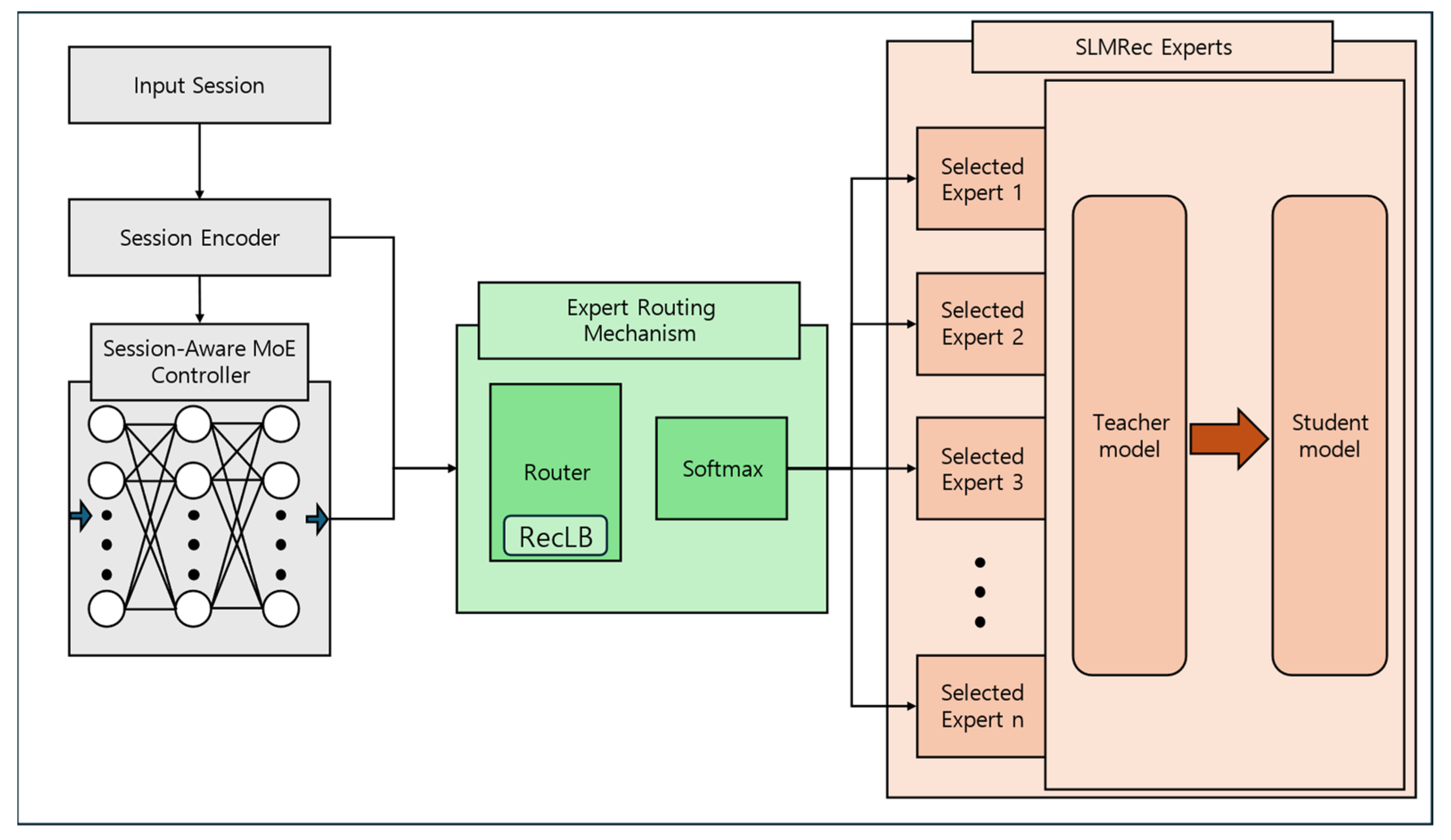
The MoE-SLMRec model proposed in this study is designed to improve overall recommendation accuracy by balancing Head and Tail items while maintaining the capacity expansion capabilities of the Mixture-of-Experts (MoE) architecture within a session-based recommendation environment. The proposed model distinguishes itself from conventional single-path recommendation models or naïve MoE applications. Specifically, by performing expert routing based on session-level contextual information, it effectively mitigates performance bias toward specific data domains or high-frequency patterns. The overall architecture is illustrated in
Figure 1.
As shown in
Figure 1, the MoE-SLMRec architecture consists of three primary components: the Session-aware MoE Controller, the Set of Expert Networks, and the Expert Routing Mechanism.
The Session-aware MoE Controller takes the interaction sequence within a user session as input and generates a latent representation that summarizes the context of the current session. This representation serves as the core control signal for selecting the experts to be activated. By handling decision-making at the session level, the controller enables consistent, non-fragmented expert selection, even in environments characterized by short interactions and sparse feedback.
This automated routing strategy is also consistent with recent studies highlighting the importance of automated decision-making mechanisms in complex data-driven industrial systems. In practical deployment environments, manually designed or static configurations often struggle to adapt to highly dynamic and high-dimensional user behavior patterns. Automated approaches, such as those explored in AutoML-based system [
37] design, reduce reliance on manual configuration and improve robustness by enabling models to adapt automatically to changing data characteristics. Similarly, the proposed session-aware controller performs automatic expert routing decisions based on session context, allowing the model to dynamically adjust expert utilization without requiring manual intervention or fixed routing strategies, thereby facilitating scalable deployment in real-world recommendation services.
The Set of Expert Networks comprises multiple networks trained to adapt to diverse user behavioral patterns and item distributions. While each expert shares the same input structure, the training process induces natural Specialization toward different data characteristics. This ensures that the expansion of expressiveness provided by the MoE structure translates into substantial performance gains by capturing various interaction features, rather than mere parameter scaling.
The Expert Routing Mechanism receives the session representation from the controller to select active experts and assign weights. Instead of token-level routing, our model adopts a session-unit routing strategy and incorporates an internal RecLB (Recommendation Load-Balancing) module to prevent Routing Collapse (over-concentration on specific experts). This mechanism facilitates more stable and generalized predictive characteristics across the entire data distribution.
The final recommendation score is obtained by aggregating the outputs of the selected experts using a routing-weighted combination. Knowledge distillation, when employed, is applied during the backbone training stage to obtain an efficient session encoder, and no additional teacher–student distillation objective is used in MoE-SLMRec training. The ultimate goal is to achieve generalization centered on holistic performance—carefully managing the trade-off between Head and Tail items—rather than localized optimization for specific data segments.
The detailed procedure for MoE-SLMRec is presented in Algorithm 1. As an extension that integrates MoE into the SLMRec framework, MoE-SLMRec maintains the fundamental architecture of the original SLMRec while enhancing its representational flexibility.
| Algorithm 1. MoE-SLMRec |
| Input S, , k, λ1, λ2 |
Output Θ- 1.
Def Moe-SLMRec(S, ): - 2.
←SLMRec.SessionEncoder.Pool(S) - 3.
, T ← MoEController() - 4.
← Softmax(/T) - 5.
Idx, ’← TopK(, k); ← Renorm() - 6.
= - 7.
logits ← SLMRec.OutputHead( - 8.
← CE(logits, ) + () + (T)
|
The parameters for this are shown in
Table 2.
The proposed algorithm preserves the overall architecture of the original SLMRec while replacing the Feed-Forward Network (FFN) layers with a Mixture-of-Experts (MoE) structure, enabling adaptive expert selection based on session context.
First, in Line 2, a batch-level set of sessions S is transformed into a session-level embedding h through the session encoder and pooling operation employed in SLMRec. This process is identical to that of the original SLMRec and aggregates item order and interaction information within each session into a compact representation.
Next, in Line 3, the MoE controller takes the session embedding h as input and predicts a temperature parameter T, which controls the sensitivity of expert selection, along with a logit adjustment vector z applied to the gating outputs. Through this mechanism, the expert selection distribution is dynamically adapted according to session characteristics.
In Line 4, the gating network computes selection scores for each expert based on the session embedding. A softmax operation is then applied to the temperature-scaled and logit-adjusted scores, producing the expert selection probability distribution . This distribution reflects the relative importance of each expert for the current session.
Subsequently, the Top-k experts with the highest probabilities in g are selected, and their corresponding weights are renormalized. This strategy enables the model to leverage a small subset of experts that are most relevant to the session while maintaining computational efficiency by avoiding activation of all experts.
In Line 5, the selected experts replace the FFN layer of the original SLMRec. The output of each expert is combined through a weighted linear aggregation using the renormalized weights , forming the MoE-based representation . This process enhances model expressiveness by allowing different combinations of experts to be activated across sessions.
Finally, in Line 7, the aggregated MoE representation hmoe is passed through the output head of SLMRec to produce next-item prediction scores, logits. During training, the final loss L is computed by jointly optimizing the standard cross-entropy loss for recommendation, a recommendation-aware load-balancing regularization term L_LB to mitigate excessive concentration of expert usage, and a temperature regularization term L_Temp to stabilize the learned temperature parameter.
MoE-SLMRec builds upon an SLMRec-style backbone. While backbone models can optionally be pretrained using distillation-based procedures, distillation is not part of the proposed MoE-SLMRec training objective. Instead, this work focuses on architectural modification through MoE-based expert routing, and the training objective includes only the standard recommendation loss and routing regularization.
3.3. Session-Aware MoE Controller
The session-aware MoE controller plays a central role in encoding an input user session into a latent representation space, summarizing the overall behavioral characteristics of the current session. Given an interaction sequence that constitutes a session, the proposed model learns a fixed-length session representation vector through a DNN-based encoder. This controller is designed to capture not only simple item frequency information, but also the sequential context and interaction patterns within the session in an integrated manner.
Specifically, each item interaction is first mapped to a low-dimensional embedding vector and aggregated through a multi-layer perceptron (MLP)-based encoder. Through nonlinear transformations, the encoder abstracts complex interaction relationships among items within the session and produces a d-dimensional latent session representation vector h. The encoder is implemented as a two-layer MLP with hidden dimension d, ReLU activation, and dropout rate p.
In session-based recommendation environments, interaction-level information is often sparse and highly volatile, making expert selection at the token level prone to unnecessary routing fluctuations. In particular, when sessions are short or user behavior is irregular, token-level routing may cause unstable expert activation patterns, hindering consistent expert specialization. In contrast, the latent session representation , which aggregates the entire sequence of interactions within a session, provides a more stable summary of overall behavioral patterns, contextual signals, and interaction complexity. Routing decisions based on this aggregated session representation therefore reflect session-level intent rather than momentary interaction variations, leading to more stable and consistent expert selection. Furthermore, since sessions differ in length, behavioral diversity, and item frequency distribution, session-level routing naturally enables experts to specialize in different session characteristics. For these reasons, we adopt the session-level latent representation , rather than interaction-level representations, as the routing input, since it provides a more suitable and stable basis for expert selection in session-based recommendation settings.
Considering the strict inference latency constraints in real-world recommendation services, this study adopts a shallow DNN architecture with limited depth for the controller encoder. This design choice prevents session representation learning from becoming a computational bottleneck in the overall recommendation pipeline, while keeping the computational overhead manageable within the overall recommendation pipeline.
In addition, the controller focuses exclusively on encoding session characteristics, while the actual expert activation decisions are deferred to the subsequent expert routing mechanism. This clear separation of responsibilities allows the proposed model to independently optimize session representation learning and expert selection. As a result, the model achieves more stable and precise expert routing even in environments characterized by short interaction sequences and sparse feedback.
After obtaining the session representation , the controller produces two outputs used for expert routing: an expert logit adjustment vector and a temperature parameter . The vector modulates expert preference scores, while the temperature parameter controls the sharpness of the routing distribution when computing gating weights via softmax normalization.
To maintain routing stability, the predicted temperature is constrained within a predefined valid range so that excessively small temperature values do not cause expert over-concentration. Specifically, temperature values are bounded using a scaled sigmoid function to ensure they remain within this predefined range. Furthermore, a temperature regularization loss is introduced during training to discourage unstable routing behavior and maintain balanced expert utilization. This design ensures that expert routing remains stable while preserving sufficient flexibility for session-adaptive specialization.
3.4. Expert Networks
The expert networks constitute a core component of the Mixture-of-Experts (MoE) architecture and consist of a set of expert models {} designed to capture diverse user behavior patterns and item distributions. Rather than introducing novel expert architectures, the proposed model adopts a standard expert design and focuses primarily on the expert selection mechanism. This design choice avoids unnecessary increases in model complexity while effectively maximizing the representational benefits of the MoE framework.
Each expert is implemented as a Feed-Forward Network (FFN) with an identical architecture and receives the session representation h produced by the session-aware MoE controller as input. During training, the experts are encouraged to naturally adapt to different session types and data characteristics. This enables the model to distribute learning across experts, capturing not only frequently observed patterns associated with popular (Head) items but also a diverse range of interaction characteristics present in the data.
Importantly, functional specialization among experts is not explicitly predefined. All experts are trained under the same optimization objective, and their roles emerge in a data-driven manner through the interaction between the session-aware controller and the expert routing mechanism. This design prevents experts from being rigidly assigned to predetermined data regions and allows their functional roles to flexibly evolve in accordance with the observed session distribution during training.
Furthermore, instead of activating all experts simultaneously, the proposed model aggregates the outputs of only the Top-k experts selected by the routing mechanism to produce the final recommendation scores. This strategy ensures computational efficiency while providing expanded representational capacity compared to single-model architectures.
3.5. Expert Routing Mechanism
The expert routing mechanism determines the activation strength of each expert based on the session representation h provided by the session-aware MoE controller. Instead of adopting fine-grained routing at the token or item level, this study employs a session-level routing strategy, which enables more consistent expert selection even in environments characterized by short sessions and sparse feedback. This design mitigates unnecessary fluctuations in expert selection within the same session and promotes stable functional specialization among experts.
Specifically, given the session representation vector h generated by the session-aware controller, the routing function computes a probability distribution
over all experts, where
N denotes the total number of experts. The routing (gate) scores are defined as follows:
where
and
are learnable parameters, and
T is a temperature parameter that controls the smoothness of the routing distribution. The resulting weights
indicate the relative contribution of each expert to the final prediction.
For computational efficiency, only the Top-K experts with the highest routing probabilities in are selected to form an index set I. The corresponding routing weights are then renormalized to obtain , ensuring that the selected weights sum to one.
The final MoE-based representation
is computed as a weighted sum of the outputs of the selected experts, as follows:
This Top-K sparse activation strategy allows the model to effectively exploit the representational capacity of the MoE architecture without activating all experts simultaneously.
3.6. RecLB (Recommendation Load Balancing)
In session-based MoE recommendation systems, imbalanced expert selection can lead to a routing collapse phenomenon, where traffic becomes excessively concentrated on a small subset of experts. This issue is particularly pronounced during the early stages of training, where certain experts may monopolize high-frequency (Head) sessions. As a result, other experts receive limited learning signals, which distorts expert specialization and degrades overall model robustness. To mitigate this issue, we introduce RecLB (Recommendation Load Balancing Loss), a recommendation-aware regularization term that explicitly accounts for the data distribution characteristics of recommendation systems.
RecLB begins by defining the expert usage distribution. Let B denote the batch size and
N the total number of experts. For a session
, let
denote the gating probability that expert e is selected. The average usage (importance) of expert e over a batch, denoted as
, is calculated as:
This quantity represents the proportion of overall session traffic assigned to expert
e. To alleviate basic expert collapse, RecLB introduces a usage balancing term that penalizes only extreme concentration in expert usage, defined as:
This term does not aim to enforce uniform expert utilization, but instead applies regularization only when a particular expert becomes excessively dominant.
However, recommendation data inherently follows a long-tail distribution, making simple usage balancing insufficient to address concentration on popular sessions. To account for this, we define a popularity-based weight
for each session
, derived from the popularity of its ground-truth item. Using this weight, the popularity-weighted expert usage
is computed as:
Based on this quantity, the popularity-aware balancing term is defined as:
This term suppresses scenarios in which a small number of experts disproportionately process popular (Head) sessions, encouraging Head traffic to be distributed across multiple experts. As a consequence, Tail sessions and items gain increased opportunities to be processed by diverse experts.
In addition, to promote diversity in expert routing paths, we introduce a traffic diversity term that maximizes the entropy of the expert usage distribution:
This entropy-based regularization increases routing diversity, thereby improving the likelihood that Tail sessions and Tail items are handled by multiple experts. Since corresponds to the entropy of expert utilization, the final objective is formulated such that minimizing the total loss encourages higher entropy, thereby preventing expert over-concentration.
Finally, the overall RecLB loss is defined as a weighted combination of the three components:
where
α,
β, and
γ are hyperparameters controlling the contribution of each term. The negative sign before the entropy term explicitly ensures that minimizing the overall loss promotes higher routing entropy, preventing routing collapse caused by expert over-concentration. Through this design, RecLB effectively mitigates early-stage Head expert lock-in without forcibly constraining expert usage to a uniform 1/N distribution. As a result, the proposed approach preserves the representational capacity of the MoE architecture while maintaining a balanced Head–Tail trade-off aligned with recommendation data characteristics. In all experiments, the coefficients are set to
α = 1.0,
β = 1.0, and
γ = 0.1. This formulation removes ambiguity in the optimization direction of the entropy term and prevents unintended expert concentration during implementation.
4. Experimental Results
4.1. Dataset
In this study, experiments were conducted using the Yoochoose dataset from the RecSys Challenge 2015 [
38]. Yoochoose is a representative benchmark dataset for session-based recommendation, consisting of user click logs collected from an e-commerce platform. The dataset is defined solely by item click sequences within individual sessions, without explicit user identifiers. As a result, sessions are relatively short, and the data exhibits a high degree of sparsity, which makes the recommendation task particularly challenging.
The Yoochoose dataset reflects real-world service environments and exhibits an extremely imbalanced long-tail distribution in item popularity. A small number of popular items account for the majority of clicks, while most items are observed only infrequently. Consequently, popularity bias and performance degradation on Tail items have been recognized as central challenges in recommendation system research using this dataset.
In our experiments, the raw click logs were first sorted by session identifier and timestamp, and sessions containing fewer than two interactions were removed. The remaining sessions were then transformed into item sequences of maximum length T (T = 20 in our experiments), and the task was formulated as a next-item prediction problem. The last item in each session was treated as the prediction target (label), while the preceding sequence was used as the model input. For sessions longer than T + 1 interactions, only the most recent interactions were retained to construct training samples. The column structure of the preprocessed dataset is summarized in
Table 3. The resulting samples were randomly divided into training, validation, and test sets using an 80/10/10 ratio with a fixed random seed to ensure reproducibility, and item popularity statistics were computed using only the training set.
To facilitate a detailed long-tail analysis and examine the generalization characteristics of the model with respect to item popularity, we partition the entire item set into Head and Tail items. First, item popularity is defined based on the occurrence frequency of each item in the training data. Specifically, the popularity of item i, denoted as
Pop(i), is computed as follows:
where
S denotes the set of all sessions in the training set, and
is an indicator function that returns 1 if the condition holds and 0 otherwise.
After computing item frequencies, all items are sorted in descending order of popularity. The top r = 20% of items are defined as Head items, while the remaining 80% are categorized as Tail items. This partitioning strategy enables a clear distinction between a small subset of highly popular items that account for the majority of click events and a large number of infrequently observed items. As a result, it allows for a quantitative analysis of popularity bias mitigation and region-wise generalization performance of the proposed model. The threshold r = 20% follows common practice in long-tail recommendation studies and provides a balanced trade-off between coverage and interpretability.
4.2. Implementation Details
All models were trained under identical preprocessing and training configurations to ensure fair comparison. The session dataset was preprocessed and stored in NPZ format for efficient loading, where sessions were converted into fixed-length sequences and randomly split into training, validation, and test sets using an 80/10/10 ratio with a fixed random seed.
Training was conducted using the Adam optimizer with a learning rate of and a batch size of 256 for up to 100 epochs. Model selection was performed based on validation performance, and the checkpoint achieving the best combined Recall@20 and MRR@20 score was used for final evaluation. All methods were evaluated using Top-20 ranking metrics.
Next-item prediction was trained using cross-entropy loss over all candidate items. When load-balancing regularization was enabled, an auxiliary load-balancing loss term was added with a weighting coefficient of 0.01. Hyperparameters shared across models were tuned using the same validation protocol, while parameters specific to the MoE architecture, such as the number of experts and routing configuration, were tuned only within the proposed model framework.
This unified training protocol ensures that performance differences arise from architectural improvements rather than discrepancies in training configurations.
4.3. Model Performance Evaluation
In this section, we analyze the performance of the proposed MoE-SLMRec by comparing it with the baseline SLMRec model and several state-of-the-art (SOTA) recommendation models. All experiments were conducted under identical data preprocessing procedures and training configurations to ensure fair comparisons. The primary differences among the models lie in whether the Feed-Forward Network (FFN) within the Transformer blocks is replaced by a Mixture-of-Experts (MoE) structure and whether the proposed recommendation-aware load-balancing regularization (RecLB) is applied.
Performance comparisons were conducted not only in terms of overall recommendation quality but also with respect to item frequency, considering both Head and Tail item segments. The evaluation metrics used in this study are summarized in
Table 4.
Specifically, recommendation performance was evaluated using Overall Accuracy, Head Accuracy, Tail Accuracy, Recall@20 (R@20), and Mean Reciprocal Rank@20 (MRR@20). Recall@20 measures the probability that the item actually selected by the user appears within the top-20 recommended items, reflecting the coverage and correctness of the recommendation list. MRR@20 computes the average reciprocal rank of the ground-truth item within the top-20 recommendations, capturing how quickly a user can reach the desired item.
By jointly considering Overall Accuracy, Head Accuracy, Tail Accuracy, R@20, and MRR@20, we provide a comprehensive evaluation of model performance across both popularity segments and ranking quality. The quantitative results are reported in
Table 5.
MoE-SLMRec achieved an Overall Accuracy of 0.2027, representing an approximately 8.0% relative improvement over the baseline SLMRec (0.1876). It also consistently outperformed Transformer-based SASRec (0.1784) and RNN-based GRU4Rec (0.1601), demonstrating superior predictive accuracy across different model families. In particular, MoE-SLMRec achieved the highest scores on the Top-K ranking metrics, with Recall@20 of 0.8358 and MRR@20 of 0.3455. These results indicate that the proposed model not only improves the likelihood of including the correct item in the recommendation list, but also places it at higher ranks, thereby achieving superior ranking quality.
A segment-wise analysis based on item popularity reveals that the proposed model yields a substantial performance gain in the Head item region, improving accuracy from 0.1461 to 0.1888 compared to SLMRec. This improvement suggests that the MoE architecture effectively disentangles and models dominant behavioral patterns within sessions, leading to more accurate predictions for frequently occurring items.
In contrast, a performance degradation is observed in the Tail item region, where accuracy decreases from 0.3137 to 0.2449 relative to SLMRec. This phenomenon can be interpreted as a structural generalization trade-off arising from the representational expansion of the MoE architecture, where optimization toward high-frequency patterns is prioritized. Similar tendencies are also observed in other models such as SASRec, reaffirming that accurate prediction of sparse items remains a fundamental challenge in session-based recommendation.
To improve interpretability of the Head–Tail performance comparison, we additionally report the number of test instances in each segment together with segment-wise ranking metrics and their 95% confidence intervals, as summarized in
Table 6.
To provide a finer-grained analysis of performance across item popularity, we further conduct evaluation based on item-frequency deciles. Following the Pareto principle, which commonly characterizes recommendation logs where a small portion of popular items accounts for a large share of interactions, items are first sorted according to training interaction frequency and then partitioned into ten equally sized groups.
For readability, we summarize the decile-level results by grouping them into Head (Deciles 1–3), Middle (Deciles 4–7), and Tail (Deciles 8–10) segments, as shown in
Table 7. The results indicate that MoE-SLMRec achieves clear improvements in high-frequency item groups while maintaining competitive performance in lower-frequency segments. This decile-based analysis provides additional quantitative evidence that the proposed routing and load-balancing mechanism reallocates model capacity across popularity regions rather than uniformly optimizing a single segment, supporting the balanced generalization claim.
For further comparison with a modern Transformer-based session recommendation baseline, we additionally evaluated BERT4Rec under the same experimental protocol. BERT4Rec achieved an Overall Accuracy of 0.1915, which surpasses both GRU4Rec (0.1601) and SASRec (0.1784) while remaining slightly below MoE-SLMRec (0.2027). In terms of ranking quality, BERT4Rec obtained Recall@20 of 0.8040 and MRR@20 of 0.3220, demonstrating competitive ranking capability among Transformer-based session models, although still lower than MoE-SLMRec, which achieved 0.8358 and 0.3455, respectively.
A segment-wise analysis further reveals differences in generalization behavior across item popularity groups. BERT4Rec achieves a relatively high accuracy of 0.2050 in the Head region, exceeding both SLMRec (0.1461) and MoE-SLMRec (0.1888), indicating that bidirectional contextual modeling effectively captures dominant behavioral patterns associated with popular items. However, performance in the Tail region drops to 0.1450, significantly below SLMRec (0.3137) and MoE-SLMRec (0.2449). This observation suggests that while Transformer-based contextual modeling strengthens predictions for frequent interaction patterns, it still struggles to generalize effectively to sparse items.
In contrast, MoE-SLMRec achieves a more balanced outcome by improving overall recommendation accuracy while preserving substantially stronger Tail performance compared with BERT4Rec. These results indicate that performance gains obtained solely through Transformer-based sequence modeling do not fully resolve the Head–Tail generalization imbalance. Instead, the session-aware expert routing and RecLB regularization employed in MoE-SLMRec provide a practical mechanism for coordinating expert specialization, enabling improved overall recommendation utility while maintaining more robust performance across the item popularity spectrum.
Overall, the experimental results demonstrate that MoE-SLMRec does not aim to maximize performance in the Tail region in isolation but instead recalibrates the generalization boundary to maximize overall recommendation utility. Notably, the pronounced performance improvements in the Head region directly translate into gains in ranking-based metrics such as Recall and MRR, which are closely associated with user satisfaction in real-world service environments. Taken together, this study provides an empirical analysis of the performance imbalance introduced by MoE architectures and presents a practical approach for coordinating such trade-offs to improve overall recommendation quality.
To better understand the internal behavior behind these improvements, we further analyze the stability of the expert routing mechanism.
Table 8 summarizes expert utilization statistics for head and tail sessions, allowing us to verify that routing does not collapse into a small subset of experts. The results show that expert usage remains broadly distributed, with maximum expert selection shares remaining below 9% and entropy values close to the uniform baseline, indicating stable utilization across experts. In addition, the learned temperature values remain within a stable range (mean ≈ 0.51, minimum fixed at the enforced lower bound of 0.5), confirming that routing does not become overly sharp. These observations provide quantitative evidence that the proposed routing mechanism operates stably even under short and volatile session conditions.
4.4. Ablation Study
In this section, we conduct an ablation study to analyze the contribution of each component in the proposed MoE-SLMRec model to the overall recommendation performance. Using the baseline SLMRec as Ablation 1, we systematically evaluate performance variations by selectively enabling or disabling the session-aware controller, the Mixture-of-Experts (MoE) architecture, and the proposed RecLB regularization term. The results of these ablation experiments are summarized in
Table 9.
One of the most notable observations from the ablation results is the severe performance degradation observed when the session-aware controller is removed (Ablations 3 and 4). Replacing the Feed-Forward Network with a Mixture-of-Experts architecture without explicit control signals (Ablation 4), or introducing load-balancing without session-aware guidance (Ablation 3), leads to unstable and inconsistent performance gains, indicating routing inefficiency rather than effective expert specialization. In session-based recommendation settings characterized by short and volatile sequences, MoE routing without explicit guidance struggles to learn meaningful expert allocation.
In contrast, the proposed model integrating all components (Ablation 2) achieves consistent improvements across evaluation metrics. The session-aware controller stabilizes expert routing, while RecLB distributes expert utilization, enabling the increased representational capacity of MoE to translate into measurable recommendation gains. These results indicate that performance improvements arise from the interaction of components rather than isolated module effects.
Consistent with earlier experiments, Tail Accuracy remains highest in the single-path baseline SLMRec. However, the proposed model increases Head Accuracy by +0.0427 while reducing Tail Accuracy by −0.0688, reallocating capacity toward items contributing more to ranking quality. This trade-off ultimately improves overall ranking performance, with MRR@20 increasing by +0.0203. These results quantitatively support the claim that the proposed approach recalibrates generalization toward improved recommendation utility rather than merely amplifying popularity bias.
To further examine whether the observed Head–Tail performance difference depends on routing configuration, we evaluate the trained MoE-SLMRec model using different numbers of activated experts. As shown in
Table 10, increasing k leads to only marginal improvements in Tail performance while overall and Head performance remain largely unchanged. This indicates that activating more experts does not fundamentally remove the Head–Tail imbalance. Instead, the observed performance shift reflects an inherent capacity–specialization trade-off in MoE routing rather than a specific routing configuration.
In addition to accuracy analysis, we also report computational cost measurements comparing SLMRec and MoE-SLMRec under identical inference settings.
Table 11 summarizes parameter count, inference latency, throughput, and GPU memory consumption. The results show that inference latency increases monotonically with the number of activated experts k, confirming that computational cost is primarily governed by the number of active experts and reflecting the capacity–cost trade-off introduced by MoE routing.
As shown in
Table 11, inference latency increases monotonically with the number of activated experts k, confirming that computational cost is primarily governed by the number of active experts. This analysis provides a quantitative view of the capacity–cost trade-off introduced by MoE-based expert routing.
5. Conclusions
In this paper, we focus on the Head–Tail generalization imbalance that commonly arises in session-based recommendation settings and propose MoE-SLMRec, a session-aware Mixture-of-Experts (MoE) recommendation model designed to mitigate this issue. Due to the inherent characteristics of session-based recommendation—namely short interaction sequences and sparse feedback—models tend to over-adapt to high-frequency items and repetitive behavioral patterns. This tendency not only limits generalization across the entire data distribution but also poses challenges to the stability and long-term utility of recommendation systems.
Rather than framing this problem solely as a matter of improving Tail item performance, this study redefines it from a more practical perspective: how to strategically balance generalization characteristics between Head and Tail items based on overall recommendation utility. By adopting this viewpoint, we emphasize that meaningful performance gains in session-based recommendation settings require coordinated trade-offs across different popularity regions, rather than isolated optimization of specific segments.
The proposed MoE-SLMRec leverages session-level contextual information to guide expert selection, effectively adapting the representational advantages of MoE architectures to session-based recommendation environments. In particular, by adopting a session-level routing strategy instead of token- or item-level routing, the model maintains consistent expert selection even under short and volatile input sequences, thereby structurally mitigating routing collapse. Furthermore, the introduction of RecLB (Recommendation Load Balancing Loss) explicitly accounts for the long-tailed nature of recommendation data, suppressing excessive expert monopolization without forcibly enforcing uniform expert utilization.
Experimental results on the Yoochoose dataset demonstrate that MoE-SLMRec improves Overall Accuracy from 0.1876 to 0.2027, achieving an approximately 8.0% relative performance gain over the baseline SLMRec. Consistent improvements are also observed in ranking-based metrics such as Recall@20 and MRR@20, indicating that the proposed model not only increases the likelihood of retrieving the correct item but also ranks it more accurately within the recommendation list. Although a structural trade-off is observed in the Tail region due to the refined modeling of Head items, this behavior reflects a meaningful reallocation of generalization capacity toward overall recommendation quality as reflected by ranking-based metrics.
The key contribution of this work lies in its empirical analysis of the generalization behavior of MoE architectures in session-based recommendation from an item frequency perspective, and in proposing a practical architectural framework to regulate this behavior. The integration of a session-aware controller with recommendation-specific load-balancing regularization provides an effective design paradigm for future MoE-based recommendation systems under session-based recommendation environments characterized by popularity imbalance. While our evaluation was conducted on the Yoochoose benchmark, future work will extend experiments to additional public session-based datasets to further validate the generality of the observed head–tail trade-off patterns.
For future work, we plan to further enhance Tail item generalization by exploring adaptive MoE structures that dynamically adjust the number of active experts based on session characteristics, as well as hybrid expert designs incorporating external metadata and content features. In addition, we aim to evaluate the long-term impact of the proposed model through online experiments and extended user behavior analysis in practical session-based recommendation scenarios.