
A Novel Ambiguity Resolution Method for Array Signals via Wavefront Modulation

Abstract
1. Introduction
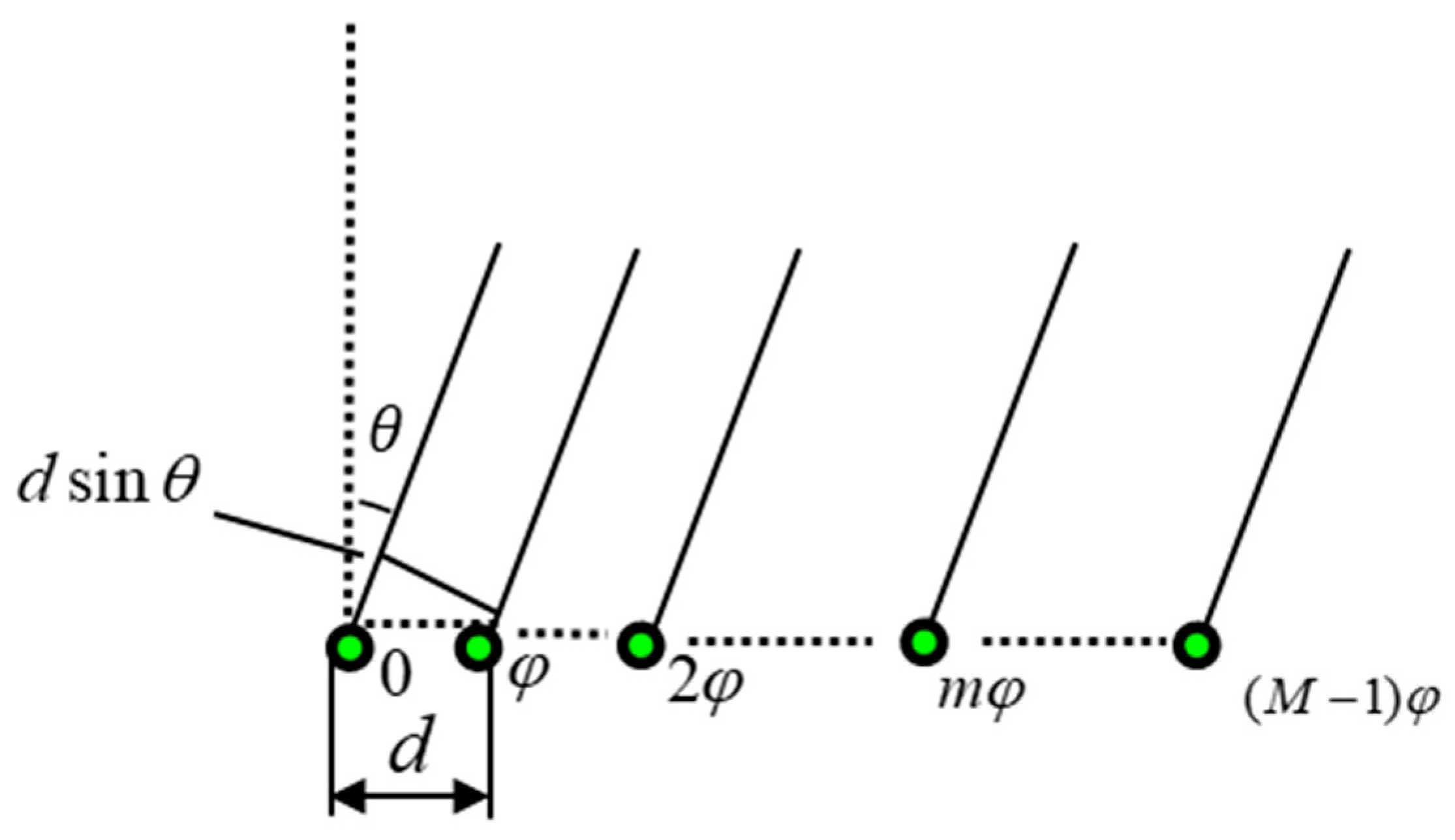
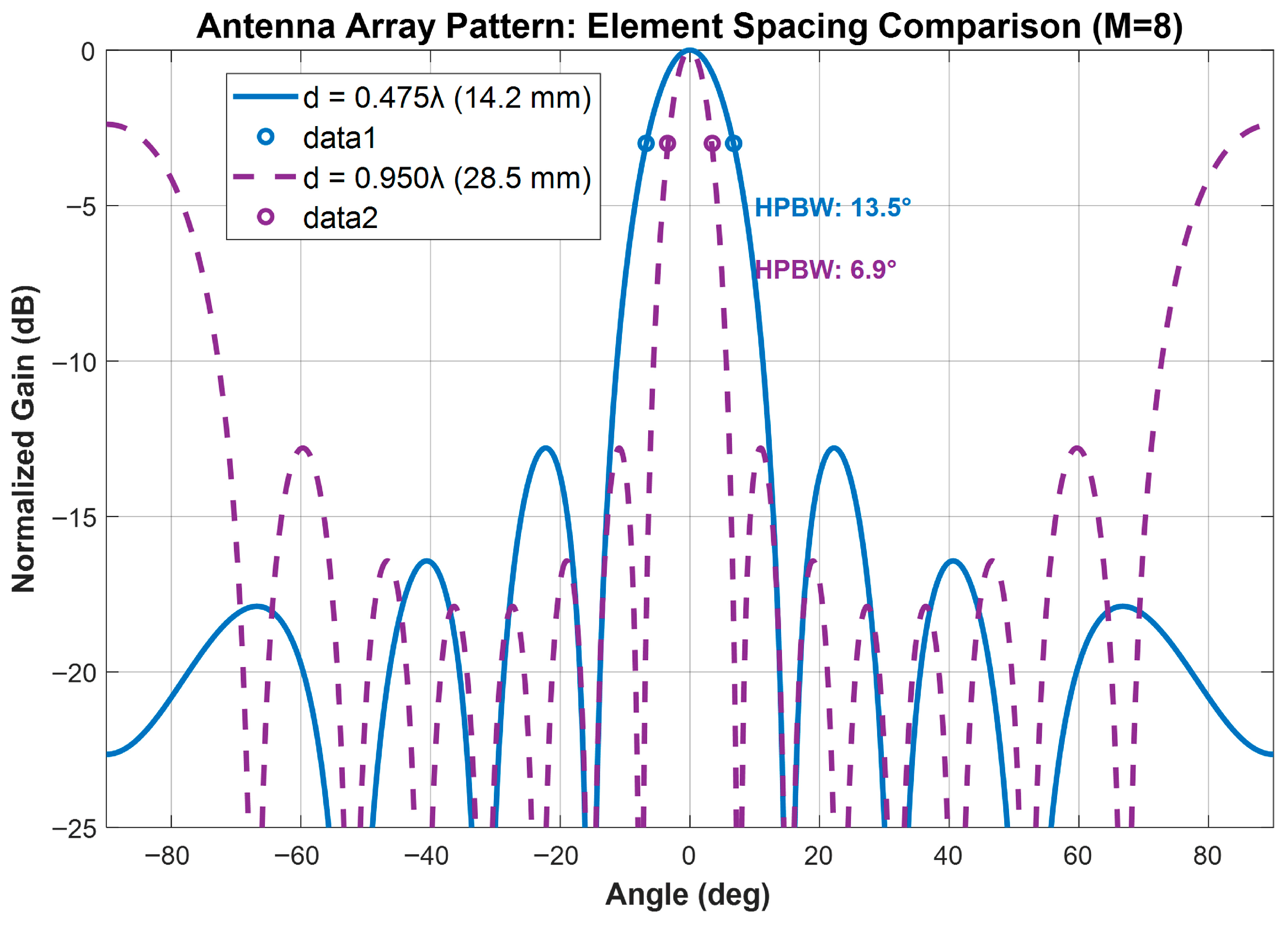
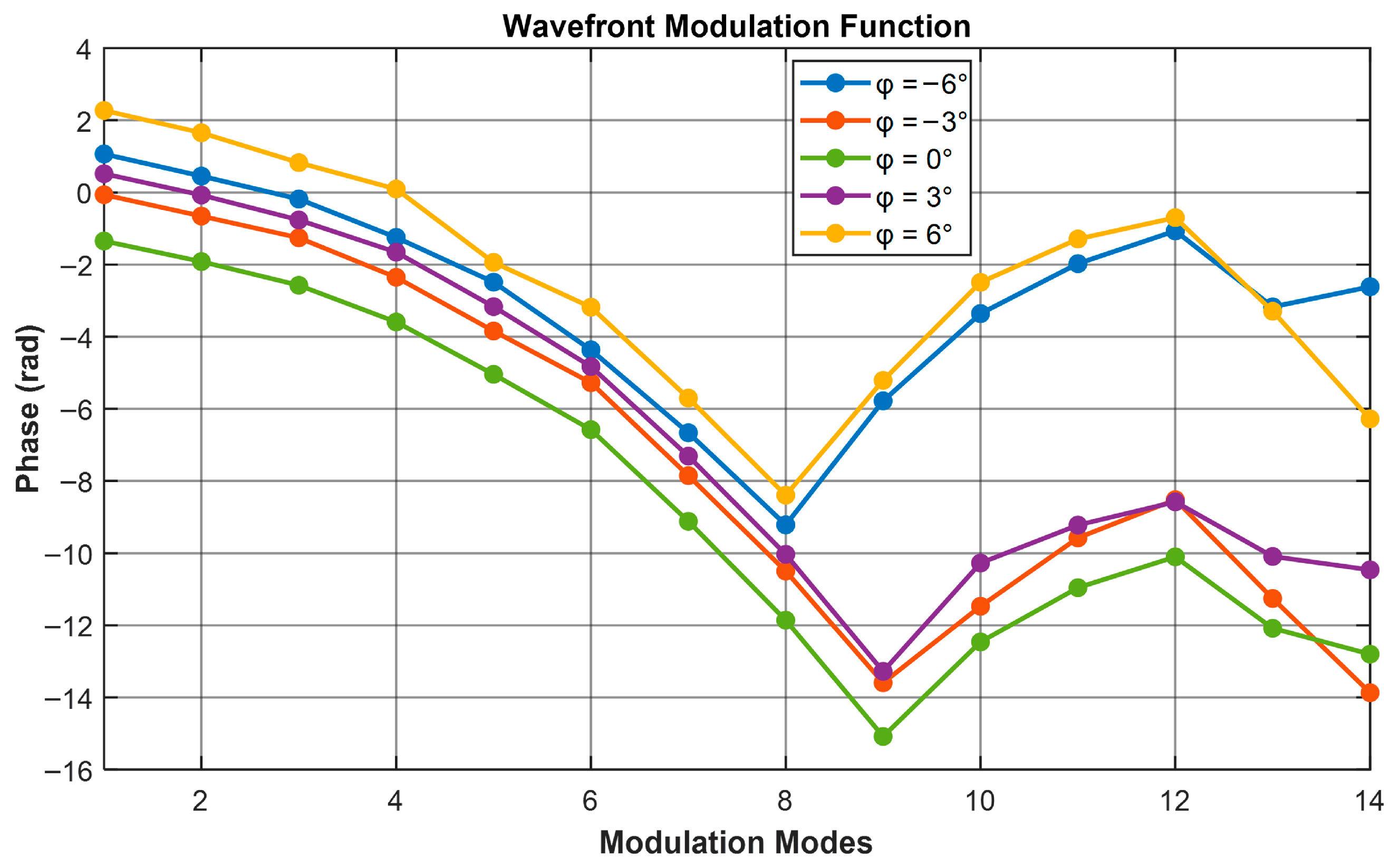
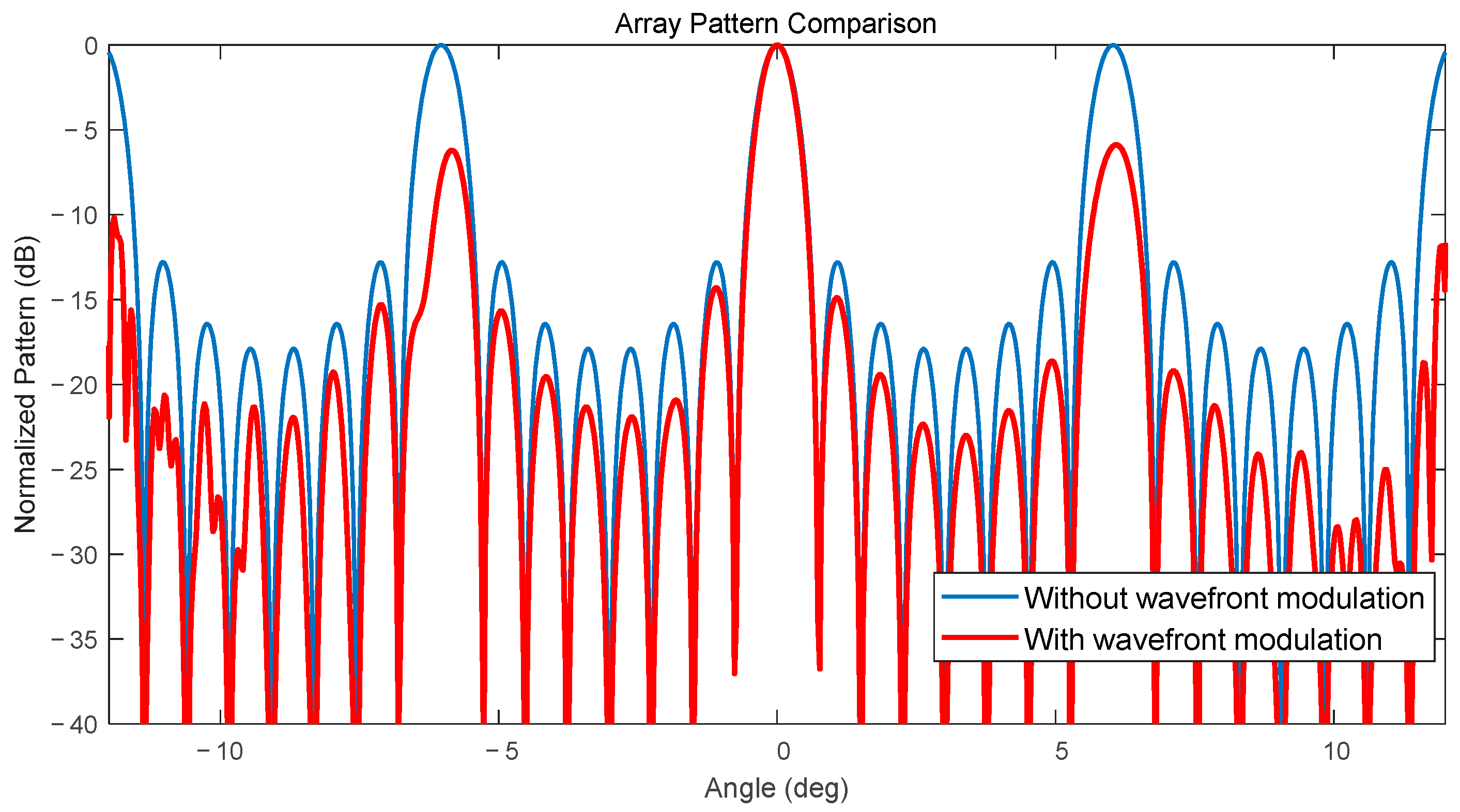
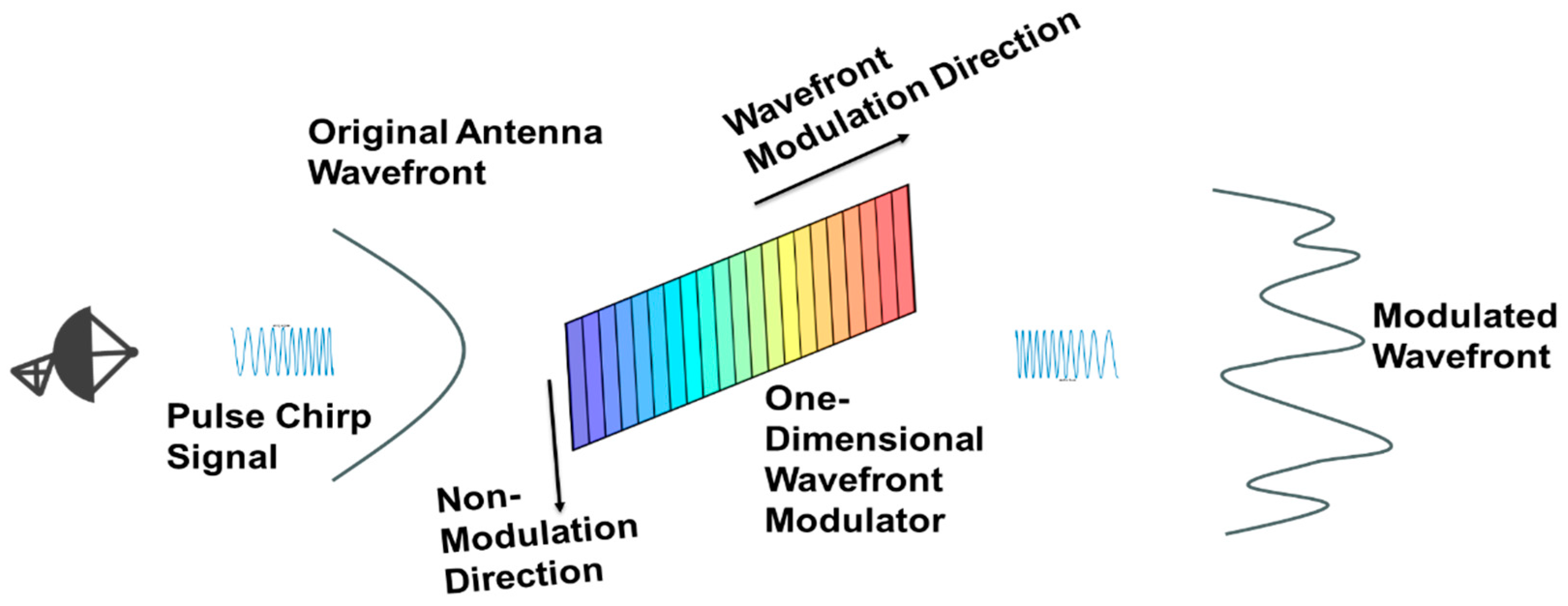
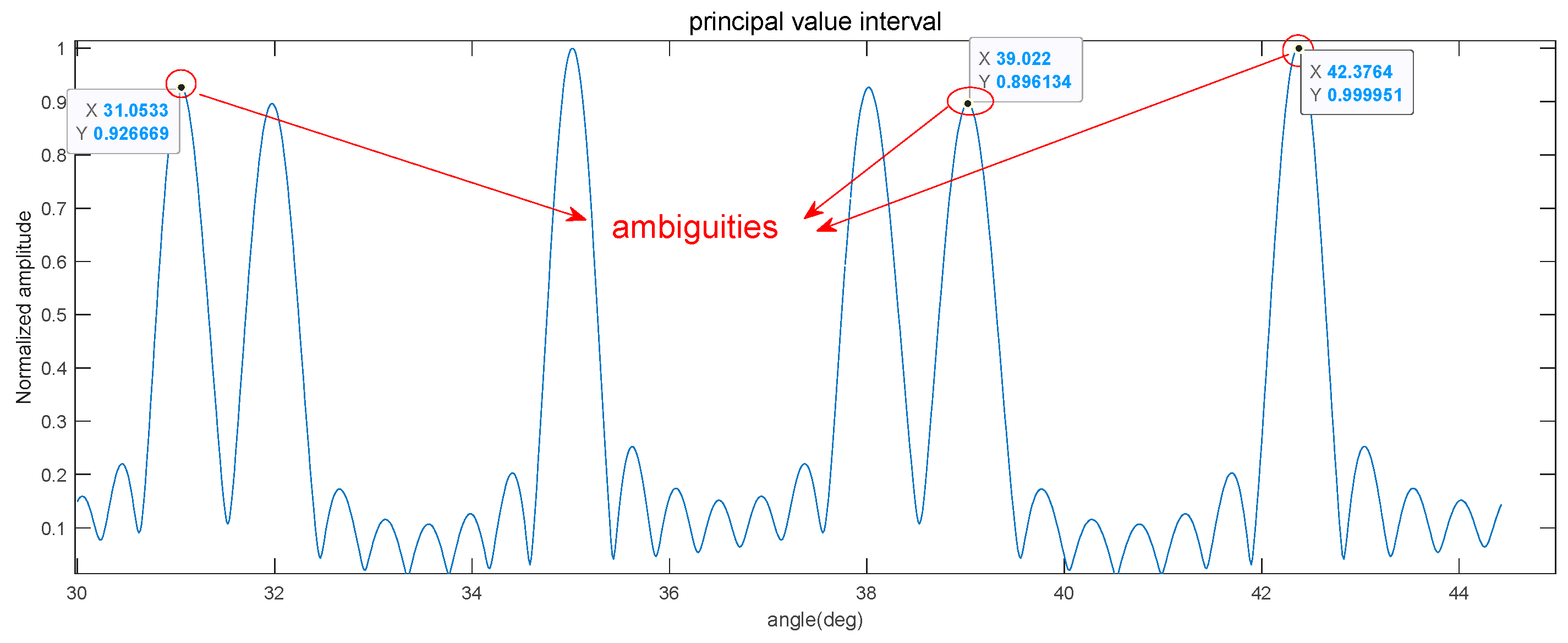
- For the first time, starting from the physical model of the maximum unambiguous height, this paper analyzes the inherent limitations imposed by the array antenna pattern. It innovatively achieves modulation of the array pattern through wavefront phase modulation, derives the equivalent antenna pattern model after wavefront modulation, and explains the principle by which wavefront modulation increases the theoretical maximum unambiguous height.
- This paper derives the echo model after introducing wavefront modulation. By analyzing the relationship between the scattering coefficient matrix and the wavefront phase modulation matrix, it presents the use of the OMP algorithm based on compressed sensing for reconstructing targets in the elevation direction.
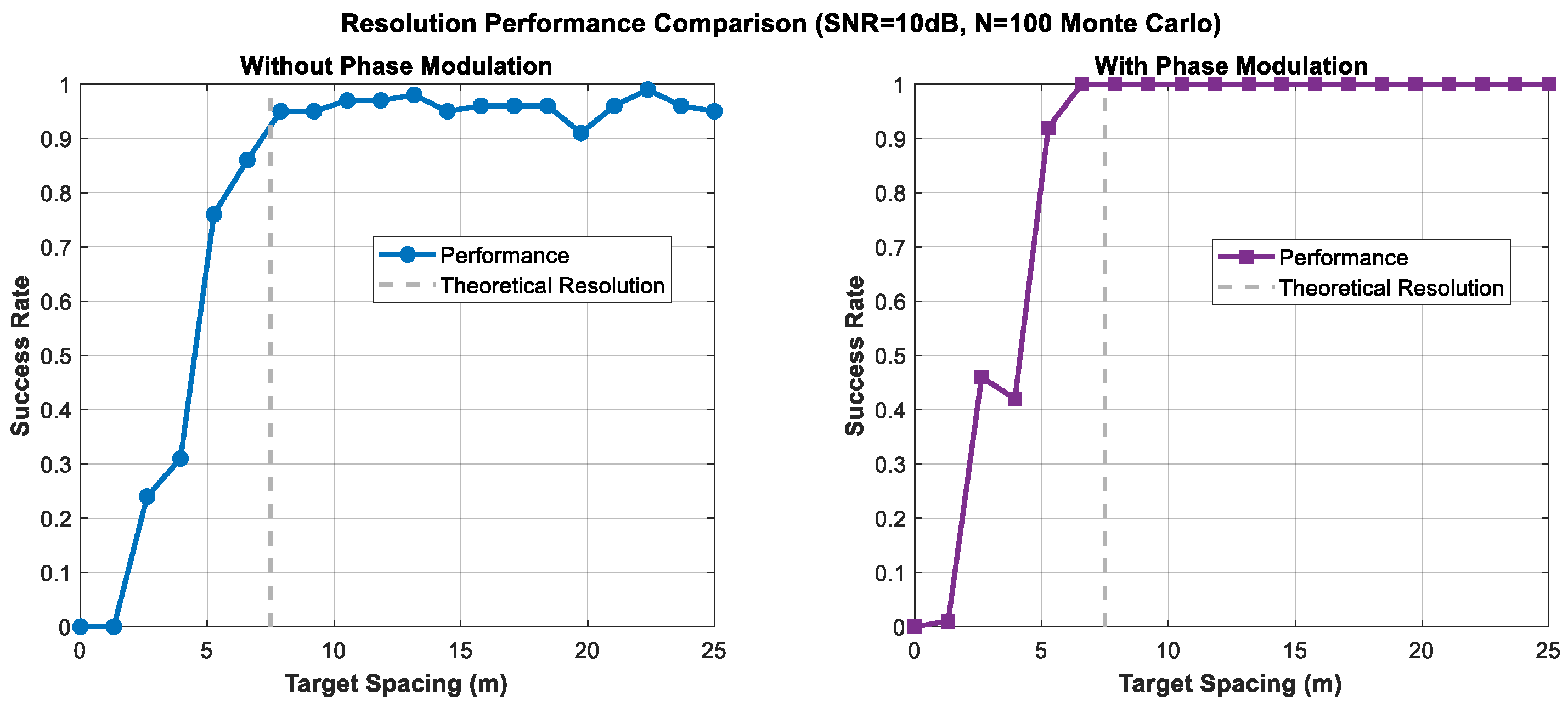
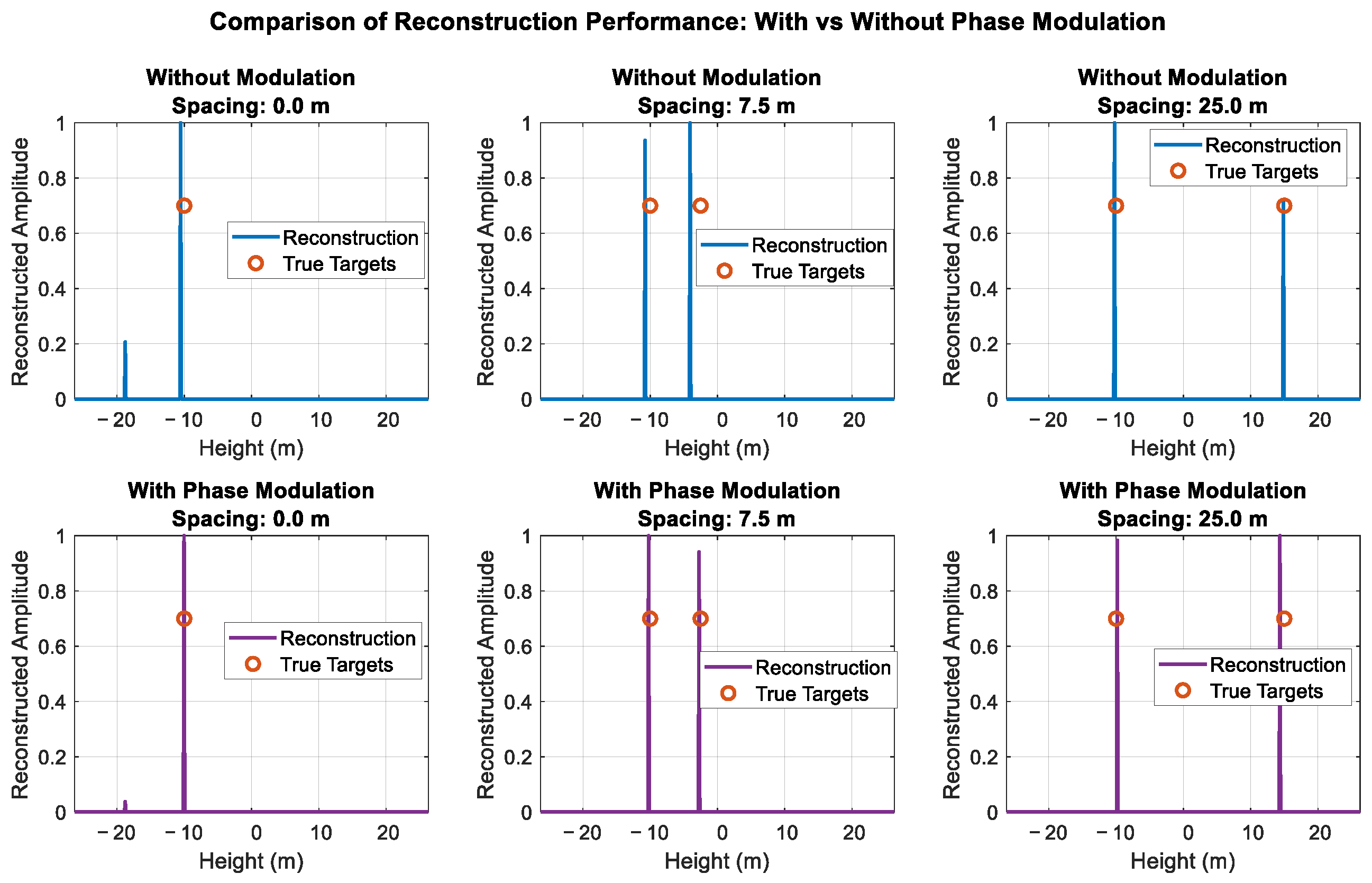
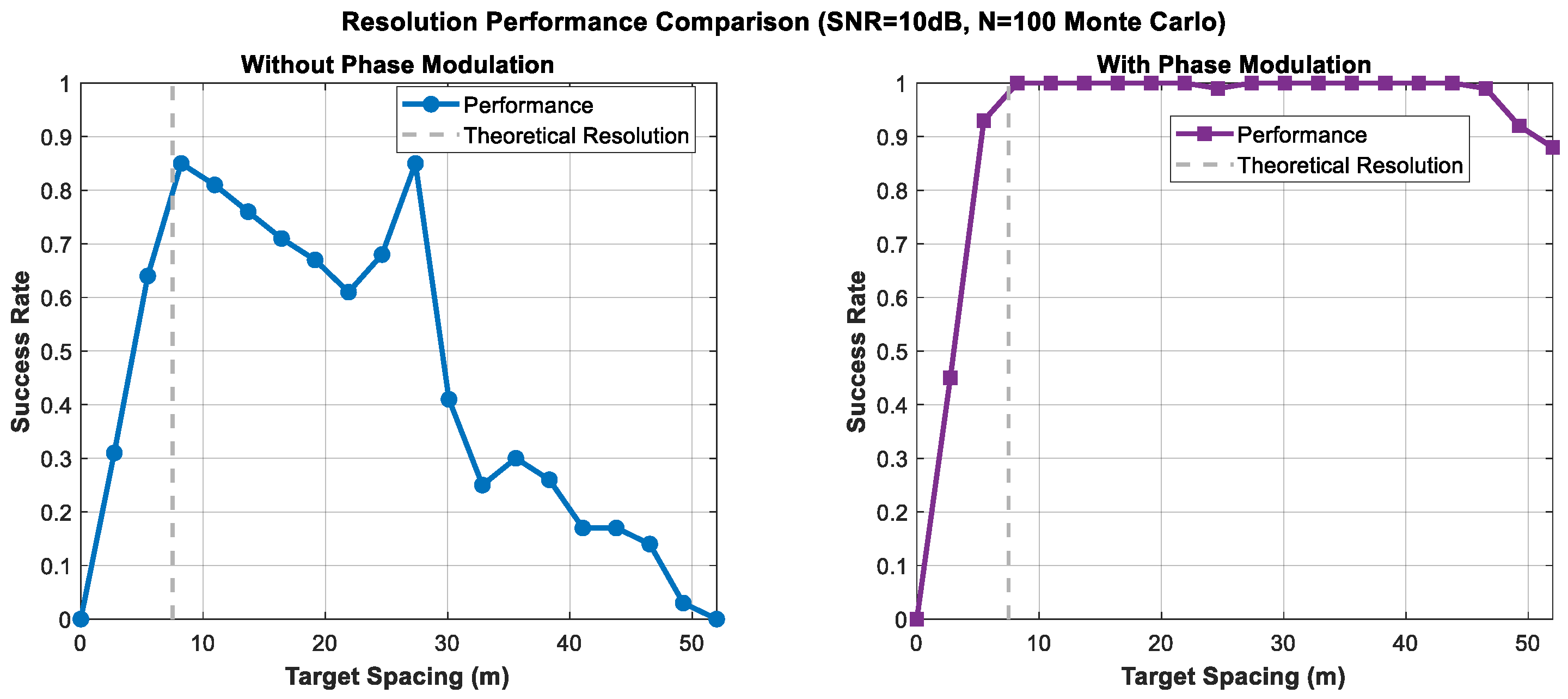
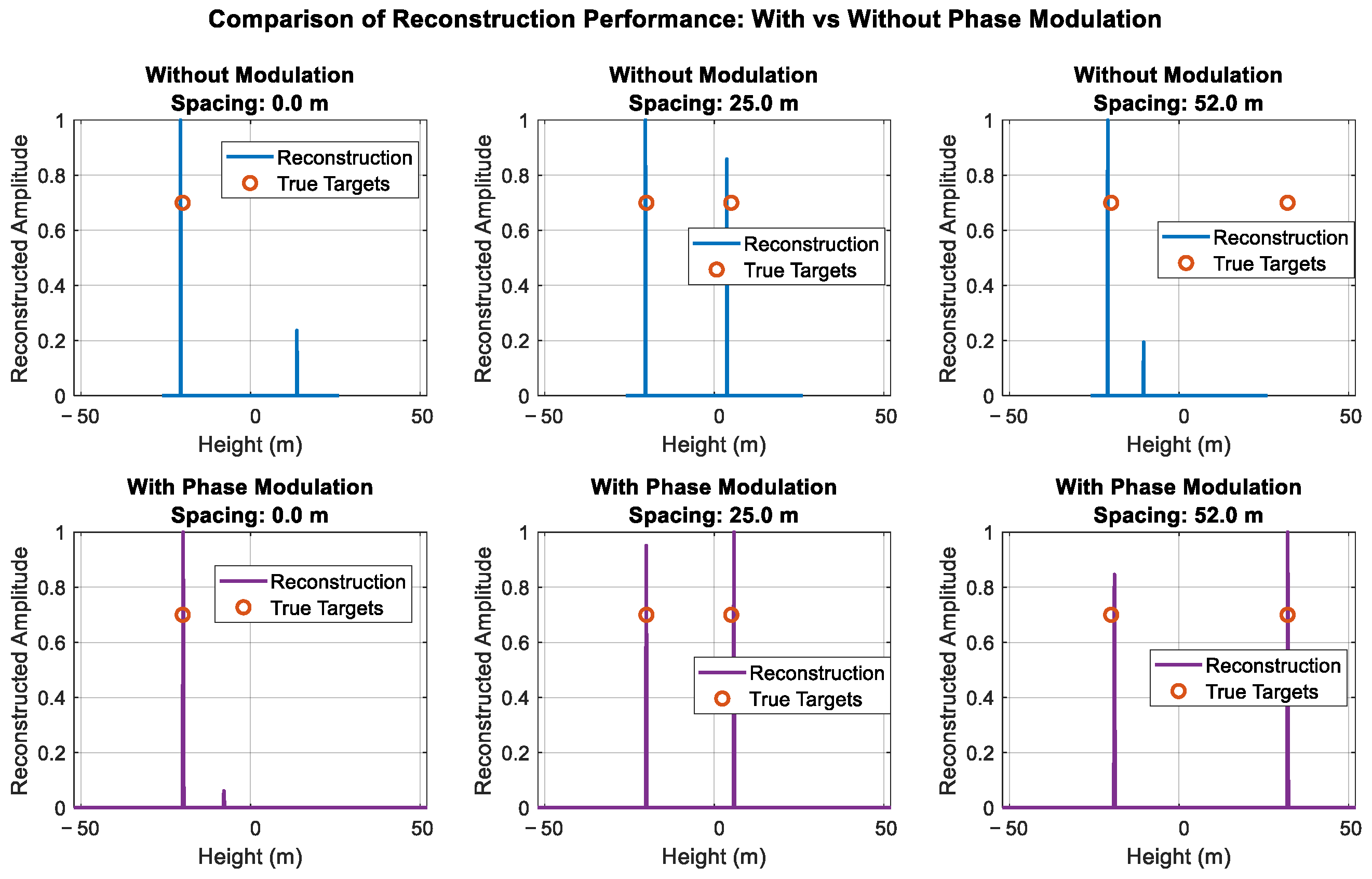
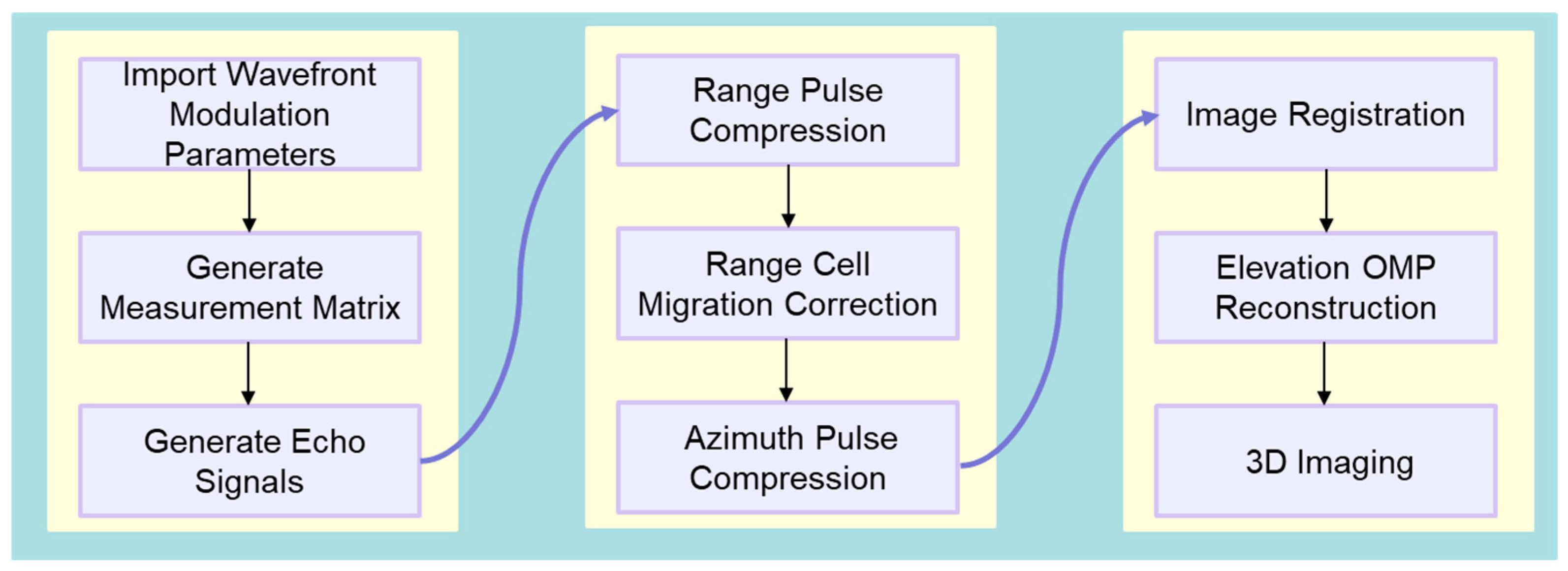
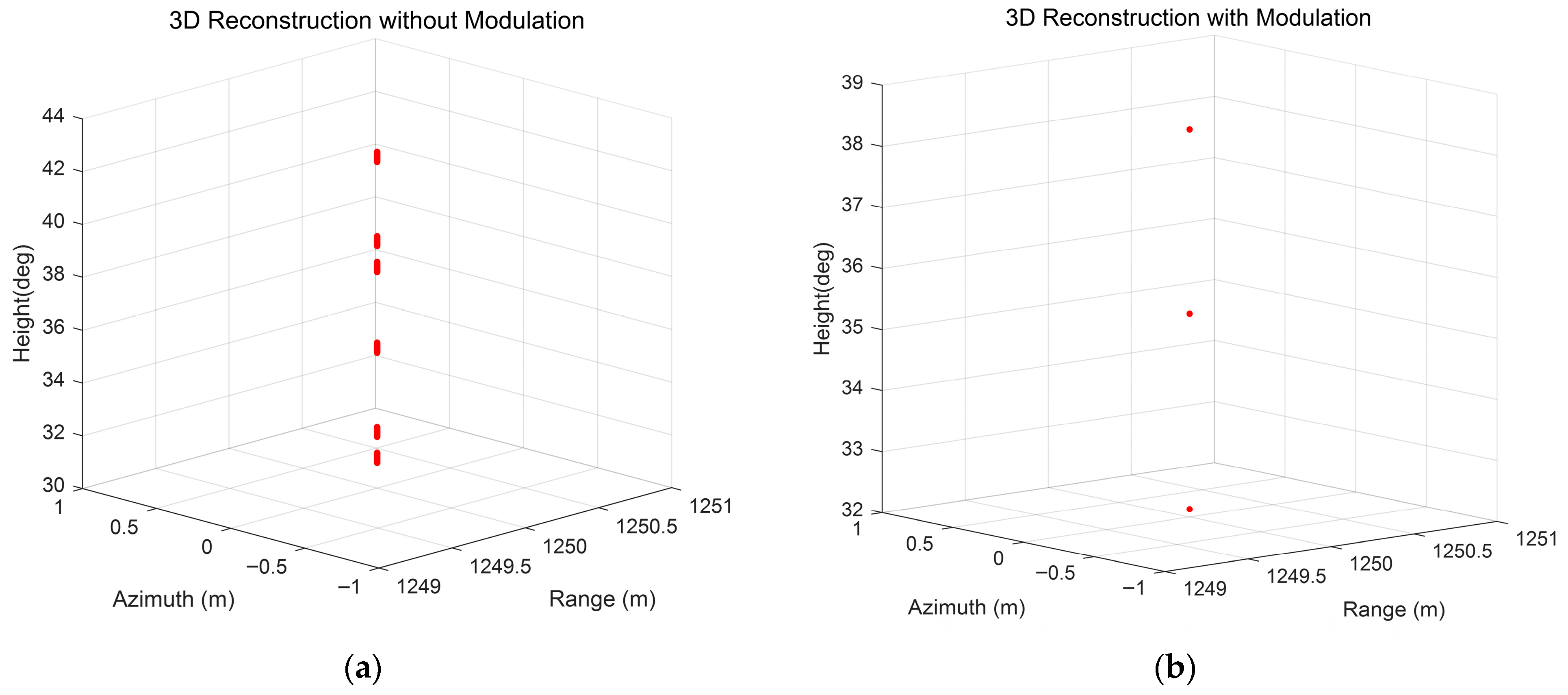
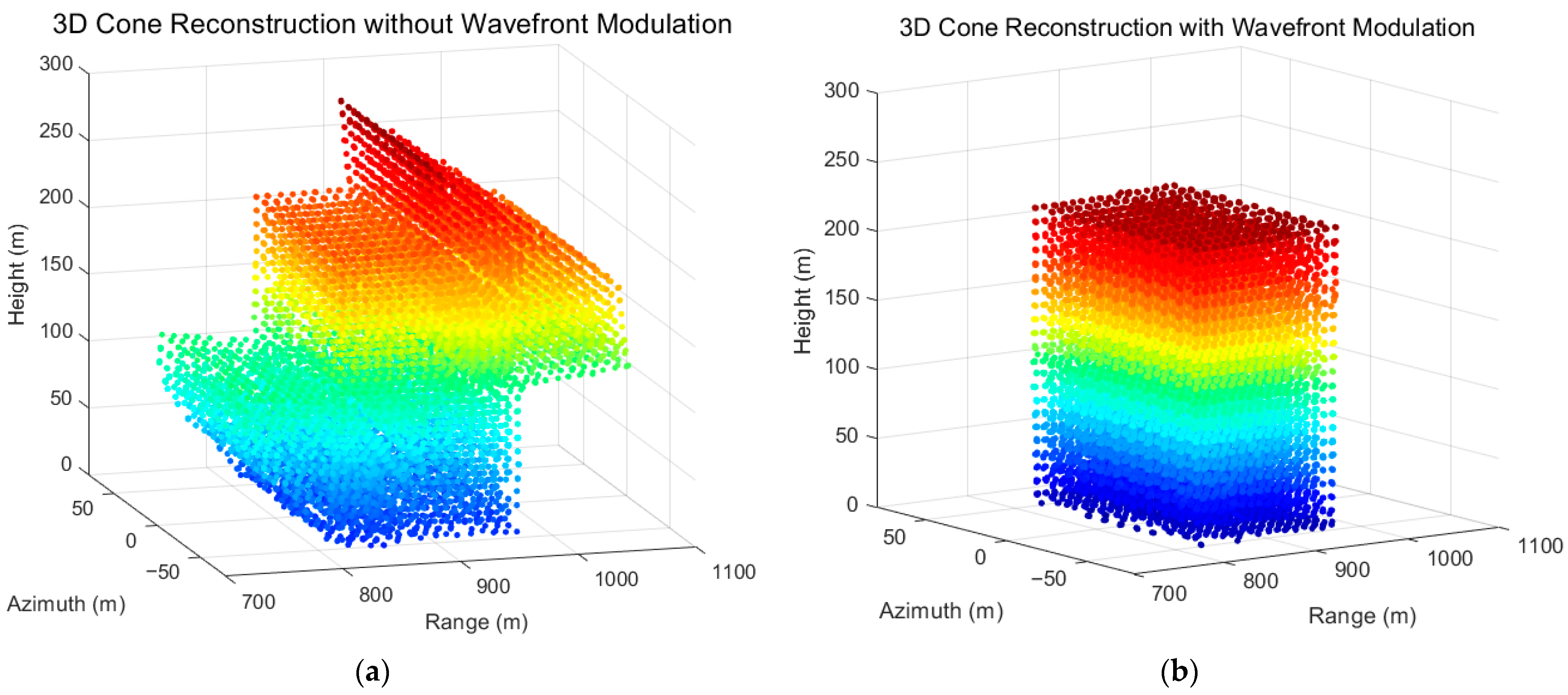
- This paper proposes a 3D reconstruction processing flow based on wavefront modulation. Experiment 1 simulates and analyzes the improvement in target reconstruction success rate and maximum unambiguous observation range in the elevation dimension after adding wavefront modulation. Experiment 2 performs 3D reconstruction incorporating wavefront modulation on point targets and volumetric targets. The generated point cloud results verify the enhancement capability of wavefront modulation on the maximum unambiguous height in the elevation direction, i.e., achieving ambiguity-resolving in the height dimension.
- The remainder of the article is organized as follows: Section 2 introduces the modulation model of wavefront modulation on the antenna pattern, used to explain the principle of wavefront modulation ambiguity-resolving it then introduces the echo model after wavefront modulation. Section 3 analyzes the sparsity characteristics of the echo signal after wavefront modulation and provides the solution workflow of the OMP algorithm based on compressed sensing. Section 4 introduces the relevant experimental parameter settings and presents and analyzes the experimental results. Section 5 summarizes the main content of this paper.
2. Wavefront Modulation Signal Model
2.1. Principle of Wavefront Modulation for Ambiguity-Resolving
2.2. Wavefront Modulation Echo Model
3. Method
3.1. Solution Method Selection
- High computational efficiency: The iterative process is simple, and for very sparse signals, the computation speed is fast.
- Conceptual intuitiveness: Each iteration identifies one target, making the physical meaning clear.
- Simple parameters: The main parameter is the number of iterations k (sparsity), which is easy to set and interpret.
3.2. OMP Algorithm Workflow
| Algorithm 1: OMP Algorithm Workflow. OMP_Algorithm (,,) |
| Input: , its column vector set is ,, , is the iteration count of the algorithm, which is determined by the sparsity of the signal. |
| Result: |
| Initialization: , |
| Normalize all columns of to unit norm |
| Remove duplicated columns in |
| For k = 1, 2, … do Step 1. Step 2. Step 3. Step 4. end |
4. Experiments and Results
4.1. Elevation Direction Target Reconstruction Realized by Wavefront Modulation
4.2. 3D Imaging Ambiguity-Resolving with Wavefront Modulation
5. Conclusions
Author Contributions
Funding
Data Availability Statement
Conflicts of Interest
References
- Ding, C.; Qiu, X.; Xu, F.; Liang, X.; Jiao, Z.; Zhang, F. Synthetic aperture radar three-dimensional imaging—From TomoSAR and array InSAR to microwave vision. J. Radars 2019, 8, 693–709. [Google Scholar]
- Zhu, X.X.; Bamler, R. Tomographic SAR inversion by L1-norm regularization—The compressive sensing approach. IEEE Trans. Geosci. Remote Sens. 2010, 48, 3839–3846. [Google Scholar] [CrossRef]
- Zhang, F.; Liang, X.; Cheng, R.; Wan, Y.; Chen, L.; Wu, Y. Building corner reflection in MIMO SAR tomography and compressive sensing-based corner reflection suppression. IEEE Geosci. Remote Sens. Lett. 2019, 17, 446–450. [Google Scholar]
- Zhang, F.; Yang, Y.; Chen, L.; Yang, L. Building 3D reconstruction of TomoSAR using multiple bounce scattering model. Electron. Lett. 2022, 58, 486–488. [Google Scholar] [CrossRef]
- Shi, M.; Chen, L.; Zhang, F.; Li, W.; Cui, C.; Liu, Y. Building point cloud reconstruction in TomoSAR based on deep learning semantic segmentation. Electron. Lett. 2024, 60, e13208. [Google Scholar] [CrossRef]
- Zhao, C.; Xiao, N.; Liu, H.; Shi, H.; Li, F. Research on the Ambiguity Problem in SAR Three-Dimensional Imaging. Radar Sci. Technol. 2025, 23, 298–312. [Google Scholar]
- Jacobs, E.; Ralston, E.W. Ambiguity Resolution in Interferometry. IEEE Trans. Aerosp. Electron. Syst. 1981, AES-17, 766–780. [Google Scholar] [CrossRef]
- Ming, X.; Wang, C.; Mao, X.; Li, Z.; Wu, J.; Yang, J. Distributed UAV-borne InSAR hybrid multi-baseline phase unwrapping and elevation inversion technology. J. Signal Process. 2024, 40, 1685–1695. [Google Scholar]
- Uemoto, J.; Nadai, A.; Kojima, S.; Kobayashi, T.; Umehara, T.; Matsuoka, T.; Uratsuka, S.; Satake, M. Extraction and height estimation of artificial vertical structures based on the wrapped interferometric phase difference within their layovers. ISPRS J. Photogramm. Remote Sens. 2018, 139, 14–29. [Google Scholar]
- Homer, I.; Longstaff, D.; Callaghan, G. High resolution 3-D SAR via multi-baseline interferometry. In Proceedings of the IGARSS’96: 1996 International Geoscience and Remote Sensing Symposium, Lincoln, NE, USA, 31 May 1996; pp. 796–798. [Google Scholar]
- Shi, W.; Vorobyov, S.A.; Li, Y. ULA Fitting for Sparse Array Design. IEEE Trans. Signal Process. 2021, 69, 6431–6447. [Google Scholar] [CrossRef]
- Pan, Z.-H.; Liu, B.; Zhang, Q.-J.; Li, D.-J. Millimeter-wave InSAR phase unwrapping and DEM reconstruction based on three-baseline. J. Infrared Millim. Waves 2013, 32, 474. [Google Scholar] [CrossRef]
- Li, X.; Zhang, F.; Li, Y.; Guo, Q.; Wan, Y.; Bu, X.; Liu, Y.; Liang, X. An Elevation Ambiguity Resolution Method Based on Segmentation and Reorganization of TomoSAR Point Cloud in 3D Mountain Reconstruction. Remote Sens. 2021, 13, 5118. [Google Scholar] [CrossRef]
- Wang, R.; Liu, T.; Yang, H.; Wang, K.; Yuan, B.; Liu, X. Radar staring imaging scheme and target change detection based on range pulse compression and azimuth wavefront modulation. In 2014 IEEE Geoscience and Remote Sensing Symposium; IEEE: New York, NY, USA, 2014; pp. 676–679. [Google Scholar]
- Yang, H.; Zhang, L.; Gao, Y.; Wang, K.; Liu, X. Azimuth wavefront modulation using plasma lens array for microwave staring imaging. In 2015 IEEE International Geoscience and Remote Sensing Symposium (IGARSS); IEEE: New York, NY, USA, 2015; pp. 4276–4279. [Google Scholar]
- Wang, R.; Liu, T.; Yang, H.; Wang, K.; Yuan, B.; Liu, X. Microwave Staring Imaging Based on Range Pulse Compression and Azimuth Wavefront Modulation. In EUSAR 2014: 10th European Conference on Synthetic Aperture Radar; VDE: Berlin, Germany, 2014; pp. 1–4. [Google Scholar]
- Cheng, Y.; Wang, H.; Cao, K.; Liu, K.; Luo, C. Progress and prospect of microwave coincidence imaging(Invited). Infrared Laser Eng. 2021, 50, 20210790. [Google Scholar]
- Li, H.; Guo, Y.; Liu, F. Microwave Staring Correlated Imaging Method Based on Multi-station Network Radar. In 2018 International Conference on Computer, Information and Telecommunication Systems (CITS); IEEE: New York, NY, USA, 2018; pp. 1–5. [Google Scholar]
- Guo, Y.; Wang, D.; He, X.; Liu, B. Super-resolution staring imaging radar based on stochastic radiation fields. In 2012 IEEE MTT-S International Microwave Workshop Series on Millimeter Wave Wireless Technology and Applications; IEEE: New York, NY, USA, 2012; pp. 1–4. [Google Scholar]
- Tian, C.; Zhang, J.; Meng, Q.; Wang, D. Microwave staring correlated imaging using BOMP based on adaptive meshing. In 2016 CIE International Conference on Radar (RADAR); IEEE: New York, NY, USA, 2016; pp. 1–4. [Google Scholar]
- Zhang, R.; Quan, Y.; Xu, R.; Zhu, S.; Li, Y.; Xing, M. High-Resolution Imaging Based on Temporal-Spatial Stochastic Radiation Field and Compressive Sensing Theory. In IGARSS 2020—2020 IEEE International Geoscience and Remote Sensing Symposium; IEEE: New York, NY, USA, 2020; pp. 2635–2638. [Google Scholar]
- Cheng, Y.; Zhou, X.; Xu, X.; Qin, Y.; Wang, H. Radar coincidence imaging with stochastic frequency modulated array. IEEE J. Sel. Top. Signal Process. 2016, 11, 414–427. [Google Scholar] [CrossRef]
- Shi, M.; Gao, Y.; Ma, J.; Shi, W.; Yuan, B.; Liu, X. A Novel High-Resolution Imaging Method Based on Nonlinear Wavefront Modulation. IEEE Trans. Radar Syst. 2025, 3, 453–466. [Google Scholar] [CrossRef]
- Zhao, R.; Zhang, Z.; Zhang, L.; Wang, G.; Ouyang, J. Microwave scattering by inhomogeneous plasma column. High Power Lase Part. Beams 2017, 29, 33–39. [Google Scholar]
- Li, X.; Ma, X.; Luo, X. Principles and applications of metasurfaces with phase modulation. Opto-Electron. Eng. 2017, 44, 255–275. [Google Scholar]
- Kuang, F.; Liu, K.; Liu, H.; Yang, Y.; Cheng, Y. Object Imaging Method with Electromagnetic Wavefront Modulation in Forward-Looking Sight. IEEE Antennas Wirel. Propag. Lett. 2024, 23, 3357–3361. [Google Scholar] [CrossRef]
- Donoho, D.L. Compressed sensing. IEEE Trans. Inf. Theory 2006, 52, 1289–1306. [Google Scholar] [CrossRef]
- Candès, E.J.; Romberg, J.; Tao, T. Robust uncertainty principles: Exact signal reconstruction from highly incomplete frequency information. IEEE Trans. Inf. Theory 2006, 52, 489–509. [Google Scholar] [CrossRef]
- Tian, B.; Zhang, X.; Li, L.; Pu, L.; Pu, L.; Shi, J.; Wei, S. Fast bayesian compressed sensing algorithm via relevance vector machine for LASAR 3D imaging. Remote Sens. 2021, 13, 1751. [Google Scholar]
- Tian, H.; Li, D. Sparse flight array SAR downward-looking 3-D imaging based on compressed sensing. IEEE Geosci. Remote Sens. Lett. 2016, 13, 1395–1399. [Google Scholar]
- Gu, T.; Liao, G.; Li, Y.; Guo, Y.; Liu, Y. DLSLA 3-D SAR imaging via sparse recovery through combination of nuclear norm and low-rank matrix factorization. IEEE Trans. Geosci. Remote Sens. 2021, 60, 5208213. [Google Scholar]
- Li, X.-S.; Sun, G.-C.; Xu, G.; Xing, M.-D.; Liang, Y. A New Method of Downward-looking 3D-SAR Based on Compressed Sensing. J. Electron. Inf. Technol. 2012, 34, 1017–1023. [Google Scholar]
- Liu, J.-H.; Xu, S.-K.; Gao, X.-Z.; Li, X.; Zhuang, Z.-W. A Review of Radar Imaging Technique based on Compressed Sensing. J. Signal Process. 2011, 27, 251–260. [Google Scholar]
- Wang, J.; Kwon, S.; Shim, B. Generalized orthogonal matching pursuit. IEEE Trans. Signal Process. 2012, 60, 6202–6216. [Google Scholar] [CrossRef]
- Wang, J.; Kwon, S.; Li, P.; Shim, B. Recovery of sparse signals via generalized orthogonal matching pursuit: A new analysis. IEEE Trans. Signal Process. 2015, 64, 1076–1089. [Google Scholar] [CrossRef]



| Parameter | Value |
|---|---|
| Carrier Frequency | 10.0 GHz |
| Element Spacing | 0.1427 m |
| Number of Elements | 8 |
| Scene Center Slant Range | 500 m |
| Theoretical Unambiguous Height | 52.56 m |
| Theoretical Height Resolution | 7.43 m |
| Wavefront Modulation Modes | 14 |
| Modulation Angle | [−6°, 6°] |
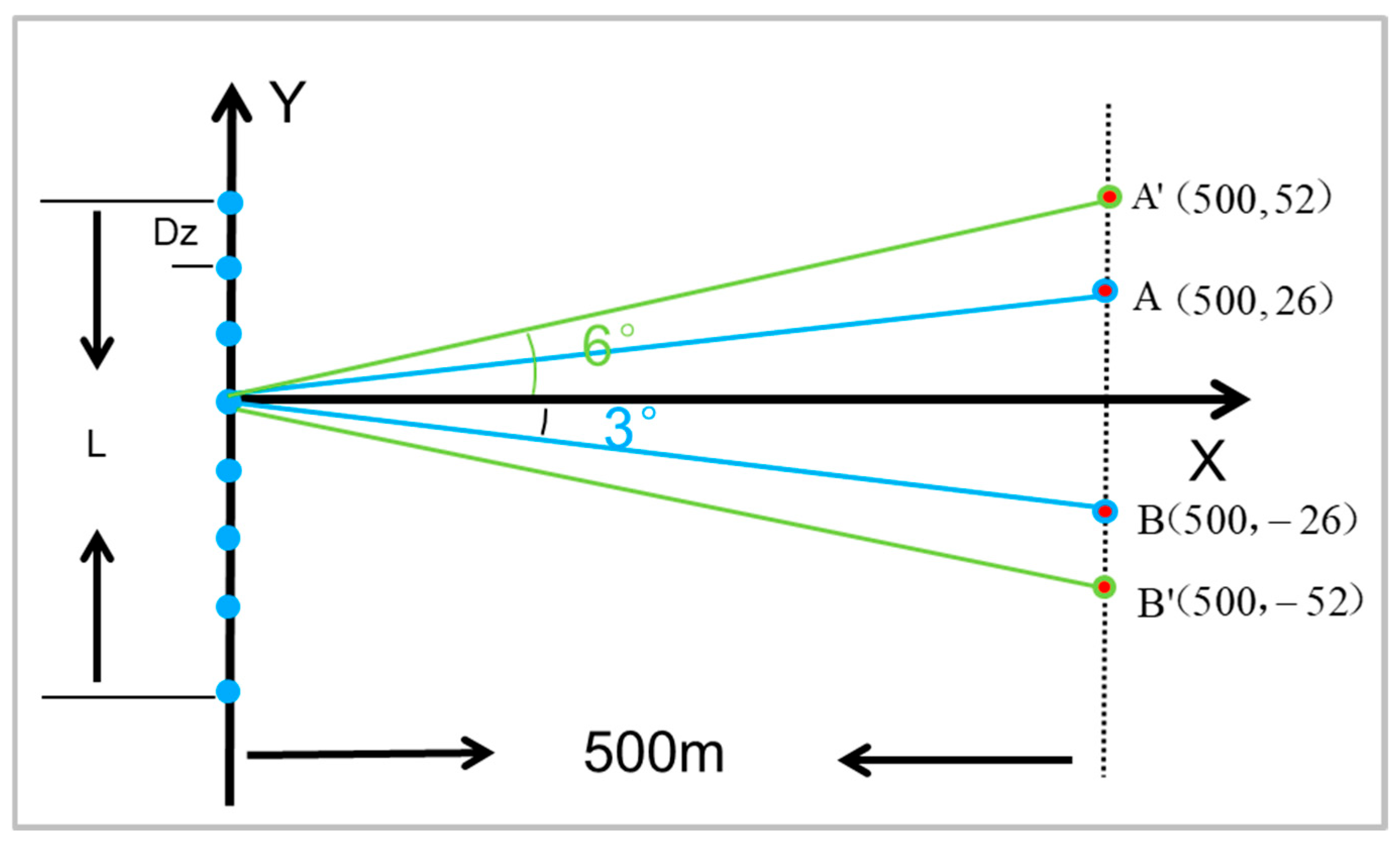
| Height Range of Targets AB in Figure 7 | −26 m~26 m |
| Angle of Targets AB Relative to Array Center | [−3°, 3°] |
| Height Range of Targets A′B′ in Figure 7 | −52 m~52 m |
| Angle of Targets A′B′ Relative to Array Center | [−6°, 6°] |
| SNR | 10 dB |
| Parameter | Value |
|---|---|
| Carrier Frequency | 10.0 GHz |
| Element Spacing | 0.1427 m |
| Number of Elements | 8 |
| Platform height | 800 m |
| Scene Center Slant Range | 1150 m |
| Theoretical Unambiguous Angle Range | [30°, 37.5°] |
| Wavefront Modulation Modes | 14 |
| Modulation Angle | [30°, 42°] |
| Point Target Angles | 32°, 35°, 38° |
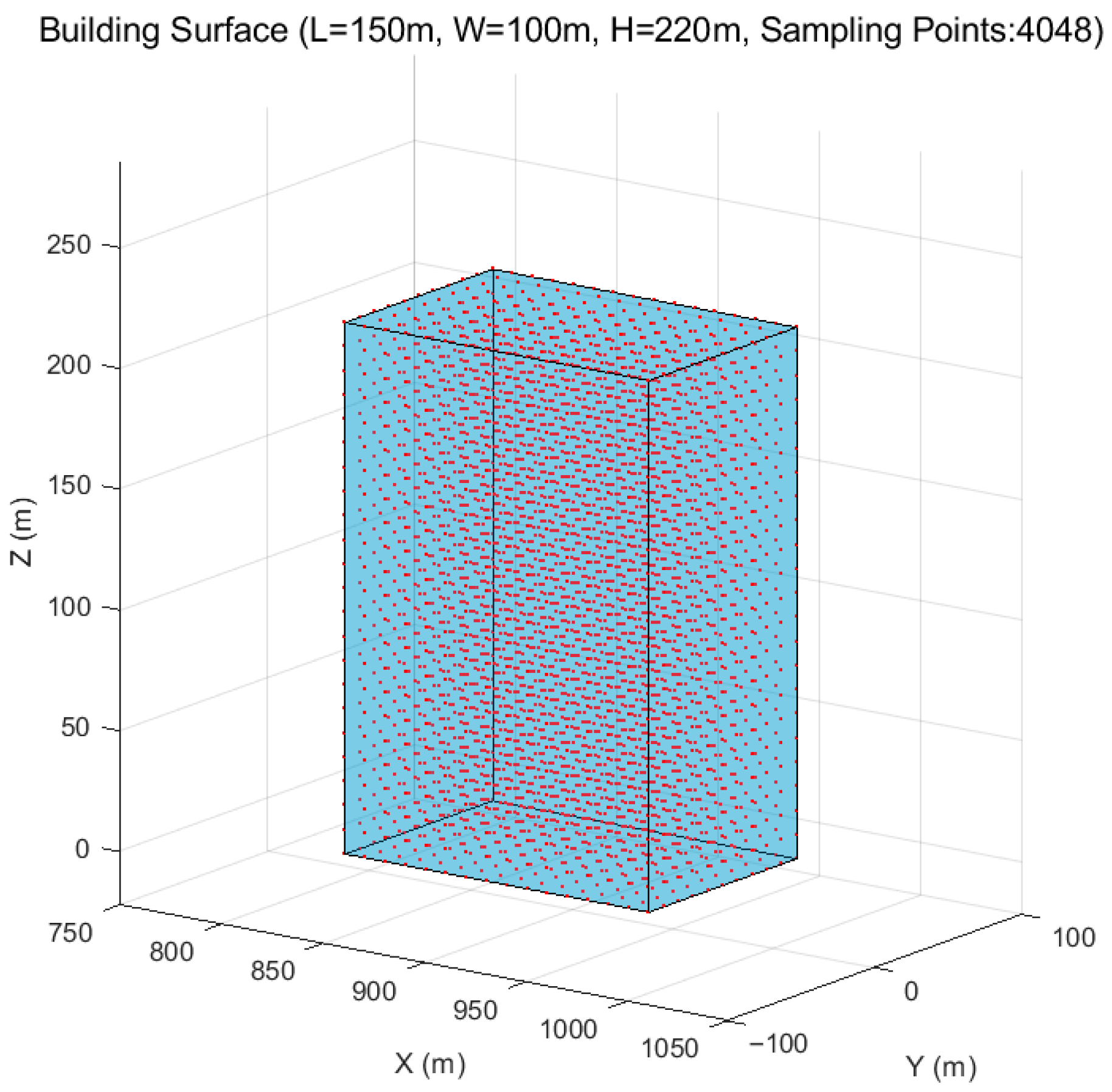
| Volumetric Target Angle Range | 30.73–44.12° |
| SNR | 10 dB |
| Target Angle | Without Wavefront Modulation | With Wavefront Modulation |
|---|---|---|
| Target1: 32° | ||
| Reconstructed position | 32.13° | 32.12° |
| Ambiguous position | 39.12° | Be suppressed |
| Positioning error | 0.13° | 0.12° |
| Target2: 35° | ||
| Reconstructed position | 35.32° | 35.32° |
| Ambiguous position | 42.55° | Be suppressed |
| Positioning error | 0.32° | 0.32° |
| Target3: 38° | ||
| Reconstructed position | 38.35° | 38.35° |
| Ambiguous position | 31.12° | Be suppressed |
| Positioning error | 0.35° | 0.35° |
Disclaimer/Publisher’s Note: The statements, opinions and data contained in all publications are solely those of the individual author(s) and contributor(s) and not of MDPI and/or the editor(s). MDPI and/or the editor(s) disclaim responsibility for any injury to people or property resulting from any ideas, methods, instructions or products referred to in the content. |
© 2026 by the authors. Licensee MDPI, Basel, Switzerland. This article is an open access article distributed under the terms and conditions of the Creative Commons Attribution (CC BY) license.
Share and Cite
Lei, Y.; Zhang, F.; Li, W.; Xu, Y.; Chen, L.; Liu, S. A Novel Ambiguity Resolution Method for Array Signals via Wavefront Modulation. Electronics 2026, 15, 824. https://doi.org/10.3390/electronics15040824
Lei Y, Zhang F, Li W, Xu Y, Chen L, Liu S. A Novel Ambiguity Resolution Method for Array Signals via Wavefront Modulation. Electronics. 2026; 15(4):824. https://doi.org/10.3390/electronics15040824
Chicago/Turabian StyleLei, Yuhui, Fubo Zhang, Wenjie Li, Yihao Xu, Longyong Chen, and Shuo Liu. 2026. "A Novel Ambiguity Resolution Method for Array Signals via Wavefront Modulation" Electronics 15, no. 4: 824. https://doi.org/10.3390/electronics15040824
APA StyleLei, Y., Zhang, F., Li, W., Xu, Y., Chen, L., & Liu, S. (2026). A Novel Ambiguity Resolution Method for Array Signals via Wavefront Modulation. Electronics, 15(4), 824. https://doi.org/10.3390/electronics15040824