1. Introduction
Point cloud data, depicting three-dimensional renderings of existing structures, landscapes, or topographies, is acquired through diverse sensors like LiDAR, RGB-D cameras, and Kinect [
1]. In particular, Light Detection and Ranging (LiDAR) stands out for its ability to capture the environment with unparalleled resolution and accuracy [
2]. These datasets represent objects or surfaces using an extensive collection of 3D points in 3D space, enriched with RGB color values and luminance data indicating brightness. The surge in 3D imaging devices and data accessibility has spotlighted the potential of deep learning models in the analysis of point cloud data [
3].
In the early stages of employing deep learning for 3D structure modeling, a conventional approach involved transforming point clouds into either multi-view images, suitable for learning by 2D Convolutional Neural Networks (CNNs), or volumetric data, amenable to 3D CNNs [
4]. In contrast to projective observations from the built environment offered by 2D images, 3D point clouds provide metric reconstructions of building scenes devoid of scale ambiguity. Point-based methods utilizing raw point clouds as input have demonstrated the capacity to create highly accurate and detailed models of objects or environments [
5]. The utilization of point cloud data is on the ascent in construction and transportation networks due to its remarkable precision in recording measurements of buildings and infrastructure. A sequence of steps, including 3D reconstruction, semantic segmentation, extraction of geometric parameters, and integration into Building Information Modeling (BIM), is undertaken to obtain geometric data about pre-existing structures [
6,
7].
Deep learning models, including Convolutional Neural Networks (CNNs) [
6], Graph Convolutional Networks (GCNs) [
8,
9], and PointNet [
10,
11], can autonomously acquire hierarchical and discriminative features from raw point cloud data. These models have been successfully applied to diverse point cloud data analysis tasks, encompassing object segmentation, classification, and reconstruction. The existing literature has extensively addressed point cloud processing. Qian [
12] reviewed applications of point cloud data in the civil construction industry, providing insights for potential research directions. Mirzaei [
13] surveyed machine learning applications for the automatic processing of point cloud datasets in construction and infrastructure. Liu [
14] contributed to knowledge about 3D reconstruction in civil engineering, summarizing recent progress and challenges. Zhang et al. [
15] and Cao [
16] provided comprehensive overviews of point cloud studies, with a focus on deep learning techniques. Rana [
17] conducted a systematic literature review, emphasizing deep learning applications in the construction industry. Point cloud data also enhance Building Information Modeling (BIM) capabilities. Scan-to-BIM utilizes automated processes leveraging point cloud geometric characteristics to categorize structural, architectural, and MEP components with semantic labels. The application of a Markov Random Field (MRF) learning approach enhances precision by ensuring consistency between semantic and geometric labels, utilizing surrounding context [
18,
19].
This literature review offers a comprehensive exploration of current research on the potential applications of deep learning models in the analysis of point cloud data. The primary focus is to thoroughly examine the utilization of 3D point cloud data for Civil Infrastructure Management within the construction industry. The existing literature indicates that although deep learning techniques have been widely adopted in computer vision (CV) and image processing, the potential of point cloud data within the Architecture, Engineering, and Construction (AEC) industry remains largely unexplored. As summarized in
Table 1, all data presented have been collected from studies published since 2010, with each topic specifically reviewed for relevance to deep learning methodologies. Additionally, this review includes a critical comparison of existing deep learning models, addresses future challenges, and highlights research gaps concerning point cloud data acquisition with a focus on its construction-specific applications.
Based on gaps and recurring themes identified in the existing body of research, this review is structured around the following key objectives and thematic focus areas:
To synthesize and critically compare existing deep learning-based techniques for point cloud processing, with particular emphasis on their applicability to Civil Infrastructure Management.
To examine the current state of research on anomaly and defect detection in civil infrastructure using point cloud data, an area that has received comparatively less consolidated attention in prior review studies.
To analyze how point cloud-based deep learning approaches differ from conventional deep learning applications by focusing on unstructured three-dimensional data, thereby addressing a gap in the existing literature that predominantly emphasizes image-based methods.
To identify current limitations and outline future research challenges related to data quality, model robustness, and practical deployment of point cloud processing techniques for Civil Infrastructure Management.
These objectives guide the organization of this review and provide a coherent framework for evaluating existing methods, identifying research gaps, and highlighting directions for future investigation.
2. Background
2.1. Deep Learning Models for Point Cloud Analysis
Deep learning (DL) models are a subset of machine learning algorithms that use artificial neural networks to perform complex tasks [
20]. Deep learning techniques have made significant progress in recent years and are now being applied to solve a wide range of problems, including image recognition, natural language processing, and robotics. Point cloud data, which is becoming more prevalent in infrastructure engineering and management for assisting in different phases of a project, like planning, design, construction, and monitoring up to operation and maintenance, have numerous applications that can be enhanced with DL models [
21]. Point cloud data analysis requires models that can extract features from unordered sets of points. Traditional methods, such as the Random Sample Consensus (RANSAC) algorithm, were effective in the past, but deep learning models have shown better results in recent years [
22]. PointNet and PointNet++ are among the most popular deep learning models for point cloud data analysis. PointNet is a fully connected neural network that can directly take a set of points as input, while PointNet++ uses hierarchical feature learning to extract features from different scales [
23,
24].
CNNs are good at identifying patterns in image data and are widely used in image recognition tasks [
25]. They can be used to detect anomalies in infrastructure images such as cracks, geometric deformations, or other defects [
26]. Other deep learning models that have been used for point cloud data analysis include Dynamic Graph Neural Networks (DGCNNs) and Graph Convolutional Networks (GNNs). Dynamic Graph CNNs and GNNs are designed specifically for graph data. These models have shown promise in point cloud segmentation, classification, and object detection tasks [
27,
28].
ResNet is another DL network that has achieved state-of-the-art performance on a variety of computer vision tasks, including image classification, object detection, and semantic segmentation. The core idea behind ResNet is the introduction of residual connections, which allow information to bypass one or more layers of the network. Thus, ResNet can train much deeper neural networks than was previously possible [
25,
29].
DL models for point cloud data analysis have many potential applications in the infrastructure management sector. For example, DL models can be used to detect and segment infrastructure such as bridges, tunnels, and buildings, allowing for more accurate and efficient maintenance and repairs with object detection and achieving high levels of accuracy [
30]. The purpose of this literature review is to explore the potential of existing DL models for point cloud data analysis in the civil engineering and management field, and to conduct a critical comparison of these models under benchmark conditions, thus suggesting the use of particular models for particular conditions. In the following, we discuss the most-in-use architectures/techniques of deep learning models for the analysis of point cloud data [
31].
2.2. Convolutional Neural Network
A CNN is a type of deep learning algorithm commonly used for image and video recognition, classification, and processing [
32]. CNNs are modeled after the way the human brain processes visual information, by breaking down an image into smaller, simpler components and then analyzing each component to understand the overall image [
33].
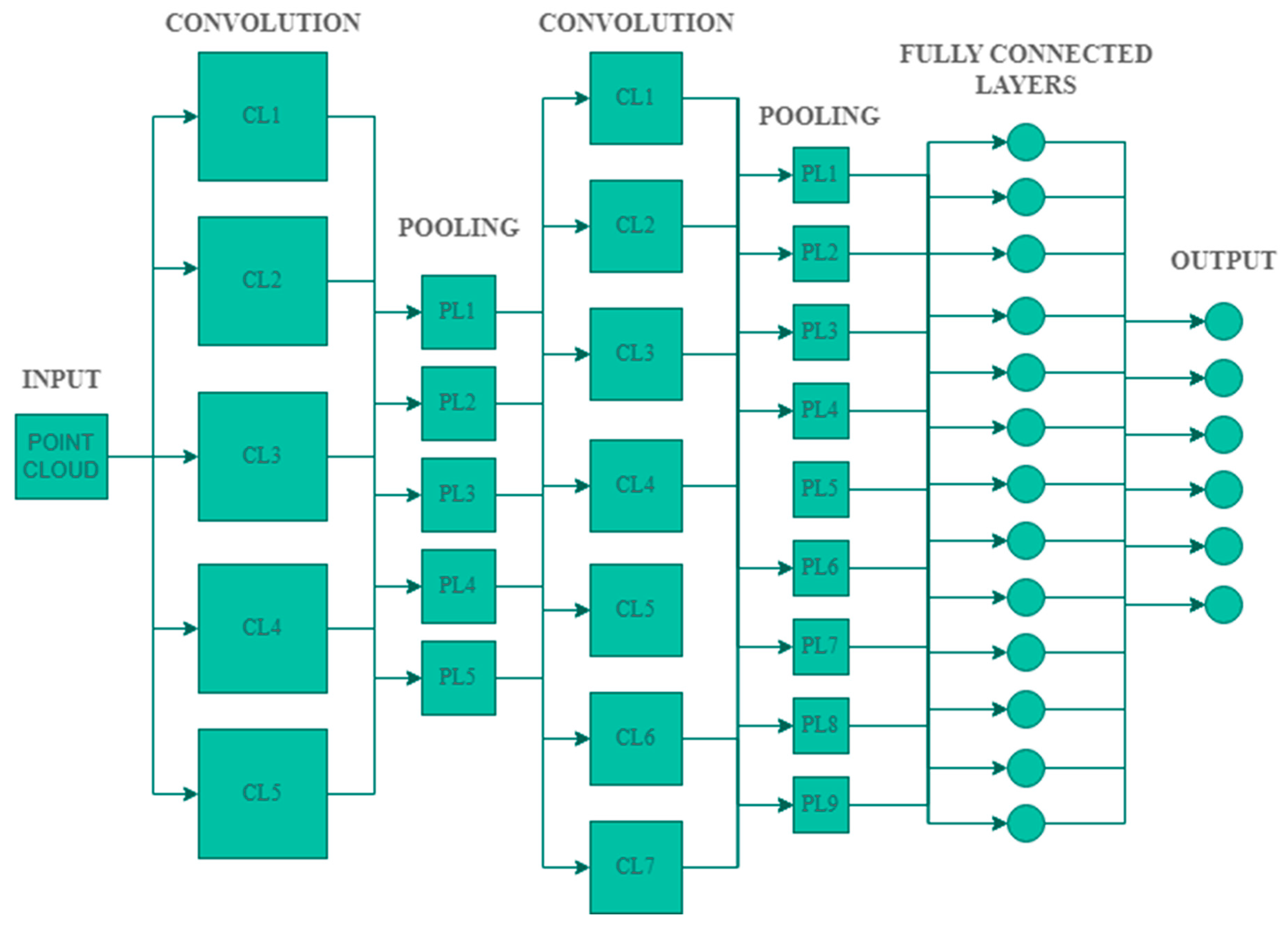
CNNs use a series of convolutional layers to extract features from the input image, followed by pooling layers to down-sample the features and reduce computational complexity [
34,
35,
36]. The final layers are typically fully connected layers that perform the classification task based on the extracted features, as illustrated in
Figure 1.
Object classification and segmentation with CNNs are typically achieved by training the network on a dataset of labeled images [
37,
38]. During training, the CNN learns to recognize features in the input images by passing them through a series of convolutional layers. Irregular point clouds are transformed into dense grids and voxels using volumetric methods, enabling feature extraction through the use of standard CNNs [
39,
40]. Each convolutional layer applies a set of filters to the input image, which allows the network to identify different patterns and features in the image, such as edges, textures, and shapes [
41,
42,
43]. Utilizing a training dataset that includes a combination of real and synthetic data can result in notably improved performance compared to solely training neural networks on real-world data. In the infrastructure domain, Ma et al. trained the network with synthetic data and showed its potential to address data scarcity [
21,
44].
The output of the convolutional layers is then passed through a series of fully connected layers, which use the extracted features to predict the class of the input image. The fully connected layers perform a series of matrix multiplications and nonlinear activations to transform the extracted features into a final output vector, which represents the predicted class probabilities for the input image. A CNN can be modified for specific applications, as it is possible to utilize the Directionally Constrained Fully Convolutional Neural Network (D-FCN) model for the classification of airborne LiDAR point clouds by applying it directly to unstructured 3D point sets [
7,
45,
46,
47,
48,
49].
2.3. Graph Neural Networks (GNNs)
GNNs are a type of neural network designed to operate on graphs and structured data. In the context of object segmentation, GNNs can be used to segment objects in images by leveraging the structured information present in the image [
50,
51,
52]. GNNs are used for object classification and segmentation to represent the image as a graph, where each pixel is a node in the graph, and the edges between nodes represent spatial relationships between pixels. For example, two pixels that are adjacent to each other in the image might be connected by an edge in the graph. Once the image has been represented as a graph, a GNN can be trained to perform object segmentation by learning to propagate information across the graph [
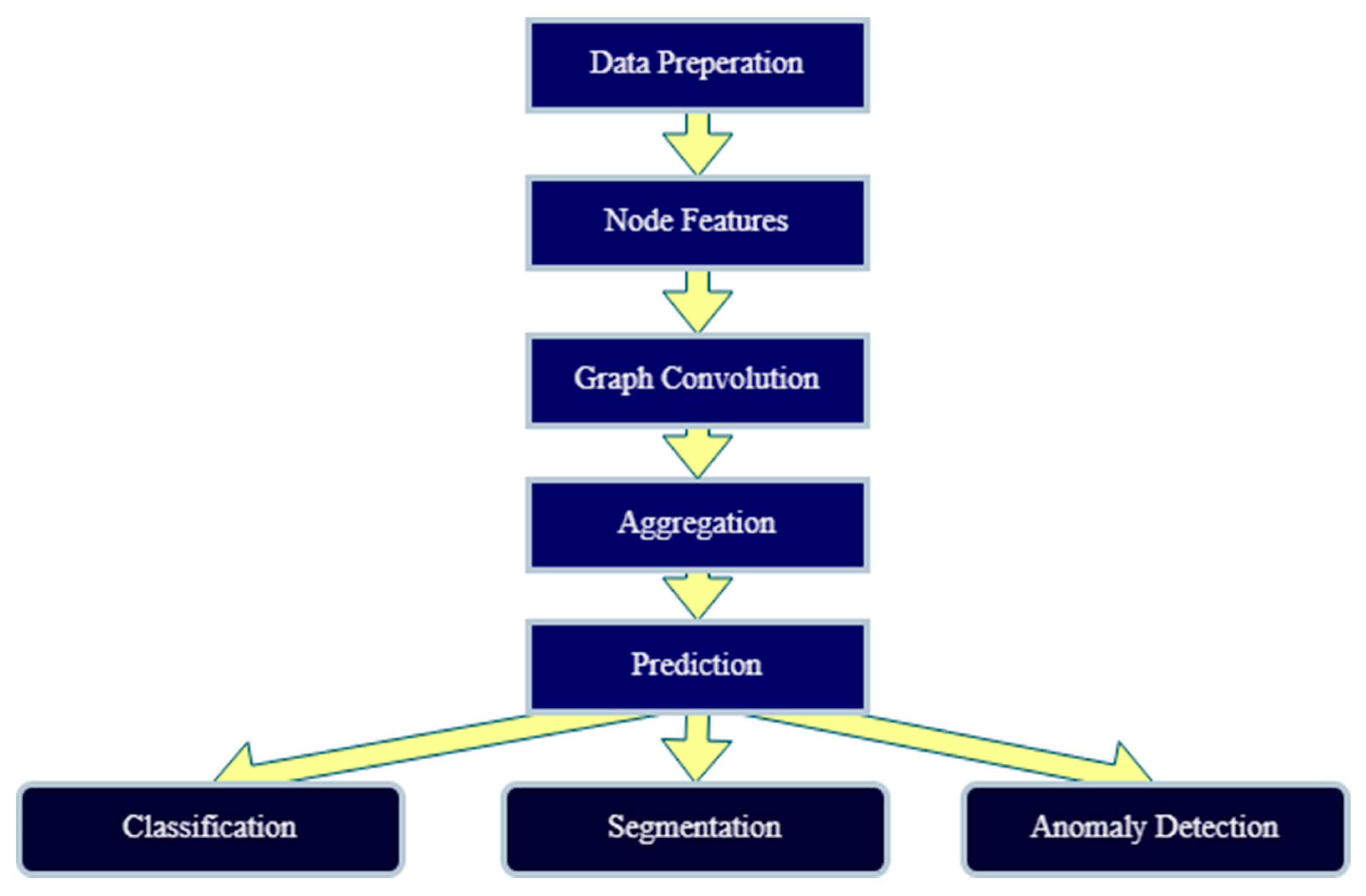
53]. The network typically consists of multiple layers, each of which updates the node features based on the features of neighboring nodes. This allows the network to capture spatial relationships between pixels and perform object segmentation based on these relationships [
52].
Figure 2 provides a visual representation of the sequential process involved in the operations of GNNs.
There are a variety of applications for Graph Neural Networks. By employing a dynamic graph for every layer of the network, the Dynamic Graph Convolutional Neural Network (DGCNN) can learn the connections among neighboring points or those with comparable characteristics. The DGCNN takes unmodified point cloud data as input and adjusts the graph structure in each layer to obtain neighboring points within a feature-based Euclidean space. This allows the model to simultaneously learn edge vectors from multiple points [
34,
54,
55].
Point-GNN is a graph neural network-based framework designed for object detection in point clouds, where each point is treated as a vertex within a graph structure. By taking a point graph as input, Point-GNN simultaneously predicts the object category and corresponding bounding box parameters for each vertex. As a one-stage detection approach, it is capable of identifying multiple objects in a single forward pass, thereby achieving both computational efficiency and robust detection performance [
21]. In parallel, techniques that explicitly emphasize geometric structure, such as ShapeConv, can be employed to construct shape-oriented convolutional neural networks (SOCNNs). These networks are particularly effective for point cloud classification and part segmentation tasks [
56,
57]. ShapeConv enhances local feature learning by densely connecting points that belong to the same local shape, strengthening point-to-point interactions and enabling the computation of representative moment points within the local graph. Building upon this concept, the present research investigates the encoding of contextual information through the definition and modeling of two complementary shape-oriented relationships in point clouds: intra-shape relationships, which capture geometric dependencies within a local shape, and inter-shape relationships, which model interactions among distinct shapes within the scene [
38,
58].
2.4. PointNet
The PointNet architecture is based on a neural network that inputs a point cloud and performs feature extraction, transformation, and classification tasks. The architecture is unique in that it can process point clouds directly without the need for preprocessing or feature engineering [
10]. The main advantages of PointNet include its ability to handle variable-sized point clouds, its robustness to noise and occlusion, and its ability to preserve spatial relationships between points. These properties make PointNet well suited for a variety of applications, such as object recognition, segmentation, and classification in robotics, reconstruction, and augmented reality [
11,
59].
PointNet is used for these tasks by first inputting the data, and then the first layer of PointNet applies shared multilayer perceptrons (MLPs) to each point in the input point cloud data, allowing the network to learn local features for each point. Max pooling is performed next, which involves dividing the input image into small regions and taking the maximum value of each region [
60]. The output of the final convolutional layer is usually flattened into a one-dimensional vector and passed through one or more fully connected layers [
61,
62]. The final layer of the PointNet produces a probability distribution over the possible output classes. The predicted class typically has the highest probability. PointNet can be used to create a 3D BIM Model with the help of Dynamo, a Revit plugin [
63].
PointNet can be used to segment images or 3D models. Usually, a pixel-wise or point-wise prediction is generated for each dataset, where each pixel or point is classified as belonging to an object or the background [
64]. Anomalies are identified as data points that diverge significantly from the learned patterns and features of the normal data. After the anomalies are detected, the results are refined, and false positives are removed [
55].
Consequently, PointNet++ is an extension of the PointNet architecture designed to address some of the limitations of the original model. PointNet++ uses a hierarchical neural network architecture to learn features at multiple levels of abstraction, allowing it to capture both global and local features of the point cloud. The main improvements in PointNet++ include its ability to group nearby points into local regions and process them using shared weights, allowing it to capture local geometric features more effectively [
65]. PointNet++ also uses a feature propagation module to propagate information between points in the same local region, allowing it to capture spatial relationships between points more effectively. PointNet++ uses adaptive sampling to dynamically adjust the density of points in different regions of the point cloud, allowing it to handle point clouds with varying densities. PointNet++ has also inspired many other extensions and variants, such as PointSIFT and PointCNN, which aim to further improve the performance and efficiency of point cloud processing models [
29,
66].
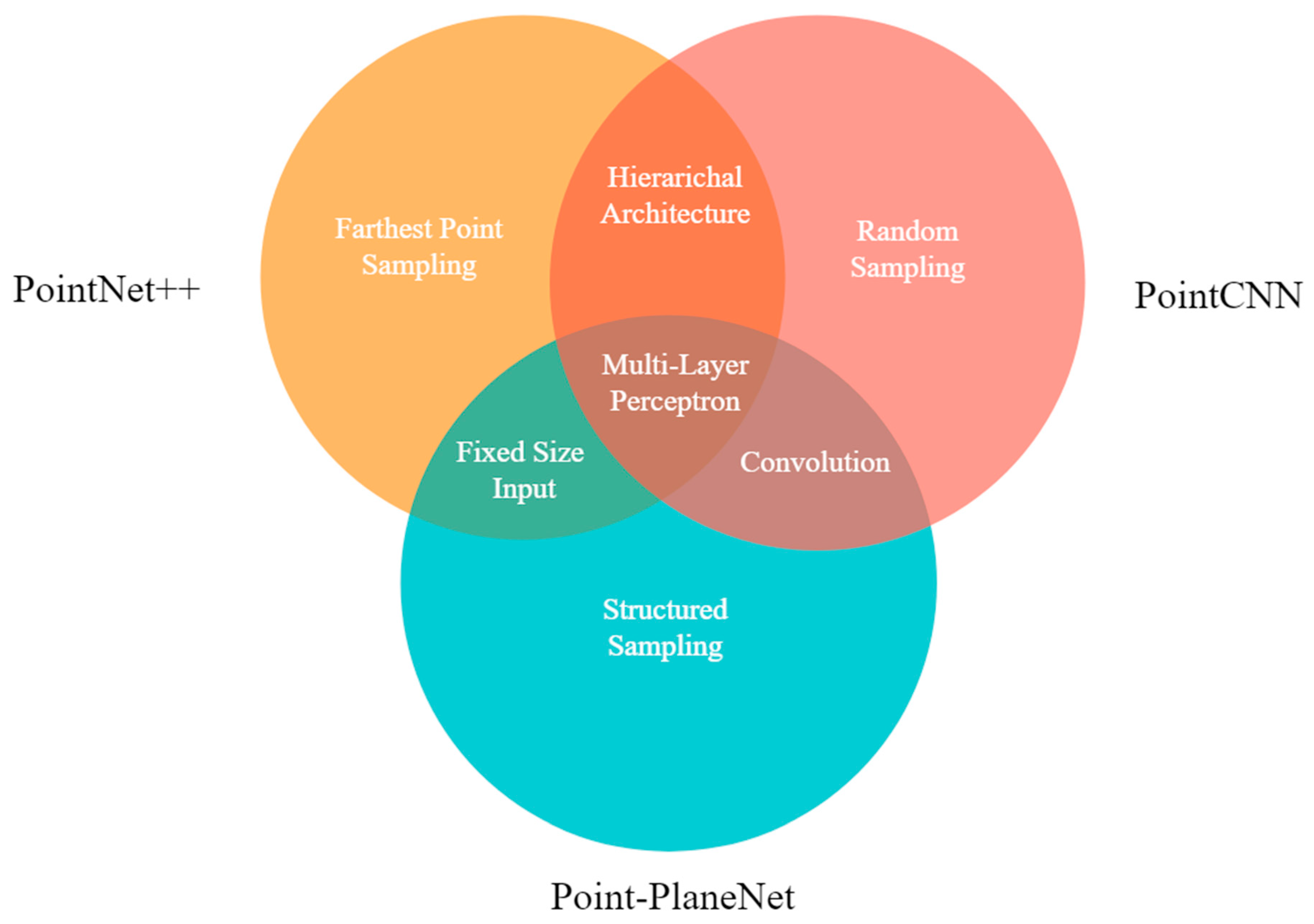
Therefore, by expanding the topology of a convolutional neural network (CNN) and combining it with PointNet, PointCNN is intended to learn the local correlation between points in space. Similarly to PointNet, PointCNN operates on untransformed point cloud data and, by generalizing the grid CNN principle, can learn independently of the input order [
3].
Point-PlanetNet is another network that is an improvement upon PointNet. To leverage spatial local correlations, PlaneNet utilizes the distance between points and planes. The PlaneConv operation plays a key role in PlaneNet by learning a set of planes in Rn space that can extract local geometric features from point clouds. Notably, this network takes point clouds as direct input and therefore eliminates the need to convert them into images or volumes. The three aforementioned improved version of PointNet are compared in
Figure 3.
2.5. ResNet
ResNet is designed to solve the problem of vanishing gradients that can occur in very deep neural networks, making it difficult to train them effectively. The basic idea behind ResNet is to introduce skip connections, which allow information to flow directly from one layer to another, bypassing intermediate layers. This helps to ensure that gradients can flow more easily through the network during training, enabling better performance on very deep networks [
67].
ResNet is highly effective for a wide range of computer vision tasks, including object classification and defect detection. In object classification, ResNet is often used as a backbone architecture in convolutional neural networks (CNNs) [
68,
69]. The CNN is trained on a large dataset of images with labeled object classes, and the ResNet architecture is used to extract features from the images. These features are then fed into fully connected layers to perform object classification. ResNet can be used for detecting defects in images or point clouds by training a CNN to classify them as either defective or non-defective [
70].
Noise can be a source of great difficulty in point cloud processing. PointASNL is a method that can effectively handle noisy point clouds, and its main element is the adaptive sampling (AS) module. This module employs a two-step process: first, it re-weights the neighbors around the initially sampled points that are selected using farthest point sampling (FPS), and then it dynamically adjusts the sampled points beyond the entire point cloud [
71,
72]. Another modification of ResNet, i.e., ResSANet, has also been shown to be great at point cloud classification and segmentation. ResSANet utilizes geometric primitives as the foundation to acquire hierarchical geometry information. Within the ResSANet module, a skip connection is incorporated to enhance the exchange of information between adjacent layers and facilitate the merging of features at varying levels [
73].
2.6. Constraints for the Paper
As stated earlier, the primary objective of this review is to critically analyze and compare existing deep learning techniques for point cloud processing in the context of Civil Infrastructure Management, with particular attention given to end-user requirements (EURs). To maintain methodological consistency and ensure meaningful comparison across studies, this review deliberately constrains its scope along several dimensions.
First, this review focuses exclusively on point cloud-based data representations and deep learning methods that directly process three-dimensional spatial information. Studies relying solely on two-dimensional imagery or non-geometric data modalities are therefore excluded unless they explicitly contribute to point cloud analysis or hybrid point cloud workflows.
Second, the benchmark conditions considered in this review are limited to major categories of civil infrastructure that are frequently examined in the literature and exhibit distinct geometric and operational characteristics. Specifically, the analysis concentrates on the following infrastructure types:
Bridges.
Buildings.
Energy infrastructure.
Tunnels.
These infrastructure categories were selected because they represent common application domains for point cloud acquisition and exhibit varying structural complexity, scale, and data acquisition challenges. Restricting the review to these domains enables a more focused and comparative assessment of deep learning techniques under representative civil engineering conditions.
Third, this review primarily examines methods evaluated on static point cloud datasets. Dynamic or time-series point cloud analysis, although increasingly relevant for real-time monitoring and digital twin applications, is discussed only where it directly supports infrastructure management objectives. This constraint reflects the current maturity level of available datasets and the dominant focus of existing studies.
Finally, it is acknowledged that reported model performance across the reviewed literature is influenced by factors such as dataset size, point density, noise levels, and evaluation protocols. As a result, direct quantitative comparison across studies is inherently limited. This review therefore emphasizes relative methodological characteristics, practical suitability, and alignment with EURs rather than absolute performance rankings.
These scope definitions and constraints clarify the boundaries of the review, support transparent interpretation of the comparative analysis, and ensure that the conclusions drawn remain consistent with the available evidence.
3. Methodology
This study follows a structured narrative review approach based on manual literature identification, iterative screening, and expert judgment. The methodology was designed to support critical analysis and conceptual synthesis across infrastructure-related research, rather than exhaustive quantitative aggregation. The emphasis is placed on the quality, relevance, and methodological contribution of selected studies.
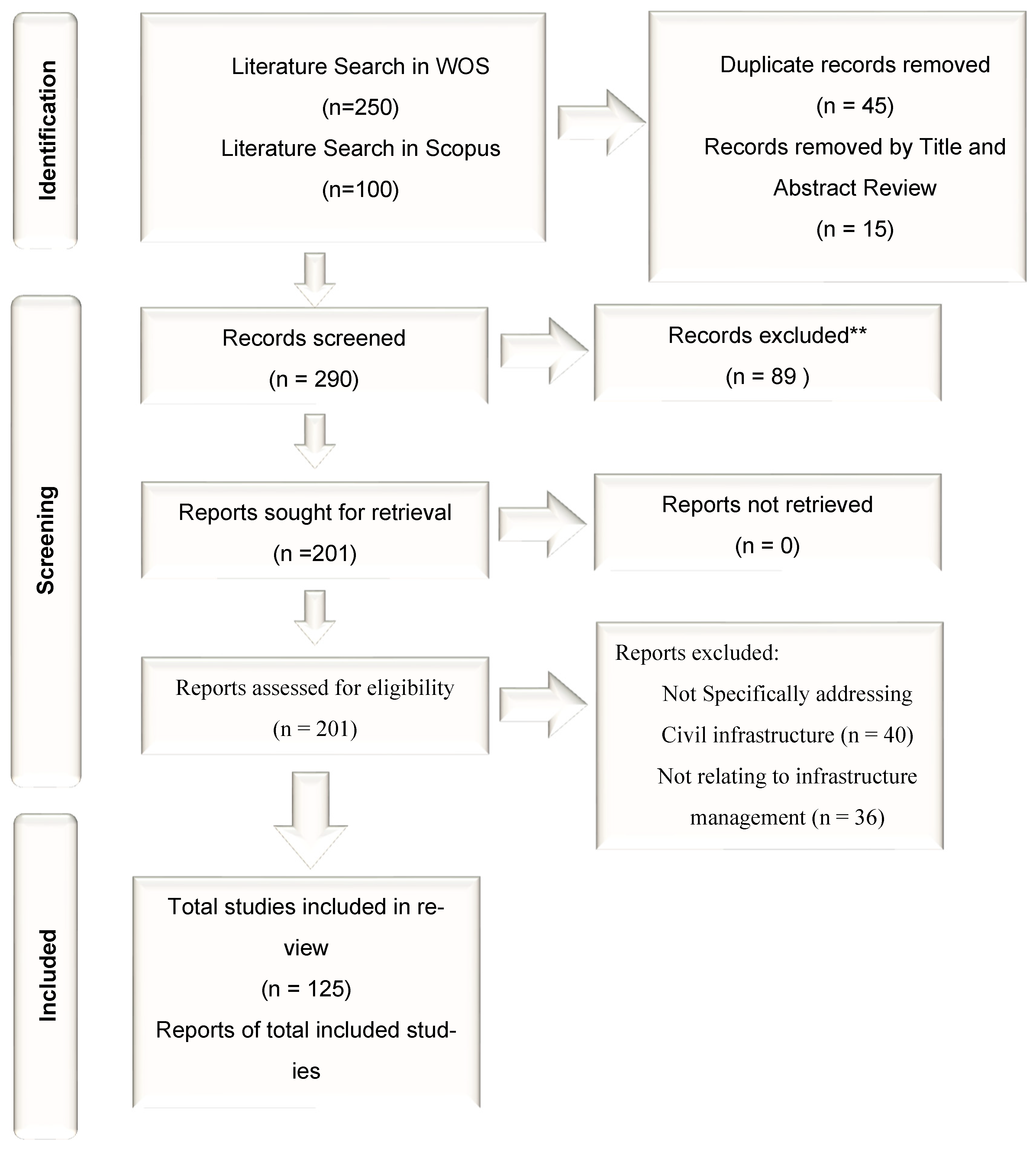
The review process was conducted in successive stages, beginning with broad literature identification and progressively narrowing the corpus through relevance-based screening. An overview of the selection process and final study counts is provided in
Figure 4, which serves as a descriptive summary of the workflow.
3.1. Literature Identification
Relevant literature was identified through targeted searches in Web of Science and Scopus, chosen for their comprehensive coverage of peer-reviewed journals in civil engineering, infrastructure systems, transportation engineering, and applied computational research.
Search queries were constructed using combinations of keywords associated with the following:
Civil and infrastructure systems;
Infrastructure and asset management;
Monitoring, assessment, and decision support methods;
Analytical, data-driven, and computational techniques applied to infrastructure problems.
The search strategy was intentionally iterative. Initial keyword sets were refined during the review process as additional relevant terminology and research directions emerged. This adaptive strategy enabled the inclusion of influential studies that might not be captured by a single fixed query.
3.2. Preliminary Screening
All retrieved records were consolidated and reviewed manually. Duplicate entries arising from overlapping database coverage were identified and removed. The remaining records underwent title and abstract screening to assess topical relevance.
At this stage, studies were excluded according to the following:
They did not address infrastructure systems or civil engineering applications;
They focused on domains without transferable relevance to infrastructure management;
They lacked a clear analytical, methodological, or technical component.
This initial screening reduced the dataset to a manageable set of candidate studies for detailed evaluation, as summarized in
Figure 4.
3.3. Full-Text Evaluation and Selection
Studies passing the preliminary screening were subjected to full-text assessment. This stage constituted the core selection process and relied on domain expertise to evaluate each study’s contribution and suitability.
Inclusion decisions were guided by the following criteria:
Explicit focus on infrastructure systems, management, or performance assessment;
Presentation of a defined methodological framework, analytical model, or evaluative approach;
Sufficient technical detail to support comparison and synthesis.
Studies were excluded according to the following:
They addressed infrastructure only marginally;
They provided primarily descriptive or conceptual discussions without analytical depth;
They repeated well-established methods without offering new insight or application relevance.
The selection process aimed to ensure conceptual coherence across the reviewed literature while maintaining diversity in methods and application contexts.
3.4. Final Study Corpus
Following full-text evaluation, a final corpus of 125 studies was selected for inclusion in the review. The size of the corpus reflects the point at which additional studies no longer introduced substantively new methodological perspectives or thematic insights relevant to the objectives of the paper.
The selected studies are intended to be representative of major research directions rather than exhaustive. All subsequent analyses and discussions in this manuscript are based exclusively on this final set of studies.
3.5. Data Extraction and Organization
For each included study, relevant information was extracted manually and organized into structured categories, including the following:
Infrastructure type and application domain;
Core methodological or analytical approach;
Data sources and evaluation strategies;
Reported strengths, limitations, and practical implications.
Rather than reducing these characteristics to numerical summaries, the extracted information was used to support qualitative comparison and thematic grouping, preserving methodological nuance and contextual specificity.
3.6. Thematic Synthesis
The synthesis of the selected literature was conducted using a thematic analysis framework. Studies were grouped according to shared methodological characteristics and application objectives. Themes were identified inductively through repeated comparison across studies and refined iteratively to ensure internal consistency.
Within each thematic group, studies were examined in terms of the following:
Methodological robustness;
Applicability to real-world infrastructure scenarios;
Scalability and implementation considerations;
Identified challenges and research gaps.
This approach supports a balanced assessment of current research practices and emerging directions within infrastructure-related studies.
4. Operations Conducted via Point Cloud Processing
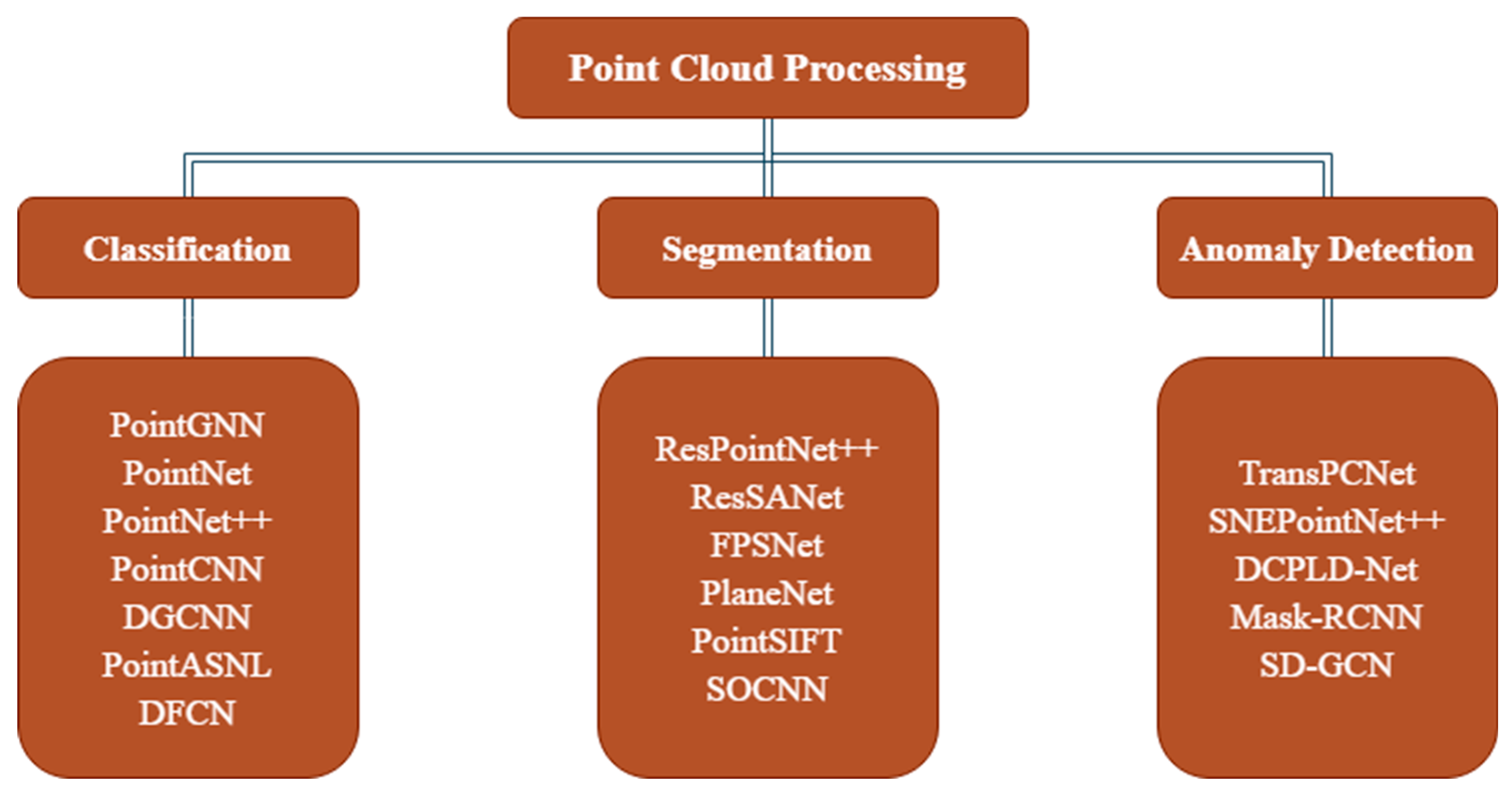
This paper discusses various neural network architectures employed in point cloud processing, as illustrated in
Figure 5.
4.1. Three-Dimensional Model Making
Point cloud data acquisition techniques, including LiDAR, photogrammetry, and structured light systems, facilitate the creation of 3D models [
74]. LiDAR utilizes laser beams to map object surfaces, while photogrammetry constructs point clouds from photographs taken at various angles. Studies have extensively explored volumetric measurements using LiDAR. Structured light systems project patterns onto objects, capturing surface distortions to generate point clouds [
74,
75]. Post acquisition, point cloud data undergo noise and outlier removal before being organized into groups via algorithms. These groups form a 3D mesh representing the object’s surface, enhanced with textures and colors from images or software materials. Exported models find applications in architectural design and construction planning. Despite its growing importance in civil engineering digitization, practical applications of 3D point cloud data remain underexplored [
76,
77]. Technological advancements in LiDAR and modeling software have streamlined model creation. PointNet, integrated with Revit through plugins like Dynamo, facilitates 3D BIM generation. Graph Geometric Moment (GGM) convolutional networks offer improved feature extraction compared to PointNet or PointCNN [
78,
79,
80].
Primary challenges in 3D model-making include input data quality, crucial for model accuracy and completeness. Processing large point cloud volumes poses algorithmic complexity hurdles, and texture/color information necessitates additional data sources. Limited point cloud datasets also hinder deep learning model training.
4.2. Object Recognition and Classification
Object recognition and classification from point cloud data serve numerous applications, including 3D mapping and distinguishing civil structure components like buildings and bridges using deep learning models. Point clouds offer an advantage over 2D RGB images in classifying bridge components due to the additional dimensionality. However, this task is challenging due to the inherent noise, incompleteness, and sparsity of point cloud data, along with the complexity of object shapes and sizes. To tackle this, machine learning algorithms such as deep neural networks and convolutional neural networks are employed to identify features and patterns for accurate classification [
81,
82].
Various approaches have been proposed to address these challenges. One approach involves using machine learning techniques like deep neural networks to extract features from point cloud data, followed by classification using clustering or support vector machines. Another approach employs geometric and topological methods, such as voxelization and octree-based methods, to extract features for classification using techniques like random forests or decision trees. However, further research is warranted to enhance the accuracy and efficiency of existing methods [
83].
Deep learning neural networks, particularly PointGNN, are prominent in point cloud classification, enabling 3D object detection. For bridge part categorization, PointNet, PointCNN, and the Dynamic Graph Convolutional Neural Network (DGCNN) are utilized, with the DGCNN demonstrating superior object classification.
Ma et al. utilized PointNet and DGCNN models for comprehensive insights into building interiors, incorporating synthetic PC datasets from the BIM framework during training. PointNet excelled in predicting specific interior features like columns and windows, while the DGCNN showed limitations in tall interior prediction [
22,
84].
Quality point cloud data remain a significant challenge for object recognition and classification. Obtaining as-is BIM of existing infrastructure poses hurdles due to data quality issues such as noise, incompleteness, and outliers. Extracting relevant features from point cloud data for classification presents difficulties, with traditional methods often inadequate. Moreover, the complexity of point cloud data necessitates robust algorithms capable of handling variations in object characteristics. Real-time processing of large point cloud datasets requires optimization, while avoiding overfitting in deep learning models is essential for generalizability to new data [
12,
85,
86].
4.3. Point Segmentation
Point segmentation is a fundamental task in processing point cloud data, involving the partitioning of points into groups based on their spatial characteristics or semantic meanings. Essentially, this process divides points into distinct subsets or clusters, with each subset representing a meaningful part of the object or scene being analyzed [
87,
88]. This segmentation is particularly valuable in applications like object recognition, where precise identification and localization of objects or obstacles are essential. Initially, scholars primarily employed conventional algorithms to address challenges such as reconstructing complex objects, handling scenes with repetitive elements, and updating Building Information Models (BIMs) [
89,
90]. However, contemporary point segmentation algorithms heavily rely on machine learning techniques like clustering, classification, and segmentation to identify patterns and group points based on similarities in their spatial and feature properties. The overarching goal of point segmentation is to generate a structured representation of the point cloud data that can facilitate subsequent analysis and decision-making processes [
24].
In the realm of point segmentation, semantic segmentation aims to assign categorical labels to individual points comprising a point cloud, while instance segmentation assigns distinct labels for separate instances of objects falling under the same class. Combinations of multiple models can also be used to achieve more accurate segmentation. For instance, ResPointNet++ has been shown to be capable of more accurate segmentation compared to benchmark approaches such as PointNet and PointNet++. RANSAC is a potent method, particularly effective in categorizing straightforward 3D shapes from noisy point cloud models [
91].
Fusion networks like FPS-Net, which combine or fuse information from multiple modalities, can also be employed for object segmentation. FPS-Net, for example, maps each point cloud scan into three modality images using a spherical projection. The fusion learning network then learns the features of each modality individually and combines them in a shared high-dimensional space. The fused feature is encoded and decoded before being passed through FPS-Net, which maps the 2D predictions back into 3D space for semantic prediction at the point level. PlaneNet, evaluated in various experiments such as point cloud classification and part and semantic segmentation, has achieved competitive results with a relatively low number of parameters, rendering it effective in capturing fine local structure information [
37,
92].
Developing methods capable of handling large-scale point clouds with millions or billions of points, while maintaining high accuracy and efficiency, along with developing methods that can handle noisy, incomplete, or occluded point clouds and generalize to different environments and sensor modalities, is a strenuous task. Developing methods that can perform point segmentation in real time and can be used for interactive applications such as augmented reality and virtual reality is challenging due to the widely varying complexity of objects in point cloud data, with some objects having irregular shapes, making accurate segmentation difficult [
93].
4.4. Anomaly (Defects) Detection
Anomaly detection plays a crucial role in point cloud analysis, aiming to identify outliers or defects that deviate from the expected patterns or norms. Commonly, statistical methods are employed, involving computations of measures such as mean, variance, and covariance of the point cloud data [
94,
95]. The Mahalanobis distance, for instance, is widely used to measure the distance between a point and the mean of the point cloud data. Additionally, clustering-based methods are utilized, where the point cloud data are partitioned into groups or clusters based on their similarity. The k-means algorithm, a popular clustering approach, partitions the data into k clusters based on distances to cluster centroids. For instance, Yang et al. [
96] developed algorithms for fitting pier point clouds and segmented arches with idealized 3D cylinders and 2D planes, revealing geometric distortions due to prior settlements. Other studies have leveraged surface normal vector irregularities, roughness, and color to detect and categorize defects like cracking and material loss in rail tracks. Moreover, synthetic data generated from LiDAR simulators are utilized to supplement real datasets in autonomous driving research [
97,
98].
In civil engineering, point cloud technology finds applications in displacement measurement, deformation monitoring, and damage detection. Recently, deep learning-based methods have emerged for anomaly detection in point cloud data, where neural networks are trained to learn data patterns, enabling the detection of significant deviations from learned patterns. For instance, Kim et al. developed techniques using point cloud processing to identify rebar reinforcement arrangements in concrete structures for quality assessments, while Lu and Brilakis introduced a framework for extracting geometric features from laser-scanned concrete bridges [
99,
100].
TransPCNet, a Transformer-based point cloud classification network, achieves superior classification results by leveraging three main modules: the feature embedding module, the attention module, and the classification module. These modules enhance feature extraction and learning capabilities, supported by a novel loss function to address data imbalance issues. SNEPointNet++, on the other hand, focuses on semantic segmentation of defects in concrete bridges, emphasizing normal vector and depth attributes while addressing imbalanced datasets. The DCPLD-Net, a convolutional neural network, enables real-time detection of power transmission lines from LiDAR data captured by UAVs. The mask-RCNN model is employed for damage recognition, generating 2D segments representing damage types mapped to the 3D global coordinate system for spatial coordination. Furthermore, SD-GCN is developed for pavement crack detection from MLS point clouds, comprising modules to eliminate off-ground points, generate feature saliency maps, extract features using dilated convolution, and refine crack detection results [
99,
101].
However, interpreting deep learning models can be challenging, and the lack of labeled data for training anomaly detection models, along with scalability issues for large-scale point cloud data, present additional challenges. Moreover, existing methods often overlook the context of point cloud data, potentially affecting detection accuracy.
4.5. Robustness Considerations
The robustness of deep learning models for point cloud analysis is strongly influenced by underlying data characteristics, including dataset size, geometric nonlinearity, point density variation, and data inhomogeneity. In civil infrastructure applications, point clouds often exhibit non-uniform sampling, occlusions, and noise introduced by acquisition conditions, which can significantly affect model behavior.
Models such as PointNet demonstrate relatively stable performance on smaller datasets due to their simplified architecture and limited parameterization. However, their ability to capture complex local geometric variations remains constrained. In contrast, hierarchical and graph-based approaches, including PointNet++ and the DGCNN, exhibit improved sensitivity to local structural variations, but require larger datasets to achieve stable convergence.
From a quantitative perspective, robustness can be assessed using established indicators such as feature spread, convergence stability during training, and the diversity of learned representations. Studies reviewed in this work indicate that graph-based models tend to exhibit higher feature diversity but may show increased variance in convergence behavior when trained on sparse or highly inhomogeneous point clouds. Conversely, simpler architectures often converge more consistently but with reduced representational richness.
These observations suggest that no single architecture is universally robust across all data conditions. Instead, robustness should be evaluated relative to the scale, density, and complexity of the infrastructure under investigation.
4.6. Optimization-Oriented Applications in Infrastructure Management
Beyond geometric modeling and condition assessment, point cloud-based deep learning also supports optimization-driven decision-making in infrastructure management. Optimization-type problems commonly arise in areas such as maintenance planning, resource allocation, scheduling, and capacity assessment, where spatial and structural information directly influences operational decisions. Point cloud data provide accurate geometric representations of infrastructure assets, which can be leveraged by deep learning models to extract quantitative features relevant to optimization objectives [
102,
103]. For example, segmented structural components can inform maintenance prioritization by identifying regions with higher defect density, while classified asset inventories support capacity planning and asset utilization analysis. Deep learning models contribute to these tasks primarily by reducing uncertainty in input data and enabling automated feature extraction from complex spatial environments. Although the reviewed studies focus predominantly on perception-oriented tasks such as segmentation and anomaly detection, their outputs form a critical foundation for downstream optimization workflows. Integrating deep learning-based point cloud analysis with optimization frameworks remains an important direction for future infrastructure management systems [
104,
105].
4.7. Practical End-User Requirements and Illustrative Application Scenarios
While end-user requirements (EURs) are referenced throughout this review, practical deployment of point cloud-based deep learning systems presents challenges that extend beyond model accuracy [
106]. Infrastructure owners and operators require solutions that are reliable under variable data quality, computationally efficient, and compatible with existing inspection and management workflows. In bridge inspection scenarios, point cloud-based deep learning methods are primarily used to identify structural components, detect surface anomalies, and support condition assessment [
11,
107]. Models such as PointNet and the DGCNN have been applied to classify bridge elements and identify geometric irregularities. However, practitioners face challenges related to incomplete scans caused by occlusion, limited accessibility, and sensor noise, which directly impact model reliability in operational settings [
108,
109]. For building monitoring, deep learning applied to point cloud data supports tasks such as interior element recognition and as-is model generation. These applications address practical needs such as renovation planning and facility management. Nonetheless, end users frequently encounter difficulties related to data preprocessing, model generalization across different building layouts, and integration with BIM platforms. Across these scenarios, key end-user concerns include the interpretability of model outputs, robustness to imperfect data, and ease of integration into decision-making processes. These practical considerations underscore the importance of aligning model development with operational requirements, rather than optimizing performance solely under controlled experimental conditions [
101].
5. Comparison of Deep Learning Techniques
Deep learning architectures have made significant strides in analyzing point cloud data for infrastructure engineering and management tasks. However, while there has been notable advancement in point cloud processing for computer vision and robotics, exploration of its applications in civil infrastructure remains in its early stages. Future research should prioritize the development of streamlined algorithms and frameworks tailored specifically for point cloud processing in civil engineering applications [
85,
110].
It is important to note that comparisons drawn from existing, limited datasets should be interpreted with caution. Results obtained from deep learning models for point cloud data analysis in civil infrastructure can vary significantly and depend on several factors. These include the quality and quantity of data, the chosen algorithm and its hyperparameters, the complexity and variability of the infrastructure being analyzed, and the overall approach to the analysis [
31,
111].
In examining the primary neural network architectures in this review—CNN, GNN, PointNet, and ResNet—certain similarities and differences emerge. For instance, CNN, GNN, and ResNet architectures typically include convolutional layers, pooling layers, optimization algorithms, and loss functions. However, a GNN employs graph convolutional layers to capture hierarchical representations of the graph, refining features in each subsequent layer. In contrast, PointNet applies shared multilayer perceptrons (MLPs) to every point in the input point cloud data, allowing the network to capture local features for each point. ResNet, besides convolutional layers, integrates residual connections, enabling the network to bypass certain layers and directly transmit information to deeper layers.
Additionally, the data input format varies across these networks. A CNN requires the conversion of point cloud data into a voxel grid, while a GNN necessitates input data in the form of a matrix or a list of matrices. PointNet and ResNet, however, can operate on both raw point cloud data and voxel grids. A comparative analysis of the deep learning models mentioned in this paper is provided in
Table 2.
To facilitate a clearer and more practical comparison of the deep learning architectures reviewed in
Section 5 and
Section 6, a consolidated summary of their relative strengths and limitations is presented in
Table 3. This comparison emphasizes not only predictive performance but also computational characteristics, data requirements, and practical usability in civil infrastructure applications. Such a perspective is particularly important for infrastructure management tasks, where deployment constraints, data availability, and model interpretability often influence method selection. Given the diversity of point cloud processing architectures referenced in this review, a structured comparison is necessary to clarify their relative suitability for infrastructure management applications. Beyond algorithmic novelty, practical factors such as computational demand, sensitivity to data quality, and applicability to specific infrastructure scenarios play a decisive role in method selection.
While several studies report superior performance of specific models in terms of classification or segmentation accuracy, accuracy alone provides an incomplete assessment of practical applicability. Computational efficiency, memory requirements, and scalability are equally critical in infrastructure management scenarios, where large-scale point clouds and real-time constraints are common.
The reviewed literature indicates that performance gains are often accompanied by increased computational expense, particularly for graph-based and transformer-inspired architectures. Models such as the DGCNN achieve high classification accuracy by dynamically constructing neighborhood graphs at each layer, which increases memory usage and computational complexity. In contrast, PointNet-based approaches generally require fewer resources but may sacrifice fine-grained geometric discrimination. Reporting resource intensity alongside predictive performance allows for a clearer distinction between improvements achieved through architectural innovation versus those driven primarily by increased computational capacity. Such trade-off analysis is essential for informed model selection, particularly in deployment scenarios with constrained hardware or real-time requirements.
6. Research and Future Directions
This paper evaluates various deep learning models commonly employed for analyzing point cloud data in Civil Infrastructure Engineering and Management. The evaluation aims to critically compare these models to determine their suitability for different tasks in infrastructure engineering and management, providing insights into their strengths and weaknesses. Through an in-depth review of the existing literature, several research gaps were identified.
6.1. Development of Advanced Deep Learning Models
Despite the widespread adoption of deep learning models for point cloud data analysis, there is still a need for further development of advanced models that can improve accuracy and efficiency. Research can focus on the development of new models that can better handle noisy and incomplete point cloud data, as well as models that can work with a variety of point cloud data formats. Furthermore, incorporating other types of data, such as 3D images, videos, and time-series data, can also be explored to enhance model performance.
6.2. Construction-Specific Deep Learning Model
A revolutionary step in the field of Civil Infrastructure Engineering and Management could be the development of a construction-specific deep learning model to meet all end-user requirements, thus eliminating the need for different DL models for different tasks. Future research can focus on the development of such models that can address the unique challenges and requirements of Civil Infrastructure Engineering and Management. Those models can be optimized for construction-specific tasks such as project designing, project planning, execution control, progress monitoring, safety monitoring, resource management, and productivity assessment [
112].
6.3. Digital Twin of a Real-Time Monitoring Structure
To achieve real-time monitoring and progress reporting, future research can focus on developing new methods for acquiring point cloud data from BIM 3D models in AutoCAD 19, Revit 2021, or other BIM software. This can involve developing new algorithms that can accurately extract point cloud data from 3D models, as well as methods for comparing these data to point cloud data obtained from actual construction sites. Furthermore, exploring the integration of real-time point cloud data with other sources of data, such as sensors and IoT devices, can also be explored for real-time monitoring of Infrastructure.
6.4. Automation of Construction Site Management
Automation of construction site management can be achieved through the use of deep learning architecture combined with terrestrial land scanners, drone images, and videos to extract project progress and compare it to planned progress from time schedules. Future research can focus on the development of algorithms that can automatically detect and analyze construction activities from drone-scanned data, imagery, and video, as well as methods for integrating these data with BIM data to create a centralized repository of project data.
6.5. Site Safety Monitoring and Productivity Assessment
Site safety monitoring and productivity assessment are crucial components of Civil Infrastructure Engineering and Management during construction and in the operational state of the asset. By using these data to monitor site safety, track material movement, and monitor worker activities, project managers can identify areas for improvement and take steps to optimize the safety and productivity of the structure. Future research can explore the use of deep learning models to monitor and analyze construction site safety, such as detecting unsafe behavior or identifying potential hazards, and productivity assessment by monitoring the traffic flow, material movement, and activities performed by workers, all by analyzing point cloud data from multiple scans taken at different time intervals. Similarly, developing models that can accurately assess productivity and resource utilization can help optimize site safety and improve project efficiency [
28,
68].
6.6. Identified Research Gaps Across Infrastructure Types
Although a broad range of deep learning models for point cloud processing has been explored in the literature, several critical research gaps remain, particularly when examined from the perspective of different infrastructure categories. Existing studies predominantly focus on algorithmic development and benchmark datasets, while domain-specific challenges associated with real-world civil infrastructure are often insufficiently addressed.
For bridge infrastructure, a major research gap lies in the reliable interpretation of complex geometries under occlusion, varying point densities, and incomplete scans. While models such as PointNet and the DGCNN have demonstrated promising performance in component classification, their robustness under sparse data conditions and long-span structures remains limited. Additionally, most studies focus on static datasets, leaving temporal degradation and progressive damage modeling underexplored.
In the context of buildings, current research emphasizes interior reconstruction and semantic segmentation; however, scalability to large, heterogeneous building complexes remains a challenge. Variations in architectural styles, materials, and point cloud acquisition quality introduce significant inconsistencies that existing models struggle to generalize across. Moreover, the integration of point cloud-based outputs into operational Building Information Modeling workflows is still not fully automated.
For linear infrastructure such as tunnels and energy transmission corridors, research gaps primarily relate to real-time processing and anomaly localization over extended spatial domains. While deep learning models can detect defects with reasonable accuracy, computational efficiency and memory constraints hinder deployment in continuous monitoring scenarios.
These differentiated gaps highlight the need for infrastructure-specific evaluation frameworks rather than generalized performance claims. Addressing these challenges requires not only advances in model architectures but also a deeper consideration of data characteristics, deployment constraints, and end-user objectives unique to each infrastructure type.
7. Conclusions
The culmination of this review involved a selection of pertinent academic articles from reputable journals and conferences, leveraging specific keywords tailored for point cloud data analysis in Civil Infrastructure Engineering and Management. Through this process, we conducted a comprehensive overview and assessment of deep learning methodologies employed in processing point clouds for construction and infrastructure applications. We systematically delineated the requisite steps for automating point cloud processing across various construction applications. Deep learning-based approaches emerged as a prevalent choice in the realm of construction and infrastructure point cloud processing, owing to their adaptability across diverse applications and processing stages. Additionally, the development of clustering methods facilitated the segmentation of point clouds into clusters sharing similar attributes. Our investigation delved into key applications of point clouds in construction and infrastructure, encompassing 3D model generation, object detection, classification, segmentation, and anomaly detection. The creation of accurate 3D models from scanned data, sourced from Terrestrial Laser Scanners (TLSs), drone imagery, and videos, is pivotal in visualizing structures after noise filtration. Object detection, classification, and segmentation of scanned elements play a pivotal role in constructing precise models essential for Infrastructure Engineering and Management processes. To discern the most prominent deep learning models utilized in Infrastructure Engineering and Management, we conducted a comparative analysis, taking into consideration the aforementioned aspects. Notably, anomaly detection garnered special attention in our research, given its paramount importance in sustaining civil infrastructure. Our review unearthed pertinent gaps and delineated future research directions. There is a burgeoning opportunity to broaden the scope of construction and infrastructure applications benefiting from point cloud processing, particularly in infrastructure management. Furthermore, customizing machine learning methodologies to align with construction and infrastructure end-user requirements, as well as the development of construction-specific deep learning models, represents promising avenues for future inquiry. Despite the extensive scholarly endeavors in automating point cloud processing for construction and infrastructure, future research should explore cutting-edge methodologies from disparate industries, such as real-time monitoring, safety management, and productivity assessment. Collaboration between academia and industry stakeholders is imperative to ascertain the applicability of these methodologies within the construction and infrastructure domains. In sum, this review serves as a cornerstone for researchers and stakeholders in the construction and infrastructure sectors, propelling them towards automation by streamlining point cloud processing in these industries.
Author Contributions
Conceptualization, Q.Z. and W.W.; methodology, Q.Z.; software, S.Q.; validation, T.U.R., M.K., S.U.A. and S.Q.; formal analysis, J.W.; investigation, Q.Z.; resources, S.Q.; data curation, W.W. and S.U.A.; writing—original draft preparation, Q.Z.; writing—review and editing, T.U.R. and S.U.A.; visualization, F.D.; supervision, S.Q.; project administration, J.W. and S.U.A.; funding acquisition, S.Q. All authors have read and agreed to the published version of the manuscript.
Funding
This research received no external funding.
Data Availability Statement
Some or all data, models, or code that support the findings of this study are available from the corresponding author upon reasonable request.
Conflicts of Interest
The authors declare that there are no conflicts of interest.
Abbreviations
| DL | Deep Learning |
| CNN | Convolutional Neural Network |
| GNN | Graph Neural Network |
| DGCNN | Dynamic Graph Convolutional Neural Network |
| BIM | Building Information Modeling |
| LiDAR | Light Detection and Ranging |
| PC | Point Cloud |
| FPS | Farthest Point Sampling |
| MLP | Multilayer Perceptron |
| GCN | Graph Convolutional Network |
References
- Wu, Z.; Song, S.; Khosla, A.; Yu, F.; Zhang, L.; Tang, X.; Xiao, J. 3D ShapeNets: A deep representation for volumetric shapes. In Proceedings of the IEEE Conference on Computer Vision and Pattern Recognition, Boston, MA, USA, 7–12 June 2015; pp. 1912–1920. [Google Scholar] [CrossRef] [Scilit]
- Jia, S.; Gong, X.; Liu, F.; Ma, L. AI-Powered LiDAR Point Cloud Understanding and Processing: An Updated Survey. IEEE Trans. Intell. Transp. Syst. 2025, 26, 11249–11275. [Google Scholar] [CrossRef] [Scilit]
- Wang, Z.; Huang, X.; Hu, Z. Attention-Based LiDAR–Camera Fusion for 3D Object Detection in Autonomous Driving. World Electr. Veh. J. 2025, 16, 306. [Google Scholar] [CrossRef] [Scilit]
- Uchiyama, T.; Sogi, N.; Niinuma, K.; Fukui, K. Visually explaining 3D-CNN predictions for video classification with an adaptive occlusion sensitivity analysis. In Proceedings of the IEEE/CVF Winter Conference on Applications of Computer Vision, Tucson, AZ, USA, 28 February–4 March 2023; pp. 1513–1522. [Google Scholar]
- Jung, Y.; Han, S.; Choi, H. Explaining CNN and RNN Using Selective Layer-Wise Relevance Propagation. IEEE Access 2021, 9, 18670–18681. [Google Scholar] [CrossRef] [Scilit]
- Wang, J.; Zeng, Z.; Sharma, P.K.; Alfarraj, O.; Tolba, A.; Zhang, J.; Wang, L. Dual-path network combining CNN and transformer for pavement crack segmentation. Autom. Constr. 2024, 158, 105217. [Google Scholar] [CrossRef] [Scilit]
- Di Benedetto, A.; Fiani, M.; Gujski, L.M. U-Net-Based CNN Architecture for Road Crack Segmentation. Infrastructures 2023, 8, 90. [Google Scholar] [CrossRef] [Scilit]
- Chui, K.T.; Gupta, B.B.; Torres-Ruiz, M.; Arya, V.; Alhalabi, W.; Zamzami, I.F. A Convolutional Neural Network-Based Feature Extraction and Weighted Twin Support Vector Machine Algorithm for Context-Aware Human Activity Recognition. Electronics 2023, 12, 1915. [Google Scholar] [CrossRef] [Scilit]
- Han, X.F.; Laga, H.; Bennamoun, M. Image-based 3d object reconstruction: State-of-the-art and trends in the deep learning era. IEEE Trans. Pattern Anal. Mach. Intell. 2021, 43, 1578–1604. [Google Scholar] [CrossRef] [Scilit] [PubMed]
- Qi, C.R.; Yi, L.; Su, H.; Guibas, L.J. PointNet++: Deep Hierarchical Feature Learning on Point Sets in a Metric Space. arXiv 2017, arXiv:1706.02413. [Google Scholar]
- Zaheer, Q.; Wang, J.; Ahmed, S.M.; Shah, H.; Atta, Z.; Wang, W. An efficient PointNet-based multifaceted autoencoder (PMAE) for denoising rail track fastener point clouds. J. Civ. Struct. Health Monit. 2025, 15, 3995–4015. [Google Scholar] [CrossRef] [Scilit]
- Wang, Q.; Kim, M.K. Applications of 3D point cloud data in the construction industry: A fifteen-year review from 2004 to 2018. Adv. Eng. Inform. 2019, 39, 306–319. [Google Scholar] [CrossRef] [Scilit]
- Mirzaei, K.; Arashpour, M.; Asadi, E.; Masoumi, H.; Bai, Y.; Behnood, A. 3D point cloud data processing with machine learning for construction and infrastructure applications: A comprehensive review. Adv. Eng. Inform. 2022, 51, 101501. [Google Scholar] [CrossRef] [Scilit]
- Wu, Z.; Liu, Z.; Shi, K.; Wang, L.; Liang, X. Review on the Construction and Application of Digital Twins in Transportation Scenes. J. Syst. Simul. 2021, 33, 295–305. [Google Scholar] [CrossRef]
- Zhang, H.; Zhu, Y.; Xiong, W.; Cai, C.S. Point Cloud Registration Methods for Long-Span Bridge Spatial Deformation Monitoring Using Terrestrial Laser Scanning. Struct. Control Health Monit. 2023, 2023, 2629418. [Google Scholar] [CrossRef] [Scilit]
- Cao, H.; Chen, D.; Zhang, Y.; Zhou, H.; Wen, D.; Cao, C. MFINet: A multi-scale feature interaction network for point cloud registration. Vis. Comput. 2024, 41, 4067–4079. [Google Scholar] [CrossRef] [Scilit]
- Khallaf, R.; Khallaf, L.; Anumba, C.J.; Madubuike, O.C. Review of Digital Twins for Constructed Facilities. Buildings 2022, 12, 2029. [Google Scholar] [CrossRef] [Scilit]
- Lawani, K.; Sadeghineko, F.; Tong, M.; Bayraktar, M. Methodology for retrospectively developing a BIM model from point cloud scans using ongoing building project as case study. J. Eng. Des. Technol. 2024, 23, 1243–1261. [Google Scholar] [CrossRef] [Scilit]
- Xie, Y.; Teo, M.X.; Li, S.; Huang, L.; Liang, N.; Cai, Y. As-built BIM reconstruction of piping systems using smartphone videogrammetry and terrestrial laser scanning. Autom. Constr. 2023, 156, 105120. [Google Scholar] [CrossRef] [Scilit]
- Chen, J.; Kira, Z.; Cho, Y.K. Deep Learning Approach to Point Cloud Scene Understanding for Automated Scan to 3D Reconstruction. J. Comput. Civ. Eng. 2019, 33, 1–10. [Google Scholar] [CrossRef] [Scilit]
- Sohail, S.S.; Himeur, Y.; Kheddar, H.; Amira, A.; Fadli, F.; Atalla, S.; Copiaco, A.; Mansoor, W. Advancing 3D Point Cloud Understanding through Deep Transfer Learning: A Comprehensive Survey. Inf. Fusion 2024, 113, 102601. [Google Scholar] [CrossRef] [Scilit]
- Grandio, J.; Soil, M. Automation in Construction Point cloud semantic segmentation of complex railway environments using deep learning. Autom. Constr. 2022, 141, 104425. [Google Scholar] [CrossRef] [Scilit]
- Wang, X.; Cui, W.; Xiong, R.; Fan, X.; Zhao, D. FCNet: Learning Noise-Free Features for Point Cloud Denoising. IEEE Trans. Circuits Syst. Video Technol. 2023, 33, 6288–6301. [Google Scholar] [CrossRef] [Scilit]
- Huang, C.; Li, R.; Li, X.; Fu, C.-W. Non-Local Part-Aware Point Cloud Denoising. arXiv 2020, arXiv:2003.06631. [Google Scholar] [CrossRef] [Scilit]
- Rakotosaona, M.J.; La Barbera, V.; Guerrero, P.; Mitra, N.J.; Ovsjanikov, M. PointCleanNet: Learning to Denoise and Remove Outliers from Dense Point Clouds. Comput. Graph. Forum 2020, 39, 185–203. [Google Scholar] [CrossRef] [Scilit]
- Zhu, D.; Chen, H.; Wang, W.; Xie, H.; Cheng, G.; Wei, M.; Wang, J.; Wang, F.L. Nonlocal Low-Rank Point Cloud Denoising for 3-D Measurement Surfaces. IEEE Trans. Instrum. Meas. 2022, 71, 5002214. [Google Scholar] [CrossRef] [Scilit]
- Dekker, B.; Ton, B.; Meijer, J.; Bouali, N.; Linssen, J.; Ahmed, F. Point Cloud Analysis of Railway Infrastructure: A Systematic Literature Review. IEEE Access 2023, 11, 134355–134373. [Google Scholar] [CrossRef] [Scilit]
- Zaheer, Q.; Wang, J.; Shah, S.M.A.H.; Ehsan, H.; Shah, S.F.H.; Ai, C.; Kuang, J.; Wang, W.; Qiu, S. Self-supervised contrastive anomaly detection in railway fasteners using point clouds and deep metric learning for imbalance dataset. J. Civ. Struct. Health Monit. 2025, 15, 2861–2886. [Google Scholar] [CrossRef] [Scilit]
- Bello, S.A.; Yu, S.; Wang, C.; Adam, J.M.; Li, J. Review: Deep learning on 3D point clouds. Remote Sens. 2020, 12, 1729. [Google Scholar] [CrossRef] [Scilit]
- Grandio, J.; Riveiro, B.; Lamas, D.; Arias, P. Automation in Construction Multimodal deep learning for point cloud panoptic segmentation of railway environments. Autom. Constr. 2023, 150, 104854. [Google Scholar] [CrossRef] [Scilit]
- Zhou, L.; Sun, G.; Li, Y.; Li, W.; Su, Z. Point cloud denoising review: From classical to deep learning-based approaches. Graph. Models 2022, 121, 101140. [Google Scholar] [CrossRef] [Scilit]
- Pistilli, F.; Fracastoro, G.; Valsesia, D.; Magli, E. Learning Robust Graph-Convolutional Representations for Point Cloud Denoising. IEEE J. Sel. Top. Signal Process. 2021, 15, 402–414. [Google Scholar] [CrossRef] [Scilit]
- Merenda, M.; Praticò, F.G.; Fedele, R.; Carotenuto, R.; Della Corte, F.G. A real-time decision platform for the management of structures and infrastructures. Electronics 2019, 8, 1180. [Google Scholar] [CrossRef] [Scilit]
- Yan, B.; Wang, S.; Hu, W.; Liu, X.; Wang, W.; Liu, Y.; Wang, J.; Qiu, S. Semantic Segmentation of Railway Infrastructure Based on Virtual Model Synthetic Data. In Proceedings of the 2023 IEEE 26th International Conference on Intelligent Transportation Systems (ITSC), Bilbao, Spain, 24–28 September 2023; pp. 3831–3836. [Google Scholar] [CrossRef] [Scilit]
- Huang, C.; Han, H.; Yao, Q.; Zhu, S.; Zhou, K.S. 3D U2-Net: A 3D Universal U-Net for Multi-Domain Medical Image Segmentation; Springer Nature: Durham, NC, USA, 2019; Volume 1. [Google Scholar] [CrossRef] [Scilit]
- Shan, T.; Wang, J.; Chen, F.; Szenher, P.; Englot, B. Simulation-based lidar super-resolution for ground vehicles. Rob. Auton. Syst. 2020, 134, 103647. [Google Scholar] [CrossRef] [Scilit]
- Qiu, S.; Zaheer, Q.; Shah, S.M.A.H.; Shah, S.F.H.; Ehsan, H.; Atta, Z.; Ai, C.; Wang, J.; Wang, W.; Peng, J. Multimodal geometric AutoEncoder (MGAE) for rail fasteners tightness evaluation with point clouds & monocular depth fusion. Measurement 2025, 244, 116557. [Google Scholar] [CrossRef] [Scilit]
- Wang, W.; Niu, H.; Qiu, S.; Wang, J.; Luo, Y. Railway-Fastener Point Cloud Segmentation and Damage Quantification Based on Deep Learning and Synthetic Data Augmentation. J. Comput. Civ. Eng. 2025, 39, 04024059. [Google Scholar] [CrossRef] [Scilit]
- Yuan, J.; Wang, N.; Cai, S.; Jiang, C.; Li, X. A Lightweight Crack Detection Model Based on Multibranch Ghost Module in Complex Scenes. IEEE Sens. J. 2023, 23, 22754–22762. [Google Scholar] [CrossRef] [Scilit]
- Mohammadi, M.E.; Wood, R.L.; Wittich, C.E. Non-temporal point cloud analysis for surface damage in civil structures. ISPRS Int. J. Geo-Inf. 2019, 8, 527. [Google Scholar] [CrossRef] [Scilit]
- Qiu, S.; Cai, B.; Wang, W.; Wang, J.; Zaheer, Q.; Liu, X.; Hu, W.; Peng, J. Automated detection of railway defective fasteners based on YOLOv8-FAM and synthetic data using style transfer. Autom. Constr. 2024, 162, 105363. [Google Scholar] [CrossRef] [Scilit]
- Hu, W.; Wang, W.; Ai, C.; Wang, J.; Wang, W.; Meng, X.; Liu, J.; Tao, H.; Qiu, S. Machine vision-based surface crack analysis for transportation infrastructure. Autom. Constr. 2021, 132, 103973. [Google Scholar] [CrossRef] [Scilit]
- Jayabharathi, K.; Rohini, C.; Geethanjali, N.; Kanna, S.K.R.; Sharanyaa, S. Protection of Network Hacking and Threats in Industry 5.0 Based on DL Intrusion Detection System. Int. J. Intell. Syst. Appl. Eng. 2024, 12, 104–111. [Google Scholar]
- Chormai, P.; Herrmann, J.; Klaus-robert, M. Disentangled Explanations of Neural Network Predictions by Finding Relevant Subspaces. IEEE Trans. Pattern Anal. Mach. Intell. 2024, 46, 7283–7299. [Google Scholar] [CrossRef] [Scilit]
- Zhu, L.; Chen, C.; Wang, H.; Yu, F.R.; Tang, T. Machine Learning in Urban Rail Transit Systems: A Survey. IEEE Trans. Intell. Transp. Syst. 2024, 25, 2182–2207. [Google Scholar] [CrossRef] [Scilit]
- Shen, Y.; Yu, Z.; Li, C.; Zhao, C.; Sun, Z. Automated Detection for Concrete Surface Cracks Based on Deeplabv3+ BDF. Buildings 2023, 13, 118. [Google Scholar] [CrossRef] [Scilit]
- Dick, K.; Russell, L.; Dosso, Y.S.; Kwamena, F.; Green, J.R. Deep Learning for Critical Infrastructure Resilience. J. Infrastruct. Syst. 2019, 25, 1–11. [Google Scholar] [CrossRef] [Scilit]
- Zheng, S.; Jayasumana, S.; Romera-Paredes, B.; Vineet, V.; Su, Z.; Du, D.; Huang, C.; Torr, P.H.S. Conditional random fields as recurrent neural networks. In Proceedings of the 2015 IEEE International Conference on Computer Vision (ICCV), Santiago, Chile, 7–13 December 2015; pp. 1529–1537. [Google Scholar] [CrossRef] [Scilit]
- Wang, W.; Hu, W.; Wang, W.; Xu, X.; Wang, M.; Shi, Y.; Qiu, S.; Tutumluer, E. Automated crack severity level detection and classification for ballastless track slab using deep convolutional neural network. Autom. Constr. 2021, 124, 103484. [Google Scholar] [CrossRef] [Scilit]
- Wu, Z.; Pan, S.; Chen, F.; Long, G.; Zhang, C.; Yu, P.S. A Comprehensive Survey on Graph Neural Networks. IEEE Trans. Neural Netw. Learn. Syst. 2021, 32, 4–24. [Google Scholar] [CrossRef] [Scilit]
- Nie, T.; Qin, G.; Wang, Y.; Sun, J. Towards better traffic volume estimation: Jointly addressing the underdetermination and nonequilibrium problems with correlation-adaptive GNNs. Transp. Res. Part C Emerg. Technol. 2023, 157, 104402. [Google Scholar] [CrossRef] [Scilit]
- Zhou, J.; Cui, G.; Hu, S.; Zhang, Z.; Yang, C.; Liu, Z.; Wang, L.; Li, C.; Sun, M. Graph neural networks: A review of methods and applications. AI Open 2020, 1, 57–81. [Google Scholar] [CrossRef] [Scilit]
- Chen, Y.; Shu, T.; Zhou, X.; Zheng, X.; Kawai, A.; Fueda, K.; Yan, Z.; Liang, W.; Wang, K.I.-K. Graph Attention Network with Spatial-Temporal Clustering for Traffic Flow Forecasting in Intelligent Transportation System. IEEE Trans. Intell. Transp. Syst. 2023, 24, 8727–8737. [Google Scholar] [CrossRef] [Scilit]
- Singh, D.P.; Yadav, M. Deep learning-based semantic segmentation of three-dimensional point cloud: A comprehensive review. Int. J. Remote Sens. 2024, 45, 532–586. [Google Scholar] [CrossRef] [Scilit]
- Kim, H.; Kim, C. Deep-learning-based classification of point clouds for bridge inspection. Remote Sens. 2020, 12, 3757. [Google Scholar] [CrossRef] [Scilit]
- Zaheer, Q.; Qiu, S.; Shah, S.M.A.H.; Ai, C.; Wang, J. Intelligent Multitasking Framework for Boundary-Preserving Semantic Segmentation, Width Estimation, and Propagation Modeling of Concrete Cracks. J. Infrastruct. Syst. 2025, 31, 04025009. [Google Scholar] [CrossRef] [Scilit]
- Wang, J.; Qiu, S.; Yang, B.; Zaheer, Q.; Wang, W.; Sun, Y.; Liu, X.; Xiao, C.; Ge, H. Three-stage location-routing programming for heavy-duty railway maintenance machinery base based on multi-factor combined weights. Intell. Transp. Infrastruct. 2024, 3, liae022. [Google Scholar] [CrossRef] [Scilit]
- Vassilev, H.; Laska, M.; Blankenbach, J. Uncertainty-aware point cloud segmentation for infrastructure projects using Bayesian deep learning. Autom. Constr. 2024, 164, 105419. [Google Scholar] [CrossRef] [Scilit]
- Mansour, M.; Martens, J.; Blankenbach, J. Hierarchical SVM for Semantic Segmentation of 3D Point Clouds for Infrastructure Scenes. Infrastructures 2024, 9, 83. [Google Scholar] [CrossRef] [Scilit]
- Li, J.; Zhang, J.; Wang, Z.; Shen, S.; Wen, C.; Ma, Y.; Xu, L.; Yu, J.; Wang, C. LiDARCap: Long-range Markerless 3D Human Motion Capture with LiDAR Point Clouds. In Proceedings of the 2022 IEEE/CVF Conference on Computer Vision and Pattern Recognition (CVPR), New Orleans, LA, USA, 18–24 June 2022; pp. 20470–20480. [Google Scholar] [CrossRef] [Scilit]
- Wang, N.; Dong, J.; Fang, H.; Li, B.; Zhai, K.; Ma, D.; Shen, Y.; Hu, H. 3D reconstruction and segmentation system for pavement potholes based on improved structure-from-motion (SFM) and deep learning. Constr. Build. Mater. 2023, 398, 132499. [Google Scholar] [CrossRef] [Scilit]
- Guerrero, P.; Kleiman, Y.; Ovsjanikov, M.; Mitra, N.J. PCPNet learning local shape properties from raw point clouds. Comput. Graph. Forum 2018, 37, 75–85. [Google Scholar] [CrossRef] [Scilit]
- Yang, Y.; Feng, C.; Shen, Y.; Tian, D. FoldingNet: Point Cloud Auto-Encoder via Deep Grid Deformation. In Proceedings of the 2018 IEEE/CVF Conference on Computer Vision and Pattern Recognition, Salt Lake City, UT, USA, 18–23 June 2018; pp. 206–215. [Google Scholar] [CrossRef] [Scilit]
- Li, R.; Yang, Z.; Pei, X.; Yue, Y.; Jia, S.; Han, C.; He, Z. A novel one-stage approach for pointwise transportation mode identification inspired by point cloud processing. Transp. Res. Part C Emerg. Technol. 2023, 152, 104127. [Google Scholar] [CrossRef] [Scilit]
- Dong, J.; Wang, N.; Fang, H.; Lu, H.; Ma, D. Advanced Engineering Informatics Automatic augmentation and segmentation system for three-dimensional point cloud of pavement potholes by fusion convolution and transformer. Adv. Eng. Inform. 2024, 60, 102378. [Google Scholar] [CrossRef] [Scilit]
- Lu, Y.; Wang, S.; Fan, S.; Lu, J.; Li, P.; Tang, P. Image-based 3D reconstruction for Multi-Scale civil and infrastructure Projects: A review from 2012 to 2022 with new perspective from deep learning methods. Adv. Eng. Inform. 2024, 59, 102268. [Google Scholar] [CrossRef] [Scilit]
- Zhuang, J.; Yang, J.; Gu, L.; Dvornek, N. Shelfnet for fast semantic segmentation. In Proceedings of the 2019 IEEE/CVF International Conference on Computer Vision Workshop (ICCVW), Seoul, Republic of Korea, 27–28 October 2019; pp. 847–856. [Google Scholar] [CrossRef] [Scilit]
- Zaheer, Q.; Ehsan, H.; Wang, W.; Malik, M.; Wang, J. Real-time synthetic data generation and segmentation of railway fasteners using an attention guided dual-phase diffusion-aided model. Measurement 2026, 261, 119874. [Google Scholar] [CrossRef] [Scilit]
- Wang, W.; Yin, Q.; Ai, C.; Wang, J.; Zaheer, Q. Automation railway fastener tightness detection based on instance segmentation and monocular depth estimation. Eng. Struct. 2025, 322, 119229. [Google Scholar] [CrossRef] [Scilit]
- Serte, S.; Al-Turjman, F. COVID-19 Detection on CT Scans Using Local Binary Pattern and Deep Learning. In Science and Technologies for Smart Cities; Springer: Cham, Switzerland, 2021; Volume 372. [Google Scholar] [CrossRef] [Scilit]
- Aboulola, O.I. Improving traffic accident severity prediction using MobileNet transfer learning model and SHAP XAI technique. PLoS ONE 2024, 19, e0300640. [Google Scholar] [CrossRef] [Scilit] [PubMed]
- Ntrougkas, M.; Gkalelis, N.; Mezaris, V. TAME: Attention Mechanism Based Feature Fusion for Generating Explanation Maps of Convolutional Neural Networks. In Proceedings of the 2022 IEEE International Symposium on Multimedia (ISM), Naples, Italy, 5–7 December 2022; pp. 58–65. [Google Scholar] [CrossRef] [Scilit]
- Zheng, S.; Wang, Y.; Li, L.; Chen, X.; Peng, L.; Shang, Z. A Railway Fastener Inspection Method Based on Abnormal Sample Generation. Comput. Model. Eng. Sci. 2023, 139, 565–592. [Google Scholar] [CrossRef] [Scilit]
- Shim, C.S.; Dang, N.S.; Lon, S.; Jeon, C.H. Development of a bridge maintenance system for prestressed concrete bridges using 3D digital twin model. Struct. Infrastruct. Eng. 2019, 15, 1319–1332. [Google Scholar] [CrossRef] [Scilit]
- Hoskere, V.; Narazaki, Y.; Spencer, B.F. Physics-Based Graphics Models in 3D Synthetic Environments as Autonomous Vision-Based Inspection Testbeds. Sensors 2022, 22, 532. [Google Scholar] [CrossRef] [Scilit]
- Zhang, Y. Application of Information Technology to Maintenance Management of Civil Infrastructure with BIM Collaboration Platform. Ph.D. Thesis, Hokkaido University, Hokkaido, Japan.
- Karaaslan, E.; Bagci, U.; Catbas, N. A novel decision support system for long-term management of bridge networks. Appl. Sci. 2021, 11, 5928. [Google Scholar] [CrossRef] [Scilit]
- Bassier, M.; Vergauwen, M.; Poux, F. Point cloud vs. mesh features for building interior classification. Remote Sens. 2020, 12, 2224. [Google Scholar] [CrossRef] [Scilit]
- Liu, Z.; Zhao, Y.; Zhan, S.; Liu, Y.; Chen, R.; He, Y. PCDNF: Revisiting Learning-based Point Cloud Denoising via Joint Normal Filtering. IEEE Trans. Vis. Comput. Graph. 2023, 30, 5419–5436. [Google Scholar] [CrossRef] [Scilit]
- Fathi, H.; Brilakis, I. Automated sparse 3D point cloud generation of infrastructure using its distinctive visual features. Adv. Eng. Inform. 2011, 25, 760–770. [Google Scholar] [CrossRef] [Scilit]
- Bhabad, D.; Kadam, S.; Malode, T.; Shinde, G.; Bage, D. Object Detection for Night Vision using Deep Learning Algorithms. Int. J. Comput. Trends Technol. 2023, 71, 87–92. [Google Scholar] [CrossRef] [Scilit]
- Remy, S.; Ducellier, G.; Issa, M.; Remy, S.; Ducellier, G. Updating a railway infrastructure digital twin by the integration updating a railway infrastructure digital twin by the integration of a variety of data sources of a variety of data sources. Transp. Res. Procedia 2023, 72, 666–673. [Google Scholar] [CrossRef] [Scilit]
- Outay, F.; Mengash, H.A.; Adnan, M. Applications of unmanned aerial vehicle (UAV) in road safety, traffic and highway infrastructure management: Recent advances and challenges. Transp. Res. Part A Policy Pract. 2020, 141, 116–129. [Google Scholar] [CrossRef] [Scilit]
- Selvakumaran, S.B.; Hall, D.M. From crowd to cloud: Simplified automatic reconstruction of digital building assets for facility management. J. Facil. Manag. 2022, 20, 401–436. [Google Scholar] [CrossRef] [Scilit]
- Wu, P.; Tang, J. Engineering Applications of Artificial Intelligence Mamba-based hybrid network for multi-modality feature fusion. Eng. Appl. Artif. Intell. 2025, 156, 111064. [Google Scholar] [CrossRef] [Scilit]
- Borji, A.; Cheng, M. Salient object detection: A survey. Comput. Vis. Media 2019, 5, 117–150. [Google Scholar] [CrossRef] [Scilit]
- Spencer, B.F.; Hoskere, V.; Narazaki, Y. Advances in Computer Vision-Based Civil Infrastructure Inspection and Monitoring. Engineering 2019, 5, 199–222. [Google Scholar] [CrossRef] [Scilit]
- Tuhaise, V.V.; Tah, J.H.M.; Abanda, F.H. Technologies for digital twin applications in construction. Autom. Constr. 2023, 152, 104931. [Google Scholar] [CrossRef] [Scilit]
- Lu, J.; Yang, W.; Xiong, Z.; Xing, C.; Tafazolli, R.; Quek, T.Q.; Debbah, M. Generative Artificial intelligence-Enhanced MultiModal Semantic Communication in Internet of Vehicles: System Design and Methodologies. IEEE Veh. Technol. Mag. 2025, 20, 71–82. [Google Scholar] [CrossRef] [Scilit]
- Schnabel, R.; Wahl, R.; Klein, R. Efficient RANSAC for Point-Cloud Shape Detection. Comput. Graph. Forum 2007, 26, 214–226. [Google Scholar] [CrossRef] [Scilit]
- Xue, F.; Lu, W.; Webster, C.J.; Chen, K. A derivative-free optimization-based approach for detecting architectural symmetries from 3D point clouds. ISPRS J. Photogramm. Remote Sens. 2019, 148, 32–40. [Google Scholar] [CrossRef] [Scilit]
- Helmi, W.; Bridgelall, R.; Askarzadeh, T. Remote Sensing and Machine Learning for Safer Railways: A Review. Appl. Sci. 2024, 14, 3573. [Google Scholar] [CrossRef] [Scilit]
- Son, H.; Kim, C. 3D structural component recognition and modeling method using color and 3D data for construction progress monitoring. Autom. Constr. 2010, 19, 844–854. [Google Scholar] [CrossRef] [Scilit]
- Zaheer, Q.; Malik, M.; Shah, S.A.H.; Ai, C.; Wang, H.; Liang, Z.; Qiu, S. Attention-guided triplet framework for synthetic data generation and semantic segmentation of railway fasteners under data scarcity and disparity. Appl. Soft Comput. 2025, 184, 113784. [Google Scholar] [CrossRef] [Scilit]
- Qiu, S.; Malik, M.; Ehsan, H.; Wang, W. Trends and perspectives in structural health monitoring through edge computing: A review with zero-shot natural language processing categorization. J. Railw. Sci. Technol. 2025, 2, 130–200. [Google Scholar] [CrossRef] [Scilit]
- Tang, R.; De Donato, L.; BešiNović, N.; Flammini, F.; Goverde, R.M.; Lin, Z.; Liu, R.; Tang, T.; Vittorini, V.; Wang, Z. A literature review of Artificial Intelligence applications in railway systems. Transp. Res. Part C Emerg. Technol. 2022, 140, 103679. [Google Scholar] [CrossRef] [Scilit]
- Xu, Y.; Fan, Y.; Bao, Y.; Li, H. Advanced Engineering Informatics Few-shot learning for structural health diagnosis of civil infrastructure. Adv. Eng. Inform. 2024, 62, 102650. [Google Scholar] [CrossRef] [Scilit]
- Ghamari, M.; Rangel, P.; Mehrubeoglu, M.; Tewolde, G.S.; Sherratt, R.S. Unmanned Aerial Vehicle Communications for Civil Applications: A Review. IEEE Access 2022, 10, 102492–102531. [Google Scholar] [CrossRef] [Scilit]
- Aela, P.; Cai, J.; Jing, G.; Chi, H. Vision-based monitoring of railway superstructure: A review. Constr. Build. Mater. 2024, 442, 137385. [Google Scholar] [CrossRef] [Scilit]
- Gao, Y.; Cao, Z.; Qin, Y.; Ge, X.; Lian, L.; Bai, J.; Yu, H. Railway Fastener Anomaly Detection via Multisensor Fusion and Self-Driven Loss Reweighting. IEEE Sens. J. 2024, 24, 1812–1825. [Google Scholar] [CrossRef] [Scilit]
- Xu, Y.; Huang, W.; Xiao, J.; Shan, J. A WebGIS-based digital twin platform for intelligent operation and maintenance of rail transit infrastructure. Expert Syst. Appl. 2026, 296, 129180. [Google Scholar] [CrossRef] [Scilit]
- Peng, Z.; Li, J.; Hao, H. Development and experimental verification of an IoT sensing system for drive-by bridge health monitoring. Eng. Struct. 2023, 293, 116705. [Google Scholar] [CrossRef] [Scilit]
- Martini, B.; Bellisario, D. Human-Centered and Sustainable Artificial Intelligence in Industry 5.0: Challenges and Perspectives. Sustainability 2024, 16, 5448. [Google Scholar] [CrossRef] [Scilit]
- Poux, F.; Billen, R. Voxel-based 3D Point Cloud Semantic Segmentation: Unsupervised geometric and relationship featuring vs deep learning methods. ISPRS Int. J. Geo-Inf. 2019, 8, 213. [Google Scholar] [CrossRef] [Scilit]
- Pan, Y.; Zhang, L. Roles of artificial intelligence in construction engineering and management: A critical review and future trends. Autom. Constr. 2021, 122, 103517. [Google Scholar] [CrossRef] [Scilit]
- An, C.; Study, E.; Makhloufi, E. AI Application in Transport and Logistics Opportunities and Challenges (An Exploratory Study); Amsterdam Univeristy of Applied Sciences: Amsterdam, The Netherlands, 2023. [Google Scholar]
- Ning, H.; Chang, C.; Zaheer, Q.; Long, X. Investigation on the mechanical properties and failure mechanism of high-strength recycled concrete enhanced with basalt fiber and nano-calcium carbonate under impact loading. Constr. Build. Mater. 2025, 505, 144700. [Google Scholar] [CrossRef] [Scilit]
- Kiziltas, S.; Akinci, B.; Ergen, E.; Tang, P.; Gordon, C. Technological assessment and process implications of field data capture technologies for construction and facility/infrastructure management. Electron. J. Inf. Technol. Constr. 2008, 13, 134–154. [Google Scholar]
- Hosamo, H.H.; Hosamo, M.H. Digital Twin Technology for Bridge Maintenance using 3D Laser Scanning: A Review. Adv. Civ. Eng. 2022, 2022, 2194949. [Google Scholar] [CrossRef] [Scilit]
- Albahri, A.; Duhaim, A.M.; Fadhel, M.A.; Alnoor, A.; Baqer, N.S.; Alzubaidi, L.; Albahri, O.; Alamoodi, A.; Bai, J.; Salhi, A.; et al. A systematic review of trustworthy and explainable artificial intelligence in healthcare: Assessment of quality, bias risk, and data fusion. Inf. Fusion 2023, 96, 156–191. [Google Scholar] [CrossRef] [Scilit]
- Öztireli, A.C.; Guennebaud, G.; Gross, M. Feature preserving point set surfaces based on non-linear kernel regression. Comput. Graph. Forum 2009, 28, 493–501. [Google Scholar] [CrossRef] [Scilit]
- Qiu, S.; Xiao, C.; Wei, X.; Zaheer, Q.; Wang, W.; Guan, J.; Cheng, R.; Luo, Y.; Kuang, J.; Wang, J. Flatness assessment for NATM tunnel shotcrete lining quality monitoring based on point cloud and 2D discrete wavelet transform. J. Civ. Struct. Health Monit. 2025, 15, 3841–3860. [Google Scholar] [CrossRef] [Scilit]
| Disclaimer/Publisher’s Note: The statements, opinions and data contained in all publications are solely those of the individual author(s) and contributor(s) and not of MDPI and/or the editor(s). MDPI and/or the editor(s) disclaim responsibility for any injury to people or property resulting from any ideas, methods, instructions or products referred to in the content. |





 ,
,