1. Introduction
Digital product passports (DPP) specify information about a product and its lifecycle, including component suppliers, manufacturer, validity period, information that enables its circularity, and sustainability-related information [
1]. Sustainability claims in DPP are data claims that specify certain regulatory and quality properties in a product. Such claims may outline specific material composition in a product, carbon footprints, recycled material content, etc. Sustainability claims, especially in consumer products, are becoming a regulatory necessity, particularly with the European Union’s upcoming DPP requirements and Green Claims Directive [
2,
3]. Companies must disclose data such as carbon footprint, recycled content, material compositions, and sourcing practices to comply with these rules. In addition, sustainability claims also specify product quality attributes that help build consumer trust in a product [
4]. For instance, eco-conscious consumers are more likely to purchase an organic product over a non-organic one of similar quality. They will also choose products with lower carbon footprints and more recycled content over similar products without these properties, as the former adopts environmental conservation practices during its production. Some research studies have proposed an AI-based approach for the efficient use and extension of a product’s lifecycle [
5,
6]
However, current practices face two major challenges. First, consumers and regulators struggle to verify sustainability claims, which can lead to greenwashing and erode confidence in environmental information [
7]. Second, companies are reluctant to disclose detailed product and supply chain data due to concerns over intellectual property, trade secrets, and competitive advantage. This tension between transparency and confidentiality creates a pressing need for a system that ensures verifiable, trustworthy sustainability claims while safeguarding sensitive business information.
Privacy-aware computation provided in ZKP systems provides the possibility of verifying sustainability claims in products without revealing sensitive business information. ZKPs are a cryptographic protocol that enables a prover to prove the correctness of a statement without revealing sensitive information about the statement [
8]. Using selective disclosure mechanisms within ZKPs, companies can prove statements such as “this product contains at least 30% recycled material” or “its carbon footprint is below a regulatory threshold” without revealing confidential raw data. Stakeholders, such as manufacturers, auditors, regulators, and consumers, will benefit from trusted, machine-verifiable sustainability information tailored to their needs. The value proposition lies in enabling compliance with emerging regulations, protecting intellectual property, preventing greenwashing, and enhancing consumer trust in sustainable products.
The objective of this paper is to formally describe sustainability claims in consumer products and provide a ZKP-based system for verifying these claims while protecting sensitive information related to the claims. The main contribution of this work lies not in introducing new zero-knowledge primitives, but in providing a claim-agnostic methodology that unifies (i) formal claim specification, (ii) trust-aware input validation, and (iii) privacy-preserving proof generation within a DPP-compatible architecture. This contribution clearly differs from previous research studies on single-claim sustainability attribute verification (e.g., carbon emissions or provenance) [
9,
10]. This work focuses on producing a generalized sustainability verification framework for DPP based on ZKPs.
The rest of this paper is structured as follows:
Section 2 provides background and related literature review.
Section 3 provides a formal description of various sustainability claims.
Section 4 describes the data types and the trust model scenarios for the input data used in proof generation.
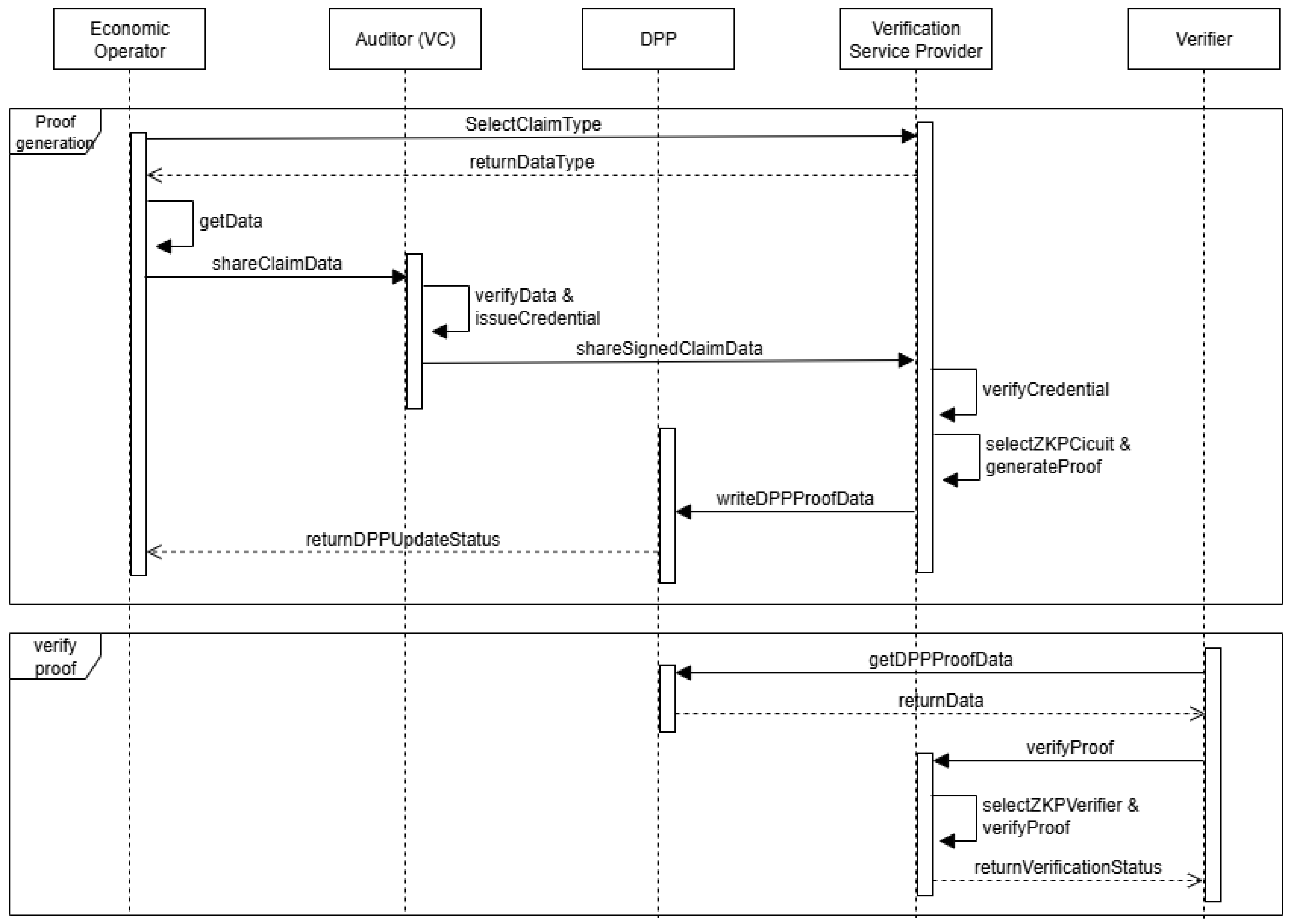
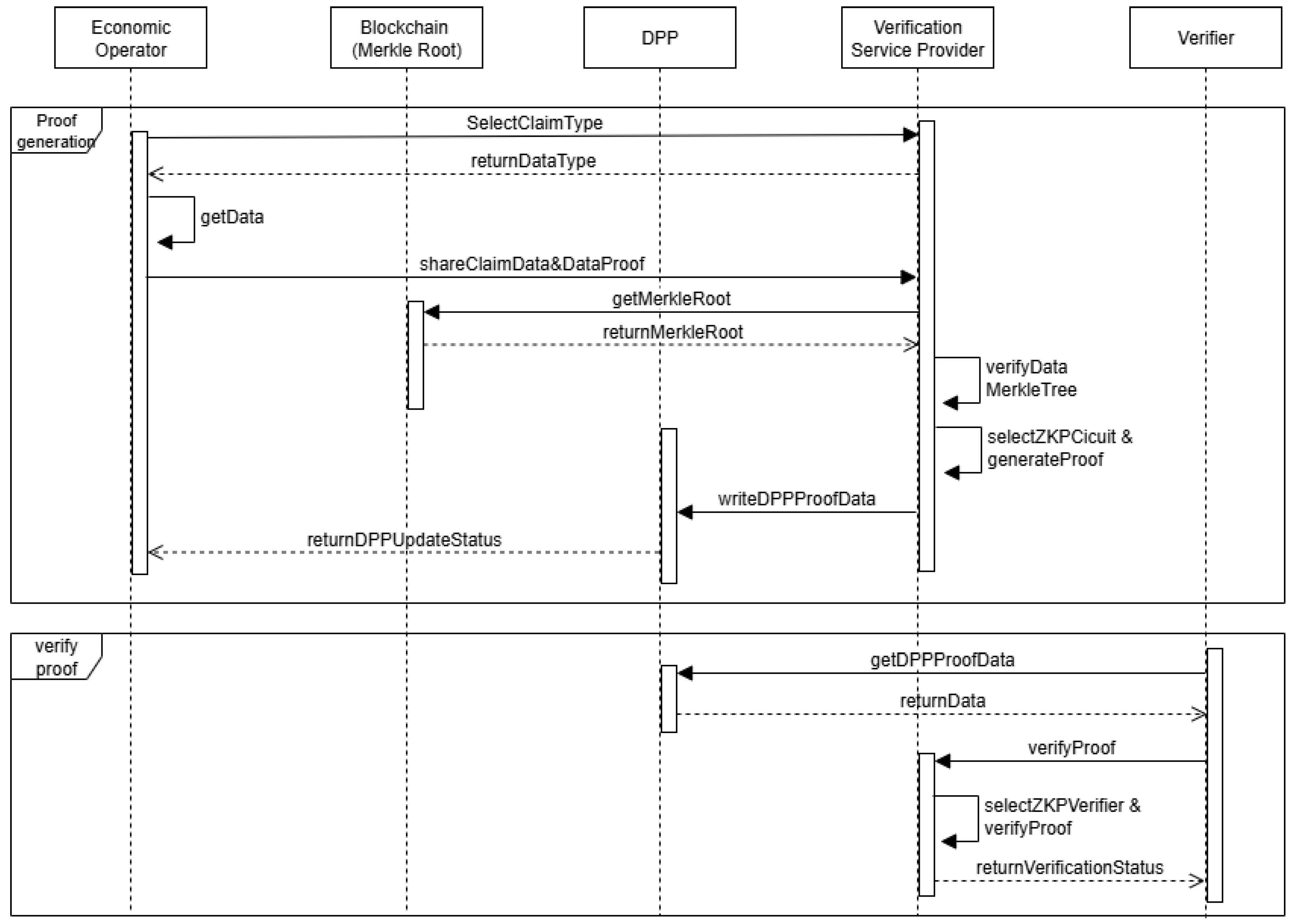
Section 5 outlines the interaction sequences for the relevant stakeholders and entities for the proof generation and verification lifecycle.
Section 6 shows the necessary algorithms for implementing the ZKP system for sustainability claim verifications.
Section 7 provides scenario-based experiments to evaluate the concepts developed in this paper.
Section 8 provides the discussions resulting from this work.
Section 9 provides the conclusion of this work, along with the limitations and future work.
6. ZKP Extensions Implementing Concepts
6.1. ZKP Circuit for Sustainability Claims
For sustainability claims in Equations (1)–(5), a separate zk-SNARK circuit has to be prepared for each of them to outline the signal conditions that satisfy the equation. In outlining the implementation concepts, this paper focuses on Equation (
3) to show the input signals, output signals, and mathematical conditions for realizing the equation in a circuit in a textile material production scenario.
The material composition circuits represent the ratio of a particular material and the summation of the list of all materials used in textile production. Each material input is provided in weight, and zero input is provided when a material in the list is not used in the textile product. Using a list of all possible materials protects the circuit’s signals from linking to a specific manufacturer’s input material list. Since direct divisions are not easily implemented in zk-SNARK circuits, the inverse of the total materials’ weight is also provided. The input total inverse is validated with a condition in the circuit that checks that the multiplication of the inverse total supplied and the total produced in the circuit results in 1. The zk-SNARK circuits are designed for integer calculations; hence, the decimal number produced by the inverse total is scaled using a factor
that ensures the number becomes an integer. The input inverse total validation becomes
. All arithmetic operations inside the zero-knowledge circuit are performed on the scaled integer values. Unit conversions and scaling are performed off-circuit and validated through externally issued verifiable credentials or standardized registries. The rest of the calculation follows basic arithmetic operations. The composition percentage, which is the output of the circuit, is the multiplication of the specific product weight and the validated inverse of the total weight. These are shown in the Circom code in
Listing 1.
All sustainability claim computations are implemented using fixed-point arithmetic to ensure compatibility with zero-knowledge circuits, which operate over finite fields and do not support floating-point numbers. Each real-valued quantity is encoded as an integer , where p is a globally agreed precision parameter. The precision parameter p is selected based on the semantic meaning of the quantity. For example, percentages are encoded with to preserve two decimal places, while emission factors are encoded with to allow micro-scale precision. Deterministic floor rounding is applied to avoid ambiguity across proof generators and to ensure circuit determinism.
To protect the variables in the circuit material composition, every possible material used in the product is mapped to an indexed ID, and the index number is used to represent the material on the circuit. The circuit template shown in
Listing 1 provides an easy-to-understand overview for the readers; however, the circuit simulation experiment performed in
Section 7 uses indexes to represent the materials in the circuit.
Listing 1.
CIRCOM CODE: Material Composition Circuit.
Listing 1.
CIRCOM CODE: Material Composition Circuit.
6.2. Verifiable Credential for ZKP Input Data Validation
The input data for proof generation can be verified by another party that issues a data credential to the party that makes the sustainability claim. The credential issuer can be a trusted entity (e.g., an auditor), another economic operator (e.g., a supplier), or a self-issued data credential by the economic operator that makes the sustainability claim (e.g., manufacturer).
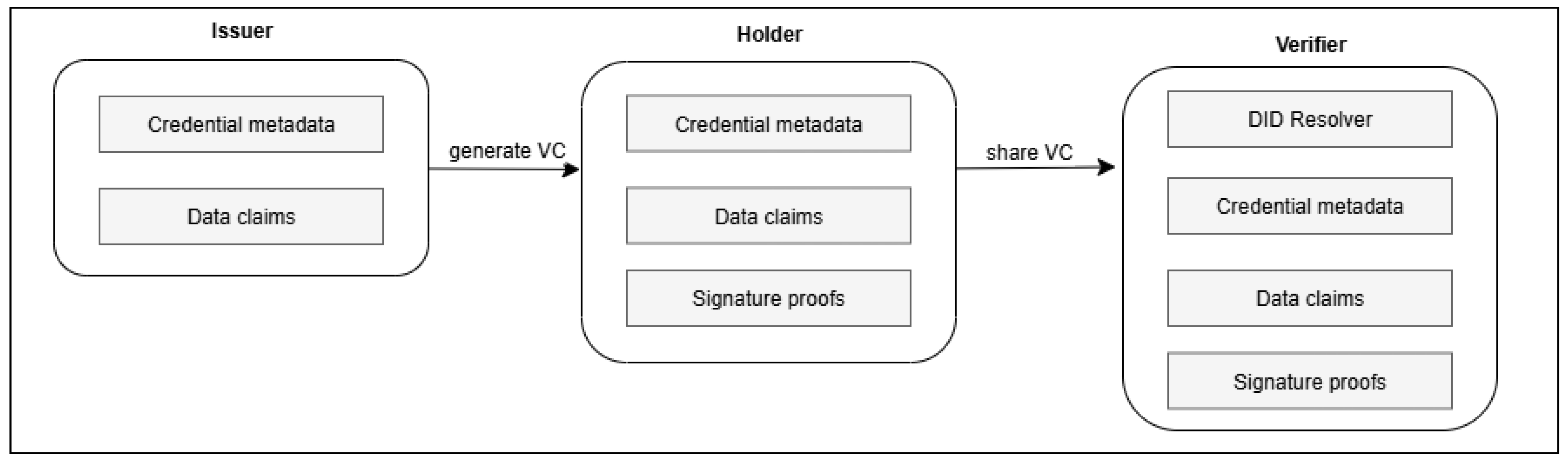
Figure 4 shows the changes in the credential structure as it moves from the issuer to the verifier. The core structure of the credential contains the credential metadata and the data claims. The metadata comprises the issuer DID, the subject (holder) DID address, and the type of credential. The data claims part consists of specific claims and values assigned to the claims, such as material type, material quantity, supply date, etc. The issuer of the credential signs all the claims in the credential. The product manufacturer aggregates all the credentials received from different suppliers using a verifiable presentation (VP), signs it, and shares the VP with a verifier. The verifier (which in this case is the entity that produces the proof) uses a DID resolver and associated DID document to verify the credentials before using the data in the VC for proof generation.
The credential example in
Listing 2 is expressed as a W3C verifiable credential (VC) payload This choice is motivated by compactness and ease of transport in DPP deployments. The same
credentialSubject claims can alternatively be represented using JSON-LD with Data Integrity proofs, without changing the ZKP design. DID-based verification follows standard DID resolution: the verifier resolves the issuer DID (
issuer_did) to obtain the issuer DID document, extracts the appropriate verification method (public key), and verifies the credential signature against that key material. Key rotation is handled by DID document updates according to the DID method and resolution rules. Credential revocation or suspension is handled via the VC
credentialStatus mechanism. In the workflow outlined in the paper, the proving/verifying service validates both the issuer signature and the credential status before accepting any credential-derived values as inputs to the ZKP circuit.
Listing 2.
JSON: Material supply credential.
Listing 2.
JSON: Material supply credential.
To use the credential structure provided in the JSON above for the circuit presented earlier, it is expected that the suppliers of the materials will provide credentials for the supply of cotton, wool, silk, and polyester with the following quantities: 3 tonnes, 2 tonnes, 5 tonnes, and 10 tonnes, respectively.
9. Conclusions
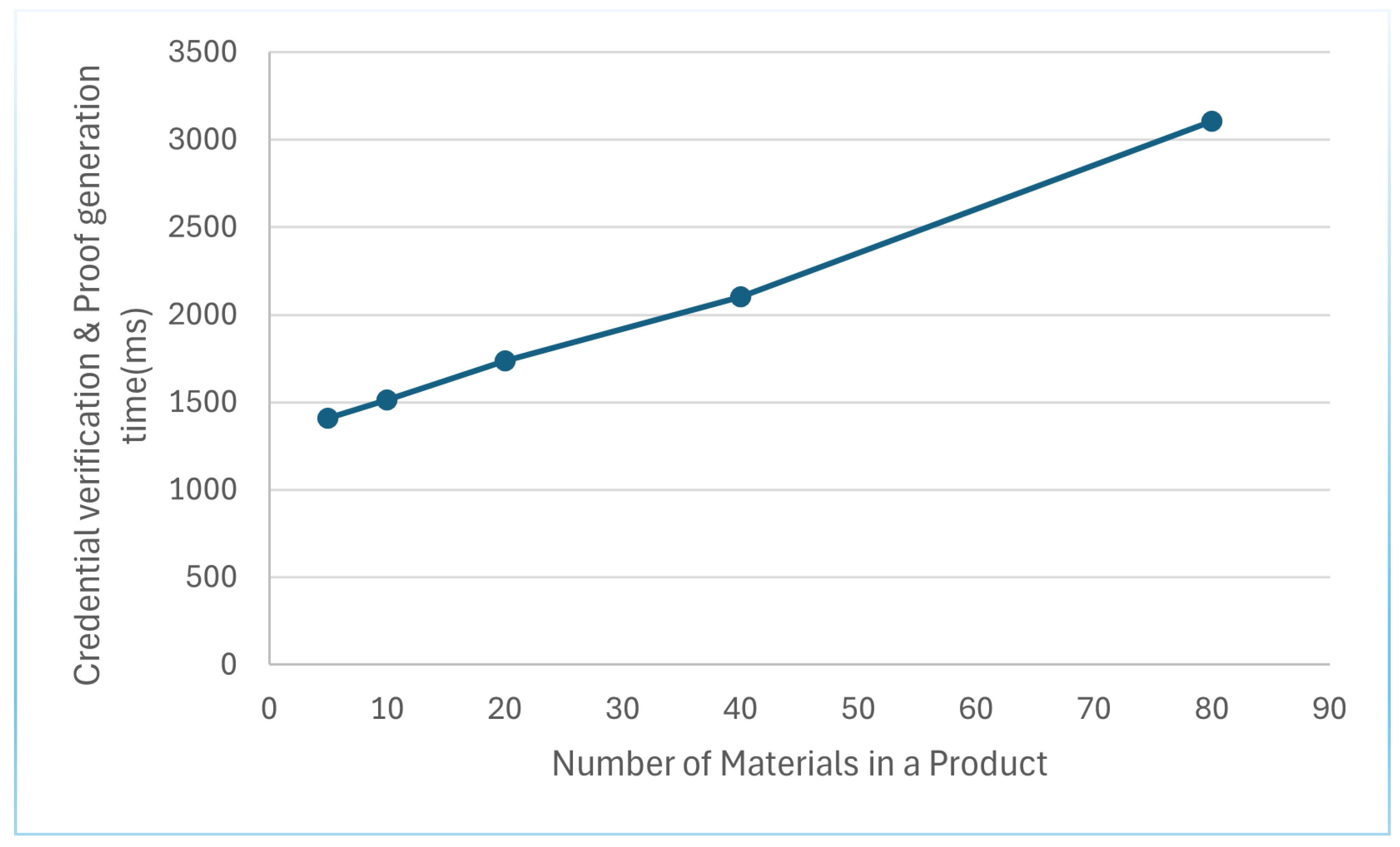
This work explored the application of ZKPs to extend the capabilities of DPP in presenting and verifying the sustainability claims in consumer products. Relevant sustainability claims were identified and formalized to identify necessary input and output data, useful for proof generation and verification. For instance, a range proof can be generated to show that the carbon footprint of a product is less than a specified amount. The actual amount of carbon footprint per product unit can also be presented as an output, whereas the input production activities used for their calculation are hidden from the public. The percentages of material composition or recycled content composition can be generated as the output of a proof, whereas other confidential materials and their compositions are protected from the public. A data matrix is presented for different sustainability claims, the data sources were also examined, and trust model scenarios for input data validation are presented. The validation of input data for proof generation is necessary to ensure trust in the generated proof; otherwise, the system faces a problem of “garbage input data, valid proof output”. The trust model shows different scenarios where manufacturers, other economic operators, and blockchain technologies play different roles in validating input supply chain data and generating trustable ZKP proofs. Furthermore, this work used sequence diagrams to show different components in the privacy-aware sustainability claims verification and the interactions necessary for proof generation and verification. Lastly, a SNARK circuit is used to provide a template for the proof generation schema of a sustainability claim, and a VC structure is used to present the schema for input data validation for the proof generation service. Scenario-based experiments are used to demonstrate the concepts developed in this paper by assessing the total time required to validate the proof input data and generate the proof of material composition.
This work has some limitations. First, the formalization of sustainability claims and circuit templates for the proof generation does not cover all the sustainability claims that can be represented in DPPs. Secondly, although this work provides template schemas for proof generation and input data validation, the output proofs have not been integrated into an actual DPP system to evaluate the performance and usability of the approach. The main future work that will evolve from the current work is a ZKP-based sustainability reporting tool, and will loosely integrate the proof presentation part into the DPP structure. The tool will expand the circuits to support different types of sustainability claims and enable automated proof generation for validated input data.