Article

STD: Sensor-Oriented Temporal Detector Against Multi-Type Load Redistribution Attacks in Smart Grid

1
Electric Power Dispatching and Control Center, Guizhou Power Grid Co., Ltd., Guiyang 550002, China
2
School of Computer Science, University of Bristol, Bristol BS8 1UB, UK
3
School of Information and Control Engineering, Qingdao University of Technology, Qingdao 266520, China
*
Author to whom correspondence should be addressed.
Electronics 2026, 15(4), 746; https://doi.org/10.3390/electronics15040746
Submission received: 16 December 2025 / Revised: 4 January 2026 / Accepted: 26 January 2026 / Published: 10 February 2026

Abstract

The modern smart grid integrates information and communication technology (ICT) with electronic devices, but this integration introduces cybersecurity risks. Load measurements, crucial for grid operation, are vulnerable to attacks, particularly Load Redistribution Attacks (LRAs). LRAs maliciously alter load readings to mislead control systems without being detected by conventional methods. This paper first introduces two advanced LRA variants: a stealthy-enhanced LRA designed to bypass sophisticated data-driven detectors, and an impact-enhanced LRA engineered to cause significant operational disruptions, such as increased generation costs. To address these evolving threats, we propose a novel Sensor-oriented Temporal Detector (STD). Unlike existing methods that often rely on aggregate data or labeled attack examples, our STD focuses on the unique temporal patterns of individual sensor measurements. It achieves this by combining principal subspace projection to identify normal data subspaces with sequential change extraction to detect subtle deviations over time. This approach allows the STD to identify various LRA types effectively, even without prior knowledge of attack signatures. Extensive simulations validate the destructive impact of our proposed LRA variants and demonstrate the superior detection performance of the STD against these sophisticated attacks.

1. Introduction

As a typical example of industrial digitalization, the smart grid relies heavily on information and communication technology (ICT) for data transmission and operation. This integration enables unprecedented efficiencies and supports the proliferation of distributed energy resources. However, the open communication network and the remote monitoring significantly increase the risk of cyberattacks from both external and internal adversaries [1]. The integrity of critical data and the stability of operational control are constantly continually under threat, as evidenced by incidents such as the BlackEnergy attack, which compromised power-system [2]. Recent years have witnessed a sharp escalation in cyberattacks targeting power grids worldwide, underscoring the persistent and growing risks to smart grid infrastructure. For instance, in May 2023, a coordinated cyber campaign struck 22 Danish energy companies in what became Denmark’s largest recorded cyber incident, exploiting vulnerabilities in decentralized grid components (David Kasabji, “Deep Dive into the May 2023 Cyber Attack on Danish Energy Infrastructure,” https://conscia.com/ie/blog/deep-dive-into-the-may-2023-cyber-attack-on-danish-energy-infrastructure/, accessed on 25 January 2026). In 2024, U.S. utilities experienced a nearly 70% surge in cyberattacks compared to 2023, with over 1100 incidents reported in the first eight months alone, according to Check Point Research (Check Point Research, “Cyber Attacks on Utilities Surge 70% in 2024,” https://www.reuters.com/technology/cybersecurity/cyberattacks-us-utilities-surged-70-this-year-says-check-point-2024-09-11/, accessed on 25 January 2026). Additionally, the U.S. Department of Energy documented at least 175 physical attacks or threats against critical grid infrastructure in 2023, highlighting the dual cyber-physical threat vector (U.S. Department of Energy, “Electric Disturbance Events (OE-417) Annual Summaries,” https://securethegrid.com/oe-417-database/, accessed on 25 January 2026). These developments, alongside ongoing state-sponsored probing and ransomware targeting European energy firms, emphasize the urgent need for advanced defenses against sophisticated threats, including those exploiting load measurements in modern smart grids. Particularly vulnerable is the ICT infrastructure on the load side, which is more easily penetrated by skilled attackers [3], making load measurements attractive targets for malicious manipulation.
The LRA is a prime example of such a cyberattack, specifically targeting load measurements. LRAs maliciously modify these measurements and redistribute loads while maintaining a constant total power consumption, thereby enabling them to bypass conventional Bad Data Detection (BDD) mechanisms [4]. While prior work has explored various LRA designs to enhance stealthiness against BDD [5,6,7], it has also introduced dummy data attacks to evade cluster-based and machine learning detectors [8]. Mohsenian-Rad and Leon-Garcia [9] laid the groundwork for understanding how adversaries could manipulate power consumption on a large scale by exploiting IoT-enabled devices. The core idea is that by coordinating synchronized load changes (e.g., turning devices on or off), attackers can disrupt the balance between power supply and demand, thereby impacting grid stability. This initial conceptualization established LRAs as a distinct and significant cyber threat to modern power systems. Lakshminarayana et al. [10] delve into the heightened vulnerability of power grids to LRAs, particularly under low-inertia conditions. This research was motivated by observations of load consumption patterns during events like the COVID-19 pandemic, where errors in Renewable Energy Source (RES) forecasting could exacerbate the effects of LRAs. Soleymani et al. [11] explore a crucial aspect of the attacker model: the ability to execute LRAs with limited knowledge of the power system. Specifically, this paper focuses on an (EV-oriented) LRA that constructs its attack vector based only on the grid’s frequency. Maleki et al. [12] provide an analytical framework to quantify the impact of LRAs specifically on distribution systems with ZIP loads. Ospina et al. [13] expand the understanding of LRA impacts beyond grid stability to energy market manipulation. This paper investigates how LRAs can affect locational marginal prices in distribution systems. The authors demonstrate that LRAs can propagate from targeted distribution systems to neighboring areas, causing substantial local increases in electricity prices.
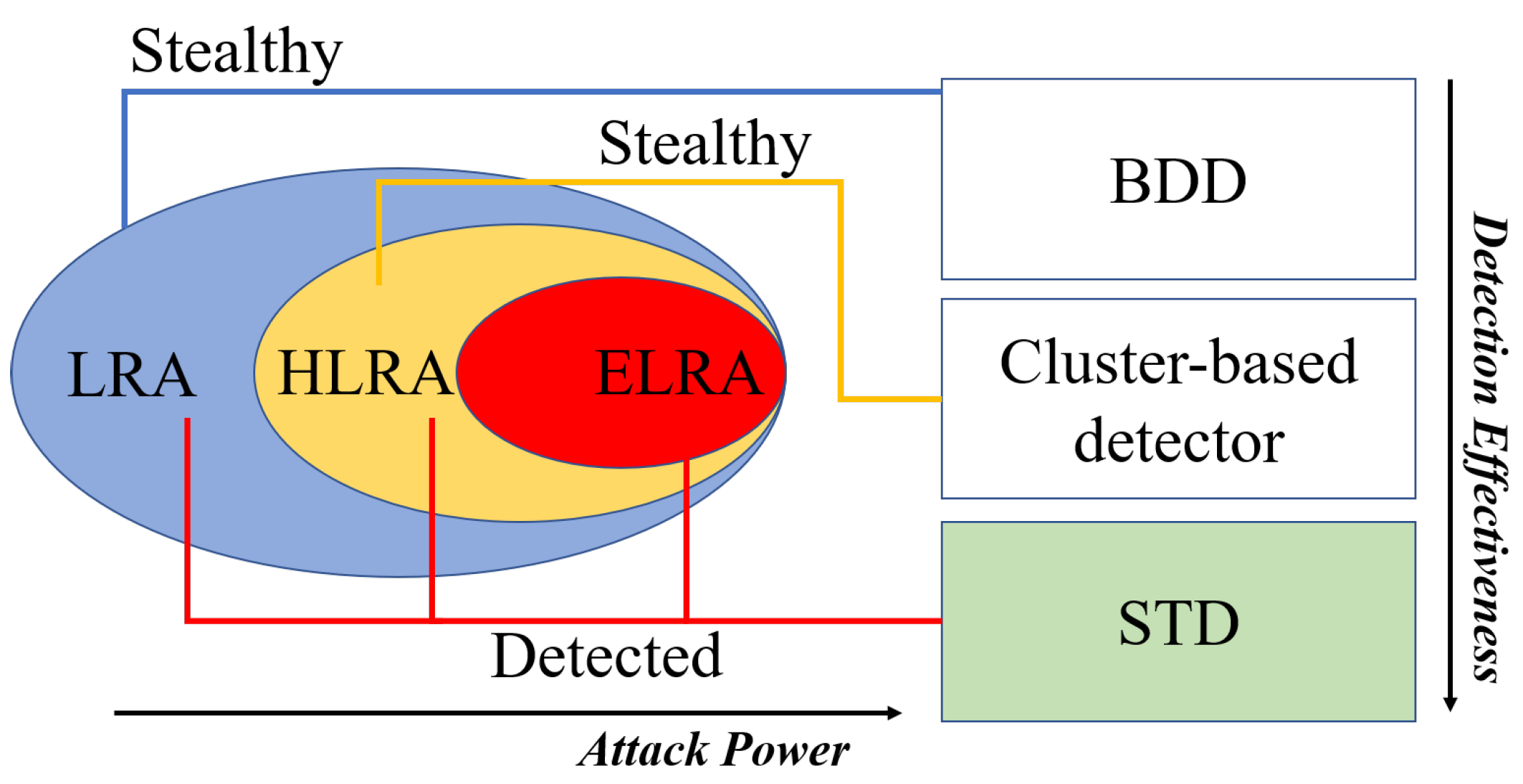
Current literature faces two primary challenges in comprehensively addressing LRAs. First, many existing LRA constructions, despite bypassing BDD, may still exhibit anomalous patterns detectable by more sophisticated, data-driven algorithms that exploit statistical or behavioral anomalies. A truly robust LRA needs to be inherently stealthy, not just against basic BDD, but also against these advanced detection methods that often rely on statistical properties of aggregated measurements. Second, a significant gap in existing LRA research is the emphasis on an attack’s actual impact on grid operations. Many LRAs are designed with stealth as the primary goal. Still, if an attack does not genuinely disrupt system operations—such as by increasing generation costs or compromising economic dispatch—its practical threat is diminished. Understanding how to design LRAs that are not only stealthy but also effective in causing tangible adverse effects remains an underexplored area. To be more clear, we provide Figure 1 to illustrate these issues.
In response to the growing sophistication of LRAs, various countermeasures have been proposed. These include model-based approaches like sliding mode observers [14] and low-rank Kalman filters [15] for detecting Load Alteration Attacks (LAAs), physics-informed machine learning algorithms for detection and localization [16], and control-based defenses [17]. Some methods leverage signal processing techniques like Fast Fourier Transform [18] or deep learning with PMU data [19] and even genetic algorithms for enhanced data management security [20]. However, these existing detectors also present several limitations. First, model-based detectors often require precise system models and global measurement vectors (i.e., all sensor measurements) as input, which can be challenging to obtain, maintain, and computationally intensive in dynamic, large-scale smart grids. These approaches may also overlook localized, subtle anomalies. Second, many data-driven and machine learning-based detectors necessitate labeled attack data for training, which is typically scarce, difficult to acquire, and may not encompass the full spectrum of evolving attack types. Third, most current detectors focus on the overall system state or aggregate deviations. They tend to overlook the unique temporal characteristics and dynamic features inherent in measurements from individual sensors, which can be critical indicators of an LRA, even when global aggregated measurements appear normal.
Therefore, this paper aims to address these critical challenges by proposing a two-fold investigation. First, we introduce novel stealthy-enhanced LRAs and impact-enhanced LRAs to thoroughly investigate advanced attack vectors that are designed to bypass not only BDD but also data-driven detectors, and to demonstrate significant operational disruption, respectively. Second, and as our core contribution, we develop a novel sensor-oriented temporal detector (STD). The STD is designed to effectively identify these multi-type attacks by uniquely exploiting the temporal relationships of individual sensor measurements through a combination of principal subspace projection and sequential change extraction, all without requiring labeled attack data. The goal is to provide a more robust and responsive detection mechanism against sophisticated load redistribution attacks in smart grids.
Therefore, in this paper, we propose a stealthiness-enhanced and an effectiveness-enhanced LRA, and develop a sensor-oriented temporal detector (STD) to detect these attacks. For constructing a more powerful LRA, our idea lies in the fact that many recent detectors exploit clusters to distinguish attacks, and that the LRA fails to affect the system’s operation if it is not designed to cause system loss, except for its stealthiness. For detecting the LRA, we observe that the measurements of an individual sensor are changed in an unreasonable manner, although the LRA is stealthy against the BDD. The abnormal change in the measurements of a separate sensor is typically ignored by the BDD and other detectors, which use the norm of measurement deviations of all sensors. The goal of this paper is to address the issues mentioned above. In summary, our contributions are as follows:
  • We propose two LRA types that enhance stealthiness in bypassing cluster-based detectors and increase effectiveness in raising the generation cost.
  • We develop a sensor-oriented temporal detector (STD) by combining the principal subspace projection and the sequential change extraction.
  • We conduct extensive simulations to analyze the impact of the attack and the detection performance of STD.
The remainder of this paper is organized as follows. Section 2 introduces the system model and the LRA models. The sensor-oriented temporal detector is presented in Section 3. Section 4 provides the simulation results. Section 5 concludes the paper.

2. System Model and Load Redistribution Attack

In this section, we first introduce the power flow model and provide background on the power system. Then, we introduce three types of load redistribution attack (LRA). The general LRA is designed to bypass the bad data detection (BDD). The hidden LRA (HLRA) is hidden from the BDD and the cluster-based detector. The effective LRA (ELRA) considers the effectiveness of the LRA and HLRA to cause an increase in the generation cost. The attack’s impact is becoming increasingly powerful with LRA, HLRA, and ELRA.

2.1. Power Flow Model

The power flow model represents the physical law of the transmission network. Here we assume that the network consists of a set { 1 , 2 , , n + 1 } of buses (bus 1 is the reference bus) and a set { T 1 , T 2 , , T m } of transmission lines. Given each line T k , it starts from the bus i and ends at the bus j. The line-bus incidence matrix A R m × ( n + 1 ) is formulated as
A k i = 1 , The line T k starts from bus i ; 1 , The line T k ends at bus i ; 0 , otherwise ,
where A k i is the element of A at the position ( k , i ) . Since the first bus is regarded as the reference bus, the first column of A is usually eliminated. The new A R m × n (Here we do not use a new symbol for simplification) is used in the following. We do not change the notation to make it easy to follow. The diagonal susceptance matrix is D R m × m , whose element at the position ( k , k ) is the susceptance of line T k . Therefore, the invertible symmetric admittance matrix is derived as B = A T D A and the line-bus shift factor matrix is S = D A . Except for the reference bus, the power generations of the buses form a vector p g (if bus i is not a generator, then the ith element of p g is 0). The power loads of the buses form a vector p l (if bus i is not a load, then the ith element of p l is 0). Hence, the vector of power injections is p = p g p l . With the DC power flow model [21], we can derive that
f = D A B 1 p ,
where f is a vector of power flows corresponding to the transmission lines (each line has a power flow measurement in the positive direction).

2.2. Load Redistribution Attack

Given the vulnerabilities of communication networks and smart sensors, load measurements can be compromised by both internal and external attackers. The LRA is a typical attack that maliciously modifies the load measurements and remains stealthy. The stealthiness is guaranteed by maintaining the following equations
1 T Δ p l = 0
σ p l | Δ p l | σ p l , σ [ 0 , 1 ]
Δ f = D A B 1 Δ p l ,
Δ p g = 0 ,
where Δ p l , Δ f , and  Δ p g are vectors of injected errors into the load measurements, power flow measurements, and generation measurements, 1 R n is a vector with all elements equal to 1 and 0 R m is a vector with all elements equal to 0. The constraint (3) indicates that the sum of the injected errors into the load measurements is 0. The injected errors are carefully balanced to be stealthy. The constraint (4) limits the injected errors for the load measurements. The constraint (5) ensures that the injected errors adhere to the DC model (2), which is crucial for maintaining the stealthiness of the attack (i.e., LRA). According to [4], we can prove that the LRA can bypass the bad data detection (BDD), and thus realize a stealthy attack.

2.3. Hidden LRA

Although the LRA is stealthy against BDD, it might be detected by cluster-based data-driven detectors [22]. By minimizing the distance between the modified measurement and the historical measurements, we can effectively conceal the measurement within the normal measurements. The attacked measurement is treated as normal with the Principal Component Analysis (PCA) distance [23]. The following problem is formulated to compute a malicious measurement z for the hidden load redistribution attack (HLRA):
min z z z 1 + z z 2 + + z z ω
s . t . ( 3 ) ( 6 )
Δ f i / f i max > δ i , 1 i m ,
z = z + [ Δ p l ; Δ f ] ,
where the constraint (9) is used to limit the error injected into the power flow measurement, and  δ i is the threshold for limiting the change in Δ f i . The objective is to minimize the distance between the target measurement and the historical measurements. The length ω depends on the system dynamics. As the system loads usually change in a periodic manner (daily, monthly, or seasonal), the  ω is less than the cycle time.

2.4. Effective LRA

Although the LRA and HLRA are stealthy, they might be ineffective in disrupting the system’s operation. Therefore, an effective load redistribution attack (ELRA) must be designed. The main idea is to consider the impact of LRA on the grid’s operation when planning the attack. For example, we believe the additional generation cost incurred by LRA. If the generation cost increases after the attack, then the LRA is effective; otherwise, the LRA fails.
The security-constrained DC optimal power flow (SC-DCOPF) is used to compute the generation cost. Therefore, we compare the generation cost before and after the LRA. The SC-DCOPF is formulated by
C 0 = argmin p g C ( p g )
s . t . p ̲ g p g p ¯ g ,
f max D A B 1 p f max ,
1 T p g = 1 T p l ,
where C ( p g ) is a cost function and usually in a quadratic form (for example, C ( p g ) = π 1 T p g π 1 + π 2 T p g + π 3 , where π 1 and π 2 are vectors and π 3 is a constant.), p ̲ g and p ¯ g are the lower and upper limits of power injections, and  f max is the positive congested power flows of transmission lines. Once the load profile is determined, the SC-DCOPF is used to compute the generation cost. Without the LRA, the generation cost is C 0 . With the LRA, the generation cost might be changed. The generation cost after the LRA is formulated by
C ˜ = argmin p ˜ g C ( p ˜ g )
s . t . p ̲ g p ˜ g p ¯ g ,
f max D A B 1 p ˜ f max ,
1 T p ˜ g = 1 T p ˜ l ,
( 3 ) ( 6 )
where p ˜ l = p l + Δ p l and p ˜ = p g p ˜ l . Therefore, the LRA is effective if C ˜ C 0 > 0 . For the HLRA, it is effective by solving the following optimization problem:
C ˜ = argmin p ˜ g C ( p ˜ g )
s . t . ( 7 ) ( 10 ) , ( 16 ) ( 18 )
The HLRA is effective if C ˜ C 0 > 0 .
While LRAs are a known cyber threat, their efficacy is often limited by existing defense mechanisms. Our work introduces Hidden LRA (HLRA) and Effective LRA (ELRA), which are not fundamentally new attack vectors but rather advanced iterations of the LRA. HLRA is meticulously designed to bypass traditional bad data detection (BDD) and cluster-based data-driven detectors by minimizing its deviation from historical measurement patterns. ELRA further enhances this by ensuring the attack causes a significant and quantifiable increase in generation costs, thereby demonstrating a more impactful and economically damaging threat. These enhanced LRA models are specifically crafted to succeed where simpler LRAs might fail against current defense strategies.
In response to this evolving threat landscape, we propose the Sensor-oriented Temporal Detector (STD). Unlike conventional methods that often treat sensor measurements as static vectors or rely on aggregated data, STD leverages the dynamic, temporal characteristics of individual sensor measurements. By combining principal subspace projection with sequential change extraction, STD is designed to identify subtle anomalies that stealthier attacks, such as HLRA and ELRA, introduce into the system. Our comprehensive simulations demonstrate STD’s superior performance in detecting not only general LRAs but critically, also these advanced HLRA and ELRA variants, highlighting its robustness against more sophisticated attack strategies where existing detectors often fall short. This integrated approach allows for a rigorous assessment of both the enhanced attack models as realistic threats and the robust capabilities of our proposed detection method.

3. Sensor-Oriented Attack Detection

Most existing approaches detect the measurement modification attacks from a statistical perspective. This will ignore the specific dynamics of each sensor and the structural information. Therefore, the sensor-oriented attack detection can be more effective. More importantly, the detector is designed in an unsupervised form. The labelled abnormal data is not required since it cannot be comprehensively and well generated.The attack-defense relationship is given in Figure 2.
For each sensor, its measurements change in response to the system dynamics. As a time series data, the sensor measurements of the load or power flow sensor are denoted by M = { m 1 , m 2 , m 3 , , m i , m i + 1 , } , where m i is a load or power flow measurement. Given a lag parameter L, the subseries is formed by
m i = [ m i + 1 m i , m i + 2 m i + 1 , , m i + L m i + L 1 ] = [ Δ m i , Δ m i + 1 , , Δ m L ] .
This measurement vector is typically referred to as the lag vector. Suppose there are H lag vectors. Then, for  j > H , we can construct a measurement matrix as
M = m j H + 1 m j H + 2 m j = Δ m j H + 1 Δ m j H + 2 Δ m j Δ m j H + 2 Δ m j H + 3 Δ m j + 1 Δ m j H + L Δ m j H + L + 1 Δ m G ,
where G is the length of the time series data. The covariance matrix is M ¯ = M M T . We can conduct the singular value decomposition (SVD) on M ¯ . The eigenvectors of M ¯ are obtained as v 1 , v 2 , ⋯, v L . The principal eigenvalues of M ¯ can be derived with SVD. Suppose there are k principal eigenvalues. The eigenvectors corresponding to these principle eigenvalues are v 1 , v 2 , ⋯, v k . These eigenvectors form a matrix V .
Considering the system dynamics, time is a critical factor in defining the data characteristics. As the lag vectors are time-stamped, we compute the weighted mean in the following way.
x = s = j H + 1 j e ( s j ) i = j H + 1 j e ( i j ) m s ,
where x is the weighted mean of the lag vectors. With the matrix V , we can obtain a projection matrix like P = V ( V T V ) 1 V T . Using the projection matrix, the cluster center is computed by
x ˜ = P x .
Therefore, the abnormal measurement can be captured by the distance between the measured vector and the cluster center. That is, given the current lag vector m t of measurements, we compute the distance by
D = P m t x ˜ .
A threshold δ is predefined to determine whether there are abnormal measurements in m t or not. The theory given in [24] said that the normal measurements are contained in the subspace L v spanned by V . Therefore, in the normal case, the distance D is small. However, this is a rough detection since the temporal characteristic is not taken into account. In other words, although the lag vector formed by the measurements is contained in the subspace L v , it is not normal since the measurements are not normal at the time. An example is the replace attack, the attacker replaced m H with m 1 (both m 1 and m H are contained by the subspace L v ) to bypass the detection with (26). Therefore, except for distance detection, we develop a spectral method to detect abnormal measurements.
The spectral is defined as
S t = { m t m t 1 , m t 1 m t 2 , , m t H + 2 m t H + 1 } , S t 1 = { m t 1 m t 2 , m t 2 m t 3 , , m t H + 1 m t H } .
Then, the dynamic time warping (DTW) is used to compute the distance between S t and S t 1 . For easy understanding, we denote S t and S t 1 as
S t = { Δ m 1 t , Δ m 2 t , , Δ m H t } , S t 1 = { Δ m 1 t 1 , Δ m 2 t 1 , , Δ m H t 1 } .
The alignment cost is computed by evaluating each cost cell. The cost cell is calculated as
D ( i , j ) = d ( i , j ) + D ( i 1 , j ) d ( i , j ) + D ( i 1 , j 1 ) d ( i , j ) + D ( i , j 1 )
where D ( i , j ) is the value at the position ( i , j ) of the cost matrix D and d ( i , j ) is the distance between m i t and m j t 1 . The result D ( | S t | , | S t 1 | ) (i.e., D ( H , H ) ) indicates the dissimilarity between the sequences S t and S t 1 , where | | is the size of the set. Therefore, the sensor-oriented temporal detector is formulated as
D t m p = δ 1 D + δ 2 D ( H , H ) ,
where δ 1 and δ 2 are coefficients to trade-off the distance. The details of the sensor-oriented temporal detector (STD) are given in Algorithm 1. Given a measurement vector m t , the abnormal indicator is
D t m p φ , Normal D t m p > φ , Abnormal
where φ is the threshold for detecting the abnormal measurement. The theoretical complexity for a single detection step is O ( H 2 L ) . Given that L and H are typically much smaller than N (the total data length) and are constant parameters for the detector, the per-sample detection is efficient. For a total of N samples, the total complexity would be O ( N H 2 L ) . The per-sample (per-sensor, per-time-step) computational complexity of STD is dominated by the SVD on the lag vector matrix (size L × H ), yielding O ( H 2 L ) in the training phase and similar for online updates with incremental SVD approximations. Here, L is the lag parameter (dimension of each difference vector). H is the sliding window size (number of lag vectors).
Algorithm 1 Sensor-oriented temporal detector (STD)
  1:
function STD(The measurement matrix M , the current measurement m t )
  2:
    Compute the eigenvectors v 1 , v 2 , ⋯, v L and form the eigenvector matrix V of M T M with SVD
  3:
    Compute the projection matrix P = V ( V T V ) 1 V T
  4:
    Compute the weighted mean x = j = 1 H e ( j H ) m j
  5:
    Compute the distance D = P m t P x
  6:
     D ( 0 , 0 ) 0
  7:
    for  i = 1 to H do
  8:
        for  j = 1 to H do
  9:
              d ( i , j ) Δ m i t Δ m j t
10:
              D ( i , j ) d ( i , j ) + min D ( i 1 , j ) , D ( i , j 1 ) , D ( i 1 , j 1 )
11:
        end for
12:
    end for
13:
    Compute D t m p = δ 1 D + δ 2 D ( H , H )
14:
    return  D t m p
15:
end function
The parameters are selected according to the following. The key parameters in STD-subspace dimension k, weighting ratio δ 1 / δ 2 , and detection threshold φ are selected based on standard practices in subspace-based anomaly detection and statistical properties of normal data, while ensuring robust performance across varying conditions.
The subspace dimension k is determined using the cumulative explained variance ratio from the eigenvalues obtained via SVD on the lag vector matrix. Specifically, k is chosen such that the principal subspace captures at least 95% of the total variance in normal historical measurements:
k = min d i = 1 d λ i i = 1 L λ i 0.95 ,
where λ i are the sorted eigenvalues. This threshold is a common heuristic in PCA-based methods for retaining the dominant normal patterns while projecting subtle anomalies into the residual space, as supported by extensive literature on subspace anomaly detection in power systems and time series data.
The weighting factors δ 1 and δ 2 (with ratio δ 1 / δ 2 ) balance the contributions of projection residuals and sequential DTW changes in the combined anomaly score. We set δ 1 / δ 2 = 1 (equal weighting) as a baseline, which empirically provides stable performance, reflecting the complementary nature of spatial (subspace) and temporal (DTW) deviations under LRAs.
The detection threshold φ is statistically derived from the distribution of anomaly scores on attack-free training data. Specifically, φ = μ ¯ + 3 σ ¯ , where μ ¯ and σ ¯ are the mean and standard deviation of normal scores, corresponding to a false positive rate below 0.3% under Gaussian assumptions (common for residual-based detectors).
To demonstrate robustness, we conducted a sensitivity analysis on the IEEE 14-bus test system. Varying k via explained variance thresholds (90–99%) yields detection rates above 98% for all LRA variants, with minimal variation (±1.2% in F1-score). Adjusting the weighting ratio from 0.5 to 2 changes the F1-score by less than 2.5%, confirming insensitivity. For φ , scaling the multiplier trades recall for precision predictably, maintaining overall F1-scores above 97%. These results affirm that STD’s performance is stable across reasonable parameter ranges, enhancing reproducibility.


4. Simulation Results

In the following, we conduct extensive simulation results to analyze the impact of LRA, HLRA, and ELRA, and evaluate the performance of STD. The tested power system and data are from real-world scenarios.

4.1. Settings

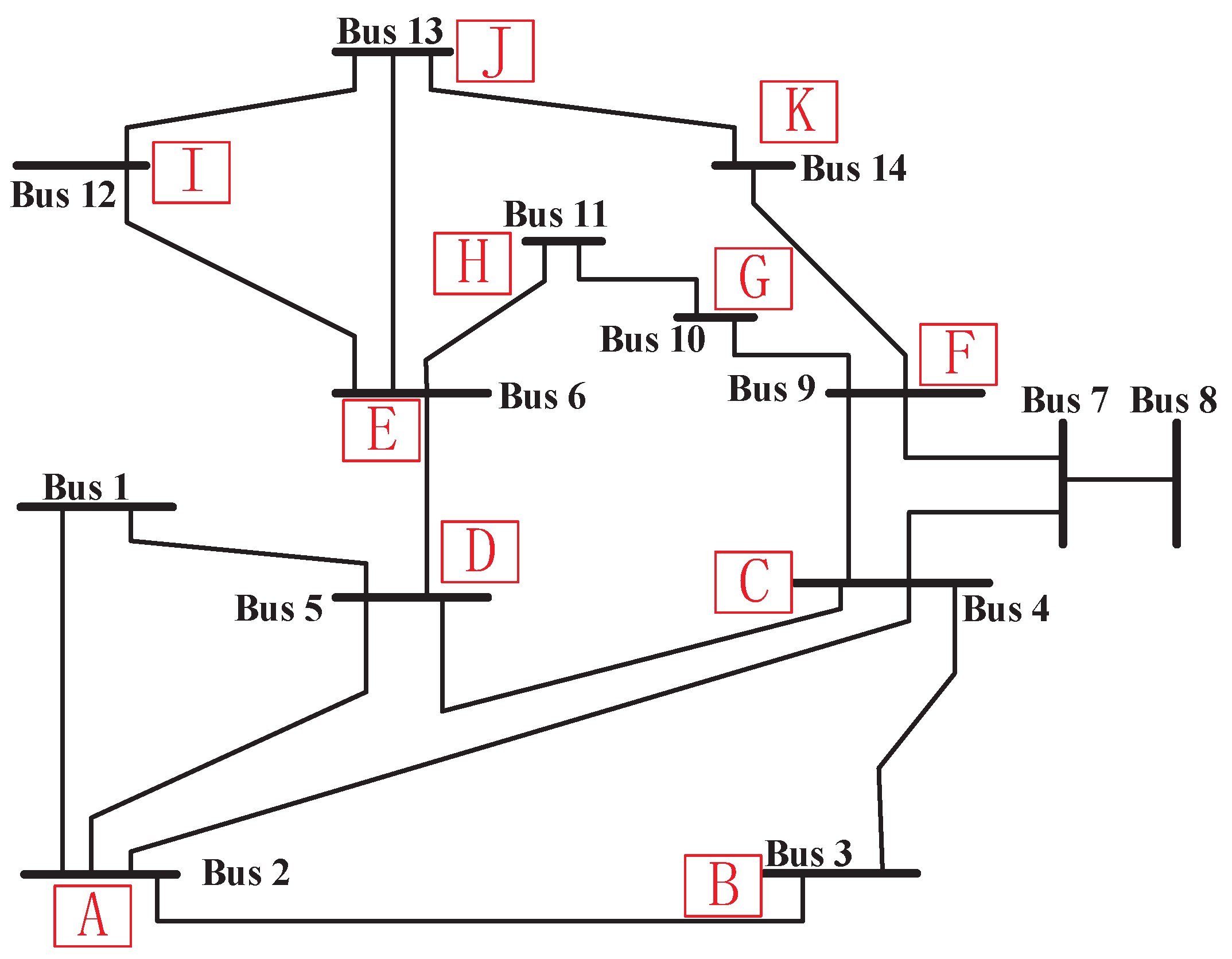
The test power system is extracted from the MATPOWER (MATPOWER, https://matpower.org/, accessed on: 30 December 2025). It is claimed that the practical power systems justify the test cases from MATPOWER. For example, the IEEE 14-bus power system is a model from the American Electric Power System (in the Midwestern US) (14-Bus System (IEEE Test Case), https://al-roomi.org/power-flow/14-bus-system, accessed on: 30 December 2025). Therefore, the IEEE 14-bus power system is used in this paper, as shown in Figure 3.
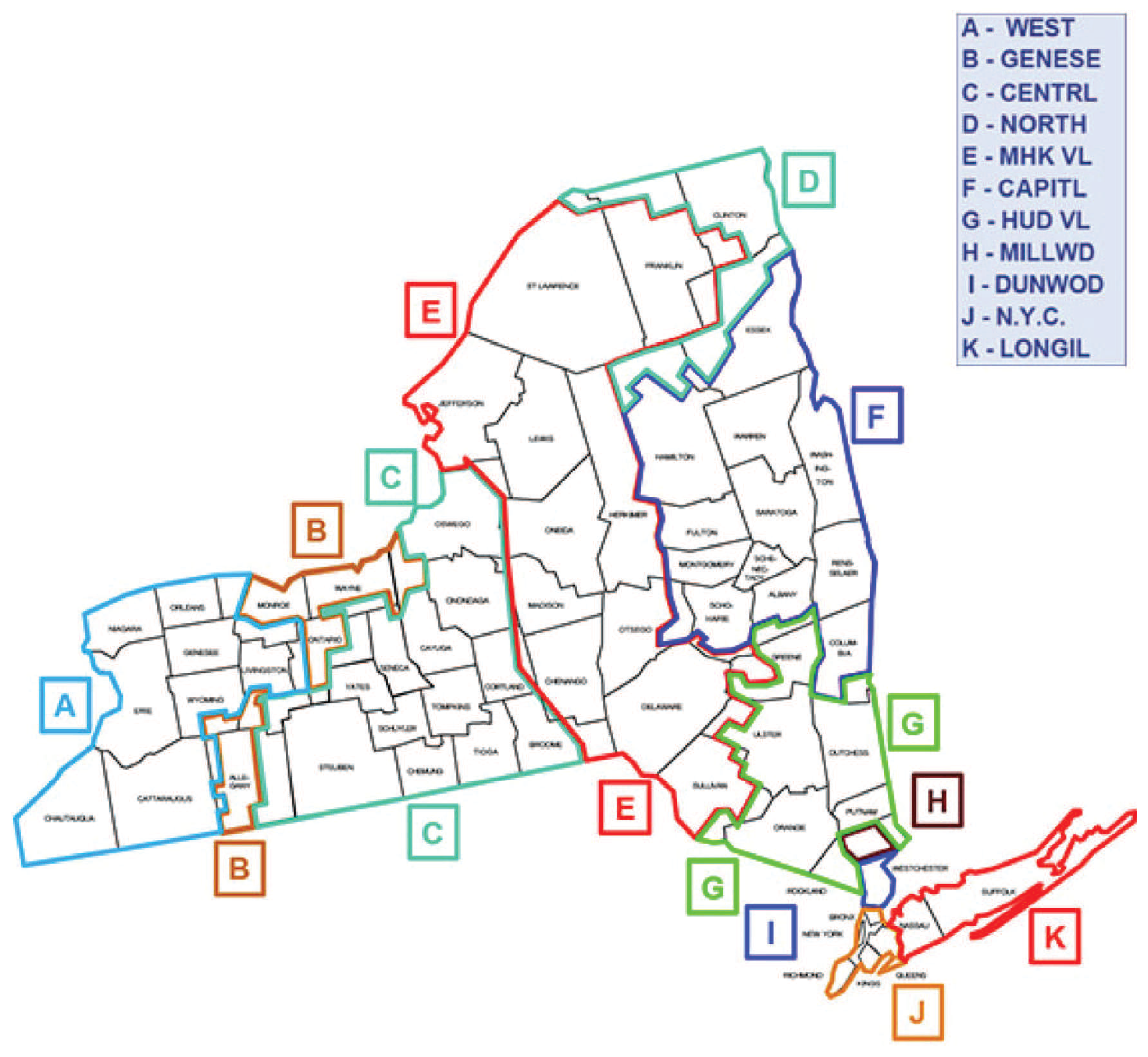
Moreover, the power loads from the New York Independent System Operator (NYISO) (Load Data, https://www.nyiso.com/load-data, accessed on: 30 December 2025). The loads are collected every five minutes from 11 areas. These areas are shown in Figure 4. These areas correspond to the buses given in Figure 3. That is, these areas correspond to bus 2 (A), bus 3 (B), bus 4 (C), bus 5 (D), bus 6 (E), bus 9 (F), bus 10 (G), bus 11 (H), bus 12 (I), bus 13 (J), and bus 14 (K). We inject these real-world loads into the IEEE 14-bus power system. The loads were collected in February 2021.
The simulation tool is MATLAB 2019b, and all codes are written with this scripting language. The computation device is a laptop equipped with an 11th Gen Intel(R) Core(TM) i7-1165G7 processor, which operates at 2.80 GHz, and features 32 GB of RAM.

4.2. Analysis of the Attack Impact

The injected errors for executing the LRA are constructed according to the methods given in Section 2. The choice of σ and other parameters ( ω , δ i ) during simulations dictates the specific characteristics and magnitude of these computed injected errors.

4.2.1. Attack Design

The attack is constructed based on the load measurements collected from the NYISO. For each data point, the LRA is built according to (3)–(6). The parameter σ is set as 0.1, 0.2, 0.3, 0.4, and 0.5. The HLRA is constructed according to (7)–(10). The parameter σ is also set as 0.1, 0.2, 0.3, 0.4, and 0.5. The power flow limitation parameter δ i is set as 1.2 for all power flows. The length ω of the historical measurements is set as 20, 30, and 40. The ELRA with LRA is constructed according to (15)–(19) while the ELRA with HLRA is built according to (20) and (21). The parameters for designing ELRA are given in Table 1 and Table 2. The objective function for computing the generation cost is as C ( x ) = a x 2 + b x + c .

4.2.2. Attack Impact

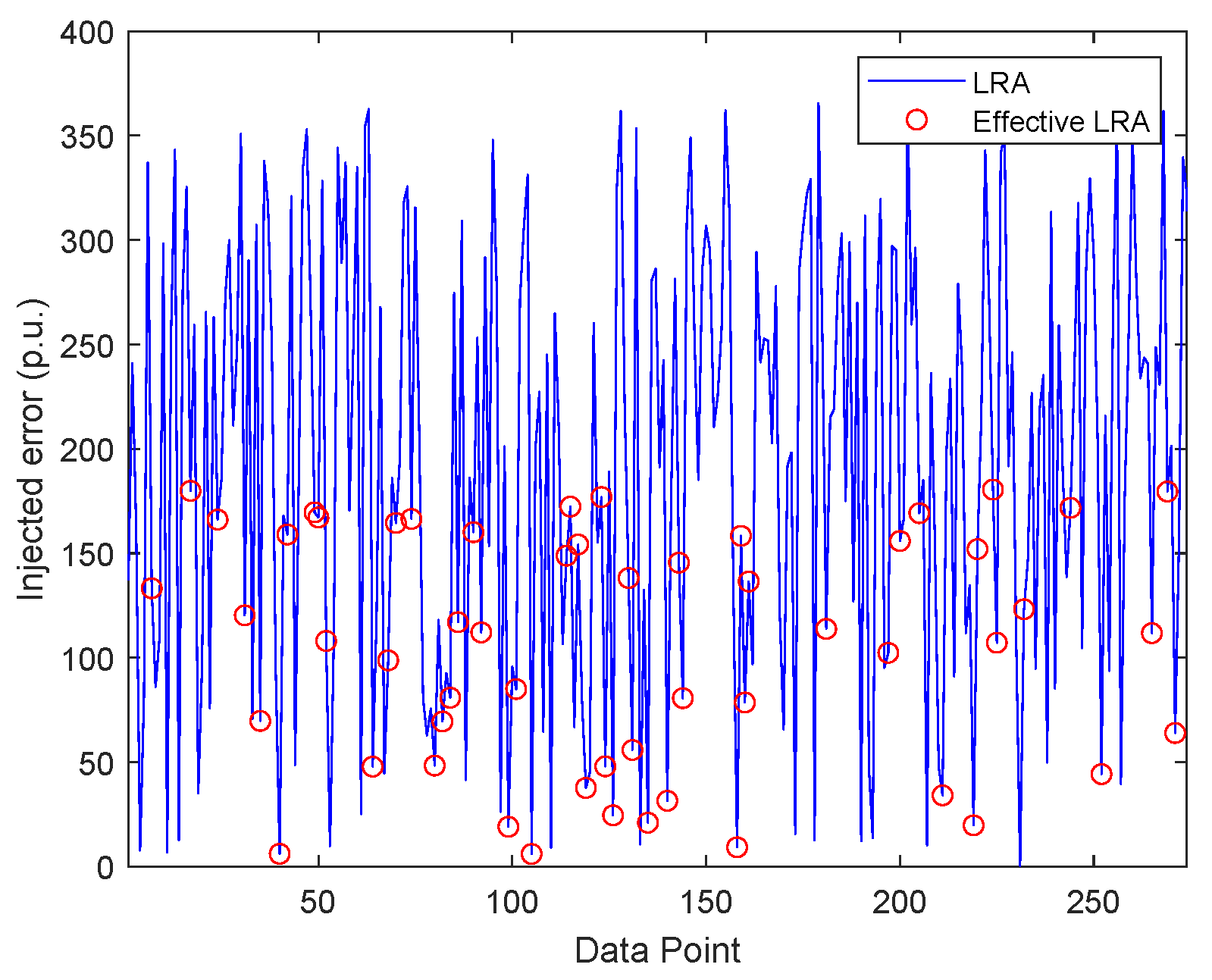
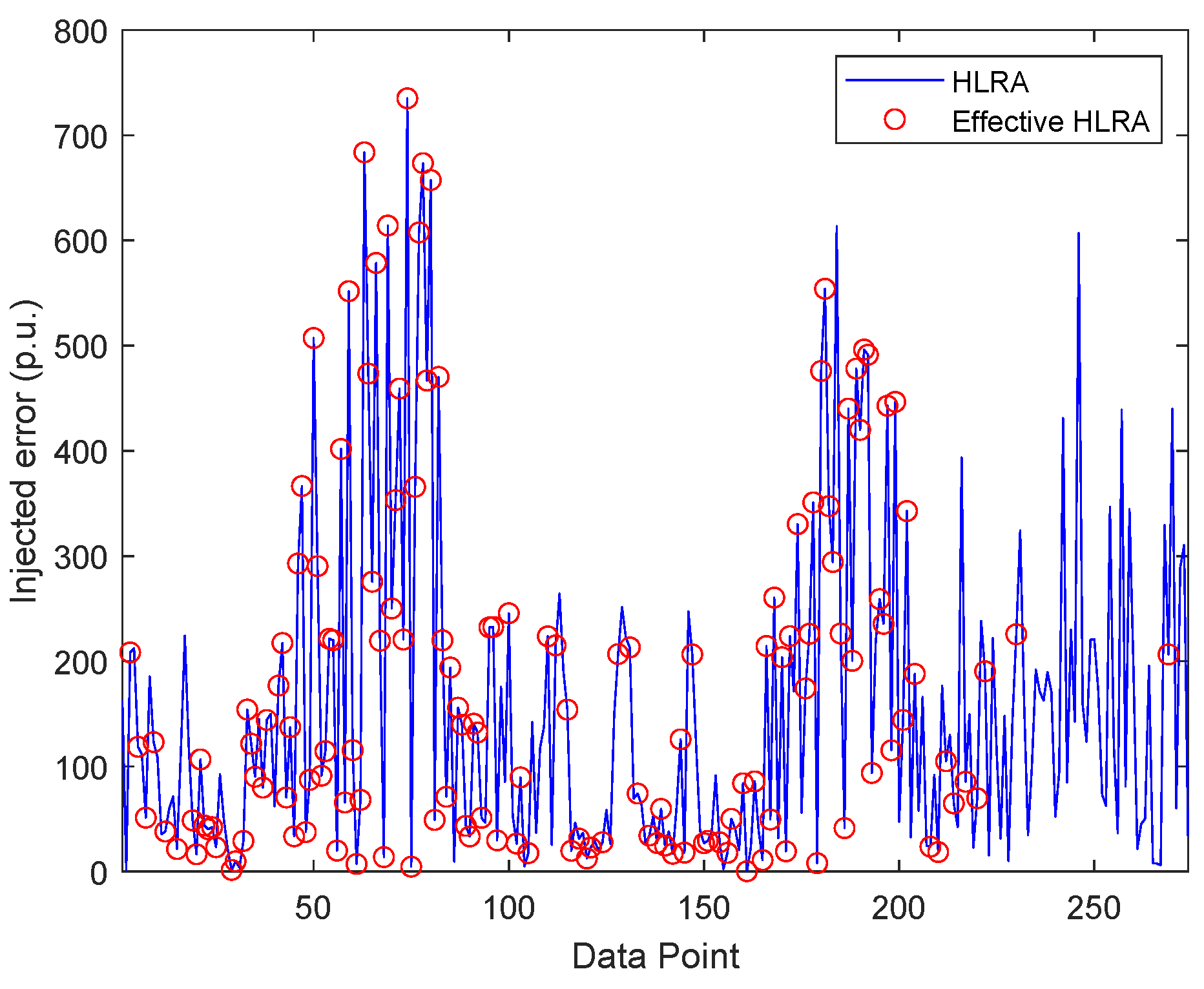
First, we show the injected error in the load measurements. Actually, the parameter σ is used to limit the size of the injected error. Here, we aim to identify the differences in the injected errors between the LRA and the effective LRA (and also between the HLRA and the effective HLRA). The results are shown in Figure 5 and Figure 6. The figures present the injected error of the load measurement of bus 2. We find that there is no specific relationship between the injected error and the effectiveness of the attack. Therefore, the effectiveness of LRA and HLRA is not related to the size of the injected error.
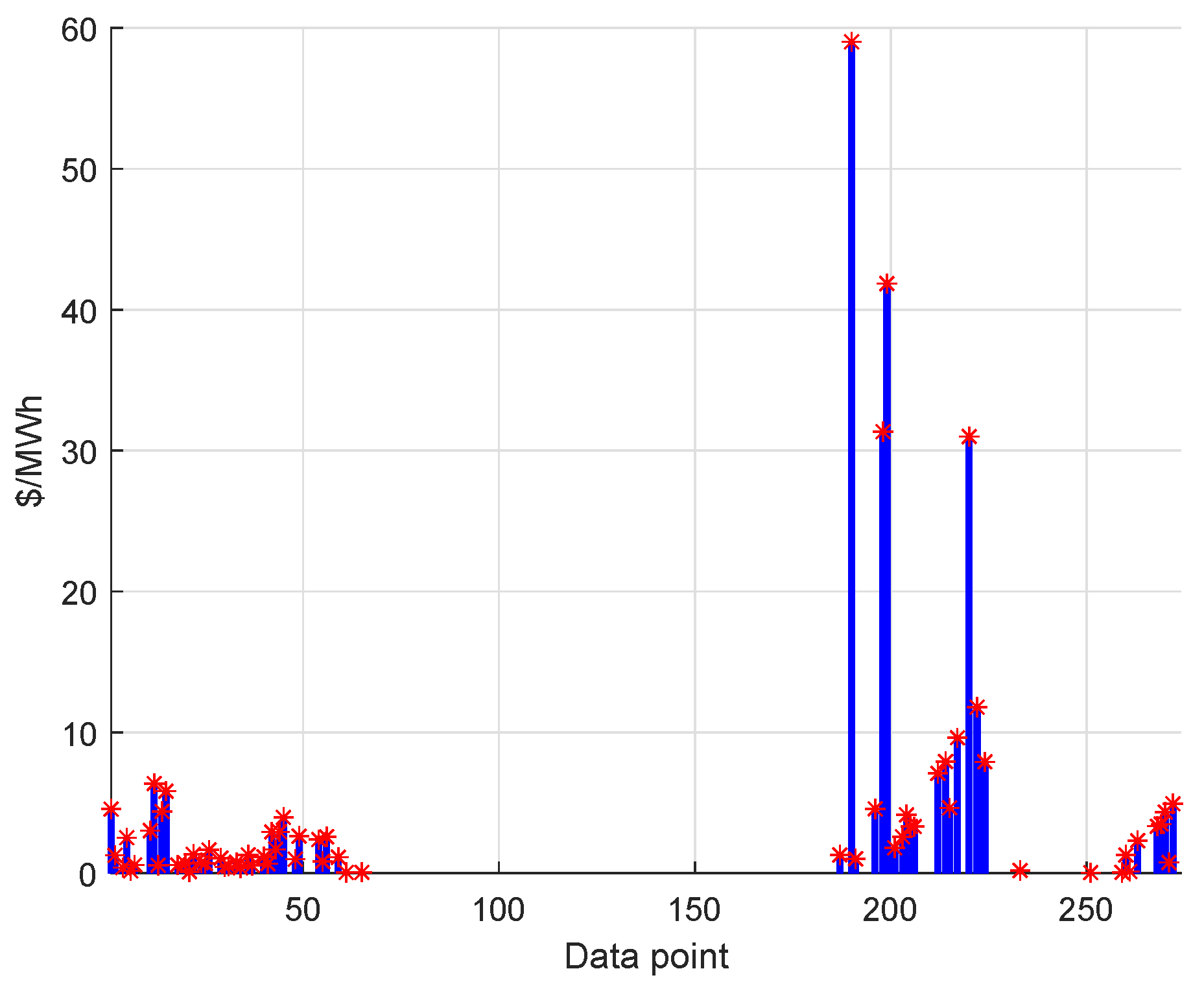
Second, we analyze the ratio of effective attacks for both LRA and HLRA. For LRA, the results are given in Table 3. We can see that there are more effective LRAs if the parameter σ is larger. An example is that the number of effective LRAs with σ = 0.5 is nearly 4 times that of those with σ = 0.1 . For HLRA, the results are given in Table 4 and Table 5. It seems that there is almost no change in the ratio of the effective HLRAs with respect to the parameter σ (Except that there is a slight increase with σ = 0.5 ). Regarding the parameter ω , we observe that it has a minimal impact on the ratio of effective HLRAs. After all, not all LRAs and HLRAs affect the generation costs. It is more difficult for the attacker to design effective LRA and HLRA. However, once the attacker succeeds, the generation cost may increase significantly. As shown in Figure 7, the generation cost rises to nearly 60 $/MWh if the attack succeeds.

4.3. Evaluation of the Performance of STD

Next, we evaluate the performance of STD in detecting LRA, HLRA, effective LRA, and effective HLRA.

4.3.1. Detecting LRA

First, we evaluate the performance of STD in detecting LRA. With different parameters, we provide the actual positive rate (TPR) and false positive rate (FPR) in Table 6. From row 1 to row 4, larger values of H yield smaller TPR and FPR. From the first, second, fifth, and sixth rows, a smaller H yields smaller TPR and larger FPR. According to the first four rows and the last four rows, in most cases, the TPR is smaller for a smaller k, while in all cases, the FPR is smaller for a smaller k. The above results indicate the trade-off between TPR and FPR is the best when G = 40 , H = 5 , k = 2 , σ = 0.5 , and ω = 20 .
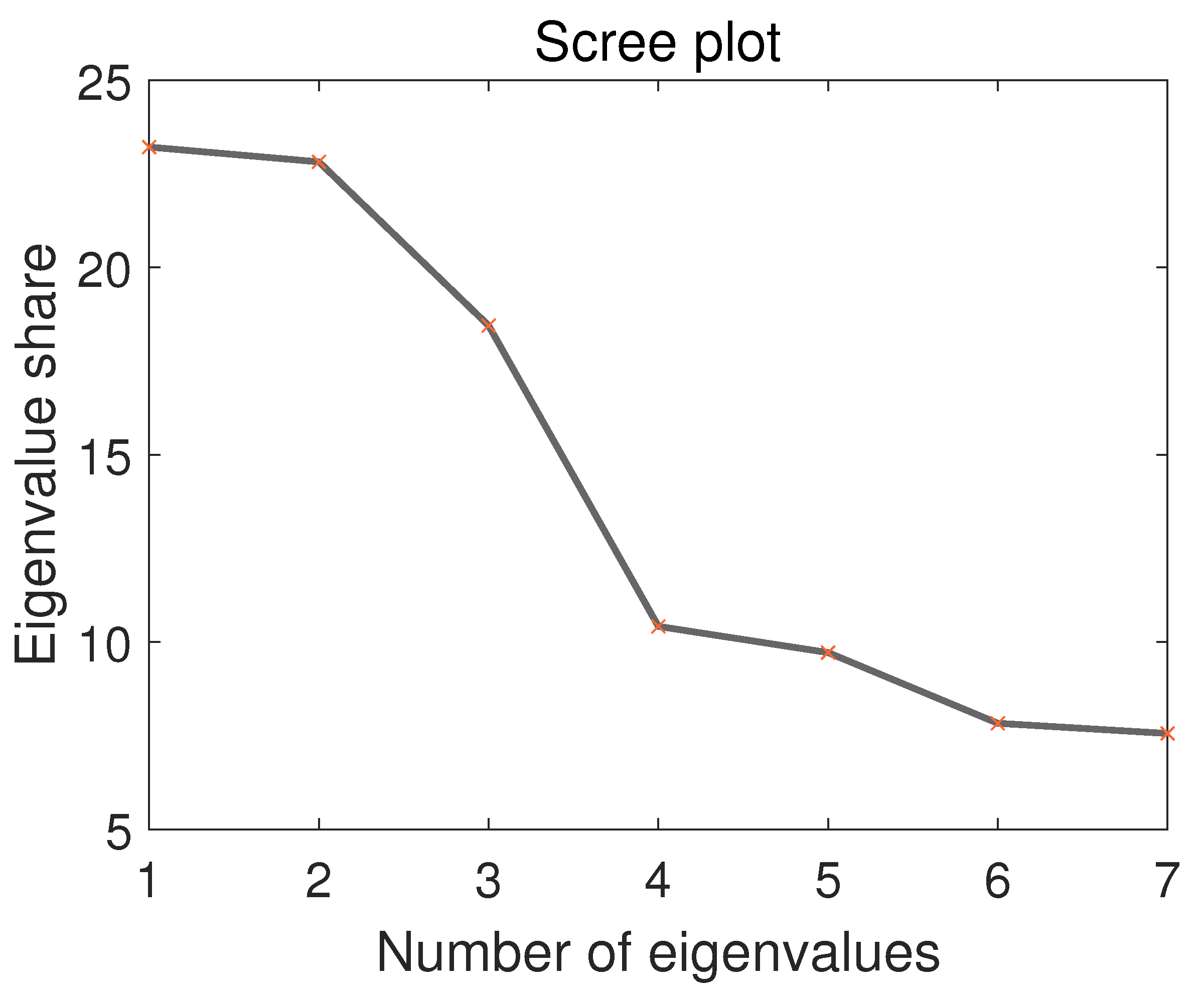
Moreover, the performance of STD in detecting LRA with different parameters. The results are given in Table 7. From row 1 to row 4, we can see that increasing the window size H enhances detection accuracy. This conclusion is the same with σ = 0.5 , σ = 0.4 , and σ = 0.3 . The largest detection rate is 99.6% with G = 40 , H = 5 , k = 3 , and σ = 0.5 . Comparing the cases with different σ (rows 1 to 12), we can see that the better the detection performance of STD, the larger σ . According to rows 1, 2, 13, and 14, a smaller G yields a better performance of STD in detecting LRAs. The detection rate achieves 100% with with G = 20 , H = 10 , k = 3 , and σ = 0.5 . From the first four rows and the last four rows, the performance of STD in detecting LRAs is better with a smaller k. For k, we plot the eigenvalues in Figure 8. We can see that k = 2 is more appropriate. Therefore, it is crucial to select suitable parameters for STD to detect LRAs accurately.
Second, we evaluate the performance of STD in detecting effective LRA with different parameters. The simulation results are given in Table 8. We can obtain similar conclusions to those presented above. Moreover, by comparing Table 7 and Table 8, it can be found that the detection performance in terms of the effective LRA is better than that in terms of LRA. Therefore, the effective LRA can be more easily detected by the STD.

4.3.2. Detecting HLRA

Next, we evaluate the performance of STD in detecting HLRA with different parameters. The simulation results are shown in Table 9. From row 1 to row 4, we can see that as H increases, the detection rate improves. This conclusion is the same with σ = 0.5 , σ = 0.4 , and σ = 0.3 . Comparing the cases with different σ (rows 1 to 12), we can see that the better the detection performance of STD, the larger σ must be. However, the detection performances of HLRAs with different σ are changed slightly. It seems that the parameter σ does not affect the detection performance. According to rows 1, 2, 13, and 14, the smaller G results in better performance of STD in detecting LRAs. The detection rate achieves 99.10% with with G = 20 , H = 10 , k = 3 , and σ = 0.5 . From the first four rows and the last four rows, the performance of STD in detecting LRAs improves with a larger k. From the 1st, 19th, and 20th rows, we can see that the parameter ω affects the detection performance of STD in terms of HLRA. However, the parameter ω has a minimal impact on detection performance, and the detection rates are all greater than 95%. Therefore, similarly, it is crucial to select suitable parameters for STD to detect HLRAs. Comparing Table 7 with Table 9, it seems that the STD detects the HLRA with better performance. For example, the detection rates of HLRA are all above 85% with the STD.
Moreover, we evaluate the performance of STD in detecting effective HLRA with different parameters. The simulation results are given in Table 10. We can obtain similar conclusions with the detection performance of HLRAs. In addition, by comparing Table 9 and Table 10, it can be found that the detection performance in terms of the effective HLRA is better than that in terms of HLRA. Therefore, similarly, the effective HLRA can be more easily detected by the STD.

4.3.3. Comparison with Other Methods

Next, we compare the detection performance of STD with other methods. The BDD, PCA, modified local outlier factor (MLOF) [22], DBSCAN [25], and iForest [26] are used as the comparison methods. The detection of HLRA with STD is used as an example. The parameters of STD are G = 40 , H = 5 , k = 3 , σ = 0.5 , and ω = 20 . The results are shown in Table 11. We can see that the STD achieves the best performance. The BDD and PCA have the worst detection rates, which is consistent with the design goal of HLRA given in Section 2.3. The learning-based methods DBSCAN and iForest are better in detecting HLRAs compared to BDD and PCA, while their performance is worse than that of MLOF and STD. Comparing with the density-based method MLOF, the detection performance of STD achieves 10% better than that of MLOF.
To provide a more robust and comprehensive evaluation, we expand our comparison of STD with existing methods beyond just the detection rate. We introduce additional metrics and discuss the applicability and limitations of each method under different operational scenarios and attack types. The F1-score is the harmonic mean of precision and recall. It provides a single metric that balances both false positives and false negatives, which is particularly useful when dealing with imbalanced datasets, as attack instances can be rare. Real-time detection is critical in smart grids. We will measure the average time taken by each method to process a data point or a batch of data, demonstrating their feasibility for online deployment.
From Table 12, we can obtain the following conclusions. BDD and PCA, while computationally cheap, are largely ineffective against sophisticated stealthy attacks. DBSCAN and iForest offer better performance than BDD/PCA but may not capture the temporal intricacies as effectively as STD. Their performance is also sensitive to parameter choices and data characteristics (e.g., varying densities for DBSCAN). MLOF performs well by focusing on local anomalies, but STD’s explicit modeling of temporal dynamics gives it an edge, especially in distinguishing subtle temporal shifts from normal fluctuations. Under the evaluated NYISO-load IEEE 14-bus scenario, STD consistently achieves the highest detection rates with a remarkably low FPR and a strong F1-score, demonstrating its superior balance of sensitivity and specificity. Its computational overhead is acceptable for real-time monitoring. The temporal aspect of STD makes it particularly robust to attacks designed to mimic normal statistical distributions.

4.4. Discussion

4.4.1. About Comparison of Methods

Unlike conventional PCA-based methods, which typically apply dimensionality reduction or anomaly scoring across aggregated multi-sensor data or static vectors, STD employs principal subspace projection specifically on lag-differentiated time series from individual sensors. This per-sensor focus captures unique normal subspaces while ignoring global correlations, enabling detection of localized temporal anomalies overlooked by aggregate PCA approaches.
In contrast to standard DTW methods that directly compare entire time series for similarity (e.g., in clustering or alignment tasks), STD applies DTW exclusively to sequences of consecutive measurement differences. This targets subtle shifts in dynamic patterns over short windows, rather than holistic series matching, to identify attack-induced deviations.
Compared to hybrid PCA-DTW methods used in general anomaly detection (e.g., for multivariate time series), STD’s core distinction is its unsupervised, sensor-oriented architecture: it combines subspace projection for normal pattern identification with DTW-based sequential change extraction, without relying on labeled attack data, global system models, or multi-sensor fusion. This design enhances robustness against stealthy LRAs by exploiting individual sensor temporal characteristics.

4.4.2. About Scalability

The experimental evaluation in this paper primarily utilizes the IEEE 14-bus test system with synthetic load profiles generated from historical patterns and the DC power flow model. While this setup is standard in power system cybersecurity research and allows controlled, reproducible assessment of attack impacts and detection performance, we explicitly discuss the applicability and limitations of the proposed STD to enhance understanding of its broader potential.
Applicability and Strengths in Larger Systems: STD is inherently sensor-oriented and processes each measurement time series independently, requiring only historical data from the individual sensor to construct its normal subspace and temporal patterns. This decentralized design confers excellent scalability: computational complexity is linear in the number of sensors and independent of system size (e.g., number of buses or lines). Therefore, STD is directly applicable to larger transmission systems (e.g., IEEE 300-bus, Polish 3375-bus) or even cross-regional interconnected grids without modification, as long as per-sensor historical measurements are available. The unsupervised nature further facilitates deployment in real-world state estimation pipelines where global models may be difficult to maintain.
Limitations of the Current Evaluation: The use of the DC power flow model simplifies branch flow calculations and is widely adopted for initial LRA studies, but it neglects reactive power, voltage magnitudes, and non-linear effects present in real systems. Additionally, load profiles, while realistic and periodic, are synthetic and derived from a single test case, which may not fully capture the diversity of regional demand patterns, renewable integration variability, or measurement noise levels encountered in operational grids.
  • AC Power Flow Models: Extending STD to AC settings is straightforward, as the detector operates on raw sensor measurements (active/reactive loads, voltage magnitudes, branch flows) rather than relying on the power flow equations. Future work could validate STD on AC-based test cases (e.g., using MATPOWER’s ACOPF) to assess performance under voltage and reactive power anomalies induced by advanced LRAs.
  • Real-World and Cross-Regional Datasets: STD could be evaluated on actual SCADA/PMU datasets from diverse operators (e.g., U.S. Eastern Interconnection, European ENTSO-E, or Chinese provincial grids) to confirm robustness across varying load compositions, renewable penetration, and noise characteristics.
  • Integration with Measurement Noise and Missing Data: Additional preprocessing (e.g., robust subspace estimation or imputation) can further enhance resilience in practical noisy environments.
Overall, the sensor-oriented, model-free, and unsupervised characteristics of STD position it as a highly generalizable defense mechanism. The current results on the IEEE 14-bus DC system provide a solid foundation, and the discussed extensions will be pursued in future work to demonstrate performance in more complex and realistic scenarios.

4.4.3. About Robustness

While the simulations in this work assume reliable, synchronous measurement delivery (standard for initial LRA detection studies), real-world smart grid deployments often encounter communication delays, packet loss, and clock asynchrony in SCADA/PMU networks. These factors can introduce noise or irregularities in individual sensor time series, potentially impacting temporal pattern analysis.
STD’s sensor-oriented design offers inherent advantages here: by focusing on per-sensor lag-differentiated sequences and robust subspace projection (using SVD on historical windows), it exhibits tolerance to moderate noise and missing samples, as the principal subspace captures dominant normal dynamics while residuals highlight significant deviations. Preliminary analysis indicates that low-to-moderate packet loss (<10%) or delays (<sampling interval) would primarily affect short-term difference sequences but not substantially degrade the DTW-based change extraction, given its warping flexibility.

5. Conclusions

In this paper, we analyze the impact of LRA, HLRA, effective LRA, and effective HLRA, and propose a sensor-oriented temporal detector (STD) to detect these attacks. First, we modeled the general LRA and HLRA with error and physical constraints. Additionally, we formulated the effective LRA and HLRA, considering the generation costs incurred by the attacks. Second, we proposed the STD to detect the attacks by merging the projection matrix and DTW. The measurement difference was used as input for STD. Finally, we analyzed the attack impact and demonstrated the effectiveness of STD in terms of detecting LRA, HLRA, effective LRA, and effective HLRA. In the future work, the large-scale transmission or distribution networks still need further verification for STD.

Author Contributions

Y.Y.: Conceptualization, methodology, software, and writing—original draft; B.Z.: formal analysis, investigation, data curation, and visualization; M.L.: methodology, validation, and writing—review editing; X.J.: supervision, project administration, funding acquisition, and writing—review editing. All authors have read and agreed to the published version of the manuscript.

Funding

This research received no external funding.

Data Availability Statement

Data available upon request from the authors.

Conflicts of Interest

Authors Yunhao Yu and Boda Zhang were employed by the company Guizhou Power Grid Co., Ltd. The remaining authors declare that the research was conducted in the absence of any commercial or financial relationships that could be construed as a potential conflict of interest.

References

  1. Zhang, M.; Liu, Y.; Cheng, Q.; Li, H.; Liao, D.; Li, H. Smart grid security based on blockchain and smart contract. Peer-to-Peer Netw. Appl. 2024, 17, 2167–2184. [Google Scholar] [CrossRef]
  2. Pollard, M. A case study of Russian cyber-attacks on the Ukrainian power grid: Implications and best practices for the United States. Pepperdine Policy Rev. 2024, 16, 1. [Google Scholar]
  3. Nasr, T.; Torabi, S.; Bou-Harb, E.; Fachkha, C.; Assi, C. Power jacking your station: In-depth security analysis of electric vehicle charging station management systems. Comput. Secur. 2022, 112, 102511. [Google Scholar] [CrossRef]
  4. Yuan, Y.; Li, Z.; Ren, K. Quantitative analysis of load redistribution attacks in power systems. IEEE Trans. Parallel Distrib. Syst. 2012, 23, 1731–1738. [Google Scholar] [CrossRef]
  5. Liu, Y.; Ning, P.; Reiter, M.K. False data injection attacks against state estimation in electric power grid. ACM Trans. Inf. Syst. Secur. 2011, 14, 13. [Google Scholar] [CrossRef]
  6. Liang, J.; Sankar, L.; Kosut, O. Vulnerability Analysis and Consequences of False Data Injection Attack on Power System State Estimation. IEEE Trans. Power Syst. 2016, 31, 3864–3872. [Google Scholar] [CrossRef]
  7. Zhang, Z.; Deng, R.; Yau, D.K.; Chen, P. Zero-parameter-information data integrity attacks and countermeasures in IoT-based smart grid. IEEE Internet Things J. 2021, 8, 6608–6623. [Google Scholar] [CrossRef]
  8. Liu, X.; Song, Y.; Li, Z. Dummy Data Attacks in Power Systems. IEEE Trans. Smart Grid 2019, 11, 1792–1795. [Google Scholar] [CrossRef]
  9. Mohsenian-Rad, A.-H.; Leon-Garcia, A. Distributed Internet-based load altering attacks against smart power grids. IEEE Trans. Smart Grid 2011, 2, 667–674. [Google Scholar] [CrossRef]
  10. Lakshminarayana, S.; Ospina, J.; Konstantinou, C. Load-altering attacks against power grids under COVID-19 low-inertia conditions. IEEE Open Access J. Power Energy 2022, 9, 226–240. [Google Scholar] [CrossRef]
  11. Soleymani, M.M.; Abazari, A.; Ghafouri, M.; Jafarigiv, D.; Atallah, R.; Assi, C. Data-enabled modeling and PMU-based real-time localization of EV-based load-altering attacks. IEEE Trans. Smart Grid 2024, 15, 6063–6079. [Google Scholar] [CrossRef]
  12. Maleki, S.; Pan, S.; Belmega, E.V.; Konstantinou, C.; Lakshminarayana, S. The impact of load altering attacks on distribution systems with ZIP loads. In 2024 IEEE Power & Energy Society General Meeting (PESGM); IEEE: Piscataway, NJ, USA, 2024; pp. 1–5. [Google Scholar]
  13. Ospina, J.; Fobes, D.M.; Bent, R. On the feasibility of market manipulation and energy storage arbitrage via load-altering attacks. Energies 2023, 16, 1670. [Google Scholar] [CrossRef]
  14. Mellucci, C.; Menon, P.P.; Edwards, C.; Ferrara, A. Load Alteration Fault Detection and Reconstruction in Power Networks Modelled in Semiexplicit Differential Algebraic Equation Form. In 2015 American Control Conference (ACC); IEEE: Piscataway, NJ, USA, 2015; pp. 5836–5841. [Google Scholar]
  15. Izbicki, M.; Amini, S.; Shelton, C.R.; Mohsenian-Rad, H. Identification of Destabilizing Attacks in Power Systems. In 2017 American Control Conference (ACC); IEEE: Piscataway, NJ, USA, 2017; pp. 3424–3429. [Google Scholar]
  16. Lakshminarayana, S.; Sthapit, S.; Jahangir, H.; Maple, C.; Poor, H.V. Data-driven Detection and Identification of IoT-enabled Load-altering Attacks in Power Grids. IET Smart Grid 2022, 5, 203–218. [Google Scholar] [CrossRef]
  17. Zhou, M.; Wu, J.; Long, C. Robust Defense against Load Redistribution Attacks in Power Grids based on Reactance Control. In 2023 American Control Conference (ACC); IEEE: Piscataway, NJ, USA, 2023; pp. 4477–4482. [Google Scholar]
  18. Amini, S.; Pasqualetti, F.; Mohsenian-Rad, H. Detecting Dynamic Load Altering Attacks: A Data-driven Time-frequency Analysis. In 2015 IEEE International Conference on Smart Grid Communications (SmartGridComm); IEEE: Piscataway, NJ, USA, 2015; pp. 503–508. [Google Scholar]
  19. Wu, Y.; Chen, B.; Weng, J.; Wei, Z.; Li, X.; Qiu, B. False Load Attack to Smart Meters by Synchronously Switching Power Circuits. IEEE Trans. Smart Grid 2019, 10, 2641–2649. [Google Scholar] [CrossRef]
  20. Cao, X. Enhanced security data management in power grids using deep learning with genetic algorithm-based hyperparameter optimization. Peer-to-Peer Netw. Appl. 2025, 18, 117. [Google Scholar] [CrossRef]
  21. Qi, Y.; Shi, D.; Tylavsky, D. Impact of assumptions on DC power flow model accuracy. In 2012 North American Power Symposium (NAPS); IEEE: Piscataway, NJ, USA, 2012; pp. 1–6. [Google Scholar]
  22. Zhang, Z.; Qin, Y.; Wang, J.; Li, H.; Deng, R. Letter Detecting the One-Shot Dummy Attack on the Power Industrial Control Processes with an Unsupervised Data-Driven Approach. IEEE/CAA J. Autom. Sin. 2023, 10, 550–553. [Google Scholar] [CrossRef]
  23. Du, M.; Liu, X.; Li, Z.; Lin, H. Robust Mitigation Strategy Against Dummy Data Attacks in Power Systems. IEEE Trans. Smart Grid 2023, 14, 3102–3113. [Google Scholar] [CrossRef]
  24. Amini, S.; Pasqualetti, F.; Mohsenian-Rad, H. Truth will out: Departure-based process-level detection of stealthy attacks on control systems. In Proceedings of the 2018 ACM SIGSAC Conference on Computer and Communications Security; Association for Computing Machinery: New York, NY, USA, 2018; pp. 817–831. [Google Scholar]
  25. Schubert, E.; Sander, J.; Ester, M.; Kriegel, H.P.; Xu, X. DBSCAN Revisited, Revisited: Why and How You Should (Still) Use DBSCAN. ACM Trans. Database Syst. 2017, 42, 19. [Google Scholar] [CrossRef]
  26. Zhao, X.; Wu, Y.; Lee, D.L.; Cui, W. iForest: Interpreting Random Forests via Visual Analytics. IEEE Trans. Vis. Comput. Graph. 2019, 25, 407–416. [Google Scholar] [CrossRef] [PubMed]
Figure 1. The issues for designing the LRA.
Electronics 15 00746 g001
Figure 2. The attack and defense relationship.
Electronics 15 00746 g002
Figure 3. The IEEE 14-bus power system.
Electronics 15 00746 g003
Figure 4. The 11 load areas of NYISO.
Electronics 15 00746 g004
Figure 5. The injected error into the load measurement of bus 2 with the LRA and effective LRA ( σ = 0.5 ).
Electronics 15 00746 g005
Figure 6. The injected error into the load measurement of bus 2 with the HLRA and effective HLRA ( σ = 0.5 , ω = 20 ).
Electronics 15 00746 g006
Figure 7. The increasing generation cost caused by the effective HLRA ( σ = 0.5 , ω = 20 ).
Electronics 15 00746 g007
Figure 8. The distribution of eigenvalues.
Electronics 15 00746 g008
Table 1. The parameters for computing the generation cost.
Generation Bus12368
p ¯ g 6060606060
p ̲ g 00000
a($/MWh)0.0430.250.010.010.01
b($/MWh)1520253035
c($/MWh)55555
Table 2. Limitations for the power flows.
Transmission Line f max (MW)
T 1 40
T 2 40
T 3 40
T 4 40
T 5 40
T 6 50
T 7 50
T 8 40
T 9 50
T 10 40
T 11 50
T 12 50
T 13 50
T 14 50
T 15 50
T 16 50
T 17 50
T 18 50
T 19 50
T 20 50
Table 3. The ratio of effective LRAs.
σ 0.10.20.30.40.5
Ratio6.8%10.3%14.5%19.3%20.8%
Table 4. The ratio of effective HLRAs with respect to σ ( ω = 20 ).
σ 0.10.20.30.40.5
Ratio54.01%54.01%54.01%54.01%54.38%
Table 5. The ratio of effective HLRA with respect to ω ( σ = 0.5 ).
ω 203040
Ratio54.38%51.09%52.92%
Table 6. The true positive rate (TPR) and false positive rate (FPR) of STD in detecting LRA.
RowGHk σ ω TPRFPR
140530.52098.20%23.42%
240830.52096.85%22.97%
3401030.52096.40%23.42%
4402030.52087.39%10.36%
520530.52096.40%28.38%
6201030.52087.39%33.78%
740520.52099.6%23.11%
840820.52089.5%21.70%
9401020.52092.3%21.70%
10402020.52063.3%8.96%
Table 7. The performance of STD in detecting LRAs.
RowGHk σ Detection Rate
140530.599.6%
240830.595.2%
3401030.593.2%
4402030.559.1%
540530.498.5%
640830.490.7%
7401030.488.1%
8402030.455.9%
940530.395.4%
1040830.379.6%
11401030.376.8%
12402030.346.6%
1320530.599.6%
14201030.5100%
1540520.599.6%
1640820.589.5%
17401020.592.3%
18402020.563.3%
Table 8. The performance of STD in detecting effective LRAs.
RowGHk σ Detection Rate
140530.5100%
240830.596.63%
3401030.595.67%
4402030.544.71%
540530.497.93%
640830.495.34%
7401030.492.75%
8402030.428.50%
940530.395.86%
1040830.381.38%
11401030.377.93%
12402030.30%
1320530.5100%
14201030.5100%
1540520.5100%
1640820.590.87%
17401020.592.31%
18402020.561.54%
Table 9. The performance of STD in detecting HLRAs.
RowGHk σ ω Detection Rate
140530.52098.20%
240830.52096.85%
3401030.52096.40%
4402030.52087.39%
540530.42098.20%
640830.42096.85%
7401030.42096.40%
8402030.42086.94%
940530.32098.20%
1040830.32096.85%
11401030.32096.40%
12402030.32086.04%
1320530.52099.10%
14201030.52096.85%
1540520.52097.30%
1640820.52096.85%
17401020.52094.59%
18402020.52085.59%
1940530.53095.28%
2040530.54096.53%
Table 10. The performance of STD in detecting effective HLRAs.
RowGHk σ ω Detection Rate
140530.52097.94%
240830.52095.88%
3401030.52096.91%
4402030.52087.63%
540530.42097.92%
640830.42095.83%
7401030.42096.88%
8402030.42087.50%
940530.32097.92%
1040830.32095.83%
11401030.32096.88%
12402030.32087.50%
1320530.520100%
14201030.52096.91%
1540520.52096.91%
1640820.52096.91%
17401020.52093.81%
18402020.52087.63%
1940530.53093.18%
2040530.54096.77%
Table 11. The detection rates of HLRAs with BDD, PCA, DBSCAN, iForest, MLOF, and STD.
MethodBDDPCADBSCANiForestMLOFSTD
Detection rate0%5.34%60.90%20.10%88.18%98.20%
Table 12. The comparison of different metrics with BDD, PCA, DBSCAN, iForest, MLOF, and STD.
MethodTPRFPRF1-ScoreAvg. Comp. Time (ms)
BDD0%0%0.00<1
PCA5.34%1.2%0.09<1
DBSCAN60.90%5.8%0.745
iForest20.10%0.5%0.332
MLOF88.18%3.1%0.9210
STD98.20%0.8%0.997
Disclaimer/Publisher’s Note: The statements, opinions and data contained in all publications are solely those of the individual author(s) and contributor(s) and not of MDPI and/or the editor(s). MDPI and/or the editor(s) disclaim responsibility for any injury to people or property resulting from any ideas, methods, instructions or products referred to in the content.