2.1. PEMFC
PEMFCs utilize a polymer membrane with proton-conductive properties as their electrolyte. The term PEM is an abbreviation for Polymer Electrolyte Membrane, and these cells are also referred to as polymer membrane FCs or membrane FCs. During their initial development in the 1960s, PEMFCs were recognized as Solid Polymer Electrolyte (SPE) FCs [
41,
42]. PEMFCs have gained considerable attention due to their numerous advantages, including high energy efficiency, high energy density, minimal operating noise, cost-effectiveness, low operating temperature, fast start-up capability, corrosion resistance, the use of solid electrolytes, and extended operational lifetime [
43].
These advantageous characteristics make PEMFC technology highly suitable for a wide range of applications, ranging from portable electronic devices such as mobile phones and tablets to transportation systems, including buses and trains [
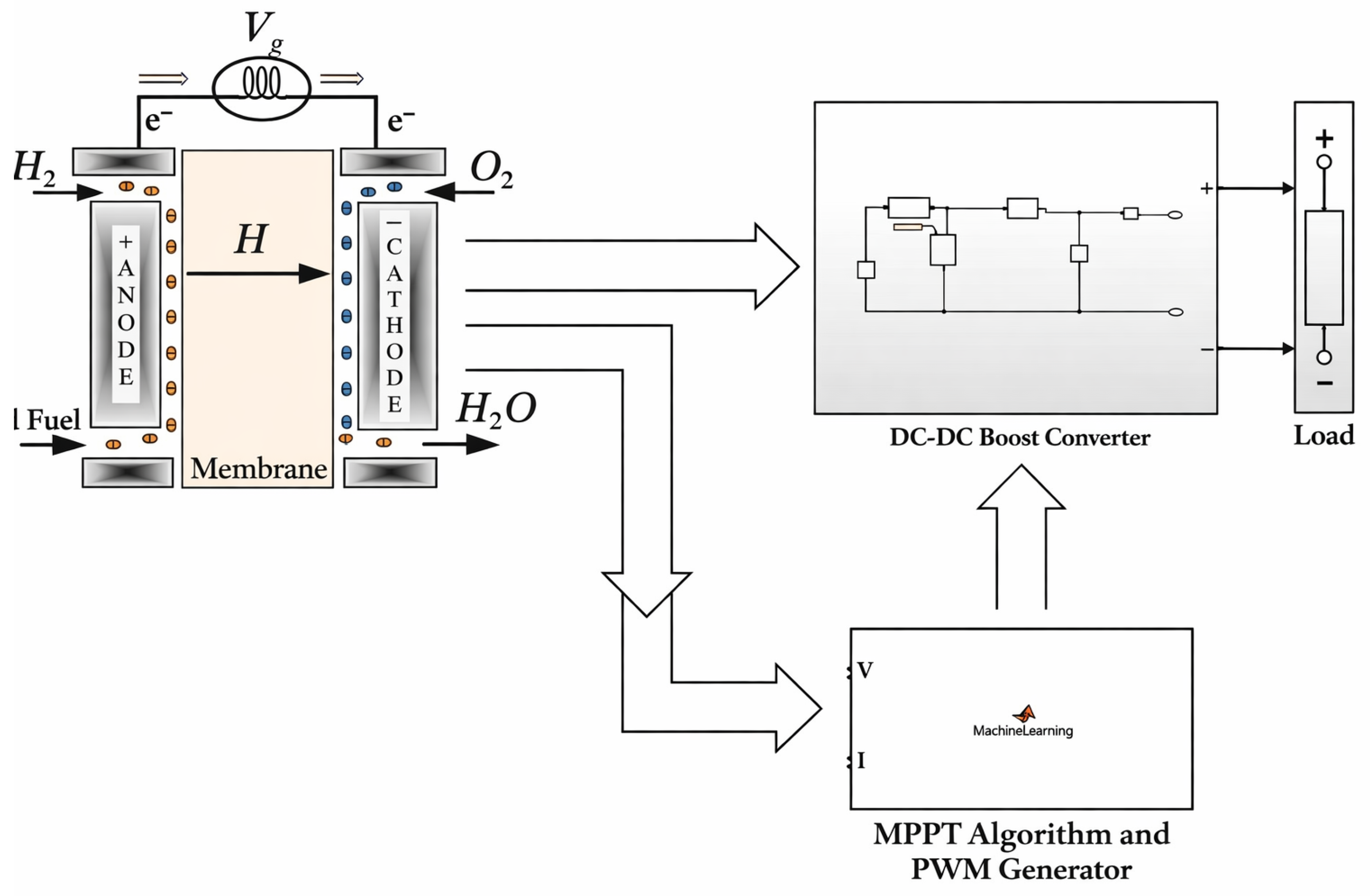
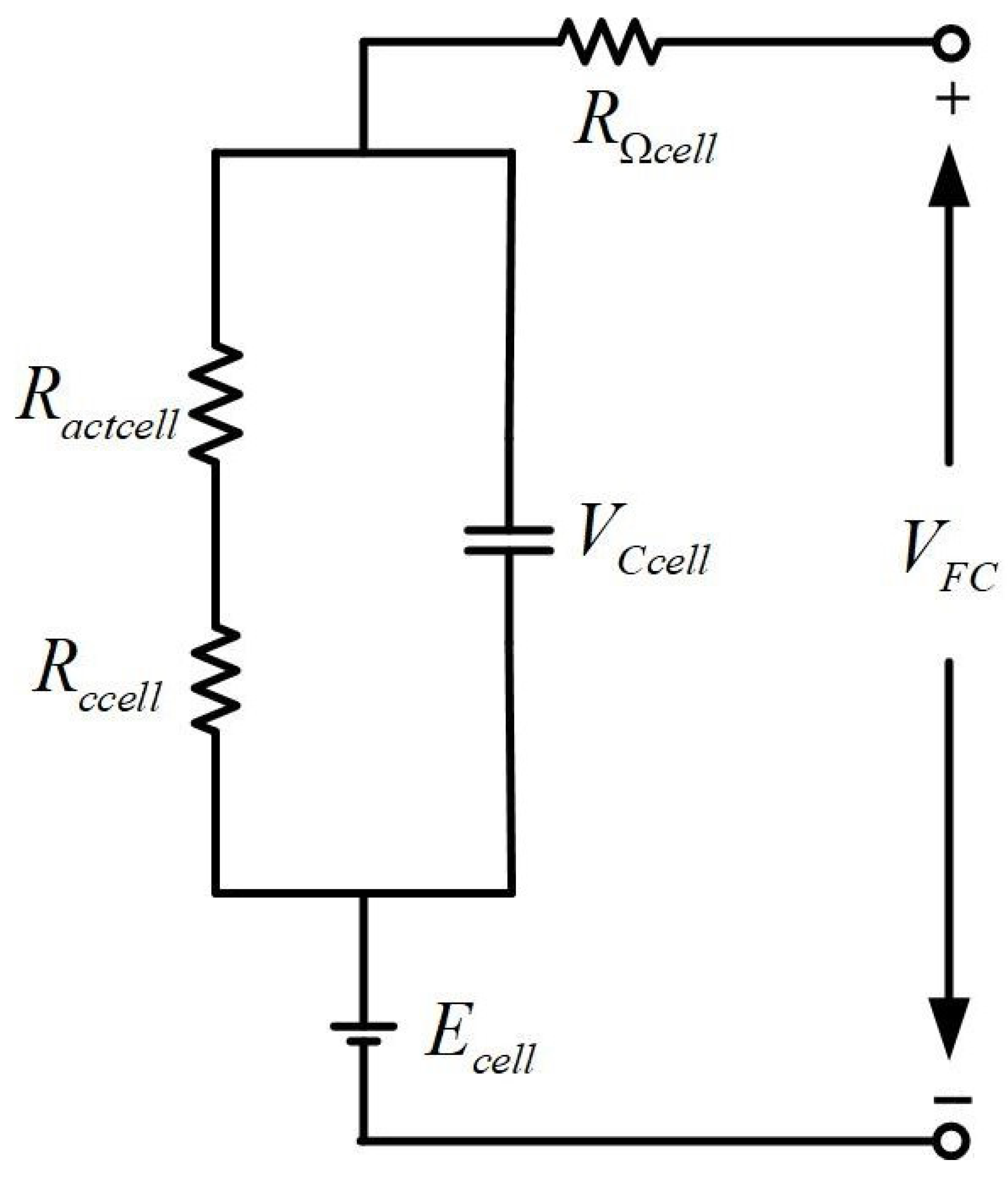
44]. The operation of a PEMFC can be illustrated using both a circuit diagram and a corresponding electrical circuit model, as shown in
Figure 2. The circuit diagram represents the fundamental physical components and their interconnections within the FC, providing a clear understanding of the electrochemical processes involved. Meanwhile, the electrical circuit model establishes a mathematical framework for analyzing and describing the flow of electricity generated during the electrochemical reactions occurring inside the cell. This modeling approach helps to clarify how the PEMFC converts hydrogen and oxygen into electrical power, water, and thermal energy, emphasizing the contribution of each component to the overall system [
45,
46].
The electrochemical reactions occurring within a PEMFC can be expressed as follows:
The resistive elements
,
, and
, shown in
Figure 2, are used to determine the overall performance of the FC. The resistance
represents the ohmic resistance, which arises from the internal properties of the materials used in the cell and leads to energy loss in the form of heat. The resistance
is associated with concentration polarization, which occurs due to variations in reactant concentrations during cell operation. In contrast,
represents the activation polarization resistance, which is related to the energy barrier that must be overcome for electrochemical reactions to occur [
47].
Based on these loss mechanisms, the output voltage of the FC can be calculated using Equation (
2) [
48].
Here,
and
denote the electrical output voltage of the FC and the open-circuit voltage, respectively. The terms
,
, and
represent the voltage losses due to activation polarization, ohmic resistance, and concentration (mass transport) effects occurring at the electrodes and membrane. As observed from Equation (
2), these voltage drops depend on the load current as well as the operating temperature and pressure of the FC [
49]. For a FC stack consisting of multiple cells connected in series, the overall output voltage can be expressed as
The open-circuit voltage
of a PEMFC can be calculated using the Nernst thermodynamic equation, which is given in Equation (
4). This equation enables the evaluation of the FC performance by accounting for key operating variables such as temperature, system pressure, and the partial pressures of hydrogen and oxygen gases. In this mathematical formulation, voltage losses due to ohmic resistance, activation polarization, and concentration polarization are neglected in order to represent the ideal reversible cell potential [
50].
Here, T represents the cell operating temperature measured in Kelvin, and denotes the temperature correction offset. The variables and represent the partial pressures of oxygen and hydrogen gases, respectively. The universal gas constant R is taken as , and the Faraday constant is denoted as F. The value corresponds to the reversible standard potential at .
The T equation is widely used to analyze the activation overvoltage (
) in FCs. This loss is primarily influenced by the reaction kinetics of hydrogen oxidation at the anode and oxygen reduction at the cathode, both of which play a crucial role in determining the overall performance of the FC. Activation losses represent the energy required to overcome the electrochemical reaction barriers during FC operation. The total activation overvoltage, accounting for both anode and cathode contributions, is expressed by Equation (
5) [
51].
In Equation (
5), the activation overvoltage is modeled using semi-empirical coefficients that capture the electrochemical reaction kinetics at the anode and cathode of the PEMFC. The parameter
represents the combined activation overpotential at reference conditions, while
accounts for the temperature-dependent variation of the activation losses. The coefficient
reflects the influence of oxygen concentration at the cathode catalyst layer, and
characterizes the logarithmic dependence of activation overvoltage on the fuel cell current. These coefficients are typically obtained through curve fitting of experimental polarization data or adopted from validated empirical models reported in the literature. In this study, the parameter values were selected based on well-established PEMFC models and are summarized in
Table 2. Detailed derivations and parameter identification procedures can be found in the referenced studies, which provide comprehensive explanations of the underlying electrochemical modeling framework.
The parameter
represents the FC current, while
denotes the oxygen concentration at the membrane surface. The coefficients
,
,
, and
are characteristic parameters of the FC model and can be derived using the partial pressure of oxygen. Resistances within the membrane and interconnections give rise to ohmic losses (
) as electrons travel from the anode to the cathode. These losses are caused by ionic resistance in the membrane and electronic resistance in the electrodes and current collectors. The ohmic voltage loss, expressed in Equation (
6), can be calculated based on Ohm’s law [
54].
Here, , l, and A represent the membrane ionic conductivity, the thickness of the cell membrane, and the active surface area of the FC. The electrical resistance is of a relatively small magnitude and has a negligible effect on the overall results; therefore, it can be ignored.
According to the literature [
55], a concentration overvoltage (
) arises due to mass transport limitations in the PEMFC. This voltage loss can be expressed using Equation (
7).
Here, b, , and denote the concentration loss coefficient, the operating current of the FC, and the maximum current density, respectively. In addition, A represents the active surface area of the cell.
The theoretical voltage generated by the electrochemical reaction of hydrogen and oxygen is approximately
. However, in practical FC operation, the actual voltage produced by an individual FC is lower due to several factors, including internal resistances and inefficiencies in the electrochemical processes. Under nominal operating conditions, the output voltage of a single cell typically ranges between
and
. This voltage reduction can significantly affect the overall performance of the FC system [
56].
To achieve the desired output voltage and power levels, FCs can be configured in different electrical arrangements. When FCs are connected in series, the total output voltage increases as the voltages of individual cells are summed, making this configuration suitable for applications requiring higher voltage levels. Conversely, when FCs are connected in parallel, the total output current increases while maintaining the same voltage level, thereby enabling higher power capacity. By combining series and parallel connections, specific voltage and current requirements can be satisfied, optimizing the system performance for various applications. Such a configuration is commonly referred to as a FC stack [
57].
The required number of series-connected cells (
) and parallel-connected stacks (
) can be determined using Equation (
8).
Here, and denote the output power and output voltage of the FC system, respectively, while and represent the operating power and operating voltage of the FC stack.
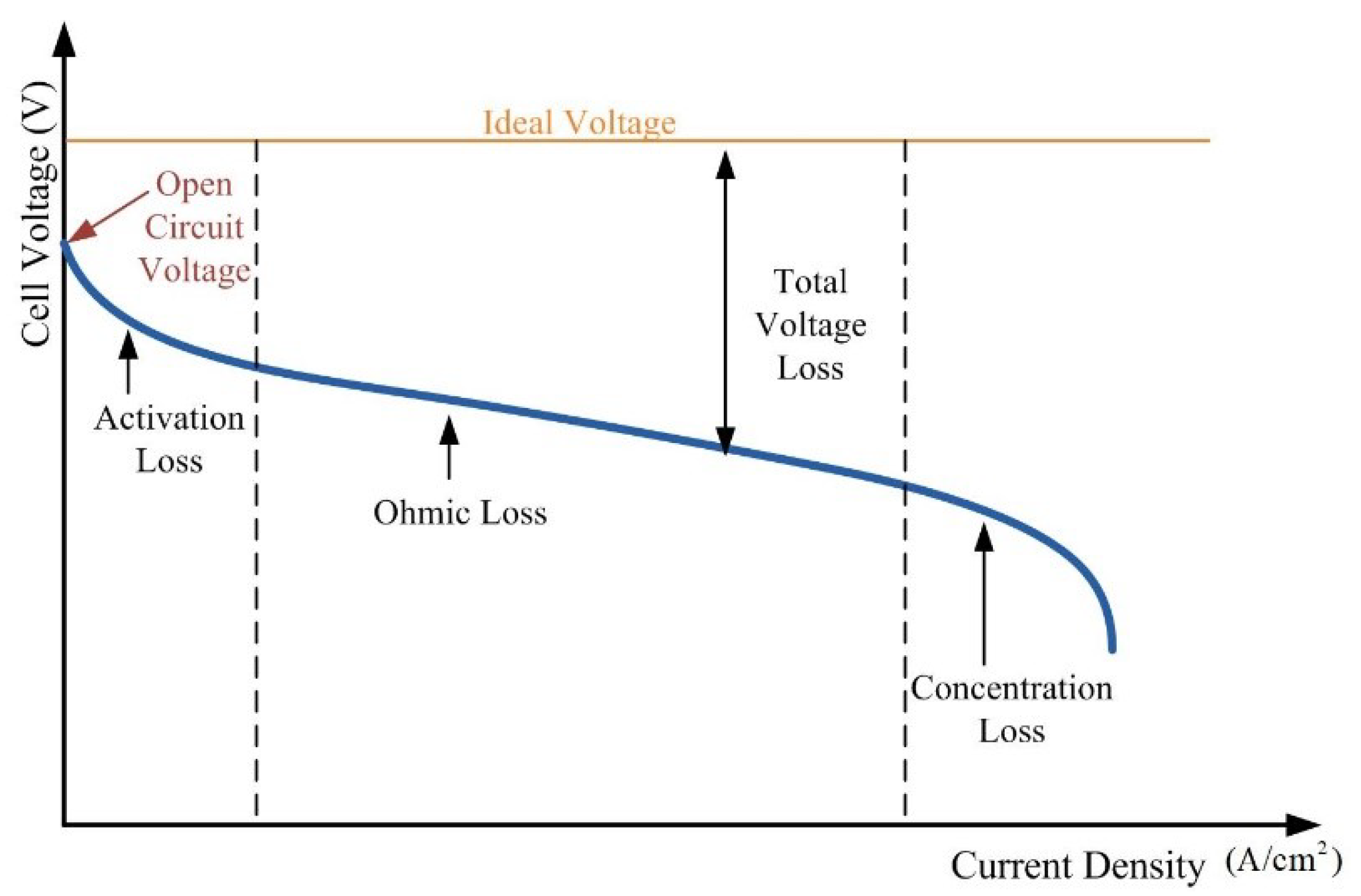
The power generation of a FC is primarily influenced by operating parameters such as cell temperature and membrane water content. As the hydrogen consumption rate in a PEMFC increases, a proportional increase in the electrical current generated by the cell is observed. The performance of a PEMFC is commonly characterized by its voltage–current (V–I) relationship, which provides critical insight into its operating behavior. Accordingly, the efficiency of the FC can be evaluated by analyzing its output voltage, which decreases as the electrical power generated per unit amount of hydrogen consumed is reduced. Therefore, the cell voltage serves as a reliable indicator of the overall efficiency and performance of the FC [
58]. Based on the derived mathematical models, the polarization curve of the PEMFC can be obtained by plotting the V–I characteristics, as illustrated in
Figure 3. This curve is a fundamental tool for assessing the performance and operating limits of the FC.
2.2. DC–DC Boost Converter
Power electronic circuits play a critical role in monitoring and optimizing the MPPs of PEMFCs, thereby ensuring a stable and desirable voltage level under varying operating conditions. In order to supply electric motors, residential loads, or grid-connected systems, the relatively low DC bus voltage generated by FCs must be increased to higher voltage levels using a DC–DC boost converter. Consequently, achieving a high voltage gain with high efficiency over a wide range of output power is essential for the overall performance of the converter [
59].
In this study, a DC–DC boost converter is employed to enhance output voltage stability by stepping up the input voltage to a higher and more regulated level [
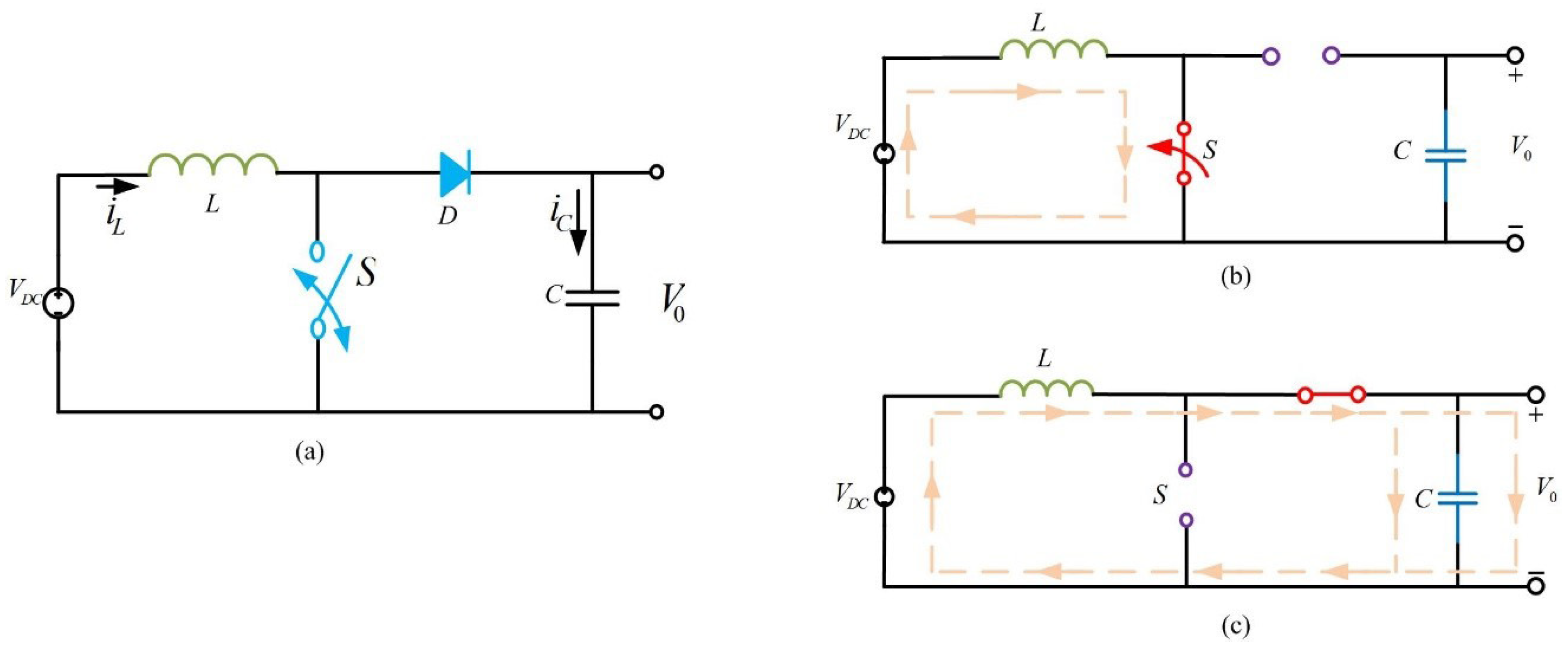
60]. A basic circuit configuration of the DC–DC boost converter is illustrated in
Figure 4. The converter comprises several key components: the input voltage source (
), which may originate from a DC source or a battery; an inductor (
L), which stores energy when the switch is turned on and releases it to the output when the switch is turned off; a diode (
D), which ensures unidirectional current flow and prevents reverse current; and a filter capacitor (
C), which smooths the output voltage by reducing ripple and maintaining a steady voltage level across the load [
61].
The switching device (
S) operates based on a pulse-width modulation (PWM) control signal, alternating between on and off states to regulate the energy transfer from the inductor to the output. In this analysis, all electronic components are assumed to be ideal, meaning that resistive losses and non-ideal characteristics of the inductor, capacitor, diode, and switch are neglected for simplicity. The switch is turned on during the interval
, where
d denotes the duty cycle and
T represents the switching period. During this interval, as shown in
Figure 4b, the switch
S is closed and the diode
D is reverse-biased. Conversely, during the interval
, illustrated in
Figure 4c, the switch
S is opened and the diode
D becomes forward-biased, allowing energy transfer to the output [
40].
The duty cycle (
d), as well as the inductor and capacitor values of the DC–DC boost converter, can be determined using Equations (
9)–(
11). The duty cycle is constrained within the range
. When the switch remains continuously in the off state, corresponding to
, the output voltage is equal to the input source voltage. As the duty cycle increases, a proportional rise in the output voltage is obtained. Based on the inductor volt–second balance principle, the steady-state operation of the boost converter can be expressed as
Equations (
10) and (
11) were evaluated based on the nominal operating conditions of the PEMFC system and conservative ripple design criteria to ensure stable MPPT operation. The inductor value was selected by limiting the peak-to-peak inductor current ripple to a small fraction of the rated PEMFC current, while the capacitor value was determined to maintain the output voltage ripple within a tight bound under dynamic load and fuel flow variations. The relatively large inductance and capacitance values adopted in this study were intentionally chosen to reduce current and voltage ripple, suppress high-frequency oscillations, and improve system robustness during rapid MPPT transients. These design choices prioritize control stability and clear evaluation of the ML-based MPPT strategy over converter size optimization.
The passive component values reported in
Table 3 were selected following conservative design criteria commonly adopted in PEMFC power conditioning systems to ensure low ripple and stable dynamic behavior. In the literature, DC–DC boost converters interfaced with PEM fuel cells often employ relatively large inductance and capacitance values to mitigate the inherent slow dynamics of fuel cells and suppress current and voltage oscillations that may degrade system performance. For example, in IEEE Transactions–level studies on PEMFC power conditioning, inductance values are intentionally chosen to limit current ripple to 15–30% of the rated current, while output capacitors are sized to maintain voltage ripple within 1–2% under load and operating condition variations [
62,
63].
Compared with designs that prioritize compactness or high power density, the component values used in this work emphasize control stability and robustness during MPPT transients rather than hardware minimization. As summarized in
Table 3, the adopted inductance and capacitance values fall within the range reported in prior IEEE Transactions studies for low- to medium-power PEMFC systems, and are particularly suitable for evaluating MPPT algorithms without confounding effects from excessive electrical ripple or converter-induced instability [
62,
63,
64,
65].