1. Introduction
With the increasing demands of 6G communication systems for high spectral efficiency, low latency, and secure transmission, wireless communication technologies are evolving toward greater intelligence and programmability. In this context, both academia and industry are focusing on how to collaboratively optimize the wireless propagation environment and transmission strategies to achieve low-cost, high-performance communication. In particular, driven by key technologies such as multi-antenna systems, millimeter-wave communications, and reconfigurable intelligent surfaces (RISs), communication systems are gradually evolving towards a software–hardware collaborative design and the reconstruction of intelligent propagation environments [
1,
2,
3].
In recent years, RISs have emerged as a promising technology in wireless communications, attracting considerable attention due to their capability to intelligently reconfigure the wireless propagation environment in a cost-effective and energy-efficient manner [
4,
5]. An RIS consists of a large number of programmable reflecting elements, which can jointly adjust its reflection phase to enhance the desired signal and suppress interference. This leads to significant improvements in both the spectral efficiency and energy efficiency of wireless communication systems [
6,
7]. In addition to extending signal coverage and improving transmission quality, RISs also play a vital role in physical layer security (PLS) by providing novel means to secure wireless communications.
1.1. Related Works
In the field of PLS, the application of RISs provides new opportunities to enhance the confidentiality of wireless communication systems. Unlike traditional encryption methods, PLS uses the characteristics of wireless channels to protect information at the physical layer, offering advantages such as lower complexity and higher anti-attack capability [
8]. By optimizing the reflection coefficients of RISs, the received signal strength at legitimate users can be enhanced, while the signal reception at eavesdroppers can be suppressed, thereby improving the system’s secrecy rate. In recent years, PLS communication assisted by a single RIS has been extensively studied [
9,
10,
11,
12]. In [
9], a PLS transmission method for power communication networks was proposed by integrating an RIS and meta-reinforcement learning, aiming to maximize the secrecy rate through the joint optimization of RIS phase shifts and beamforming. Liu et al. proposed an algorithm based on the Generalized Diffusion Model (GDM) to optimize the PLS performance in RIS-assisted Multiple-Input Multiple-Output (MIMO) communication networks. By jointly optimizing the beamforming matrix at the base station (BS) and the phase-shift matrix of the RIS, the algorithm aimed to maximize the minimum achievable secrecy rate of the network [
10]. In the context of PLS, an RIS-assisted dual-layer caching satellite communication network was investigated, wherein the secure transmission probability is maximized through the joint optimization of transmission rates and caching probabilities [
11]. In [
12], the authors studied a robust secure design in RIS-assisted multiple-input single-output (MISO) systems under imperfect eavesdropper channel state information (CSI). The proposed scheme jointly optimized signal beamforming, artificial noise beamforming, and the RIS phase-shift matrix to maximize the secrecy outage rate.
While a single RIS can enhance physical layer security to some extent, its optimization capability remains limited in complex propagation environments, particularly when line-of-sight links are blocked or coverage is constrained [
13]. To overcome these limitations, the double-RIS architecture has been proposed and has attracted increasing attention, which extends coverage through multiple reflection links and offers greater degrees of optimization freedom [
14]. Recently, several studies have explored double-RIS-aided communication systems [
15,
16,
17,
18]. In [
15], a unified manifold optimization (UMO) framework was proposed to optimize the channel capacity of a double-RIS-aided MIMO communication system. By constructing a unified manifold space and employing a parallel conjugate gradient algorithm, the system capacity was maximized without relaxing the objective function. A double-RIS-aided active eavesdropping system was investigated in [
16]. The core of their approach was the joint optimization of the phase-shift matrices for both RISs, aiming to enhance eavesdropping performance on a suspicious communication link. In [
17], the authors analyzed and optimized a cooperative double-RIS-aided system, proposing a quasi-static phase-shift design to maximize the average channel power. In [
18], the focus was on channel estimation and passive beamforming design in double-RIS-aided wireless communication systems. Two channel estimation schemes were proposed, and the corresponding cooperative passive beamforming was optimized to maximize the achievable rate. Moreover, while double-RIS architectures have been proposed to extend coverage and enhance secrecy performance, their deployment introduces additional complexities. Specifically, the joint optimization of multiple RIS phase-shift matrices not only enlarges the search space but also exacerbates the computational burden, which lead to an increase in algorithmic complexity and convergence time.
1.2. Contributions
The double-RIS system introduces a higher-dimensional and more tightly coupled optimization problem compared to its single-RIS counterpart. This complexity stems from the joint optimization of two phase-shift matrices and their interaction with the transmit beamformer. In this paper, we tackle this challenge by proposing an alternating optimization algorithm based on the manifold optimization (MOAO) algorithm, which jointly optimizes AP beamforming and both RIS phase-shift matrices to maximize the secrecy rate under practical constraints. Although alternating optimization and manifold optimization have been widely used in RIS-assisted systems, their integration for secrecy-oriented double-RIS optimization with strongly coupled cascaded channels has not been adequately addressed. The main contributions of this work are summarized as follows:
(1) Firstly, we construct a novel double-RIS-aided PLS communication model and formulate a mathematical optimization problem that aims to maximize the secrecy rate, based on the channel characteristics of the legitimate user and the eavesdropper. We utilize two RISs deployed near the access point (AP) and user to enhance communication and improve the security performance of the system.
(2) Secondly, to tackle the non-convexity and high computational complexity of the formulated problem, we propose an MOAO algorithm. Specifically, the MOAO algorithm decomposes the joint optimization of the AP beamforming and RIS reflection matrices into iterative subproblems, while the manifold optimization-based algorithm is used to jointly optimize the reflection matrices of the two RISs, effectively reducing computational complexity. Simulation results demonstrate the significant advantages of the proposed algorithm in terms of secrecy rate enhancement and computational efficiency.
(3) In addition, for performance comparison, we also introduce a successive convex approximation (SCA)-based algorithm to optimize the reflection matrices of the two RISs. Specifically, simplify the original problem into a convex optimization problem and then alternately optimize the beamforming and RIS reflection matrices.
The rest of the paper is organized as follows:
Section 2 presents the system model of the double-RIS-aided scheme.
Section 3 formulates the secrecy rate maximization problem.
Section 4 describes the proposed optimization algorithm and the benchmark schemes.
Section 5 provides simulation results, and
Section 6 concludes the paper.
Notations: Throughout this study, scalars are denoted by italic letters, and vectors and matrices are denoted by bold lowercase and bold uppercase letters, respectively. denotes the set of complex-valued matrices of size . The i-th element of vector is denoted by . is the m-dimensional all-zero vector. The -th element of a matrix is denoted by . , , and represent the conjugate, transpose, and conjugate transpose of matrix , respectively. The modulus and Frobenius norm of vector are denoted by and , respectively. denotes a diagonal matrix whose diagonal entries are . {} denotes the real part of a complex number. ∘ denotes the Hadamard product between two matrices. denotes a circularly symmetric complex Gaussian vector with mean and covariance matrix .
2. System Model
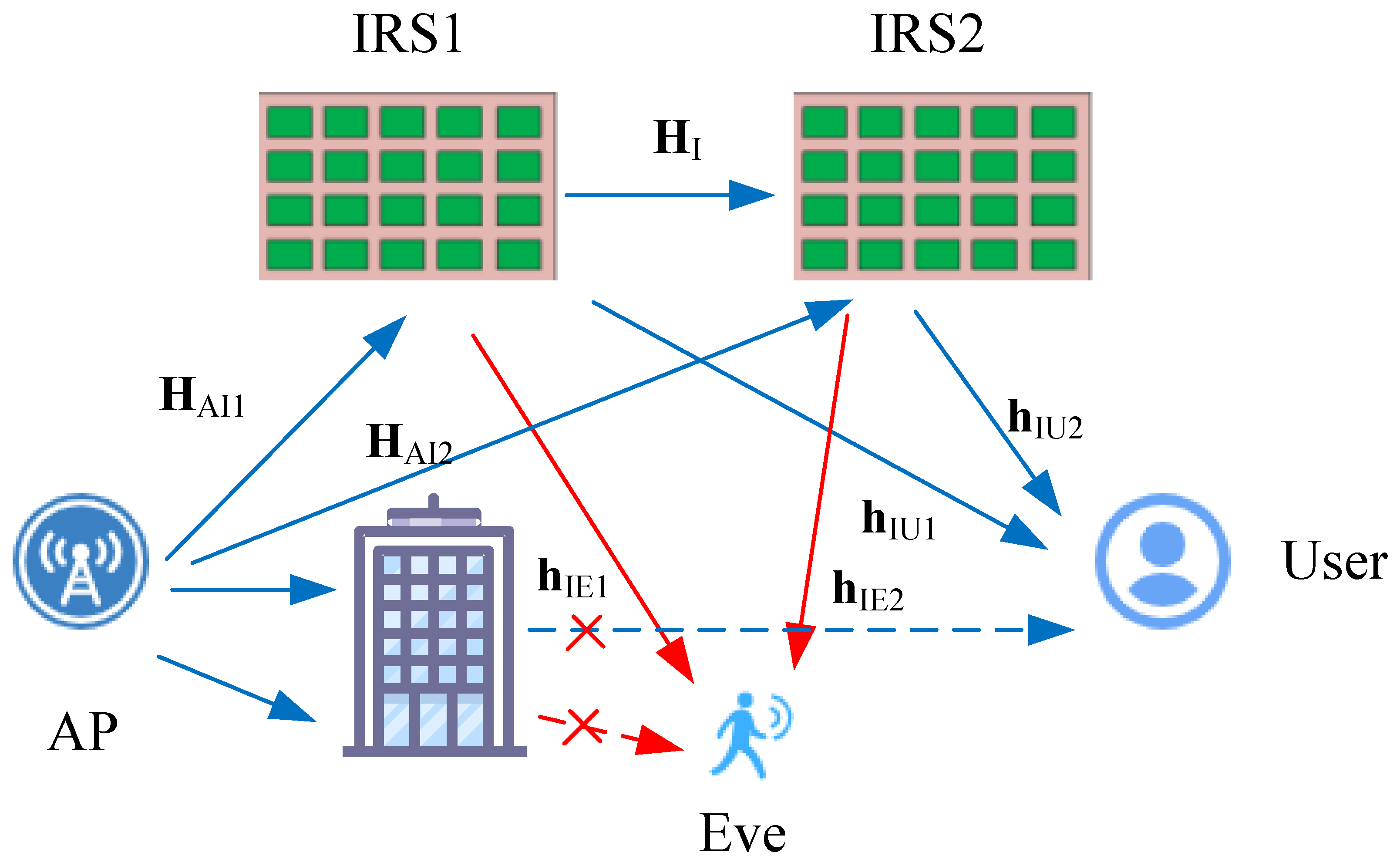
This paper studies a double-RIS-assisted secure communication system, as shown in
Figure 1. The system consists of one AP, two RISs (RIS1, RIS2), one legitimate user (User), and one eavesdropper (Eve). The AP is equipped with
M antennas, and RIS1 and RIS2 are equipped with
and
reflecting elements, respectively. User and Eve are each equipped with a single antenna. Since the direct link between the AP and User/Eve is blocked by buildings or trees, the direct channel from the AP to the User/Eve is not considered in the system. In this work, the multiple reflection links include single-reflection paths (AP–RIS–User/Eve) and the double-reflection path formed by the cascaded RISs. Signals reflected more than twice and the AP-RIS2-RIS1-User link signals are ignored due to the long path and high path loss [
19]. We utilize two RISs (RIS1 and RIS2) deployed near the AP and User to enhance communication and improve the security performance of the system.
Next, we consider the channel model. Let
and
denote the channels of AP-RIS1 and AP-RIS2, respectively. Let
and
denote the channels of RIS1-User and RIS1-Eve, respectively. Let
and
denote the channels of RIS2-User and RIS2-Eve, respectively. And let
denote the channel of RIS1-RIS2. To achieve the upper limit of rate performance, we assume that all the global CSI related to the channels mentioned above is perfectly known at the AP and RISs. It is also assumed that
and
are known, which is widely assumed in the literature of proactive eavesdropping, where a compromised user (Eve) acts as a legitimate user in one period but then tries to eavesdrop on other users [
16,
20,
21]. Such perfect CSI can be practically obtained using existing methods, such as the joint channel estimation approach or the variational Bayesian inference-based method [
22,
23], which have been widely investigated in IRS-assisted systems as well as recent hybrid-field and large-scale MIMO architectures [
24]. The channels
, and
are modeled as Rician channels, e.g.,
where
is the path loss,
is the Rician factor,
is the line-of-sight (LoS) component, and
is the non-LoS (NLoS) component with zero mean and the unit variance. The channel
is modeled as the LoS channel, which is given by
, where
is the steering vector of the transmitter and
is the steering vector of the receiver. The azimuth and elevation angles of the transmitter are represented by
and
respectively, and the azimuth and elevation angles of the receiver are represented by
and
respectively. Both
and
satisfy
, where
m and
n represent the number of rows and columns in the antenna array, respectively.
represents the wavelength and
d represents the distance between adjacent antennas.
The RIS1 has reflection elements and the phase shift matrix of it can be expressed as . represents the nth reflection coefficients, e.g., , where the and represent the amplitude and phase shift of the nth elements of RIS1, respectively. Similarly, the RIS2 has reflection elements, and the phase-shift matrix of it can be expressed as . represents the nth reflection coefficients, e.g., , where the and represent the amplitude and phase shift of the nth elements of RIS2, respectively. In this paper, and are set to 1 in order to achieve the maximum reflection power gain; thus, and should satisfy and .
The transmitted signal at the AP can be denoted as
where
s represents the user’s transmitted data symbol and satisfies
and
represents the corresponding transmit beamforming vector. Therefore, the User’s received signal and the Eve’s received signal are expressed as
where
is the complex additive white Gaussian noise (AWGN) of the User and
is the complex AWGN of the Eve.
3. Problem Formulation
In this paper, our objective is to maximize the secrecy rate of the system by jointly optimizing the transmit beamforming at the AP and the phase-shift matrices at both RIS1 and RIS2.
Let
, then the achievable rate at the User is
where
Similarly, let
. Then the achievable rate at the Eve is
where
.
Therefore, the achievable secrecy rate can be expressed as
where
. In the following discussion, we omit the operation
since scenarios with non-positive secrecy rates are meaningless. Considering the system’s transmit power constraint and unit modulus constraints, we formulate the achievable secrecy rate optimization problem as
where
P is the maximum transmit power at the AP. The objective function of the optimization problem is to maximize the secrecy rate, and the first constraint restricts the maximum transmit power of the AP as
P, while
, and
represent the unit modulus constraints, which ensure the RISs can only adjust the phase of the incident signals without changing the amplitude. Although
is concise, the optimization variables
and
are deeply coupled in the non-convex objective function and are subject to challenging unit-modulus constraints, which make it difficult to solve. Therefore, in the next subsection, we will propose an efficient algorithm to address the optimization problem.
4. Alternation Optimization Algorithm
To address the non-convex optimization problem in , we propose an AO algorithm to jointly optimize the beamforming vector at the AP and the phase-shift matrices of RIS1 and RIS2 in this section. Firstly, when given a fixed , we use the maximum ratio transmission (MRT) method to obtain the closed-form solution of . Secondly, when the is solved, we propose a manifold optimization-based algorithm to simultaneously optimize both and . Finally, we introduce an SCA-based algorithm, where non-convex terms are linearized via first-order Taylor expansion, followed by a semidefinite relaxation (SDR) approach to alternately optimize and . The following three subsections will provide detailed introductions to the above algorithms, including the complete algorithm, convergence, and complexity.
4.1. Beamforming Optimization
In this subsection, our objective is to optimize the beamforming vector
with the given
and
. The optimization problem can be expressed as
For the given
and
, the secrecy rate can be reformulated as
To further simplify (9), let
and
; then
can be represented as
According to [
25,
26], the MRT method can be used to solve
; then the optimal solution is
where
is the normalized dominant generalized eigenvector of the matrix pencil
and
denotes an
identity matrix.
4.2. Phase-Shift Matrix Optimization
In this subsection, we propose two algorithms to optimize the reflection phase matrices of the two RISs: the manifold optimization-based algorithm and the SCA-based algorithm. The SCA-based algorithm serves as a benchmark for comparison with the manifold optimization-based algorithm.
4.2.1. Manifold Optimization-Based Algorithm
Manifold optimization techniques, such as the Riemannian conjugate gradient method, have been widely applied to unit-modulus constrained problems in RIS-assisted systems (e.g., Ref. [
15]). Inspired by these works, we propose a manifold optimization-based algorithm using manifold optimization to jointly optimize the phase-shift matrices of the two RISs. Unlike the UMO in [
15], which focuses on capacity maximization in double-RIS MIMO systems, our algorithm is specifically designed for secrecy rate maximization in the presence of an eavesdropper. When the
has been solved, the optimization problem can be formulated as
Since the unit modulus constraint
, it can be regarded as a complex circle manifold
Similarly, due to the unit modulus constraint
, it also forms as a complex circle manifold
The unified manifold space
that includes the above complex circle manifolds can be represented as
Therefore,
can be formulated as
The unified manifold is adopted to facilitate the joint optimization of and within a single Riemannian framework. This approach allows us to efficiently handle the coupling between the two RIS phase-shift vectors and to apply a unified conjugate gradient method, thereby improving convergence speed and algorithmic stability compared to separate manifold optimizations.
To further solve the problem, we reformulate
as
It can be further simplified as
The optimization problem is a fractional programming problem. According to [
26], by introducing the parameter
,
can be represented as
where
is expressed as
where
k denotes the iteration number. It can be seen that
is an unconstrained optimization problem on the manifold without relaxation. Then, in each iteration, the following three main steps are required to obtain
and
.
First, for
, the tangent space is given by
and for
, the tangent space is given by
where
and
are the tangent vectors at points
and
, respectively. The Riemannian gradient is the direction of steepest descent of the objective function among all tangent vectors in the tangent space. It is the orthogonal projection of the Euclidean gradient onto the tangent space. Therefore, the Riemannian gradient
of
and
can be represented as
where
is the Riemannian gradient at
and
is the Riemannian gradient at
, which can be represented as
and
The Euclidean gradients
and
are given by
and
where the relevant parameters are given as
and
Secondly, after obtaining the Riemannian gradients, the search direction
at
and
can be represented as
where
and
Here,
is the vector that transports the previous search direction
from the current tangent space
to the next tangent space
, and it can be represented as
and
are scalar parameters, which can be denoted according to [
27] as
Thirdly, after obtaining the update directions, the retraction step is used to map the updated points, which may have deviated from the manifold and back onto the manifold. Specifically, retraction is a mapping from the tangent space to the manifold itself. Therefore, the retraction operation can be written as
where
is the Armijo backtracking step size. Specifically, if
satisfies the condition
is the desired step size. If the condition is not satisfied, the step size is reduced as
, and Formula (32) is repeated until a satisfying
is found where
is a constant, typically chosen as
, and
is the contraction factor, which also satisfies
.
Based on the above discussion, we have presented the key steps used in each iteration to solve
. The manifold optimization-based algorithm is summarized in Algorithm 1, where
denotes the target accuracy for the convergence of the Riemannian gradient. Due to the transmit power constraint, the objective function is upper-bounded. Moreover, the line search strategy (32) ensures the monotonic increase of
, where each subproblem is solved with a sufficient decrease guaranteed by the Armijo backtracking line search. Therefore, Algorithm 1 is guaranteed to converge [
27].
| Algorithm 1 Manifold Optimization-based Algorithm |
- 1:
Initialize , , and . Initialize iteration count . Initialize the search direction ; - 2:
repeat - 3:
Set the initial step size ; - 4:
repeat - 5:
Set ; - 6:
until - 7:
Update the new point using the retraction operation as ; - 8:
Compute the Riemannian gradient according to (24) and (25); - 9:
Compute the vector transport according to (29); - 10:
Compute according to Formula (30); - 11:
Update the search direction ; - 12:
Set ; - 13:
until
|
4.2.2. SCA-Based Algorithm
To compare with the manifold optimization-based algorithm mentioned above, in this subsection, we propose the SCA-based algorithm to simplify the objective function, which optimizes
and
. Since the objective function in
is complex, we alternately optimize
and
by fixing one of them as a constant. Since
and
are symmetric in the objective function, the proposed method for
applies to
and vice versa. Therefore, in the following, we focus on the design of
with a given
and
. When we fix
and
,
can be transformed as
where
. Furthermore, it can be simplified as
Combining the constant terms, let
,
,
,
,
,
, and
. Then (34) can be represented as
Let
and
. By expanding the squared terms, it can be obtained that
Let
and
. Simplify Formula (36) to
Let
,
,
,
,
, and
. Simplify Formula (37) to
Accordingly, the optimization problem
can be reformulated as
However, it can be seen that the objective function is non-convex. To solve this problem, we use a first-order Taylor expansion on
, and there is
Then the optimization problem
can be represented as
Problem can be solved by CVX, and an approximate solution for is obtained by employing the standard Gaussian randomization method.
When
and
are fixed, the optimization problem can also be formulated as
The SCA method used to solve as described above can be applied to obtain .
4.3. Overall Algorithm and Complexity Analysis
To solve the optimization problem
, we employ the MOAO algorithm to alternately optimize
and
. The overall algorithm is summarized in Algorithm 2, where
denotes the convergence tolerance of the algorithm. Since
and
are all bounded, the MOAO algorithm is guaranteed to converge monotonically. The overall algorithm complexity is mainly due to steps 5 and 6, with step 5 having a complexity of
. The algorithm complexity of step 6 mainly lies in computing the Euclidean gradients of
and
, with a complexity of
[
15]. Since Algorithm 1 typically converges within a small number of inner iterations per outer loop, the overall cost per outer iteration remains
. Therefore, the overall algorithm complexity is
, where
is the number of iterations. Since the SCA-based algorithm cannot simultaneously optimize
and
, it has a higher computational complexity with
compared to the proposed manifold optimization-based algorithm, where
denotes the number of iterations.
| Algorithm 2 The MOAO Algorithm |
Input: , , , , , , and .
Output: Optimal beamforming vector ; optimal reflection matrix and ; optimal .
- 1:
Initialize , , and ; - 2:
Set , compute ; - 3:
repeat - 4:
set . - 5:
Update according to (11); - 6:
Update and according to Algorithm 1; - 7:
Compute ; - 8:
until
|
5. Simulation Results and Discussion
In this section, simulation results are presented to validate the performance of the MOAO algorithm. It is assumed that the two deployed RISs are of the same type. A three-dimensional (3D) coordinate system is considered, where the AP is located at (0 m, 0 m, 10 m), RIS1 is located at (0 m, 10 m, 15 m), RIS2 is located at (0 m, 50 m, 15 m), while the User is positioned at (5 m, 45 m, 0 m) and the Eve is located at (10 m, 60 m, 0 m). The path loss model is given by , where denotes the path loss at the reference distance . d is the distance between the transmitter and the receiver, and is the path loss exponent. It is set as and . The path loss exponents for the AP-RIS1 link, AP-RIS2 link, RIS1-User link, RIS2-User link, RIS1-Eve link, RIS2-Eve link, and RIS1-RIS2 link are set as , , , , , , and , respectively. Rician factors are set as , , and , respectively. For simplicity, set , . To verify the effectiveness of the MOAO algorithm, it is compared with the following four benchmark schemes:
Scheme 1: Random Phase Design for Double RIS: Both and are initialized with random values and is updated by Formula (11).
Scheme 2: Phase Design for RIS Near the AP: is designed according to Algorithm 1. is updated using Formula (11).
Scheme 3: Phase Design for RIS Near the User: is designed according to Algorithm 1. is updated using Formula (11).
Scheme 4: SCA-Based Design: and are jointly optimized using the SCA algorithm. is obtained by Formula (11).
These methods are respectively labeled as “Random Phase”, “Near AP”, “Near User”, and “SCA”.
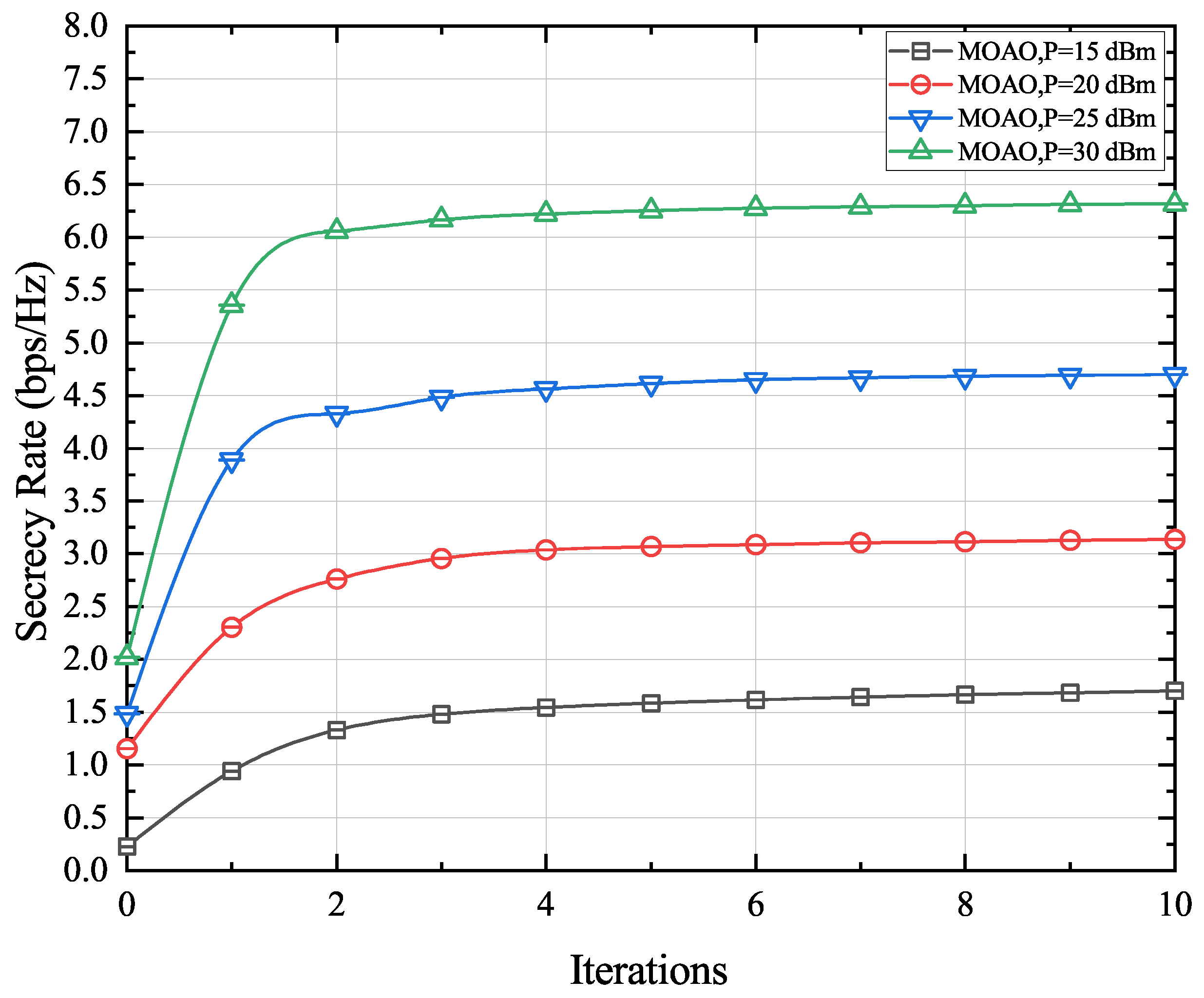
Figure 2 illustrates the convergence performance of the MOAO algorithm under different maximum transmit power levels. The parameters are set as
and
. As shown in this figure, for all power levels, the secrecy rate increases with the number of iterations and gradually converges after the fourth iteration. This demonstrates the effectiveness and convergence of the MOAO algorithm under different powers.
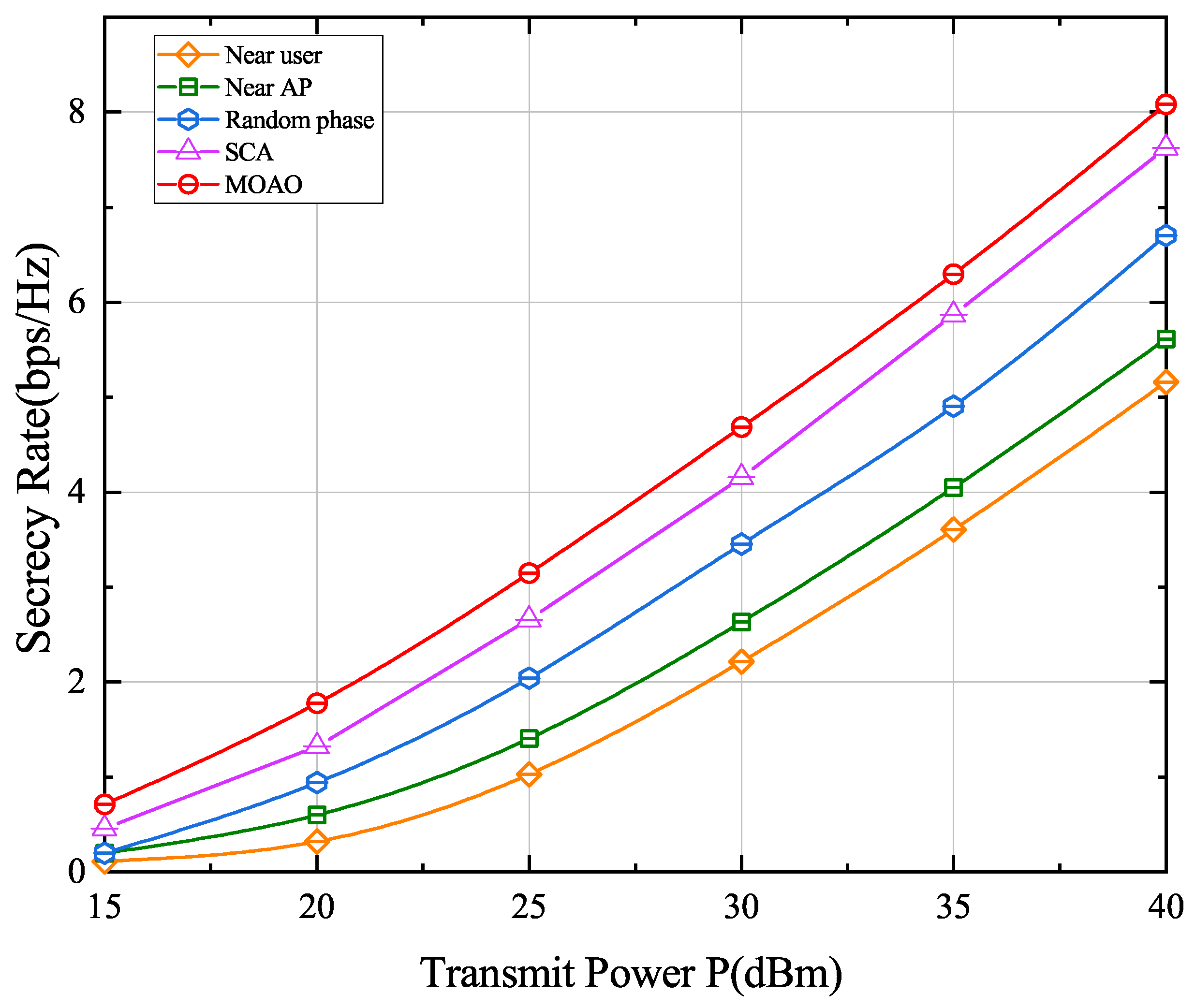
Figure 3 illustrates the relationship between the secrecy rate and the maximum transmit power
P, where
and
. It can be seen that the secrecy rate increases with the transmit power in all schemes. However, there exist significant performance differences among them. In particular, when
, the MOAO algorithm achieves a secrecy rate of 8.02 bps/Hz, which is approximately 5.25% higher than that of the SCA scheme (around 7.62 bps/Hz) and about 19.7% higher than that of the random phase scheme (around 6.7 bps/Hz). These results demonstrate that the MOAO algorithm consistently achieves the best performance in the whole transmit power range. Futhermore, its performance advantage becomes more pronounced as the transmit power increases. In addition, the lower performance of the ‘Near User’ scheme compared to the ‘Near AP’ scheme can be attributed to the geometric layout and channel conditions in our scenario. Since the AP–RIS1–User link involves a shorter overall propagation distance and a more favorable angle of departure/arrival, optimizing RIS1 provides a stronger effective channel gain for the legitimate user. In contrast, RIS2, though closer to the user, is farther from the AP, resulting in higher path loss for the AP–RIS2 link. Moreover, the cascaded reflection through the RIS1–RIS2–User path is also more effective when RIS1 is optimized, as it acts as the first reflector in the double-reflection cascade.
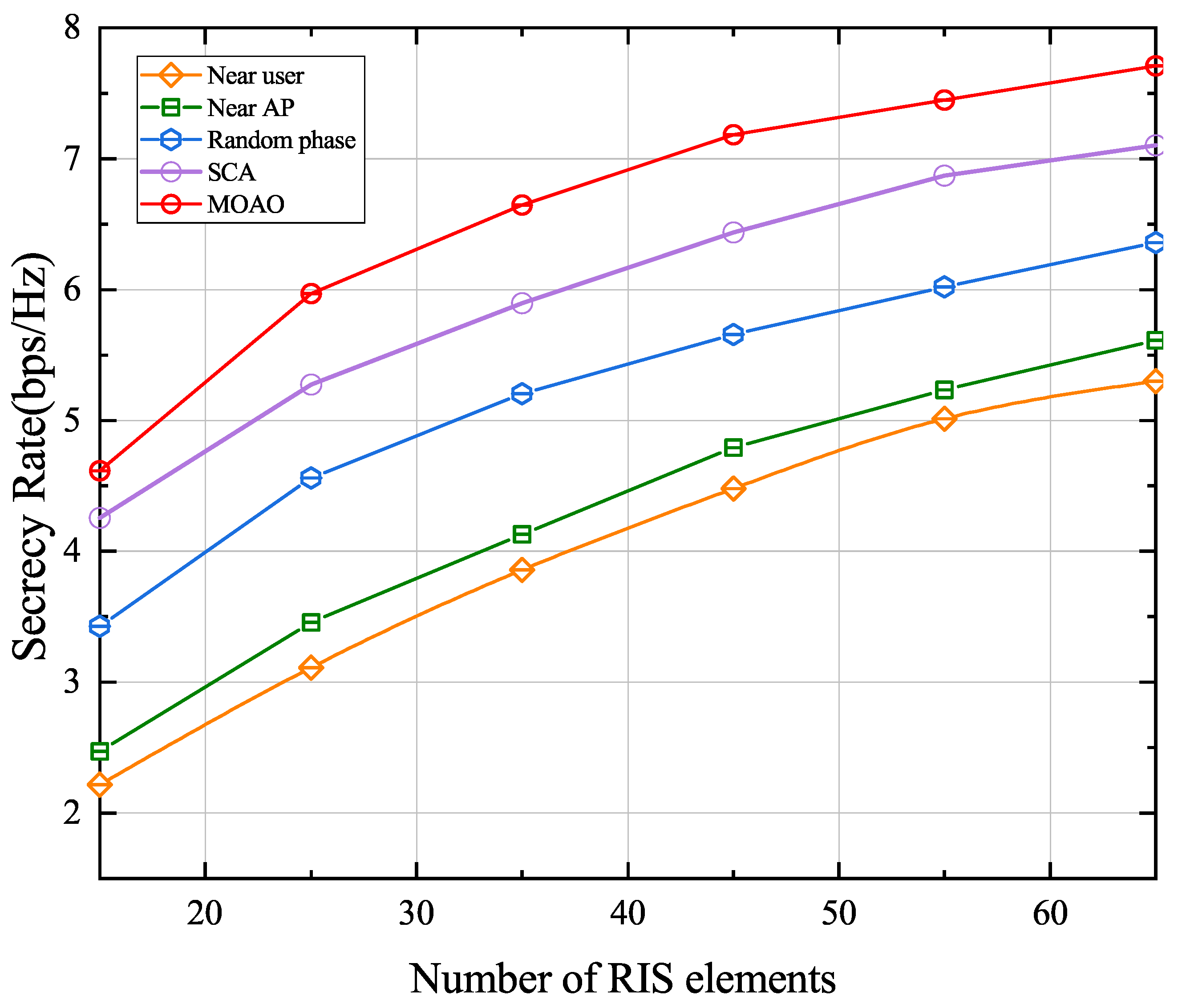
Figure 4 illustrates the impact of the number of RIS elements on the secrecy rate under different schemes, where
and
. As shown in
Figure 4, the secrecy rate of all schemes increases with the number of RIS elements, and the MOAO algorithm consistently achieves the best performance. When the number of RIS elements is 65, the proposed scheme achieves a secrecy rate of 7.71 bps/Hz, which is 21.2% and 8.6% higher than that of the random phase scheme (6.36 bps/Hz) and the SCA scheme (7.10 bps/Hz), respectively. In addition, all double-RIS designs outperform the single-RIS design in terms of the secrecy rate, which demonstrates the significant advantage of using double RIS in assisting wireless communication.
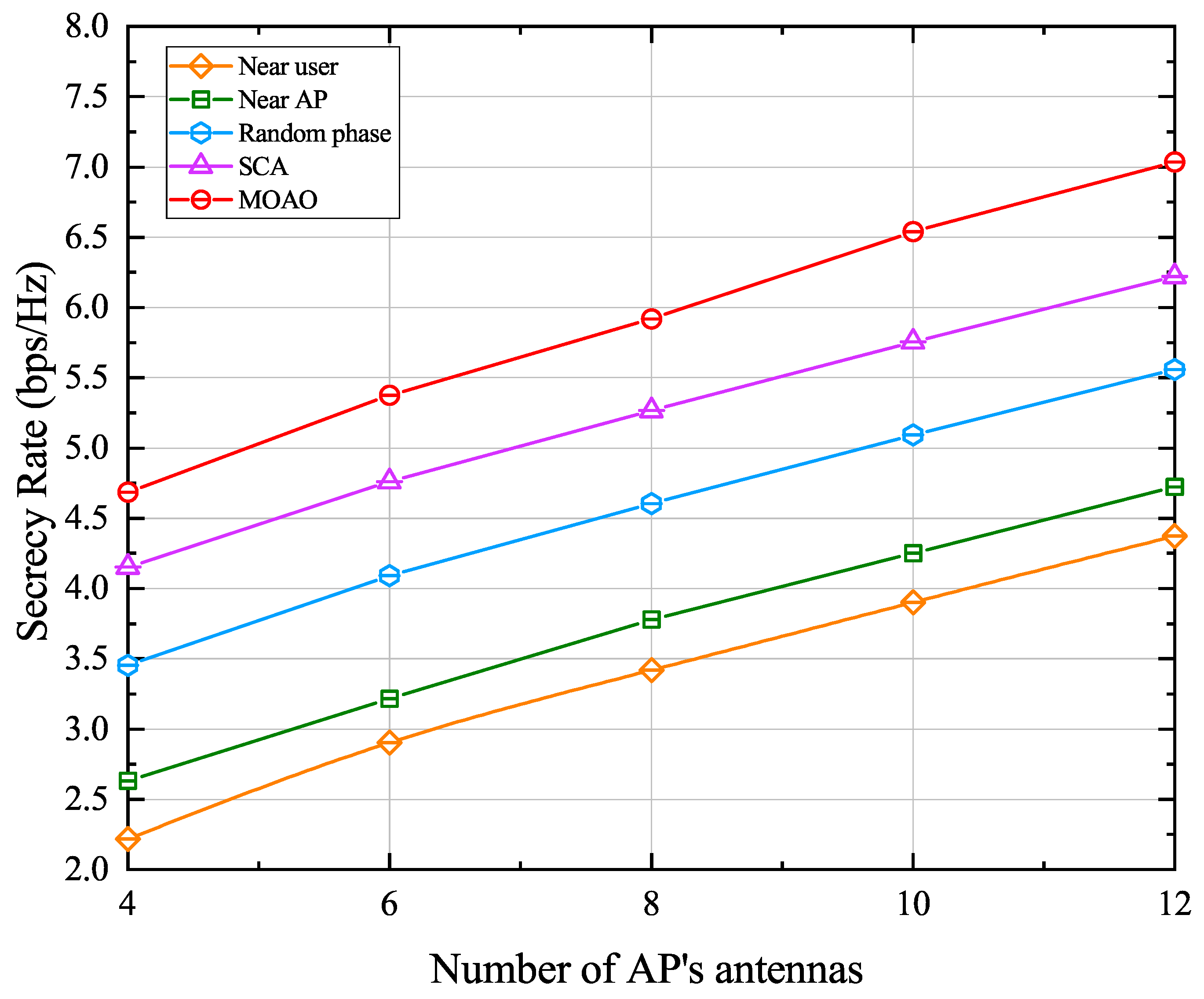
Figure 5 shows the relationship between the secrecy rate and the number of AP antennas, where
and
. As illustrated in the
Figure 5, the secrecy rate increases monotonically with the number of AP antennas. This is because more antennas at the AP can enhance the channel conditions. Moreover, as the number of AP antennas increases, the MOAO algorithm exhibits a significant performance advantage. These results not only confirm the importance of multiple antenna techniques in enhancing PLS but also demonstrate that the MOAO algorithm can effectively reduce hardware deployment costs, providing valuable insight for the secure design of practical communication systems.
As summarized in
Table 1, the MOAO algorithm converges within approximately four iterations, while SCA requires around eight iterations to reach convergence. Moreover, the average running time of MOAO is significantly lower than that of SCA, which directly corroborates the claim of reduced computational complexity in
Section 4.3.
6. Conclusions
In this paper, we investigated the optimization of PLS in a double-RIS-aided communication system and proposed an efficient algorithm based on manifold optimization. The MOAO algorithm jointly optimized the RIS phase-shift matrices and the beamforming vector at the AP, which effectively enhanced the system’s secrecy rate to a high precision level. Simulation results demonstrated that the MOAO algorithm not only improved communication security but also confirmed the effectiveness of employing double RIS in enhancing the secrecy rate. In future studies, this approach can be extended to scenarios involving multi-antenna receivers and multiple legitimate eavesdroppers to further optimize performance in more complex environments. In addition, we plan to relax the perfect CSI assumption and investigate more practical scenarios where the eavesdropper’s CSI is imperfect or partially known. Moreover, the impact of RIS quantization is an important extension and will be investigated in future work.
Author Contributions
Conceptualization, J.L. and S.C.; methodology, J.L. and S.C.; software, J.L. and S.C.; validation, J.L. and S.C.; formal analysis, J.L., S.C., Z.W., and H.L.; investigation, J.L. and S.C.; resources, Y.C., J.L., and S.C.; data curation, J.L., S.C., Z.W., H.L., and Y.C.; writing original draft preparation, J.L. and S.C.; writing review and editing, Y.S., Y.L., and W.W.; visualization, J.L. and S.C.; supervision, Y.S., Y.L., and W.W.; project administration, Y.L. and W.W.; funding acquisition, W.W., Y.L., and Y.S. J.L. and S.C. contributed equally to this work and are co-first authors. All authors have read and agreed to the published version of the manuscript.
Funding
This study was supported by the National Natural Science Foundation of China under Grant Nos. 62371245, 62371248, and 62371249, the National Key R&D Program of China (2023YFB2904000), the Jiangsu Key Development Planning Project (BE2023004-2), the Natural Science Foundation of Jiangsu Province (Higher Education Institutions) (20KJA520001), the 14th Five Year Plan project of Equipment Development Department (315107402), and the Science and Technology Research and Development Program of China State Railway Group Co., Ltd. (L2024G006).
Institutional Review Board Statement
Not applicable.
Informed Consent Statement
Not applicable.
Data Availability Statement
The original contributions presented in this study are included in the article. Further inquiries can be directed to the corresponding authors.
Conflicts of Interest
The authors declare no conflicts of interest.
Abbreviations
The following abbreviations are used in this manuscript:
| RIS | Reconfigurable Intelligent Surface |
| PLS | Physical Layer Security |
| MOAO | Manifold Optimization-assisted Alternating Optimization |
| SCA | Successive Convex Approximation |
| GDM | Generalized Diffusion Model |
| MIMO | Multiple-Input Multiple-Output |
| MISO | Multiple-Input Single-Output |
| CSI | Channel State Information |
| LoS | Line of Sight |
| UMO | Unified Manifold Optimization |
| AP | Access Point |
| MRT | Maximum Ratio Transmission |
| SDR | Semidefinite Relaxation |
| 3D | Three-Dimensional |
References
- Kumar, S.; Kumbhani, B. Performance Analysis of Active STAR-RIS-assisted NOMA with Hardware Impairments at Finite Blocklength. Digit. Signal Process. 2025, 163, 105206. [Google Scholar] [CrossRef] [Scilit]
- Zhang, X.; Wang, X.; Huang, J.; So, H.C. Joint design of antenna selection and transmit linear array beamformer for integrated radar and communications. Digit. Signal Process. 2024, 144, 104281. [Google Scholar] [CrossRef] [Scilit]
- Pham, X.N.; Nguyen, B.C.; Thi, T.D.; Van Vinh, N.; Minh, B.V.; Kim, T.; Nguyen, T.N.; Le, A.V. Enhancing data rate and energy efficiency of NOMA systems using reconfigurable intelligent surfaces for millimeter-wave communications. Digit. Signal Process. 2024, 151, 104553. [Google Scholar] [CrossRef] [Scilit]
- Wu, Q.; Zhang, S.; Zheng, B.; You, C.; Zhang, R. Intelligent reflecting surface-aided wireless communications: A tutorial. IEEE Trans. Commun. 2021, 69, 3313–3351. [Google Scholar] [CrossRef] [Scilit]
- Ma, T.; Xiao, Y.; Lei, X.; Zhang, L.; Niu, Y.; Karagiannidis, G.K. Reconfigurable intelligent surface-assisted localization: Technologies, challenges, and the road ahead. IEEE Open J. Commun. Soc. 2023, 4, 1430–1451. [Google Scholar] [CrossRef] [Scilit]
- Tang, W.; Dai, J.Y.; Chen, M.Z.; Wong, K.K.; Li, X.; Zhao, X.; Jin, S.; Cheng, Q.; Cui, T.J. MIMO transmission through reconfigurable intelligent surface: System design, analysis, and implementation. IEEE J. Sel. Areas Commun. 2020, 38, 2683–2699. [Google Scholar] [CrossRef] [Scilit]
- Wu, Q.; Zhang, R. Towards smart and reconfigurable environment: Intelligent reflecting surface aided wireless network. IEEE Commun. Mag. 2019, 58, 106–112. [Google Scholar] [CrossRef] [Scilit]
- Tran, H.Q. Enhanced Antenna Selection and Physical Layer Security in Multi-User MIMO-CR-NOMA Systems with In-Phase/Quadrature Imbalance. Digit. Signal Process. 2025, 163, 105239. [Google Scholar] [CrossRef] [Scilit]
- Wang, D.; Tian, X.; Wang, J.; Fu, J. Transmission Method of Electric Power Communication Network Based on Physical Layer Security. In 2024 6th International Conference on Energy, Power and Grid (ICEPG); IEEE: Piscataway, NJ, USA, 2024; pp. 1910–1913. [Google Scholar]
- Liu, Z.; Zhang, J.; Guan, Y. A Physical Layer Security Algorithm for IRS-Assisted MIMO Communication Networks via GDM. In 2024 IEEE/CIC International Conference on Communications in China (ICCC Workshops); IEEE: Piscataway, NJ, USA, 2024; pp. 232–237. [Google Scholar]
- Ngo, Q.T.; Phan, K.T.; Mahmood, A.; Xiang, W. Physical layer security in IRS-assisted cache-enabled satellite communication networks. IEEE Trans. Green Commun. Netw. 2023, 7, 1920–1931. [Google Scholar] [CrossRef] [Scilit]
- Zhai, Z.; Lei, W.; Lei, H.; Tang, H. Robust design of the security scheme in IRS-assisted MISO systems with imperfect eavesdropping CSI. IEEE Trans. Veh. Technol. 2024, 73, 12815–12827. [Google Scholar] [CrossRef] [Scilit]
- Bilal, M.; Zahra, S.F.; Rizwan, H.; Umar, T.; Hassan, S.A.; Jung, H.; Dev, K. Single Versus Double IRS-assisted Networks: A Comparative Analysis Using Practical Phase Shifting. In 2024 IEEE Wireless Communications and Networking Conference (WCNC); IEEE: Piscataway, NJ, USA, 2024; pp. 1–5. [Google Scholar]
- Niu, H.; Chu, Z.; Zhou, F.; Pan, C.; Ng, D.W.K.; Nguyen, H.X. Double intelligent reflecting surface-assisted multi-user MIMO mmWave systems with hybrid precoding. IEEE Trans. Veh. Technol. 2021, 71, 1575–1587. [Google Scholar] [CrossRef] [Scilit]
- Geng, Y.; Cheng, T.H.; Zhong, K.; Teh, K.C. Unified Manifold Optimization for Double-IRS Aided MIMO Communication. IEEE Commun. Lett. 2024, 28, 1713–1717. [Google Scholar] [CrossRef] [Scilit]
- Cao, Y.; Duan, L.; Jin, M.; Zhao, N. Cooperative double-IRS aided proactive eavesdropping. IEEE Trans. Commun. 2022, 70, 6228–6240. [Google Scholar] [CrossRef] [Scilit]
- Ding, G.; Yang, F.; Ding, L.; Cui, Y. Analysis and optimization of a double-IRS cooperatively assisted system with a quasi-static phase shift design. IEEE Trans. Wirel. Commun. 2022, 22, 4416–4433. [Google Scholar] [CrossRef] [Scilit]
- You, C.; Zheng, B.; Zhang, R. Wireless communication via double IRS: Channel estimation and passive beamforming designs. IEEE Wirel. Commun. Lett. 2020, 10, 431–435. [Google Scholar] [CrossRef] [Scilit]
- Zheng, B.; You, C.; Zhang, R. Double-IRS assisted multi-user MIMO: Cooperative passive beamforming design. IEEE Trans. Wirel. Commun. 2021, 20, 4513–4526. [Google Scholar] [CrossRef] [Scilit]
- Abughalwa, M.; Nguyen, D.N.; Hoang, D.T.; Dutkiewicz, E. Multi-User Secrecy Rate Maximization in IRS-aided Systems. In GLOBECOM 2024—2024 IEEE Global Communications Conference; IEEE: Piscataway, NJ, USA, 2024; pp. 2491–2496. [Google Scholar]
- Dong, L.; Wang, H.M.; Bai, J.; Xiao, H. Double intelligent reflecting surface for secure transmission with inter-surface signal reflection. IEEE Trans. Veh. Technol. 2021, 70, 2912–2916. [Google Scholar] [CrossRef] [Scilit]
- Fang, X. Joint Channel Estimation Algorithm for IRS-assisted Multi-User MIMO Systems. IEEE Commun. Lett. 2024, 28, 367–371. [Google Scholar] [CrossRef] [Scilit]
- Ji, C.; Dong, H.; Xu, W.; Dai, J. Joint Channel Estimation and Data Detection for IRS-assisted OFDM Systems. IEEE Trans. Veh. Technol. 2023, 72, 11963–11974. [Google Scholar] [CrossRef] [Scilit]
- Wang, H.; Zhang, K.; Fu, Q.; Wen, F.; Li, X. Enhanced Channel Estimation for Hybrid-Field XL-MIMO Systems Using Joint Sparse Bayesian Learning. IEEE Wirel. Commun. Lett. 2025, 14, 3099–3103. [Google Scholar] [CrossRef] [Scilit]
- Cui, M.; Zhang, G.; Zhang, R. Secure wireless communication via intelligent reflecting surface. IEEE Wirel. Commun. Lett. 2019, 8, 1410–1414. [Google Scholar] [CrossRef] [Scilit]
- Shen, H.; Xu, W.; Gong, S.; He, Z.; Zhao, C. Secrecy rate maximization for intelligent reflecting surface assisted multi-antenna communications. IEEE Commun. Lett. 2019, 23, 1488–1492. [Google Scholar] [CrossRef] [Scilit]
- Sato, H. Riemannian conjugate gradient methods: General framework and specific algorithms with convergence analyses. SIAM J. Optim. 2022, 32, 2690–2717. [Google Scholar] [CrossRef] [Scilit]
| Disclaimer/Publisher’s Note: The statements, opinions and data contained in all publications are solely those of the individual author(s) and contributor(s) and not of MDPI and/or the editor(s). MDPI and/or the editor(s) disclaim responsibility for any injury to people or property resulting from any ideas, methods, instructions or products referred to in the content. |