


Abstract
Limited computational resources prevent GNSS-based passive radar systems from processing all accessible signals, necessitating intelligent signal selection for efficient target tracking. This paper proposes an adaptive selection method based on Rényi divergence. Within the Cardinality Balanced Multi-Bernoulli (CBMeMBer) filter framework, the method establishes an optimization model that maximizes the expected information gain under a fixed signal-number constraint. To comprehensively validate performance, simulations are conducted under three scenarios: multi-target linear motion, single-target tracking (for comparison with the classical Geometric Dilution of Precision (GDOP) criterion), and multi-target nonlinear maneuvering. Results demonstrate that the proposed algorithm significantly reduces computational load while achieving tracking accuracy superior to random selection and comparable to using all satellites. Compared to the GDOP-based method, it exhibits improved steady-state tracking accuracy by leveraging its dynamic, information-driven selection mechanism. This work provides an effective solution for intelligent resource management in resource-constrained GNSS-based passive radar systems.
1. Introduction
Passive radar is a type of passive detection system that relies on existing radio waves in the environment. It does not generate its own electromagnetic emissions but instead utilizes bands such as those used for communications and broadcasting as its illuminators. Acting as a receiver, it passively detects signals reflected from targets to perform target detection [1]. With its separated transmitter–receiver architecture, this system is difficult for adversaries to detect, exhibiting outstanding anti-jamming capabilities and resistance to anti-radiation missile attacks, and has become a research focus for new-generation detection technologies [2,3]. Currently, signals that can serve as illuminators include FM radio broadcasts, television signals, satellites, mobile communication base stations, and various radar station signals [4,5]. In particular, signals from the Global Navigation Satellite System (GNSS), due to their global coverage and continuous operation, represent an easily accessible source of illumination. Therefore, this study selects GNSS signals as the external illuminators.
With the rapid advancement of satellite communication technology, the number of operational satellites in space continues to increase, leading to a growing number of satellite signals in the atmosphere. Radar receivers must handle radiation waves from numerous different satellites. However, in practical applications, the more external illuminators a passive radar uses, the larger the data volume, and consequently, the higher the information processing load on the fusion center. Therefore, under limited system resources, it is necessary to select a combination of GNSS signals with good performance as illuminators during the target tracking process to achieve the best possible performance.
The fundamental approach to illuminator selection is to define an evaluation criterion to measure the impact of different illuminator combinations on target tracking quality and select the combination that optimizes this criterion. Reference [6] outlined three key factors for illuminator selection in passive radar systems: illuminator availability and transmit power, the waveform characteristics of the signal, and the usage scenario, proposing corresponding selection schemes. Furthermore, Reference [7], based on a scenario using the BeiDou Navigation System as the illuminator, a missile as the carrier, and an aircraft carrier as the detection target, proposed a method for selecting opportunity illuminator satellites according to their spatial location and the system’s geometric configuration, considering the resolution required for target detection. Reference [8] constructed a radar system consisting of two external illuminators and one receiver, calculated the Cramér-Rao Lower Bound (CRLB) for both illuminators, and proposed an external illuminator selection method using the CRLB, which improved the tracking performance of the radar system. However, the aforementioned literature primarily addresses single-target tracking problems, and their methods are not suitable for multi-target tracking scenarios.
To solve the sensor selection problem in multi-target tracking, scholars have adopted divergences between the prior and posterior target probability densities from information theory as reward functions, specifically including Rényi divergence and Cauchy-Schwarz (CS) divergence [9]. Ristic utilized Rényi divergence to study the receiver selection problem in multi-target tracking and derived a numerical approximation for the Rényi divergence [10]. Hoang, H.G modeled the multi-target state as a Multi-Bernoulli RFS and proposed two control objectives for sensor selection: maximizing the expected Rényi divergence between the predicted density and the updated density, while minimizing the expected posterior cardinality variance [11]. Reference [12] combined the Cardinality Balanced Multi-Extended Target Multi-Bernoulli filter algorithm and presented an RHM Cubature Kalman Gaussian Mixture filter for tracking multiple extended targets. Furthermore, the CS divergence between Gaussian mixture densities was used as the evaluation function for sensor control, deciding the optimal sensor control method based on the criterion of maximizing information gain. References [9,10,11,12] primarily studied ground-based illuminators and mostly addressed the selection of receiving stations within radar networks. Based on the existing literature, research on GNSS signal-based external illuminator selection is relatively scarce.
However, when applying selection criteria to GNSS-based passive radar—a specific bistatic radar regime—the theoretical foundation of many conventional methods, most notably the “maximum energy” criterion, becomes fundamentally problematic. This is because, unlike in monostatic radar, the energy of the target echo in a passive bistatic system is not directly proportional to the energy of the direct-path signal. The signal-to-noise ratio (SNR) of the target echo is governed by the bistatic radar equation, where the received power is critically dependent on the spatial geometry formed by the transmitter, target, and receiver. Key factors include the bistatic path loss (proportional to the product , where and are the distances from the target to the transmitter and receiver, respectively) and the bistatic Radar Cross Section (RCS) of the target. Critically, the bistatic RCS is not a constant but varies dramatically with the changing bistatic angle. Research has quantitatively demonstrated that variations in the bistatic angle can induce significant polarization mismatch loss, leading to considerable fluctuation in echo energy [13]. Furthermore, in extreme geometries such as the forward-scatter region (bistatic angle > 135°), the echo mechanism becomes even more complex due to the interference between the scattered and direct fields, making the received signal characteristics highly unpredictable and distinct from those in monostatic or conventional bistatic scenarios [14]. Consequently, selecting the illuminator with the strongest direct-path signal offers no guarantee of providing the strongest target echo; an unfavorable geometry may even result in an undetectable return.
In view of this, selecting the optimal subset of illuminators requires moving beyond simplistic energy metrics. In existing research, optimization methods based on the Geometric Dilution of Precision (GDOP) [15] provide a significant approach by evaluating the impact of spatial configuration on positioning accuracy. However, from the perspective of state estimation and information fusion, the signal selection problem depends not only on geometric configuration but also profoundly on the dynamic uncertainty of the target, measurement noise, and the state information gain that different signal combinations can provide.
To address this problem systematically from an information-theoretic perspective, this paper proposes an adaptive GNSS signal selection method based on Rényi divergence. Within the Cardinality Balanced Multi-Bernoulli (CBMeMBer) filter framework, this method formulates the selection problem as an optimization model that maximizes the expected information gain. Unlike methods that primarily focus on final geometric distribution accuracy, the core of the proposed approach lies in directly quantifying and maximizing the information increment from observation to state update. By dynamically evaluating, via Rényi divergence, the contribution of different signal combinations to reducing state uncertainty under specific target prior distributions and observation models, it provides a novel criterion for signal selection under resource-constrained conditions.
2. Model Establishment
2.1. System Model
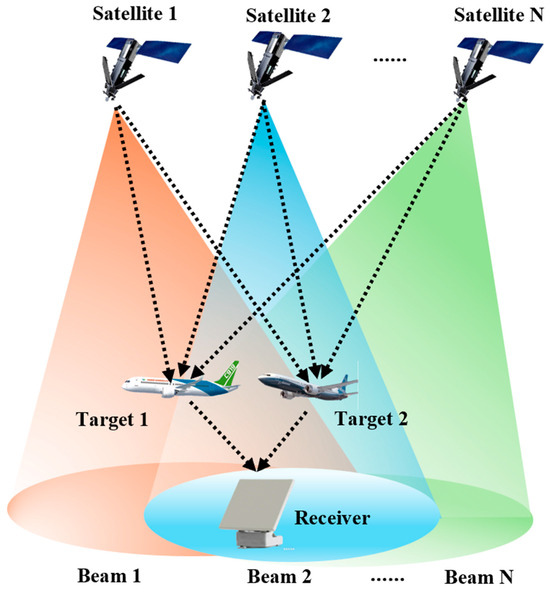
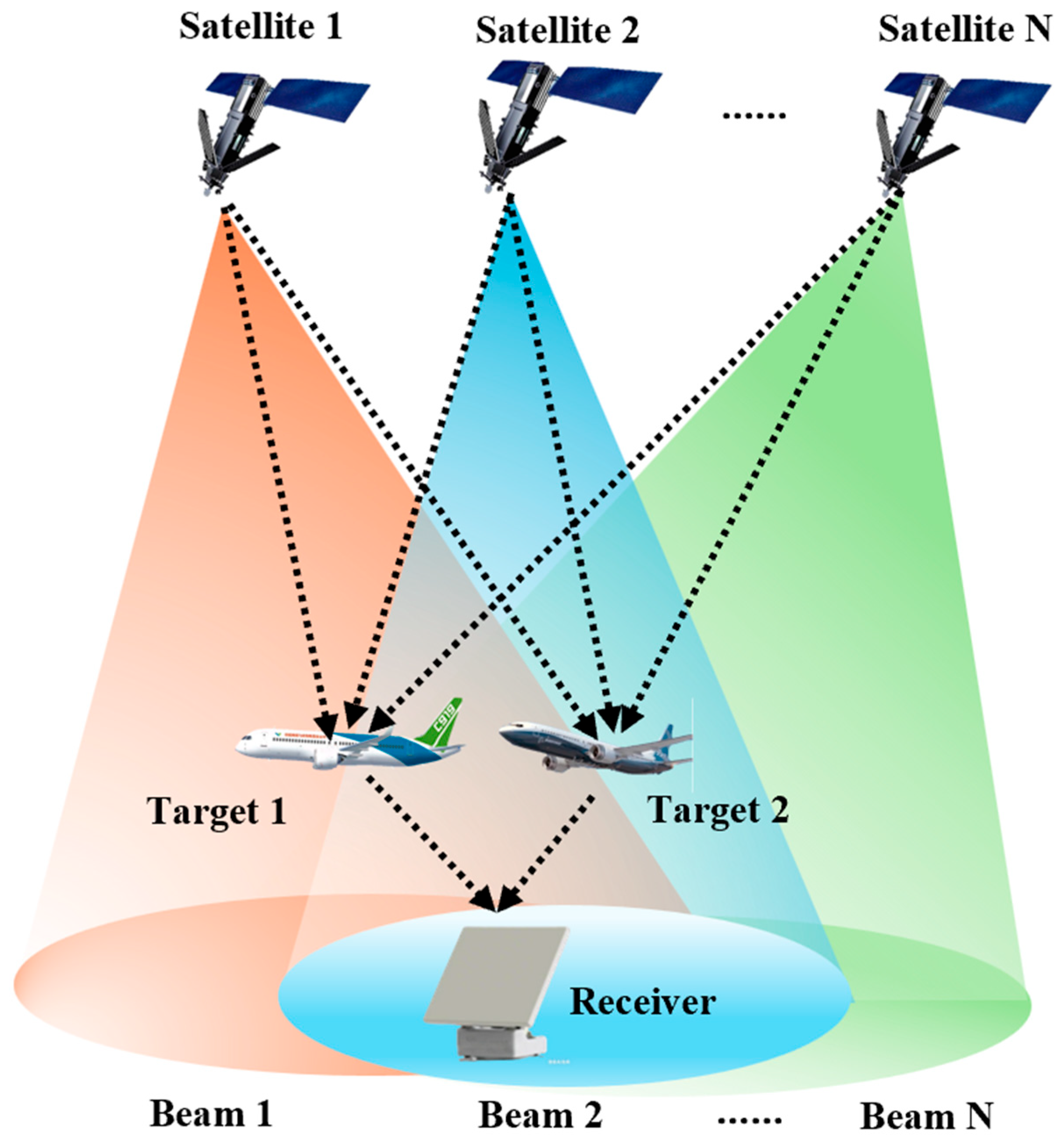
The operating principle of the system, which exploits GNSS signals as external illuminators, is illustrated in Figure 1. It depicts a scenario where multiple satellite beams simultaneously illuminate two targets. The passive radar receiver then concurrently collects the direct signals from the satellites and the echoes reflected from the targets within this shared illumination geometry. At time epoch k, the target’s coordinates are denoted by , its velocity by , and its resulting state vector by .
Figure 1.
Illumination geometry of a multiple-satellite, multiple-target passive radar system.
Assuming the target moves with constant velocity in a straight line, its state equation can be expressed as:
where F is the state transition matrix; is the state noise, following a Gaussian distribution N(0,Q); and Q is the covariance. In this paper,
where T is the sampling interval and q is the state noise intensity.
Assume the number of external illuminators participating in target tracking is n. The coordinates of the external illuminators are denoted as , and the coordinates of the passive radar receiver are denoted as . The distance from the target to the receiving equipment is represented by r0, the distance to the w-th illuminator is denoted by rw, and the total distance from the target to the receiving equipment and the w-th illuminator is represented by rsw. The Doppler frequency shift resulting from the relative motion between the target and the w-th illuminator is characterized by fdw. Thus, the following relationships hold:
where is the wavelength of the w-th external illuminator signal. Therefore, the system’s measurement equation is:
Here, is the observation noise, which follows a Gaussian distribution with a mean of 0 and a covariance matrix . For the same transmitter source, assuming the observation noise remains constant over time and that the noise components across different measurement channels are mutually independent, the observation noise covariance matrix is given by:
2.2. Comparative Method: Geometric Dilution of Precision Optimization
To establish a performance benchmark, the proposed algorithm is compared against a classical selection criterion based on the Geometric Dilution of Precision (GDOP) [15]. GDOP is a well-established metric that quantifies how satellite geometry affects positioning accuracy. For a given subset of satellites with the associated observation matrix , the GDOP is calculated as follows:
A lower GDOP value corresponds to a more favorable satellite geometry, which is theoretically linked to higher estimation accuracy. Accordingly, this method serves as a baseline in our study. At each time step, the specific combination of satellites that minimizes the GDOP is selected from the pool of all visible satellites :
Here, denotes the fixed number of satellites to be selected, which is set to in this work. This GDOP-based strategy is a standard and widely referenced approach for satellite selection. Its principle relies exclusively on the instantaneous spatial geometry, providing a clear contrast to our proposed adaptive algorithm, which also incorporates information-theoretic measures.
3. Adaptive Illuminator Selection Algorithm for Target Tracking
3.1. Cardinality Balanced Multi-Target Multi-Bernoulli
The Cardinality Balanced Multi-Target Multi-Bernoulli (CBMeMBer) filter algorithm is derived from Random Finite Set (RFS) theory [16,17]. According to this model, the random finite set of multi-target states at time *k* is defined as follows:
where nk denotes the number of targets at time k, and each element in the set represents the state of an individual target.
The random finite set of multi-target measurements is defined as follows:
where mk represents the total number of measurement values obtained at the k-th time point, and each element in the set corresponds to the j-th measurement.
The random finite set formulates the problem of tracking multiple targets as a Bayesian filtering process, which consists primarily of two parts: prediction and update. The corresponding computational formulas are respectively:
where:
is the multi-target transition density;
is the multi-target likelihood function;
is the set of all measurements from the initial time 1 to the current time .
For the Sequential Monte Carlo (SMC) implementation of the CBMeMBer tracking algorithm, please refer to [18].
3.2. Adaptive Illuminator Selection Algorithm
In GNSS-based passive radar systems, the selection of optimal illuminators is fundamentally driven by a dynamically coupled geometric and informational relationship among the Target, the Illuminator, and the Receiver. This tripartite coupling manifests specifically as: (1) The target state (position, velocity, and associated uncertainty) determines its kinematic trend and observability relative to each bistatic baseline. (2) The spatial distribution of illuminators (satellite constellation) and their signal characteristics jointly define the geometric diversity of the illumination region covering the target. (3) The fixed receiver position sets the observation perspective, which together with the target and illuminators forms time-varying bistatic angles and range sums, directly impacting measurement accuracy and echo strength (as shown in Equations (2) and (3)). Consequently, an effective selection criterion must be capable of comprehensively evaluating and optimizing the collective impact of this tripartite relationship on the final state estimation quality.
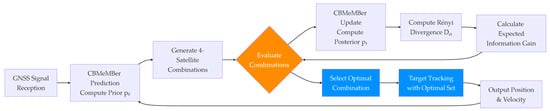
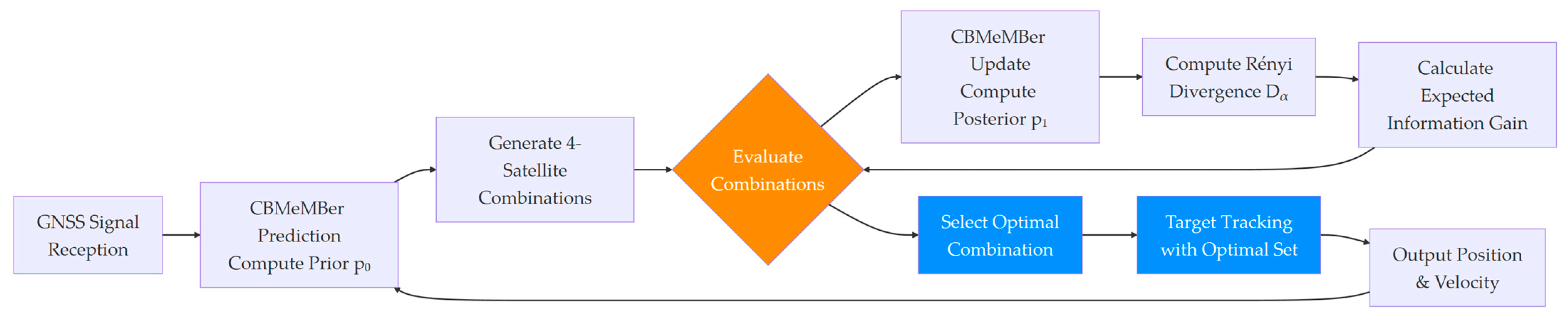
Given the abundance of available external illuminators, it is necessary to perform adaptive selection of these illuminators during the detection and tracking processes to identify the combination most likely to provide effective data. To evaluate the update quality of different illuminator combinations, this paper employs the Rényi divergence of each combination as the evaluation function for information gain [10,19]. The overall structure diagram of the algorithm is shown in Figure 2.
Figure 2.
Flowchart of Adaptive Illuminator Selection Algorithm.
This paper adopts the Rényi divergence as the function to evaluate the information gain from different illuminator combinations. The strength of this criterion lies in its natural integration into the Bayesian filtering framework, thereby inherently encapsulating the aforementioned “Target–Illuminator–Receiver” coupling relationship. Specifically, within the CBMeMBer filtering framework, the predicted multi-target posterior probability density embodies the prior state uncertainty of the target dynamics. For any candidate illuminator combination, the updated posterior density reflects the corrective effect on the prior information imposed by the specific “Illuminator-Target-Receiver” geometric relationship of that combination (encoded through the observation model and noise ). Therefore, the Rényi divergence essentially measures the reduction in state uncertainty achievable from measurements under a specific tripartite relationship.
Assume two probability density functions, denoted as and , both follow Gaussian distributions. The Rényi divergence between and is then defined as follows:
The configuration of parameter determines the specific characteristics of . For instance, when = 0.5, the divergence emphasizes the tails of the distribution functions, enabling it to discriminate effectively between two similar probability distributions and ascertain their optimality. Consequently, selecting = 0.5 for tracking applications yields superior performance.
Within the Multi-Bernoulli filtering framework for tracking, let p0 denote the predicted multi-target posterior probability density , which is computed using Equation (6). Similarly, let represent the updated multi-target posterior probability density , calculated via Equation (7). Therefore, the evaluation function based on the Rényi divergence can be formulated as follows:
A numerical approximation of the aforementioned equation can be obtained using the Sequential Monte Carlo (SMC) method:
Furthermore, the expectation of the evaluation function can be derived as:
where and are the Monte Carlo approximations of the probability density . When M and N in the above equation approach infinity, the result will converge to the expected value of the evaluation function.
To achieve target detection and tracking based on GNSS signals, a minimum of four satellites is required. While increasing the number of satellites enhances tracking accuracy, it also escalates the computational load of the tracking algorithm, potentially compromising real-time performance. Therefore, this paper selects four satellites for target tracking. Consequently, the illuminator selection optimization model can be formulated as follows:
The objective of this optimization function can be stated as follows: In a GNSS-based passive radar system, given that the number of external illuminators used for target detection and tracking is fixed at four, the aim is to maximize the overall target tracking accuracy by optimizing the selection of the illuminator combination.
The aforementioned algorithmic framework clarifies how to dynamically select the optimal satellite combination. However, the practical utility of this method depends not only on the improved tracking accuracy it delivers but also on whether the associated computational load remains within acceptable bounds for the system. To rigorously demonstrate the advantage of this algorithm under resource-constrained conditions from a theoretical standpoint, the following section will conduct a detailed computational complexity analysis. This analysis will quantitatively compare the overhead introduced by the selection mechanism against the savings achieved by reducing the number of tracking channels.
In summary, the adaptive selection algorithm proposed herein, through the criterion of maximizing information gain based on Rényi divergence, achieves quantitative evaluation and adaptive optimization of the dynamically varying “Target–Illumination Region–Receiver” coupling relationship. This provides a theoretical foundation for intelligent signal selection under resource-constrained conditions.
4. Computational Complexity Analysis
This section aims to quantitatively assess the impact of the proposed adaptive selection algorithm on the real-time processing load of the system. The algorithm’s advantage lies in reducing the computational overhead while maintaining tracking accuracy by dynamically selecting an optimal set of satellites for tracking, instead of processing all visible satellites. The total overhead consists of two main parts: the satellite selection overhead based on Rényi divergence (low-frequency) and the signal processing overhead of the multi-target tracking filter (high-frequency). The following analysis demonstrates that the persistent processing savings achieved by reducing the number of tracked satellites far outweigh the introduced periodic selection cost.
4.1. Overhead Model and Comparison
Selection Overhead: The algorithm evaluates all satellites at each selection instant. A single evaluation involves signal probability density estimation (e.g., using the histogram method) and Rényi divergence calculation. The total overhead can be approximated as:
where is the sample length, is the number of histogram bins, and is a small constant. Its computational complexity is .
Per-Channel Tracking Overhead: Each tracked satellite channel requires operations such as signal acquisition, correlation processing, and CBMeMBer filter update within each Coherent Processing Interval (CPI). This overhead, denoted as , depends primarily on the signal processing complexity and the filter computational load related to the number of targets. Its magnitude is significantly higher than the per-satellite cost .
4.2. Net Saving Condition and Efficiency Analysis
Assuming the system performs selection once every cycle and tracks satellites (), the average net saving per CPI compared to the baseline strategy of tracking all satellites is:
The condition for achieving net savings is Given that and the selection interval is typically large (e.g., due to slow changes in target state and geometry, here set to ), this condition is easily satisfied in practice.
Using the simulation parameters from this paper () for estimation, the amortized selection cost per CPI is only on the order of 102 operations, while the tracking overhead saved by not tracking 2 satellites is on the order of operations per CPI. Therefore, the selection overhead is almost negligible, and the net system saving is primarily determined by the reduced number of tracking channels .
The theoretical analysis confirms that the additional computational cost introduced by the proposed adaptive selection algorithm is minimal. However, it effectively avoids the high, persistent processing load incurred by tracking all satellite channels. This provides strong support, from the perspective of computational efficiency, for the practical value of the algorithm in resource-constrained GNSS-based passive radar systems.
5. Results and Analysis
To validate the effectiveness of the proposed adaptive GNSS signal selection method, this section designs and conducts multiple sets of simulation experiments. First, the simulation framework and parameters are defined, and the algorithm’s fundamental performance is evaluated in a basic multi-target linear motion scenario (Section 5.1). Second, a focused and in-depth comparison is made between the Rényi-based method and the classic Geometric Dilution of Precision (GDOP) optimization method. To isolate the effects and control for coupling phenomena inherent in multi-target tracking, this comparison is carried out within a single-target scenario, thereby highlighting the advantages of the information-theoretic criterion (Section 5.2). Finally, the algorithm’s robustness and adaptability are tested in a multi-target nonlinear maneuvering scenario (Section 5.3). The specific details of these experiments are described as follows.
5.1. Simulation Setup and Baseline Performance
Currently, there are four major global satellite navigation systems. Consequently, any location on Earth can simultaneously receive signals from 4 to 6 satellites belonging to a single system. When all four systems operate concurrently, each location can receive signals from 16 to 24 satellites simultaneously. The visibility duration for each individual satellite ranges from 60 to 360 min.
To validate the effectiveness of the proposed algorithm, simulation data is utilized for analysis. The simulation assumes a total of six BeiDou satellites simultaneously illuminating the target area. As these satellites belong to the same GNSS constellation, their parameters are set to be identical. The initial spherical coordinates of the satellites relative to the receiver are (25,011,382 m, 290.99°, 7.43°), (20,596,647 m, 309.98°, 64.18°), (23,599,854 m, 234.02°, 21.47°), (21,298,173 m, 215.27°, 52.03°), (20,416,928 m, 38.01°, 63.39°), and (21,640,011 m, 111.89°, 49.96°). All satellites are in Medium Earth Orbit (MEO), characterized by a repeat ground track pattern of 13 revolutions every 7 days.
The targets are modeled as ships. Their initial coordinates are set at (200 m, 1200 m, 0) and (500 m, 500 m, 0), with velocities of (6 m/s, 7 m/s, 0) and (7 m/s, 7 m/s, 0), respectively. To effectively simulate the target motion scenario, the total signal collection duration is set to 100 s, with a Coherent Processing Interval (CPI) of 2 s. The two targets are introduced into the scenario at the 1-s and 10-s marks, respectively. Under these conditions of model mismatch, three strategies are compared: using all six satellites (All-6), the proposed adaptive selection (Method-4), and random selection (Random-4).
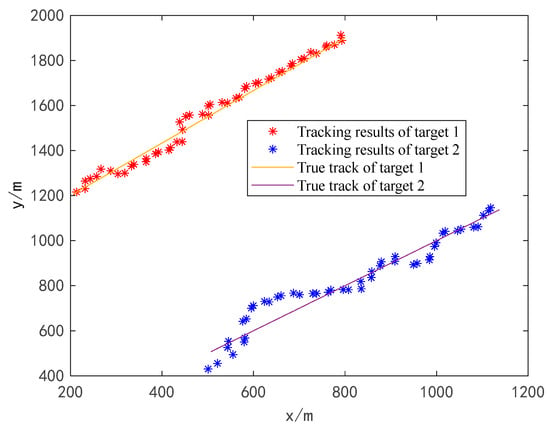
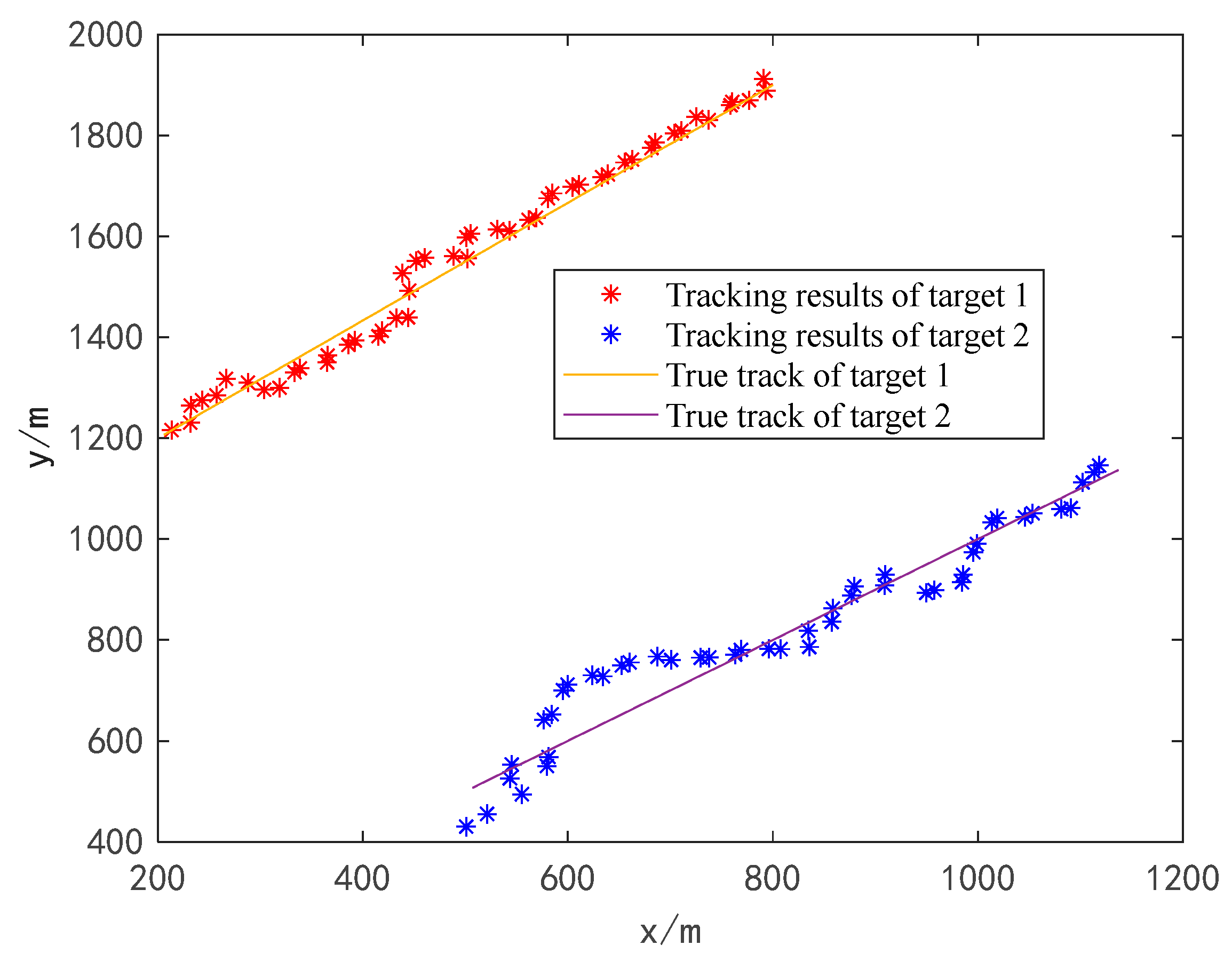
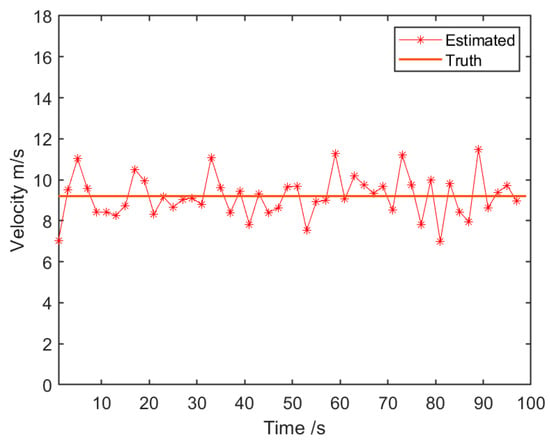
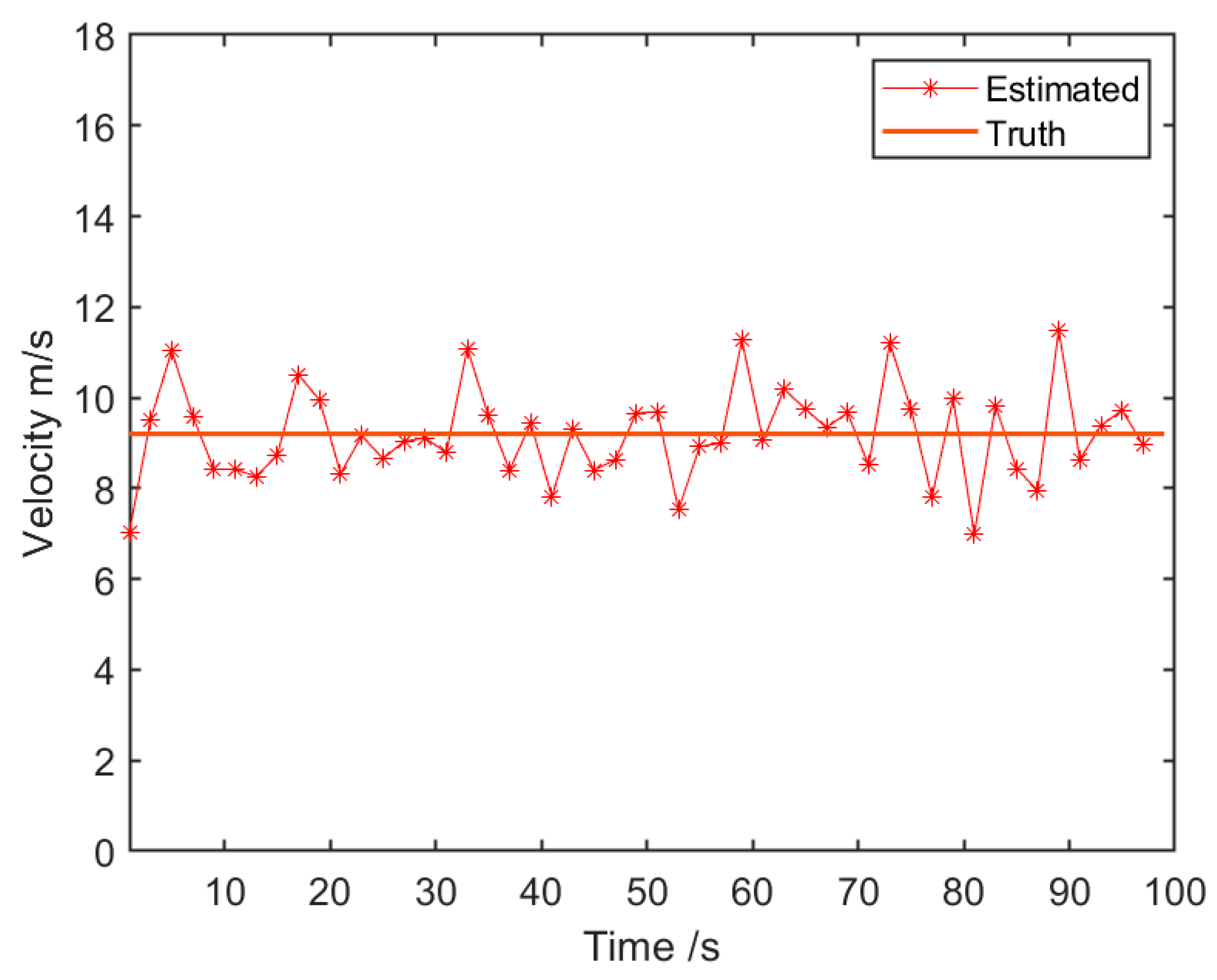
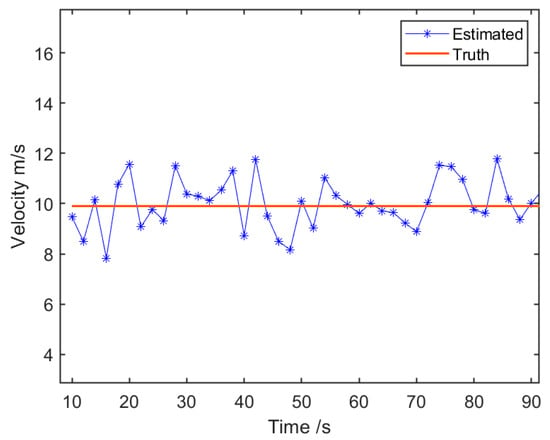
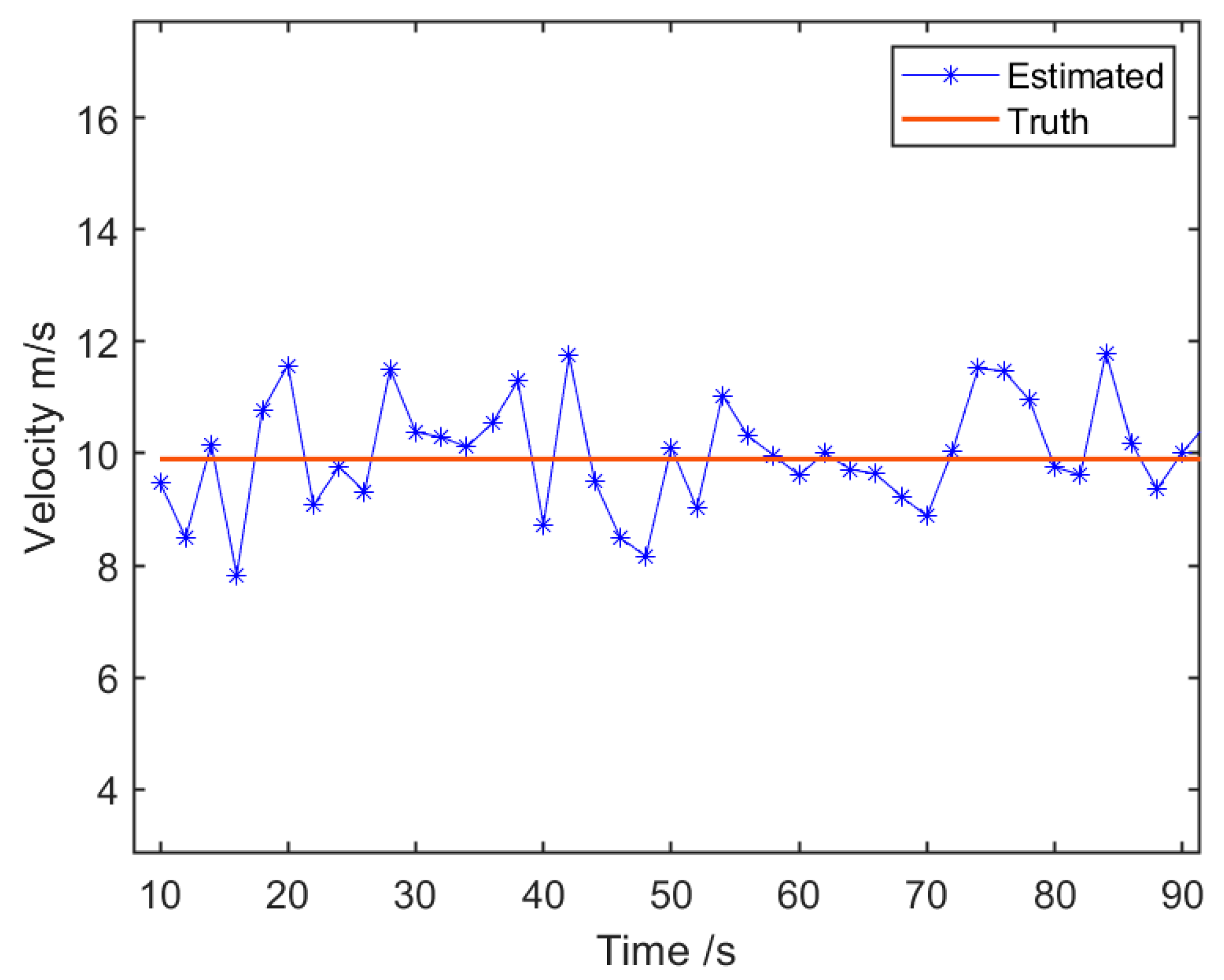
By substituting the aforementioned parameters into the calculations, the target tracking results shown in Figure 3 were obtained. Figure 4 and Figure 5 present the estimated velocity results for the two targets computed using the proposed algorithm. The figures demonstrate that the estimated values for both target position and velocity closely align with the ground truth, indicating that the proposed algorithm achieves effective tracking performance.
Figure 3.
Target Tracking Results.
Figure 4.
Velocity Estimation Results for Target 1.
Figure 5.
Velocity Estimation Results for Target 2.
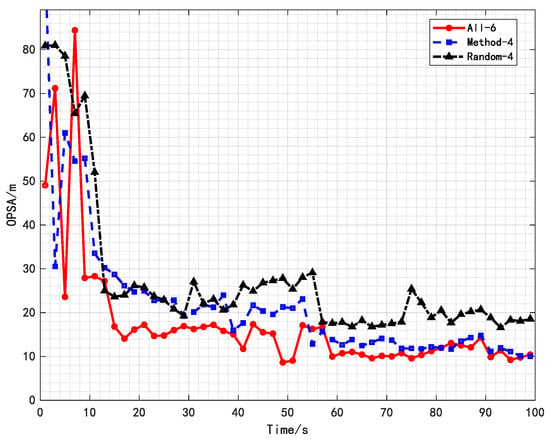
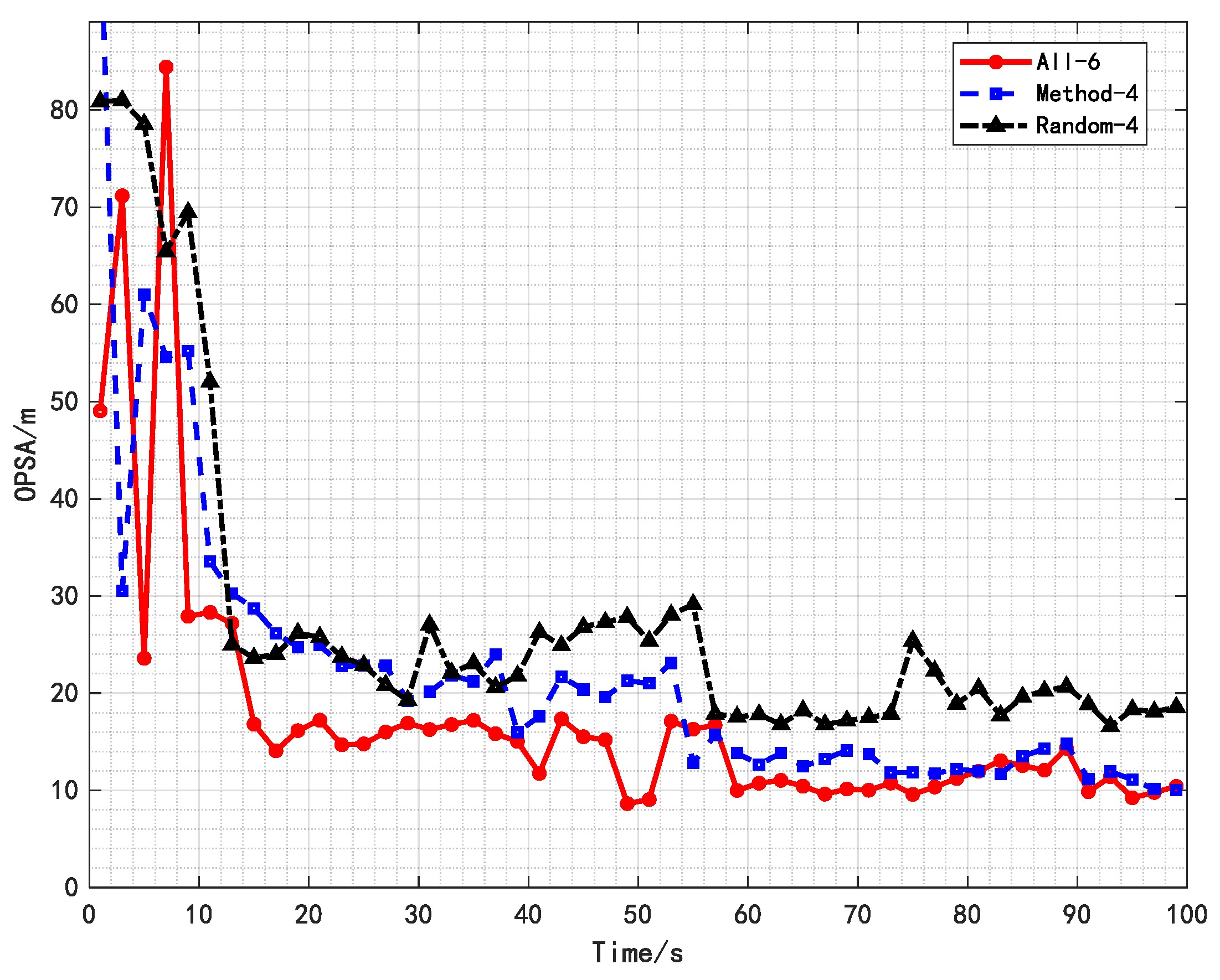
To provide a more comprehensive evaluation of the tracking performance, which encompasses both localization accuracy and cardinality (target count) estimation, this paper employs the Optimal Subpattern Assignment (OSPA) metric [20]. The OSPA metric is a widely recognized standard in the field of multi-target tracking for performance evaluation, as it simultaneously measures both the localization error and the cardinality error in multi-target state estimation. Figure 6 presents the OSPA distance over time for the three strategies in the multi-target linear motion scenario. A lower OSPA distance indicates better overall tracking performance.
Figure 6.
OSPA distance comparison for different strategies.
As illustrated in Figure 6, the OSPA curve for the proposed method remains consistently close to that of the All-6 baseline throughout the entire tracking period and is markedly lower than the curve for random selection. This demonstrates that the proposed selection strategy not only reduces the computational load but also maintains high tracking fidelity, including accurate estimation of the target count.
To further analyze the advantages of the proposed algorithm, target tracking was performed using both randomly selected sets of 4 satellites and the full set of 6 satellites. The position Root Mean Square Error (pos_RMSE), velocity Root Mean Square Error (vel_RMSE), and the computation time were calculated for each case. Here, the computation time is defined as the sum of the target detection time and the target tracking time. The formulas for calculating pos_RMSE and vel_RMSE are given below:
Here, and represent the true and estimated positions of the target, respectively, while and denote the true and estimated velocities, respectively. It indicates the number of tracking cycles. The results and computation times, obtained from 100 Monte Carlo simulation runs, are summarized in Table 1.
Table 1.
Comparison of Computational Results and Time Consumption.
As presented in Table 1, the proposed algorithm yields a position RMSE of approximately 28.22 m and a velocity RMSE of about 0.73 m/s. Compared with the strategy of randomly selecting four satellites, our method reduces the position RMSE by 10.36% and the velocity RMSE by 13.10%. Moreover, its tracking accuracy closely approaches that achieved using all six satellites, with only a 1.7% increase in position RMSE and a 4.3% increase in velocity RMSE. In terms of computational efficiency, processing four instead of six satellite links reduces the overall radar system computation time by approximately 33.33%.
5.2. Single-Target Scenario: A Comparative Study of Rényi Divergence and GDOP
This section presents a comparative analysis of four signal selection strategies within a simplified single-target tracking scenario. By isolating the complexities of multi-target data association, this experiment focuses on evaluating the fundamental efficacy of each criterion in optimizing state estimation. The simulation parameters, including satellite constellation and receiver location, remain consistent with Section 4.1
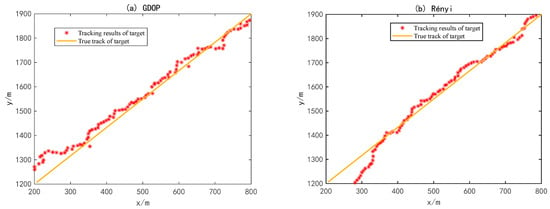
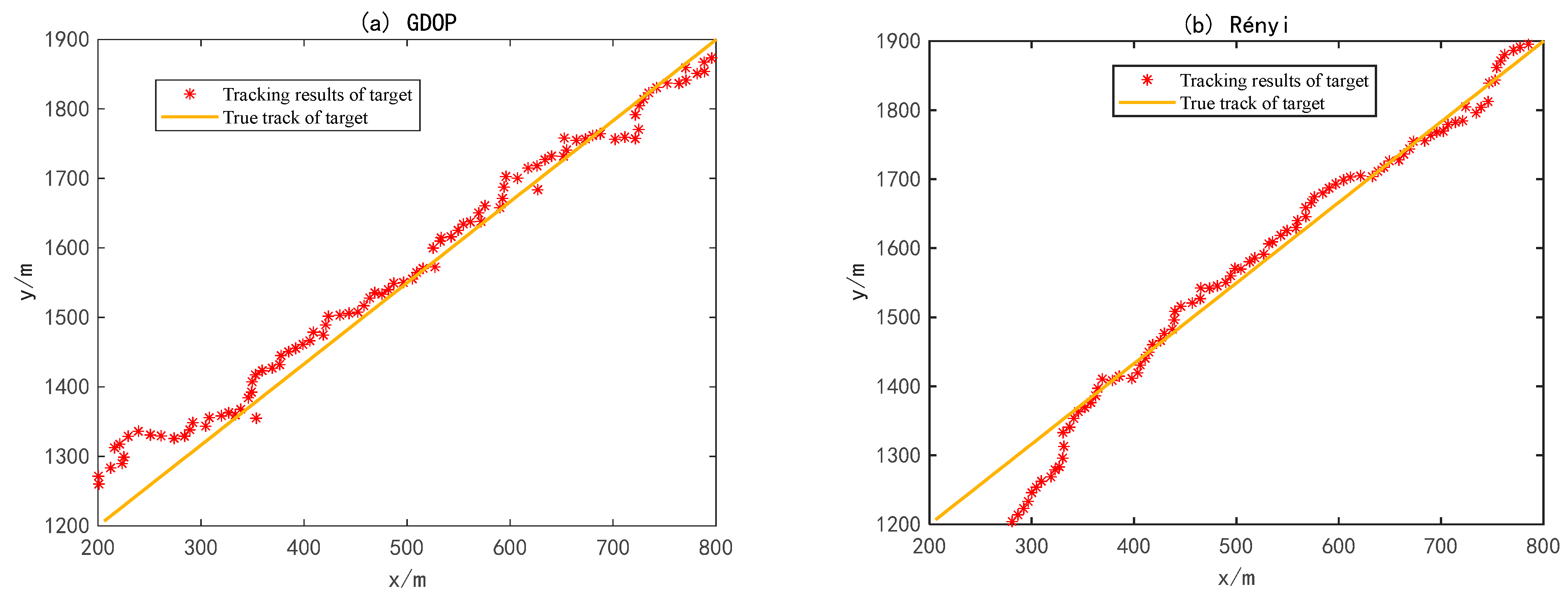
Figure 7 compares the tracking trajectories of two selection strategies. During the initial phase of high prior state uncertainty, both algorithms demonstrate comparable convergence rates. In steady-state tracking, however, the trajectory estimated by the Rényi divergence-based strategy (Figure 7b) exhibits less fluctuation than that of the GDOP minimization strategy (Figure 7a).
Figure 7.
Tracking trajectory comparison under different selection strategies in a single-target scenario: (a) GDOP; (b) Rényi.
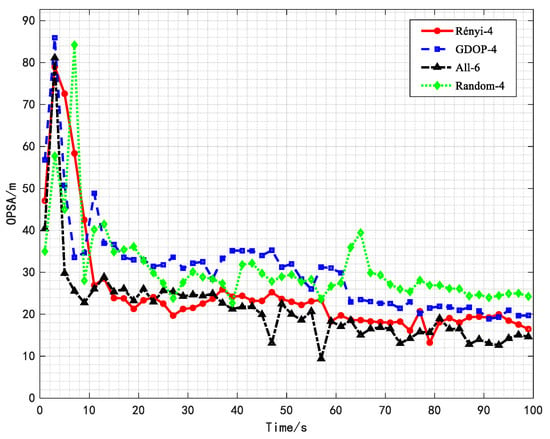
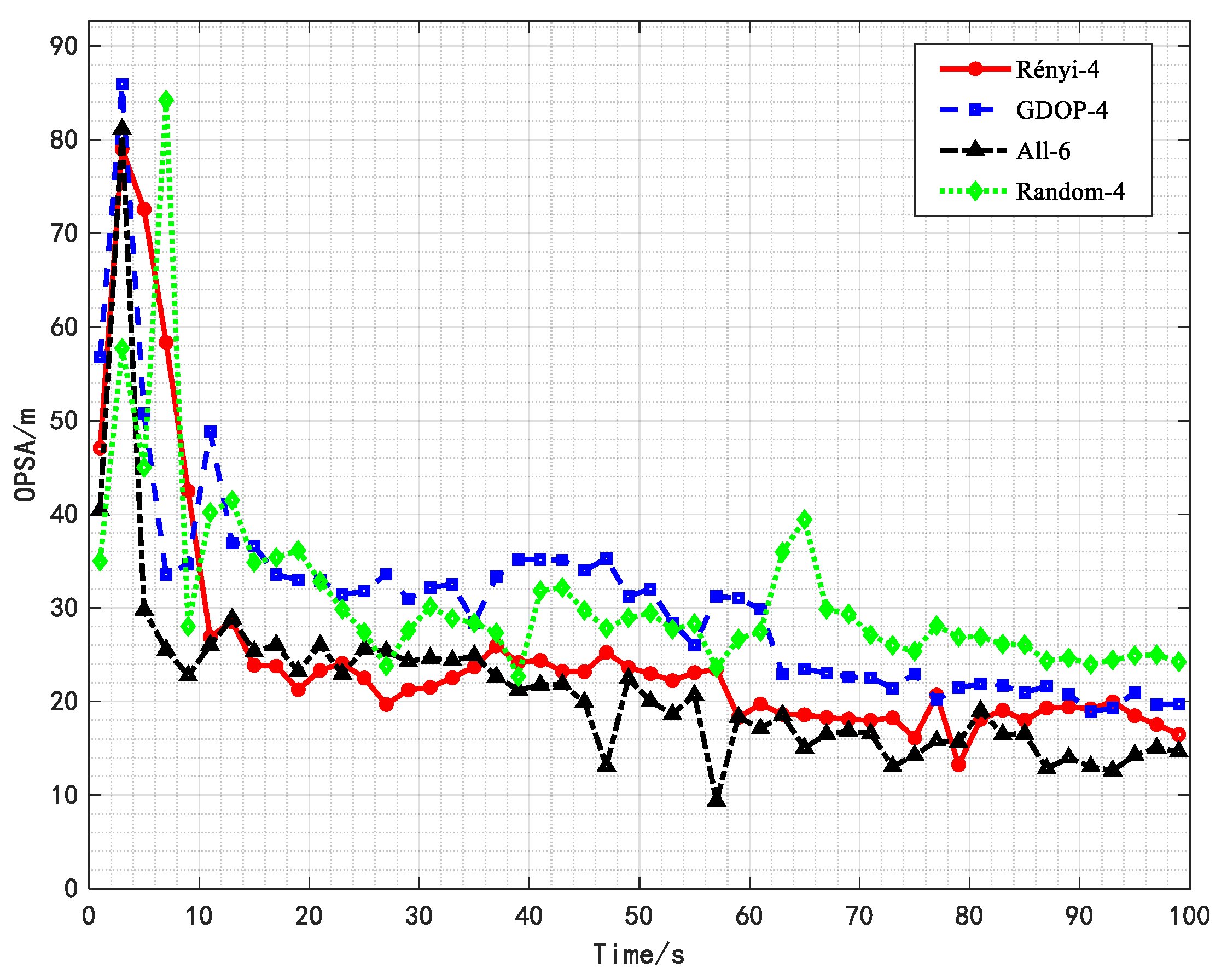
Figure 8 plots the Optimal Subpattern Assignment (OSPA) distance over time for four strategies: using all six satellites (All-6), Rényi divergence-based selection (Rényi-4), GDOP-based selection (GDOP-4), and random selection (Random-4). The OSPA metric jointly quantifies localization and cardinality estimation errors, with lower values indicating superior tracking performance. The OSPA curve for the Rényi strategy remains consistently close to that of the All-6 baseline throughout the tracking period. While the GDOP strategy shows a slightly faster initial decline in OSPA during the convergence phase (0–10 s), the Rényi strategy achieves a significantly lower steady-state OSPA value after 10 s.
Figure 8.
OSPA distance comparison for different strategies in a single-target scenario.
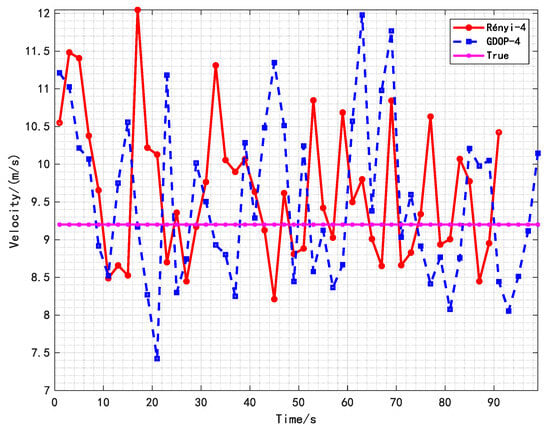
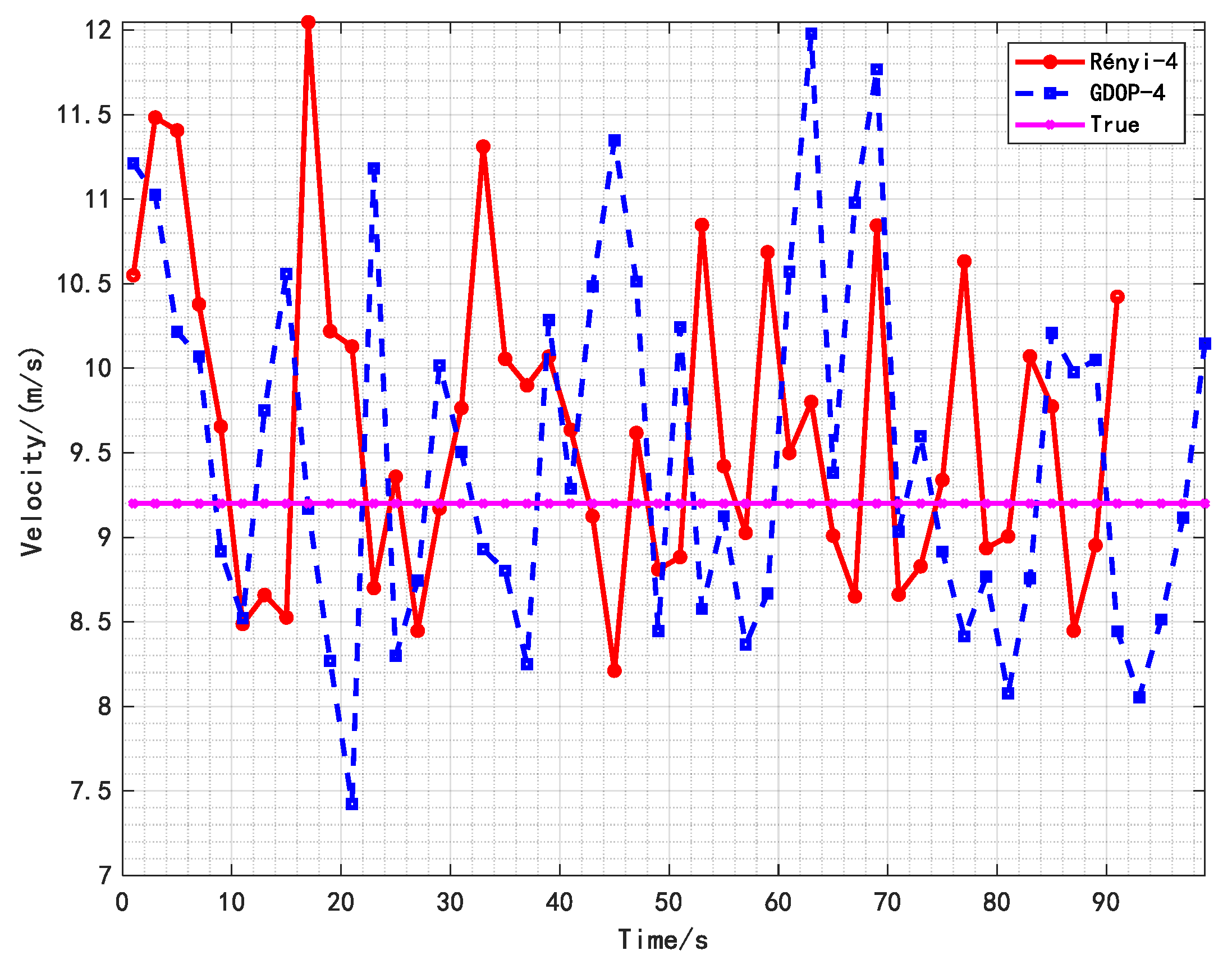
Figure 9 compares the velocity estimation accuracy. Similarly to the OSPA results, the GDOP strategy yields slightly better accuracy during the initial 10-s convergence phase, but is outperformed by the Rényi strategy in steady-state tracking. This demonstrates the advantage of the information-theoretic Rényi criterion over the static geometric GDOP criterion in extracting information gain, particularly after the filter has converged.
Figure 9.
Velocity estimation accuracy comparison for different strategies in a single-target scenario.
As summarized in Table 2, both the GDOP and Rényi strategies outperform random selection, though neither matches the accuracy of using all satellites. Compared to the GDOP baseline, the proposed Rényi-based strategy increases the position RMSE by 4.9% and the velocity RMSE by 9.8%.
Table 2.
Performance comparison in a single-target scenario.
These results highlight the fundamental difference between the two selection criteria. The GDOP criterion is a static, geometry-centric method that selects illuminators based solely on the instantaneous spatial configuration, ignoring target dynamics and prior uncertainty. In contrast, the Rényi divergence criterion is a dynamic, information-centric method integrated within the Bayesian filtering framework. It quantifies the information gain from the prediction-update cycle, enabling it to dynamically select the illuminator subset that most effectively reduces the current state uncertainty. This leads to superior steady-state estimation accuracy, particularly when prior confidence is low.
5.3. Multi-Target Nonlinear Maneuvering Scenario
Section 4.1 and Section 4.2 validated the proposed algorithm’s effectiveness in multi-target linear and single-target scenarios, respectively, and demonstrated its advantage over the geometric GDOP criterion. To further assess the algorithm’s robustness and generalizability under challenging, real-world conditions, this section evaluates its performance in a dual-target nonlinear maneuvering scenario. This test examines whether the Rényi divergence-based selection mechanism can maintain stable tracking by dynamically optimizing the illuminator set when the target motion significantly deviates from the filter’s constant-velocity model assumption.
In this scenario, both targets execute identical complex curved maneuvers. The satellite and receiver configuration matches Section 4.1. Under these conditions of model mismatch, three strategies are compared: using all six satellites (All-6), the proposed adaptive selection (Method-4), and random selection (Random-4).
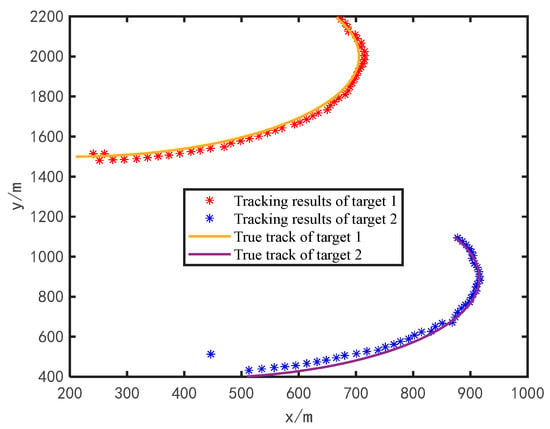
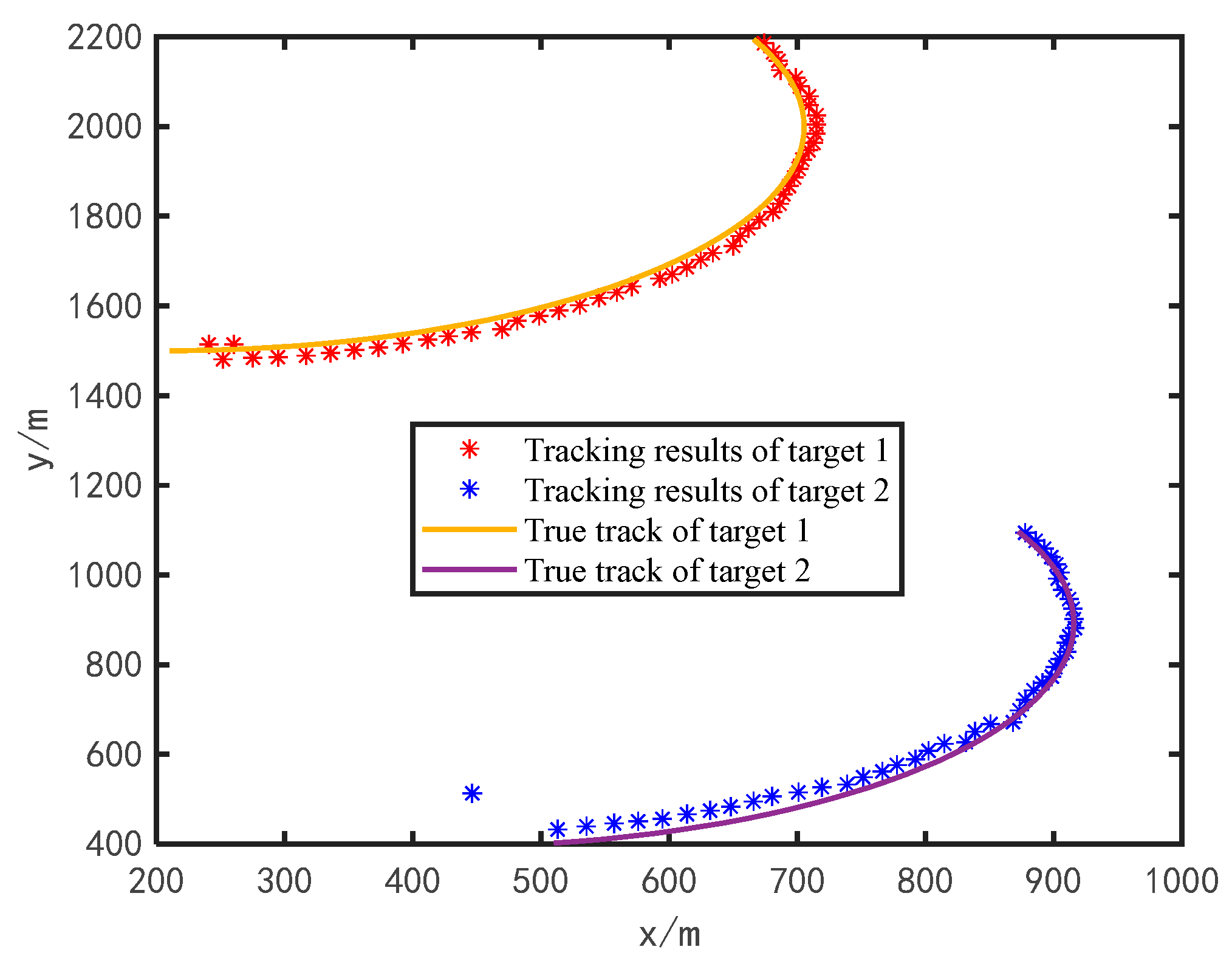
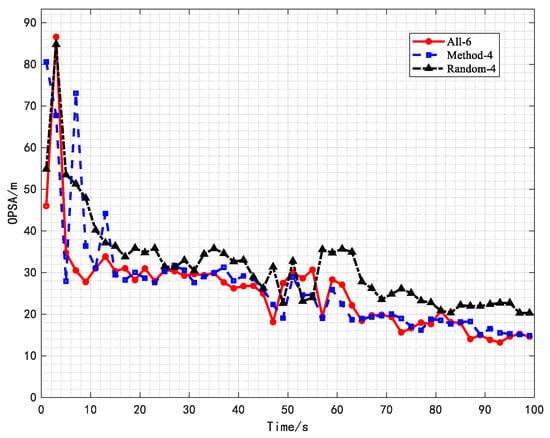
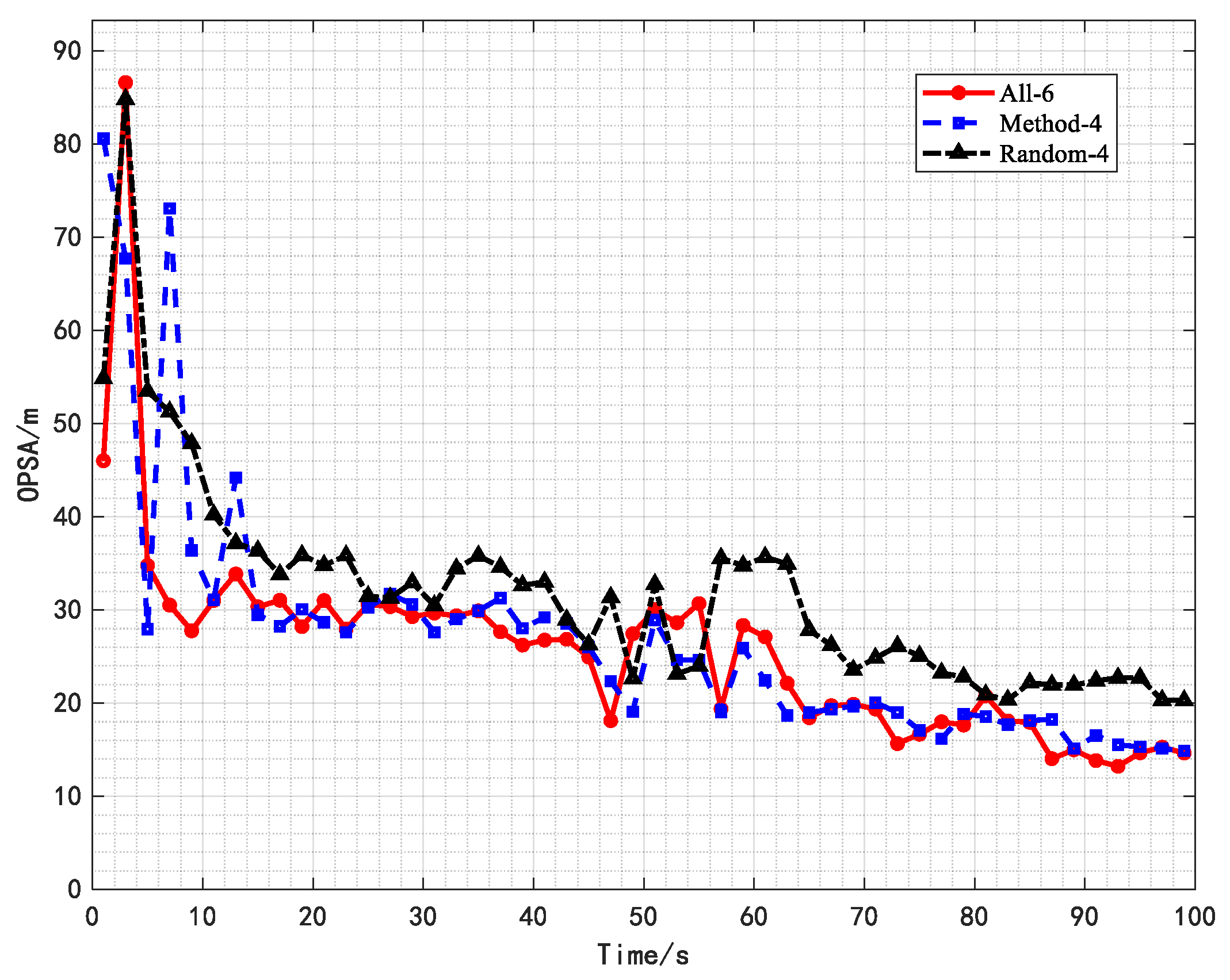
Figure 10 shows that the proposed method successfully tracks both targets undergoing nonlinear motion. By selecting the satellite combination that maximizes information gain, the algorithm compensates for model errors induced by complex maneuvers, maintaining reliable track continuity. Figure 11 provides a more precise performance quantification via the OSPA distance. At the onset of the maneuver, the OSPA for the proposed method is lower than that of the All-6 strategy. While its performance is momentarily worse than random selection in one instance, it remains superior most other times. Upon achieving steady tracking, the proposed method’s OSPA value converges closely to the All-6 baseline and is significantly better than using four randomly selected satellites, confirming that its overall tracking performance remains robust.
Figure 10.
Multi-target tracking trajectory in the nonlinear maneuvering scenario.
Figure 11.
OSPA distance comparison for multi-target tracking in the nonlinear maneuvering scenario.
The quantitative results in Table 3 show increased tracking difficulty in this nonlinear scenario, with errors rising for all strategies compared to the linear case (Table 1). Nevertheless, the proposed method maintains a relative advantage. Compared to random selection, it reduces the position and velocity RMSE by 9.74% and 24.79%, respectively. Compared to the All-6 benchmark, it incurs a modest performance penalty of 2.62% in position RMSE and 3.52% in velocity RMSE, while achieving a 33.3% reduction in total computation time. This favorable accuracy-efficiency trade-off is consistent with the findings in Section 4.1, demonstrating the algorithm’s stable performance across diverse scenarios.
Table 3.
Performance comparison in the multi-target nonlinear maneuvering scenario.
6. Conclusions
This study addresses the signal selection problem for GNSS-based passive radar under resource-constrained conditions by proposing an adaptive optimization method based on the information-theoretic Rényi divergence. Within the Cardinality Balanced Multi-Bernoulli (CBMeMBer) filtering framework, the method dynamically selects the GNSS signal subset that is most effective in reducing target state uncertainty by maximizing the information gain from the prediction-update cycle of the posterior distributions.
Theoretical analysis and simulation experiments lead to the following conclusions:
- Effectiveness and Efficiency of the Method: The proposed algorithm effectively balances tracking accuracy and computational efficiency. Across various scenarios, its tracking accuracy using only four satellites is significantly better than random selection and approaches the benchmark performance using all satellites, while substantially reducing the system computational load. Theoretical complexity analysis confirms its efficiency.
- Advantage of the Information-Theoretic Criterion: In the single-target tracking scenario (Section 5.2), the dynamic information gain criterion based on Rényi divergence demonstrates superior steady-state tracking accuracy compared to the static optimization method based on the Geometric Dilution of Precision (GDOP). This validates that the information-theoretic approach, which comprehensively considers target dynamic uncertainty and measurement noise, holds an advantage over purely geometric criteria for signal selection.
- Adaptability to Complex Scenarios: In the challenging multi-target nonlinear maneuvering scenario involving model mismatch (Section 5.3), the algorithm maintains reliable track continuity by dynamically selecting the most informative signal combination, demonstrating its potential and adaptability in handling variations in target motion patterns.
This research provides a new pathway for intelligent resource management in GNSS-based passive radar with external illuminators. Future work may proceed in the following directions: First, investigating the tracking of targets with more complex dynamics (e.g., uniform acceleration, variable acceleration) to verify and enhance the algorithm’s generalizability across a broader range of motion modes. Second, incorporating more practical error sources into the model, such as atmospheric delays, multipath effects, and heterogeneous signal characteristics, to improve the algorithm’s engineering practicality. Finally, evaluating its joint detection and tracking performance in harsh environments with low signal-to-noise ratios and heavy clutter is crucial for assessing its practical application value. Continued research is expected to further advance the practical deployment of GNSS-based passive radar technology in areas such as wide-area maritime surveillance and air traffic management.
Author Contributions
Conceptualization, H.F., H.C., Y.L., T.F., B.T. and H.T.; methodology, H.F. and H.T.; software, H.F. and H.T.; validation, H.F. and H.C.; formal analysis, H.F. and H.T.; investigation, Y.L. and T.F.; writing—original draft preparation, H.F., H.T., Y.L. and T.F.; writing—review and editing, H.F., HT., Y.L., T.F., B.T. and H.C.; All authors have read and agreed to the published version of the manuscript.
Funding
This work was supported in part by the National Key Research and Development Program of China under Grant 2023YFB3306900; in part by the National Natural Science Foundation of China under Grant U21A20448; in part by the Fundamental Research Funds for the Central Universities under Grant 2024CDJGF-012.
Data Availability Statement
Data are contained within the article.
Acknowledgments
The authors thank the anonymous reviewers for their constructive comments and suggestions that greatly improved this paper.
Conflicts of Interest
The authors declare no conflicts of interest.
References
- Wang, B.B.; Cha, H.; Zhou, Z.; Zuo, L. Maritime moving target joint localization and kinematic state estimation using GNSS based multistatic radar. Atmosphere 2022, 13, 1497–1511. [Google Scholar] [CrossRef] [Scilit]
- Colone, F.; Filippini, F.; Pastina, D. Passive radar: Past, present, and future challenges. IEEE Aerosp. Electron. Syst. Mag. 2023, 38, 54–69. [Google Scholar] [CrossRef] [Scilit]
- Wang, H.; Lyu, X.; Zhong, L. Interference-to-noise ratio estimation in long-term evolution passive radarbased on cyclic auto-correlation. Electron. Lett. 2021, 57, 375–377. [Google Scholar] [CrossRef] [Scilit]
- Nasso, I.; Santi, F.; Pastina, D. Maritime targets velocity estimation in space-based passive multistatic radar using long integration times. IEEE Access 2021, 9, 163764–163779. [Google Scholar] [CrossRef] [Scilit]
- Samczynski, P.; Abratkiewicz, K.; Płotka, M.; Zieliński, T.P.; Wszołek, J.; Hausman, S.; Korbel, P.; Ksiȩżyk, A. 5G network-based passive radar. IEEE Trans. Geosci. Remote Sens. 2022, 60, 1–9. [Google Scholar] [CrossRef] [Scilit]
- Xu, S.; Chen, Z. Selectingof illuminatorin opportunistic illuminator radar system. Mod. Radar 2007, 29, 16–19. [Google Scholar]
- Xiao, Z.; Wang, H.; Zhou, P.; Han, L.X.; Wang, Y.K.; Li, X.; Lu, X. A satellite selection method for missile-borne detection system based on opportunity illuminators. Acta Armamentarii 2017, 38, 1555–1562. [Google Scholar]
- Stinco, P.; Greco, M.; Gini, F.; Farina, A. Cramér-Rao bounds and their application to sensor selection. In 2012 IEEE International Conference on Acoustics, Speech and Signal Processing (ICASSP 2012); IEEE: New York, NY, USA, 2012. [Google Scholar]
- Panicker, S.; Gostar, A.K.; Bab-Hadiashar, A.; Hoseinnezhad, R. Recent advances in stochastic sensor control for multi-object tracking. Sensors 2019, 19, 3790. [Google Scholar] [CrossRef] [Scilit] [PubMed]
- Ristic, B.; Vo, B.-N. Sensor control formulti-object state-space estimation using random finite sets. Automatica 2010, 46, 1812–1818. [Google Scholar] [CrossRef] [Scilit]
- Hoang, H.G.; Vo, B.T. Sensor management for multi-target tracking via multi-Bernoulli filtering. Automatica 2014, 50, 1135–1142. [Google Scholar] [CrossRef] [Scilit]
- Chen, H.; Li, G.; Han, C.; Du, J.R. Sensor control method for star-convex shape multiple extended target tracking. Control Theory Appl. 2020, 37, 2627–2637. [Google Scholar]
- Bu, L.; Wang, J. Polarisation variation of linear polarised Bi-ISAR system in space targets imaging. IET Radar Sonar Navig. 2021, 15, 547–560. [Google Scholar] [CrossRef] [Scilit]
- Hu, C.; Liu, C.; Zeng, T. Bistatic Forward Scattering Radar Detection and Imaging. J. Radars 2016, 5, 229–243. [Google Scholar]
- Kihara, M.; Okada, T. A Satellite Selection Method and Accuracy for the Global Positioning System. Navigation 1984, 31, 8–20. [Google Scholar] [CrossRef] [Scilit]
- Da, K.; Li, T.; Zhu, Y.; Fan, H.; Fu, Q. Recent advances in multi-sensor multi-target tracking using random finiteset. Front. Inf. Technol. Electron. Eng. 2021, 22, 5–25. [Google Scholar] [CrossRef] [Scilit]
- Li, G.; Battistelli, G.; Chisci, L.; Gao, L.; Wei, P. Distributed joint detection, tracking, and classification via labeled multi-Bernoulli filtering. IEEE Trans. Cybern. 2024, 54, 1429–1441. [Google Scholar] [CrossRef] [Scilit] [PubMed]
- Shan, J.; Lu, Y.; Ling, H. Robust adaptive multi-target tracking algorithm for airborne passive bistatic radar. J. Syst. Eng. Electron. 2024, 46, 2902–2915. [Google Scholar]
- Maksymiuk, R.; Abratkiewicz, K.; Samczyński, P.; Płotka, M. Rényi entropy-based adaptive integration method for 5G-based passive radar drone detection. Remote Sens. 2022, 14, 6146. [Google Scholar] [CrossRef] [Scilit]
- Schuhmacher, D.; Vo, B.-T.; Vo, B.-N. A Consistent Metric for Performance Evaluation of Multi-Object Filters. IEEE Trans. Signal Process. 2008, 56, 3447–3457. [Google Scholar] [CrossRef] [Scilit]

Disclaimer/Publisher’s Note: The statements, opinions and data contained in all publications are solely those of the individual author(s) and contributor(s) and not of MDPI and/or the editor(s). MDPI and/or the editor(s) disclaim responsibility for any injury to people or property resulting from any ideas, methods, instructions or products referred to in the content. |
© 2026 by the authors. Licensee MDPI, Basel, Switzerland. This article is an open access article distributed under the terms and conditions of the Creative Commons Attribution (CC BY) license.