Review

Advances in EMG Signal Processing and Pattern Recognition: Techniques, Challenges, and Emerging Applications


by
Lasitha Piyathilaka
*,
Jung-Hoon Sul
,
Sanura Dunu Arachchige
,
Amal Jayawardena
and
Diluka Moratuwage
School of Engineering and Technology, Central Queensland University, Rockhampton, QLD 4701, Australia
*
Author to whom correspondence should be addressed.
Electronics 2026, 15(3), 590; https://doi.org/10.3390/electronics15030590
Submission received: 24 December 2025 / Revised: 23 January 2026 / Accepted: 24 January 2026 / Published: 29 January 2026
(This article belongs to the Special Issue Image and Signal Processing Techniques and Applications)

Abstract

Electromyography (EMG) has become essential in biomedical engineering, rehabilitation, and human–machine interfacing due to its ability to capture neuromuscular activation for control, monitoring, and diagnosis. Recent advances in sensing hardware, high-density and flexible electrodes, and embedded acquisition modules combined with modern signal processing and machine learning have significantly enhanced the robustness and applicability of EMG-based systems. This review provides an integrated overview of EMG generation, acquisition standards, and preprocessing techniques, including adaptive filtering, wavelet denoising, and empirical mode decomposition. Feature extraction methods across the time, frequency, time–frequency, and nonlinear domains are compared with respect to computational efficiency and suitability for real-time systems. The review synthesizes classical and contemporary pattern-recognition approaches, from statistical classifiers to deep architectures such as CNNs, RNNs, hybrid CNN–RNN models, transformer-based networks, and graph neural networks. Key challenges, including signal non-stationarity, electrode displacement, muscle fatigue, and poor cross-user or cross-session generalization, are examined alongside emerging strategies such as transfer learning, domain adaptation, and multimodal fusion with IMU or FMG signals. Finally, the paper surveys rapidly growing EMG applications in prosthetics, rehabilitation robotics, human–machine interfaces, clinical diagnostics, and sports analytics. The review highlights ongoing limitations and outlines future pathways toward robust, adaptive, and deployable EMG-driven intelligent systems.

1. Introduction

Electromyography (EMG) has become one of the most widely adopted physiological sensing modalities in biomedical engineering, rehabilitation, and human–machine interfacing due to its ability to capture neuromuscular activation patterns in a non-invasive manner. Surface EMG (sEMG) signals, generated from the superposition of muscle fiber action potentials, provide detailed information regarding motor intent, muscle coordination, and neuromuscular health [1,2]. Over the past two decades, the field has evolved significantly from early analog amplifiers and handcrafted feature engineering to modern high-density sensor arrays, deep learning frameworks, and multimodal fusion systems. These advances have enabled more precise decoding of human motion and facilitated the development of intuitive assistive technologies, including prosthetic limbs, exoskeletons, robotic manipulators, and gesture-based human–machine interfaces [3,4,5,6].
Historically, EMG-based pattern recognition systems relied on carefully engineered time, frequency, and time–frequency-domain features combined with lightweight statistical classifiers such as Linear Discriminant Analysis (LDA), Support Vector Machines (SVM), and Random Forests. Although computationally efficient, these pipelines suffer from sensitivity to electrode displacement, skin–electrode impedance variation, and signal non-stationarity, key factors that hinder long-term robustness and cross-user generalization [7,8]. To address these limitations, recent research has increasingly shifted toward adaptive preprocessing, advanced denoising techniques, and domain-agnostic feature representations. Approaches such as wavelet transform, empirical mode decomposition, adaptive filtering, and entropy-based signal descriptors have been shown to improve robustness or representation stability under dynamic and noisy conditions [9,10].
In parallel, the rapid progression of deep learning has transformed the EMG research landscape. Convolutional neural networks (CNNs) have proven effective in learning spatial activation patterns, particularly within high-density EMG configurations [11]. Recurrent neural network models such as LSTM and GRU capture temporal muscle activation dynamics and often outperform traditional classifiers in multi-gesture or non-stationary settings [12,13]. Hybrid CNN–LSTM pipelines and attention-based fusion strategies further enhance spatiotemporal modeling, achieving state-of-the-art performance across multiple benchmark datasets [14]. More recently, transformer-based architectures and graph neural networks (GNNs) have emerged as powerful tools capable of modeling long-range temporal dependencies, spatial electrode geometry, and inter-channel correlations in highly structured EMG layouts [15]. In addition, emerging multimodal systems integrating sEMG with inertial measurement units (IMU), force myography (FMG), optical sensors, or flexible wearable electronics have expanded the capabilities of EMG-driven interfaces, enabling robust interaction under variable limb positions and environmental conditions [16,17,18,19].
Despite these advancements, several challenges remain. EMG signals are inherently non-stationary, with substantial variability caused by electrode shift, muscle fatigue, skin hydration, perspiration, and day-to-day physiological differences [8]. These factors degrade classifier stability over time, limiting the practical deployment of EMG-based systems in long-term, real-world scenarios. Recent work attempts to mitigate these effects using transfer learning, domain adaptation, adaptive filtering, and self-retraining strategies [20,21]. However, achieving user-independent, session-independent, and calibration-free EMG recognition remains an open research challenge. Furthermore, high-density EMG systems, although offering superior spatial resolution, introduce increased computational load, hardware cost, and energy consumption issues that are critical for edge devices, prostheses, or wearable controllers.
Given the rapid expansion of EMG research, a comprehensive synthesis of recent advances is needed to contextualize emerging methodologies, unify trends, and identify the remaining scientific and engineering challenges. Although several reviews exist, many focus on narrow aspects such as feature engineering, clinical diagnostics, deep learning, or multimodal fusion [22,23,24,25,26,27]. In addition, EMG review articles published between 2022 and 2025 have surveyed advances in EMG-based pattern recognition with a strong emphasis on (i) deep learning model families and application benchmarks, (ii) transformer-based architectures for EMG/HD-sEMG, or (iii) multimodal sensor fusion (e.g., sEMG–IMU) pipelines [22,27,28,29,30]. While these reviews provide valuable trend summaries, they often concentrate on a subset of the end-to-end EMG workflow (e.g., gesture recognition only, feature extraction only, prosthetic control only, or fusion only), which makes it difficult for readers to connect upstream signal-processing decisions to downstream learning performance and deployability.
In contrast, this review contributes a systems-level, pipeline-centricsynthesis that explicitly links EMG signal characteristics, acquisition and preprocessing choices, feature representations, learning architectures (classical ML, deep learning, and transformer-based models), robustness constraints (noise, inter-session variability), and real-time suitability within one unified framework. Importantly, we complement conceptual taxonomy with a quantitative, deployment-aware comparison of feature domains and processing choices using reported accuracy ranges, computational complexity, noise robustness, and real-time suitability. We also provide a consolidated discussion of the recent transition toward transformer-based EMG models, which is presented alongside, not isolated from, the signal-processing and deployment constraints that determine real-world viability. To make the distinction explicit for readers, Table 1 compares the scope and emphasis of representative recent reviews (2022–2025) against the present manuscript.
This review further highlights recent breakthroughs in adaptive learning, robustness to non-stationarity, real-time embedded deployment, and emerging applications across prosthetics, rehabilitation, human–machine interfaces, clinical diagnostics, sports science, and wearable robotics. By synthesizing current trends and identifying research gaps, this work aims to guide future directions toward developing scalable, interpretable, and clinically viable EMG-based intelligent systems.

2. EMG Signal Fundamentals

Electromyography (EMG) has experienced a rapid increase in its range of applications over the past decade. In particular, EMG signals are now utilized in a variety of real-world contexts, including the treatment of patients with paralysis, motion and gait analysis, sports performance enhancement, robotic assistive devices, artistic performances, rehabilitation, and gesture and motion recognition [10,31,32,33]. When examining the fundamentals of EMG signals, it is essential first to understand how these signals are generated within the human body.
EMG signals originate as a consequence of voluntary motor commands initiated in the central nervous system. When an individual intends to produce movement, motor commands generated in the motor cortex are transmitted through descending pathways to α -motor neurons located in the spinal cord [1]. The activation of these motor neurons generates action potentials that propagate along their axons to the corresponding muscle fibers via peripheral nerves. At the neuromuscular junction, these action potentials trigger depolarization of the muscle fibers, producing muscle fiber action potentials that propagate bidirectionally along the fibers [1,2]. The superposition of the extracellular potentials generated by multiple active muscle fibers constitutes the EMG signal, which can be detected either at the muscle surface or within the muscle using appropriate electrodes.
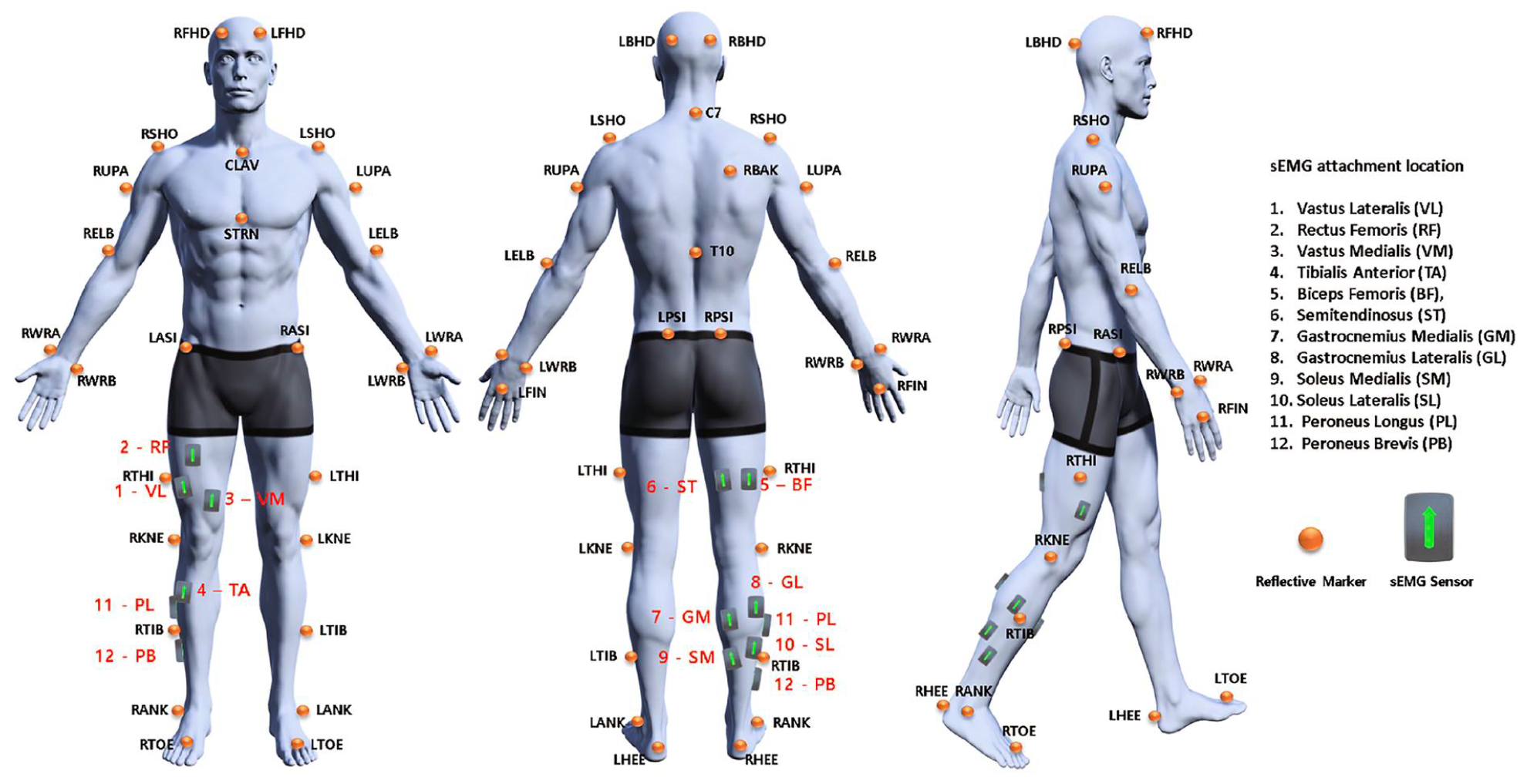
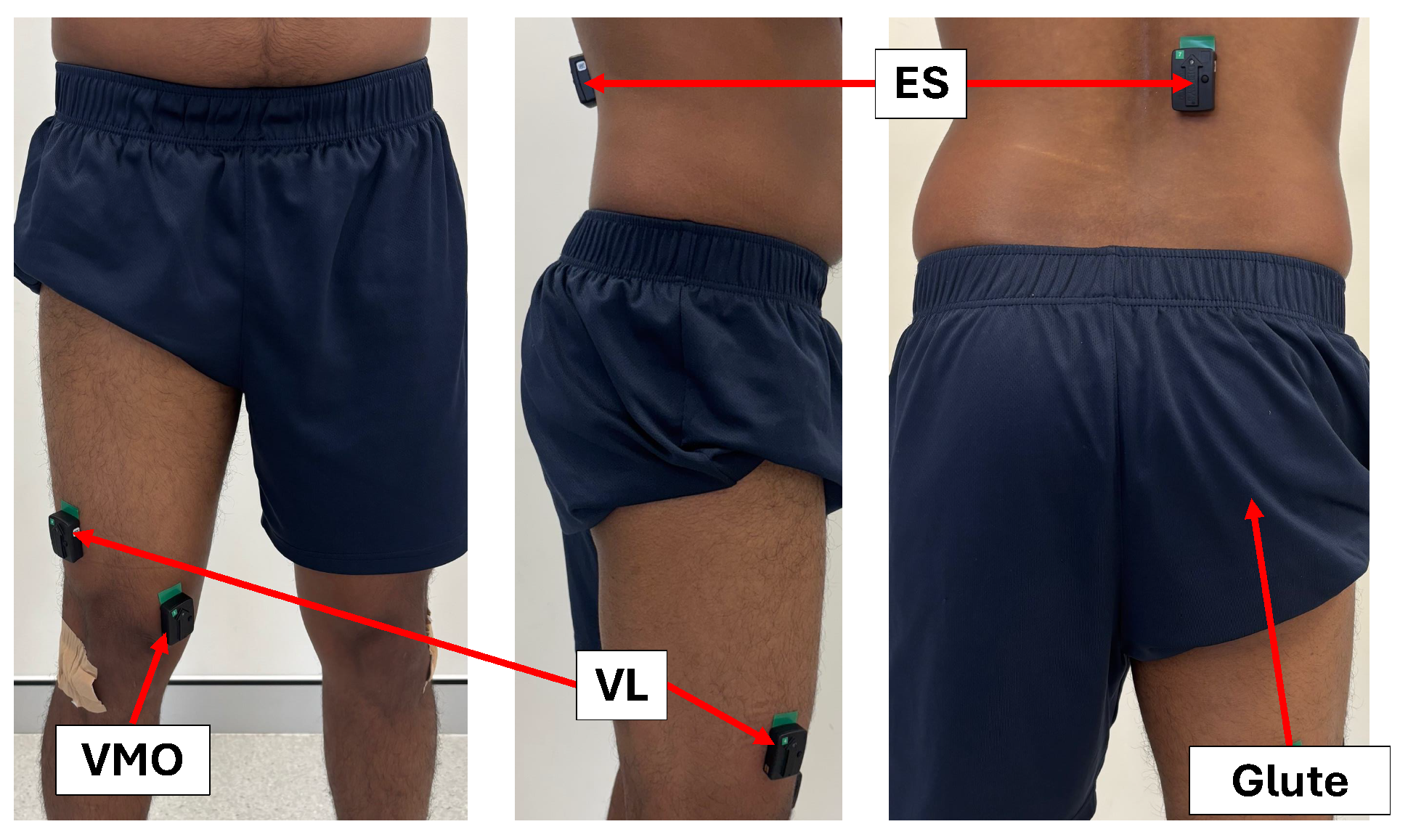
When considering EMG data acquisition, it is essential to understand that there are two main types of electrodes. The most commonly used method involves surface EMG (sEMG) electrodes [10,32,34,35]. Surface EMG electrodes are attached directly to the skin over the target muscle, hence the term surface EMG. These electrodes are typically made of silver/silver chloride (Ag/AgCl) and are available in various shapes, such as disks, bars, and rectangles. Because these electrodes are applied to the skin, a standardized preparation procedure must be followed [34]. First, the skin area over the relevant muscle should be cleaned. This usually involves lightly abrading the skin with abrasive paper to remove dead skin cells and ensuring the area is clean-shaven. Afterward, the skin should be wiped with alcohol to remove any remaining oils or debris. Once the area has been properly prepared, the surface electrodes regardless of their shape can be attached [34]. A conductive gel is typically applied between the skin and the electrode to improve electrical contact and reduce impedance. It is important to note that electrode placement should be performed by a trained professional, as proper placement requires knowledge of muscle fiber orientation and the correct positioning of the electrodes/EMG Sensor Units (Refer to Figure 1 and Figure 2) relative to the muscle structure [34,35].
The second type is intramuscular electrodes [32,34]. As the name suggests, these electrodes are inserted directly into the muscle to record electrical activity. They generally provide more accurate measurements since the signals are obtained directly from the muscle fibers. However, in most research applications, intramuscular electrodes are used less frequently than surface EMG (sEMG) electrodes due to the complexity and invasiveness of the procedure.
All of the procedures described above follow field-specific standards. The International Society of Electrophysiology and Kinesiology (ISEK) has established guidelines for the reporting of EMG data [34], while the Surface Electromyography for the Non-Invasive Assessment of Muscles (SENIAM) project provides detailed recommendations regarding sensor types, electrode placement procedures, and signal processing methods for EMG-related experiments [35].
When considering the different types of hardware used for EMG signal acquisition, these can be broadly divided into two main categories. The first category includes gold standard, research-grade EMG sensors and equipment, such as those manufactured by Delsys Inc. (Natick, MA, USA) [37] and Noraxon USA Inc. (Scottsdale, AZ, USA) [38]. These systems are equipped with advanced EMG sensors, data acquisition units, and data analysis software that adhere to standardized data presentation protocols. The main disadvantage of such systems is their high cost. Moreover, they are primarily used for research and development purposes as standard EMG measurement systems. On the other hand, there are low-cost EMG sensors, such as the MyoWare 2.0 manufactured by Advancer Technologies LLC. (Raleigh, NC, USA), which have demonstrated potential for use in research-related applications; however, their reliability for detailed data analysis cannot be guaranteed [39]. Despite this limitation, these sensors can be useful for obtaining signals to control or initiate other systems, such as robotic arms or exoskeletons [10,32,33,39].

3. EMG Signal Preprocessing and Conditioning

When following the standard procedure for EMG data acquisition, as illustrated in Figure 3, the filtering and rectification stages are considered part of the signal preprocessing and conditioning pipeline. Prior to any meaningful analysis, it is essential to preprocess EMG signals to ensure data quality. Because EMG measurements typically fall within the millivolt (mV) range, they are highly susceptible to various sources of noise [40]. This susceptibility is further exacerbated by the dynamic nature of EMG acquisition, as recordings are obtained from muscles in motion, which inherently introduces additional noise into the signal [32,39,40].
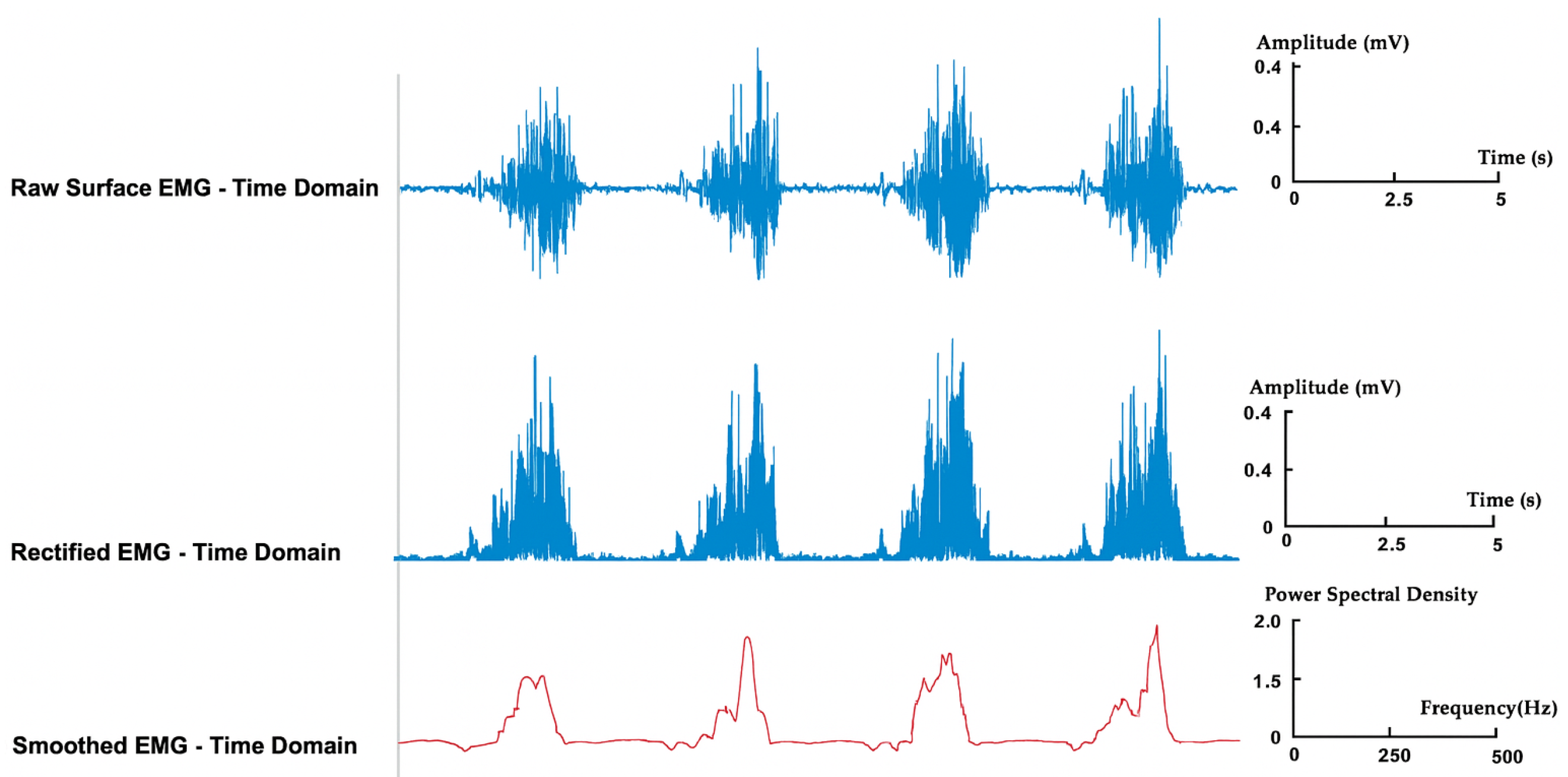
The first step in EMG analysis involves data acquisition. In modern EMG systems, sensors are typically connected either directly to a computer or through a data acquisition unit [32,37]. Data collection is often conducted by at least two individuals: one serving as the test subject and the other as the test coordinator. The coordinator initiates data recording when the test subject begins the motion and stops it once the motion is completed [32]. This approach helps to minimise signal artefacts that may occur if the subject were to start and stop the recording themselves. Despite these precautions, raw EMG signals are inherently noisy and cannot be directly used for meaningful interpretation without further processing. Refer to Figure 4 to compare raw, rectified, and smoothed EMG signals.
The first step in EMG signal preprocessing is filtering the raw signal to remove noise and artefacts [32,34,40,42]. In recent studies, this filtering is performed computationally using software platforms such as MATLAB R2024b or Python 3.13 [32,40]. According to guidelines from the International Society of Electrophysiology and Kinesiology (ISEK), band-pass filters—commonly implemented using Butterworth designs—are recommended to denoise EMG recordings [34,40]. When reporting EMG data, it is standard practice to specify the filter parameters used during preprocessing.
For surface EMG, typical cutoff frequencies include a high-pass cutoff in the range of 5–10 Hz and a low-pass cutoff between 400 and 450 Hz [32,34,35]. High-pass filtering is applied to remove low-frequency components such as motion artefacts, baseline drift, and electrode–skin impedance fluctuations, which primarily occur below 10–20 Hz. Attenuating these components helps preserve physiologically meaningful muscle activation information and improves the robustness of subsequent feature extraction and classification.
Low-pass filtering is used to suppress high-frequency noise, including electrical interference and sensor-related noise, while retaining the dominant EMG signal content. Depending on the sampling rate and application, low-pass cutoff frequencies may extend up to 500 Hz. Together, the high-pass and low-pass filters define the effective EMG bandwidth, forming a band-pass filtering stage that enhances signal quality prior to further processing.
Once the raw EMG signal has been filtered, it must be rectified. According to ISEK [34], either full-wave or half-wave rectification may be applied; however, the majority of the literature employs full-wave rectification [32,40,42]. This process converts all negative signal amplitudes into positive values, allowing the EMG signal to represent the magnitude of muscle activation rather than oscillations around zero [40]. Following rectification, feature extraction can be performed. If the researcher aims to obtain a clear linear envelope of the EMG signal, an additional low-pass filter can be applied, or alternatively, a moving average can be computed using a relatively small time window to preserve the integrity of the signal while smoothing out rapid fluctuations [10,32,34].
The methodology described above represents the conventional approach for EMG signal preprocessing. However, more advanced techniques have recently been introduced for each stage of this process. In terms of filtering, instead of using the traditional Butterworth filter, wavelet denoising and Empirical Mode Decomposition (EMD) can be employed as alternative, data-driven methods. According to [43], a Multilayer Wavelet Transform can be effectively applied to remove ECG artifacts from sEMG signals. Furthermore, this approach has been shown to enhance the overall signal quality, enabling more accurate muscle force estimation. This indicates that the method is capable of denoising and refining the entire sEMG signal [43,44]. In addition, the Empirical Mode Decomposition algorithm can improve EMG signal analysis by isolating and extracting features from distinct frequency components [45,46]. Such denoising and feature-extraction capabilities have been successfully applied in detecting and predicting motion patterns based on EMG signals [46]. Once all the preprocessing process is completed, then its possible to move on the advanced and modern pattern recognition strategies.

4. Feature Extraction Techniques

The feature extraction step is pivotal in the pipeline of EMG signal processing for pattern recognition and control. It transforms raw myoelectric signals into compact, discriminative representations that facilitate subsequent pattern recognition and classification tasks [18] while reducing dimensionality and improving the separability of classes [47]. The choice of feature set has a direct and significant influence on classification accuracy, computational efficiency, and robustness to various confounding factors [47,48]. This section systematically examines feature extraction methodologies spanning time-domain, frequency-domain, time-frequency domain, and non-linear dynamics, followed by the emerging paradigm of deep learning-based approaches. The most common types of these feature extractions are reviewed to elucidate their computational characteristics, strengths and weaknesses, typical applications, and comparative performance metrics.

4.1. Time-Domain Features

Time-domain (TD) features are the most conventional EMG features, typically derived from statistical analyses of the EMG signal or its first derivative. The TD features are extracted from the signal amplitude, which varies over time depending on the muscle activation [49]. TD features offer several advantages over other feature types, such as low computational complexity [50], real-time applications [51], easy implementation, and competitive performance in low noise environments. Furthermore, any additional signal transformation is not required for these features [52].
The simplest TD feature type is the Mean Absolute Value (MAV) that represents the average of the absolute value of EMG signal amplitude [53]. It is widely used to measure the muscle movement levels in hand-finger recognition applications [54], upper limb prosthetic [50,55,56] and exoskeleton controls [51]. The MAV is computationally efficient and strongly correlated with muscle contraction intensity, making it suitable for real-time applications [55]. However, it is too sensitive to the placement of electrodes, changes in impedance, and high-amplitude noise [57,58]. Root Mean Square (RMS) is known to be the most used TD feature type in EMG signal analysis, with its high noise robustness and strong physiological relevance to muscle activation. As indicated by its name, it is the square root of the mean of the squared signal amplitude. With its squaring and square root operations, it is computationally heavier than the MAV. Its reliance only on an amplitude feature makes it harder to distinguish gestures or movements with similar amplitude [59]. On the other hand, Waveform Length (WL) is another TD feature type that measures amplitude and the amount of waveform variation [60]. This enables the WL to be more informative and robust to amplitude scaling while still as computationally efficient as the MAV [56]. However, it is still sensitive to noise and motion artifacts and requires good signal filtering preprocessing for reliable outcomes [58].

4.2. Frequency-Domain Features

Frequency-domain (FD) features extract information on the spectral distribution of EMG, typically by means of the Fourier Transform applied to each segment. These features are specifically useful for understanding muscle fatigue [61], conduction velocity [62], and neuromuscular state at the cost of higher computational load, stronger stationarity and preprocessing requirements, and lower temporal resolution than TD features.
Commonly used FD features are Mean Frequency (MNF) and Median Frequency (MDF). Firstly, the MNF represents the average frequency of the power spectrum, weighted by the power at each frequency. It reflects changes in muscle fiber conduction velocity, which normally decreases with fatigue, and reduces the entire spectrum to a single and better interpretable value [61,62]. Therefore, this FD feature type is useful for tracking temporal changes. Meanwhile, MNF tends to be sensitive to outliers and noise [63], thereby requiring extra preprocessing leading to higher computational costs. In contrast, MDF divides the power spectrum into two equal halves, indicating the middle of the spectrum. Therefore, its key characteristics and typical applications are similar to those of MNF, while MDF boasts less sensitivity to noise and spectral spikes as compared to MNF [63,64].

4.3. Time-Frequency Domain Features

Time-frequency domain (TFD) features use transformations to analyze both the signal’s time and frequency simultaneously, providing more comprehensive information than time or frequency analysis alone. These features, therefore, possess better representations of dynamic/transient EMG and higher sensitivity to fatigue development and complex movement patterns than pure time- or frequency-domain features [65]. They are usually extracted from transforms such as Short-Time Fourier Transform (STFT), Continuous Wavelet Transform (CWT), and Discrete Wavelet Transform (DWT).
STFT is one of the foundational ways to bring EMG into the time-frequency domain. It approximates the signal as locally stationary within short time windows and computes a Fourier transform for each window [66]. By using the regular Fourier transform, it is conceptually simple and easily applicable for moderately non-stationary EMG [65]. Hence, they are typically used for the assessment of muscle fatigue (both dynamic and static contractions) [60,67], analysis of gait motions, gesture classification, and prosthetic control [66]. In contrast, its good sensitivity causes adverse effects as it is known to show high sensitivity to noise and artifacts, which requires extra preprocessing processes [57]. As STFT assumes the signal is quasi-stationary within each segment [68], it leads to poor performance in highly dynamic tasks.
CWT and DWT use wavelets to represent an EMG signal using scaled and shifted versions of a mother wavelet. While CWT computes coefficients for a continuous range of scales and shifts [69], DWT uses a discrete set of scales and shifts, as their name indicates [70,71]. This leads to multiple differences in terms of their strengths and weaknesses as well as potential applications. CWT offers rich time-frequency details, good visualization, and flexible scales [72], which make it suitable for dynamic EMG, fatigue analysis, pathology characterization, and joint features with deep learning-based features, such as Convolutional Neural Networks (CNNs) [73]. However, it demands higher computational costs and redundancy in relation to excessive parameter tuning. In contrast, DWT is compact, efficient, and easy to implement in real-time EMG and pattern recognition systems, while its drawbacks are with limited scale and frequency flexibility, high shift sensitivity, and less visually intuitive [71].

4.4. Non-Linear Dynamics Features

Instead of just using its amplitude and/or power spectrum as in the previously introduced features, non-linear dynamics features were developed to capture the complex, non-linear, and often chaotic behavior of neuromuscular activity. The EMG waveform is not purely linear or Gaussian, these features can quantify complexity, regularity, predictability, and long-range correlations in the EMG signal [69,72]. Among various feature types in this category, the entropy-based feature type is one of the most typical types with its multiple variants [74].
First of all, the Sample Entropy (SampEn) quantifies how unpredictable the EMG signal is by checking how often short patterns of length that are similar when extended to the original length without counting self-matches [75]. On the other hand, the Approximate Entropy (ApEn) compares the likelihood of similar patterns at a length and the extended length with self-matches [76], which makes it more biased for short data than SampEn [77]. As a result, ApEn is preferred for earlier studies on fatigue detection, disease classification, and movement complexity, whereas SampEn is usually used in newer work because it is less sensitive to data length and parameter choices [77]. Another feature type using non-linear dynamics is Fractal Dimension (FD) that is formulated to quantify the geometric complexity or roughness of the EMG time series [78], reflecting self-similarity across scales. This feature type is good at distinguishing pathological EMG patterns from normal patterns and is normally used to complement linear features in pattern recognition tasks [79].
The EMG feature extraction methods reviewed in this section are compared in Table 2 with respect to their key characteristics and classification accuracy. With advances in computational power and processing speed, the application of deep learning has expanded into signal processing. In recent years, numerous studies have combined feature extraction with deep learning to address the limitations of conventional feature extraction techniques while improving performance [80]. This trend has continued to evolve, extending combinations with other subsets of machine learning [47,56,59], which are further reviewed in the following section.

4.5. Interpretation of Reported Classification Accuracy

Reported classification accuracies in Table 2 are strongly influenced by experimental factors such as dataset size, number of channels, window length, overlap ratio, preprocessing pipeline, subject-dependence, and validation protocol (e.g., intra-subject, inter-subject, or cross-session evaluation). Consequently, direct numerical comparison of accuracy values across different studies may be misleading if these contextual factors are not considered. In this review, accuracy ranges (e.g., 95–99%) are therefore presented as indicative performance envelopes rather than absolute benchmarks. Wherever possible, reported results are interpreted in conjunction with their evaluation settings, and emphasis is placed on relative trends across model families, robustness properties, and computational trade-offs rather than isolated peak accuracies. This approach aims to mitigate deceptive cross-study comparisons and to provide a more realistic assessment of EMG classification performance under diverse experimental conditions.

5. Machine Learning Architectures for EMG Signal Classification

Recent advances in surface electromyography (sEMG) pattern recognition demonstrate a clear methodological transition from conventional handcrafted-feature pipelines to deep, hybrid, multimodal, and graph-based neural architectures. Contemporary research increasingly targets robustness to limb-position variation, inter-session variability, electrode displacement, and user independence factors that critically limit real-world deployment of EMG-based interfaces [7,89,90,91]. This section synthesizes these developments by comparing classical machine learning (ML) models, convolutional and recurrent neural architectures, hybrid CNN–RNN systems, transformer-based methods, graph neural networks, and multimodal fusion strategies. The review integrates findings across prosthetic control, gesture interfaces, rehabilitation robotics, and neuromuscular disease detection [92,93,94,95].

5.1. Historical Evolution of EMG Pattern Recognition

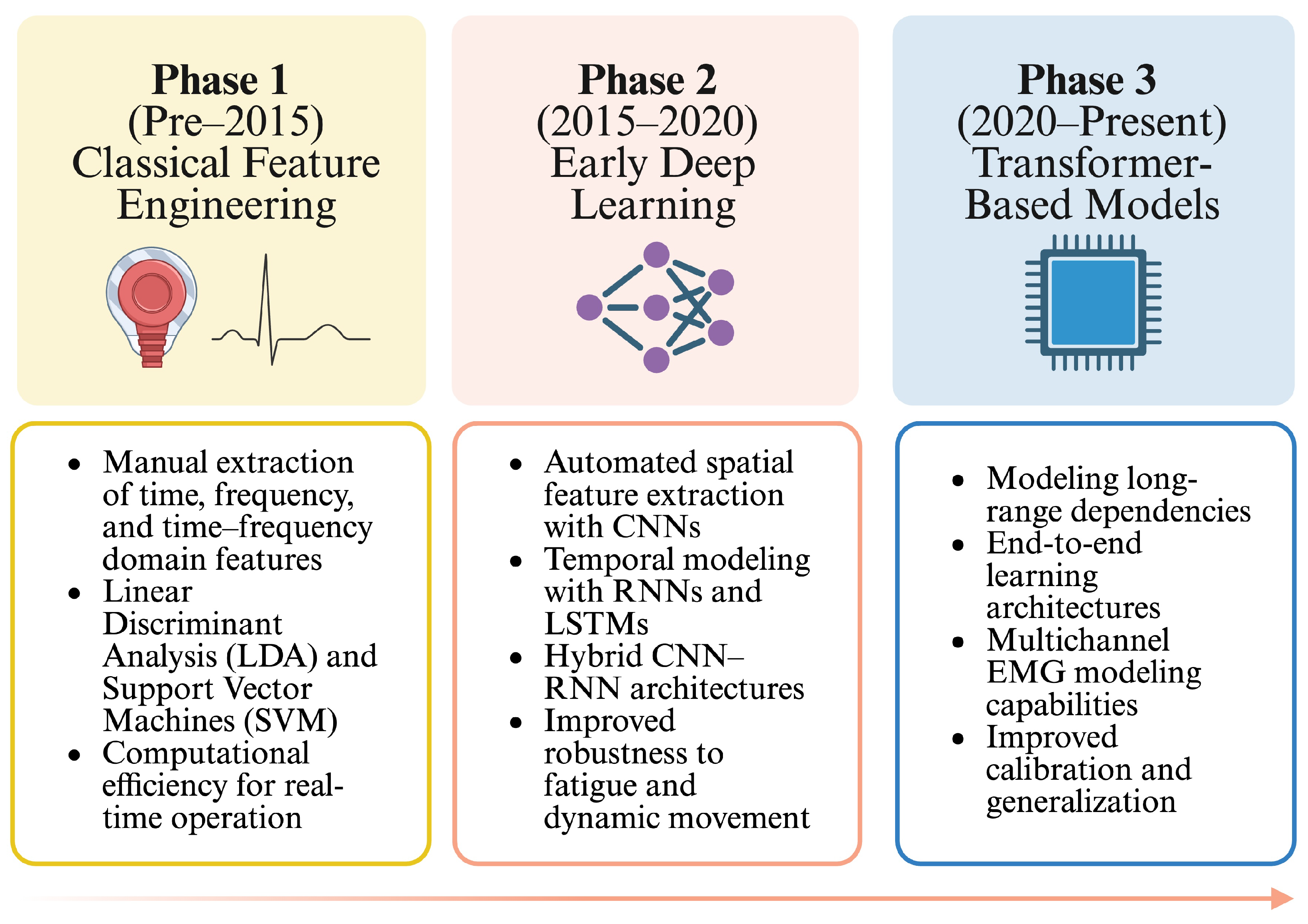
The development of electromyographic (EMG) pattern-recognition techniques has followed a clear methodological trajectory, progressing from handcrafted statistical approaches to modern deep learning and transformer-based architectures. Broadly, the field can be divided into three major phases, each defined by its dominant modeling paradigm and research priorities, as illustrated in Figure 5.

5.1.1. Phase 1 (Pre-2015): Classical Feature Engineering

The earliest phase relied on manual extraction of time-, frequency-, and time–frequency-domain features to represent muscle activation patterns. Linear Discriminant Analysis (LDA), Support Vector Machines (SVM), and related shallow classifiers dominated gesture recognition and prosthetic control applications due to their computational efficiency and suitability for real-time embedded systems [51,57,83]. During this period, research focused primarily on feature design, dimensionality reduction, and classifier optimization rather than end-to-end learning.
Robustness challenges such as inter-session variability and electrode displacement were later addressed through advances in high-density surface EMG (HD-sEMG) acquisition and spatial feature representations, laying the groundwork for more invariant modeling approaches [90,96].

5.1.2. Phase 2 (2015–2020): Early Deep Learning

The second phase marked the initial adoption of deep learning for EMG pattern recognition. Convolutional Neural Networks (CNNs) enabled automated spatial feature extraction from multichannel EMG signals, while Recurrent Neural Networks (RNNs) and Long Short-Term Memory (LSTM) models captured temporal dependencies in sequential muscle activation patterns [97]. Hybrid CNN–RNN architectures further improved spatiotemporal fusion capabilities, supporting dynamic gesture recognition under varying execution conditions [98,99].
During this period, transfer learning and adaptive calibration strategies emerged as effective tools for reducing user-specific training requirements and mitigating inter-subject variability, representing an important step toward practical deployment [89].

5.1.3. Phase 3 (2020–Present): Modern Deep Learning and Transformer-Based Models

The most recent phase is characterized by advanced deep-learning architectures, including vision transformers, multi-scale spatiotemporal fusion networks, hybrid CNN–Transformer models, and open-set recognition frameworks. Transformer-based architectures introduced self-attention mechanisms capable of modeling long-range temporal dependencies and spatial correlations in HD-sEMG arrays. Representative examples include TraHGR [15], CNN–Transformer hybrid systems [100], and transformer-based fusion approaches for high-density EMG [101].
Recent studies have further extended transformer-based modeling to multimodal fusion and cross-user generalization [102], robust temporal vision transformers [103], and compact architectures suitable for real-time deployment [6,104]. Hybrid end-to-end systems combining CNN, LSTM, and transformer components have demonstrated strong performance in rehabilitation and muscle fatigue monitoring contexts [105,106].
In parallel, graph neural network (GNN) approaches have emerged to explicitly encode spatial relationships among EMG electrodes, improving generalization and interpretability across static and dynamic gestures [91,107,108]. Collectively, these advances emphasize robustness, multi-scale representation learning, transferability, and edge deployment, positioning transformer- and graph-based models as key enablers for next-generation, real-world EMG interfaces.

5.2. Classical Machine Learning Models

Classical machine learning (ML) classifiers—such as support vector machines (SVM), Random Forests (RF), linear discriminant analysis (LDA), multilayer perceptrons (MLP), and k-nearest neighbors—remain foundational in EMG research. Their success relies heavily on feature engineering, including time-domain descriptors such as root mean square (RMS), waveform length, and zero-crossing rate, as well as time–frequency representations such as wavelet packet energies and advanced descriptors derived from Hilbert–Huang analysis. Tallapragada and Sagare achieved 98.68% accuracy using an RF classifier trained on RMS and waveform length features on their evaluated dataset [92], while Villela et al. reported high accuracies with an optimized SVM-based approach [109].
Additional studies further confirm the viability of classical methods. Habib et al. compared multiple linear and nonlinear ML algorithms, demonstrating that RF outperforms k-NN for EMG-based hand-gesture recognition [94]. Aarotale and Rattani evaluated several ML classifiers trained on preprocessed sEMG signals and observed accuracies exceeding 95% when time–frequency representations were employed [93]. Studies on neuromuscular-disease detection further indicate that classical classifiers provide stable and interpretable baselines for pathological EMG analysis [110,111].
Nevertheless, classical ML models remain constrained by their dependence on handcrafted features and their limited ability to generalize across users, recording sessions, and dynamic limb configurations, motivating the transition toward deep and adaptive learning frameworks [7,23].

5.3. Convolutional Neural Networks

Convolutional neural networks (CNNs) have emerged as one of the most influential deep learning architectures for sEMG pattern recognition, largely due to their ability to automatically learn hierarchical spatial features from raw signals, spectrograms, or other time–frequency representations. Unlike classical machine learning models that rely heavily on handcrafted feature sets, CNNs extract discriminative local patterns through convolutional filters, making them particularly effective for dealing with the spatial heterogeneity and muscle activation morphology inherent in EMG data. In multi-channel or high-density EMG (HD-sEMG) settings, CNNs have shown strong performance because the spatial arrangement of electrodes resembles the grid-like topology on which convolutional operations excel.
Filipowska et al. demonstrated the effectiveness of CNNs in practical communication systems, achieving 98.3% accuracy for the recognition of 24 Polish Sign Language expressions using multi-channel EMG signals on their evaluated dataset [112]. Similarly, the DLPR framework achieved up to 99.12% accuracy across several NinaPro benchmark datasets, highlighting the maturity of CNN-based pipelines for high-gesture-count recognition under controlled conditions [113]. These results illustrate the capacity of CNNs to scale to large gesture vocabularies with high inter-class variability.
Subsequent work has extended CNN architectures by integrating advanced preprocessing and hybrid modeling techniques. Bustos et al. combined discrete wavelet transform (DWT) coefficients with CNNs to enhance multi-class prosthesis control, demonstrating that time–frequency decompositions provide more informative spatial patterns for convolutional learning, particularly when muscular activation varies across users [114]. Elbeshbeshy et al. similarly showed that applying time–frequency representations such as short-time Fourier or wavelet transforms prior to CNN training significantly improves classification accuracy, especially under noisy recording conditions [115].
CNN-based and hybrid CNN architectures have also been adapted for human–computer interaction. Wang and Wang developed a CNN for decoding EMG patterns into interaction commands, reporting robust performance in the presence of inter-subject variation [99]. Bai et al. explored a CNN–LSTM hybrid model for multi-channel EMG, observing that convolutional spatial encoding followed by recurrent temporal modeling leads to significant accuracy gains over standalone CNNs [98].
High-density EMG applications have further motivated specialized CNN architectures. Chen et al. introduced a CNN–Transformer hybrid model that leverages convolutional filters for local feature extraction and attention mechanisms for global spatial integration, achieving improved robustness to electrode misalignment [11].
CNNs have also been applied within multimodal and adaptive frameworks to address limb-position variation and dynamic movement contexts. Zhang et al. demonstrated that CNN-based feature extraction remains effective when integrated with multimodal sensing and adaptive fusion strategies under varying arm postures and contraction intensities [16]. Additional applications include neuromuscular disease diagnosis, where CNNs have been shown to detect subtle variations in EMG morphology associated with pathological muscle states [110,116].
More recent contributions have explored embedding CNNs into real-time or resource-constrained systems. Yu et al. demonstrated that compact CNN architectures with channel-attention mechanisms can achieve high classification accuracy for EMG-based gesture recognition while remaining suitable for real-time prosthetic hand control, highlighting their practicality for wearable and embedded deployments [117]. Related work in robotic manipulation has shown that CNN-based feature extraction can support shared-control systems incorporating EMG-driven intent estimation [118].
Despite these advancements, CNNs face persistent challenges related to computational complexity, sensitivity to electrode displacement, and non-stationary EMG distributions. Although strategies such as spatial augmentation, transfer learning, and domain adaptation have been proposed, CNN performance often degrades under highly dynamic real-world conditions unless combined with adaptive learning or multimodal sensing [7,89,90].

5.4. Recurrent Neural Networks and Temporal Models

Recurrent neural networks (RNNs) and their gated variants, including long short-term memory (LSTM), gated recurrent units (GRUs), and bidirectional LSTM (BiLSTM), play an essential role in EMG pattern recognition due to their intrinsic ability to capture the temporal evolution of muscle activation. Unlike CNNs, which primarily exploit spatial relationships across electrodes, RNNs are well-suited for modeling sequential dependencies and transient variations that occur during muscle contractions, relaxation phases, and transitions between gestures. These temporal features are often highly non-stationary, making deep recurrent models a natural fit for sEMG processing.
A substantial body of literature demonstrates the effectiveness of RNN-based architectures. Xiong et al. achieved a 98.57% classification accuracy using a BiLSTM trained on instant high-density EMG on their evaluated dataset, showing that bidirectional temporal modeling captures both past and future dependencies within short activation windows [119]. Similarly, Alam et al. reported that LSTM architectures outperform tree-based and margin-based classical machine learning classifiers in their comparative evaluation, highlighting the value of temporal recurrence in complex gesture-set classification tasks [120]. Their findings further indicate improved robustness to session variability under the studied experimental conditions.
Recent advances have extended the capabilities of RNNs to more complex temporal modeling scenarios. Koch et al. implemented a stacked sequence-to-sequence architecture in which multiple LSTM layers encode long, variable-length EMG sequences for dynamic gesture decoding, demonstrating improved stability in cross-user settings [12]. Vamsi et al. integrated LSTM layers within a multimodal CNN–RNN pipeline to classify complex human activities from sEMG, achieving strong performance in realistic multi-sensor experimental settings involving movement artefacts and task variability [121]. These studies highlight the growing relevance of RNNs beyond isolated gesture recognition and toward continuous activity monitoring.
Hybrid recurrent architectures have also been increasingly explored. Chandran et al. demonstrated that a GRU–LSTM fusion model enhanced with an attention mechanism significantly improves robustness to noise and limb-position variability, outperforming single-gate recurrent networks in both accuracy and convergence speed [13]. RNNs have also been applied to physiological monitoring tasks. Recent work by Miaoulis et al. leveraged recurrent temporal modeling to develop a fatigue index for wearable EMG systems, demonstrating that LSTM-driven regression can reliably track muscular fatigue progression in near real time [122]. Such applications underscore the broader utility of RNNs in EMG-based human–machine interfacing, rehabilitation, and biomechanical assessment.
Further contributions explore the use of RNNs in multimodal and noise-heavy contexts. Studies integrating RNNs with IMU, accelerometer, or force myography signals report improved temporal alignment and sensor-fusion performance, particularly for gestures involving complex transitions or changes in limb posture [17]. RNNs have also shown promise in neuromuscular pathology classification, where recurrent architectures capture subtle temporal irregularities in pathological EMG signals [110].
Despite their strengths, RNN-based models introduce notable limitations, including increased computational cost, higher inference latency, and sensitivity to long-term dependency degradation. Although gated mechanisms mitigate vanishing-gradient effects, very long temporal contexts remain challenging to model without attention-based or transformer-style augmentation. Moreover, RNN performance degrades under electrode displacement and spatial inconsistency unless combined with convolutional layers for spatial encoding [7,89,98].

5.5. Hybrid CNN–RNN Architectures

Hybrid CNN–RNN architectures represent one of the most effective classes of models for EMG signal processing, combining the strengths of convolutional neural networks (CNNs) for spatial feature extraction with recurrent neural networks (RNNs), such as LSTM or GRU, for temporal sequence modeling. This combination allows hybrid models to capture both localized spatial activation patterns across electrodes and the dynamic temporal evolution of muscle contractions—two properties that are critical for accurate gesture recognition, particularly in continuous or realistic movement scenarios.
A number of studies demonstrate the strong performance of hybrid architectures compared to standalone CNN or RNN models. Jiang et al. introduced a multimodal CNN–LSTM–ResNet hybrid for EMG–IMU fusion, achieving 99.67% classification accuracy on their evaluated dataset and highlighting the advantage of combining deep spatial hierarchies with temporal recurrence for robust multimodal gesture classification [17]. Similarly, Botros et al. presented a temporal CNN–BiLSTM architecture capable of transitioning from zero-shot to few-shot learning, achieving 98.3% accuracy with brief calibration. Their results indicate improved cross-user generalization relative to CNN-only models in their cross-user evaluation, particularly when using bidirectional temporal backbones [123].
Hybrid CNN–RNN frameworks have been widely explored in multi-channel and high-density EMG applications. Bai et al. proposed an improved CNN–LSTM model that demonstrated strong spatiotemporal representation capabilities in multi-channel gesture datasets, outperforming single-stream architectures [98]. Neenu and Titus introduced CNN–GRU hybrids optimised for reduced computational demand, showing that GRU-based recurrent decoding can achieve performance comparable to LSTM-based systems while requiring fewer parameters [124]. These results illustrate that hybrid architectures can be tuned to balance accuracy and computational efficiency.
Beyond upper-limb gestures, hybrid architectures have also been applied to lower-limb movement and activity recognition. Vijayvargiya et al. employed hybrid CNN–LSTM networks to classify lower-limb sEMG signals for gait and activity recognition, demonstrating high accuracy and robustness to inter-subject variability under controlled experimental conditions [125]. This work underscores the suitability of hybrid models for capturing both muscle coordination patterns and temporal stride dynamics in rehabilitation and wearable gait-monitoring systems.
In rehabilitation-focused applications, hybrid models have proven particularly valuable due to their robustness in noisy or abnormal EMG conditions. Cao et al. developed a DAE–CNN–LSTM hybrid designed for stroke rehabilitation, showing substantial improvements in denoising and gesture recognition accuracy under fatigue, spasticity, and irregular contraction patterns [106]. By incorporating denoising autoencoders, this architecture illustrates how hybrid models can integrate multiple deep-learning components to address the complexities of clinical EMG.
Several studies further highlight the effectiveness of hybrid architectures in multimodal fusion systems. Approaches combining EMG with IMU, force myography (FMG), or accelerometer data generally report that CNN–LSTM hybrids outperform CNN-only or RNN-only pipelines due to their ability to synchronize spatiotemporal features across modalities [17]. In robotic-control environments, hybrid architectures have also demonstrated improved reliability in dynamic teleoperation systems incorporating EMG-driven intent estimation [118].
Despite their strong performance, hybrid CNN–RNN models introduce increased computational cost, memory requirements, and training complexity. Processing both spatial and temporal hierarchies leads to larger parameter counts, making deployment on embedded prosthetic controllers challenging without compression or pruning. Latency introduced by recurrent layers—particularly BiLSTM—may also limit real-time applicability. Furthermore, hybrid architectures remain sensitive to electrode displacement and cross-session variability unless supplemented with domain adaptation, transfer learning, or multimodal sensing strategies [7,89,98].
Overall, hybrid CNN–RNN systems remain a widely adopted and high-performance solution for EMG classification. Their ability to unify spatial feature hierarchies with rich temporal context makes them particularly valuable for continuous gesture control, rehabilitation monitoring, and human–machine interaction. Ongoing research focuses on model compression, lightweight recurrent units, and attention-enhanced hybrids to further improve robustness while keeping computational demands manageable.

5.6. Transformer and Attention-Based Models

Transformer architectures have recently gained traction in EMG pattern recognition due to their ability to model long-range temporal dependencies through self-attention mechanisms, without relying on recurrence or convolutional locality constraints. This capability is particularly advantageous for EMG signals, where discriminative information may be distributed across non-contiguous time segments or across multiple channels with complex temporal relationships. By explicitly modeling global dependencies, transformers offer a flexible alternative to traditional CNN- and RNN-based architectures.
Godoy et al. demonstrated the applicability of transformer-based models to EMG classification using a Temporal Multi-Channel Vision Transformer (TMC-ViT) architecture, reporting robust hand motion classification performance on the Ninapro dataset and comparable accuracy to modern deep learning baselines [103]. Similarly, Moslhi et al. reported that signal transformer architectures achieve competitive and, in several cases, superior performance relative to CNN-based models across multiple EMG gesture recognition datasets, with high classification accuracies [126]. These results suggest that attention-based representations can effectively capture subtle temporal dynamics and inter-channel relationships that may be underutilized by convolutional filters alone.
Hybrid architectures combining convolutional layers with transformer encoders have further improved performance by leveraging the complementary strengths of both paradigms. Chen et al. proposed a CNN–Transformer hybrid framework for high-density EMG (HD-EMG) analysis, where convolutional layers extract local spatial features while transformer modules model global temporal dependencies, resulting in improved spatiotemporal feature alignment [11]. Such hybrid designs are particularly well suited to HD-EMG configurations, where both spatial structure and long-range temporal context are critical.
Despite their strong representational capacity, transformer-based models present notable challenges for practical deployment. The self-attention mechanism incurs increased computational complexity and memory usage, often requiring larger training datasets and more powerful hardware compared to classical or lightweight deep learning approaches [28]. As a result, transformer models may be less suitable for real-time, embedded, or battery-powered EMG systems without model compression, pruning, or efficient attention mechanisms [127]. Consequently, while transformers represent a powerful and conceptually important advancement in EMG pattern recognition, careful consideration of model size, latency, and hardware constraints remains essential for real-world deployment.

5.7. Graph Neural Networks

Graph neural networks (GNNs), including Graph Convolutional Networks (GCN) and Graph Attention Networks (GAT), model the electrode array as a spatial graph, enabling explicit representation of functional relationships among EMG channels and underlying muscle groups. This formulation is particularly appealing for high-density EMG (HD-EMG), where electrode geometry and inter-channel dependencies play a critical role in decoding motor intent.
Xia et al. applied a Graph Attention Network (GAT) to sEMG-based gesture recognition, achieving 88.8% classification accuracy on their evaluated dataset and demonstrating the feasibility of attention-based graph modeling for spatial EMG representations [108]. Lee et al. introduced a spatiotemporal graph convolutional network that integrates spatial electrode relationships with temporal dynamics, achieving improved cross-user generalization and enhanced interpretability in EMG-based gesture classification [91]. Earlier work by Xiong et al. explored graph-based representations for high-density EMG signals, showing that explicit modeling of inter-electrode connectivity can enhance deep-learning-based gesture recognition [119]. Overall, GNN-based approaches offer a principled framework for capturing spatial dependencies in EMG data and show promise for improving robustness in scenarios involving complex electrode layouts or configuration variability. However, their practical adoption is constrained by the need for explicit graph construction, sensitivity to graph topology design, and higher computational overhead compared to conventional CNN-based architectures. As a result, GNNs are most effective when applied to structured HD-EMG setups where spatial relationships are well defined and stable.

5.8. Multimodal Fusion Architectures

Multimodal fusion architectures combine EMG with complementary sensing modalities such as inertial measurement units (IMU), pressure-based force myography (pFMG), accelerometers, or gyroscopes to improve robustness under limb-position variation and dynamic movement conditions. By leveraging heterogeneous sensory information, these systems aim to mitigate the sensitivity of EMG-only approaches to posture changes, electrode placement variability, and motion artefacts.
Jiang et al. demonstrated the effectiveness of multimodal fusion by achieving 99.67% classification accuracy on their evaluated dataset using an integrated EMG–IMU deep learning framework, highlighting the benefit of combining spatial, temporal, and inertial cues for gesture recognition [17]. Similarly, research on adaptive multimodal fusion strategies reports improved robustness to posture and sensor-related variability through dynamic feature weighting and cross-modal alignment [16].
Multimodal fusion has also been investigated in applied control settings. Godoy et al. evaluated multiple sensor-fusion pipelines for robotic telemanipulation systems incorporating EMG-driven intent estimation, demonstrating improved reliability under dynamic operating conditions [118].
Despite these advantages, multimodal systems introduce practical challenges, including increased hardware cost, sensor synchronization complexity, calibration overhead, and higher computational demand. These constraints must be carefully managed when deploying multimodal EMG systems in wearable, embedded, or battery-powered applications [7,23].

5.9. Model Complexity and Deployment Considerations

While deep models achieve state-of-the-art performance in EMG classification, their computational and memory demands complicate deployment on resource-limited embedded devices. Koch et al. demonstrated that compact RNN architectures can achieve strong cross-user generalization while maintaining low computational complexity, making them suitable for real-time applications [12]. Lu et al. proposed MMyoHMI, a lightweight on-device learning system that achieves near–99% accuracy through adaptive user calibration, highlighting the effectiveness of personalized and resource-aware EMG interfaces [128]. Naser and Hashim reported 99.26% accuracy using a semi-supervised autoencoder–MLNN architecture with moderate resource requirements on their evaluated dataset [129].
Despite these advances, architectures relying on high-density EMG acquisition, transformer-based attention mechanisms, or graph neural networks remain challenging to deploy in battery-powered, real-time prosthetic and wearable systems due to increased computational load, memory usage, and latency constraints [7,89]. Table 3 summarizes representative EMG classification architectures, highlighting their relative strengths, limitations, and reported accuracy ranges.

5.10. Generalization, Dataset Bias, and Evaluation Protocols

Generalization remains one of the most critical and unresolved challenges in EMG-based pattern recognition. Although recent advances in deep learning, transformer-based architectures, and multimodal fusion report high classification accuracies, these results are frequently obtained under laboratory-controlled conditions that do not reflect long-term or real-world usage scenarios.
A substantial proportion of the literature surveyed in this review relies on standardized laboratory datasets acquired under tightly controlled protocols, most notably NinaPro-style datasets [133]. Such datasets typically involve fixed electrode placement, scripted gesture execution, controlled postures, and limited environmental variability. While these protocols are essential for benchmarking and reproducibility, they inherently bias performance evaluation toward short-term, intra-session conditions and may overestimate robustness in practical deployments.
Based on qualitative synthesis of the surveyed studies, a clear majority of EMG classification works employ intra-session or subject-dependent validation schemes, most commonly using random train–test splits within a single recording session. A smaller subset reports cross-subject or limited cross-session evaluations, while only a small fraction explicitly investigates cross-day, long-term, or real-world scenarios involving electrode repositioning, sensor drift, muscle fatigue, or changes in daily activity context. These proportions are indicative rather than exhaustive, but they highlight the dominance of laboratory-centric evaluation paradigms in the current literature.
The prevalence of controlled datasets has contributed to optimistic robustness claims. Models that perform well under NinaPro-like conditions often experience substantial performance degradation when evaluated across sessions, days, or unconstrained environments. This gap underscores the importance of interpreting reported accuracy values in conjunction with validation protocol, dataset diversity, and recording duration. Accordingly, accuracy ranges reported in this review are treated as contextual indicators rather than directly comparable benchmarks. The continued absence of large-scale, openly available EMG datasets collected under realistic, long-term conditions remains a key barrier to the development of truly generalizable EMG-driven systems.

5.11. Feature-Based Versus Deep Learning Approaches Under Embedded and Real-Time Constraints

Although deep learning has become dominant in EMG pattern recognition, manually engineered feature pipelines remain highly competitive in several deployment settings, particularly when real-time operation and constrained hardware are primary requirements. Classical approaches (e.g., time-domain statistics with LDA/SVM) were historically adopted because they offer low latency, low memory footprint, and predictable compute requirements suitable for embedded systems. This emphasis on computational efficiency is a key reason feature-based pipelines remain attractive for wearable and assistive devices requiring continuous inference [7].
In practice, handcrafted feature-based pipelines can compete with, or even outperform, deep learning approaches under several common deployment conditions:
  • Limited training data: When datasets contain few subjects, limited repetitions, or scarce labelled samples, classical feature-based methods are less prone to overfitting than deep models.
  • Low channel count: For sparse sEMG configurations with a small number of electrodes, the representational advantage of deep architectures is reduced, making handcrafted features more effective.
  • Strict real-time or energy constraints: In embedded deployments (e.g., microcontrollers or DSPs), feature extraction combined with lightweight classifiers offers predictable latency and lower power consumption.
  • Short inference windows: For applications requiring small window sizes and low overlap, classical features can be computed deterministically with bounded execution time.
  • Interpretability and validation requirements: Physiologically meaningful features (e.g., amplitude- and frequency-based descriptors) facilitate debugging, validation, and regulatory acceptance.
Conversely, deep learning is more likely to be warranted when datasets are sufficiently large and diverse (supporting generalization), when channel density is high (e.g., HD-EMG spatial patterns), or when tasks require complex spatiotemporal modeling and robustness across contexts. It is also important to note that feature choice itself can affect real-time feasibility: frequency-domain and time–frequency features often provide richer representations but typically incur higher computational load and stronger preprocessing requirements than time-domain descriptors [8]. Therefore, embedded deployments often favor compact time-domain feature sets paired with lightweight classifiers, unless compute resources and power budgets permit more complex transforms.

5.12. Latency, Memory, and Power Trade-Offs for Embedded EMG Deployment

For wearable, assistive, and prosthetic applications, classification accuracy alone is insufficient to determine the suitability of an EMG processing pipeline. Real-time control requires bounded inference latency, limited memory footprint, and low power consumption to ensure responsiveness, battery longevity, and user safety. Consequently, model families that achieve high accuracy under offline evaluation may still be impractical for embedded deployment.
Classical machine learning pipelines, such as time-domain feature extraction followed by LDA or SVM classifiers, typically offer inference latencies on the order of microseconds to low milliseconds, minimal memory usage, and predictable computational cost. These properties make them well-suited to microcontroller- and DSP-based platforms commonly used in wearable and prosthetic devices. In contrast, CNN–RNN hybrid models introduce additional computational overhead due to convolutional feature extraction and recurrent temporal modeling, often increasing latency and memory requirements by an order of magnitude relative to classical approaches.
Transformer-based architectures further amplify these costs due to self-attention operations, which scale poorly with input dimensionality and sequence length. Although transformers can achieve strong performance on benchmark datasets, their inference latency, parameter count, and memory footprint frequently exceed the constraints of low-power embedded hardware unless aggressive model compression, quantization, or hardware acceleration is employed. As a result, transformer-based EMG models are currently more suitable for edge devices with dedicated AI accelerators than for ultra-low-power wearables.
Table 4 summarizes representative deployment-level trade-offs across model families, highlighting that the practical advantage of deep learning is highly dependent on available computational resources and power budgets. These considerations reinforce that, for many real-time myoelectric applications, lightweight classical pipelines or shallow neural models remain competitive and, in some cases, preferable despite lower peak accuracy.

6. Emerging Applications

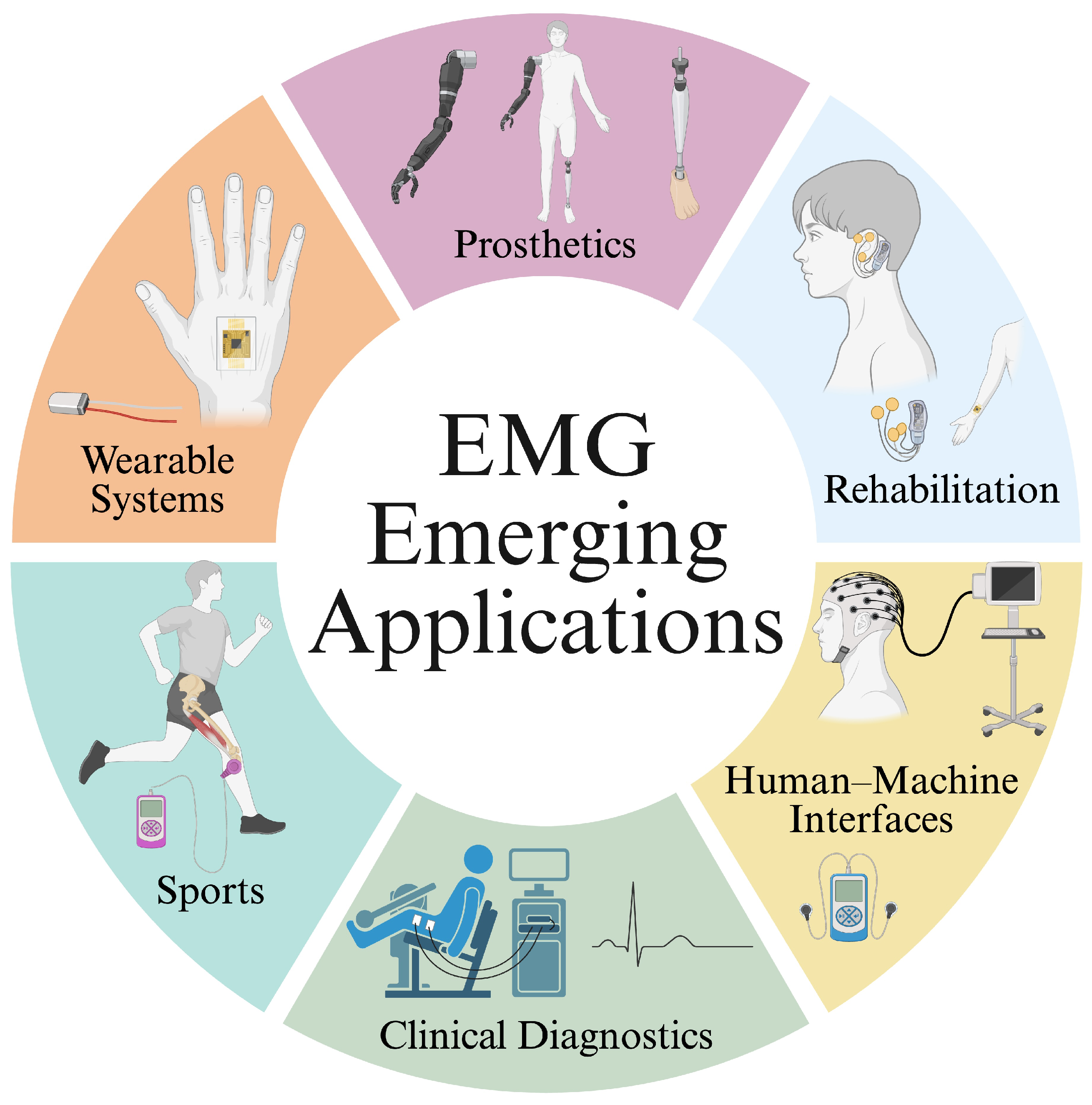
Electromyography (EMG) signal processing and pattern recognition have expanded beyond traditional clinical use into diverse domains. Driven by advances in sensor design, embedded processing, and machine learning, EMG-based interfaces are enabling more intuitive prosthetic controls, innovative rehabilitation tools, seamless human–machine interfaces (HMIs), improved clinical diagnostics, sports performance monitoring, and ubiquitous wearable systems. This section reviews six key application domains (Figure 6), highlighting recent developments and emerging technologies such as deep learning algorithms, muscle fatigue monitoring, flexible electronics, closed-loop feedback systems, and on-device processing that are shaping the future of EMG-based solutions. Table 5 summarizes representative recent case studies in these domains.

6.1. Prosthetics

EMG-driven prosthetic limbs have seen rapid progress in control sophistication and user experience. Deep learning and high-density EMG (HD-EMG) are enhancing pattern recognition for multifunctional hand control. For instance, recent work demonstrates that HD-EMG electrode arrays combined with machine learning significantly improve intention detection for dexterous prosthetic hand movements [30]. These approaches leverage the richer spatial information of HD-EMG to increase classification accuracy and robustness, moving closer to intuitive control of multiple degrees of freedom. Closed-loop systems that restore sensory feedback represent another breakthrough. Tchimino et al. (2024) introduced an EMG feedback technique for a myoelectric hand, where the user’s muscle activation level is fed back via vibrotactile stimulation [134]. In a case study with a high-level amputee, adding EMG-mediated tactile feedback improved force control success rate by approximately 30 percent, allowing the user to more precisely modulate prosthetic grip force [134]. Such bidirectional interfaces that send sensation back to the user exemplify emerging biomimetic prosthesis designs that close the loop between user and device.
Recent prosthetic prototypes also emphasize embedded intelligence and user-centric design. Kalita et al. (2025) developed a real-time EMG-controlled hand (ENRICH) that achieved a rapid 250 millisecond response time, on par with human neuromuscular latency, and demonstrated functional grasp performance in standard tests [135]. Notably, ENRICH was benchmarked against 26 research prototypes and 10 commercial prosthetic hands, showing competitive speeds and force capabilities [135]. At the same time, affordability and accessibility are being addressed through low-cost hardware and open-source approaches. Rodrigues et al. (2025) present a three-dimensional printed myoelectric hand using an Arduino-based EMG controller, costing far less than high-end bionic hands [136]. Their preliminary system reliably detected muscle signals and actuated a simple hand closure within approximately 150 milliseconds. While limited to one grip motion, it lays a foundation for scalable, user-customized prosthetics in resource-limited settings. Future prosthetic limbs are expected to integrate artificial intelligence-driven signal processing and multimodal sensing to further enhance control naturalness [136]. Overall, the prosthetics domain illustrates how EMG pattern recognition research is translating into more intuitive, responsive, and inclusive prosthetic control systems, bolstered by advances in machine learning and electronics integration.
Table 5. Recent representative case studies of emerging EMG applications. Each study illustrates a novel method or technology in a specific domain, along with the context and key performance outcome.
YearRefMethod/InnovationApplication SettingKey Performance Metrics/Outcomes
2023[107]Stretchable EMG patch with Graph Neural Network for gesture recognitionHMI (wearable gesture controller)97% accuracy for 18 gestures; maintained ∼95% accuracy over 72 h of continuous use
2024[134]Vibrotactile EMG feedback integrated into myoelectric hand controlProsthetics (high-level amputee case)∼30% improvement in force-matching success rate; enhanced grasp precision
2024[137]Embedded 8-channel EMG acquisition module with on-board filteringRehabilitation (wearable exoskeleton HMI)Real-time synchronization of exoskeleton motion with user intent; improved assistive responsiveness
2024[138]Intermuscular EMG coupling analysis under fatigue (bench press protocol)Sports performance (resistance training)Fatigue induced 15–20% reduction in antagonist coherence and compensatory increases in synergist muscle coupling
2024[139]Polyurethane foam interface for motion-artifact suppression in wearable EMGWearable systems (daily-use EMG garment)Maintained stable 1–2 kPa electrode-skin pressure; reduced motion artifacts and improved signal quality
2025[140]Surface EMG combined with AI for fall-risk prediction (review)Clinical diagnostics (preventative monitoring)Identified muscle-weakness biomarkers related to fall risk; proposed real-time EMG-based fall-warning system
2025[135]Real-time EMG-controlled prosthetic hand (ENRICH) with fast actuationProsthetics (prototype vs commercial hands)250 ms grasp response time; successful completion of Box-and-Block test; performance comparable to commercial devices

6.2. Rehabilitation

In rehabilitation engineering, EMG is enabling assistive devices that synchronize with the user’s own neuromuscular signals to restore or augment motor function. A prime example is EMG-controlled exoskeletons for gait and limb support. These wearable robots benefit from EMG-based intent detection to initiate movements in phase with patient effort, reducing the lag between the user’s muscle activation and the exoskeleton’s response. Lu et al. (2024) designed an embedded eight-channel EMG acquisition module specifically for exoskeleton control, featuring on-board preprocessing to filter noise and light indicators of signal strength [137]. The device’s real-time EMG capture and processing allowed an exoskeleton to anticipate user motions and even respond in advance to the user’s intent [137]. By improving the timing and “intelligence” of the human–robot interaction, such systems can provide more naturalistic assistance during rehabilitation exercises or mobility support. Importantly, the entire EMG interface was miniaturized and low-cost, facilitating integration into wearable form factors. This reflects a broader trend of embedded processing in rehab devices, where microcontrollers directly handle EMG filtering and pattern recognition on-board, eliminating reliance on tethered computers and thereby increasing portability.
Beyond exoskeletons, EMG pattern recognition is being used in functional electrical stimulation (FES) and other therapeutic interventions. For stroke rehabilitation, for example, EMG signals from a patient’s residual muscle activity can trigger electrical stimulators to assist weakened muscles in a coordinated, closed-loop fashion. Early studies indicate that EMG-driven FES can promote neuroplastic recovery by timing stimulation with voluntary intent, though challenges remain in reliable intent decoding for paretic muscles. In general, machine learning algorithms are now applied to refine these EMG interpretations in rehab settings. Kim, Min, and Ko (2023) highlight that EMG combined with ML enables real-time prediction of complex motions, which is revolutionizing rehabilitation strategies by allowing adaptive assistance tailored to the patient’s effort [141]. For instance, classifiers can distinguish subtle muscle activation patterns in different therapy exercises, enabling robotic or electrical assistance to adjust difficulty in real time. Another emerging concept is fatigue-aware rehabilitation devices: by monitoring EMG-based fatigue indicators, a rehabilitation robot or FES unit could modulate intensity to prevent overexertion. In summary, EMG interfaces in rehabilitation are moving toward smarter, patient-specific systems—leveraging pattern recognition for intent detection, closed-loop feedback, and adaptive control—to maximize recovery outcomes and patient engagement.

6.3. Human–Machine Interfaces (HMI)

EMG-based human–machine interfaces are extending muscle control to a variety of external systems for both assistive and general interactive purposes. Gesture recognition using forearm or facial EMG has become a prominent area, enabling users to control computers, robots, or virtual environments through muscle signals. Recent advances in wearable sensors and deep learning have dramatically improved the accuracy and practicality of EMG gesture control. Lee et al. (2023) developed a stretchable sixteen-electrode EMG patch coupled with a self-attention graph neural network, achieving approximately 97 percent recognition accuracy for eighteen distinct hand gestures with only one training trial per gesture [107]. Notably, their skin-conformal, wireless patch maintained about 95 percent accuracy over seventy-two hours of use and multiple reapplications. This high performance and stability exemplify how flexible electronics combined with advanced artificial intelligence algorithms are making EMG a viable input modality for human–machine interfaces. Users could, for example, seamlessly control a drone or interact in augmented reality by simply performing natural muscle movements, with the system accurately interpreting each gesture [107]. Similarly, facial EMG has emerged as a practical modality for hands-free control. A recent system decoded facial muscle activity to generate discrete commands within augmented and virtual reality environments, highlighting its potential as an accessible interface for users with limited limb mobility [142].
Beyond classification accuracy, a key challenge for EMG human–machine interfaces is ensuring low latency and real-time responsiveness. Embedded machine learning models are increasingly deployed on wearable EMG devices to enable instantaneous decoding. For example, an in-sensor adaptive learning approach demonstrated in-device gesture classification without streaming raw EMG data, substantially reducing control latency and improving real-time performance [127]. Such developments point toward autonomous EMG controllers that can be integrated into everyday objects such as smart prosthetic sockets or virtual reality controllers. Another frontier is combining EMG with other bio signals or contextual data to enrich human–machine interface capabilities. Research has shown that multimodal systems, such as those combining EMG with inertial sensors, can more robustly detect complex activities than EMG alone. This is promising for intuitive control in unpredictable real-world environments. Overall, EMG pattern recognition is poised to become a mainstream human–machine interface modality, supported by improvements in sensor comfort, signal reliability, and deep learning-based interpretation that together allow muscle impulses to serve as fast, precise control commands for a wide range of interactive technologies.

6.4. Clinical Diagnostics

Electromyography has long been a fundamental tool in clinical neurodiagnostic, and the integration of artificial intelligence with EMG analysis is creating new opportunities for early detection and monitoring of neuromuscular disorders. Artificial intelligence and deep learning are now applied to both traditional needle-based EMG assessments and surface EMG evaluations to support clinical decision-making. For example, artificial intelligence has been applied to needle EMG to automatically classify motor unit action potentials, where a two-stage neural network distinguished rest, contraction, and artifacts and then categorized MUAPs as prolonged, normal, or shortened with performance approaching clinical interpretation [143]. One study demonstrated that a deep learning model could successfully interpret complex EMG signals and identify patterns indicative of neuromuscular disease, suggesting the potential for such tools to assist physicians with diagnostic interpretation [141]. These approaches are particularly helpful for conditions such as amyotrophic lateral sclerosis or peripheral neuropathies, where subtle EMG signal differences demand expert review. Preliminary findings indicate that artificial intelligence models can align closely with human diagnosticians, although broader clinical validation remains necessary.
Surface EMG is increasingly recognized as a non-invasive marker for functional decline and is gaining utility in risk assessment. A prominent example is its application in predicting fall risk among older adults. Liao et al. (2025) reviewed evidence showing that wearable surface EMG combined with machine learning can detect indicators of muscle weakness or instability during daily activities, offering early insights into fall susceptibility [140]. Progress has been made using machine learning algorithms trained on EMG features, such as patterns of muscle activation during gait, to identify individuals at increased fall risk and enable timely intervention. However, technical challenges persist, including signal noise, lack of standardized protocols, and the scarcity of real-world training datasets. To enhance reliability, researchers advocate the collection of large-scale EMG data from both at-risk and healthy populations, and the development of compact EMG monitoring systems capable of continuous use in domestic environments.
In addition to risk prediction, EMG serves as a diagnostic aid for assessing muscular health and monitoring recovery. For example, changes in EMG signal characteristics under fatigue can serve as biomarkers of neuromuscular integrity. Ou et al. (2024) observed that signal kurtosis increased significantly in older adults during exercise-induced fatigue and introduced a time-based kurtosis metric that effectively identified fatigue onset with minimal computational demand [144]. Such indices have potential clinical value in tailoring physical therapy regimens or monitoring endurance over time. In summary, the integration of EMG with artificial intelligence is advancing clinical diagnostics by offering earlier detection, personalized monitoring, and decision-support tools. Future work must focus on broad validation, model interpretability, and deployment in diverse healthcare environments.

6.5. Sports

In sports science and occupational health, EMG-based solutions are increasingly utilized for real-time performance monitoring, fatigue management, and injury prevention. Muscular fatigue is a critical factor associated with elevated injury risk and diminished performance. EMG serves as a tool to monitor the onset and progression of fatigue by quantifying changes in muscle electrical activity. Historically, indicators such as median frequency shift and amplitude increase in EMG signals have been employed to detect fatigue. Contemporary research is advancing these analyses by incorporating improved datasets and sophisticated algorithms. Cerqueira et al. (2024) addressed the demand for extensive datasets by publishing a comprehensive open-access collection of surface EMG data captured during dynamic upper-limb exercises, annotated with self-reported fatigue levels [145]. This resource, comprising over 13 h of data from 13 individuals performing 12 distinct movements, serves as a foundational benchmark for training deep learning models capable of generalizing fatigue detection across diverse users [145]. These models have shown potential to detect subtle, fatigue-related patterns that traditional threshold-based techniques might overlook. With sufficient data, researchers are training neural networks to continuously assess fatigue states, aiming to develop intelligent wearables capable of issuing early warnings to athletes or workers prior to performance decline or heightened injury risk.
Applied studies also utilize EMG to investigate neuromuscular coordination in response to fatigue during specific activities. For example, Wang et al. (2024) analysed intermuscular coherence during bench press exercises to explore changes in neuromuscular control under fatigue [138]. Their findings revealed that as subjects approached fatigue, the coupling between synergistic muscles such as the anterior deltoid and triceps increased, while coherence among antagonist pairs diminished, particularly within high-frequency bands. These findings indicate a shift in muscle recruitment strategies under fatigue, offering valuable insights for adjusting training regimens and enhancing movement efficiency. On the performance enhancement front, wearable EMG systems provide athletes with immediate biofeedback regarding muscle activation patterns. During rehabilitation, EMG monitoring ensures proper re-engagement of target muscle groups. The evolution of flexible, ergonomic EMG wearables enables their use beyond controlled laboratory settings, allowing for deployment in naturalistic environments, including training sessions and pre-competition routines. Overall, the integration of EMG with intelligent algorithms is advancing applications in sports science and ergonomics by supporting individualized training strategies and injury prevention through continuous monitoring of muscular performance and coordination.

6.6. Wearable Systems

The proliferation of wearable EMG systems supports a wide range of emerging applications by enabling continuous, real-world muscle monitoring. Key technological innovations in this domain include the development of flexible and stretchable electrodes, smart textiles, and wireless miniaturized devices that make EMG acquisition seamless and unobtrusive. Researchers are increasingly focusing on electrode designs that conform to body contours and maintain consistent skin contact during movement. For example, Takagi et al. introduced a polyurethane foam interface that stabilizes electrode contact pressure and reduces motion artifacts during routine EMG monitoring [139]. By integrating foam with specific mechanical characteristics between the electrode and the skin, the system-maintained contact pressure within an optimal range of 1.0 to 2.0 kPa, even during movement, thus significantly improving signal quality.
Epidermal and textile-based EMG sensors have also seen significant maturation. These sensors are typically thin and integrated into clothing or worn as nearly imperceptible patches, allowing users to wear them for extended periods without discomfort. Cheng et al. reviewed advances in soft, patch-type EMG electrodes, including serpentine-patterned metal conductors embedded in elastomeric substrates, which provide excellent skin conformability and enable high-fidelity signal acquisition [19]. Similarly, stretchable fabric electrodes have been embedded into everyday garments, including sleeves, leggings, and socks, enabling multi-muscle monitoring during normal activity. These garment-integrated sensors support applications in fitness tracking, physical therapy, and continuous health monitoring.
At the forefront of wearable EMG technologies are breathable and reusable patches tailored for specialized applications. Park et al. presented an ultra-thin, dermal EMG sensor designed for amputees [146]. This sensor, featuring a porous structure to enhance sweat evaporation and comfort, also maintained robustness under pressure inside a prosthetic socket. With its serpentine micro-pattern, the device preserved adhesion and flexibility and demonstrated a superior signal-to-noise ratio when compared to traditional electrodes. Notably, the wireless sensor enabled consistent and accurate control of a powered prosthetic leg, demonstrating the feasibility of using fully wearable EMG control systems in high-performance applications.
Modern wearable EMG platforms increasingly integrate wireless transmission technologies such as Bluetooth and NFC, as well as onboard memory and embedded data processing units. These capabilities enable real-time biofeedback and reduce dependence on external computing resources. As part of an expanding Internet of Things (IoT) ecosystem, EMG data can be seamlessly streamed to mobile applications or processed locally for immediate feedback and control. With continuing improvements in sensor design, comfort, and usability, EMG bio signals are poised to become as accessible and routinely monitored as other physiological metrics like heart rate or step count. Ultimately, wearable systems form the technological foundation that is enabling EMG to move beyond laboratory settings and into mainstream consumer and clinical use.

7. Challenges and Research Gaps

Despite the remarkable progress achieved in EMG signal processing and pattern recognition, several enduring challenges continue to constrain the reliability, generalizability, and practical deployment of EMG-based systems. In this section we discusses key challenge areas and identify the associated research gaps that remain unresolved. Effectively addressing these limitations is essential to translating laboratory-level advancements into robust, field-ready human–machine interfaces capable of consistent real-world performance.

7.1. Data Scarcity and Dataset Standardization

A primary limitation in advancing EMG-based systems lies in the scarcity of large-scale, high-quality datasets collected under consistent acquisition protocols. Most existing studies rely on custom recordings that vary widely in sampling rates, electrode configurations, participant demographics, and labeling schemes for gestures or motions. Such heterogeneity undermines direct comparison across studies and complicates the benchmarking of algorithms. For example, the community-driven repository “awesome-emg-data” [147] consolidates numerous datasets, but still exposes major inconsistencies in file formats and metadata. Without standardization, both the reproducibility of reported results and the generalization of models remain problematic [148].
Therefore, a coordinated, community-wide effort is needed to establish common standards for EMG data acquisition and annotation. This includes defining consistent electrode placement maps, unified sampling and filtering protocols, and agreed-upon motion or gesture taxonomies, alongside the creation of large, open-access, and well-documented datasets. Such harmonization is essential for fair comparison of methods, robust benchmarking, and genuine progress toward EMG systems that are suitable for real-world deployment.

7.2. Electrode Shift and Signal Non-Stationarity

Electrode shift and, more broadly, EMG signal non-stationarity remain among the most persistent and practically limiting challenges in myoelectric control systems. Signal non-stationarity refers to temporal changes in the statistical properties of EMG signals, which cause feature distributions to drift and progressively degrade the performance of fixed-parameter classifiers. Even minor variations in the electrode–skin interface can significantly affect signal amplitude, spectral characteristics, and spatial activation patterns, with such effects accumulating across sessions, days, or even within a single prolonged usage period.
One of the dominant sources of non-stationarity is electrode displacement, whereby electrodes move relative to the underlying muscle due to arm motion, donning and doffing, or deformation of wearable substrates. Electrode shift disrupts the spatial correspondence between muscle activation and recorded channels, resulting in inconsistent spatial and temporal feature representations across sessions. Additional contributors include muscle fatigue, perspiration, changes in skin impedance, and variations in limb posture, all of which modify the muscle–electrode interface and introduce time-dependent distortions in EMG morphology [7,8]. These effects are particularly pronounced in high-density EMG (HD-EMG) systems, where small spatial displacements can substantially alter channel-level activation maps and spatial gradients.
Traditional static classifiers, such as linear discriminant analysis (LDA), support vector machines (SVM), and shallow neural networks, typically assume stationarity and therefore struggle to maintain reliable performance under these conditions. As a result, frequent recalibration is often required, imposing a significant usability burden on end users. To address this limitation, recent studies have explored mitigation strategies including domain adaptation, transfer learning, adaptive filtering, and self-retraining mechanisms. However, many of these approaches remain constrained by their reliance on labelled post-shift data, sensitivity to misadaptation, or vulnerability to catastrophic drift under prolonged non-stationarity.
More recent research has investigated representation-learning approaches, such as pre-training-based adaptation frameworks, contrastive learning, and session-invariant embeddings, with the aim of learning feature spaces that are inherently robust to electrode displacement and long-term interface changes. Despite promising early results, methods capable of continuous, autonomous adaptation to electrode shift, impedance variation, and long-term drift—without explicit user intervention—remain rare [21]. Moreover, a substantial portion of the literature evaluates robustness only under short-duration, within-session protocols, which fail to capture the cumulative variability encountered in real-world, multi-day usage scenarios.

Evidence-Backed Remedies for Electrode-Shift Robustness

Electrode displacement is a primary driver of EMG non-stationarity and can substantially degrade fixed-parameter classifiers by altering signal amplitude, spectral content, and spatial activation patterns across channels [90,96]. Although numerous mitigation strategies have been proposed, the strength of empirical evidence varies considerably depending on how electrode shift is evaluated.
A critical distinction exists between studies that assess robustness using simulated electrode shift (e.g., channel remapping, cropping, or synthetic spatial translations) and those that evaluate real electrode displacement (e.g., controlled repositioning, doffing/donning, or multi-day reapplication). Robustness demonstrated under simulated perturbations does not necessarily translate to real-world scenarios, where electrode shifts interact with fatigue, posture variation, and impedance changes.
To reduce the risk of overstating robustness, this review explicitly differentiates between methods validated only under simulated shift conditions and those supported by evidence from real displacement experiments. Table 6 summarizes representative studies and provides a practical evidence-based ranking of electrode-shift mitigation strategies. Overall, the strongest empirical support is observed for approaches that either (i) explicitly exploit spatial structure and shift-invariant representations, such as spatial correlation and CSP-style methods in HD-EMG, or (ii) adapt model parameters using data collected after electrode displacement, as in transfer learning and domain adaptation under real shift conditions. Graph-based models show promising potential due to their ability to capture electrode topology and long-range dependencies; however, convincing electrode-shift robustness is observed primarily when these models are validated under explicit real-displacement protocols rather than inferred from benchmark accuracy alone.

7.3. Inter-Subject and Intra-Session Variability

Variability in EMG signal characteristics across users (inter-subject) and within the same user over time or across sessions (intra-session) poses a major challenge to reliable generalization. EMG signals are highly sensitive to physiological and experimental factors such as skin impedance, subcutaneous fat, muscle fiber composition, electrode–skin contact quality, and the level of force exerted during muscle activation. These factors can cause noticeable changes in signal amplitude and frequency content, even for identical gestures [10,151]. More recently, transfer-learning and domain-adaptation approaches have been explored to mitigate these effects [152].
While these techniques show promise, their deployment remains largely in laboratory datasets. We need more work on (a) truly subject-independent models, (b) few-shot or zero-shot adaptation to new users/sessions, (c) robust validation on large, diverse cohorts (age, gender, body types), and (d) better understanding of the underlying physiological distributions that cause the shifts. Only then can EMG models be scalable across populations rather than tailored per subject.

7.4. Model Explainability and Interpretability

As EMG-based learning models increase in complexity, particularly with the adoption of deep and hybrid architectures, understanding the rationale behind model decisions has become increasingly important. Model explainability and interpretability are critical not only for debugging and trustworthiness, but also for ensuring that learned representations align with underlying neuromuscular physiology. This is especially relevant for safety-critical applications such as prosthetic control, rehabilitation, wearable robotics, and assistive systems.
Explainable artificial intelligence (XAI) techniques have therefore gained prominence in EMG-based systems as a means to connect algorithmic outputs with physiological mechanisms. Across the reviewed literature, XAI methods have consistently revealed several physiologically meaningful patterns when applied to both classical and deep learning EMG models.
First, saliency- and attribution-based techniques, such as gradient-based relevance mapping and integrated gradients, frequently identify channel- and time-localized importance that aligns with known muscle activation timing during specific gestures or functional tasks. In EMG applications, these explanations have been used to verify that model decisions are driven by physiologically relevant activation bursts rather than noise or recording artefacts [153]. Such analyses help confirm that classifiers rely on meaningful neuromuscular information rather than spurious correlations.
Second, representation-level explanations and attention mechanisms have revealed muscle synergy–like structures, where groups of electrodes or features jointly contribute to model predictions. These patterns are consistent with established neurophysiological theories of coordinated muscle recruitment and dimensionality reduction in motor control [154]. From an interpretability perspective, this suggests that EMG models, particularly those incorporating attention or structured representations, can implicitly capture biologically plausible coordination strategies rather than treating channels as independent inputs.
Third, temporal relevance analysis has demonstrated that activation onset, offset, and transition phases often play a disproportionately important role in movement intent decoding. This observation aligns with classical EMG analysis, which recognizes transient activation dynamics as highly informative for myoelectric control and user adaptation [155]. XAI thus provides a useful tool for verifying that temporal modeling components emphasize physiologically meaningful signal segments.
Despite these advances, validation of XAI-derived insights with physiologists and clinicians remains largely qualitative. Several studies report expert assessment confirming correspondence between highlighted channels or temporal regions and expected agonist antagonist muscle activity, particularly in prosthetic control and rehabilitation contexts [7]. However, systematic quantitative validation of XAI explanations against independent physiological ground truth, such as measured activation timing or known synergy structures, remains limited. This highlights an important gap between explainability and clinical validation.
Overall, XAI techniques offer a promising pathway for enhancing transparency and physiological interpretability in EMG-based systems. However, future research must move beyond visually intuitive explanations toward standardized, clinician-in-the-loop validation frameworks to ensure that interpretability claims are both physiologically accurate and clinically actionable.

7.5. Ethical, Privacy and User-Centric Considerations

Beyond technical limitations, EMG research also faces important ethical and human-factors challenges. These include how biosignal data are shared and protected, how informed consent is managed in longitudinal studies, the degree to which annotations and anonymization practices are standardized, and the presence of potential demographic biases (e.g., age, gender, ethnicity) embedded within datasets. As EMG technologies move into wearable, consumer, and assistive-device applications, the risks associated with misuse, inappropriate data handling, or unintentional harm become increasingly significant.
At present, the field lacks widely accepted frameworks for anonymized biosignal sharing, cross-study consent mechanisms, systematic auditing of dataset and algorithmic biases, and user-centered design principles that address usability, comfort, long-term wearability, and calibration burden. Progress in these areas is essential for transitioning EMG systems from controlled laboratory settings to ethical, trustworthy, and broadly acceptable real-world deployments.

8. Future Trends

As electromyographic (EMG) signal processing continues to evolve, several emerging directions are beginning to shape the next generation of intelligent and resilient EMG-based systems. These developments build on recent advances in multimodal sensing, artificial intelligence, and computational modeling, aiming to address the limitations highlighted in earlier sections while improving system performance, interpretability, and readiness for real-world deployment.

8.1. Multimodal Integration

Future EMG systems are expected to move increasingly toward multimodal sensor fusion, where EMG is combined with complementary biosignals such as mechanomyography (MMG), electroencephalography (EEG), inertial measurement units (IMUs), and vision-based motion capture. Integrating surface and depth information in this way can strengthen motion-intent decoding, particularly under non-stationary or noisy conditions [18,156]. Recent deep fusion approaches that incorporate attention-based mechanisms further support this trend by enabling adaptive weighting of each modality, improving robustness in the presence of signal degradation or dropout [157]. Looking ahead, these developments point toward flexible, wearable systems that seamlessly integrate heterogeneous sensing modalities to deliver more reliable and resilient human–machine interfaces.

8.2. Edge AI and On-Device Processing

Another emerging direction is the deployment of EMG-based pattern recognition models directly on embedded and wearable devices using edge AI techniques. Running inference on-device reduces latency, improves data privacy, and enables real-time operation without reliance on cloud connectivity [158]. Techniques such as quantization-aware training, model pruning, and the use of lightweight architectures (e.g., MobileNet, TinyML frameworks) have shown strong potential for real-time prosthetic control and rehabilitation exoskeletons [159]. This move toward edge computing also opens opportunities for adaptive online learning, allowing systems to recalibrate and personalize performance during daily use.

8.3. Synthetic EMG Data Generation

The limited availability of labeled EMG data continues to drive interest in generative modeling for dataset augmentation. Recent work using Generative Adversarial Networks (GANs), Variational Autoencoders (VAEs), and diffusion-based models demonstrates that physiologically plausible EMG signals can be synthesized across a range of conditions. These synthetic datasets not only increase the volume of training data but also enable the modeling of rare gestures and support more robust learning under inter-subject variability [160,161]. Looking ahead, a key direction will be the integration of these generative techniques with biophysical muscle activation models to ensure that synthesized signals maintain both statistical fidelity and physiological realism.

8.4. Digital Twin Technology

Digital twins, virtual representations of the human neuromuscular system, are emerging as a promising direction for EMG-driven research and application. By combining EMG signals with musculoskeletal models and real-time simulation environments, these systems can predict user intent, simulate rehabilitation progression, and evaluate prosthesis control strategies prior to deployment. This coupling between physical and virtual domains enables closed-loop adaptation, supporting personalized training, diagnostics, and adaptive therapy [160,162]. Nonetheless, important challenges remain, particularly in achieving real-time bi-directional integration and ensuring computational scalability for practical use.

8.5. Explainable AI and Trustworthy EMG Systems

As deep learning continues to shape EMG signal interpretation, there is an increasing need for explainable AI (XAI) approaches that make model decisions transparent and physiologically grounded. These methods aim to clarify which muscles, channels, or signal segments contribute to a predicted output, thereby improving interpretability and trust. Techniques such as saliency mapping, feature attribution, and attention-based visualization are now being adapted for EMG analysis, offering clinicians and users clearer insight into how automated systems generate their decisions [163].

8.6. Priority Research Directions Toward Long-Term Calibration-Free EMG

Among the future trends discussed in this review (digital twins, synthetic data, multimodal fusion, and edge AI), we identify three research areas as the most critical for enabling long-term, calibration-free EMG systems.
  • Multimodal fusion: Fusion of EMG with complementary sensing modalities (e.g., IMU/kinematics, force, or contextual sensors) is a direct pathway to improved robustness because non-stationarity in EMG (electrode shift, impedance variation, fatigue) can be partially compensated by signals that remain stable across sessions. Multimodal information also supports intent inference when EMG quality degrades, improving continuity of control in daily-use scenarios.
  • Edge AI with on-device adaptation: Calibration-free operation ultimately requires continuous or periodic adaptation to drift while preserving low latency and privacy. Edge AI enables real-time inference and adaptation without cloud dependency, which is essential for safety-critical systems (prostheses, exoskeletons, wearables). Practical progress in this area depends on lightweight models, compression/quantization, and stable update strategies that avoid catastrophic drift.
  • Digital twins and synthetic data generation: Digital twins and synthetic data can model long-term variability that is difficult and expensive to capture experimentally (multi-day electrode repositioning, posture variability, fatigue, sensor ageing). They can also support stress-testing of algorithms under controlled perturbations (e.g., electrode displacement) and reduce reliance on large-scale real-world data collection by providing targeted augmentation for rare or challenging conditions.
While each trend contributes to progress, these three directions are the most directly aligned with calibration-free deployment because they explicitly target (i) robustness through complementary sensing, (ii) continual adaptation under real-time constraints, and (iii) scalable modeling of long-term variability.

9. Conclusions

Electromyography (EMG) continues to play a pivotal role in biomedical engineering, assistive technologies, and human–machine interfacing. This review has examined the complete EMG processing pipeline, from physiological signal origins and acquisition hardware to preprocessing, feature extraction, and advanced pattern-recognition frameworks. Recent advances in filtering, wavelet-based denoising, and empirical mode decomposition have notably improved signal quality, while comparative analyses of time-, frequency-, time–frequency-, and nonlinear-domain features highlight ongoing trade-offs between robustness, computational cost, and real-time suitability.
Machine learning advances have driven a transformative shift in EMG pattern recognition. Classical classifiers remain valuable for low-power, interpretable systems, but deep learning has demonstrated superior performance in modeling spatial and temporal activation patterns. Convolutional neural networks (CNNs), recurrent models (LSTM/GRU), hybrid CNN–RNN architectures, transformers, and graph neural networks (GNNs) now represent state-of-the-art approaches, offering improved generalization across gestures, subjects, and dynamic conditions. However, persistent challenges—including signal non-stationarity, electrode displacement, muscle fatigue, and cross-session variability—continue to limit out-of-lab deployment. Emerging solutions such as transfer learning, domain adaptation, multimodal fusion (EMG–IMU–FMG), and lightweight edge-AI models show strong potential for addressing these limitations.
Beyond methodological developments, EMG applications are rapidly expanding in prosthetics, rehabilitation robotics, human–machine interfaces, clinical diagnostics, sports science, and fatigue monitoring. High-density EMG arrays, flexible wearable electrodes, and embedded processing modules are enabling more intuitive, responsive, and personalized EMG-driven systems. Yet achieving robust, long-term real-world performance remains an open challenge that requires advances in sensor stability, adaptive learning, large-scale dataset collection, and model interpretability.
Overall, the synthesis presented in this review highlights the significant progress achieved across EMG signal processing and pattern recognition, while underscoring the need for continued research toward scalable, adaptive, and user-independent systems. Future EMG technologies will likely integrate multimodal sensing, attention-based deep models, and on-device learning to support seamless human–machine interaction in daily life, clinical environments, and assistive robotics.

Author Contributions

Conceptualization, L.P. and J.-H.S.; methodology, J.-H.S. and L.P.; validation, D.M. and S.D.A.; formal analysis, S.D.A.; investigation, D.M., A.J. and S.D.A.; resources, L.P.; writing—original draft preparation, A.J., J.-H.S., D.M., S.D.A. and L.P.; writing—review and editing, A.J., J.-H.S., D.M., S.D.A. and L.P.; visualization, J.-H.S., L.P., and A.J.; supervision, L.P. and J.-H.S. All authors have read and agreed to the published version of the manuscript.

Funding

This research received no external funding.

Data Availability Statement

No new data were created or analyzed in this study. Data sharing is not applicable to this article.

Conflicts of Interest

The authors declare no conflict of interest.

Abbreviations

The following abbreviations are used in this manuscript:
AIArtificial Intelligence
AR/VRAugmented Reality/Virtual Reality
ApEnApproximate Entropy
BiLSTMBidirectional Long Short-Term Memory
CNNConvolutional Neural Network
CWTContinuous Wavelet Transform
DAEDenoising Autoencoder
DLDeep Learning
DLPRDeep Learning Pattern Recognition
DoFDegrees of Freedom
DWTDiscrete Wavelet Transform
ECGElectrocardiography
EMDEmpirical Mode Decomposition
EMGElectromyography
FESFunctional Electrical Stimulation
FMGForce Myography
FDFractal Dimension
GATGraph Attention Network
GCNGraph Convolutional Network
GNNGraph Neural Network
GRUGated Recurrent Unit
HCI/HMIHuman–Computer Interaction/Human–Machine Interface
HD-EMGHigh-Density Electromyography
HD-sEMGHigh-Density Surface Electromyography
IMUInertial Measurement Unit
ISEKInternational Society of Electrophysiology and Kinesiology
k-NNk-Nearest Neighbors
LDALinear Discriminant Analysis
LSTMLong Short-Term Memory
MAVMean Absolute Value
MDFMedian Frequency
MLMachine Learning
MLPMultilayer Perceptron
MNFMean Frequency
MMGMechanomyography
MUAPMotor Unit Action Potential
RBFRadial Basis Function
RFRandom Forest
RMSRoot Mean Square
RNNRecurrent Neural Network
SampEnSample Entropy
SENIAMSurface EMG for the Non-Invasive Assessment of Muscles
sEMGSurface Electromyography
STFTShort-Time Fourier Transform
SVMSupport Vector Machine
TFDTime–Frequency Domain
TDTime Domain
WLWaveform Length

References

  1. Vecchio, A.D.; Holobar, A.; Falla, D.; Felici, F.; Enoka, R.M.; Farina, D. Tutorial: Analysis of motor unit discharge characteristics from high-density surface EMG signals. J. Electromyogr. Kinesiol. 2020, 53, 102426. [Google Scholar] [CrossRef]
  2. Raghavan, M.; Fee, D.; Barkhaus, P.E. Chapter 1—Generation and propagation of the action potential. In Handbook of Clinical Neurology; Clinical Neurophysiology: Basis and Technical Aspects; Levin, K.H., Chauvel, P., Eds.; Elsevier: Amsterdam, The Netherlands, 2019; Volume 160, pp. 3–22. [Google Scholar] [CrossRef]
  3. Zhou, Z.; Tao, Q.; Su, N.; Liu, J.; Chen, Q.; Li, B. Lower Limb Motion Recognition Based on sEMG and CNN-TL Fusion Model. Sensors 2024, 24, 7087. [Google Scholar] [CrossRef]
  4. Liu, J.; Tao, Q.; Wu, B. Dynamic Muscle Fatigue State Recognition Based on Deep Learning Fusion Model. IEEE Access 2023, 11, 95079–95091. [Google Scholar] [CrossRef]
  5. Zhang, K.; Badesa, F.J.; Liu, Y.; Pérez, M.F. Dual Stream Long Short-Term Memory Feature Fusion Classifier for Surface Electromyography Gesture Recognition. Sensors 2024, 24, 3631. [Google Scholar] [CrossRef]
  6. Zhang, X.; Chen, J.; Liu, L.; Sun, F. CS-Net: Convolutional Spider Neural Network for Surface-EMG-based Hybrid Gesture Recognition. J. Neural Eng. 2025, 22, 056043. [Google Scholar] [CrossRef]
  7. Campbell, E.; Phinyomark, A.; Scheme, E.J. Current Trends and Confounding Factors in Myoelectric Control: Limb Position and Contraction Intensity. Sensors 2020, 20, 1613. [Google Scholar] [CrossRef]
  8. Simão, M.; Mendes, N.; Gibaru, O.; Neto, P. A Review on Electromyography Decoding and Pattern Recognition for Human-Machine Interaction. IEEE Access 2019, 7, 39564–39582. [Google Scholar] [CrossRef]
  9. Shafiq, U.; Waris, A.; Amin, F.; Ullah, A.; Ashraf, H.; Khan, M.J.; Ijaz, M.A.; Hazzazi, F.; Ansari, K.; Gilani, S.O. Enhanced spectro-temporal feature extraction for prosthetic control using variational mode decomposition. Sci. Rep. 2025, 15, 44386. [Google Scholar] [CrossRef] [PubMed]
  10. Sul, J.H.; Piyathilaka, L.; Moratuwage, D.; Dunu Arachchige, S.; Jayawardena, A.; Kahandawa, G.; Preethichandra, D.M.G. Electromyography Signal Acquisition, Filtering, and Data Analysis for Exoskeleton Development. Sensors 2025, 25, 4004. [Google Scholar] [CrossRef] [PubMed]
  11. Chen, M.; Li, Z.; Yang, H.; Hou, Z.G. A CNN-Transformer Hybrid Network for Hand Gesture Classification based on High-Density sEMG. In Proceedings of the 2024 17th International Convention on Rehabilitation Engineering and Assistive Technology (i-CREATe), Shanghai, China, 23–26 August 2024; IEEE: Piscataway, NJ, USA, 2024; pp. 1–6. [Google Scholar] [CrossRef]
  12. Koch, P.; Dreier, M.; Maass, M.; Phan, H.; Mertins, A. RNN with stacked architecture for sEMG based sequence-to-sequence hand gesture recognition. In Proceedings of the EUSIPCO, Amsterdam, The Netherlands, 18–21 January 2021; IEEE: Piscataway, NJ, USA, 2021; pp. 1600–1604. [Google Scholar] [CrossRef]
  13. Chandran, R.R.; Devaraj, D.; Krishnan, S. Attention-driven hybrid LSTM-GRU model for enhanced EMG signal hand gesture recognition. SSRG Int. J. Electr. Electron. Eng. 2024, 11, 53–64. [Google Scholar] [CrossRef]
  14. Le, H.; Panhuis, M.i.h.; Spinks, G.M.; Alici, G. Hybrid LDA-CNN Framework for Robust End-to-End Myoelectric Hand Gesture Recognition Under Dynamic Conditions. Robotics 2025, 14, 83. [Google Scholar] [CrossRef]
  15. Zabihi, S.; Rahimian, E.; Asif, A.; Mohammadi, A. TraHGR: Transformer for Hand Gesture Recognition via Electromyography. IEEE Trans. Neural Syst. Rehabil. Eng. 2023, 31, 4211–4224. [Google Scholar] [CrossRef]
  16. Zhang, S.; Zhou, H.; Tchantchane, R.; Alici, G. Hand gesture recognition across various limb positions using a multimodal sensing system based on self-adaptive data fusion and CNNs. IEEE Sens. J. 2024, 24, 18633–18645. [Google Scholar] [CrossRef]
  17. Jiang, Y.; Song, L.; Zhang, J.; Song, Y.; Yan, M. Multi-Category Gesture Recognition Modeling Based on sEMG and IMU Signals. Sensors 2022, 22, 5855. [Google Scholar] [CrossRef]
  18. Fang, C.; He, B.; Wang, Y.; Cao, J.; Gao, S. EMG-Centered Multisensory Based Technologies for Pattern Recognition in Rehabilitation: State of the Art and Challenges. Biosensors 2020, 10, 85. [Google Scholar] [CrossRef]
  19. Cheng, L.; Li, J.; Guo, A.; Zhang, J. Recent advances in flexible noninvasive electrodes for surface electromyography acquisition. Npj Flex. Electron. 2023, 7, 39. [Google Scholar] [CrossRef]
  20. Li, S.; Sun, W.; Li, W.; Yu, H. Deep Adversarial Inception Domain Adaptation for Enhancing Robustness of sEMG Recognition. Appl. Sci. 2024, 14, 3417. [Google Scholar] [CrossRef]
  21. Ma, C.; Jiang, X.; Nazarpour, K. Pre-training, personalization, and self-calibration: All a neural network-based myoelectric decoder needs. Front. Neurorobotics 2025, 19, 1604453. [Google Scholar] [CrossRef]
  22. Sid’El Moctar, S.M.; Rida, I.; Boudaoud, S. Comprehensive Review of Feature Extraction Techniques for sEMG Signal Classification: From Handcrafted Features to Deep Learning Approaches. IRBM 2024, 45, 100866. [Google Scholar] [CrossRef]
  23. Sultana, A.; Ahmed, F.; Alam, M.S. A systematic review on surface electromyography-based classification system for identifying hand and finger movements. Healthc. Anal. 2022, 3, 100126. [Google Scholar] [CrossRef]
  24. Zhang, Q.; Zhu, J. The Application of EMG and Machine Learning in Human Machine Interface. In Proceedings of the 2022 2nd International Conference on Bioinformatics and Intelligent Computing (BIC 2022), Harbin, China, 21–23 January 2022; Association for Computing Machinery: New York, NY, USA, 2022; pp. 465–469. [Google Scholar] [CrossRef]
  25. Taha, M.A.; Morren, J.A. The role of artificial intelligence in electrodiagnostic and neuromuscular medicine: Current state and future directions. Muscle Nerve 2024, 69, 260–272. [Google Scholar] [CrossRef]
  26. de Jonge, S.; Potters, W.V.; Verhamme, C. Artificial intelligence for automatic classification of needle EMG signals: A scoping review. Clin. Neurophysiol. 2024, 159, 41–55. [Google Scholar] [CrossRef] [PubMed]
  27. Zhang, H.; Sid’El Moctar, S.M.; Boudaoud, S.; Rida, I. A comprehensive review of sEMG-IMU sensor fusion for upper limb movements pattern recognition. Inf. Fusion 2026, 125, 103422. [Google Scholar] [CrossRef]
  28. Ni, S.; Al-qaness, M.A.A.; Hawbani, A.; Al-Alimi, D.; Abd Elaziz, M.; Ewees, A.A. A Survey on Hand Gesture Recognition Based on Surface Electromyography: Fundamentals, Methods, Applications, Challenges and Future Trends. Appl. Soft Comput. 2024, 166, 112235. [Google Scholar] [CrossRef]
  29. Tamilvanan, P.; Elumalai, V.K.; Elumalai, B. A Comprehensive Survey of Machine Learning Algorithms in Hand Gesture Recognition for Myoelectric Prosthetic Control: Current Trends, Challenges and Future Directions. Arch. Comput. Methods Eng. 2025, in press. [Google Scholar] [CrossRef]
  30. Quadrelli, D.; Canepa, M.; Di Domenico, D.; Boccardo, N.; Chiappalone, M.; Laffranchi, M. Advances in HD-EMG interfaces and spatial algorithms for upper limb prosthetic control. Front. Neurosci. 2025, 19, 1655257. [Google Scholar] [CrossRef]
  31. Arachchige, S.D.; Piyathilaka, L.; Sul, J.H.; Preethichandra, D.M.G. A Review of Potential Exoskeletons for the Prevention of Work-Related Musculoskeletal Disorders in Agriculture. Sensors 2024, 24, 7026. [Google Scholar] [CrossRef] [PubMed]
  32. Arachchige, S.D. Development of an Exoskeleton to Assist Citrus-Picking. Doctoral Dissertation, CQUniversity, North Rockhampton, Australia, 2025. [Google Scholar] [CrossRef]
  33. Preethichandra, D.M.G.; Piyathilaka, L.; Sul, J.H.; Izhar, U.; Samarasinghe, R.; Arachchige, S.D.; de Silva, L.C. Passive and Active Exoskeleton Solutions: Sensors, Actuators, Applications, and Recent Trends. Sensors 2024, 24, 7095. [Google Scholar] [CrossRef]
  34. Merletti, R.; Di Torino, P. Standards for Reporting EMG Data. J. Electromyogr. Kinesiol. 1999, 9, III–IV. [Google Scholar]
  35. Hermens, H.J.; Freriks, B.; Disselhorst-Klug, C.; Rau, G. Development of recommendations for SEMG sensors and sensor placement procedures. J. Electromyogr. Kinesiol. 2000, 10, 361–374. [Google Scholar] [CrossRef]
  36. Boo, J.; Seo, D.; Kim, M.; Koo, S. Comprehensive human locomotion and electromyography dataset: Gait120. Sci. Data 2025, 12, 1023. [Google Scholar] [CrossRef]
  37. Delsys Incorporated. Trigno Wireless Biofeedback System User’s Guide; Delsys Incorporated: Natick, MA, USA, 2024. [Google Scholar]
  38. Noraxon USA Inc. Noraxon Ultium EMG Sensor; Noraxon USA Inc.: Scottsdale, AZ, USA, 2024. [Google Scholar]
  39. Arachchige, S.D.; Piyathilaka, L.; Sul, J.H.; Preethichandra, P. Development of an Exoskeleton for Assisting Orange and Mandarin Pickers. In Proceedings of the 2024 17th International Conference on Sensing Technology (ICST), Sydney, Australia, 9–11 December 2024; IEEE: Piscataway, NJ, USA, 2024; pp. 1–6. [Google Scholar] [CrossRef]
  40. Howard, R. The Application of Data Analysis Methods for Surface Electromyography in Shot Putting and Sprinting. Ph.D. Thesis, University of Limerick, Limerick, Ireland, 2017. [Google Scholar] [CrossRef]
  41. Alcan, V.; Zinnuroğlu, M. Current developments in surface electromyography. Turk. J. Med. Sci. 2023, 53, 1019–1031. [Google Scholar] [CrossRef]
  42. Muceli, S.; Merletti, R. Tutorial. Frequency analysis of the surface EMG signal: Best practices. J. Electromyogr. Kinesiol. 2024, 79, 102937. [Google Scholar] [CrossRef]
  43. Lu, W.; Gong, D.; Xue, X.; Gao, L. Improved multi-layer wavelet transform and blind source separation based ECG artifacts removal algorithm from the sEMG signal: In the case of upper limbs. Front. Bioeng. Biotechnol. 2024, 12, 1367929. [Google Scholar] [CrossRef]
  44. Ouyang, C.; Cai, L.; Liu, B.; Zhang, T. An improved wavelet threshold denoising approach for surface electromyography signal. EURASIP J. Adv. Signal Process. 2023, 2023, 108. [Google Scholar] [CrossRef]
  45. Koppolu, P.K.; Chemmangat, K. Automatic selection of IMFs to denoise the sEMG signals using EMD. J. Electromyogr. Kinesiol. 2023, 73, 102834. [Google Scholar] [CrossRef]
  46. Wei, C.; Wang, H.; Lu, Y.; Hu, F.; Feng, N.; Zhou, B.; Jiang, D.; Wang, Z. Recognition of lower limb movements using empirical mode decomposition and k-nearest neighbor entropy estimator with surface electromyogram signals. Biomed. Signal Process. Control 2022, 71, 103198. [Google Scholar] [CrossRef]
  47. Abdelrazik, W.N.; El-Bialy, A. Enhancing EMG-based gesture recognition for prosthetic control: Impact of dimensionality reduction on machine learning classifier. Sens. Actuators A Phys. 2025, 396, 117120. [Google Scholar] [CrossRef]
  48. Faisal, M.; Khosa, I.; Waris, A.; Gilani, S.O.; Khan, M.J.; Hazzazi, F.; Ijaz, M.A. Optimizing the impact of time domain segmentation techniques on upper limb EMG decoding using multimodal features. PLoS ONE 2025, 20, e0322580. [Google Scholar] [CrossRef]
  49. Sid’El Moctar, S.M.; Rida, I.; Boudaoud, S. Time-domain features for sEMG signal classification: A brief survey. In Proceedings of the JETSAN 2023, Paris, France, 1–2 June 2023. [Google Scholar]
  50. Samuel, O.W.; Asogbon, M.G.; Geng, Y.; Chen, S.; Feng, P.; Chuang, L.; Wang, L.; Li, G. A Novel Time-Domain Descriptor for Improved Prediction of Upper Limb Movement Intent in EMG-PR System. In Proceedings of the 2018 40th Annual International Conference of the IEEE Engineering in Medicine and Biology Society (EMBC), Honolulu, HI, USA, 18–21 July 2018; IEEE: Piscataway, NJ, USA, 2018; pp. 3513–3516. [Google Scholar] [CrossRef]
  51. Khokhar, Z.O.; Xiao, Z.G.; Menon, C. Surface EMG pattern recognition for real-time control of a wrist exoskeleton. Biomed. Eng. Online 2010, 9, 41. [Google Scholar] [CrossRef]
  52. Jali, M.H.; Ibrahim, I.M.; Sulaima, M.F.; Bukhari, W.M.; Izzuddin, T.A.; Nasir, M.N. Features extraction of EMG signal using time domain analysis for arm rehabilitation device. AIP Conf. Proc. 2015, 1660, 070041. [Google Scholar] [CrossRef]
  53. Arteaga, M.V.; Castiblanco, J.C.; Mondragon, I.F.; Colorado, J.D.; Alvarado-Rojas, C. EMG-driven hand model based on the classification of individual finger movements. Biomed. Signal Process. Control 2020, 58, 101834. [Google Scholar] [CrossRef]
  54. Robinson, C.P.; Li, B.; Meng, Q.; Pain, M.T. Pattern Classification of Hand Movements using Time Domain Features of Electromyography. In Proceedings of the 4th International Conference on Movement Computing, New York, NY, USA, 28–30 June 2017; MOCO ’17; Association for Computing Machinery: New York, NY, USA, 2017; pp. 1–6. [Google Scholar] [CrossRef]
  55. Samuel, O.W.; Zhou, H.; Li, X.; Wang, H.; Zhang, H.; Sangaiah, A.K.; Li, G. Pattern recognition of electromyography signals based on novel time domain features for amputees’ limb motion classification. Comput. Electr. Eng. 2018, 67, 646–655. [Google Scholar] [CrossRef]
  56. Lin, L.; Dai, Y.; Zhang, G.; Ge, Y.; Mayet, A.M.; Pan, X.; Yang, G.; Lin, M. Low-computational EMG gesture recognition for prosthetic control via handcrafted features and lightweight MLP. Results Eng. 2025, 27, 106602. [Google Scholar] [CrossRef]
  57. Chowdhury, R.; Reaz, M.; Ali, M.; Bakar, A.; Chellappan, K.; Chang, T. Surface electromyography signal processing and classification techniques. Sensors 2013, 13, 12431–12466. [Google Scholar] [CrossRef]
  58. Fratini, A.; Cesarelli, M.; Bifulco, P.; Romano, M. Relevance of motion artifact in electromyography recordings during vibration treatment. J. Electromyogr. Kinesiol. 2009, 19, 710–718. [Google Scholar] [CrossRef]
  59. Kataria, P.; Sharma, T.; Narayan, Y. Hand Gesture Recognition with Derivative and Summative Feature using Machine Learning Model. J. Eng. Sci. Technol. Rev. 2025, 18, 203–214. [Google Scholar] [CrossRef]
  60. Sparto, P.J.; Parnianpour, M.; Barria, E.A.; Jagadeesh, J.M. Wavelet and short-time Fourier transform analysis of electromyography for detection of back muscle fatigue. IEEE Trans. Rehabil. Eng. 2000, 8, 433–436. [Google Scholar] [CrossRef]
  61. Yousif, H.A.; Zakaria, A.; Rahim, N.A.; Salleh, A.F.B.; Mahmood, M.; Alfarhan, K.A.; Kamarudin, L.M.; Mamduh, S.M.; Hasan, A.M.; Hussain, M.K. Assessment of Muscles Fatigue Based on Surface EMG Signals Using Machine Learning and Statistical Approaches: A Review. IOP Conf. Ser. Mater. Sci. Eng. 2019, 705, 012010. [Google Scholar] [CrossRef]
  62. Stulen, F.B.; Luca, C.J.D. Frequency Parameters of the Myoelectric Signal as a Measure of Muscle Conduction Velocity. IEEE Trans. Biomed. Eng. 1981, BME-28, 515–523. [Google Scholar] [CrossRef]
  63. Corvini, G.; Conforto, S. A Simulation Study to Assess the Factors of Influence on Mean and Median Frequency of sEMG Signals during Muscle Fatigue. Sensors 2022, 22, 6360. [Google Scholar] [CrossRef]
  64. Yang, H.; Klotz, T.; Gizzi, L.; Lu, H.; Monittola, G.; Schneider, U.; Siegel, M.; Marquetand, J. The effect of sensor-to-source distance on magnetic neuromuscular signals. Sci. Rep. 2025, 15, 20225. [Google Scholar] [CrossRef]
  65. Canal, M.R. Comparison of Wavelet and Short Time Fourier Transform Methods in the Analysis of EMG Signals. J. Med. Syst. 2010, 34, 91–94. [Google Scholar] [CrossRef]
  66. Chen, B.; Chen, C.; Hu, J.; Nguyen, T.; Qi, J.; Yang, B.; Chen, D.; Alshahrani, Y.; Zhou, Y.; Tsai, A.; et al. A Real-Time EMG-Based Fixed-Bandwidth Frequency-Domain Embedded System for Robotic Hand. Front. Neurorobotics 2022, 16, 880073. [Google Scholar] [CrossRef]
  67. da Silva, R.A.; Larivière, C.; Arsenault, A.B.; Nadeau, S.; Plamondon, A. The comparison of wavelet- and Fourier-based electromyographic indices of back muscle fatigue during dynamic contractions: Validity and reliability results. Electromyogr. Clin. Neurophysiol. 2008, 48, 147–162. [Google Scholar]
  68. Boyer, M.; Bouyer, L.; Roy, J.S.; Campeau-Lecours, A. A Real-Time Algorithm to Estimate Shoulder Muscle Fatigue Based on Surface EMG Signal For Static and Dynamic Upper Limb Tasks. In Proceedings of the 2021 43rd Annual International Conference of the IEEE Engineering in Medicine & Biology Society (EMBC), Mexico, 1–5 November 2021; IEEE: Piscataway, NJ, USA, 2021; pp. 100–106. [Google Scholar] [CrossRef]
  69. Wachowiak, M.P.; Wachowiak-Smolíková, R.; Johnson, M.J.; Hay, D.C.; Power, K.E.; Williams-Bell, F.M. Quantitative feature analysis of continuous analytic wavelet transforms of electrocardiography and electromyography. Philos. Trans. R. Soc. A Math. Phys. Eng. Sci. 2018, 376, 20170250. [Google Scholar] [CrossRef]
  70. Phinyomark, A.; Nuidod, A.; Phukpattaranont, P.; Limsakul, C. Feature Extraction and Reduction of Wavelet Transform Coefficients for EMG Pattern Classification. Elektron. ir Elektrotechnika 2012, 122, 27–32. [Google Scholar] [CrossRef]
  71. Achmamad, A.; Jbari, A. A comparative study of wavelet families for electromyography signal classification based on discrete wavelet transform. Bull. Electr. Eng. Inform. 2020, 9, 1420–1429. [Google Scholar] [CrossRef]
  72. Arts, L.P.A.; van den Broek, E.L. The fast continuous wavelet transformation (fCWT) for real-time, high-quality, noise-resistant time–frequency analysis. Nat. Comput. Sci. 2022, 2, 47–58. [Google Scholar] [CrossRef]
  73. Negi, P.C.B.S.; Pandey, S.S.; Sharma, S.; Sharma, N. Hybrid attention-CNN model for classification of gait abnormalities using EMG scalogram images. J. Med. Eng. Technol. 2024, 48, 239–252. [Google Scholar] [CrossRef]
  74. Istenič, R.; Kaplanis, P.A.; Pattichis, C.S.; Zazula, D. Multiscale entropy-based approach to automated surface EMG classification of neuromuscular disorders. Med. Biol. Eng. Comput. 2010, 48, 773–781. [Google Scholar] [CrossRef]
  75. Kosmidou, V.E.; Hadjileontiadis, L.I. Using sample entropy for automated sign language recognition on sEMG and accelerometer data. Med. Biol. Eng. Comput. 2010, 48, 255–267. [Google Scholar] [CrossRef]
  76. Ahmad, S.A.; Chappell, P.H. Moving approximate entropy applied to surface electromyographic signals. Biomed. Signal Process. Control 2008, 3, 88–93. [Google Scholar] [CrossRef]
  77. Richman, J.S.; Moorman, J.R. Physiological time-series analysis using approximate entropy and sample entropy. Am. J. Physiol.-Heart Circ. Physiol. 2000, 278, H2039–H2049. [Google Scholar] [CrossRef]
  78. Katz, M.J. Fractals and the analysis of waveforms. Comput. Biol. Med. 1988, 18, 145–156. [Google Scholar] [CrossRef]
  79. Gupta, V.; Suryanarayanan, S.; Reddy, N.P. Fractal analysis of surface EMG signals from the biceps. Int. J. Med. Inform. 1997, 45, 185–192. [Google Scholar] [CrossRef]
  80. Putro, N.A.S.; Avian, C.; Prakosa, S.W.; Mahali, M.I.; Leu, J.S. Estimating finger joint angles by surface EMG signal using feature extraction and transformer-based deep learning model. Biomed. Signal Process. Control 2024, 87, 105447. [Google Scholar] [CrossRef]
  81. Nayab, M.; Waris, A.; Imran, U.; Shafique, U. Improving Myoelectric Control Performance through Optimal EMG Signal Feature Selection. In Proceedings of the 2023 3rd International Conference on Digital Futures and Transformative Technologies (ICoDT2), Islamabad, Pakistan, 3–4 October 2023; IEEE: Piscataway, NJ, USA, 2023; Volume 18, pp. 1–5. [Google Scholar] [CrossRef]
  82. Khezri, M.; Jahed, M. A Neuro–Fuzzy Inference System for sEMG-Based Identification of Hand Motion Commands. IEEE Trans. Ind. Electron. 2011, 58, 1952–1960. [Google Scholar] [CrossRef]
  83. Phinyomark, A.; Hirunviriya, S.; Limsakul, C.; Phukpattaranont, P. Evaluation of EMG Feature Extraction for Hand Movement Recognition Based on Euclidean Distance and Standard Deviation. In Proceedings of the 7th International Conference on Electrical Engineering/Electronics, Computer, Telecommunications and Information Technology (ECTI-CON 2010), Chiang Mai, Thailand, 19–21 May 2010; IEEE: Piscataway, NJ, USA, 2010; pp. 856–860. [Google Scholar]
  84. Subasi, A.; Kiymik, M.K. Muscle Fatigue Detection in EMG Using Time–Frequency Methods, ICA and Neural Networks. J. Med. Syst. 2010, 34, 777–785. [Google Scholar] [CrossRef]
  85. Daniel, N.; Małachowski, J. Wavelet analysis of the EMG signal to assess muscle fatigue in the lower extremities during symmetric movement on a rowing ergometer. Acta Bioeng. Biomech. 2023, 25, 15–27. [Google Scholar] [CrossRef]
  86. Gu, X.; Ren, S.; Shi, Y.; Li, X.; Guo, Z.; Zhao, X.; Mao, Z.; Cai, M.; Xie, F. Evaluation of Correlation Between Surface Diaphragm Electromyography and Airflow Using Fixed Sample Entropy in Healthy Subjects. IEEE Trans. Neural Syst. Rehabil. Eng. 2022, 30, 238–250. [Google Scholar] [CrossRef]
  87. Namazi, H.; Pakniyat, N. Investigation of the effect of walking speed on leg muscle reaction by complexity-based analysis of electromyogram (EMG) signals. Fractals 2021, 29, 2150254. [Google Scholar] [CrossRef]
  88. Chen, W.t.; Wang, Z.z.; Ren, X.m. Characterization of surface EMG signals using improved approximate entropy. J. Zhejiang Univ. Sci. B 2006, 7, 844–848. [Google Scholar] [CrossRef]
  89. Ameri, A.; Akhaee, M.A.; Scheme, E.; Englehart, K. A Deep Transfer Learning Approach to Reducing the Effect of Electrode Shift in EMG Pattern Recognition-Based Control. IEEE Trans. Neural Syst. Rehabil. Eng. 2020, 28, 370–379. [Google Scholar] [CrossRef]
  90. Stango, A.; Negro, F.; Farina, D. Spatial Correlation of High-Density EMG Signals Provides Features Robust to Electrode Number and Shift in Pattern Recognition for Myocontrol. IEEE Trans. Neural Syst. Rehabil. Eng. 2015, 23, 189–198. [Google Scholar] [CrossRef]
  91. Lee, H.; Jiang, M.; Yang, J.; Yang, Z.; Zhao, Q. Decoding gestures in electromyography: Spatiotemporal graph neural networks for generalizable and interpretable classification. IEEE Trans. Neural Syst. Rehabil. Eng. 2024, 33, 404–419. [Google Scholar] [CrossRef]
  92. Tallapragada, D.; Sagare, V. Multichannel EMG-based gesture recognition utilizing advanced Machine Learning techniques. World J. Adv. Res. Rev. 2024, 24, 323–332. [Google Scholar] [CrossRef]
  93. Aarotale, P.N.; Rattani, A. Machine Learning-based sEMG Signal Classification for Hand Gesture Recognition. In Proceedings of the 2024 IEEE International Conference on Bioinformatics and Biomedicine (BIBM), Lisbon, Portugal, 3–6 December 2024; IEEE: Piscataway, NJ, USA, 2024; pp. 6319–6326. [Google Scholar] [CrossRef]
  94. Habib, A.B.; Ashraf, F.B.; Shakil, A. Finding efficient machine learning model for hand gesture classification using EMG data. In Proceedings of the ICEEICT, Dhaka, Bangladesh, 18–20 November 2021; IEEE: Piscataway, NJ, USA, 2021; pp. 1–6. [Google Scholar] [CrossRef]
  95. DeLello, G.; Chaves, G.; Caldeira, J.; Lima, M. Comparison of sEMG-based hand gesture classifiers. Learn. Nonlinear Model. 2024, 22, 48–61. [Google Scholar] [CrossRef]
  96. Pan, L.; Zhang, D.; Jiang, N.; Sheng, X.; Zhu, X. Improving robustness against electrode shift of high density EMG for myoelectric control through common spatial patterns. J. Neuroeng. Rehabil. 2015, 12, 110. [Google Scholar] [CrossRef]
  97. Zhai, X.; Jelfs, B.; Chan, R.H.M.; Tin, C. Self-Recalibrating Surface EMG Pattern Recognition for Neuroprosthesis Control Based on Convolutional Neural Network. Front. Neurosci. 2017, 11, 379. [Google Scholar] [CrossRef]
  98. Bai, D.; Liu, T.; Han, X.; Chen, G.; Jiang, Y.; Hiroshi, Y. Multi-channel sEMG signal gesture recognition based on improved CNN-LSTM hybrid models. In Proceedings of the 2021 IEEE International Conference on Intelligence and Safety for Robotics (ISR), Tokoname, Japan, 4–6 March 2021; IEEE: Piscataway, NJ, USA, 2021; pp. 111–116. [Google Scholar] [CrossRef]
  99. Wang, Q.; Wang, X. Deep convolutional neural network for decoding EMG for human–computer interaction. In Proceedings of the UEMCON, New York, NY, USA, 25 December 2020; IEEE: Piscataway, NJ, USA, 2020; pp. 0554–0557. [Google Scholar] [CrossRef]
  100. Liu, Y.; Li, X.; Yang, L.; Bian, G.; Yu, H. A CNN-Transformer Hybrid Recognition Approach for sEMG-Based Dynamic Gesture Prediction. IEEE Trans. Instrum. Meas. 2023, 72, 2514816. [Google Scholar] [CrossRef]
  101. Montazerin, M.; Rahimian, E.; Naderkhani, F.; Atashzar, S.F.; Yanushkevich, S.; Mohammadi, A. Transformer-based hand gesture recognition from instantaneous to fused neural decomposition of high-density EMG signals. Sci. Rep. 2023, 13, 11000. [Google Scholar] [CrossRef]
  102. Xu, T.; Zhao, K.; Hu, Y.; Li, L.; Wang, W.; Wang, F.; Zhou, Y.; Li, J. Transferable Non-Invasive Modal Fusion-Transformer (NIMFT) for End-to-End Hand Gesture Recognition. J. Neural Eng. 2024, 21, 026034. [Google Scholar] [CrossRef]
  103. de Godoy, R.V.; Lahr, G.J.G.; Dwivedi, A.; dos Reis, T.J.S.; Polegato, P.H.; Becker, M.; Caurin, G.A.P.; Liarokapis, M. Electromyography-Based, Robust Hand Motion Classification Employing Temporal Multi-Channel Vision Transformers. In Proceedings of the BioRob, Seoul, Republic of Korea, 21–24 August 2022; IEEE: Piscataway, NJ, USA, 2020; pp. 1–8. [Google Scholar] [CrossRef]
  104. Macías, L.G.; Zea, J.A.; Barona, L.I.; Valdivieso, A.L.; Benalcázar, M.E. HGREncoder: Enhancing Real-Time Hand Gesture Recognition with Transformer Encoder—A Comparative Study. Math. Comput. Appl. 2025, 30, 101. [Google Scholar] [CrossRef]
  105. Yu, J.; Yang, J.; Zhu, C.; Meng, W.; Liu, Q.; Zhou, Z. Hybrid CNN-LSTM-Transformer Model for Robust Muscle Fatigue Detection during Rehabilitation Using sEMG Signals. In Proceedings of the ICARM, Tokyo, Japan, 8–10 July 2024; IEEE: Piscataway, NJ, USA, 2024; pp. 51–56. [Google Scholar] [CrossRef]
  106. Cao, W.; Guo, X.; Zou, Y.; Zhang, S.; Luo, M.; Kobsiriphat, W.; Wu, X.; Yin, M. EMG Based Rehabilitation Gesture Recognition Using DAE-CNN-LSTM Hybrid Model. In Proceedings of the WRRC, Shanghai, China, 23–26 August 2024; IEEE: Piscataway, NJ, USA, 2024; pp. 1–6. [Google Scholar] [CrossRef]
  107. Lee, H.; Lee, S.; Kim, J.; Jung, H.; Yoon, K.J.; Gandla, S.; Park, H.; Kim, S. Stretchable array electromyography sensor with graph neural network for static and dynamic gestures recognition system. npj Flex. Electron. 2023, 7, 20. [Google Scholar] [CrossRef]
  108. Xia, T.; Wang, F.; Kawata, S.; Zhao, J.; She, J.; Chugo, D. Capturing spatial information for sEMG-based gesture recognition using graph attention networks. In Proceedings of the PICOM, Boracay Island, Philippines, 5–8 November 2024; IEEE: Piscataway, NJ, USA, 2024; pp. 137–141. [Google Scholar] [CrossRef]
  109. Villela, U.; Grossi, A.; Gasparini, F.; Salgado, I.; Ballesteros, M. Multiclass classifiers for hand-gesture recognition of electromyographic signals from Wyoflex band. In Proceedings of the CBMS, Guadalajara, Mexico, 26–28 June 2024; IEEE: Piscataway, NJ, USA, 2024; pp. 134–139. [Google Scholar] [CrossRef]
  110. Boutellaa, E.; Benakcha, I.C.; Hadid, A. On neuromuscular disease detection from electromyograms using convolutional and recurrent neural networks. In Proceedings of the ICSPIS, Dubai, United Arab Emirates, 12–14 November 2024; IEEE: Piscataway, NJ, USA, 2024; pp. 1–5. [Google Scholar] [CrossRef]
  111. Farid, N. Machine Learning in Neuromuscular Disease Classification. In Handbook of Metrology and Applications; Springer Nature: Singapore, 2022; pp. 1–26. [Google Scholar] [CrossRef]
  112. Filipowska, A.; Filipowski, W.; Mieszczanin, J.; Bryzik, K.; Henkel, M.; Skwarek, E.; Raif, P.; Sieciński, S.; Doniec, R.; Mika, B.; et al. Pattern Recognition in the Processing of Electromyographic Signals for Selected Expressions of Polish Sign Language. Sensors 2024, 24, 6710. [Google Scholar] [CrossRef]
  113. Pancholi, S.; Joshi, A.M.; Joshi, D. DLPR: Deep learning-based enhanced pattern recognition framework for improved myoelectric prosthesis control. IEEE Trans. Med. Robot. Bionics 2022, 4, 991–999. [Google Scholar] [CrossRef]
  114. Hile Bustos, P.D.; Serrezuela, R.R.; Suarez Leon, A.A.; Rivera Gomez, A.E.; Echeverry Suaza, D.M. Electromyographic EMG Signal Recognition of Hand Gestures for Multi-class Prostheses Based on DWT and CNN. In Proceedings of the AMITIC, David, Panama, 12 November 2024; IEEE: Piscataway, NJ, USA, 2024; pp. 1–7. [Google Scholar] [CrossRef]
  115. Elbeshbeshy, A.M.; Rushdi, M.A.; El-Metwally, S.M. Electromyography signal analysis and classification using time-frequency representations and deep learning. In Proceedings of the EMBC, Mexico, 1–5 November 2021; IEEE: Piscataway, NJ, USA, 2021; pp. 661–664. [Google Scholar] [CrossRef]
  116. Al-Khazzar, A.; Altaweel, Z.; Hussain, J.S. Using deep neural networks in classifying electromyography signals for hand gestures. IAES Int. J. Artif. Intell. 2024, 13, 217. [Google Scholar] [CrossRef]
  117. Yu, G.; Deng, Z.; Bao, Z.; Zhang, Y.; He, B. Gesture Classification in Electromyography Signals for Real-Time Prosthetic Hand Control Using a Convolutional Neural Network-Enhanced Channel Attention Model. Bioengineering 2023, 10, 1324. [Google Scholar] [CrossRef] [PubMed]
  118. Godoy, R.V.; Dwivedi, A.; Guan, B.; Turner, A.; Shieff, D.; Liarokapis, M.V. On EMG-based dexterous robotic telemanipulation: Assessing machine learning techniques, feature extraction methods, and shared control schemes. IEEE Access 2022, 10, 99661–99674. [Google Scholar] [CrossRef]
  119. Xiong, D.; Zhang, D.; Zhao, X.; Zhao, Y. Hand Gesture Recognition Using Instant High-Density EMG Graph via Deep Learning Method. In Proceedings of the 2020 Chinese Automation Congress (CAC), Shanghai, China, 6–8 November 2020; IEEE: Piscataway, NJ, USA, 2020; pp. 5143–5148. [Google Scholar] [CrossRef]
  120. Alam, S.; Kabir, M.S.; Hossain, M.N.; Hasnaine, Q.R.; Rabiul Alam, M.G. Classification Accuracy Comparison Between Machine Learning Algorithms and a Deep Learning Algorithm in Predicting Hand Gestures. In Proceedings of the 2022 31st Conference of the FRUCT Association, Tampere, Finland, 9–11 November 2022; IEEE: Piscataway, NJ, USA, 2022; pp. 22–29. [Google Scholar] [CrossRef]
  121. Vamsi, R.M.; Adapa, N.; Yelamanchili, D.; Choudhury, N.A.; Soni, B. An Efficient and Optimized CNN-LSTM Framework for Complex Human Activity Recognition System Using Surface EMG Physiological Sensors and Feature Engineering. In Proceedings of the SCES, Prayagraj, India, 21–23 June 2024; IEEE: Piscataway, NJ, USA, 2024; pp. 1–6. [Google Scholar] [CrossRef]
  122. Miaoulis, D.; Stivaros, I.; Koubias, S. Developing a Novel Muscle Fatigue Index for Wireless sEMG Sensors: Metrics and Regression Models for Real-Time Monitoring. Electronics 2025, 14, 2097. [Google Scholar] [CrossRef]
  123. Botros, F.S.; Williams, H.E.; Phinyomark, A.; Scheme, E. From zero- to few-shot: Deep temporal learning of wrist EMG enables scalable cross-user gesture recognition. J. Neural Eng. 2025, 22, 056018. [Google Scholar] [CrossRef]
  124. Neenu, R.; Titus, G. Hybrid deep learning models for hand gesture recognition with EMG signals. In Proceedings of the AMATHE, Shivamogga, India, 16–17 May 2024; IEEE: Piscataway, NJ, USA, 2024; pp. 1–6. [Google Scholar] [CrossRef]
  125. Vijayvargiya, A.; Singh, B.; Kumar, R.; Desai, U.; Hemanth, J. Hybrid deep learning approaches for sEMG signal-based lower limb activity recognition. Math. Probl. Eng. 2022, 2022, 3321810. [Google Scholar] [CrossRef]
  126. Moslhi, A.M.; Aly, H.H.; ElMessiery, M. The Impact of Feature Extraction on Classification Accuracy Examined by Employing a Signal Transformer to Classify Hand Gestures Using Surface Electromyography Signals. Sensors 2024, 24, 1259. [Google Scholar] [CrossRef]
  127. Moin, A.; Zhou, A.; Rahimi, A.; Menon, A.; Benatti, S.; Alexandrov, G.; Tamakloe, S.; Ting, J.; Yamamoto, N.; Khan, Y.; et al. A wearable biosensing system with in-sensor adaptive machine learning for hand gesture recognition. Nat. Electron. 2021, 4, 54–63. [Google Scholar] [CrossRef]
  128. Lu, J.; Modan, A.; Lin, Z.; Lee Hughes, C.M.; Zhang, X.; Qin, Z. MMyoHMI: Real-time EMG-based pattern recognition with on-device learning adaptation. In Proceedings of the BioRob, Heidelberg, Germany, 1–4 September 2024; IEEE: Piscataway, NJ, USA, 2024; pp. 747–752. [Google Scholar] [CrossRef]
  129. Naser, H.; Hashim, H.A. sEMG-based hand gestures classification using a semi-supervised multi-layer neural network with autoencoder. Syst. Soft Comput. 2024, 6, 200144. [Google Scholar] [CrossRef]
  130. Mereu, F.; Morosato, F.; Cordella, F.; Zollo, L.; Gruppioni, E. Exploring the EMG transient: The muscular activation sequences used as novel time-domain features for hand gesture classification. Front. Neurorobotics 2023, 17, 1264802. [Google Scholar] [CrossRef] [PubMed]
  131. Prakash, V.; Kirubakaran, G. Comprehensive analysis of an EMG based human-robot interface using various machine learning techniques. Philipp. J. Sci. 2023, 152, 2399–2406. [Google Scholar] [CrossRef]
  132. Hany, U.; Chakravarty, S.; Akter, L. Artificial intelligence for sEMG-based muscular movement recognition for hand prosthesis. IEEE Access 2023, 11, 38850–38863. [Google Scholar] [CrossRef]
  133. Atzori, M.; Gijsberts, A.; Castellini, C.; Caputo, B.; Mittaz Hager, A.G.; Elsig, S.; Giatsidis, G.; Bassetto, F.; Müller, H. Electromyography data for non-invasive naturally-controlled robotic hand prostheses. Sci. Data 2014, 1, 140053. [Google Scholar] [CrossRef]
  134. Tchimino, J.; Hansen, R.L.; Jørgensen, P.H.; Dideriksen, J.; Dosen, S. Application of EMG feedback for hand prosthesis control in high-level amputation: A case study. Sci. Rep. 2024, 14, 31676. [Google Scholar] [CrossRef] [PubMed]
  135. Kalita, A.J.; Chanu, M.P.; Kakoty, N.M.; Vinjamuri, R.K.; Borah, S. Functional evaluation of a real-time EMG controlled prosthetic hand. Wearable Technol. 2025, 6, e18. [Google Scholar] [CrossRef] [PubMed]
  136. Rodrigues, R.; Miranda, D.; Carvalho, V.; Matos, D. Design and Development of an EMG Upper Limb Controlled Prosthesis: A Preliminary Approach. Actuators 2025, 14, 219. [Google Scholar] [CrossRef]
  137. Lu, C.; Xu, X.; Liu, Y.; Li, D.; Wang, Y.; Xian, W.; Chen, C.; Wei, B.; Tian, J. An Embedded Electromyogram Signal Acquisition Device. Sensors 2024, 24, 4106. [Google Scholar] [CrossRef]
  138. Wang, L.; Tao, H.; Chen, Q.; Qiao, M.; Song, X.; Niu, W. Effect of fatigue on intermuscular EMG-EMG coupling during bench press exercise at 60% 1RM workload in males. Front. Hum. Neurosci. 2024, 18, 1472075. [Google Scholar] [CrossRef]
  139. Takagi, T.; Tomita, N.; Sato, S.; Yamamoto, M.; Takamatsu, S.; Itoh, T. Wearable EMG Measurement Device Using Polyurethane Foam for Motion Artifact Suppression. Sensors 2024, 24, 2985. [Google Scholar] [CrossRef]
  140. Liao, Y.; Tan, G.; Zhang, H. Surface Electromyography Combined with Artificial Intelligence in Predicting Neuromuscular Falls in the Elderly: A Narrative Review of Present Applications and Future Perspectives. Healthcare 2025, 13, 1204. [Google Scholar] [CrossRef]
  141. Kim, D.; Min, J.; Ko, S.H. Recent Developments and Future Directions of Wearable Skin Biosignal Sensors. Adv. Sens. Res. 2024, 3, 2300118. [Google Scholar] [CrossRef]
  142. Kim, C.; Kim, C.; Kim, H.; Kwak, H.; Lee, W.; Im, C.H. Facial electromyogram-based facial gesture recognition for hands-free control of an AR/VR environment: Optimal gesture set selection and validation of feasibility as an assistive technology. Biomed. Eng. Lett. 2023, 13, 465–473. [Google Scholar] [CrossRef]
  143. Hubers, D.; Potters, W.; Paalvast, O.; de Jonge, S.; Doelkahar, B.; Tannemaat, M.; Wieske, L.; Verhamme, C. Artificial intelligence-based classification of motor unit action potentials in real-world needle EMG recordings. Clin. Neurophysiol. 2023, 156, 220–227. [Google Scholar] [CrossRef] [PubMed]
  144. Ou, J.; Li, N.; He, H.; He, J.; Zhang, L.; Jiang, N. Detecting muscle fatigue among community-dwelling senior adults with shape features of the probability density function of sEMG. J. Neuroeng. Rehabil. 2024, 21, 196. [Google Scholar] [CrossRef] [PubMed]
  145. Cerqueira, S.M.; Vilas Boas, R.; Figueiredo, J.; Santos, C.P. A Comprehensive Dataset of Surface Electromyography and Self-Perceived Fatigue Levels for Muscle Fatigue Analysis. Sensors 2024, 24, 8081. [Google Scholar] [CrossRef] [PubMed]
  146. Park, J.; Jeong, J.; Kang, M.; Pritish, N.; Cho, Y.; Ha, J.; Yea, J.; Jang, K.I.; Kim, H.; Hwang, J.; et al. Imperceptive and reusable dermal surface EMG for lower extremity neuro-prosthetic control and clinical assessment. npj Flex. Electron. 2023, 7, 49. [Google Scholar] [CrossRef]
  147. awesome-emg-data Contributors. awesome-emg-data: A Curated Collection of EMG Datasets and Resources. GitHub Repository. 2025. Available online: https://github.com/x-labs-xyz/awesome-emg-data (accessed on 22 January 2026).
  148. Yang, J.; Soh, M.; Lieu, V.; Weber, D.J.; Erickson, Z. EMGBench: Benchmarking Out-of-Distribution Generalization and Adaptation for Electromyography. In Proceedings of the Advances in Neural Information Processing Systems 37 (NeurIPS 2024), Datasets and Benchmarks Track, Vancouver, BC, Canada, 10–15 December 2024; Neural Information Processing Systems Foundation, Inc.: San Diego, CA, USA, 2024; pp. 50313–50342. [Google Scholar] [CrossRef]
  149. Liu, R.; Paassen, B. Linear Domain Adaptation for Robustness to Electrode Shifts. In Proceedings of the ESANN Proceedings, Bruges, Belgium, 23–25 April 2025; ESANN: Bruges, Belgium, 2025; pp. 63–68. [Google Scholar] [CrossRef]
  150. Li, Z.; Zhao, X.; Liu, G.; Zhang, B.; Zhang, D.; Han, J. Electrode Shifts Estimation and Adaptive Correction for Improving Robustness of sEMG-Based Recognition. IEEE J. Biomed. Health Inform. 2021, 25, 1101–1110. [Google Scholar] [CrossRef]
  151. Kadavath, M.R.K.; Nasor, M.; Imran, A. Enhanced Hand Gesture Recognition with Surface Electromyogram and Machine Learning. Sensors 2024, 24, 5231. [Google Scholar] [CrossRef]
  152. Shin, J.; Miah, A.S.M.; Kabir, M.H.; Rahim, M.A.; Al Shiam, A. A Methodological and Structural Review of Hand Gesture Recognition Across Diverse Data Modalities. IEEE Access 2024, 12, 142606–142639. [Google Scholar] [CrossRef]
  153. Côte-Allard, U.; Campbell, E.; Phinyomark, A.; Laviolette, F.; Gosselin, B.; Scheme, E. Interpreting Deep Learning Features for Myoelectric Control: A Comparison With Handcrafted Features. Front. Bioeng. Biotechnol. 2020, 8, 158. [Google Scholar] [CrossRef]
  154. Farina, D.; Negro, F.; Dideriksen, J.L. The Effective Neural Drive to Muscles Is the Common Synaptic Input to Motor Neurons. J. Physiol. 2014, 592, 3427–3441. [Google Scholar] [CrossRef]
  155. Hahne, J.M.; Markovic, M.; Farina, D. User adaptation in Myoelectric Man-Machine Interfaces. Sci. Rep. 2017, 7, 4437. [Google Scholar] [CrossRef]
  156. Xia, H.; Zhang, Y.; Rajabi, N.; Taleb, F.; Yang, Q.; Kragic, D.; Li, Z. Shaping high-performance wearable robots for human motor and sensory reconstruction and enhancement. Nat. Commun. 2024, 15, 1760. [Google Scholar] [CrossRef]
  157. Xiao, Y.; Huang, Z.; Ren, J.; Bai, Y.; Song, H.; Jin, Z.; Gao, Y. Wrist2Finger: Sensing Fingertip Force for Force-Aware Hand Interaction with a Ring-Watch Wearable. In Proceedings of the 38th Annual ACM Symposium on User Interface Software and Technology, Busan, Republic of Korea, 28 September–1 October 2025; Association for Computing Machinery: New York, NY, USA, 2025; pp. 1–16. [Google Scholar] [CrossRef]
  158. Ding, Y.; Donati, E.; Li, H.; Heidari, H. Event-Driven Implementation of a Physical Reservoir Computing Framework for superficial EMG-based Gesture Recognition. IEEE Trans. Artif. Intell. 2025, 1, 1–13. [Google Scholar] [CrossRef]
  159. Basit, A.; Nawaz, M.; Rehman, S.; Shafique, M. CognitiveArm: Enabling Real-Time EEG-Controlled Prosthetic Arm Using Embodied Machine Learning. In Proceedings of the 2025 62nd ACM/IEEE Design Automation Conference (DAC), San Francisco, CA, USA, 22–25 June 2025; IEEE: Piscataway, NJ, USA, 2025; pp. 1–7. [Google Scholar] [CrossRef]
  160. Maksymenko, K.; Clarke, A.K.; Mendez Guerra, I.; Deslauriers-Gauthier, S.; Farina, D. A myoelectric digital twin for fast and realistic modeling in deep learning. Nat. Commun. 2023, 14, 1600. [Google Scholar] [CrossRef]
  161. Wang, N.; Li, G.; Wang, S.; Ren, P.; Su, H. New Synthetic Goldmine: Hand Joint Angle-Driven EMG Data Generation Framework for Micro-Gesture Recognition. arXiv 2025, arXiv:2509.23359. [Google Scholar] [CrossRef]
  162. Pizzolato, C.; Saxby, D.J.; Palipana, D.; Diamond, L.E.; Barrett, R.S.; Teng, Y.D.; Lloyd, D.G. Neuromusculoskeletal Modeling-Based Prostheses for Recovery After Spinal Cord Injury. Front. Neurorobot. 2019, 13, 97. [Google Scholar] [CrossRef] [PubMed]
  163. Hussain, I.; Jany, R. Interpreting Stroke-Impaired Electromyography Patterns through Explainable Artificial Intelligence. Sensors 2024, 24, 1392. [Google Scholar] [CrossRef] [PubMed]
Figure 1. sEMG attachment chart (CCBY 4.0 [36]).
Electronics 15 00590 g001
Figure 2. EMG actual placement for a Squat experiment (VMO = Vastus Medialis Oblique Mucsle, VL = Lastus Lateralis Mucsle, ES = Erector Spinae Mucsle and Glute = Glutes Maximus Mucsle) (CCBY 4.0 [32]).
Electronics 15 00590 g002
Figure 3. Basic EMG data processing process.
Electronics 15 00590 g003
Figure 4. Comparison between Raw, Rectified and Smoothed/Filtered EMG (CCBY 4.0 [41]).
Electronics 15 00590 g004
Figure 5. Historical evolution of EMG pattern recognition across three major phases.
Electronics 15 00590 g005
Figure 6. Summary of six major application domains of electromyography, illustrated as a central EMG signal hub connected to prosthetics, rehabilitation, human–machine interfaces, clinical diagnostics, sports performance, and wearable systems. The figure highlights how EMG serves as a unifying biosignal across assistive technologies, healthcare, athletic performance, and emerging smart-wearable platforms.
Electronics 15 00590 g006
Table 1. Comparison between representative EMG review articles (2022–2025) and the present review.
ReferencePrimary
Scope
DLTransf.Multi-
Modal
Signal
Proc.
Quant.
Trade-Offs
Deploy.
/RT
Ni et al. (2024) [28]Hand gesture recognition survey (methods, datasets, challenges)(lim.)(lim.)(part.)(part.)
Sid’El Moctar et al. (2024) [22]Feature extraction taxonomy for sEMG classification××(part.)(part.)
Zhang et al. (2025) [27]sEMG–IMU fusion for upper-limb pattern recognition(lim.)(part.)(part.)
Tamilvanan et al. (2025) [29]ML/DL survey for myoelectric prosthetic control(lim.)(part.)(part.)(part.)
Quadrelli et al. (2025) [30]HD-EMG interfaces and spatial algorithms for prosthetic control(lim.)(lim.)(part.)
This reviewEnd-to-end EMG pipeline: signal processing, learning, robustness, deployment
Abbreviations: DL = Deep learning; Transf. = Transformer-based models; Multimodal = Multimodal EMG or EMG–sensor fusion systems; Signal proc. = Depth of signal preprocessing and feature-extraction coverage; Quant. trade-offs = Quantitative comparison of accuracy, robustness, and computational complexity; Deploy./RT = Consideration of deployment constraints and real-time suitability; (lim.) = Limited coverage; (part.) = Partial coverage; ✓ = Full coverage; × = Not Covered.
Table 2. Comparison of various EMG feature extraction types for their characteristics and accuracy.
Feature DomainFeature Type *Classification Accuracy (%)Computational ComplexityNoise RobustnessReal-Time SuitabilityReferences **
Time-domainMAV88–92LowLowExcellent[55,81,82,83]
RMS89–93LowMediumExcellent[51,55,66,81,83]
WL90–94LowMediumExcellent[81,83]
Frequency-domainMNF73–88MediumHighGood[63,81,83]
MDF72–89MediumHighGood[63,81,83]
Time-Frequency domainSFTF88–96HighHighFair[66,67,68,72,84,85]
CWT91–97Very highVery highPoor[68,69,72,84]
DWT94–98Medium-highHighFair[71,85]
Nonlinear domainSampEn89–95MediumVery highGood[75,77,86,87]
ApEn87–92MediumHighGood[76,77,88]
FD89–94HighHighFair[87,88]
* MAV (Mean Absolute Value), RMS (Root Mean Square), WL (Waveform Length), MNF (Mean Frequency), MDF (Median Frequency), STFT (Short-Time Fourier Transform), CWT (Continuous Wavelet Transform), DWT (Discrete Wavelet Transform), SampEn (Sample Entropy), ApEn (Approximate Entropy), FD (Fractal Dimension). ** Classification accuracy not in percentage interpreted and converted. Note: Reported accuracy values are drawn from heterogeneous datasets and evaluation protocols and should be interpreted comparatively within context rather than as directly comparable benchmarks.
Table 3. Comparison of Machine Learning Architectures for EMG Classification.
ArchitectureRepresentative StudiesAccuracy RangeStrengthsLimitations
Classical ML[92,93,94]85–98%Fast, interpretableWeak user generalization
CNN[11,99,112,114]92–99%Strong spatial learningSensitive to electrode shift
RNN[12,119,121,130]93–99%Strong temporal modelingLimited long-range context
Hybrid CNN–RNN[17,106,123,124]95–99.7%Best spatiotemporal fusionHeavy computation
Transformers[11,126,131,132]97–99%Long-range attentionVery high compute
GNNs[91,108,119]88–98%Strong spatial topologyComplex graph setup
Multimodal Fusion[16,17,118]88–99.7%High robustnessExtra sensors needed
Note: Reported accuracy values are drawn from heterogeneous datasets and evaluation protocols and should be interpreted comparatively within context rather than as directly comparable benchmarks.
Table 4. Representative latency, memory, and power trade-offs for EMG classification models in embedded and edge deployment scenarios.
Model FamilyInference LatencyMemory FootprintPower Suitability
Classical ML (TD features + LDA/SVM) μ s–low ms (deterministic)Very low (1 kB range)Excellent for MCU/DSP, long battery life
Shallow NN/CNNLow msLow–moderate (10–100 kB)Suitable for embedded edge devices
CNN–RNN hybridsSeveral ms to 10 msModerate (100 kB–1 MB)Feasible with careful optimization
Transformers/
attention models
10 ms or higher (sequence-dependent)High (MB range)Typically requires edge AI accelerators
Note: Values are indicative and depend on window length, channel count, and hardware platform. Power suitability reflects typical feasibility for continuous wearable operation without aggressive compression or specialized accelerators.
Table 6. Evidence-backed ranking of electrode-shift mitigation strategies in EMG pattern recognition.
RankRemedy FamilyEvidence of RobustnessShift Type TestedTypical Constraints
1Spatially-informed features/spatial filtering (HD-EMG)Improves robustness to electrode number and shift via spatial representations and CSP-style filtering [90,96]Simulated + controlled physical shiftUsually requires multi-channel or HD-EMG layouts
2Transfer learning/few-shot recalibrationFine-tuning with minimal post-shift data; demonstrated robustness under deliberate electrode shift (∼2.5 cm) [89]Real shift (controlled repositioning)Requires small amount of post-shift calibration data
3Domain adaptation (adversarial/feature alignment)Aligns source and target feature distributions; improves stability across position- and shift-induced domain changes [20,149]Simulated shift; some real shift datasets reportedMay require target data; risk of misadaptation if drift is large
4Shift estimation + adaptive correctionExplicitly estimates displacement and corrects features or samples; validated with recorded or controlled shifts [150]Real shift (measured/recorded)Requires reliable shift estimation assumptions
5Graph models/topology-aware learningModels electrode geometry and inter-channel relationships; evidence is promising but often limited to controlled settings [90,107]Mostly controlled; limited explicit real-shift reportingEffectiveness depends strongly on dataset and protocol
Note: “Simulated shift” refers to synthetic spatial perturbations (e.g., channel remapping, cropping, or translation). “Real shift” refers to controlled repositioning, doffing/donning, or multi-session reapplication. Rankings reflect the strength of electrode-shift robustness evidence, not peak classification accuracy.
Disclaimer/Publisher’s Note: The statements, opinions and data contained in all publications are solely those of the individual author(s) and contributor(s) and not of MDPI and/or the editor(s). MDPI and/or the editor(s) disclaim responsibility for any injury to people or property resulting from any ideas, methods, instructions or products referred to in the content.