Privacy-Preserving Protocols in Smart Cities and Industrial IoT: Challenges, Trends, and Future Directions


Abstract
1. Introduction
Review Methodology
2. Background and Motivation
2.1. Characteristics of Smart City and IIoT Environments
2.2. Security vs. Privacy: Distinctions and Interplay
2.3. Regulatory and Ethical Considerations
- GDPR: In the EU, the General Data Protection Regulation (GDPR) frames core obligations (lawful basis, purpose limitation, data minimization, DPIAs) and rights (access, erasure) that constrain how sensor data can be collected and processed [16].
- NIS2: The NIS2 Directive mandates risk management and incident reporting for essential and important entities across critical sectors (e.g., energy, transport, water, digital infrastructure), affecting industrial operators and Smart City providers [17].
- Data Act: The EU Data Act clarifies fair access and use of data generated by connected products and related services, with implications for data sharing and interoperability among vendors and municipalities [18].
- AI Act: The EU AI Act establishes harmonized rules for AI systems, including risk tiers and requirements that intersect with privacy (documentation, transparency, data governance), increasingly relevant to edge/IoT analytics in cities and industry [19].
- Sectoral and baseline security standards: ETSI EN 303 645 sets a baseline for consumer IoT cybersecurity (password policy, vulnerability disclosure, secure updates) that increasingly informs procurement and conformance schemes [20]. ISO/IEC 27001:2022 defines ISMS requirements for organizations that operate Smart City and IIoT platforms [21].
3. Privacy Challenges in Smart Cities and IIoT
3.1. Data Heterogeneity and Interoperability
3.2. Resource Constraints at the Edge
3.3. Real-Time and Latency Sensitivity
3.4. Expanded Attack Surface and Inference
3.5. Synthesis
4. State-of-the-Art Privacy-Preserving Protocols
4.1. Lightweight Cryptography (LWC) for Constrained Devices
4.2. Privacy-Preserving Data Aggregation and Analytics
4.2.1. Homomorphic Encryption (HE) and Verifiable Aggregation
4.2.2. Differential Privacy (DP)
4.2.3. Federated Learning (FL) and Secure Aggregation
- Engineering guidance:
4.3. Anonymous Communication and Unlinkability
- Design trade-offs:
4.4. Blockchain- and Ledger-Based Frameworks
- Post-Quantum Cryptography at Gateways and Inter-Domain Interfaces:
- Design guidance:
5. Comparative Analysis and Trade-Offs
5.1. Threat Model and Assumptions
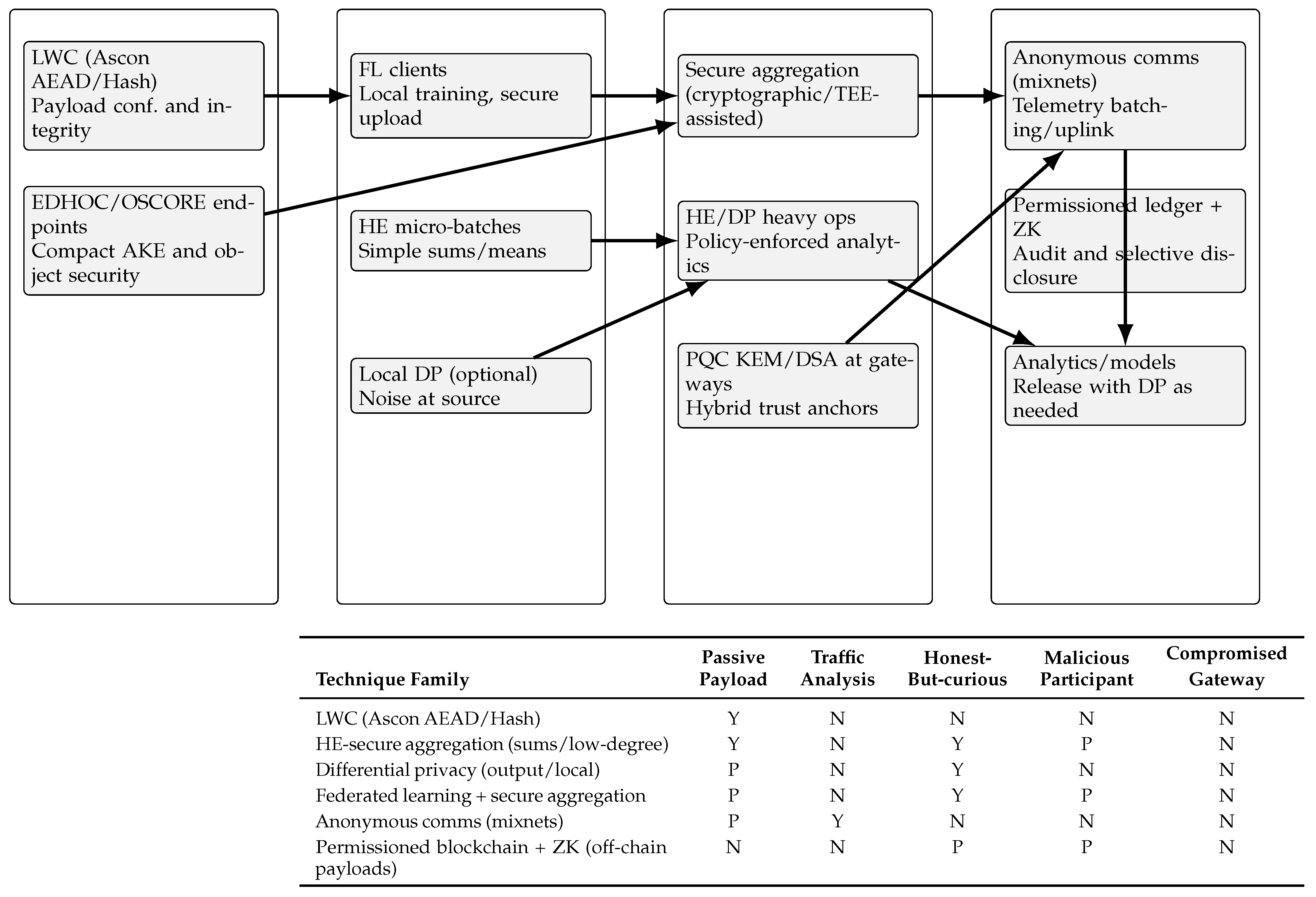
- Adversary classes:
- Passive network eavesdropper (payload) can read packets on one or more links but cannot modify traffic.
- Passive traffic analyst (metadata) observes timing, sizes, endpoints, DNS/flow patterns; attempts linkage and profiling without decrypting payloads.
- Honest-but-curious aggregator follows the protocol but tries to infer per-device values or identities from messages or model updates.
- Malicious participant (Byzantine) deviates from the protocol (e.g., sends crafted updates or malformed aggregates) to degrade privacy or integrity.
- Compromised gateway/edge has full control of a gateway or edge server; can read local memory and keys present on that node.
- Scope assumptions:
5.2. Methodological Criteria
5.3. Qualitative Comparison Across Technique Families
5.4. Latency and Determinism
5.5. Compute/Energy and Footprint
5.6. Privacy Guarantees and Residual Risks
5.7. Deployability, Interoperability, and Governance
5.8. When to Use What: Design Heuristics
- City-scale sensing with periodic uploads: Combine LWC with batching; if metadata privacy is required, consider light mixing on the telemetry uplink with explicit latency budgets [57].
5.9. Summary
6. Emerging Trends and Open Challenges
6.1. Secure Interoperability Across Vendors and Protocols
6.2. Privacy in Federated Learning and Edge AI
6.3. Resilience Against AI-Driven Attacks
6.4. Integration with 6G, Digital Twins, and Metaverse/XR
- Practical readiness of privacy-enhancing technologies:
7. Future Research Directions
7.1. Standardization and Secure Interoperability
- Usage control that travels with data: Combine WoT TD 1.1 metadata with consent/usage schemas aligned to ISO/IEC TS 27560 (consent record information structure), enabling policy evaluation at collection, aggregation, and release time. (See also governance frameworks discussed in Section 2).
- Cross-standard bindings: Formal profiles that bind RATS/EAT claims into WoT TDs and data-space connectors (e.g., IDS) are largely unexplored and would enable privacy-by-design procurement and auditing.
7.2. AI-Driven Adaptive Privacy Mechanisms
- Privacy-aware FL under constraints: Scheduling and secure aggregation tuned to device energy/connectivity while using DP only for external model release to preserve accuracy and battery life [54].
- Policy learning: Reinforcement learning to allocate privacy budgets and select PETs (e.g., HE vs. DP vs. mixnet routing) per context, with safety guards that prevent budget overrun and latency violations.
7.3. Quantum-Safe Cryptography for IIoT
- PQC-on-IoT benchmarks: Open datasets and testbeds comparing PQ KEMs/signatures on common MCU/SoC classes under realistic link MTUs and energy budgets, to guide protocol selections in Smart City backbones [98].
7.4. Privacy-Aware Middleware and Orchestration
- Policy-as-code for IoT: Declarative policies that compose authentication (EDHOC/OSCORE), attestation (RATS/EAT), privacy budgets (DP), and governance (consent/usage) into deployable artifacts across vendors.
- Telemetry minimization: Principled designs for privacy-preserving observability (e.g., DP counters, redacted logs) that still support SLOs and incident response in critical infrastructures.
- Co-design with determinism: Tooling to co-synthesize privacy mechanisms (padding, batching, mixing) with deterministic networking (TSN), so that privacy targets are met without violating latency bounds.
8. Conclusions
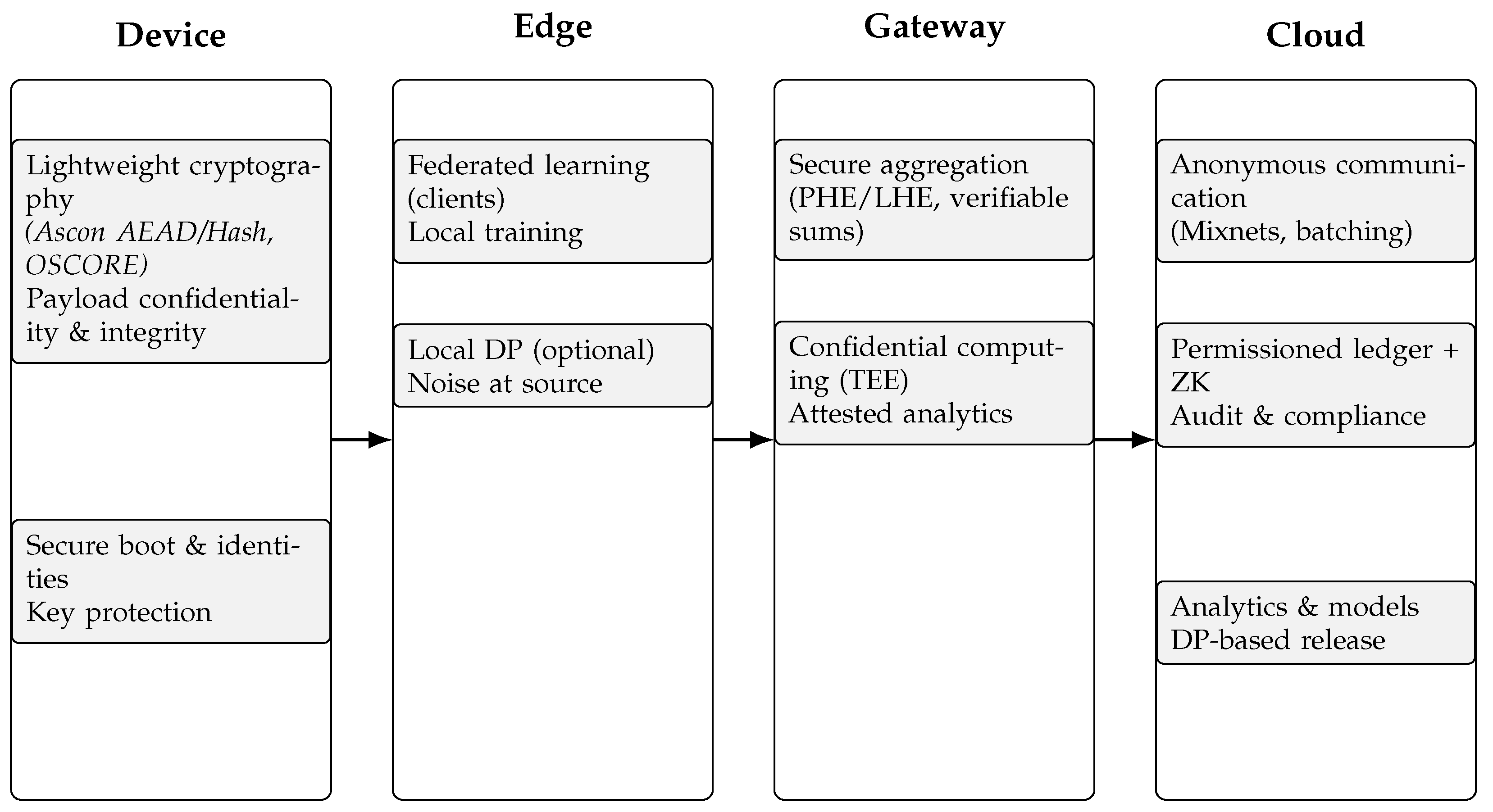
- At the constrained edge, LWC AEAD/Hash primitives provide strong payload confidentiality and integrity with minimal latency and footprint, and pair naturally with compact key exchange on IETF stacks.
- At aggregation and analytics layers, HE- and DP-based mechanisms, as well as FL with secure aggregation, reduce exposure of raw records and bound inference risks when models or statistics are shared across organizational boundaries.
- For metadata privacy, mix networks and related anonymization mechanisms offer robust unlinkability when latency budgets allow, complementing payload encryption.
- For governance and accountability, permissioned ledgers (kept off the data plane) with selective disclosure via privacy-enhancing proofs strengthen audit trails and cross-organization policy enforcement.
9. Limitations
10. Outlook
Funding
Data Availability Statement
Acknowledgments
Conflicts of Interest
Abbreviations
| LWC | Lightweight Cryptography |
| DP | Differential Privacy |
| FL | Federated Learning |
| HE | Homomorphic Encryption |
| PQC | Post-Quantum Cryptography |
| TEE | Trusted Execution Environment |
| TSN | Time-Sensitive Networking |
| IDS | International Data Spaces |
| VC 2.0 | W3C Verifiable Credentials, Version 2.0 |
References
- Kumar, S.; Kumar, D.; Dangi, R.; Choudhary, G.; Dragoni, N.; You, I. A Review of Lightweight Security and Privacy for Resource-Constrained IoT Devices. Comput. Mater. Contin. 2024, 78, 31–63. [Google Scholar] [CrossRef] [Scilit]
- Mathews, R.; Jose, D.V. Hybrid homomorphic-asymmetric lightweight cryptosystem for securing smart devices: A review. Trans. Emerg. Telecommun. Technol. 2024, 35, e4866. [Google Scholar] [CrossRef] [Scilit]
- Hazzaa, F.; Hasan, M.M.; Qashou, A.; Yousef, S. A New Lightweight Cryptosystem for IoT in Smart City Environments. Mesopotamian J. Cybersecur. 2024, 4, 46–58. [Google Scholar] [CrossRef] [Scilit]
- Khalique, A.; Siddiqui, F.; Ahad, M.A.; Hussain, I. Lightweight authentication for IoT devices (LAID) in sustainable smart cities. Sci. Rep. 2025, 15, 25410. [Google Scholar] [CrossRef] [Scilit] [PubMed]
- Dhinakaran, D.; Sankar, S.M.U.; Selvaraj, D.; Raja, S.E. Privacy-Preserving Data in IoT-based Cloud Systems: A Comprehensive Survey with AI Integration. arXiv 2024, arXiv:2401.00794. [Google Scholar] [CrossRef] [Scilit]
- Ali, M.; Suchismita, M.; Ali, S.S.; Choi, B.J. Privacy-Preserving Machine Learning for IoT-Integrated Smart Grids: Recent Advances, Opportunities, and Challenges. Energies 2025, 18, 2515. [Google Scholar] [CrossRef] [Scilit]
- Wei, L.; Liu, Z. Light weight blockchain with IoT devices to secure smart non-fungible tokens using hybrid secure functions. Sci. Rep. 2025, 15, 31633. [Google Scholar] [CrossRef] [Scilit]
- Majeed, A.; Patni, S.; Hwang, S.O. A Comprehensive Analysis of Privacy-Preserving Solutions Developed for IoT-Based Systems and Applications. Electronics 2025, 14, 2106. [Google Scholar] [CrossRef] [Scilit]
- Smajlović, H.; Shajii, A.; Berger, B.; Cho, H.; Numanagić, I. Sequre: A high-performance framework for secure multiparty computation enables biomedical data sharing. Genome Biol. 2023, 24, 5. [Google Scholar] [CrossRef] [Scilit]
- Zhou, I.; Tofigh, F.; Piccardi, M.; Abolhasan, M.; Franklin, D.; Lipman, J. Secure Multi-Party Computation for Machine Learning: A Survey. IEEE Access 2024, 12, 53881–53899. [Google Scholar] [CrossRef] [Scilit]
- Geppert, T.; Deml, S.; Sturzenegger, D.; Ebert, N. Trusted Execution Environments: Applications and Organizational Challenges. Front. Comput. Sci. 2022, 4, 930741. [Google Scholar] [CrossRef] [Scilit]
- Alotaibi, B. A Survey on Industrial Internet of Things Security: Requirements, Attacks, AI-Based Solutions, and Edge Computing Opportunities. Sensors 2023, 23, 7470. [Google Scholar] [CrossRef] [Scilit]
- Joint Task Force on Cybersecurity Education. Security and Privacy Controls for Information Systems and Organizations; NIST Special Publication 800-53, Revision 5; National Institute of Standards and Technology: Gaithersburg, MA, USA, 2020. [Google Scholar] [CrossRef] [Scilit]
- Boeckl, K.; Fagan, M.; Fisher, N.; Lefkovitz, N.; Megas, K.; Nadeau, J.; Ronquillo, D.; Smith, E.; Wald, D. NIST Privacy Framework: A Tool for Improving Privacy Through Enterprise Risk Management, Version 1.0; Technical Report; National Institute of Standards and Technology: Gaithersburg, MA, USA, 2020. [Google Scholar] [CrossRef] [Scilit]
- Al-Huthaifi, R.; Li, T.; Huang, W.; Gu, J.; Li, C. Federated Learning in Smart Cities: Privacy and Security Survey. Inf. Sci. 2023, 632, 833–857. [Google Scholar] [CrossRef] [Scilit]
- European Parliament and the Council of the European Union. Regulation (EU) 2016/679 of the European Parliament and of the Council of 27 April 2016 on the Protection of Natural Persons with Regard to the Processing of Personal Data and on the Free Movement of Such Data, and Repealing Directive 95/46/EC (General Data Protection Regulation). 2016. Available online: https://eur-lex.europa.eu/eli/reg/2016/679/oj/eng (accessed on 2 September 2025).
- European Parliament and the Council of the European Union. Directive (EU) 2022/2555 of the European Parliament and of the Council of 14 December 2022 on Measures for a High Common Level of Cybersecurity Across the Union, Amending Regulation (EU) No 910/2014 and Directive (EU) 2018/1972, and Repealing Directive (EU) 2016/1148 (NIS 2 Directive). 2022. Available online: https://eur-lex.europa.eu/eli/dir/2022/2555/oj/eng (accessed on 2 September 2025).
- European Parliament and the Council of the European Union. Regulation (EU) 2023/2854 of the European Parliament and of the Council of 13 December 2023 on Harmonised Rules on Fair Access to and Use of Data (Data Act). 2023. Available online: https://eur-lex.europa.eu/eli/reg/2023/2854/oj/eng (accessed on 2 September 2025).
- European Parliament and the Council of the European Union. Regulation (EU) 2024/1689 of the European Parliament and of the Council of 13 June 2024 Laying Down Harmonised Rules on Artificial Intelligence (Artificial Intelligence Act). 2024. Available online: https://eur-lex.europa.eu/eli/reg/2024/1689/oj/eng (accessed on 2 September 2025).
- European Telecommunications Standards Institute (ETSI). ETSI EN 303 645 V3.1.3 (2024-09); Cyber Security for Consumer Internet of Things: Baseline Requirements. ETSI: Sophia Antipolis, France, 2024. Available online: https://www.etsi.org/deliver/etsi_en/303600_303699/303645/03.01.03_60/en_303645v030103p.pdf (accessed on 2 September 2025).
- International Organization for Standardization (ISO); International Electrotechnical Commission (IEC). ISO/IEC 27001:2022; Information Security, Cybersecurity and Privacy Protection—Information Security Management Systems—Requirements. ISO: Geneva, Switzerland, 2022. Available online: https://www.iso.org/standard/27001 (accessed on 2 September 2025).
- Peralta Abadía, J.J.; Walther, C.; Osman, A.; Smarsly, K. A systematic survey of Internet of Things frameworks for smart city applications. Sustain. Cities Soc. 2022, 83, 103949. [Google Scholar] [CrossRef] [Scilit]
- Pinto, G.P.; Donta, P.K.; Dustdar, S.; Prazeres, C. A Systematic Review on Privacy-Aware IoT Personal Data Stores. Sensors 2024, 24, 2197. [Google Scholar] [CrossRef] [Scilit]
- OECD. Smart City Data Governance; Technical Report; Organisation for Economic Co-Operation and Development: Paris, France, 2023. [Google Scholar]
- Autoriteit Persoonsgegevens (Dutch DPA). The Dutch Data Protection Authority (DPA) Concerned About Smart Traffic Lights. 2024. Available online: https://www.autoriteitpersoonsgegevens.nl/en/current/the-dutch-data-protection-authority-dpa-concerned-about-smart-traffic-lights (accessed on 2 September 2025).
- Wang, X.; Tang, Z.; Guo, J.; Meng, T.; Wang, C.; Wang, T.; Jia, W. Empowering Edge Intelligence: A Comprehensive Survey on On-Device AI Models. ACM Comput. Surv. 2025, 57, 22. [Google Scholar] [CrossRef] [Scilit]
- Wang, X.; Wang, B.; Wu, Y.; Ning, Z.; Guo, S.; Yu, F.R. A Survey on Trustworthy Edge Intelligence: From Security and Reliability to Transparency and Sustainability. arXiv 2024, arXiv:2310.17944. [Google Scholar] [CrossRef] [Scilit]
- Zhang, T.; Wang, G.; Xue, C.; Wang, J.; Nixon, M.; Han, S. Time-Sensitive Networking (TSN) for Industrial Automation: Current Advances and Future Directions. ACM Comput. Surv. 2024. early access. [Google Scholar] [CrossRef] [Scilit]
- Fedullo, T.; Morato, A.; Tramarin, F.; Rovati, L.; Vitturi, S. A Comprehensive Review on Time Sensitive Networks with a Special Focus on Its Applicability to Industrial Smart and Distributed Measurement Systems. Sensors 2022, 22, 1638. [Google Scholar] [CrossRef] [Scilit] [PubMed]
- Institute of Electrical and Electronics Engineers (IEEE). IEEE 802.1 Time-Sensitive Networking (TSN) Task Group; IEEE: Piscataway, NJ, USA, 2025; Available online: https://1.ieee802.org/tsn/ (accessed on 2 September 2025).
- International Electrotechnical Commission (IEC); Institute of Electrical and Electronics Engineers (IEEE). IEC/IEEE 60802 Joint Project: TSN Profile for Industrial Automation; IEC: Geneva, Switzerland; IEEE: Piscataway, NJ, USA, 2025; Available online: https://1.ieee802.org/tsn/iec-ieee-60802/ (accessed on 2 September 2025).
- Moure-Garrido, N.; Casillas-Pérez, D.; Ortego, J.; Vázquez-Gallego, F. Reducing DNS Traffic to Enhance Home IoT Device Privacy. Sensors 2024, 24, 2690. [Google Scholar] [CrossRef] [Scilit]
- Sasi, T.; Lashkari, A.H.; Lu, R.; Xiong, P.; Iqbal, S. A Comprehensive Survey on IoT Attacks: Taxonomy, Detection Mechanisms and Challenges. J. Inf. Intell. 2024, 2, 455–513. [Google Scholar] [CrossRef] [Scilit]
- European Union Agency for Cybersecurity (ENISA). ENISA Threat Landscape 2024; Technical Report; ENISA: Athens, Greece, 2024. [Google Scholar]
- Niu, J.; Liu, P.; Zhu, X.; Shen, K.; Wang, Y.; Chi, H.; Shen, Y.; Jiang, X.; Ma, J.; Zhang, Y. A Survey on Membership Inference Attacks and Defenses in Machine Learning. J. Inf. Intell. 2024, 2, 404–454. [Google Scholar] [CrossRef] [Scilit]
- Turan, M.S.; McKay, K.A.; Chang, D.; Bassham, L.E.; Kang, J.; Waller, N.D.; Kelsey, J.M.; Hong, D. Status Report on the Final Round of the NIST Lightweight Cryptography Standardization Process; NIST Interagency or Internal Report NIST IR 8454; National Institute of Standards and Technology: Gaithersburg, MD, USA, 2023. [Google Scholar] [CrossRef] [Scilit]
- Madushan, H.; Salam, I.; Alawatugoda, J. A Review of the NIST Lightweight Cryptography Finalists and Their Fault Analyses. Electronics 2022, 11, 4199. [Google Scholar] [CrossRef] [Scilit]
- Soto-Cruz, J.; Ruiz-Ibarra, E.; Vázquez-Castillo, J.; Espinoza-Ruiz, A.; Castillo-Atoche, A.; Mass-Sanchez, J. A Survey of Efficient Lightweight Cryptography for Power-Constrained Microcontrollers. Technologies 2025, 13, 3. [Google Scholar] [CrossRef] [Scilit]
- Sönmez Turan, M.; McKay, K.; Kang, J.; Kelsey, J.; Chang, D. Ascon-Based Lightweight Cryptography Standards for Constrained Devices: Authenticated Encryption, Hash, and Extendable Output Functions; NIST Special Publication 800-232; National Institute of Standards and Technology: Gaithersburg, MD, USA, 2025. [Google Scholar] [CrossRef] [Scilit]
- National Institute of Standards and Technology (NIST). NIST Finalizes “Lightweight Cryptography” Standard to Protect Small Devices; National Institute of Standards and Technology: Gaithersburg, MD, USA, 2025. Available online: https://www.nist.gov/news-events/news/2025/xx/nist-finalizes-lightweight-cryptography-standard (accessed on 2 September 2025).
- National Institute of Standards and Technology (NIST). NIST Selects “Lightweight Cryptography” Algorithms to Protect Small Devices; National Institute of Standards and Technology: Gaithersburg, MD, USA, 2023. Available online: https://www.nist.gov/news-events/news/2023/xx/nist-selects-lightweight-cryptography-algorithms-protect-small-devices (accessed on 2 September 2025).
- McKay, K.; National Institute of Standards and Technology (NIST). Benchmarking of NIST LWC Finalists on Microcontrollers; National Institute of Standards and Technology: Gaithersburg, MD, USA, 2023. [CrossRef]
- Selander, G.; Mattsson, J.P.; Palombini, F. RFC 9528: Ephemeral Diffie-Hellman Over COSE (EDHOC); Internet Engineering Task Force (IETF): Fremont, CA, USA, 2024. [Google Scholar] [CrossRef] [Scilit]
- National Institute of Standards and Technology (NIST). Module-Lattice-Based Key-Encapsulation Mechanism Standard (ML-KEM); Federal Information Processing Standards Publication FIPS 203; National Institute of Standards and Technology: Gaithersburg, MD, USA, 2024. [CrossRef] [Scilit]
- National Institute of Standards and Technology (NIST). Module-Lattice-Based Digital Signature Standard (ML-DSA); Federal Information Processing Standards Publication FIPS 204; National Institute of Standards and Technology: Gaithersburg, MD, USA, 2024. [CrossRef] [Scilit]
- Zhou, F.; Wang, X.; Zhang, W. Privacy-Preserving and Verifiable Data Aggregation for Internet of Vehicles. Comput. Netw. 2024, 241, 110055. [Google Scholar] [CrossRef] [Scilit]
- Zhang, J.; Li, X.; Chen, Y.; Wang, J. A Lightweight Privacy-Preserving Data Aggregation Scheme Against Malicious Aggregators for IoT. J. King Saud Univ. Comput. Inf. Sci. 2023, 35, 105180. [Google Scholar] [CrossRef] [Scilit]
- Loukil, F.; Ghedira-Guegan, C.; Boukadi, K.; Benharkat, A. Privacy-Preserving IoT Data Aggregation Based on Blockchain and Homomorphic Encryption. Sensors 2021, 21, 2452. [Google Scholar] [CrossRef] [Scilit] [PubMed]
- Aziz, R.; Aljarah, I.; Abdullah, S.; Faris, H. Exploring Homomorphic Encryption and Differential Privacy in Federated Learning: A Survey. Future Internet 2023, 15, 310. [Google Scholar] [CrossRef] [Scilit]
- Tayyeh, H.K.; Hammoudeh, M.; Ould, S.M. A Differential Privacy Approach in Federated Learning. Computers 2024, 13, 277. [Google Scholar] [CrossRef] [Scilit]
- Zheng, L.; Zhang, Q.; Li, W.; Chen, H. Sensitivity-Aware Differential Privacy for Federated Medical Imaging. Sensors 2025, 25, 2847. [Google Scholar] [CrossRef] [Scilit]
- Dritsas, E.; Trigka, M. Federated Learning for IoT: A Survey of Techniques, Challenges, and Applications. IoT 2025, 14, 9. [Google Scholar] [CrossRef] [Scilit]
- Zhang, X.; Sun, K.; Liu, Q. A Review of Research on Secure Aggregation for Privacy-Preserving Federated Learning. Future Internet 2025, 17, 308. [Google Scholar] [CrossRef] [Scilit]
- Zhao, J.; Bagchi, S.; Avestimehr, S.; Chan, K.; Chaterji, S.; Dimitriadis, D.; Li, J.; Nourian, A.; Roth, H. A Survey of Federated Learning Privacy Attacks, Defenses, Applications, and Policy Landscape. ACM Comput. Surv. 2025, 57, 230. [Google Scholar] [CrossRef] [Scilit]
- Shi, R.; Liu, Y.; Zhang, C.; Li, W. More Efficient and Verifiable Privacy-Preserving Aggregation for Federated Learning. Appl. Sci. 2024, 14, 5361. [Google Scholar] [CrossRef] [Scilit]
- de Laage, R.; Yuhala, P.; Wicht, F.X.; Felber, P.; Cachin, C.; Schiavoni, V. Practical Secure Aggregation by Combining Cryptography and Trusted Execution Environments. In Proceedings of the 19th ACM International Conference on Distributed and Event-Based Systems, Gothenburg, Sweden, 10–13 June 2025. [Google Scholar] [CrossRef] [Scilit]
- Oldenburg, L.; Juarez, M.; Rúa, E.A.; Diaz, C. MixMatch: Flow Matching for Mixnet Traffic. Proc. Priv. Enhancing Technol. 2024, 2024, 276–294. [Google Scholar] [CrossRef] [Scilit]
- Das, D.; Diaz, C.; Kiayias, A.; Zacharias, T. Are Continuous Stop-and-Go Mixnets Provably Secure? Proc. Priv. Enhancing Technol. 2024, 2024, 665–683. [Google Scholar] [CrossRef] [Scilit]
- Rahimi, M. CLAM: Client-Aware Routing in Mix Networks. In Proceedings of the 2024 ACM Workshop on Information Hiding and Multimedia Security, Baiona, Spain, 24–26 June 2024. [Google Scholar] [CrossRef] [Scilit]
- Benarous, L.; Zeadally, S.; Boudjit, S.; Mellouk, A. A Review of Pseudonym Change Strategies for Location Privacy in Vehicular Networks. ACM Comput. Surv. 2025, 57, 204. [Google Scholar] [CrossRef] [Scilit]
- Sutradhar, K.; Das, A.; Khan, M.N.; Shivam, P.; Khandelwal, P. A Survey on Privacy-Preserving Authentication Protocols for Vehicular Networks. Comput. Netw. 2024, 240, 110001. [Google Scholar] [CrossRef] [Scilit]
- Tao, Y.; Wu, H.; Javanmardi, E.; Tsukada, M.; Esaki, H. Zero-Knowledge Proof of Distinct Identity for Sybil-Resistant Pseudonyms in C-ITS. arXiv 2024, arXiv:2403.14020. [Google Scholar]
- Khan, I.; Majib, Y.; Ullah, R.; Rana, O. Blockchain Applications for Internet of Things—A Survey. Array 2024, 27, 101254. [Google Scholar] [CrossRef] [Scilit]
- Mathur, S.; Kalla, A.; Gür, G.; Bohra, M.K.; Liyanage, M. A Survey on the Role of Blockchain for IoT: Applications and Challenges. Comput. Netw. 2023, 225, 109518. [Google Scholar] [CrossRef] [Scilit]
- Enaya, A.; Fernando, X.; Kashef, R. Survey of Blockchain-Based Applications for IoT. Appl. Sci. 2025, 15, 4562. [Google Scholar] [CrossRef] [Scilit]
- Hu, T.; Yang, S.; Wang, Y.; Li, G.; Wang, Y.; Wang, G.; Yin, M. A Blockchain-Based Access Control Framework for Secure IoT Data Management. Sensors 2023, 23, 8535. [Google Scholar] [CrossRef] [Scilit]
- Zhou, L.; Diro, A.; Saini, A.; Kaisar, S.; Hiep, P.C. Leveraging Zero Knowledge Proofs for Blockchain-Based Identity Sharing: A Survey of Advancements, Challenges and Opportunities. J. Inf. Secur. Appl. 2024, 80, 103678. [Google Scholar] [CrossRef] [Scilit]
- Roelink, B.O.; El-Hajj, M.; Sarmah, D. Promise of Zero-Knowledge Proofs (ZKPs) for Blockchain Systems. Secur. Priv. 2024, 7, e461. [Google Scholar] [CrossRef] [Scilit]
- Qi, M.; Wang, Z.; Han, Q.L.; Zhang, J.; Chen, S.; Xiang, Y. Privacy Protection for Blockchain-Based Healthcare IoT Systems: A Survey. IEEE/CAA J. Autom. Sin. 2024, 11, 1143–1163. [Google Scholar] [CrossRef] [Scilit]
- OPC Foundation. OPC UA: Interoperability for Industrie 4.0 and IoT; OPC Foundation: Scottsdale, AZ, USA, 2023. [Google Scholar]
- oneM2M Partnership Project. oneM2M: IoT Standards for Interoperable and Secure Services. 2025. Available online: https://www.onem2m.org (accessed on 2 September 2025).
- International Society of Automation (ISA); International Electrotechnical Commission (IEC). ISA/IEC 62443; Series of Standards for Industrial Automation and Control Systems Security. International Society of Automation (ISA): Research Triangle Park, NC, USA, 2025. Available online: https://www.iec.ch/dyn/www/f?p=103:85:0::::FSP_LANG_ID:25 (accessed on 2 September 2025).
- International Data Spaces Association (IDSA). IDS Reference Architecture Model (IDS-RAM), Version 4.0; International Data Spaces Association: Dortmund, Germany, 2022; Available online: https://internationaldataspaces.org/publications/ids-reference-architecture-model/ (accessed on 2 September 2025).
- International Data Spaces Association (IDSA). Understanding the IDS Reference Architecture Model. 2024. Available online: https://internationaldataspaces.org/understanding-the-idsa-reference-architecture-model/ (accessed on 2 September 2025).
- World Wide Web Consortium (W3C). Verifiable Credentials Data Model v2.0. 2025. Available online: https://www.w3.org/TR/vc-data-model-2.0/ (accessed on 2 September 2025).
- Li, Y.; Xie, B.; Guo, S.; Yang, Y.; Xiao, B. A Survey of Robustness and Safety of 2D and 3D Deep Learning Models against Adversarial Attacks. ACM Comput. Surv. 2024, 56, 138. [Google Scholar] [CrossRef] [Scilit]
- Liu, B.; Lv, N.; Guo, Y.; Li, Y. Recent advances on federated learning: A systematic survey. Neurocomputing 2024, 597, 128019. [Google Scholar] [CrossRef] [Scilit]
- Feng, D.; Qin, Y.; Feng, W.; Li, W.; Shang, K.; Ma, H. Survey of Research on Confidential Computing. IET Commun. 2024, 18, 1405–1428. [Google Scholar] [CrossRef] [Scilit]
- Sabt, M.; Achemlal, M.; Bouabdallah, A. Trusted Execution Environment: What It Is, and What It Is Not. In Proceedings of the 2015 IEEE Trustcom/BigDataSE/ISPA, Helsinki, Finland, 20–22 August 2015. [Google Scholar] [CrossRef] [Scilit]
- Wang, Q.; Oswald, D. Confidential Computing on Heterogeneous CPU-GPU Systems. arXiv 2024, arXiv:2408.11601. [Google Scholar]
- Addula, S.R.; Meesala, M.K.; Ravipati, P.; Sajja, G.S. A Hybrid Autoencoder and Gated Recurrent Unit Model Optimized by Honey Badger Algorithm for Enhanced Cyber Threat Detection in IoT Networks. Secur. Priv. 2025, 8, e70086. [Google Scholar] [CrossRef] [Scilit]
- Vassilev, A.; Oprea, A.; Fordyce, A.; Anderson, H. Adversarial Machine Learning: A Taxonomy and Terminology; NIST AI Technical Report AI 100-2e202; National Institute of Standards and Technology: Gaithersburg, MD, USA, 2025. [Google Scholar]
- Mao, B.; Liu, J.; Wu, Y.; Kato, N. Security and Privacy on 6G Network Edge: A Survey. IEEE Commun. Surv. Tutor. 2023, 25, 1095–1127. [Google Scholar] [CrossRef] [Scilit]
- Ferrag, M.A.; Friha, O.; Kantarci, B.; Tihanyi, N.; Cordeiro, L.; Debbah, M.; Hamouda, D.; Al-Hawawreh, M.; Choo, K.K.R. Edge Learning for 6G-enabled Internet of Things: A Comprehensive Survey of Vulnerabilities, Datasets, and Defenses. arXiv 2023, arXiv:2306.10309. [Google Scholar] [CrossRef] [Scilit]
- Qureshi, A.R.; Asensio, A.; Imran, M.; Garcia, J.; Masip-Bruin, X. A Survey on Security-Enhancing Digital Twins: Models, applications and tools. Comput. Commun. 2025, 238, 108158. [Google Scholar] [CrossRef] [Scilit]
- Odeh, J.O.; Yang, X. Industrial-Internet-of-Things-Based Digital Twin and Cybersecurity. IT Prof. 2024, 26, 14–23. [Google Scholar] [CrossRef] [Scilit]
- Wang, Y.; Su, Z.; Zhang, N.; Xing, R.; Liu, D.; Luan, T.H.; Shen, X. A Survey on Metaverse: Fundamentals, Security, and Privacy. IEEE Commun. Surv. Tutor. 2023, 25, 2337–2371. [Google Scholar] [CrossRef] [Scilit]
- Garrido, G.M.; Nair, V.; Song, D. SoK: Data Privacy in Virtual Reality. Proc. Priv. Enhancing Technol. 2024, 2024, 21–40. [Google Scholar] [CrossRef] [Scilit]
- Birkholz, H.; Thaler, D.; Richardson, M.; Smith, N.; Moran, B.; Eckel, M. RFC 9334: Remote Attestation Procedures (RATS) Architecture; Internet Engineering Task Force (IETF): Fremont, CA, USA, 2023. [Google Scholar] [CrossRef] [Scilit]
- Lundblade, L.; Mandyam, G.; O’Donoghue, J.; Wallace, C. RFC 9711: The Entity Attestation Token (EAT); Internet Engineering Task Force (IETF): Fremont, CA, USA, 2025. [Google Scholar] [CrossRef] [Scilit]
- Pan, K.; Ong, Y.S.; Gong, M.; Li, H.; Qin, A.K.; Gao, Y. Differential Privacy in Deep Learning: A Literature Survey. Neurocomputing 2024, 589, 127663. [Google Scholar] [CrossRef] [Scilit]
- Demelius, L.; Kern, R.; Trügler, A. Recent Advances of Differential Privacy in Centralized Deep Learning: A Survey. ACM Comput. Surv. 2025, 57, 158. [Google Scholar] [CrossRef] [Scilit]
- Wang, Y.; Liu, Y.; Chen, X. Scenario-based Adaptations of Differential Privacy: A Survey. ACM Comput. Surv. 2024, 56, 199. [Google Scholar] [CrossRef] [Scilit]
- Newhouse, W.; Souppaya, M.; Barker, W.; Brown, C.; Kampanakis, P.; Goodman, J.; Prat, J.; Gray, J.; Ounsworth, M.; Viana, C.; et al. SP 1800-38B: Migration to Post-Quantum Cryptography—Quantum Readiness: Cryptographic Discovery; Technical Report; National Institute of Standards and Technology, National Cybersecurity Center of Excellence (NCCoE): Gaithersburg, MD, USA, 2023. Available online: https://www.nccoe.nist.gov/projects/migration-post-quantum-cryptography (accessed on 2 September 2025).
- Newhouse, W.; Souppaya, M.; Barker, W.; Brown, C.; Kampanakis, P.; Manzano, M.; McGrew, D.; Dames, A.; Soukharev, V.; Lafrance, P.; et al. SP 1800-38C: Migration to Post-Quantum Cryptography—Approaches for Discovery and Remediation; Technical Report; National Institute of Standards and Technology, National Cybersecurity Center of Excellence (NCCoE): Gaithersburg, MD, USA, 2023. Available online: https://www.nccoe.nist.gov/projects/migration-post-quantum-cryptography (accessed on 2 September 2025).
- National Security Agency (NSA). NSA Releases Future Quantum-Resistant Algorithm Requirements for National Security Systems (CNSA 2.0); National Security Agency: Fort Meade, MD, USA, 2022. Available online: https://www.nsa.gov/Press-Room/Press-Releases-Statements/Press-Release-View/Article/xxxx/ (accessed on 2 September 2025).
- National Security Agency (NSA). Commercial National Security Algorithm Suite 2.0 (CNSA 2.0): Algorithms and Guidance; National Security Agency: Fort Meade, MD, USA, 2025. Available online: https://www.nsa.gov/Press-Room/Press-Releases-Statements/ (accessed on 2 September 2025).
- Liu, T.; Ramachandran, G.; Jurdak, R. Post-Quantum Cryptography for Internet of Things: A Survey. arXiv 2024, arXiv:2401.17538. [Google Scholar] [CrossRef] [Scilit]


| Challenge | Primary Causes | Examples of Typical Privacy Risks |
|---|---|---|
| Heterogeneity and interoperability | Multi-vendor stacks; divergent schemas; cross-agency data sharing | Policy drift; inconsistent consent/retention; cross-dataset linkage [22,24] |
| Resource constraints | Low-power MCUs; limited RAM/flash; bandwidth caps | Weakened crypto/padding; coarse-grained access; stale keys [12] |
| Real-time determinism | Tight latency/jitter bounds; TSN schedules | Infeasible mixing/padding; timing side effects; safety regressions [28,29,31] |
| Side-channel inference | Distinctive DNS/flow patterns; traffic rate fingerprints | Device/behavior identification; targeted exploits [32] |
| Data aggregation and linkage | Mobility, utility, service logs combined at scale | Re-identification; trajectory and profile reconstruction [23,24] |
| Adversarial/AI-driven threats | IoT botnets; supply chain; ML privacy attacks | 6.1 cm mass surveillance via compromised endpoints; MIA/model leakage [33,34,35] |
| Technique Family | Passive Payload | Traffic Analysis | Honest- But-Curious | Malicious Participant | Compromised Gateway | Typical Residual Risks |
|---|---|---|---|---|---|---|
| Lightweight cryptography (Ascon AEAD/Hash) | Y | N | N | N | N | Metadata leakage (flows, DNS, timing), key theft on nodes without hardening, misconfigurations (nonce reuse) |
| HE/secure aggregation (sums, low-degree) | Y | N | Y | P | N | Metadata leakage unless combined with padding/mixing; limited function classes; aggregator compromise if not verifiable |
| Differential privacy (output/local) | P | N | Y | N | N | Utility loss vs. privacy budget; composition across releases; local DP depends on client honesty and calibration |
| Federated learning + secure aggregation | P | N | Y | P | N | Model leakage (membership/inversion) without DP; poisoning/backdoors by malicious clients; dropouts/stragglers |
| Anonymous communication (mix networks) | P | Y | N | N | N | Added latency and bandwidth (cover traffic); global observers may still infer under misconfiguration or low load |
| Permissioned blockchain + ZK (off-chain payloads) | N | N | P | P | N | Throughput/storage overhead; key management; privacy of off-chain stores; correlation via access patterns |
| Technique Family | Latency Overhead | Compute/ Energy | Bandwidth Overhead | Privacy Strength | Typical Fit |
|---|---|---|---|---|---|
| Lightweight cryptography (Ascon AEAD/Hash) | L | L | L | Payload confidentiality/integrity (medium vs. traffic analysis) | Constrained sensors/actuators; TSN-aware deployments [28,36,37,42] |
| HE-based secure aggregation (additive/leveled) | M | M–H | M | Strong on-value privacy; metadata exposed unless combined with PETs | Gateway-side aggregation; micro-batch analytics [47,48,49] |
| Differential privacy (output or local) | L–M | L–M | L | Formal bounds on individual leakage; depends on budget and composition | Release of statistics/models; cross-agency sharing [49,51] |
| Federated learning + secure aggregation | M | M | M | Limits raw-data exposure; residual model leakage without DP | On-device/edge training with aggregator trust minimization [52,53,55] |
| Anonymous communication (mixnets) | M–H | M | H | Strong metadata privacy; configurable latency | Telemetry batching, alerting where delay is tolerable [57,58,59] |
| Permissioned blockchain + ZK | M | M | M | Auditability, integrity, selective disclosure; keys/throughput are bottlenecks | Cross-organization access control and compliance logging [63,64,67,68] |
Disclaimer/Publisher’s Note: The statements, opinions and data contained in all publications are solely those of the individual author(s) and contributor(s) and not of MDPI and/or the editor(s). MDPI and/or the editor(s) disclaim responsibility for any injury to people or property resulting from any ideas, methods, instructions or products referred to in the content. |
© 2026 by the author. Licensee MDPI, Basel, Switzerland. This article is an open access article distributed under the terms and conditions of the Creative Commons Attribution (CC BY) license.
Share and Cite
Reis, M.J.C.d.S. Privacy-Preserving Protocols in Smart Cities and Industrial IoT: Challenges, Trends, and Future Directions. Electronics 2026, 15, 399. https://doi.org/10.3390/electronics15020399
Reis MJCdS. Privacy-Preserving Protocols in Smart Cities and Industrial IoT: Challenges, Trends, and Future Directions. Electronics. 2026; 15(2):399. https://doi.org/10.3390/electronics15020399
Chicago/Turabian StyleReis, Manuel José Cabral dos Santos. 2026. "Privacy-Preserving Protocols in Smart Cities and Industrial IoT: Challenges, Trends, and Future Directions" Electronics 15, no. 2: 399. https://doi.org/10.3390/electronics15020399
APA StyleReis, M. J. C. d. S. (2026). Privacy-Preserving Protocols in Smart Cities and Industrial IoT: Challenges, Trends, and Future Directions. Electronics, 15(2), 399. https://doi.org/10.3390/electronics15020399