Article

Resilience-Oriented Energy Management of Networked Microgrids: A Case Study from Lombok, Indonesia

by
Mahshid Javidsharifi
1,*,
Hamoun Pourroshanfekr Arabani
2,
Najmeh Bazmohammadi
1,
Juan C. Vasquez
1 and
Josep M. Guerrero
1,3
1
Center for Research on Microgrids (CROM), AAU Energy, Aalborg University, 9220 Aalborg, Denmark
2
Division of Industrial Electrical Engineering & Automation, Lund University, 221 00 Lund, Sweden
3
Department of Electrical Engineering, Valladolid University, 47011 Valladolid, Spain
*
Author to whom correspondence should be addressed.
Electronics 2026, 15(2), 387; https://doi.org/10.3390/electronics15020387
Submission received: 3 December 2025 / Revised: 8 January 2026 / Accepted: 14 January 2026 / Published: 15 January 2026

Abstract

Building resilient and sustainable energy systems is a critical challenge for disaster-prone regions in the Global South. This study investigates the energy management of a networked microgrid (NMG) system on Lombok Island, Indonesia, a region frequently exposed to natural disasters (NDs) and characterized by vulnerable grid infrastructure. A multi-objective optimization framework is developed to jointly minimize operational costs, load-not-served, and environmental impacts under both normal and abnormal operating conditions. The proposed strategy employs the Multi-objective JAYA (MJAYA) algorithm to coordinate photovoltaic generation, diesel generators, battery energy storage systems, and inter-microgrid power exchanges within a 20 kV distribution network. Using real load, generation, and electricity price data, we evaluate the NMG’s performance under five representative fault scenarios that emulate ND-induced outages, including grid disconnection and loss of inter-microgrid links. Results show that the interconnected NMG structure significantly enhances system resilience, reducing load-not-served from 366.3 kWh in fully isolated operation to only 31.7 kWh when interconnections remain intact. These findings highlight the critical role of cooperative microgrid networks in strengthening community-level energy resilience in vulnerable regions. The proposed framework offers a practical decision-support tool for planners and governments seeking to enhance energy security and advance sustainable development in disaster-affected areas.

1. Introduction

The continuous growth in global energy consumption and increasing concerns about environmental impact have accelerated the transition toward sustainable energy systems. As a result, renewable-based distributed energy resources (DERs) are being rapidly deployed worldwide [1,2]. In this context, microgrids (MGs) have emerged as a promising solution, offering localized energy generation, distribution, and control capabilities [3,4]. MGs enable improved energy access, particularly in remote and underserved regions, while supporting economic, social, and environmental objectives [5]. By aggregating DERs, energy storage systems (ESSs), and loads at the distribution level, MGs enhance system reliability, sustainability, and cost-effectiveness [6,7].
Building upon single MG concepts, networked microgrids (NMGs) have gained increasing attention as an evolution of decentralized power systems. NMGs interconnect multiple MGs to enable energy sharing, coordinated operation, and mutual support during disturbances [8,9]. By integrating renewable energy sources (RESs), ESSs, and flexible loads, NMGs enhance operational efficiency, reliability, and resilience under diverse operating conditions. Their ability to support peer-to-peer energy exchange and adapt to dynamic demand patterns positions NMGs as a key component of future resilient and sustainable energy infrastructures [8,9].
Effective coordination of DERs within NMGs requires advanced energy management systems (EMSs) capable of handling multiple objectives and operational constraints [10,11,12,13,14]. EMSs play a central role in scheduling generation, storage, and power exchanges to achieve economic and environmental goals. These challenges become particularly critical during abnormal operating conditions, such as natural disasters (NDs), when grid disruptions and limited generation capacity threaten supply continuity. Under such conditions, EMSs must allocate available resources efficiently to maintain system stability, resilience, and reliability while prioritizing critical loads [15,16,17,18].
A substantial body of literature has investigated optimal energy management of NMGs under normal operating conditions. Prior studies have explored chance-constrained formulations [19,20,21], stochastic and cooperative game-based approaches [22,23,24,25,26,27,28,29], and multi-objective optimization frameworks [30,31]. These works address various aspects such as cost minimization, emissions reduction, bidding strategies, and energy trading. However, many of these studies either neglect uncertainties, overlook environmental objectives, or do not consider energy not served (ENS) as a performance metric. More importantly, most of these approaches focus on normal operation and do not explicitly address system behavior under disaster-induced disruptions.
To address uncertainties in RES generation, load demand, and market prices, several studies have proposed stochastic and robust optimization frameworks [32,33,34,35,36]. Other works incorporate mobile ESSs, electric vehicles (EVs), and transactive energy mechanisms to enhance operational flexibility [37,38,39,40,41]. While these approaches improve system performance under uncertainty, they primarily focus on economic optimization during normal operation and do not explicitly evaluate system resilience or performance degradation under abnormal conditions.
More recently, deep reinforcement learning (DRL) methods have been applied to MG energy management, particularly for real-time or online control under uncertainty [42,43,44,45]. Despite their adaptability, DRL-based methods typically require extensive training, rely on carefully designed reward functions, and lack guarantees on feasibility and optimality under strict operational constraints. Consequently, while DRL approaches are promising for real-time adaptive control, optimization-based methods remain more suitable for offline, scenario-based resilience assessment and planning-oriented studies, which is the focus of this work.
Resilience in MGs refers to the ability of the system to withstand, adapt to, and recover from disruptions such as NDs, equipment failures, and cyber-attacks [46,47]. Various resilience-enhancement strategies have been proposed, including self-healing algorithms [48], fault detection [49] and isolation techniques [50], and adaptive control mechanisms [51]. While resilience-oriented operational strategies have been widely studied for single MGs [48,49,50,51], extending these concepts to NMGs introduces additional complexity due to interdependencies among MGs [41,52,53].
Recent studies on NMG resilience have investigated risk-based scheduling [54], uncertainty-aware coordination [55], and resilience metrics [56,57]. These works demonstrate the resilience benefits of interconnected MG operation but often neglect environmental objectives, demand response (DR) strategies, or coordinated energy management under multi-objective settings.
Many disaster-prone regions, particularly in the Global South, face growing challenges in ensuring a reliable and sustainable electricity supply due to vulnerable grid infrastructure and frequent NDs [58,59]. Although MGs and NMGs offer promising solutions for improving energy access and resilience, existing studies often focus on isolated MG operation or real-time control and do not sufficiently quantify the resilience benefits of coordinated NMG operation under disaster-induced disruptions.
Motivated by this gap, this study develops a resilience-oriented, multi-objective, scenario-based energy management framework for NMGs to systematically assess how coordinated operation among interconnected MGs enhances load-serving capability, reduces ENS, and improves sustainability under both normal and abnormal operating conditions. Lombok Island, Indonesia, is selected as a representative case study due to its high exposure to NDs and persistent energy access challenges.
The proposed framework formulates the NMG energy management problem as a multi-objective optimization that minimizes operational cost, environmental impact, and load-not-served, and is solved using the Multi-objective JAYA (MJAYA) algorithm, a parameter-free and computationally efficient approach suitable for offline, scenario-based resilience assessment [60]. The framework explicitly coordinates distributed energy resources, energy storage systems, and inter-MG power exchanges and is evaluated under a set of realistic disruption scenarios that emulate ND-induced outages. The results provide new insights into the resilience benefits of cooperative multi-MG structures in disaster-prone regions.
This study makes several key contributions to the advancement of resilient, community-centered energy systems in disaster-prone regions. The novelty of the work emerges from its integrated consideration of NMG operation, multi-objective resilience optimization, and real-world disruptions representative of NDs, all within a developing-region context. The main contributions are summarized as follows:
  • This study introduces a multi-objective, resilience-oriented energy management framework for NMGs that jointly minimizes operational cost, environmental impact, and load-not-served while explicitly incorporating resilience considerations essential under disaster-induced disruptions.
  • The research incorporates a realistic multi-scenario representation of ND impacts by evaluating five abnormal-operation cases, including loss of the main grid and different patterns of inter-MG disconnection, thereby capturing the spatially uneven and cascading nature of such disruptions more accurately than conventional islanding models.
  • The study applies the parameter-free MJAYA algorithm to coordinated NMG scheduling under both normal and abnormal conditions, offering a novel methodological contribution to resilience-focused multi-MG optimization.
  • The analysis provides one of the first detailed resilience assessments of a real NMG system on Lombok Island, Indonesia, using actual load profiles, renewable generation data, and local electricity prices to generate context-specific insights for disaster-prone regions.
  • The results quantify the resilience benefits of inter-MG cooperation, demonstrating that maintaining connectivity among MGs reduces load-not-served from 366.3 kWh in fully isolated operation to 31.7 kWh under coordinated operation, thereby highlighting the tangible value of NMG structures.
  • The proposed framework functions as a practical decision-support tool for policymakers and energy planners by offering scenario-based evaluations that inform the design of resilient MG networks and support sustainable energy development in regions facing climate-induced disruptions.
The rest of this paper is organized as follows: Section 2 explores the energy management of NMGs, detailing the system structure and problem formulation. Section 3 introduces the MJAYA algorithm and the structure for solving the NMG energy management problem. Simulation results are presented in Section 4. Finally, conclusions are drawn in Section 5.

2. Energy Management of Networked Microgrids (NMGs)

2.1. System Structure

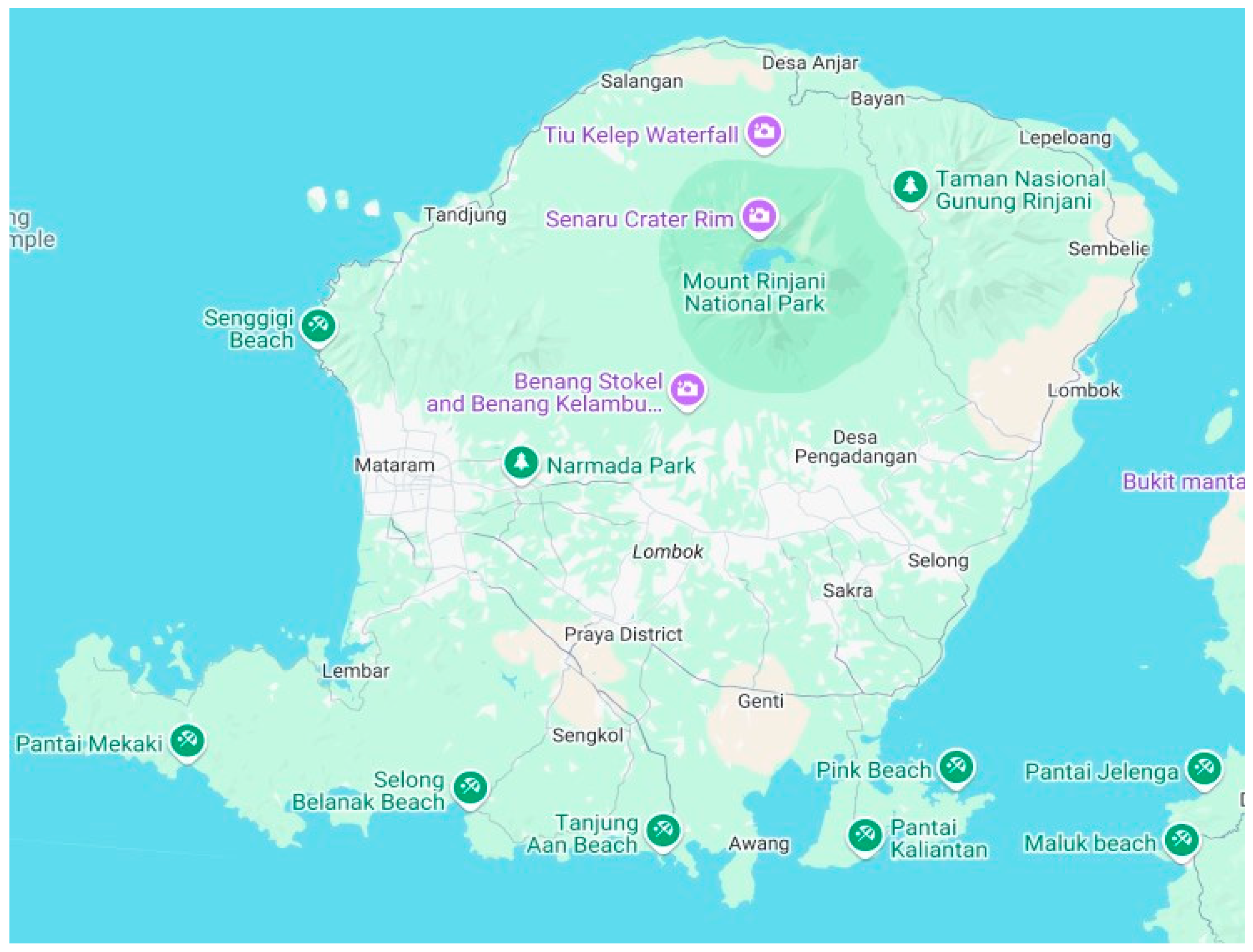
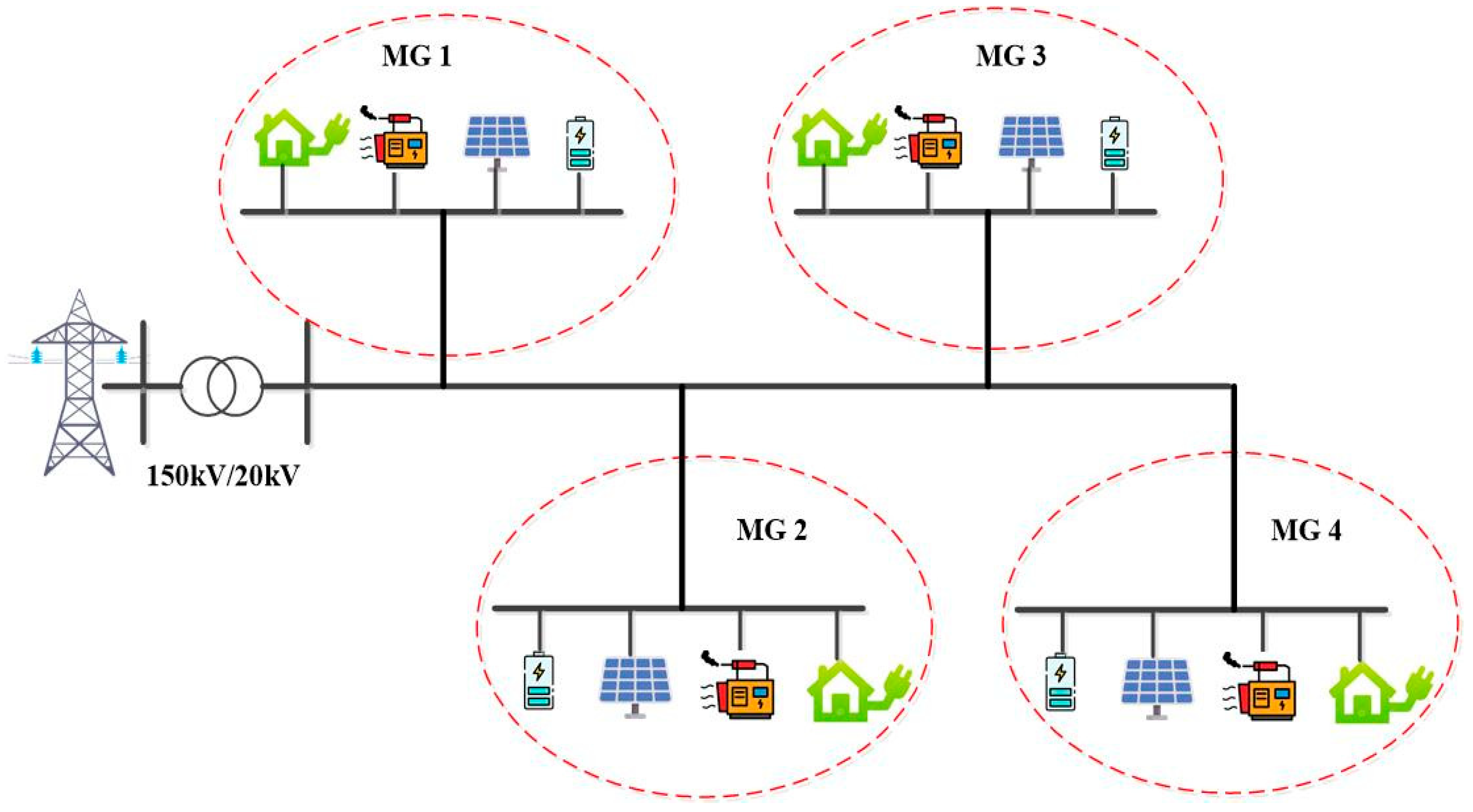
The selected case study is Lombok Island, Indonesia, situated in the West Nusa Tenggara province. Lombok Island spans an area of 4738.65 km2 and has a population of 3,869,194. A general overview of the proposed NMG is represented in Figure 1. The NMG is composed of four single MGs, connected to a 20 kV distribution network. It is considered that in a single MG, there are three kinds of DERs as candidates, including a photovoltaic (PV) system, a diesel generator (DG), and a battery energy storage system (BESS). The installed capacity of each DER is shown in Table 1. The considered NMG configuration is based on system specifications developed within the Tech-IN project [61]. Planning-level aspects of the project are discussed in [59], while this paper focuses exclusively on operational energy management and resilience assessment.

2.2. Problem Formulation

This section presents the formulation of the operational energy management problem for the considered NMG shown in Figure 1. The objective is to jointly reduce the system’s operating expenditure and environmental impact while ensuring compliance with all technical and operational constraints. The optimization determines key decision variables, including power imports from and exports to the main electricity grid, power exchanges among interconnected MGs, dispatch levels of diesel generator units, and battery charging and discharging actions. PV generation is treated as a non-dispatchable resource, and all available PV output is assumed to be fully utilized. Under normal operating conditions, the NMG remains grid-connected and can meet local demand throughout the day. To prevent supply shortages in these conditions, a sufficiently large penalty is assigned to any unserved load, effectively discouraging load curtailment in feasible optimal solutions.

2.2.1. Objective Functions

The energy management task under consideration seeks to jointly reduce the operational cost and environmental impact of the NMG by optimally allocating the demand among the available energy resources. Accordingly, the problem is formulated as a multi-objective optimization model comprising two conflicting objective functions, defined as follows:
F = ( F 1 , F 2 )
The first objective function, F 1 , quantifies the total operating cost incurred by the NMG over the entire daily simulation horizon. This cost component accounts for energy production from dispatchable units as well as power exchanges with the main grid, and it reflects the economic performance of the NMG under the considered operating conditions:
F 1 = n = 1 N t = 1 T C o s t D G n , t + u b u y n , t P b u y n , t E b u y t u s e l l n , t P s e l l n , t E s e l l t + M × n = 1 N t = 1 T P N o t _ S e r v e d _ L o a d n , t
where N is the number of MGs in the NMG, T is the total number of discrete time instants in the optimization horizon, P b u y n , t and P s e l l n , t are, respectively, the purchased and sold powers from/to the electricity grid in kW by the nth MG at time instant t. E b u y t and E s e l l t represent the buying and selling price of electricity from/to the grid in $/kWh at time instant t, respectively. u s e l l n , t and u b u y n , t represent the state of buying and selling power from/to the electricity grid, respectively, and their values are either 0 or 1. P N o t _ S e r v e d _ L o a d t is the part of the load or demand not supplied at each time instant t. M is a big number that is considered a penalty factor. This second term reflects the priority assigned to demand satisfaction during abnormal operating conditions, where ensuring load supply becomes the dominant objective.
C o s t D G n , t is the operational cost of the nth dispatchable unit (DG in this study) in $, which is modeled as a quadratic function as follows [41]:
C o s t D G n , t = α × ( P D G n , t ) 2 + β × P D G n , t + γ
where (3), P D G n , t is the output power of the nth DG in kW at time instant t. The values of α ,   β , and γ are set to 0, 0.055, and 0, respectively, according to the available data from Table 25 of reference [62].
The second objective is to minimize the total emission of the NMG, which is calculated using the following equation [41]:
F 2 = n = 1 N t = 1 T P D G n , t E D G n , t + u b u y n , t P b u y n , t C e m t t
where E D G n , t denotes the emission factor (kg/kWh) associated with electricity generated by the nth DG at time t, while C e m t t represents the emission coefficient corresponding to each kWh of power imported from the electricity grid.
It should be mentioned that when the power is exported from an MG to the main grid, the associated grid emission term is set to zero, as no emissions are attributed to exported energy. Furthermore, PV units and BESSs are assumed to operate without direct emissions.

2.2.2. Constraints

The energy management problem of the NMG is constrained by a set of technical and operational limitations, including generation capacity bounds of dispatchable units, limits on power exchange with the main grid, battery charging and discharging rate restrictions, state-of-charge constraints, and nodal power balance requirements.
DG constraints
The constraint related to the power limits of DGs is as follows, in which P D G , M i n n and P D G , M a x n are the minimum and the maximum allowable power of the DG unit in the nth MG. It is worth mentioning that it is assumed that all DG units in an MG are assumed to be of the same type and therefore are subjected to the same constraints.
P D G , M i n n P D G n , t P D G , M a x n
Power exchange constraints
Considering the thermal capacity of the power lines, there is a limit to the exchangeable power between MGs in the NMG ( P n m t ) and between each MG and the main electricity grid as represented in Equations (6)–(10).
P b u y , M i n n P b u y n , t P b u y , M a x n
P s e l l , M i n n P s e l l n , t P s e l l , M a x n
u s e l l n , t + u b u y n , t 1
0 P n m t P n m , M a x
u n m t + u m n t 1
where P b u y , M i n n and P b u y , M a x n are the minimum and the maximum power that the nth MG can purchase from the electricity grid. P s e l l , M i n n and P s e l l , M a x n denote the minimum and the maximum power that the nth MG can sell to the electricity grid. u s e l l n , t and u b u y n , t represent the state of buying and selling power from/to the electricity grid, respectively, and their values are either 0 or 1. u n m t and u m n t define the state of flowing power between the nth and the mth MG, and their values are either 0 or 1.

Constraints (6) and (7) define the admissible range of power that the nth MG can purchase from or sell to the main electricity grid. These bounds reflect the thermal capacity of the point of common coupling (PCC), contractual agreements with the utility, and protection limits of power electronic interfaces. Enforcing both minimum and maximum limits prevents unrealistically small or excessively large power exchanges that would violate technical constraints or market participation rules. Constraint (8) limits the power transferred between the nth and the mth MGs based on the thermal rating of the interconnecting lines and converters. This constraint ensures that power sharing within the NMG remains within safe operating limits, preventing line overloads and maintaining system reliability.
Constraints (9) and (10) are introduced to ensure physical consistency and operational realism in the power exchange modeling. Constraint (9) enforces that the nth MG cannot simultaneously buy power from and sell power to the main electricity grid at the same time step t . Since u buy n t and u sell n t are binary decision variables; this constraint guarantees a mutually exclusive operation, either importing power, exporting power, or remaining idle. This reflects the physical and market-based reality of grid-connected MGs and prevents infeasible or economically irrational solutions, such as simultaneous buying and selling driven by price differences within the same time interval.
Similarly, constraint (10) ensures that power flow between the nth and the mth MGs is unidirectional at each time step. That is, power can flow either from the nth MG to the mth MG or from m to n , but not in both directions simultaneously. This constraint avoids physically meaningless bidirectional flows within a single time interval and eliminates artificial circulation of power that could otherwise be exploited by the optimization algorithm without delivering any practical benefit.
Together, these constraints ensure that all power exchange decisions generated by the optimization are physically feasible, operationally safe, and consistent with real-world grid interconnection and MG-to-MG power transfer capabilities.
Battery constraints
The battery constraints are related to the charging and discharging power limits, and the state of charge (SOC) of the battery as follows:
0 P B a t t , c h n , t C r a t e   B a t t , c h n · B c a p n
0 P B a t t , d c h n , t C r a t e   B a t t , d c h n · B c a p n
u c h n , t + u d c h n , t 1
S O C B a t t , M i n n S O C B a t t n , t S O C B a t t , M a x n
S O C B a t t n , t = S O C B a t t n , t 1 + ( u c h n , t P B a t t , c h n , t × η B a t t , c h n B c a p n ) ( u d c h n , t P B a t t , d c h n , t η B a t t , d c h n × B c a p n )
where B c a p is the battery capacity, C r a t e is battery C-Rate that limits the battery’s charging and discharging rates. u c h n , t and u d c h n , t represent the state of charging and discharging of batteries, respectively, and their values are either 0 or 1. S O C B a t t n , t and S O C B a t t n , t 1 are the stored energy levels of the nth battery at hour t and t − 1, respectively, S O C B a t t n , m i n and S O C B a t t n , m a x are the minimum and the maximum allowable stored energy levels in the battery, respectively, and η B a t t , c h n and η B a t t , d c h n are, respectively, the nth battery charging and discharging efficiencies.
Constraints (11) and (12) represent charging and discharging power limits. These constraints limit the maximum charging and discharging power of the battery based on its rated capacity and C-rate. They represent the electrochemical and thermal limitations of battery cells and power electronic converters, preventing unrealistically fast charging or discharging that could degrade the battery or violate safety limits.
Constraint (13) represents the mutual exclusivity of charging and discharging. This constraint ensures that the battery cannot charge and discharge simultaneously at the same time step. Since u ch n t and u dch n t are binary variables, the battery can operate in only one mode—charging, discharging, or idle—reflecting its physical operating behavior and preventing non-physical energy circulation.
Constraint (14) restricts the battery SOC within safe operating limits. The lower bound prevents deep discharge, which accelerates battery aging and may damage cells, while the upper bound avoids overcharging, ensuring safety and prolonging battery lifetime.
The SOC evolution Equation (15) enforces energy conservation within the battery by linking the SOC at consecutive time steps. Charging and discharging efficiencies are explicitly included to account for conversion losses, ensuring that the stored energy evolution accurately reflects real battery behavior.
Together, these constraints guarantee that the battery operation remains safe, realistic, and consistent with physical and electrochemical characteristics, while allowing the optimization to exploit storage flexibility for cost and emission reduction.
Power balance constraint:
According to this constraint, the total supplying power must satisfy the total power demand of each MG in the NMG system at each time instant, as expressed in the following.
The power balance constraint ensures that, at each time instant t , the total power supplied to the nth MG equals the total power consumed within that MG. This constraint represents the fundamental law of energy conservation and is essential for guaranteeing the physically feasible operation of the NMG.
On the left-hand side, the equation accounts for all power sources supplying the MG, including dispatchable DG units, non-dispatchable PV generation, battery discharging, power purchased from the main grid, and power received from neighboring MGs. On the right-hand side, all power sinks are represented, including local load demand, battery charging, power sold to the main grid, and power shared with other MGs. The term P N o t _ S e r v e d _ L o a d n , t allows for load curtailment when necessary; however, under normal operating conditions, its value is driven to zero due to the high penalty imposed in the objective function.
This constraint guarantees that every unit of generated, imported, or discharged energy is properly allocated to consumption, storage, export, or sharing, thereby preventing non-physical solutions such as power creation or loss within the optimization. Consequently, the power balance constraint forms the core of the energy management model and ensures realistic, reliable, and operationally consistent scheduling of all resources in the NMG.
P D G n , t + P P V n , t + u d c h n , t P B a t t , d c h n , t + u b u y n , t P b u y n , t + P S h a r e d , i n n , t     = P L n , t P N o t _ S e r v e d _ L o a d n , t + u c h n , t P B a t t , c h n , t + u s e l l n , t P s e l l n , t + P S h a r e d , o u t n , t
P S h a r e d , i n n , t = m = 1 m n N u m n t P m n t
P S h a r e d , o u t n , t = m = 1 m n N u n m t P n m t
where P B a t t , c h n , t and P B a t t , d c h n , t are the charging and discharging power of the battery in the nth MG in kW, P P V n , t is the estimated available power of PV units of the nth MG in kW, and P L n , t   is the load of each MG in kW at time instant t. P S h a r e d , i n n , t shows the total sent power from the nth to other MGs in the NMG, while P S h a r e d , o u t n , t represents the total flowing power from other MGs in the NMG to the nth MG.
P n m t   represents the flowing power from the nth MG to the mth MG in NMG in kW while P m n t denotes the flowing power from the mth MG to the nth MG in NMG in kW at time instant t. u n m t and u m n t define the state of flowing power between the nth and the mth MG, and their values are either 0 or 1.


3. Application of the Proposed Methodology

3.1. JAYA Algorithm

Compared to many population-based meta-heuristic algorithms, the JAYA algorithm, originally proposed by R. Venkata Rao, is characterized by a simple update mechanism, fast convergence, and the absence of algorithm-specific control parameters, eliminating the need for parameter tuning. These features make JAYA particularly suitable for complex energy management problems with high-dimensional decision spaces and operational constraints [60,63]; hence, the JAYA algorithm is applied to solve the presented optimization problem in this task. If it is considered to minimize the objective function f(x), it is assumed that m is the number of design variables i (i = 1, 2, …, m) in each iteration, iter, and n is the number of solutions, i.e., the size of the population (j = 1, 2, …, n). The best solution has the lowest value of f(x) in solution queues, and the worst solution has the maximum value of f(x). Considering X i , j , i t e r as the ith variable for the jth solution in the iterth iteration, X i , j , i t e r is modified at each iteration as follows [63,64]:
X i , j , i t e r = X i , j , i t e r + r 1 i , i t e r ( X i , b e s t , i t e r X i , j , i t e r ) r 2 i , i t e r ( X i , w o r s t , i t e r X i , j , i t e r )
where X i , b e s t , i t e r is the ith variable in the best solution in the iterth iteration, and X i , w o r s t , i t e r is the ith variable in the worst solution in the iterth iteration. X i , j , i t e r is the modified version of X i , j , i t e r ; and r 1 i , i t e r and r 2 i , i t e r are two random values in the range [0, 1]. The term r 1 i , i t e r ( X i , b e s t , i t e r X i , j , i t e r ) drives the candidate solution toward the best-performing solution in the current iteration, whereas r 2 i , i t e r ( X i , w o r s t , i t e r X i , j , i t e r ) encourages it to move away from the worst-performing solution. The updated solution X i , j , i t e r is accepted if it yields an improvement in the objective function compared to X i , j , i t e r . At the conclusion of each iteration, the set of superior solutions is retained and used to form the population for the subsequent iteration. The best and worst solutions are then reidentified within this updated population, and the process is repeated until the predefined termination criterion is met. It is worth mentioning that in this study, the convergence criteria for both JAYA and MJAYA are defined as reaching the maximum number of iterations, i.e., 500 in this study.

3.2. MJAYA Algorithm

In this work, a multi-objective extension of the JAYA algorithm, referred to as MJAYA, is employed to simultaneously optimize the operating cost and environmental impact of NMGs. The novelty of the MJAYA approach lies in integrating Pareto dominance concepts into the JAYA update process, enabling the algorithm to handle conflicting objectives without scalarization. Instead of converging to a single solution, MJAYA generates a set of non-dominated (Pareto-optimal) solutions that explicitly capture the trade-off between economic and environmental objectives. To ensure solution diversity and convergence stability, Pareto-optimal solutions obtained at each iteration are preserved in an external repository and updated dynamically throughout the optimization process. This adaptation allows MJAYA to retain the simplicity and parameter-free nature of the original JAYA algorithm while extending its applicability to multi-objective energy management problems. The detailed procedural steps of the MJAYA algorithm are provided in our previous work [63].

3.3. Modular Framework for Solving the NMG Energy Management Problem

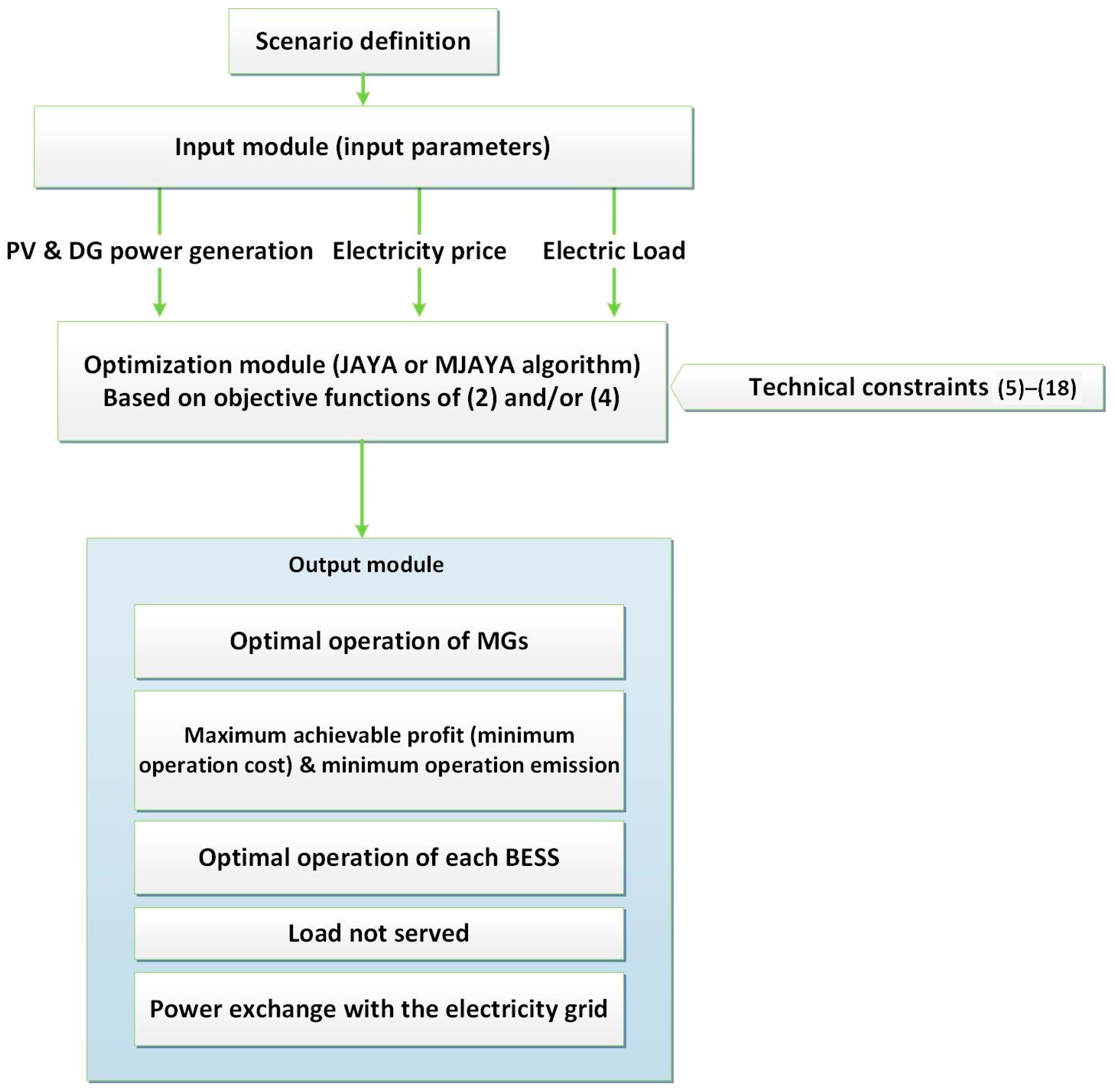
The proposed methodology is organized as a modular framework, as illustrated in Figure 2, to ensure clarity, flexibility, and scalability in solving the NMG energy management problem. Each module performs a distinct function while interacting systematically with the others.
Scenario definition module: This module defines the operating scenario under study, including the time horizon, operating conditions (e.g., normal grid-connected operation), and the optimization objective (single-objective or multi-objective). It establishes the context in which the NMG energy management problem is solved.
Input module: The input module collects all required parameters for the optimization problem. These include the available power from PV units, the power production characteristics of dispatchable DG units, the electricity market price, and the electric load demand of each MG. These inputs represent external conditions and forecasts and are treated as known parameters for the optimization horizon.
Optimization module: The optimization module constitutes the core of the framework. Depending on the problem formulation, it applies either the JAYA algorithm for single-objective optimization or the MJAYA algorithm for multi-objective optimization. The objective functions (economic cost minimization and/or emission minimization) are optimized subject to the full set of technical and operational constraints (5)–(18), including power balance, battery dynamics, generation limits, and power exchange constraints. Through iterative updates, the optimization module determines the optimal operating decisions for all controllable resources in the NMG.
Output module: The output module processes and reports the optimization results. It provides the optimal operating schedules of the MGs, including the dispatch of DG units, the charging and discharging profiles of battery energy storage systems (BESS), the amount of load not served at each time step, and the power exchanged between the NMG and the main electricity grid. In the multi-objective case, the output also includes Pareto-optimal solutions representing the trade-off between economic and environmental objectives.
The modular structure allows individual components (e.g., input data, optimization algorithm, or constraints) to be modified or extended independently, enhancing the adaptability of the framework to different NMG configurations, operating conditions, and optimization objectives.

4. Simulation Results

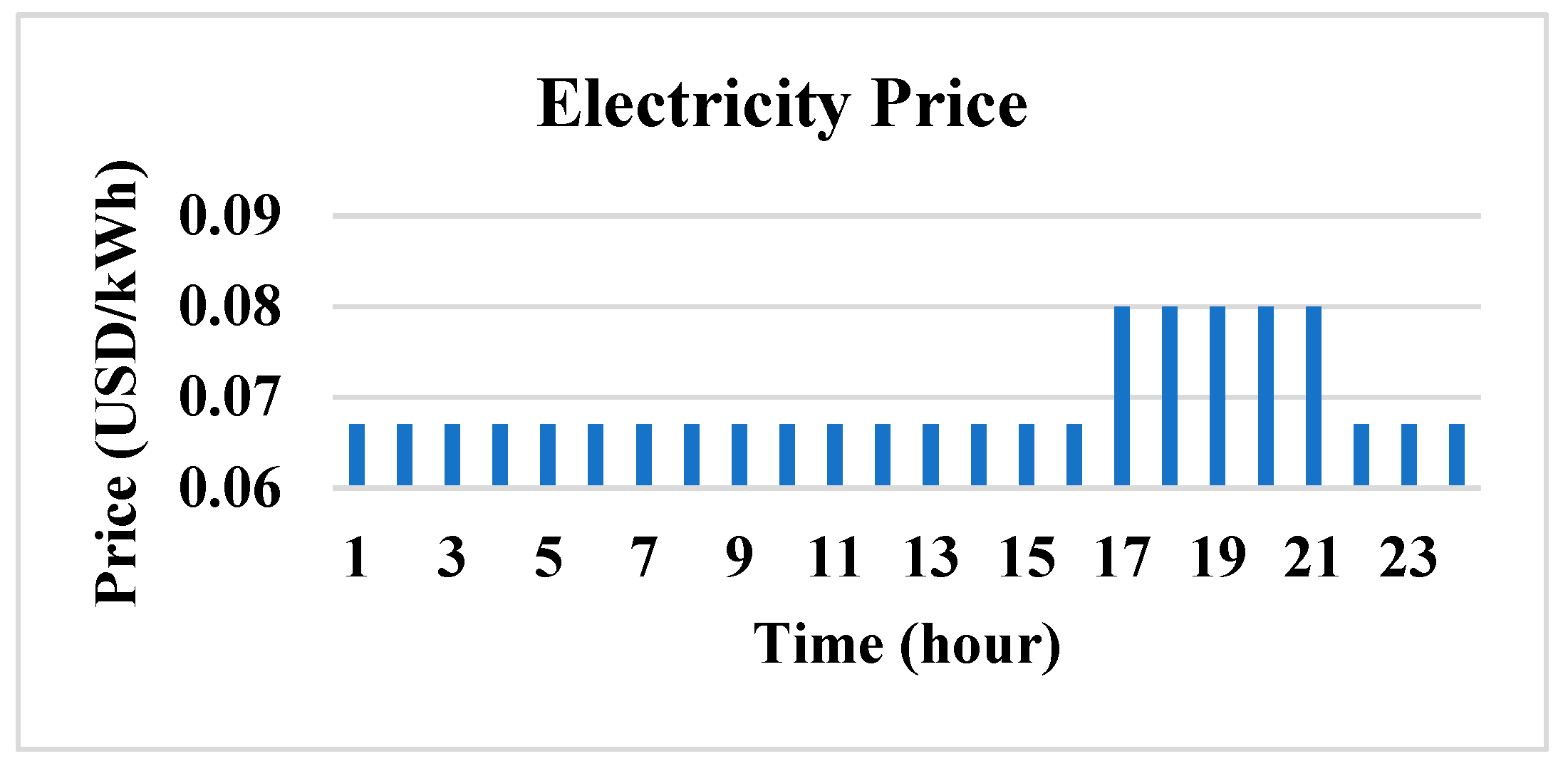
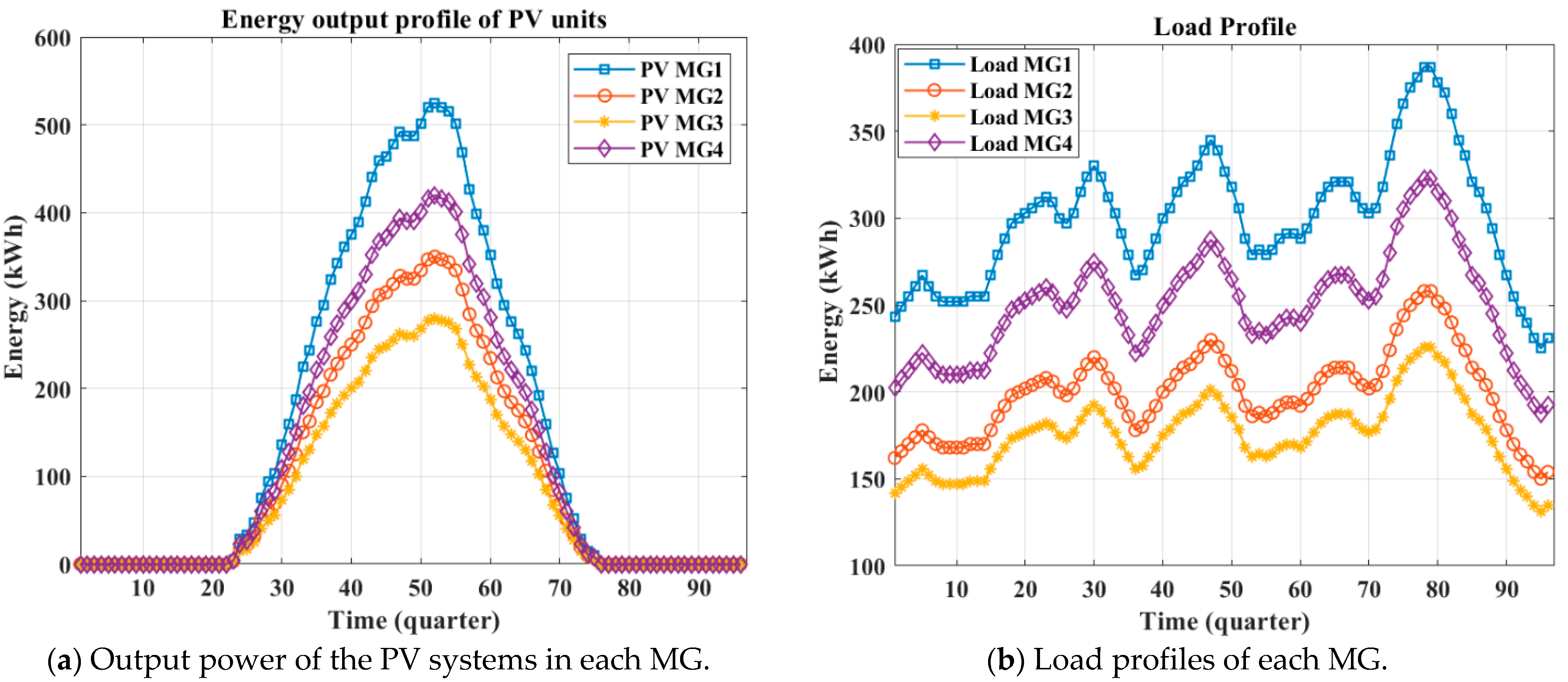
In this section, simulation results obtained in different scenarios are presented and discussed. Lombok Island in Indonesia has been selected as the case study for the simulation analysis in all scenarios. The electricity price, the output power of the PV panels, and the demanded load of each MG of the NMG on the selected date (1st of July) are shown in Figure 3 and Figure 4. The output power of the PV panels is derived from the PVGIS tool [64] based on the geographical coordinates of the target area and the rated power of the PV panels.
To assess the effectiveness of the proposed strategy, various normal and abnormal operating scenarios are examined. Different fault scenarios resulting from NDs in energy management under abnormal operation conditions were simulated. The selection of these scenarios was based on the prediction of fault locations within the NMG. This proactive approach allowed us to simulate realistic fault scenarios and observe the restructuring of the NMG in response to these disruptions. Through our research, we aim to gain valuable insights into the effectiveness of energy management strategies under adverse conditions, ultimately contributing to the resilience of NMG systems.
An overview of the considered scenarios is provided in Table 2. This Table also summarizes the number of continuous and binary variables per scenario, providing transparency regarding problem scale and computational complexity.
For scenario 1, the proposed formulation includes 36 T continuous variables and 28 T binary variables. For the 24 h horizon, discretized into T = 96 time steps, this corresponds to 3456 continuous variables and 2688 binary variables, i.e., 6144 decision variables in total.
For Scenario 2’s cases, the number of decision variables is as shown in Table 2, based on the configuration after disconnections.
All simulations were implemented in MATLAB R2025a using a JAYA-based optimization framework. The population size was defined as five times the total number of decision variables and the maximum number of iterations was set to 500. Scenario 1 Case 2 was solved as a multi-objective problem using MJAYA, whereas all cases in Scenario 2 were formulated as single-objective problems.
Due to the additional Pareto dominance checks and archive handling in the multi-objective formulation, Scenario 1, Case 2 required higher computational effort, with an average CPU time of approximately 25 min per run, while Scenario 2 cases required between 7.5 and 14 min, depending on the number of decision variables. Table 3 presents the total number of decision variables, the type of optimization problem, and the corresponding CPU time required to solve each case. The input data used in the simulations are provided in Table 4.

4.1. Scenario 1: Normal Operation

4.1.1. Scenario 1-Case 1: Single-Objective Energy Management

  • A: Cost minimization strategy
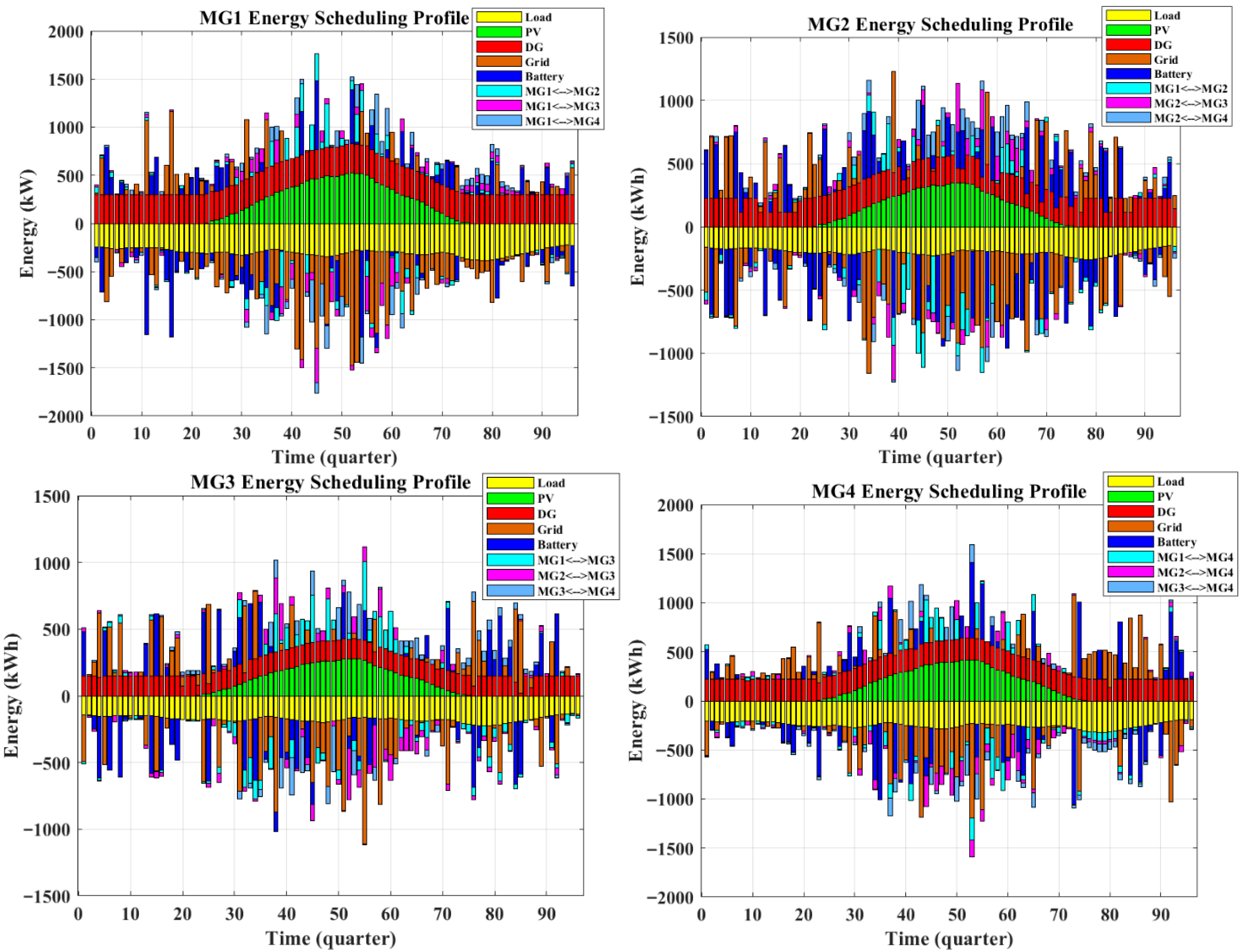
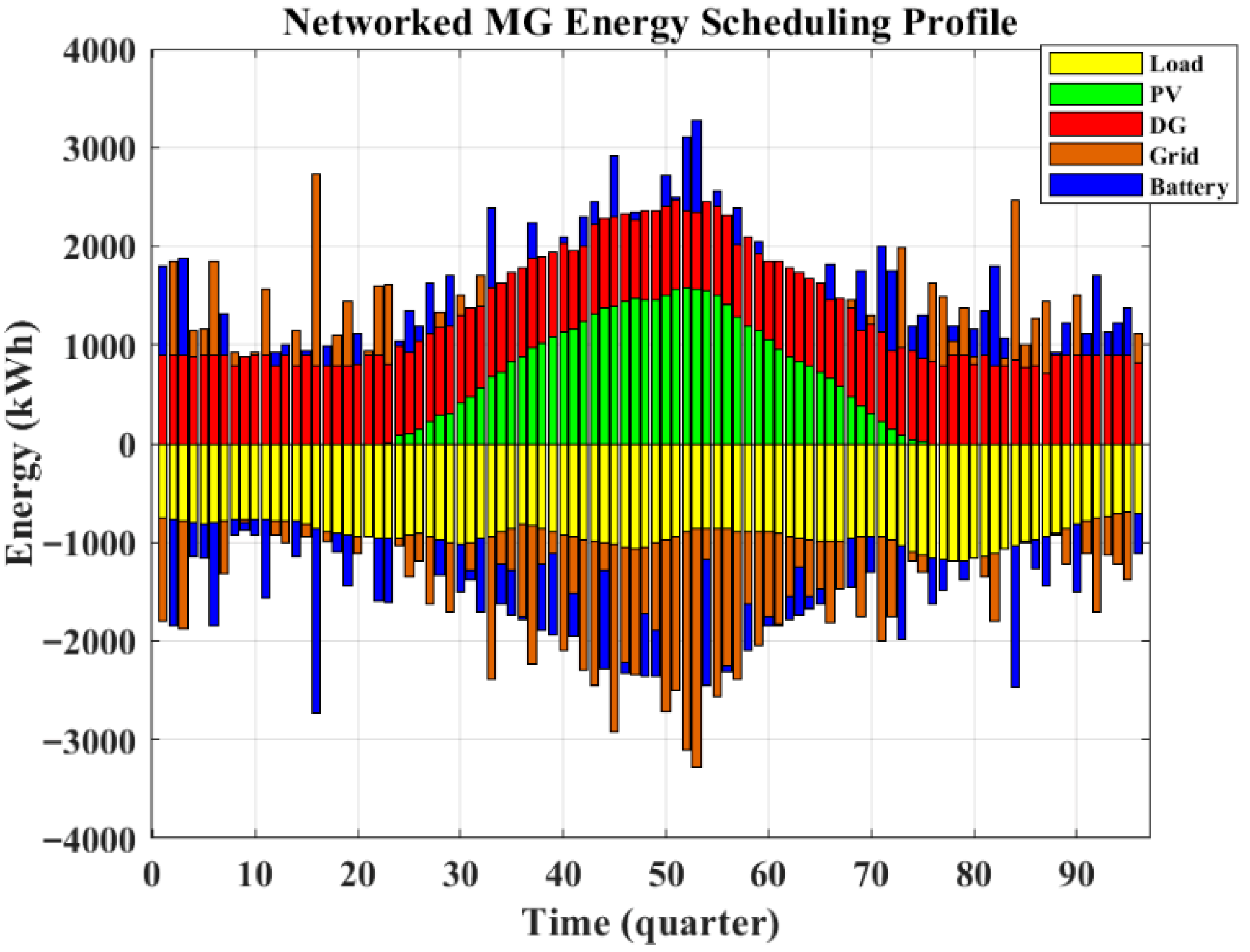
The first case under normal operation focuses on minimizing the operation cost of the NMG using the JAYA algorithm. The results, depicted in Figure 5 and Figure 6, show the energy exchange profile of each MG and the entire NMG on the selected day (1st of July).
In these figures, power demand and other consumption-related variables are represented by negative values at each time step, whereas supply-side variables are shown with positive values. Battery energy storage systems can operate in both modes: during charging periods, they act as power consumers, while during discharging periods, they function as power producers. In addition, negative values of the power exchanged with the main grid indicate electricity export from the NMG, whereas positive values correspond to power imports from the grid and energy supplied to the NMG.
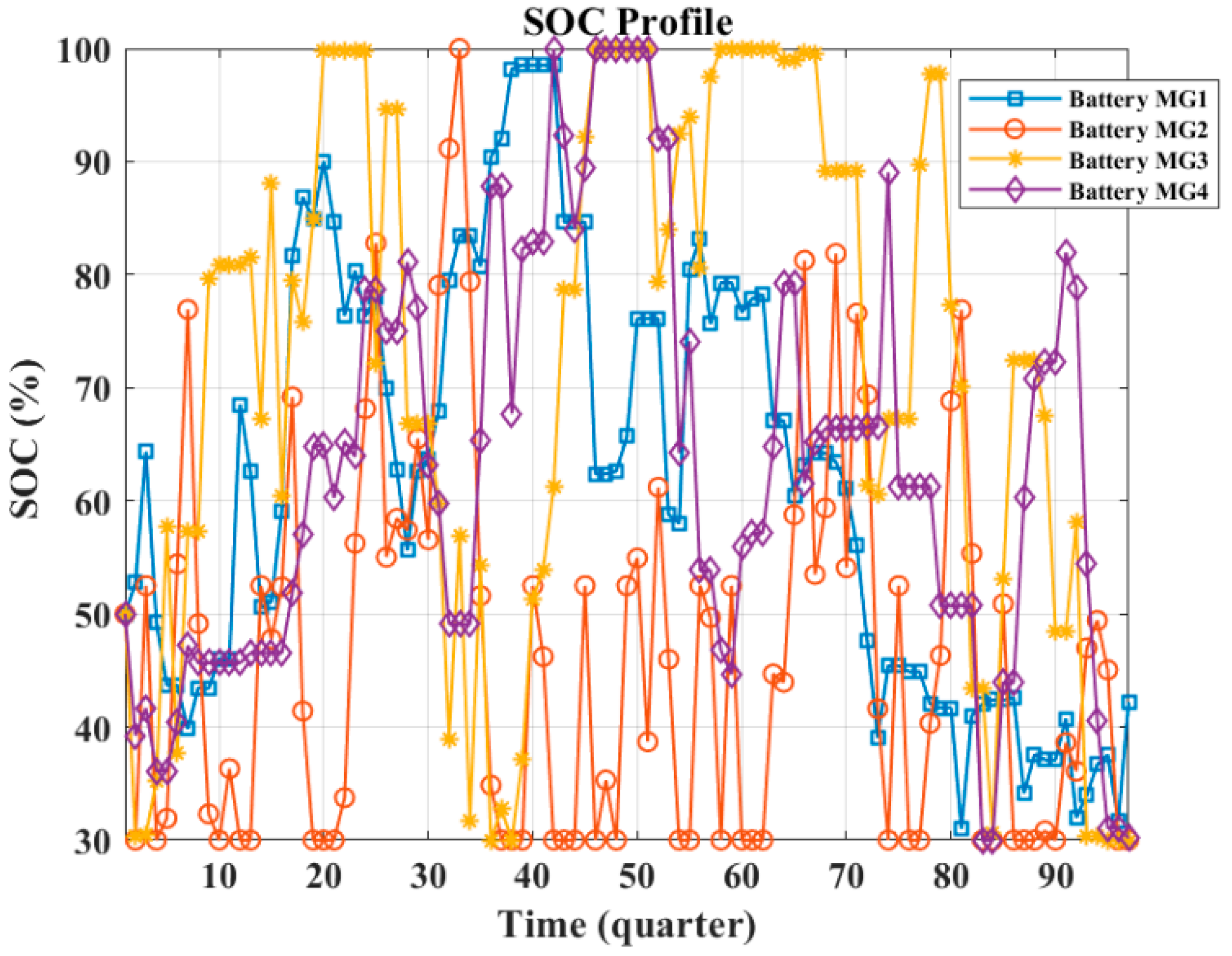
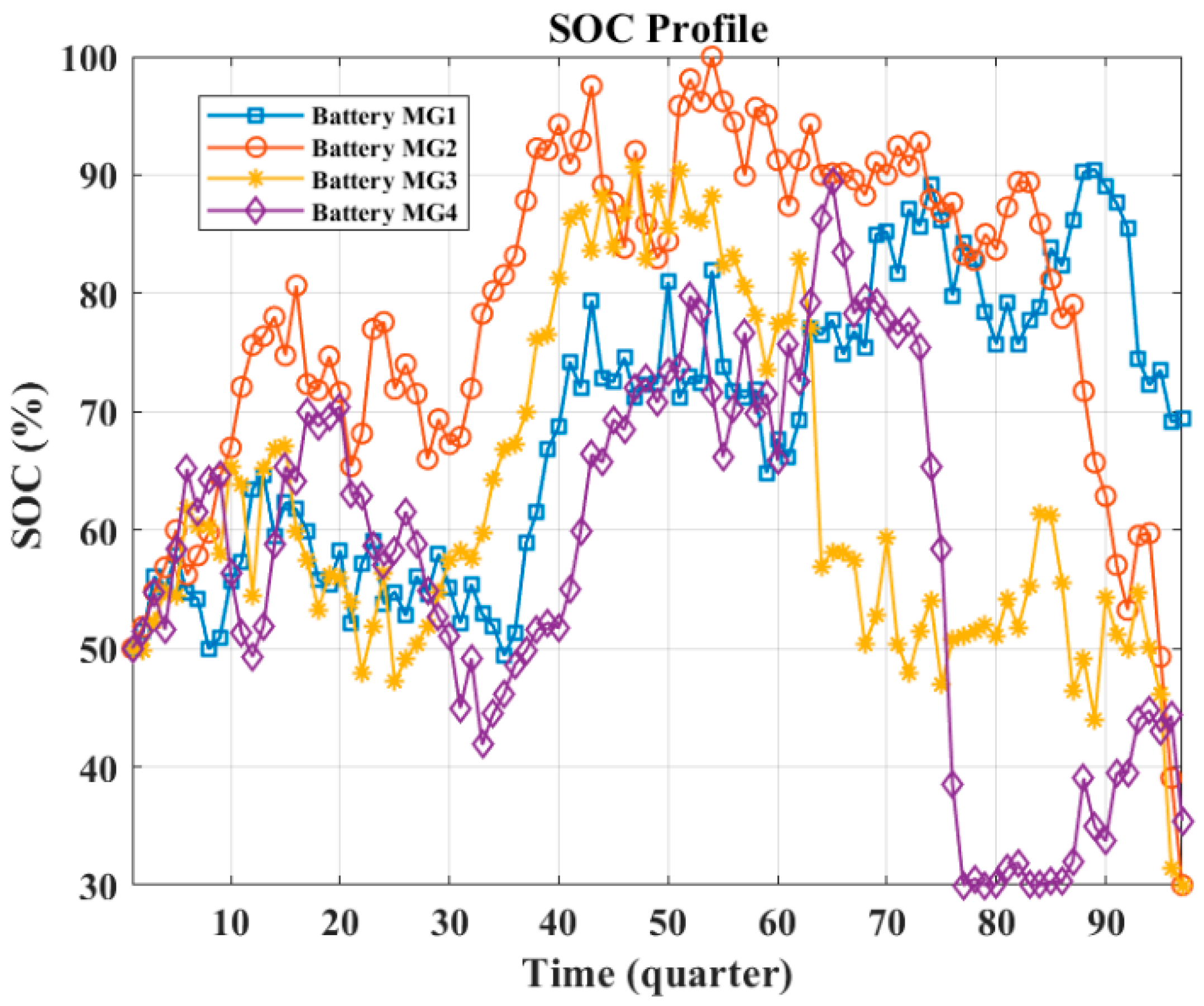
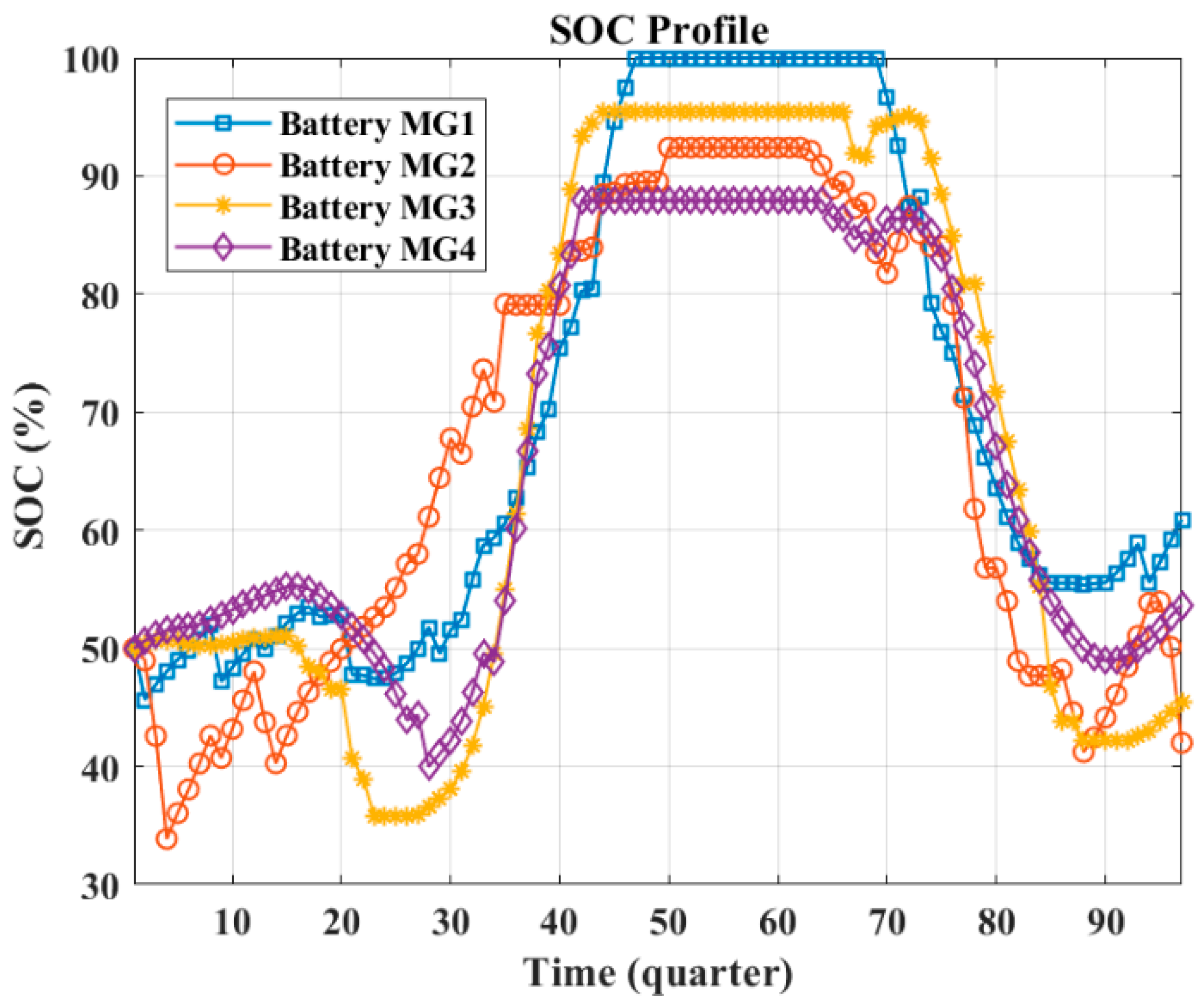
As illustrated in Figure 6, the simulation horizon begins at midnight. From 00:00 to 06:00, the electricity demand is mainly supplied by the main grid, as lower electricity prices during this period make grid imports economically attractive and enable battery charging. Between 06:00 and 15:00, PV generation becomes the dominant supply source, covering the local demand, while surplus PV energy is either stored in the batteries or exported to the grid. After 15:00, the demand is primarily served by a combination of battery discharge and grid power. During the peak price period from 17:00 to 21:00, the batteries discharge to supply demand and sell stored energy to the grid, thereby increasing operational profitability. The corresponding battery SOC profiles, shown in Figure 7, confirm that the SOC remains within the prescribed limits (0.3–1) throughout the entire operating horizon.
  • B: Emission minimization strategy
When the environmental impact is the sole objective, the results, illustrated in Figure 8 and Figure 9, show a different energy exchange profile.
Figure 10 illustrates the battery SOC profiles for each MG in the NMG when emission minimization is the sole objective. The results show that the SOC remains within the allowable range of 0.3 to 1 throughout the day, indicating that battery operating limits are respected over the entire optimization horizon.
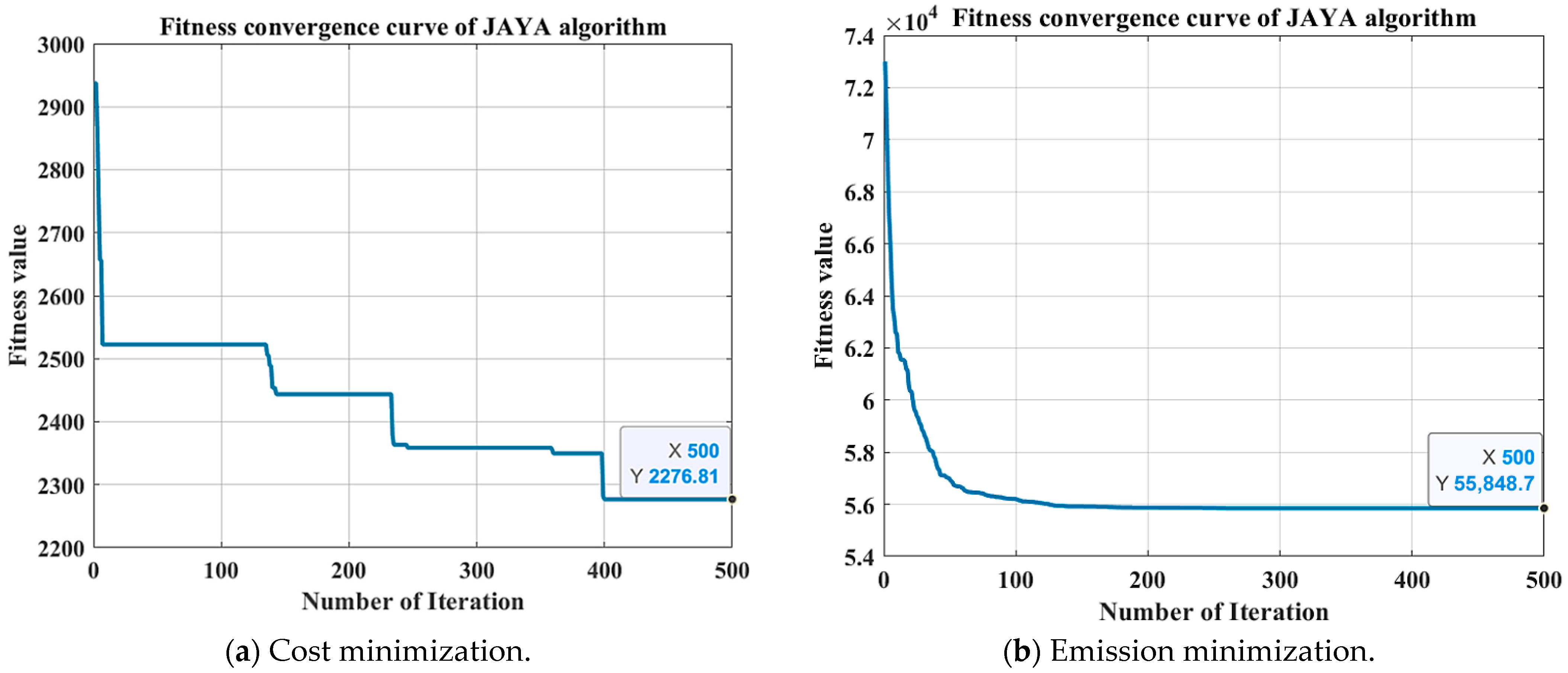
Figure 11 illustrates the convergence behavior of the JAYA algorithm for the energy management problem on July 1 as a representative case. In addition, Table 5 reports the best, worst, mean value, and standard deviation (SD) of the fitness values (objective functions) obtained from 10 independent runs with different random initializations. The results indicate that the JAYA algorithm consistently converges to high-quality solutions and demonstrates stable performance for solving the NMG energy management problem.

4.1.2. Scenario 1-Case 2: Multi-Objective Energy Management

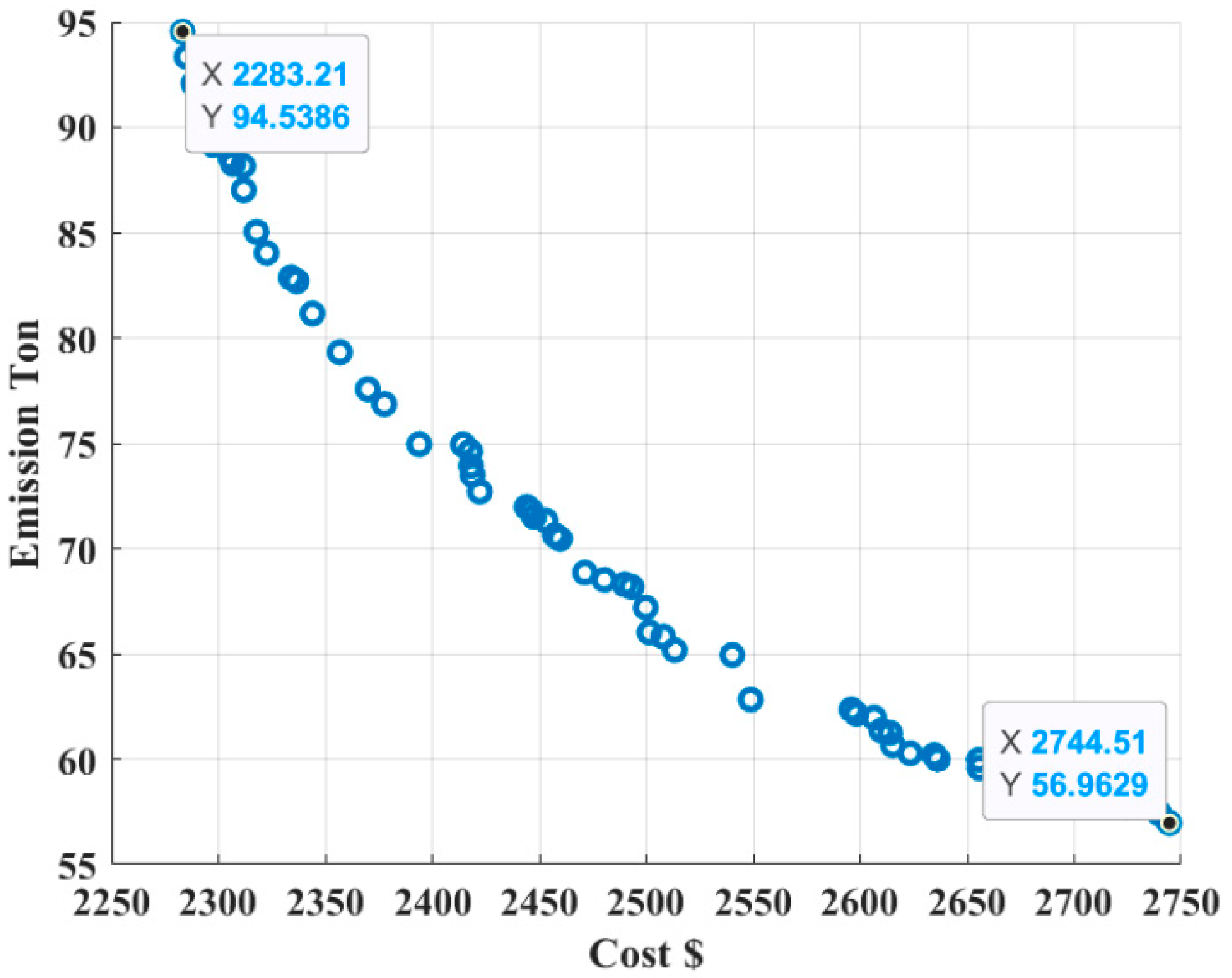
In this scenario, both objectives, minimizing operating cost and minimizing total emissions, are considered simultaneously. The resulting Pareto-optimal front, illustrated in Figure 12, represents a set of trade-off solutions for the optimal operation of the NMG, each reflecting a different balance between economic and environmental performance. This enables the MG operator to select an operating point according to the desired priority.

4.2. Scenario 2: Abnormal Operation

Five cases are studied in this scenario to investigate the probable effects of NDs on the system performance, as listed in Table 2. In the following, the performance of the proposed EMs for the NMG is evaluated. The studies are performed for a peak day in July 2022, considering minimizing the cost and the load not served as the main objectives.
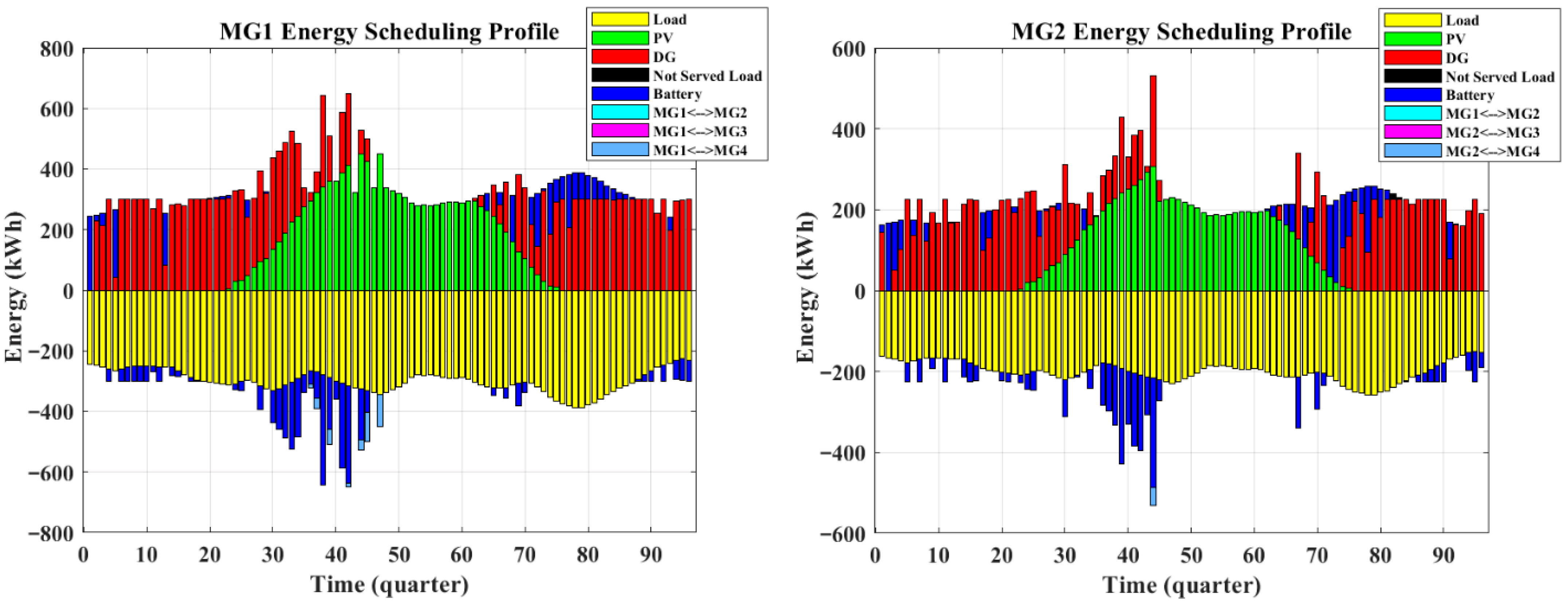
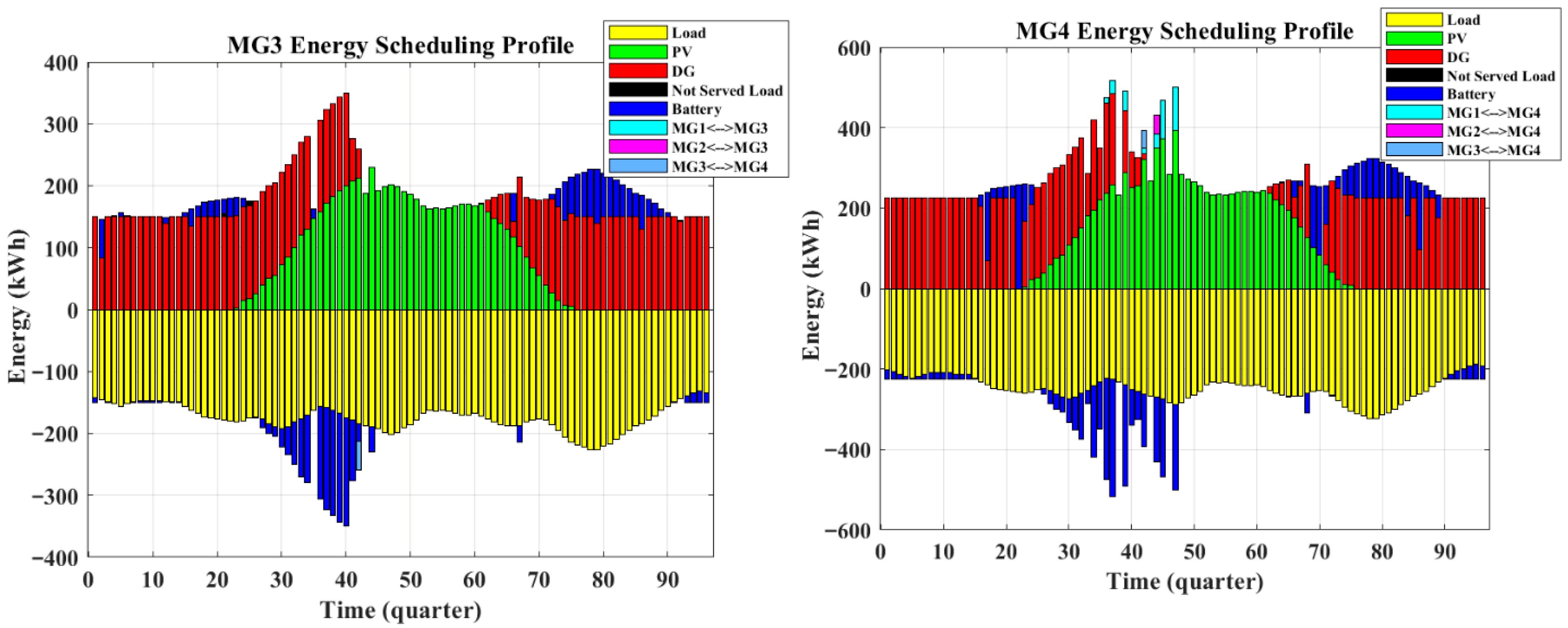
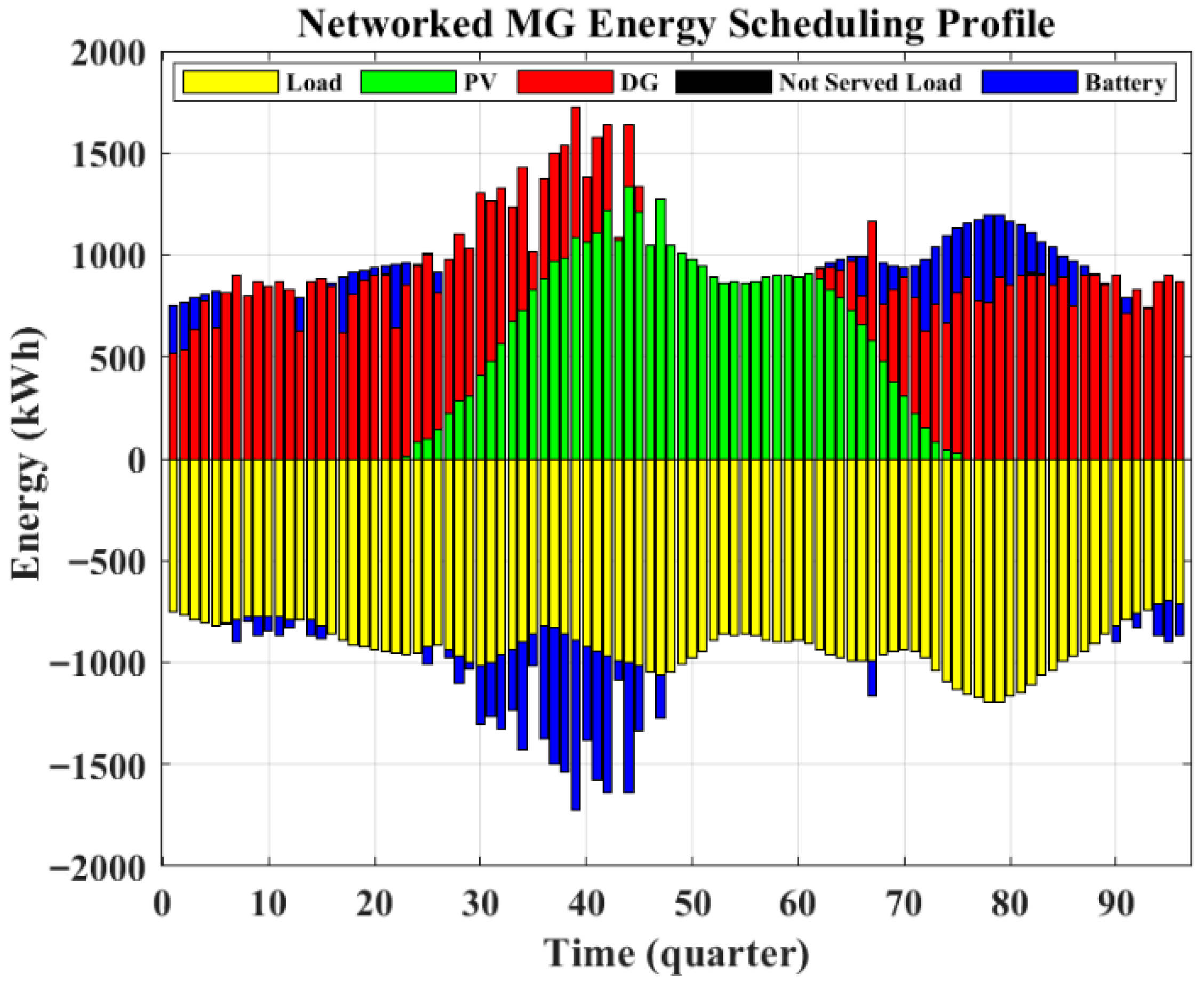
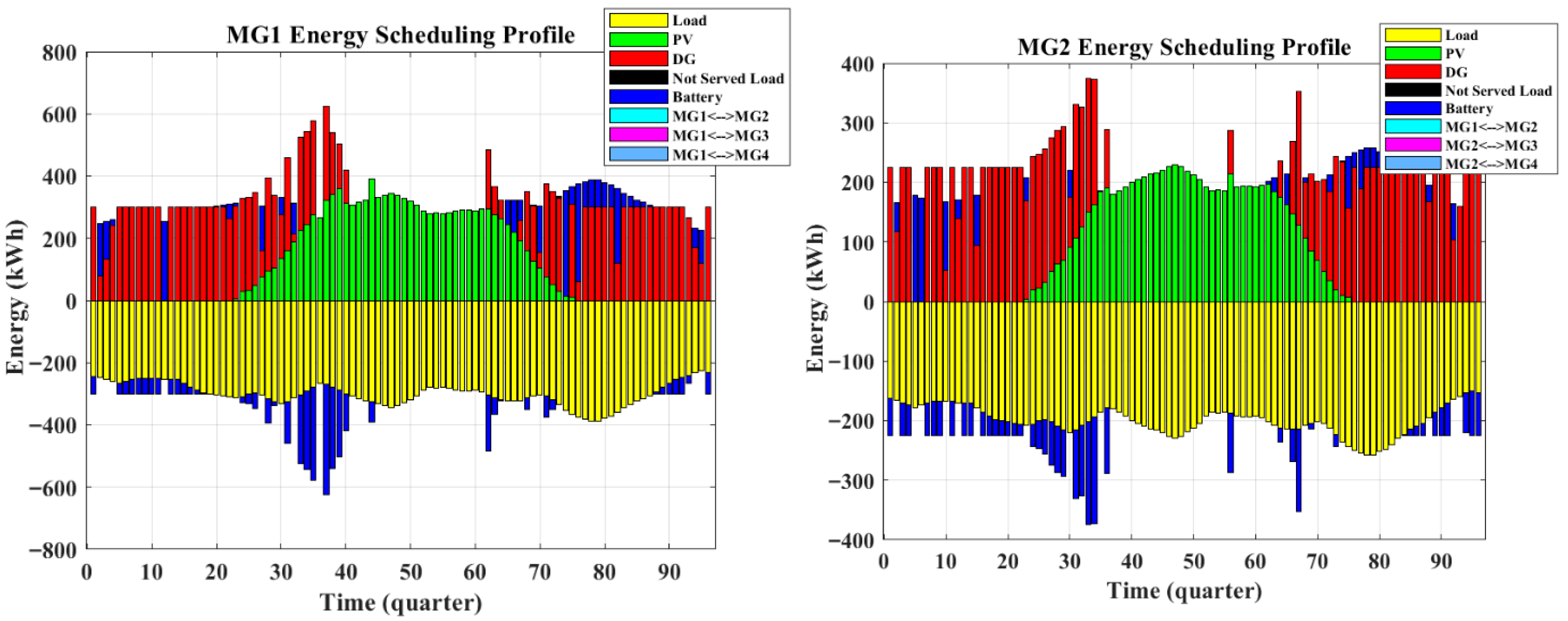
In the following sections in the energy scheduling profiles, the figures show load profiles in yellow bars, PV generation in green bars, DG power in red bars, battery power in blue bars, and unserved load in black.

4.2.1. Scenario 2-Case 1: There Is No Access to the Main Electricity Grid for the Whole Day (Results in an Islanded NMG (MG1-MG2-MG3-MG4))

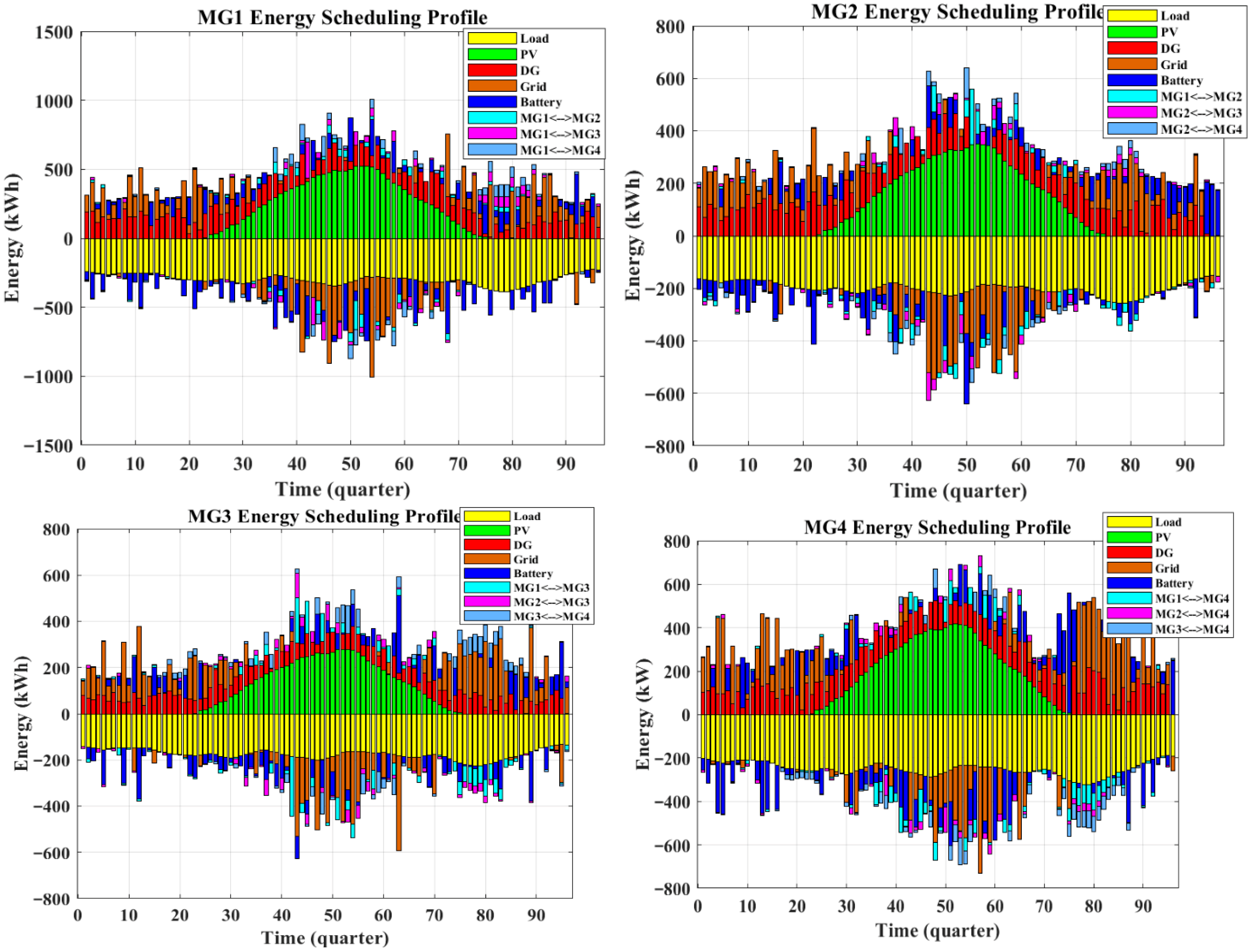
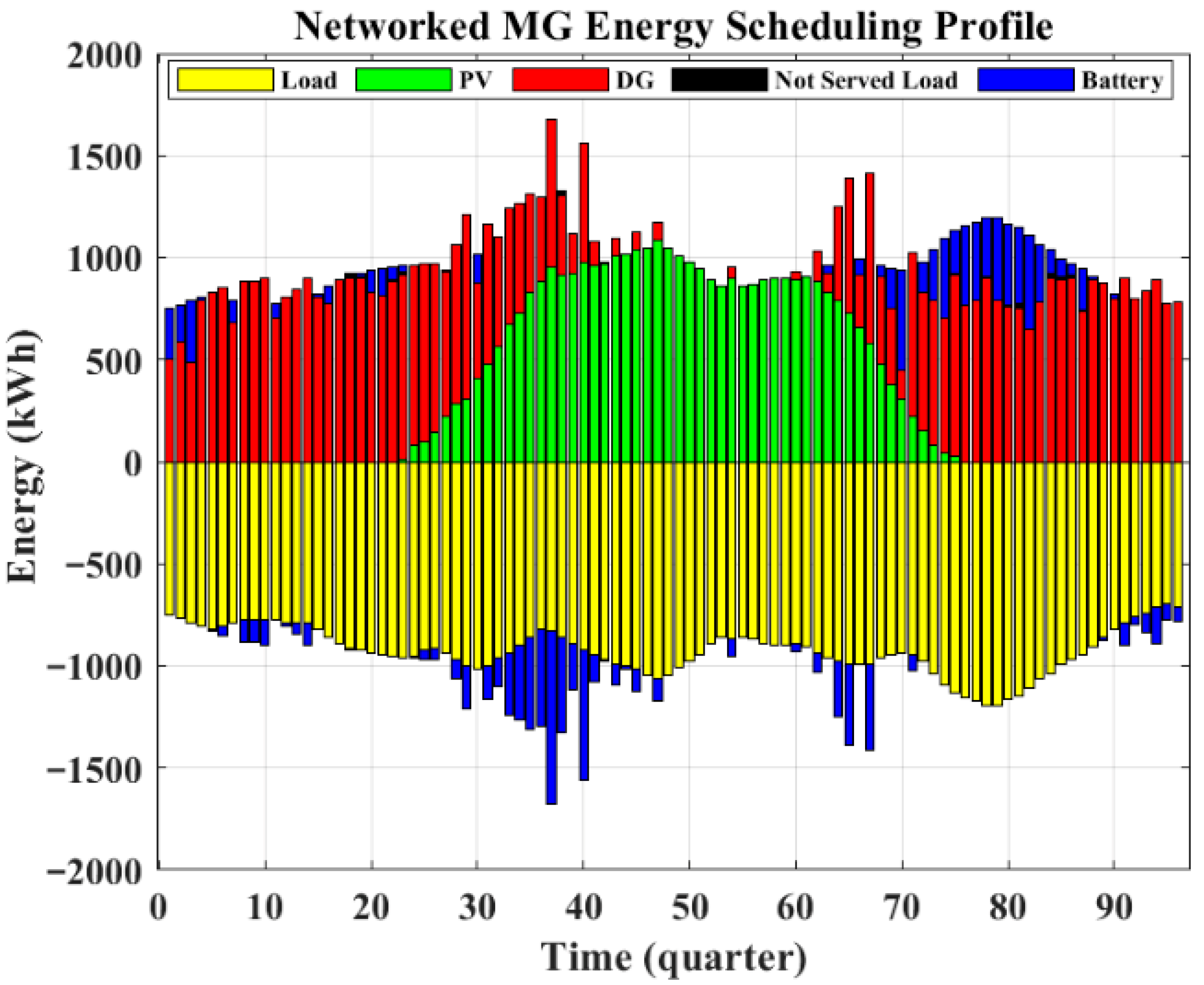
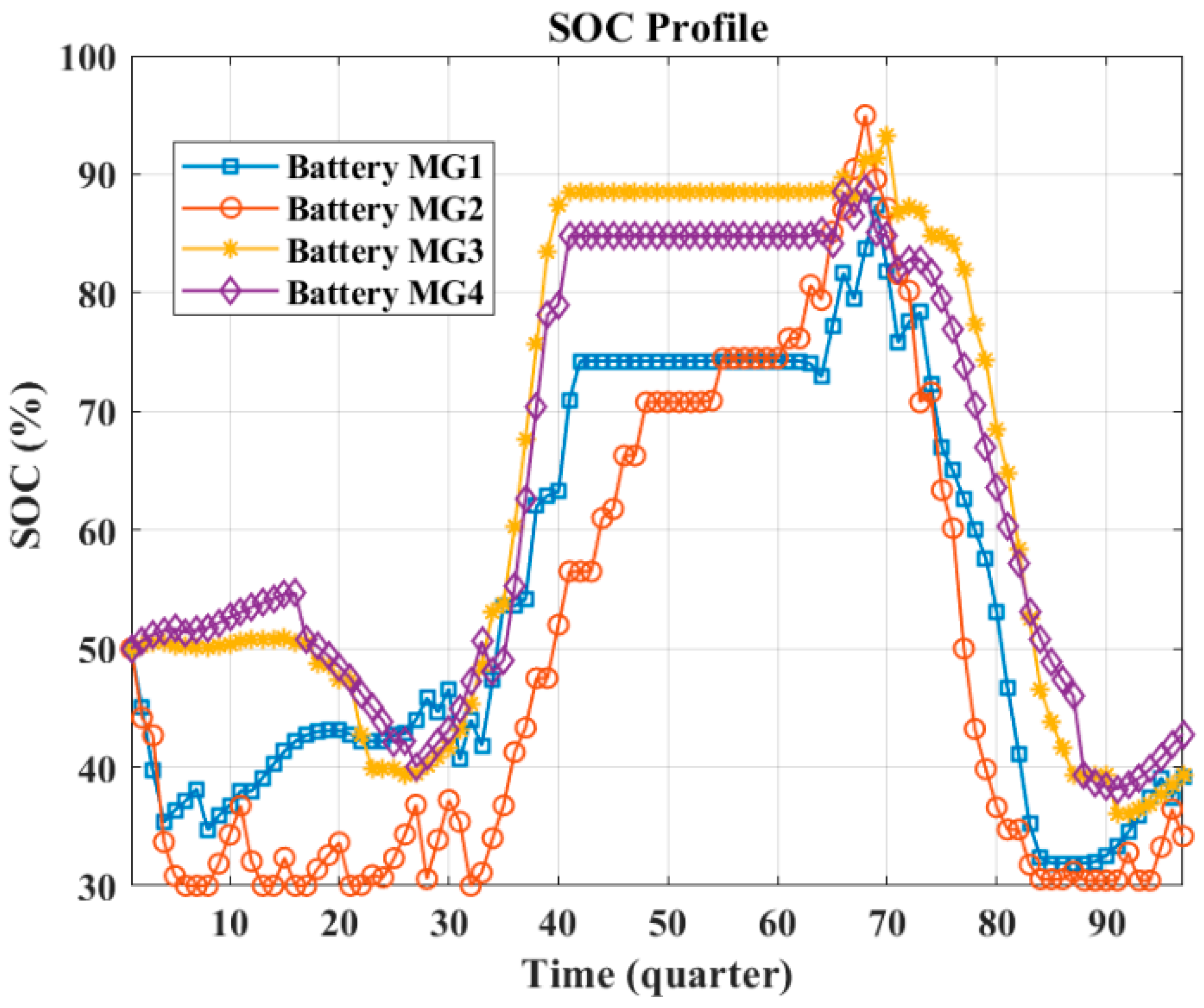
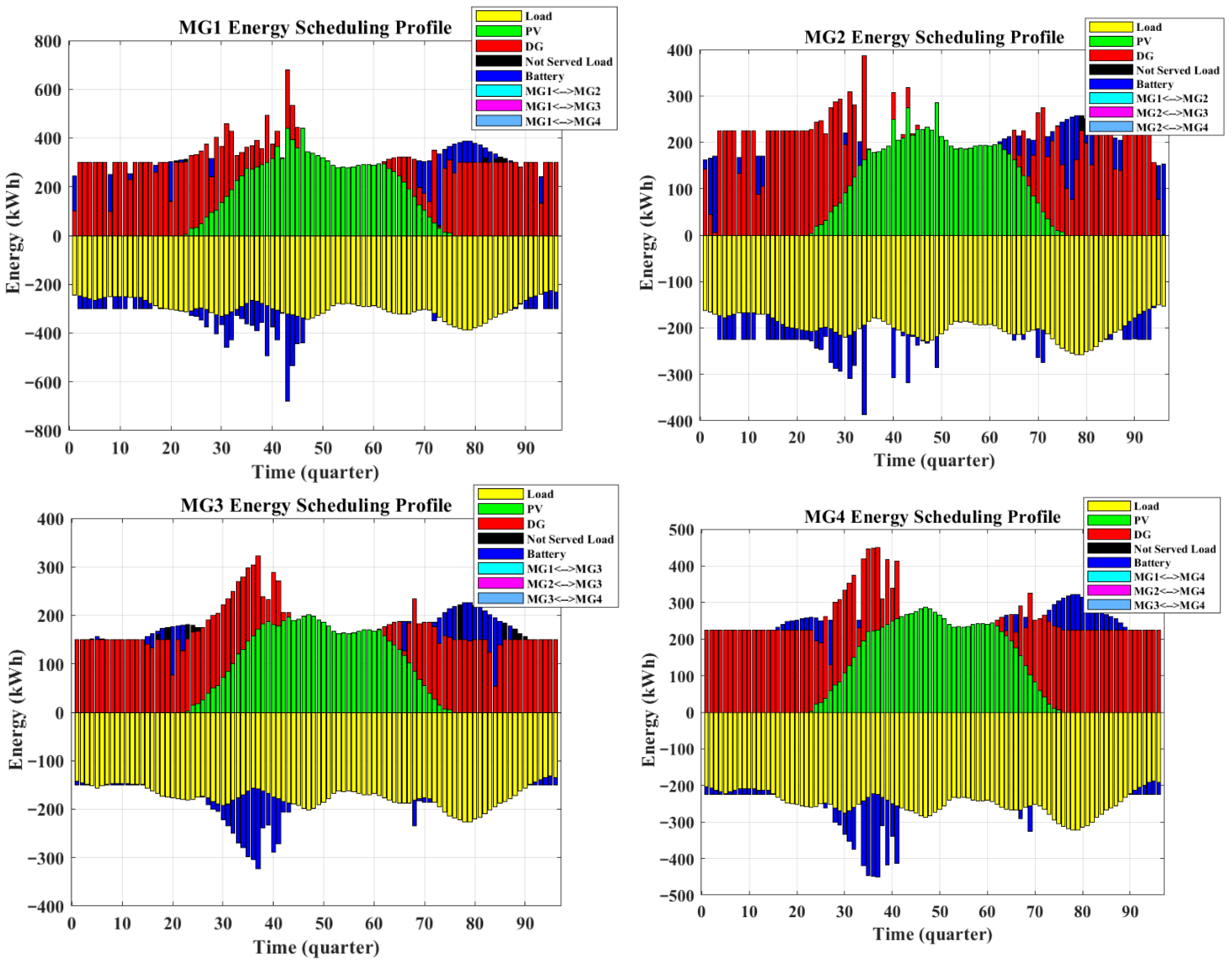
In this case, the NMG operates without access to the main grid for the entire day, requiring power exchange only among the MGs. Figure 13, Figure 14 and Figure 15 illustrate the power scheduling of DER units and SOC levels of the batteries in each MG of the NMG. The total load not served, summarized in Table 6, is 31.7 kWh, demonstrating the NMG’s capability to manage load during grid outages.
As is seen in Figure 13, from 00:00 to 6:00, MGs rely on stored battery energy and DGs. The energy demand is low, and batteries are used to supply power. From 6:00 to 15:00, the PV output increases, and MGs use PV energy to meet demand, charge batteries, and minimize DG usage. From 15:00 to 18:00, as PV output decreases, batteries start discharging to meet the demand. DG usage increases to compensate for lower solar output. The energy demand peaks from 18:00 to 20:00. Batteries continue discharging, and DGs are used more intensively to meet the higher demand.
According to Figure 14, the overall trend shows a balanced approach where PV energy is maximized during daylight hours, and battery storage is optimized for evening peak demand. DGs provide consistent backup throughout the day.
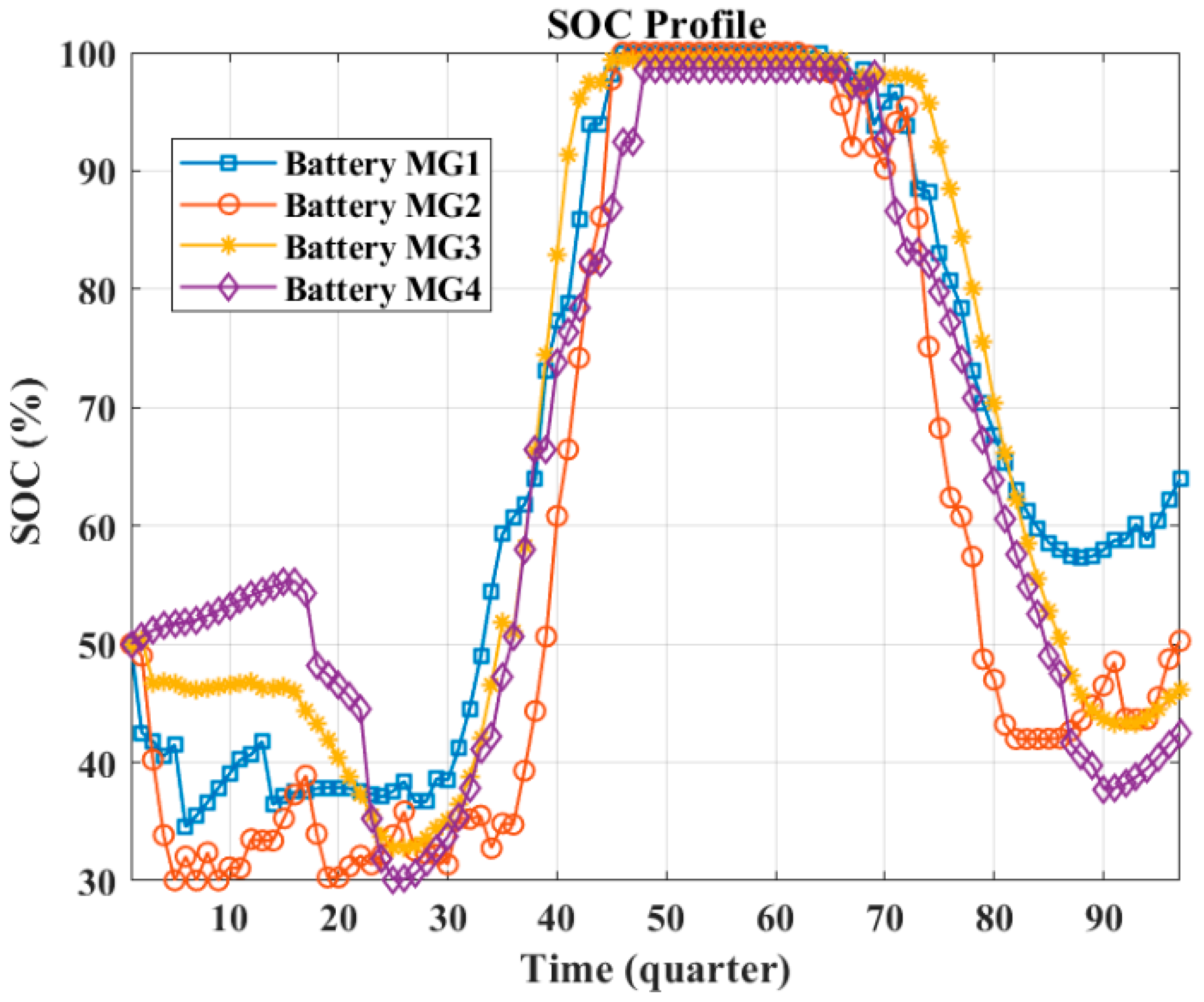
Based on the SOC profile of the batteries in Figure 15, from 00:00 to 6:00, batteries discharge to meet demand, resulting in decreasing SOC. From 6:00 to 15:00, SOC increases as PV energy charges the batteries, this is while the SOC decreases as batteries discharge to meet demand from 15:00 to 18:00. It is observed that from 18:00 to 24:00, SOC further decreases as batteries continue discharge during peak demand hours.

4.2.2. Scenario 2-Case 2: Case 1 Plus MG2 Is Disconnected from MG3 (Results in 2 Separate NMGs (MG1-MG2) and (MG3-MG4))

This case adds the disruption of the connection between MG2 and MG3, resulting in two separate NMGs (MG1-MG2 and MG3-MG4) due to a fault resulting from an ND. The results, shown in Figure 16, Figure 17 and Figure 18, indicate an increased total load not served of 63.8 kWh, as detailed in Table 7, highlighting the sensitivity of the NMG to disruptions in inter-MG links.
According to Figure 16, from 00:00 to 6:00, like Case 1, MGs rely on batteries and DGs. The disconnection of MG2 and MG3 limits energy sharing. From 6:00 to 15:00, PV output is utilized locally, and the disconnected MGs (MG2 and MG3) must manage their energy independently. From 15:00 to 18:00, batteries discharge to meet demand locally, with increased DG usage in isolated MGs. From 18:00 to 24:00, a higher DG usage is observed due to the inability to share energy across disconnected MGs. Batteries continue to be discharged to meet demand.
Figure 17 shows the aggregated energy scheduling of the NMG with disconnected MG2 and MG3. The energy scheduling profile shows more reliance on DGs and batteries within isolated groups and less optimal energy use compared to interconnected scenarios.
Figure 18 shows the SOC levels of batteries with disconnected MG2 and MG3. From 00:00 to 06:00, batteries discharge to meet demand locally. From 6:00 to 15:00, SOC increases with PV charging, but less efficiently than when interconnected. From 15:00 to 18:00, SOC decreases as the batteries discharge. From 18:00 to 24:00, SOC levels dropped significantly due to increased reliance on batteries during peak demand.

4.2.3. Scenario 2-Case 3: Case 1 Plus MG4 Is Disconnected from Other MGs (Results in an NMG (MG1-MG2-MG3) and One Islanded MG (MG4))

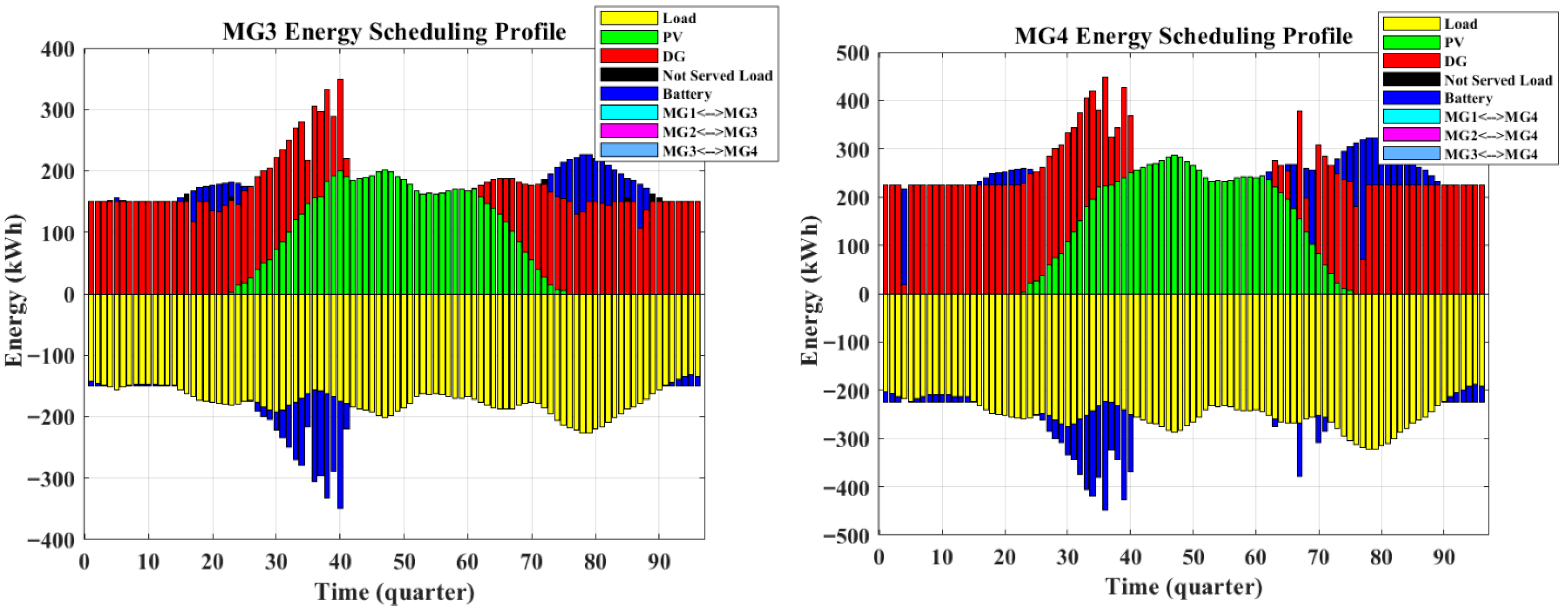
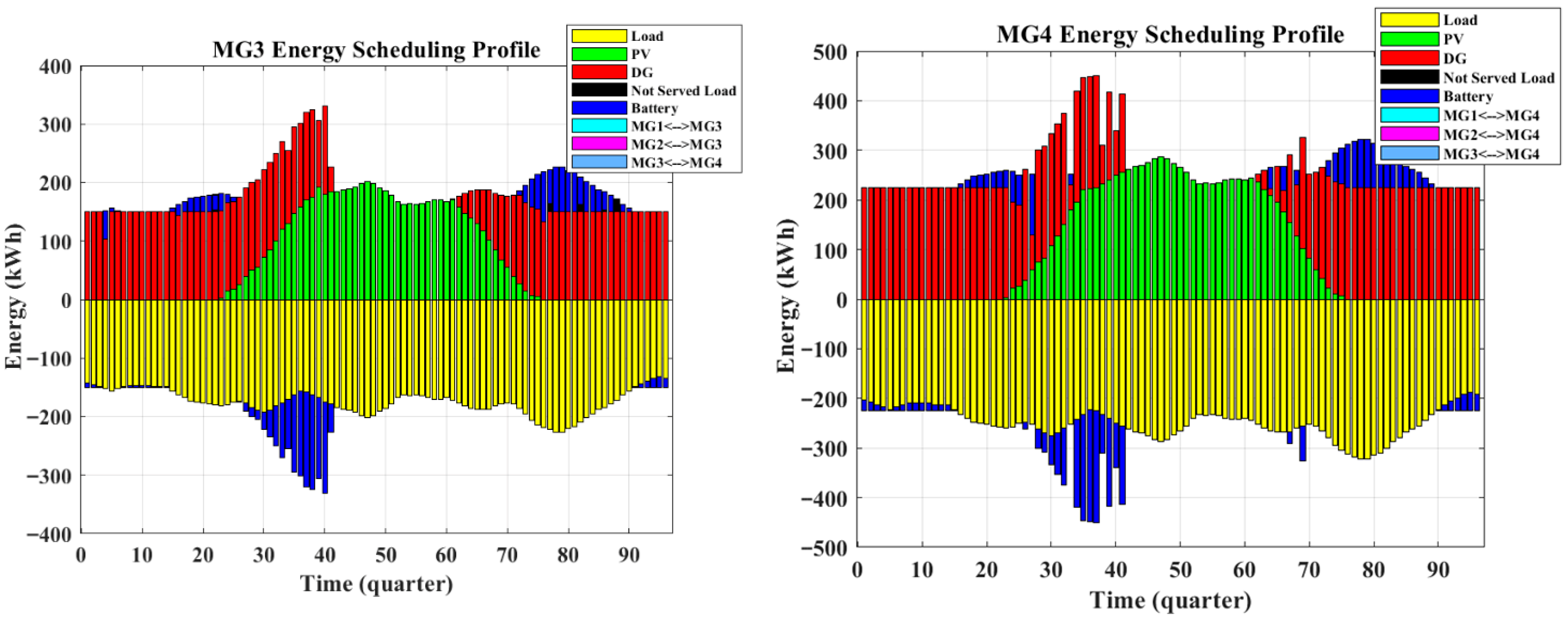
With MG4 isolated from other MGs, the energy scheduling and SOC levels, which are illustrated in Figure 19, Figure 20 and Figure 21, show that MG4 cannot exchange power with other MGs or the main electricity grid. The total load not served, summarized in Table 8, is 64.7 kWh, emphasizing the importance of network robustness. Also, MG1, MG2, and MG3 can only exchange power with each other according to the system topology represented in Figure 1, and it is not possible to exchange power with the main electricity grid.
Figure 19 shows the energy scheduling of MGs when MG4 is isolated. From 00:00 to 6:00, MG4 relies on its DGs and batteries. Other MGs share energy efficiently among themselves. From 6:00 to 15:00, MG4 uses PV output for local demand and battery charging. Other MGs benefit from mutual energy exchange. From 15:00 to 18:00, MG4’s reliance on DGs increases as PV output decreases. Other MGs manage better with shared resources. From 18:00 to 24:00, peak demand leads to increased DG usage and battery discharge in MG4. Other MGs also increase DG usage, but less due to shared resources.
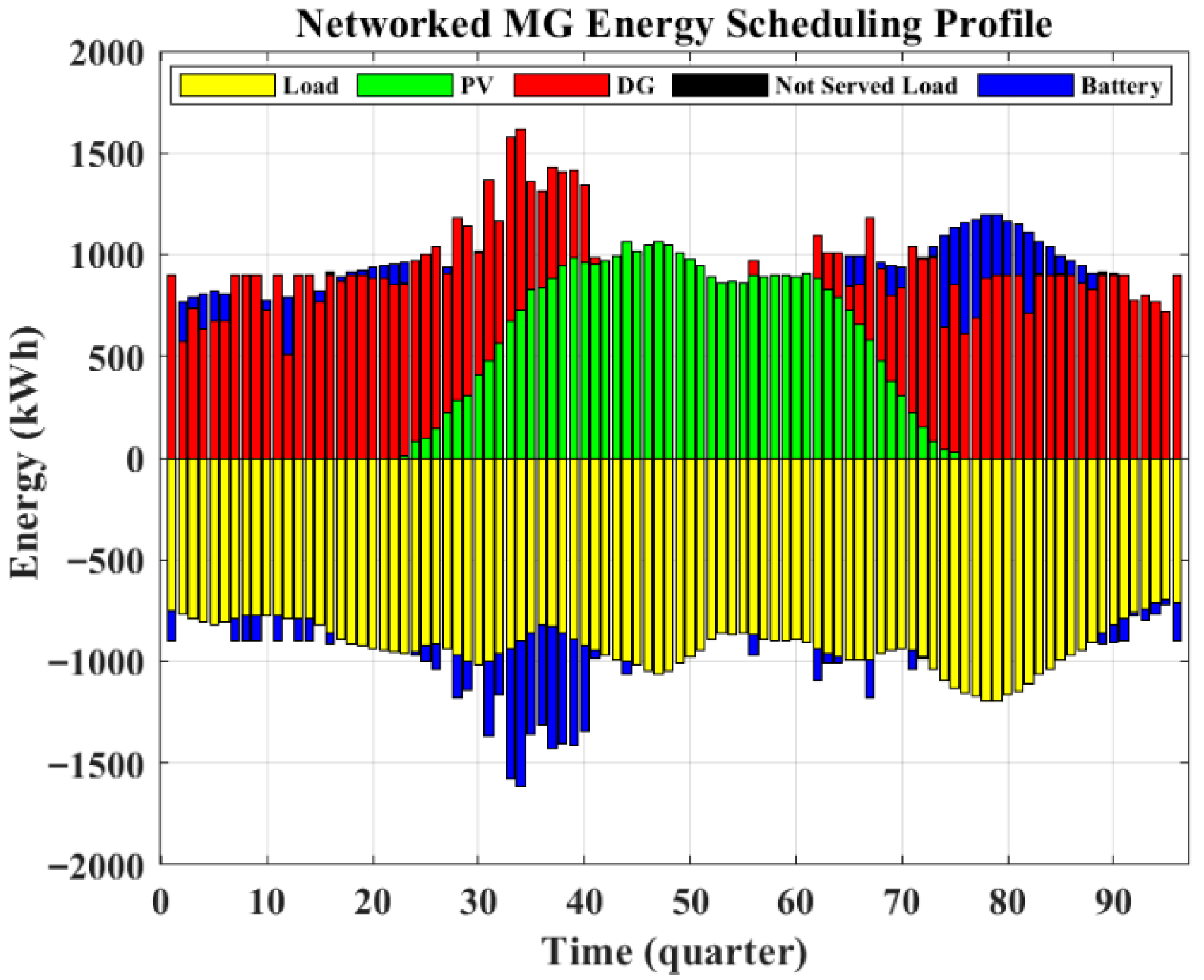
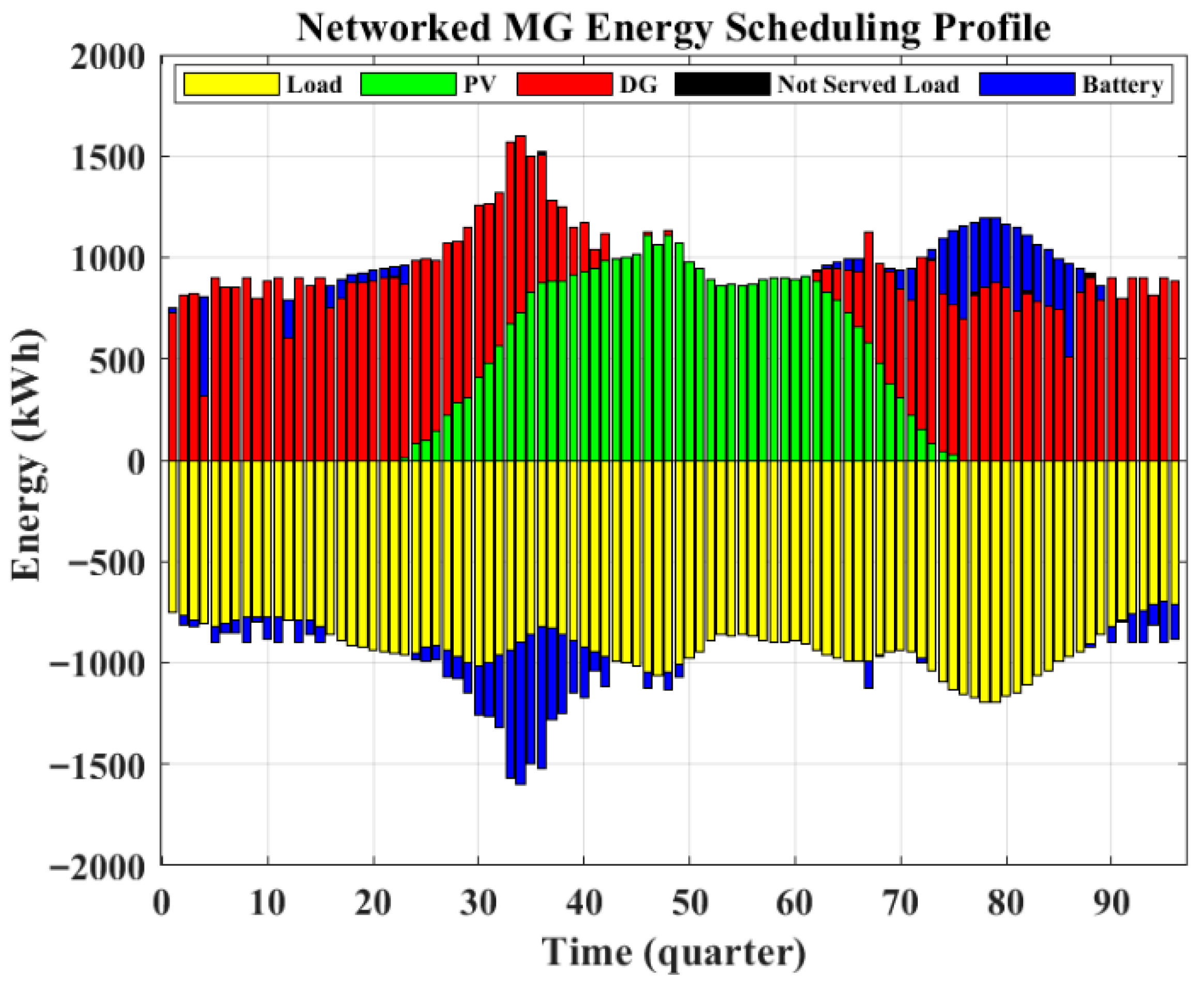
Figure 20 illustrates the aggregated energy scheduling of the NMG with isolated MG4. The energy scheduling shows MG4’s inefficiency in energy use compared to the interconnected MGs. Increased DG usage and less optimal battery usage in MG4 are evident.
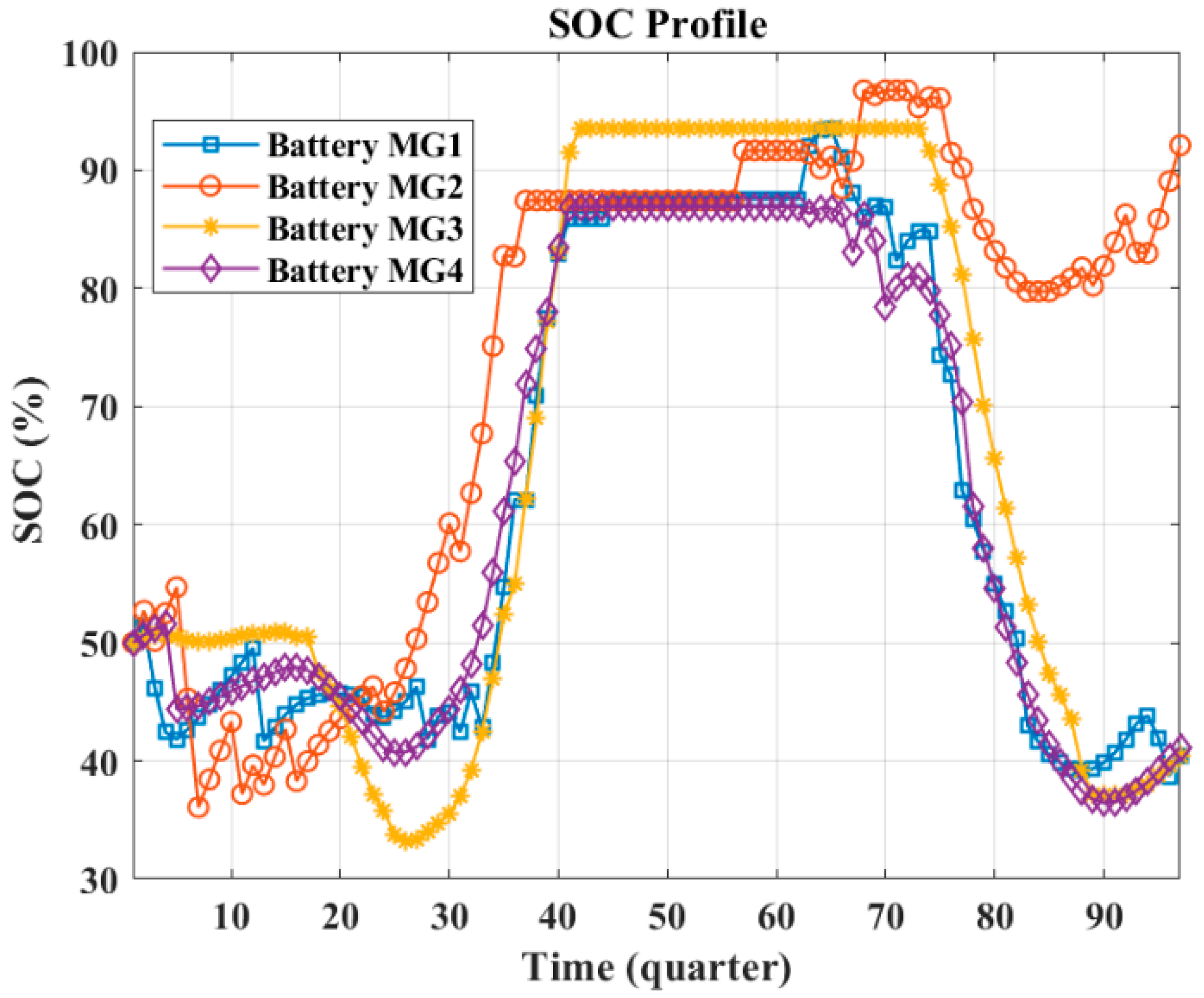
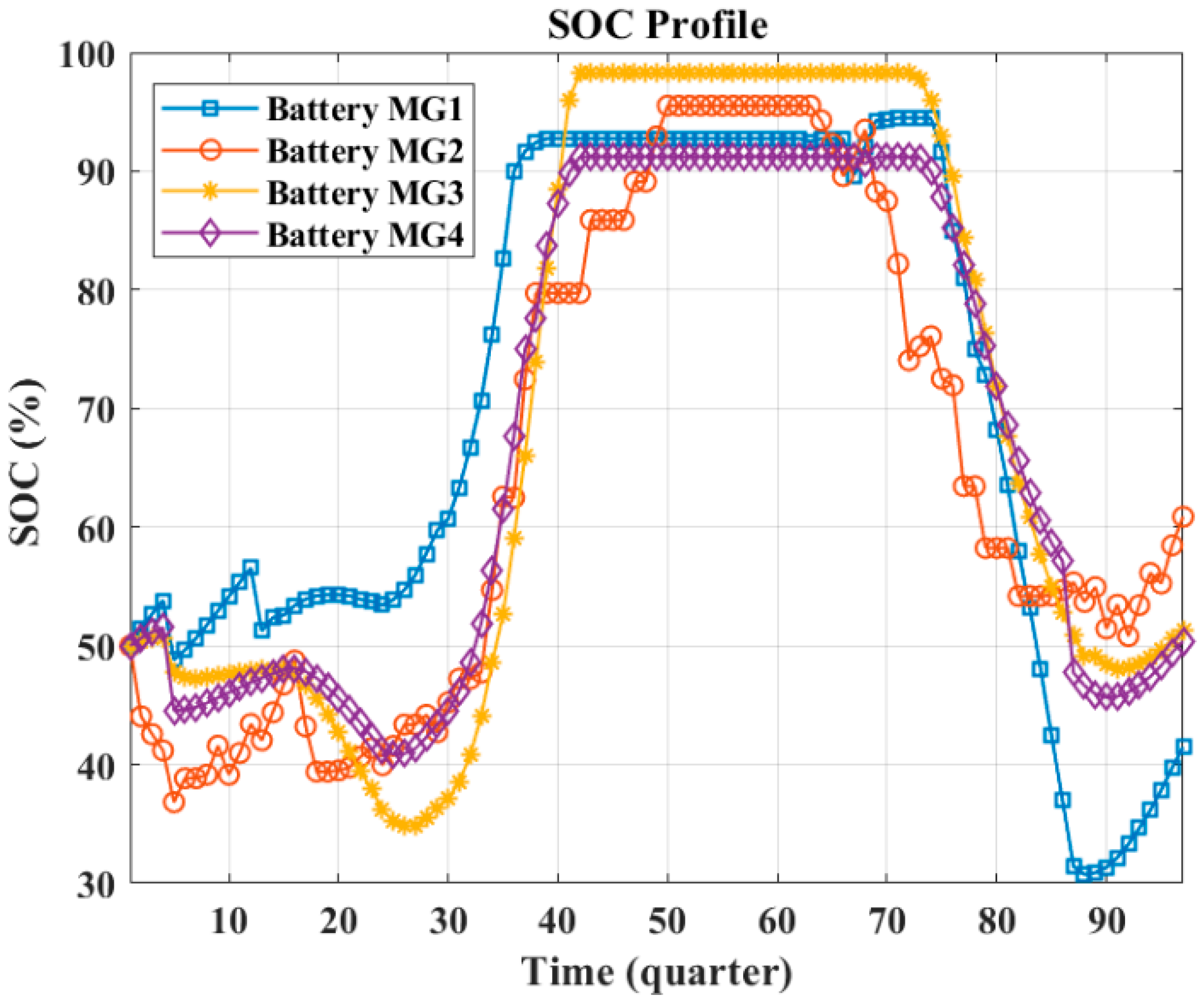
The SOC levels of batteries with isolated MG4 are shown in Figure 21. From 00:00 to 06:00, MG4’s SOC decreases as it discharges to meet demand. From 06:00 to 15:00, SOC increases with PV charging but less efficiently than interconnected MGs. From 15:00 to 18:00, SOC decreases as MG4 discharges batteries. From 18:00 to 24:00, SOC levels drop significantly in MG4 due to high evening demand.

4.2.4. Scenario 2-Case 4: Case 1 Plus MG1 Is Disconnected from Other MGs (Resulting in an NMG (MG2-MG3-MG4) and One Islanded MG (MG1))

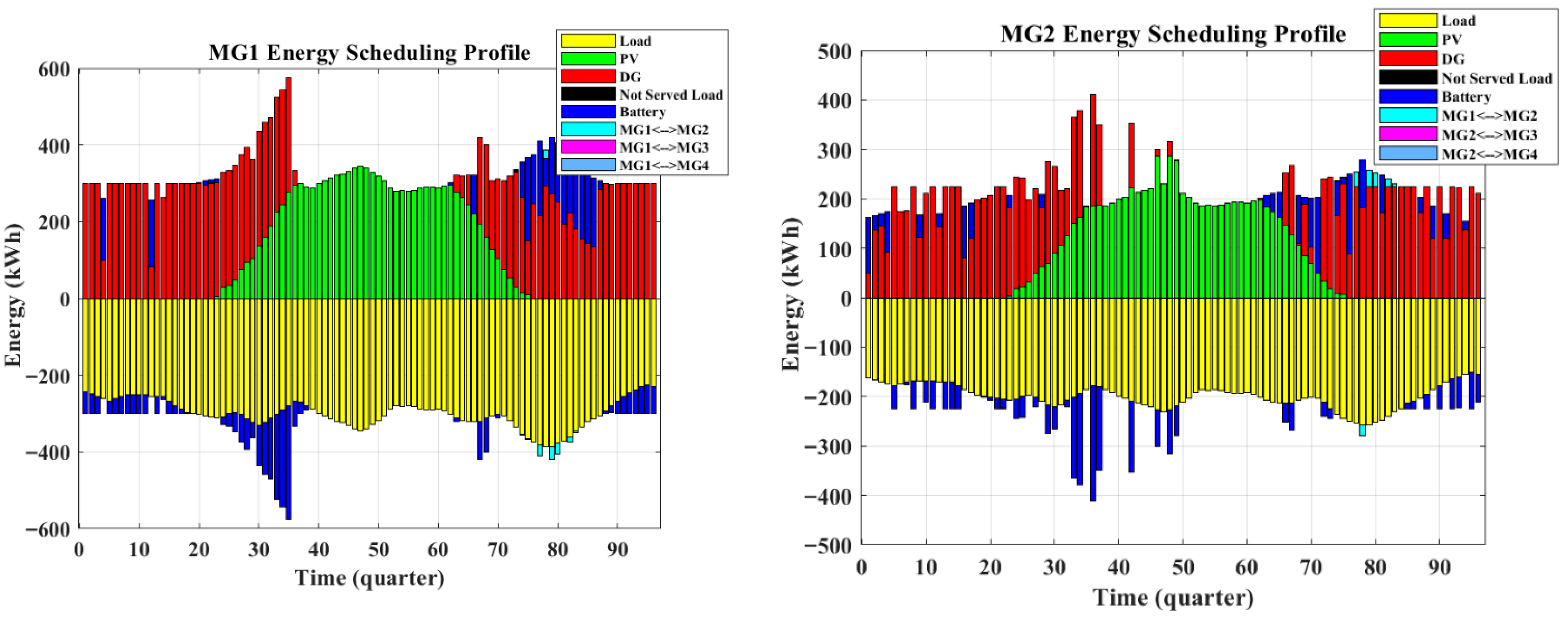
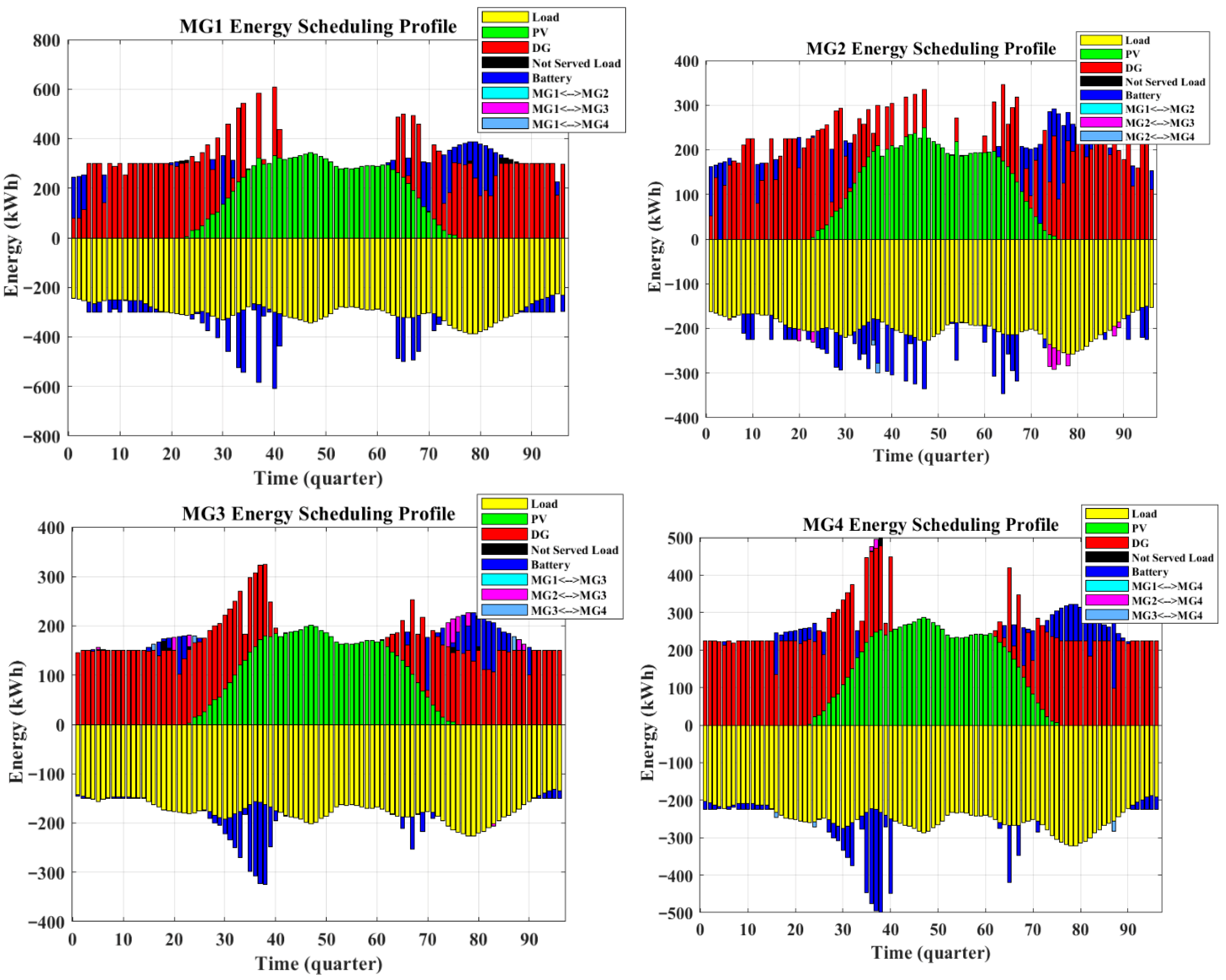
In this case, it is assumed that the electricity grid is not available for the whole day, and MG1 is disconnected from other MGs due to a fault resulting from an ND. Therefore, MG 1 becomes isolated and cannot exchange power with other MGs or the main electricity grid. Also, MG2, MG3, and MG4 can only exchange power with each other according to the system topology represented in Figure 1, and it is not possible to exchange power with the main electricity grid. The power scheduling of the DER units and the SOC level of batteries in each MG of the NMG are shown in Figure 22, Figure 23 and Figure 24. The total load not served, shown in Table 9, rises significantly to 183.1 kWh, underscoring the critical role of interconnectedness for effective load distribution.
The energy scheduling of MGs when MG1 is isolated is shown in Figure 22. It is seen that, from 00:00 to 6:00, MG1 relies on its DGs and batteries. Other MGs operate more efficiently with mutual energy exchange. From 6:00 to 15:00, MG1 uses PV output for local demand and battery charging. Other MGs benefit from energy sharing. From 15:00 to 18:00, MG1’s reliance on DGs increases as PV output decreases. Other MGs manage with shared resources. From 18:00 to 24:00, peak demand increases DG usage and battery discharge in MG1. Other MGs also increase DG usage but maintain some efficiency through energy sharing.
The aggregated energy scheduling of the NMG with isolated MG1 is illustrated in Figure 23. The energy scheduling shows MG1’s less efficient energy management compared to the interconnected MGs. Increased DG usage and less optimal battery usage in MG1 are clear.
Figure 24 shows the SOC levels of batteries with isolated MG1. From 00:00 to 6:00, MG1’s SOC decreases as it discharges to meet demand. From 6:00 to 15:00, SOC increases with PV charging but less efficiently than interconnected MGs. From 15:00 to 18:00, SOC decreases as MG1 discharges batteries. From 18:00 to 24:00, SOC levels drop significantly in MG1 due to high evening demand.

4.2.5. Scenario 2-Case 5: The Interconnection Among All MGs Is Disrupted (Results in 4 Separate MGs, Each of Which Works Separately)

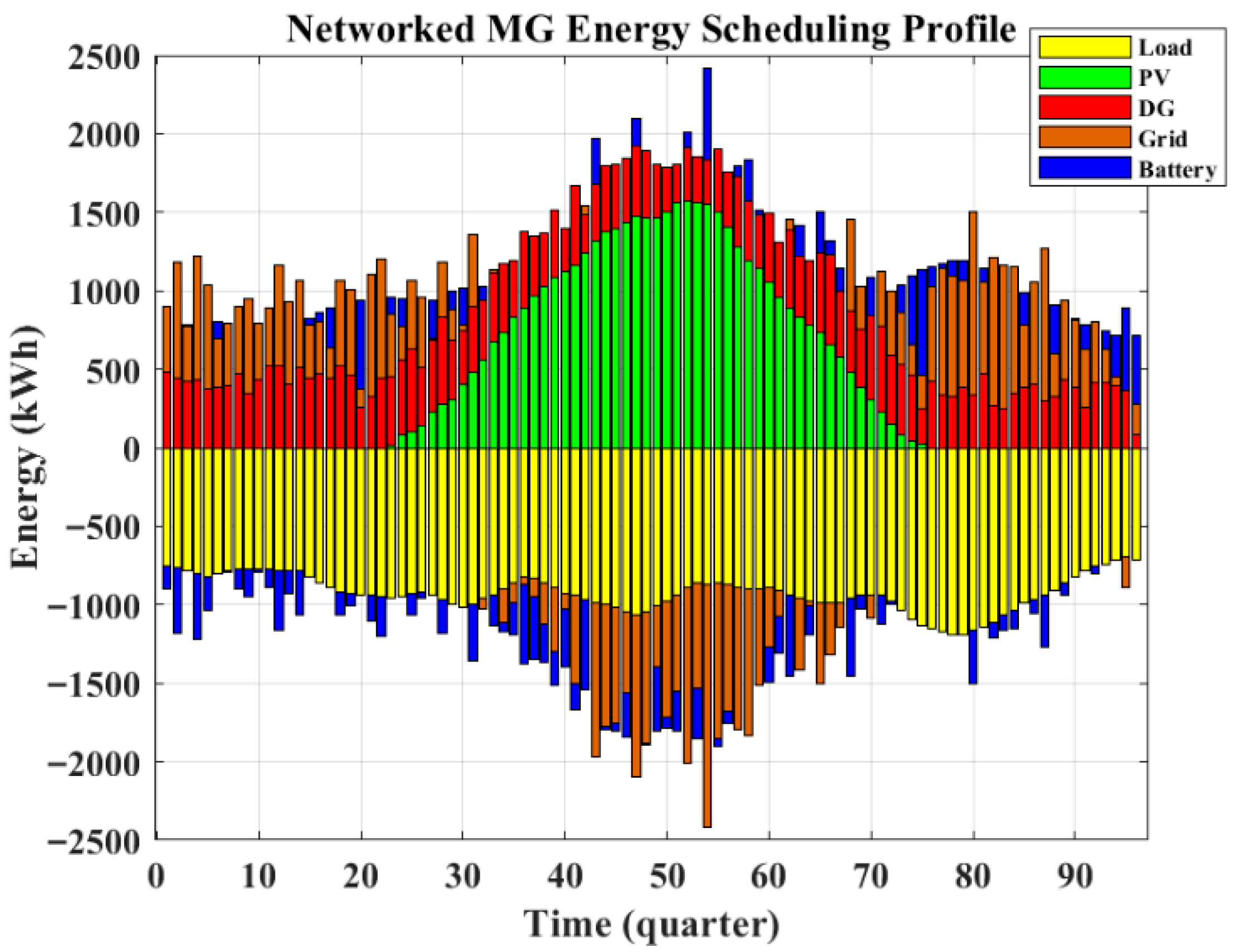
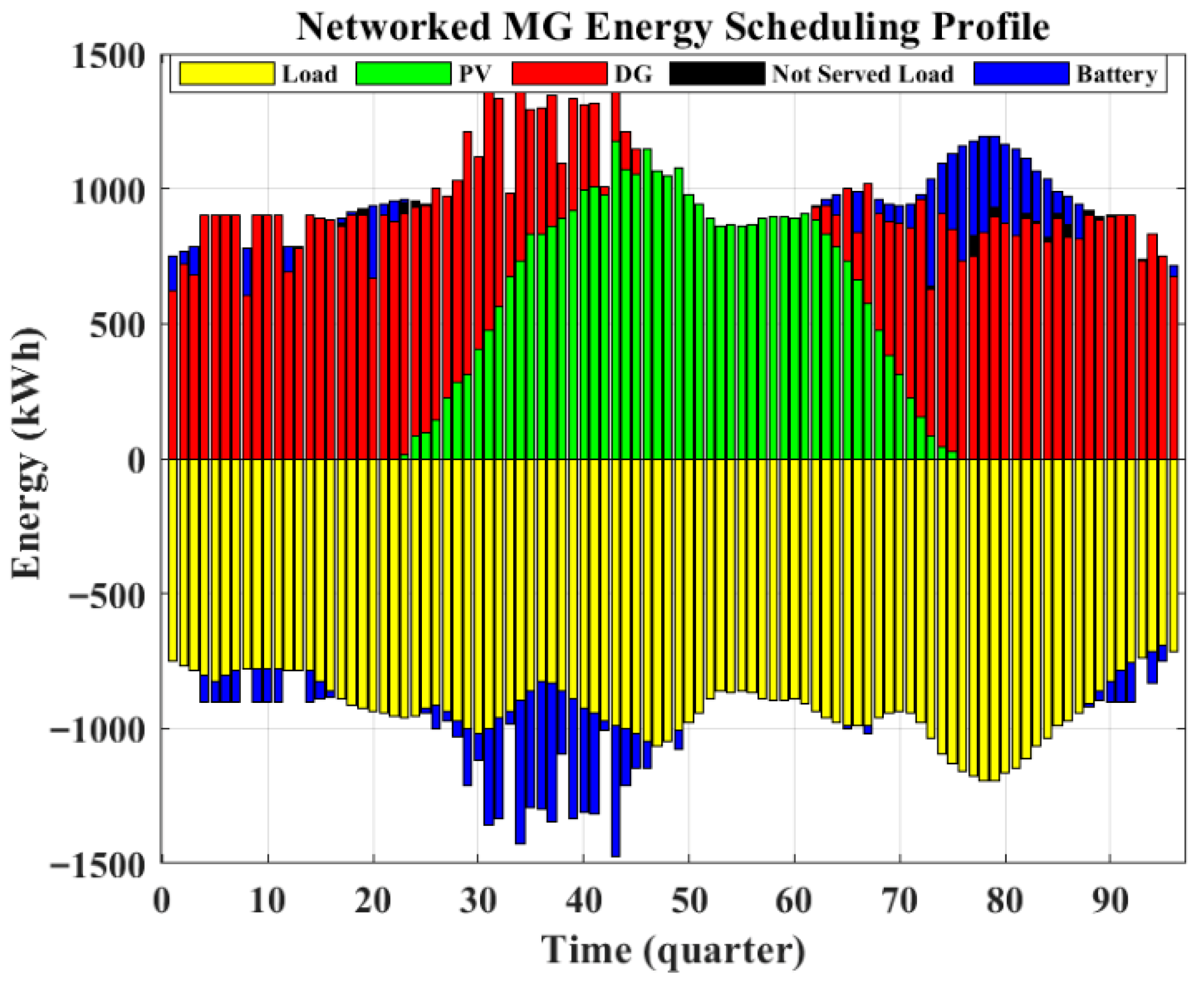
The most extreme scenario, where all MGs are isolated, (the interconnection among all MGs is disrupted due to a fault resulting from an ND. Therefore, the system is divided into four individual MGs without any power exchange between them and the main grid.) is depicted in Figure 25, Figure 26 and Figure 27. The total load not served peaks at 366.3 kWh, as shown in Table 10, revealing that the resilience of multiple MGs will improve when they are operating as a networked system. It should be mentioned that, since the operating cost reported in Table 10 includes DG unit operational costs but excludes the penalty for load-not-served, even when no load is curtailed (ENS = 0), MG4 may still incur operating costs due to local generation.
The energy scheduling of MGs when all MGs are isolated is shown in Figure 25. From 00:00 to 6:00, each MG relies solely on its DGs and batteries without the possibility to share energy with other MGs. From 6:00 to 15:00, PV output is used locally within each MG for demand and battery charging (no benefit from energy sharing). From 15:00 to 18:00, each MG increases DG usage as PV output decreases, with a high reliance on local batteries. From 18:00 to 24:00, peak demand results in increased DG usage and battery discharge in all MGs. Severe inefficiency due to a lack of coordination is observed.
The aggregated energy scheduling of the fully isolated MGs is shown in Figure 26. The overall scheduling highlights severe inefficiency, with each MG managing independently. The highest DG usage and most significant unmet load are evident.
Figure 27 shows the SOC levels of batteries with all MGs isolated. From 00:00 to 6:00, SOC decreases in all MGs as batteries discharge to meet local demand. From 06:00 to 15:00, SOC increases with PV charging but far less efficiently due to isolation. From 15:00 to 18:00, SOC decreases as batteries discharge locally. From 18:00 to 24:00, SOC levels drop significantly in all MGs due to high evening demand and no energy sharing.
In Scenario 2, the investigation into load not served reveals varying degrees of unmet demand under different conditions when the electricity grid is unavailable. A comparison of the total load not served in different considered fault cases is shown in Table 10. The baseline case (Case 1) without any loss in inter-MG connections results in a moderate load not served of 31.7 kWh, showcasing the NMG’s capacity to handle a certain level of load during grid outages and absorb the negative impacts of NDs. Introducing a disruption in the connection between MG2 and MG3 (Case 2) increases the load not served to 63.8 kWh, emphasizing the sensitivity of the NMG to disruptions in inter-MG links. Further disruption in connections between MG4 and other MGs (Case 3) led to a rise in load not served to 64.7 kWh, underscoring the importance of network robustness. A substantial disconnection specifically between MG1 and other MGs (Case 4) results in a significant increase in load not served (183.1 kWh), highlighting the critical role of interconnectedness for effective load distribution. The most extreme scenario, the disconnection of all MGs (Case 5), peaks at 366.3 kWh, revealing the vulnerability of the NMG to complete isolation.
To summarize the results of the considered abnormal operating cases, Table 11 compares the total load not served and the total operating cost across the studied fault scenarios. An important observation is that even when the load not served increases (indicating more unmet demand), the operating cost can sometimes be lower. This happens because the cost values in Table 11 do not include the penalty for the load not served. In other words, when more load is curtailed, the system may avoid the extra costs associated with ramping up local generation or battery discharge to meet every unit of demand. This “savings” is reflected as a reduction in the operating cost, even though, from a system performance perspective, failing to meet demand is undesirable. If the penalty cost were added, the economic impact of load curtailment would become evident, and scenarios with higher unmet demand would show a higher total cost.

5. Conclusions

This study presented a multi-objective, resilience-oriented energy management framework for NMGs, aiming to jointly minimize operational cost, load-not-served, and environmental impact under both normal and disaster-induced abnormal operating conditions. By formulating the problem within a multi-objective optimization framework and applying the parameter-free MJAYA algorithm, the results demonstrate that coordinated operation among interconnected MGs can substantially enhance system resilience, even under severe disruption scenarios.
The scenario-based analysis revealed that disruptions to grid access and inter-MG connectivity have a pronounced impact on system performance, highlighting the critical importance of cooperative MG operation during natural disaster events. In particular, maintaining interconnections among MG reduced the total load-not-served from 366.3 kWh in fully isolated operation to 31.7 kWh under coordinated operation, quantitatively illustrating the resilience benefits of NMG structures. These findings provide actionable insights for the design and operation of MG networks in disaster-prone regions such as Lombok Island and contribute to the broader objective of strengthening community-level energy resilience.
It should be noted that this work focuses on offline, scenario-based resilience assessment rather than real-time operational control. Battery capacities, generation limits, and cost parameters are assumed to be fixed and representative of an existing system configuration, and uncertainties related to fuel prices, renewable degradation, and forecasting errors are not explicitly modeled. Moreover, as a meta-heuristic optimization approach is employed, global optimality guarantees are not claimed; instead, the framework is designed to enable consistent comparative analysis across multiple disruption scenarios, which is the primary objective of this study.
Future research may extend this framework in several directions. Methodologically, integrating stochastic or robust optimization techniques could enable explicit consideration of uncertainties in renewable generation, load demand, and fuel prices. From a system modeling perspective, the inclusion of electric vehicles, mobile or distributed storage technologies, and demand response programs could further enhance operational flexibility and resilience. Future work may also explore reformulating the proposed model as a mixed-integer quadratic program (MIQP) and solving reduced-scale instances with exact solvers to quantify optimality gaps. Additionally, investigating the impact of communication reliability, cybersecurity threats, and decentralized control architectures would provide a more comprehensive assessment of NMG resilience under extreme events. Finally, planning-level extensions that jointly optimize infrastructure sizing, network topology, and policy incentives could support the scalable deployment of resilient MG clusters and inform long-term energy planning strategies in vulnerable regions.

Author Contributions

Conceptualization, M.J., H.P.A. and N.B.; methodology, M.J. and H.P.A.; software, M.J. and H.P.A.; validation, M.J. and H.P.A.; formal analysis, M.J. and H.P.A.; investigation, M.J.; resources, M.J.; data curation, M.J.; writing—original draft preparation, M.J. and H.P.A.; writing—review and editing, M.J., H.P.A. and N.B.; visualization, M.J. and H.P.A.; supervision, J.C.V. and J.M.G.; project administration, J.C.V.; funding acquisition, J.C.V. and J.M.G. All authors have read and agreed to the published version of the manuscript.

Funding

This research was funded by the Ministry of Foreign Affairs of Denmark, DANIDA Fellowship Centre (Project No. 20-M06-AAU), and supported by the Danida Fellowship Centre. https://www.energy.aau.dk/research/research-groups/crom/research-and-projects/microgrid-technologies-for-remote-indonesian-islands-tech-in (accessed on 7 January 2025). J. M. Guerrero was supported by VILLUM FONDEN under the VILLUM Investigator Grant (no. 25920): Center for Research on Microgrids (CROM).

Data Availability Statement

The original contributions presented in this study are included in the article. Further inquiries can be directed to the corresponding author.

Conflicts of Interest

The authors declare no conflicts of interest.

References

  1. Davoudkhani, I.F.; Dejamkhooy, A.; Nowdeh, S.A. A novel cloud-based framework for optimal design of stand-alone hybrid renewable energy system considering uncertainty and battery aging. Appl. Energy 2023, 344, 121257. [Google Scholar] [CrossRef]
  2. Shotorbani, A.M.; Zeinal-Kheiri, S.; Chhipi-Shrestha, G.; Mohammadi-Ivatloo, B.; Sadiq, R.; Hewage, K. Enhanced real-time scheduling algorithm for energy management in a renewable-integrated microgrid. Appl. Energy 2021, 304, 117658. [Google Scholar] [CrossRef]
  3. Zia, M.F.; Elbouchikhi, E.; Benbouzid, M. Microgrids energy management systems: A critical review on methods, solutions, and prospects. Appl. Energy 2018, 222, 1033–1055. [Google Scholar] [CrossRef]
  4. Javidsharifi, M.; Niknam, T.; Aghaei, J.; Mokryani, G. Multi-objective short-term scheduling of a renewable-based microgrid in the presence of tidal resources and storage devices. Appl. Energy 2018, 216, 367–381. [Google Scholar] [CrossRef]
  5. de la Hoz, J.; Martín, H.; Alonso, A.; Luna, A.C.; Matas, J.; Vasquez, J.C.; Guerrero, J.M. Regulatory-framework-embedded energy management system for microgrids: The case study of the Spanish self-consumption scheme. Appl. Energy 2019, 251, 113374. [Google Scholar] [CrossRef]
  6. Carpinelli, G.; Di Fazio, A.R.; Perna, S.; Russo, A.; Russo, M. A-priori multi-objective optimization for the short-term dispatch of distributed energy resources. Int. J. Electr. Power Energy Syst. 2025, 164, 110410. [Google Scholar] [CrossRef]
  7. Vásquez, L.O.P.; Redondo, J.L.; Hervás, J.D.Á.; Ramírez, V.M.; Torres, J.L. Balancing CO2 emissions and economic cost in a microgrid through an energy management system using MPC and multi-objective optimization. Appl. Energy 2023, 347, 120998. [Google Scholar] [CrossRef]
  8. Wang, J.; Yao, L.; Liang, J.; Wang, J.; Cheng, F. Distributed optimization strategy for networked microgrids based on network partitioning. Appl. Energy 2025, 378, 124834. [Google Scholar] [CrossRef]
  9. Mansour-Saatloo, A.; Pezhmani, Y.; Mirzaei, M.A.; Mohammadi-Ivatloo, B.; Zare, K.; Marzband, M.; Anvari-Moghaddam, A. Robust decentralized optimization of multi-microgrids integrated with power-to-X technologies. Appl. Energy 2021, 304, 117635. [Google Scholar] [CrossRef]
  10. Karavas, C.S.G.; Plakas, K.A.; Krommydas, K.F.; Kurashvili, A.S.; Dikaiakos, C.N.; Papaioannou, G.P. A review of wide-area monitoring and damping control systems in Europe. In Proceedings of the 2021 IEEE Madrid PowerTech, Madrid, Spain, 28 June–2 July 2021; pp. 1–6. [Google Scholar]
  11. Boglou, V.; Karavas, C.S.; Karlis, A.; Arvanitis, K.G.; Palaiologou, I. An Optimal Distributed RES Sizing Strategy in Hybrid Low Voltage Networks Focused on EVs’ Integration. IEEE Access 2023, 11, 16250–16270. [Google Scholar] [CrossRef]
  12. Boglou, V.; Karavas, C.S.; Karlis, A.; Arvanitis, K. An intelligent decentralized energy management strategy for the optimal electric vehicles’ charging in low-voltage islanded microgrids. Int. J. Energy Res. 2022, 46, 2988–3016. [Google Scholar] [CrossRef]
  13. Rodrigues, S.D.; Garcia, V.J. Transactive energy in microgrid communities: A systematic review. Renew. Sustain. Energy Rev. 2023, 171, 112999. [Google Scholar] [CrossRef]
  14. Mehrabanifar, K.; Shayeghi, H.; Younesi, A.; Siano, P. Enhancing Modern Distribution System Resilience: A Comprehensive Two-Stage Approach for Mitigating Climate Change Impact. Smart Cities 2025, 8, 76. [Google Scholar] [CrossRef]
  15. Babu, V.V.; Roselyn, J.P.; Sundaravadivel, P. Multi-objective genetic algorithm-based energy management system considering optimal utilization of grid and degradation of battery storage in microgrid. Energy Rep. 2023, 9, 5992–6005. [Google Scholar] [CrossRef]
  16. AlOwaifeer, M.; Alamri, A.; Meliopoulos, A.S. Microgrid energy management system for normal and emergency operating conditions. In Proceedings of the 2019 North American Power Symposium (NAPS), Wichita, KS, USA, 13–15 October 2019. [Google Scholar]
  17. Yankson, S.; Ullah, S.S.; Ebrahimi, S.; Ferdowsi, F.; Ritter, K.A.; Chambers, T. Resilience-Enabling Load Flexibility and Resource Adequacy Investment in Microgrids. In Proceedings of the 2023 IEEE Texas Power and Energy Conference (TPEC), College Station, TX, USA, 13–14 February 2023. [Google Scholar]
  18. Suresh, V.; Janik, P.; Jasinski, M.; Guerrero, J.M.; Leonowicz, Z. Microgrid energy management using metaheuristic optimization algorithms. Appl. Soft Comput. 2023, 134, 109981. [Google Scholar] [CrossRef]
  19. Sefidgar-Dezfouli, A.; Joorabian, M.; Mashhour, E. A multiple chance-constrained model for optimal scheduling of microgrids considering normal and emergency operation. Int. J. Electr. Power Energy Syst. 2019, 112, 370–380. [Google Scholar] [CrossRef]
  20. Park, S.H.; Hussain, A.; Kim, H.M. Impact analysis of survivability-oriented demand response on islanded operation of networked microgrids with high penetration of renewables. Energies 2019, 12, 452. [Google Scholar] [CrossRef]
  21. Aghdam, F.H.; Kalantari, N.T.; Mohammadi-Ivatloo, B. A stochastic optimal scheduling of multi-microgrid systems considering emissions: A chance constrained model. J. Clean. Prod. 2020, 275, 122965. [Google Scholar] [CrossRef]
  22. Rezaei, N.; Pezhmani, Y.; Khazali, A. Economic-environmental risk-averse optimal heat and power energy management of a grid-connected multi microgrid system considering demand response and bidding strategy. Energy 2022, 240, 122844. [Google Scholar] [CrossRef]
  23. Pakdel, M.J.V.; Sohrabi, F.; Mohammadi-Ivatloo, B. Multi-objective optimization of energy and water management in networked hubs considering transactive energy. J. Clean. Prod. 2020, 266, 121936. [Google Scholar] [CrossRef]
  24. Xing, X.; Xie, L.; Meng, H. Cooperative energy management optimization based on distributed MPC in grid-connected microgrids community. Int. J. Electr. Power Energy Syst. 2019, 107, 186–199. [Google Scholar] [CrossRef]
  25. Jani, A.; Karimi, H.; Jadid, S. Hybrid energy management for islanded networked microgrids considering battery energy storage and wasted energy. J. Energy Storage 2021, 40, 102700. [Google Scholar] [CrossRef]
  26. Karimi, H.; Jadid, S. Optimal energy management for multimicrogrid considering demand response programs: A stochastic multiobjective framework. Energy 2020, 195, 116992. [Google Scholar] [CrossRef]
  27. Bahmani, R.; Karimi, H.; Jadid, S. Cooperative energy management of multi-energy hub systems considering demand response programs and ice storage. Int. J. Electr. Power Energy Syst. 2021, 130, 106904. [Google Scholar] [CrossRef]
  28. Khavari, F.; Badri, A.; Zangeneh, A. Energy management in multimicrogrids considering point of common coupling constraint. Int. J. Electr. Power Energy Syst. 2020, 115, 105465. [Google Scholar] [CrossRef]
  29. Tan, M.; Zhou, Y.; Wang, L.; Su, Y.; Duan, B.; Wang, R. Fair-efficient energy trading for microgrid cluster in an active distribution network. Sustain. Energy Grids Netw. 2021, 26, 100453. [Google Scholar] [CrossRef]
  30. Karimi, H.; Jadid, S. Two-stage economic, reliability, and environmental scheduling of multi-microgrid systems and fair cost allocation. Sustain. Energy Grids Netw. 2021, 28, 100546. [Google Scholar] [CrossRef]
  31. Karimi, H.; Jadid, S. A strategy-based coalition formation model for hybrid wind/PV/FC/MT/DG/battery multi-microgrid systems considering demand response programs. Int. J. Electr. Power Energy Syst. 2022, 136, 107642. [Google Scholar] [CrossRef]
  32. Karimi, H.; Jadid, S.; Makui, A. Stochastic energy scheduling of multi-microgrid systems considering independence performance index and energy storage systems. J. Energy Storage 2021, 33, 102083. [Google Scholar] [CrossRef]
  33. Han, D.; Lee, J.H. Two-stage stochastic programming formulation for optimal design and operation of multi-microgrid system using data-based modeling of renewable energy sources. Appl. Energy 2021, 291, 116830. [Google Scholar] [CrossRef]
  34. Qu, Z.; Chen, J.; Peng, K.; Zhao, Y.; Rong, Z.; Zhang, M. Enhancing stochastic multimicrogrid operational flexibility with mobile energy storage system and power transaction. Sustain. Cities Soc. 2021, 71, 102962. [Google Scholar] [CrossRef]
  35. Tan, B.; Chen, H. Multi-objective energy management of multiple microgrids under random electric vehicle charging. Energy 2020, 208, 118360. [Google Scholar] [CrossRef]
  36. Zargar, R.H.M.; Yaghmaee, M.H. Energy exchange cooperative model in SDNbased interconnected multi-microgrids. Sustain. Energy Grids Netw. 2021, 27, 100491. [Google Scholar] [CrossRef]
  37. Sadeghi Sarcheshmeh, M.; Taher, S.A.; Mazidi, M. A stochastic frequency security constrained optimization model for day-ahead energy and reserve scheduling of islanded multi-microgrids systems. Int. Trans. Electr. Energy Syst. 2020, 30, e12386. [Google Scholar] [CrossRef]
  38. Afrakhte, H.; Bayat, P. A contingency based energy management strategy for multimicrogrids considering battery energy storage systems and electric vehicles. J. Energy Storage 2020, 27, 101087. [Google Scholar] [CrossRef]
  39. Rezaei, N.; Pezhmani, Y. Optimal islanding operation of hydrogen integrated multi-microgrids considering uncertainty and unexpected outages. J. Energy Storage 2022, 49, 104142. [Google Scholar] [CrossRef]
  40. Liu, Y.; Wang, Y.; Li, Y.; Gooi, H.B.; Xin, H. Multi-agent based optimal scheduling and trading for multi-microgrids integrated with urban transportation networks. IEEE Trans. Power Syst. 2020, 36, 2197–2210. [Google Scholar] [CrossRef]
  41. Javidsharifi, M.; Pourroshanfekr Arabani, H.; Kerekes, T.; Sera, D.; Guerrero, J.M. Stochastic optimal strategy for power management in interconnected multi-microgrid systems. Electronics 2022, 11, 1424. [Google Scholar] [CrossRef]
  42. Cui, Y.; Xu, Y.; Li, Y.; Wang, Y.; Zou, X. Deep reinforcement learning based optimal energy management of multi-energy microgrids with uncertainties. CSEE J. Power Energy Syst. 2024; in press. [Google Scholar]
  43. Lee, S.; Seon, J.; Sun, Y.G.; Kim, S.H.; Kyeong, C.; Kim, D.I.; Kim, J.Y. Novel architecture of energy management systems based on deep reinforcement learning in microgrid. IEEE Trans. Smart Grid 2023, 15, 1646–1658. [Google Scholar] [CrossRef]
  44. Meng, Q.; Hussain, S.; Luo, F.; Wang, Z.; Jin, X. An online reinforcement learning-based energy management strategy for microgrids with centralized control. IEEE Trans. Ind. Appl. 2024, 16, 1501–1510. [Google Scholar] [CrossRef]
  45. Li, Y.; Chang, W.; Yang, Q. Deep reinforcement learning based hierarchical energy management for virtual power plant with aggregated multiple heterogeneous microgrids. Appl. Energy 2025, 382, 125333. [Google Scholar] [CrossRef]
  46. Ullah, S.S.; Yankson, S.; Ebrahimi, S.; Ferdowsi, F.; Chambers, T. Smart investment framework for energy resilience: A case study of a campus microgrid research facility. Next Energy 2024, 4, 100131. [Google Scholar] [CrossRef]
  47. Ullah, S.S.; Sheida, K.; Ferdowsi, F.; Chambers, T. Cost-aware strategies for enhancing energy resilience in microgrids via stationary and mobile resources. J. Saf. Sci. Resil. 2025, 6, 163–174. [Google Scholar] [CrossRef]
  48. Ma, C.; Lei, S.; Chen, D.; Wang, C.; Hatziargyriou, N.D.; Song, Z. Sequential service restoration with grid-interactive flexibility from building AC systems for resilient microgrids under endogenous and exogenous uncertainties. Appl. Energy 2025, 377, 124351. [Google Scholar] [CrossRef]
  49. Javidsharifi, M.; Bazmohammadi, N.; Pourroshanfekr Arabani, H.; Vasquez, J.C.; Guerrero, J.M. Environmental–Economic Analysis of Multi-Node Community Microgrid Operation in Normal and Abnormal Conditions—A Case Study of Indonesia. Sustainability 2023, 15, 16625. [Google Scholar] [CrossRef]
  50. Masrur, H.; Islam, M.R.; Muttaqi, K.M.; Gamil, M.M.; Huang, Y.; Senjyu, T. Resilience-aware Optimal Design and Energy Management Scheme of Multi-Energy Microgrids. In Proceedings of the 2021 IEEE Industry Applications Society Annual Meeting (IAS), Vancouver, BC, Canada, 10–14 October 2021; IEEE: New York, NY, USA, 2021; pp. 1–5. [Google Scholar]
  51. Shen, Y.; Wang, G.; Zhu, J. Resilience improvement model of distribution network based on two-stage robust optimization. Electr. Power Syst. Res. 2023, 223, 109559. [Google Scholar] [CrossRef]
  52. Zhou, A.; Wang, J.; Khodayar, M.E. Optimal Scheduling for Networked Microgrids Considering Back-to-Back MVDC Systems. IEEE Trans. Smart Grid 2025, 16, 2000–2011. [Google Scholar] [CrossRef]
  53. Cambambi, C.A.; Canha, L.N.; Sperandio, M.; Rangel, C.; Milani, I.P. Energy exchange optimization among multiple geolocated microgrids: A coalition formation approach for cost reduction. Appl. Energy 2025, 379, 124902. [Google Scholar] [CrossRef]
  54. Mortazavi, N.; Alizadeh, B.; Sahab, A.; Barzegar, S.M.S. Risk-Based planning and partitioning of multiple micro-grids in distribution systems. Int. J. Electr. Power Energy Syst. 2022, 137, 107659. [Google Scholar] [CrossRef]
  55. Samadi Gharehveran, S. A Review of Energy Management of Multi-microgrid Power Systems in the Presence of Uncertainty of Distributed Generation Resources. Power Control Data Process. Syst. 2025, 2, 46–58. [Google Scholar]
  56. Mishra, S.; Kwasnik, T.; Anderson, K. Microgrid resilience: A holistic and context-aware resilience metric. Energy Syst. 2023, 14, 1081–1105. [Google Scholar] [CrossRef]
  57. Gholami, M.; Muyeen, S.M.; Mousavi, S.A. Development of new reliability metrics for microgrids: Integrating renewable energy sources and battery energy storage system. Energy Rep. 2023, 10, 2251–2259. [Google Scholar] [CrossRef]
  58. Millions Affected by Major Blackout to Be Compensated: PLN-Business-the Jakarta Post. Available online: https://www.thejakartapost.com/news/2019/08/05/millions-affected-by-major-blackout-to-be-compensated-pln.html (accessed on 22 August 2023).
  59. Kang, W.; Guan, Y.; Danang Wijaya, F.; Kondorura Bawan, E.; Priyo Perdana, A.; Vasquez, J.C.; Guerrero, J.M. Community microgrid planning in Lombok Island: An Indonesian case study. Front. Energy Res. 2023, 11, 1209875. [Google Scholar] [CrossRef]
  60. Rao, R. Jaya: A simple and new optimization algorithm for solving constrained and unconstrained optimization problems. Int. J. Ind. Eng. Comput. 2016, 7, 19–34. [Google Scholar] [CrossRef]
  61. Available online: https://www.tech-in.energy.aau.dk (accessed on 7 January 2025).
  62. Statistik PLN. Available online: https://web.pln.co.id/statics/uploads/2022/08/Statistik-PLN-2021-29-7-22-Final.pdf (accessed on 6 February 2025).
  63. Javidsharifi, M.; Pourroshanfekr, H.; Kerekes, T.; Sera, D.; Spataru, S.; Guerrero, J.M. Optimum sizing of photovoltaic and energy storage systems for powering green base stations in cellular networks. Energies 2021, 14, 1895. [Google Scholar] [CrossRef]
  64. Photovoltaic Geographical Information System. Available online: https://re.jrc.ec.europa.eu/pvg_tools/en/ (accessed on 6 February 2025).
Figure 1. Structure of the networked microgrid (NMG) system on Lombok Island.
Electronics 15 00387 g001aElectronics 15 00387 g001b
Figure 2. Flowchart of the proposed modular framework for solving the NMG energy management problem.
Electronics 15 00387 g002
Figure 3. Hourly electricity price on 1 July [62].
Electronics 15 00387 g003
Figure 4. Output power of the PV systems and load profiles of each MG in the NMG.
Electronics 15 00387 g004
Figure 5. Energy exchange profile of each MG on 1 July (cost minimization).
Electronics 15 00387 g005
Figure 6. Energy exchange profile of the NMG on 1 July (cost minimization).
Electronics 15 00387 g006
Figure 7. Battery SOC levels in the NMG on 1 July (cost minimization).
Electronics 15 00387 g007
Figure 8. Energy exchange profile of each MG on 1 July (emission minimization).
Electronics 15 00387 g008
Figure 9. Energy exchange profile of the NMG on 1 July (emission minimization).
Electronics 15 00387 g009
Figure 10. Battery SOC levels in each MG on 1 July (emission minimization).
Electronics 15 00387 g010
Figure 11. Convergence process of the JAYA algorithm for each objective: (a) cost and (b) emission minimization on 1 July.
Electronics 15 00387 g011
Figure 12. Pareto front of the multi-objective energy management problem of the NMG.
Electronics 15 00387 g012
Figure 13. Energy scheduling of each MG when the electricity grid is unavailable (Case 1).
Electronics 15 00387 g013aElectronics 15 00387 g013b
Figure 14. Energy scheduling of the NMG when the electricity grid is unavailable (Case 1).
Electronics 15 00387 g014
Figure 15. SOC levels of batteries in each MG during grid unavailability (Case 1).
Electronics 15 00387 g015
Figure 16. Energy scheduling of each MG when MG2 is disconnected from MG3 (Case 2).
Electronics 15 00387 g016aElectronics 15 00387 g016b
Figure 17. Energy scheduling of the NMG when MG2 is disconnected from MG3 (Case 2).
Electronics 15 00387 g017
Figure 18. SOC levels of batteries in each MG when MG2 is disconnected from MG3 (Case 2).
Electronics 15 00387 g018
Figure 19. Energy scheduling of each MG when MG4 is disconnected from other MGs (Case 3).
Electronics 15 00387 g019aElectronics 15 00387 g019b
Figure 20. Energy scheduling of the NMG when MG4 is disconnected from other MGs (Case 3).
Electronics 15 00387 g020
Figure 21. SOC levels of batteries in each MG when MG4 is disconnected from other MGs (Case 3).
Electronics 15 00387 g021
Figure 22. Energy scheduling of each MG when MG1 is disconnected from other MGs (Case 4).
Electronics 15 00387 g022
Figure 23. Energy scheduling of the NMG when MG1 is disconnected from other MGs (Case 4).
Electronics 15 00387 g023
Figure 24. SOC levels of batteries in each MG when MG1 is disconnected from other MGs (Case 4).
Electronics 15 00387 g024
Figure 25. Energy scheduling of each MG when all MGs are isolated due to the disruption of interconnection (Case 5).
Electronics 15 00387 g025
Figure 26. Energy scheduling of the NMG when all MGs are isolated (Case 5).
Electronics 15 00387 g026
Figure 27. SOC levels of batteries in each MG when all MGs are isolated (Case 5).
Electronics 15 00387 g027
Table 1. Installed capacity of DERs in each MG.
DG (MW)PV (MW)BESS (MWh)
MG11.233.6
MG20.922.1
MG30.61.61.86
MG40.92.43.1
Table 2. Overview of the considered scenarios, and problem dimensions for each scenario.
ScenarioCaseNumber of Variables
Continuous VariablesBinary Variables
Scenario 1Case 1: Single-objective energy management36 T28 T
Case 2: Multi-objective energy management36 T28 T
Scenario 2Case 1: The electricity grid is unavailable28 T20 T
Case 2: Case 1 + MG2 is disconnected from MG320 T16 T
Case 3: Case 1 + MG4 is disconnected from other MGs22 T14 T
Case 4: Case 1 + MG1 is disconnected from other MGs22 T14 T
Case 5: Case 1 + the interconnection among all MGs is disrupted16 T8 T
Table 3. Computational characteristics of the studied scenarios.
ScenarioNumber of Decision VariablesOptimization TypeCPU Time (Per Run)
Scenario 1-Case 16144Single objective20 min (≈1200 s)
Scenario 1-Case 26144Multi-objective25 min (≈1500 s)
Scenario 2-Case 14608Single objective14 min (≈840 s)
Scenario 2-Case 23456Single objective10 min (≈600 s)
Scenario 2-Case 33456Single objective10 min (≈600 s)
Scenario 2-Case 43456Single objective10 min (≈600 s)
Scenario 2-Case 52304Single objective7 min (≈420 s)
Table 4. Input data.
BESSGrid
S O C M i n = 30% P b u y , M i n = 0
S O C M a x = 100% P b u y , M a x = 5 MW
S O C i n i t i a l = 50% P s e l l , M i n = 0
η c h = η d c h = 90 % P s e l l , M a x = 5 MW
C r a t e = 0.7 C
Table 5. Evaluating the performance of the JAYA algorithm over 10 trials.
CaseBestWorstAverageSD
Cost minimization2276.812278.612277.550.68202
Emission minimization55,848.755,852.755,803.64.17
Table 6. Comparison of the total load not served and the total operational cost in each MG for Scenario 2-Case 1.
Load Not Served (kWh)Cost (USD)
MG10968.8
MG220.0624.6
MG311.7557.8
MG40753.5
Total31.72905
Table 7. Comparison of the total load not served and the total operational cost in each MG for Scenario 2-Case 2.
Load Not Served (kWh)Cost (USD)
MG18.4934.5
MG25.04688
MG350.5552
MG40792.4
Total63.82966.9
Table 8. Comparison of the total load not served and the total operational cost in each MG for Scenario 2-Case 3.
Load Not Served (kWh)Cost (USD)
MG110.9946.7
MG20639.8
MG353.7563.3
MG40804.3
Total64.72954.1
Table 9. Comparison of the total load not served and the total operational cost in each MG for Scenario 2-Case 4.
Load Not Served (kWh)Cost (USD)
MG188.3933.7
MG223634.2
MG348.7535.8
MG423.1792.7
Total183.12896.4
Table 10. Comparison of the total load not served and the total operational cost in each MG for Scenario 2-Case 5.
Load Not Served (kWh)Cost (USD)
MG190.0955
MG239.6623.3
MG3236.6547.3
MG40811.2
Total366.32936.8
Table 11. Comparison of the total Load not served and total cost in different fault cases.
Scenario 2Load Not Served (kWh)Cost (USD)
Case 1: The electricity grid is unavailable31.72905
Case 2: Case 1 + MG2 is disconnected from MG363.82966.9
Case 3: Case 1 + MG4 is disconnected from other MGs64.72954.1
Case 4: Case 1 + MG1 is disconnected from other MGs183.12896.4
Case 5: Case 1 + the interconnection among all MGs is disrupted366.32936.8
Disclaimer/Publisher’s Note: The statements, opinions and data contained in all publications are solely those of the individual author(s) and contributor(s) and not of MDPI and/or the editor(s). MDPI and/or the editor(s) disclaim responsibility for any injury to people or property resulting from any ideas, methods, instructions or products referred to in the content.