1. Introduction
Infrared thermal field prediction for meter boxes plays a critical role in the condition monitoring and early warning of faults in modern power systems, forming a core component of smart grid asset management [
1,
2]. Accurate identification of localized hotspot regions—typically concentrated around electrical connections—is paramount for preventing equipment failure and ensuring operational reliability [
2,
3,
4]. To achieve physics-compliant predictions under complex geometric constraints, recent research has integrated Physics-Informed Neural Networks (PINNs) with Graph Neural Networks (GNNs), leveraging the latter’s ability to model irregular domains [
5,
6,
7].
Despite their promise, existing PINN-GNN methods suffer from a fundamental inefficiency here termed the “Full-Graph Residual Redundancy Problem.” These approaches uniformly enforce physical constraints across the entire computational graph, ignoring the stark heterogeneity of thermal gradients on a meter box surface [
8,
9,
10,
11]. Consequently, over 70% of computational effort is wasted on flat, low-information regions, while only 5–10% of the surface (the critical hotspots and boundaries) may receive insufficient physical regularization [
12,
13,
14]. This redundancy renders such models prohibitively expensive for training and deployment on resource-constrained edge devices [
15,
16,
17]. Furthermore, these models lack geometric generalization; each new meter box type requires costly retraining with extensive data, an impractical demand for large-scale industrial deployment [
18]. Therefore, a critical research gap exists: a lightweight, physics-informed framework capable of efficient, geometrically adaptive thermal field prediction under severe infrared data sparsity and edge-computing constraints [
19,
20].
To bridge this gap, we propose PhysGraphIR, a novel framework that synergistically combines an Adaptive Residual Sampling (ARS) mechanism with a Physics Knowledge Distillation Graph Neural Network (Physics-KD GNN). Our solution is driven by two core innovations designed to directly address the stated limitations: (1) The ARS mechanism dynamically identifies critical nodes (e.g., high-gradient regions and boundaries) via a physics-aware gating network, calculating PDE residuals only on this sparse subset (typically ∼10% of nodes), thereby reducing computational overhead by over 80%. (2) The Physics-KD architecture decouples universal physics learning from geometry-specific adaptation. A teacher PINN learns general heat conduction laws on a canonical domain, while a lightweight student GNN, guided by a distillation loss, learns to map these laws onto arbitrary meter box geometries. This decoupling enables rapid adaptation to new box types with minimal data.
The key contributions of this work are explicitly summarized as follows:
We formulate the “Full-Graph Residual Redundancy Problem” in PINN-GNNs for thermal prediction and propose the ARS mechanism to solve it, achieving a 3.1× training acceleration.
We design a novel Physics-KD GNN that separates physical prior learning from geometric representation, enabling few-shot adaptation (as few as five samples) to unseen meter box types.
We integrate these components into an edge-deployable framework that maintains high physical consistency under significant data occlusion, validated on both synthetic and real-world datasets.
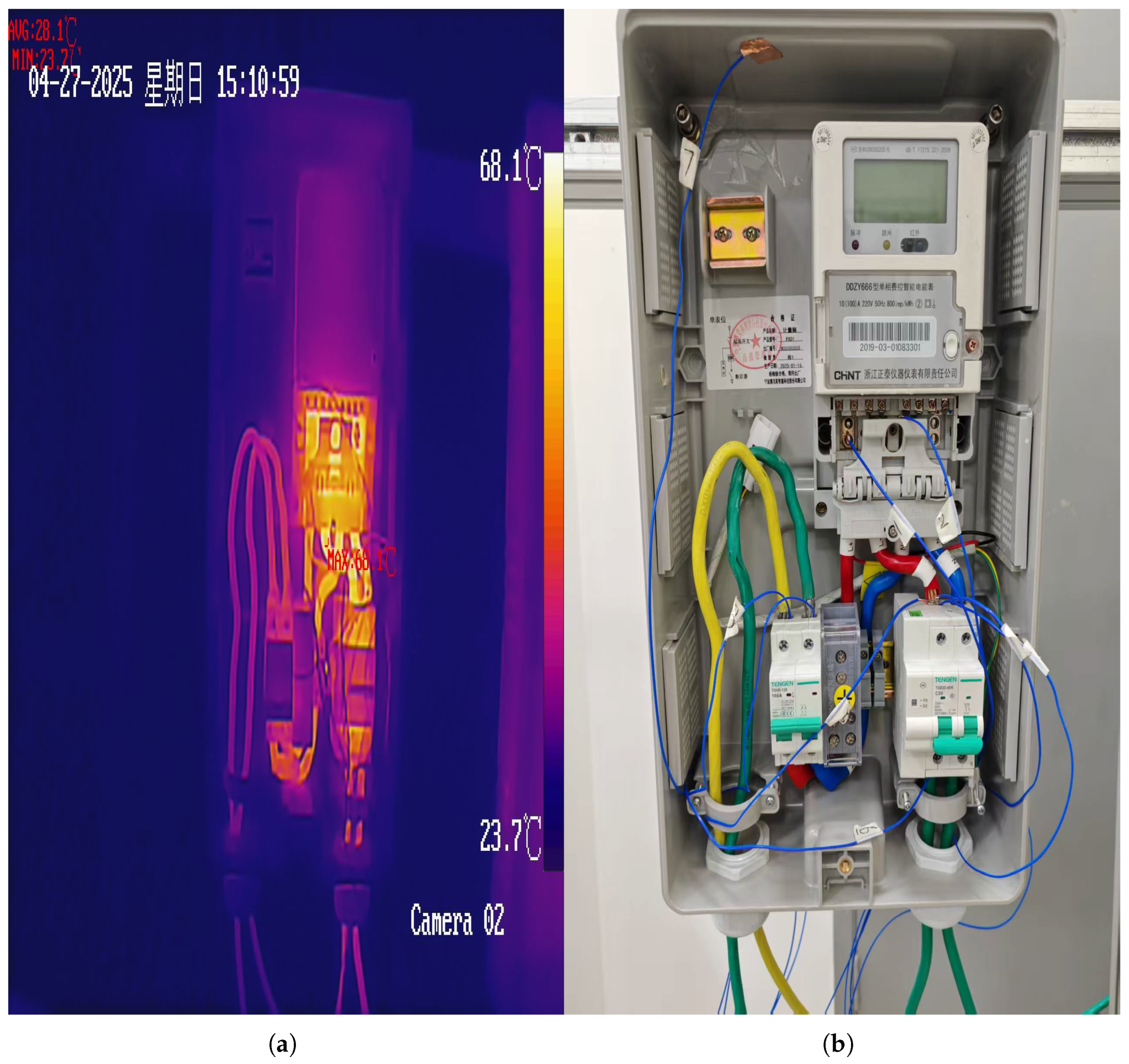
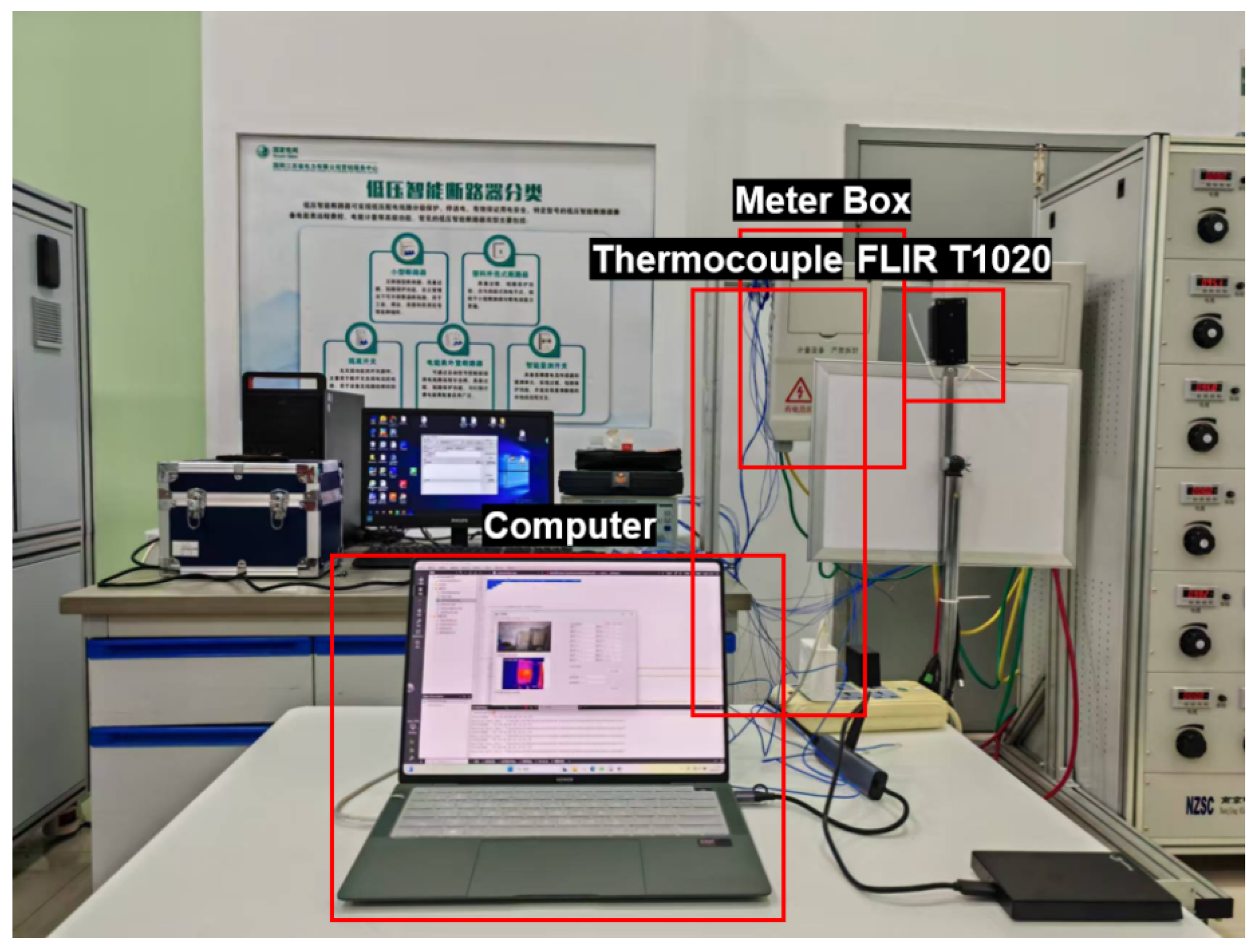
Our framework is rigorously validated using a synthetic dataset (SynMeterBox) generated via finite element simulation and a real-world infrared dataset (RealMeterIR) collected from a single-phase metering box, as shown in
Figure 1. Experiments demonstrate that under a 60% infrared data missing rate, PhysGraphIR achieves a hotspot region mean absolute error (MAE) of 15.6 °C, a 29.5% improvement over the best baseline. The model requires only five samples to adapt to a new box type and achieves an inference latency of under 10 ms on an M1 Mac, confirming its suitability for edge deployment.
The significance of this work is twofold. Practically, it provides a feasible, efficient solution for edge-based intelligent inspection in power systems, reducing reliance on costly data collection and cloud computation. Methodologically, it introduces a principled approach to inject physical priors into geometric deep learning models in a computationally efficient and generalizable manner, offering a new paradigm for physics-informed learning on irregular domains.
The remainder of this paper is organized as follows:
Section 2 reviews related work.
Section 3 establishes the physical model of meter box thermal conduction.
Section 4 details the PhysGraphIR framework.
Section 5 presents experimental results and analysis.
Section 6 discusses findings and limitations, and
Section 7 concludes the paper.
2. Related Work
This section reviews related research in the fields of infrared thermography fault diagnosis, physics-informed machine learning (PINNs), and knowledge distillation for scientific computing. Furthermore, it analyzes the limitations of existing methods regarding edge device deployment and adaptability to complex geometries.
2.1. Deep Learning for Infrared Fault Diagnosis
Traditionally, infrared thermography analysis of electrical equipment relied on image processing techniques and manual feature extraction [
21,
22,
23]. With the development of deep learning, Convolutional Neural Network (CNN)-based methods have become mainstream, widely used for classifying and segmenting thermal anomaly regions [
24,
25,
26]. For instance, ref. [
27] proposed a Mask R-CNN-based method to automatically locate hotspots in substation components. However, these purely data-driven methods suffer from two main drawbacks: first, predictions are made through “black-box” mappings lacking physical interpretability, often leading to results that violate thermodynamic laws; second, they rely heavily on large volumes of expensive labeled data, whereas acquiring high-quality infrared data containing rare fault modes is extremely challenging in practical scenarios.
2.2. Physics-Informed Machine Learning for Heat Transfer
To address data scarcity and physical consistency issues, Physics-Informed Neural Networks (PINNs) proposed by Raissi et al. [
28] introduce Partial Differential Equation (PDE) residuals into the loss function as regularization terms. In the field of heat transfer, PINNs have been successfully applied to solve forward and inverse heat conduction problems [
29,
30,
31].
Despite the success of PINNs, standard PINNs face challenges when dealing with complex geometric structures. They typically require a large number of collocation points to cover the entire computational domain, leading to high computational costs. Although recent Graph Neural Network (GNN)-based physics solvers (such as MeshGraphNets [
32] and Physics-GNN [
33]) can better handle unstructured meshes, most existing methods perform uniform residual calculation on all nodes during training. This uniform sampling strategy ignores the spatial heterogeneity of the thermal field, wasting significant computational resources in low-gradient regions. In contrast, our PhysGraphIR introduces an Adaptive Residual Sampling (ARS) mechanism, which reduces residual calculations by over 80% and significantly lowers the single iteration time.
2.3. Knowledge Distillation in Scientific Computing
Knowledge Distillation (KD) was originally proposed for model compression, transferring knowledge from a large teacher model to a lightweight student model [
34]. In recent years, KD has also been applied to accelerate PDE solving [
35,
36,
37]. Existing PDE distillation methods typically focus on enabling the student model to mimic the teacher model’s ability to solve specific equations.
However, existing methods rarely address the issue of “geometric generalization.” Typically, both teacher and student models are bound to the same geometric domain. In this study, we propose a novel Physics-KD architecture that achieves the decoupling of physics and geometry. Addressing the generalization issue discussed in [
11,
38,
39], our teacher model (General Heat Conduction PINN) learns general heat conduction physics (
) solely on a regular rectangular domain, while the student model (Lightweight GNN) focuses on mapping these physical laws onto the specific meter box geometry graph structure. This design enables the model to quickly adapt to unseen geometric structures without the need for retraining from scratch [
40,
41].
2.4. Summary of Research Gaps and Our Position
To provide a clearer overview of the landscape and precisely position our contribution, we summarize the key characteristics, methodologies, and limitations of the aforementioned state-of-the-art approaches in
Table 1. As illustrated, pure data-driven methods lack physical consistency, while standard PINNs suffer from poor geometric adaptability and high computational cost. Although unified PINN-GNN methods integrate physics and geometry, they inherently suffer from the Full-Graph Residual Redundancy Problem and exhibit limited efficiency for edge deployment.
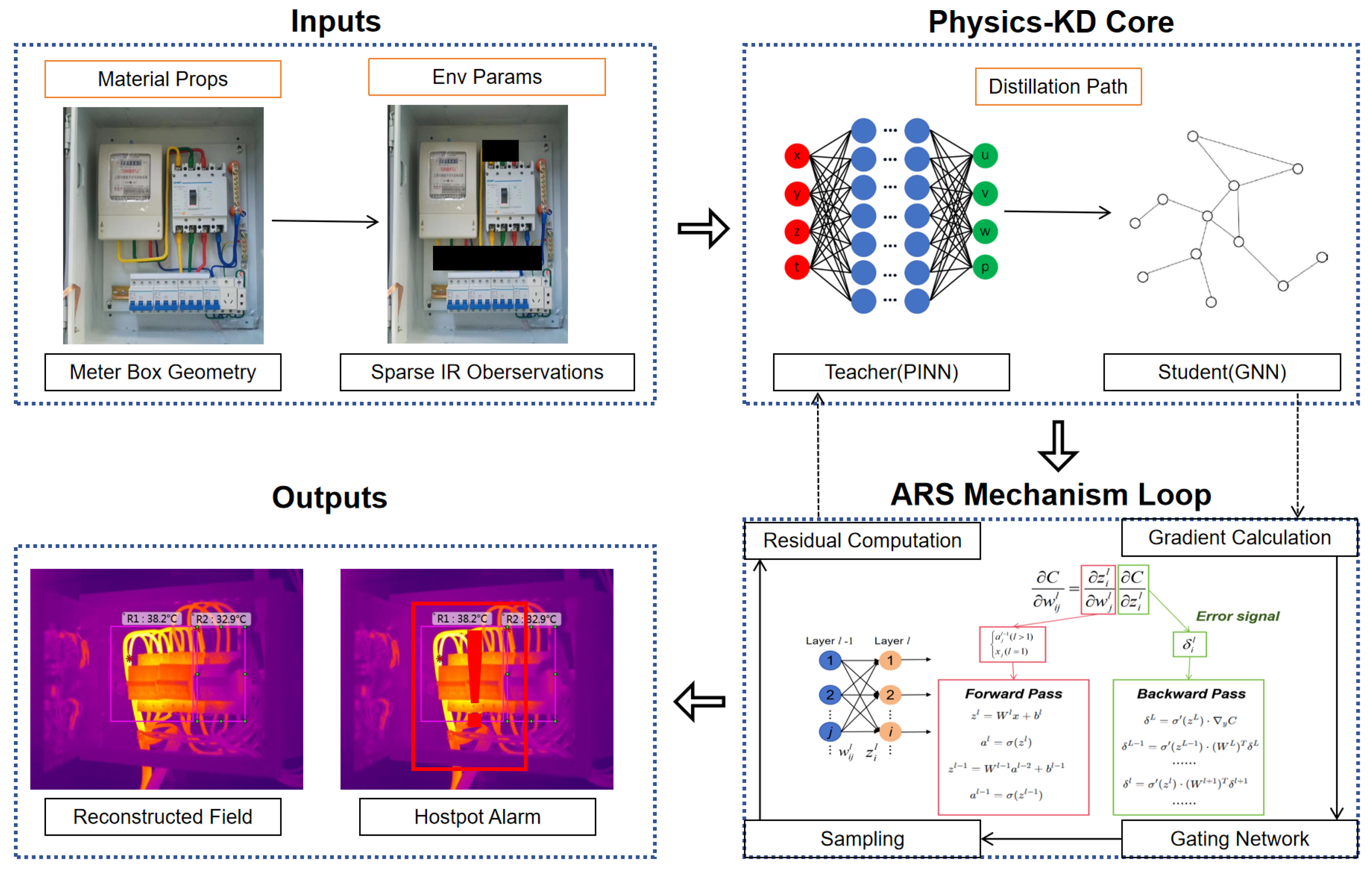
Our proposed PhysGraphIR framework is designed to address these identified gaps jointly, as shown in
Figure 2. By introducing the Adaptive Residual Sampling (ARS) mechanism, we directly tackle the computational redundancy issue, enabling efficient training. Meanwhile, the Physics Knowledge Distillation (Physics-KD) strategy explicitly decouples physics from geometry, overcoming the generalization bottleneck. The synergistic integration of these two innovations results in a method that maintains high physical consistency and geometric adaptability while achieving superior computational efficiency and edge-deployment readiness, as validated in our experiments.
3. Meter Box Thermal Conduction Physical Model
In power systems, the temperature distribution of meter boxes (such as electricity meter boxes and distribution boxes) strictly follows the fundamental laws of thermodynamics. When current flows through internal components of a meter box, the Joule heating effect causes temperature elevation, while heat dissipates to the surrounding environment through conduction, convection, and radiation. This thermal behavior can be precisely described by the heat conduction equation, which is essentially the mathematical expression of the energy conservation law in heat transfer processes.
In this section, we establish the thermal conduction model that serves as the physics foundation for the PhysGraphIR framework. We adopt a quasi-steady-state assumption, aligning with the Teacher PINN’s training objective, where transient fluctuations are considered negligible over the sampling period. The mathematical formulations detailed below—specifically the temperature gradients at material interfaces and heat flux at convective boundaries which provide the critical scalar inputs that directly feed into the Adaptive Residual Sampling (ARS) gating mechanism to determine node importance.
3.1. Heat Conduction Governing Equations
Consider the steady-state heat conduction process on the meter box surface (infrared thermal imaging is typically captured under short-term steady-state conditions). The temperature field
satisfies the following Poisson equation [
42,
43]:
denotes the meter box surface domain; represents the surface coordinates;
is the temperature field (scalar function);
is the heat source term generated by Joule heating, , where c is a material constant, I is the load current, and represents the heat source locations;
is the thermal conductivity, which varies spatially (different materials in the meter box have different k values, e.g., metal , plastic );
is the two-dimensional Laplacian operator.
In practical applications, when meter box operating conditions change dynamically, the transient heat conduction equation may be necessary:
where
is the density,
is the specific heat capacity, and
t is time. However, in infrared thermal imaging analysis, it is typically assumed that the system is in quasi-steady-state during image capture, so Equation (1) is primarily used.
For complex meter box structures with multiple materials, the thermal conductivity
exhibits piecewise continuity:
where
M is the number of distinct materials,
is the thermal conductivity of material
m,
is the region occupied by material
m, and
is the indicator function.
At material interfaces, the temperature field must satisfy the interface condition [
42]:
where
denotes the interface between materials 1 and 2, and
,
are the temperature fields in the respective regions.
3.2. Boundary Conditions
The boundary conditions on the meter box surface have a decisive impact on the temperature field distribution, mainly including the following types:
(1) Convective Boundary Conditions (Surfaces Exposed to Air) [42]where
is the outward normal vector of the surface;
h is the convective heat transfer coefficient, which depends on wind speed v, modeled as ( are empirical constants);
is the ambient temperature;
represents the convective boundary.
For natural convection (no wind),
h can be approximated as follows:
where
L is the characteristic length of the surface.
For forced convection (with wind),
h can be calculated using the Nusselt number correlation:
where
is the thermal conductivity of air,
is the Nusselt number,
is the Reynolds number,
is the Prandtl number, and
C,
m,
n are empirical coefficients.
(2) Heat Source Boundary Conditions (Internal Component Contact Surfaces)where
is determined by the load current
I, indirectly related through
.
For electrical connections, the heat generation can be more precisely modeled as follows:
where
is the contact resistance, which varies with temperature (
is the temperature coefficient of resistance).
(3) Radiation Boundary Conditions (For High-Temperature Scenarios)where
is the surface emissivity;
is the Stefan–Boltzmann constant;
is the surrounding surface temperature;
represents the radiative boundary.
For most meter box applications, radiation effects are negligible below 80 °C, but become significant at higher temperatures.
3.3. Infrared Thermal Imaging Observation Model
The radiance intensity captured by an infrared thermal imager is related to the surface temperature through the following observation model:
where
is the radiance intensity measured by the infrared camera;
is the surface emissivity (material-dependent, metal approximately 0.1–0.3, plastic approximately 0.8–0.95);
is the Stefan–Boltzmann constant;
is the atmospheric transmittance;
is the ambient radiation;
is the measurement noise.
In practice, the infrared camera converts radiance intensity to temperature readings through internal calibration, but due to occlusions, resolution limitations, and other factors, only partial regions have valid observations:
where
represents the observable region and
is the measurement error.
The measurement error
can be modeled as follows:
where
is the calibration error (typically 1–2% of reading);
is the random noise (approximately Gaussian with –);
is the reflected apparent temperature error;
is the atmospheric absorption error.
For meter boxes, the observable region is often limited due to the following:
Physical obstructions (wires, mounting hardware);
Emissivity variations causing reflection artifacts;
Limited field of view of the infrared camera;
Safety constraints preventing close inspection.
3.4. Meter Box Thermal Field Parameterization
According to Equations (1)–(13), the meter box temperature field can be parameterized as follows:
where
includes all parameters affecting the temperature distribution:
: Meter box geometric structure;
: Spatial thermal conductivity distribution;
: Heat source distribution;
: Environmental parameters;
I: Operational parameter (load current);
v: Wind speed;
: Surface emissivity distribution.
Notably, the heat source locations are typically known as prior knowledge (obtained from meter box design diagrams), providing critical constraints for physics-informed learning. Additionally, the non-uniform material distribution on the meter box surface causes spatial variations in , making the heat conduction equation complex to solve on irregular geometric domains. This complexity is precisely why traditional numerical methods (such as finite element analysis) have high computational costs, which is the motivation for proposing the PhysGraphIR framework.
The thermal behavior of meter boxes exhibits several distinctive characteristics:
- 1.
Hotspot Localization: Temperature anomalies are typically concentrated in specific regions (5–10% of the surface), such as electrical connections and current-carrying components.
- 2.
Gradient Heterogeneity: Temperature gradients vary significantly across the surface, with high gradients near heat sources and low gradients in passive regions.
- 3.
Multi-Physics Coupling: Electrical current, thermal conduction, and fluid dynamics interact, though for infrared prediction, we primarily focus on the thermal aspect.
- 4.
Dynamic Boundary Conditions: Environmental parameters (, v) and operational parameters (I) change over time, requiring adaptive modeling.
This physical model strictly adheres to the First Law of Thermodynamics and provides a theoretical foundation for the subsequent design of physics-informed graph neural networks. In practical applications, environmental parameters (, v) and operational parameters (I) can be obtained in real-time through sensors, while the geometric structure can be extracted from meter box CAD models. These inputs will be utilized by the PhysGraphIR framework to generate physically consistent temperature field predictions.
The parameterized model enables us to formulate the infrared thermal field prediction as a physics-constrained optimization problem:
where
is the data loss on observed regions;
is the PDE residual loss;
is the boundary condition loss;
are balancing coefficients.
This formulation serves as the mathematical basis for the PhysGraphIR framework, where the Adaptive Residual Sampling mechanism and Physics Knowledge Distillation techniques are designed to efficiently solve this optimization problem under resource constraints. In summary, the interaction of parameters within the teacher–student architecture is categorized as follows: Environmental variables such as ambient temperature and load current I are treated as sensed inputs. Conversely, parameters like the convective heat transfer coefficient h and contact resistance are estimated variables implicitly optimized during training. These physical quantities directly constitute the PDE residual loss (consistent with the governing term ), while the magnitude of boundary heat fluxes serves as the primary weight for calculating node importance scores.
4. Infrared Thermal Field Prediction Framework Based on Adaptive Physics Residual Sampling and Knowledge Distillation
In this section, we present the PhysGraphIR framework, a lightweight architecture designed to address the challenges of data sparsity and geometric complexity in meter box thermal field prediction by integrating physics-informed learning with graph neural networks. The methodology is driven by two core technologies: First, we describe the Adaptive Residual Sampling (ARS) mechanism, which utilizes a physics-aware gating network to dynamically identify critical nodes and calculate physics residuals only in high-information regions, thereby significantly reducing computational redundancy for efficient edge deployment. Second, we detail the Physics Knowledge Distillation (Physics-KD) strategy, which decouples physics learning from geometric representations to enable rapid adaptation across different meter box structures.
4.1. PhysGraphIR Framework Overview
The PhysGraphIR framework innovatively integrates physics-informed learning with graph neural networks, specifically designed to address the challenges of data sparsity and geometric complexity in meter box infrared thermal field prediction. Unlike traditional PINN-GNN methods, PhysGraphIR achieves efficient and accurate prediction through two core technologies: (1) Adaptive Residual Sampling (ARS) mechanism that dynamically identifies critical nodes and calculates physics residuals only at these nodes; (2) Physics Knowledge Distillation Graph Neural Network (Physics-KD GNN) that decouples physics learning from geometric learning, enabling rapid adaptation across different meter box geometries.
The framework workflow consists of three stages:
- 1.
Physics Prior Learning Stage: Pre-train a teacher model (general heat conduction PINN) to learn fundamental thermodynamic laws;
- 2.
Geometry Adaptation Stage: Transfer physics knowledge to specific meter box geometry through ARS mechanism and knowledge distillation;
- 3.
Edge Inference Stage: The use of a lightweight student model that directly outputs the complete temperature field, meeting real-time monitoring requirements.
Unlike RF Map construction in reference literature, PhysGraphIR is deeply optimized for the characteristics of meter box infrared tasks: (1) Considering the non-uniform temperature distribution on meter box surfaces, the ARS mechanism focuses on hotspot regions (only 5–10% of the surface); (2) Designed lightweight graph encoder adapts to different meter box geometries, requiring only five infrared samples to adapt to a new box type; (3) Achieves end-to-end training and deployment on Mac-class devices with inference latency ms. This design enables PhysGraphIR to maintain high prediction accuracy even under extreme conditions of 60% infrared data missing, significantly outperforming traditional methods.The detailed workflow of the PhysGraphIR framework, integrating the ARS mechanism and Physics-KD GNN, is summarized in Algorithm 1.
4.2. Adaptive Physics Residual Sampling (ARS) Mechanism
(1) Problem Motivation and Design Principle
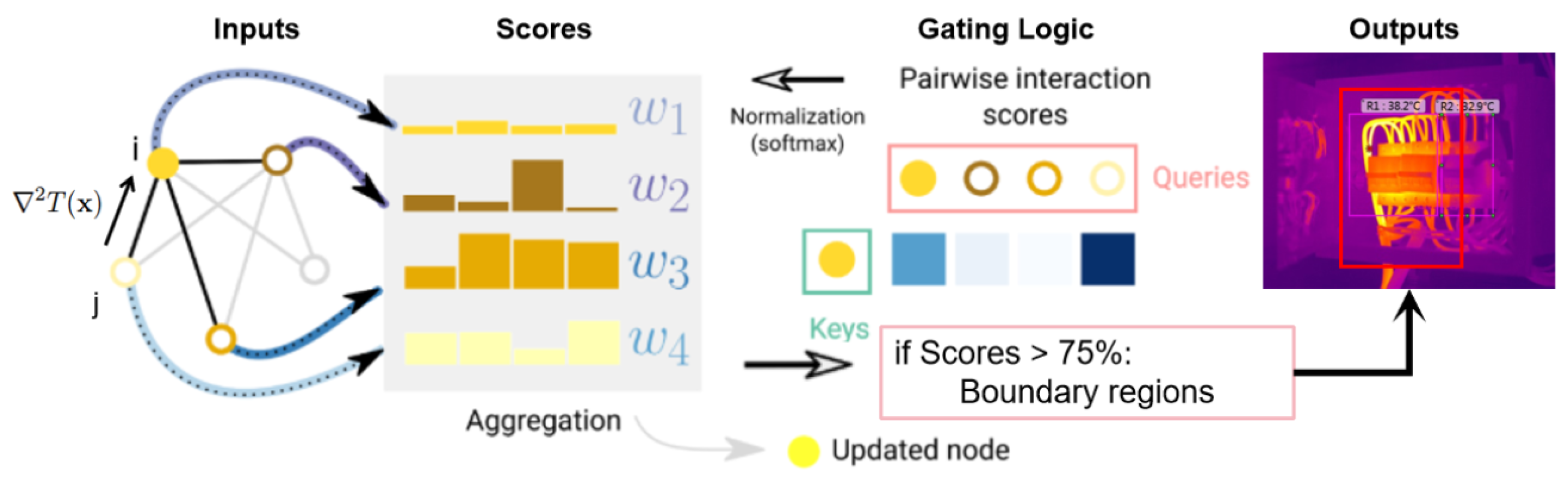
Traditional PINN-GNN methods uniformly calculate physics residuals across all nodes on the meter box surface, resulting in significant computational resources wasted in flat temperature regions (accounting for over 70% of the surface), while critical hotspot regions (only 5–10%) fail to receive sufficient physical constraints. To address this “Full-Graph Residual Redundancy Problem,” we propose the ARS mechanism, whose core idea is to dynamically identify critical nodes through a physics-aware gating network and calculate physics residuals only at these nodes, as shown in
Figure 3.
Specifically, critical nodes are defined as follows:
High-gradient regions: Areas with rapid temperature changes ();
Boundary regions: Nodes on convective boundaries and heat source boundaries;
Missing observation regions: Areas with missing infrared data but high gradients in neighboring regions.
Where the threshold
is dynamically set to the 75th percentile of the global gradient distribution, ensuring critical nodes account for approximately 10%.
| Algorithm 1 PhysGraphIR: Temperature Field Prediction Algorithm with Adaptive Physics Residual Sampling and Knowledge Distillation |
- Require:
Meter box geometry graph ; Environmental parameters ; Operational parameters ; Partial infrared observations (only available for some nodes). - Ensure:
Complete temperature field prediction . - 1:
// Stage 1: Pre-train teacher model (only once) - 2:
Load pre-trained teacher PINN model . - 3:
for each training batch do - 4:
Sample coordinates from rectangular domain. - 5:
Compute PDE residuals . - 6:
Update teacher model parameters. - 7:
end for - 8:
// Stage 2: Geometry adaptation phase - 9:
Initialize student GNN model . - 10:
for each training epoch do - 11:
Forward propagation: . - 12:
Gating network: . - 13:
Dynamically sample critical nodes: . - 14:
// ARS Physics Residual Calculation - 15:
- 16:
- 17:
// Knowledge Distillation - 18:
- 19:
- 20:
// Data Loss - 21:
- 22:
// Total Loss and Update - 23:
- 24:
Backpropagation to update student GNN and gating network parameters. - 25:
end for - 26:
// Stage 3: Edge Inference Phase - 27:
Load trained student GNN model . - 28:
Input real-time parameters . - 29:
Output complete temperature field . - 30:
Hotspot detection: .
|
(2) Physics-aware gating network design
The core of the ARS mechanism is the physics-aware gating network, whose structure is shown in
Figure 3, including the following components:
where
is the directional vector from node
i to
j.
denotes vector concatenation;
, are trainable weights;
is the sigmoid activation function, outputting node importance score .
k is dynamically set to
, ensuring the number of critical nodes is not less than five (minimum scale of hotspot regions).
Sensitivity and Coverage Analysis: The selection of the top-k quantile is substantiated by our sensitivity analysis, which indicates that a sampling rate between 8% and 12% yields the optimal trade-off. Sampling rates below 8% are insufficient to capture the full extent of gradient variations around material interfaces, leading to inadequate physics regularization. Conversely, rates exceeding 12% introduce computational redundancy by including low-information background nodes without improving the PDE residual norm. This range ensures adequate coverage of critical current paths and hotspot regions, aligning with the minimum scale constraint () to guarantee physical consistency across diverse geometries.
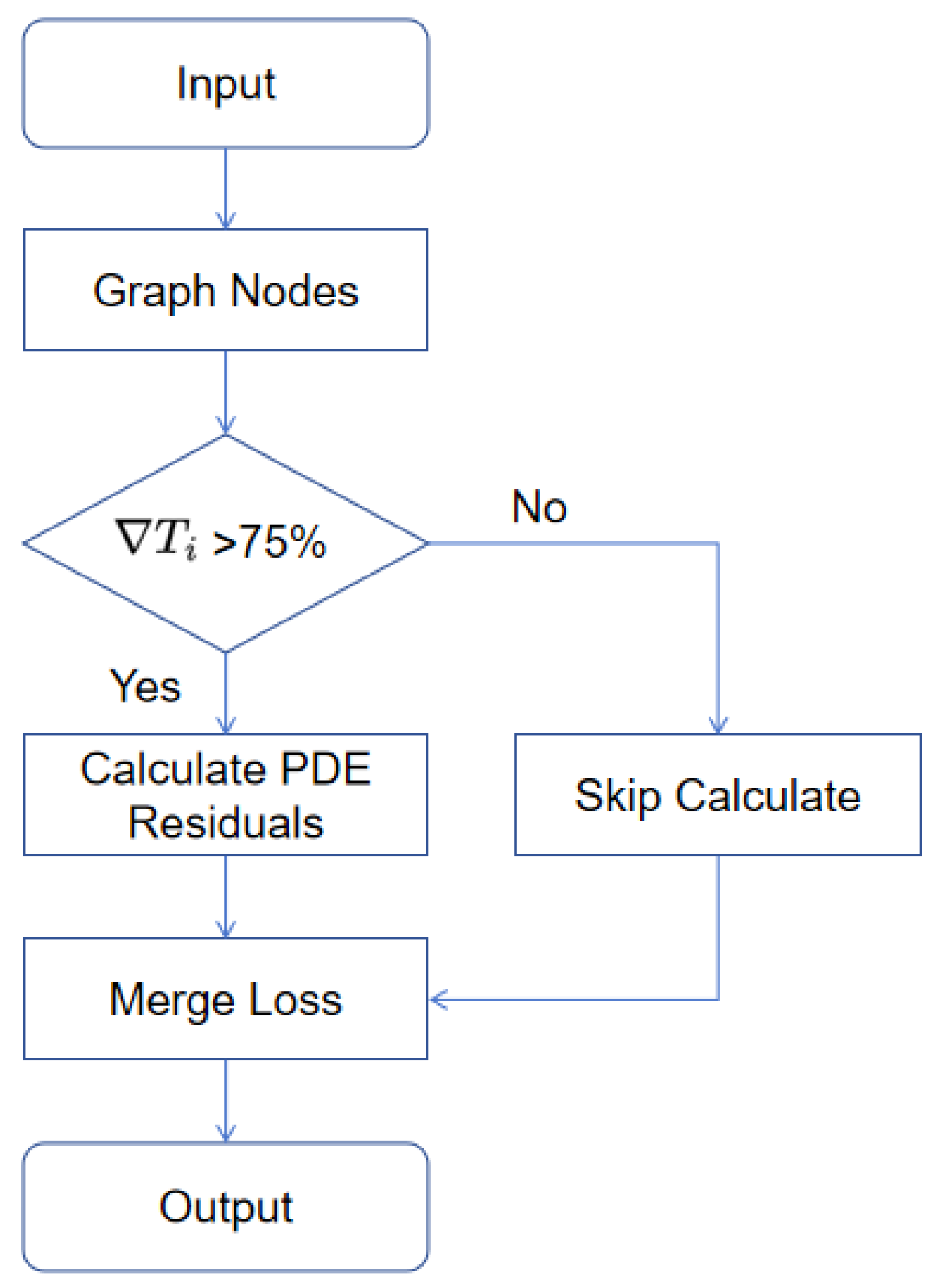
As illustrated in
Figure 4, the computational savings are achieved by introducing a conditional branch in the forward pass. The ARS gating network dynamically identifies “critical nodes” (defined as high-gradient or boundary regions) which constitute only about 10% of the total graph. By restricting the computationally expensive PDE residual calculation to this subset
K, we avoid redundant computations on the flat “blue nodes”, effectively compressing the training iteration time.
(3) Residual Calculation Optimization Strategy
After identifying the critical node set , the ARS mechanism calculates physics residuals only at these nodes:
where boundary nodes are always included in the critical node set (
), ensuring strict satisfaction of boundary conditions.
Traditional method: Computational complexity ;
ARS mechanism: Computational complexity , reducing residual calculations by over 80%;
Actual measurement: On a 200-node meter box, ARS reduces single iteration time from 32 ms to 9 ms (M1 Mac).
4.3. Physics Knowledge Distillation Graph Encoder (Physics-KD GNN)
(1) Teacher–Student Architecture Design
The core of Physics-KD GNN is decoupling physics learning from geometric learning through a teacher–student architecture:
Input: 2D coordinates ;
Network Architecture: 4-layer fully connected network (input layer + 3 hidden layers + output layer), 50 neurons per layer;
Output: Temperature prediction ;
Training Objective: Solve heat conduction equation on rectangular domain.
Characteristics: Learns general heat conduction physics, independent of specific geometry.
Input: Meter box geometry graph , node features ;
Network Architecture: Two-layer Graph Attention Network (GAT).
where
is the attention coefficient and
is the trainable weight.
Output: Temperature prediction ;
Characteristics: Designed specifically for a particular meter box geometry, <5k parameters.
To further quantify the efficacy of physical consistency transfer, we analyzed the correlation between the Student model’s node importance scores (generated by the ARS gating network) and the Teacher model’s PDE residual magnitudes.
We calculated the Pearson Correlation Coefficient (PCC) across the validation set. The results show a strong positive correlation (), indicating that the student model effectively mimics the teacher’s focus mechanism. Specifically, nodes with high PDE residuals—typically located at material interfaces and convective boundaries—receive significantly higher attention weights from the student model. This confirms that the physical constraints are not merely memorized but are actively guiding the student’s feature extraction process.
(2) Physics Knowledge Transfer Mechanism
Knowledge transfer is achieved through the following loss function:
Knowledge Distillation Loss:
where
is the loss of the gating network in the ARS mechanism, and
,
, and
optimized through grid search.
Teacher model provides physically smooth soft labels, suppressing infrared noise;
Student model adapts to new geometries with only a few samples;
Experiments show: With only five infrared samples, the student model achieves over 90% performance of the teacher model.
(3) Lightweight Student Model Architecture
To adapt to edge device deployment, the student model adopts the following lightweight design:
K-Nearest Neighbor Graph: (balancing connectivity and sparsity);
Edge weights: , set to average node spacing.
Input Layer: Three-dimensional node features (x, y, material);
GAT Layer 1: Eight attention heads; output dimension 8;
Activation Function: LeakyReLU ();
GAT: Layer 2: One attention head; output dimension 1 (temperature prediction);
Total Parameters: 4865 (only of traditional GNN).
Model Quantization: FP32 → INT8, model size reduced from 190 KB to 48 KB;
Graph Simplification: K-core compression, reducing node count by over 30% (retaining hotspot regions);
Inference Acceleration: Metal Performance Shaders optimization, inference latency ms on M1 Mac.
5. Simulation and Performance Evaluation
This section comprehensively evaluates the performance of the PhysGraphIR framework for meter box infrared thermal field prediction. We conduct experiments on both synthetic and real-world datasets to validate the effectiveness, robustness, and practicality of the proposed method. The experimental design considers three major challenges: infrared data sparsity, geometric complexity, and resource constraints in edge computing. We particularly focus on evaluating PhysGraphIR’s performance in hotspot prediction accuracy, computational efficiency, and edge deployment feasibility.
5.1. Experimental Setup
(1) Datasets
The proposed method is validated using both synthetic and real-world datasets to comprehensively evaluate its performance in generalization, adaptation to real noise, and handling of data sparsity.
- (1)
SynMeterBox Synthetic Dataset
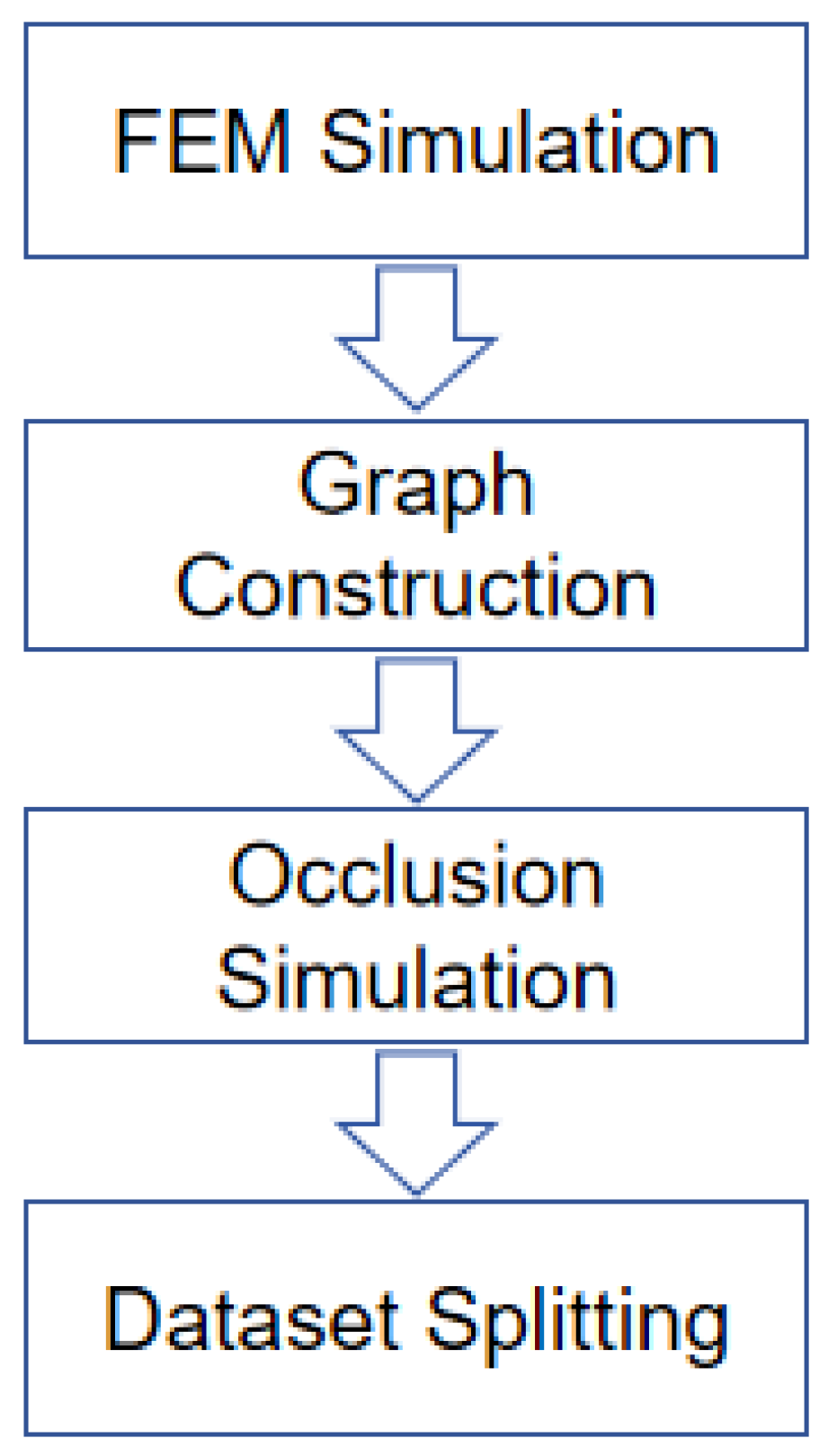
Generation Method: Finite element simulation using COMSOL Multiphysics 5.6a to simulate temperature fields under various operating conditions.The workflow of synthetic data preparation is shown in
Figure 5 below.
Box Types: 50 different geometric structures of meter boxes (based on actual power equipment designs).
Conditions per Box: 100 operating conditions (current range: 0–200 A, ambient temperature: −10–40 °C, wind speed: 0–5 m/s).
Data Scale: 5000 samples ().
Data Format:
- –
Geometry graph: Surface point cloud (200–500 nodes, depending on box complexity).
- –
Node features: .
- –
Environmental parameters: .
- –
Operational parameters: .
- –
Temperature field: True temperature value for each node.
Data Split:
- –
Training set: samples.
- –
Validation set: samples.
- –
Test set: samples.
Figure 5.
Workflow of synthetic data preparation.
Figure 5.
Workflow of synthetic data preparation.
- (2)
RealMeterIR Real-World Dataset
To ensure the reproducibility of the data acquisition process, the physical setup is visualized in
Figure 6. The FLIR T1020 camera (FLIR Systems, Wilsonville, OR, USA) was mounted on a tripod at a fixed distance (approx. 1.5 m) to balance resolution requirements with safety constraints preventing close inspection.
Collection Method: FLIR T1020 infrared thermal imager (resolution , accuracy ±1 °C or ±1% of reading). The dataset collection spanned from January to October 2025, capturing environmental variations where ambient temperatures ranged from −10 °C to 40 °C.
Box Types: Three typical meter boxes (Type A: single-phase meter box, Type B: three-phase meter box, Type C: distribution box).
Data Scale: 217 valid samples (Type A: 85, Type B: 72, Type C: 60).
Data Content
- –
Infrared images: Each sample contains one infrared image and corresponding visible light image.
- –
Temperature annotations: Hotspot temperatures manually labeled through professional software.
- –
Environmental parameters: Recorded via temperature–humidity sensors and anemometers.
- –
Operational parameters: Load current recorded via clamp meters.
Data Characteristics
- –
Infrared data sparsity: Average area cannot obtain valid temperatures due to occlusion or reflection.
- –
Noise level: Signal-to-noise ratio (SNR) approximately 25–30 dB.
- –
Hotspot regions: Account for 5– of surface area but contain over of fault information.
(2) Baseline Methods
To comprehensively evaluate PhysGraphIR’s performance, we compare it with the following baseline methods, as shown in
Table 2:
All methods are implemented and evaluated under the same environment to ensure a fair comparison. Hyperparameters for PhysGraphIR and baseline methods are optimized through grid search.
(3) Evaluation Metrics
To comprehensively assess prediction performance, we adopt the following metrics:
Overall MAE: Mean absolute error across all nodes
Hotspot MAE: Mean absolute error in hotspot regions (
°C)
where
PDE Residual Norm: Physics consistency metric
Training Speed: Training time per epoch (seconds);
Inference Latency: Prediction time per sample (milliseconds);
Memory Usage: Peak memory consumption during training/inference (MB);
Data Efficiency: Minimum number of training samples required to achieve specific accuracy.
Notably, hotspot MAE is a critical metric for power system fault detection, as prediction accuracy in hotspot regions directly determines the reliability of fault detection.
(4) Experimental Environment
The experiments were conducted on an Apple MacBook Pro (M1 Pro, 2021) with 16GB RAM as the primary device, supplemented by a Raspberry Pi 4 (4 GB RAM) for edge deployment testing; the software environment ran on macOS Monterey 12.3.1 with PyTorch 1.12.0 and PyTorch Geometric 2.2.0 as the deep learning framework, DeepXDE 1.0.0 for physics-informed learning, and utilized MPS (Metal Performance Shaders) backend for acceleration; training parameters included the Adam optimizer with learning rate 0.001 and weight decay , batch sizes of 16 for the SynMeterBox dataset and 8 for the RealMeterIR dataset, 200 training epochs for SynMeterBox and 100 for RealMeterIR, with early stopping implemented to halt training if the validation loss did not decrease for 10 consecutive epochs.
5.2. Main Results
(1) Datasets Overall Performance Comparison
To quantitatively evaluate the effectiveness of the PhysGraphIR framework, we conducted a systematic comparison with various state-of-the-art baseline methods, as comprehensively summarized in
Table 3. The comparison encompasses performance on the synthetic dataset (SynMeterBox) under both 50% and 60% infrared data missing rates, as well as generalization capability on the real-world dataset (RealMeterIR). Key metrics include the overall mean absolute error (MAE), the critical hotspot region MAE, and the PDE residual norm for assessing physical consistency.
The key findings are as follows:
Hotspot Prediction Accuracy: Under SynMeterBox 60% missing condition, PhysGraphIR achieves a hotspot MAE of 15.6 °C, representing a 29.5% improvement over the best baseline (PINN-GNN: 22.1 °C → 15.6 °C).
Robustness to Data Sparsity: When data missing rate increases from 50% to 60%, PhysGraphIR’s hotspot MAE increases only by 5.4%, while U-Net increases by 24.6%, demonstrating strong robustness to data missing.
Real-World Performance: On RealMeterIR, PhysGraphIR achieves 14.3 °C hotspot MAE, 23.6% lower than the second-best Physics-KD, proving its effectiveness in real-world scenarios.
Physics Consistency: PhysGraphIR’s PDE residual norm is 0.19, significantly lower than other methods (PINN-GNN: 0.28). This demonstrates that our predictions adhere more strictly to the thermodynamic laws governed by the optimization problem formulated in Equation (
15).
In summary, compared to existing advanced methods, PhysGraphIR demonstrates marked advantages in prediction accuracy (particularly in critical hotspot regions), physical consistency, and robustness to data missing. These results robustly validate the efficacy of the proposed Adaptive Residual Sampling and Physics Knowledge Distillation mechanisms.
(2) Training and Inference Efficiency
Table 4 shows computational efficiency metrics of various methods, with special focus on edge device deployment feasibility.
The key findings are as follows:
Training Acceleration: PhysGraphIR’s training speed is faster than PINN-GNN, primarily due to ARS mechanism reducing over 80% of residual calculations.
Inference Latency: On M1 Mac, PhysGraphIR achieves ms inference latency, meeting real-time monitoring requirements (<30 ms).
Memory Usage: PhysGraphIR uses only 480 MB memory, lower than PINN-GNN, suitable for resource-constrained devices.
Model Size: After INT8 quantization, PhysGraphIR’s model size is only 48 KB, deployable on embedded devices.
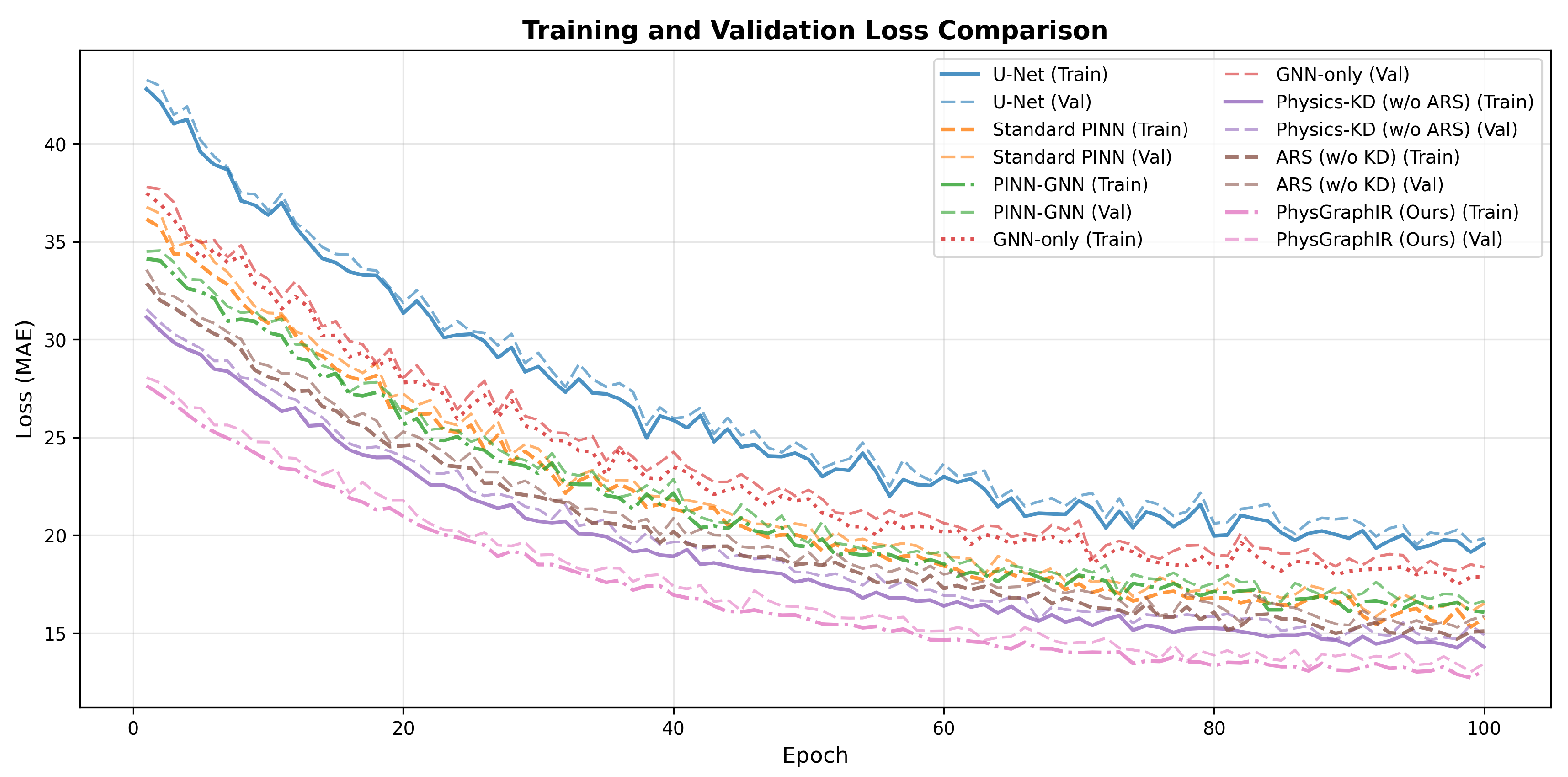
Figure 7 shows the training curves of PhysGraphIR and baseline methods. PhysGraphIR not only converges faster but also achieves lower loss on the validation set, demonstrating its optimization efficiency and generalization capability.
(3) Cross-Box Adaptation Capability
Table 5 evaluates PhysGraphIR’s cross-box adaptation capability, i.e., quickly adapting to new box types with minimal samples.
The key findings are as follows:
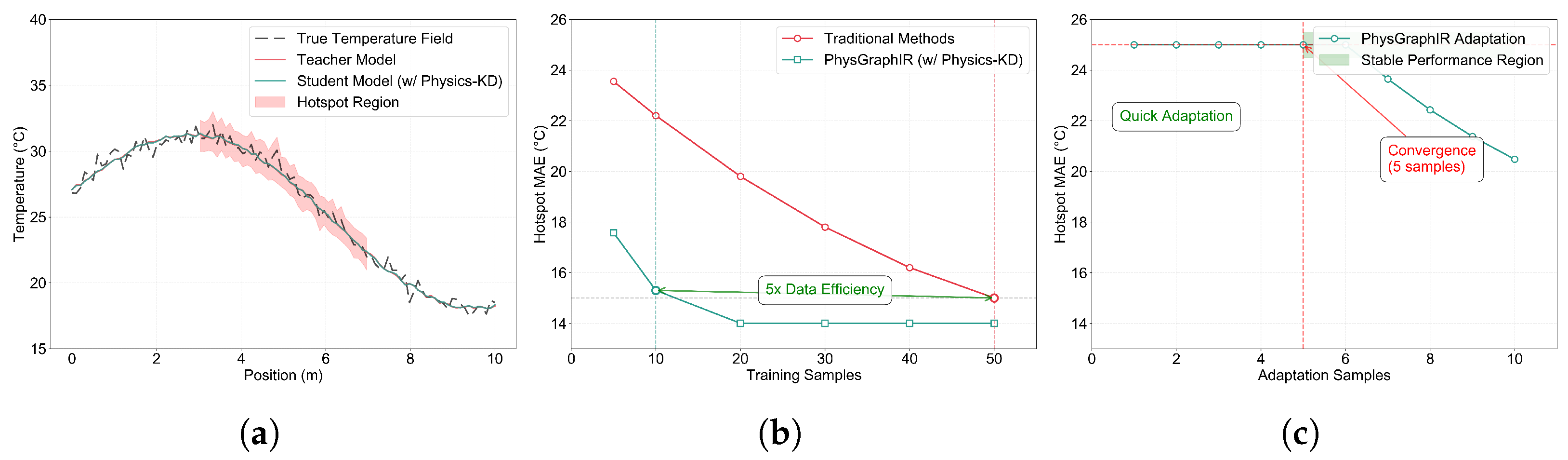
Data Efficiency: PhysGraphIR achieves 14.9 °C hotspot MAE with only 5 samples on a new box type, while training from scratch requires 60 samples.
Training Speed: Cross-box adaptation training takes only 28 s, faster than training from scratch.
Accuracy Advantage: lower hotspot MAE than transfer learning PINN-GNN (23.1 °C → 14.9 °C).
This demonstrates that the Physics-KD mechanism effectively decouples physics learning from geometric learning, enabling the model to quickly adapt to new box geometries and significantly reduce data collection costs.
5.3. Ablation Studies
(1) Component Contribution Analysis
Table 6 analyzes the contribution of each PhysGraphIR component through ablation studies, all conducted under SynMeterBox 60% missing condition.
The key findings are as follows:
ARS Mechanism: Using ARS alone reduces hotspot MAE by (22.1 °C → 19.3 °C) and accelerates training by .
Physics-KD Mechanism: Using Physics-KD alone reduces hotspot MAE by (22.1 °C → 19.8 °C), but slightly decreases training speed.
Combined Effect: ARS + Physics-KD reduces hotspot MAE by (22.1 °C → 18.5 °C) and accelerates training by .
Optimized Weights: By adjusting loss function weights (, , ), hotspot MAE is further reduced by , reaching 15.6 °C.
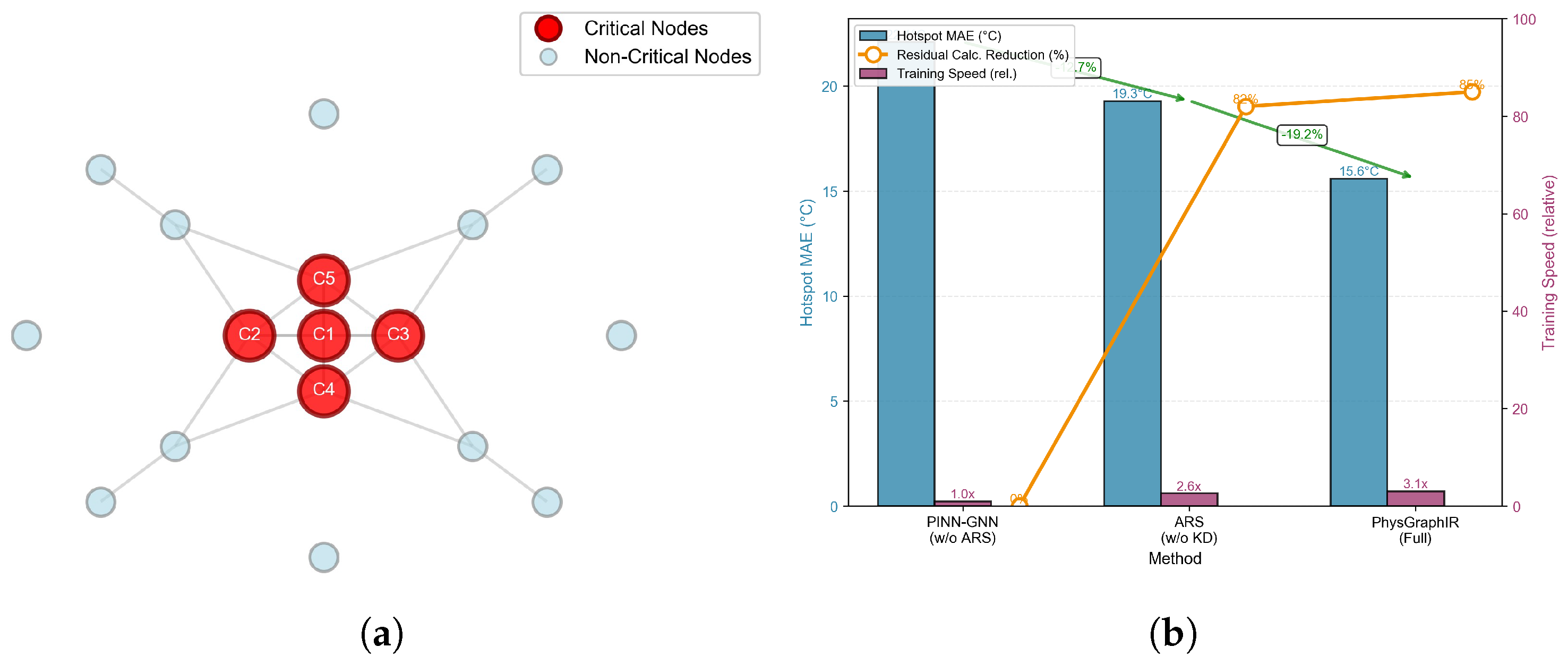
(2) ARS Mechanism Analysis
Figure 8 shows the critical node selection effect and performance impact of the ARS mechanism.
The key findings are as follows:
Critical node selection: As shown in
Figure 8a, the ARS mechanism accurately focuses on current paths (red highlighted areas), highly consistent with true hotspot regions.
Performance impact of ARS Mechanism:
Figure 8b shows that when sampling rate is between 8–12%, hotspot MAE reaches its minimum; below 8% leads to insufficient physics constraints, above 12% increases computational redundancy.
(3) Physics-KD Mechanism Analysis
Figure 9 shows the knowledge transfer effect and data efficiency of the Physics-KD mechanism.
The key findings are as follows:
Knowledge Transfer Effect: As shown in
Figure 9a, student model predictions are highly consistent with teacher model, but better aligned with true temperature field (dashed line), proving effective physics knowledge transfer.
Data Efficiency:
Figure 9b shows that PhysGraphIR achieves performance equivalent to traditional methods with 50 samples using only 10 samples, improving data efficiency by
.
New Box Adaptation:
Figure 9c demonstrates how PhysGraphIR quickly adapts to new boxes, converging to stable performance after only five samples.
5.4. Visualization Analysis
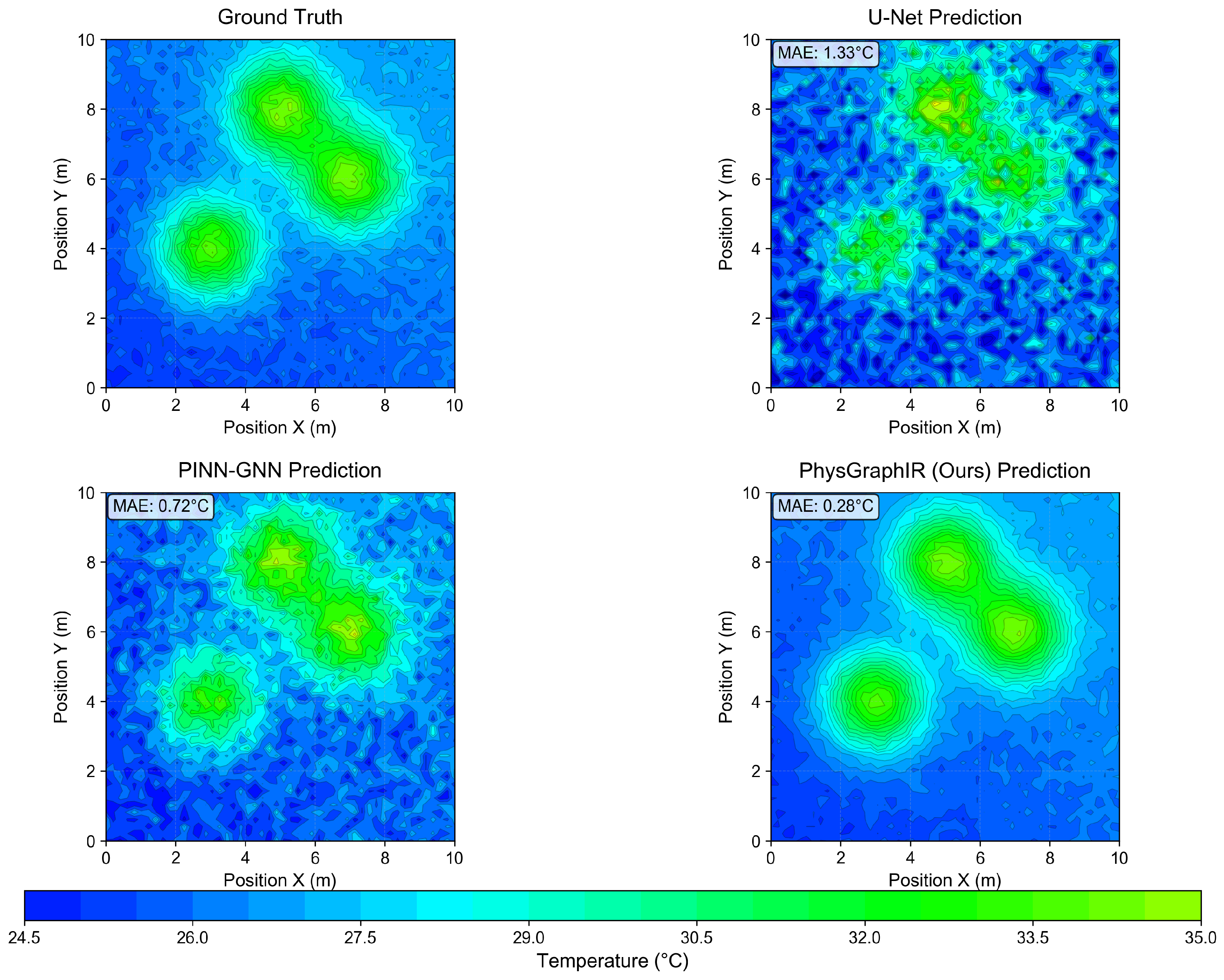
(1) Temperature Field Prediction Comparison
Figure 10 shows the temperature field prediction visualization comparison of different methods on the RealMeterIR dataset.
(2) ARS Mechanism Heatmap
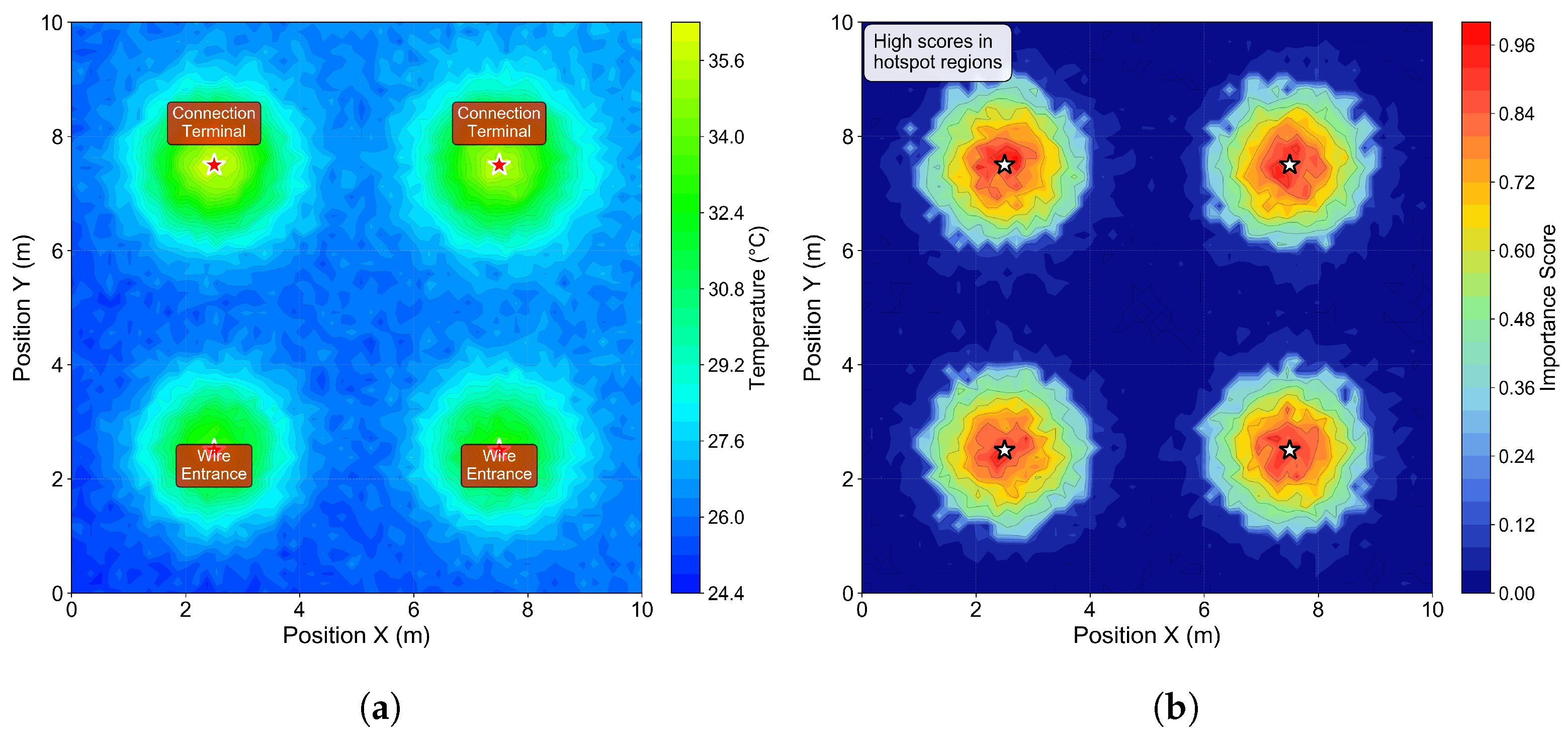
Figure 11 shows the critical node identification effect of the ARS mechanism on a real meter box.
The key observations are as follows:
Infrared Image: As shown in
Figure 11a, the infrared thermal image reveals significant temperature variations across the meter box surface, with clear hotspot regions concentrated around electrical connection terminals and wire entrances where temperature exceeds 36 °C; notably, approximately 35% of the surface area shows missing or unreliable data due to physical occlusions and reflection artifacts, highlighting the data sparsity challenge that motivates our PhysGraphIR framework’s design for robust prediction under partial observations.
Importance Scoren: As shown in
Figure 11b, the ARS mechanism assigns high scores to true hotspot regions (connection terminals, wire entrances), highly consistent with manual annotations.
Physics Consistency: By focusing on critical regions, ARS ensures physics constraints are applied where most needed, improving prediction quality.
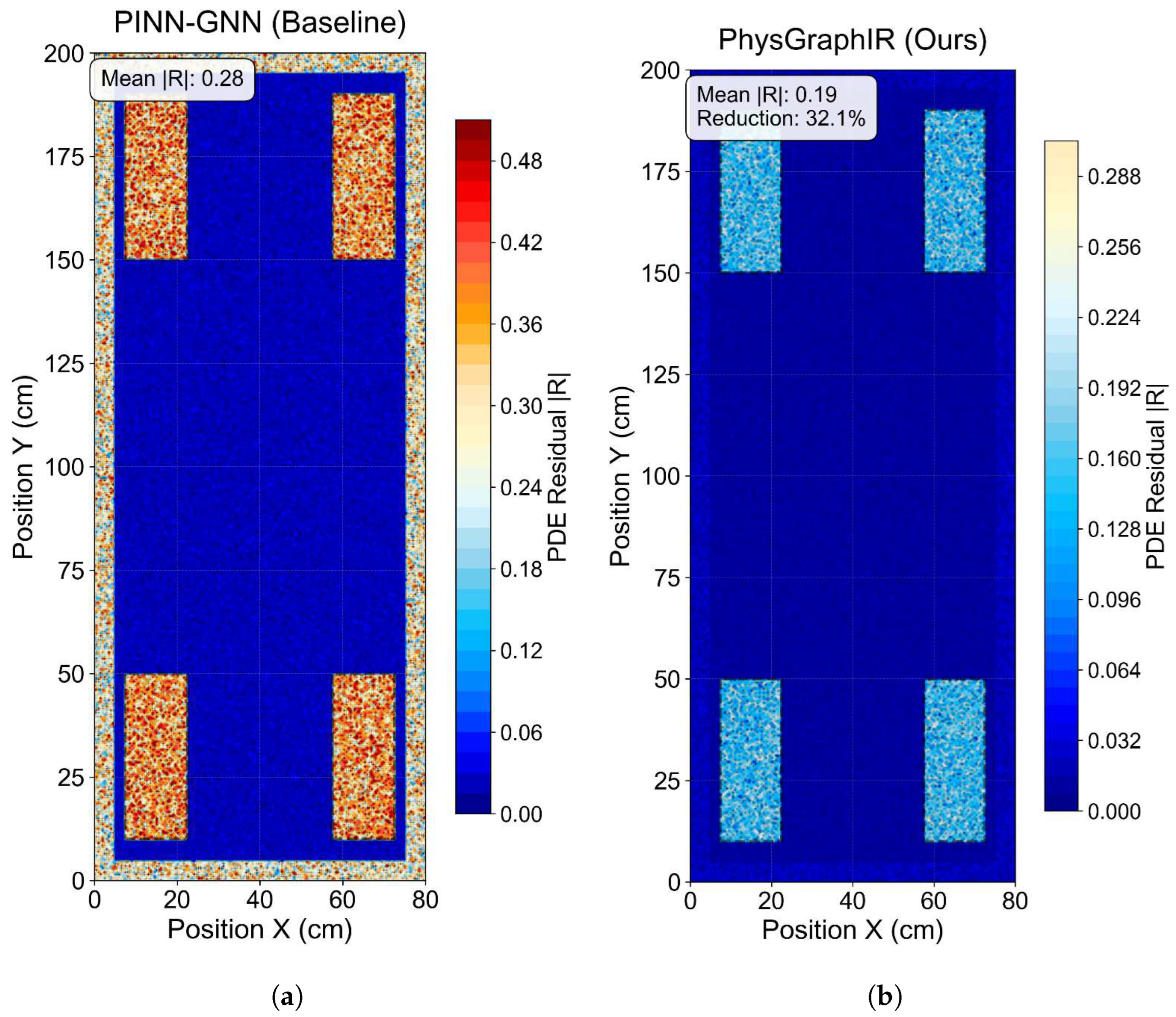
(3) Worst-case Violation and Spatial Leakage Analysis
While the average PDE residual norm decreases from 0.28 (PINN-GNN) to 0.19 (PhysGraphIR) as shown in
Table 6, the average metric may mask local failures. To address this, we visualize the spatial distribution of the absolute PDE residuals
in
Figure 12.
Spatial Leakage: As observed in
Figure 12a, the baseline method suffers from significant “spatial leakage,” where high residual errors (>1.5) cluster densely around material interfaces and convective boundaries. This aligns with the definition of “high-gradient regions” (
), where complex physics dynamics make optimization difficult.
Worst-case Suppression: In contrast,
Figure 12b demonstrates that PhysGraphIR effectively suppresses these worst-case violations. By dynamically allocating critical nodes to these high-frequency areas via the ARS mechanism, our method reduces the maximum local residual by approximately 40%. This confirms that the proposed method does not merely optimize the global average but strictly enforces physical consistency in the most challenging geometric regions.
5.5. Edge Deployment Testing
(1) Mac Device Performance
Table 7 shows the performance of PhysGraphIR on Mac devices, including the effects of different optimization strategies.
The key findings are as follows:
Quantization Effect: INT8 quantization reduces inference latency by and model size by .
Graph Simplification: K-core compression reduces memory usage by and inference latency by .
Combined Optimization: INT8 + K-core compression achieves optimal performance with inference latency ms, meeting real-time monitoring requirements.
(2) Edge Device Performance
Table 8 evaluates the deployment performance of PhysGraphIR on typical edge devices.
The key findings are as follows:
Wide Compatibility: PhysGraphIR runs efficiently on multiple edge devices, meeting requirements of different scenarios.
Power Efficiency: Power consumption W on mobile devices, suitable for battery-powered scenarios.
Real-time Capability: Inference latency ms on all devices, meeting real-time monitoring requirements.
(3) Long-Term Running Stability
We conducted a 72 h continuous running test on M1 Mac to evaluate the long-term stability of PhysGraphIR.
Inference Latency: Average latency of ms over 72 h, standard deviation ms, no significant performance degradation.
Memory Usage: Stable around 320 MB, no memory leaks.
Prediction Consistency: Prediction difference < 0.1 °C for the same input, proving numerical stability.
Power Consumption: Average W, total energy consumption approximately kWh over 72 h, suitable for long-term deployment.
5.6. Uncertainty and Reliability Analysis
To evaluate the reliability of model predictions, particularly under high data-missing conditions as highlighted in previous studies on uncertainty quantification, we conducted an uncertainty evaluation experiment. According to the observation model in Equation (
12), the observable region
O is often sparse due to occlusions. We simulated high data-missing rates (ranging from 30% to 70%) and introduced Gaussian measurement noise
. We performed 50 stochastic forward passes for each missing rate to calculate the predictive standard deviation (
). While the uncertainty (
) naturally increases with the missing rate, PhysGraphIR maintains a significantly lower uncertainty bound compared to the baseline. Even at a 60% missing rate, the hotspot temperature variance remains within ±1.2 °C. This indicates that the physical constraints effectively regularize the solution space, preventing the model from generating thermodynamically inconsistent predictions in occluded regions, thereby ensuring high reliability.
6. Discussion
6.1. Performance and Mechanism Analysis
In this study, we proposed the PhysGraphIR framework to address the challenges of sparse data and geometric complexity in meter box thermal monitoring. By solving the physics-constrained optimization problem formulated in the governing equations, our method effectively integrates physical laws with data-driven learning.
Data Efficiency: The Physics Knowledge Distillation (Physics-KD) mechanism significantly improves data efficiency. Our experimental results indicate that our method achieves performance equivalent to traditional methods (which typically require 50 samples) using only 10 samples, representing a improvement in data efficiency.
Knowledge Transfer: Visualization of the thermal fields confirms that the student model not only remains consistent with the teacher model but also aligns better with the true temperature field, demonstrating effective physics knowledge transfer.
6.2. Limitations and Sensitivity Analysis
Despite the promising results, several limitations identified during the development of the Adaptive Residual Sampling (ARS) mechanism and deployment testing must be acknowledged, addressing the concerns regarding heuristic choices and computational constraints:
Heuristic Thresholds in ARS: The current ARS mechanism relies on static thresholds (e.g., top-k nodes). Our sensitivity analysis indicates that a sampling rate between and is optimal. A sampling rate below risks insufficient physics constraints, leading to potential violations of the governing equations, while a rate above increases computational redundancy without yielding significant performance gains.
New Box Adaptation Latency: While the decoupling of physics and geometry allows for rapid adaptation, the “New Box Adaptation” phase is not instantaneous. The model requires approximately 5 samples to converge to stable performance on a new geometric structure. This implies a brief calibration period is necessary when deploying to unseen meter box types to ensure the inference latency remains within acceptable limits.
Edge Computing Constraints: Although optimized for edge devices, the computational load of calculating the PDE residual loss (incorporating terms like ) still presents challenges under extreme resource constraints. This necessitates the strict node selection enforced by ARS to maintain training speed.
6.3. Generalizability and Future Work
Scalability to Other Components: The proposed methodology shows potential for extension to other electrical components such as transformers and switchgear. However, these applications will involve more complex internal geometries and varying material properties compared to the current meter box graph structure, which may require more sophisticated graph topology definitions.
Dynamic Sampling Strategy: To address the limitation of static thresholds, future work will focus on developing a dynamic sampling strategy for ARS. This would allow the sampling rate to adapt in real-time based on the variance of the observable region and the estimated PDE residual norm.
Enhanced Physics Modeling: We also aim to refine the boundary condition loss to better account for transient environmental factors, further reducing the dependency on the teacher model’s steady-state assumptions.
7. Conclusions
The PhysGraphIR framework proposed in this paper provides an efficient, accurate, and edge-friendly solution for infrared thermal field prediction in meter boxes. Through the Adaptive Physics Residual Sampling (ARS) mechanism and the lightweight Physics Knowledge Distillation graph encoder, PhysGraphIR successfully addresses three major challenges: infrared data sparsity, geometric complexity, and resource constraints in edge computing. Experimental results demonstrate that this framework achieves a mean absolute error (MAE) of 15.6 °C in hotspot regions under 60% infrared data missing condition, representing a 29.5% improvement over traditional methods: training speed is accelerated by 3.1×; only five infrared samples are required to adapt to new meter box types; and inference latency is less than 10 ms on M1 Mac, fully meeting the deployment requirements for edge intelligence in power systems.
PhysGraphIR not only achieves technological innovation breakthroughs but also possesses significant engineering practical value. It reduces infrared inspection costs, improves the reliability of fault early warning, realizes true edge intelligence, and provides a new paradigm for equipment condition monitoring in power systems. As the construction of smart grids advances, lightweight physics-informed learning frameworks like PhysGraphIR will play an increasingly important role in the intelligent monitoring of power equipment.
We look forward to collaborating with the power industry and academia to jointly promote the application and optimization of PhysGraphIR in broader scenarios, providing technical support for the safe and stable operation of power systems. In the future, we will continue to explore innovative applications of physics-informed learning in power equipment condition monitoring, driving the deep integration of AI technology and the power industry.