


Abstract
As the automation and intelligence of low-voltage distribution networks continue to advance, the inter-layer coupling between medium- and low-voltage distribution networks is increasingly strengthened, making traditional fixed-point iteration methods inadequate for distributed power flow calculation in such a collaborative framework. To address this issue, this paper proposes a distributed power flow calculation method for medium- and low-voltage distribution networks based on edge intelligence. First, a cooperative operational framework for medium- and low-voltage distribution networks is designed by integrating edge intelligence technology. Then, a distributed power flow calculation model is established, and its fixed-point iterative characteristics are analyzed. A convergence index calculation method based on small perturbations is proposed, followed by an iterative algorithm based on continuous intersection estimation. Finally, simulation case studies validate the proposed method in terms of accuracy, convergence, and computational efficiency, demonstrating its capability to meet the modeling and analytical needs of power flow calculation in medium- and low-voltage distribution networks, providing methodological support for the development of distributed intelligent power grids.
1. Introduction
Against the background of source–grid–load–storage coordinated development in new-type power systems [1,2,3,4,5], emerging resources such as renewable generation and energy storage are rapidly penetrating into low-voltage station areas [6]. Consequently, the operational paradigm of distribution networks is evolving from traditional unidirectional supply to a more complex form driven jointly by both the source and load sides [7]. In this context, reverse power flow and voltage constraints on the low-voltage side exert increasingly significant impacts on boundary power interchange and nodal voltage profiles on the medium-voltage side. As a result, low-voltage station areas often need to retain their original topologies in power flow studies and participate explicitly in medium-voltage analysis, which imposes more stringent requirements on the convergence robustness and computational efficiency of coordinated power flow calculation for medium- and low-voltage distribution networks.
However, classical distribution power-flow algorithms, such as the forward–backward sweep [8,9] and Newton–Raphson [10,11], are increasingly inadequate in terms of scenario applicability and convergence. On the one hand, medium-voltage power-flow studies typically model low-voltage station areas as equivalent loads. Reference [12] builds simplified graph representations of distribution networks using a Neo4j-based graph model and achieves global power-flow computation via the forward–backward sweep; nevertheless, such an equivalent treatment is unable to explicitly capture intra-station voltage constraints and the impacts of distributed resource integration on boundary quantities. On the other hand, most classical approaches are formulated and solved for a single voltage level. With the interconnection of multiple low-voltage station areas, the enhanced medium- and low-voltage coupling leads to a substantial growth in system dimensionality; for example, Case B2 in [13] reports a total node count close to 4000. The resulting large-scale network drives classical methods into the curse of dimensionality, accompanied by bottlenecks such as matrix-dimension explosion and degraded cross-level convergence [14,15]. To reduce computational burden, prior work have proposed linear power-flow models, such as LinDistFlow and linearized AC power flow, by linearizing the DistFlow or branch-flow formulations [16,17]. However, their accuracy is sensitive to the chosen linearization point, making them difficult to substitute for the precise solution required by coordinated power flow in medium- and low-voltage distribution networks. Therefore, there is a pressing need for distributed power-flow methods for medium- and low-voltage distribution networks to support modern distribution systems.
Moreover, in practice different voltage levels are typically operated by different systems, with pronounced differences in transparency, network structure, and operating characteristics [18]. Consequently, a distributed power-flow approach is more appropriate. Coordinated power-flow calculation for transmission and distribution systems has been investigated in prior studies [19,20,21,22,23]. Reference [23] adopts a master–slave splitting approach to decompose the transmission–distribution power-flow problem into transmission and distribution subproblems and solves them via alternating iterations. Building on this coordination mechanism, some studies split the medium-voltage and low-voltage distribution networks, solve their power flows separately, and then coordinate to obtain a global solution [24,25]. Reference [24] formulates a medium-voltage distribution network model based on Kirchhoff’s laws and constructs a convolutional neural network surrogate for the low-voltage feeder; the two are coupled at the boundary to compute the power flow, but the accuracy is strictly limited by the completeness of the training data. Moreover, these methods exchange boundary information through a fixed-point iterative approach; as distributed energy resources are integrated at scale, boundary sensitivities in medium- and low-voltage distribution networks increase substantially, leading to a pronounced deterioration in the convergence of this approach [20].
At the same time, edge intelligence [26,27,28] has received widespread attention from both academia and industry in recent years. In the context of distributed smart grid development, the integration of numerous distributed generation units, energy storage systems, and other emerging resources into medium- and low-voltage distribution networks has gradually enabled their participation in system regulation and control. Reference [29] develops a cloud–edge collaborative scheduling framework, where edge-intelligent nodes perform local optimization of PV outputs and enable coordinated control among multiple feeders. Reference [30] addresses economic dispatch of virtual power plants by introducing a cloud–edge–end edge-intelligence architecture that deploys reinforcement-learning agents at the edge to achieve distributed control. As the terminal segment of the power system, low-voltage feeders are located close to data sources and naturally exhibit well-defined physical boundaries, making them an ideal scenario for the application of edge intelligence technology. Deploying edge intelligence devices in these feeders enables localized computation and analysis, alleviates communication and control burdens on centralized systems, and optimizes low-voltage distribution network dispatch under high penetration of distributed resources. This approach represents an effective technological pathway for advancing distributed smart grid development [31,32,33,34].
In summary, the main contributions of this paper are as follows:
- Considering the physical characteristics and informatization level of medium- and low-voltage distribution networks, a collaborative operation framework oriented to edge intelligence is developed.
- A distributed power flow calculation model with a fixed-point iterative structure is established, and a small-perturbation-based convergence index is proposed to quantitatively evaluate the iterative convergence behavior.
- The convergence characteristics of conventional power flow solvers are systematically investigated, and a power flow calculation method based on continuous intersection estimation is proposed to enhance convergence performance.
2. Collaborative Operation Framework for Medium- and Low-Voltage Distribution Networks Oriented to Edge Intelligence
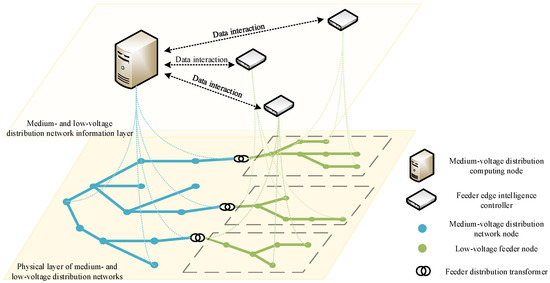
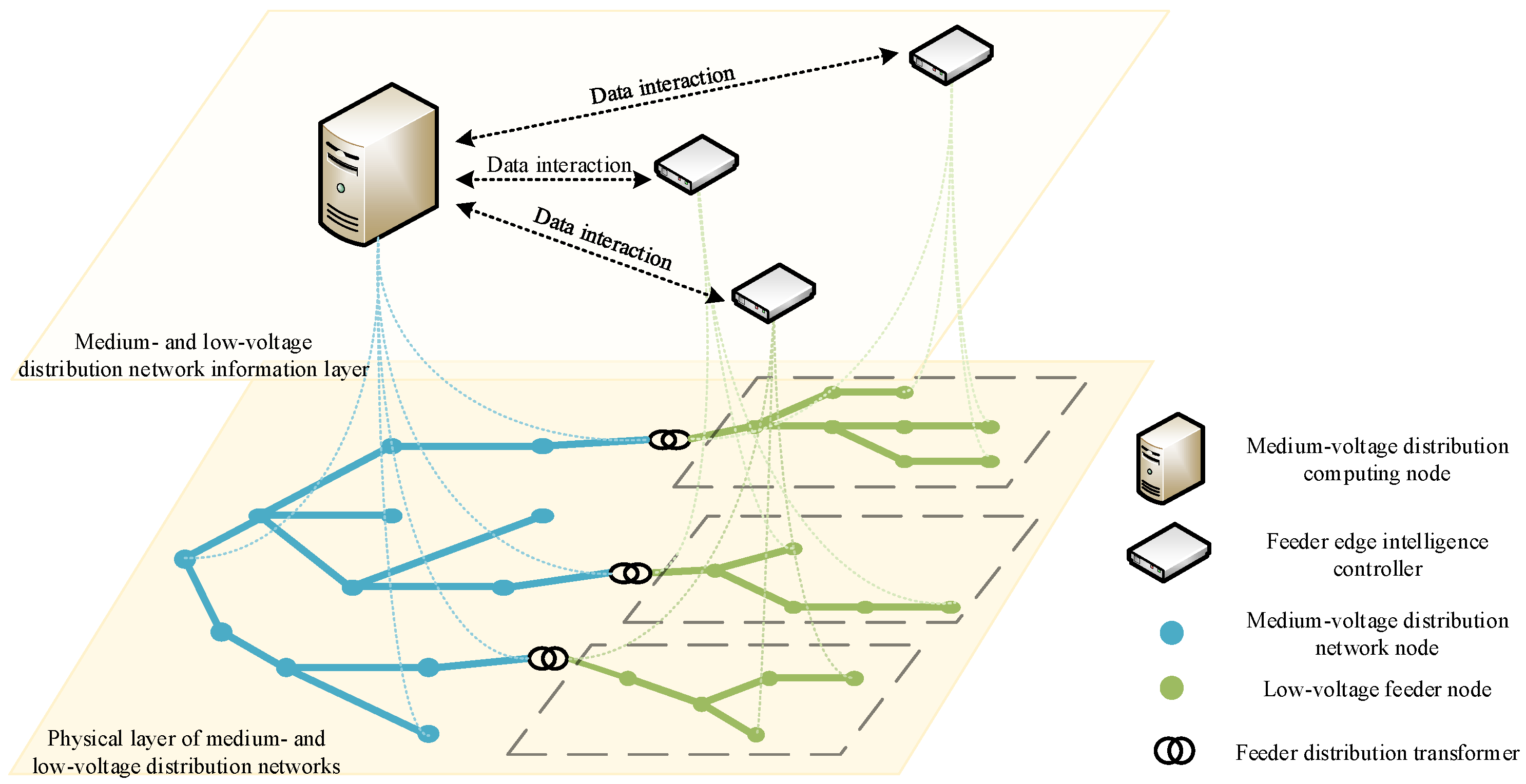
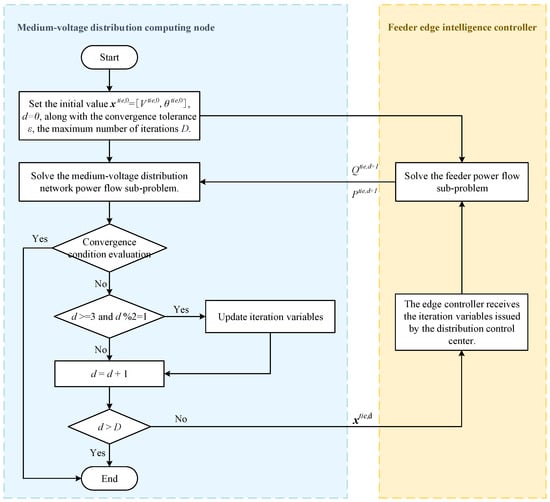
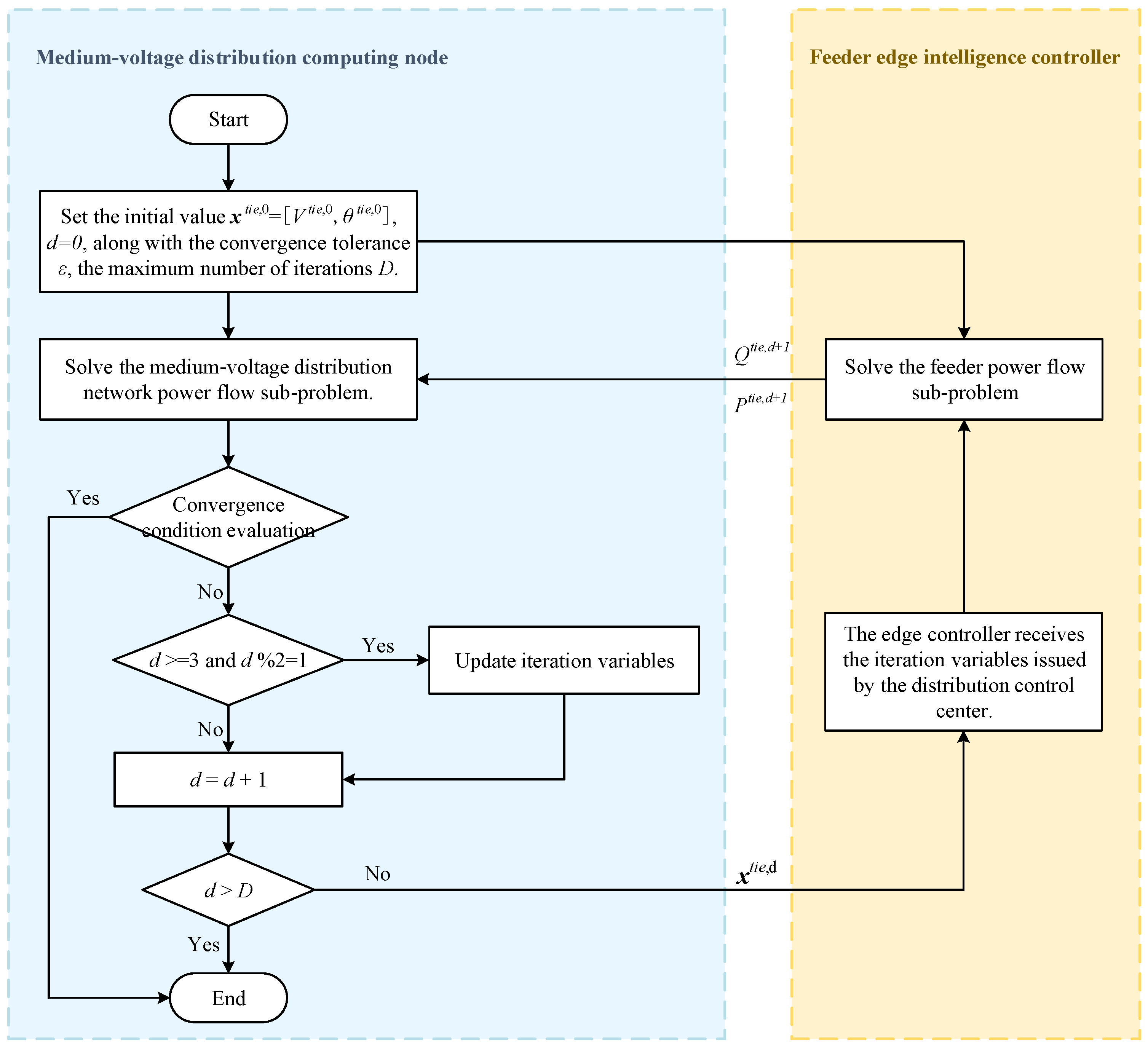
A distribution network typically originates at a 110/35 kV substation, supplies the 10 kV medium-voltage network, and delivers power to low-voltage feeders through distribution transformers. Finally, the transformers convert the 10 kV medium voltage into 380 V low voltage for regional power supply [35], forming an overall radial topology. In addition, significant differences exist between the medium-voltage distribution network and low-voltage feeders in terms of physical structure, management, and data characteristics. Based on these characteristics, this paper designs a collaborative computing framework for medium- and low-voltage distribution networks oriented to edge intelligence, as shown in Figure 1. The framework adopts a master–slave star topology, consisting of two hierarchical levels: the medium-voltage distribution computing node and the low-voltage feeder edge intelligence controllers. The former serves as the master node, interacting with all low-voltage feeder edge intelligence controllers, while the latter act as slave nodes, each directly connected to the master node. The number of slave nodes corresponds to the number of feeders, enabling bidirectional interaction with the distribution computing node.
Figure 1.
Collaborative operation framework for medium- and low-voltage distribution networks oriented to edge intelligence.
Based on the proposed framework, the connotation of edge intelligence in this paper can be specified from the following two aspects:
- (1)
- “Edge” refers to the implementation of localized computation and control near the data source, reducing data transmission requirements to achieve low-latency response and alleviating dependence on the cloud. The proposed framework dynamically offloads computational tasks that were traditionally handled entirely by the master node, reconstructing the collaborative computing framework for medium- and low-voltage networks and enabling low-voltage feeders to locally execute edge computing tasks.
- (2)
- “Intelligence” refers to the deployment of advanced analytical algorithms at the edge, allowing it to perform both data acquisition and transmission as well as localized decision-making. The proposed framework integrates embedded databases and solvers, equipping feeder edge controllers with autonomous data storage and computational capabilities.
3. Distributed Power Flow Model for Medium- and Low-Voltage Distribution Networks
3.1. Power Flow Calculation Model
Due to parameter differences between medium- and low-voltage distribution networks, a global power flow model may exhibit poor matrix conditioning, which can lead to slow convergence, poor convergence performance, or even divergence. Additionally, as the number of feeders increases and the data scale expands, the computational burden of the global model becomes increasingly prohibitive. Therefore, a distributed model is adopted for the modeling of medium- and low-voltage distribution networks. The boundary section refers to the distribution transformers that connect the distribution network and feeder sections. Equations (1)–(3) represent the sub-models for the medium-voltage distribution network, boundary nodes, and low-voltage feeders, respectively.
where PG represents the active power output of generators, PD represents the active power demand of loads, P represents active power, V represents the voltage magnitude, and θ represents the voltage phase angle, G represents the conductance term of the network admittance, and B represents the susceptance term of the network admittance. SNode represents the set of nodes. The superscripts D, tie, and S represent variables associated with the medium-voltage distribution network section, boundary node section, and low-voltage feeder section. The superscripts D-tie and tie-Sk represent the line from the medium-voltage side to the boundary node and the line from the boundary node to the k-th station area, respectively. Sk represents the k-th feeder connected to the medium-voltage distribution network. The corresponding reactive power expressions follow the same formulation.
The distributed modeling approach decouples the global model of the medium- and low-voltage distribution network. The distribution computing node and feeder edge intelligence controllers establish their respective sub-models using boundary node information and locally managed data, enabling zonal autonomy. The distribution computing node manages the medium-voltage distribution network, while each edge intelligence controller governs its respective low-voltage feeder, ensuring coordinated operation.
3.2. Fixed-Point Iterative Solution Analysis of Power Flow Calculation
Section 3.1 decomposes the global power flow calculation problem into a distribution network sub-problem and a feeder sub-problem, enabling distributed modeling, where the model is generally solved using an iterative approach. For clarity, the analysis considers the case of a single low-voltage feeder connected to a medium-voltage distribution system, while Section 5 will analyze the situation of multi-station area.
In the feeder sub-problem, the voltage at the boundary node is obtained from the distribution network sub-problem. This voltage is set as a fixed value and used as the root node voltage to solve the power flow within the feeder section, ultimately obtaining the injected power at the root node of the feeder. This process can be abstracted as:
where gS(•) represents the abstract operator of the feeder sub-problem, which maps the voltage magnitude at the root node of the feeder section to the net injected power at the root node. Ptie and Qtie represent the net injected active and reactive power at the boundary node. Vtie and θtie represent the voltage magnitude and voltage phase angle at the boundary node, respectively.
In the distribution network sub-problem, the feeder is treated as an equivalent load, and the boundary node injection power obtained from the feeder power flow calculation is substituted into the distribution power flow model to solve for the voltage at each boundary node. This process can be abstracted as:
where gD(•) represents the abstract operator for the distribution network sub-problem, which maps the boundary node injection power to the root node voltage.
The objective of the distributed power flow calculation for the medium- and low-voltage distribution network is to obtain [Vtie*,θtie*] that satisfies:
Let φ(•) represent the aforementioned composite mapping, that is,
where φ(•) is the fixed point of Equation (7), and the mathematical essence of the distributed power flow calculation for medium- and low-voltage distribution networks is to solve for the fixed point of Equation (7).
3.3. Convergence Index of the Power Flow Calculation Model Based on Small Perturbations
According to the fixed-point iteration convergence theorem [18], the convergence condition in medium- and low-voltage distribution networks can be expressed as:
where rD represents the sensitivity of the distribution network power flow sub-problem. rS represents the sensitivity of the feeder power flow sub-problem. Their product, r, represents the convergence index, where a smaller value indicates better convergence.
The power flow equations in the collaborative computation of medium- and low-voltage distribution networks are large in scale, resulting in high computational complexity for direct differentiation. To address this, a small perturbation method is proposed to compute the composite sensitivity of the distributed power flow model. Assuming that the medium-voltage distribution network is connected to n low-voltage feeders, where each feeder is integrated into the distribution network through a single distribution transformer, meaning each feeder has one boundary node, the calculation steps for the composite convergence index of the distributed power flow model in medium- and low-voltage distribution networks are as follows:
Step 1: Initialize the state variables of each boundary node [Vtie,0, θtie,0].
Step 2: Compute the power flow for feeder i using the given [Vitie,0, θitie,0] to obtain the boundary node power injection [Pitie,0, Qitie,0].
Step 3: Introduce a small perturbation ΔV to Vitie,0, then perform the power flow calculation for the feeder again based on [Vitie,0 + ΔV, θitie,0] to obtain the updated boundary node power injection [Pitie,1, Qitie,1]. Similarly, introduce a small perturbation Δθ to θitie,0, then perform the power flow calculation for the feeder again based on [Vitie,0, θitie,0 + Δθ] to obtain the updated boundary node power injection [Pitie,2, Qitie,2].
Step 4: Based on the boundary power obtained in Step 3, the sensitivity matrix JS,i of feeder i and the overall sensitivity matrix JS of all feeders are calculated as follows:
Step 5: Transmit the computed boundary node power injection [Pitie,0, Qitie,0] from the feeder to the distribution network, perform the power flow calculation for the distribution network, and obtain the updated boundary node voltage [Vitie,1, θitie,1].
Step 6: Introduce a small perturbation ΔP to Pitie,0, then perform the power flow calculation for the distribution network again based on [Pitie,0 + ΔP, Qitie,0] to obtain the updated boundary node voltage [Vitie,2, θitie,2]. Similarly, introduce a small perturbation ΔQ to Qitie,0, then perform the power flow calculation for the distribution network again based on [Pitie,0, Qitie,0 + ΔQ] to obtain the updated boundary node voltage [Vitie,3, θitie,3].
Step 7: Based on the boundary nodes obtained in Step 6, The sensitivity matrix JD,i at each boundary node and the overall sensitivity matrix JD of the distribution network are calculated as follows:
Step 8: Using the feeder sensitivity matrix JS obtained from Step 4 and the distribution network sensitivity matrix JD obtained from Step 7, compute the convergence index as follows:
4. Distributed Power Flow Calculation Method for Medium- and Low-Voltage Distribution Networks Based on Continuous Intersection Estimation
4.1. Traditional Power Flow Solution Methods and Convergence Analysis
The conventional approach solves the fixed-point power flow iteration problem by alternating iterations. It iterates between the medium-voltage distribution network sub-problem and the low-voltage feeder sub-problems until convergence is reached. The algorithm steps are as follows:
Step 1: Set the initial value xtie,0 = [Vtie,0, θtie,0] for the boundary node state variables, along with the convergence tolerance ε, iteration count d = 0, and the maximum number of iterations.
Step 2: Solve the feeder sub-problem. Based on xtie,d, compute the power flow solution for the feeder sub-problem to obtain xS,d+1, and subsequently determine the boundary node power injections Ptie,d+1 and Qtie,d+1.
Step 3: Solve the distribution network sub-problem. Based on Ptie,d+1 and Qtie,d+1, compute the power flow solution to obtain xD,d+1 and xtie,d+1.
Step 4: Check whether |xtie,d+1 − xtie,d| < ε, |Ptie,d+1 − Ptie,d| < ε and |Qtie,d+1 − Qtie,d| < ε satisfy the convergence criteria. If all conditions are met, terminate the iteration; otherwise, proceed to Step 5.
Step 5: Set d = d + 1. If d reaches the maximum number of iterations, terminate the iteration; otherwise, return to Step 2.
Equation (8) represents the convergence condition for the fixed-point iteration method. If the sensitivity of boundary node voltage to power in the medium-voltage distribution network sub-problem is high, or if the sensitivity of boundary node power to voltage in the low-voltage feeder sub-problem is high, the fixed-point iteration method may fail to converge. As modern distribution networks are developed and expanded, large numbers of distributed generators such as photovoltaic units are being connected to medium- and low-voltage distribution networks. As a result, the sensitivity of root-node power injection to voltage has increased significantly. Additionally, the expansion of the medium- and low-voltage distribution network further reduces the convergence of the fixed-point iteration method. Therefore, it is crucial to develop iterative algorithms with improved convergence properties to enhance the computational efficiency of power flow models in medium- and low-voltage distribution networks.
4.2. Fundamental Principle of the Continuous Intersection Estimation Method
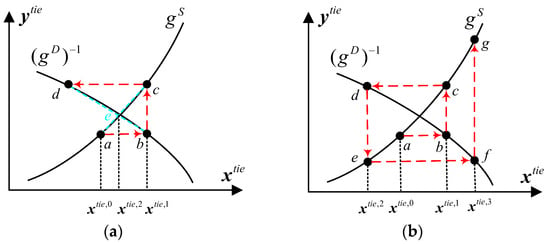
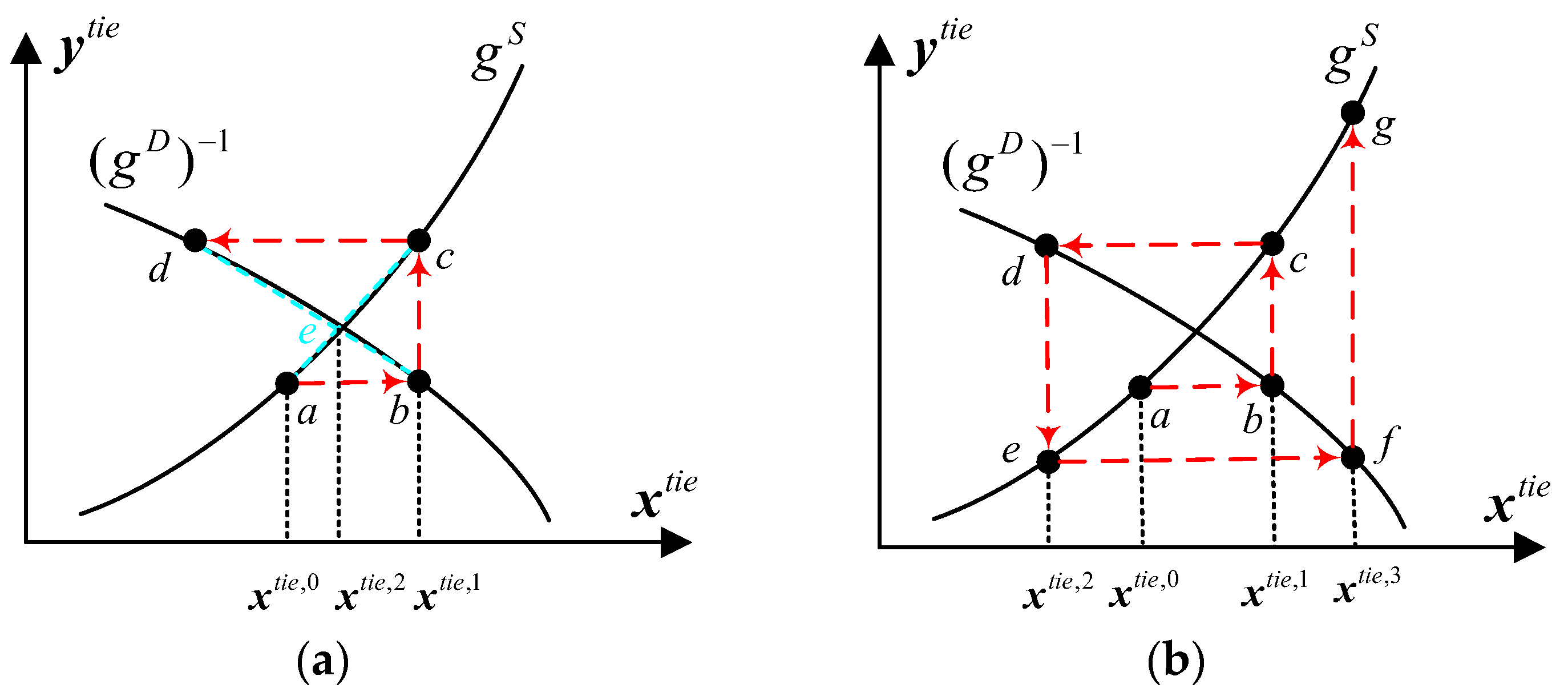
This paper proposes the use of the continuous intersection estimation method to accelerate iterations [36], enhancing the solution speed and convergence performance of the distributed power flow calculation model for medium- and low-voltage distribution networks. The difference in iteration methods between continuous intersection estimation and the fixed-point iteration method is illustrated in Figure 2, where gS and gD correspond to the respective equations in Section 3.2, and (gD)−1 represents the inverse function.
Figure 2.
Schematic diagram of iterative methods for continuous intersection point estimation and traditional fixed-point iteration methods. (a) Continuous intersection estimation. (b) Fixed-point iteration.
According to the two operators defined in Section 3.2, the abstract operator gS for the feeder subproblem maps the boundary-node voltage state xtie to the net injected power at the boundary node ytie, namely ytie = gS(xtie). The abstract operator gD for the distribution-network subproblem maps the boundary-node injected power ytie to the boundary-node voltage state xtie, namely xtie = gD(ytie). Accordingly, a composite mapping can be obtained on the xtie plane as φ(xtie) = gD[gS(xtie)]. The fixed-point iteration adopts a single-step mapping update strategy, which updates the boundary variables using only the mapping result from the previous iteration in each round, following xtie,d+1 = φ(xtie,d) This update is concise, yet in some cases such as those shown in Figure 2b, such an iteration may gradually move away from the convergence point and diverge, leading to failure in obtaining a solution.
In contrast, continuous intersection estimation does not directly use the single-step mapping output as the next boundary variable. Instead, it leverages the historical information of multiple consecutive iterates to construct secant approximations of the two operator relations and corrects the boundary variable using the intersection point of the secants. Specifically, based on the geometric interpretation in Figure 2a, after points ac and bd are obtained, the intersection point e of the two straight lines is taken as the predicted update value of the boundary variable for the next iteration. The intersection correction introduced by continuous intersection estimation on top of fixed-point iteration calibrates the update direction and step size using the most recent two alternating solutions, thereby improving the stability of the iterative trajectory and the convergence efficiency.
It should be emphasized that continuous intersection estimation does not introduce additional computational overhead for solving the feeder or distribution-network power-flow subproblems. It only adds a low-dimensional algebraic calculation at the boundary update stage, and updates xtie according to (14), so the computational burden of this correction is small.
The local convergence of continuous intersection estimation can be guaranteed under the following assumptions.
- The coordinated medium- and low-voltage power-flow problem admits a convergent solution xtie*, which satisfies xtie* = φ(xtie*).
- There exists a neighborhood C of xtie* such that φ″(·) is continuous.
- This neighborhood C satisfies φ′(·)≠1.
When the above assumptions hold and the initial value xtie,0C, continuous intersection estimation exhibits a locally second-order convergence rate [36].
Furthermore, as shown in Figure 2, alternately solving the feeder and distribution-network subproblems generates a sequence of iterates. Let xtie = [Vtie θtie] and ytie = [Ptie Qtie], and the iterative method is illustrated as follows:
- (1)
- Substituting the initial iteration value xtie,0 into the feeder sub-problem yields point a: (xtie,0, gS(xtie,0)).
- (2)
- Substituting ytie,0 = gS(xtie,0) into the distribution network sub-problem yields (ytie,0, gD(ytie,0)), and setting xtie,1 = gD(ytie,0) is represented in the figure as point b: (xtie,1, ytie,0).
- (3)
- Substituting the updated iteration variable xtie,1 into the feeder sub-problem yields point c: (xtie,1, gS(xtie,1)).
In the fixed-point iteration method, the above steps are repeated by substituting ytie,1 = gS(xtie,1) into the distribution network sub-problem to obtain point d: (xtie,2, ytie,1).
Unlike the fixed-point iteration method, which only references the result of the previous iteration, the continuous intersection estimation method stores and utilizes the results of the last four iterations starting from the fifth iteration. When updating the iteration variable x, it follows the updating strategy as described below:
- (4)
- Draw a straight line through points a and c, and another straight line through points b and d. The x-coordinate of their intersection point e is then taken as the updated iteration variable for the next step.
By adopting the continuous intersection estimation method, the gradual divergence issue observed in the fixed-point iteration method, as shown in Figure 2, can be avoided. For every two alternating iterations between the feeder sub-problem and the distribution network sub-problem, the continuous intersection estimation method utilizes the results of these two iterations to adjust the boundary state variables, progressively converging toward the final solution.
4.3. Algorithm Steps of the Continuous Intersection Estimation Method
Based on the fundamental principles and graphical interpretation in Section 4.2, a continuous intersection estimation method is proposed to solve the distributed power flow calculation problem for medium- and low-voltage distribution networks. The algorithm flowchart is shown in Figure 3. For clarity, the analysis considers the case of a single low-voltage feeder connected to a medium-voltage distribution system through a single boundary transformer, which can be directly extended to scenarios with multiple feeders. A detailed discussion on multi-feeder integration will be provided in Section 4. The algorithm steps are as follows:
Figure 3.
Flow chart of distributed power flow calculation algorithm for medium and low voltage distribution network based on continuous cross point estimation.
Steps 1–4 are identical to those in Section 4.1.
Step 5: If the iteration count d is not less than 3 and is an odd number, take the values from the previous four iterations and denote them as point a (xtie,d, ytie,d), point b (xtie,d+1, ytie,d), point c (xtie,d+1, ytie,d+1), and point d (xtie,d+2, ytie,d+1). Draw straight lines connecting ac and bd, respectively. The intersection of these two lines is point e, and solving the simultaneous equations for these lines yields the x-coordinate of point e as:
Use this value as the variable for the next iteration. If the iteration count is less than 3 or an even number, proceed to Step 6.
Step 6: Set d = d + 1. If d reaches the maximum number of iterations, terminate the iteration; otherwise, return to Step 2.
5. Case Analysis
5.1. Formulae and Symbols
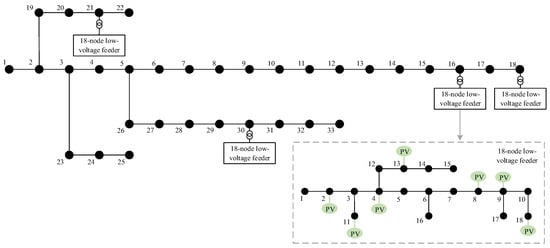
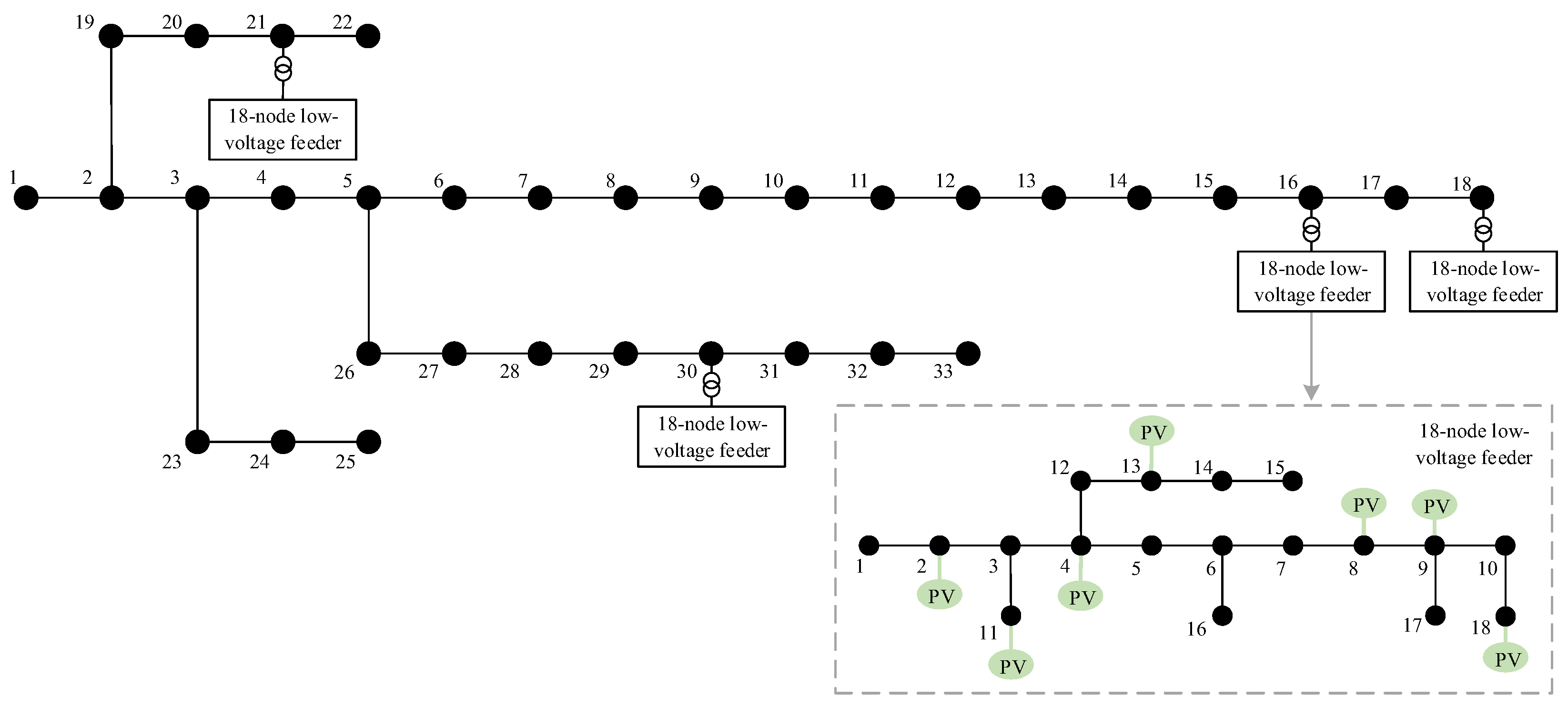
All case studies in this paper are implemented on the Python v3.12.7 platform. The computational environment is a 64-bit Windows 11 system equipped with an Intel Core i9-14900 processor (Intel Corporation, Santa Clara, CA, USA) and 32 GB of RAM. Both subproblems adopt flat start initialization for power flow calculation, with the convergence tolerance set to 1 × 10⁻⁸ p.u. and the maximum number of iterations set to 100. Several medium-voltage distribution network–low-voltage feeder system cases are constructed, as shown in Table 1. The topology diagram of Case A4 is illustrated in Figure 4. In the case studies, the communication between the medium-voltage distribution network and the low-voltage station-area systems is assumed to be ideal and reliable, and non-ideal communication factors such as communication delays are not considered.
Table 1.
Example parameters of distributed power flow calculation in medium- and low-voltage distribution networks.
Figure 4.
Topology of example A4.
- (1)
- The distribution network system is based on a modified IEEE Case33 test system with a voltage level of 12.66 kV. The feeder section adopts a modified 18-node test case [37] and the IEEE European low-voltage unbalanced 906-node network [13], with a voltage level of 0.4 kV, and the lines are modeled as underground cables.
- (2)
- Some feeders are three-phase connected with multiple photovoltaic units, each ranging from 8 to 20 kW in capacity, operating under PV control mode.
- (3)
- The distribution network and feeder sections are connected through a distribution transformer with a rated capacity of 0.63 MVA.
- (4)
- The B-group test cases are designed to simulate heavy-loading conditions on the distribution transformer. In these cases, the active and reactive power loads at each node are scaled by a predefined heavy-loading factor based on the original test-case parameters.
5.2. Accuracy Verification
The proposed method is compared with the Newton–Raphson method based on the global model, the Newton–Raphson method based on the equivalent model, and the fixed-point iteration method:
- (1)
- Newton–Raphson method based on the global model: Although solving a fully aggregated global model is often impractical in real deployments, its Newton–Raphson solution provides a theoretically accurate reference. Therefore, the Newton–Raphson global model results are used as the benchmark for accuracy evaluation.
- (2)
- Newton–Raphson method based on the equivalent model: The feeder is equivalently modeled as a constant load node connected to the distribution network, and the Newton–Raphson method is applied for power flow calculation.
- (3)
- Fixed-point iteration method: The method proposed in Section 4.1.
The power flow calculation results for the boundary nodes in the test cases are presented in Table 2. Due to space limitations, only a subset of the results is shown.
Table 2.
Distributed power flow calculation results of medium and low voltage distribution network (Boundary Nodes).
Considering the integration of distributed photovoltaic generation into low-voltage feeders, comparisons between cases A1 and A4 and between A3 and A6 show that active power injection at the boundary node decreases after photovoltaic is connected. This is because photovoltaic generation balances local electricity consumption, reducing the need for power transmission from the upstream grid, which in turn decreases power flow through the lines and reduces line losses. This demonstrates the local consumption characteristic of renewable energy in modern distribution networks, indicating that photovoltaic integration can alleviate the loading pressure on distribution transformers to some extent.
In terms of the proposed model and algorithm, comparisons across different models and solution methods show that the Newton–Raphson method based on the equivalent model has poor accuracy, with noticeable errors in all scenarios. It cannot accurately analyze the power-flow in medium- and low-voltage distribution networks and does not support unbalanced three-phase modeling. In scenario C, the three-phase results are simply repetitions of the single-phase values. This suggests that traditional power flow calculation methods for medium- and low-voltage distribution networks, which treat the low-voltage network as an equivalent load node and ignore its influence on the medium-voltage network, lead to inaccurate power flow results with significant errors.
By contrast, the fixed-point iteration method and the proposed method produce results that are highly consistent with those of the global-model Newton–Raphson benchmark in terms of key physical quantities, including the boundary-node voltage magnitude and phase angle as well as the net active and reactive power injections. This consistency confirms the numerical reliability of the proposed method. It also suggests that, while fully preserving the topology of low-voltage feeders, the distributed power-flow model established in this paper can closely reproduce the reference results obtained from global centralized solving. Meanwhile, the agreement in accuracy between the two iterative methods further corroborates the correctness of the developed master–slave splitting framework for medium- and low-voltage distribution networks and its boundary–quantity interaction mechanism.
5.3. Convergence Analysis
5.3.1. Convergence Performance Analysis of the Algorithm
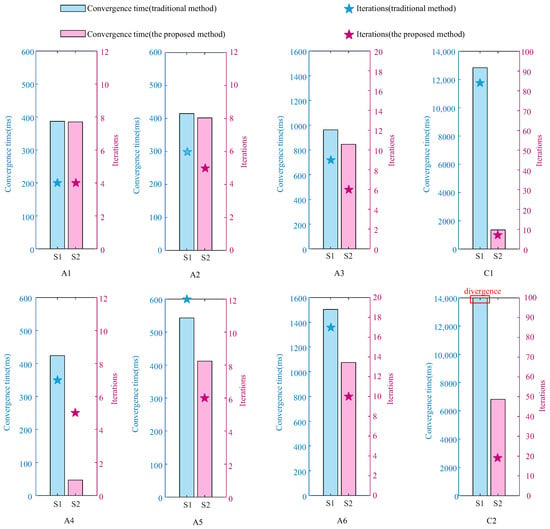
Figure 5 compares the convergence time and iteration count of the proposed method with the traditional fixed-point iteration method under different scenarios. S1 represents the traditional fixed-point iteration method, while S2 represents the proposed method. The bar chart illustrates the convergence time, and the scatter points represent the number of iterations. As shown in Figure 5, the proposed method performs better than the conventional fixed-point iteration in terms of both iteration count and convergence time. For all cases that can converge, continuous intersection estimation accelerates the convergence process, leading to fewer required iterations and a noticeably reduced computational time. More specifically, in Scenario C2, the fixed-point iteration fails to converge within the prescribed maximum number of iterations, whereas the proposed method still reaches a stable solution within a finite number of steps. These results demonstrate that the proposed method offers more pronounced advantages over the conventional approach in terms of convergence performance and computational efficiency.
Figure 5.
Convergence comparison of the continuous intersection estimation method and the conventional fixed-point iteration method in different scenarios.
By analyzing the convergence trends under different test scenarios, it can be observed that factors such as the integration of distributed energy resources, the location of feeders within the distribution network, and the scale of feeders all impact the convergence of power flow calculations in medium- and low-voltage distribution networks. A detailed analysis will be conducted based on the computation of the convergence index. It is important to note that the convergence index measures the intrinsic properties of the fixed-point iteration model for power flow calculations in medium- and low-voltage distribution networks and is independent of the specific iterative algorithm. While iterative algorithms improve convergence speed by refining the iteration formula, they do not alter the mathematical characteristics of the model itself.
5.3.2. Convergence Index Analysis of the Power Flow Calculation Model
Using the method proposed in Section 3.3, the convergence indices rD, rS, and r are computed for each test case scenario, and the number of iterations required for convergence under different algorithms is also recorded. Considering the sensitivity of the indices to the perturbations and balancing rounding and truncation errors, the small perturbations are set to ΔV = 1 × 10⁻¹⁰, Δθ = 1 × 10⁻¹⁰, ΔP = 1 × 10⁻⁸, and ΔQ = 1 × 10⁻⁸. The test results are presented in Table 3.
Table 3.
Comparison of convergence metrics for distributed power-flow in medium- and low-voltage distribution networks.
By comparing the iteration counts and convergence indices rD, rS, and r for different scenarios in Table 3, it can be observed that as the convergence index increases, the number of iterations required for convergence also increases. When r approaches 1, the convergence performance deteriorates, and when r exceeds 1, the algorithm fails to converge. This demonstrates the feasibility of the proposed convergence index, which can be used for estimating iteration counts and analyzing convergence behavior.
Additionally, when the number of integrated feeders increases, rD exhibits a more significant increase compared to rS, indicating that the distribution network’s sensitivity increases in multi-feeder scenarios. As the scale of the medium-voltage distribution network and feeder system expands, power flow calculation convergence deteriorates. Conversely, when distributed energy resources are integrated, the growth rate of rS is greater than that of rD, highlighting that distributed generation significantly increases feeder sensitivity. This suggests that in practical applications, the impact of distributed energy integration on system power flow distribution should be carefully considered.
In Case C2, the convergence index is greater than 1 and the fixed-point iteration diverges, whereas the proposed method can still converge into a feasible solution. This is because the original mapping function exhibits pronounced nonlinearity. By applying continuous intersection estimation, the proposed method can follow a new update trajectory in this scenario, effectively bypass a locally divergent path, and identify a stable solution. Consequently, the proposed method is able to achieve convergence even when the conventional method fails to converge.
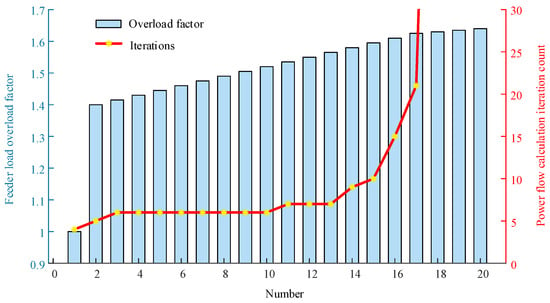
Furthermore, with the increasing electrification of kitchens, the integration of private charging stations, and the influence of factors such as weather conditions, seasonal variations, holidays, and user electricity consumption habits, distribution transformers are prone to overloading. To analyze the impact of load growth on the convergence of distributed power flow calculations in medium- and low-voltage distribution networks, Case B1 is selected, and multiple feeder loads are scaled with different overload factors. The variation in iteration counts with increasing feeder load is observed, and the convergence performance under different load scaling factors is analyzed. The resulting trend is illustrated in Figure 6.
Figure 6.
Comparison of convergence iteration counts for case B1 under varying feeder load overload factors.
From Figure 6, it can be observed that as the feeder load scaling factor increases, the convergence indices rD, rS, and r all gradually increase, and the number of iterations required for convergence also rises. This indicates that as the load grows, the convergence performance of the distributed power flow calculation progressively weakens. Additionally, the sensitivity rD of the distribution network changes only slightly and remains nearly constant, whereas the sensitivity rS, of the feeders, exhibits significant variation. This suggests that load growth has a notable impact on the sensitivity of root node power injection with respect to root node voltage in the feeders. When the overload factor is high, rS increases sharply, leading to a rapid deterioration in convergence. Furthermore, when the overload factor is below 1.6, the number of iterations remains around or below 10. However, when the overload factor exceeds 1.6 and the convergence index r surpasses 0.8, the iteration count rises sharply until the algorithm fails to converge. This is because the feeder load surpasses the system’s critical capacity, ultimately leading to system instability and failure.
6. Conclusions
This paper constructs a distributed power flow calculation model for medium- and low-voltage distribution networks based on edge intelligence technology and proposes a distributed power flow calculation method using continuous intersection estimation. Through case study analysis, it is demonstrated that the proposed method effectively improves computational efficiency and convergence performance, addressing the modeling and analysis requirements of power flow calculations in medium- and low-voltage distribution networks for engineering applications. The main conclusions are as follows:
- (1)
- The distributed power flow model supports heterogeneous modeling of medium- and low-voltage distribution networks, where each part is solved independently within its respective sub-problem. This allows for the use of appropriate modeling approaches and solution algorithms tailored to each network level while exchanging only a minimal amount of necessary data, ensuring data privacy and security across different distribution network layers.
- (2)
- The proposed distributed model convergence index evaluation method based on small perturbations effectively assesses model convergence under different scenarios. Using detailed indices, the impact of factors such as the number and scale of integrated feeders, system overloading, and the integration of distributed energy resources on power flow convergence can be analyzed.
- (3)
- The distributed power flow algorithm based on continuous intersection estimation achieves the same accuracy as the Newton–Raphson method under the global model and the traditional fixed-point iteration method. However, it exhibits superior convergence and computational efficiency, reducing iteration counts and computation time by approximately 40% compared to the traditional fixed-point iteration method, with a quadratic convergence rate.
Future work will further incorporate non-ideal factors such as communication delays and evaluate their impacts on convergence behavior and computational timeliness to enhance the engineering applicability of the proposed method. In addition, building on the medium- and low-voltage master–slave splitting framework and the boundary–quantity interaction mechanism developed in this paper, distributed optimal power flow modeling and solution methods will be investigated, together with an assessment of their applicability in edge-side collaborative optimization scenarios.
Author Contributions
Methodology: X.Z., Y.L., S.G., Y.T. and Y.G.; writing—original draft preparation: X.Z. and Y.G.; writing—review and editing: X.Z., Y.L., S.G., Y.T. and Y.G. All authors have read and agreed to the published version of the manuscript.
Funding
This research was funded by the Science & Technology Project of the State Grid Corporation of China, grant number 5400-202356680A-3-3-JC, project name: Research on Key Technologies of Distributed Collaborative Computing and Control for New-Type Distribution Networks.
Data Availability Statement
The original contributions presented in the study are included in the article; further inquiries can be directed to the corresponding author.
Conflicts of Interest
All authors were employed by the company State Grid Economic and Technological Research Institute Co., Ltd.
Nomenclature
| List of Symbols | |
| S | Node set |
| PG | Generator active power output |
| PD | Load active power |
| P | Active power |
| Q | Reactive power |
| V | Voltage magnitude |
| θ | Voltage phase angle |
| G | Conductance term of network admittance |
| B | Susceptance term of network admittance |
| r | Convergence index |
| ΔV | Small perturbation of voltage magnitude |
| Δθ | Small perturbation of voltage phase angle |
| ΔP | Small perturbation of injected active power |
| ΔQ | Small perturbation of injected reactive power |
| J | Sensitivity matrix |
| ε | Convergence tolerance |
| x | State vector |
| y | Node power injection vector |
| List of Superscripts | |
| D | Medium-voltage distribution network section of variable |
| tie | Boundary-node section of variable |
| S | Low-voltage feeder section of variable |
| D-tie | The line from the medium-voltage side to the boundary node |
| tie-Sk | The line from the boundary node to the k-th low-voltage feeder |
| * | The true value of the variable |
| d | Iteration count |
| List of Subscripts | |
| i,j | Node number |
| Node | Node set indicator |
References
- Li, S.; Chen, T.; Ding, R.; Li, S.; Chen, T.; Ding, R. Active Distribution Network Source–Network–Load–Storage Collaborative Interaction Considering Multiple Flexible and Controllable Resources. Information 2025, 16, 325. [Google Scholar] [CrossRef] [Scilit]
- Xie, H.; Wang, W.; Wang, W.; Tian, L. Optimal Dispatching Strategy of Active Distribution Network for Promoting Local Consumption of Renewable Energy. Front. Energy Res. 2022, 10, 826141. [Google Scholar] [CrossRef] [Scilit]
- Li, Q.; Chen, J.; Yang, J.; Li, Z. Research on Source Network Load–Storage Hierarchical Coordinated Intelligent Control Method for Active Distribution Network. Electr. Eng. 2025, 107, 1191–1202. [Google Scholar] [CrossRef] [Scilit]
- Avila-Rojas, A.E.; De Oliveira-De Jesus, P.M.; Alvarez, M. Distribution Network Electric Vehicle Hosting Capacity Enhancement Using an Optimal Power Flow Formulation. Electr. Eng. 2022, 104, 1337–1348. [Google Scholar] [CrossRef] [Scilit]
- Zhang, X.; Liu, J.; Zhang, X.; Liu, J. Distributed Power, Energy Storage Planning, and Power Tracking Studies for Distribution Networks. Electronics 2025, 14, 2833. [Google Scholar] [CrossRef] [Scilit]
- Haque, M.M.; Wolfs, P. A Review of High PV Penetrations in LV Distribution Networks: Present Status, Impacts and Mitigation Measures. Renew. Sustain. Energy Rev. 2016, 62, 1195–1208. [Google Scholar] [CrossRef] [Scilit]
- Hussan, U.; Wang, H.; Ayub, M.A.; Rasheed, H.; Majeed, M.A.; Peng, J.; Jiang, H. Decentralized Stochastic Recursive Gradient Method for Fully Decentralized OPF in Multi-Area Power Systems. Mathematics 2024, 12, 3064. [Google Scholar] [CrossRef] [Scilit]
- Shirmohammadi, D.; Hong, H.W.; Semlyen, A.; Luo, G.X. A Compensation-Based Power Flow Method for Weakly Meshed Distribution and Transmission Networks. IEEE Trans. Power Syst. 1988, 3, 753–762. [Google Scholar] [CrossRef] [Scilit]
- Petridis, S.; Blanas, O.; Rakopoulos, D.; Stergiopoulos, F.; Nikolopoulos, N.; Voutetakis, S.; Petridis, S.; Blanas, O.; Rakopoulos, D.; Stergiopoulos, F.; et al. An Efficient Backward/Forward Sweep Algorithm for Power Flow Analysis through a Novel Tree-like Structure for Unbalanced Distribution Networks. Energies 2021, 14, 897. [Google Scholar] [CrossRef] [Scilit]
- Chen, T.-H.; Chen, M.-S.; Inoue, T.; Kotas, P.; Chebli, E.A. Three-Phase Cogenerator and Transformer Models for Distribution System Analysis. IEEE Trans. Power Del. 1991, 6, 1671–1681. [Google Scholar] [CrossRef] [Scilit]
- Glavic, M.; Alvarado, F.L. An Extension of Newton–Raphson Power Flow Problem. Appl. Math. Comput. 2007, 186, 1192–1204. [Google Scholar] [CrossRef] [Scilit]
- Wang, X.; Chen, W.; Tian, R.; Ji, Y.; Zhu, J. Fast Power Flow Calculation for Distribution Networks Based on Graph Models and Hierarchical Forward-Backward Sweep Parallel Algorithm. Front. Energy Res. 2024, 12, 5900. [Google Scholar] [CrossRef] [Scilit]
- Schneider, K.P.; Mather, B.A.; Pal, B.C.; Ten, C.-W.; Shirek, G.J.; Zhu, H.; Fuller, J.C.; Pereira, J.L.R.; Ochoa, L.F.; de Araujo, L.R.; et al. Analytic Considerations and Design Basis for the IEEE Distribution Test Feeders. IEEE Trans. Power Syst. 2018, 33, 3181–3188. [Google Scholar] [CrossRef] [Scilit]
- Wu, J.Q.; Bose, A. Parallel Solution of Large Sparse Matrix Equations and Parallel Power Flow. IEEE Trans. Power Syst. 1995, 10, 1343–1349. [Google Scholar] [CrossRef] [Scilit]
- Di Santo, M.; Vaccaro, A.; Villacci, D.; Zimeo, E. A Distributed Architecture for Online Power Systems Security Analysis. IEEE Trans. Ind. Electron. 2004, 51, 1238–1248. [Google Scholar] [CrossRef] [Scilit]
- Pediaditis, P.; Sirviö, K.; Ziras, C.; Kauhaniemi, K.; Laaksonen, H.; Hatziargyriou, N.; Pediaditis, P.; Sirviö, K.; Ziras, C.; Kauhaniemi, K.; et al. Compliance of Distribution System Reactive Flows with Transmission System Requirements. Appl. Sci. 2021, 11, 7719. [Google Scholar] [CrossRef] [Scilit]
- Li, W.; You, Y.; Liu, T.; Ju, Y.; Ma, Y.; Li, W.; You, Y.; Liu, T.; Ju, Y.; Ma, Y. Linearized Power Flow Calculation of Flexible Interconnected Distribution Network Driven by Data–Physical Fusion. Processes 2025, 13, 1582. [Google Scholar] [CrossRef] [Scilit]
- Zhong, H.; Zhang, G.; Tan, Z.; Ruan, G.; Wang, X. Hierarchical Collaborative Expansion Planning for Transmission and Distribution Networks Considering Transmission Cost Allocation. Appl. Energy 2022, 307, 118147. [Google Scholar] [CrossRef] [Scilit]
- Luo, Y.; Liu, C.; Sun, K. Analytical Segmental Holomorphic Embedding Power Flow Method for Integrated Transmission and Distribution Networks. Int. J. Electr. Power Energy Syst. 2025, 170, 110809. [Google Scholar] [CrossRef] [Scilit]
- Sun, H.; Guo, Q.; Zhang, B.; Guo, Y.; Li, Z.; Wang, J. Master–Slave-Splitting Based Distributed Global Power Flow Method for Integrated Transmission and Distribution Analysis. IEEE Trans. Smart Grid 2015, 6, 1484–1492. [Google Scholar] [CrossRef] [Scilit]
- Portelinha, R.K.; Durce, C.C.; Tortelli, O.L.; Lourenço, E.M. Fast-Decoupled Power Flow Method for Integrated Analysis of Transmission and Distribution Systems. Electr. Power Syst. Res. 2021, 196, 107215. [Google Scholar] [CrossRef] [Scilit]
- Huang, Q.; Vittal, V. Integrated Transmission and Distribution System Power Flow and Dynamic Simulation Using Mixed Three-Sequence/Three-Phase Modeling. IEEE Trans. Power Syst. 2017, 32, 3704–3714. [Google Scholar] [CrossRef] [Scilit]
- Tao, W.; Wang, X.; Zhang, C.; Xu, B.; Guo, Z. Power Flow Calculation of Integrated Transmission and Distribution Networks. J. Phys. Conf. Ser. 2023, 2666, 12008. [Google Scholar] [CrossRef] [Scilit]
- Hu, J.; Dou, X.; Li, C.; Long, H.; Chen, K.; Zhou, J. Distributed Cooperative Reactive Power Optimization Strategy for Medium- and Low-Voltage Distribution Network. Autom. Electr. Power Syst. 2021, 45, 47–54. [Google Scholar] [CrossRef]
- Sereeter, B.; Van Westering, W.; Vuik, C.; Witteveen, C. Linear Power Flow Method Improved with Numerical Analysis Techniques Applied to a Very Large Network. Energies 2019, 12, 4078. [Google Scholar] [CrossRef] [Scilit]
- Pan, J.; McElhannon, J. Future Edge Cloud and Edge Computing for Internet of Things Applications. IEEE Internet Things J. 2018, 5, 439–449. [Google Scholar] [CrossRef] [Scilit]
- Wang, Y.; Yang, C.; Lan, S.; Zhu, L.; Zhang, Y. End-Edge-Cloud Collaborative Computing for Deep Learning: A Comprehensive Survey. IEEE Commun. Surv. Tuts. 2024, 26, 2647–2683. [Google Scholar] [CrossRef] [Scilit]
- Shen, S.; Ren, Y.; Ju, Y.; Wang, X.; Wang, W.; Leung, V.C.M. EdgeMatrix: A Resource-Redefined Scheduling Framework for SLA-Guaranteed Multi-Tier Edge-Cloud Computing Systems. IEEE J. Sel. Areas Commun. 2023, 41, 820–834. [Google Scholar] [CrossRef] [Scilit]
- Liu, Z.; Song, J.; Qiu, C.; Wang, X.; Chen, X.; He, Q.; Sheng, H. Hastening Stream Offloading of Inference via Multi-Exit DNNs in Mobile Edge Computing. IEEE Trans. Mob. Comput. 2024, 23, 535–548. [Google Scholar] [CrossRef] [Scilit]
- Shen, L.; Dou, X.; Long, H.; Li, C.; Zhou, J.; Chen, K. A Cloud-Edge Cooperative Dispatching Method for Distribution Networks Considering Photovoltaic Generation Uncertainty. J. Mod. Power Syst. Clean Energy 2021, 9, 1111–1120. [Google Scholar] [CrossRef] [Scilit]
- Fang, D.; Guan, X.; Lin, L.; Peng, Y.; Sun, D.; Hassan, M.M. Edge Intelligence Based Economic Dispatch for Virtual Power Plant in 5G Internet of Energy. Comput. Commun. 2020, 151, 42–50. [Google Scholar] [CrossRef] [Scilit]
- Li, X.; Wang, J.; Lu, Z.; Cai, Y. A Cloud Edge Computing Method for Economic Dispatch of Active Distribution Network with Multi-Microgrids. Electr. Power Syst. Res. 2023, 214, 108806. [Google Scholar] [CrossRef] [Scilit]
- Luo, P.; Liang, J.; Fan, H.; Zeng, S.; Yang, G.; Lin, J. Real-Time Distributed Dispatch Strategy for Distribution Transformer Supply Zone Cluster Based on Cloud-Edge Collaboration Architecture. Front. Energy Res. 2022, 10, 1019349. [Google Scholar] [CrossRef] [Scilit]
- Fan, Y.; Wu, H.; Li, Z.; Lin, J.; Li, L.; Huang, X.; Chen, W.; Chen, B. A Flexible Orchestration of Lightweight AI for Edge Computing in Low-Voltage Distribution Network. Front. Energy Res. 2024, 12, 1424663. [Google Scholar] [CrossRef] [Scilit]
- Wu, J.; Hu, J.; Zhong, R.; Wang, J.; Yang, Y.; Luo, Y.; Tang, Y. Research on Optimal Control of Rural Distribution Network Voltage Support Based on Station Energy Storage. In Proceedings of the 19th Annual Conference of China Electrotechnical Society, Xi’an, China, 20–22 September 2024; Yang, Q., Bie, Z., Yang, X., Eds.; Springer Nature: Singapore, 2025; pp. 373–386. [Google Scholar]
- Tang, K.; Dong, S.; Song, Y. Successive-Intersection-Approximation-Based Power Flow Method for Integrated Transmission and Distribution Networks. IEEE Trans. Power Syst. 2020, 35, 4836–4846. [Google Scholar] [CrossRef] [Scilit]
- CIGRE Networks—Pandapower 3.2.0 Documentation. Available online: https://pandapower.readthedocs.io/en/latest/networks/cigre.html (accessed on 24 November 2025).

Disclaimer/Publisher’s Note: The statements, opinions and data contained in all publications are solely those of the individual author(s) and contributor(s) and not of MDPI and/or the editor(s). MDPI and/or the editor(s) disclaim responsibility for any injury to people or property resulting from any ideas, methods, instructions or products referred to in the content. |
© 2026 by the authors. Licensee MDPI, Basel, Switzerland. This article is an open access article distributed under the terms and conditions of the Creative Commons Attribution (CC BY) license.