Article

AMUSE++: A Mamba-Enhanced Speech Enhancement Framework with Bi-Directional and Advanced Front-End Modeling

1
Department of Electrical Engineering, National Chi Nan University, Nantou County 545301, Taiwan
2
Department of Computer Science and Information Engineering, National Taiwan Normal University, Taipei City 106308, Taiwan
*
Author to whom correspondence should be addressed.
Electronics 2026, 15(2), 282; https://doi.org/10.3390/electronics15020282
Submission received: 10 December 2025 / Revised: 4 January 2026 / Accepted: 6 January 2026 / Published: 8 January 2026

Abstract

This study presents AMUSE++, an advanced speech enhancement framework that extends the MUSE++ model by redesigning its core Mamba module with two major improvements. First, the originally unidirectional one-dimensional (1D) Mamba is transformed into a bi-directional architecture to capture temporal dependencies more effectively. Second, this module is extended to a two-dimensional (2D) structure that jointly models both time and frequency dimensions, capturing richer speech features essential for enhancement tasks. In addition to these structural changes, we propose a Preliminary Denoising Module (PDM) as an advanced front-end, which is composed of multiple cascaded 2D bi-directional Mamba Blocks designed to preprocess and denoise input speech features before the main enhancement stage. Extensive experiments on the VoiceBank+DEMAND dataset demonstrate that AMUSE++ significantly outperforms both the backbone MUSE++ across a variety of objective speech enhancement metrics, including improvements in perceptual quality and intelligibility. These results confirm that the combination of bi-directionality, two-dimensional modeling, and an enhanced denoising frontend provides a powerful approach for tackling challenging noisy speech scenarios. AMUSE++ thus represents a notable advancement in neural speech enhancement architectures, paving the way for more effective and robust speech enhancement systems in real-world applications.

1. Introduction

Speech enhancement (SE) aims to improve both intelligibility and perceptual quality of speech signals in noise, with applications spanning mobile audio, hearing aids, smart assistants, remote conferencing, and speech recognition [1,2,3]. SE methodologies have progressed from classical statistical and frequency-domain approaches, such as spectral subtraction, Wiener filters, and MMSE estimators [4,5,6], to powerful data-driven deep learning frameworks [7,8,9,10].
Traditional statistical SE methods primarily operated in the frequency domain, manipulating spectral magnitude while ignoring phase, which restricted performance, especially in nonstationary noise and low signal-to-noise ratio (SNR) conditions [2,6]. With the advent of deep learning, models based on DNNs, CNNs, LSTMs, and U-Net architectures enabled complex, data-driven mappings between noisy and clean speech, supporting both magnitude- and, increasingly, phase-aware enhancement [2,11,12].
Modern research highlights the importance of phase modeling alongside magnitude estimation, with phase-aware methods such as PHASEN, dual-path, and parallel magnitude-phase networks [12,13,14] delivering substantial improvements, especially at low SNRs. Simultaneously, lightweight and efficient SE architectures have emerged to support real-time and embedded scenarios [3,9], employing design strategies such as bottleneck compression, grouped convolutions, efficient attention, and neural architecture search, as seen in GTCRN, FSPEN, CTSE-Net, and LDSTransformer [10,15].
Additionally, there is a growing emphasis on multi-modal and cross-domain SE methods, incorporating visual, bone-conduction, or sensor signals for improved robustness in challenging environments [16,17,18,19]. These advances are making high-quality, real-time, and resource-efficient SE increasingly feasible for widespread and diverse applications.
In summary, the evolution of speech enhancement (SE) has been marked by the following:
  • A transition from magnitude-only, frequency-domain approaches to deep learning models operating in time-frequency and time-domain representations.
  • Increased focus on explicit phase modeling to achieve perceptual quality and intelligibility improvements.
  • Development of lightweight architectures optimized for edge devices and mobile deployment.
  • Growing use of multi-modal integration and cross-sensor fusion to handle real-world acoustic challenges.
These trends provide a robust foundation for the next generation of SE systems in practical, dynamic environments.
In our recent work [20], we introduced MUSE++, an advanced speech enhancement (SE) framework that builds upon the original MUSE architecture [7] and addresses critical limitations of computational efficiency and generalization. MUSE++ incorporates several targeted innovations to enable high-quality enhancement with significantly reduced computational and parameter requirements, making it well suited for resource-constrained and real-time applications. The central architectural upgrade in MUSE++ is the replacement of the original Multi-path Enhanced Taylor (MET) Transformer component with the Mamba state space model [21,22], a recent sequence modeling paradigm that achieves linear complexity with respect to input length. This substitution not only improves practical deployment by enabling faster inference and lower memory usage but also preserves a high level of enhancement accuracy.
Unlike methods that rely on attention-based transformers—often introducing high computational overhead—Mamba provides an efficient mechanism to capture both long-range and local sequence dependencies through structured state space modeling. Prior work has also explored efficient Transformer variants such as Performer [23], yet Mamba’s state space approach stands out for its scalability in long sequence modeling without the need for expensive attention approximations. Recent empirical studies [24,25] have further validated Mamba’s effectiveness as a drop-in replacement for Transformer blocks in SE architectures, where it achieves comparable or superior performance with much lower computational demands.
To further enhance the robustness and generalization capability, MUSE++ incorporates a dynamic training regime, where clean speech signals are mixed with noise on-the-fly at SNRs uniformly sampled from a wide range. This exposes the model to diverse acoustic conditions during training, fostering robust feature learning. An augmented, multi-objective loss function—encompassing time-domain, consistency, and multi-resolution STFT components—guides the network optimization toward both perceptual and objective quality improvements. Comprehensive evaluations on the VoiceBank-DEMAND corpus [26,27] verify that MUSE++ not only dramatically reduces model size and inference cost but also achieves consistent gains in enhancement metrics over the original MUSE framework.
Building on this foundation, the present work introduces AMUSE++, which takes MUSE++ as its backbone and targets a key remaining limitation. The name “AMUSE++” stands for Advanced Mamba-enhanced MUSE++, highlighting that the proposed framework augments MUSE++ with more powerful Mamba-based modeling and additional enhancement modules. In its current form, MUSE++ performs primarily one-dimensional, uni-directional sequence modeling, which may underutilize the rich two-dimensional (time–frequency) structure of speech spectrograms. To overcome this bottleneck, AMUSE++ extends the MUSE++ backbone with two-dimensional bi-directional Mamba modules that jointly model temporal and spectral dependencies, together with a preliminary denoising module that applies these modules in a dedicated front-end stage. Moreover, AMUSE++ retains the dynamic SNR augmentation and augmented multi-objective loss of MUSE++, and further leverages an auxiliary enhancement branch that directly supervises the PDM. In this way, AMUSE++ inherits the efficiency advantages of MUSE++ while providing more expressive and context-aware modeling, with the goal of further advancing the state of the art in speech enhancement.
The main contributions of this work are threefold:
  • We propose a 2D bi-directional Mamba module that explicitly models spectro-temporal dependencies along both time and frequency axes and show that it significantly outperforms 1D uni-directional Mamba module in speech enhancement.
  • We design a preliminary denoising module that applies the proposed 2D bi-directional Mamba in a front-end stage and introduce an auxiliary enhancement branch that provides direct supervision to this module via the MUSE++ multi-objective loss.
  • Through extensive experiments and ablation studies on the VoiceBank-DEMAND corpus, we demonstrate that AMUSE++ achieves superior perceptual quality and intelligibility compared with MUSE, MUSE++, and several state-of-the-art lightweight SE models, while maintaining a compact parameter footprint
The remainder of this study is organized as follows. Section 2 reviews the backbone model MUSE++. Section 3 details the proposed AMUSE++ framework, including the 2D bi-directional Mamba module, its integration into the MUSE++ backbone, and the preliminary denoising module with auxiliary supervision. Section 4 and  Section 5 describe the experimental setup and report both quantitative and qualitative results, together with ablation analyses. Finally, Section 6 concludes the paper and outlines several directions for future research.

2. Backbone Model: MUSE++ and Its 1D Uni-Directional Mamba Block

The MUSE++ framework [20] is an advanced evolution of the original MUSE model [7], aiming to enhance architectural efficiency, model compactness, and practical robustness for speech enhancement. Although the original MUSE demonstrates strong denoising performance, its use of the MET Transformer backbone incurs substantial computational overhead and model size, presenting obstacles for deployment on real-time or resource-constrained applications. In addition, the use of fixed data augmentation and baseline loss limits generalization in diverse, real-world acoustic environments.
To address these issues, MUSE++ incorporates three main methodological innovations:
1.
Efficient Sequence Modeling with Mamba-2: The MET Transformer in MUSE is replaced by the 1D Mamba-2 state space model, which maintains linear complexity with respect to sequence length. This facilitates both a significant reduction in parameter count and computational cost, while enabling effective long-range dependency modeling in sequential audio data.
2.
Dynamic SNR-based Data Augmentation: Instead of fixed-SNR mixing, MUSE++ performs dynamic, on-the-fly mixing for every training utterance by sampling SNR values uniformly from a broad range, generating noisy-clean pairs on demand. This dramatically increases data diversity and improves noise robustness.
3.
Augmented Multi-Objective Loss: The objective is expanded to include STFT consistency, time-domain, and multi-resolution STFT losses in addition to standard spectrogram-based terms, yielding richer and more comprehensive supervision for optimization.
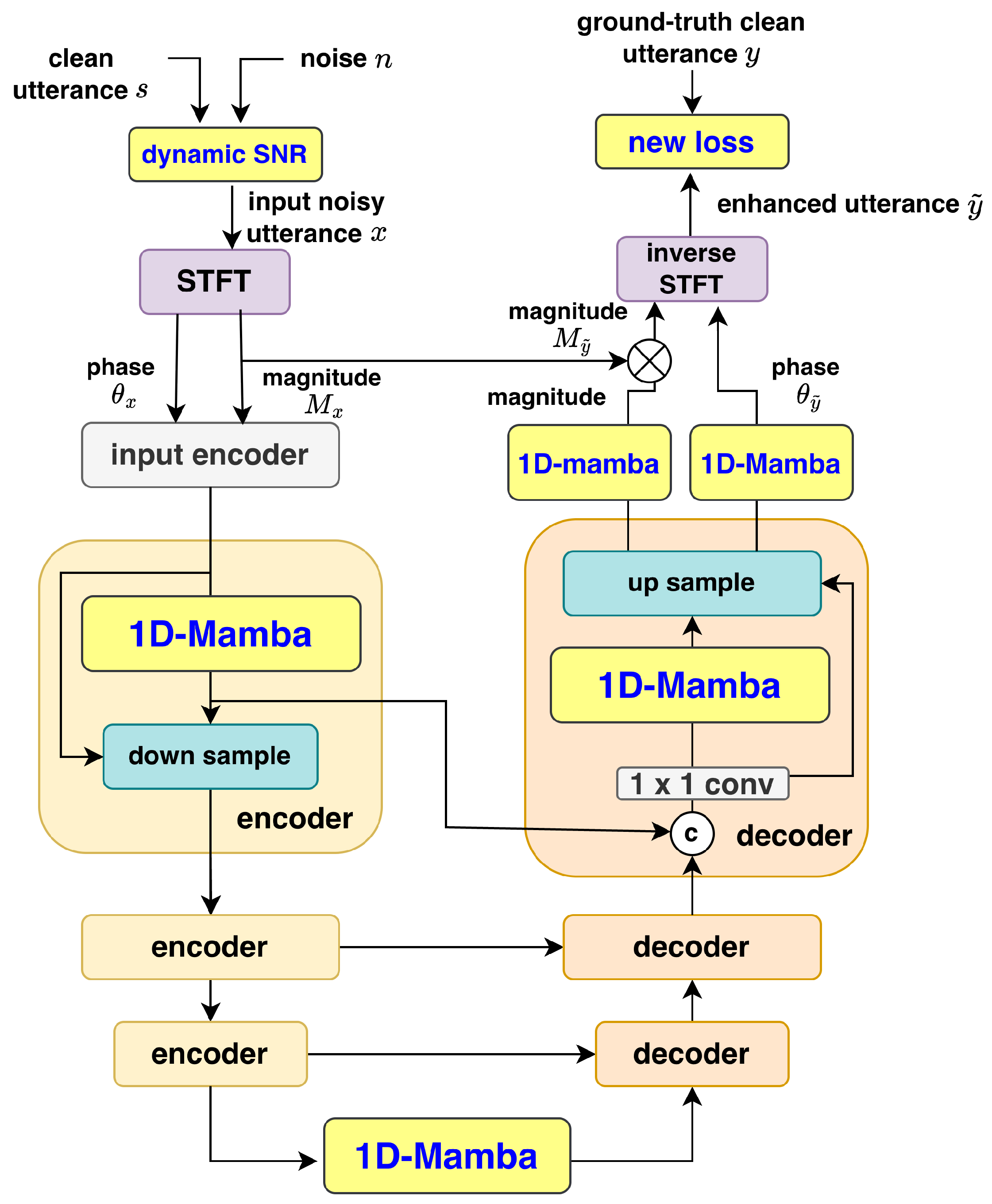
A schematic of the full MUSE++ pipeline is shown in Figure 1, highlighting its concise UNet backbone, 1D Mamba-2 modeling blocks, dynamic data augmentation, and integrated multi-objective losses. In the following, we introduce the main component procedures of MUSE++ and the corresponding characteristics. For clarity, detailed module explanations are omitted due to complexity, and interested readers are referred to [20] for further details.

2.1. Input Representation and Data Flow

Given a time-domain input signal x, the Short-Time Fourier Transform (STFT) produces a magnitude spectrogram M x R T × F and phase spectrogram θ x R T × F for T time frames and F frequency bins:
( M x , θ x ) = STFT ( x ) .
To balance the dynamic range and facilitate learning, the magnitude is compressed using a power-law transform:
M x ( c ) = M x γ ,
with typical γ = 0.3 .
The input tensor to the U-Net is then formed by concatenating compressed magnitude and raw phase:
X in ( c ) = [ M x ( c ) ; θ x ] R T × F × 2 .
This tensor passes through the encoder-decoder skip-connected U-Net. At the output, enhanced magnitude M y ^ and phase θ y ^ features are produced, then recombined for waveform synthesis by inverse STFT (ISTFT).

2.2. 1D Mamba (Mamba-2): The Backbone Sequence Model

At the heart of MUSE++ lies the 1D Mamba-2 module—a state space sequence modeling architecture designed for both efficiency and modeling power. Given an input X R B × L × D (B = batch, L = sequence length, D = feature dimension), Mamba-2 updates the hidden state and computes output by:
h t = γ t h t 1 + v t k t ,
y t = h t q t ,
where γ t (forgetting factor) and { v t , k t , q t } are learned projections of the input at step t. The dynamic update efficiently captures long-range dependencies with linear complexity.
Compared to quadratic-complexity Transformers, Mamba-2 is much more scalable, and its modular design supports drop-in replacement inside large U-Net or encoder–decoder architectures. The use of residual connections further preserves global context and network expressivity. Figure 2 depicts the details of this module.

2.3. Dense Convolution Codec

The input and output encoders adopt a dilated Dense-Net architecture based on MP-SENet, using dilation rates d = { 1 , 2 , 4 , 8 } . This extends the receptive field efficiently:
F Codec ( X ) = DenseConv ( X , d ) .

2.4. Employed Loss Function

The MUSE++ model is optimized using an augmented composite loss that extends the objective employed in the original MUSE framework. Specifically, the MUSE++ loss is defined as
L MUSE + + = L MUSE + γ 5 L con + γ 6 L time + γ 7 L mr ,
where L con , L time , and L mr denote the STFT consistency loss, the time-domain loss, and the multi-resolution STFT loss, respectively, and γ 5 , γ 6 , and γ 7 are their corresponding weights. The term L MUSE in (7) is the original loss used in MUSE [7], given by
L MUSE = γ 1 L metric + γ 2 L mag + γ 3 L phase + γ 4 L com ,
where γ 1 γ 4 are weighting coefficients, and L metric , L mag , L phase , and L com represent the metric-based, magnitude, phase, and complex-domain losses, respectively. Detailed formulations of these loss components can be found in [13,14].

2.5. Limitations of the MUSE++ Backbone and Motivation for Further Development

Although replacing the MET Transformer with 1D Uni-directional Mamba (Mamba-2) in MUSE++ drastically reduces model size and runtime, a direct substitution—without the aid of dynamic SNR augmentation and the augmented multi-objective loss—yields enhancement performance that is only comparable to, or slightly worse than, the original MUSE. This indicates that the lightweight 1D uni-directional Mamba backbone alone is not sufficient; strong generalization and competitive quality rely on the synergistic effect of both architectural compression and carefully designed training strategies.
Moreover, even with these improvements, the MUSE++ backbone models sequential dependencies primarily along a single axis (typically time), which may under-utilize the inherently two-dimensional time–frequency structure of speech spectrograms. In particular, correlations across frequency bins and the potential benefits of bi-directional context are not explicitly exploited in the original design. These limitations motivate the development of our AMUSE++ architecture, which generalizes the backbone by incorporating 2D and bi-directional Mamba modules, together with a preliminary denoising module, to achieve more expressive, context-aware, and structurally aligned representation learning for speech enhancement.

3. Proposed Method: AMUSE++

In this section, we present the proposed AMUSE++ (Advanced Mamba-enhanced MUSE++) framework in detail. We begin by introducing the 2D bi-directional Mamba module, which serves as the core sequence model for jointly capturing temporal and frequency dependencies. We then describe how this module is integrated into the original MUSE++ architecture to form a Mamba-enhanced backbone. Building upon this enhanced backbone, we further design a preliminary denoising module (PDM) that exploits the 2D bi-directional Mamba for early-stage refinement of the noisy time–frequency representation.

3.1. Advanced Mamba Module

The original Mamba-2 block in MUSE++ is formulated for 1D uni-directional sequential data, typically processing flattened time-frequency signals in a single direction (past-to-future). However, such a design is limited in its ability to model the rich contextual relationships and local dependencies across both temporal and frequency axes which are inherent in spectrogram-based speech enhancement and similar multi-dimensional tasks. To overcome these limitations, we propose a novel Mamba architecture that integrates two key advancements: (1) bi-directional processing, and (2) native two-dimensional (2D) modeling. Individually, these extensions empower the network to capture both long-range and localized patterns. When combined, the result is a highly expressive and flexible 2D bi-directional Mamba module.
We first detail each advancement, and then describe their integration.

3.1.1. Transition from Uni-Directional to Bi-Directional Mamba

We first extend the standard uni-directional Mamba, which processes a 1D sequence only in the forward direction, to a bi-directional variant, following the common “forward + reversed-forward” implementation pattern. Given an input tensor
X R B × C × L ,
where B is the batch size, C the channel dimension, and L the sequence length, the bi-directional encoding can be written as
H = Mamba ( X ) ,
H = Reverse ( Mamba ( Reverse ( X ) ) ) ,
where Mamba denotes a standard 1D uni-directional Mamba block and Reverse ( · ) reverses the sequence along the last (temporal) dimension. The forward and backward representations are merged by element-wise summation,
H = H + H ,
and a residual connection yields the block output,
Y = X + H .
This construction allows each position to aggregate information from both past and future positions, in contrast to the uni-directional Mamba that accumulates context only in the forward direction.

3.1.2. Extension from 1D to 2D Mamba for Time–Frequency Modeling

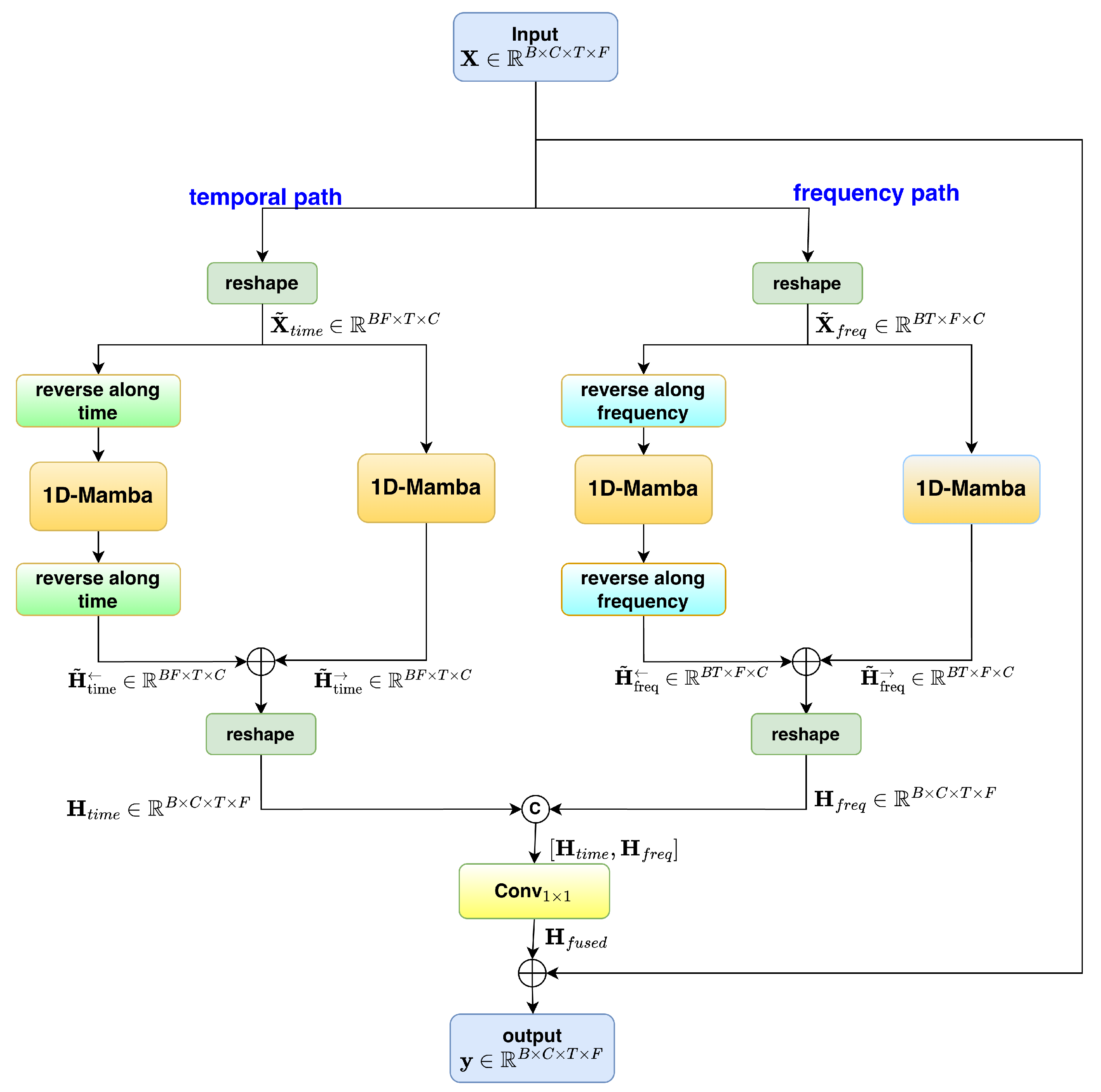
To model correlations jointly along the temporal and frequency axes, we further generalize the 1D Mamba into a 2D Mamba module, implemented via two 1D branches applied in a batched fashion. Given a 2D feature map
X R B × C × T × F ,
where T and F denote the numbers of time frames and frequency bins, respectively, we treat each time (or frequency) trajectory as an independent 1D sequence, and stack these sequences along the batch dimension before applying Mamba.
  • Temporal branch (along time):
    X ˜ time = reshape X , ( B · F ) , T , C ,
    H ˜ time = Mamba time ( X ˜ time ) ,
    H time = reshape H ˜ time , B , C , T , F ,
    where the reshape operation converts all B × F time trajectories into a batch of 1D sequences of length T, so that a single Mambatime block can be shared across all frequency bins while keeping each trajectory independent.
  • Frequency branch (along frequency):
    X ˜ freq = reshape X , ( B · T ) , F , C ,
    H ˜ freq   =   Mamba freq ( X ˜ freq ) ,
    H freq = reshape H ˜ freq , B , C , T , F ,
    where each of the B × T frequency trajectories becomes a 1D sequence of length F in the batch, processed by a single shared Mambafreq block.
The temporal and frequency representations are concatenated along the channel dimension and fused by a 1 × 1 convolution:
H fused = Conv 1 × 1 [ H time ; H freq ] ,
followed by a residual connection:
Y = X + H fused .
This formulation makes it explicit that only two Mamba blocks, shared across many 1D sequences via batching, are sufficient to capture complementary dependencies along time and frequency, in contrast to a purely one-dimensional Mamba that operates only along a single sequence axis.

3.1.3. Integration: 2D Bi-Directional Mamba Module

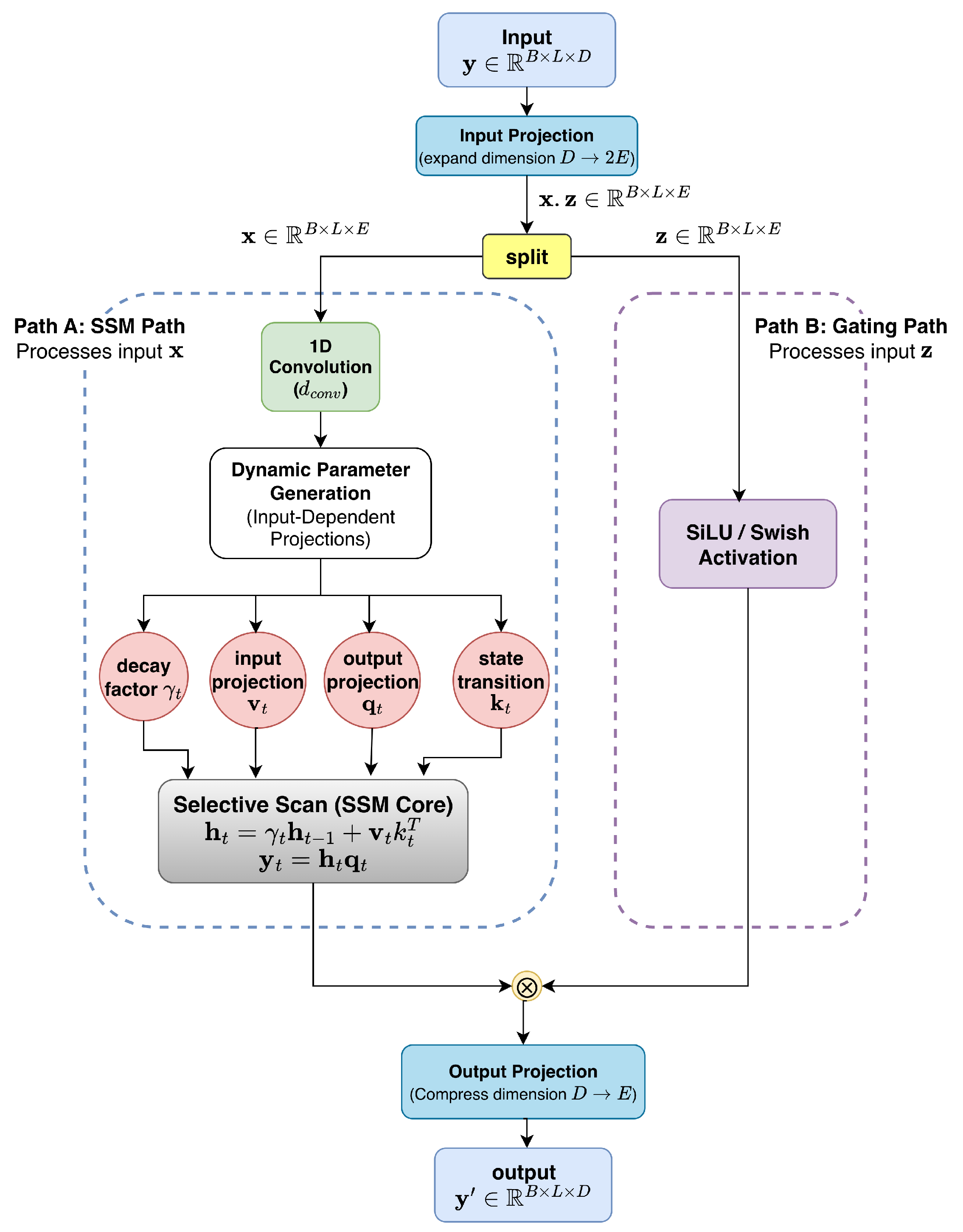
We finally integrate the above ideas into a full 2D bi-directional Mamba module, where both temporal and frequency branches are bi-directional but still implemented using shared Mamba blocks and batched reshaping. The flowchart for a 2D bi-directional Mamba is shown in Figure 3. For the same input
X R B × C × T × F ,
the bi-directional temporal branch is given by
X ˜ time = reshape X , ( B · F ) , T , C ,
H ˜ time = Mamba time ( X ˜ time ) ,
H ˜ time = Reverse Mamba time ( Reverse ( X ˜ time ) ) ,
H ˜ time = H ˜ time + H ˜ time ,
H time = reshape H ˜ time , B , C , T , F ,
where the initial reshape again stacks all B × F temporal trajectories into the batch dimension, so that a single Mambatime block can model bi-directional context along time for all frequency bins.
Similarly, the bi-directional frequency branch is
X ˜ freq = reshape X , ( B · T ) , F , C ,
H ˜ freq = Mamba freq ( X ˜ freq ) ,
H ˜ freq = Reverse Mamba freq ( Reverse ( X ˜ freq ) ) ,
H ˜ freq = H ˜ freq + H ˜ freq ,
H freq = reshape H ˜ freq , B , C , T , F ,
where the reshape similarly converts all B × T frequency trajectories into a batch of 1D sequences of length F, processed by a single shared Mambafreq block.
The bi-directional temporal and frequency features are then concatenated and projected via a 1 × 1 convolution,
H fused = Conv 1 × 1 [ H time ; H freq ] ,
and a residual connection produces the final output of the 2D bi-directional Mamba block:
Y = X + H fused .
This 2D bi-directional Mamba design enables each time–frequency representation to exploit rich contextual information from both past and future positions along both axes, leading to more expressive and structurally aligned modeling of spectro-temporal patterns than conventional uni-directional, one-dimensional Mamba architectures.

3.2. The AMUSE++ Framework

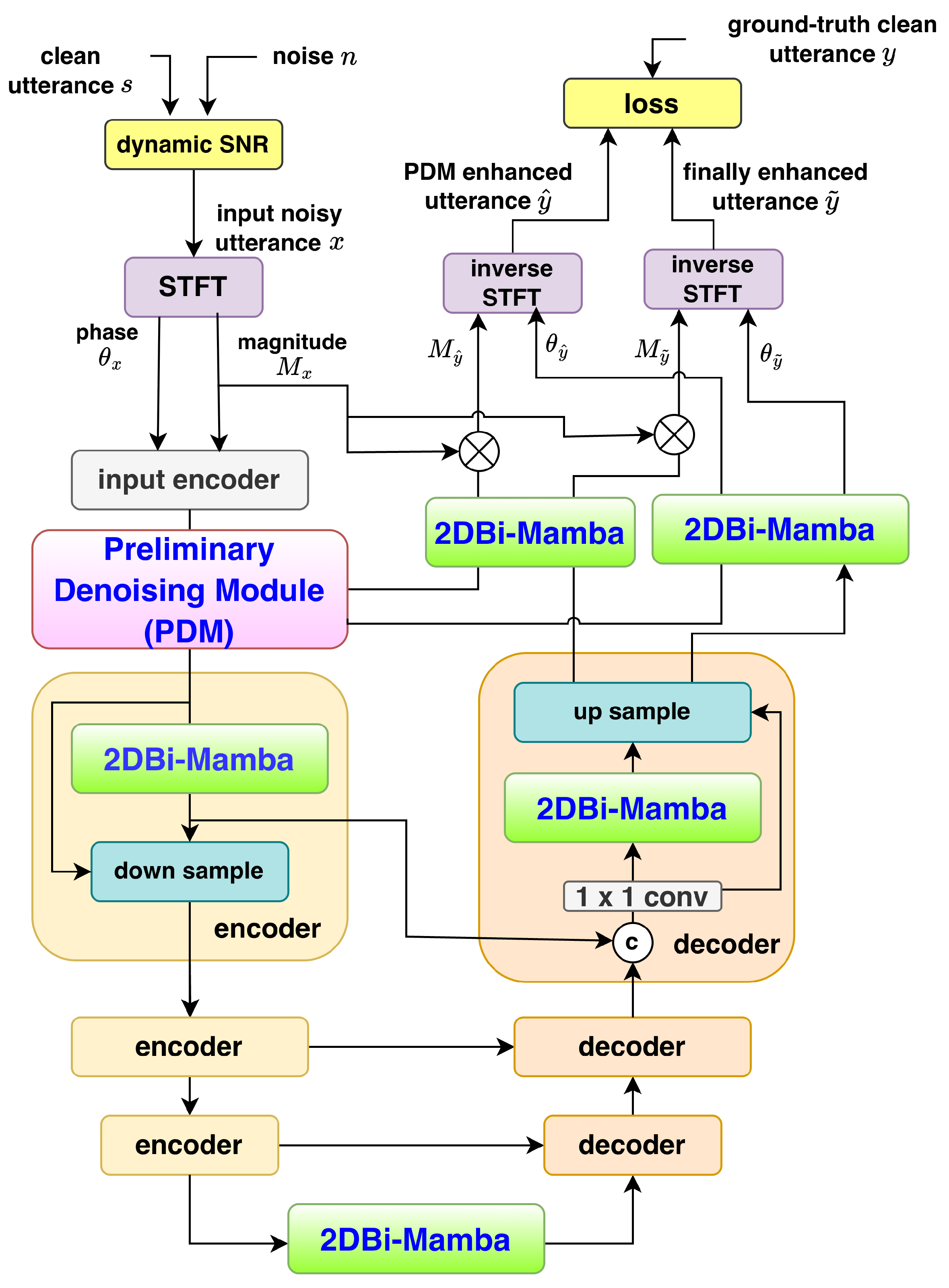
We construct the proposed AMUSE++ framework based on the advanced Mamba module, which adopts a 2D bi-directional Mamba architecture for joint time–frequency modeling. The overall system diagram is shown in Figure 4. Compared with the original MUSE++ framework, AMUSE++ introduces the following key modifications:
  • Replacement of 1D uni-directional Mamba blocks: All 1D uni-directional Mamba (Mamba-2) modules in the original MUSE++ backbone are replaced by the advanced Mamba module. This allows each sequence modeling block to capture dependencies along both the time and frequency axes, in both forward and backward directions, providing richer contextual representations than purely 1D, uni-directional processing.
  • Addition of a front-end Preliminary Denoising Module: A stack of advanced Mamba modules is introduced as a dedicated Preliminary Denoising Module (PDM) at the front end of AMUSE++. This module performs an initial enhancement of the input speech features before they are passed to the main backbone for further refinement.
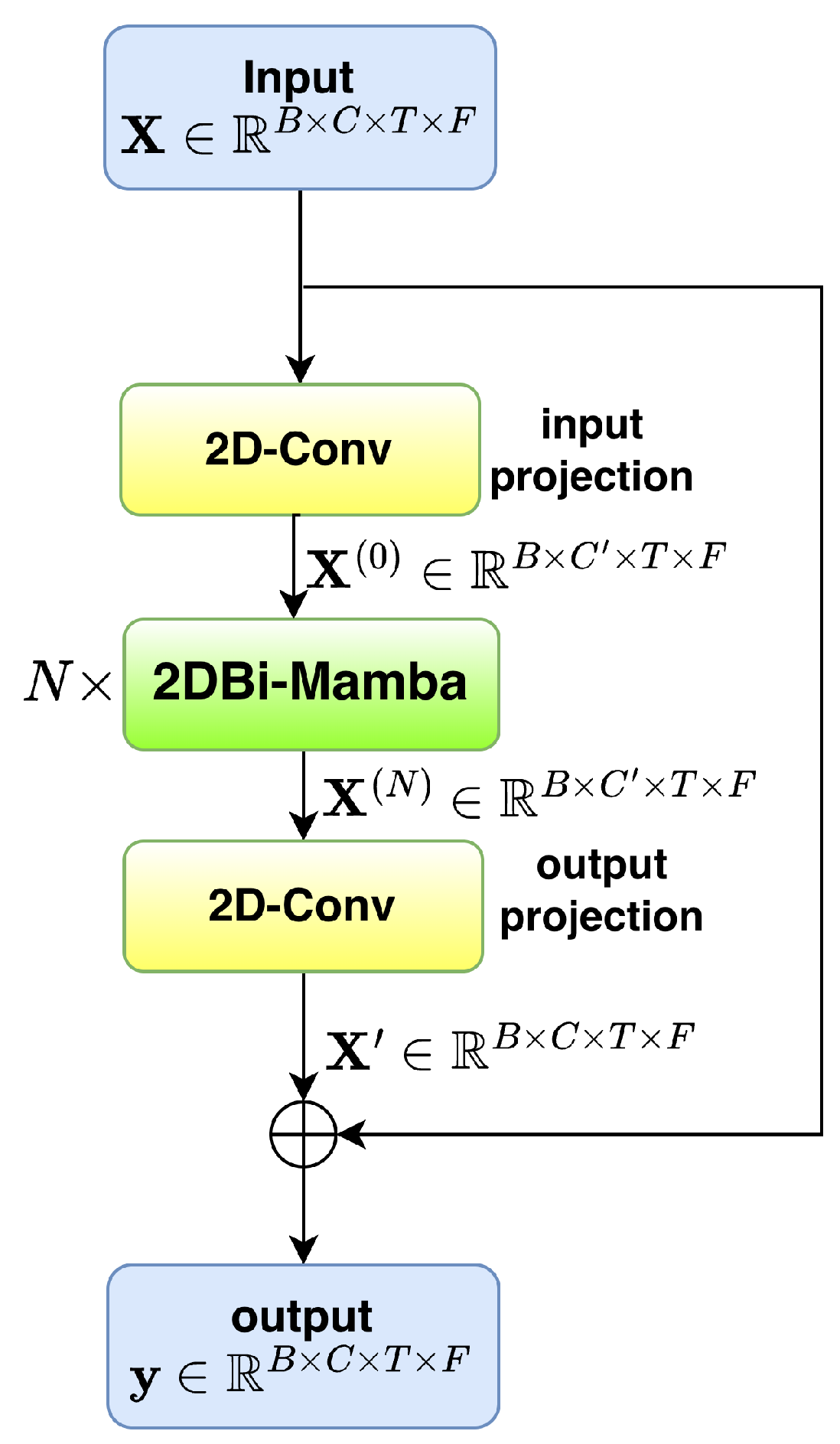
We now describe the structure of the Preliminary Denoising Module (PDM), whose processing flow is illustrated in Figure 5. The PDM processes a time–frequency feature map in four stages.
1.
Input projection: Given an input tensor
X R B × C × T × F ,
where B is the batch size, C the input channel dimension, and T and F the numbers of time frames and frequency bins, respectively, a k × k Conv2D layer projects X into the internal model with a new channel dimension C while preserving the time–frequency resolution:
X ( 0 ) = Conv 2 D ( X ) R B × C × T × F .
2.
Stack of 2D bi-directional Mamba blocks: The projected features are then refined by a stack of N Mamba blocks:
X ( k ) = 2 DBi Mamba X ( k 1 ) , k = 1 , , N ,
where each 2 DBi Mamba ( · ) implements the proposed 2D bi-directional Mamba over the time–frequency plane.
3.
Output projection: The output of the last Mamba block is mapped back to the original channel dimension C using another k × k Conv2D layer:
X = Conv 2 D X ( N ) ,
where Conv 2 D is configured such that X R B × C × T × F .
4.
Residual connection and preliminary enhancement. Finally, a residual connection is applied by adding the original input:
Y = X + X .
The resulting tensor Y is interpreted as a preliminarily denoised time–frequency representation and is fed into the subsequent AMUSE++ backbone for further enhancement and decoding.
Following the AMUSE++ framework illustrated in Figure 4, the PDM output feeds into both the main U-Net encoder–decoder pathway for further refinement and a parallel auxiliary enhancement branch.
In the primary path, the PDM output enters the U-Net encoder–decoder, which applies multi-scale convolutional processing to enrich the time–frequency representation. The resulting magnitude-mask and phase features are then processed by 2D bi-directional Mamba modules to predict the final magnitude mask and phase. The enhanced spectrogram is subsequently converted back to the time domain, yielding the output signal y ˜ .
To provide direct supervision for the PDM, we introduce an auxiliary training branch where the PDM output bypasses the U-Net and feeds directly into the Mamba-based magnitude and phase estimation heads, producing an intermediate enhanced signal y ^ . The total loss combines the main pathway loss with this auxiliary loss:
L AMUSE + + = L MUSE + + ( y ˜ , y ) + λ L aux ( y ^ , y ) ,
where y is the ground-truth signal, L MUSE + + is defined in Equation (7), the weight λ balances the auxiliary contribution, and
L aux ( y ^ , y ) = L mag ( y ^ , y ) + L time ( y ^ , y )
applies the same magnitude and time-domain losses from Equations (7) and (8) to the intermediate signal y ^ . This dual-path design explicitly guides the PDM toward informative, denoised early representations while enabling end-to-end optimization of the full AMUSE++ pipeline.

4. Experimental Setup

To assess the effectiveness of the proposed AMUSE++ framework, we perform experiments on the VoiceBank-DEMAND corpus [26,27], a widely used benchmark that pairs clean speech from VoiceBank with diverse noise recordings from DEMAND. The training set contains 11,572 utterances from 28 speakers, while the test set comprises 824 utterances from two unseen speakers; roughly 200 utterances are held out for validation.
In the standard training configuration, clean speech is mixed with ten DEMAND noise types at four fixed SNR levels: 0, 5, 10, and 15 dB. In contrast, the dynamic SNR augmentation strategy mixes each clean utterance with noise at an SNR drawn uniformly from the range [−5 dB, 20 dB]. For evaluation, we follow the conventional protocol and use five DEMAND noise types at SNRs of 2.5, 7.5, 12.5, and 17.5 dB. The main experimental settings are summarized below.
  • Data preprocessing and training protocol: All waveforms are normalized to zero mean and unit variance before being fed into the model. Signals are uniformly segmented into chunks of 30,700 samples. The STFT uses an FFT size of 510, window length 510, hop size 100, and a sampling rate of 16 kHz. Models are trained for up to 100 epochs using the AdamW optimizer with an initial learning rate of 0.0005, an exponential decay factor of 0.99, weight decay of 1 × 10 4 , and a batch size of 2. Early stopping is applied if the validation loss does not improve for 10 consecutive epochs.
  • Model architecture configuration: AMUSE++ adopts a three-level U-Net encoder–decoder architecture with the dense channel dimension initialized at 16 and doubled at each downsampling stage. Each Mamba module in the U-Net is configured with state size d state = 16 , convolution width d conv = 4 , and expansion factor expand = 2 . For the PDM module, both the input channel dimension C and the Conv2D-processed channel dimension C are set to 16, the number of Mamba blocks N = 3 , and the Conv2D layers use a kernel size of 3 × 3 (i.e., k = 3 ).
  • Loss function configuration: For the multi-resolution STFT loss ( L mr ) in Equation (7), we employ three STFT settings: [FFT size, window length, hop size] = [510, 510, 100], [800, 800, 200], [320, 320, 80]. The loss function weights in Equations (7) and (8) are set as: γ 1 = 0.05 , γ 2 = 0.9 , γ 3 = 0.3 , γ 4 = 0.1 , γ 5 = 0.1 , γ 6 = 0.2 , and γ 7 = 1 . These hyperparameters follow prior work on MUSE++ [20], MUSE [7] and MP-SENet [13,14], the latter serving as the main baseline during the development of MUSE. Finally, the weight λ for the auxiliary loss term in Equation (41) is set to 0.1 .
  • Implementation details: The front-end dense encoder and the back-end mask and phase decoders follow the MP-SENet design, using dilated convolutions with dilation rates { 1 , 2 , 4 , 8 } and dense skip connections. The magnitude mask is predicted using a learnable sigmoid activation with the initial parameter β = 2.0 . Our implementation is based on the official MUSE repository, with additional modifications for integrating Mamba, dynamic SNR augmentation, and the augmented loss terms. Our implementation is built upon a modified version of the official MUSE repository. A refactored and documented AMUSE++ codebase, along with pre-trained models, is planned to be released publicly to support reproducibility and future extensions.
    To quantify computational efficiency, we further measured the runtime of AMUSE++ on an Intel(R) Xeon(R) CPU E5-1620 and an NVIDIA RTX 3060 (12 GB). On the VoiceBank+DEMAND test set, AMUSE++ achieves a real-time factor (RTF) of 0.032 and reduces GPU memory usage from 7.5 GB (MUSE) to 3.6 GB. The RTF details will be clarified in the subsequent section.
For a comprehensive evaluation of SE performance, we utilize six established objective metrics, each capturing a distinct facet of speech enhancement quality:
  • Perceptual Evaluation of Speech Quality (PESQ) [28]: Scores range from 0.5 to 4.5, with higher values indicating improved perceived quality, based on a predictive model of human mean opinion scores (MOS).
  • Short-Time Objective Intelligibility (STOI) [29]: Measures speech intelligibility on a 0 to 1 scale; higher scores signify clearer, more understandable speech.
  • Segmental Signal-to-Noise Ratio (SSNR) [30]: Assesses segmental SNR throughout an utterance, where increased values reflect more effective noise attenuation.
  • Composite Overall Quality (COVL) [30]: Reports a MOS-like score from 0 to 5 for holistic speech quality, with higher numbers denoting better quality.
  • Composite Signal Distortion (CSIG) [30]: Rates signal distortion on a MOS scale (0 to 5), with higher results indicating less distortion in the output.
  • Composite Background Noise Intrusiveness (CBAK) [30]: Evaluates the intrusiveness of background noise, again on a 0–5 MOS scale; higher values indicate greater background noise suppression.
Together, these widely adopted metrics facilitate objective and quantitative comparison against the original MUSE model and contemporary state-of-the-art enhancement systems.

5. Results and Discussions

5.1. Overall Performance Evaluation

Table 1 reports the SE performance of the original MUSE (reproduced with the official MUSE repository), the backbone MUSE++, and the proposed AMUSE++ model. Note that AMUSE++ is built directly on top of the MUSE++ framework by replacing all 1D uni-directional Mamba blocks with the proposed advanced 2D bi-directional Mamba modules and inserting the preliminary denoising module at the front end.
Several observations can be made from the results:
  • AMUSE++ vs. MUSE++ (our backbone): Relative to MUSE++, AMUSE++ consistently improves all objective metrics. The gains in PESQ, CSIG, CBAK, and COVL indicate that the proposed architectural changes lead to better perceived quality, less speech distortion, and less intrusive background noise. SSNR and STOI are also higher, showing that AMUSE++ achieves stronger noise reduction and slightly better intelligibility while still inheriting the compact Mamba-based backbone of MUSE++.
  • AMUSE++ vs. MUSE: Compared with the original MUSE model, AMUSE++ not only achieves better scores on every metric (PESQ, CSIG, CBAK, COVL, SSNR, STOI) but also uses fewer parameters (0.31 M vs. 0.51 M). This demonstrates that starting from the lightweight MUSE++ backbone and enhancing it with 2D bi-directional Mamba leads to a model that is both more efficient and more effective than the heavier Transformer-based baseline.
  • Trade-off between quality and complexity: While AMUSE++ increases the parameter count from 0.17 M (MUSE++) to 0.31 M, this is still substantially smaller than MUSE, and the additional capacity is reflected in consistent improvements across all evaluation indices. Thus, AMUSE++ can be viewed as a strengthened successor to MUSE++, offering a more favorable quality–complexity trade-off than either of the two baselines.
  • Behavior of quality- and noise-related indices: The simultaneous improvement in CSIG and CBAK shows that AMUSE++ is able to reduce background noise without introducing additional speech distortion, which is a common failure mode for overly aggressive denoisers. At the same time, the higher SSNR together with the gains in PESQ and COVL suggest that the model not only removes more noise energy but also reconstructs cleaner and more natural spectral details.
  • Intelligibility and robustness: The STOI gains over both MUSE and MUSE++ indicate that the proposed 2D bi-directional Mamba modules help preserve critical linguistic cues, rather than merely optimizing for signal-level metrics. This is particularly important for downstream ASR and human listening, and it confirms that AMUSE++ improves robustness in challenging noisy conditions while maintaining high intelligibility.
Overall, these results confirm that AMUSE++ successfully leverages the MUSE++ backbone, and that the advanced 2D bi-directional Mamba design yields clear and uniform gains across all major SE metrics in terms of both perceptual quality and intelligibility.
Table 2 shows that AMUSE++ consistently outperforms MUSE++ across all SNR levels on the standard VoiceBank+DEMAND test set. At each SNR, AMUSE++ achieves higher PESQ, CSIG, CBAK, and COVL scores, indicating better perceived quality, less speech distortion, and more effective background noise suppression. The gains are especially noticeable at lower SNRs (e.g., 2.5 dB), where AMUSE++ improves PESQ from 2.8122 to 3.0291 and COVL from 3.5924 to 3.8023, while also raising STOI and SSNR. These results suggest that the proposed 2D bi-directional Mamba and PDM design not only enhances performance under moderate noise conditions but also maintains robust enhancement quality as the input SNR decreases.
Furthermore, here we would like to test the MUSE++ and AMUSE++ models under noise conditions that are much harsher than those in the official VoiceBank+DEMAND test set. The 5 dB and 10 dB test sets are not provided by the corpus; instead, they are independently synthesized by us following the original noisy-speech generation protocol, and both MUSE++ and AMUSE++ are evaluated directly on these additional test sets without any retraining or fine-tuning. This setting therefore reflects the intrinsic generalization ability of the models trained only on the standard VoiceBank+DEMAND data.
The corresponding results are shown in Table 3. Even under these extremely low SNRs, AMUSE++ consistently yields better scores than MUSE++ across all objective metrics. For 5 dB, AMUSE++ improves PESQ from 2.3215 to 2.5450 and STOI from 0.8865 to 0.9032, while also increasing CSIG, CBAK, COVL, and SSNR. At the more challenging 10 dB condition, the advantage becomes even more evident: AMUSE++ raises PESQ from 1.8938 to 2.0571, CSIG from 3.3068 to 3.5192, and SSNR from 2.8387 to 3.9378, together with a STOI gain from 0.8131 to 0.8381. These observations indicate that the proposed 2D bi-directional Mamba and PDM design not only improves performance on the official benchmark, but also provides stronger robustness and intelligibility preservation when the input SNR drops far beyond the original evaluation range, without requiring any additional training.
Table 4 summarizes the computational characteristics of MUSE, MUSE++, and AMUSE++ implemented on the workstation with an Intel(R) Xeon(R) CPU E5-1620 and an NVIDIA RTX 3060 (12 GB). As expected, MUSE++ is the most lightweight model, with the fewest parameters, the lowest RTF, and the smallest peak GPU memory footprint, making it attractive when extreme throughput and memory savings are the primary objectives. In contrast, AMUSE++ incurs higher complexity than MUSE++ because it replaces the 1D uni-directional Mamba blocks with 2D bi-directional Mamba modules, which naturally introduce additional computation and memory usage.
Nevertheless, AMUSE++ still operates comfortably in real time (RTF 0.0320 ) and is more than three times faster than the original MUSE, while requiring substantially less peak GPU memory than MUSE. Together with the clear gains in enhancement quality reported in Table 1, these results indicate that the additional complexity brought by the 2D bi-directional Mamba design is well justified by the corresponding improvements in speech enhancement performance.

5.2. Ablation Study of AMUSE++

Table 5 presents an ablation study on AMUSE++, analyzing the impact of the Mamba type, the preliminary denoising module (PDM), and the use of dynamic SNR together with the augmented loss. All five columns correspond to AMUSE++ variants; from right to left, components are progressively added. Here, “1D-uni” denotes a one-dimensional uni-directional Mamba, “1D-Bi” denotes a one-dimensional bi-directional Mamba, and “2D-Bi” denotes the proposed two-dimensional bi-directional Mamba. From this table, we have the following observations:
  • From 1D uni-directional to 1D bi-directional Mamba: The two rightmost columns (both excluding PDM and dynamic SNR/loss) isolate the effect of bi-directionality in the 1D configuration. Transitioning from 1D-uni to 1D-Bi yields modest gains in some metrics—PESQ improves from 3.2860 to 3.3386 and COVL from 4.0334 to 4.0793—but at the cost of reduced SSNR and STOI performance. These mixed results suggest that bi-directional temporal context may offer benefits in perceptual quality metrics despite trade-offs in signal fidelity and intelligibility measures, with only a minor parameter increase from 0.17 M to 0.27 M.
  • Benefit of 2D bi-directional modeling (1D-Bi vs. 2D-Bi): The fourth column (2D-Bi, no PDM, no dynamic SNR/loss) replaces 1D-Bi with the proposed 2D bi-directional Mamba while keeping the rest of the architecture unchanged. This further improves PESQ (3.3386 → 3.3845), CSIG (4.6389 → 4.6603), CBAK (3.7342 → 3.8349), COVL (4.0793 → 4.1225), and STOI (0.9494 → 0.9538), together with a substantial SSNR gain (8.4190 → 9.6307). These results indicate that jointly modeling temporal and frequency dependencies in a bi-directional manner is more effective than restricting Mamba to a single temporal dimension, as it better exploits the inherent 2D structure of spectrograms and yields cleaner, more speech-like reconstructions.
  • Effect of the preliminary denoising module (2D-Bi vs. 2D-Bi + PDM): The third column introduces the PDM on top of the 2D-Bi configuration, still without dynamic SNR or augmented loss. Adding the PDM yields consistent improvements across almost all metrics: PESQ increases from 3.3845 to 3.4425, CSIG from 4.6603 to 4.6842, COVL from 4.1225 to 4.1733, and SSNR from 9.6307 to 9.5079 (comparable), with STOI remaining at a similarly high level. The parameter count only slightly increases from 0.29 M to 0.31 M. These observations suggest that a dedicated front-end denoising stage helps the backbone operate on cleaner and more structured time–frequency representations, enabling it to focus on finer-grained refinement and thereby improving perceived quality.
  • Dynamic SNR and augmented loss (2D-Bi + PDM vs. full AMUSE++): The second column adds dynamic SNR augmentation together with the augmented loss on top of the 2D-Bi + PDM architecture. This full configuration achieves the best performance across all metrics: PESQ, CSIG, CBAK, COVL, SSNR, and STOI all reach their maximum values (e.g., PESQ 3.5305, COVL 4.2753, SSNR 10.8090, STOI 0.9592), with no change in the number of parameters. The improvements over the second column therefore stem purely from a stronger and more diverse training strategy, indicating that dynamic SNR and the augmented loss provide more effective supervision and improve robustness across different noise levels.
  • Global trend and interaction of components: Overall, the sequence
    1 D - uni 1 D - Bi 2 D - Bi 2 D - Bi + PDM 2 D - Bi + PDM + Dyn . SNR + Loss
    exhibits a nearly monotonic improvement across all objective metrics. This pattern shows that the proposed design choices are complementary: (i) moving from 1D uni-directional to 1D bi-directional Mamba improves temporal context aggregation, (ii) upgrading to 2D bi-directional Mamba exploits the full time–frequency structure, (iii) adding the PDM provides a useful front-end enhancement stage, and (iv) dynamic SNR with the augmented loss further aligns optimization with perceptual and robustness objectives. The final AMUSE++ configuration therefore represents a well-balanced combination of architectural and training improvements that jointly contribute to its strong overall performance.

Table 5. Ablation study of AMUSE++: effect of Mamba type, the preliminary denoising module (PDM), and dynamic SNR plus augmented loss. Columns 2-6 denote different AMUSE++ variants. “+”/“-” indicate whether a component is enabled or disabled. The bold values indicate the best results for each metric among the compared models.
AMUSE++ Variants
Mamba Type2D-Bi2D-Bi2D-Bi1D-Bi1D-uni
PDM++---
Dynamic SNR
+ Augmented Loss
+----
PESQ3.53053.44253.38453.33863.2860
CSIG4.76604.68424.66034.63894.6082
CBAK3.97913.85393.83493.73423.7610
COVL4.27534.17334.12254.07934.0334
SSNR10.80909.50799.63078.41909.2603
STOI0.95920.95350.95380.94940.9504
Params (M)0.310.310.290.270.17

5.3. Qualitative Evaluation Using Spectrograms

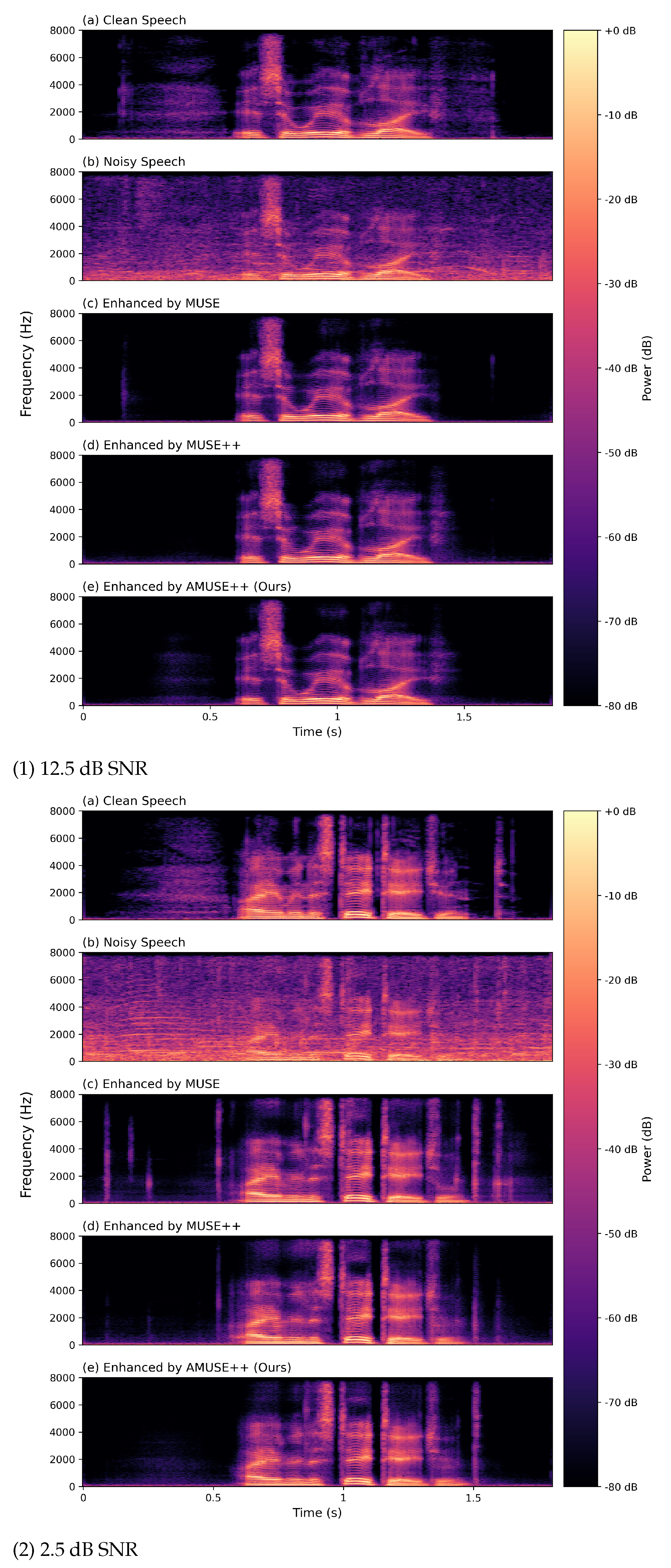
Figure 6 provides a qualitative comparison of the time–frequency representations for clean, noisy, and enhanced speech at (1) 12.5 dB and (2) 2.5 dB SNR. In both cases, the noisy spectrograms exhibit strong background energy across a wide frequency range, which partially masks the harmonic structures and formant trajectories of the target speech.
For the 12.5 dB condition, MUSE already suppresses a noticeable amount of background energy; however, residual noise components remain, especially in the high-frequency regions and between voiced segments. MUSE++ further cleans the background and produces clearer harmonic patterns, but some low-level artifacts and smeared harmonics can still be observed. In contrast, AMUSE++ produces a spectrogram whose overall energy distribution more closely matches that of the clean reference: the inter-harmonic regions are darker (indicating better noise suppression), while the formant structures and voiced harmonic stacks are sharper and more continuous over time.
The differences become more pronounced at the lower 2.5 dB SNR. Under this more challenging condition, the noisy spectrogram is heavily contaminated, and the speech structures are severely obscured. MUSE is able to recover the rough outline of the speech, but considerable residual noise and blur remain. MUSE++ improves the contrast between speech and noise, yet some diffuse background energy persists throughout the time–frequency plane. AMUSE++ yields the most speech-like spectrogram: harmonic trajectories are clearly visible, background regions are effectively attenuated, and low-energy gaps between phonetic units are better preserved; in some highly noise-dominated regions, this aggressive suppression leads to near-silent segments. We regard this behavior as a limitation of the current training objective, which optimizes only frame-level objective metrics and does not directly penalize local “over-suppression”. In many practical pipelines (e.g., ASR or telecommunication front-ends), such near-silent regions can be further controlled or smoothed by an additional VAD or post-processing stage to better align with the target downstream task. It should be emphasized that Figure 6 is intended as an illustrative, qualitative demonstration on a representative utterance; the main conclusions of this work are supported by the comprehensive objective evaluation in Table 1, and the spectrogram analysis is presented only to provide additional visual intuition consistent with those quantitative results.

5.4. Comparison with Some State-of-the-Art SE Methods

Table 6 summarizes the performance of AMUSE++, two conventional non-neural SE baselines (Wiener filtering [31] and LogMMSE [5,32]), and several representative lightweight neural speech enhancement systems, including the backbone model MUSE++ [20], MUSE [7], TSTNN [33], DB-AIAT [34], DPT-FSNet [35], MetricGAN-OKDv2 [36], and MANNER-S-5.3GF [37]. Notably, the results for most competing neural methods are primarily compiled from [7]. The results can be discussed from four perspectives: performance of classical baselines, overall enhancement quality, comparison with MUSE/MUSE++, and parameter efficiency.
  • Performance of classical baselines. The two conventional non-neural SE methods, Wiener filtering [31] and LogMMSE [5], provide only limited enhancement compared with modern deep models. Specifically, Wiener filtering improves PESQ from 1.97 (Noisy) to 2.22 but yields a slightly lower CSIG (3.23 vs. 3.35) and essentially no gain in COVL (2.63), suggesting that it mainly performs mild noise suppression without substantially improving perceived quality or signal distortion. In contrast, LogMMSE attains higher scores across all reported metrics (PESQ 2.34, CSIG 3.67, CBAK 3.12, COVL 3.04, STOI 0.91) than both the Noisy and Wiener conditions, indicating that it can better preserve speech structure while reducing background noise. However, both methods remain clearly inferior to recent lightweight neural approaches such as TSTNN, DPT-FSNet, MUSE/MUSE++, and AMUSE++, whose PESQ, CSIG, CBAK, and COVL scores are substantially higher, highlighting the advantage of data-driven architectures over traditional spectral-domain estimators in this task.
  • Overall enhancement quality. AMUSE++ attains the best or on-par-with-the-best scores across all objective metrics, achieving a PESQ of 3.53, CSIG of 4.77, CBAK of 3.98, COVL of 4.28, and STOI of 0.96. These scores are consistently higher than those of most competing methods, indicating that AMUSE++ not only improves perceived speech quality (PESQ, COVL) and signal distortion (CSIG), but also yields competitive background noise suppression (CBAK) and intelligibility (STOI). In particular, the gains in PESQ and COVL suggest that the proposed architecture is especially effective at producing natural-sounding enhanced speech.
  • Comparison within the MUSE family. Within the MUSE family, both MUSE++ and AMUSE++ clearly outperform the original MUSE baseline across all reported metrics, confirming the effectiveness of the Mamba-based backbone introduced in MUSE++. Building on this stronger backbone, AMUSE++ further improves performance over MUSE++ itself, with noticeable gains in PESQ, CSIG, CBAK, and COVL. This indicates that the proposed preliminary denoising module, the 2D bi-directional Mamba extension, and the auxiliary enhancement branch provide additional benefits on top of the MUSE++ architecture, rather than merely reproducing its behavior with a different parametrization.
  • Parameter efficiency and trade-offs. Despite its strong performance, AMUSE++ remains highly compact, with only 0.31 M parameters. This is one order of magnitude smaller than DB-AIAT (2.81 M), while still achieving clearly superior PESQ and COVL scores. Compared with other competitive lightweight models such as TSTNN (0.92 M), DPT-FSNet (0.88 M), and MetricGAN-OKDv2 (0.82 M), AMUSE++ uses fewer parameters yet consistently matches or outperforms them across all metrics, particularly in PESQ and COVL. Although AMUSE++ has slightly more parameters than its backbone model MUSE++ (0.17 M), the increase in model size is modest and is accompanied by consistent performance gains, indicating a favorable trade-off between complexity and enhancement quality.
  • Impact of the proposed design. Taken together, these results suggest that the combination of the preliminary denoising module, the 2D bi-directional Mamba extension of the MUSE++ backbone, and the auxiliary enhancement branch allows AMUSE++ to exploit richer spectro-temporal context than conventional 1D or purely convolutional designs. The improvements over MUSE/MUSE++ and other lightweight baselines indicate that the proposed architecture can effectively strengthen speech enhancement performance without incurring a prohibitive parameter cost, making it attractive for deployment in resource-constrained scenarios.

6. Conclusions and Future Work

In this work, we proposed AMUSE++, a Mamba-enhanced speech enhancement framework that augments the MUSE++ backbone with advanced 2D bi-directional Mamba modeling and a preliminary denoising module. By explicitly modeling both temporal and frequency dependencies in a bi-directional manner and introducing a dedicated front-end denoising stage, AMUSE++ learns richer spectro-temporal representations than conventional 1D or purely convolutional designs. Extensive experiments demonstrated that AMUSE++ consistently outperforms the original MUSE and MUSE++ systems, as well as several representative lightweight SE baselines, across a wide range of objective metrics, including PESQ, CSIG, CBAK, COVL, SSNR, and STOI, while maintaining a compact parameter budget. The ablation study further confirmed the complementary benefits of the 2D bi-directional Mamba blocks, the preliminary denoising module, and the use of dynamic SNR augmentation with an augmented loss, revealing a nearly monotonic improvement as these components are incrementally added.
Despite these promising results, several avenues remain for future work. First, although VoiceBank+DEMAND facilitates rigorous SOTA benchmarking via artificial mixing, it may not fully capture real acoustic complexities. In this work, we therefore rely on dynamic SNR training (uniformly sampling from 5 to 20 dB, plus additional tests down to 10 dB) to promote generalization across a wide range of noise levels, but we acknowledge that this cannot replace evaluation on genuinely recorded corpora. Future work will prioritize full-scale validation on CHiME-6 [39], DNS Challenge [40], and similar real-world noisy-speech datasets to more directly confirm the practical viability and generalisability of AMUSE++ under diverse noise and speech conditions. Second, the current design focuses on single-channel, offline enhancement; systematically extending AMUSE++ to multi-channel microphone array processing and low-latency or streaming scenarios (e.g., via causal variants and modest buffering) is an important direction for future work, particularly for applications such as smart conferencing systems and hearing aids. Third, although the 2D bi-directional Mamba modules effectively capture local and mid-range spectro-temporal context, integrating them with other long-context mechanisms (e.g., cross-band attention or cross-utterance modeling) may yield additional gains, particularly in highly non-stationary noise conditions. Fourth, it would be valuable to investigate tighter integration with downstream tasks such as automatic speech recognition or speaker verification, for example via joint or multi-task training, to better align the enhancement objective with end-task performance. Finally, exploring model compression and hardware-aware optimization (e.g., pruning, quantization, or efficient Mamba variants) could make AMUSE++ even more attractive for deployment on edge devices and real-time embedded platforms.

Author Contributions

Conceptualization, T.-J.L., B.C. and J.-W.H.; methodology, T.-J.L., J.-W.H.; software, T.-J.L.; validation, T.-J.L., B.C. and J.-W.H.; formal analysis, J.-W.H., B.C. and T.-J.L.; investigation, J.-W.H.; resources, B.C. and J.-W.H.; data curation, B.C., J.-W.H. and T.-J.L.; writing—original draft preparation, J.-W.H.; writing—review and editing, J.-W.H.; visualization, B.C., J.-W.H. and T.-J.L.; supervision, J.-W.H.; project administration, J.-W.H.; funding acquisition, B.C. and J.-W.H. All authors have read and agreed to the published version of the manuscript.

Funding

This research received no external funding.

Data Availability Statement

The original contributions presented in this study are included in the article. Further inquiries can be directed to the corresponding author.

Conflicts of Interest

The authors declare no conflicts of interest.

References

  1. Leglaive, S.; Fraticelli, M.; ElGhazaly, H.; Borne, L.; Sadeghi, M.; Wisdom, S.; Pariente, M.; Hershey, J.R.; Pressnitzer, D.; Barker, J.P. Objective and subjective evaluation of speech enhancement methods in the UDASE task of the 7th CHiME challenge. Comput. Speech Lang. 2025, 89, 101685. [Google Scholar] [CrossRef] [Scilit]
  2. Zheng, C.; Zhang, H.; Liu, W.; Luo, X.; Li, A.; Li, X.; Moore, B.C.J. Sixty Years of Frequency-Domain Monaural Speech Enhancement: From Traditional to Deep Learning Methods. Trends Hear. 2023, 27, 23312165231209913. [Google Scholar] [CrossRef] [Scilit] [PubMed]
  3. Natarajan, S.; Rahman Al-Haddad, S.A.; Ahmad, F.A.; Kamil, R.; Hassan, M.K.; Azrad, S.; Macleans, J.F.; Abdulhussain, S.H.; Mahmmod, B.M.; Saparkhojayev, N.; et al. Deep neural networks for speech enhancement and speech recognition: A systematic review. Ain Shams Eng. J. 2025, 16, 103405. [Google Scholar] [CrossRef] [Scilit]
  4. Boll, S.F. Suppression of acoustic noise in speech using spectral subtraction. IEEE Trans. Acoust. Speech Signal Process. 1979, 27, 113–120. [Google Scholar] [CrossRef] [Scilit]
  5. Ephraim, Y.; Malah, D. Speech enhancement using a minimum mean-square error log-spectral amplitude estimator. IEEE Trans. Acoust. Speech Signal Process. 1985, 33, 443–445. [Google Scholar] [CrossRef] [Scilit]
  6. Paliwal, K.K.; Wojcicki, K.; Rao, B.P. The importance of phase in speech enhancement. Speech Commun. 2010, 53, 465–494. [Google Scholar] [CrossRef] [Scilit]
  7. Lin, Z.; Chen, X.; Wang, J. MUSE: Flexible Voiceprint Receptive Fields and Multi-Path Fusion Enhanced Taylor Transformer for U-Net-based Speech Enhancement. In Proceedings of the INTERSPEECH 2024, Kos, Greece, 1–5 September 2024; pp. 672–676. [Google Scholar]
  8. Wahab, F.E.; Ye, Z.; Saleem, N.; Ullah, R. Compact deep neural networks for real-time speech enhancement on resource-limited devices. Speech Commun. 2024, 156, 103008. [Google Scholar] [CrossRef] [Scilit]
  9. Saleem, N.; Bourouis, S.; Elmannai, H.; Algarni, A.D. CTSE-Net: Resource-efficient convolutional and TF-transformer network for speech enhancement. Knowl.-Based Syst. 2024, 290, 110597. [Google Scholar] [CrossRef] [Scilit]
  10. Zhang, Z.; Zhuang, X.; Qian, Y.; Wang, M. Lightweight Dynamic Sparse Transformer for Monaural Speech Enhancement. In Proceedings of the Interspeech 2024, Kos, Greece, 1–5 September 2024; pp. 3816–3820. [Google Scholar]
  11. Mattursun, A.; Wang, L.; Yu, Y.; Ma, C. Magnitude-Phase Dual-Path Speech Enhancement Network based on Self-Supervised Embedding and Perceptual Contrast Stretch Boosting. In Proceedings of the IEEE International Conference on Multimedia and Expo (ICME), Nantes, France, 30 June–4 July 2025. [Google Scholar]
  12. Yin, D.; Huang, J.; Wu, Y.; Zou, Y.; Xue, W.; Jin, Z.Y.; Zhang, S.; Wu, J.; Yu, D. PHASEN: A self-supervised phase-and-harmonics-aware speech enhancement network. In Proceedings of the AAAI Conference on Artificial Intelligence, New York, NY, USA, 7–12 February 2020; Volume 34, pp. 9458–9465. [Google Scholar]
  13. Lu, Y.X.; Ai, Y.; Ling, Z.H. MP-SENet: A Speech Enhancement Model with Parallel Denoising of Magnitude and Phase Spectra. In Proceedings of the Interspeech 2023, Dublin, Ireland, 20–24 August 2023; pp. 3834–3838. [Google Scholar]
  14. Lu, Y.X.; Ai, Y.; Ling, Z.H. Explicit estimation of magnitude and phase spectra in speech enhancement. Neural Netw. 2025, 189, 107562. [Google Scholar] [CrossRef] [Scilit] [PubMed]
  15. Yang, L.; Liu, W.; Meng, R.; Lee, G.; Baek, S.; Moon, H.G. Fspen: An Ultra-Lightweight Network for Real Time Speech Enahncment. In Proceedings of the ICASSP 2024—2024 IEEE International Conference on Acoustics, Speech and Signal Processing (ICASSP), Seoul, Republic of Korea, 14–19 April 2024; pp. 10671–10675. [Google Scholar] [CrossRef] [Scilit]
  16. Michelsanti, D.; Tan, Z.H.; Xu, Y.; Richter, S.R.; Ma, M.; Sørensen, J.; Jensen, J.; Gerkmann, T.; Jensen, S.; Virtanen, T.; et al. An Overview of Deep-Learning-Based Audio-Visual Speech Enhancement and Separation. IEEE/ACM Trans. Audio Speech Lang. Process. 2021, 29, 1368–1396. [Google Scholar] [CrossRef] [Scilit]
  17. Li, S.; Du, Z.; Lei, S.; Huoyijun, H.; Yang, M.; Zhang, Z.; Shen, L. Lip landmark-based audio-visual speech enhancement with cross-modality attention. Neurocomputing 2023, 545, 127409. [Google Scholar]
  18. Kuang, K.; Yang, F.; Yang, J. A lightweight speech enhancement network fusing bone- and air-conducted speech. J. Acoust. Soc. Am. 2024, 156, 1355–1366. [Google Scholar] [CrossRef] [Scilit] [PubMed]
  19. Lin, X.; Zhang, Y.; Wang, S. Mixed T-domain and TF-domain Magnitude and Phase Representations for GAN-based Speech Enhancement. Sci. Rep. 2024, 14, 17698. [Google Scholar] [CrossRef] [Scilit] [PubMed]
  20. Li, T.J.; Hung, J.W. Enhancing the MUSE Speech Enhancement Framework with Mamba-Based Architecture and Extended Loss Functions. Mathematics 2025, 13, 3481. [Google Scholar] [CrossRef] [Scilit]
  21. Gu, A.; Dao, T. Mamba: Linear-Time Sequence Modeling with Selective State Spaces. In Proceedings of the Conference on Language Modeling (COLM), Philadelphia, PA, USA, 7–9 October 2024. [Google Scholar]
  22. Dao, T.; Gu, A. Transformers are SSMs: Generalized models and efficient algorithms through structured state space duality. In Proceedings of the 41st International Conference on Machine Learning, Vienna, Austria, 21–27 July 2024. ICML’24. [Google Scholar]
  23. Choromanski, K.; Likhosherstov, V.; Dohan, D.; Song, X.; Gane, A.; Sarlós, T.; Hawkins, P.; Davis, J.; Mohiuddin, A.; Kaiser, Ł; et al. Rethinking Attention with Performers. In Proceedings of the International Conference on Learning Representations, Virtual, 25–29 April 2021. [Google Scholar]
  24. Zhang, X.; Zhang, Q.; Liu, H.; Xiao, T.; Qian, X.; Ahmed, B.; Ambikairajah, E.; Li, H.; Epps, J. Mamba in Speech: Towards an Alternative to Self-Attention. IEEE Trans. Audio Speech Lang. Process. 2025, 33, 1933–1948. [Google Scholar] [CrossRef] [Scilit]
  25. Kim, S.H.; Kim, T.G.; Chun, C.J. Mamba-based Hybrid Model for Speech Enhancement. In Proceedings of the Interspeech, Rotterdam, The Netherlands, 17–21 August 2025. [Google Scholar]
  26. Valentini-Botinhao, C.; Wang, X.; Takaki, S.; Yamagishi, J. Investigating RNN-based speech enhancement methods for noise-robust Text-to-Speech. In Proceedings of the 9th ISCA Workshop on Speech Synthesis Workshop (SSW 9), Sunnyvale, CA, USA, 13–15 September 2016; pp. 146–152. [Google Scholar] [CrossRef] [Scilit]
  27. Thiemann, J.; Ito, N.; Vincent, E. The Diverse Environments Multi-channel Acoustic Noise Database (DEMAND): A database of multichannel environmental noise recordings. In Proceedings of the 21st International Congress on Acoustics, Montreal, QC, Canada, 2–7 June 2013; pp. 1–6. [Google Scholar]
  28. ITU-T. Perceptual Evaluation of Speech Quality (PESQ), an Objective Method for End-to-End Speech Quality Assessment of Narrowband Telephone Networks and Speech Codecs; Technical Report P.862; International Telecommunication Union: Geneva, Switzerland, 2001. [Google Scholar]
  29. Taal, C.H.; Hendriks, R.C.; Heusdens, R.; Jensen, J. An Algorithm for Intelligibility Prediction of Time–Frequency Weighted Noisy Speech. IEEE Trans. Audio Speech Lang. Process. 2011, 19, 2125–2136. [Google Scholar] [CrossRef] [Scilit]
  30. Hu, Y.; Loizou, P.C. Evaluation of Objective Quality Measures for Speech Enhancement. IEEE Trans. Audio Speech Lang. Process. 2008, 16, 229–238. [Google Scholar] [CrossRef] [Scilit]
  31. Scalart, P.; Vieira Filho, J.V. Speech enhancement based on a priori signal to noise estimation. In Proceedings of the 1996 IEEE International Conference on Acoustics, Speech, and Signal Processing (ICASSP), Atlanta, GA, USA, 7–10 May 1996; Volume 2, pp. 629–632. [Google Scholar]
  32. Logmmse: A Python Implementation of the LogMMSE Speech Enhancement/Noise Reduction Algorithm. Version 1.5.3. Available online: https://pypi.org/project/logmmse/ (accessed on 2 January 2026).
  33. Wang, K.; He, B.; Zhu, W.P. TSTNN: Two-stage Transformer Based Neural Network for Speech Enhancement in the Time Domain. In Proceedings of the ICASSP 2021—2021 IEEE International Conference on Acoustics, Speech and Signal Processing (ICASSP), Toronto, ON, Canada, 6–11 June 2021; IEEE: New York, NY, USA, 2021; pp. 7098–7102. [Google Scholar]
  34. Yu, G.; Li, A.; Zheng, C.; Guo, Y.; Wang, Y.; Wang, H. Dual-Branch Attention-In-Attention Transformer for Single-Channel Speech Enhancement. In Proceedings of the IEEE International Conference on Acoustics, Speech and Signal Processing (ICASSP), Singapore, 23–27 May 2022; pp. 7847–7851. [Google Scholar]
  35. Dang, F.; Chen, H.; Zhang, P. DPT-FSNet: Dual-Path Transformer Based Full-Band and Sub-Band Fusion Network for Speech Enhancement. In Proceedings of the IEEE International Conference on Acoustics, Speech and Signal Processing (ICASSP), Singapore, 23–27 May 2022; pp. 6857–6861. [Google Scholar]
  36. Shin, W.; Lee, B.H.; Kim, J.S.; Park, H.J.; Han, S.W. MetricGAN-OKD: Multi-Metric Optimization of MetricGAN via Online Knowledge Distillation for Speech Enhancement. In Proceedings of the 40th International Conference on Machine Learning, Honolulu, HI, USA, 23–29 July 2023; pp. 31521–31538. [Google Scholar]
  37. Shin, W.; Park, H.J.; Kim, J.S.; Lee, B.H.; Han, S.W. Multi-View Attention Transfer for Efficient Speech Enhancement. In Proceedings of the Interspeech, Incheon, Republic of Korea, 18–22 September 2022; pp. 1196–1200. [Google Scholar] [CrossRef] [Scilit]
  38. Pascual, S.; Bonafonte, A.; Serrà, J. SEGAN: Speech Enhancement Generative Adversarial Network. In Proceedings of the Interspeech 2017, Stockholm, Sweden, 20–24 August 2017; pp. 3642–3646. [Google Scholar]
  39. Watanabe, S.; Mandel, M.I.; Barker, J.; Vincent, E.; Arora, A.; Chang, X.; Khudanpur, S.; Manohar, V.; Povey, D.; Raj, D.; et al. CHiME-6 Challenge: Tackling Multispeaker Speech Recognition for Unsegmented Recordings. In Proceedings of the 6th International Workshop on Speech Processing in Everyday Environments (CHiME 2020), Online Virtual Workshop, 4 May 2020. [Google Scholar]
  40. Reddy, C.K.A.; Dubey, H.; Noufal, A.A.; Gopal, V.; Cutler, R.; Braun, S.; Gamper, H.; Aichner, R.; Srinivasan, S.; Tashev, I.; et al. The INTERSPEECH 2020 Deep Noise Suppression Challenge: Datasets, Subjective Testing Framework, and Challenge Results. In Proceedings of the Interspeech, Shanghai, China, 25–29 October 2020; pp. 2472–2476. [Google Scholar] [CrossRef] [Scilit]
Figure 1. Diagram of the proposed MUSE++ framework architecture (redrawn according to [20]).
Electronics 15 00282 g001
Figure 2. Block diagram of the 1D Mamba (Mamba-2) module as used in MUSE++ (redrawn according to [20]).
Electronics 15 00282 g002
Figure 3. Block diagram of the 2D bi-directional Mamba.
Electronics 15 00282 g003
Figure 4. Block diagram of the presented AMUSE++.
Electronics 15 00282 g004
Figure 5. Block diagram of the preliminary denoising module (PDM).
Electronics 15 00282 g005
Figure 6. Spectrogram comparisons of speech signals corrupted by cafe noise at (1) 12.5 dB and (2) 2.5 dB SNR. Each panel displays (a) clean speech, (b) noisy mixture, (c) enhancement by the MUSE model, (d) enhancement by the backbone MUSE++ model (e) enhancement by the AMUSE++ model.
Electronics 15 00282 g006
Table 1. The various SE performance scores over the all test set for MUSE (reproduced using official code), the MUSE++ baseline and the proposed AMUSE++. The bold values indicate the best results for each metric among the compared models.
PESQCSIGCBAKCOVLSSNRSTOI#Para. (M)
MUSE3.34754.61633.79654.08279.33090.95060.51
MUSE++3.36364.66193.85844.120910.18380.95380.17
AMUSE++3.53054.76603.97914.275310.80900.95920.31
Table 2. Performance of MUSE++ and AMUSE++ under different input SNR levels on the standard VoiceBank+DEMAND test set. The bold values indicate the best results for each metric among the compared models.
SNRMethodPESQCSIGCBAKCOVLSSNRSTOI
17.5 dBMUSE++3.81634.93554.24554.552212.75260.9722
AMUSE++3.94144.97344.34724.660713.39760.9748
12.5 dBMUSE++3.54724.81803.99634.300710.92780.9652
AMUSE++3.69224.89434.10334.431811.51460.9680
7.5 dBMUSE++3.28484.63203.77494.04409.48440.9545
AMUSE++3.46504.75113.90124.211510.10930.9596
2.5 dBMUSE++2.81224.26593.42213.59247.60420.9237
AMUSE++3.02914.44823.56953.80238.24860.9345
Table 3. Performance of MUSE++ and AMUSE++ on two additional test sets with extremely low SNRs (−5 dB and −10 dB), which we independently generated (non-official noisy data) by following the original VoiceBank+DEMAND noisy-speech protocol, while keeping the models fixed without retraining. The bold values indicate the best results for each metric among the compared models.
SNRMethodPESQCSIGCBAKCOVLSSNRSTOI
−5 dBMUSE++2.32153.80133.02543.09815.40210.8865
AMUSE++2.54504.02683.20473.32826.36550.9032
−10 dBMUSE++1.89383.30682.60012.61422.83870.8131
AMUSE++2.05713.51922.77702.81333.93780.8381
Table 4. Model complexity and runtime efficiency of MUSE, MUSE++, and the proposed AMUSE++. The table reports the number of parameters (#Para. in M, lower is better), real-time factor (RTF, ratio of processing time to input duration, lower is better), total inference time on the test set (IFT in seconds, lower is better), throughput (THP, processed audio duration per second, higher is better), and peak GPU memory usage (Peak VRAM in GB, lower is better).
#Para. (M) ↓RTF ↓IFT (s) ↓THP ↑Peak VRAM (GB) ↓
MUSE0.510.10382189.647.58
MUSE++0.170.01162785.981.20
AMUSE++0.310.03207531.233.64
Table 6. The SE performance scores (rounded to two decimal places) of the proposed AMUSE++, two non-neural-network conventional SE methods, including Wiener filtering [31] (reported in [38]) and LogMMSE [5] (implemented using the code in [32]), and several SOTA lightweight SE frameworks, including TSTNN [33], DB-AIAT [34], DPT-FSNet [35], MetricGAN-OKDv2 [36], MANNER-S-5.3GF [37], MUSE [7], and MUSE++ [20]. The bold values indicate the best results for each metric among the compared models.
MethodParametersPESQCSIGCBAKCOVLSTOI
Noisy-1.973.352.442.630.91
Wiener-2.223.232.682.63-
logMMSE-2.343.673.123.040.91
TSTNN0.92 M2.964.333.533.670.95
DB-AIAT2.81 M3.314.613.753.96-
DPT-FSNet0.88 M3.334.583.724.000.96
MetricGAN-OKDv20.82 M3.124.273.163.710.95
MANNER-S-5.3GF0.90 M3.064.423.583.770.95
MUSE0.51 M3.354.623.804.080.95
MUSE++0.17 M3.364.663.864.120.95
AMUSE++ (ours)0.31 M3.534.773.984.280.96
Disclaimer/Publisher’s Note: The statements, opinions and data contained in all publications are solely those of the individual author(s) and contributor(s) and not of MDPI and/or the editor(s). MDPI and/or the editor(s) disclaim responsibility for any injury to people or property resulting from any ideas, methods, instructions or products referred to in the content.