Article

Hierarchical Sparse-Routing-Enabled Mamba Scanning for Tire Pattern Recognition

1
School of Electrical and Control Engineering, Shaanxi University of Science and Technology, Xi’an 710061, China
2
Institute of Artificial Intelligence and Robotics, Xi’an Jiaotong University, Xi’an 710049, China
3
School of Telecommunication and Information Engineering, Xi’an University of Posts and Telecommunications, Xi’an 710121, China
4
School of Artificial Intelligence, Optics and Electronics (iOPEN), Northwestern Polytechnical University, Xi’an 710072, China
*
Author to whom correspondence should be addressed.
Electronics 2026, 15(18), 4203; https://doi.org/10.3390/electronics15184203
Submission received: 28 July 2026 / Revised: 12 September 2026 / Accepted: 14 September 2026 / Published: 16 September 2026
(This article belongs to the Section Artificial Intelligence)

Abstract

To tackle the challenging representation problem of fine-grained tire tread patterns, we present a hierarchical sparse-routing-enabled multi-mode multi-directional Mamba (HSR-Mamba) scanning framework for tire pattern recognition to improve performance, and it mainly consists of a fine-grained textural MoE based on four-directional pixel scanning and a coarse-grained structural Mixture-of-Experts (MoE) based on three global patch traversals. It simultaneously realizes micro multi-directional fine-grained texture modeling and macro multi-mode global structure modeling. Additionally, hierarchical sparse routing is adopted to eliminate redundant forward computations, which effectively balances recognition accuracy and inference efficiency through correlated activation mechanism of a dual-layer expert system. In addition, a series of experimental results on CIIP-TPID-V1.1 have verified its effectiveness.

1. Introduction

Tire pattern recognition [1] serves as a core fine-grained visual classification task across multiple critical application scenarios, including intelligent manufacturing-based tire quality inspection, resource recycling classification of waste tires, tire product traceability, and road condition semantic perception for autonomous driving. Distinct from general natural image classification and generic object recognition tasks, tire tread images captured in industrial scenarios exhibit strong structural priors, directional texture constraints, local repetitive patterns, and inter-class global structural discrepancies. Meanwhile, such images are heavily affected by industrial acquisition environments and tire wear conditions, making the overall recognition far more challenging than conventional natural image classification. The core characteristics and technical difficulties are listed as follows.
  • Strong sensitivity to texture orientations, with directional features serving as the primary classification cues.
  • Fine-grained categories exhibit marginal inter-class discrepancies, leading to severe discrimination difficulty.
  • Global layout patterns vary drastically, leading to poor adaptability of a single modeling paradigm.
  • Industrial complex scenarios suffer severe interferences, imposing great difficulty in screening valid features.
To remedy the incapability of existing approaches to model both fine-grained texture and coarse-grained structures, we present HSR-Mamba, a dual-layer hierarchical sparse routing multi-directional multi-mode Mamba recognition framework built on Mamba and its visual variants [2,3]. Specifically, the fine-grained textural (FgT) MoE adaptively extracts multi-directional textures, while the coarse-grained structural (CgS) MoE conducts adaptive global modeling for diverse structures. It designs a heterogeneous mechanism with full activation during training and sparse pruning during inference to reduce computational overhead without accuracy degradation and meets the real-time detection demands of industrial pipelines. Specifically, all experts are fully activated in training to facilitate comprehensive learning of diverse textures and structural patterns, while valid experts are dynamically selected to skip redundant computations. In summary, the contributions of this work are listed as follows.
  • We jointly configure the multi-mode scanning paradigm and multi-directional Mamba scanning mechanism to adequately capture both fine- and coarse-grained texture information of tire images.
  • We design a dual-layer hierarchical sparse routing framework toward correlated activation, to eliminate redundant computation and further balance the recognition performance and inference efficiency.

2. Related Works

This section reviews three closely-related research threads: fine-grained industrial visual classification including tire-pattern recognition, visual state-space Mamba models, and sparse-routing Mixture-of-Experts (MoE) for vision tasks. We highlight existing limitations to motivate our HSR-Mamba framework.

2.1. Fine-Grained Tire-Pattern Recognition

Fine-grained visual classification targets subtle inter-class differences under complex real-world disturbances, which is particularly challenging for industrial inspection scenarios [4,5]. Tire-tread pattern recognition is one representative industrial fine-grained task, widely deployed in intelligent manufacturing quality control, waste-tire recycling, forensic trace analysis, and autonomous-driving road perception [6,7].
Early research relied on hand-crafted texture and gradient descriptors. Classical texture operators such as LBP, Gabor filter and HOG were widely adopted to extract local orientation information for tire images, yet they heavily depend on manually predefined rules and cannot effectively capture long-range spatial layout under tire wear, occlusion and uneven industrial illumination. Metric-learning-based retrieval pipelines further improved matching performance for tire impressions, but they lack end-to-end classification capacity for large-scale tread categories.
Convolutional neural networks brought significant performance gains for tire-pattern analysis. Transfer-learning CNNs excavated deep local texture features, while knowledge-graph-guided models introduced external semantic priors to model tire category correlations. Nevertheless, convolution’s limited receptive field hinders comprehensive global-structure modeling for diverse tread layouts, creating evident performance bottlenecks for fine-grained discrimination. Recent advanced deep works integrated attention modules, multi-source joint learning and lightweight network designs to further boost accuracy, yet most adopt a fixed single feature-modeling paradigm. They seldom design dedicated modules for tread-specific characteristics: multi-directional grain textures, repetitive local patterns and variant global patch arrangements.
Generic fine-grained classification methods for natural images provide valuable references [4,5]. Existing approaches focus on discriminative-part discovery, multi-scale feature fusion and metric-learning optimization for birds, cars and plant species. However, natural fine-grained datasets rarely contain strong directional texture constraints and heavy industrial noise, making those models hard to directly transfer to tire-pattern scenarios. Different from previous works, our work constructs dual-layer scanning to explicitly model micro-level multi-directional textures and macro-level global structures for tire-tread images.

2.2. Visual Mamba State-Space Models

Mamba is a selective state-space model (SSM) achieving linear-complexity long-sequence modeling via hardware-aware selective scanning mechanisms. To adapt SSMs for 2-D visual inputs, Vision Mamba (Vim) built bidirectional Mamba blocks for image sequence modeling, demonstrating promising performance across classification, segmentation and detection tasks [8]. VMamba proposed cross-scan multi-direction traversal to convert spatial images into 1-D sequences, establishing global receptive fields without quadratic complexity overhead. Subsequent variants including MambaVision and EfficientViM further designed hybrid convolution-Mamba structures and state-mixer modules to enhance local detail perception [9,10].
Most existing visual Mamba variants adopt fixed or limited scanning orders. For fine-grained industrial images with strong orientation priors, one single traversal strategy cannot fully excavate multi-orientation texture cues and diverse spatial layouts. Several remote-sensing studies verified that multi-pattern scanning Mamba can adapt to heterogeneous geospatial distribution, which inspired our multi-mode scanning design for tire-tread feature extraction. Still, existing multi-scan Mamba frameworks do not introduce sparse expert routing to balance representation capacity and inference latency, which restricts their practical deployment on industrial real-time pipelines.

2.3. Sparse-Routing MoE for Visual Tasks

Mixture-of-Experts (MoE) improves model capacity without proportional inference cost by activating only partial expert subnetworks conditioned on input content [11,12]. Switch Transformers were first applied Top-K sparse gating at large-scale NLP, while V-MoE transplanted sparse MoE into vision transformers for ImageNet-scale classification [13]. Nevertheless, vanilla vision MoE suffers from notorious expert-collapse and load-imbalance problems: a small subset of experts absorb most tokens while others remain under-utilized [14,15]. Auxiliary balance loss, teacher-guided routing and transport-constrained gating have been proposed to stabilize routing training behavior [16,17].
Recent research combined MoE with Mamba to obtain the merits of both selective SSM and sparse expert computation [18]. MoE-Mamba integrates sparse-expert gating into state-space sequence modeling, and MambaMoE builds spectral-spatial expert blocks for hyperspectral image classification [19]. MG-MoE adopts multi-granularity expert division for natural-image fine-grained tasks, assigning different experts to process local parts and global contexts respectively [20]. Apart from general-purpose vision tasks, MoE has also been explored for industrial fine-grained recognition such as crop disease detection and open-vocabulary defect inspection [21,22]. Attention-enhanced routing further mitigates unreasonable token assignment by introducing feature prior into gating networks [23].
Even so, few existing works explore hierarchical dual-layer correlated-activation MoE for industrial fine-grained vision. Most vision MoE-Mamba designs adopt single-level expert routing, lacking explicit separation for micro-texture and macro-structure modeling. To fill this gap, we propose HSR-Mamba: an inner fine-grained-texture MoE processes multi-directional pixel-level sequences, while an outer coarse-grained-structure MoE models global patch layouts. A train-inference-heterogeneous sparse-routing mechanism is adopted: full-expert activation is enabled during training for comprehensive pattern learning, and Top-K sparse routing skips redundant forward computation at inference. Two expert-balance regularization losses further mitigate expert collapse, yielding a good trade-off between discriminative feature representation and industrial real-time requirements.

3. Proposed Method

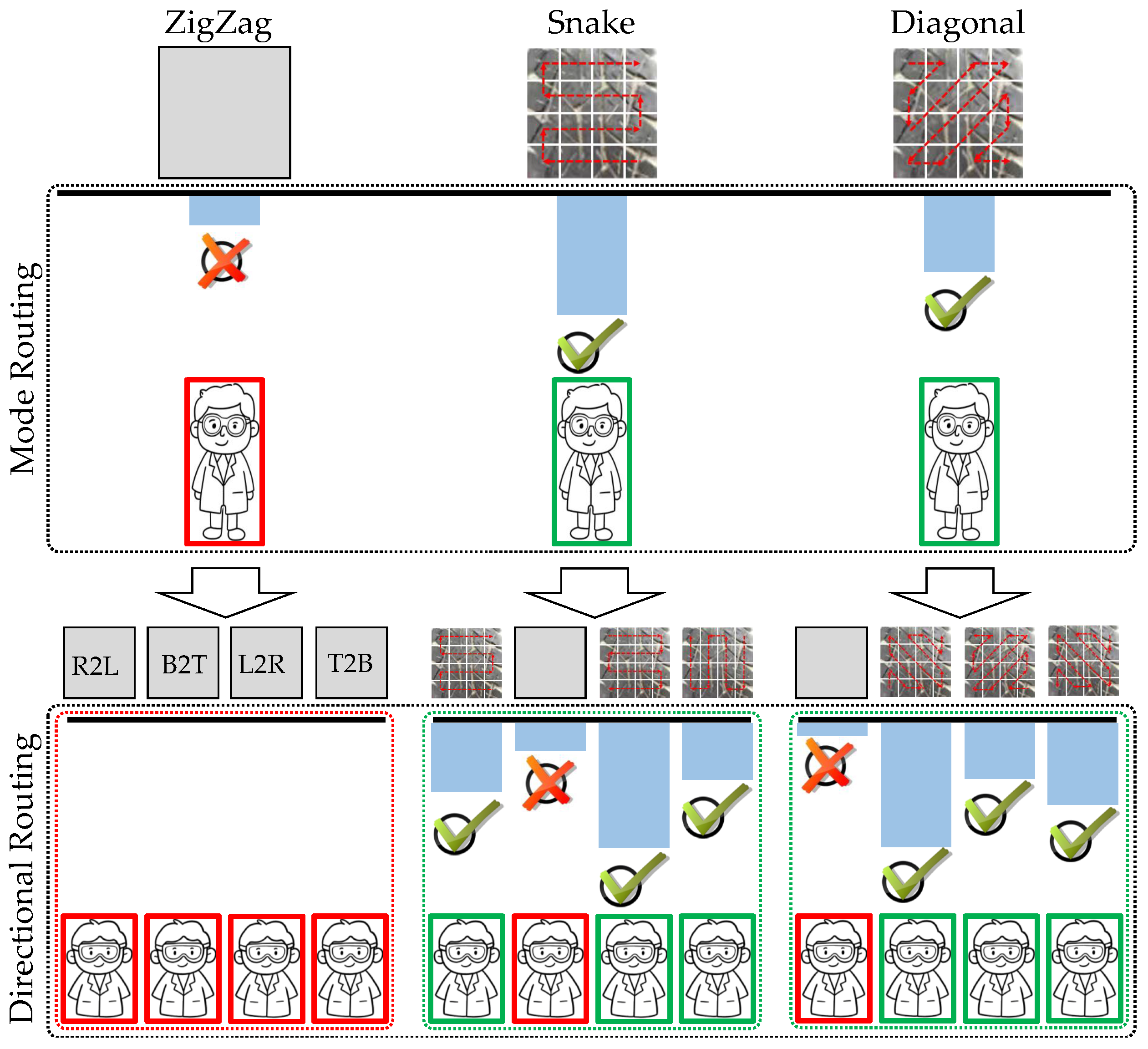
This paper proposes a hierarchically decoupled, functionally specialized, and train-inference heterogeneous dual-layer sparse MoE-Mamba architecture for tire tread features, and it performs fine-grained textural prior to coarse-grained global structural fusion. The dual-layer MoE implements adaptive multi-dimensional feature modeling via constraint relationship between experts of different layers, to achieve favorable balance between comprehensive feature representation and high inference efficiency. The overall framework of the proposed method is shown in Figure 1.

3.1. Multi-Directional Multi-Mode Scanning Mechanism

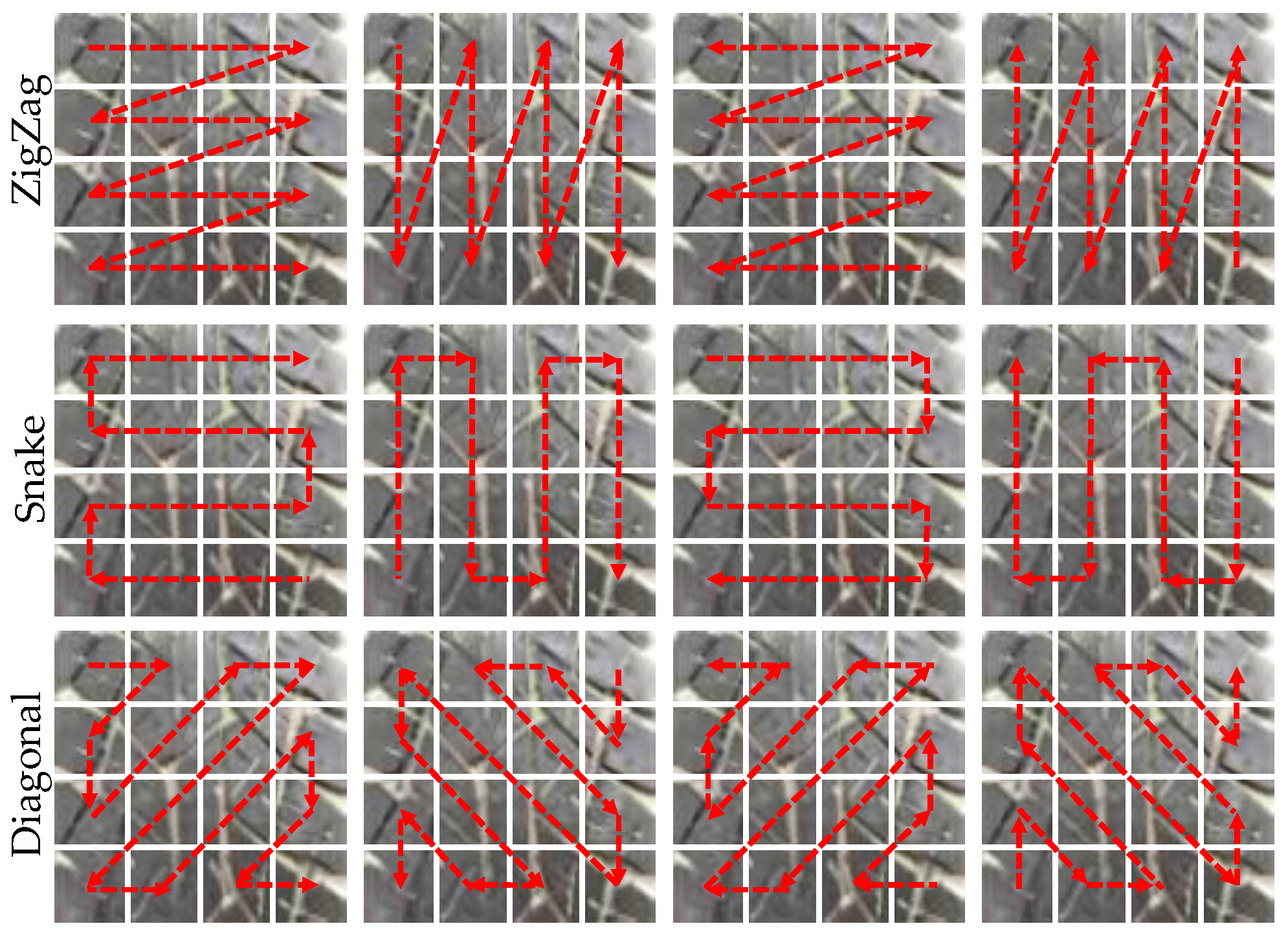
Considering the multi-orientation textures and multi-morphology structures of tire treads, this paper develops two differentiated sequence scanning systems. The four-direction fine-grained pixel-level textural scanning adapts to microscopic texture details, while the outer three-mode coarse-grained global-structral patch traversal fits macroscopic structural layouts, providing reliable sequence representation for the specialized modeling of the dual-layer MoE framework. The visualized examples are shown in Figure 2.

3.1.1. Four-Direction Fine-Grained Pixel-Level Textural Scanning

Fine-grained discrimination of tire treads mainly relies on texture orientations, and single-direction scanning inevitably leads to feature loss. This paper designs four full-coverage pixel traversal directions corresponding to four inner MoE experts to accurately extract tire texture features under diverse conditions and shapes.
Top-to-bottom vertical scanning traverses pixels row by row along the vertical image direction, focusing on capturing longitudinal main drainage grooves and continuous vertical texture features. Bottom-to-top reverse vertical scanning reversely traverses vertical pixel sequences to capture worn edge textures, occluded bottom textures and subtle reverse longitudinal patterns on treads. Left-to-right horizontal scanning traverses pixels column by column along the horizontal image direction, focusing on extracting horizontal anti-slip fine lines. Right-to-left reverse horizontal scanning traverses pixels in reverse horizontal order, focusing on oblique anti-slip textures, reversed interleaved patterns and locally asymmetric textures.

3.1.2. Three-Mode Coarse-Grained Global-Structural Patch Traversal

Global patch layout rules differ fundamentally across various tire treads, making a single traversal scheme incapable of modeling diverse structures. We propose three distinct global patch scanning strategies matched with three outer MoE structure experts to accurately capture global structural features of different tire types.
ZigZag traversal arranges patch sequences in standard top-to-bottom, left-to-right row order with strong sequence continuity and prominent vertical dependencies. Snake traversal traverses odd rows forward and even rows backward to form a reciprocating zigzag patch sequence, which retains interleaved correlations between patches of adjacent rows, fits tires with continuous reciprocating mixed patterns and bidirectional anti-slip treads. Diagonal traversal traverses patches diagonally layer by layer according to the sum of pixel coordinates, breaking the constraints of fixed horizontal and vertical layouts.

3.2. Coarse-Grained Structural MoE

The coarse-grained structural MoE acts as a global structure adaptive modeling and fusion module, it adaptively selects the structural features most suitable for the input tire sample and fuses multi-view structural information to overcome the limitations of single-structure modeling, thereby achieving precise representation of the overall morphology of tire tread patterns defined in Equation (1).
F ˜ CgS = j I CgS W CgS , j F CgS , j
where I CgS = TopK ( W CgS , F CgS ) . W CgS = G CgS ( { F CgS , j } j = 1 N CgS ) , and its element can be calculated with Equation (2).
F CgS , j = B ( S CgS , j )
S CgS = P { X ZigZag , X Snake , X Diagonal } . P denotes the predefined patch embedding projection layer. X denotes the input image. B denotes the VMamba [2] shared backbone.

3.3. Fine-Grained Texture MoE

Fine-grained texture MoE is actually an adaptive fusion module to filter, extract and weight-fuse multi-morphology subtle textures under a unified structural paradigm. Firstly, four-direction pixel scanning is performed on the input patch feature map to generate four groups of feature sequences with distinct orientations.
S FgT = P { X , X , X , X }
The four sequences are separately fed into a shared BiMamba block for deep temporal feature modeling to extract orientation-specific texture features.
F FgT , i = B ( S FgT , i )
In addition, the inner gating network computes weights for each expert to conduct Top-K sparse weighted fusion, outputting single-branch refined and high-purity texture features.
I FgT = TopK ( W FgT , F FgT )
where W FgT = G FgT ( { F FgT , i } i = 1 N FgT ) , and G FgT denotes the fine-grained texture gate network.

3.4. Final Representation

The final output of the model is defined as Equation (6),
F = j I CgS i I FgT B F FgT , i
which reflects the interactions between coarse-grained and fine-grained layers.

3.5. Optimization

The overall loss function of the proposed algorithm is defined in Equation (7).
L total = L cls + λ FgT · L FgT _ balance + λ CgS · L CgS _ balance
where λ FgT = 0.008 and λ CgS = 0.01 are two coefficient weights to balance the relative importance among different loss terms. L cls denotes the cross entropy loss, it is defined in Equation (8).
L cls = c = 1 C y c log y ^ c
where C denotes the category number. y c denotes the true one-hot label of the i th category. y ^ c denotes the predicted probability of the c th category. L FgT _ balance in Equation (7) is designed to avoid over-reliance on dominant textures and neglect of subtle minor patterns. Specifically, it adopts an entropy regularization-based expert balance loss to equalize the global activation probability of four experts to prevent single-expert dominance and idle redundant experts. It is defined in Equation (9).
L FgT _ balance = N FgT n = 1 N FgT p n log p n + ϵ
where N FgT = 4 denotes the number of experts in multi-direction routing layer. p n denotes the mean activation weight of the n th directional expert in global training samples. ϵ = 10 8 is a minimum constant to avoid meaningless logarithmic operations. L CgS _ balance in Equation (7) is designed to avoid fixation on a single scanning paradigm and poor generalization across diverse tire structures, it adopts a dedicated outer balance loss to uniformize expert participation, ensuring robust modeling for strip, block and mixed tread patterns. It is defined in Equation (10).
L CgS _ balance = N CgS n = 1 N CgS q n log q n + ϵ
where N CgS = 3 denotes the number of experts in multi-path routing layer. q n denotes the denotes the mean activation weight of the n th mode expert in global training samples. The training and testing pipelines are shown in Algorithm 1 and Algorithm 2, respectively.
Algorithm 1 Training Pipeline of HSR-Mamba
Hyper-Para:  N FgT = 4 , N CgS = 3 , Top- K FgT = 3 , Top- K CgS = 2 , E split = 0.5 E total
Input:  D = { X , Y } , P , B , G FgT , G CgS
Output: Trained multi-layer sparse MoE-Mamba model M , track prediction y ^
  1:
for all epoch e [ 1 , E total ]  do
  2:
      for all batch ( x , y ) D  do
  3:
            Coarse-grained Texture MoE:
  4:
             S CgS = P { X ZigZag , X Snake , X Diagonal }
  5:
            for  j = 1 to N CgS  do
  6:
                F CgS , j = B ( S CgS , j , F ˜ FgT )
  7:
            end for
  8:
             W CgS = G CgS ( { F CgS , j } j = 1 N CgS )
  9:
            Fine-grained Texture MoE:
10:
             S FgT = { X , X , X , X }
11:
            for  i = 1 to N FgT  do
12:
                F FgT , i = B ( S FgT , i )
13:
            end for
14:
             W FgT = G FgT ( { F FgT , i } i = 1 N FgT )
15:
             F ˜ FgT = i = 1 N FgT W FgT , i F FgT , i
16:
            if  e E split  then
17:
               Full Expert Activation
18:
                F ˜ CgS = j = 1 N CgS W CgS , j F CgS , j
19:
                y ^ = Softmax ( Classifier ( F ˜ CgS ) )
20:
            else
21:
               TopK Expert Activation:
22:
                I FgT = TopK ( W FgT , F FgT )
23:
                I CgS = TopK ( W CgS , F CgS )
24:
                F ˜ FgT = i I FgT W FgT , i F FgT , i
25:
                F ˜ CgS = j I CgS W CgS , j F CgS , j
26:
                y ^ = Softmax ( Classifier ( F ˜ CgS ) )
27:
            end if
28:
          Update M via L total in Equation (7) ▷ Apply expert Dropout ( p = 0.1 ), gradient clipping, weight decay, AMP mixed precision.
29:
      end for
30:
end for
31:
return Trained model M
Algorithm 2 Testing pipeline of HSR-Mamba
Input: Single test tire image x test , trained model M
Output: Tread category prediction y ^ test
  1:
Z 0 = P ( x test )
▷ Patch embedding
  2:
W CgS light = G CoS ( Z 0 )
  3:
I CgS = TopK ( W CoS light , K CoS )
▷ Select activated outer experts
  4:
Initialize empty list F CoS _ valid
  5:
for all  j { 1 , 2 , 3 }  do
  6:
      if  j I CoS  then
▷ Only activated outer expert: execute full inner MoE pipeline
  7:
            for  i = 1 to N FgT  do
  8:
                F FgT , i = B ( S FgT , i )
  9:
            end for
10:
             W dir = G FgT ( { F dir , i } i = 1 N FgT )
11:
             I FgT = TopK ( W FgT , K FgT )
12:
             F ˜ FgT = i I FgT W FgT , i F FgT , i
▷ Outer branch modeling based on valid inner texture feature
13:
             F CgS , j = B ( S CgS , j , F ˜ FgT )
14:
            Append F CgS , j and W CgS , j to F CgS _ valid
15:
      else
▷ Inactive outer expert: skip all inner MoE calculation, inner experts hibernate entirely
16:
            Continue
17:
      end if
18:
end for
▷ Feature fusion only for activated outer branches
19:
F ˜ CgS = ( f , w ) F CgS _ valid w · f
20:
y ^ test = argmax ( Softmax ( Classifier ( F ˜ CgS ) ) )
21:
return Prediction y ^ test

4. Experiments

4.1. Datasets and Metrics

We conduct a series of experiments on the CIIP-TPID-V1.1 [24] dataset, which contains 983 images with a resolution of approximately 3000 × 4000 pixels, covering 75 distinct tread designs across 30 brands, to illustrate the performance of different methods. In addition, we utilize accuracy (Acc.) to measure performance.

4.2. Experimental Setup

In this work, the dataset is split into training, validation, and test sets with ratios of 50%, 10%, and 40%, respectively. The learning rate is set to 0.001. We set the number of training epochs to 100 and the batch size to 32. All experiments are implemented on an NVIDIA RTX 4090 GPU. Additionally, in the training phase, all experts are activated for the first 50 epochs to ensure their basic functions, while the Top-K strategy is adopted in the subsequent 50 epochs to accelerate convergence.

4.3. Contrasting Methods

We compare our methods with rotation-invariant texture feature extraction (RiTFE) [1], orientation-frequency fields and periodic prior reranking (OFFPPR) [25], rotation invariant hog (RiHOG) [26], wavelet-energy-weighted local binary pattern (DWT-LBP) [27], a convolutional neural network based on transfer learning (TLCNN) [28], knowledge distillation and attention mechanism (KGAW) [24], line weber local descriptor (LWLD) [29], knowledge distillation and attention mechanism (KDAM) [30], unpaired multisource imagery joint learning (UMIJL) [31], and a visual state space model (VMamba) [2] to demonstrate its superiority.

4.4. Experimental Analysis

4.4.1. Contrasting Experimental Results

The experimental results on CIIP-TPID-V1.1 dataset are shown in Table 1, from which we can see that, the proposed method surpasses all of the contrasting ones.
Specifically, methods relying on hand-designed texture/gradient descriptors (RiTFE, OFFFPPR, RiHOG and DWT-LBP) obtain low accuracy ranging from 74.22% to 82.73%. Limited by fixed artificial feature rules, these methods fail to capture complex spatial long-range dependencies in the input data, resulting in weak discrimination ability. Convolutional neural networks (TLCNN and KGAW) yield moderate performance (83.00% to 85.40%). The local receptive field nature of convolution restricts their capacity to model global contextual information, which hinders further accuracy improvement. Recent advanced deep frameworks (LWLD, KDAM, and UMJL) reach accuracy between 90.20% and 91.42%. Though these designs introduce extra feature alignment or metric learning modules, they still suffer from inefficient long-distance dependency modeling, and the best competitor UMIJL only attains 91.42%, which is 2.86% lower than our HSR-Mamba. Benefiting from the linear-complexity sequence modeling of Mamba architecture and the specially designed HSR feature enhancement module, our method efficiently excavates both local fine-grained features and global long-range correlations. It establishes a clear performance margin over all compared SOTAs, verifying the effectiveness of the proposed HSR-Mamba framework.
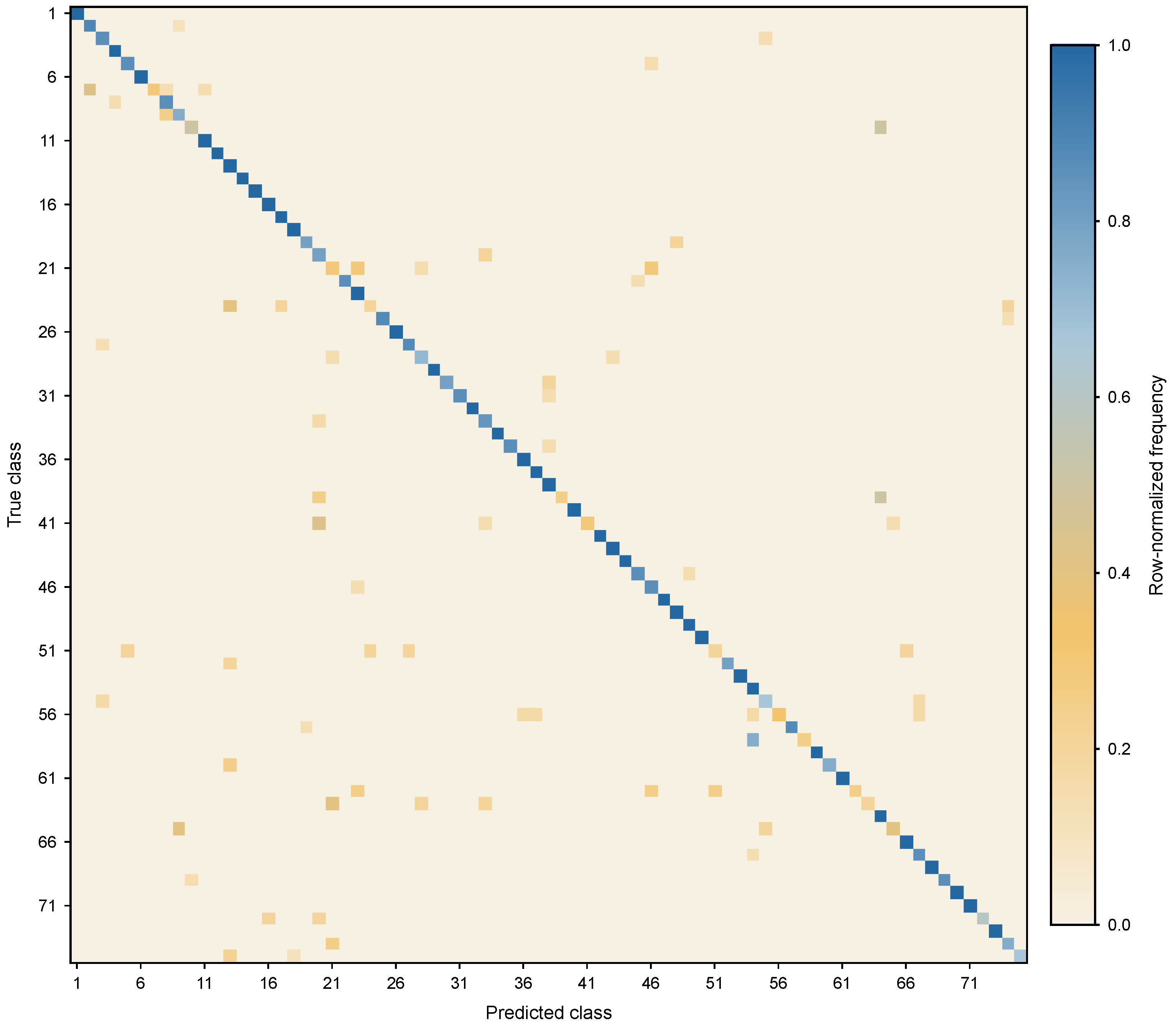
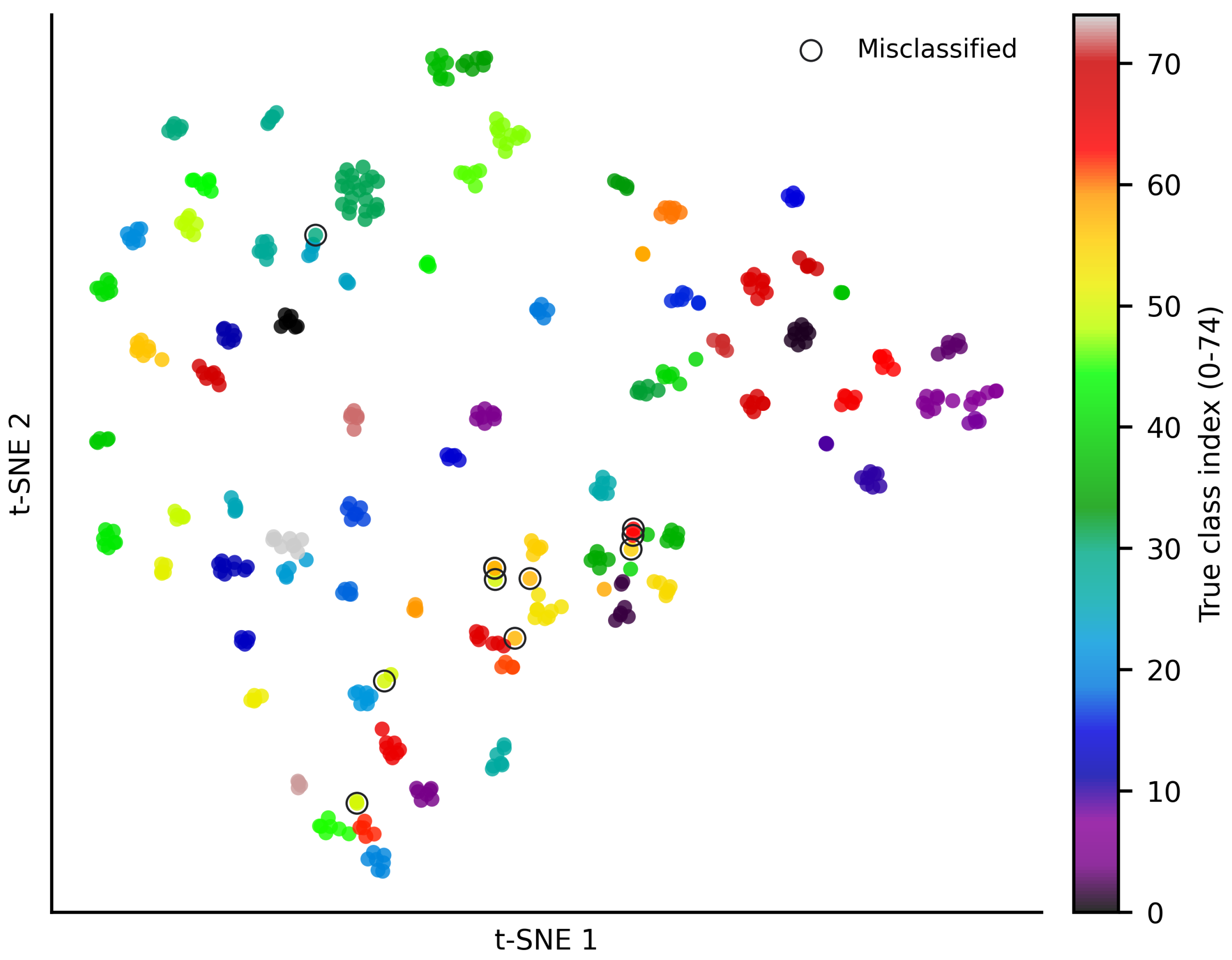
In addition, the confusion matrix of our method on the testing dataset is shown in Figure 3, and the t-sne visualization is shown in Figure 4, from which we can see that the proposed method can correctly recognize most samples.

4.4.2. Ablation Studies

The ablation experimental results about dual-layer scanning and hierarchical routing are shown in Table 2.
As observed, the dual-layer scanning and hierarchical routing jointly improve classification performance. The scanning mechanism extracts informative local texture and global structure features, while hierarchical routing eliminates noisy distractions. Meanwhile, it drastically reduces inference latency by forcing redundant texture and structure experts into dormancy. Specifically, the gain in inference FPS is attributed to our mechanism that directly skips fine-grained experts associated with unactivated coarse-grained experts during inference.

5. Conclusions

This work presents a hierarchical sparse routing enabled multi-path multi-directional Mamba scanning framework for tire pattern recognition to improve the performance, which mainly contains a fine-grained feature layer MoE based on four-directional pixel scanning and a coarse-grained structural layer MoE based on three global patch traversals. It realizes micro multi-directional fine-grained texture modeling as well as macro multi-mode global structure modeling. Meanwhile, hierarchical sparse routing is adopted to eliminate redundant forward computations, which balances recognition accuracy and inference efficiency. In addition, the experimental results on CIIP-TPID-V1.1 have demonstrated its superiority.

Author Contributions

X.C. performed the study design and drafted the manuscript. X.X. carried out data analysis and figure preparation. Z.S. was responsible for code development and experimental testing. J.F. conducted literature retrieval and manuscript proofreading. All authors have read and agreed to the published version of the manuscript.

Funding

This research received no external funding.

Data Availability Statement

The data that support the findings of this study are available from the corresponding author upon reasonable request.

Acknowledgments

The authors thank the editors and anonymous reviewers for their insightful comments that improved the manuscript.

Conflicts of Interest

The authors declare no conflicts of interest.

References

  1. Liu, Y.; Yan, H.; Lim, K.P. Study on rotation-invariant texture feature extraction for tire pattern retrieval. Multidimens. Syst. Signal Process. 2017, 28, 757–770. [Google Scholar] [CrossRef] [Scilit]
  2. Liu, Y.; Tian, Y.; Zhao, Y.; Yu, H.; Xie, L.; Wang, Y.; Ye, Q.; Jiao, J.; Liu, Y. Vmamba: Visual state space model. Adv. Neural Inf. Process. Syst. 2024, 37, 103031–103063. [Google Scholar] [CrossRef] [Scilit]
  3. Xin, X.; Deng, Y.; Huang, W.; Wu, Y.; Fang, J.; Wang, J. Multi-Pattern Scanning Mamba for Cloud Removal. Remote Sens. 2025, 17, 3593. [Google Scholar] [CrossRef] [Scilit]
  4. Sun, H.; He, X.; Xu, J. SIM-OFE: Structure Information Mining and Object-Aware Feature Enhancement for Fine-Grained Visual Categorization. IEEE Trans. Image Process. 2024, 33, 5312–5326. [Google Scholar] [CrossRef] [Scilit] [PubMed]
  5. Wang, J.; Xu, Q.; Jiang, B. Multi-Granularity Part Sampling Attention for Fine-Grained Visual Classification. IEEE Trans. Image Process. 2024, 33, 4529–4542. [Google Scholar] [CrossRef] [Scilit] [PubMed]
  6. Phadnis, A.; Patel, M. Real-Time Tire Tread Identification From Wheel Tracks Using YOLOv11 and Triplet Embedding. Int. J. Intell. Syst. 2026, 2026, 7723883. [Google Scholar] [CrossRef] [Scilit]
  7. Zhong, Y.; Fang, J. Mutual Modality Trust with Lightweight Reconstruction Regularization for Fine-grained Tire Pattern Recognition. arXiv 2026, arXiv:2607.23979. [Google Scholar]
  8. Zhu, L.; Liao, B.; Zhang, Q.; Wang, X.; Liu, W.; Wang, X. Vision Mamba: Efficient Visual Representation Learning with Bidirectional State Space Model. In Proceedings of the International Conference on Machine Learning; PMLR: Cambridge, MA, USA, 2024; Volume 235, pp. 62429–62442. [Google Scholar]
  9. Hatamizadeh, A.; Kautz, J. MambaVision: A Hybrid Mamba-Transformer Vision Backbone. In 2025 IEEE/CVF Conference on Computer Vision and Pattern Recognition (CVPR); IEEE: New York, NY, USA, 2025. [Google Scholar]
  10. Lee, S.; Choi, J.; Kim, H. EfficientViM: Efficient Vision Mamba with Hidden State Mixer Based State Space Duality. In 2025 IEEE/CVF Conference on Computer Vision and Pattern Recognition (CVPR); IEEE: New York, NY, USA, 2025. [Google Scholar]
  11. Fedus, W.; Dean, J.; Zoph, B. A Review of Sparse Expert Models in Deep Learning. arXiv 2022, arXiv:2209.01667. [Google Scholar]
  12. Zhang, W.; Zhou, T.; Wang, Y. A Comprehensive Survey of Mixture-of-Experts: Algorithms, Theory, and Applications. arXiv 2026, arXiv:2503.07137. [Google Scholar]
  13. Chen, Y.; Dai, X.; Chen, D. Mobile V-MoEs: Scaling Down Vision Transformers via Sparse Mixture-of-Experts. arXiv 2023, arXiv:2309.04354. [Google Scholar]
  14. Brock, A.; Walker, E. When Does Sparse MoE Help in Vision? The Role of Backbone Compute Leverage. arXiv 2026, arXiv:2605.15484. [Google Scholar]
  15. Beyer, L.; Riquelme, C. Mixture of Experts for Image Classification: What’s the Sweet Spot? arXiv 2024, arXiv:2411.18322. [Google Scholar]
  16. Kada, H.; Benavides, M. Teacher-Guided Routing for Sparse Vision Mixture-of-Experts. In Proceedings of the IEEE/CVF Conference on Computer Vision and Pattern Recognition; IEEE: New York, NY, USA, 2026; pp. 23412–23421. [Google Scholar]
  17. Liu, Z.; Chen, Y.; Dai, X. Routers in Vision Mixture of Experts: An Empirical Study. arXiv 2024, arXiv:2401.15969. [Google Scholar]
  18. Gu, J.; Zhang, A.; Li, B. MoE-Mamba: Mixture-of-Experts for Selective State-Space Models. arXiv 2024, arXiv:2408.15273. [Google Scholar]
  19. Xu, Y.; Li, Z. MambaMoE: Mixture-of-Spectral-Spatial-Experts State Space Model for Hyperspectral Image Classification. arXiv 2025, arXiv:2504.20509. [Google Scholar]
  20. Xian, F.; Jian, H.; Xie, Z.; Du, J.; Zhang, Y.; Ning, X.; Dong, M.; Wang, H. MG-MoE: Multi-Granularity Mixture-of-Experts Ensemble. J. Electron. Inf. Technol. 2026, 48, 1–10. [Google Scholar]
  21. Pu, L.; Zhang, Y. AdapterMoE: A Two-Stage Hard-Routing Mixture-of-Experts Architecture for Multi-Crop Disease Recognition. arXiv 2026, arXiv:2608.08808. [Google Scholar]
  22. Han, Y.; Song, S. Dynamic-DINO: Fine-Grained Mixture of Experts Tuning for Real-time Open-Vocabulary Object Detection. arXiv 2025, arXiv:2507.17436. [Google Scholar]
  23. Wang, K.; Liu, M. AttnRoute-MoE: Attention-Prior Routing for Mixture-of-Experts Vision Transformers. arXiv 2025, arXiv:2506.10789. [Google Scholar]
  24. Hu, X.; Wang, T.; Liu, Y.; Xu, Z.; Pan, Y.; Xiang, N.; Zhang, W.; Hao, Y. Cross-Modal Tire Impression Comparison via Knowledge Graphs and Adaptive Weight Learning. In Proceedings of the 2026 8th International Conference on Natural Language Processing (ICNLP); IEEE: New York, NY, USA, 2026; pp. 606–612. [Google Scholar]
  25. Hu, X.; Sun, Z.; Liu, Y.; Xu, Z.; Pan, Y.; Xiang, N.; Zhang, W.; Hao, Y. Orientation-Frequency Fields and Periodic Prior Reranking for Robust Cross-Modal Tire Indentation Retrieval. In Proceedings of the 2026 8th International Conference on Natural Language Processing (ICNLP); IEEE: New York, NY, USA, 2026; pp. 593–599. [Google Scholar]
  26. Liu, Y.; Ge, Y.; Wang, F.; Liu, Q.; Lei, Y.; Zhang, D.; Lu, G. A rotation invariant HOG descriptor for tire pattern image classification. In Proceedings of the ICASSP 2019–2019 IEEE International Conference on Acoustics, Speech and Signal Processing (ICASSP); IEEE: New York, NY, USA, 2019; pp. 2412–2416. [Google Scholar]
  27. Liu, Y.; Zhang, S.; Wang, F.; Lim, K.; Liu, Q.; Lei, Y.; Gong, Y.; Lu, J. Wavelet-energy-weighted local binary pattern analysis for tire tread pattern classification. In Proceedings of the 2019 3rd International Conference on Imaging, Signal Processing and Communication (ICISPC); IEEE: New York, NY, USA, 2019; pp. 90–95. [Google Scholar]
  28. Liu, Y.; Zhang, S.; Wang, F.; Ling, N. Tread pattern image classification using convolutional neural network based on transfer learning. In Proceedings of the 2018 IEEE International Workshop on Signal Processing Systems (SiPS); IEEE: New York, NY, USA, 2018; pp. 300–305. [Google Scholar]
  29. Liu, Y.; Che, X.; Dong, H.; Li, D.; Teng, S.W.; Lu, G. Integrating Line Weber Local Descriptor and Deep Feature for Tire Indentation Mark Image Classification. In Proceedings of the 2021 4th International Conference on Artificial Intelligence and Pattern Recognition; ACM: New York, NY, USA, 2021; pp. 56–61. [Google Scholar]
  30. Feng, H.; Liu, Y.; Zhang, W. A Fine-grained Image Classification Algorithm Using Knowledge Distillation and Attention Mechanism. In Proceedings of the 2023 6th International Conference on Artificial Intelligence and Pattern Recognition; ACM: New York, NY, USA, 2023; pp. 188–193. [Google Scholar]
  31. Zhong, Y.; Wang, J.; Fang, J. Unpaired Multisource Imagery Joint Learning via Lightweight Network for Tread Tire Recognition. In Proceedings of the 2024 6th International Conference on Natural Language Processing (ICNLP); IEEE: New York, NY, USA, 2024; pp. 585–591. [Google Scholar]
Figure 1. Hierarchical sparse routing framework. R2L, L2R, T2B, and B2T denote the right to left, left to right, top to bottom, and bottom to top scanning directions respectively. Green indicates the activated experts, and red represents the unactivated experts.
Electronics 15 04203 g001
Figure 2. Examples of multi-mode multi-directional scanning.
Electronics 15 04203 g002
Figure 3. Confusion matrix of our method on the testing dataset.
Electronics 15 04203 g003
Figure 4. t-sne visualizations of the proposed method.
Electronics 15 04203 g004
Table 1. Experimental results on CIIP-TPID-V1.1 dataset.
CategoryMethodsAcc. (%)Params (M)GFLOPsFPS
Handcrafted featureRiTFE [1]74.22---
OFFPPR [25]75.81---
RiHOG [26]81.51---
DWT-LBP [27]82.73---
Vanilla CNNsTLCNN [28]83.00---
KGAW [24]85.40---
Advanced Deep SOTALWLD [29]90.20134.5730.94363.62
KDAM [30]90.512.320.60539.33
UMIJL [31]91.4226.508.85549.69
VMamba [2]91.3622.054.5388.74
OursHSR-Mamba94.2823.424.61102.5
Table 2. Ablation experimental results.
Dual-Layer ScanningHierarchical RoutingAcc. (%)FPS (Hz)
90.7559.34
92.6355.29
94.28102.5
✓: the corresponding module is enabled.
Disclaimer/Publisher’s Note: The statements, opinions and data contained in all publications are solely those of the individual author(s) and contributor(s) and not of MDPI and/or the editor(s). MDPI and/or the editor(s) disclaim responsibility for any injury to people or property resulting from any ideas, methods, instructions or products referred to in the content.