A Multi-Timescale Control Framework for Energy and SLA-Aware O-RAN Network Slicing

 , , ,
, , ,  , and
, and 
Abstract
1. Introduction
- We develop a hierarchical network slicing framework aligned with O-RAN architecture, separating the Non-RT resource optimization controller from the Near-RT adaptive controller.
- We design a PPO-based rApp that generates nominal PRB allocations and energy-mode decisions, enabling long-term optimization of the energy-efficiency and SLA trade-off.
- We introduce a lightweight RLS-assisted xApp that utilizes Near-RT telemetry to identify potential URLLC performance degradation and apply bounded adjustment actions. The mechanism preserves the nominal energy-aware policy while providing rapid adaptation to traffic fluctuations.
- We evaluate the proposed framework under challenging within-episode traffic transitions, including bursty traffic, flash-crowd events, and demand-shift phases. The results demonstrate the effectiveness of hierarchical multi-timescale control in balancing energy efficiency, URLLC reliability, and eMBB performance under dynamic network conditions.
2. Related Work
2.1. Traditional Optimization and Heuristic Resource Allocation
2.2. Single-Timescale DRL Solution
2.3. Multi-Timescale and Joint Slicing Architectures
3. System Model and Problem Formulation
3.1. System Model
3.2. Problem Formulation
4. Proposed H-RLS Hierarchical Framework
- (1)
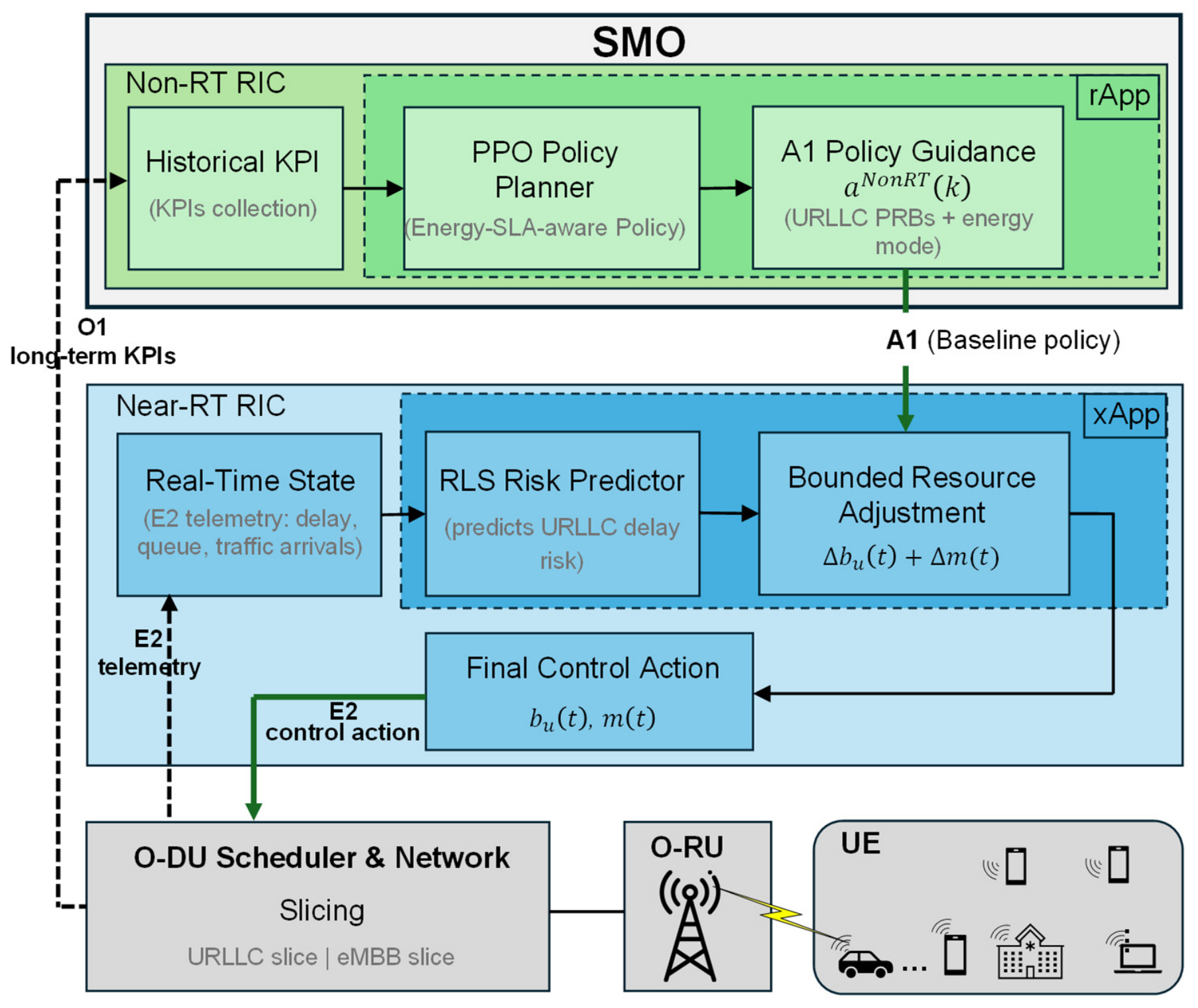
- The Non-RT Strategic Control Loop: Operating within the SMO, a PPO agent acts as an rApp. It observes aggregated, long-term historical Key Performance Indicators (KPIs) to learn the broader energy-SLA trade-off. It periodically issues a nominal or baseline policy consisting of a URLLC PRB budget and a target energy-saving mode down to the Near-RT RIC via the A1 interface.
- (2)
- The Near-RT Tactical Execution Loop: Operating closer to the radio edge, a lightweight RLS agent is deployed within the xApp. It monitors real-time E2 telemetry, including instantaneous queue depths and packet arrivals. Instead of overriding the Non-RT policy, it computes a bounded adjustment to the nominal plan to safely accommodate sudden traffic bursts or flash crowds.
- (1)
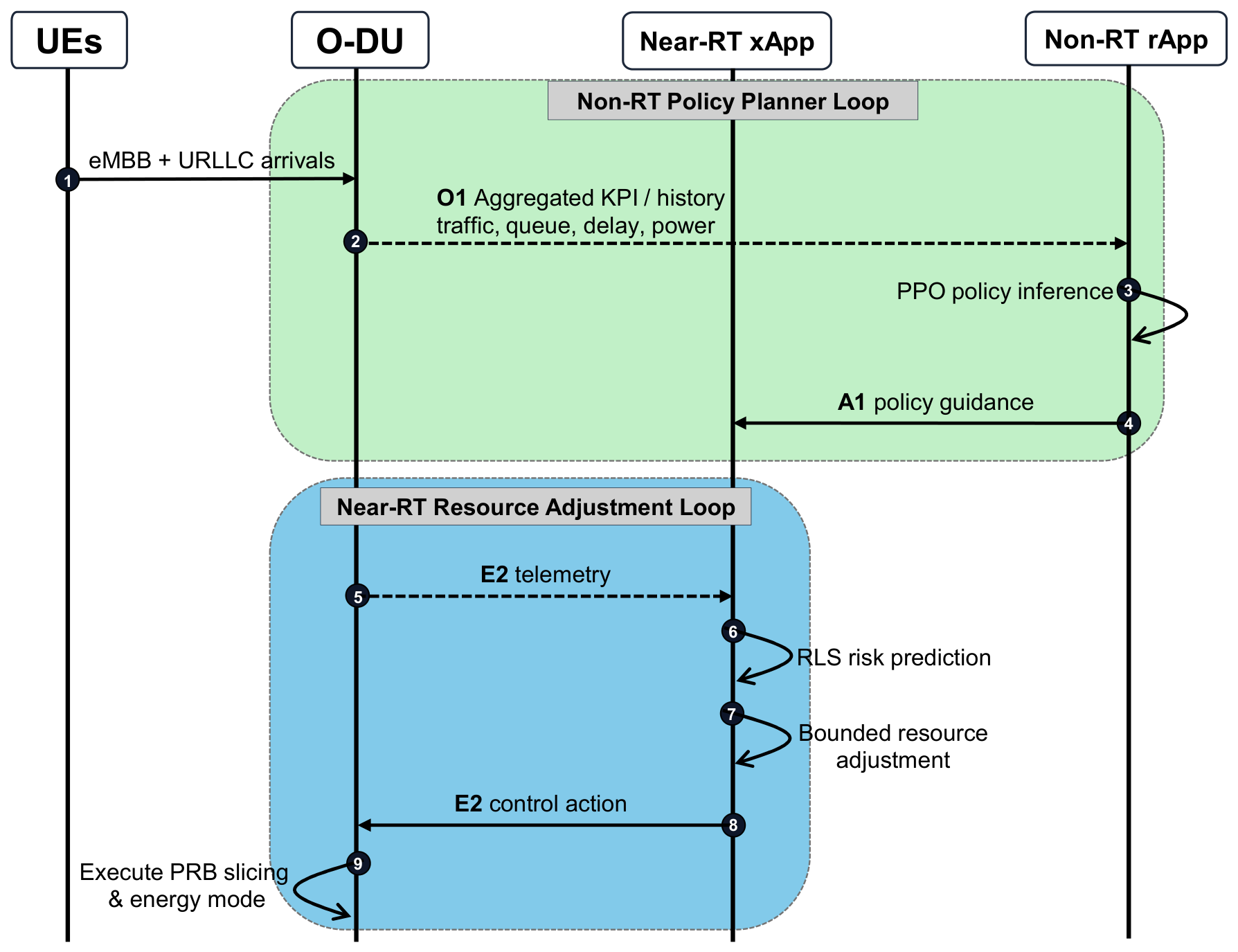
- Over the course of the nominal interval ( base steps), the O-DU aggregates historical network states, including traffic profiles, queue depths, and delay metrics, then forwards them to the SMO layer via the O1 interface.
- (2)
- The Non-RT RIC rApp processes this historical data using the PPO agent to evaluate the long-term energy-SLA trade-off and update its strategic policy.
- (3)
- The rApp issues an updated policy intent, , which establishes the baseline URLLC PRB budget and the target energy mode. This nominal plan is transmitted down to the Near-RT RIC via the A1 interface and remains anchored for the duration of the subsequent interval.
- (4)
- Within the established nominal interval, the O-DU streams instantaneous, millisecond-level telemetry to the Near-RT RIC via the E2 interface at every control step .
- (5)
- The Near-RT xApp feeds this E2 telemetry into the RLS predictor to predict imminent URLLC SLA risks.
- (6)
- Based on the predicted risk severity, the xApp computes a bounded tactical adjustment, generating and to safely modify the nominal plan without overriding the strategic energy-saving goals.
- (7)
- The Near-RT xApp formulates the final control action by integrating the strategic Non-RT nominal plan with the newly computed tactical adjustments.
- (8)
- This combined resource and energy command is subsequently transmitted from the Near-RT RIC back to the O-DU via the E2 interface.
- (9)
- Upon receiving the command, the O-DU executes the physical PRB slicing and applies the selected energy-saving mode to the RU, repeating this adjustment loop continuously at every control step .
4.1. Non-RT RIC: PPO-Based Policy Learning
4.1.1. State Space
4.1.2. Action Space
4.1.3. Reward Formulation
4.1.4. PPO Agent Training Process
| Algorithm 1. Offline training procedure for the Non-RT rApp | ||||
| Input: PPO agent with initial actor network and critic network | ||||
| System parameters: , episode duration , Non-RT interval | ||||
| Hyperparameters: discount factor clipping ratio , and | ||||
| Output: Optimized policy weight | ||||
| 1: | Initialization: transition replay buffer | |||
| 2: | for episode to do | |||
| 3: | Reset O-RAN environment, initialize queues, set initial | |||
| 4: | Observe initial aggregated Non-RT state | |||
| 5: | for to do | |||
| 6: | Nominal action ~ | |||
| 7: | Initialize interval reward accumulator | |||
| 8: | for to do | |||
| 9: | xApp calculate real-time bounded adjustment and | |||
| 10: | Execute clipped physical action and | |||
| 11: | Observe immediate step reward | |||
| 12: | Accumulate interval reward: | |||
| 13: | end for | |||
| 14: | Compute state-value estimate for all state in | |||
| 15: | Store transition in | |||
| 16: | end for | |||
| 17: | Compute state-value estimate for all state in | |||
| 18: | Compute using and | |||
| 19: | Compute reward target values | |||
| 20: | for several optimization epochs do | |||
| 21: | Calculate probability ratio: | |||
| 22: | Calculate surrogate objective | |||
| 23: | Update Actor via Adam optimizer to maximize with | |||
| 24: | end for | |||
| 25: | Clear relay buffer | |||
| 26: | end | |||
4.2. Near-RT RIC: Real-Time Adaptive Control
4.2.1. RLS Feature Representation
4.2.2. Risk Prediction and Recursive Update
4.3. Bounded Resource Adjustment Mechanism
| Algorithm 2. Online Near-Real-Time Execution of xApp | |||
| Input: Active nominal policy | |||
| System parameters: Risk thresholds , sensitivity scale , , | |||
| RLS state: Current weights , inverse covariance | |||
| 1: | for each base control step do | ||
| 2: | Observe instantaneous E2 telemetry: , traffic flags | ||
| 3: | Construct and normalize feature vector | ||
| 4: | Compute predicted SLA risk | ||
| 5: | Observe actual environment delay pressure | ||
| 6: | Compute RLS gain | ||
| 7: | Update weights | ||
| 8: | Update covariance | ||
| 9: | if then | ||
| 10: | |||
| 11: | |||
| 12: | else if then | ||
| 13: | |||
| 14: | |||
| 15: | else | ||
| 16: | |||
| 17: | appropriate energy decrease | ||
| 18: | else if | ||
| 19: | |||
| 20: | |||
| 21: | Send to O-DU MAC scheduler via E2 interface | ||
| 22: | end | ||
5. Computational Complexity and Signal Overhead
5.1. Computational Complexity
5.2. Signaling Overhead
6. Performance Evaluation
6.1. Simulation Setup
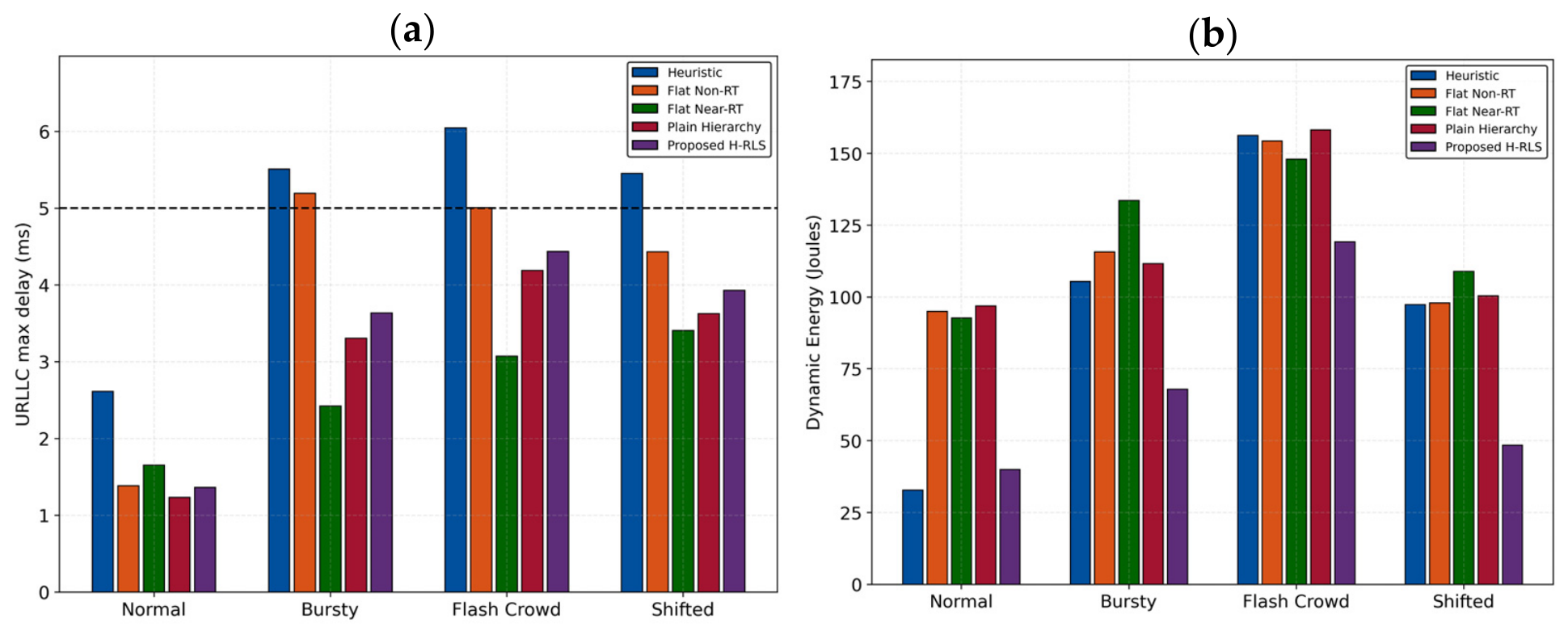
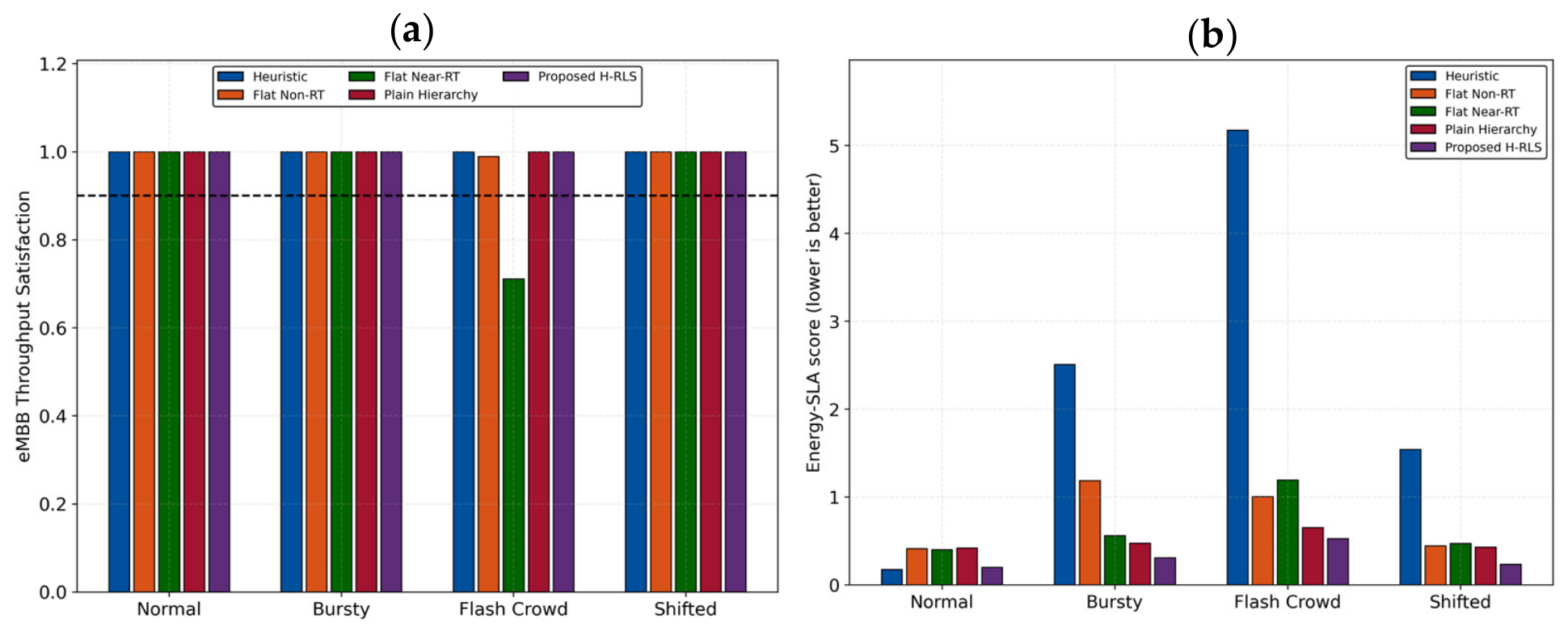
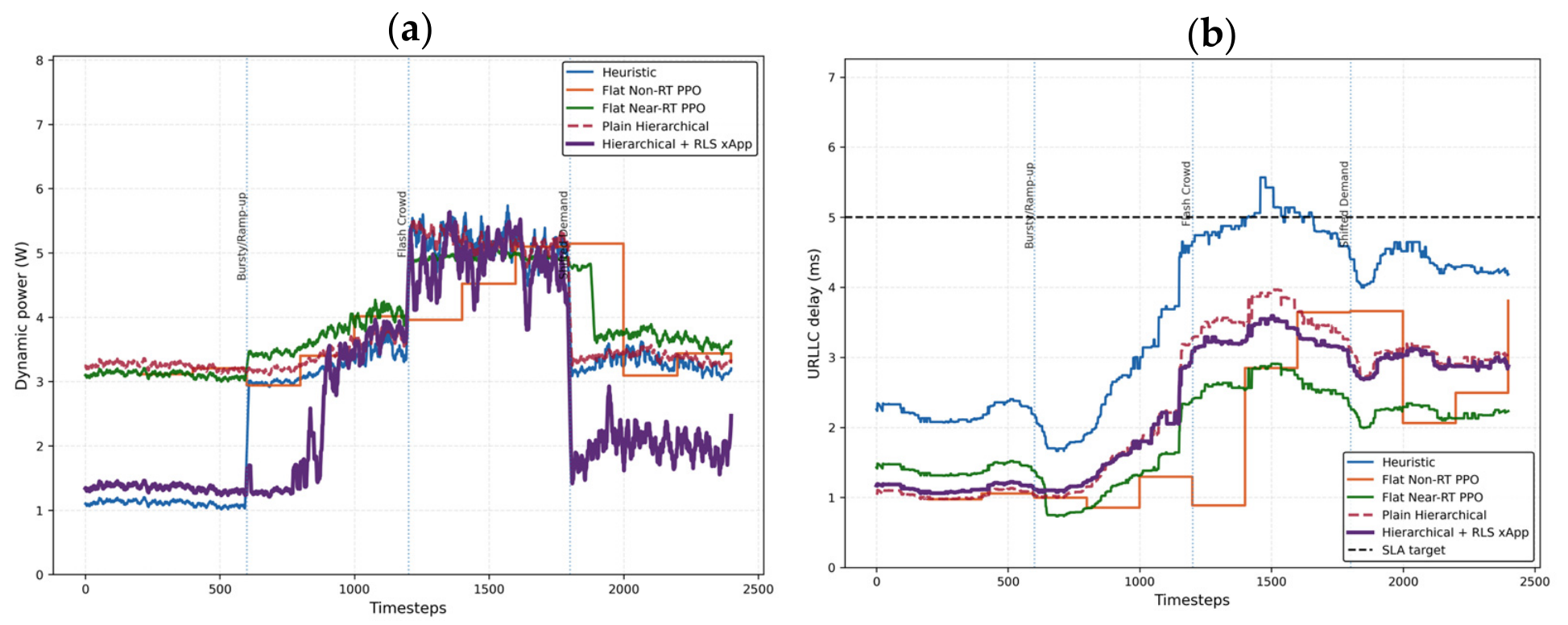
- Normal: Represents a stable network operation. The total offered load ratio is maintained between 40% and 50%. The traffic is distributed with 45 Mbps allocated to eMBB and 5 Mbps allocated to URLLC.
- Bursty: Introduces temporary traffic spikes. The overall offered load ratio rises to 80%. During these spikes, eMBB demand rises to 60 Mbps, and URLLC demand increases to 10 Mbps.
- Flash-crowd: Models severe congestion stress on the network. The offered load ratio reaches a critical level between 90% and 120%. Traffic surges significantly across both slices, with eMBB reaching 80 Mbps and URLLC spiking to 30 Mbps.
- Shifted Demand: Simulates a fundamental service demand shift resulting in high URLLC pressure. The standard traffic distribution is inverted, with URLLC becoming the dominant service class at 45 Mbps, while eMBB decreases to 35 Mbps.
6.2. Benchmarking Methods
6.3. Evaluation Results and Discussion
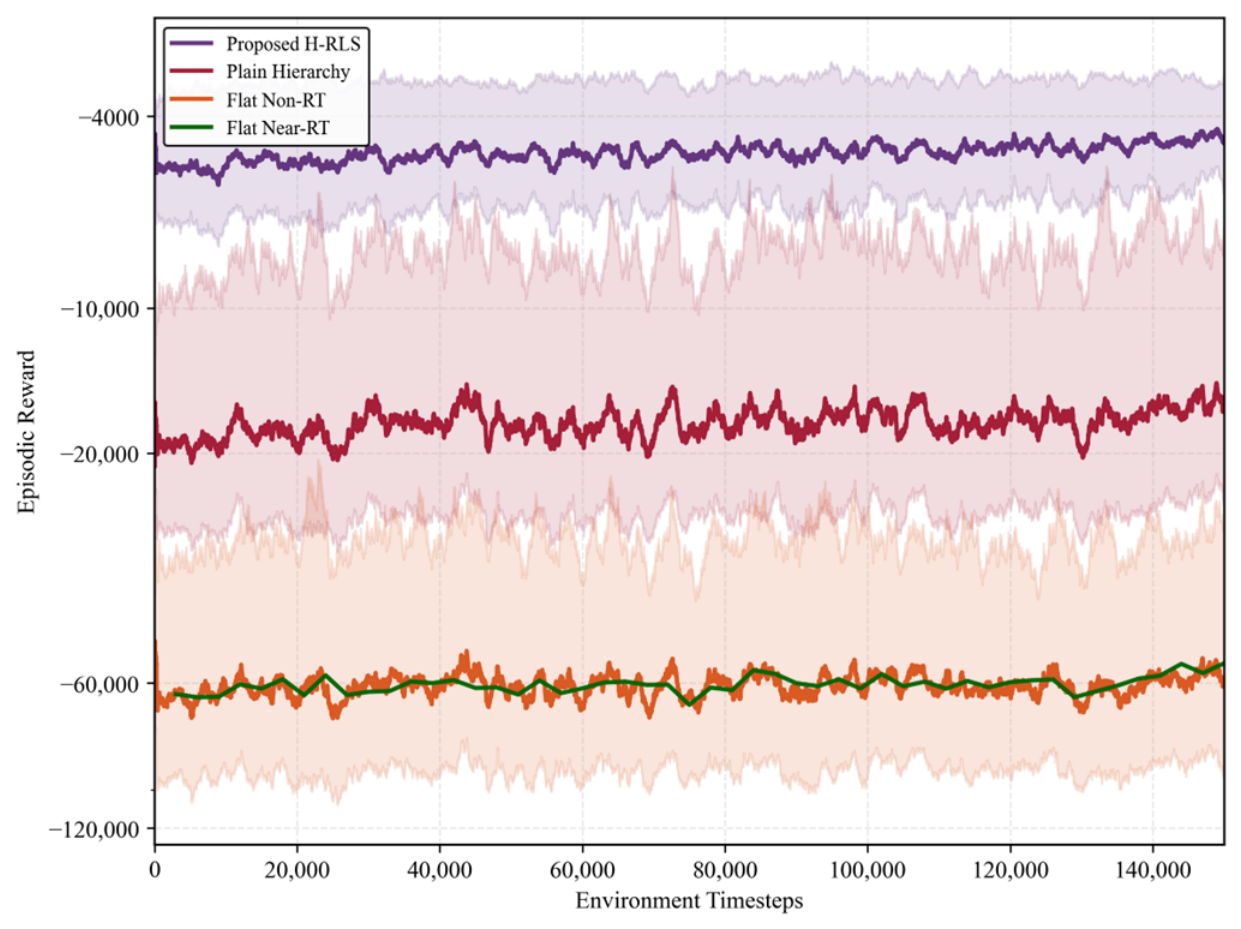
6.3.1. Training Convergence
6.3.2. Slice-Level Performance Evaluation Under Heterogeneous Traffic Conditions
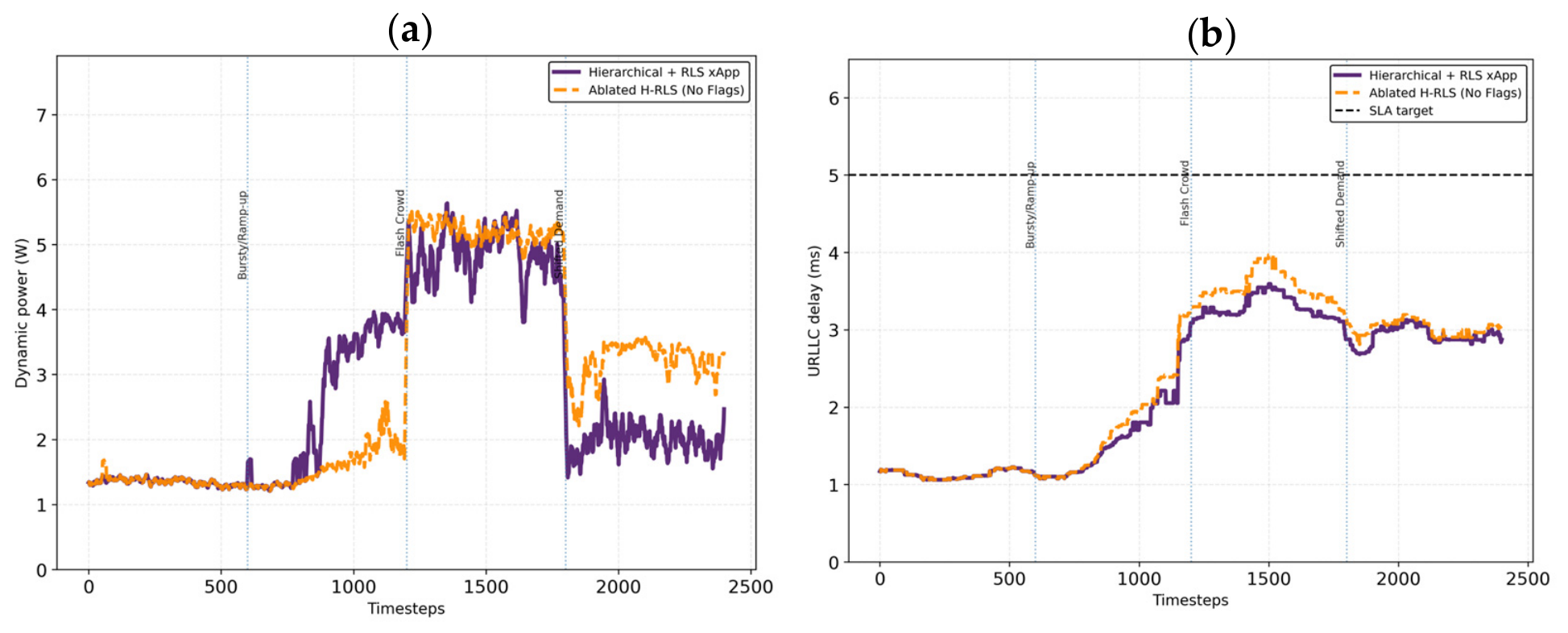
6.3.3. Transient Response Under Dynamic Traffic Transitions
7. Conclusions
Author Contributions
Funding
Data Availability Statement
Conflicts of Interest
References
- Alam, K.; Habibi, M.A.; Tammen, M.; Krummacker, D.; Saad, W.; Di Renzo, M.; Melodia, T.; Costa-Pérez, X.; Debbah, M.; Dutta, A.; et al. A Comprehensive Tutorial and Survey of O-RAN: Exploring Slicing-Aware Architecture, Deployment Options, Use Cases, and Challenges. IEEE Commun. Surv. Tutor. 2025, 28, 1637–1678. [Google Scholar] [CrossRef] [Scilit]
- Taskou, S.K.; Rasti, M.; Hossain, E. End-to-End Resource Slicing for Coexistence of eMBB and URLLC Services in 5G-Advanced/6 G Networks. IEEE Trans. Mob. Comput. 2023, 23, 8015–8032. [Google Scholar] [CrossRef] [Scilit]
- Liu, Y.; Zhao, L.; Wu, J.; Liu, D.; Hei, X. Achieving High Energy Efficiency for Network Slicing-Enabled 5G O-RAN Base Stations. In Proceedings of the 2024 IEEE International Conference on High Performance Computing and Communications (HPCC); IEEE: Piscataway, NJ, USA, 2024; pp. 1051–1056. [Google Scholar] [CrossRef] [Scilit]
- Xu, D.; Su, X.; Premsankar, G.; Wang, H.; Tarkoma, S.; Hui, P. Dynamic Hierarchical Reinforcement Learning Framework for Energy-Efficient 5G Base Stations in Urban Environments. IEEE Trans. Mob. Comput. 2025, 24, 8582–8599. [Google Scholar] [CrossRef] [Scilit]
- Park, H.; Nguyen, T.-H.; Park, L. An Investigation on Open-RAN Specifications: Use Cases, Security Threats, Requirements, Discussions. Comput. Model. Eng. Sci. 2024, 141, 13–41. [Google Scholar] [CrossRef] [Scilit]
- Dai, J.; Li, L.; Safavinejad, R.; Mahboob, S.; Chen, H.; Ratnam, V.V.; Wang, H.; Zhang, J.; Liu, L. O-RAN-Enabled Intelligent Network Slicing to Meet Service-Level Agreement (SLA). IEEE Trans. Mob. Comput. 2025, 24, 890–906. [Google Scholar] [CrossRef] [Scilit]
- Ros, S.; Kang, S.; Song, I.; Cha, G.; Tam, P.; Kim, S. Priority/Demand-Based Resource Management with Intelligent O-RAN for Energy-Aware Industrial Internet of Things. Processes 2024, 12, 2674. [Google Scholar] [CrossRef] [Scilit]
- Raftopoulos, R.; D’Oro, S.; Melodia, T.; Schembra, G. DRL-Based Latency-Aware Network Slicing in O-RAN with Time-Varying SLAs. In Proceedings of the 2024 International Conference on Computing, Networking and Communications (ICNC); IEEE: Piscataway, NJ, USA, 2024; pp. 737–743. [Google Scholar] [CrossRef] [Scilit]
- Phyu, H.P.; Naboulsi, D.; Stanica, R.; Poitau, G. Towards Energy Efficiency in RAN Network Slicing. In Proceedings of the 2023 IEEE 48th Conference on Local Computer Networks (LCN); IEEE: Piscataway, NJ, USA, 2023; pp. 1–9. [Google Scholar] [CrossRef] [Scilit]
- Kumar, R.; Sinwar, D.; Singh, V. QoS Aware Resource Allocation for Coexistence Mechanisms between eMBB and URLLC: Issues, Challenges, and Future Directions in 5G. Comput. Commun. 2024, 213, 208–235. [Google Scholar] [CrossRef] [Scilit]
- Gu, J.; Zhu, M.; Wang, Y.; Dong, B.; Kong, L.; Li, R.; Cai, Y.; Zhang, J.; Huang, Y. Threshold-Triggered Heuristic-Assisted Deep Reinforcement Learning for Elastic and QoS-Guaranteed 5G RAN Slice Migration. IEEE Trans. Mob. Comput. 2026, 25, 8928–8946. [Google Scholar] [CrossRef] [Scilit]
- Han, R.; Wang, J.; Qi, Q.; Chen, D.; Zhuang, Z.; Sun, H.; Fu, X.; Liao, J.; Guo, S. Dynamic Network Slice for Bursty Edge Traffic. IEEE/ACM Trans. Netw. 2024, 32, 3142–3157. [Google Scholar] [CrossRef] [Scilit]
- El-Hajj, M. Secure and Trustworthy Open Radio Access Network (O-RAN) Optimization: A Zero-Trust and Federated Learning Framework for 6G Networks. Future Internet 2025, 17, 233. [Google Scholar] [CrossRef] [Scilit]
- Wu, C.-J.; Ho, J.-M. Time-Critical Data Dissemination Under Flash Crowd Traffic. IEEE Open J. Comput. Soc. 2022, 3, 11–22. [Google Scholar] [CrossRef] [Scilit]
- Alchaab, A.; Younis, A.; Pompili, D. Slice-on-the-Fly: AI-Based Network Slicing in O-RAN for Dynamic Traffic Demands. In Proceedings of the 2025 IEEE 26th International Symposium on a World of Wireless, Mobile and Multimedia Networks (WoWMoM); IEEE: Piscataway, NJ, USA, 2025; pp. 51–60. [Google Scholar] [CrossRef] [Scilit]
- Tam, P.; Ros, S.; Song, I.; Kang, S.; Kim, S. A Survey of Intelligent End-to-End Networking Solutions: Integrating Graph Neural Networks and Deep Reinforcement Learning Approaches. Electronics 2024, 13, 994. [Google Scholar] [CrossRef] [Scilit]
- Sever, O.; Salan, O.; Hokelek, I.; Gorcin, A. Deep Reinforcement Learning Based xApp for RAN Slice Management Using OpenAirInterface. In Proceedings of the 2025 IEEE 36th International Symposium on Personal, Indoor and Mobile Radio Communications (PIMRC); IEEE: Piscataway, NJ, USA, 2025; pp. 1–6. [Google Scholar] [CrossRef] [Scilit]
- Sohaib, R.M.; Shah, S.T.; Jamshed, M.A.; Onireti, O.; Yadav, P. Optimizing URLLC in Open RAN: A Deep Reinforcement Learning-Based Trade-Off Analysis. IEEE Commun. Stand. Mag. 2025, 9, 33–39. [Google Scholar] [CrossRef] [Scilit]
- Lotfi, F.; Rajoli, H.; Afghah, F. LLM-Augmented Deep Reinforcement Learning for Dynamic O-RAN Network Slicing. In Proceedings of the IEEE International Conference on Communications; IEEE: Piscataway, NJ, USA, 2025; pp. 3827–3832. [Google Scholar] [CrossRef] [Scilit]
- Truong, T.-V.; Nguyen, V.D.; Luu, Q.-T.; Vo, P.-S.; Nguyen, X.-P.; Kavehmadavani, F.; Chatzinotas, S. Accelerating Resource Allocation in Open RAN Slicing via Deep Reinforcement Learning. IEEE Trans. Netw. Serv. Manag. 2026, 23, 3055–3070. [Google Scholar] [CrossRef] [Scilit]
- Qiao, K.; Wang, H.; Zhang, W.; Yang, D.; Zhang, Y.; Zhang, N. Resource Allocation for Network Slicing in Open RAN: A Hierarchical Learning Approach. IEEE Trans. Cogn. Commun. Netw. 2025, 11, 2584–2600. [Google Scholar] [CrossRef] [Scilit]
- Iv, T.; Ros, S.; Sam, S.; Kim, S. Adaptive Computation Offloading Decision Optimization in MEC-Assisted FL. J. Netw. Syst. Manag. 2026, 34, 103. [Google Scholar] [CrossRef] [Scilit]
- Harutyunyan, D.; Fedrizzi, R.; Shahriar, N.; Boutaba, R.; Riggio, R. Orchestrating End-to-End Slices in 5G Networks. In Proceedings of the 2019 15th International Conference on Network and Service Management (CNSM); IEEE: Piscataway, NJ, USA, 2019. [Google Scholar] [CrossRef] [Scilit]
- Xiao, Y.; Hirzallah, M.; Krunz, M. Distributed Resource Allocation for Network Slicing Over Licensed and Unlicensed Bands. IEEE J. Sel. Areas Commun. 2018, 36, 2260–2274. [Google Scholar] [CrossRef] [Scilit]
- Fayad, A.; Cinkler, T. Energy-Efficient Joint User and Power Allocation in 5G Millimeter Wave Networks: A Genetic Algorithm-Based Approach. IEEE Access 2024, 12, 20019–20030. [Google Scholar] [CrossRef] [Scilit]
- Girycki, A.; Rahman, M.A.; Pollin, S. Energy Efficiency Analysis and Optimization for Cell-Free mMIMO Networks. IEEE Trans. Mob. Comput. 2026, 25, 3314–3327. [Google Scholar] [CrossRef] [Scilit]
- Fryganiotis, N.; Stai, E.; Dimolitsas, I.; Zafeiropoulos, A.; Papavassiliou, S. Dynamic, Reconfigurable and Green Network Slice Admission Control and Resource Allocation in the O-RAN Using Model Predictive Control. In Proceedings of the 2024 IFIP Networking Conference (IFIP Networking); IEEE: Piscataway, NJ, USA, 2024; pp. 1–9. [Google Scholar] [CrossRef] [Scilit]
- Dorcheh, A.E.; Seyfi, T.; Afghah, F. DORA: Dynamic O-RAN Resource Allocation for Multi-Slice 5G Networks. In Proceedings of the 2025 IEEE Middle East Conference on Communications and Networking (MECOM); IEEE: Piscataway, NJ, USA, 2025; pp. 1–6. [Google Scholar] [CrossRef] [Scilit]
- Ngo, D.-T.; Piamrat, K.; Aouedi, O.; Hassan, T.; Raipin-Parvédy, P. Towards Scalable O-RAN Resource Management: Graph-Augmented Proximal Policy Optimization. In Proceedings of the 2025 23rd International Symposium on Network Computing and Applications (NCA); IEEE: Piscataway, NJ, USA, 2025; pp. 165–173. [Google Scholar] [CrossRef] [Scilit]
- Filali, A.; Naboulsi, D.; Kaddoum, G. DRL-Based RAN Slicing With Efficient Inter-Slice Isolation in Tactical Wireless Networks. IEEE Open J. Veh. Technol. 2026, 7, 1263–1278. [Google Scholar] [CrossRef] [Scilit]
- Li, Y.; Wang, H.; Min, G.; Wang, X.; Wang, C. A Flexible and Scalable Multi-Agent Learning Framework for Dynamic RAN Slicing in 6G Native-AI Networks. IEEE Trans. Mob. Comput. 2026, 25, 7258–7273. [Google Scholar] [CrossRef] [Scilit]
- Eskandari, M.; Rahmani, M.; Burr, A.G. Network Slicing in O-RAN-Enabled Cell-Free Massive MIMO: A DRL-Based Power Control. In Proceedings of the 2025 IEEE Wireless Communications and Networking Conference (WCNC); IEEE: Piscataway, NJ, USA, 2025; pp. 1–7. [Google Scholar] [CrossRef] [Scilit]
- Mouawad, M.; El-Ashmawy, A.; Abdelmoaty, A. O-RAN RIC-Enabled Dynamic Resource Allocation with Reinforcement Learning for Green Communication. In Proceedings of the 2025 IEEE Middle East Conference on Communications and Networking (MECOM); IEEE: Piscataway, NJ, USA, 2025; pp. 138–143. [Google Scholar] [CrossRef] [Scilit]
- Sherif, H.; Ahmed, E.; Kotb, A.M. Towards Green Networking: Efficient Dynamic Radio Resource Management in Open-RAN Slicing Using Deep Reinforcement Learning and Transfer Learning. Comput. Commun. 2025, 236, 108126. [Google Scholar] [CrossRef] [Scilit]
- Yan, P.; Lu, J.; Zeng, H.; Thomas Hou, Y. Near-Real-Time Resource Slicing for QoS Optimization in 5G O-RAN Using Deep Reinforcement Learning. IEEE Trans. Netw. 2026, 34, 1596–1611. [Google Scholar] [CrossRef] [Scilit]
- Cai, Y.; Cheng, P.; Chen, Z.; Ding, M.; Vucetic, B.; Li, Y. Deep Reinforcement Learning for Online Resource Allocation in Network Slicing. IEEE Trans. Mob. Comput. 2023, 23, 7099–7116. [Google Scholar] [CrossRef] [Scilit]
- Ho, T.M.; Nguyen, K.-K.; Cheriet, M. Energy Efficiency Learning Closed-Loop Controls in O-RAN 5G Network. In Proceedings of the 2023 IEEE Global Communications Conference; IEEE: Piscataway, NJ, USA, 2023; pp. 2748–2753. [Google Scholar] [CrossRef] [Scilit]
- Salvat Lozano, J.X.; Ayala-Romero, J.A.; Garcia-Saavedra, A.; Costa-Perez, X. Kairos: Energy-Efficient Radio Unit Control for O-RAN via Advanced Sleep Modes. In Proceedings of the IEEE Conference on Computer Communications; IEEE: Piscataway, NJ, USA, 2025; pp. 1–10. [Google Scholar] [CrossRef] [Scilit]
- Gu, Y.; Cheng, Y.; Chen, C.L.P.; Wang, X. Proximal Policy Optimization With Policy Feedback. IEEE Trans. Syst. Man. Cybern. Syst. 2021, 52, 4600–4610. [Google Scholar] [CrossRef] [Scilit]
- Shi, W.; Xu, J.; Xu, W.; Yuen, C.; Lee Swindlehurst, A.; Zhao, C. On Secrecy Performance of RIS-Assisted MISO Systems Over Rician Channels With Spatially Random Eavesdroppers. IEEE Trans. Wirel. Commun. 2024, 23, 8357–8371. [Google Scholar] [CrossRef] [Scilit]
- Shi, W.; Yao, J.; Xu, W.; Xu, J.; You, X.; Eldar, Y.C.; Zhao, C. Combating Interference for Over-the-Air Federated Learning: A Statistical Approach via RIS. IEEE Trans. Signal Process. 2025, 73, 936–953. [Google Scholar] [CrossRef] [Scilit]



| Ref. | Hierarchical Control | Non-RT Stability | Near-RT Adaptation | Low Edge Overhead | Core Algorithm |
|---|---|---|---|---|---|
| [25] | ✗ | ✗ | ✓ | ✗ | Genetic Algorithm (GA) |
| [27] | ✗ | ✗ | ✓ | ✗ | Model Predictive Control (MPC) |
| [28] | ✗ | ✗ | ✓ | ✗ | PPO |
| [29] | ✗ | ✓ | ✗ | ✗ | Graph-Augmented PPO (GPPO) |
| [4] | ✓ | ✓ | ✓ | ✗ | Multi-Agent RL (MARL) |
| [21] | ✓ | ✓ | ✓ | ✗ | D3QN + TD3 |
| [Our Work] | ✓ | ✓ | ✓ | ✓ | PPO + RLS |
| Notation | Definition |
|---|---|
| S | Set of supported network slices, S = {e, u} |
| eMBB and URLLC slice representation | |
| Discrete Near-RT time step | |
| Discrete Non-RT time step | |
| Total number of time steps in one simulation episode | |
| Total available Physical Resource Block (PRB) budget | |
| Number of PRBs physically allocated to slice at timestep | |
| Executed discrete energy-saving mode at time | |
| Minimum and maximum PRB allocation bounds for slice | |
| Arrival traffic volume for slice at timestep | |
| Spectral efficiency constant (bits per PRB) for slice | |
| Service capacity multiplier determined by energy mode | |
| Service capacity for slice | |
| Actual volume of traffic served for slice | |
| Queue backlog of slice at time | |
| Maximum buffer capacity for slice | |
| Critical queue threshold for the URLLC slice | |
| Queue-based delay proxy for URLLC traffic | |
| URLLC delay threshold | |
| Binary indicator for an SLA violation at step | |
| Aggregated URLLC delay violation ratio over the episode | |
| Maximum acceptable URLLC violation ratio over the episode | |
| Achieved service rate (throughput) for the eMBB slice | |
| Target throughput required to fully satisfy the eMBB slice | |
| Normalized throughput satisfaction ratio for eMBB slice | |
| Average eMBB throughput satisfaction over the episode | |
| Minimum acceptable ratio | |
| Executed discrete energy-saving mode at time | |
| Total base station power consumption at time | |
| Static baseline power consumption of the base station | |
| Maximum load-dependent dynamic power | |
| Normalized traffic load ratio of the cell | |
| Dynamic power scaling factor determined by | |
| Nominal URLLC PRB budget planned by rApp PPO agent | |
| Nominal energy mode planned by the rApp PPO agent | |
| Maximum allowable bounds for Near-RT xApp tactical adjustments | |
| Control policy governing the resource allocation and energy mode | |
| Immediate RL reward function observed at time | |
| Expected cumulative RL learning objective | |
| Composite evaluation cost metric |
| Parameters | Specifications |
|---|---|
| Cell capacity | 100 Mbps |
| Number of Slices | 2 (eMBB and URLLC) |
| Total PRB () | 100 PRBs |
| Spectral efficiency () | 1 Mbps/PRB |
| URLLC queue threshold | 25 |
| Non-RT decision interval | 100 base steps (1 s update interval) |
| Near-RT decision interval | 1 base step (10 ms update interval) |
| Maximum dynamic power () | 130 W |
| Static baseline power () | 25 W |
| SLA delay threshold | 5 ms |
| Discrete Energy Modes | Performance (0), Balanced (1), Saving (2) |
| Discount factor () | 0.99 |
| GAE | 0.95 |
| Learning rate | |
| Clipping ratio | 0.2 |
| Episode length | 3000-steps (30 s per episode) |
| Batch size | 128 |
| URLLC buffer size | 50 |
| eMBB buffer size | 500 |
| RLS forgetting factor () | 0.92 |
| Moderate risk threshold () | 0.45 |
| Critical risk threshold () | 0.60 |
| Max PRB adjustment () | 25 PRBs |
| Max mode adjustment () | 2 |
| Adjustment gain sensitivity () | 1.0 |
| Penalized objective weight () | (2.0, 8.0, 100.0, 10.0, 0.10) |
| Evaluation objective weight () | (1.0, 50.0, 10.0, 2.0) |
| Random seeds | 41, 42, 43, 44, 45 |
| Method | Energy-SLA Cost | Dynamic Energy | URLLC Max Delay | eMBB Satisfaction Ratio |
|---|---|---|---|---|
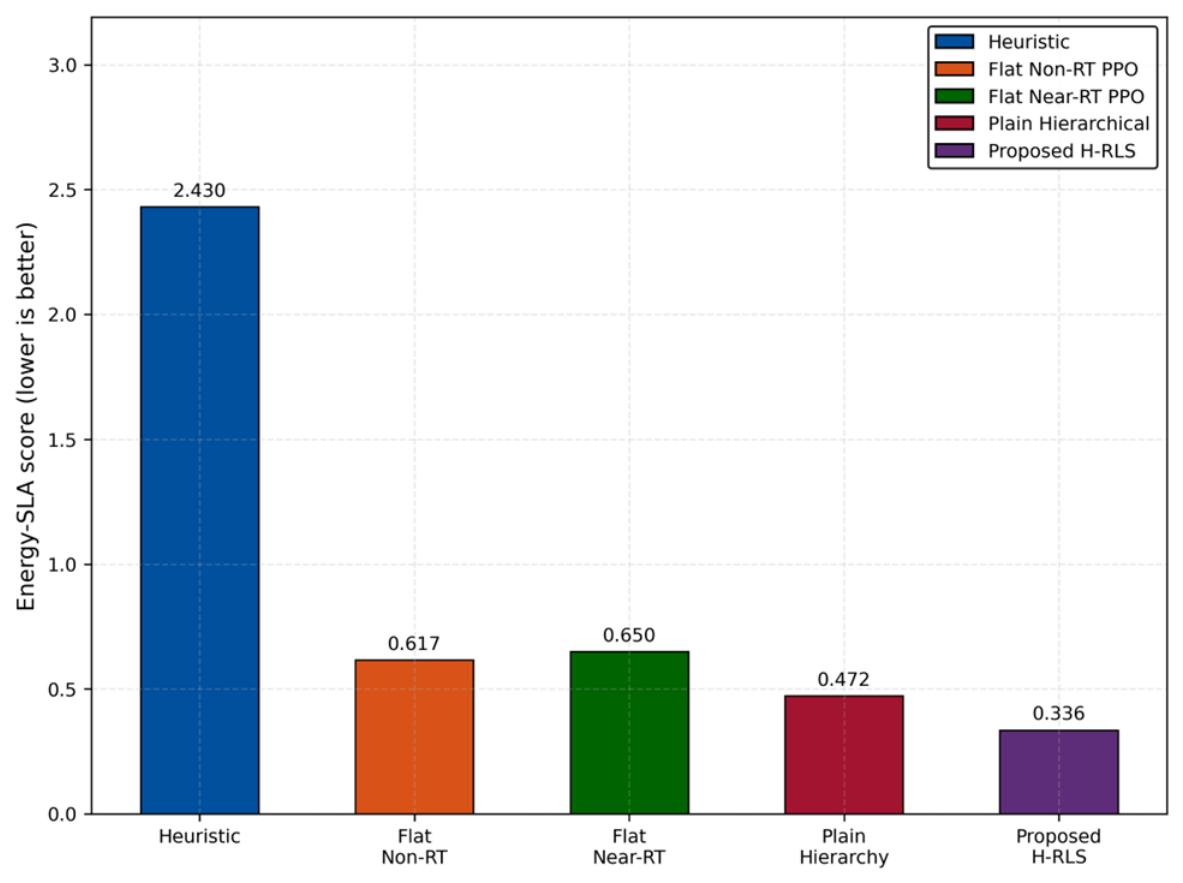
| Proposed H-RLS | 0.326 ± 0.027 | 70.16 ± 3.19 | 4.08 ± 0.33 | 1.00 ± 0.00 |
| Plain Hierarchical | 0.510 ± 0.086 | 110.97 ± 0.59 | 4.31 ± 0.37 | 1.00 ± 0.00 |
| Flat Non-RT PPO | 0.562 ± 0.076 | 113.12 ± 2.62 | 3.90 ± 0.71 | 0.97 ± 0.04 |
| Flat Near-RT PPO | 1.129 ± 0.969 | 132.88 ± 27.05 | 4.31 ± 1.21 | 0.97 ± 0.04 |
| Heuristic | 2.430 ± 0.000 | 83.24 ± 0.00 | 5.88 ± 0.00 | 1.00 ± 0.00 |
Disclaimer/Publisher’s Note: The statements, opinions and data contained in all publications are solely those of the individual author(s) and contributor(s) and not of MDPI and/or the editor(s). MDPI and/or the editor(s) disclaim responsibility for any injury to people or property resulting from any ideas, methods, instructions or products referred to in the content. |
© 2026 by the authors. Licensee MDPI, Basel, Switzerland. This article is an open access article distributed under the terms and conditions of the Creative Commons Attribution (CC BY) license.
Share and Cite
Riel, S.; Ros, S.; Iv, T.; Song, I.; Kang, S.; Kim, S. A Multi-Timescale Control Framework for Energy and SLA-Aware O-RAN Network Slicing. Electronics 2026, 15, 4083. https://doi.org/10.3390/electronics15184083
Riel S, Ros S, Iv T, Song I, Kang S, Kim S. A Multi-Timescale Control Framework for Energy and SLA-Aware O-RAN Network Slicing. Electronics. 2026; 15(18):4083. https://doi.org/10.3390/electronics15184083
Chicago/Turabian StyleRiel, Sovanndoeur, Seyha Ros, Taikuong Iv, Inseok Song, Seungwoo Kang, and Seokhoon Kim. 2026. "A Multi-Timescale Control Framework for Energy and SLA-Aware O-RAN Network Slicing" Electronics 15, no. 18: 4083. https://doi.org/10.3390/electronics15184083
APA StyleRiel, S., Ros, S., Iv, T., Song, I., Kang, S., & Kim, S. (2026). A Multi-Timescale Control Framework for Energy and SLA-Aware O-RAN Network Slicing. Electronics, 15(18), 4083. https://doi.org/10.3390/electronics15184083