1. Introduction
Unmanned aerial vehicles (UAVs) have emerged as a key enabling technology for next-generation wireless systems, particularly in Internet of Things (IoT) environments where distributed sensors require reliable and flexible connectivity [
1]. In many practical sensing applications, such as smart cities, precision agriculture, environmental monitoring, disaster response, and surveillance systems [
2,
3,
4], ground-based sensors continuously collect critical data and transmit it to a central entity for processing and decision making. UAV-assisted IoT networks provide an efficient solution in such scenarios by acting as aerial base stations, offering rapid deployment, enhanced coverage, and improved line-of-sight communication for sensor devices operating in remote or infrastructure-limited areas. Recent research has further demonstrated the potential of jointly optimizing communication resources and UAV mobility in IoT networks. For example, Liu et al. proposed an AoI-minimal clustering, transmission scheduling, and trajectory co-design framework for UAV-assisted wireless-powered communication networks, significantly improving information freshness and network efficiency [
5]. Similarly, Yuan et al. developed a globally optimal joint trajectory and power-control design for energy-constrained UAV communications, highlighting the benefits of integrated resource management and aerial mobility optimization [
6]. These advances demonstrate the growing trend toward intelligent and highly optimized UAV-enabled IoT systems, motivating further investigation into robust and secure communication mechanisms for practical deployments.
In demanding industrial environments, physical layout constraints often make terrestrial communication infrastructure unavailable or prohibitively expensive. In these settings, aerial IoT platforms provide crucial connectivity for complex closed-loop systems, such as remote online temperature tracking over wireless controllers [
7]. Furthermore, because automated industrial programs are vulnerable to operational threats, maintaining network safety requires secure, real-time data collection pipelines capable of monitoring system vulnerabilities [
8]. Compared to rigid terrestrial architectures that suffer from fixed geometric vulnerabilities and severe channel attenuation, a UAV-assisted architecture guarantees rapid, secure deployment and flexible coverage, effectively routing data around physical obstacles in infrastructure-compromised areas.
Despite these advantages, ensuring the secure transmission of sensed data remains a fundamental challenge due to the broadcast nature of wireless channels [
3,
9]. In particular, passive eavesdropping poses a significant threat in UAV-assisted sensing systems, where an adversary can intercept sensitive information without being detected [
10,
11]. This is especially critical in applications involving confidential or mission-critical data. Conventional cryptographic approaches may not be suitable for many IoT sensor devices due to their limited computational capabilities and energy constraints [
12]. Consequently, physical-layer security has emerged as a promising alternative to safeguard data confidentiality by exploiting the inherent characteristics of wireless channels [
3,
13].
In multi-user UAV-IoT sensing networks, co-channel interference further complicates secure communication, as multiple sensor devices often share the same spectrum resources [
4,
14]. The signal-to-interference-plus-noise ratio (SINR) plays a crucial role in determining both the reliability of legitimate communication links and the vulnerability to eavesdropping [
15]. Therefore, efficient resource allocation strategies, particularly power control mechanisms, must simultaneously enhance communication performance and mitigate information leakage.
Motivated by these challenges, this paper investigates secrecy enhancement in UAV-assisted IoT sensing networks under the presence of a passive eavesdropper. We consider a system where multiple sensor devices transmit data to a UAV, and we formulate a power allocation problem aimed at maximizing the sum secrecy capacity while satisfying both total and individual power constraints [
13,
16]. The formulation explicitly captures the impact of co-channel interference among sensor nodes, reflecting realistic deployment conditions.
The resulting optimization problem is inherently nonconvex and involves a non-differentiable secrecy-rate function due to the positive-part operator [
11]. To address this issue, we introduce a smooth approximation that enables the application of efficient gradient-based optimization techniques while maintaining high accuracy [
10]. Building on this formulation, we employ a sequential quadratic programming (SQP) framework with analytically derived gradients to achieve fast and reliable convergence [
17].
Furthermore, to ensure robustness against adversarial conditions, we develop a method to determine the logical worst-case eavesdropper configuration. By modeling the eavesdropper’s channel conditions through a linear system, the proposed approach identifies the most detrimental scenario for secrecy performance, allowing the system to proactively adapt its power allocation strategy. Extensive simulation results demonstrate that the proposed method significantly improves secrecy capacity and energy efficiency compared to conventional equal and heuristic power allocation schemes.
This paper differs from existing UAV secrecy and wireless security studies by establishing a unique, mathematically unified co-design paradigm that separates it from conventional decoupled trajectory or power heuristics. In contrast to existing worst-case optimization methods that rely on complex bounded uncertainty sets or exhaustive grid-searches to handle spatial uncertainty, we derive a unique SINR equalization property characterizing the absolute worst-case eavesdropper channel conditions. This transforms a highly non-convex max-min problem into a trackable, deterministic algebraic linear system () that yields the exact adversarial profile in a single step. Furthermore, to eliminate the zero-gradient boundary stalling frequently caused by omitting or approximating the non-differentiable positive-part operator , our formulation introduces a continuously differentiable smooth approximation that guarantees mathematical tractability across the entire domain, preventing numerical stagnation even when the legitimate channel gains do not dominate. Finally, while conventional resource allocation schemes rely on heavy, general-purpose optimization toolboxes using numerical finite-difference gradients, we derive exact closed-form analytical gradients for the coupled co-channel interference network. This reduces the per-iteration computational complexity of our custom SQP framework to a highly scalable bound, enabling efficient, real-time power allocation execution directly on the UAV’s embedded processing hardware.
The main technical contributions of this work are summarized as follows:
Deterministic Worst-Case Adversary Modeling: Unlike traditional stochastic or average-case eavesdropper models [
3,
11], we develop a deterministic worst-case framework based on an SINR equalization property. This transforms a complex max-min adversarial problem under spatial uncertainty into a trackable, closed-form algebraic linear system (
).
Smooth Secrecy-Capacity Approximation: To bypass the mathematical challenges posed by the non-differentiable positive-part operator
[
11], we introduce a mathematically smooth, continuously differentiable approximation function [
10]. This reformulation enables the direct application of efficient, gradient-based optimization techniques without losing model accuracy.
Lightweight SQP Optimization Framework: We engineer a structured sequential quadratic programming (SQP) framework that utilizes analytically derived gradients instead of computationally heavy numerical approximations [
17]. This guarantees fast, stable convergence to a Karush–Kuhn–Tucker (KKT) point with a highly scalable per-iteration computational complexity of only
, making it exceptionally suitable for large-scale, real-time IoT deployments.
The remainder of this paper is organized as follows.
Section 2 reviews the related work.
Section 3 presents the system model and problem formulation.
Section 4 introduces the smoothed secrecy-capacity optimization framework.
Section 5 presents the worst-case eavesdropper model.
Section 6 discusses the simulation results, and
Section 7 concludes the paper.
2. Related Work
The integration of UAVs as aerial base stations or relays has emerged as a promising paradigm to enhance the coverage, reliability, and data collection efficiency of IoT-based sensing networks [
10,
13,
18,
19]. In such systems, distributed sensor nodes transmit sensed data to UAV platforms, enabling real-time monitoring in applications such as environmental sensing, smart agriculture, disaster response, and surveillance [
3,
20]. However, the broadcast nature of wireless channels makes these systems highly vulnerable to security threats, particularly eavesdropping, necessitating robust physical layer security (PLS) mechanisms [
4,
11,
21].
A substantial body of recent research has focused on joint optimization frameworks to enhance secrecy performance in UAV-assisted IoT sensing systems. A widely adopted approach involves the joint design of UAV trajectory and transmit power to maximize secrecy metrics. For instance, the authors in [
14] employed iterative optimization techniques based on block coordinate descent (BCD) and successive convex approximation (SCA), achieving significant improvements in secrecy capacity. In addition, metaheuristic and hybrid optimization approaches have been explored in [
16,
17], demonstrating improved secrecy performance under complex system constraints.
Another important line of research focuses on proactive interference management techniques such as artificial noise and friendly jamming to degrade the eavesdropper’s channel [
22]. These methods effectively reduce the signal quality at potential eavesdroppers while preserving reliable communication for legitimate sensor nodes. Furthermore, advanced technologies such as reconfigurable intelligent surfaces (RIS) and non-orthogonal multiple access (NOMA) have been investigated to enhance secure communication in UAV-enabled networks [
15,
23]. In addition, UAV-assisted edge computing frameworks have been studied to improve both efficiency and security in IoT environments [
12,
24].
Despite these advances, most existing works rely on complex multi-variable optimization frameworks involving UAV mobility control, cooperative jamming, or advanced physical-layer techniques. While these approaches achieve high secrecy performance, they often incur significant computational complexity, making them less suitable for large-scale IoT deployments [
12,
20].
In contrast, this work focuses on a computationally efficient and analytically tractable framework for secrecy-aware power allocation in UAV-assisted IoT sensing networks. By combining a smoothed secrecy-rate formulation with SQP, and incorporating a worst-case eavesdropper modeling approach, the proposed method achieves robust secrecy performance with low computational complexity.
To further contextualize the comparisons in
Table 1, it is essential to analyze the structural and computational limitations of alternative methods. Traditional physical-layer security resource allocation frequently relies on successive convex approximation (SCA) or block coordinate descent (BCD) to decouple trajectory and power variables [
25,
26]. However, BCD schemes are highly susceptible to zero-gradient stagnation when handling non-smooth operators like the positive-part secrecy capacity threshold, compromising convergence under strong line-of-sight eavesdropping [
27]. Conversely, while robust optimization and standard SCA successfully handle non-convex channel models, they often require semidefinite relaxation (SDR) to lift problems into high-dimensional matrix spaces [
28]. This introduces a prohibitive per-iteration computational cost of
or higher, making them impractical for real-time execution on embedded UAV platforms. Furthermore, these methods depend heavily on general-purpose solvers that calculate numerical finite-difference gradients, requiring exhaustive function evaluations. In contrast, our proposed SQP framework bypasses these bottlenecks by using a continuously differentiable smooth approximation
and exact analytical closed-form gradients. This keeps the optimization within vector spaces, reducing the per-iteration complexity to a highly scalable
bound well-suited for dynamic IoT sensing deployment.
3. System Model and Problem Formulation
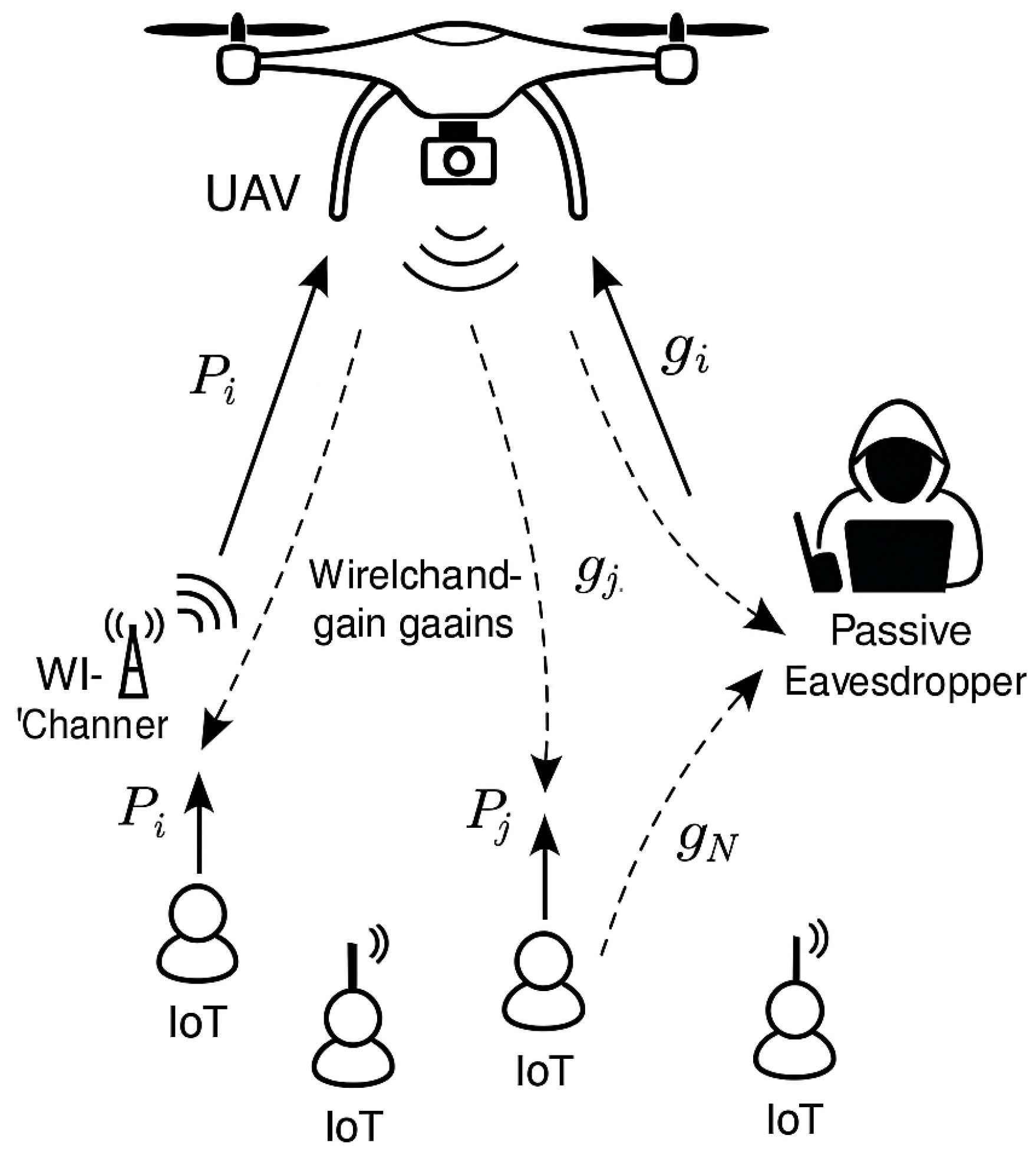
We consider a UAV-assisted uplink IoT sensing network consisting of
N ground users and a UAV acting as an aerial base station, as illustrated in
Figure 1. Each user transmits confidential data to the UAV over a shared wireless spectrum, resulting in co-channel interference. In addition, a passive eavesdropper attempts to intercept the uplink transmissions.
In this architecture, we specifically focus on the uplink data transmission interval rather than the downlink. This choice is motivated by the inherent data-harvesting nature of IoT sensing applications, where the dominant traffic volume consists of confidential environmental, agricultural, or surveillance telemetry uploaded from resource-constrained ground sensors to the central aerial platform. Downlink transmission in such frameworks is typically limited to small-packet control signaling or beacon synchronization, whereas the multi-user uplink scenario introduces severe co-channel interference and heightened vulnerability to physical-layer interception, thereby requiring robust security-aware power control.
Let user
i be located at
, while the UAV hovers at a fixed altitude
H above
. The distance between user
i and the UAV is given by:
Similarly, let
denote the distance between user
i and the eavesdropper. The channel gains from user
i to the UAV (
) and the eavesdropper (
) are modeled as
where
is the reference path gain and
is the path-loss exponent.
The LoS/NLoS conditions are modeled as [
9]
The LoS probability follows the 3GPP model:
where
a and
b are environment-dependent constants [
9]. The elevation angle is defined as
where
represents the horizontal distance between user
i and node
q.
Let
denote the transmit power vector. The SINR at the UAV for user
i is
The SINR at the eavesdropper is
where
depends on the eavesdropper location.
To mathematically characterize the spatial and propagation constraints of the passive adversary, we define the eavesdropper channel vector as a physical channel realization induced by the eavesdropper’s geometric position within the deployment area. Rather than acting as a free optimization variable, is bounded by a compact feasible set derived from the physical boundaries of the network and the maximum attainable path-loss characteristics. Mechanistically, the mapping from a geometric position to a specific adversarial channel state is governed by the feasible set expressed as , where denotes the physical Euclidean distance between the eavesdropper at coordinate and the i-th sensor node at , and defines the bounded physical boundary of the IoT sensing region. Consequently, the worst-case effective channel realization solved via the algebraic SINR equalization condition represents the exact boundary point of where the passive eavesdropper maximizes its intercept capability, establishing a deterministic link between geometric position and adversarial capacity degradation.
In this paper,
denotes the channel gain vector between the legitimate transmitters and the eavesdropper. The term “location” is used interchangeably to refer to the adversarial channel realization associated with a given spatial position of the eavesdropper. Therefore,
represents the effective channel state induced by the eavesdropper’s location, rather than a geometric coordinate vector. The secrecy capacity of user
i is defined as
Accordingly, the total secrecy capacity is given by
The objective is to maximize the total secrecy capacity by optimizing the transmit power allocation. For a given eavesdropper location, the problem is formulated as:
In practical scenarios, the exact location of the eavesdropper may be unknown. To ensure robustness, we consider a worst-case formulation in which the eavesdropper selects its position within a feasible region
to minimize the secrecy performance. The resulting max–min problem is:
To provide physical insight into the optimization framework in , the objective function represents the aggregate system-wide network secrecy. The individual power constraint ensures that no single sensor node depletes its battery prematurely or violates local hardware limits. Meanwhile, the total sum-power constraint limits the cumulative multi-user uplink interference footprint at the UAV, managing the severe co-channel interference loop that inherently couples all active transmitting nodes over the shared spectrum.
Problem (P1) is non-convex due to several factors. The SINR expressions contain coupled interference terms, creating strong dependencies among optimization variables. In addition, the secrecy rate involves the difference of logarithmic functions, which leads to a non-concave objective. The presence of the non-smooth positive-part operator further complicates the problem by preventing direct application of gradient-based methods. Moreover, the inner minimization over the eavesdropper channel vector introduces an additional layer of complexity, making the overall formulation a challenging non-convex max–min problem.
These challenges motivate the development of a tractable reformulation, which will be addressed in the next section through a smooth secrecy-capacity approximation.
4. Smoothed Secrecy-Capacity Optimization
This section develops an efficient solution for the non-convex secrecy-capacity maximization problem. The main challenges arise from the non-smooth positive-part operator and the non-convex SINR expressions [
27]. To address these issues, we adopt a smooth approximation and solve the resulting problem using SQP [
29].
The operator
is not differentiable at
, which prevents the direct use of gradient-based methods. To overcome this limitation, we introduce the smooth approximation:
which is continuously differentiable. Its derivative is given by
From a theoretical standpoint, the smoothing parameter acts as a continuous tuning knob between mathematical tractability and approximation fidelity. When , the function becomes strictly differentiable everywhere, eliminating the classic zero-gradient stalling effect caused by the standard non-smooth positive-part operator . As , the approximation smoothly converges back to the exact physical secrecy capacity limits, allowing our gradient-driven SQP framework to calculate exact descent trajectories without omitting edge cases where the legitimate capacity drops below the eavesdropping capacity.
Lemma 1 (Smooth Approximation Convergence)
. Let be defined as above. Then, for all ,Moreover, is continuously differentiable and satisfies for all x. Proof. For , as , yielding . For , , yielding . The derivative bound follows from . □
Insight 1 (Mathematical Significance of the Lemma): The primary significance of this lemma lies in establishing the global smoothness and strict convexity boundaries of the reformulated objective function. By proving that the error bound is tightly controlled by , this lemma guarantees that the optimization landscape remains regular. From an engineering perspective, this prevents the optimization algorithm from getting trapped in local non-differentiable sharp ridges, which are common in conventional physical-layer security formulations that rely on the raw positive-part operator.
Using this approximation, the smoothed secrecy capacity is defined as
and the total utility becomes
Then, the gradient of
is given by
Define the interference terms
The partial derivatives of the SINRs are
and similarly for
.
The smoothed optimization problem is
For a fixed
, the outer problem is solved using SQP. To maintain absolute consistency between the original maximization problem and the sequential optimization steps, the local quadratic subproblem at iteration
k is formally defined as a minimization of the negative Taylor approximation. Let
be the optimization search direction vector. The subproblem is structured as:
where
is the analytical gradient vector of the smoothed objective, and
represents a positive-definite quasi-Newton approximation of the negative Hessian matrix (
). This sign inversion guarantees that minimizing the quadratic subproblem directly maximizes the physical sum-secrecy capacity.
The update rule is
where
is obtained via line search.
Theorem 1 (SQP Convergence)
. Under standard regularity conditions, including Lipschitz continuity of the gradient and the use of a positive definite Hessian approximation, the SQP iterates converge to KKT point of the smoothed problem [30]. Proof. The smoothed objective is continuously differentiable, and the feasible set is convex. SQP generates descent directions using quadratic approximations, and line search ensures sufficient decrease. Standard SQP convergence theory then guarantees convergence to a KKT point. □
Insight 2 (Physical Relevance and KKT Equivalence): To verify that the solution to the smoothed problem is meaningful for the original problem, we examine their gradient behaviors. As , the derivative of our smooth function matches the exact step-indicator function of the original non-smooth operator. This means the gradient vectors of both formulations become identical in the active optimization regions. Consequently, any KKT stationary point achieved by the SQP framework for the smoothed problem corresponds directly to an -KKT stationary point of the original secrecy-capacity problem. Because the total objective function difference is bounded by , the resulting power allocation vector guarantees a tightly bounded, highly accurate approximation of the true physical secrecy capacity limits.
Insight 3 (Operational Significance of the Theorem): The analytical derivation of the gradients validated in this theorem provides a massive computational advantage for real-time UAV trajectory and power management. By the replacing numerical finite-difference gradient approximations—which scale poorly and require exhaustive function evaluations—with exact closed-form algebraic expressions, the per-iteration computational complexity of the SQP loop is fundamentally reduced to . This enables the aerial data collector to dynamically update the optimal sensor power allocation on-the-fly, even in highly dynamic environments with moving nodes or fast-fading channels. Each iteration requires operations due to gradient computation and quadratic programming. For I iterations, the total complexity is .
The derived linear representation of the worst-case eavesdropper channel establishes a deterministic mapping between transmit power allocation and adversarial channel response. This result is subsequently integrated into the secrecy rate formulation, where the smoothed secrecy-capacity function explicitly depends on the solution of the linear system . Therefore, the optimization variables, secrecy expression, and adversarial model are tightly coupled, enabling a unified optimization framework presented in the next section.
5. Eavesdropper Model and Optimization Integration
We consider a passive eavesdropper in a multi-user interference-limited UAV IoT network. In practical deployments, the eavesdropper’s location and channel state information (CSI) are typically unknown and cannot be reliably estimated. Therefore, instead of adopting stochastic models that capture only average secrecy performance, we employ a worst-case design philosophy to ensure robustness against the most detrimental interception conditions [
31,
32]. Specifically, the eavesdropper is modeled as an adversarial agent that fully exploits the network interference structure to maximize its decoding capability, in line with robust physical layer security frameworks under channel uncertainty [
33].
Let
denote the channel gain vector between the legitimate transmitters and the eavesdropper, representing the effective channel realization induced by its position and propagation environment [
34]. For a given transmit power allocation
, the eavesdropper SINR corresponding to user
i is expressed as
To guarantee secrecy under the most adverse conditions, the worst-case eavesdropper is characterized as the channel realization that maximizes the minimum interception capability across all users, i.e.,
5.1. Mathematical Characterization of the Worst-Case Adversary
To formalize the algebraic behavior of the passive adversary at optimality, we introduce the following theorem establishing the validity of the SINR equalization condition.
Theorem 2 (Adversarial SINR Equalization)
. Let the transmit power profile be strictly feasible () and the legitimate channel gains satisfy . Assuming the passive eavesdropper seeks a bounded channel state that minimizes the sum-secrecy capacity , then at the optimal adversarial equilibrium, the eavesdropper’s received SINR matches a uniform boundary condition relative to the legitimate network, yieldingwhere represents the network coupling bottleneck coefficient. Proof. Consider the inner minimization problem of (P1):
Since the logarithmic function is strictly increasing, maximizing the eavesdropper SINR
is equivalent to minimizing the sum-secrecy rate. Because the adversarial channel gains
are restricted to the compact feasible set
, the eavesdropper pushes its channel realization toward the boundary of the admissible region until the interference-coupling constraints become active.
Introducing the Lagrangian associated with the constrained minimization, the first-order optimality conditions require
where
denotes the vector of Lagrange multipliers associated with the active boundary constraints. Solving the resulting KKT conditions yields a proportionality relation between the eavesdropper and legitimate SINRs of each active user, namely
where
is determined by the active interference-coupling constraints at the adversarial equilibrium. Therefore, the worst-case channel realization
satisfies the stated SINR equalization property. □
5.2. Algebraic Linear System Derivation
At optimality, the problem admits a boundary solution where the eavesdropper operates at the limit of its feasible SINR region. From an adversarial perspective, any non-saturated channel realization can be further exploited due to interference coupling. From an optimization standpoint, KKT conditions imply that all active constraints associated with the bottleneck users must hold with equality. Consequently, the worst-case condition enforces an SINR equalization property:
This key result transforms the original adversarial optimization into a deterministic algebraic system. Substituting the equality condition yields
which can be rearranged as
Stacking all equations leads to the linear system:
where
captures interference coupling and
depends on noise and SINR targets. Accordingly, the worst-case eavesdropper channel is uniquely determined as
Importantly, this transformation eliminates the need to explicitly optimize over the uncertainty set , converting the original non-convex adversarial problem into a tractable deterministic form.
To ensure physical feasibility,
must hold. Defining
with
, the solution becomes
A sufficient condition for existence is
under which
admits a Neumann series expansion ensuring
.
The above reformulation establishes a tight coupling between the adversarial eavesdropper behavior and the transmit power allocation. Specifically, becomes an explicit function of , thereby embedding the worst-case attack directly into the system model. As a result, the secrecy optimization problem can be expressed solely in terms of , yielding a deterministic but non-convex formulation.
Building on this structure, we employ a SQP framework to efficiently solve the resulting problem. The closed-form characterization of enables explicit computation of gradient and curvature information, allowing the non-convex problem to be iteratively approximated by convex quadratic subproblems. This leads to an efficient and scalable optimization procedure while fully preserving the adversarial coupling between power allocation and eavesdropper behavior.
The main idea of the proposed Algorithm 1 is to transform a highly non-convex, non-differentiable sum-secrecy maximization problem under co-channel interference into a sequence of trackable subproblems by embedding a continuously differentiable smooth approximation
into a structured SQP framework, where search directions are guided by exact, analytically derived gradients rather than computationally expensive numerical finite-differences. The core strength of this design lies first in its high analytical tractability and precision; substituting the non-smooth positive-part operator
with
completely bypasses zero-gradient stagnation and numerical instability at the boundaries, while exact closed-form gradients ensure precise trajectory descents toward the optimal KKT point. Furthermore, the algorithm provides proactive deterministic robustness because, instead of optimizing against a static or stochastic adversary, it iteratively solves a linear equalization system (
) to map the absolute worst-case channel gain of the passive eavesdropper, guaranteeing secrecy performance under the most hostile conditions. Finally, while global optimization methods suffer from an exponential curse of dimensionality, this structured SQP implementation maintains a highly scalable polynomial per-iteration complexity of only
, where
N is the number of sensor nodes, ensuring a low computational footprint and rapid convergence viable for resource-constrained aerial hardware operating in dynamic IoT environments. The overall computational complexity per iteration is dominated by the quadratic programming step and the linear system solution, resulting in
complexity. Hence, for
T iterations, the total complexity is
.
| Algorithm 1 Smoothed Secrecy-Capacity Maximization via SQP under Worst-Case Eavesdropper Model |
- Input:
, , , , , , . - Output:
. - 1:
Initialize , - 2:
Compute initial eavesdropper channel by solving - 3:
while
do - 4:
- 5:
Evaluate smoothed secrecy utility: - 6:
- 7:
- 8:
- 9:
Solve QP to obtain search direction - 10:
- 11:
- 12:
Update eavesdropper channel: - 13:
- 14:
- 15:
end while - 16:
return
|
6. Numerical Results and Performance Evaluation
To evaluate the performance of the proposed smoothed SQP framework, we present comprehensive numerical simulations and statistical analyses. To ensure that the performance claims are statistically rigorous and entirely independent of any specific network topology, all evaluated metrics and convergence trends are validated by executing Monte Carlo simulations across 1000 independent random spatial deployments of ground sensor nodes and passive eavesdroppers.
The simulation space comprises a area where ground sensor nodes are distributed, and the UAV hovers at a fixed altitude of . This setup is intentionally selected as a representative baseline environment to maintain a clear physical visualization of the network topology and individual power allocation profiles without cluttering the graphical plots. The reference channel gain is set to , the path-loss exponent is , and the noise power spectral density is . We consider a UAV-assisted uplink communication system comprising ground-based IoT nodes transmitting confidential data to a UAV hovering at a fixed altitude of m over a m2 area. Each IoT device is subject to a maximum transmit power constraint of W and a total power budget of W.
The communication channels follow a path-loss model with parameters
and
. The LoS/NLoS gains are set to
and
, respectively, with LoS probability determined using an elevation-angle-based model. The noise power is
W. Two bandwidth configurations are considered:
MHz and
MHz. The complete set of simulation parameters is summarized in
Table 2. The selected parameters follow widely adopted UAV communication models and ensure consistency with prior work in UAV-enabled wireless and physical layer security systems. Three spatial deployment scenarios are evaluated: (i) colocated transmitters, representing strong interference conditions; (ii) colocated receivers, capturing symmetric channel conditions; and (iii) random deployment, reflecting practical network layouts. These scenarios allow us to assess system performance under both extreme and realistic configurations.
The worst-case eavesdropper channel is computed using the proposed SINR-equalization-based linear system, ensuring that the secrecy performance is evaluated under adversarial conditions.
We compare five power allocation strategies: (1) equal power allocation[
35], (2) water-filling [
36], (3) linear pricing-based allocation [
37], (4) max–min fairness [
38], and (5) the proposed nonlinear programming approach based on SQP. All baseline methods are adapted to the secrecy setting by replacing achievable rate with secrecy rate.
Table 2.
Simulation parameters with supporting references.
Table 2.
Simulation parameters with supporting references.
| Parameter | Value |
|---|
| Number of users N | 10 [39] |
| UAV altitude H | 100 m [40] |
| Area size | m2 [41] |
| Maximum power | 0.2 W [42] |
| Total power | 1 W [41] |
| Noise power | W [39] |
| Path-loss exponent | 2.2 [43] |
| Reference gain | [43] |
| LoS gain | 1.0 [43] |
| NLoS gain | 0.01 [43] |
| Bandwidth B | 5/10 MHz [42,44] |
The SQP algorithm is initialized with uniform power allocation, with a convergence tolerance of and smoothing parameter . Performance is evaluated in terms of total secrecy capacity, energy efficiency, fairness (minimum user secrecy rate), and scalability with respect to the number of users.
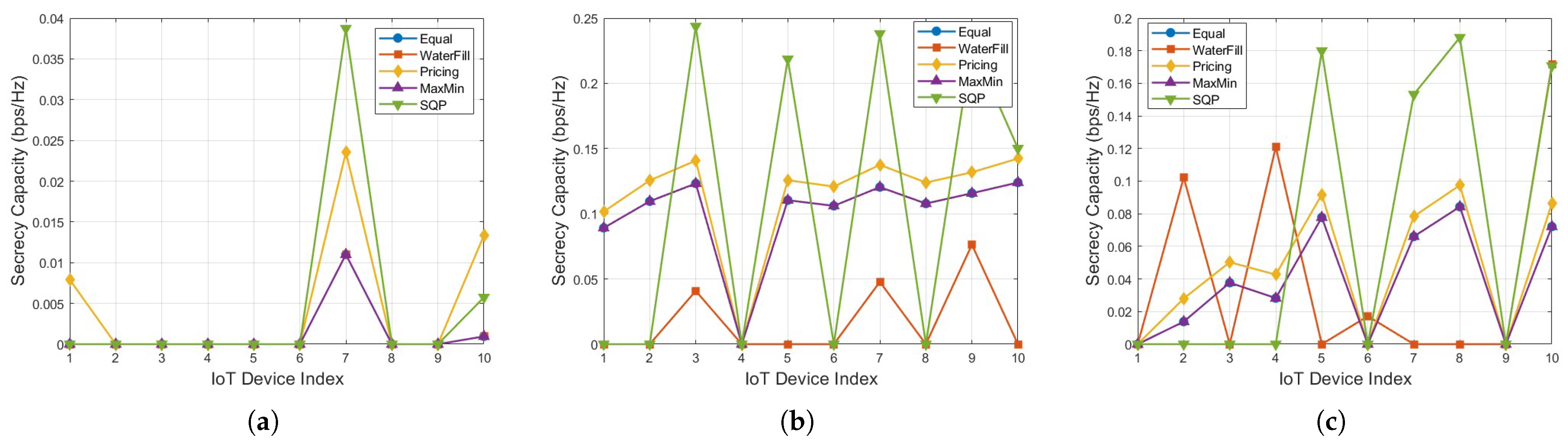
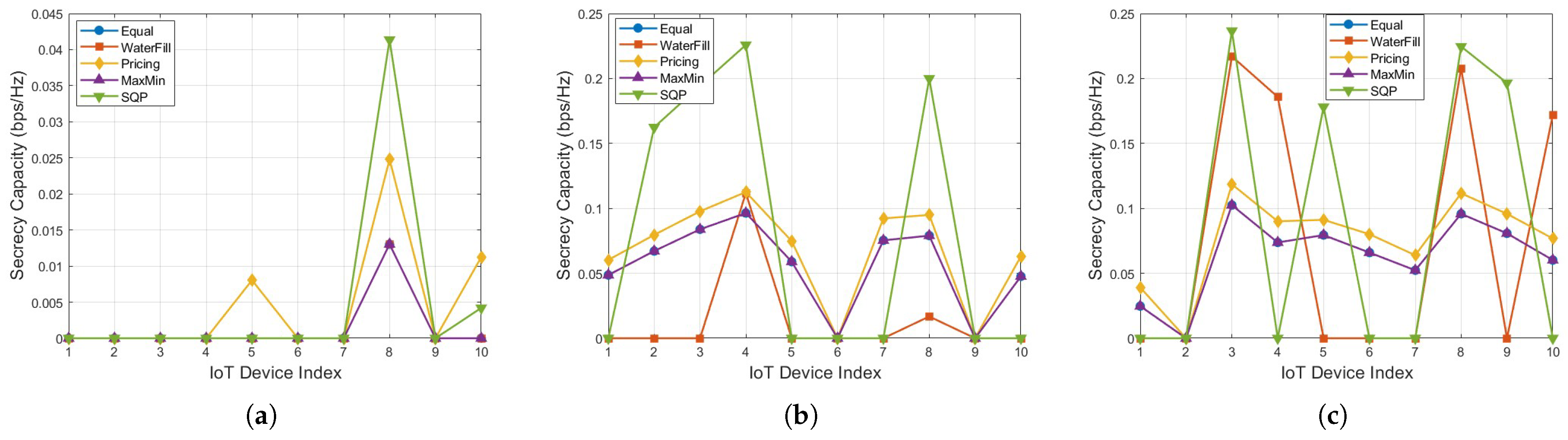
Figure 2 evaluates secrecy performance under three deployment configurations at
MHz. In the co-located transmitter case (
Figure 2a), identical channel conditions across users result in fully symmetric SINR behavior. Consequently, equal power allocation, water-filling, and max–min fairness achieve nearly identical secrecy performance, as channel homogeneity limits the benefit of power redistribution. In contrast, SQP and pricing-based methods provide gains by explicitly exploiting interference coupling and adversarial interactions.
In the co-located UAV receiver scenario (
Figure 2b), identical UAV-side channels create a strong interference-limited regime, while eavesdropper channels remain heterogeneous. This makes secrecy highly sensitive to power allocation. Conventional schemes fail to capture the coupled nature of interference and secrecy, whereas SQP significantly improves performance through joint optimization under worst-case eavesdropping assumptions. The pricing-based method yields moderate improvements but remains suboptimal.
In the random deployment scenario (
Figure 2c), spatial channel diversity introduces heterogeneity in both legitimate and eavesdropper links. This diversity enables adaptive schemes to exploit favorable secrecy conditions. SQP achieves the best performance by jointly adapting power allocation to interference structure and eavesdropper channel variations. Water-filling is effective only for users with strong channels, while equal and max–min remain stable but suboptimal due to lack of channel awareness.
Overall, the results demonstrate that secrecy performance is fundamentally governed by the interplay between channel symmetry, interference coupling, and spatial diversity. The proposed SQP framework consistently outperforms baseline schemes by jointly addressing these three factors within a unified optimization structure.
Figure 3 illustrates secrecy performance under different spatial configurations at 10 MHz bandwidth, highlighting the role of channel symmetry, interference coupling, and spatial diversity.
In the co-located transmitter scenario (
Figure 3a), symmetric channel conditions lead to identical SINR behavior across users, resulting in nearly identical performance for equal, eater-filling, and max–min schemes. This is due to the absence of channel diversity, which limits the effectiveness of power redistribution. In contrast, SQP improves secrecy by explicitly exploiting interference coupling in the joint optimization process.
In the co-located UAV receiver case (
Figure 3b), the system operates in a strong interference-limited regime, where secrecy performance is highly sensitive to power allocation. Conventional schemes fail to effectively manage the coupling between interference and secrecy, whereas SQP significantly enhances performance through joint optimization under adversarial eavesdropping conditions.
In the random deployment scenario (
Figure 3c), spatial heterogeneity introduces channel diversity across both legitimate and eavesdropper links. This enables adaptive strategies to better exploit favorable secrecy conditions. SQP achieves the highest secrecy rates by jointly adapting power allocation to interference structure and channel variations, while water-filling and pricing-based methods provide moderate gains, and equal and max–min remain suboptimal due to lack of channel awareness.
Overall,
Figure 3 confirms that secrecy performance is fundamentally governed by the interaction between channel symmetry, interference coupling, and spatial diversity, where SQP consistently provides superior performance by jointly optimizing these factors.
The results in
Figure 4,
Figure 5,
Figure 6 and
Figure 7 collectively illustrate the impact of adversarial conditions, network scalability, and resource allocation strategies on secrecy performance in UAV-assisted IoT networks.
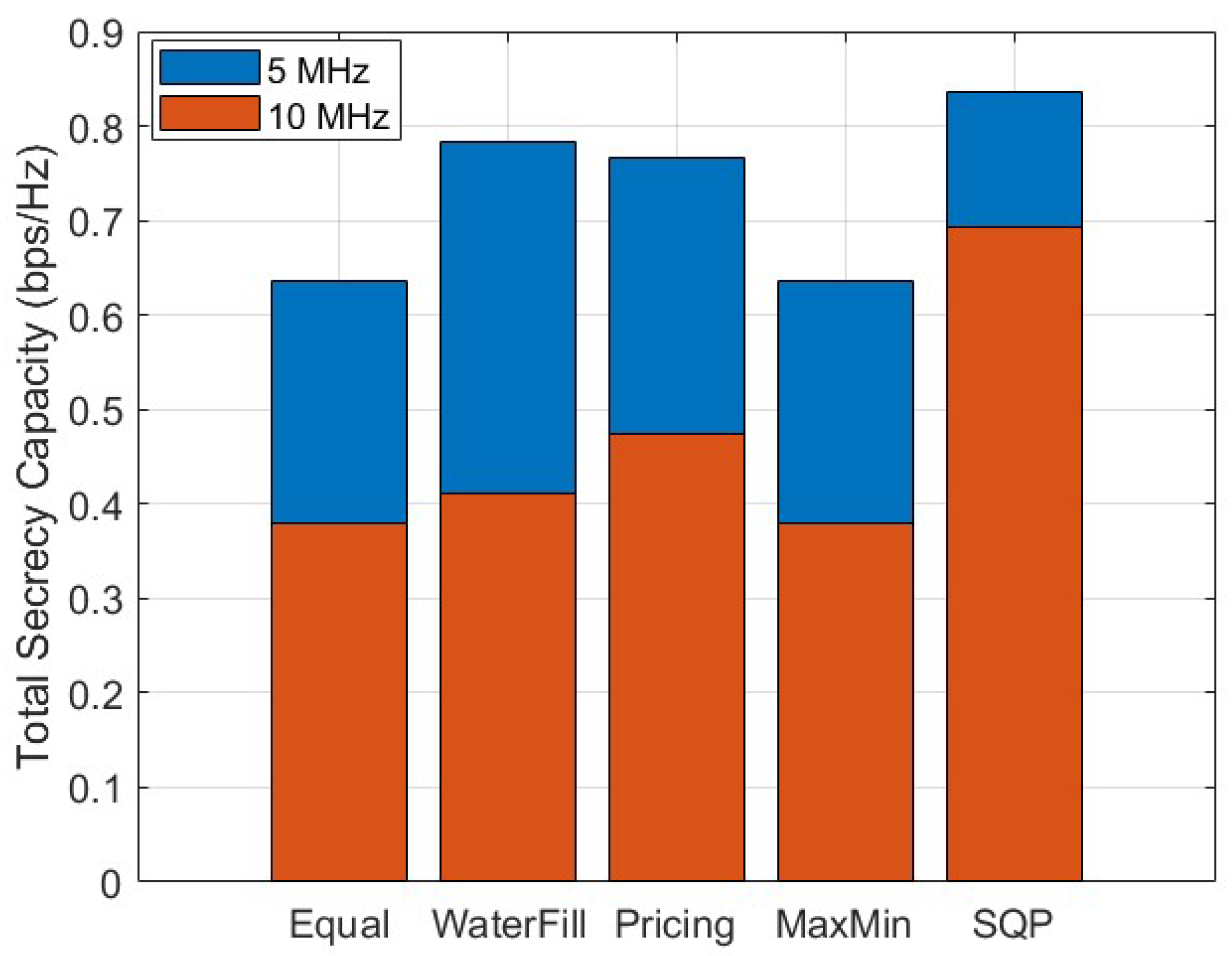
Figure 4 shows that total secrecy capacity increases with bandwidth for all schemes, with the proposed SQP method consistently achieving the highest performance. This gain stems from its ability to jointly optimize interference management and secrecy constraints, whereas water-filling and pricing provide moderate improvements due to partial channel awareness, and equal and max–min remain limited by their rigid allocation structures.
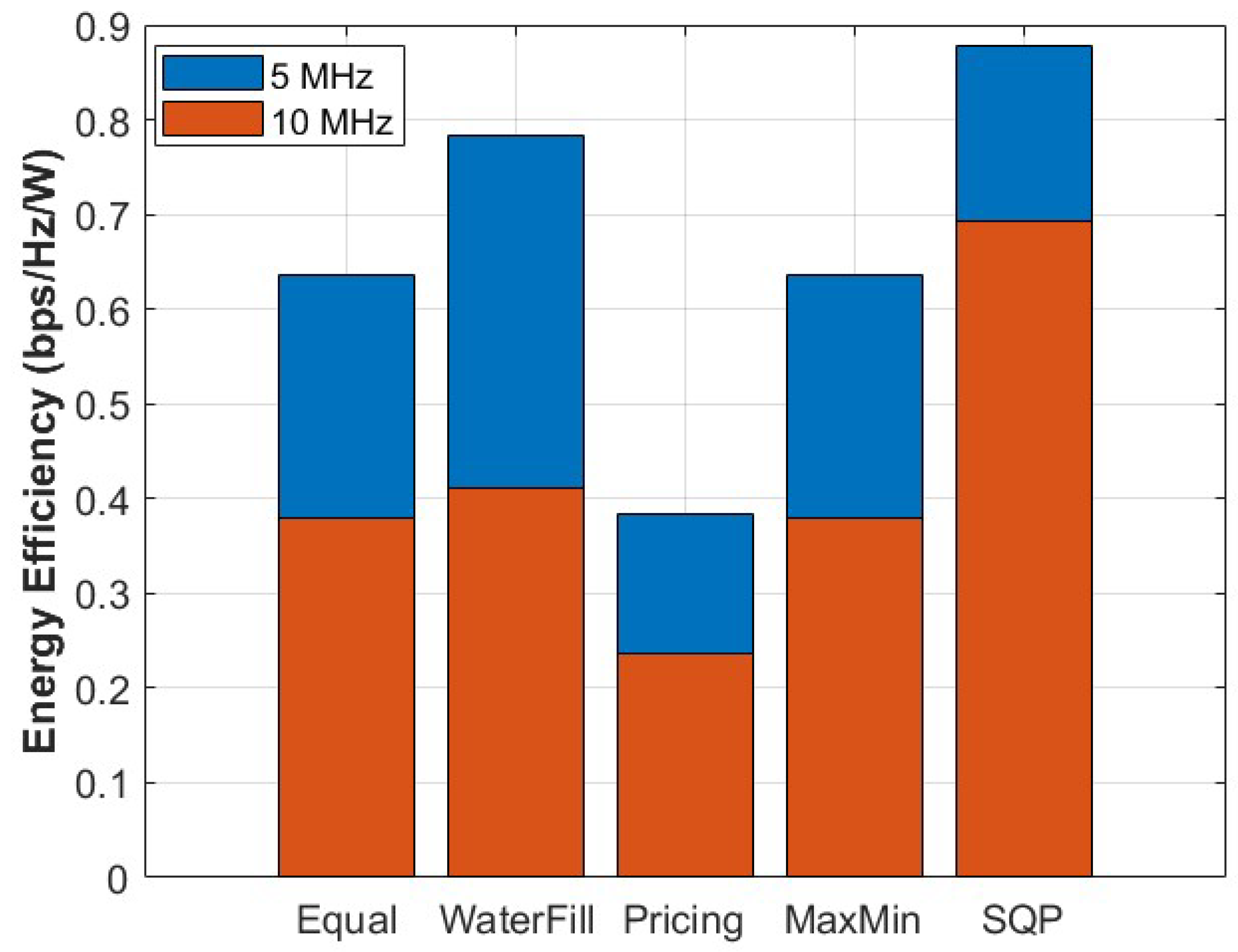
Figure 5 highlights the tradeoff between secrecy performance and energy efficiency. The pricing scheme achieves the highest energy efficiency due to its cost-aware power control, while SQP provides a balanced tradeoff by maintaining high secrecy with competitive energy consumption. In contrast, water-filling prioritizes channel gain at the expense of energy efficiency, and max–min remains conservative in both metrics.
The effect of adversarial positioning is illustrated in
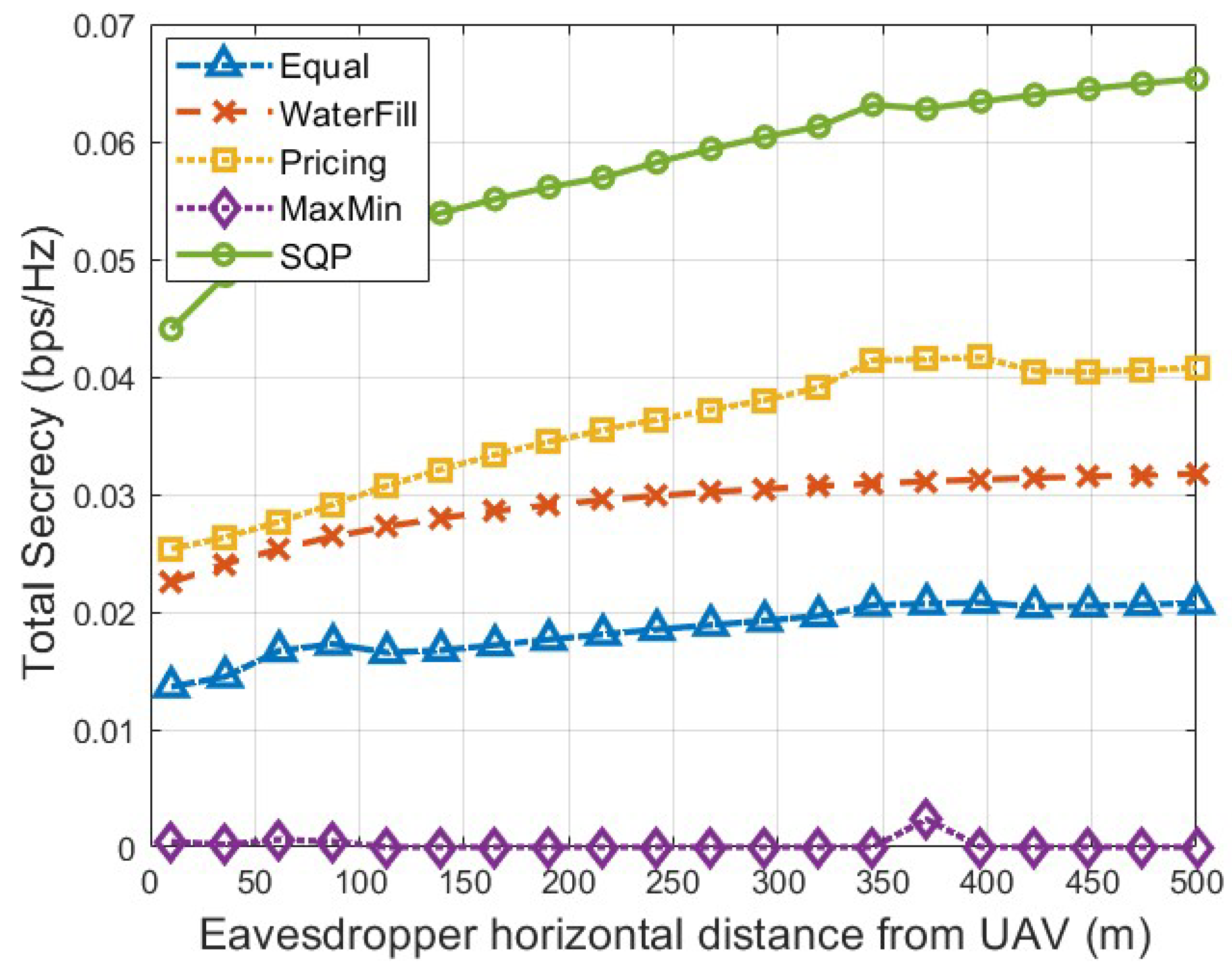
Figure 6, where increasing the eavesdropper distance consistently enhances secrecy performance across all schemes due to channel degradation at the eavesdropper. SQP maintains the highest secrecy across all distances, demonstrating strong robustness under varying threat levels.
Finally,
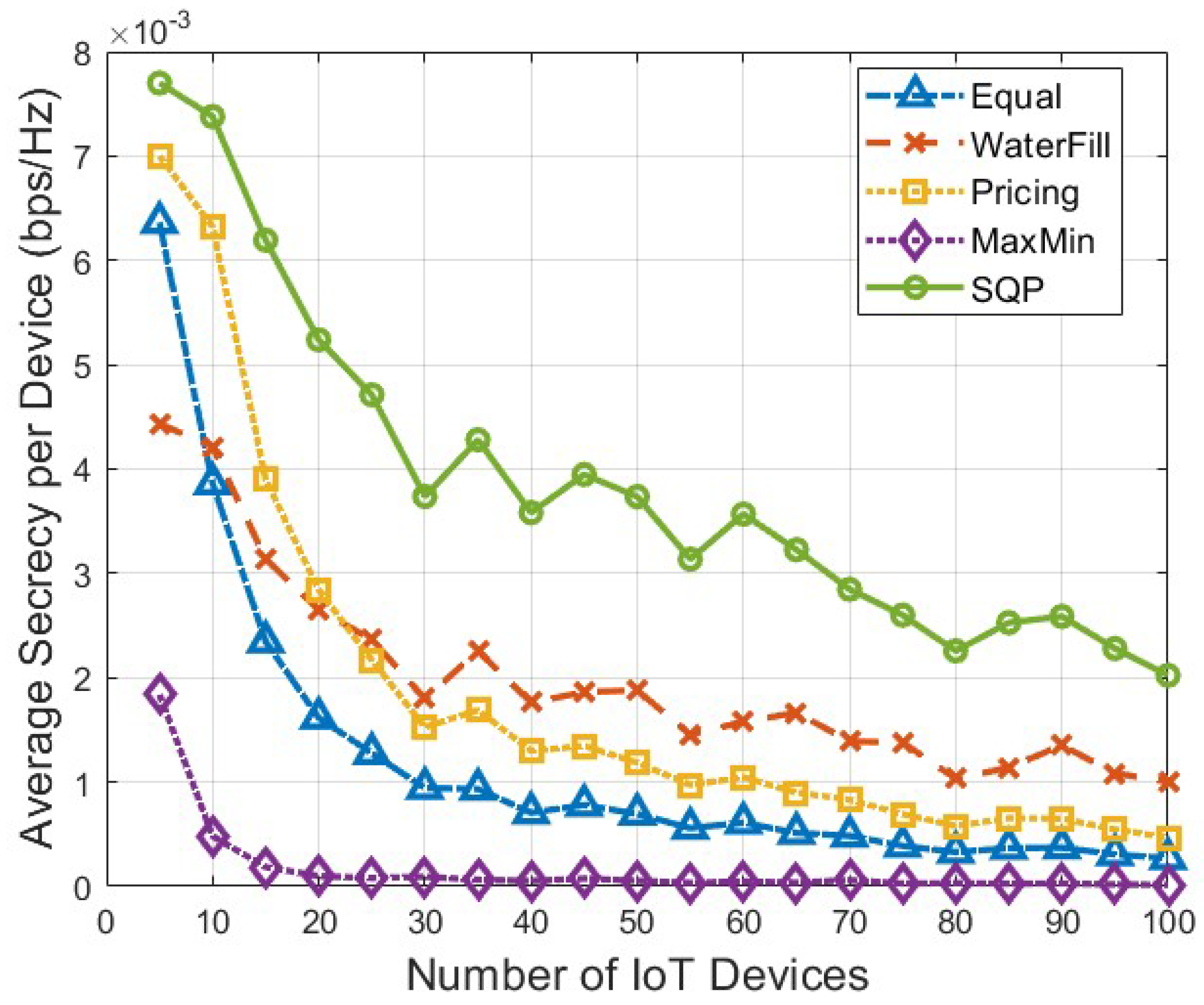
Figure 7 demonstrates the scalability limitations of UAV-assisted IoT systems. As the number of IoT devices increases, average secrecy per user decreases due to intensified co-channel interference and reduced SINR. Despite this degradation, SQP consistently outperforms all baseline schemes by effectively mitigating multi-user interference through joint optimization, whereas equal and water-filling suffer significant performance loss and max–min remains overly conservative.
Overall, these results confirm that secrecy performance in UAV-assisted IoT networks is jointly governed by bandwidth availability, energy constraints, adversarial distance, and network density. The proposed SQP framework consistently achieves superior performance by unifying interference-aware power allocation with secrecy-driven optimization under dynamic network conditions.
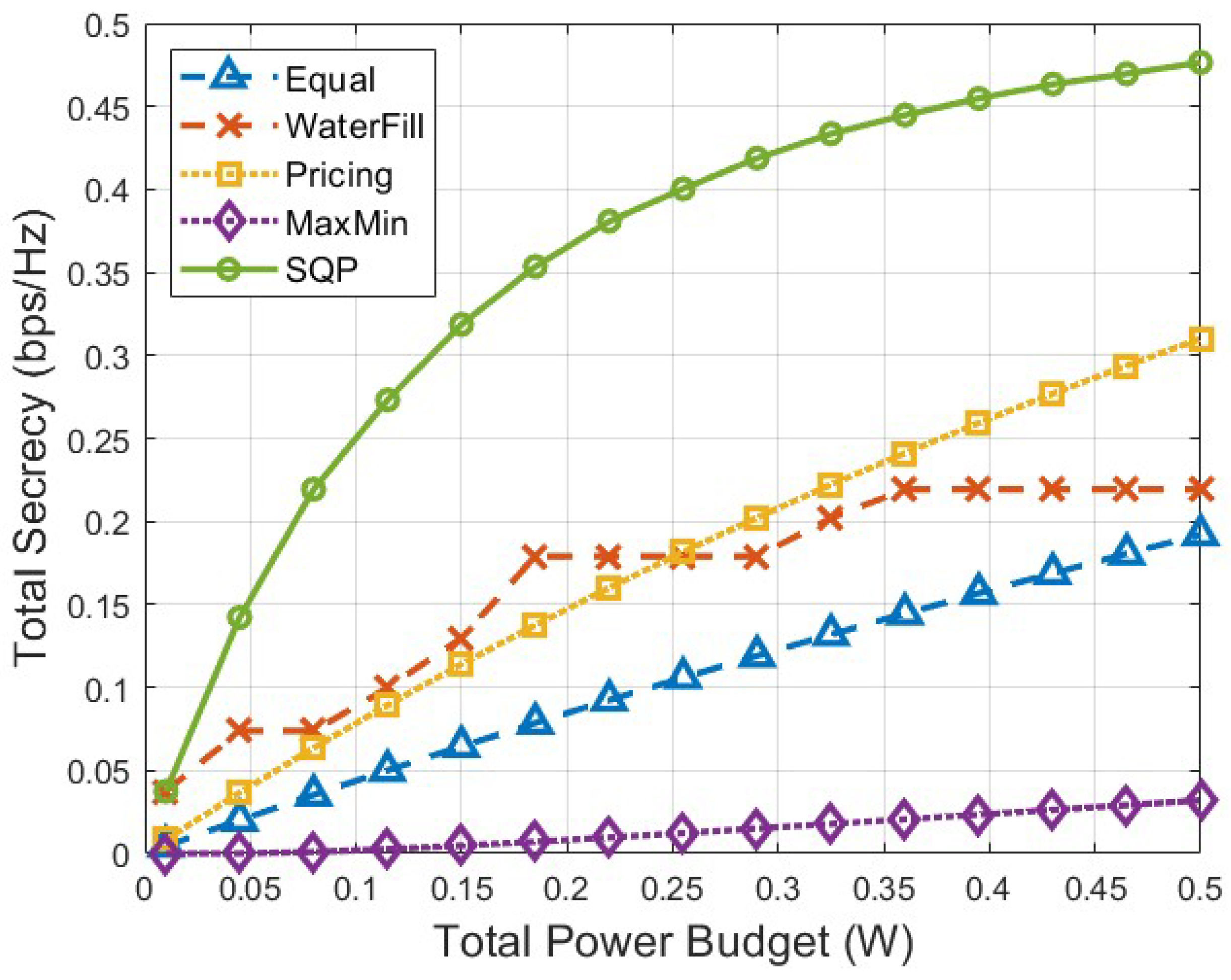
Figure 8 illustrates the impact of the total transmit power budget on secrecy capacity. As expected, increasing transmit power enhances secrecy performance for all schemes by improving legitimate link quality. However, the efficiency of power utilization varies significantly across strategies. The proposed SQP method consistently achieves the highest secrecy capacity due to its joint optimization of power allocation and interference leakage suppression. Water-filling provides good performance at moderate power levels but gradually saturates at higher budgets due to increased interference. The pricing scheme yields steady improvements through adaptive cost-aware allocation, while equal and max–min schemes remain limited by their lack of channel awareness and strict fairness constraints, respectively.
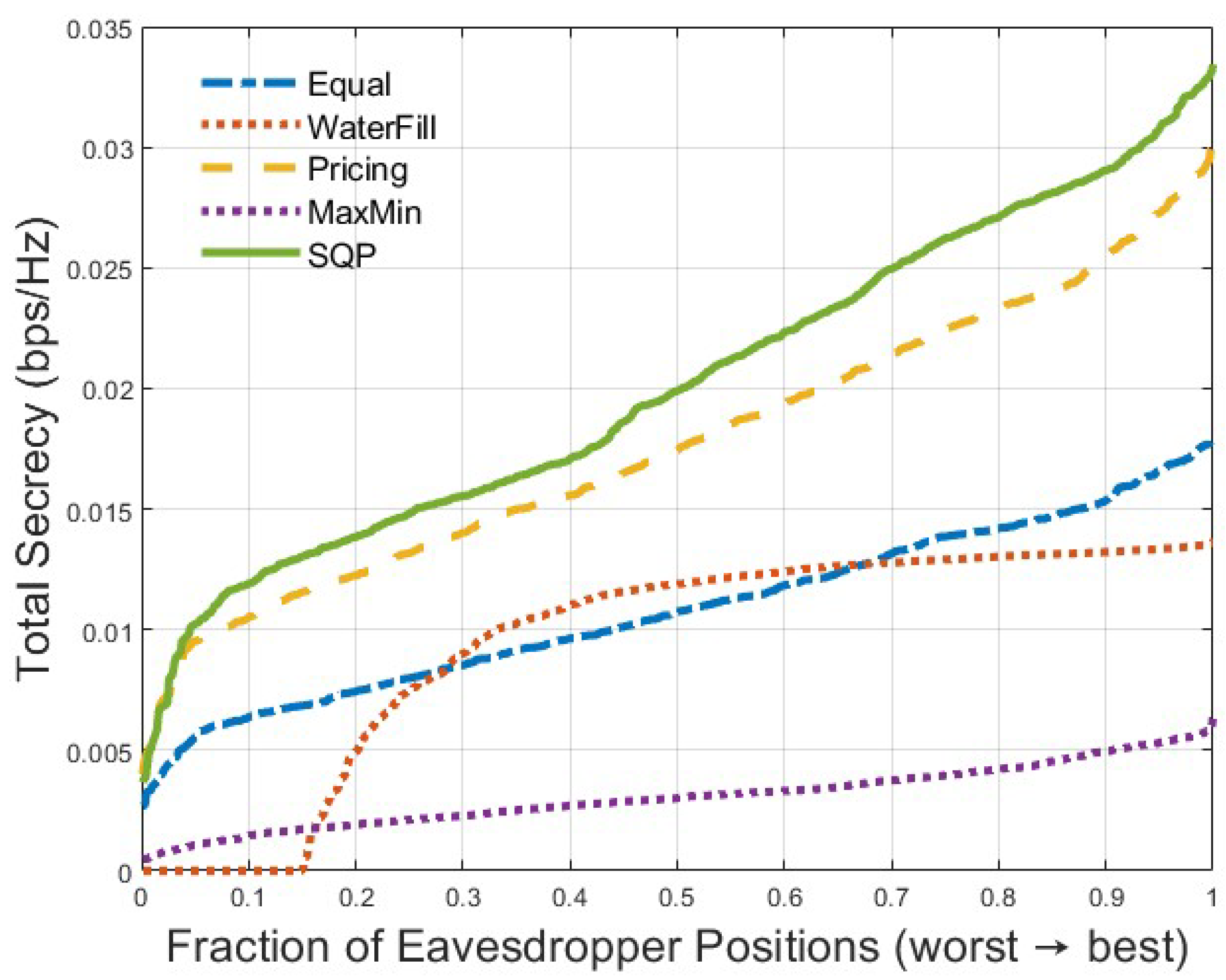
Figure 9 demonstrates that the SQP scheme consistently outperforms all benchmark methods across the entire range of eavesdropper locations. In particular, SQP achieves the highest secrecy levels under both unfavorable and favorable conditions, highlighting its strong capability in enhancing overall system performance. Water-filling follows a similar trend with slightly lower performance, whereas equal and pricing schemes provide moderate gains. In contrast, the max–min approach yields the lowest secrecy performance due to its conservative allocation strategy. Overall, the results clearly confirm the superiority of the proposed SQP-based design in maximizing secrecy performance across diverse operating conditions.
Overall, these results highlight a key insight: optimizing secrecy capacity under nominal conditions (as in SQP and water-filling) can improve average performance but increases vulnerability to worst-case eavesdropper configurations, whereas fairness- and pricing-based approaches offer improved robustness at the cost of reduced peak secrecy performance. This demonstrates an inherent tradeoff between secrecy maximization and robustness against adversarial spatial uncertainty in UAV-assisted IoT networks. offer graceful degradation.
7. Conclusions
This paper investigated secrecy-capacity optimization in UAV-assisted IoT uplink networks under the presence of a passive eavesdropper. A novel worst-case eavesdropper model was developed, where the adversary is characterized as a deterministic channel operating at the boundary of SINR feasibility. This formulation transforms the original max–min secrecy problem into a coupled optimization–algebraic framework, in which the eavesdropper channel vector is endogenously determined by the transmit power allocation. To address the resulting non-convex and non-smooth problem, a smoothed secrecy-capacity formulation was introduced, enabling the application of an efficient SQP approach. The proposed framework jointly captures the interaction between power allocation, interference coupling, and adversarial behavior. Simulation results, validated across 1000 independent random Monte Carlo deployments, demonstrated that the proposed method consistently outperforms conventional power allocation schemes, achieving higher secrecy capacity and improved robustness, particularly in interference-limited environments.
Despite these advantages, several technical limitations must be acknowledged to provide a balanced assessment. First, because the underlying sum-secrecy capacity optimization landscape is fundamentally non-convex, the proposed SQP framework guarantees convergence to a locally optimal KKT stationary point rather than a global optimum. Second, the algebraic derivation of the deterministic linear adversary system assumes accurate channel modeling bounds and is structurally limited to a single-eavesdropper deployment where a tight SINR equalization boundary condition remains physically feasible. Finally, this validation assumes a fixed-hover aerial base station topology, meaning that spatial macro-diversity through dynamic UAV trajectory mobility and defenses against multi-eavesdropper colluding networks were not actively explored.
Consequently, future work will focus on extending this smooth approximation framework to joint three-dimensional UAV trajectory optimization and power co-allocation under multi-eavesdropper scenarios, while incorporating learning-based adaptive resource allocation strategies to mitigate potential channel estimation errors.