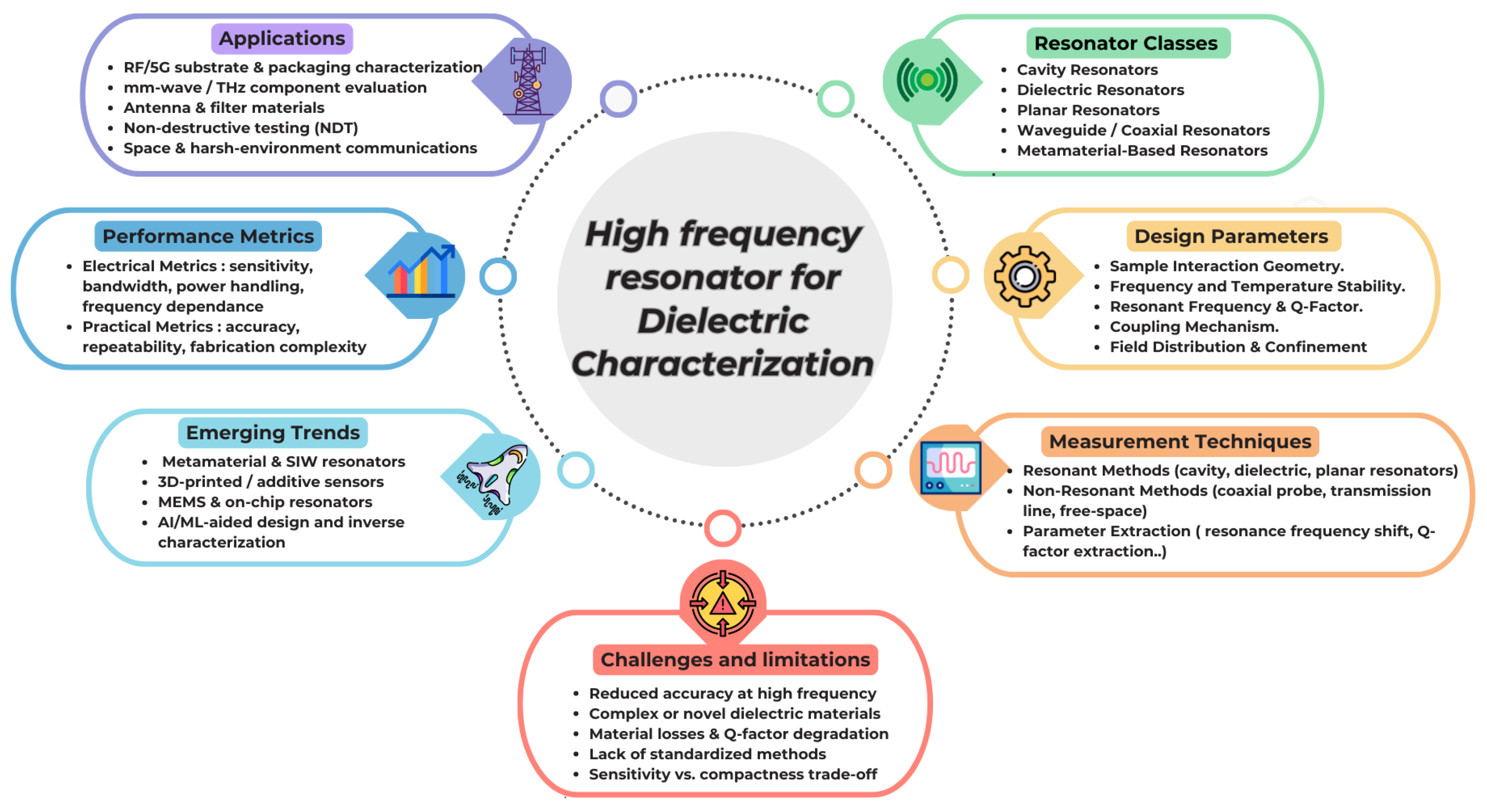
High-Frequency Resonators for Dielectric Characterization: A Review of Design Techniques, Performance Trade-Offs, and Future Directions

 , , , , , and
Abstract
1. Introduction
- Classifies resonator-based characterization techniques according to topology, operating principle, frequency range, and integration capability;
- Compares resonator configurations in terms of sensitivity, quality factor, measurement accuracy, sample loading strategies, and fabrication complexity;
- Reviews extraction techniques with emphasis on applicability to microwave and millimeter-wave systems;
- Identifies key limitations related to accuracy, repeatability, integration, and environmental robustness;
- Discusses emerging research directions, including AI-assisted resonator design, machine-learning-based permittivity estimation, hybrid microwave–photonic systems, and standardization efforts.
2. Dielectric Materials and Resonator-Based Characterization
2.1. Taxonomy of Resonator-Based Characterization Techniques
2.2. High-Frequency Resonator Design for Dielectric Characterization in Telecommunications
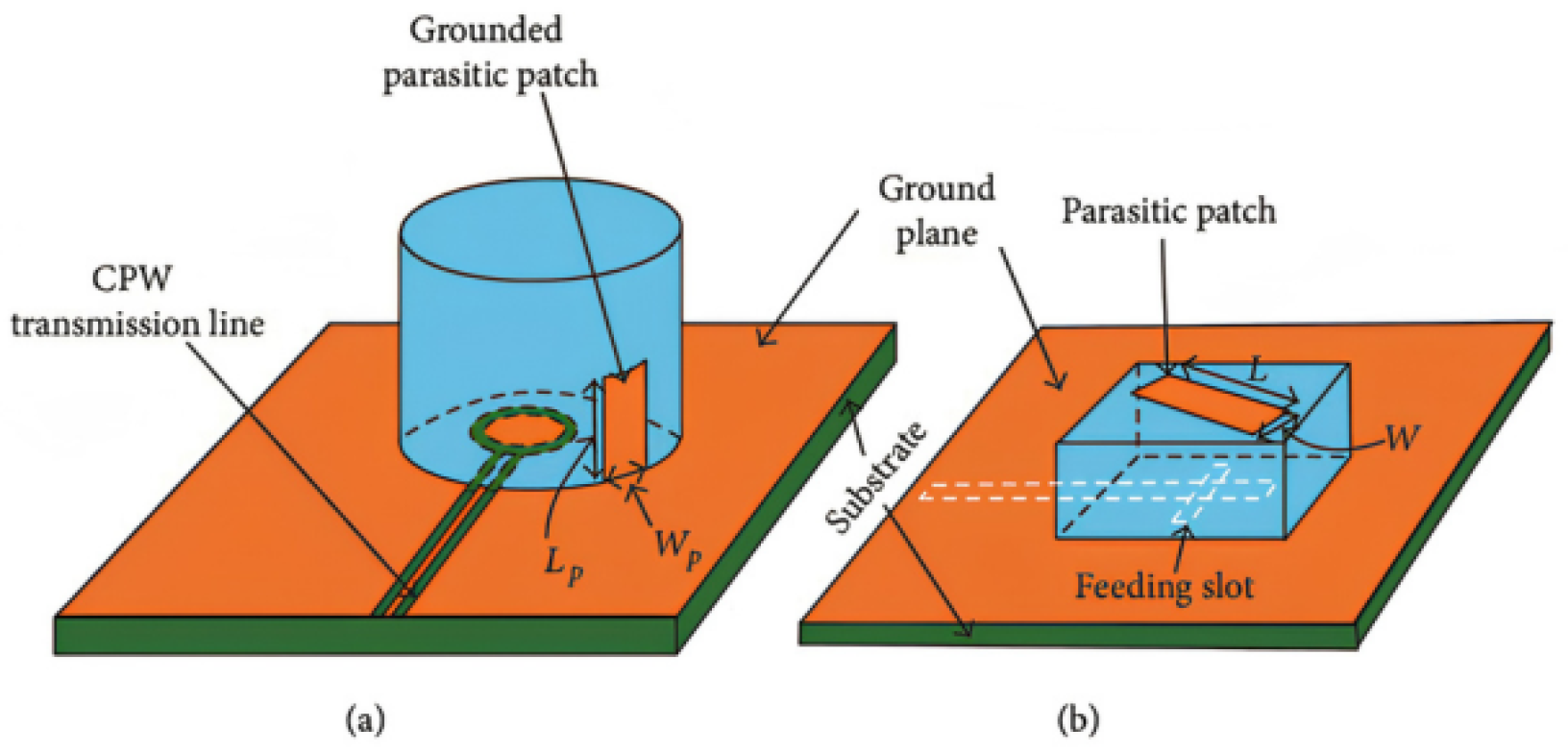
2.3. Types of Resonators
3. Resonator Architectures for Dielectric Characterization
3.1. Cavity Resonators
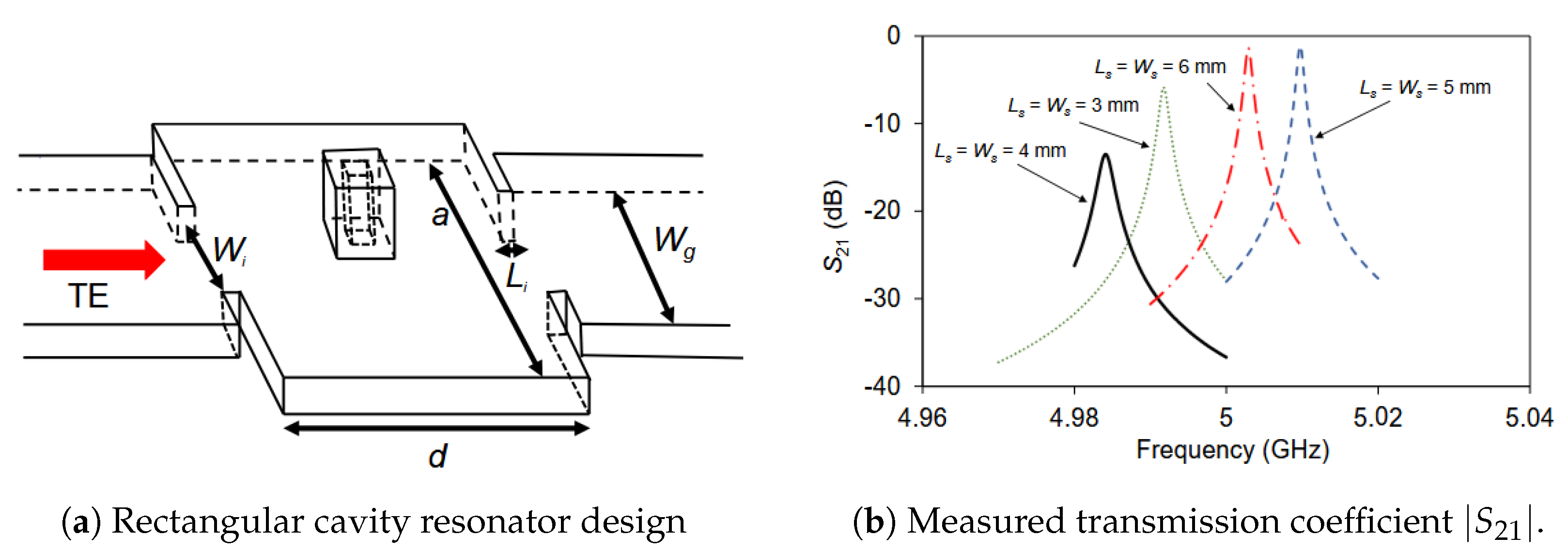
3.1.1. Rectangular Cavities
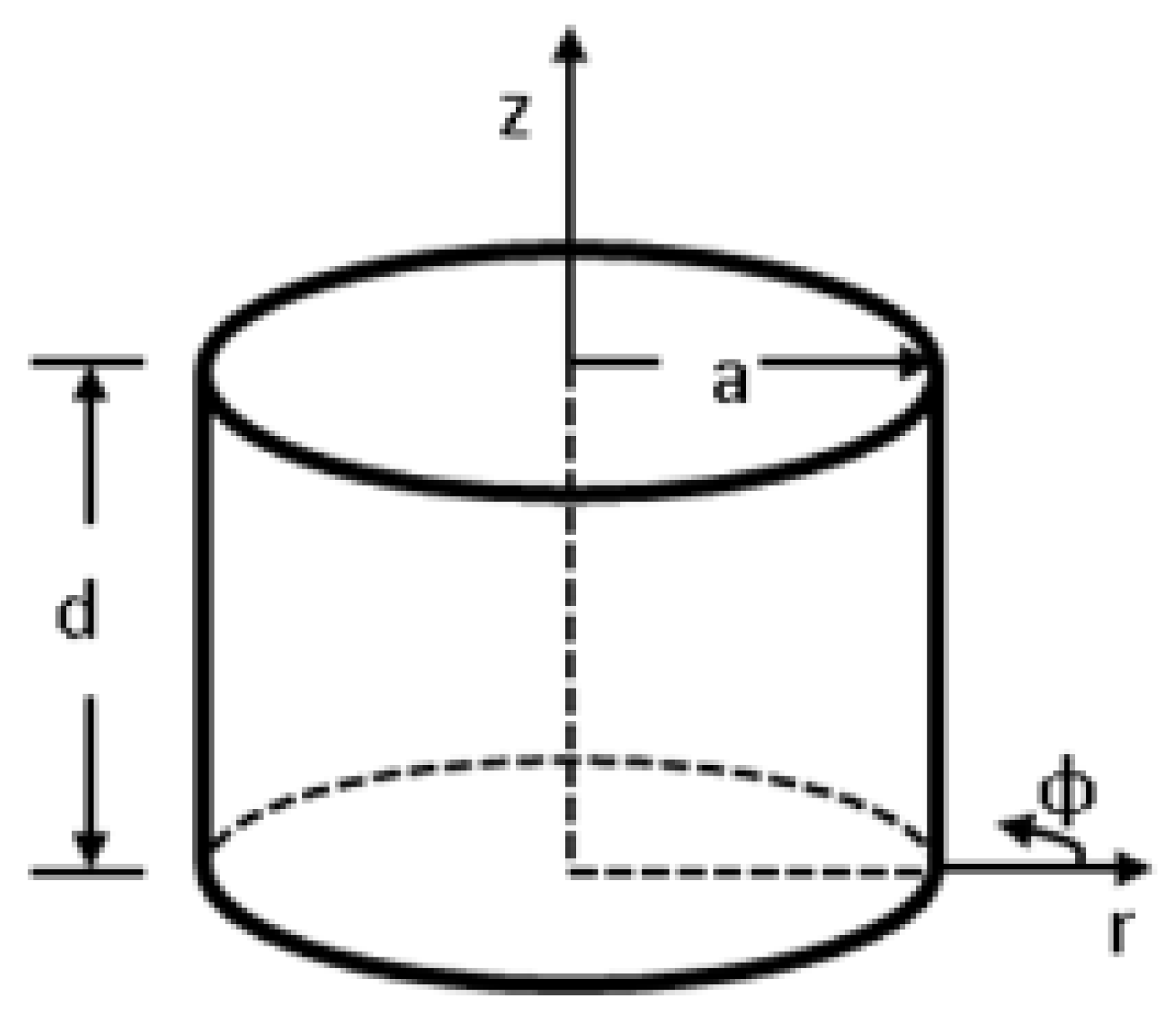
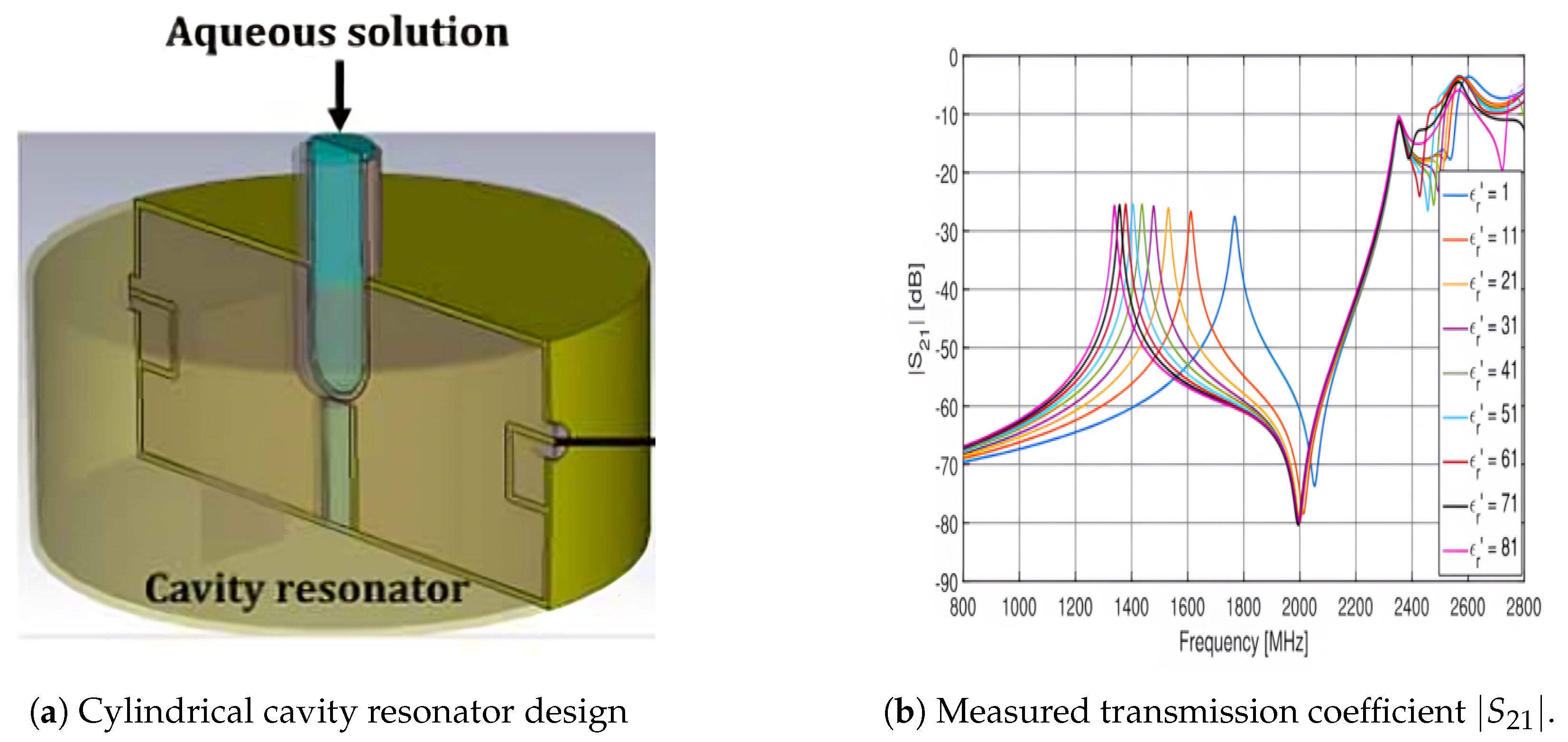
3.1.2. Cylindrical Cavities
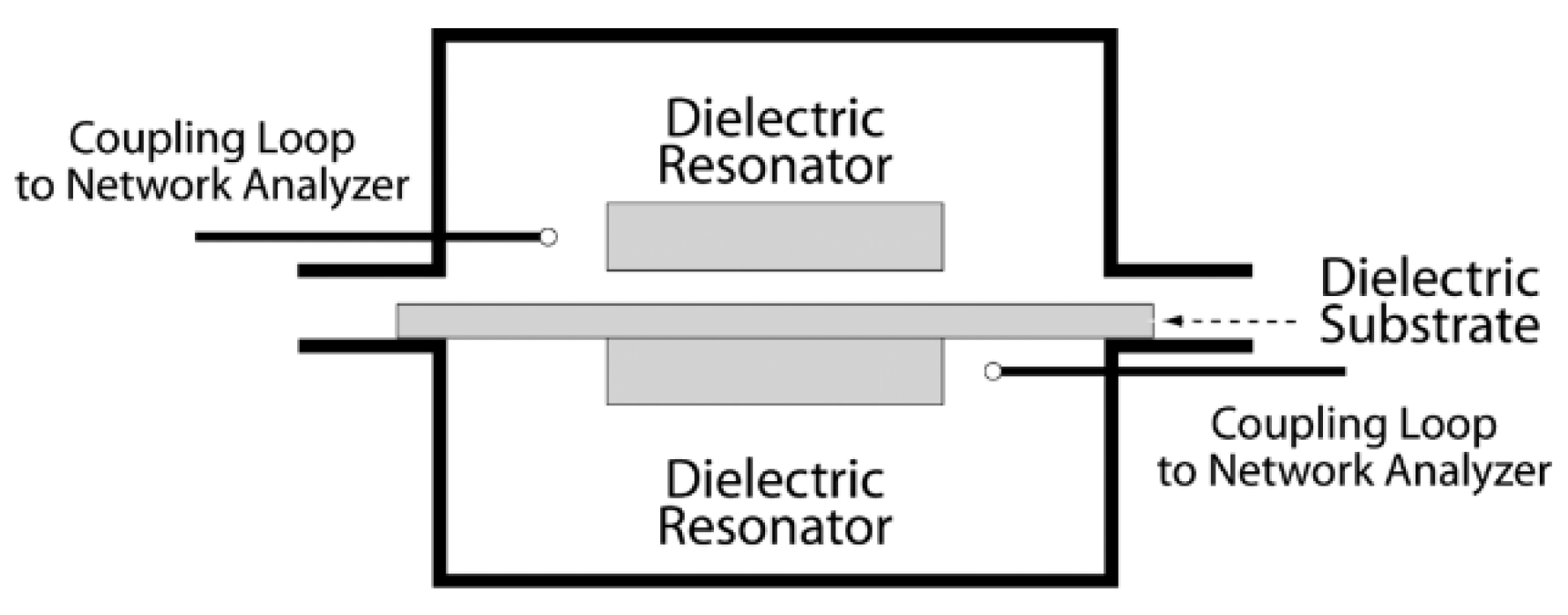
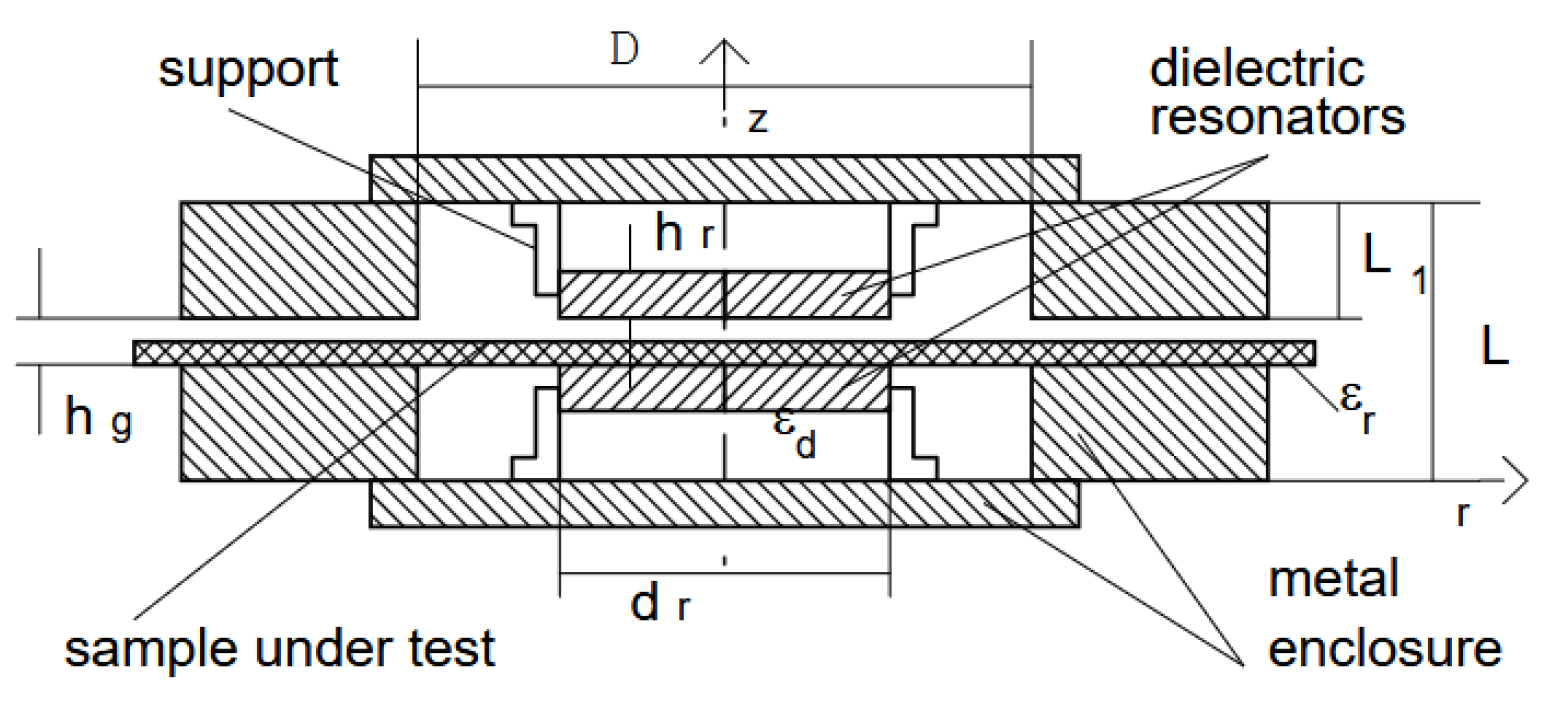
3.2. Split-Post Dielectric Resonator (SPDR) Technique
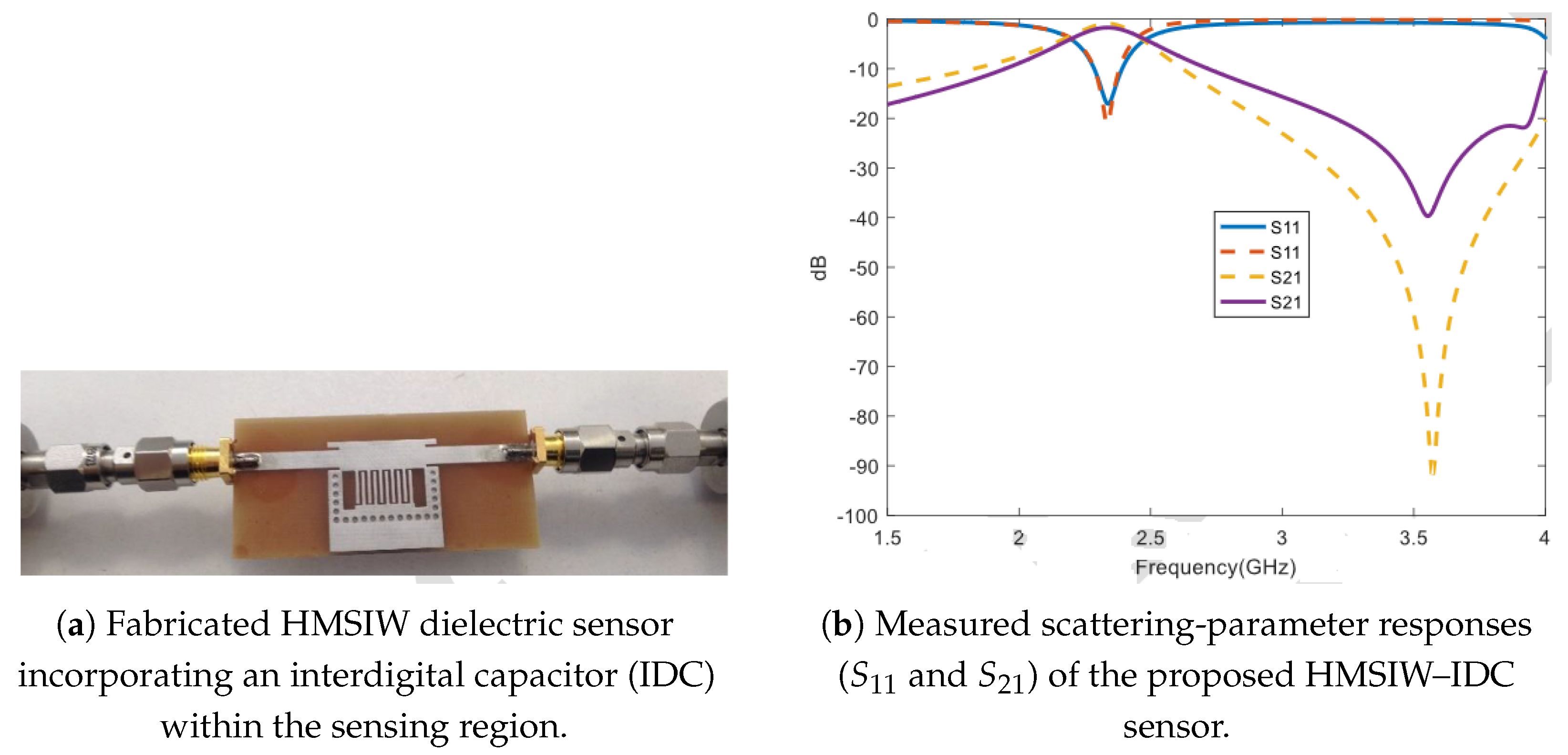
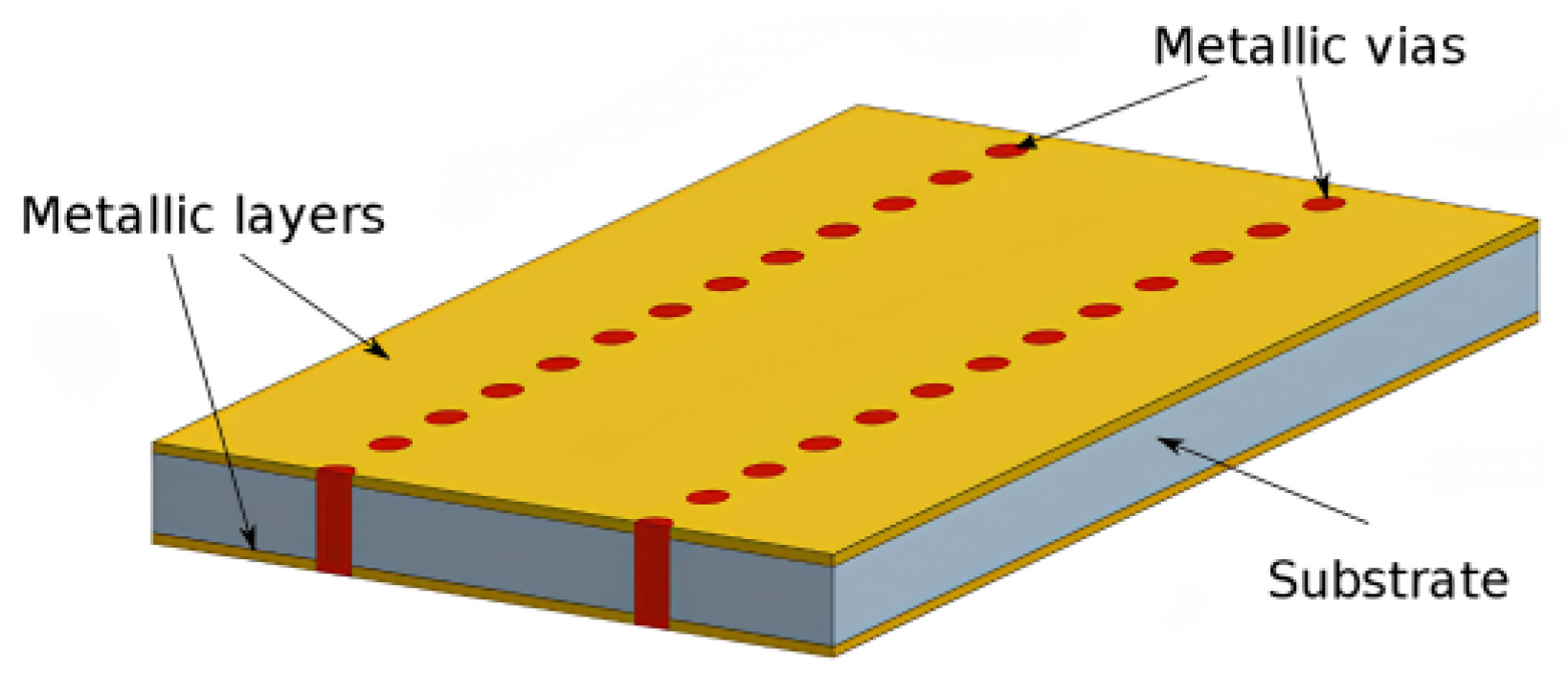
3.3. Planar and SIW Microwave Resonators
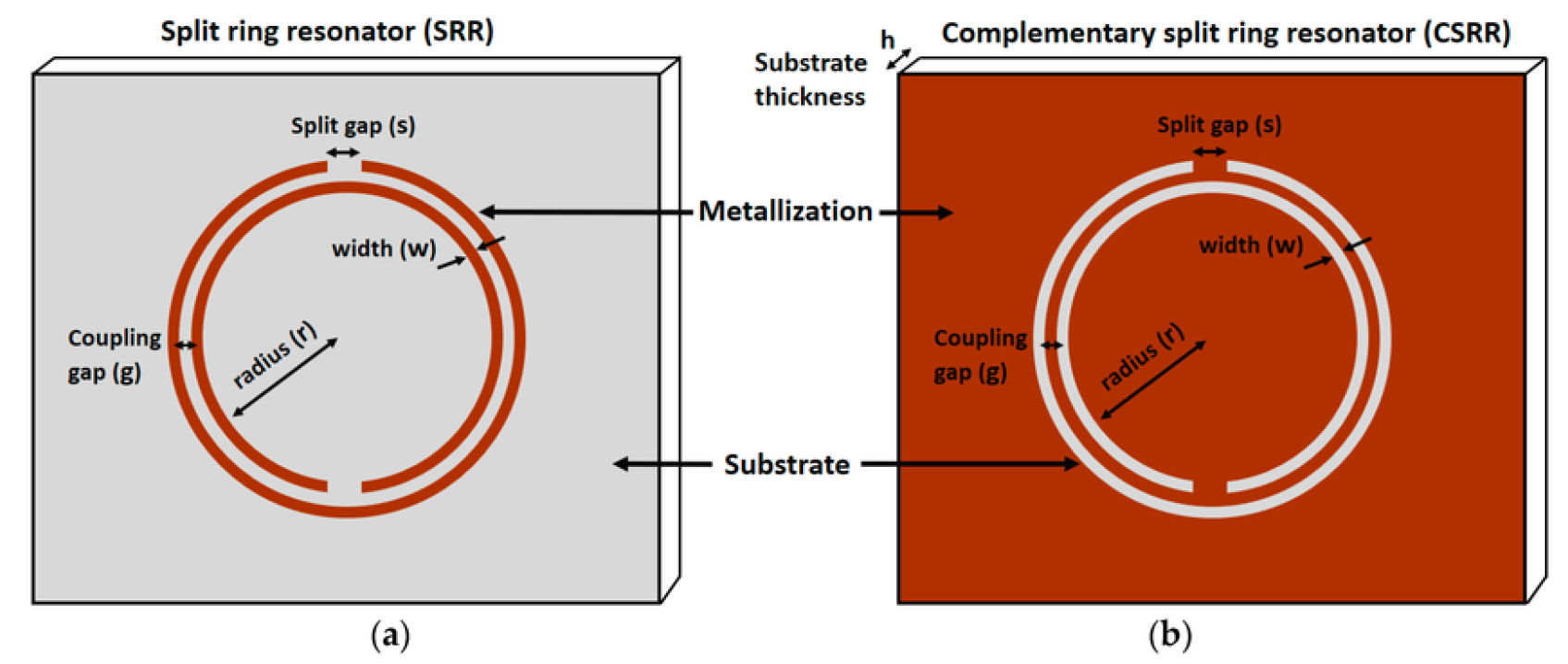
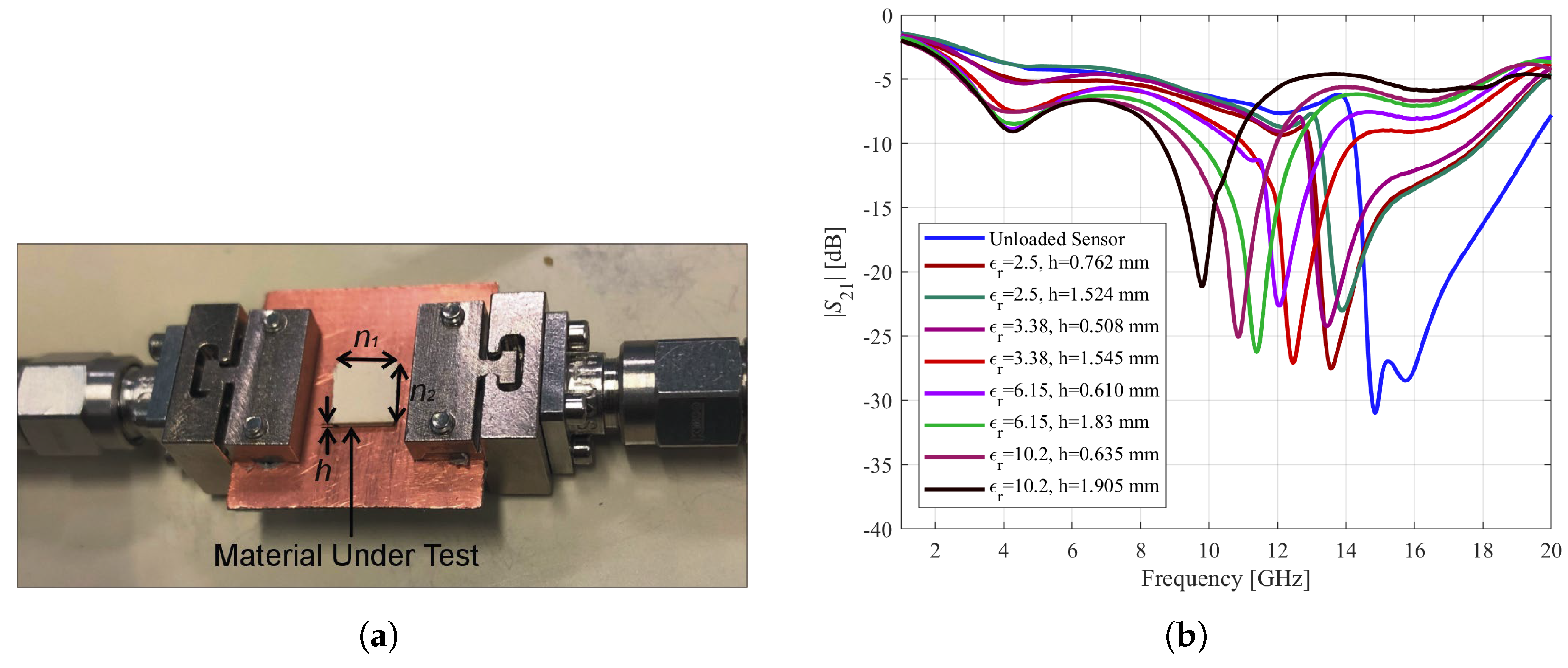
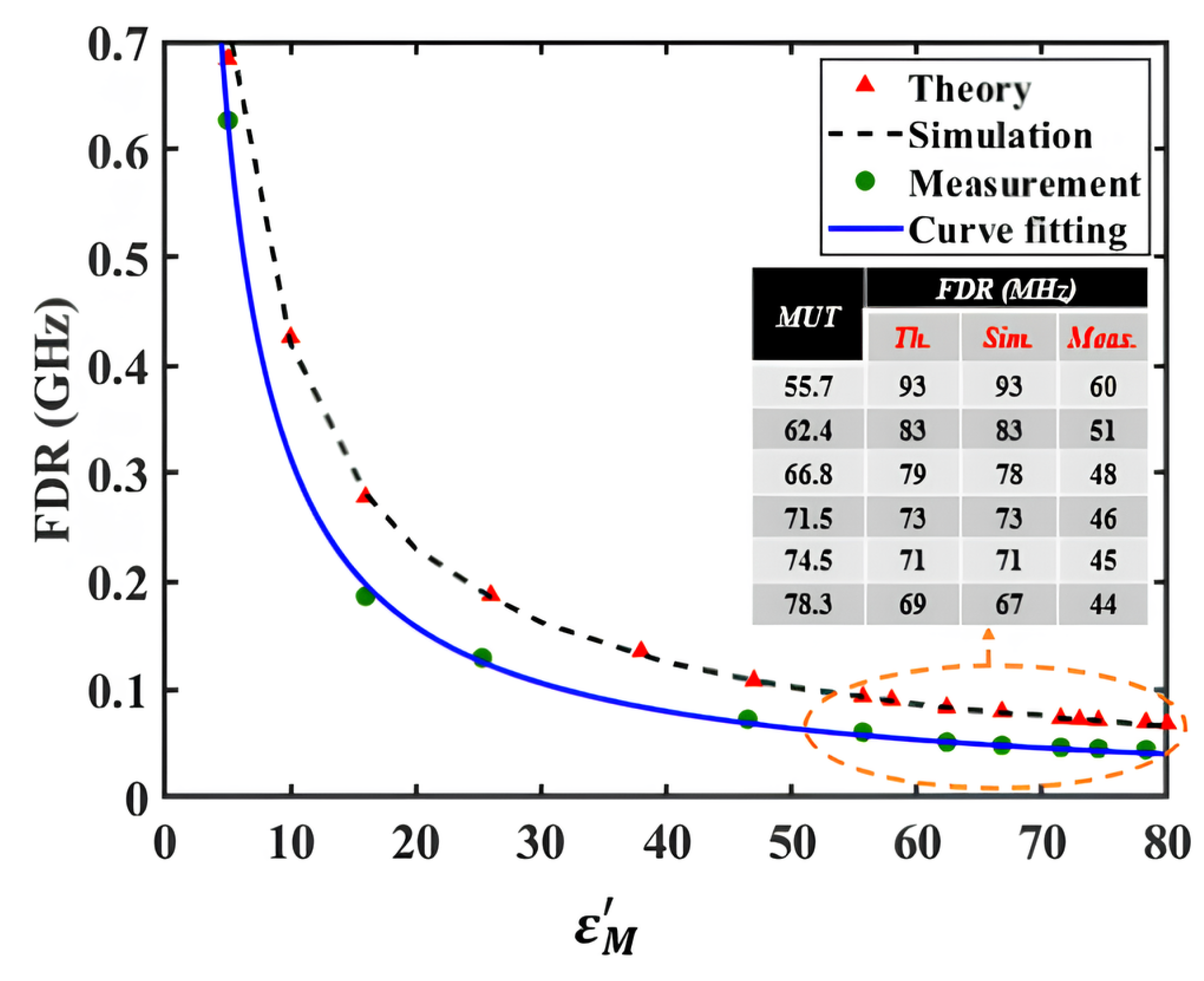
3.4. Metamaterial-Based Resonators

| Ref. | Resonator Type | Frequency (GHz) | (MHz)/Sensitivity/ Range | MUT |
|---|---|---|---|---|
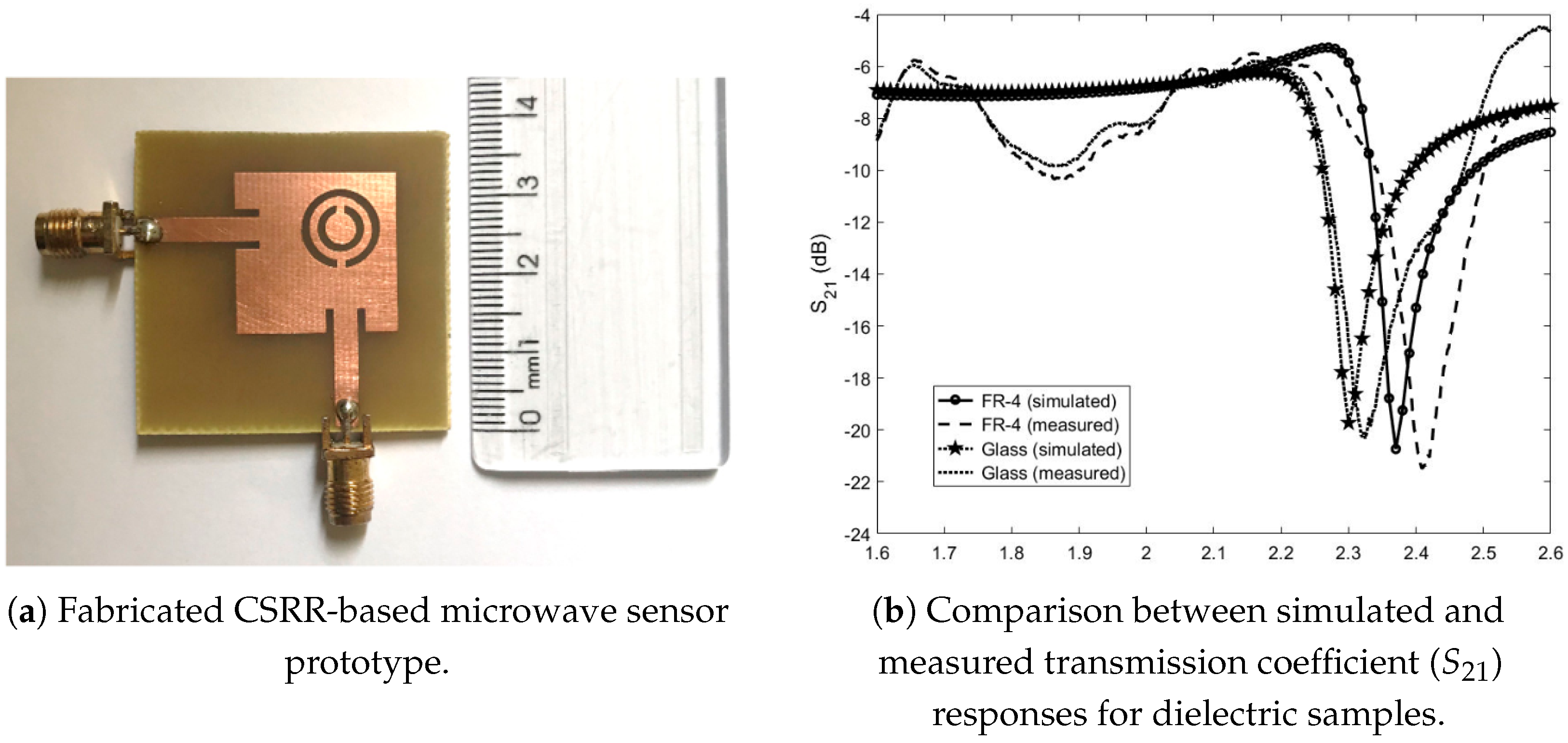
| [63] | CSRR/SRR metasurface | 4.41 | – | Dielectric substrates |
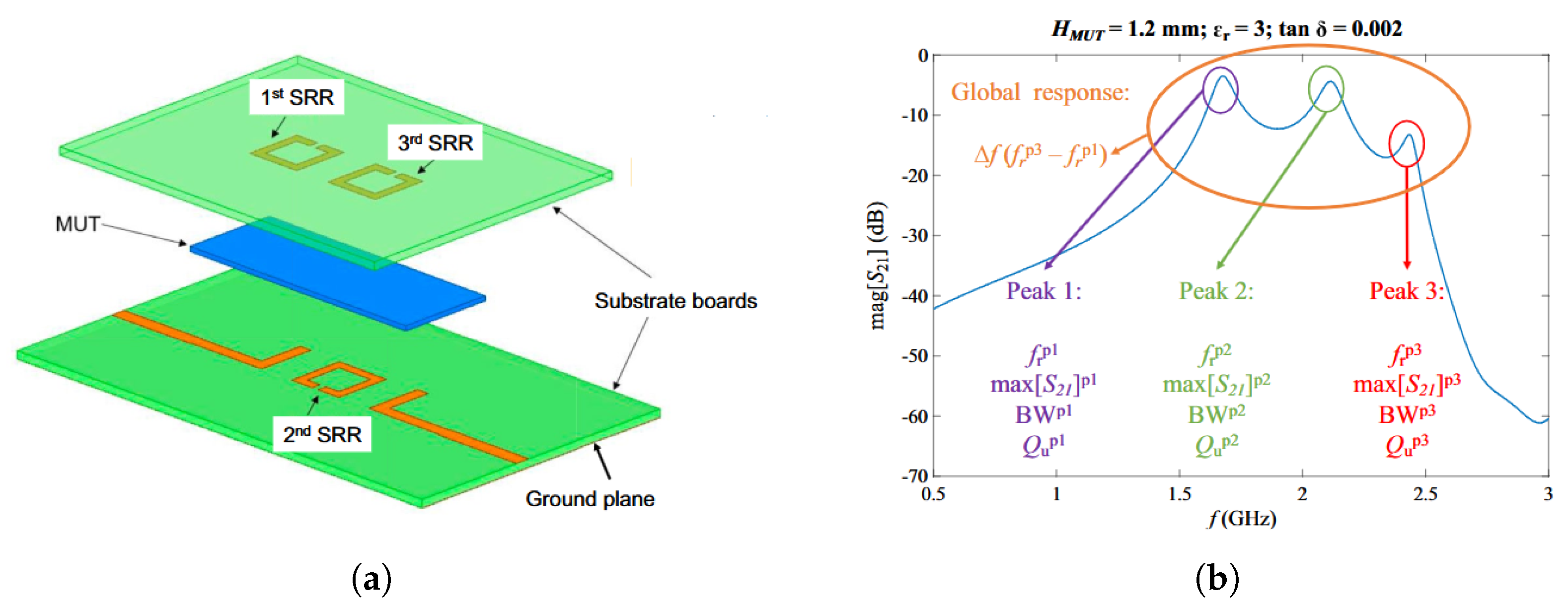
| [66] | Modified SRR | 1.1–2.07 | RO3003, Alumina | |
| [11] | Differential SRR splitter/combiner | 1.04 | DI water/ethanol | |
| [69] | Differential SRR transmission lines | ∼1 | Sensitivity: 0.033 (NaCl), 0.032 (KCl), 0.021 (CaCl2) | Ionic solutions, urine |
| [71] | Dual-band SIW + IDC–SRR | 4.15/9.18 | /11 | Liquid mixtures |
| [76] | SRR-loaded monopole antenna | 2.4 | Sensitivity: 2.83 dB/5% | Ethanol–water |
| [68] | CSRR microstrip two-port | 2.65 | Liquids | |
| [67] | Single CSRR | 5.39 | Liquids | |
| [70] | Differential CSRR | 2.35 | –111 | Liquids |
| [75] | SIW cavity-based skyrmionic multimode resonator | 0.9–2.8 | 123.5 MHz/(), 517.8 MHz/mm | Solid dielectrics (thickness + permittivity characterization) |
| [73] | CPW OCSRR + IDE | 2.44 | Sensitivity: 5.51%; –7 | Solid dielectrics |
| [74] | Multi-ring SRR (M-SRR) | 0.9–1.4 | High normalized sensitivity for transformer-oil degradation monitoring | Transformer oils |
| [72] | H-shaped Nested SRR (H-NSRR) | 5.9 | , , GHz (water span) | Small-volume liquids (0.5 mL PET tray) |
3.5. Unified Performance Comparison and Design Trade-Offs
4. Dielectric Measurement and Extraction Techniques
4.1. Resonant Methods
4.1.1. Fundamental Principles of Dielectric Extraction
4.1.2. Resonant Frequency Shift
4.1.3. Q-Factor-Based Loss Tangent Extraction
4.1.4. Differential/Reference-Based Extraction
4.2. Non-Resonant Methods
4.2.1. Transmission-Line-Based Techniques
4.2.2. Coaxial Probe Method
4.2.3. Free-Space Measurement
4.2.4. Transmission/Reflection Method
5. Applications in Telecommunications
5.1. RF and Microwave Passive Components and Circuits
5.2. Millimeter-Wave and 5G/6G Systems
5.3. System-Level Integration of Portable RF Sensing Systems
5.4. Satellite and Space Communication Systems
6. Current Challenges and Research Gaps
6.1. Limited Accuracy at Very High Frequencies (mm-Wave, THz)
6.2. Characterization of Novel Dielectric Materials (Composites, Nanomaterials, Polymers)
6.3. Integration with Compact, On-Chip Telecom Devices
6.4. Standardization, Calibration Stability, and Measurement Robustness
6.5. Environmental Challenges in Dielectric Characterization
7. Future Perspectives
7.1. AI/ML-Assisted Resonator Design and AI-Enabled Dielectric Characterization
7.2. Integration with Lab-on-Chip and MEMS Technologies
7.3. Standardization and Calibration Frameworks for Industrial Implementation
8. Conclusions
Author Contributions
Funding
Data Availability Statement
Conflicts of Interest
References
- Le Floch, J.M.; Fan, Y.; Humbert, G.; Shan, Q.; Férachou, D.; Bara-Maillet, R.; Aubourg, M.; Hartnett, J.G.; Madrangeas, V.; Cros, D.; et al. Invited article: Dielectric material characterization techniques and designs of high-Q resonators for applications from micro to millimeter-waves frequencies applicable at room and cryogenic temperatures. Rev. Sci. Instrum. 2014, 85, 031301. [Google Scholar] [PubMed]
- Krupka, J. Frequency domain complex permittivity measurements at microwave frequencies. Meas. Sci. Technol. 2006, 17, R55–R70. [Google Scholar] [CrossRef]
- Alahnomi, R.A.; Zakaria, Z.; Yussof, Z.M.; Althuwayb, A.A.; Alhegazi, A.; Alsariera, H.; Rahman, N.A. Review of recent microwave planar resonator-based sensors: Techniques of complex permittivity extraction, applications, open challenges and future research directions. Sensors 2021, 21, 2267. [Google Scholar] [CrossRef] [PubMed]
- Marksteiner, Q.R.; Treiman, M.B.; Chen, C.F.; Haynes, W.B.; Reiten, M.; Dalmas, D.; Pulliam, E. Cavity resonator for dielectric measurements of high-ε, low loss materials, demonstrated with barium strontium zirconium titanate ceramics. Rev. Sci. Instrum. 2017, 88, 064704. [Google Scholar] [CrossRef] [PubMed]
- Orloff, N.D.; Obrzut, J.; Long, C.J.; Lam, T.; Kabos, P.; Novotny, D.R.; Booth, J.C.; Liddle, J.A. Dielectric characterization by microwave cavity perturbation corrected for nonuniform fields. IEEE Trans. Microw. Theory Tech. 2014, 62, 2149–2159. [Google Scholar] [CrossRef]
- Sofokleous, P.; Paz, E.; Herraiz-Martínez, F.J. Design and Manufacturing of Dielectric Resonators via 3D Printing of Composite Polymer/Ceramic Filaments. Polymers 2024, 16, 2589. [Google Scholar] [CrossRef] [PubMed]
- Alimenti, A.; Torokhtii, K.; Vidal García, P.; Pompeo, N.; Silva, E. Design and test of a new dielectric-loaded resonator for the accurate characterization of conductive and dielectric materials. Sensors 2023, 23, 518. [Google Scholar] [CrossRef] [PubMed]
- Bozzi, M.; Georgiadis, A.; Wu, K. Review of substrate-integrated waveguide circuits and antennas. IET Microwaves Antennas Propag. 2011, 5, 909–920. [Google Scholar] [CrossRef]
- Lee, C.K.; McGhee, J.; Tsipogiannis, C.; Zhang, S.; Cadman, D.; Goulas, A.; Whittaker, T.; Gheisari, R.; Engstrom, D.; Vardaxoglou, J.; et al. Evaluation of microwave characterization methods for additively manufactured materials. Designs 2019, 3, 47. [Google Scholar] [CrossRef]
- Krupka, J. Split post dielectric resonators for measurements of the complex permittivity of laminar dielectric materials at microwave frequencies. In Proceedings of the Conference Workshop on Applied Radio Science (WARS’2002), Newport Beach, CA, USA, 31 August–1 September 2002. [Google Scholar]
- Vélez, P.; Su, L.; Grenier, K.; Mata-Contreras, J.; Dubuc, D.; Martín, F. Microwave microfluidic sensor based on a microstrip splitter/combiner configuration and split ring resonators (SRRs) for dielectric characterization of liquids. IEEE Sens. J. 2017, 17, 6589–6598. [Google Scholar] [CrossRef]
- Zhang, Y.; Ogurtsov, S.; Vasilev, V.; Kishk, A.A.; Caratelli, D. Advanced dielectric resonator antenna technology for 5G and 6G applications. Sensors 2024, 24, 1413. [Google Scholar] [CrossRef] [PubMed]
- Wang, J.; Wang, R.; Shen, Z.; Liu, B.; Sun, C.; Xue, Q. Microwave biosensors utilizing metamaterial enhancement: Design and application. Nanotechnol. Precis. Eng. 2025, 8, 015001. [Google Scholar]
- Singh, K.K.; Kumar Mahto, S.; Sinha, R. A review: Material characterization with metamaterial based sensors. Sens. Rev. 2023, 43, 41–51. [Google Scholar] [CrossRef]
- Sim, M.S.; You, K.Y.; Dewan, R.; Esa, F.; Salim, M.R.; Khe, C.S.; Kew, S.Y.N.; Hamid, F. Microwave sensors loaded with metamaterial-inspired resonators for dielectric material characterization: A review. Sens. Actuators A Phys. 2024, 372, 115322. [Google Scholar] [CrossRef]
- Haq, M.A.U.; Armghan, A.; Aliqab, K.; Alsharari, M. A review of contemporary microwave antenna sensors: Designs, fabrication techniques, and potential application. IEEE Access 2023, 11, 40064–40074. [Google Scholar] [CrossRef]
- Subad, R.A.S.I.; El Kashouty, M.F.; Das, S. Antenna as sensors: A mini review. J. Mater. Chem. C 2025, 13, 20862–20879. [Google Scholar] [CrossRef]
- Liu, C.; Liao, C.; Peng, Y.; Zhang, W.; Wu, B.; Yang, P. Microwave sensors and their applications in permittivity measurement. Sensors 2024, 24, 7696. [Google Scholar] [CrossRef] [PubMed]
- Sharma, S.; Singh, M.; Kumar, R. Microwave sensors for dielectric characterization of materials: A review. Phys. Scr. 2026, 101, 092001. [Google Scholar] [CrossRef]
- Palandoken, M.; Gocen, C. Microwave sensor designs for liquid material dielectric characterization: Technological advances and applications. Sens. Actuators A Phys. 2025, 387, 116381. [Google Scholar] [CrossRef]
- Shi, J.; Fernández-García, R.; Gil, I. Sensor technologies for non-invasive blood glucose monitoring. Sensors 2025, 25, 3591. [Google Scholar] [CrossRef] [PubMed]
- Tu, H.; Hong, H.; Zhang, Y.; Zhou, L.; Li, X. Influence of Dielectric Loss on RF Performance of Microstrip Multi-Resonant Circuits. J. Sens. 2022, 2022, 3866692. [Google Scholar] [CrossRef]
- Barker-Jarvis, J.; Janezic, M.D.; Paulter, N.G.; Blendell, J.E. Dielectric and conductor-loss characterization and measurements on electronic packaging materials. NIST Tech. Note 2001, 1520, 3–19. [Google Scholar]
- Egorov, V. Resonance methods for microwave studies of dielectrics. Instrum. Exp. Tech. 2007, 50, 143–175. [Google Scholar] [CrossRef]
- Zhou, D.; Pang, L.X.; Wang, D.W.; Li, C.; Jin, B.B.; Reaney, I.M. High permittivity and low loss microwave dielectrics suitable for 5G resonators and low temperature co-fired ceramic architecture. J. Mater. Chem. C 2017, 5, 10094–10098. [Google Scholar] [CrossRef]
- Zou, J.; Li, C.J.; Zheng, C.; Wang, D.; Zhang, J.; Wang, X.; Zhang, J.Y.; Hou, Z.L. A Novel Strategy for Detecting Permittivity and Loss Tangent of Low-Loss Materials Based on Cylindrical Resonant Cavity. Sensors 2023, 23, 5469. [Google Scholar] [CrossRef] [PubMed]
- Saadat-Safa, M.; Nayyeri, V.; Khanjarian, M.; Soleimani, M.; Ramahi, O.M. A CSRR-based sensor for full characterization of magneto-dielectric materials. IEEE Trans. Microw. Theory Tech. 2019, 67, 806–814. [Google Scholar]
- Wang, Q.; Zhang, D.; Yang, H.; Tao, C.; Huang, Y.; Zhuang, S.; Mei, T. Sensitivity of a label-free guided-mode resonant optical biosensor with different modes. Sensors 2012, 12, 9791–9799. [Google Scholar] [PubMed]
- Krupka, J.; Breeze, J.; Centeno, A.; Alford, N.; Claussen, T.; Jensen, L. Measurements of permittivity, dielectric loss tangent, and resistivity of float-zone silicon at microwave frequencies. IEEE Trans. Microw. Theory Tech. 2006, 54, 3995–4001. [Google Scholar] [CrossRef]
- Hopcroft, M.; Melamud, R.; Candler, R.N.; Park, W.T.; Kim, B.; Yama, G.; Partridge, A.; Lutz, M.; Kenny, T.W. Active temperature compensation for micromachined resonators. In Proceedings of the Solid-State Sensor, Actuator and Microsystems Workshop; IEEE: Piscataway, NJ, USA, 2004; pp. 364–367. [Google Scholar]
- Jonscher, A. The’universal’dielectric response. I. IEEE Electr. Insul. Mag. 2002, 6, 16–22. [Google Scholar]
- Chakraborty, S. Frequency-dependent dielectric properties of sodium silicate. Mod. Phys. Lett. B 2018, 32, 1850411. [Google Scholar] [CrossRef]
- Kremer, F.; Schönhals, A. Broadband Dielectric Spectroscopy; Springer Science & Business Media: New York, NY, USA, 2002. [Google Scholar]
- Giannoukos, G.; Min, M.; Rang, T. Relative complex permittivity and its dependence on frequency. World J. Eng. 2017, 14, 532–537. [Google Scholar] [CrossRef]
- Krupka, J. Microwave measurements of electromagnetic properties of materials. Materials 2021, 14, 5097. [Google Scholar] [CrossRef] [PubMed]
- Sharma, P.; Lao, L.; Falcone, G. A microwave cavity resonator sensor for water-in-oil measurements. Sens. Actuators B Chem. 2018, 255, 560–567. [Google Scholar]
- Nwajana, A.O.; Obi, E.R. A review on SIW and its applications to microwave components. Electronics 2022, 11, 1160. [Google Scholar] [CrossRef]
- Salim, A.; Lim, S. Review of recent metamaterial microfluidic sensors. Sensors 2018, 18, 232. [Google Scholar] [CrossRef] [PubMed]
- Keyrouz, S.; Caratelli, D. Dielectric resonator antennas: Basic concepts, design guidelines, and recent developments at millimeter-wave frequencies. Int. J. Antennas Propag. 2016, 2016, 6075680. [Google Scholar] [CrossRef]
- Gungor, A.C.; Olszewska-Placha, M.; Celuch, M.; Smajic, J.; Leuthold, J. Advanced modelling techniques for resonator based dielectric and semiconductor materials characterization. Appl. Sci. 2020, 10, 8533. [Google Scholar] [CrossRef]
- Gregory, A.P.; Clarke, R.N. A review of RF and microwave techniques for dielectric measurements on polar liquids. IEEE Trans. Dielectr. Electr. Insul. 2006, 13, 727–743. [Google Scholar] [CrossRef]
- Jha, A.K.; Akhtar, M.J. A generalized rectangular cavity approach for determination of complex permittivity of materials. IEEE Trans. Instrum. Meas. 2014, 63, 2632–2641. [Google Scholar] [CrossRef]
- Hussain, N.S.M.; Azman, A.N.; Yusof, N.A.T.; Mohtadzar, N.A.A.H.; Karim, M.S.A. Design of resonator cavity for liquid material characterization. TELKOMNIKA (Telecommun. Comput. Electron. Control) 2022, 20, 447–454. [Google Scholar] [CrossRef]
- Ribas, R.A.; Gelosi, I.E.; Uriz, A.J.; Moreira, J.C.; Bonadero, J.C. A high-sensitivity cylindrical cavity resonator sensor for the characterization of aqueous solutions. IEEE Sens. J. 2020, 21, 7581–7589. [Google Scholar] [CrossRef]
- Varshney, P.K.; Akhtar, M.J. A compact planar cylindrical resonant RF sensor for the characterization of dielectric samples. J. Electromagn. Waves Appl. 2019, 33, 1700–1717. [Google Scholar] [CrossRef]
- Sheen, J. Microwave measurements of dielectric properties using a closed cylindrical cavity dielectric resonator. IEEE Trans. Dielectr. Electr. Insul. 2007, 14, 1139–1144. [Google Scholar] [CrossRef]
- Phakaew, T.; Oo, T.P.; Uzair, M.; Kowitwarangkul, P.; Chuchuay, P.; Yeetsorn, R.; Torrungrueng, D.; Chudpooti, N.; Chalermwisutkul, S. Additively Manufactured Mechanically Tunable Cavity Resonator for Broadband Characterization of Liquid Permittivity. Sensors 2025, 25, 7145. [Google Scholar] [CrossRef] [PubMed]
- Meng, B.; Booske, J.; Cooper, R. Extended cavity perturbation technique to determine the complex permittivity of dielectric materials. IEEE Trans. Microw. Theory Tech. 1995, 43, 2633–2636. [Google Scholar] [CrossRef]
- Krupka, J.; Huang, W.T.; Tung, M.J. Complex permittivity measurements of thin ferroelectric films employing split post dielectric resonator. Ferroelectrics 2006, 335, 89–94. [Google Scholar] [CrossRef]
- Janezic, M.D.; Krupka, J. Split-post and split-cylinder resonator techniques: A comparison of complex permittivity measurement of dielectric substrates. J. Microelectron. Electron. Packag. 2009, 6, 97–100. [Google Scholar]
- Krupka, J.; Gregory, A.; Rochard, O.; Clarke, R.; Riddle, B.; Baker-Jarvis, J. Uncertainty of complex permittivity measurements by split-post dielectric resonator technique. J. Eur. Ceram. Soc. 2001, 21, 2673–2676. [Google Scholar] [CrossRef]
- Krupka, J.; Gwarek, W.; Kwietniewski, N.; Hartnett, J.G. Measurements of planar metal–dielectric structures using split-post dielectric resonators. IEEE Trans. Microw. Theory Tech. 2010, 58, 3511–3518. [Google Scholar]
- Mazierska, J.; Krupka, J.; Jacob, M.V.; Ledenyov, D. Complex permittivity measurements at variable temperatures of low loss dielectric substrates employing split post and single post dielectric resonators. In Proceedings of the 2004 IEEE MTT-S International Microwave Symposium Digest (IEEE Cat. No. 04CH37535); IEEE: Piscataway, NJ, USA, 2004; Volume 3, pp. 1825–1828. [Google Scholar]
- Muñoz-Enano, J.; Vélez, P.; Gil, M.; Martín, F. Planar microwave resonant sensors: A review and recent developments. Appl. Sci. 2020, 10, 2615. [Google Scholar] [CrossRef]
- Fang, X.; Linton, D.; Walker, C.; Collins, B. Dielectric constant characterization using a numerical method for the microstrip ring resonator. Microw. Opt. Technol. Lett. 2004, 41, 14–17. [Google Scholar] [CrossRef]
- Rashidian, A.; Aligodarz, M.T.; Klymyshyn, D.M. Dielectric characterization of materials using a modified microstrip ring resonator technique. IEEE Trans. Dielectr. Electr. Insul. 2012, 19, 1392–1399. [Google Scholar] [CrossRef]
- Sarabandi, K.; Li, E.S. Microstrip ring resonator for soil moisture measurements. IEEE Trans. Geosci. Remote Sens. 1997, 35, 1223–1231. [Google Scholar] [CrossRef]
- Verma, A.; Nasimuddin; Omar, A. Microstrip resonator sensors for determination of complex permittivity of materials in sheet, liquid and paste forms. IEE Proc.-Microwaves Antennas Propag. 2005, 152, 47–54. [Google Scholar] [CrossRef]
- Jha, A.K.; Akhtar, M.J. SIW cavity based RF sensor for dielectric characterization of liquids. In Proceedings of the 2014 IEEE Conference on Antenna Measurements & Applications (CAMA); IEEE: Piscataway, NJ, USA, 2014; pp. 1–4. [Google Scholar]
- Varshney, P.K.; Akhtar, M.J. Permittivity estimation of dielectric substrate materials via enhanced SIW sensor. IEEE Sens. J. 2021, 21, 12104–12112. [Google Scholar] [CrossRef]
- Chen, S.; Guo, M.; Xu, K.; Zhao, P.; Hu, Y.; Dong, L.; Wang, G. A dielectric constant measurement system for liquid based on SIW resonator. IEEE Access 2018, 6, 41163–41172. [Google Scholar] [CrossRef]
- Mohammadi, P.; Mohammadi, A.; Kara, A. Enhanced half-mode SIW loaded with interdigital capacitor for permittivity measurements. IEEE Trans. Instrum. Meas. 2023, 72, 1–8. [Google Scholar] [CrossRef]
- Falcone, F.; Lopetegi, T.; Laso, M.; Baena, J.; Bonache, J.; Beruete, M.; Marqués, R.; Martín, F.; Sorolla, M. Babinet principle applied to the design of metasurfaces and metamaterials. Phys. Rev. Lett. 2004, 93, 197401. [Google Scholar] [CrossRef] [PubMed]
- Bahar, A.A.M.; Zakaria, Z.; Isa, A.A.M.; Ruslan, E.; Alahnomi, R.A. A Review of Characterization Techniques for Material’s Properties Measurement using Microwave Resonant Sensor. J. Telecommun. Electron. Comput. Eng. (JTEC) 2015, 7, 1–6. [Google Scholar]
- Su, L.; Mata-Contreras, J.; Vélez, P.; Martín, F. A Review of Sensing Strategies for Microwave Sensors Based on Metamaterial-Inspired Resonators: Dielectric Characterization, Displacement, and Angular Velocity Measurements for Health Diagnosis, Telecommunication, and Space Applications. Int. J. Antennas Propag. 2017, 2017, 5619728. [Google Scholar] [CrossRef]
- Gavrilă, R.; Mocanu, I. Investigation on modified SRR for accurate dielectric measurements. In Proceedings of the 2020 IEEE 26th International Symposium for Design and Technology in Electronic Packaging (SIITME); IEEE: Piscataway, NJ, USA, 2020; pp. 118–121. [Google Scholar]
- Alotaibi, S.A.; Cui, Y.; Tentzeris, M.M. CSRR based sensors for relative permittivity measurement with improved and uniform sensitivity throughout [0.9–10.9] GHz band. IEEE Sens. J. 2019, 20, 4667–4678. [Google Scholar] [CrossRef]
- Nogueira, J.K.; Oliveira, J.G.; Paiva, S.B.; Neto, V.P.S.; D’Assunção, A.G. A compact CSRR-based sensor for characterization of the complex permittivity of dielectric materials. Electronics 2022, 11, 1787. [Google Scholar] [CrossRef]
- Velez, P.; Munoz-Enano, J.; Grenier, K.; Mata-Contreras, J.; Dubuc, D.; Martín, F. Split ring resonator-based microwave fluidic sensors for electrolyte concentration measurements. IEEE Sens. J. 2018, 19, 2562–2569. [Google Scholar] [CrossRef]
- Das, G.S.; Buragohain, A.; Beria, Y. Microwave differential CSRR sensor for liquid permittivity measurement. J. Electron. Mater. 2024, 53, 3541–3547. [Google Scholar] [CrossRef]
- Liu, W.; Zhang, J.; Huang, K. Dual-band microwave sensor based on planar rectangular cavity loaded with pairs of improved resonator for differential sensing applications. IEEE Trans. Instrum. Meas. 2021, 70, 8005808. [Google Scholar] [CrossRef]
- Rahman, M.Z.A.; Idris, M.I.; Jemaludin, N.H.; Mat, M.R.; Johari, S.; Alam, S.; Zakaria, Z. High-Q H-Shaped Nested Split-Ring Resonator Sensor for Liquid Complex-Permittivity Characterization. IEEE Sens. J. 2026, 26, 5510–5518. [Google Scholar]
- Su, C.; Liu, G. High Sensitivity CPW Microwave Sensor Based on OCSRR and IDE Structure for Permittivity Characterization. IEEE Sens. J. 2025, 25, 21512–21519. [Google Scholar] [CrossRef]
- Kooshki, S.S.; Ghalibafan, J.; Dehghani, F.; Kaboutari, K. M-SRR-based Microwave Sensor Design and Modeling for Evaluating Transformer Oil Quality and Lifespan Employing Relative Permittivity. IEEE Sens. J. 2026, 26, 15172–15184. [Google Scholar]
- Wang, S.; Wan, C.; Chung, K.L.; Zheng, Y. Investigation of compact near-equidistant multimode resonator integrating skyrmionic metamaterial with SIW cavity and its application in dielectric material detection. IEEE Trans. Microw. Theory Tech. 2024, 73, 3565–3580. [Google Scholar] [CrossRef]
- Prakash, D.; Gupta, N. Microwave grooved SRR sensor for detecting low concentration ethanol-blended petrol. IEEE Sens. J. 2023, 23, 15544–15551. [Google Scholar] [CrossRef]
- Zable, M.A.H.; Ismail Khan, Z.; Abdul Rashid, N.E.; Zakaria, N.A.Z.; Ibrahim, I.P.; Ab Rahim, S.A.; Mahmood, M.K.A. Dielectric material measurement method: A review. J. Electr. Electron. Syst. Res. (JEESR) 2023, 22, 19–28. [Google Scholar] [CrossRef]
- Haq, T.; Koziel, S. Rapid design optimization and calibration of microwave sensors based on equivalent complementary resonators for high sensitivity and low fabrication tolerance. Sensors 2023, 23, 1044. [Google Scholar] [CrossRef] [PubMed]
- Sheen, J.; Mao, W.; Liu, W. Study on the Measurement Techniques of Microwave Dielectric Properties; NST: Taipei, Taiwan, 2007; pp. 349–352. [Google Scholar]
- Haq, T.; Koziel, S. New complementary resonator for permittivity-and thickness-based dielectric characterization. Sensors 2023, 23, 9138. [Google Scholar] [PubMed]
- Chowdhury, N.M.; Hakim, M.L.; Alam, T.; Maash, A.A.; SinghSingh, M.J.; Soliman, M.S.; Islam, M.T.; Islam, M.S. Interconnected four split rectangular ring resonator flexible metamaterial for microwave sensing application. Sci. Rep. 2025, 15, 21230. [Google Scholar] [CrossRef] [PubMed]
- Wang, X.; Wu, M.; Zhao, P. Dielectric identification method and system design of coal gangue based on frequency shift characteristics. Sci. Rep. 2025, 15, 8712. [Google Scholar] [CrossRef] [PubMed]
- Singh, K.K.; Singh, A.K.; Mahto, S.K.; Sinha, R.; Al-Gburi, A.J.A. Enhanced accuracy and high sensitivity in dielectric characterization through a compact and miniaturized metamaterial inspired microwave sensor. Sens. Actuators A Phys. 2024, 370, 115271. [Google Scholar] [CrossRef]
- Haq, T.; Koziel, S. Novel complementary multiple concentric split ring resonator for reliable characterization of dielectric substrates with high sensitivity. IEEE Sens. J. 2024, 24, 16233–16241. [Google Scholar] [CrossRef]
- Baker-Jarvis, J.; Janezic, M.D.; Grosvenor, J.H., Jr.; Geyer, R.G. Transmission/Reflection and Short-Circuit Line Methods for Measuring Permittivity and Permeability, 1992. Provided by the SAO/NASA Astrophysics Data System. Available online: https://ui.adsabs.harvard.edu/abs/1992STIN...9312084B (accessed on 1 April 2023).
- Peñaloza-Delgado, R.; Olvera-Cervantes, J.L.; Sosa-Morales, M.E.; Kataria, T.K.; Corona-Chávez, A. Dielectric characterization of vegetable oils during a heating cycle. J. Food Sci. Technol. 2021, 58, 1480–1487. [Google Scholar] [PubMed]
- Ni, E.; Jiang, X. Microwave measurement of the permittivity for high dielectric constant materials using an extra-cavity evanescent waveguide. Rev. Sci. Instrum. 2002, 73, 3997–4002. [Google Scholar] [CrossRef]
- Shan, X.; Shen, Z.; Tsuno, T. Wide-band measurement of complex permittivity using an overmoded circular cavity. Meas. Sci. Technol. 2008, 19, 025702. [Google Scholar] [CrossRef]
- Jin, H.; Dong, S.; Wang, D. Measurement of dielectric constant of thin film materials at microwave frequencies. J. Electromagn. Waves Appl. 2009, 23, 809–817. [Google Scholar] [CrossRef]
- Saeed, K.; Pollard, R.D.; Hunter, I.C. Substrate integrated waveguide cavity resonators for complex permittivity characterization of materials. IEEE Trans. Microw. Theory Tech. 2008, 56, 2340–2347. [Google Scholar] [CrossRef]
- Pan, Y.; Leung, K.; Guo, L. Compact laterally radiating dielectric resonator antenna with small ground plane. IEEE Trans. Antennas Propag. 2017, 65, 4305–4310. [Google Scholar] [CrossRef]
- Salski, B.; Pacewicz, A.; Kopyt, P. Measurement errors and uncertainties in the complex permittivity extraction with a Fabry–Perot open resonator. IEEE Trans. Microw. Theory Tech. 2023, 71, 4639–4648. [Google Scholar] [CrossRef]
- Salski, B.; Karpisz, T.; Warecka, M.; Kowalczyk, P.; Czekala, P.; Kopyt, P. Microwave characterization of dielectric sheets in a plano-concave Fabry-Perot open resonator. IEEE Trans. Microw. Theory Tech. 2022, 70, 2732–2742. [Google Scholar]
- Juan, C.G.; Potelon, B.; Aquino, A.; García-Martínez, H.; Quendo, C. Multi-parameter simultaneous extraction with a novel microwave sensor based on coupled resonators. Sci. Rep. 2024, 14, 23076. [Google Scholar] [CrossRef] [PubMed]
- Ramella, C.; Pirola, M.; Corbellini, S. Accurate Characterization of High-Q Microwave Resonances for Metrology Applications. IEEE J. Microwaves 2021, 1, 610–624. [Google Scholar]
- Buragohain, A.; Das, G.S.; Beria, Y.; Kalita, P.P.; Doloi, T.; Al-Gburi, A.J.A. Interdigitated capacitor based frequency splitting differential microwave sensor for complete dielectric characterization of organic liquids. Sens. Actuators A Phys. 2025, 382, 116127. [Google Scholar]
- Almuhlafi, A.M.; Alshaykh, M.S.; Alajmi, M.; Alshammari, B.; Ramahi, O.M. A microwave differential dielectric sensor based on mode splitting of coupled resonators. Sensors 2024, 24, 1020. [Google Scholar] [CrossRef] [PubMed]
- Li, Z.; Tian, S.; Tang, J.; Yang, W.; Hong, T.; Zhu, H. High-Sensitivity Differential Sensor for Characterizing Complex Permittivity of Liquids Based on LC Resonators. Sensors 2024, 24, 4877. [Google Scholar] [CrossRef] [PubMed]
- Nikkhah, N.; Keshavarz, R.; Abolhasan, M.; Lipman, J.; Shariati, N. Highly sensitive differential microwave sensor using enhanced spiral resonators for precision permittivity measurement. IEEE Sens. J. 2024, 24, 14177–14188. [Google Scholar] [CrossRef]
- Costa, F.; Borgese, M.; Degiorgi, M.; Monorchio, A. Electromagnetic characterisation of materials by using transmission/reflection (T/R) devices. Electronics 2017, 6, 95. [Google Scholar]
- Janezic, M.D.; Williams, D.F.; Blaschke, V.; Karamcheti, A.; Chang, C.S. Permittivity characterization of low-k thin films from transmission-line measurements. IEEE Trans. Microw. Theory Tech. 2003, 51, 132–136. [Google Scholar]
- Lin, X.; Seet, B.C. Dielectric characterization at millimeter waves with hybrid microstrip-line method. IEEE Trans. Instrum. Meas. 2017, 66, 3100–3102. [Google Scholar] [CrossRef]
- La Gioia, A.; Porter, E.; Merunka, I.; Shahzad, A.; Salahuddin, S.; Jones, M.; O’Halloran, M. Open-ended coaxial probe technique for dielectric measurement of biological tissues: Challenges and common practices. Diagnostics 2018, 8, 40. [Google Scholar] [CrossRef] [PubMed]
- Marsland, T.; Evans, S. Dielectric measurements with an open-ended coaxial probe. In Proceedings of the IEE Proceedings H (Microwaves, Antennas and Propagation); IET: Hong Kong, 1987; Volume 134, pp. 341–349. [Google Scholar]
- Filali, B.; Boone, F.; Rhazi, J.; Ballivy, G. Design and calibration of a large open-ended coaxial probe for the measurement of the dielectric properties of concrete. IEEE Trans. Microw. Theory Tech. 2008, 56, 2322–2328. [Google Scholar] [CrossRef]
- Kundu, A.; Gupta, B. Broadband dielectric properties measurement of some vegetables and fruits using open ended coaxial probe technique. In Proceedings of the 2014 International Conference on Control, Instrumentation, Energy and Communication (CIEC); IEEE: Piscataway, NJ, USA, 2014; pp. 480–484. [Google Scholar]
- Ghodgaonkar, D.; Varadan, V.; Varadan, V.K. Free-space measurement of complex permittivity and complex permeability of magnetic materials at microwave frequencies. IEEE Trans. Instrum. Meas. 2002, 39, 387–394. [Google Scholar]
- Trabelsi, S.; Nelson, S.O. Free-space measurement of dielectric properties of cereal grain and oilseed atmicrowave frequencies. Meas. Sci. Technol. 2003, 14, 589. [Google Scholar]
- Venkatesh, M.; Raghavan, G. An overview of dielectric properties measuring techniques. Can. Biosyst. Eng. 2005, 47, 15–30. [Google Scholar]
- Juan, C.G.; Bronchalo, E.; Torregrosa, G.; Ávila, E.; García, N.; Sabater-Navarro, J.M. Dielectric characterization of water glucose solutions using a transmission/reflection line method. Biomed. Signal Process. Control 2017, 31, 139–147. [Google Scholar] [CrossRef]
- Hasan, S.S.; Sundaram, M.; Kang, Y.; Howlader, M.K. Measurement of dielectric properties of materials using transmis sion/reflection method with material filled transmission line. In Proceedings of the 2005 IEEE Instrumentationand Measurement Technology Conference Proceedings; IEEE: Piscataway, NJ, USA, 2005; Volume 1, pp. 72–77. [Google Scholar]
- Lee, T.N.; Lau, J.H.; Ko, C.T.; Xia, T.; Lin, E.; Yang, K.M.; Lin, P.B.; Peng, C.Y.; Chang, L.; Chen, J.S.; et al. Characterization of low-loss dielectric materials for high-speed and high-frequency applications. Materials 2022, 15, 2396. [Google Scholar] [PubMed]
- Kapoor, M.; Daya, K.; Tyagi, G. Coupled ring resonator for microwave characterization of dielectric materials. Int. J. Microw. Wirel. Technol. 2012, 4, 241–246. [Google Scholar] [CrossRef]
- Chehade, G.; Jarrix, S.; Sorli, B.; Vena, A. CSRR-based resonator for complex dielectric permittivity measurements up to 35 GHz. Sens. Actuators A Phys. 2025, 399, 117394. [Google Scholar] [CrossRef]
- Kakutani, T.; Suzuki, Y.; Koh, M.; Sekiguchi, S.; Matsumura, S.; Oki, K.; Mishima, S.; Ishikawa, N.; Ogata, T.; Erdogan, S.; et al. Material design and high frequency characterization of novel ultra-low loss dielectric material for 5G and 6G applications. In Proceedings of the 2021 IEEE 71st Electronic Components and Technology Conference (ECTC); IEEE: Piscataway, NJ, USA, 2021; pp. 538–543. [Google Scholar]
- Yang, Y.; Mao, M.; Xu, J.; Liu, H.; Wang, J.; Song, K. Millimeter-Wave Antennas for 5G Wireless Communications: Technologies, Challenges, and Future Trends. Sensors 2025, 25, 5424. [Google Scholar] [CrossRef] [PubMed]
- Sharma, A.; Khare, K.; Shrivastava, S. Dielectric resonator antenna for X band microwave application. Res. Rev. Int. J. Adv. Res. Electr. Electron. Instrum. Eng. 2016, 2, 2247–2252. [Google Scholar]
- Singh, V.; Parikh, K.; Singh, S.; Bavaria, R. DR OMUX for satellite communications: A complete step-by-step design procedure for the C-band dielectric resonator output multiplexer. IEEE Microw. Mag. 2013, 14, 104–118. [Google Scholar]
- Rappaport, T.S.; Sun, S.; Mayzus, R.; Zhao, H.; Azar, Y.; Wang, K.; Wong, G.N.; Schulz, J.K.; Samimi, M.; Gutierrez, F. Millimeter wave mobile communications for 5G cellular: It will work! IEEE Access 2013, 1, 335–349. [Google Scholar] [CrossRef]
- Rappaport, T.S.; Xing, Y.; Kanhere, O.; Ju, S.; Madanayake, A.; Mandal, S.; Alkhateeb, A.; Trichopoulos, G.C. Wireless communications and applications above 100 GHz: Opportunities and challenges for 6G and beyond. IEEE Access 2019, 7, 78729–78757. [Google Scholar] [CrossRef]
- Chen, X.P.; Wu, K. Substrate integrated waveguide filter: Basic design rules and fundamental structure features. IEEE Microw. Mag. 2014, 15, 108–116. [Google Scholar] [CrossRef]
- Federico, G.; Hubrechsen, A.; Caratelli, D.; Smolders, A.B. Relative Permittivity Measurements with SIW Resonant Cavities at mm-Wave Frequencies. In Proceedings of the 2022 52nd European Microwave Conference (EuMC); IEEE: Piscataway, NJ, USA, 2022; pp. 103–106. [Google Scholar]
- Wang, H.; Cheng, J.H.; Kao, J.C.; Huang, T.W. Review on microwave/millimeter-wave systems for vital sign detection. In Proceedings of the 2014 IEEE Topical Conference on Wireless Sensors and Sensor Networks (WiSNet); IEEE: Piscataway, NJ, USA, 2014; pp. 19–21. [Google Scholar]
- Abd El-Hameed, A.S.; Elsheakh, D.M.; Elashry, G.M.; Abdallah, E.A. Cutting-edge microwave sensors for vital signs detection and precise human lung water level measurement. Magnetism 2024, 4, 209–239. [Google Scholar] [CrossRef]
- Wessel, J.; Schmalz, K.; Yadav, R.K.; Zarrin, P.S.; Jamal, F.I.; Wang, D.; Fischer, G. Microwave and Millimeter Wave Sensors for Industrial, Scientific and Medical Applications in BiCMOS Technology. In Proceedings of the 2020 IEEE International Symposium on Radio-Frequency Integration Technology (RFIT); IEEE: Piscataway, NJ, USA, 2020; pp. 241–243. [Google Scholar]
- Wang, D.; Yun, J.; Eissa, M.; Kucharski, M.; Schmalz, K.; Malignaggi, A.; Wang, Y.; Borngräber, J.; Liang, Y.; Ng, H.; et al. 207–257 GHz Integrated Sensing Readout System with Transducer in a 130-nm SiGe BiCMOS Technology. In Proceedings of the 2019 IEEE MTT-S International Microwave Symposium (IMS); IEEE: Piscataway, NJ, USA, 2019; pp. 496–499. [Google Scholar]
- Wang, C.; Zaki, K.A. Dielectric resonators and filters. IEEE Microw. Mag. 2007, 8, 115–127. [Google Scholar] [CrossRef]
- Peverini, O.A.; Addamo, G.; Tascone, R.; Virone, G.; Cecchini, P.; Mizzoni, R.; Calignano, F.; Ambrosio, E.P.; Manfredi, D.; Fino, P. Enhanced topology of E-plane resonators for high-power satellite applications. IEEE Trans. Microw. Theory Tech. 2015, 63, 3361–3373. [Google Scholar]
- Kazemipour, A.; Wollensack, M.; Hoffmann, J.; Hudlička, M.; Yee, S.K.; Rüfenacht, J.; Stalder, D.; Gäumann, G.; Zeier, M. Analytical uncertainty evaluation of material parameter measurements at THz frequencies. J. Infrared Millim. Terahertz Waves 2020, 41, 1199–1217. [Google Scholar] [CrossRef]
- Ma, Q.; Dong, K.; Li, F.; Jia, Q.; Tian, J.; Yu, M.; Xiong, Y. Additive manufacturing of polymer composite millimeter-wave components: Recent progress, novel applications, and challenges. Polym. Compos. 2025, 46, 14–37. [Google Scholar]
- Gugliandolo, G.; Arruzzoli, L.; Latino, M.; Crupi, G.; Donato, N. Self-Calibrating Resonant Sensor for Dielectric Material Characterization. IEEE Trans. Instrum. Meas. 2025, 74, 6009010. [Google Scholar] [CrossRef]
- Solyom, K.; Lopez, P.R.; Esquivel, P.; Lucia, A.; Vásquez-Caicedo. Effect of temperature and moisture contents on dielectric properties at 2.45 GHz of fruit and vegetable processing by-products. RSC Adv. 2020, 10, 16783–16790. [Google Scholar] [CrossRef] [PubMed]
- Baker-Fales, M.; Gutiérrez-Cano, J.D.; Catalá-Civera, J.M.; Vlachos, D.G. Temperature-dependent complex dielectric permittivity: A simple measurement strategy for liquid-phase samples. Sci. Rep. 2023, 13, 18171. [Google Scholar] [PubMed]
- Haq, T.; Koziel, S.; Pietrenko-Dabrowska, A. Unsupervised design and geometry optimization of high-sensitivity ring-resonator-based sensors. Sci. Rep. 2025, 15, 17986. [Google Scholar] [PubMed]
- Liao, J.; Shi, Z.; Dou, D.; Lu, H.; Ni, K.; Zhou, Q.; Wang, X. Deep Learning-Assisted Design for High-Q-Value Dielectric Metasurface Structures. Materials 2025, 18, 1554. [Google Scholar] [PubMed]
- Sheng, Y.; Wu, Y.; Jiang, C.; Cui, X.; Mao, Y.; Ye, C.; Zhang, W. Interpretable model of dielectric constant for rational design of microwave dielectric materials: A machine learning study. J. Mater. Inform. 2025, 5, 7. [Google Scholar] [CrossRef]
- Palandoken, M.; Gocen, C. RFID-enabled ML-assisted microwave liquid sensor design for complex dielectric characterization of water-methanol mixture. Sens. Actuators A Phys. 2025, 382, 116142. [Google Scholar] [CrossRef]
- Abdolrazzaghi, M.; Kazemi, N.; Nayyeri, V.; Martin, F. AI-assisted ultra-high-sensitivity/resolution active-coupled CSRR-based sensor with embedded selectivity. Sensors 2023, 23, 6236. [Google Scholar] [PubMed]
- Casacuberta, P.; Vélez, P.; Paredes, F.; Martín, F. Artificial Intelligence (AI)-Assisted Measurement of Glucose, Sodium, and Potassium Concentrations in Diluted Aqueous Solutions Using Microwaves. IEEE Sens. Lett. 2025, 9, 3503804. [Google Scholar]
- Tian, X.; Sved, J.; Chen, Y.; Li, L.; Zhou, L.; Nguyen, L.; Minasian, R.; Yi, X. Deep Learning-Enhanced Microwave Photonic Sensing With Inverse-Design Assisted Fabry-Pérot Cavity. J. Light. Technol. 2025, 43, 9812–9819. [Google Scholar]
- Khusro, A.; Akhter, Z.; Jha, A.K.; Shamim, A.; Hashmi, M.S. IoT-Driven Regression Tree Models for Efficient Microwave Dielectric Material Characterization: Addressing Non-Linear Cavity Sensing. IEEE Internet Things J. 2025, 12, 31891–31906. [Google Scholar]
- Wang, S.; Xie, X.; Xu, B.; Shen, Y.; Zheng, Y. Plasmonic Skyrmion-Based Microfluidic-Integrated Flexible Microwave Meta-Resonator for Noninvasive Intelligent Flow Rate Sensing. IEEE Trans. Microw. Theory Tech. 2026, 74, 3833–3844. [Google Scholar]
- Ma, J.; Qiao, L.; Watkins, G.; Dang, S.; Piechocki, R.; Haine, J.; Beach, M. Revolutionizing microwave circuit design with machine learning: Challenges and opportunities. IEEE Commun. Mag. 2024, 62, 100–106. [Google Scholar] [CrossRef]
- Rayas-Sánchez, J.E.; Koziel, S.; Bandler, J.W. Advanced RF and microwave design optimization: A journey and a vision of future trends. IEEE J. Microwaves 2021, 1, 481–493. [Google Scholar] [CrossRef]
- Chretiennot, T.; Dubuc, D.; Grenier, K. A microwave and microfluidic planar resonator for efficient and accurate complex permittivity characterization of aqueous solutions. IEEE Trans. Microw. Theory Tech. 2012, 61, 972–978. [Google Scholar] [CrossRef]
- Ye, W.; Wang, D.W.; Wang, J.; Wang, G.; Zhao, W.S. An improved split-ring resonator-based sensor for microfluidic applications. Sensors 2022, 22, 8534. [Google Scholar] [PubMed]
- Aggarwal, D.; de Campos, R.P.S.; Jemere, A.B.; Bergren, A.J.; Pekas, N. Integration of complementary split-ring resonators into digital microfluidics for manipulation and direct sensing of droplet composition. Lab Chip 2024, 24, 4461–4469. [Google Scholar] [CrossRef] [PubMed]
- Sandarenu, U.; Ebrahimi, A.; Ghorbani, K. Microwave microfluidic sensor for dielectric characterization of liquids using phase and amplitude variations. Sens. Actuators Phys. 2025, 396, 117158. [Google Scholar] [CrossRef]
- Yeap, K.H.; Tan, K.B.; Lee, F.W.; Lee, H.K.; Effendy, N.; Chin, W.C.; Toh, P.L. Enhanced Sensitivity Microfluidic Microwave Sensor for Liquid Characterization. Processes 2025, 13, 2183. [Google Scholar] [CrossRef]
- Liu, S.; Orloff, N.D.; Little, C.A.; Zhao, W.; Booth, J.C.; Williams, D.F.; Ocket, I.; Schreurs, D.M.P.; Nauwelaers, B. Hybrid characterization of nanolitre dielectric fluids in a single microfluidic channel up to 110 GHz. IEEE Trans. Microw. Theory Tech. 2017, 65, 5063–5073. [Google Scholar] [CrossRef]
- Dai, L.; Zhao, X.; Guo, J.; Feng, S.; Fu, Y.; Kang, Y.; Guo, J. Microfluidics-based microwave sensor. Sens. Actuators A Phys. 2020, 309, 111910. [Google Scholar] [CrossRef]
- Dunsmore, J.P. Handbook of Microwave Component Measurements: With Advanced VNA Techniques; John Wiley & Sons: Hoboken, NJ, USA, 2020. [Google Scholar]
- Joler, M. An Efficient and Frequency-Scalable Algorithm for the Evaluation of Relative Permittivity Based on a Reference Data Set and a Microstrip Ring Resonator. Sensors 2022, 22, 5591. [Google Scholar] [CrossRef] [PubMed]
- Li, S.; Zhu, C. Microwave photonic fiber ring resonator for optical sensing based on in-ring and out-of-ring modulation. IEEE Sens. J. 2025, 25, 26653–26662. [Google Scholar]







| Ref. | Year | Scope | Key Contributions |
|---|---|---|---|
| [3] | 2021 | Planar resonator-based sensors | Complex permittivity extraction techniques, planar resonator designs, applications, challenges, and future research directions. |
| [16] | 2023 | Microwave antenna sensors | Antenna sensor designs, fabrication techniques, performance analysis, and application domains. |
| [14] | 2023 | Metamaterial-based sensors for material characterization | Metamaterial sensor principles, material characterization methods, performance enhancement strategies, and applications. |
| [15] | 2024 | Metamaterial-inspired resonator sensors | Metamaterial-loaded resonator designs, dielectric characterization methods, performance enhancement strategies, and applications. |
| [18] | 2024 | Permittivity measurement sensors | Sensor types, permittivity extraction, applications, measurement methods. |
| [13] | 2025 | Metamaterial biosensors | Design principles, metamaterial enhancement, performance improvement, applications. |
| [17] | 2025 | Antennas as sensors | Principles, architectures, applications, limitations, future prospects. |
| [20] | 2025 | Liquid characterization sensors | Sensor designs, microfluidics, liquid dielectric analysis, advances, applications. |
| [21] | 2025 | Glucose monitoring sensors | Sensor types, non-invasive methods, materials, fabrication, challenges, future trends. |
| [19] | 2026 | Dielectric characterization sensors | Fundamentals, classification, technological advances, recent developments. |
| This Work | 2026 | Resonator-based dielectric sensors | Classification and comparative analysis of resonator techniques; evaluation of sensitivity, Q-factor, and accuracy; permittivity extraction methods; limitations and emerging trends (AI, hybrid systems). |
| Phenomenon | Frequency Regime | Effect on Resonator Response | Implication for Dielectric Extraction |
|---|---|---|---|
| Dielectric dispersion | Microwave–mmWave | Resonant frequency varies with operating band | Extracted relative permittivity is valid only at the resonance frequency ; broadband dielectric models are required |
| Relaxation processes | GHz range | Frequency-dependent loss increase and phase delay | Single-frequency extraction may underestimate the dielectric loss tangent |
| Debye-type relaxation | Narrowband | Symmetric resonance broadening with predictable frequency shift | Accurate dielectric extraction for homogeneous, low-loss materials using single-pole dispersion models |
| Non-Debye relaxation | Broadband | Mode-dependent frequency shift and quality-factor degradation | Requires advanced dispersion modeling such as Cole–Cole or Havriliak–Negami formulations |
| Conductivity contribution | Low–mid microwave | Apparent reduction of resonator quality factor due to ohmic losses | Risk of misinterpreting conductive losses as dielectric losses if conductivity is not explicitly modeled |
| Polarization mechanism transition | Microwave–mmWave | Change in dominant polarization and loss mechanisms with frequency | Dielectric model parameters must be frequency-scaled for accurate extraction |
| Temperature–frequency coupling | All frequency bands | Resonant frequency drift and permittivity variation with temperature | Thermal stabilization or compensation is essential for high-Q resonator-based measurements |
| Mode sensitivity variation | Multimode resonators | Different resonant modes probe different effective material volumes | Enables multi-frequency validation and consistency checks of extracted dielectric parameters |
| Resonator Type | Main Characteristics | Typical Applications | Main Limitations |
|---|---|---|---|
| Rectangular cavity | Closed metallic cavity; TE/TM modes; very high Q; uniform field; suitable for perturbation/inverse methods | High-accuracy solids and liquids; high-permittivity, low-loss materials | Bulky; non-planar; limited integration; accuracy drops for large samples |
| Cylindrical cavity | High-Q metallic cavity; compact; strong axial field (TM010); flexible sample placement | Solids and liquids; low-loss materials; lab measurements | Alignment sensitive; limited planar integration; possible mode degeneracy |
| Split-post dielectric (SPDR) | Very high Q; strong field confinement; optimized for thin planar samples | Thin films, substrates, laminates | Limited thickness; narrowband; careful alignment required |
| Microstrip/SIW | Planar, compact; resonance sensitive to permittivity; moderate Q; low-cost fabrication | Substrates, sheet materials; integrated sensing | Conductor/radiation losses; fabrication tolerances; environmental sensitivity |
| Metamaterial (SRR/CSRR) | Subwavelength LC; high localized fields; highly sensitive to permittivity | Biosensing; microfluidics; sensitive dielectric detection | Narrowband; fabrication-sensitive; complex calibration |
| Coaxial/Dielectric resonator (DRA) | TEM-mode or dielectric-supported; compact; moderate Q; low conductor loss | Solids, liquids, soils; in-situ measurements; biosensing | Sensitivity depends on filling factor; environmental variations; limited tuning flexibility |
| Ref. | Cavity Type/Mode | Resonant Frequency, f (GHz) | Unloaded Quality Factor, | Relative Permittivity Range, | Sample Volume, | Sensitivity | Min Loss Tangent, | Measurement Error (%) |
|---|---|---|---|---|---|---|---|---|
| [4] | Rect. (multimode) | 0.3–3.0 | > | 150–> | >50 cm3 | medium | 1–3 | |
| [42] | Slot-loaded Rect. (TE107) | 8–12 | – | wide | 10–50 cm3 | high | <2 | |
| [43] | Rect. (top-access) | 5.0 | ∼ | ∼70 | 1–5 mL | medium | 2–5 | |
| [44] | Cyl. (TM010) | 1.5 | – | liquids | ≈4 mL | high | – | |
| [45] | Planar Cyl. (TM010) | 1.5 | – | 2–4 | <2 mL | high | – | |
| [46] | Cyl. (TE01δ) | mode-dependent | > | wide | >10 cm3 | very high | – | <1 |
| Ref. | SPDR Type | Frequency, f (GHz) | Relative Permittivity, | Frequency Shift/Measurement Accuracy, | Unloaded Quality Factor, | Loss Tangent, | Field Interaction Type |
|---|---|---|---|---|---|---|---|
| [40] | SPDR (FEM/FDTD, TE01δ/TM01δ) | 4.8–5.3 | dielectric/ semiconductor | ≈0.3% | ∼ | — | EM–multiphysics |
| [51] | Standard SPDR (TE01δ) | 1–10 | ∼2–10 | ≈0.3% | (1–3) × | Uniform azimuthal E-field | |
| [52] | Scanning SPDR | 2.67,4.90 | — | MHz | ∼– | — | Spatial E/H variation |
| [49] | High-f SPDR (thin films) | ∼19 | – | — | ∼ | Strong confined E-field | |
| [53] | Cryogenic SPDR (+ SuPDR reference) | 9.95/10.8 | ∼4–24 | ≈0.5%/— | / | / | Uniform E-field/high-Q validation |
| Ref. | Resonator Type | Freq. (GHz) | Sensitivity (MHz/) | Range | ||
|---|---|---|---|---|---|---|
| [55] | Microstrip ring resonator | 2–8 | – | – | 10.97 | ∼ |
| [56] | Modified ring resonator | 2–40 | – | ∼50–200 | 2.17–6.15 | – |
| [57] | Ring resonator | 1.25 | – | ∼200 | 3–25 | 0.01–0.07 |
| [58] | Suspended patch resonator | 2.6 | – | ∼300 | 1.97–2.37 | 0.003–0.009 |
| [59] | SIW cavity resonator | 2.45 | 44–58 | ∼6 | 1–101 | ∼0.01–0.9 |
| [61] | Tunable SIW (PLL) | 3.85 | – | ∼65 | 5.3–15 | – |
| [60] | Enhanced SIW cavity | 3.0 | 431–515 | ∼20 | 2.1–10.2 | ≥ |
| Resonator Family | Typical | Sensitivity | Dynamic Range | Accuracy | Integration Capability | Environmental Robustness |
|---|---|---|---|---|---|---|
| Cavity Resonators | > | Medium–High | Very Wide | Excellent | Low | Medium |
| SPDR | – | High | Moderate | Excellent | Low–Medium | High |
| Microstrip Resonators | – | Medium | Moderate | Moderate | Very High | Low |
| SIW Resonators | 40–515 | Medium | Wide | Good | High | Medium |
| SRR/CSRR Resonators | – | Very High | Limited | Moderate | High | Low |
| Differential CSRR/SRR | – | High–Very High | Wide | Good | High | Medium–High |
| Ref. | Resonator/Structure | Extraction Principle | Band | MUT Type | Primary Output Metric |
|---|---|---|---|---|---|
| [80] | Complementary crossed-arrow resonator | Calibration + regression model | 15 GHz | Solids (–) | Sensitivity = 5.74% |
| [83] | TRB–CSRR planar resonator | Polynomial fitting + thickness dependence | 4.86 GHz | Solids (–) | Sensitivity = 20.2% |
| [81] | Interconnected metamaterial resonator | Frequency-shift sensitivity analysis | C/X band | Solid + liquid samples | Sensitivity = 0.08–0.33% |
| [82] | Low-frequency dielectric sensor | Machine learning classification | 0.4–0.5 MHz | Geological materials | Accuracy = 98.3% |
| [86] | Cylindrical cavity TE111 | Q-factor perturbation method | 2.5 GHz | Liquids | – |
| [26] | Cylindrical cavity TE111 | Coupling-corrected Q extraction | 2–5 GHz | Dielectrics | – |
| [87] | High-Q cylindrical cavity | Evanescent-wave perturbation | 38–88 GHz | Low-loss materials | – |
| [92] | Fabry–Perot resonator | Coupled Q + frequency shift model | 2–10 GHz | Planar dielectrics | – |
| [93] | Plano-concave Fabry–Perot | Optimized loaded-Q condition | 4–9 GHz | Dielectric slabs | – |
| [94] | Coupled resonator system | Multi-mode Q decomposition | 2.16–9.23 GHz | Dielectrics | + simultaneous |
| [45] | Planar cavity resonator | Q-factor fitting model | 2–3.5 GHz | Dielectrics | – |
| [88] | Overmoded cylindrical cavity | Multi-mode Q analysis | ∼8 GHz | Dielectrics | |
| [89] | Rectangular cavity TE0mn | Q-factor extraction method | ∼21 GHz | Thin films | |
| [90] | SIW cavity resonator | Q-based extraction | 1–20 GHz | Dielectrics | –20 |
| [96] | IDC differential resonator | Reference-based frequency shift | 2 GHz | Liquids | MHz |
| [97] | Coupled SRR system | Avoided mode crossing (AMC) | 3.64 GHz | Dielectrics | –431 MHz |
| [98] | Cascaded LC resonators | Differential + machine learning inversion | 1.811 GHz | Liquids | MHz |
| [99] | Spiral resonator pair | Long-term differential tracking | 12.09 GHz | Multi-material systems | MHz |
| Technique Class | Physical Principle | Frequency Coverage | Accuracy/Sensitivity | Strengths | Limitations |
|---|---|---|---|---|---|
| Resonant methods | Field perturbation in high-Q resonant structures (cavity, dielectric, planar resonators) | Narrowband (discrete resonant frequencies) | Very high sensitivity and high absolute accuracy | Excellent precision, strong field confinement, and efficient loss separation | Narrow bandwidth and strict sample size/placement requirements |
| Non-resonant methods | Wave propagation and reflection using S-parameters (transmission lines, probes, free-space, Tx/Rx methods) | Broadband (continuous frequency range) | Moderate sensitivity, calibration-dependent accuracy | Wide frequency coverage and flexible measurement setups | Lower sensitivity and higher dependence on calibration and inversion models |
| Technique | Freq. Range | Sensitivity | Size | Cost | Best Use Case | Key Limitations |
|---|---|---|---|---|---|---|
| FPOR (CPWG-based) | up to 40 GHz | Moderate | Large | Moderate | Bulk materials, interconnect substrates | Sensitive to environment and sample preparation |
| SRR/CRR | Microwave | High (powders/liquids) | Compact | Low | Material screening | Limited scalability; weak planar compatibility |
| CSRR (planar) | 10–40 GHz | High (thin films) | Compact | Low | Integrated RF and mmWave circuits | Sensitive to fabrication tolerances |
| SIW resonators | 10–30 GHz | Moderate | Moderate | Moderate | Integrated 5G/6G systems | Lower sensitivity than high-Q cavities |
| High-Q cavity resonators | Microwave–mmWave | Very High | Large | Very High | Metrology-grade characterization | Bulky and complex implementation |
| RF filter-based methods | 10–40 GHz | Moderate | Compact | Low | Circuit-level material evaluation | Material-specific; limited flexibility |
| Dielectric resonators (DRA/filters) | Microwave bands | Moderate | Moderate | Moderate | Satellite communication systems | Narrow bandwidth |
| Waveguide resonators | Ku–Q bands | Moderate | Large | High | High-power satellite systems | Bulky; not suitable for integration |
Disclaimer/Publisher’s Note: The statements, opinions and data contained in all publications are solely those of the individual author(s) and contributor(s) and not of MDPI and/or the editor(s). MDPI and/or the editor(s) disclaim responsibility for any injury to people or property resulting from any ideas, methods, instructions or products referred to in the content. |
© 2026 by the authors. Licensee MDPI, Basel, Switzerland. This article is an open access article distributed under the terms and conditions of the Creative Commons Attribution (CC BY) license.
Share and Cite
Benhamza, A.; Djeffal, N.; Amir, M.; Titouni, S.; Hedir, A.; Amazouz, M.; Messaoudene, I.; Achour, H. High-Frequency Resonators for Dielectric Characterization: A Review of Design Techniques, Performance Trade-Offs, and Future Directions. Electronics 2026, 15, 2960. https://doi.org/10.3390/electronics15132960
Benhamza A, Djeffal N, Amir M, Titouni S, Hedir A, Amazouz M, Messaoudene I, Achour H. High-Frequency Resonators for Dielectric Characterization: A Review of Design Techniques, Performance Trade-Offs, and Future Directions. Electronics. 2026; 15(13):2960. https://doi.org/10.3390/electronics15132960
Chicago/Turabian StyleBenhamza, Asma, Nadhir Djeffal, Mounir Amir, Salem Titouni, Abdallah Hedir, Mellissa Amazouz, Idris Messaoudene, and Hakim Achour. 2026. "High-Frequency Resonators for Dielectric Characterization: A Review of Design Techniques, Performance Trade-Offs, and Future Directions" Electronics 15, no. 13: 2960. https://doi.org/10.3390/electronics15132960
APA StyleBenhamza, A., Djeffal, N., Amir, M., Titouni, S., Hedir, A., Amazouz, M., Messaoudene, I., & Achour, H. (2026). High-Frequency Resonators for Dielectric Characterization: A Review of Design Techniques, Performance Trade-Offs, and Future Directions. Electronics, 15(13), 2960. https://doi.org/10.3390/electronics15132960