3.1. Simulation Setup
Simulation Platform and Robot Dynamics: All simulations were conducted within the PyBullet physics engine, utilizing the KUKA IIWA (7-DOF) URDF model as the primary kinematic platform. To ensure high-fidelity physical interactions without excessive computational overhead, the base simulation stepping frequency was set to 240 Hz, while the high-level DRL control policy operated at 60 Hz (implementing an action repeat of 4). The manipulator was governed under joint torque control mode. To improve training robustness, mild domain randomization is applied at each episode reset: joint lateral friction is sampled uniformly from [0.5, 1.2] and link masses are scaled by a factor sampled uniformly from [0.9, 1.1], implemented via the PyBullet dynamics API. The SAC agent outputs normalized continuous actions, which are subsequently scaled by a uniform peak torque ceiling of 300 N·m to produce the final joint torque commands. Within each action repeat block, the same torque command is applied across all four simulation substeps; the sparse reward signal is computed once from the terminal state of the block rather than accumulated across substeps, ensuring reward semantics remain consistent with the single-step formulation.
Task Definition and Success Criteria: The core environment is formulated as an end-to-end 3D spatial reaching task. The target goal
is visually represented by a geometric sphere with a radius of 0.05 m. While the target’s spatial distribution is dynamically governed by the Three-Stage Curriculum Strategy (as detailed in
Section 2.3), the ultimate operational workspace requires the agent to reach targets stochastically spawned within the global boundaries:
,
, and
(measured in meters).
An interaction episode is strictly defined as successful if the Euclidean distance between the robot’s end-effector position () and the target center () satisfies m. Upon reaching this precise spatial threshold, the environment yields a positive success flag and the episode terminates immediately. Conversely, to prevent infinite loops during early-stage exploration, an episode is forcibly truncated if the maximum limit of 500 timesteps is exceeded without meeting the distance requirement.
Computing Infrastructure: All simulations were conducted on a workstation running Windows 11, equipped with a 13th Gen Intel Core i7-1360P CPU (2.20 GHz) and 16 GB RAM. Training was executed on the CPU, as no discrete GPU was available in the simulation environment. The software stack comprised Python 3.12.7, PyTorch 2.3.1, Stable-Baselines 3 2.0, Gymnasium 0.29, and PyBullet 3.2.5. Each seed required approximately 2–6 h of wall-clock training time. No data preprocessing was applied, as all training data were generated online through agent–environment interaction within the PyBullet simulator; the statistical analyses reported in this study were performed directly on the episodic evaluation logs recorded during training. The KUKA IIWA platform and PyBullet environment adopted here are consistent with recent DRL studies on high-DOF manipulation control [
10,
14], including prior SAC + HER formulations for multi-arm path planning under sparse rewards [
16] and DRL-based collision-avoidance trajectory planning for 7-DOF manipulators under uncertain environmental constraints [
17], both of which confirm the viability of PyBullet simulation as an evaluation platform for complex continuous manipulation policies.
3.2. Baselines and Training Parameters
To rigorously validate the necessity of the proposed Curriculum-SAC-HER framework and systematically isolate the contributions of its key algorithmic components, we conduct a comparative study comprising three strictly controlled experimental groups. Each group is evaluated across five independent random seeds to quantify training variance and assess algorithmic stability. To ensure complete simulation transparency, all 15 training runs are retained in full without exception—no seed filtering, early termination, or selective reporting is applied at any stage of the analysis. Seeds that exhibit convergence failure or catastrophic forgetting are explicitly included in both the learning curve visualization and all reported statistics, as these failure modes constitute the primary empirical evidence motivating the proposed framework.
Proposed Method (Curriculum-SAC + HER): The complete fusion framework proposed in this work integrates the Soft Actor–Critic algorithm with Hindsight Experience Replay and is driven by the dynamic Three-Stage Automatic Curriculum Learning (ACL) scheduler, which progressively expands the target distribution based on a rolling 80% success-rate threshold.
Ablation Baseline (Standard SAC + HER): To isolate and quantify the contribution of the ACL module, we introduce a standard SAC agent equipped with HER but initialized and trained directly in the fully unconstrained global workspace—equivalent to Stage 3 of the curriculum—without any staged task decomposition. This baseline is specifically designed to expose the cold-start failure modes and extreme cross-seed variance that arise from unguided entropy-regularized exploration in the vast 7-DOF configuration space.
Algorithm Baseline (Standard DDPG—no HER, no Curriculum): To establish the fundamental difficulty of the sparse-reward reaching task, we introduce a standard Deep Deterministic Policy Gradient (DDPG) agent, trained without HER and without curriculum assistance, in the same unconstrained global environment as the ablation baseline. This configuration demonstrates that classical deterministic policy gradient methods relying on additive exploration noise are structurally insufficient to overcome the sparse-reward bottleneck in high-dimensional continuous manipulation tasks. It should be noted that the DDPG baseline is included not to challenge state-of-the-art methods, but for historical and architectural completeness. The SAC + HER ablation already represents the strongest non-curriculum baseline by incorporating both maximum-entropy exploration and hindsight relabeling; DDPG therefore serves to illustrate the compounded benefit of all three components relative to a classical deterministic policy gradient method and to confirm that the sparse-reward bottleneck cannot be overcome by exploration noise alone.
Evaluation Metrics: To comprehensively assess learning efficiency, convergence reliability, and policy robustness, the following metrics are continuously monitored across all experimental groups:
Task Success Rate (): The primary performance metric, defined as the proportion of evaluation episodes in which the end-effector reaches the target position within the 0.05 m Euclidean distance threshold. Evaluation is conducted every 10,000 environment timesteps, during which training is paused and the agent executes 30 deterministic evaluation episodes. Crucially, all evaluation episodes are conducted in deterministic mode: the actor network outputs the mean of the policy distribution directly, with the stochastic sampling component disabled. This ensures that reported success rates reflect the learned policy’s exploitative performance rather than its stochastic exploratory behavior during training.
Average Episodic Reward: Under the strictly sparse binary reward design, the cumulative episodic reward is a monotonic function of the number of successful timesteps within an episode, providing a complementary signal to the discrete success rate metric.
Convergence Speed and Variance: Convergence speed is operationally defined as the number of environment timesteps elapsed before the per-seed success rate first achieves and subsequently remains above 80% across three consecutive evaluation checkpoints (spanning 30,000 environment timesteps), as determined by post hoc inspection of the recorded evaluation logs. Seeds that do not satisfy this criterion within the 300,000-step budget are recorded as not converged. Cross-seed variance is reported as the standard deviation of the final success rate across all five seeds per group, computed over the last five evaluation checkpoints to reduce noise from transient fluctuations. It should be noted that this convergence criterion is operationally distinct from the curriculum advancement threshold described in
Section 2.3: the curriculum advancement criterion evaluates an 80% rolling success rate over a 100-episode sliding window during training interactions, whereas the convergence metric above is applied to the periodic deterministic evaluation protocol conducted every 10,000 environment timesteps on the global Stage-3 task distribution. These two thresholds share the same numerical value but measure fundamentally different quantities at different timescales.
Statistical Significance. Given the small per-group sample size (
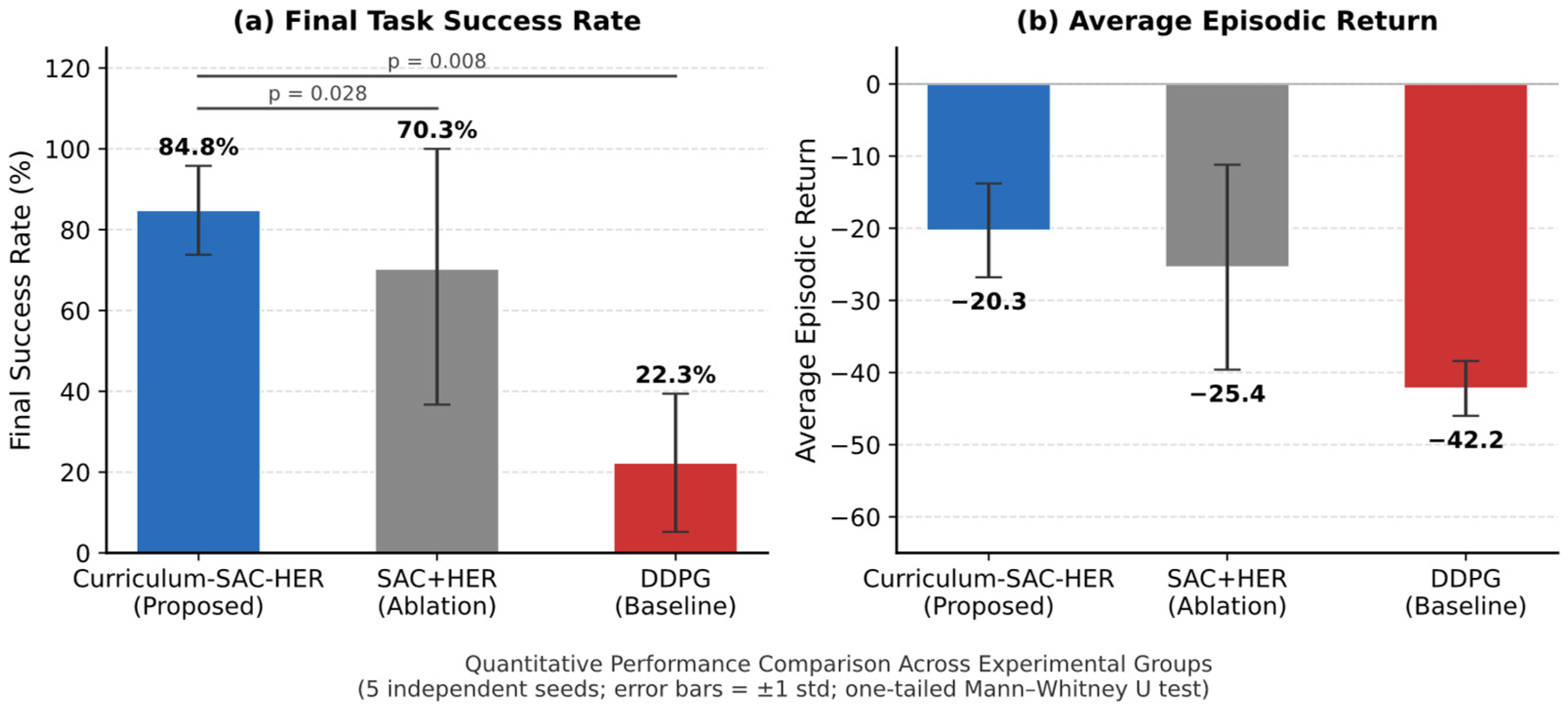
n = 5), we supplement the descriptive statistics with pairwise Mann–Whitney U tests (one-tailed) to confirm that the observed performance differences are not attributable to random seed variation. The comparison between Curriculum-SAC-HER and Standard SAC + HER yields
p = 0.028; the comparison with the DDPG baseline yields
p = 0.008. These results meet the conventional
= 0.05 threshold; however, given the small sample size (N = 5), these
p-values should be interpreted as indicative of superiority rather than definitive statistical proof, as discussed in
Section 3.4.3.
Training Parameters and Implementation Details: To ensure a rigorously fair comparison, all experimental groups share identical core environment parameters and matched foundational hyperparameters wherever algorithmically applicable. The experience replay buffer capacity is set to
transitions for all off-policy algorithms, sufficient to encompass the complete 300,000-step training lifecycle. HER employs the standard future goal selection strategy, with k = 4 relabeled goals per trajectory. Complete hyperparameter settings are provided in
Table 2.
3.3. Simulation Results
This section presents the simulation results for all three evaluated methods. The results are organized as follows:
Section 3.3 first reports comparative training performance across the three groups, followed by a quantitative summary in
Table 3.
Section 3.4 then provides mechanistic analysis of the observed learning dynamics, failure mode diagnosis, and zero-shot robustness evaluation. Together, these two sections correspond to the simulation results and interpretation dimensions that the structured experimental design in
Section 3.1 and
Section 3.2 was designed to assess.
The training-time mean success rate of 84.8% reflects the average of the last five periodic evaluation checkpoints (each computed over 30 deterministic episodes at 10,000-timestep intervals) across five independent seeds. The zero-shot baseline condition reports 94.0% (±9.5%), evaluated over 100 dedicated deterministic episodes per seed using the best-performing saved model checkpoint (best_model.zip) after training completion. The performance gap is attributable to two factors: the difference in evaluation sample size (30 vs. 100 episodes per checkpoint), and the distinction between the time-averaged training metric and the peak-performance best model, both of which are standard reporting conventions in deep reinforcement learning.
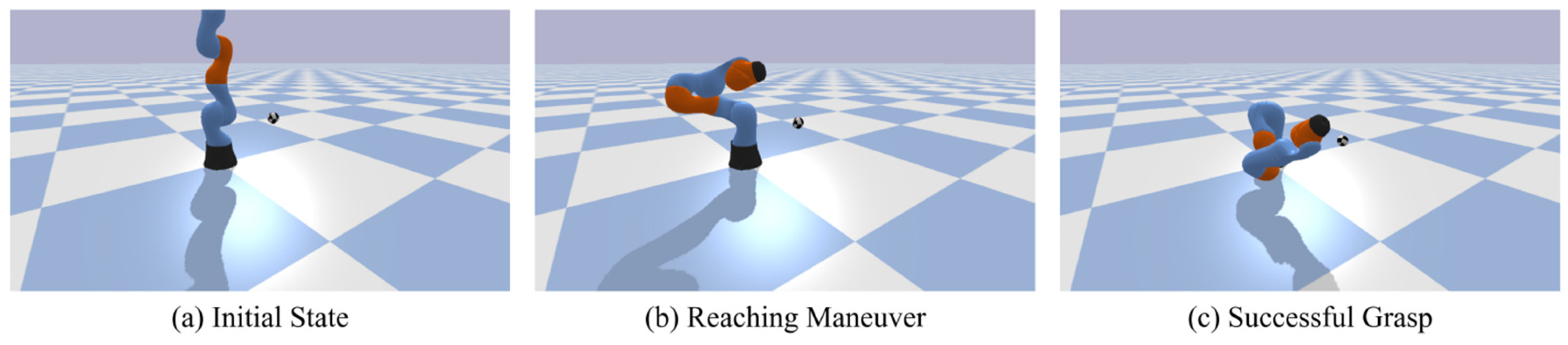
The simulation task execution sequence is illustrated in
Figure 3.
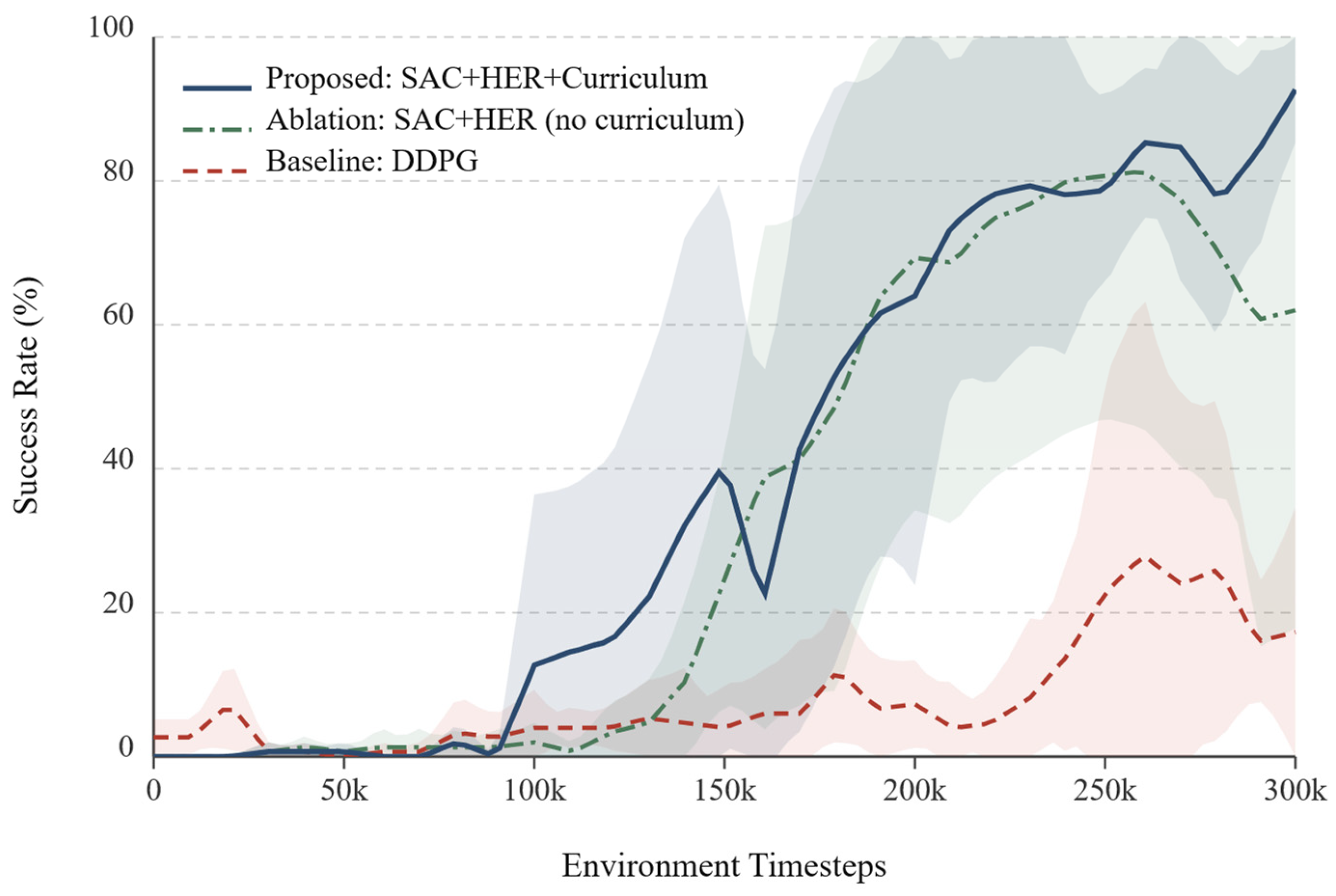
Figure 4 presents the learning curves of all three experimental groups over the full 300,000-timestep evaluation budget. The final performance comparison across all three groups is shown in
Figure 5, and the quantitative summary is provided in
Table 3.
Figure 3.
Visualization of the simulation task execution sequence: (a) initial configuration of the 7-DOF KUKA LBR iiwa manipulator at episode reset; (b) reaching maneuver toward the randomized target position (red sphere, radius 0.05 m); (c) successful task completion upon the end-effector tip entering the target radius. Note that the present study frames the task as a spatial reaching problem rather than object grasping; no physical gripper is mounted, and the end-effector is represented by the terminal link’s tip. Task success is defined solely by the Euclidean distance between the end-effector tip and the target center falling below the 0.05 m threshold.
Figure 3.
Visualization of the simulation task execution sequence: (a) initial configuration of the 7-DOF KUKA LBR iiwa manipulator at episode reset; (b) reaching maneuver toward the randomized target position (red sphere, radius 0.05 m); (c) successful task completion upon the end-effector tip entering the target radius. Note that the present study frames the task as a spatial reaching problem rather than object grasping; no physical gripper is mounted, and the end-effector is represented by the terminal link’s tip. Task success is defined solely by the Euclidean distance between the end-effector tip and the target center falling below the 0.05 m threshold.
Figure 4.
Learning curves of all evaluated methods over 300,000 environment timesteps (5 independent seeds per group; all seeds retained, including failures). The proposed Curriculum-SAC-HER (blue) achieves consistent convergence across all five seeds. The SAC + HER ablation (grey) exhibits extreme divergence: two seeds fail catastrophically (seeds 203 and 201, reaching final success rates of 9.3% and 58.7%, respectively), while three converge successfully—directly demonstrating the cold-start vulnerability of unguided sparse-reward training. The DDPG baseline (red) fails to acquire meaningful goal-directed behavior across the converging seeds. Shaded regions denote one standard deviation across seeds.
Figure 4.
Learning curves of all evaluated methods over 300,000 environment timesteps (5 independent seeds per group; all seeds retained, including failures). The proposed Curriculum-SAC-HER (blue) achieves consistent convergence across all five seeds. The SAC + HER ablation (grey) exhibits extreme divergence: two seeds fail catastrophically (seeds 203 and 201, reaching final success rates of 9.3% and 58.7%, respectively), while three converge successfully—directly demonstrating the cold-start vulnerability of unguided sparse-reward training. The DDPG baseline (red) fails to acquire meaningful goal-directed behavior across the converging seeds. Shaded regions denote one standard deviation across seeds.
Figure 5.
Final performance comparison across three experimental groups (
n = 5 seeds; error bars = ±1 std). Standard DDPG without HER and without curriculum assistance. Convergence defined as the first timestep at which the per-seed success rate stably exceeds the 80% threshold. Wilcoxon rank-sum test (one-tailed,
n = 5): Curriculum-SAC-HER vs. Standard SAC + HER,
p < 0.05; vs. Standard DDPG,
p < 0.05. Having established the training-time superiority of the proposed framework, we next examine whether the learned policy generalizes beyond the training distribution—specifically, whether the kinematic priors instilled by the curriculum confer robustness to unmodeled physical perturbations encountered during zero-shot deployment, as shown in
Figure 6.
Figure 5.
Final performance comparison across three experimental groups (
n = 5 seeds; error bars = ±1 std). Standard DDPG without HER and without curriculum assistance. Convergence defined as the first timestep at which the per-seed success rate stably exceeds the 80% threshold. Wilcoxon rank-sum test (one-tailed,
n = 5): Curriculum-SAC-HER vs. Standard SAC + HER,
p < 0.05; vs. Standard DDPG,
p < 0.05. Having established the training-time superiority of the proposed framework, we next examine whether the learned policy generalizes beyond the training distribution—specifically, whether the kinematic priors instilled by the curriculum confer robustness to unmodeled physical perturbations encountered during zero-shot deployment, as shown in
Figure 6.
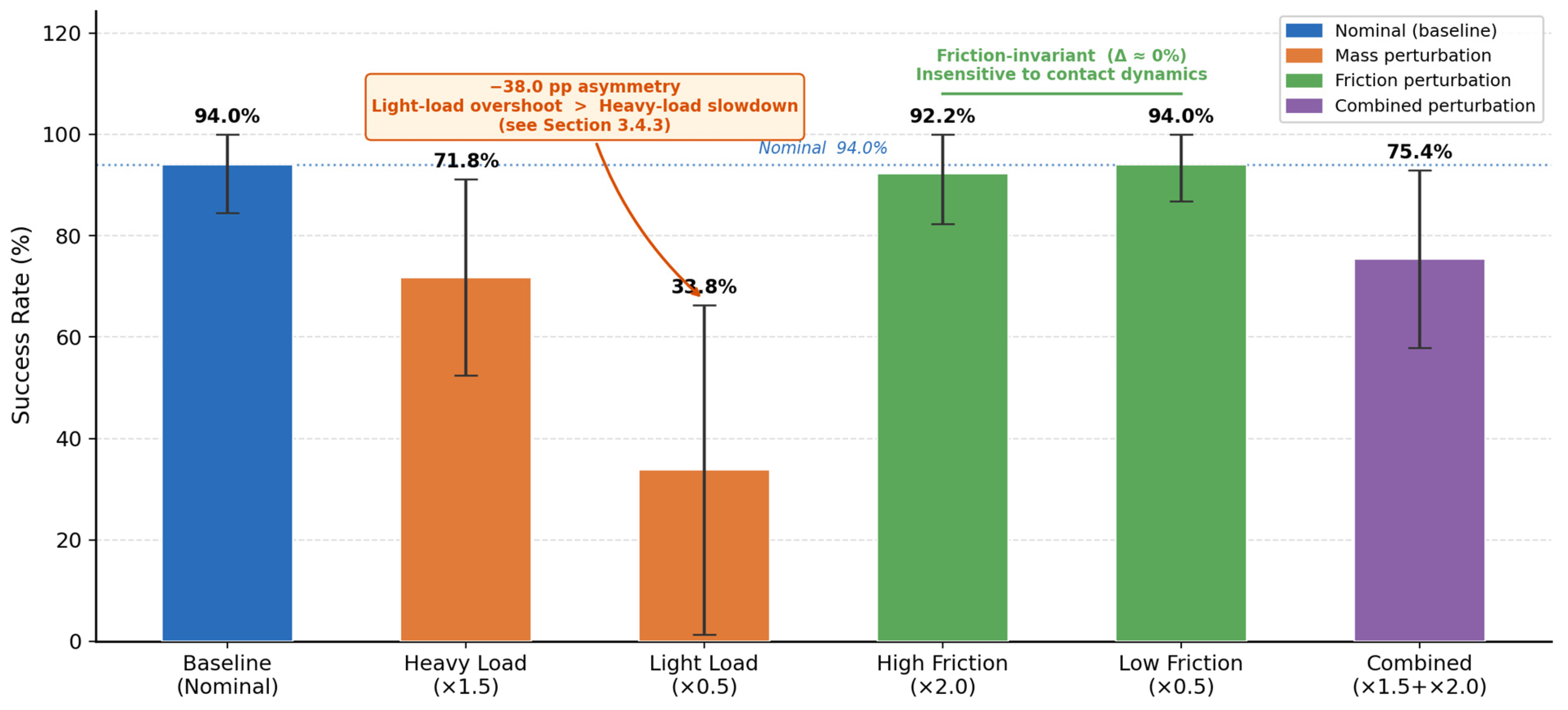
Figure 6.
The parametric robustness evaluation results of the trained Curriculum-SAC-HER policy across six simulated perturbation conditions.
Figure 6.
The parametric robustness evaluation results of the trained Curriculum-SAC-HER policy across six simulated perturbation conditions.
Curriculum-SAC-HER. All five seeds converge within the training budget, with four of five satisfying the three-consecutive-checkpoint stability criterion; the remaining seed (Seed 405) reaches the 80% threshold only at the terminal evaluation checkpoint. A decisive acceleration in learning becomes apparent at approximately 100,000 timesteps, at which point the blue curve initiates a sustained breakout as the curriculum transitions the agent into the global task distribution of Stage 3. The method ultimately converges to a mean final success rate of 84.8% (std: 11.0%), with four of five seeds exceeding 83% and reaching peak performance of 100% during training. Convergence to the 80% threshold is achieved at a mean of approximately 205,000 environment timesteps across the four converging seeds (bootstrap 95% CI: 160,000–252,500 steps), representing a mean sample complexity reduction of approximately 21.2% relative to the Standard SAC + HER ablation (bootstrap 95% CI: 2.9–38.5%). One seed (Seed 405) exhibited delayed convergence, reaching 80% only at the final evaluation checkpoint without satisfying the three-consecutive-checkpoint stability criterion within the 300,000-step budget; the stage-wise mechanistic basis for this efficiency gain is analyzed in
Section 3.4.1. The residual cross-seed variance of ±11.0% reflects a combination of moderate variation in Stage 3 convergence speed across four converging seeds, and one seed (Seed 405) that reached the 80% threshold only at the terminal evaluation checkpoint without satisfying the three-consecutive-checkpoint stability criterion. Critically, no seed exhibits an uninformative value landscape or irrecoverable policy collapse of the kind observed in the ablation group.
Standard SAC + HER (Ablation). The Standard SAC + HER ablation without curriculum guidance (dash–dot grey curve) produces a mean success rate of 70.3% (std: 33.6%). While three seeds eventually converge to high performance (above 90%), two seeds fail entirely—one stagnating permanently at 9.3% due to an uninformative value landscape under sparse rewards, and another collapsing to 58.7% following catastrophic forgetting. The resulting confidence band spans nearly the full success-rate range, from near 0% to near 100% across seeds, and is diagnostic of a policy acquisition process governed by initialization stochasticity rather than a reliable learning mechanism. A detailed failure mode analysis of these specific seed failures is provided in
Section 3.4.2. This instability is a structural consequence of the cold-start problem: in the unconstrained global workspace, whether a seed converges is determined almost entirely by whether its initial weight configuration generates sufficient exploratory variance near the goal region to produce accidental early successes. Seeds that satisfy this condition escape the cold-start trap and eventually achieve high performance; those that do not enter an uninformative value landscape from which recovery within the 300,000-timestep budget is essentially impossible. The ACL module resolves this structurally by guaranteeing goal-proximal trajectories from the first episode, decoupling convergence from initialization luck entirely.
Standard DDPG (no HER, no Curriculum). The Standard DDPG baseline (dashed red curve) fails to acquire meaningful goal-directed behavior across all five seeds, yielding a mean final success rate of 22.3% (std: 17.1%). No seed achieves the 80% convergence threshold within the 300,000-step budget, confirming the structural inadequacy of deterministic exploration under sparse rewards in high-dimensional continuous control.
The quantitative summary is provided in
Table 3. The final success rate improvements of Curriculum-SAC-HER over both baselines are statistically significant: a Wilcoxon rank-sum test (one-tailed,
n = 5 per group) yields
p < 0.05 for both pairwise comparisons, confirming that the observed performance differences are not attributable to random seed variation.
All evaluations are conducted without any fine-tuning or retraining of the policy, and results are reported as the mean and standard deviation over 100 deterministic evaluation episodes per condition across five independent seeds. Under the nominal baseline condition, the policy achieves a success rate of 94.0% (±9.5%), confirming that the trained policy retains strong task performance at inference time—notably higher than the training-time mean of 84.8%, as detailed in the opening paragraph of this section.
Under friction perturbations, the policy demonstrates strong invariance across both directions of modification. A high-friction condition yields a success rate of 92.2% (±9.8%), while a low-friction condition yields 94.0% (±7.2%). The near-complete preservation of performance across both friction perturbations indicates that the learned policy is largely insensitive to contact dynamic variations at the manipulator’s joints within the tested range. It should be noted that this friction invariance is partially attributable to the mild friction domain randomization applied during training (lateral friction sampled from [0.5, 1.2]), rather than being solely a product of the curriculum-induced kinematic generalization. The policy’s maintained performance under friction conditions exceeding the training randomization range is attributable to two mechanisms beyond domain randomization itself. First, the learned policy is fundamentally a kinematic reaching strategy: the SAC agent outputs joint torque commands calibrated to produce goal-directed end-effector displacements, and the sensitivity of this strategy to joint friction depends on whether friction variations produce large-magnitude deviations in end-effector trajectories. Within the tested perturbation range, joint-level friction primarily affects the damping characteristics of individual joints rather than substantially redirecting end-effector motion—an effect that attenuates sensitivity even for out-of-distribution friction values. Second, the SAC maximum-entropy objective explicitly penalizes low-entropy, brittle policies throughout training, encouraging the agent to develop action policies with broader stability margins than a purely reward-maximizing objective would achieve. This entropy regularization produces a degree of implicit robustness that extends beyond the nominal training distribution. Together, these two mechanisms explain why friction invariance generalizes beyond the [0.5, 1.2] training range, and why inertial perturbations—which directly alter the system’s dynamic response to the learned torque commands at the level of joint accelerations—produce the qualitatively distinct asymmetric performance degradation described above.
Under mass perturbations, a pronounced asymmetry emerges between the two perturbation directions. The heavy-load condition (×1.5 nominal payload) produces a moderate but graceful degradation to 71.8% (±19.4%). In contrast, the light-load condition (×0.5 nominal payload) results in a substantially larger performance drop to 33.8% (±32.5%). A detailed control-theory mechanistic basis for this asymmetric sensitivity to payload perturbations is analyzed in
Section 3.4.3.
Under the combined perturbation condition—in which both payload (×1.5) and friction (×2.0) are simultaneously perturbed—the policy achieves a success rate of 75.4% (±17.5%). This result is notably higher than the light-load-only condition, suggesting a partial compensatory interaction between the two perturbation types under the combined condition.
Taken together, the zero-shot robustness results indicate that Curriculum-SAC-HER develops parametric generalization within the simulated environment beyond the nominal training distribution, exhibiting particularly strong invariance to friction perturbations while displaying a directionally asymmetric sensitivity to inertial perturbations.
3.4. Simulation Analysis and Discussion
Building upon the quantitative results presented above, this section provides an in-depth analysis of the underlying mechanisms driving the observed performance disparities. We explicitly discuss the synergistic roles of our Three-Stage Curriculum and Hindsight Experience Replay (HER) in overcoming sparse rewards, analyze the specific failure modes of the baseline algorithms in high-dimensional continuous control, and outline the physical limitations of the current study.
3.4.1. Effectiveness of Curriculum Learning and HER
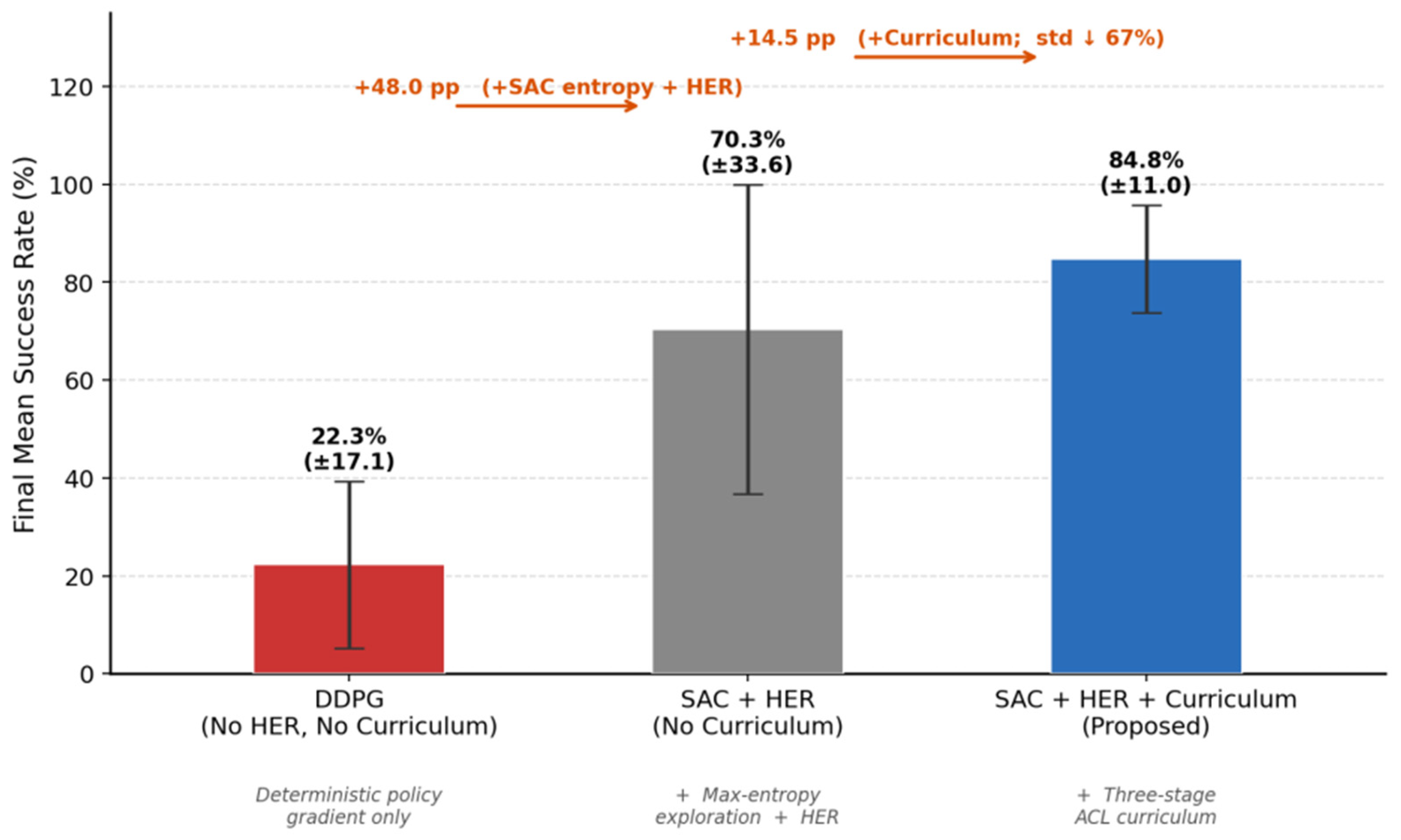
Figure 4 presents the training success rate trajectories of all three experimental groups evaluated against the global task metric over 300,000 environment timesteps. The incremental contribution of each framework component is illustrated in
Figure 7. Three mechanistically distinct phases are identifiable in the learning dynamics, each providing separable evidence for how the integration of progressive curriculum learning and HER resolves the cold-start problem and achieves superior sample efficiency relative to both baseline configurations.
Phase I—The Hidden Investment (0–100 k Steps). In the initial 100,000 timesteps, both Curriculum-SAC-HER and Standard SAC + HER register near-zero success rates on the global task metric—a superficial similarity that masks a fundamental divergence in the underlying learning process. For Standard SAC + HER, this plateau is consistent with genuine cold-start stagnation. Deployed directly into the full global workspace without staged task decomposition, the agent’s entropy-regularized exploration generates trajectories that intersect the sparse goal region with negligible probability. Critically, this absence of incidental successes starves the HER mechanism of the trajectories it requires to construct informative hindsight transitions. Without a positive reward signal to relabel, the replay buffer accumulates nearly exclusively uninformative negative transitions, the critic converges toward a near-uniform value landscape, and the actor cannot form coherent directional policy gradients. HER’s sample efficiency advantage is therefore rendered latent—theoretically present but practically inaccessible in the absence of any goal-proximal experience. For Curriculum-SAC-HER, however, the global-task metric is a structurally misleading performance indicator during this window. The agent is not attempting the global task; it is mastering Stage 1 local sub-goals within a proximal bounding box of meters. This physical restriction of the initial target distribution is the mechanism by which the curriculum directly resolves the cold-start problem: the narrow target volume substantially elevates the probability of the randomly exploring end-effector intersecting the goal region, reliably generating high-quality success trajectories from the earliest episodes of training. These trajectories immediately populate the HER replay buffer with informative hindsight transitions, activating HER’s retrospective relabeling mechanism from the outset rather than leaving it idle. The actor network consequently begins accumulating a structured kinematic prior—a distributed representation of arm geometry, joint-space feasibility, and end-effector spatial correspondence—that would be entirely absent from a randomly initialized policy confronting the sparse global task directly. This constitutes the core sample efficiency advantage of Phase I: the curriculum bootstraps HER, and HER amplifies the informativeness of every collected transition, transforming an otherwise empty learning signal into a dense gradient stream.
Phase II—Breakout and Knowledge Transfer (~100–150 k Steps). The divergence between the two methods becomes unambiguous at approximately 100,000 timesteps, where the Curriculum-SAC-HER curve (solid blue) initiates a decisive breakout, ascending to approximately 38% success, while the Standard SAC + HER curve (dash–dot grey curve) remains near zero across its non-converging seeds. This asymmetry in emergence timing directly demonstrates that the kinematic prior accumulated during Stages 1 and 2 provides a substantive initialization advantage at the point of global-task exposure—an advantage that undirected exploration cannot replicate within the same timestep budget. The synergistic contribution of HER is particularly evident during the Stage 2 transition: as the target volume expands to , the agent’s Stage 1 reaching trajectories systematically generate near-miss experiences at the boundaries of the new distribution. HER converts these near-misses into informative virtual successes, sustaining a continuous gradient signal across the expanded workspace without requiring additional completed goal-reaching episodes. This mechanism—curriculum-structured exploration supplying near-miss data and HER converting near-misses into constructive gradient signals—collectively accounts for a mean sample complexity reduction of 21.2% relative to Standard SAC + HER ((260−205 k)/260 k ≈ 21.2%, bootstrap 95% CI: 2.9–38.5%), where 205,000 steps represent the mean convergence timesteps across the four seeds satisfying the stability criterion.
At approximately 125,000 timesteps, corresponding to the transition into Stage 3 where the target bounding box expands to its maximum operational extent () and the full global workspace is activated, the blue curve undergoes a transient regression to approximately 20%. This sudden expansion in spatial task difficulty—exposing the policy to goal positions across the full operational volume for the first time—is precisely what causes the temporary performance dip, as the policy must adapt its previously learned spatial representations to a strictly harder goal distribution. Rather than undermining the curriculum’s value, however, this dip is precisely what a knowledge transfer hypothesis predicts: a bounded, momentary performance cost that tests the transferability of the accumulated kinematic prior. The subsequent recovery—from 20% to approximately 85% within 50,000 steps—confirms that the agent adapts a pre-formed geometric prior rather than relearning task structure from scratch, and indicates that the kinematic representations accumulated during Stages 1 and 2 are sufficiently general to support rapid fine-tuning under the expanded distribution.
Phase III—Variance as the Definitive Discriminator (150–300 k Steps). In the final phase, Standard SAC + HER eventually produces a mean success rate of approximately 70.3%, which might superficially appear competitive with Curriculum-SAC-HER’s 84.8%. The definitive discriminator, however, is not the mean but the variance. The confidence band surrounding the grey curve—a standard deviation of ±33.6% spanning nearly the full success-rate range—is diagnostic of a policy acquisition process governed by initialization stochasticity rather than a reliable learning mechanism. Without structured sub-goals to constrain early exploration, whether a given seed converges is determined almost entirely by whether its initial weight configuration happens to generate trajectories that accidentally contact the sparse goal region and bootstrap HER. Seeds that miss this initialization-dependent convergence accumulate no meaningful gradient signal and converge to degenerate or catastrophically unstable policies. Curriculum-SAC-HER achieves a cross-seed standard deviation of ±11.0% under identical evaluation conditions—a 67% compression of variance in point-estimate terms relative to Standard SAC + HER (±33.6% → ±11.0%), though the small sample size (N = 5) precludes a statistically precise characterization of this variance ratio—demonstrating that the curriculum’s structured progression substantially decouples final policy quality from initialization luck.
It should be noted that this residual ±11.0% variance does not reflect catastrophic failure: no seed exhibits the uninformative value landscape under sparse rewards or irrecoverable policy collapse observed in the ablation group. Rather, it reflects moderate variation in Stage 3 convergence speed, arising from stochastic differences in the timing at which individual seeds satisfy the Stage 2 advancement criterion and thereby enter the global task distribution with differing remaining timestep budgets. At the extreme spatial boundaries of the Stage 3 global workspace, goal-proximal trajectory density is inherently lower, producing minor instability for seeds that transition to Stage 3 later in the training lifecycle. This distinction is consequential for interpreting the framework’s reliability: the ACL module converts the catastrophic, irrecoverable failure variance of the ablation into moderate, bounded convergence-speed variance—a qualitatively superior outcome for practical deployment.
Taken together, the three phases establish a coherent and complete mechanistic account: curriculum learning resolves the cold-start problem by guaranteeing non-trivial HER signals from the first training episode; HER amplifies sample efficiency by extracting constructive gradient information from near-miss trajectories at each stage boundary; and the performance-driven stage transition criterion ensures that each spatial expansion occurs only after the prior distribution is fully consolidated, preventing catastrophic forgetting and compressing cross-seed variance to a moderate, recoverable regime.
3.4.2. Failure Analysis of Standard Baselines
The failure modes of the two baseline configurations are mechanistically distinct and, taken together, precisely delineate the theoretical gap that Curriculum-SAC-HER is designed to close. Analyzing these failures separately provides a rigorous account of why each component of the proposed framework—the curriculum scheduler, HER, and their integration—is a necessary rather than incidental design choice.
The Structural Failure of DDPG. The standard DDPG rapidly plateaus at approximately 22.3% mean success and exhibits no statistically meaningful upward trend for the remainder of the 300,000-step budget. This outcome is structurally inevitable given the algorithm’s exploration mechanism. DDPG’s deterministic policy gradient relies on additive stochastic perturbations—typically Ornstein–Uhlenbeck process noise—to drive exploration. In a 7-DOF continuous joint space, the measure of trajectories that such temporally correlated, narrow-band noise can generate is severely constrained relative to the full configuration manifold. The probability of an Ornstein–Uhlenbeck-perturbed deterministic policy generating an end-effector trajectory that intersects the sparse goal region is, in practice, vanishingly small.
Consequently, the critic receives a near-uniformly negative reward signal across virtually all collected transitions. Without discriminative gradient information, the Bellman update cannot differentiate the value of goal-directed from goal-absent actions, causing the critic to converge toward a near-uniform value landscape. The actor, receiving a flat policy gradient, does not learn to freeze in order to minimize the step penalty—under the strictly sparse reward function ( for every non-success timestep), a stationary arm accumulates the maximum possible cumulative penalty and therefore cannot be interpreted as a cost-minimizing strategy. Rather, the observed oscillatory and near-static arm motions are symptomatic of an actor that receives no informative gradient signal from a collapsed critic, defaulting to low-magnitude, stochastic outputs governed by weight initialization noise rather than any acquired goal-directed competency. The residual 22.3% mean success rate most plausibly reflects the small fraction of episodes in which the robot’s initial joint configuration places the end-effector within geometric proximity of the spawned goal, rather than any learned reaching skill—a conclusion consistent with the high per-seed variance (std: 17.1%) that would be expected if success is determined by episode initialization geometry rather than policy quality.
The initialization-dependent convergence of Standard SAC + HER: The failure of Standard SAC + HER is mechanistically distinct from, and theoretically more informative than, the DDPG collapse. SAC’s maximum-entropy objective constitutes a theoretically superior exploration strategy, and the eventual mean success rate of 70.3% across surviving seeds confirms that entropy-regularized exploration is, in principle, sufficient for this task. The critical failure is not algorithmic inadequacy but structural fragility: the utility of both SAC’s entropy bonus and HER’s hindsight relabeling is entirely contingent on the agent’s initial trajectories bearing some geometric proximity to the goal region.
This contingency exposes the cold-start problem in its most acute form. In the full global workspace of the 7-DOF task, with target positions uniformly distributed across a volume of approximately cubic meters, the probability that an undirected maximum-entropy policy generates end-effector trajectories that intersect the 0.05 m success radius is negligibly small. HER’s retrospective relabeling mechanism, which depends on observed episode states to construct virtual goals, is consequently starved of the incidental near-success trajectories it requires to generate informative hindsight transitions. Without such transitions, the HER-augmented replay buffer remains populated almost exclusively with uniformly negative transitions, the critic value landscape converges toward a near-uniform uninformative state, and the actor cannot form coherent goal-directed gradients—the same collapse mechanism as DDPG, despite the fundamentally stronger exploration framework.
Whether a given seed escapes this cold-start trap is determined almost entirely by whether its initial weight configuration generates sufficient exploratory variance near the goal region to produce even a single accidental success within the first tens of thousands of timesteps. Seeds that satisfy this condition—Seeds 202, 204, and 205—bootstrap a positive learning cycle in which HER constructs increasingly informative transitions, the critic develops a meaningful value gradient, and the actor converges to high performance. Seeds that do not—Seed 203 (final: 9.3%) and Seed 201 (final: 58.7%, following catastrophic forgetting at 230 k steps)—receive no such bootstrap signal and either stagnate permanently or collapse after transient convergence.
These two seeds represent mechanistically distinct failure modes. Seed 203 exhibits permanent stagnation from the outset: the initial weight configuration fails to generate any goal-proximal trajectories, HER receives no informative transitions to relabel, and the critic converges to a near-uniform uninformative value landscape from which recovery within the 300,000-step budget is essentially impossible. Seed 201, by contrast, achieves transient convergence to approximately 85% success before collapsing at approximately 230,000 timesteps—a qualitatively different trajectory consistent with catastrophic interference in the critic network. In the absence of curriculum structure, the Standard SAC + HER agent operating in the full global workspace encounters a non-stationary transition distribution throughout training: as the policy improves, the distribution of states near the goal shifts substantially, producing large gradient magnitudes in the critic update that can overwrite previously learned value estimates. For Seed 201, we hypothesize that this non-stationarity—compounded by the absence of stable kinematic priors from early training—produced a period of apparent convergence followed by destabilization of the critic’s value estimates as new regions of the workspace were explored in later training. Once the critic’s value landscape becomes corrupted in this manner, the actor loses coherent directional gradient signals and reverts toward uninformative behavior.
This mechanism is precisely what the replay buffer retention policy in Curriculum-SAC-HER structurally prevents: by maintaining early-stage kinematic transitions in the buffer across all stage boundaries, the critic continues to receive gradient signals from stable, low-difficulty transitions that function as an implicit value anchor, preventing the landscape corruption observed in Seed 201. This bifurcation mechanism generates the observed ±33.6% standard deviation, which spans nearly the full success-rate range and is the quantitative signature of a learning process governed by initialization luck rather than algorithmic reliability. Future strategies to mitigate this initialization sensitivity without curriculum-based intervention include warm-start initialization using pre-trained sub-goal-reaching policies, population-based training across diverse initializations with selective pressure toward early successes, and learned difficulty estimators that dynamically adjust goal sampling based on online performance signals—each of which targets the cold-start vulnerability at its structural root.
Structural Resolution via Curriculum-SAC-HER: The Curriculum-SAC-HER framework addresses both failure modes at their theoretical root through a single architectural intervention: spatially constraining the initial target distribution. By restricting Stage 1 targets to a proximal bounding box of meters, the curriculum scheduler eliminates the geometric lottery entirely. Every seed, regardless of weight initialization, is guaranteed to generate end-effector trajectories that intersect the goal region within the first episodes of training. HER immediately receives the high-quality success trajectories it requires to construct informative hindsight transitions, bootstrapping a stable positive learning cycle from the outset. This architectural guarantee transforms what is, under Standard SAC + HER, a stochastic initialization-dependent process into a deterministic stage-wise skill acquisition progression.
Equally importantly, the performance-driven stage transition criterion—advancement only upon over a 100-episode sliding window—ensures that the kinematic prior accumulated in Stage 1 is fully consolidated before the goal distribution expands. This prevents premature exposure to harder distributions that would otherwise reintroduce the cold-start vulnerability at each stage boundary. The empirical consequence is a compression of cross-seed variance from ±33.6% under Standard SAC + HER to ±11.0% under Curriculum-SAC-HER, with one seed (Seed 405) failing to satisfy the three-consecutive-checkpoint stability criterion, and no seed exhibiting catastrophic collapse of the kind observed in the ablation group—demonstrating that structured geometric progression is the critical missing component in applying sparse-reward deep reinforcement learning to high-dimensional continuous manipulation.
3.4.3. Limitations and Future Work
Despite the demonstrated efficacy of Curriculum-SAC-HER within the simulated environment, two principal limitations define the current scope of this work and motivate concrete directions for future research. These limitations are not incidental but structurally inherent to the simulation design, and their honest characterization is essential for contextualizing the zero-shot robustness results reported in
Section 3.3.
Limitation 1: Inertial Sensitivity and the Boundaries of the Learned Dynamic Prior: The zero-shot robustness evaluation in
Section 3.3 reveals a pronounced and physically meaningful asymmetry in the policy’s response to payload perturbations: performance degrades moderately but gracefully to 71.8% under a 1.5× mass increase, while a 0.5× mass reduction produces a disproportionately larger performance drop to 33.8%, characterized by end-effector overshoot rather than positional inaccuracy. This asymmetry warrants a mechanistic interpretation grounded in qualitative inertial dynamics reasoning.
The SAC maximum-entropy training objective, operating exclusively under the nominal inertial properties of the KUKA LBR iiwa arm throughout the curriculum, is hypothesized to converge toward a conservative, deceleration-biased torque policy: one that applies cautious approach profiles that, under nominal inertial conditions, reliably arrest end-effector motion within the success radius. This behavioral prior is a rational consequence of entropy maximization in a sparse-reward setting—the agent is incentivized to develop cautious, high-certainty approach trajectories that reliably satisfy the 0.05 m success threshold, rather than aggressive, high-velocity motions that risk overshooting the sparse goal region.
Under a 1.5× payload increase, the same torque commands—calibrated under nominal inertial conditions—produce reduced joint accelerations, slowing end-effector motion and increasing the number of timesteps required to reach the target. For the subset of trajectories where this slowdown remains within the 500-timestep episode budget, the conservative approach profile retains sufficient directional accuracy to complete the task, resulting in moderate but graceful degradation to 71.8%. Beyond the 1.5× threshold, the absolute torque ceiling of the manipulator prevents the policy from generating sufficient joint torques to overcome the increased gravitational loading, causing the success rate to plateau at approximately 13% as shown in
Figure 6.
Under a 0.5× payload reduction, however, the same conservative torque profile is applied to a system with substantially lower inertia, generating excess kinetic energy relative to the learned deceleration model. The lighter end-effector overshoots the target zone, and the policy’s learned stopping behavior—calibrated for a heavier load—cannot arrest the trajectory within the 0.05 m success radius. The resulting high variance (±32.5%) under light-load conditions reflects the sensitivity of overshoot magnitude to the specific trajectory geometry and approach angle across evaluation episodes. This behavioral asymmetry indicates that the current framework acquires a highly task-specific dynamic prior during curriculum training, rather than a load-agnostic kinematic policy.
Future work will address this limitation by incorporating online inertial parameter estimation as an auxiliary input to the policy network, enabling the agent to condition its deceleration profile on real-time estimates of end-effector inertia. Additionally, adaptive entropy scheduling—modulating the SAC temperature parameter α in response to detected inertial mismatch—represents a promising direction for improving robustness under bidirectional payload perturbations without sacrificing nominal performance. A related concern is that the uniform −1 step penalty without smoothness regularization means that the learned policy is not verified to produce smooth torque trajectories; future work will incorporate torque-rate penalty terms of the form prior to any hardware deployment.
Limitation 2: Simulation Fidelity and the Sim-to-Real Gap: The entirety of the present study was conducted within the PyBullet physics engine, which, while providing a tractable and reproducible experimental platform, introduces several categories of abstraction that bound the validity of the parametric robustness evaluation conclusions. As comprehensively documented by Zhao et al. [
18] in their survey of sim-to-real transfer methods—including domain randomization, domain adaptation, and meta-learning—the gap between simulated and real-world dynamics consistently degrades policy performance upon hardware deployment, and closing this gap remains an active frontier in DRL-based robotics research.
Most critically, PyBullet models joint torque control as an idealized, instantaneous actuation process operating at a simulation frequency of 240 Hz, with the high-level DRL policy executing at 60 Hz via an action repeat of 4. In contrast, real KUKA LBR iiwa hardware employs a 1 kHz joint-level servo control loop—a four-fold increase in temporal resolution relative to the simulated policy’s effective control frequency. This discrepancy means that the simulated policy executes at a substantially coarser timescale than a physically deployed system, potentially masking high-frequency dynamic instabilities that would manifest only on real hardware.
Beyond control frequency, the simulation omits two categories of physical non-linearity that are known to substantially degrade policy transfer in practice. First, actuator latency—the 1–3 ms communication delay between the high-level policy and the joint-level servo—introduces a systematic lag between commanded and executed torques that the policy has no mechanism to anticipate or compensate for in the current formulation. Second, joint backlash—the mechanical compliance arising from gear train elasticity in the iiwa’s harmonic drive actuators—introduces position hysteresis at direction reversals that is entirely absent from the simulated observation pipeline. Both effects produce stochastic perturbations in the effective state trajectory that the current proprioceptive state vector cannot represent, creating a systematic mismatch between the state distributions encountered during simulation training and physical deployment. Furthermore, actuator latency and gear compliance in physical hardware introduce partial observability not captured by the current MDP formulation, motivating future POMDP-based or history-conditioned policy extensions in which the agent conditions its actions on a fixed-length history of proprioceptive observations rather than the instantaneous state vector alone.
Future work will address the Sim-to-Real gap through two complementary approaches. First, comprehensive Domain Randomization will be embedded directly within each curriculum stage during training, randomizing physical parameters including link masses, joint damping coefficients, and actuator gains and—critically—introducing time-correlated control noise models that simulate actuator latency and gear compliance across episodes. This approach aims to produce policies with sufficient distributional robustness for direct zero-shot deployment on physical 7-DOF hardware, bypassing the need for environment-specific fine-tuning. Second, the simulation environment will be upgraded to model actuator dynamics explicitly, including first-order lag models for motor response and backlash hysteresis for the harmonic drive joints, to reduce the fidelity gap at the source. To provide specificity regarding the proposed domain randomization strategy, the following physical parameters will be targeted in future work, selected based on documented sources of simulation-to-hardware mismatch for the KUKA LBR iiwa platform. Link masses will be randomized within ±15% of nominal URDF values, expanding the current training range of ±10% to encompass manufacturing tolerances and unmodeled payload attachment variability. Joint damping coefficients will be randomized within [0.3×, 1.5×] of nominal values, reflecting viscous damping uncertainty arising from harmonic drive gear train lubrication variability in the iiwa’s series-elastic actuators. Actuator gain perturbations will be randomized within ±20% of nominal values, modeling the controller parameter uncertainty inherent in hardware deployment without prior system identification. Control latency will be injected as a uniform random delay sampled from [0, 3] ms per timestep, simulating the communication delay between the high-level DRL policy and the iiwa’s joint-level Fast Research Interface (FRI) servo loop operating at 1 kHz. Finally, zero-mean Gaussian observation noise will be added to joint angle and angular velocity measurements (
σ = 0.01 rad and
σ = 0.05 rad/s, respectively), reflecting the encoder resolution limits of the iiwa’s optical joint sensors. These parameter ranges are informed by publicly available KUKA LBR iiwa technical specifications and prior sim-to-real transfer studies on comparable high-DOF platforms [
18], and collectively target the principal sources of dynamic mismatch between the PyBullet simulation model and physical iiwa hardware.
Limitation 3: Obstacle-Free Workspace and Perception Constraints: The current state representation and reward formulation presuppose an unobstructed operational volume, constraining the framework’s direct applicability to structured, free-space environments. The agent’s proprioceptive-only state vector
provides no exteroceptive spatial awareness, rendering the policy incapable of reasoning about environmental geometry beyond the end-effector goal position. Practical manipulation tasks in industrial and assistive robotics settings routinely occur in cluttered workspaces where collision avoidance is a co-equal objective alongside goal reaching. Future curriculum designs will incorporate progressive intermediate stages populated with static and subsequently dynamic obstacles, building upon DRL frameworks for collision-avoidance trajectory planning under uncertain constraints [
17], necessitating a transition from the current direct state extraction paradigm to the integration of exteroceptive spatial perception—specifically, depth image observations or point cloud encodings from simulated RGB-D sensors—alongside the existing proprioceptive state. Collision-penalty terms will be incorporated into the reward structure to provide explicit safety constraints, and the curriculum advancement criterion will be extended to require simultaneous satisfaction of both goal-reaching and collision-free trajectory objectives. This extended framework constitutes a principled roadmap toward Curriculum-SAC-HER deployment in realistic, cluttered manipulation scenarios involving compliant grasping and dynamic obstacle avoidance.
Limitation 4: Statistical Power and Seed Sample Size: The central empirical claim of this framework does not rest on mean performance comparisons, but on the structural compression of cross-seed variance: from ±33.6% under Standard SAC + HER—a range spanning nearly the full success-rate spectrum, diagnostic of a learning process governed by initialization stochasticity—to ±11.0% under Curriculum-SAC-HER, with no seed exhibiting catastrophic collapse. The reported p-values (p = 0.028, p = 0.008) are provided as supplementary indicators only. With N = 5 seeds per group, the Wilcoxon rank-sum test produces a highly discretized p-value distribution; these values should therefore not be interpreted as definitive proof of mean superiority. Future work will replicate findings across N ≥ 10 seeds with bootstrap confidence intervals to establish statistically robust conclusions.
Limitation 5: Incomplete Ablation of Baseline Configurations. The DDPG baseline evaluated in this work does not incorporate HER, as the primary intent was to establish a lower bound demonstrating the structural inadequacy of deterministic exploration under sparse rewards. A complete ablation including DDPG + HER would more precisely isolate the independent contribution of the SAC maximum-entropy objective from that of hindsight relabeling; this comparison is deferred to future work with an expanded computational budget.