A Geometry-Based Design Methodology for Fair Topology Comparison of Rotary Traveling Wave Oscillators

Abstract
1. Introduction
2. Geometry-Based Design Framework
2.1. State of the Art and Problem Statement
- Avoid excessive use of thin metal layers;
- Avoid overlapping structures across different metal layers;
- Minimize abrupt geometric discontinuities;
- Optimize via arrangement and stacking in the Möbius crossover depending on the technology.
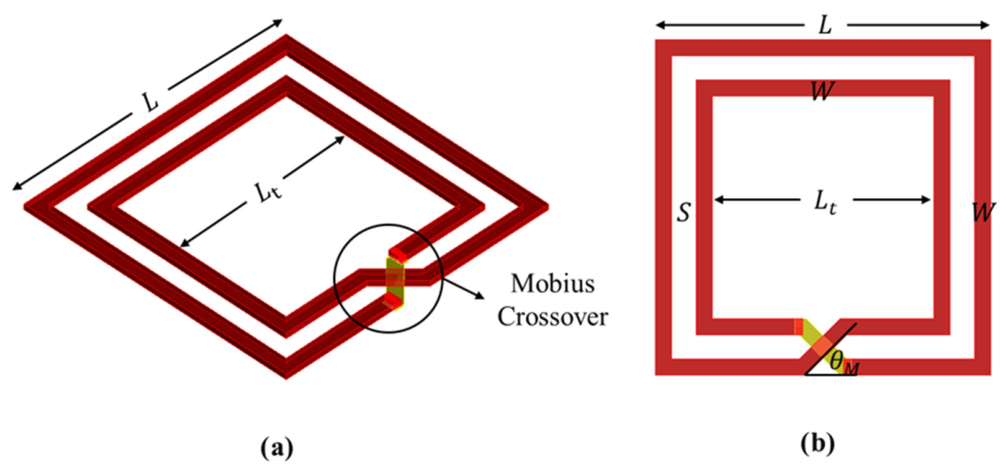
2.2. Structure of the Rotary Traveling Wave Oscillator
2.3. Geometric Analysis of RTWOs with Polygonal Resonators
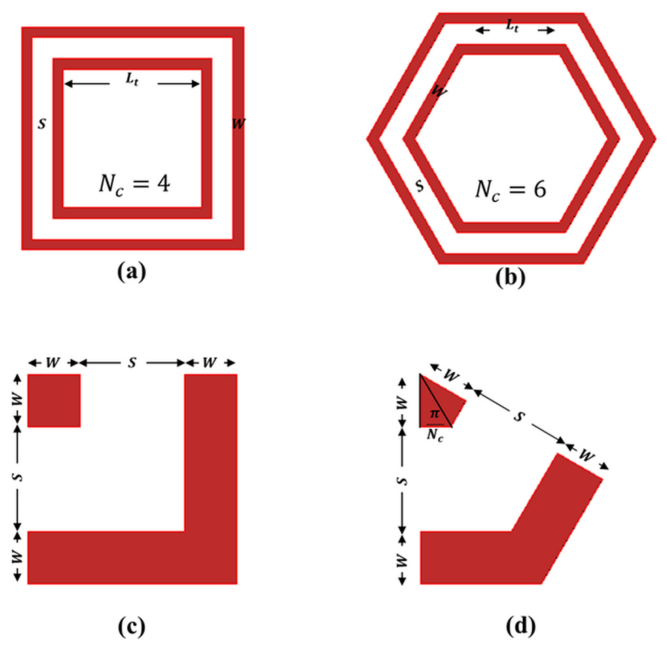
2.3.1. Integration Area of RTWOs with Polygonal Resonators
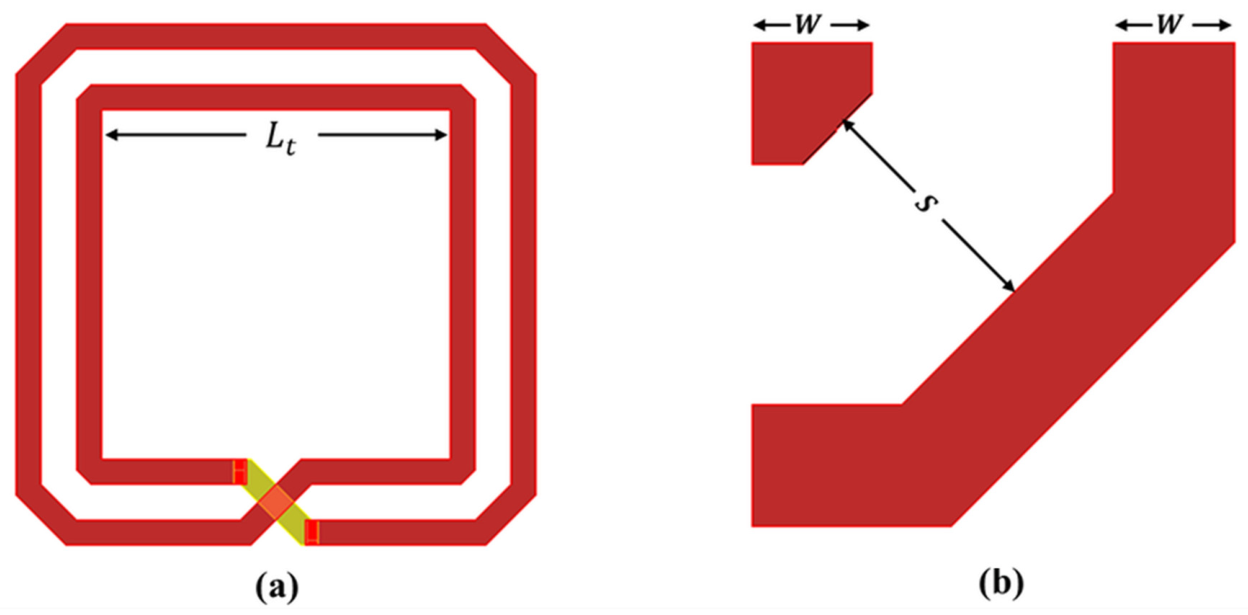
2.3.2. Geometric Analysis of an RTWO with a Square Resonator with 45° Beveled Corners
3. Comparative Analysis of RTWO Topologies
3.1. Operating Principles
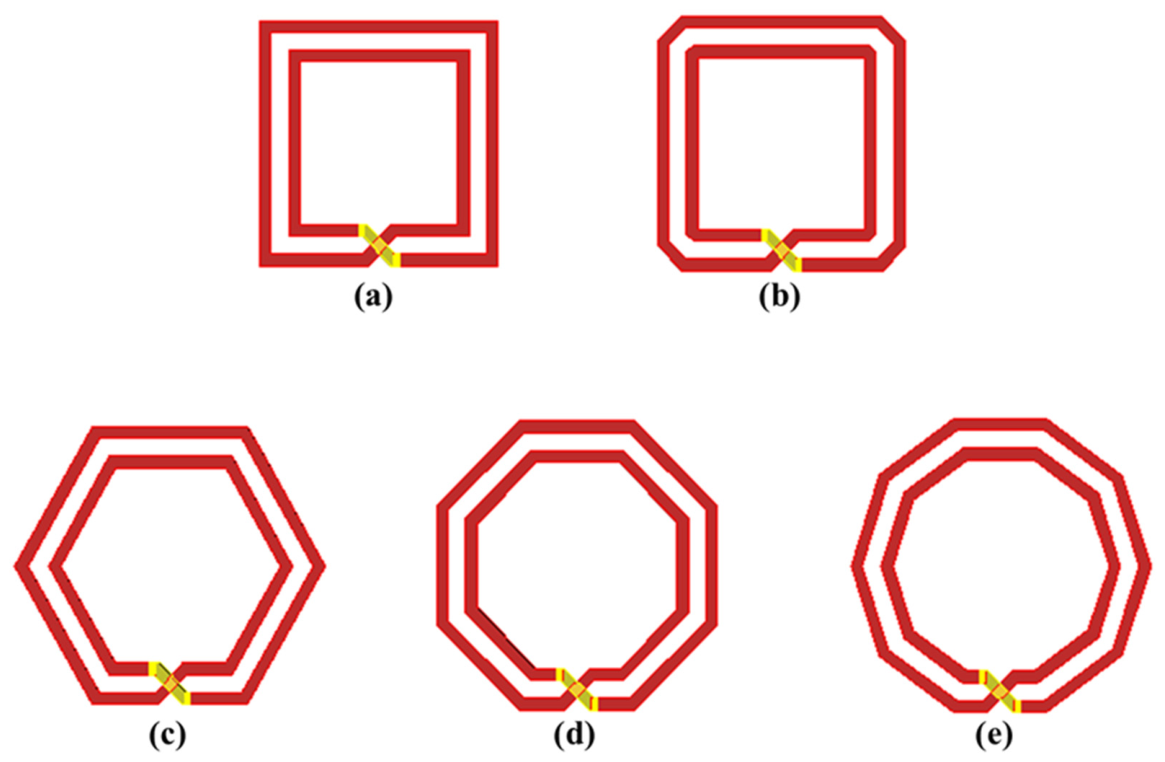
3.2. Geometric Comparison of RTWOs
3.2.1. Electrical Comparison of RTWOs
3.2.2. Performance Comparison of RTWOs
4. Discussion
5. Conclusions
Author Contributions
Funding
Data Availability Statement
Acknowledgments
Conflicts of Interest
References
- Varela, M.C.J.P.A.; Aranda, M.L.; Arteaga, R.S.M. Derivation of the frequency equation for an RTWO oscillator based on its geometry and topology in CMOS technology. In Proceedings of the 22nd International Conference of Electrical Engineering, Computing Science and Automatic Control (CCE); IEEE: New York, NY, USA, 2025. [Google Scholar] [CrossRef]
- Leo, A.; Bramanti, A.P.; Giusti, D.; Quaglia, F.; Maruccio, G. Reconfigurable Split Ring Resonators by MEMS-Driven Geometrical Tuning. Sensors 2023, 23, 1382. [Google Scholar] [CrossRef] [PubMed]
- Hershenson, M.; Hajimiri, A.; Mohan, S.S.; Boyd, S.P.; Lee, T.H. Design and Optimization of LC Oscillators. In Proceedings of the IEEE/ACM International Conference on Computer-Aided Design (ICCAD); IEEE: New York, NY, USA, 1999; pp. 65–69. [Google Scholar]
- Andreani, P.; Bevilacqua, A. Harmonic Oscillators in CMOS—A Tutorial Overview. IEEE Open J. Solid-State Circuits Soc. 2021, 1, 2–17. [Google Scholar] [CrossRef]
- Wood, J.; Edwards, T.C.; Lipa, S. Rotary traveling-wave oscillator arrays: A new clock technology. IEEE J. Solid-State Circuits 2001, 36, 1654–1665. [Google Scholar] [CrossRef]
- Hu, X.; Dai, Y.; Zhang, H.; Zhou, J.; Chen, K. Rotary traveling-wave oscillator design using 0.18 μm CMOS. J. Semicond. 2010, 31, 065009. [Google Scholar] [CrossRef]
- Sun, F.; Zhou, Y.; Bai, Z.; Chen, Y. A 190.3-dBc/Hz FoM 16-GHz rotary travelling-wave oscillator with reliable direction control. Electron. Lett. 2021, 57, 209–211. [Google Scholar] [CrossRef]
- Takinami, K.; Walsworth, R.; Osman, S.; Beccue, S. Phase-noise analysis in rotary traveling-wave oscillators using simple physical model. IEEE Trans. Microw. Theory Tech. 2010, 58, 1465–1474. [Google Scholar] [CrossRef]
- Takinami, K.; Walsworth, R. Phase error calibration technique for rotary traveling-wave oscillators. IEEE J. Solid-State Circuits 2010, 45, 2433–2444. [Google Scholar] [CrossRef]
- Aidoo, M.; Harouna, M.; Homaifar, A.; Dogan, N.S.; Xie, Z.; Savci, H.; Roblin, P. Multi-objective optimization of rotary travelling wave oscillator (RTWO) with neuro-genetic nondominated sorting algorithm. In Proceedings of the IEEE International Wireless Symposium (IWS), Beijing, China, 14–18 April 2013. [Google Scholar] [CrossRef]
- Jang, S.-L.; Lin, Z.-J.; Juang, M.-H. State-of-the-art VCO with eight-shaped resonator-type transmission line. Electronics 2025, 14, 2322. [Google Scholar] [CrossRef]
- Sanabria, C.A.D. Investigación Del Efecto de Discontinuidades de Interconexiones en el Funcionamiento de Osciladores Resonantes RTWO Con Tecnologías CMOS Nanométricas. Doctoral Dissertation, Instituto Nacional de Astrofísica, Óptica y Electrónica (INAOE), Puebla, Mexico, 2020. [Google Scholar]
- Higuera, R.M. Caracterización de Osciladores Resonantes en Tecnología CMOS. Master’s Thesis, Instituto Nacional de Astrofísica, Óptica y Electrónica (INAOE), Puebla, Mexico, 2017. [Google Scholar]
- Aidoo, M.; Dogan, N.S.; Xie, Z.; Savci, H.; Roblin, P. A power-aware rotary traveling wave oscillator (RTWO) design in 0.18 μm CMOS. In Proceedings of the IEEE MTT-S International Microwave Symposium (IMS), Tampa, FL, USA, 1–6 June 2014. [Google Scholar] [CrossRef]




| Refs. | Main Objective | Design Approach | Topology Treatment | Geometry Consideration | Fair Comparison Capability |
|---|---|---|---|---|---|
| [2] | Geometrical tuning of resonant structures | Electromagnetic and geometrical modeling | Explicit | Explicit | Not addressed |
| [5] | Introduction of RTWO concept | Distributed LC-based oscillator | Implicit | Limited | Not addressed |
| [6] | CMOS implementation of RTWO | Circuit-level design | Fixed topology | Limited | Not addressed |
| [7] | Directional control and stability | Circuit-level enhancement | Limited | Limited | Not addressed |
| [8,9] | Phase noise analysis and reduction | Analytical and circuit-level modeling | Not explicitly | Not considered | Not addressed |
| [10,12] | Performance optimization | Optimization-based design | Limited | Indirect | Not addressed |
| [11] | Advanced resonator layout for noise reduction | Transformer-based resonator design | Specific topology | Explicit | Not addressed |
| This Work | Fair topology Comparison methodology for RTWOs | Geometry-based parametrization and distributed modeling | Explicit and systematic | Explicit | Addressed |
| Topology | [μm] | [μm] | [mm2] | [%] | |
|---|---|---|---|---|---|
| Square | 4 | 137 | 207 | 0.0428 | 100 |
| Beveled | 4 | 145 | 215 1 | 0.0449 | 97.30 |
| Hexagonal | 6 | 95 | 135.4 | 0.0476 | 75.08 |
| Octagonal | 8 | 72 | 101 | 0.0492 | 82.72 |
| Decagonal | 10 | 58 | 80.7 | 0.0501 | 77.20 |
| Topology | [Ω] | [pH] | [fF] | [GHZ] | [mW] | [mW] | [mW] |
|---|---|---|---|---|---|---|---|
| Square | 8.15 | 432.02 | 159.13 | 23.07 | 1.90 | 25.36 | 27.26 |
| Beveled | 7.23 | 416.81 | 154.82 | 23.60 | 1.83 | 24.75 | 26.58 |
| Hexagonal | 7.57 | 430.13 | 158.88 | 23.15 | 1.81 | 24.56 | 26.37 |
| Octagonal | 7.12 | 417.04 | 157.53 | 23.50 | 1.82 | 24.83 | 26.65 |
| Decagonal | 6.42 | 424.96 | 158.24 | 23.42 | 1.73 | 24.06 | 25.79 |
| Topology | |||
|---|---|---|---|
| Square | 0.846 | 539.02 | 19.77 |
| Beveled | 0.887 | 525.61 | 19.77 |
| Hexagonal | 0.877 | 486.61 | 18.44 |
| Octagonal | 0.881 | 477.64 | 17.92 |
| Decagonal | 0.908 | 467.47 | 18.12 |
Disclaimer/Publisher’s Note: The statements, opinions and data contained in all publications are solely those of the individual author(s) and contributor(s) and not of MDPI and/or the editor(s). MDPI and/or the editor(s) disclaim responsibility for any injury to people or property resulting from any ideas, methods, instructions or products referred to in the content. |
© 2026 by the authors. Licensee MDPI, Basel, Switzerland. This article is an open access article distributed under the terms and conditions of the Creative Commons Attribution (CC BY) license.
Share and Cite
Varela, J.P.A.; Aranda, M.L.; Murphy Arteaga, R.S. A Geometry-Based Design Methodology for Fair Topology Comparison of Rotary Traveling Wave Oscillators. Electronics 2026, 15, 2143. https://doi.org/10.3390/electronics15102143
Varela JPA, Aranda ML, Murphy Arteaga RS. A Geometry-Based Design Methodology for Fair Topology Comparison of Rotary Traveling Wave Oscillators. Electronics. 2026; 15(10):2143. https://doi.org/10.3390/electronics15102143
Chicago/Turabian StyleVarela, Juan Pablo Azucena, Mónico Linares Aranda, and Roberto Stack Murphy Arteaga. 2026. "A Geometry-Based Design Methodology for Fair Topology Comparison of Rotary Traveling Wave Oscillators" Electronics 15, no. 10: 2143. https://doi.org/10.3390/electronics15102143
APA StyleVarela, J. P. A., Aranda, M. L., & Murphy Arteaga, R. S. (2026). A Geometry-Based Design Methodology for Fair Topology Comparison of Rotary Traveling Wave Oscillators. Electronics, 15(10), 2143. https://doi.org/10.3390/electronics15102143