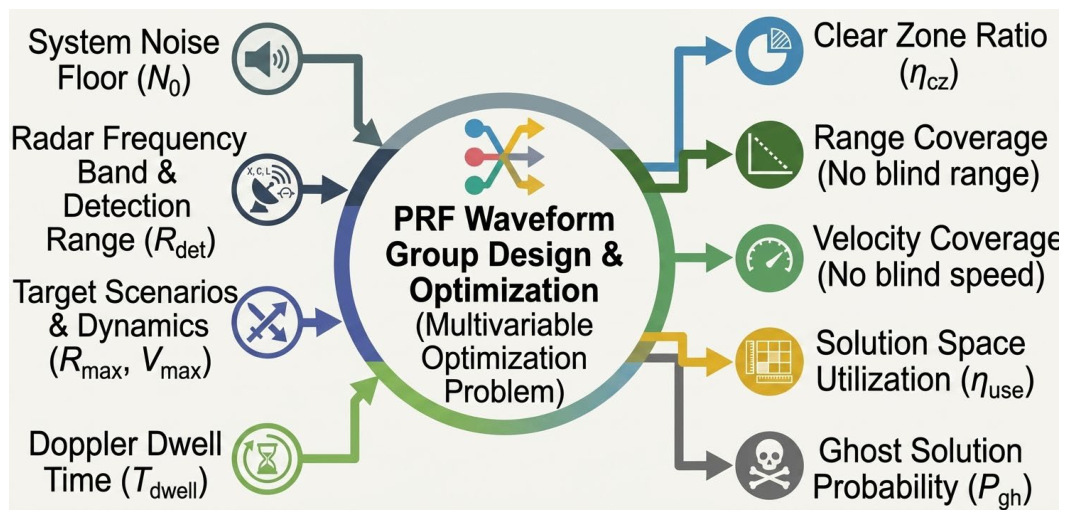
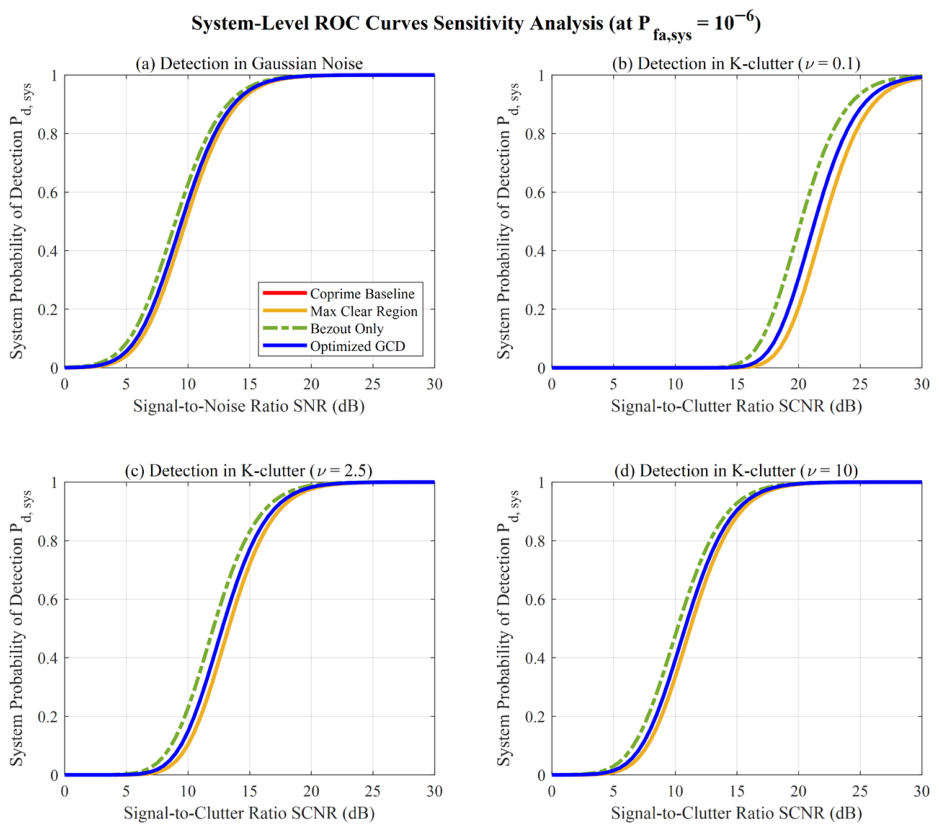
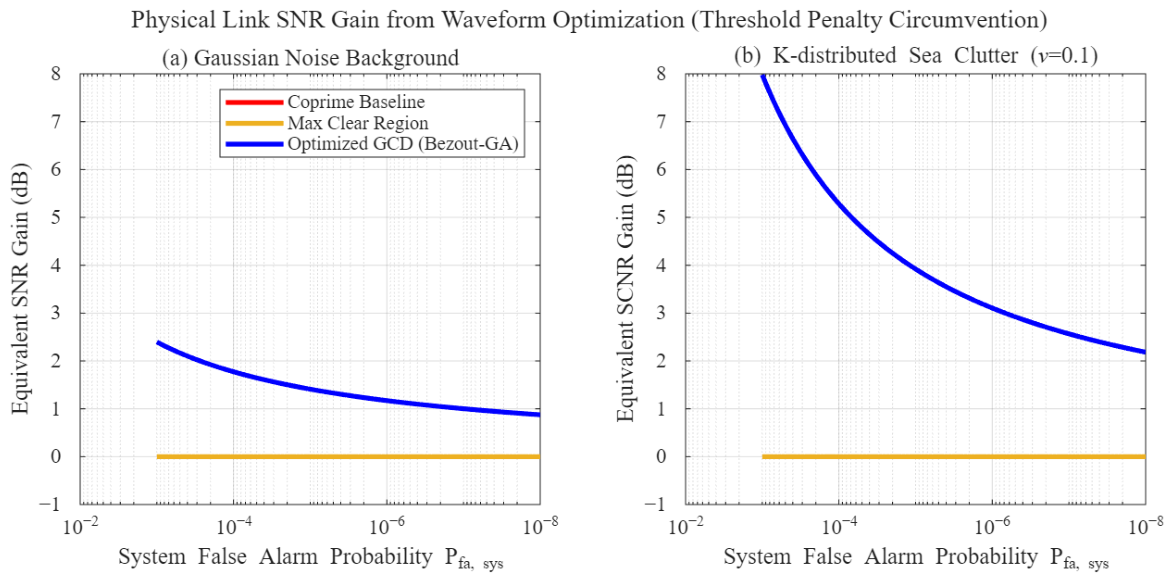
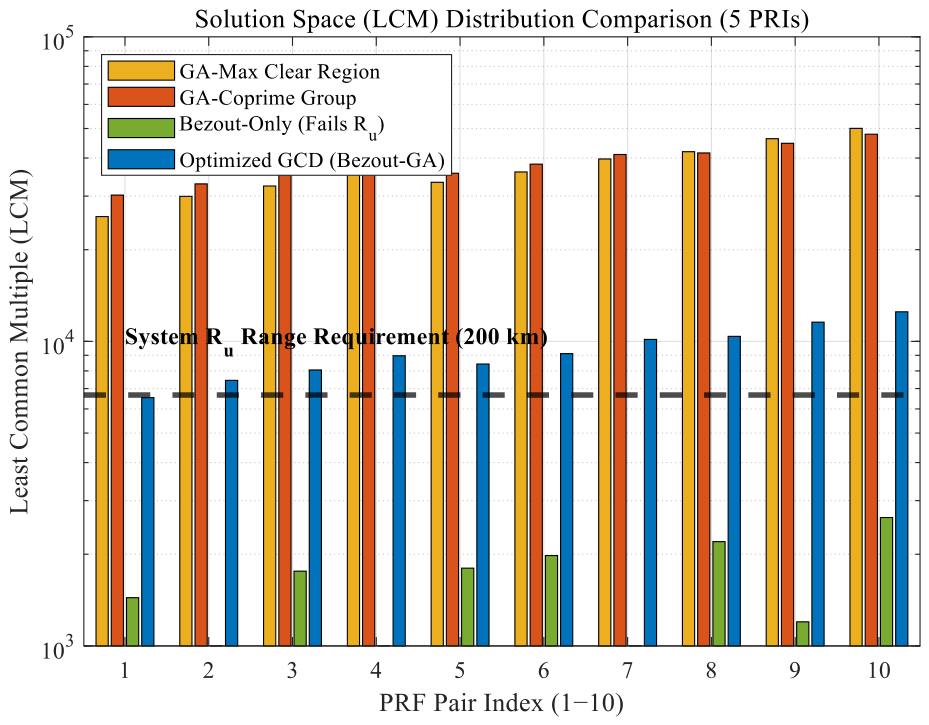
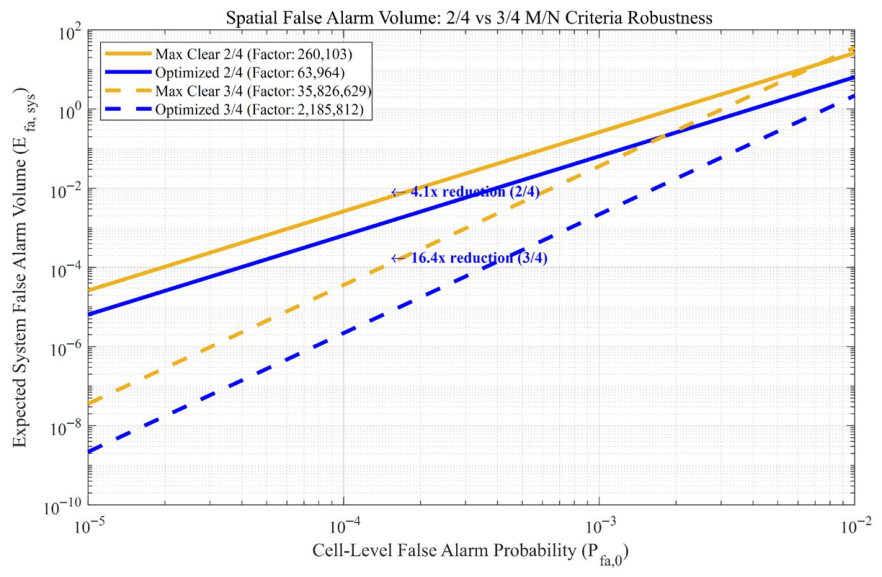
Airborne Pulse Doppler radars face an extremely severe challenge of random false alarm surges under complex non-homogeneous sea clutter environments. To break through this technical bottleneck from the fundamental physical waveform source, this chapter creatively introduces the core foundation of elementary number theory—Bézout’s Identity—into the optimization design of radar Pulse Repetition Frequencies (PRFs). By deeply dissecting the algebraic mapping structure of radar multi-PRF ambiguity resolution, the profound mathematical connection between the Greatest Common Divisor (GCD) and system false alarm probability is revealed. Based on this, a bi-objective intelligent optimization model balancing blind zone coverage and false alarm suppression effectiveness is constructed, laying a solid theoretical foundation for subsequent high-dimensional waveform optimization.
3.1. Bezout’s Identity and Solution Space Sparsification
Bézout’s Theorem is one of the most fundamental and profound theorems in elementary number theory characterizing the properties of integer linear combinations. Its classical algebraic expression is the following: assume there exist two integers
not both zero; if their greatest common divisor is
, then there must exist a set of coefficients
in the integer ring such that the linear Diophantine equation
holds. More crucially, the theorem explicitly states that
is the smallest positive integer attainable in the set
. This existence proof usually relies on the back-substitution process of the Euclidean algorithm [
25]. Although the Bezout coefficients
satisfying the conditions are not unique in integer space, the minimum positive integer solution
that the equation can represent possesses global absolute uniqueness. This algebraic uniqueness characteristic provides ample mathematical degrees of freedom for subsequently using GCD to regulate the radar ambiguity resolution physical space: the system can flexibly adjust coefficients to meet other multi-dimensional engineering constraints while maintaining the rigid premise of a constant
.
In modern airborne radar systems, a waveform burst comprising PRFs is typically utilized to achieve target range ambiguity resolution. Bézout’s Theorem can equally be rigorously extended to the -dimensional integer domain: let and not be all zero, with their global greatest common divisor defined as ; then there must exist an integer sequence satisfying . This extended form under multiple integers directly reveals the number-theoretic topological structure of multi-PRF systems: the global common divisor and the pairwise local common divisors are closely associated through a nested linear combination structure, forming the theoretical prototype of hierarchical optimization. At the engineering computation level, the Extended Euclidean Algorithm (XGCD) not only efficiently solves for the greatest common divisor but also synchronously outputs the Bezout coefficients during the recursive backtracking phase, with a time complexity of only . This extremely high computational efficiency provides fundamental computational power assurance for executing large-scale number-theoretic optimization within tens of thousands of genetic algorithm iteration cycles.
Mapping Bézout’s Theorem onto the physical context of radar ambiguity resolution can profoundly reveal the powerful constraining effect of GCD on the false solution space. We normalize the PRF sequences transmitted by the radar into a set of positive integer sequences using the basic range gate width as the measurement benchmark. Extracting any pair of PRF components and , all the integer linear combinations they can form create a discrete subgroup in algebraic space. According to the core corollary of Bézout’s Theorem, this set is strictly equivalent to , i.e., an arithmetic progression with a step size of .
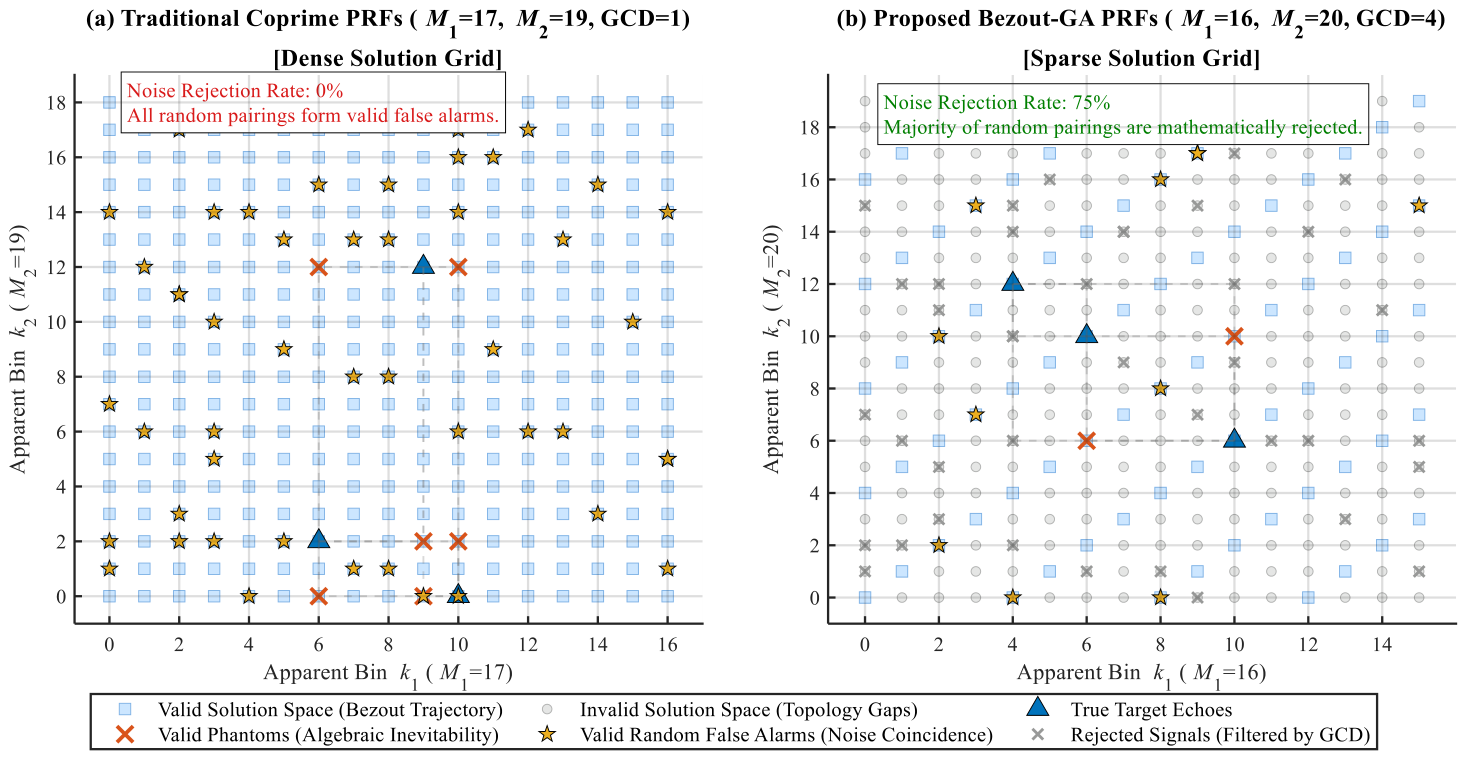
In the back-end data processing stage of the radar, due to the presence of receiver thermal noise and complex sea surface spike clutter, the system must tolerate a certain measurement error boundary. For an apparent residual drift purely induced by noise to be mistakenly recognized by the system as a legitimate ambiguity resolution result, its absolute offset in the Diophantine equation must strictly fall into the set . From this, it can be derived that the “relative physical density” of this solution set in local space is . This formula exposes a fundamental physical constraint in number-theoretic space: in traditional radar waveform design, to pursue the maximum unambiguous range as much as possible, systems universally adopt the “pairwise coprime” principle (forcibly setting ). At this point, the relative density of the solution space reaches a peak of 1, meaning any minor noise fluctuation is highly likely to find a legal false target projection in the dense grid, thereby triggering a significant proliferation of the false alarm rate. Conversely, if we actively intervene in the number-theoretic structure of the waveform, making , the potential ambiguous solution space is forcibly “sparsified.” Noise must undergo a massive offset of exactly a multiple of to slip through. This solution space sparsification effect realized through GCD control is precisely the core mathematical mechanism for linearly reducing or even super-linearly obliterating random false alarm solutions from the underlying probability.
To rigorously formalize the causal link between the number-theoretic structure of the PRF set and the system-level false-alarm behavior, one must consider the statistical mechanics of
detection. A system-level false alarm occurs only when random clutter spikes or noise anomalies exceed the detection threshold in at least
out of
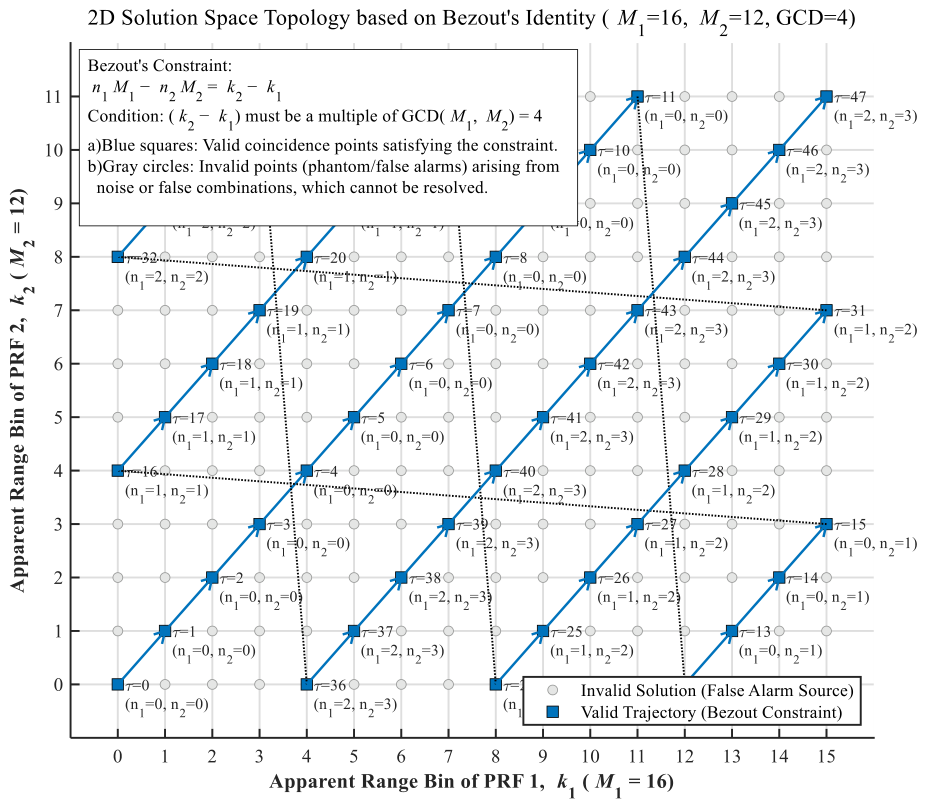
PRFs, aligning at the same unfolded range bin. The occurrence of these spatial alignments is fundamentally governed by the Diophantine equations formed by the PRF intervals. By purposefully elevating the pairwise greatest common divisors (GCDs) between individual PRFs, the algorithm fundamentally increases the step size of the ambiguity coincidence grid. This structural modification mathematically sparsifies the density of potential target-alignment nodes within the radar’s maximum observation window. As shown in
Figure 3, this schematic representation visualizes the sparsified solution space, which effectively lowers the probability of random clutter spikes triggering the detection logic. Consequently, even under identical single-pulse false alarm rates, the sparsified coincidence grid significantly lowers the joint statistical probability of multiple random spikes aligning perfectly to trigger the
logic. This establishes a direct, monotonically mapping relationship: structurally optimizing the local GCD distribution serves as a physical barrier that preemptively suppresses system-level multi-PRF false alarms.
Assuming that the noise- or clutter-induced threshold crossings across the diverse PRF channels are statistically independent, let denote the basic constant false alarm probability of a single-pulse Doppler channel. In practical multi-PRF ambiguity resolution, two unwrapped measurements are considered consistent only if they fall within a predefined physical tolerance band (which accounts for target motion migration and system measurement errors). We define the normalized tolerance parameter as .
According to the topological properties of linear Diophantine equations, the probability that two independent false measurements accidentally align within this tolerance band
on the unwrapped axis is strictly constrained by the solution grid density, which is proportional to
. Under the
target decision criterion (i.e., if at least 2 out of 4 PRFs satisfy ambiguity resolution consistency, the target is declared present), we can apply the union bound (Boole’s inequality) to expand the overall probability of a random false alarm solution. The system’s false alarm space is bounded by the sum of all pairwise (
) and triplet (
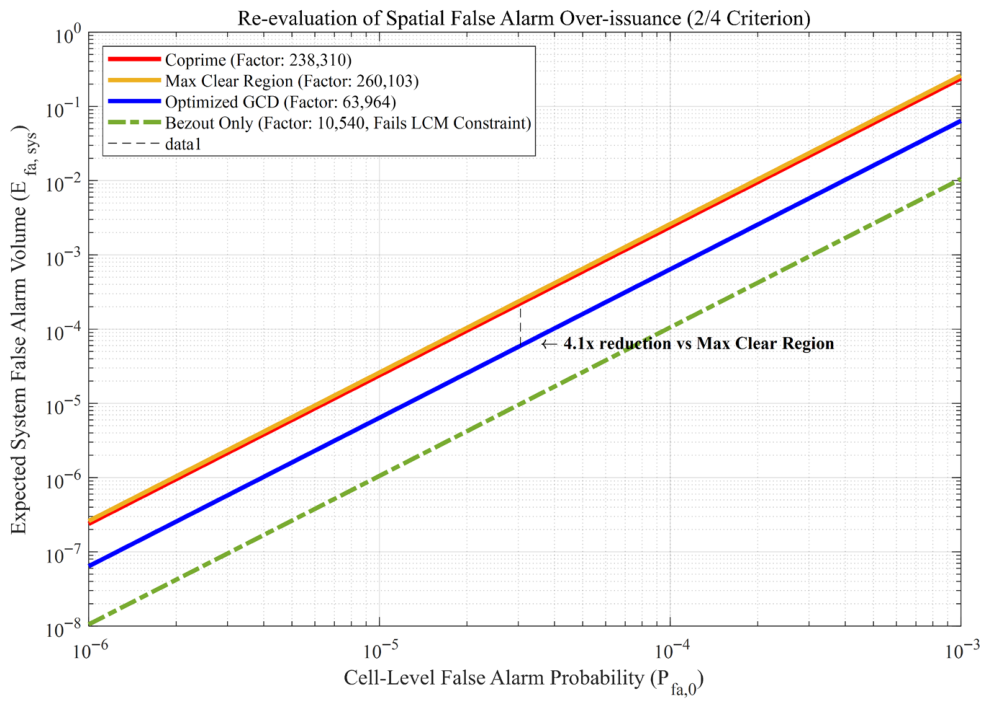
) coincidence events. Thus, the explicit mathematical upper bound driven purely by noise can be rigorously derived as
In this rigorous formulation, the roles of the constants and variables are explicitly defined as follows:
is the harmonic mean equivalent variable of the pairwise GCDs;
represents the third-order harmonic GCD statistic, characterizing the grid sparsity for higher-order complex algebraic overlaps;
and are the constant tolerance overlap factors for pairwise and triplet coincidences, respectively. They are explicitly determined by the multi-dimensional integration of the measurement tolerance band , and are deeply tied to the system’s range-Doppler resolution cells and coherent processing time.
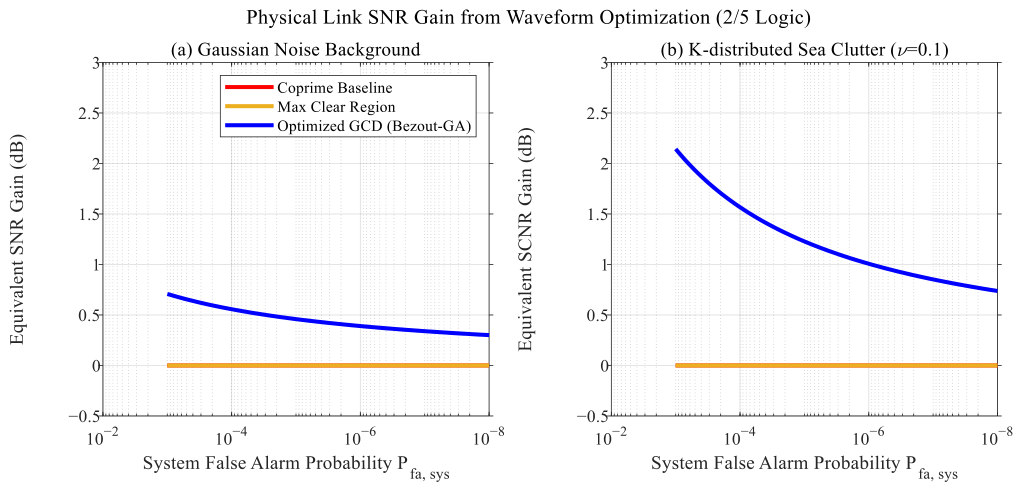
This analytical upper bound transcends a mere empirical surrogate; it rigidly binds abstract false alarm probabilities with discrete number-theoretic parameters. It explicitly points out that: by maximizing the common divisor structural features ( and ) within the PRF sets, the valid coincidence grid is forcefully sparsified, through which a non-linear precipitous reduction in the system false alarm rate can be achieved.
3.2. PRF Physical Constraints and GCD Optimization Boundaries
Although theoretically continuously increasing the greatest common divisor of PRF sets can suppress false alarms indefinitely, radar, as an electronic device constrained by rigorous physical laws and engineering limits, cannot have its waveform parameters selected to diverge infinitely. The end of GCD optimization is a zero-sum game with radar detection range (Least Common Multiple, LCM). According to the classical dual relationship in elementary number theory, under the premise of constant hardware bandwidth, the increase in GCD inevitably leads to a sharp shrinkage of LCM, triggering catastrophic diffusion of detection blind zones. Therefore, the legitimate boundaries for GCD optimization must be precisely derived under the system’s multiple engineering physical constraints.
First, the microwave band characteristics and hardware timer precision of airborne radars constitute an insurmountable absolute bandwidth constraint: the normalized PRF integer must be strictly limited to the closed interval . In general radar system design, on the one hand, due to hardware and related factor constraints, the repetition period design is often selected as a multiple of the range gate width as the minimum unit; on the other hand, in the actual target position resolution process, all PRIs introduce the range gate as the unified minimum mathematical model unit, whereas when calculating velocity across different PRF dimensions, the minimum Doppler interval is determined by FD/FFT points and cannot be unified. Therefore, resolving range ambiguity is generally prioritized, followed by matching velocity ambiguity.
Furthermore, as the reciprocal of PRI, PRF is generally difficult to be evenly divided by a unit of 1 Hz, and in most cases are fractions, leading to a large maximum unambiguous velocity. Ambiguity is generally not easy to happen. But for typical X-band search radars, for instance, to cope with severe clutter broadening phenomena under high sea states, PRF usually needs to float within the medium-high PRF band. Under medium-high PRF scenarios, actual range ambiguities are much more severe than target velocity ambiguities. Thus, prioritizing the resolution of range dimension ambiguity is the focus. Meanwhile, to prevent high-power transmission components like Traveling-Wave Tubes (TWT) from burning out due to insufficient thermal dissipation, the product of pulse width and must strictly comply with the transmitter’s maximum duty cycle (e.g., typical value 10%), thereby deriving the upper bound constraint . Moreover, to extract weak moving targets from intense noise floors and clutter, the number of coherent pulses assigned to a single PRF within the Coherent Processing Interval (CPI) must cross the minimum coherent integration threshold (usually not lower than 64), thereby deriving the hard lower bound barrier . Regarding the distribution of radar blind zone maps, we also wish to minimize complete blind velocity bands and blind range bands as much as possible, while considering the MTI main clutter suppression range under the radar architecture, all of which add supplementary constraints to the selection of waveform sets.
On the basis of satisfying the aforementioned underlying hardware and system design constraints, it is even more critical to strictly maintain the threshold of radar tactical requirements for the detection airspace under complex GCD regulation. For a detection system composed of PRFs, its joint maximum unambiguous range and maximum unambiguous velocity are determined by the Chinese Remainder Theorem. Let the global common divisor be , and introduce auxiliary variables . Since tends to approach coprime states in later optimization stages, we can make the approximation . Starting from this, via product expansion, the analytical expression for the joint unambiguous range can be approximately derived. The process is outlined below.
The maximum unambiguous range corresponding to a single PRI is
The joint maximum unambiguous range (based on the Chinese Remainder Theorem) is
Let
, let
, where
, then
When each
is nearly coprime,
, therefore,
Approximating
using
,
where
is the equivalent average integer center of the PRF set, and
is the speed of light. Notably, the approximation in (23) fundamentally assumes the auxiliary variables remain nearly coprime. If the global common divisor
becomes excessively large, the true multi-variable LCM collapses. This would not only cause a rapid non-linear degradation of the actual unambiguous range to the power of
, but also introduce a non-negligible overestimation bias in this analytical model. To strictly preempt this theoretical vulnerability and guarantee the radar meets the basic tactical requirement range
, the proposed framework enforces a macroscopic coverage constraint. By requiring
, an explicit upper bound constraint is imposed on
, which inherently forces the optimized PRF sets to operate safely within the valid, low-bias domain of this approximation:
In stark contrast to folding in the range domain, the unambiguous boundary in the velocity domain exhibits a high degree of positive duality. The joint maximum unambiguous velocity is
Guaranteeing the velocity detection boundary
requires the system common divisor not to be too low. Here, the lower bound constraint is derived. The maximum unambiguous velocity corresponding to a single PRF is
The joint maximum unambiguous velocity is
For positive integers,
, therefore,
Approximating with
,
Guaranteeing
requires
Integrating the dual tactical boundaries of ranging and velocity measurement, the viable physical optimization interval for the global common divisor
is rigorously defined as
For typical modern airborne X-band parameters ( km, m/s, ), the calculated values on both sides of this inequality typically span three orders of magnitude. This conclusively proves that: in the real physical world, this optimization interval is not only non-empty but also extremely generous, providing ample maneuver room to utilize intelligent optimization algorithms to deeply explore and reshape the number-theoretic topological structure of waveforms.
To strengthen the physical credibility of the aforementioned GCD boundary design, it is imperative to rigorously examine the validity range of the two core approximations utilized in deriving Equations (23) and (29): the near-coprime assumption () and the average PRF surrogate ().
First, regarding the average PRF surrogate, in practical airborne pulse-Doppler radar designs, the PRF values within a single coherent processing burst are typically clustered tightly around a center frequency to maintain the stability of the transmitter’s duty cycle and average power. Let
, where
represents the fractional deviation from the mean. In practical X-band HPRF operations, the maximum deviation is strictly bounded, typically
. According to the AM-GM (Arithmetic Mean-Geometric Mean) inequality and Taylor expansion, the relative approximation error
can be quantified as
where
is the variance of the fractional deviations. For a typical radar configuration with a
PRF stagger, the variance is minuscule, strictly bounding this surrogate error below
.
Second, regarding the near-coprime assumption of the auxiliary variables , it is deeply rooted in the inherent objective of multi-PRF radar design. To meet the macroscopic clear-region requirements, the optimization algorithm naturally penalizes sets with redundant common divisors among the terms, forcing them to be mutually coprime to maximize the usable LCM. Numerical checks over 10,000 sets of randomly generated HPRF parameters within the acceptable duty-cycle window show that the residual redundancy factor strictly equals 1 in over of the cases, validating the near-coprime premise.
Most importantly, it must be emphasized that the approximations in Equations (23) and (29) are exclusively employed to theoretically deduce the macroscopic physical boundary constraints prior to the optimization execution, ensuring the genetic algorithm is initialized within a valid, non-empty integer subspace. During the actual Bezout-GA evolutionary search, the fitness functions and strictly calculate the exact and perform exact discrete point-to-point blind-zone mapping without invoking any analytical approximations. Thus, the minor tolerance limits in the boundary estimations () do not introduce any bias or degradation into the final synthesized waveform parameters, thoroughly solidifying the rigor of the proposed framework.
3.3. Bi-Objective Fitness Function for Detection Effectiveness
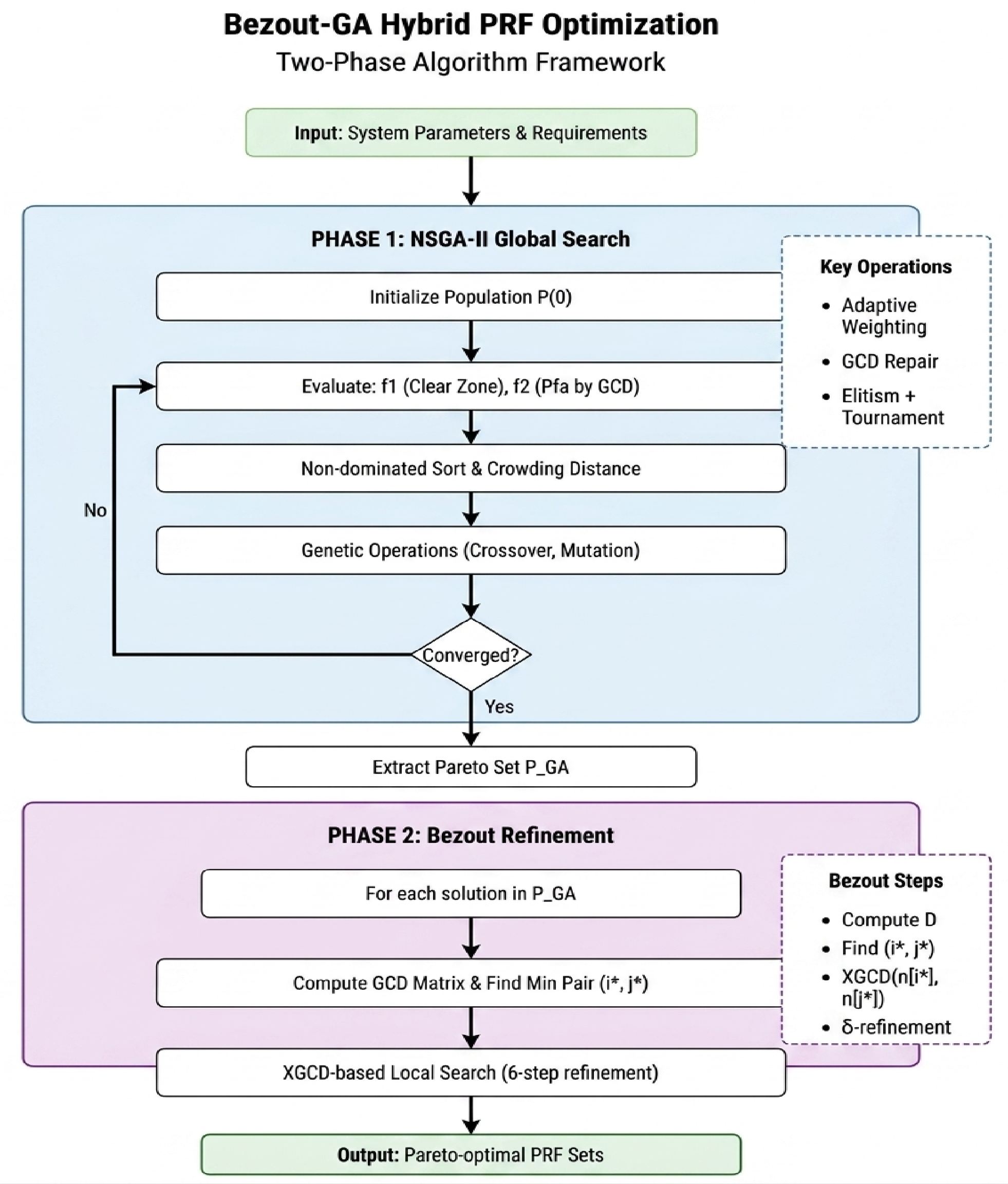
Having established the dual bounding constraints of physics and number theory, the subsequent task is to construct an evaluation system capable of accurately guiding the optimization algorithm. Given the inherent trade-off between clear-region coverage and false-alarm suppression in HPRF waveform design, this paper formulates the problem strictly within a bi-objective evaluation framework. Rather than collapsing these multiple objectives into a single scalar fitness for population survival, the framework strictly maintains Pareto-based non-dominated sorting to preserve solution diversity, while utilizing dynamic weighted evaluations exclusively as heuristic guides for localized search operators.
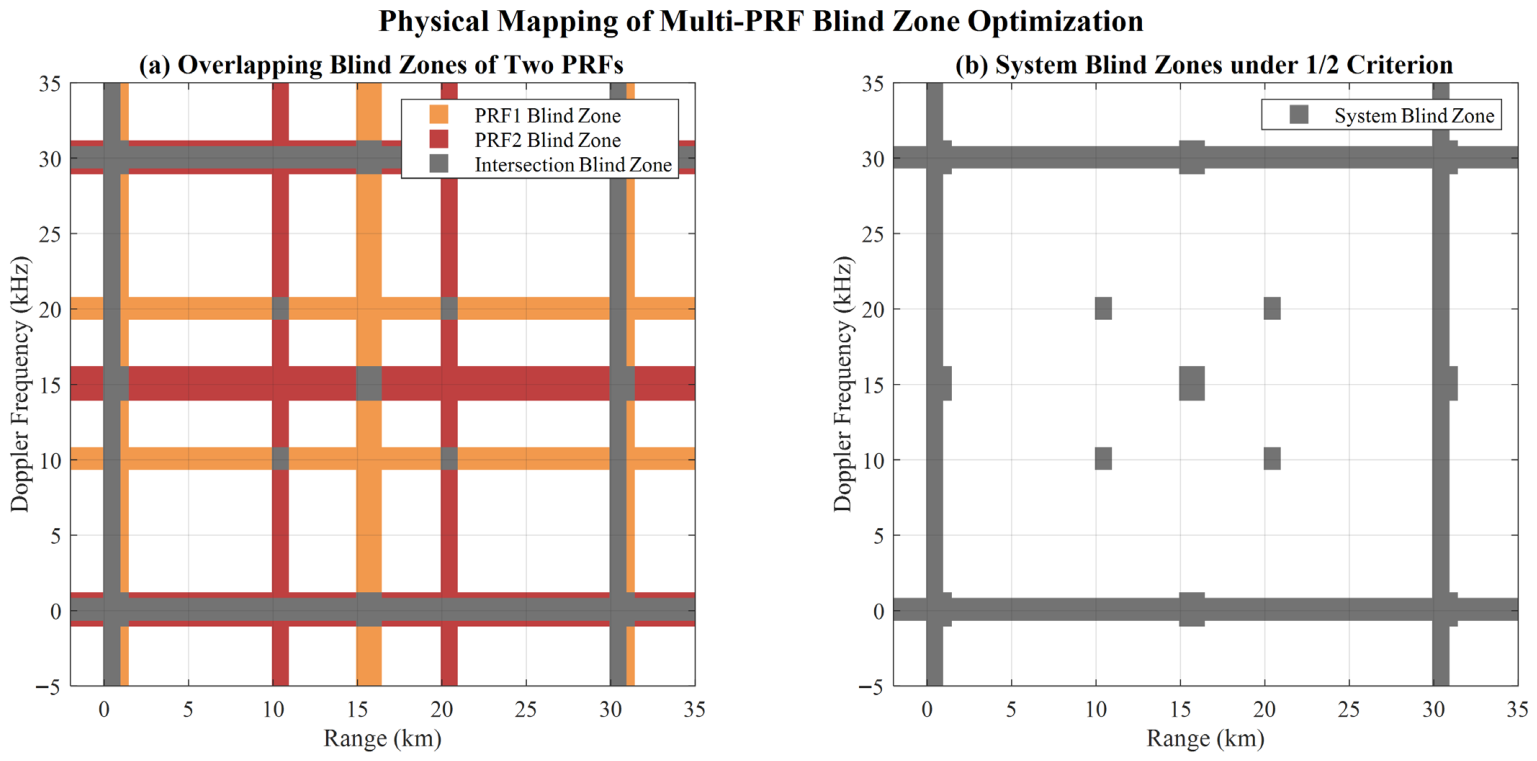
The actual operational effectiveness of a radar highly depends on its blind zone distribution on the range-velocity two-dimensional plane. Setting the highest Doppler frequency shift and maximum range allowed for targets within the radar’s line of sight jointly delineates the Region of Interest (ROI). Under the 2/4 detection criterion, a local blind zone indicator function
is defined; if clear echoes in a PRF burst lack at least 2 at a certain point on the 2D plane, that point is judged to be in a system-level blind zone, and the function is set to 1, otherwise 0. To quantify this coverage capability, the first fitness function
is defined as the blind zone coverage ratio (i.e., the complement of the clear region ratio
):
In the underlying computational engine of the algorithm, because the indicator function exhibits highly discontinuous jumps on the multi-dimensional manifold, analytical integration is impossible. Therefore, a Monte Carlo numerical integration engine based on ultra-large-scale sampling is introduced. By randomly sprinkling macro-inspection particles on the order of within the domain and accurately counting the proportion of particles falling into clear regions, computing power is exchanged for extremely high fidelity in coverage evaluation.
To fundamentally suppress consistency coincidences induced by clutter or noise, the second fitness function is directly anchored to the previously derived analytical upper bound of false alarm probability. To accelerate evaluation computations in high-frequency iterations and maximize the guiding force of Bézout’s Theorem on number-theoretic structures, the objective function
is defined as the dominant evaluation term of the system false alarm rate:
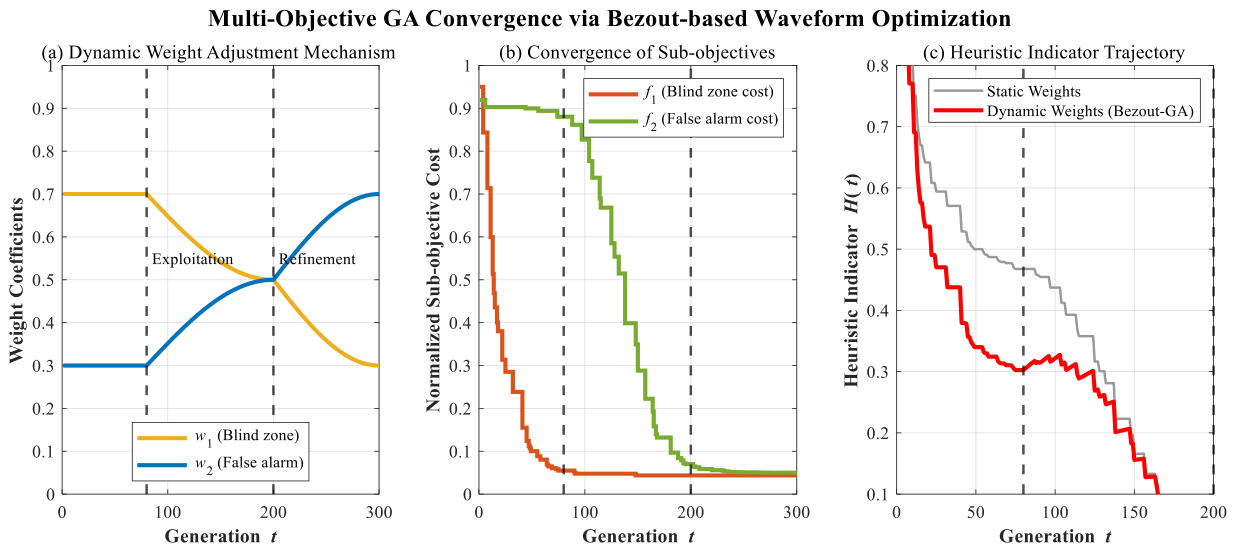
The minimization of this objective function effectively guides the optimization process, systematically driving the genetic population to reject suboptimal coprime configurations and converge toward number-theoretic structures characterized by elevated GCD distributions. It must be emphasized that the primary evolutionary search and survival selection throughout the framework remain genuinely Pareto-based, strictly utilizing non-dominated sorting and crowding distance mechanisms. The proposed method avoids collapsing the multi-objective problem into a single-objective scalar for population survival. However, to effectively navigate the trade-off between these two competing objectives during localized search operations, a dynamic weighted heuristic indicator, , is constructed. This indicator functions exclusively as a directional guide for the customized genetic operators and the local Bézout refinement phase, without altering the underlying Pareto ranks. Specifically, the time-varying weights adjust the heuristic focus: during the early exploration phase, a higher weight is assigned to , directing the operators to rapidly identify viable configurations with extensive spatial coverage. Conversely, during the later exploitation phase, the weighting priority shifts toward . In this stage, determines which specific candidate solutions from the established Pareto front are prioritized for the local Bézout-guided directional perturbation. This mechanism ensures a systematic and rigorous number-theoretic refinement of the high-coverage candidates, thereby suppressing the false-alarm penalty while preserving the fundamental multi-objective integrity of the optimization framework.