Article

Local Extrema Adaptive Pyramid Decomposition for Optical and SAR Image Fusion

1
School of Artificial Intelligence, Jiangxi Industry Polytechnic College, Nanchang 33000, China
2
School of Design and Art, Jiangxi Industry Polytechnic College, Nanchang 33000, China
3
National Center for Applied Mathematics, Chongqing Normal University, Chongqing 401331, China
*
Author to whom correspondence should be addressed.
Electronics 2026, 15(10), 2129; https://doi.org/10.3390/electronics15102129

Submission received: 1 April 2026 / Revised: 11 May 2026 / Accepted: 12 May 2026 / Published: 15 May 2026
(This article belongs to the Section Computer Science & Engineering)

Abstract

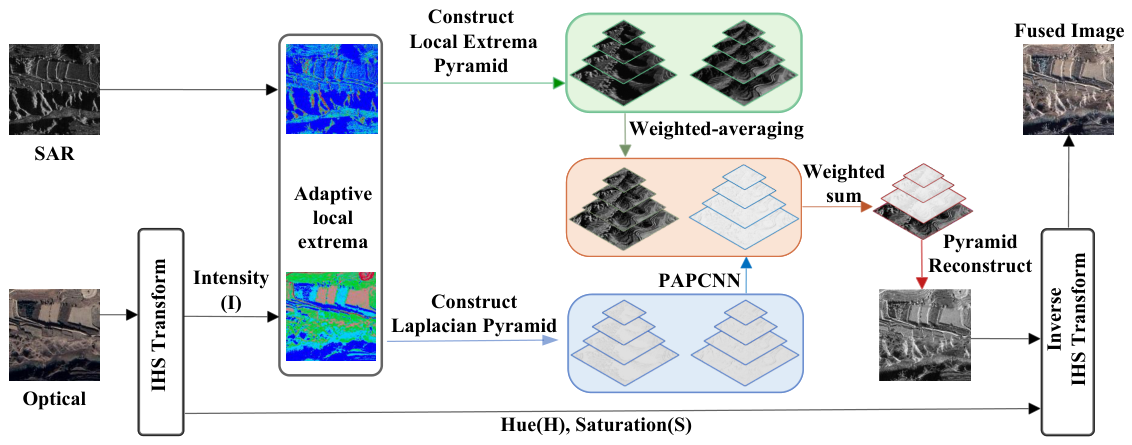
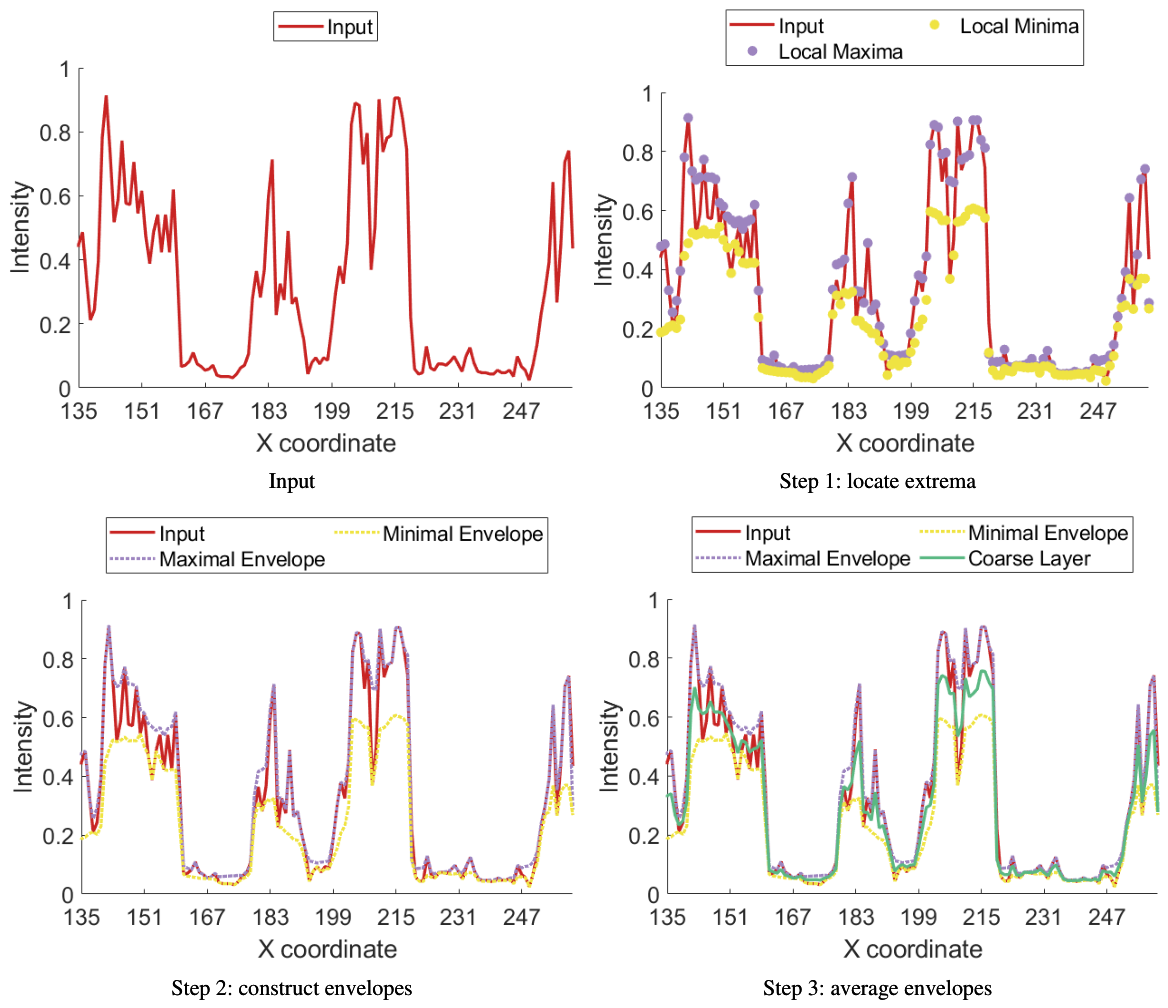
Optical and Synthetic Aperture Radar (SAR) sensors capture complementary and consistent information, and their fusion enhances remote sensing image quality. Existing pyramid decomposition-based methods suffer from insufficient texture–edge discrimination. Additionally, the manual setting of parameters during pyramid decomposition introduces uncertainty in the fusion results. To address this problem, we propose an optical and SAR image fusion framework based on local extrema adaptive pyramid decomposition (LEAPFusion), which enhances edge preservation and improves parameter adaptability. Specifically, by leveraging the edge-preserving properties of local extrema, we introduce them into the image pyramid decomposition framework to construct complementary local extrema and Laplacian pyramids. Then, we introduce an explicit parameter adaptation strategy in which the decomposition levels and local extrema kernel sizes are automatically determined from image size and pyramid scale, enabling consistent multi-scale representation and reducing parameter sensitivity compared to empirically tuned settings. Finally, by exploiting the complementary properties of the two pyramids, we implement a multi-type fusion strategy: weighted averaging for low-frequency components and parameter-adaptive pulse-coupled neural network (PAPCNN) for high-frequency details. Our decomposition framework seamlessly integrates three representative edge-preserving filters—a median filter, a guided filter, and a rolling guidance filter—demonstrating strong generalization capability across different filtering paradigms. Extensive experiments on two benchmark datasets demonstrate that our method outperforms seven state-of-the-art algorithms, achieving the best results across diverse scenes with improvements of up to 13.38% in SF and 18.90% in SCD compared to the second-best methods.
Keywords: local extrema; scale-adaptive; pyramid decomposition; edge preservation; image fusion; remote sensing local extrema; scale-adaptive; pyramid decomposition; edge preservation; image fusion; remote sensing