2.1. Radar Signal Sorting
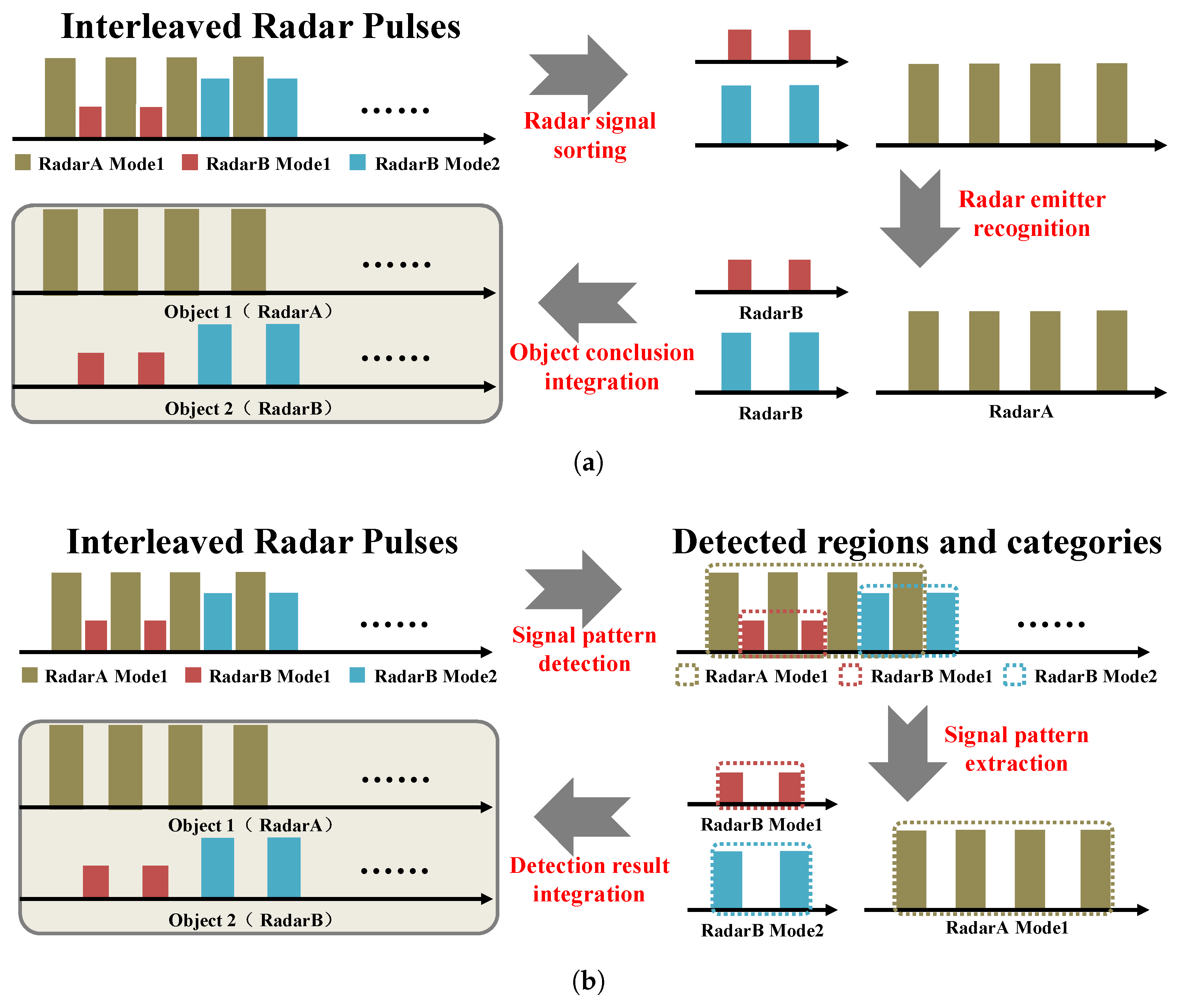
The goal of radar signal sorting is to separate the interleaved pulse streams and obtain the signal trajectories of individual radar emitters. Existing radar signal sorting methods can generally be categorized into three types: PRI-based methods, clustering-based methods, and deep learning-based methods.
Early radar signal sorting methods are often based on PRI estimation. The cumulative difference histogram [
7] employs a cumulative time of arrival (TOA) difference histogram to provide possible PRI estimations with minimal computational effort. The sequence difference histogram (SDIF) [
8] determines the PRI using a sequence difference histogram. By deriving an optimal detection threshold for the SDIF histogram, the algorithm’s efficiency is significantly improved. However, SDIF is susceptible to jittered PRI, which could lead to missing batch. To address this issue, ref. [
9] proposes an improved SDIF algorithm that uses overlapping PRI bins to detect signals with jittered PRI, and further introduces dynamic sequence searching to enhance the algorithm’s timeliness and effectiveness. Ref. [
10] proposes an improved algorithm for the PRI estimation process, which employs overlapped PRI bins with shifting time origins to improve the robustness in handling jittered pulses. Ref. [
11] proposes an enhanced PRI deinterleaving histogram method based on pulse correlation, which incorporates the mean filter and interquartile range algorithm to refine the estimated PRI values, making it more suitable for handling pulses with significant PRI fluctuations. Ref. [
12] models the signal trajectory of each emitter as a renewal or counting process, which derives the theoretical performance lower bound, and proves that the proposed algorithm approaches this theoretical limit.
Due to the flexibility of modern radar systems and complexity of electromagnetic environments, the range of PRI variation has increased, and its variation patterns have become more complicated. As a result, methods based on PRI estimation are no longer sufficient. To improve deinterleaving performance by leveraging the multi-dimensional parameters of PDWs, clustering-based methods have been developed. Ref. [
13] proposes a two-step clustering approach, where the first clustering is performed in the frequency-pulse width (F-PW) plane, followed by a second clustering based on the initial clustering results combined with optimal transport distance. Ref. [
14] introduces an adaptive density peak clustering method, named subspace decomposition-based adaptive density peak clustering (SD-ADPC), which adaptively determines optimal cluster centers to address the issue that existing clustering methods heavily rely on prior knowledge. Ref. [
15] first models interleaved radar pulses using the limited penetrable visibility graph, then combines the label propagation algorithm and density peak clustering to group signals from the same emitter, effectively mitigating the problem of increasing batch in multifunction radar signal sorting. MRTSC [
16] considers whether the modulation type and parameters of candidate working modes are known, and designs three corresponding algorithms to achieve improved adaptability and reduce dependence on prior information. Ref. [
17] employs Bézier curves to model frequency variations of intercepted pulses. These curve-based spatial distributions are used as the new features and processed via a density-based spatial clustering method to obtain the deinterleaving results. Ref. [
18] proposes an improved clustering algorithm-based on the artificial bee colony (ABC). The algorithm accelerates the convergence by dynamically adjusting the search step and incorporating a ranking-based probabilistic selection mechanism. Ref. [
19] presents a dynamic modified chaotic particle swarm optimization algorithm (DMCPSO), which enhances the diversity of particle swarm by introducing chaotic search, thereby avoiding premature convergence and falling into local optimum.
Clustering-based methods heavily rely on prior information and demonstrate limited effectiveness when radar features become more complex. Therefore, recent approaches introduce DNNs to model and solve the problem of radar signal sorting. Ref. [
20] proposes a radar signal sorting method based on a denoising autoencoder, which learns the patterns and regularities of pulse sequences from the same emitter and generates clean, deinterleaved pulse sequences. Ref. [
28] introduces RNNs to explore semantic patterns in radar signals, which predicts potentially arriving pulses based on existing ones and performs effective deinterleaving even under noisy conditions. Ref. [
29] develops a prediction model-based on long short-term memory (LSTM) that utilizes predicted pulses for deinterleaving. Ref. [
26] presents a multi-task deep learning model for radar signal sorting and PRI modulation recognition. Based on CNNs, the model exploits the interdependencies between these two tasks and improves the accuracy of both tasks simultaneously. Ref. [
27] constructs a hierarchical deep learning model that captures temporal patterns and semantic correlations among pulses in multifunction radar signals. Based on this model, an iterative and parallel pulse deinterleaving method are introduced, achieving effective signal separation. Ref. [
30] proposes a recursive deinterleaving network (RDN) of deep TOA mask (DTM), which captures both local and global contextual information of radar pulses and classifies them effectively. Some approaches [
24,
25] model interleaved pulse streams as graphs and apply graph-based solutions for deinterleaving. ResGCN-RSS [
24] constructs a graph structure using the k-nearest neighbors (KNN) algorithm and builds a residual graph convolutional network for feature learning, achieving effective deinterleaving. Ref. [
25] first applies self-organizing maps (SOM) to capture the spatial distribution of intercepted signals and constructs a graph based on SOM nodes, and then designs a three-layer weighted residual graph convolutional network (WRGCN) to predict deinterleaving results. Additionally, this method generates pseudo-labels using SOM, which pretrains the model on these pseudo-labels and finetunes using a limited number of true labels, significantly improving model generalization in few shot scenarios. Inspired by image segmentation and image object detection, several methods [
21,
22,
23,
31] adopt pulse level recognition to perform radar signal sorting. Ref. [
21] develops a radar signal sorting method based on semantic segmentation, which takes TOA differences as input and classifies each pulse based on its semantic type. Ref. [
22] converts PDWs features of intercepted signals into sequential images and applies a U-Net-based image segmentation model for radar signal sorting. Ref. [
23] generates the 2D images based on PRI transform. These images visualize the variation patterns of PRI, and a segmentation model is performed on the images to obtain the signal sorting results. SOLOv2 [
46] constructs the mimetic image mapping and visualizes the interleaved pulse sequence as mimetic point graph. An instance segmentation model is then employed to segment the mimetic point graph at pixel level, thereby achieving radar signal sorting. Ref. [
34] proposes a deinterleaving method based on object detection, which uses pulse amplitude (PA) and TOA to synthesize the image that represents the amplitude patterns, and then leverages an object detection model to detect these patterns. However, all these methods first convert the radar pulse signals into images using some transformation approaches, and then perform radar signal sorting using image processing methods. As a result, they are inevitably prone to information leakage during the data conversion process and mismatching between cross-domain tasks. In contrast, the proposed method in this paper draws inspiration from image processing but is specifically designed based on the characteristics of radar pulse signals and the requirements of the processing tasks. It provides a unified solution to both radar signal sorting and radar emitter recognition without suffering from information leakage or task mismatch.
2.2. Radar Emitter Recognition
Radar emitter recognition aims to identify the type of radar emitter based on deinterleaved signal parameters or trajectories. Existing methods for radar emitter recognition can generally be categorized into three groups: library matching-based methods, machine learning-based methods, and deep learning-based methods.
Early radar emitter recognition methods are often implemented based on library matching [
35,
36], which is commonly referred to as the emitter library, threat library, radar library, or pre-flight data library. These methods are simple and intuitive, but lack adaptability and struggle to handle unknown signals. With the development of radar systems, radar signals have become increasingly complex, and the phenomenon of parameter overlapping has become more prominent. As a result, some methods attempt to introduce machine learning techniques to further explore signal features to assist in recognition. Ref. [
37] utilizes image processing methods to extract shape features from the time-frequency distribution of radar signals, and performs radar emitter recognition based on these features. Ref. [
38] employs the support vector machine (SVM) and KNN classifier for recognition. Ref. [
39] extracts various new features from the choi-williams distribution (CWD) image and subsequently applies pattern recognition methods for recognition.
With the rapid development of deep learning, deep neural networks (DNNs) have demonstrated increasingly powerful capabilities in feature extraction. Some approaches introduce DNNs to extract high dimensional features from raw signals, further improving recognition performance. Ref. [
40] converts PW, radio frequency (RF), and PRI into 3D images through data preprocessing, and then employs CNNs for recognition. Ref. [
41] maps radar pulses into symbols at different levels, which can be regarded as a form of radar language, and then applies LSTM for recognition. Ref. [
42] introduces an additional projection step on top of the standard DNNs or gated recurrent units (GRUs), significantly enhancing the recognition performance. Ref. [
43] utilizes GRUs to capture waveform features across different dimensions of the pulse streams. An attention mechanism is then applied to fuse features and effectively reduce the impact of noise, thereby improving the robustness of recognition. Ref. [
47] proposes a radar work mode recognition method based on dual-scale feature extraction. It adopts a hybrid architecture combining CNNs and LSTM to effectively explore the temporal characteristics of the signal for improved recognition performance. Ref. [
48] presents a hybrid model that integrates CNNs and transformers. CNNs is employed to extract local features from radar pulse streams, while transformer captures long-term dependencies in the temporal domain, thereby enabling effective recognition of radar work modes.
2.3. Image Object Detection
Image object detection, as one of the fundamental tasks in computer vision, aims to identify and localize all visual objects in the images by predicting their categories and spatial positions. R-CNN [
49] is a classical object detection method, where deep neural network is used to replace handcrafted feature extraction and significantly improves the representation of semantic features from region proposals. To avoid redundant feature computation caused by overlapping region proposals, subsequent methods such as SPP-Net [
50], Fast R-CNN [
51], and Faster R-CNN [
52] are proposed, bringing substantial improvements in both speed and performance. Following this, a series of improvements based on Faster R-CNN are developed, including FPN [
53] and Cascade R-CNN [
54]. These methods typically define a set of anchor boxes, i.e., some rectangular frames at various scales, and then predict categories and location offsets of objects based on the image features within the anchor boxes.
However, some methods eliminate the setting of anchor boxes and directly predict categories and locations. For example, YOLO series methods [
55,
56,
57,
58] make direct predictions based on grid cells in the feature maps, significantly enhancing detection efficiency. SSD [
59] improves detection performance across objects of different sizes by leveraging multi-scale feature pyramids.