Time-Series Modeling Based on a Modified Volterra Neural Network

Abstract
1. Introduction
2. The Proposed Neural Network Model
2.1. Classical Volterra Digital Filter
2.2. Modified Volterra Digital Filter
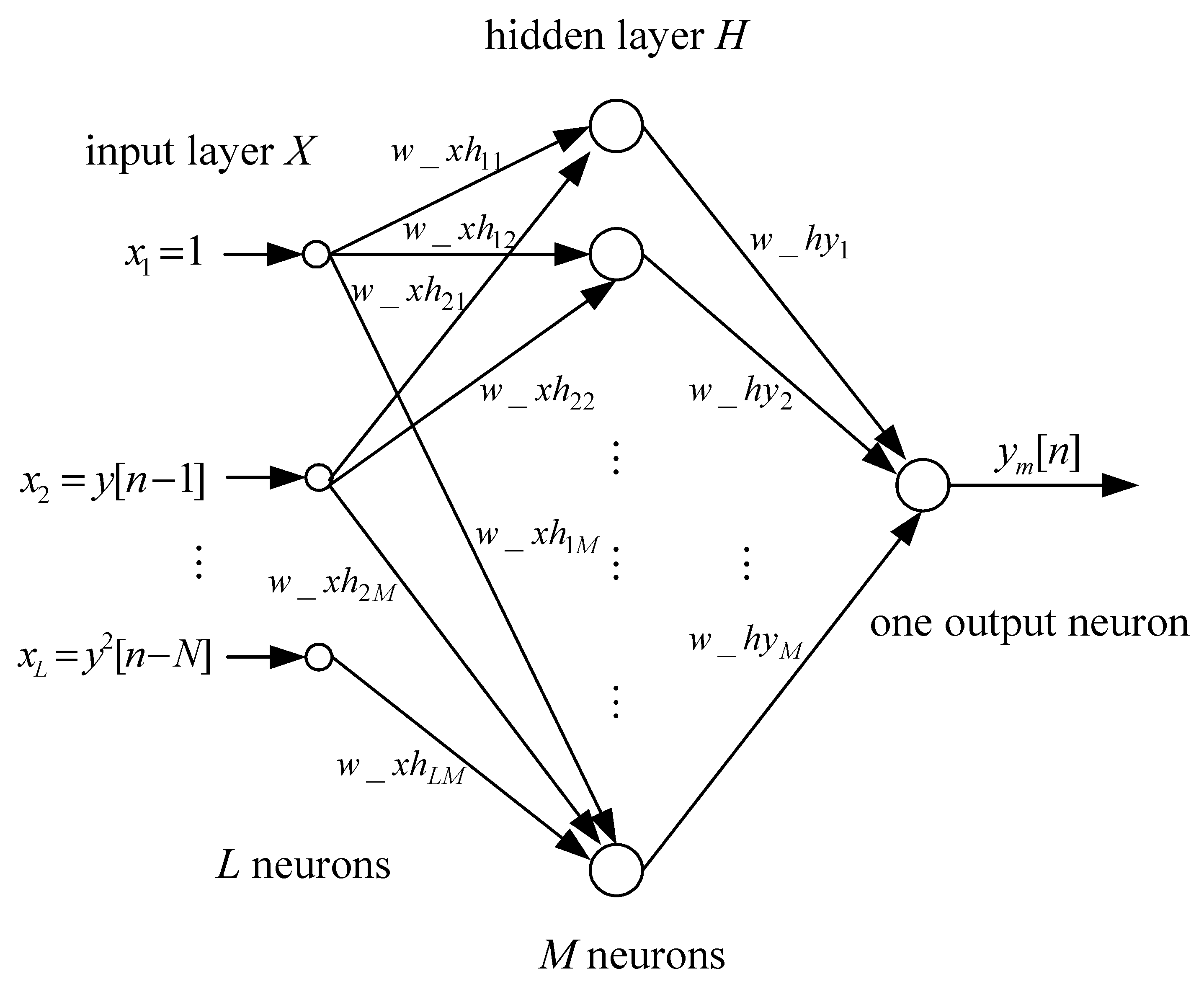
2.3. Modified Volterra Neural Network Model
3. Design Steps for Time-Series Modeling
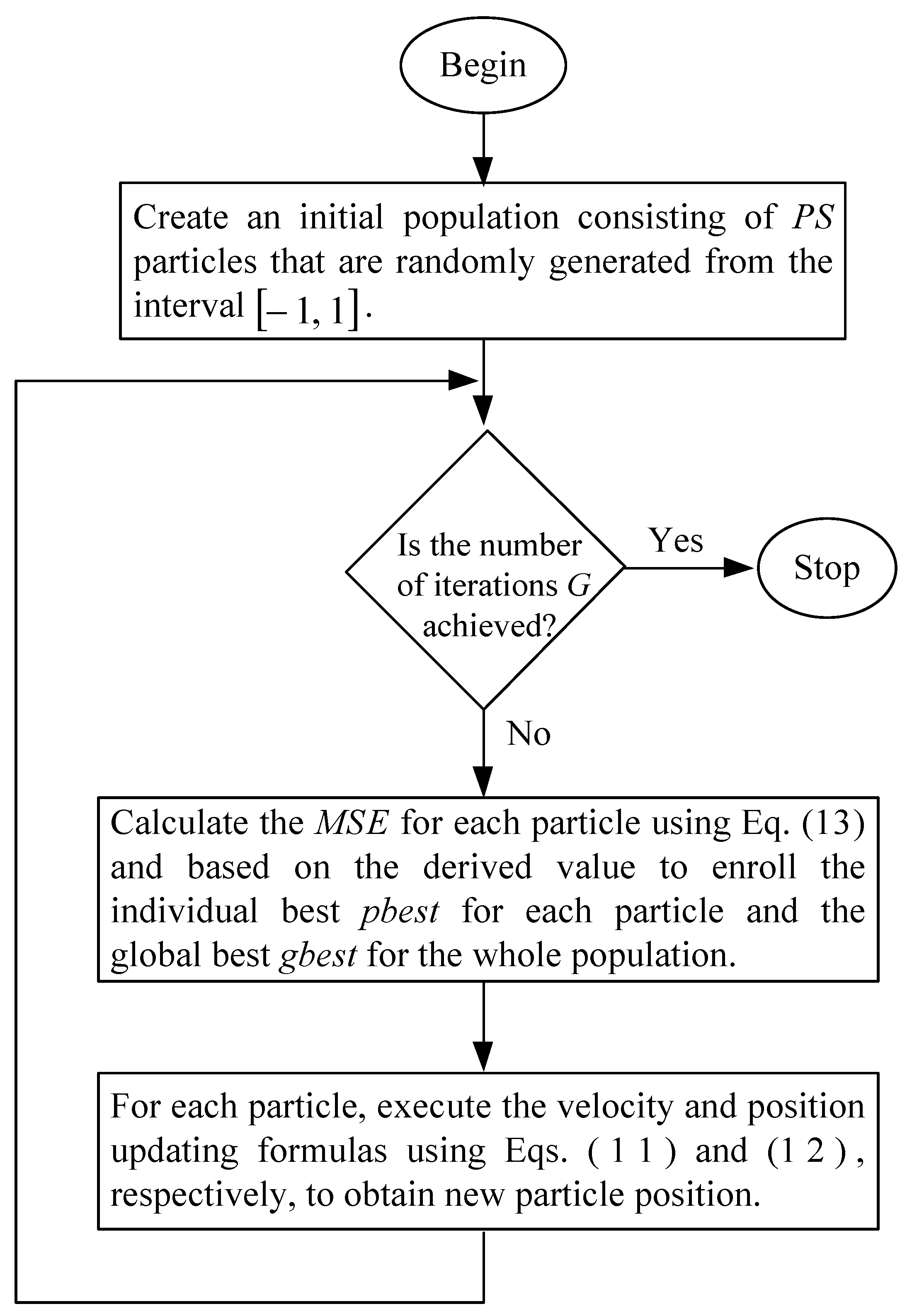
- Required Data: A modified Voterra neural network model (as described previously), a sequence of known time-series data , the inertia weight w and positive constants and from Equation (11), the total of time-series data NS from Equation (13), the number of particles (population size) PS, and the allowable number of iterations G.
- Goal: The proposed modified Volterra neural network must successfully model a sequence of time-series data using PSO algorithm tuning.
- Step 1. Generate an initial population with PS particles that are produced from the interval randomly.
- Step 2. Check the number of algorithm iterations. If the number is greater than G, then the algorithm must stop; otherwise, Step 3 is performed.
- Step 3. Evaluate the MSE of each particle using Equation (13), and based on the derived value, record the individual best, pbest, for each particle and the global best, gbest, for the whole population.
- Step 4. For each particle, employ the velocity- and position-updating formulas using Equations (11) and (12), respectively, to obtain new particle positions.
- Step 5. Go back to Step 2.
4. Some Simulations
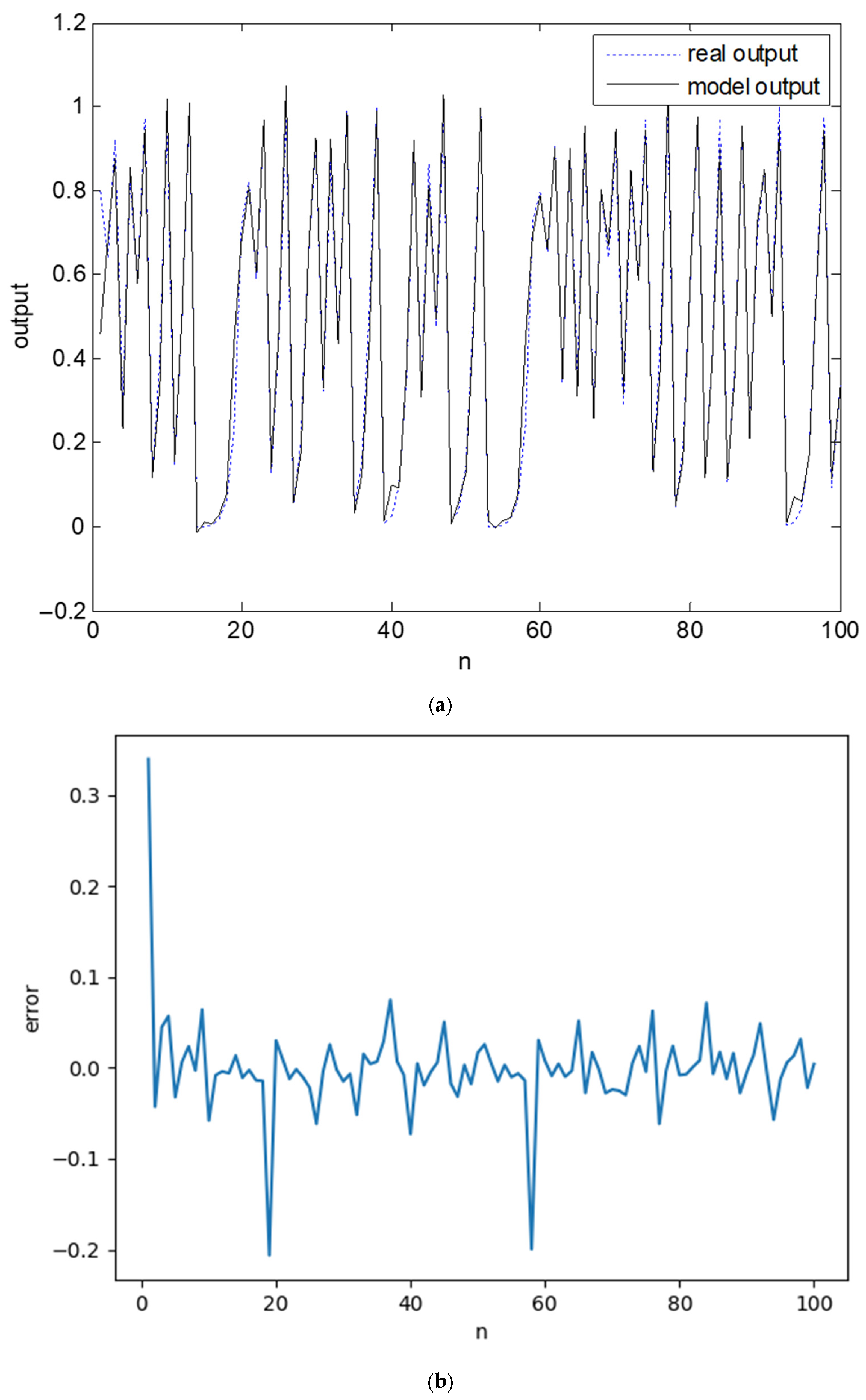
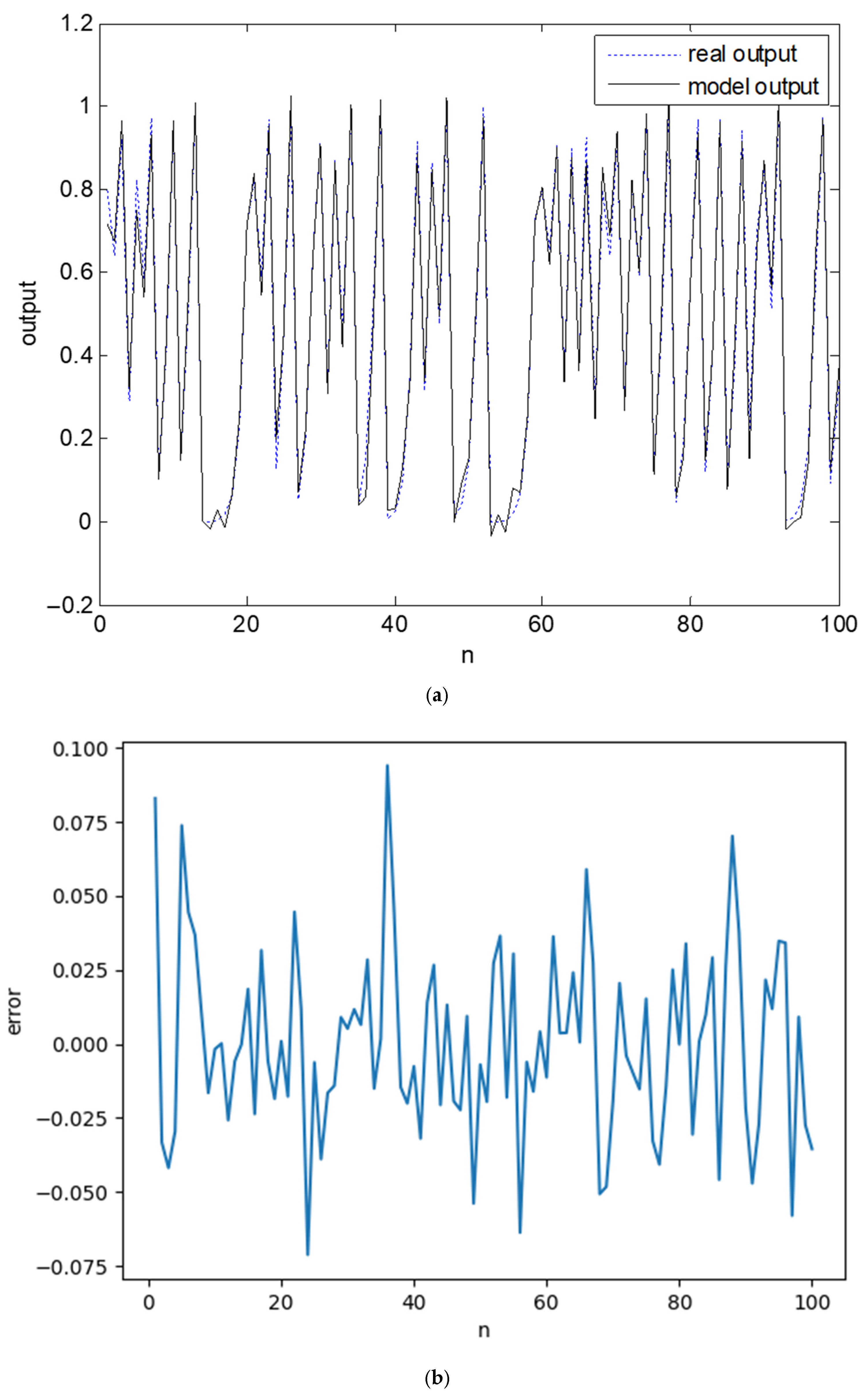
4.1. Chaotic Series Modeling
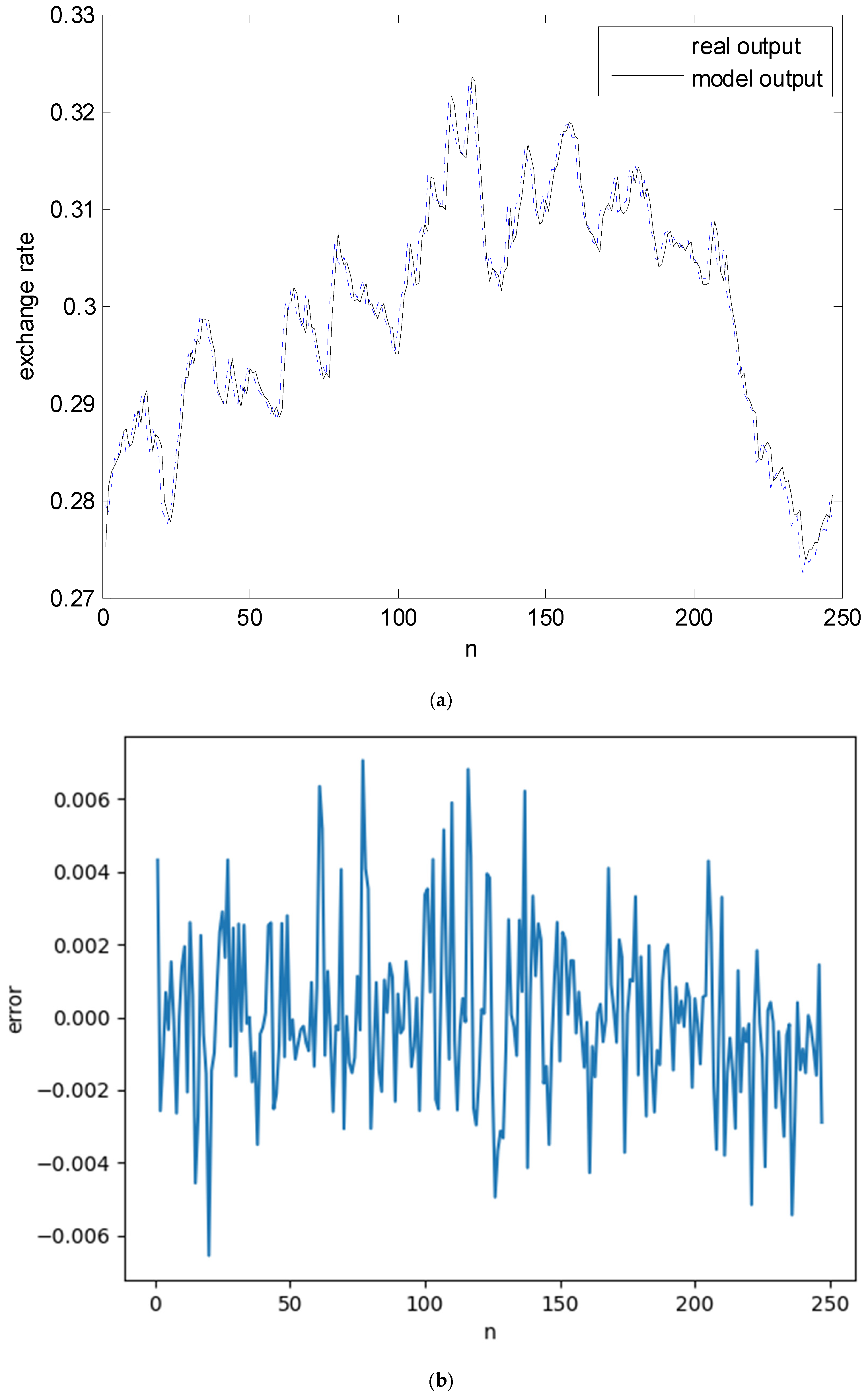
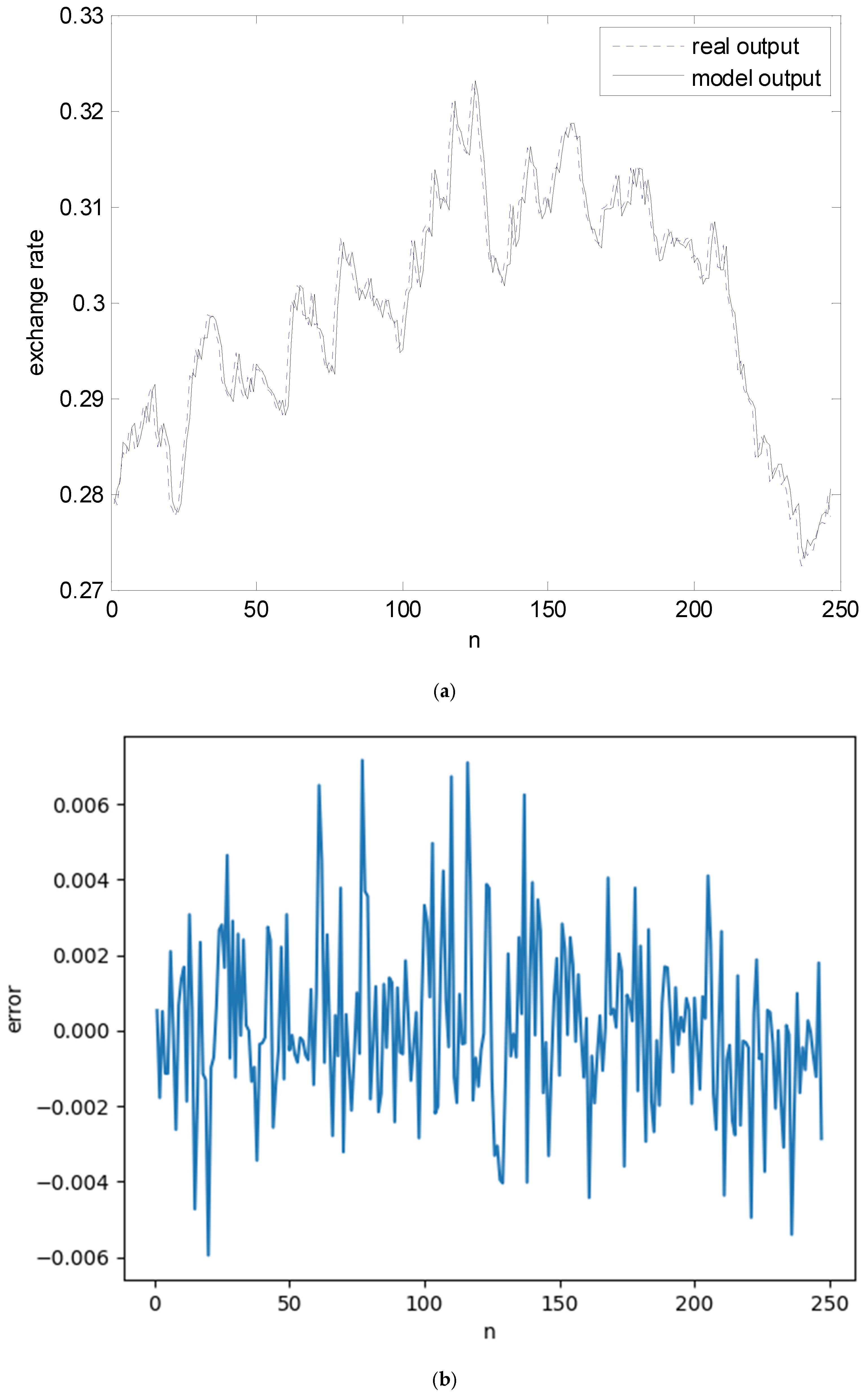
4.2. Financial Exchange Rate Series Modeling
5. Conclusions
Funding
Institutional Review Board Statement
Data Availability Statement
Conflicts of Interest
References
- Patan, K. Two stage neural network modeling for robust model predictive control. ISA Trans. 2018, 72, 56–65. [Google Scholar] [CrossRef] [PubMed]
- Kim, K.K.; Patron, E.R.; Braatz, R.D. Standard representation and unified stability analysis for dynamic artificial neural network models. Neural Netw. 2018, 98, 251–262. [Google Scholar] [CrossRef] [PubMed]
- Sanchez, A.S.; Rodrigues, D.A.; Fontes, R.M.; Martins, M.F.; Kalid, R.d.A.; Torres, E.A. Wave resource characterization through in-situ measurement followed by artificial neural networks’ modeling. Renew. Energy 2018, 115, 1055–1066. [Google Scholar] [CrossRef]
- Oliveira, J.J. Global exponential stability of nonautonomous neural network models with unbounded delays. Neural Netw. 2017, 96, 71–79. [Google Scholar] [CrossRef]
- Tavana, M.; Abtahi, A.R.; Debora, D.C.; Poortarigh, M. An artificial neural network and Bayesian network model for liquidity risk assessment in banking. Neurocomputing 2018, 275, 2525–2554. [Google Scholar] [CrossRef]
- Wu, Y.C.; Yin, F.; Liu, C.L. Improving handwritten Chinese text recognition using neural network language models and convolutional neural network shape models. Pattern Recognit. 2017, 65, 251–264. [Google Scholar] [CrossRef]
- Yang, Y.S.; Chang, W.D.; Liao, T.L. Volterra system-based neural network modeling by particle swarm optimization approach. Neurocomputing 2012, 82, 179–185. [Google Scholar] [CrossRef]
- Sorrosal, G.; Irigoyen, E.; Borges, C.E.; Martin, C.; Macarulla, A.M.; Alonso-Vicario, A. Artificial neural network modeling of the bioethanol-to-olefins process on a HZSM-5 catalyst treated with alkali. Appl. Soft Comput. 2017, 58, 648–656. [Google Scholar] [CrossRef]
- Tian, C.; Ji, Y. Filtering-based three-stage Levenberg–Marquardt iterative identification of dual-rate Volterra-Wiener nonlinear systems with colored noise. ISA Trans. 2026, 171, 17–28. [Google Scholar] [CrossRef]
- Deng, T.; Lu, L.; Lei, T.; Chen, B. Fixed-point fully adaptive interpolated Volterra filter under recursive maximum correntropy. Signal Process. 2025, 236, 110055. [Google Scholar] [CrossRef]
- Chen, Z.; Zhang, Y.; Zhang, H. Second-order Volterra Adaptive Filtering Based on Natural Gradient Descent. In 2025 International Conference on New Trends in Computational Intelligence (NTCI); IEEE: Jinan, China, 2025; pp. 385–389. [Google Scholar] [CrossRef]
- Kennedy, J.; Eberhart, R. Particle swarm optimization. In Proceedings of ICNN’95—International Conference on Neural Networks; IEEE: Perth, Australia, 1995; Volume 4, pp. 1942–1948. [Google Scholar]
- Javidrad, F.; Nazari, M.; Javidrad, H.R. Optimum stacking sequence design of laminates using a hybrid PSO-SA method. Compos. Struct. 2018, 185, 607–618. [Google Scholar] [CrossRef]
- Goudarzi, S.; Hassan, W.H.; Anisi, M.H.; Soleymani, A.; Sookhak, M.; Khan, M.K.; Hashim, A.A.; Zareei, M. ABC-PSO for vertical handover in heterogeneous wireless networks. Neurocomputing 2017, 256, 63–81. [Google Scholar] [CrossRef]
- Godio, A.; Santilano, A. On the optimization of electromagnetic geophysical data: Application of the PSO algorithm. J. Appl. Geophys. 2018, 148, 163–174. [Google Scholar] [CrossRef]
- Hannan, M.A.; Akhtar, M.; Begum, R.A.; Basri, H.; Hussain, A.; Scavino, E. Capacitated vehicle-routing problem model for scheduled solid waste collection and route optimization using PSO algorithm. Waste Manag. 2018, 71, 31–41. [Google Scholar] [CrossRef]
- Li, C.; Zhai, R.; Liu, H.; Yang, Y.; Wu, H. Optimzation of a heliostat field layout using hybrid PSO-GA algorithm. Appl. Therm. Eng. 2018, 128, 33–41. [Google Scholar] [CrossRef]
- Atashpendar, A.; Dorronsoro, B.; Danoy, G.; Bouvry, P. A scalable parallel cooperative coevolutionary PSO algorithm for multi-objective optimization. J. Parallel Distrib. Comput. 2018, 112, 111–125. [Google Scholar] [CrossRef]
- Xu, J.; Guo, C.; Zhang, H. Joint channel allocation and power control based on PSO for cellular networks with D2D communications. Comput. Netw. 2018, 133, 104–119. [Google Scholar] [CrossRef]
- Zhang, J.; Xia, P. An improved PSO algorithm for parameter identification of nonlinear dynamic hysteretic models. J. Sound Vib. 2017, 389, 153–167. [Google Scholar] [CrossRef]
- Ghodousian, A.; Parvari, M.R. A modified PSO algorithm for linear optimization problem subject to the generalized fuzzy relational inequalities with fuzzy constraints (FRI-FC). Inf. Sci. 2017, 418–419, 317–345. [Google Scholar] [CrossRef]
- Pal, D.; Chatterjee, A.; Rakshit, A. Robust-stable quadratic-optimal fuzzy-PDC controllers for systems with parametric uncertainties: A PSO based approach. Eng. Appl. Artif. Intell. 2018, 70, 38–51. [Google Scholar] [CrossRef]
- Zhang, J.; Zhao, H. A novel adaptive bilinear filter based on pipelined architecture. Digit. Signal Process. 2010, 20, 23–38. [Google Scholar] [CrossRef]
- Contan, C.; Kirei, B.S.; Topa, M.D. Modified NLMF adaptation of Volterra filters used for nonlinear acoustic echo cancellation. Signal Process. 2013, 93, 1152–1161. [Google Scholar] [CrossRef]
- Ji, W.; Gan, W.S. Identification of a parametric loudspeaker system using an adaptive Volterra filter. Appl. Acoust. 2012, 73, 1251–1262. [Google Scholar] [CrossRef]
- Chang, W.D. Volterra filter modeling of nonlinear discrete-time system using improved particle swarm optimization. Digit. Signal Process. 2012, 22, 1056–1062. [Google Scholar] [CrossRef]
- Zhang, J.; Pang, Y. Pipelined robust M-estimate adaptive second-order Volterra filter against impulsive noise. Digit. Signal Process. 2014, 26, 71–80. [Google Scholar] [CrossRef]
- Yuan, X.; Cao, B.; Yang, B.; Yuan, Y. Hydrothermal scheduling using chaotic hybrid differential evolution. Energy Convers. Manag. 2008, 49, 3627–3633. [Google Scholar] [CrossRef]



| N = 5 (L = 21 and T = 231) | N = 7 (L = 36 and T = 381) | |
|---|---|---|
| Run 1 | 3.204 × 10⁻³ | 1.972 × 10⁻³ |
| Run 2 | 3.742 × 10⁻³ | 3.432 × 10⁻³ |
| Run 3 | 3.967 × 10⁻³ | 2.167 × 10⁻³ |
| Run 4 | 3.489 × 10⁻³ | 2.788 × 10⁻³ |
| Run 5 | 4.011 × 10⁻³ | 1.701 × 10⁻³ |
| Run 6 | 3.923 × 10⁻³ | 1.573 × 10⁻³ |
| Run 7 | 3.181 × 10⁻³ | 4.883 × 10⁻³ |
| Run 8 | 4.503 × 10⁻³ | 3.706 × 10⁻³ |
| Run 9 | 3.18 × 10⁻³ | 2.456 × 10⁻³ |
| Run 10 | 2.815 × 10⁻³ | 2.32 × 10⁻³ |
| Run 11 | 3.414 × 10⁻³ | 1.151 × 10⁻³ |
| Run 12 | 3.326 × 10⁻³ | 1.537 × 10⁻³ |
| Run 13 | 5.015 × 10⁻³ | 2.662 × 10⁻³ |
| Run 14 | 4.802 × 10⁻³ | 1.736 × 10⁻³ |
| Run 15 | 3.787 × 10⁻³ | 1.677 × 10⁻³ |
| Run 16 | 3.669 × 10⁻³ | 1.541 × 10⁻³ |
| Run 17 | 2.961 × 10⁻³ | 9.978 × 10⁻⁴ * |
| Run 18 | 4.049 × 10⁻³ | 4.782 × 10⁻³ |
| Run 19 | 2.733 × 10⁻³ * | 2.77 × 10⁻³ |
| Run 20 | 4.177 × 10⁻³ | 2.284 × 10⁻³ |
| Mean | 3.697 × 10⁻³ | 2.407 × 10⁻³ |
| Variance | 3.73981 × 10⁻⁷ | 1.11854 × 10⁻⁶ |
| Standard deviation | 6.115 × 10⁻⁴ | 1.057 × 10⁻³ |
| 95% Confidence interval | [3.429 × 10⁻³, 3.965 × 10⁻³] | [1.943 × 10⁻³, 2.87 × 10⁻³] |
| Run 1 | 1.279 × 10⁻⁵ | 7.26 × 10⁻⁶ |
| Run 2 | 1.706 × 10⁻⁵ | 5.14 × 10⁻⁶ |
| Run 3 | 6.67 × 10⁻⁶ | 6.07 × 10⁻⁶ |
| Run 4 | 5.41 × 10⁻⁶ | 6.15 × 10⁻⁶ |
| Run 5 | 7.15 × 10⁻⁶ | 6.44 × 10⁻⁶ |
| Run 6 | 7.96 × 10⁻⁶ | 6.24 × 10⁻⁶ |
| Run 7 | 5.51 × 10⁻⁶ | 5.42 × 10⁻⁶ |
| Run 8 | 9.08 × 10⁻⁶ | 6.77 × 10⁻⁶ |
| Run 9 | 8.46 × 10⁻⁶ | 6.73 × 10⁻⁶ |
| Run 10 | 6.32 × 10⁻⁶ | 7.7 × 10⁻⁶ |
| Run 11 | 1.395 × 10⁻⁵ | 9.51 × 10⁻⁶ |
| Run 12 | 5.12 × 10⁻⁶ * | 1.034 × 10⁻⁵ |
| Run 13 | 9.13 × 10⁻⁶ | 5.72 × 10⁻⁶ |
| Run 14 | 6.56 × 10⁻⁶ | 6.15 × 10⁻⁶ |
| Run 15 | 8.31 × 10⁻⁶ | 9.24 × 10⁻⁶ |
| Run 16 | 5.34 × 10⁻⁶ | 4.92 × 10⁻⁶ * |
| Run 17 | 1.974 × 10⁻⁵ | 5.93 × 10⁻⁶ |
| Run 18 | 6.76 × 10⁻⁶ | 5.07 × 10⁻⁶ |
| Run 19 | 7.3 × 10⁻⁶ | 5.22 × 10⁻⁶ |
| Run 20 | 7.54 × 10⁻⁶ | 5.61 × 10⁻⁶ |
| Mean | 8.808 × 10⁻⁶ | 6.581 × 10⁻⁶ |
| Variance | 1.529 × 10⁻¹¹ | 2.237 × 10⁻¹² |
| Standard deviation | 3.911 × 10⁻⁶ | 1.495 × 10⁻⁶ |
| 95% Confidence interval | [7.094 × 10⁻⁶, 1.052 × 10⁻⁵] | [5.925 × 10⁻⁶, 7.237 × 10⁻⁶] |
Disclaimer/Publisher’s Note: The statements, opinions and data contained in all publications are solely those of the individual author(s) and contributor(s) and not of MDPI and/or the editor(s). MDPI and/or the editor(s) disclaim responsibility for any injury to people or property resulting from any ideas, methods, instructions or products referred to in the content. |
© 2026 by the author. Licensee MDPI, Basel, Switzerland. This article is an open access article distributed under the terms and conditions of the Creative Commons Attribution (CC BY) license.
Share and Cite
Chang, W.-D. Time-Series Modeling Based on a Modified Volterra Neural Network. Electronics 2026, 15, 2086. https://doi.org/10.3390/electronics15102086
Chang W-D. Time-Series Modeling Based on a Modified Volterra Neural Network. Electronics. 2026; 15(10):2086. https://doi.org/10.3390/electronics15102086
Chicago/Turabian StyleChang, Wei-Der. 2026. "Time-Series Modeling Based on a Modified Volterra Neural Network" Electronics 15, no. 10: 2086. https://doi.org/10.3390/electronics15102086
APA StyleChang, W.-D. (2026). Time-Series Modeling Based on a Modified Volterra Neural Network. Electronics, 15(10), 2086. https://doi.org/10.3390/electronics15102086