1. Introduction
Urban vehicle positioning is increasingly expected to operate reliably in dense built environments, where positioning errors are not merely occasional outliers but can evolve with the surrounding signal environment. In such scenarios, GNSS observations may alternate among usable reception, multipath-dominated canyon conditions, temporary outages, and unstable post-outage recovery, whereas INS propagation remains continuous but inevitably accumulates drift over time. These characteristics make robust INS/GNSS integration a problem of both measurement-confidence regulation and error-state isolation. This study therefore investigates how a recursive position-only INS/GNSS filter can maintain stable positioning when GNSS errors are time-varying, bias-like, and phase-dependent.
1.1. Background
Accurate and reliable positioning is essential for urban vehicles in applications such as intelligent transportation, mapping, and driving assistance [
1]. In complex urban environments, integrated positioning has become an important solution because it can exploit the complementary characteristics of multiple sensors [
2].
Among the available technologies, the integration of the Global Navigation Satellite System (GNSS) and the Inertial Navigation System (INS) has been widely adopted in vehicle positioning systems. GNSS provides absolute positioning information, while INS offers continuous short-term motion estimation. Their complementary characteristics make INS/GNSS integration one of the most practical frameworks for urban vehicle positioning [
3].
However, urban canyon environments remain highly challenging for GNSS-based positioning [
4]. Signal blockage, non-line-of-sight reception, multipath interference, and intermittent outages can substantially degrade observation quality and reduce positioning reliability [
5]. These effects are particularly critical in position-only INS/GNSS integration, where contaminated GNSS positions can directly distort the integrated solution [
6]. Therefore, improving robustness against degraded GNSS conditions observations remains an important problem in practical urban vehicle positioning [
7].
1.2. Related Work
To improve integrated positioning performance in complex environments, many studies have developed INS/GNSS fusion methods based on Kalman filtering and its nonlinear extensions [
8]. Among them, the Unscented Kalman Filter (UKF) has been widely adopted in integrated navigation studies because of its effective nonlinear state-estimation capability [
9]. The Cubature Kalman Filter (CKF) has also been widely used as an efficient nonlinear filtering method for integrated navigation systems [
10].
To enhance robustness against abnormal observations and model uncertainty, adaptive and robust filtering techniques have been increasingly introduced into integrated positioning systems [
11,
12]. Related studies have also explored fault-detection-assisted filtering strategies and quality-aware observation treatment for urban integrated navigation [
13,
14]. In addition, more flexible, robust fusion frameworks have been investigated for challenging urban environments, including tightly coupled INS/GNSS schemes and other urban-oriented, robust positioning approaches [
15,
16].
Despite these advances, urban position-only INS/GNSS integration still faces practical challenges in handling time-varying measurement uncertainty, persistent bias-like positioning distortion, and phase-dependent degradation under urban GNSS conditions [
17].
Existing robust INS/GNSS integration methods can generally be divided into several categories. Fixed-covariance CKF and UKF methods provide efficient nonlinear state estimation, but their performance depends strongly on the assumed measurement-noise covariance. When GNSS observations are affected by multipath, blockage, or non-line-of-sight reception, the fixed covariance assumption may lead to excessive trust in contaminated measurements.
Adaptive filtering methods improve this limitation by adjusting the measurement covariance according to innovation or residual statistics. However, most covariance-adaptive methods mainly treat GNSS degradation as a change in stochastic measurement noise. In urban canyon environments, GNSS errors are often not only time-varying but also persistent and bias-like. Therefore, covariance adaptation alone may be insufficient to prevent distorted GNSS positions from being mapped into the vehicle position state.
Robust filtering methods, such as innovation gating, M-estimation, Huber weighting, and fault-detection-assisted update strategies, can reduce the influence of abnormal observations. Nevertheless, many of these methods employ uniform rejection or down-weighting rules and do not explicitly distinguish between normal reception, canyon degradation, outage, and post-outage recovery. As a result, the filter may either over-suppress usable observations or over-trust unstable observations during recovery.
Recently, factor-graph-based and learning-assisted GNSS/INS integration methods have also attracted increasing attention. These approaches can improve positioning performance by using smoothing optimization, environmental features, or data-driven GNSS error mitigation. However, factor-graph methods may introduce additional computational complexity, while learning-assisted methods often require representative training data and may suffer from limited generalization across different urban environments.
Therefore, existing methods usually address measurement-noise adaptation, robust outlier suppression, or GNSS bias compensation separately. Under urban canyon conditions, however, GNSS errors are simultaneously time-varying, bias-like, and phase-dependent. A unified recursive filtering framework that jointly models these characteristics remains insufficiently explored.
1.3. Problem Statement and Motivation
Several practical difficulties remain for urban vehicle positioning under degraded GNSS conditions. First, GNSS degradation in urban canyons is often not adequately represented by fixed or purely white measurement noise [
18,
19,
20]. In realistic environments, the positioning error may exhibit persistent, slowly varying, or phase-dependent characteristics due to multipath, blockage, and unstable signal reacquisition. Conventional filters with fixed measurement assumptions are therefore often insufficiently flexible for practical urban positioning [
21,
22].
Second, these limitations become more critical in position-only INS/GNSS integration, because GNSS position observations directly affect the integrated solution without additional GNSS velocity constraints. If contaminated observations are trusted excessively, they can more easily distort the estimated state. Moreover, part of the GNSS positioning error may behave more like a slowly varying bias than a purely zero-mean random term. If this effect is not explicitly modeled, the filter may incorrectly map GNSS distortion into the vehicle position estimate [
23].
Third, urban GNSS degradation is usually phase-dependent. Different operating phases, such as canyon degradation, temporary outage, and post-outage recovery, exhibit different observation characteristics and should not be treated in the same way [
24,
25]. In particular, the recovery phase may still require cautious update regulation even after GNSS observations formally become available again.
Motivated by these issues, this paper focuses on robust position-only INS/GNSS integration for urban vehicles under degraded GNSS conditions. The central problem is not only how to reduce random GNSS measurement noise, but also how to prevent persistent and phase-dependent GNSS distortions from contaminating the integrated navigation state. To address this problem, a robust filtering framework should simultaneously satisfy three requirements: online regulation of measurement confidence, explicit representation of GNSS position-domain bias, and phase-dependent update control for canyon, outage, and recovery conditions.
1.4. Contributions
To address the above problems, this paper proposes a dual-adaptive robust Cubature Kalman Filter (Dual-ACKF) for urban vehicle position-only INS/GNSS integration under degraded GNSS conditions. The proposed method is designed to jointly handle time-varying measurement uncertainty, persistent GNSS position-domain bias, and phase-dependent degradation. The main contributions are summarized as follows.
A bias-augmented Dual-ACKF framework is developed for position-only INS/GNSS integration. Compared with conventional 15-dimensional CKF/UKF-based filters, the proposed framework uses an 18-dimensional state vector by introducing a GNSS positioning bias state. This design provides a state-space mechanism for absorbing persistent position-domain GNSS distortions instead of forcing all contaminated residuals to directly correct the vehicle position.
A slave innovation-energy-based adaptive measurement-noise estimator is incorporated into the CKF framework. The slave process estimates the GNSS measurement-noise variance online in the ENU directions and constrains it within physically meaningful bounds. This mechanism enables dynamic measurement-confidence regulation under time-varying urban GNSS conditions.
A scenario-aware robust update strategy is designed for canyon, outage, and recovery phases. The proposed update logic combines adaptive covariance regulation, residual-based down-weighting, observation suppression, recovery protection, and bias-dominant correction. Therefore, the filter can apply graded observation treatment instead of relying on a simple accept-or-reject decision.
A segmented experimental evaluation is conducted using a challenging public UrbanNav sequence [
26]. In addition to conventional accuracy metrics, the evaluation includes long-tail statistics, outage-drift indicators, recovery behavior, normalized innovation squared (NIS), normalized estimation error squared (NEES), and runtime comparison. The results demonstrate that the proposed Dual-ACKF improves robustness mainly by suppressing upper-tail positioning errors and stabilizing outage and recovery phases.
The remainder of this paper is organized as follows.
Section 2 presents the system model for position-only INS/GNSS integration.
Section 3 describes the proposed Dual-ACKF methodology, including the dual-adaptive framework, GNSS bias modeling, and scenario-aware robust update design.
Section 4 introduces the dataset, preprocessing procedures, quality segmentation, and experimental setup.
Section 5 reports the comparative experimental results.
Section 6 discusses the main findings, limitations, and implications of the proposed method. Finally,
Section 7 concludes this paper.
2. System Model
This section establishes the state-space model for urban vehicle position-only INS/GNSS integration under degraded GNSS conditions. First, the coordinate frames and main notations are defined. Then, the state vector, INS dynamic model, and position-only GNSS observation model are introduced as the basis for the proposed robust integrated positioning method.
2.1. Coordinate Frames and Notation
To formulate the proposed integrated positioning model, the coordinate frames and major notations used in this paper are first defined. Three coordinate frames are considered: the Earth-fixed geographic frame, the local navigation frame, and the body frame attached to the onboard inertial sensor unit [
27].
The raw GNSS and reference RTK positions are initially represented in geodetic coordinates, i.e., latitude, longitude, and altitude. For integrated positioning and error analysis, these geodetic coordinates are transformed into a local East–North–Up (ENU) navigation frame [
28]. In this study, the origin of the local ENU frame is defined by the first RTK reference epoch of the selected UrbanNav sequence. Therefore, all vehicle positions used in the subsequent filtering and evaluation procedures are represented in this local ENU frame.
The body frame is attached to the vehicle-mounted IMU. The angular velocity and specific force measured by the IMU are represented in the body frame and are used as the driving inputs of the system propagation model [
29]. The vehicle position, velocity, and attitude are estimated with respect to the local ENU navigation frame. In this paper, the vehicle attitude is represented by Euler angles, including roll, pitch, and yaw.
Under the adopted position-only integration setting, GNSS provides only position observations to the integrated filter [
30]. The GNSS velocity is not directly included in the observation model, although RTK-derived velocity is used offline to construct the reference trajectory for evaluation. Therefore, the integrated positioning system considered in this work is driven by high-rate IMU propagation and low-rate GNSS position updates.
For clarity, the main notations used in the subsequent sections are summarized as follows. The position, velocity, and attitude of the vehicle in the local ENU frame are denoted by , and , respectively. The gyroscope bias and accelerometer bias are denoted by and . The GNSS positioning bias introduced in the proposed model is denoted by . The IMU angular velocity and specific force measurements are denoted by and , respectively, while the GNSS position observation is denoted by . Process noise and measurement noise are denoted by and , respectively.
Based on the above definitions, the subsequent subsections establish the state-space model for urban vehicle position-only INS/GNSS integration under degraded GNSS conditions.
2.2. State Vector Definition
In the adopted position-only INS/GNSS integrated positioning framework, the navigation state is defined to describe the vehicle motion, sensor bias terms, and, for the proposed method, the GNSS positioning bias [
31]. The GNSS positioning bias considered in this work is defined in the position domain rather than in the raw pseudorange or carrier-phase measurement domain.
It is not intended to represent a single physical error source, but to capture the combined effect of residual multipath, non-line-of-sight reception, satellite-geometry degradation, and environment-dependent positioning distortion after GNSS positioning has already been formed.
Therefore, the bias state should be interpreted as a regularized nuisance state that helps isolate persistent GNSS-induced position errors from the vehicle navigation state.
The novelty of the proposed method does not rely solely on augmenting this bias state, but on coupling the bias-augmented model with online measurement-noise estimation and scenario-aware robust update regulation.
For the baseline filtering methods, a 15-dimensional state vector is used, including position, velocity, attitude, gyroscope bias, and accelerometer bias. It is written as
where
denotes the vehicle position in the local ENU frame,
denotes the velocity in the same frame, and
denotes the attitude represented by roll, pitch, and yaw. The vectors
and
denote the gyroscope bias and accelerometer bias, respectively.
For the proposed Dual-ACKF, the baseline state is augmented with an explicit GNSS positioning bias term in order to represent persistent or slowly varying GNSS distortions under urban canyon conditions [
32]. The resulting 18-dimensional state vector is defined as
where
denotes the GNSS positioning bias in the local ENU frame. This additional state is introduced because urban GNSS errors are often not fully characterized by zero-mean random noise alone. Instead, part of the positioning error may behave like a slowly varying bias caused by multipath, blockage, or environment-dependent signal distortion [
33].
With this formulation, the baseline 15-dimensional state is used by the comparison methods, while the augmented 18-dimensional state is used by the proposed Dual-ACKF. This unified notation allows the baseline and proposed models to share the same kinematic state representation while differing in their treatment of degraded GNSS conditions observations.
Based on the above state definitions, the next subsection introduces the dynamic propagation model driven by IMU measurements.
2.3. INS Dynamic Model
The state propagation of the integrated positioning system is driven by IMU measurements. In the adopted local ENU navigation frame, the INS dynamic model describes the temporal evolution of vehicle position, velocity, and attitude based on the measured angular velocity and specific force, together with the corresponding sensor bias terms.
Let
and
denote the angular velocity and specific force measured by the IMU, respectively. After bias compensation, the corrected body-frame angular velocity and specific force can be written as
The position dynamics are governed by the vehicle velocity in the local ENU frame,
The velocity dynamics are determined by the transformed specific force and gravity,
where
is the direction cosine matrix from the body frame to the local navigation frame, and
denotes the gravity vector expressed in the local ENU frame.
The attitude dynamics are described by the body angular velocity through the Euler-angle kinematic model,
where
is the Euler-angle transformation matrix. In this work, the attitude state is represented by roll, pitch, and yaw, and the corresponding nonlinear propagation is driven directly by IMU angular-rate measurements.
The gyroscope bias and accelerometer bias are modeled as slowly varying states. For simplicity and consistency with the adopted discrete-time implementation, they are treated as random-walk processes [
31],
where
and
denote the corresponding process noise terms.
For the proposed 18-dimensional model, the GNSS positioning bias is also propagated as a slowly varying stochastic state,
where
represents the process noise associated with the GNSS bias evolution. This formulation allows the filter to capture persistent or slowly varying positioning distortion caused by urban multipath and blockage.
The random-walk assumption is adopted because the position-domain GNSS distortion in urban canyons is difficult to model deterministically and may change gradually as the vehicle moves relative to surrounding buildings and signal-blocking objects.
Compared with a constant-bias model, the random-walk model provides sufficient flexibility to represent slowly varying or intermittently changing positioning distortions.
Compared with treating all GNSS errors as white measurement noise, it allows persistent residual components to be represented by a state variable rather than being directly injected into the vehicle position estimate.
The process-noise intensity of this bias state controls how quickly the filter allows the estimated GNSS bias to change. A smaller value constrains the bias to vary slowly and prevents overfitting to random noise, whereas a larger value enables faster adaptation under severe urban degradation.
In this study, the bias process noise is selected according to the expected magnitude and temporal variation in urban GNSS positioning distortions, and its scenario-dependent scaling is further described in the parameter settings of the proposed algorithm.
The continuous-time INS dynamics can therefore be summarized in the general nonlinear state-space form
where
denotes the IMU input vector, and
collects the process noise terms associated with the motion and bias states.
In practical implementation, the above model is discretized using the IMU sampling interval, and the resulting discrete-time propagation is used in the prediction step of the integrated filter. Since the main focus of this paper is robust integrated positioning under degraded GNSS conditions, the proposed method builds on this standard INS-driven nonlinear propagation model and enhances the subsequent observation update process.
Based on the above dynamic propagation model, the next subsection introduces the position-only GNSS observation model used in the integrated positioning framework.
2.4. Position-Only GNSS Measurement Model
In the integrated positioning framework considered in this paper, GNSS is used only to provide position observations. That is, the observation update is performed using GNSS position measurements in the local ENU frame, while GNSS velocity is not directly included in the measurement model. This setting is referred to as position-only INS/GNSS integration [
34].
Let the GNSS position observation at epoch
be denoted by
where the three components correspond to the East, North, and Up directions in the local ENU frame. For the baseline comparison methods, the GNSS observation is modeled as a direct measurement of the vehicle position, i.e.,
where
is the vehicle position state and
denotes the GNSS measurement noise, which is usually modeled as a zero-mean stochastic term with covariance
. In matrix form, the baseline observation model can be written as
with
where
is the
identity matrix.
However, under urban canyon conditions, GNSS positioning errors are often not fully characterized by zero-mean random noise alone. In practice, GNSS observations may contain persistent or slowly varying distortions caused by multipath propagation, signal blockage, and environment-dependent measurement contamination. To account for this effect, the proposed Dual-ACKF augments the observation model by introducing an explicit GNSS positioning bias state
. The corresponding observation equation becomes
Accordingly, for the proposed 18-dimensional state model, the observation equation can be expressed in matrix form as
where
This formulation means that the GNSS position observation is interpreted as the sum of the true vehicle position, a slowly varying GNSS positioning bias, and residual stochastic measurement noise. Compared with the baseline model, this augmented observation model provides the filter with additional flexibility to distinguish between true vehicle motion and GNSS-induced positioning distortion.
In the proposed method, the stochastic part of the GNSS observation error is further handled by adaptive measurement-noise estimation and scenario-aware robust update strategies, which will be introduced in the next section. Therefore, the above observation model serves as the basic measurement representation for position-only urban vehicle INS/GNSS integration under degraded GNSS conditions.
Based on the above dynamic and measurement models,
Section 3 presents the proposed Dual-ACKF methodology for robust position-only INS/GNSS integration under degraded GNSS conditions.
The augmented GNSS positioning bias should not be interpreted as a fully observable physical quantity at every single epoch.
From the position-only observation equation, the GNSS measurement contains the combined effect of the vehicle position and the GNSS positioning bias. Therefore, without additional constraints, the position state and the bias state may be weakly distinguishable from an instantaneous measurement.
In the proposed framework, the identifiability of the GNSS bias state is regularized by three factors: the INS-driven motion prediction, the bounded random-walk model of the bias state, and the scenario-aware update regulation.
During normal GNSS conditions, the bias state is constrained to vary slowly and is prevented from absorbing random measurement noise excessively. During degraded canyon conditions, persistent residual components are allowed to be partially absorbed by the bias state. During outage periods, the GNSS bias is not directly updated by GNSS measurements and is only propagated according to its stochastic model.
Therefore, the bias state is used as a regularized auxiliary state for reducing the contamination of the vehicle position estimate by persistent GNSS distortions, rather than as an independently observable physical parameter under all conditions.
In the present implementation, the GNSS bias and measurement-noise covariance are modeled with diagonal ENU components. This diagonal approximation is adopted to reduce parameter complexity and improve numerical stability in real-time recursive filtering. Although urban GNSS errors may exhibit cross-correlation among the East, North, and Up components, estimating a full covariance matrix from limited position-only observations can be unreliable under degraded conditions.
Therefore, the diagonal model is used as an engineering compromise between model flexibility and robust online estimation. Extending the proposed framework to full-covariance bias and measurement-noise modeling will be considered in future work.
3. Methodology
This section presents the proposed Dual-ACKF methodology for robust urban vehicle position-only INS/GNSS integration under degraded GNSS conditions. First, the overall framework of the proposed method is introduced. Then, the slave adaptive measurement-noise estimation, GNSS bias compensation, scenario-aware robust update strategy, and Non-Holonomic Constraint (NHC) assistance during GNSS outage are described in detail.
3.1. Overall Framework of the Proposed Dual-ACKF
Based on the state-space model established in
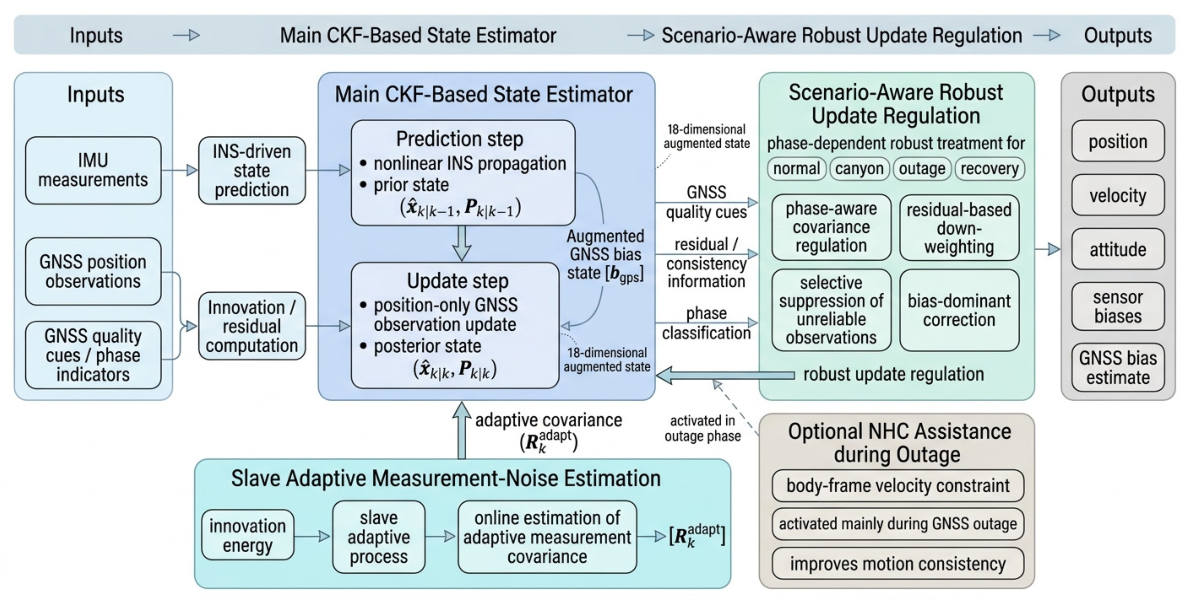
Section 2, this paper proposes a dual-adaptive robust cubature Kalman filter for urban vehicle position-only INS/GNSS integration under degraded GNSS conditions. The proposed framework is designed to improve robustness against time-varying observation uncertainty, persistent GNSS distortion, and phase-dependent degradation in urban canyon environments. The overall framework of the proposed Dual-ACKF is illustrated in
Figure 1.
The proposed method consists of two coupled components: a main CKF-based state estimator and a slave adaptive process. The main filter estimates the integrated positioning state, including vehicle position, velocity, attitude, sensor biases, and the augmented GNSS positioning bias. In parallel, the slave process estimates the GNSS measurement-noise level online from innovation energy. This dual structure enables the filter to perform state estimation and measurement-confidence regulation simultaneously.
In the prediction step, the main filter propagates the nonlinear state using IMU measurements and the INS dynamic model. In the update step, GNSS position observations are incorporated through the position-only observation model. Different from conventional fixed-covariance filtering, the proposed method combines two complementary mechanisms in the observation update: adaptive covariance estimation and explicit GNSS bias compensation. In this way, the filter can treat the GNSS residual more flexibly under degraded urban conditions.
To further improve robustness, scenario-aware update regulation is introduced for different GNSS operating phases, including canyon, outage, and recovery conditions. In addition, optional NHC assistance can be activated during outage periods to improve motion consistency for ground vehicles.
Overall, the proposed Dual-ACKF can be viewed as a robust integrated positioning framework in which the main filter performs nonlinear state estimation, the slave process regulates measurement confidence online, and the robust update logic controls degraded-condition observation treatment. The following subsections describe these components in detail.
3.2. Slave Adaptive Measurement-Noise Estimation
To improve robustness against time-varying GNSS observation quality, the proposed Dual-ACKF introduces a slave adaptive process for online measurement-noise estimation. Instead of using a fixed GNSS measurement covariance, the slave process updates the noise level according to the innovation energy of the position observation [
11]. This mechanism allows the filter to adjust measurement confidence online under changing urban canyon conditions.
Let the GNSS position innovation at epoch
be defined as
where
is the GNSS position observation and
is the predicted observation obtained from the prior state estimate. In order to characterize the observation uncertainty in each ENU direction, the innovation energy is constructed element-wise as
This energy-based quantity is used as the measurement input of the slave adaptive process.
Let
note the adaptive GNSS measurement-noise variance vector in the East, North, and Up directions. The slave process models
as a slowly varying stochastic state. Its prediction step is written as
where
denotes the covariance of the slave adaptive state and
the process-noise covariance used to describe the temporal variation in the measurement-noise level.
The observation model of the slave process is established from the relationship between innovation energy, predicted state uncertainty, and measurement noise. Specifically, the expected innovation energy in each direction is approximated by
where
denotes the diagonal contribution of the predicted observation covariance from the main filter. Therefore, the slave-process innovation can be written as
Based on this formulation, the slave adaptive state is updated by a linear Kalman-type recursion,
where
is the slave observation-noise covariance. After the update, the estimated measurement-noise variance is constrained within predefined lower and upper bounds to avoid nonphysical values and excessive fluctuation.
The adaptive GNSS measurement covariance used by the main filter is then constructed as
In this way, the confidence assigned to the GNSS position observation is no longer fixed, but changes dynamically according to the current innovation energy. When the GNSS observation becomes unstable or contaminated, the corresponding innovation energy increases, which leads to a larger adaptive covariance and thus a more conservative update. Conversely, when the observation quality becomes relatively stable, the adaptive covariance can decrease toward its nominal level.
Compared with conventional fixed-covariance filtering, this slave adaptive process provides the proposed framework with an explicit online mechanism for regulating measurement trust. It is particularly useful in urban canyon positioning, where GNSS quality may vary significantly across time and across different coordinate directions. On this basis, the proposed method further combines adaptive covariance estimation with GNSS bias compensation and scenario-aware robust update strategies, as described in the following subsections.
To avoid unstable covariance adaptation, the estimated measurement-noise variances are not used without constraints. In the implementation, each component of the adaptive variance vector is bounded by a lower limit and a scenario-dependent upper limit. The lower bound prevents the filter from becoming overconfident in GNSS observations, whereas the upper bound avoids unbounded covariance growth caused by isolated abnormal innovations.
In addition, innovation-energy clipping and symmetric positive-definite covariance correction are applied during the adaptive update. These safeguards ensure that the estimated covariance remains physically meaningful and numerically stable. Although a formal convergence proof for highly nonlinear urban GNSS degradation is beyond the scope of this study, the bounded update design prevents the adaptive measurement covariance from collapsing to unrealistically small values or increasing without limit.
Compared with conventional covariance-adaptive filters that directly adjust the measurement covariance only from innovation statistics, the slave process in the proposed Dual-ACKF is coupled with GNSS bias compensation and scenario-aware update regulation. Therefore, a large innovation is not interpreted solely as increased random noise; it can also trigger residual down-weighting, selective update suppression, or partial absorption by the GNSS bias state according to the current GNSS operating phase.
3.3. GNSS Bias Compensation
Although the slave adaptive process in
Section 3.2 can regulate the stochastic GNSS measurement-noise level online, urban GNSS degradation is often not fully characterized by random noise alone. In urban canyon environments, GNSS observations may contain persistent or slowly varying positioning distortion caused by multipath, blockage, and environment-dependent contamination. If such distortion is not explicitly modeled, the filter may incorrectly interpret it as a true vehicle-state correction.
To address this issue, the proposed Dual-ACKF augments the state vector with an explicit GNSS positioning bias term
. The GNSS observation is then modeled as
where
is the true vehicle position,
is the GNSS positioning bias, and
is the residual stochastic measurement noise. Compared with the baseline observation model, this formulation allows the GNSS residual to be decomposed into a bias-like component and a random-noise component.
The GNSS positioning bias is modeled as a slowly varying stochastic state. In discrete form, its propagation is written as
where
denotes the corresponding process noise. This random-walk model reflects the fact that urban GNSS distortion is usually not constant, but evolves gradually with the surrounding environment and signal conditions.
With this augmented formulation, the observation residual is no longer forced to directly correct only the vehicle position state. Instead, when the GNSS observation is suspected to be persistently distorted, part of the residual can be absorbed by the bias state [
20]. In this way, GNSS bias compensation and adaptive covariance estimation play complementary roles: the former captures structured positioning distortion, while the latter regulates the stochastic measurement uncertainty.
Overall, the explicit GNSS bias state improves the flexibility of the proposed framework in distinguishing between true vehicle motion and GNSS-induced positioning distortion, which is particularly important under degraded urban GNSS conditions.
It should be noted that the contribution of this work is not the use of a bias state alone. Similar bias-aware formulations can be found in prior GNSS/INS studies. The key difference in the proposed Dual-ACKF is that the GNSS positioning bias is estimated together with online measurement-noise adaptation and scenario-aware robust update regulation. This joint design allows the filter to decide whether a large residual should be treated mainly as stochastic noise, persistent GNSS distortion, or an unreliable observation that should be down-weighted or suppressed.
3.4. Scenario-Aware Robust Update Strategy
In urban environments, GNSS degradation is phase-dependent rather than uniform [
24]. During a single driving sequence, the integrated positioning system may encounter normal reception, canyon degradation, temporary outage, and post-outage recovery. Since these phases exhibit different observation characteristics, the proposed Dual-ACKF adopts a scenario-aware robust update strategy instead of a fixed measurement treatment.
In this work, the GNSS operating condition is represented by several quality-defined phases, including normal, canyon, outage, and recovery conditions. The recovery phase is defined as a short protection interval after GNSS observations become available again following degraded or unavailable conditions, during which the reacquired measurements are still treated conservatively. Normal observations are relatively stable, canyon observations are degraded but still available, outage corresponds to unavailable or unreliable GNSS updates, and recovery denotes the interval immediately after GNSS observations become available again following degraded or unavailable conditions. This classification provides the basis for adaptive update regulation. It should be noted that the scenario label is not generated by an additional learning-based predictor. Instead, it is determined from GNSS availability, quality indicators, and the recovery status after degraded or unavailable epochs. Therefore, the scenario-aware strategy is implemented as a rule-based update regulation layer within the recursive filtering framework.
For each available GNSS update, the innovation is computed using the bias-aware predicted GNSS observation. In the augmented observation model, the predicted GNSS position consists of the predicted vehicle position and the estimated GNSS positioning bias. Therefore, the innovation is expressed as
The corresponding innovation covariance is given by
where
is the adaptive GNSS measurement covariance estimated by the slave adaptive process. The normalized innovation squared (NIS) is then calculated as
The NIS value is used as one of the main consistency indicators for detecting abnormal GNSS observations, together with the axis-wise standardized residuals and the GNSS quality status. In addition, axis-wise standardized residuals are computed to identify directional GNSS contamination in the East, North, and Up components:
The use of both NIS and axis-wise standardized residuals allows the filter to detect not only globally inconsistent GNSS updates, but also direction-specific contamination that may occur in urban canyon environments.
Based on the current GNSS phase, the covariance bounds, inflation thresholds, rejection thresholds, and position-update scaling factors are adjusted. In normal conditions, the filter uses tighter covariance bounds and allows a stronger direct position correction because the GNSS observations are expected to be relatively reliable. In canyon conditions, larger covariance bounds, more conservative residual checks, and reduced position-update scaling are adopted to mitigate the influence of multipath and non-line-of-sight contamination. In outage conditions, the GNSS position update is skipped, and the filter relies on INS propagation and optional NHC assistance. In recovery conditions, the filter remains conservative for several epochs after GNSS reacquisition by applying temporary covariance inflation and weakened position correction, because newly recovered GNSS observations may still be unstable.
When the NIS or the axis-wise standardized residual exceeds the phase-dependent warning threshold, the GNSS measurement covariance is inflated to reduce the corresponding observation weight. For moderate residual anomalies, a Huber-type down-weighting strategy is applied mainly under degraded or recovery-related phases, so that the update is retained, but its influence is weakened. This treatment is mainly used for degraded or recovery-protected updates, where GNSS observations may still contain useful information but should not be fully trusted.
The Huber-type weight can be expressed as
where
is a phase-dependent robust threshold. The adaptive covariance is then modified as
A smaller leads to a larger effective measurement covariance and therefore reduces the influence of suspicious GNSS observations.
When the NIS or standardized residual exceeds the phase-dependent rejection threshold, the corresponding GNSS measurement correction is suppressed. In this case, the predicted state is retained and recorded for the current GNSS epoch, while the filter relies on INS propagation and auxiliary constraints instead of forcing the contaminated GNSS observation into the navigation state. This suppression mechanism prevents severe outliers from producing abrupt position jumps.
For degraded observations that are not completely rejected, the correction is distributed between the vehicle position state and the GNSS bias state. A position-update scaling factor
is introduced to reduce the direct correction applied to the vehicle position. The remaining correction effect is preferentially transferred to the GNSS bias state through gain regulation, so that persistent GNSS distortion is absorbed mainly by the bias state rather than directly injected into the vehicle position. Conceptually, the Kalman gain associated with the vehicle position and GNSS bias can be regulated as
where
and
denote the position-related and GNSS-bias-related gain blocks, respectively. The factor
satisfies
.A smaller
means that less of the residual is directly applied to the vehicle position and more of it is absorbed by the GNSS bias state.
Under severe canyon conditions, the direct position correction can be further weakened or temporarily frozen when the residual consistency is poor. In such cases, the filter applies a bias-dominant correction, allowing a larger portion of the correction to be assigned to the GNSS bias state. This design helps prevent distorted GNSS positions from dragging the vehicle trajectory away from the INS-predicted motion.
During the recovery phase after an outage or severe degradation, GNSS measurements are not immediately restored to full confidence. Instead, a temporary recovery protection window is introduced. Within this window, the measurement covariance is initially inflated and then gradually relaxed. The recovery inflation factor can be expressed as
where
is the initial recovery inflation factor,
is the recovery-window length, and
denotes the epoch index within the recovery window. This factor decreases from a large initial value toward unity as the recovery window progresses, so that the filter gradually restores GNSS measurement confidence rather than doing so abruptly. The covariance used in the update is then adjusted as
This design reduces the risk that unstable reacquired GNSS observations immediately drag the state estimate away from the INS-predicted trajectory.
The resulting robust measurement update can be summarized as
where
denotes the final effective measurement covariance after adaptive estimation, robust down-weighting, and recovery protection, and
denotes the regulated Kalman gain after position-bias redistribution.
The complete implementation procedure of the proposed Dual-ACKF is summarized in Algorithm 1.
| Algorithm 1. Proposed Dual-ACKF for Urban Vehicle Position-Only INS/GNSS Integration |
| 1: | Input: |
| 2: | IMU measurements; GNSS position observations; GNSS quality indicators; initial augmented state; initial state covariance; process-noise covariance; nominal GNSS measurement covariance. |
| 3: | Output: |
| 4: | Estimated navigation state, GNSS positioning bias, covariance, and robustness diagnostic statistics. |
| 5: | Step 1: Initialization |
| 6: | Initialize the augmented state vector, covariance matrix, adaptive measurement-noise state, and GNSS quality status. |
| 7: | Step 2: INS Prediction |
| 8: | For each IMU epoch, propagate the vehicle state using the INS dynamic model and update the state covariance through the CKF prediction process. |
| 9: | Step 3: GNSS Availability and Scenario Identification |
| 10: | When a GNSS epoch is reached, check the validity of the GNSS position observation and determine the current operating condition, including normal, canyon, outage, or recovery. |
| 11: | Step 4: Adaptive Measurement-Noise Estimation |
| 12: | If the GNSS observation is valid, compute the position innovation and its innovation energy. |
| 13: | Update the slave adaptive process to estimate the GNSS measurement-noise covariance online. |
| 14: | Step 5: Scenario-Aware Robust Regulation |
| 15: | Adjust the measurement update according to the current GNSS condition. |
| 16: | For degraded observations, apply covariance inflation, residual down-weighting, selective update suppression, or bias-dominant correction. |
| 17: | Step 6: GNSS Bias-Aware Measurement Update |
| 18: | Use the augmented observation model containing the GNSS positioning bias state to update the main filter. |
| 19: | Redistribute the measurement correction between the vehicle position state and the GNSS bias state according to the estimated measurement reliability. |
| 20: | Step 7: Outage Assistance |
| 21: | If GNSS is unavailable, skip the GNSS position update and optionally apply the non-holonomic constraint to improve short-term motion consistency. |
| 22: | Step 8: Result Recording |
| 23: | Record the estimated state, covariance, innovation statistics, and robustness indicators at each GNSS epoch. |
3.5. NHC Assistance During GNSS Outage
During GNSS outage periods, the integrated positioning system loses direct external position updates and must rely primarily on INS propagation. Under this condition, positioning errors may accumulate rapidly due to IMU bias, attitude drift, and model uncertainty. For ground vehicles operating on roads, however, vehicle motion is not completely unconstrained. In particular, the lateral and vertical velocities in the vehicle body frame are often close to zero under normal driving conditions. This characteristic provides a useful motion prior that can be incorporated to improve positioning stability during GNSS outages.
To exploit this property, the proposed method introduces non-holonomic constraint assistance during outage periods. Let the vehicle velocity in the local ENU frame be denoted by
, and let
be the direction cosine matrix from the body frame to the navigation frame. Then, the body-frame velocity can be expressed as
For typical wheeled vehicle motion on the road surface, the lateral and vertical components of
are approximately zero [
35]. Accordingly, the NHC measurement can be written as
where
and
denote the lateral and vertical body-frame velocity components, and
is the NHC measurement noise.
In the proposed framework, NHC is activated mainly during GNSS outage intervals, when reliable GNSS position observations are unavailable. Under such conditions, the NHC update provides an additional pseudo-measurement that constrains the vehicle motion and suppresses divergence of the propagated state. Compared with using only free INS propagation, this constraint can reduce the accumulation of velocity and position errors, especially in short- to medium-duration outages.
To ensure practical robustness, the NHC update is not applied unconditionally. Since the lateral body-frame velocity may deviate from zero during sharp turns, uneven road conditions, or abnormal maneuvers, the proposed method employs a condition-aware NHC strategy. The reliability of the NHC pseudo-measurement is regulated according to factors such as vehicle speed, yaw-rate-related turning intensity, and NHC consistency statistics. When the vehicle speed is too low, when the turning motion becomes too strong, or when the NHC residual is excessively large, the corresponding NHC update can be weakened or rejected in order to avoid introducing invalid motion constraints.
From the perspective of the overall framework, NHC assistance is an auxiliary mechanism specifically designed for outage conditions. It does not replace GNSS observations when GNSS is available, but instead complements INS propagation when external position correction is temporarily lost. Therefore, NHC mainly improves motion consistency and short-term stability during outage periods, while the broader robustness of the proposed method is still governed by the combination of adaptive covariance estimation, GNSS bias compensation, and scenario-aware robust update regulation.
In summary, the incorporation of NHC provides an additional physically meaningful constraint for ground vehicle motion under GNSS outage conditions. This constraint helps the proposed Dual-ACKF maintain more stable position and velocity estimation when GNSS observations are unavailable, thereby improving the outage robustness of the integrated positioning system.
4. Experiment Setup
This section introduces the experimental setup used to evaluate the proposed Dual-ACKF. First, the UrbanNav dataset and the selected sensor streams are described. Then, the preprocessing procedures, GNSS quality segmentation strategy, compared methods, and evaluation metrics are presented to ensure a fair and reproducible performance comparison.
4.1. Settings
The proposed method is validated using the public UrbanNav dataset, which is designed for urban positioning research under challenging GNSS conditions. In this work, the selected sequence is a Hong Kong urban driving dataset collected in a representative urban canyon environment. The dataset contains synchronized multi-sensor measurements, including GNSS observations, IMU data, and high-precision reference information, which makes it suitable for evaluating robust vehicle positioning methods under degraded GNSS conditions.
For the purpose of this study, three main data sources are used: raw GNSS measurements, IMU measurements, and RTK-based reference trajectories. The GNSS data provide the position observations used in the position-only fusion framework. The IMU data provide high-rate angular velocity and specific force measurements for state propagation. The RTK reference trajectory is used as the ground truth for quantitative evaluation after coordinate transformation and time alignment. In addition, GNSS quality information is extracted from auxiliary NMEA records and used for phase segmentation into normal, canyon, outage, and recovery conditions.
The selected sequence used in this work has an effective duration of approximately 785 s after time alignment. The IMU sampling rate is approximately 400 Hz, while the GNSS update rate is about 1 Hz. After alignment over the common valid time interval, the dataset contains 314,185 IMU samples, 775 GNSS epochs, and 786 RTK reference samples. The valid GNSS ratio is approximately 98.06%, although the effective positioning quality still varies significantly across different urban operating conditions.
It should be noted that the dataset used in this work represents a challenging urban positioning scenario rather than an ideal open-sky GNSS environment. Even in intervals where GNSS quality indicators appear relatively acceptable, the raw GNSS positions may still contain substantial distortion. This characteristic makes the selected UrbanNav sequence particularly suitable for evaluating robust integrated positioning performance under realistic urban canyon conditions.
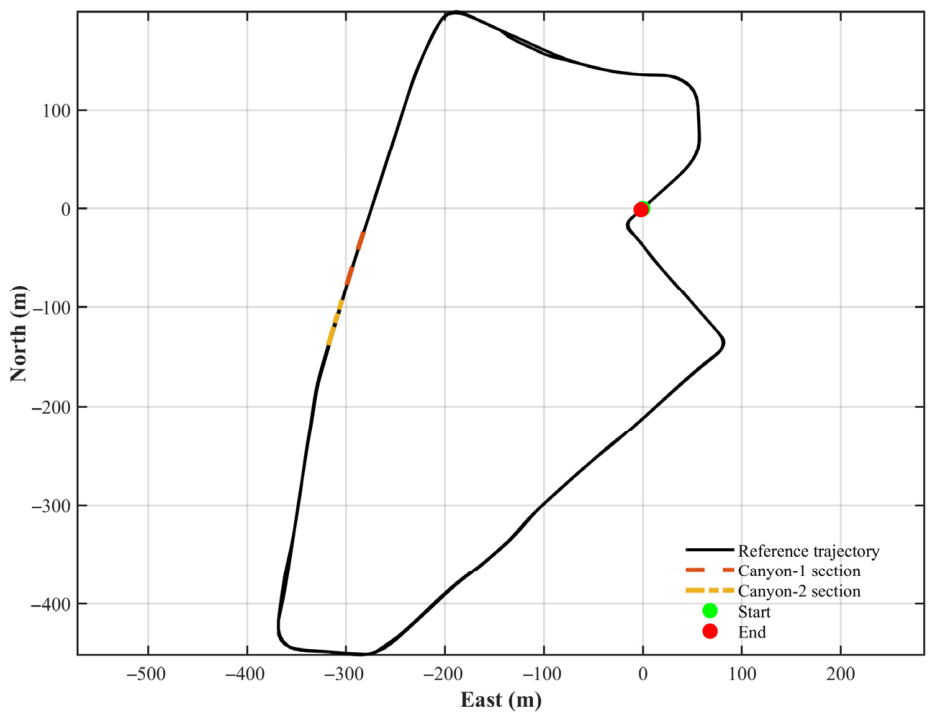
Figure 2. Reference trajectory of the selected UrbanNav sequence in the local ENU frame. The start and end points are marked, and two representative degraded GNSS conditions sections are highlighted according to the quality-based segmentation.
The main statistics of the selected UrbanNav sequence after time alignment are summarized in
Table 1.
4.2. Time Alignment and Preprocessing
Before integrated positioning, the selected UrbanNav sensor streams are preprocessed to ensure temporal and coordinate consistency. Since the GNSS, IMU, and RTK data are recorded from different sources with different sampling rates, a unified preprocessing procedure is required before they can be used in the same position-only INS/GNSS integration framework.
First, the IMU, GNSS, and RTK streams are aligned by their absolute timestamps. The common valid interval is defined by the latest start time and the earliest end time among the three data streams, and all measurements outside this interval are discarded. The retained measurements are then converted to a unified relative time axis for subsequent propagation, update, and evaluation.
Second, the actual IMU and GNSS sampling intervals are estimated from the median timestamp differences rather than fixed nominal values. In the selected sequence, the IMU sampling interval is approximately s, corresponding to about 400 Hz, while the GNSS update interval is about 1 s.
Third, the geodetic coordinates of GNSS and RTK are transformed into the local ENU frame. The ENU origin is defined by the first retained RTK epoch, and all position measurements are converted into this common navigation frame before integrated positioning and error evaluation.
The RTK-based ground-truth trajectory used in this study is obtained from the ground-truth file provided by the UrbanNav dataset. In this work, the raw base-rover GNSS observations are not reprocessed. Instead, the provided RTK-derived position solution is used as the external reference after time alignment and coordinate transformation. Therefore, low-level RTK processing settings, such as baseline length, ambiguity-resolution strategy, elevation mask, and cycle-slip handling, are not re-estimated in this study. The RTK trajectory is used only for offline performance evaluation and is not involved in the filtering update process.
Fourth, the reference velocity used for evaluation is generated from the RTK ENU trajectory by numerical differentiation. This choice is adopted to ensure consistency with the local navigation-frame interpretation used in this work. GNSS velocity placeholders can be generated in the same way when needed, although GNSS velocity is not directly used in the position-only observation update.
Finally, the GNSS altitude is corrected according to the characteristics of the NMEA Global Positioning System Fix Data (GGA) message. When available, the geoid separation is incorporated so that the converted height is more consistent with the local ENU positioning model. After these steps, the preprocessed data are organized into IMU inputs for propagation, GNSS position observations for update, RTK references for evaluation, and auxiliary GNSS quality records for later segmentation.
4.3. GNSS Quality Segmentation
To evaluate the proposed method under different levels of GNSS degradation, the synchronized GNSS observations are segmented into several representative operating conditions using quality indicators extracted from auxiliary NMEA records. This segmentation is quality-defined rather than error-defined, so that the filter performance can be analyzed under realistic GNSS operating conditions.
The quality information is obtained from the GGA and Global Positioning System Fix Data (GSA) messages and matched to each GNSS epoch on the synchronized time axis. The main indicators used for segmentation include the fix quality flag, the GSA mode indicator, the number of visible satellites, Horizontal Dilution of Precision (HDOP), and Position Dilution of Precision (PDOP). When HDOP values are available from both GSA and GGA messages, the GSA value is used preferentially and the GGA value is adopted as a fallback when necessary.
Based on these indicators, each GNSS epoch is first classified as valid or invalid. Only observations with acceptable fix and mode indicators, together with finite and physically meaningful dilution-of-precision values, are treated as valid. Invalid epochs are assigned to the outage class.
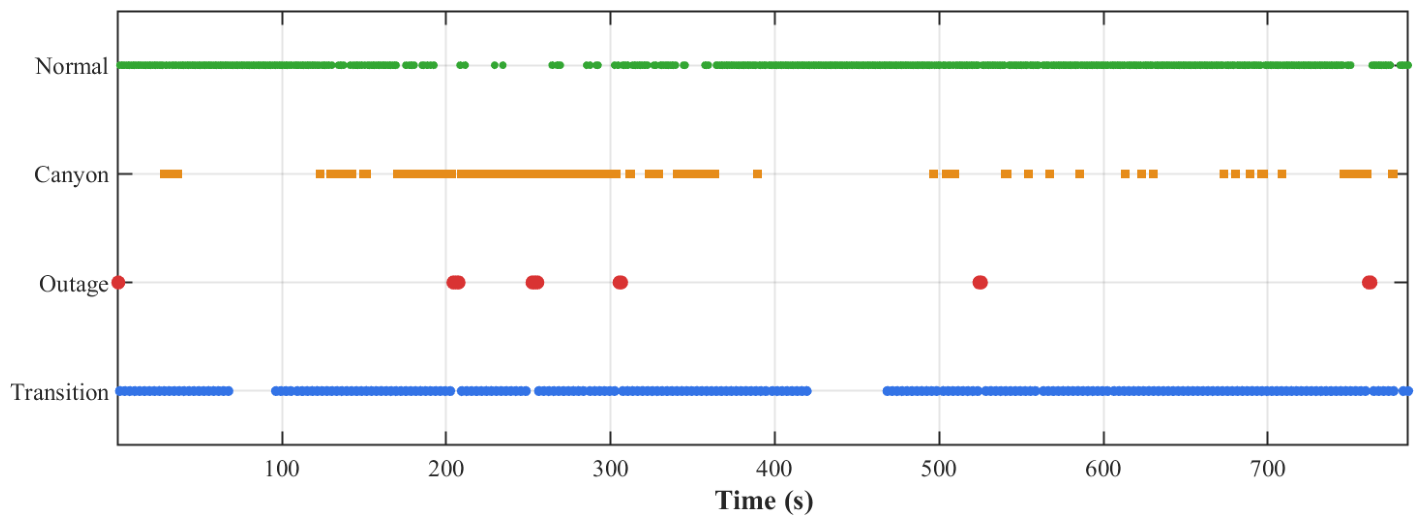
For valid GNSS epochs, a further quality-based classification is performed. Observations with relatively good satellite geometry and sufficient satellite support are classified as normal. The remaining valid observations are assigned to canyon conditions and further divided into moderate and severe degradation levels. Accordingly, each GNSS epoch is labeled as normal, canyon-1, canyon-2, or outage.
These labels are used both for segmented performance evaluation and for scenario-aware robust update control in the proposed method. In addition, transition windows are constructed around the time instants at which the GNSS condition changes from degraded or unavailable states back to normal conditions. These windows are used to analyze filter behavior during the recovery process.
It should be emphasized that a quality-defined normal epoch does not necessarily correspond to a low-error GNSS observation. In realistic urban environments, GNSS measurements may still contain significant positioning distortion even when conventional quality indicators appear acceptable. Therefore, the segmented analysis in this paper should be interpreted as performance evaluation under different GNSS quality conditions rather than under idealized error-defined classes.
In the selected UrbanNav sequence, the valid GNSS ratio is approximately 98.06%. Among the valid GNSS epochs, about 76.97% are classified as normal, 18.16% as canyon-1, and 4.87% as canyon-2. These statistics confirm that the selected sequence includes both relatively stable and significantly degraded GNSS conditions intervals.
Figure 3 presents the temporal distribution of the GNSS quality segments used in the subsequent A/B/C/D performance evaluation.
The statistics of the quality-defined GNSS segments are summarized in
Table 2.
4.4. Parameter Settings and Tuning Rules
The main parameter settings used by the proposed Dual-ACKF are summarized in
Table 3. All values are kept fixed throughout the reported experiments. Scenario-dependent rules are activated only according to the GNSS quality labels defined in
Section 4.3. These settings are introduced to clarify how the proposed filter regulates measurement confidence, absorbs GNSS position-domain bias, and protects the navigation state during outage and recovery periods.
The parameters listed in
Table 3 are fixed for all experiments and are not retuned for individual segments. They are used to define the scenario-aware update logic of the proposed Dual-ACKF. Specifically, the adaptive covariance parameters regulate the measurement confidence of GNSS observations, the GNSS bias-state parameters control the absorption of slowly varying position-domain distortions, and the outage/recovery parameters prevent unstable observations from being over-trusted after GNSS signal loss or reacquisition.
In
Table 3, slash-separated values follow the order of the scenarios explicitly stated in each row. Here,
denotes the nominal GNSS position-noise standard deviation,
is the nominal GNSS measurement covariance,
and
are the process and observation covariance matrices of the slave variance estimator,
is the innovation-energy clipping factor,
is the covariance pull-back factor,
and
are the NIS-based inflation and rejection thresholds,
is the minimum Huber weight,
is the GNSS bias-state random-walk intensity, and
is the scenario-dependent scaling factor for the GNSS bias-state process noise.
4.5. Compared Methods and Evaluation Metrics
To evaluate the proposed method, comparative experiments are conducted under the same position-only INS/GNSS integration framework. Four filtering methods are considered: Dual-ACKF, Dual-AUKF, CKF, and UKF. In all cases, the IMU-driven propagation model and the GNSS position-only observation setting are kept consistent to ensure a fair comparison.
Dual-ACKF uses the augmented 18-dimensional state model together with adaptive measurement-noise estimation, GNSS bias compensation, and scenario-aware robust update regulation. Dual-AUKF uses a 15-dimensional state model with adaptive measurement treatment but without explicit GNSS bias compensation. CKF and UKF use the same 15-dimensional state model with fixed GNSS measurement covariance. This comparison therefore covers both nonlinear filter differences and robustness-related modeling differences. The main configurations of the compared filters are summarized in
Table 4.
The evaluation is performed under the quality-defined GNSS segments described in
Section 4.3, including normal, canyon, outage, and transition conditions. This segmented setting allows the methods to be compared not only in terms of average positioning accuracy, but also in terms of robustness under degraded GNSS observations.
The metrics used in this work include central-error statistics, long-tail risk metrics, outage-related metrics, and consistency indicators. For positioning performance, Root Mean Square Error (RMSE), Mean Absolute Error (MAE), median error, P95, P99, maximum error, and threshold exceedance ratios are computed. For degraded and interrupted GNSS conditions, outage-related metrics such as drift growth, exceedance duration, and recovery time are further evaluated. In addition, Normalized Estimation Error Squared (NEES) and NIS are used to assess statistical consistency, and runtime is recorded for basic computational-cost comparison [
36].
Through this design, the experiments aim to evaluate not only whether the proposed method improves positioning accuracy but also whether it better suppresses long-tail errors and maintains stable behavior under degraded urban GNSS conditions.
5. Results
5.1. Raw GNSS Error Characteristics
Before comparing the integrated positioning methods, it is first necessary to examine the error characteristics of the raw GNSS observations themselves. This analysis provides the baseline measurement context for the subsequent filter evaluation and helps explain why robust integrated positioning remains challenging even when some GNSS quality indicators appear acceptable.
Using the RTK-derived reference trajectory as ground truth, the raw GNSS positions are transformed into the local ENU frame and directly compared with the synchronized reference positions. The horizontal positioning error is then computed for each GNSS epoch. To maintain consistency with the later filter evaluation, the raw GNSS error is analyzed under the same quality-defined segments introduced in
Section 4.3, including normal, canyon, outage, and transition conditions.
The results show that the selected UrbanNav sequence represents a highly challenging urban positioning scenario. Even within the normal segment defined by GNSS quality indicators, the raw GNSS observations still exhibit non-negligible horizontal positioning errors. This indicates that a quality-defined normal condition does not necessarily correspond to an error-defined low-distortion condition. In other words, some GNSS epochs may satisfy relatively acceptable quality thresholds in terms of satellite geometry or quality flags, while their actual positioning solutions are already distorted by urban multipath and blockage effects.
This observation is important for interpreting the subsequent integrated positioning results. In particular, if the raw GNSS observations already contain substantial distortion in nominal-quality intervals, then a filter that directly trusts these observations may inherit or propagate part of this error into the integrated positioning solution. Therefore, the role of the proposed robust framework is not only to handle obvious outages or severe degradation, but also to reduce the influence of hidden or partially masked GNSS distortion that may remain present even in apparently usable intervals.
The segmented raw GNSS statistics further show that the error characteristics vary significantly across different operating phases. In canyon and outage-related intervals, the horizontal error distribution becomes more dispersed and exhibits stronger long-tail behavior. During transition intervals, the GNSS observations may remain unstable for some time even after formally returning to valid conditions. These characteristics confirm that urban GNSS degradation is phase-dependent and cannot be fully described by a single stationary noise assumption.
Overall, the raw GNSS error analysis establishes two important facts for the remainder of this paper. First, the selected UrbanNav sequence is sufficiently challenging for evaluating robust integrated positioning under degraded urban GNSS conditions. Second, quality-defined segmentation and error-defined distortion are not strictly equivalent in realistic urban scenarios. For this reason, the results reported in the following subsections should be interpreted as performance comparisons under different GNSS quality conditions rather than under idealized error-free reference classes.
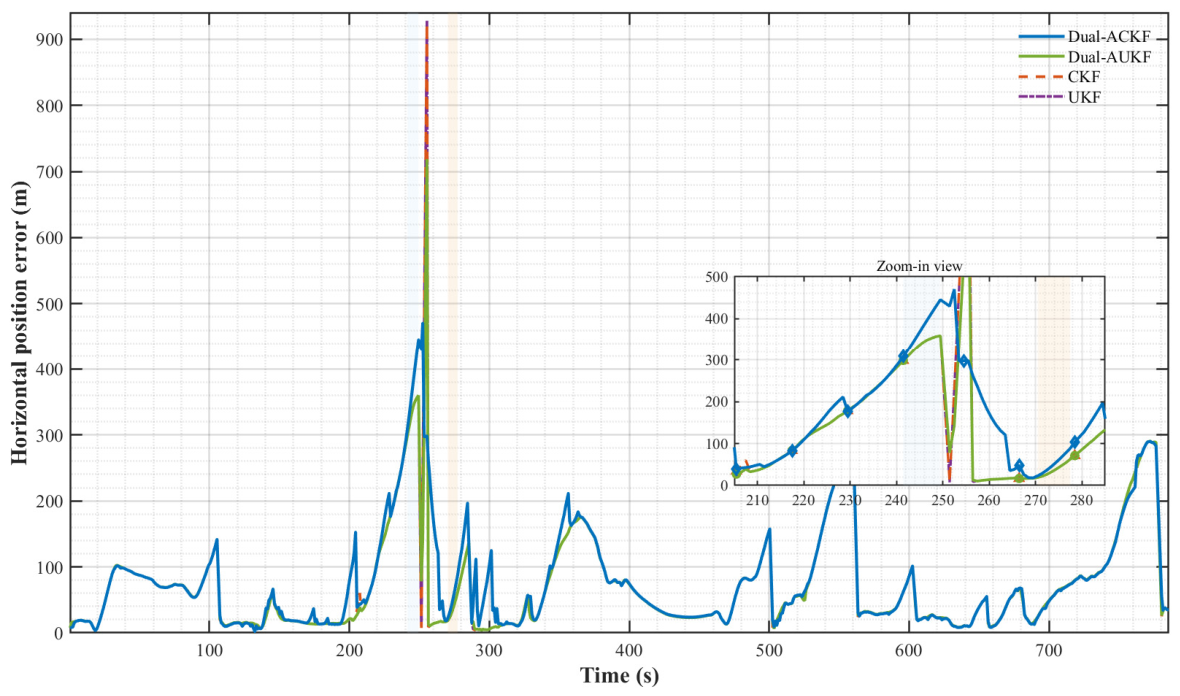
Figure 4 compares the horizontal position errors of the four filters over the entire test sequence, with a zoom-in view highlighting the performance differences in the representative degraded segment. The colored shaded areas indicate the GNSS-challenging periods, with different colors representing the Canyon 1 and Canyon 2 intervals, respectively.
The segment-wise horizontal error statistics of the raw GNSS observations are listed in
Table 5. No raw GNSS statistics are reported for the outage segment because the corresponding observations are treated as invalid in the quality-defined segmentation.
To further examine the relationship between GNSS quality labels and position-domain errors, several representative epochs with large raw GNSS horizontal errors are listed in
Table 6. The purpose of this analysis is not to redefine the GNSS quality segmentation, but to show that quality-defined observation conditions are not always equivalent to error-defined positioning reliability. In dense urban environments, the receiver may still output a valid GNSS position solution even when residual multipath, non-line-of-sight reception, or poor satellite geometry produces a biased position-domain error.
The representative epochs in
Table 6 show that the GNSS quality labels used in this work should be interpreted as observation-condition labels rather than direct error labels. For example, the normal epoch at t = 772.45 s has 12 tracked satellites, an HDOP of 1.05, and a PDOP of 1.64, but its raw GNSS horizontal error still reaches 282.50 m. This indicates that a quality-defined normal label does not necessarily guarantee a low-error position-domain observation.
The epoch around t = 248.45 s further illustrates the severe degradation near the 250 s interval. Although the GNSS solution remains valid, the epoch is labeled as canyon-2 with an HDOP of 4.42 and a PDOP of 5.83, and the raw horizontal error reaches 271.57 m. This supports the interpretation that the abnormal behavior around this interval is caused by severe position-domain GNSS distortion rather than by complete GNSS unavailability.
This observation explains why fixed-covariance filters may still suffer from large position errors even in normal or transition periods. If a contaminated but valid GNSS position is accepted with unchanged confidence, the corresponding innovation can be directly mapped into the vehicle position state. Therefore, the proposed Dual-ACKF does not rely solely on binary GNSS availability or quality labels. Instead, it combines adaptive measurement-noise regulation, residual-based robust weighting, recovery protection, and GNSS bias-state absorption to reduce the influence of valid but unreliable GNSS observations.
5.2. Segment-Wise Positioning Performance Comparison
To evaluate the proposed method under different GNSS conditions, the positioning performance of Dual-ACKF, Dual-AUKF, CKF, and UKF is compared over the quality-defined normal, canyon, outage, and transition segments introduced in
Section 4.3. This segmented analysis allows both average accuracy and degraded-condition robustness to be examined in a structured manner.
In the normal segment, the four methods show relatively similar overall performance. This result is consistent with the raw GNSS analysis in
Section 5.1, which indicates that even quality-defined normal observations in the selected UrbanNav sequence may still contain noticeable distortion. Under this condition, Dual-ACKF does not degrade the positioning performance relative to the comparison methods.
In the canyon segment, the advantage of Dual-ACKF becomes more evident in robustness-sensitive metrics. Compared with the baseline methods, it better limits upper-tail horizontal errors, indicating improved resistance to degraded GNSS observations affected by urban multipath and blockage.
In the canyon segment, the advantage of Dual-ACKF becomes more evident in robustness-sensitive metrics. Compared with the baseline methods, it better limits upper-tail horizontal errors, indicating improved resistance to degraded GNSS observations affected by urban multipath and blockage. Although some central-error metrics are not always the lowest, the proposed method shows a more favorable robustness profile in this degraded phase.
In the outage segment, the proposed method shows the clearest benefit. Without reliable GNSS updates, the integrated solution depends mainly on INS propagation and auxiliary robustness mechanisms. The results show that Dual-ACKF more effectively suppresses error accumulation and maintains lower upper-tail positioning errors than the comparison methods.
In the transition segment, the proposed method again shows improved robustness in tail-related metrics. This result indicates that the recovery-aware update regulation helps support a more stable return to normal positioning conditions after degraded or unavailable GNSS observations.
Overall, the segment-wise comparison indicates that the main advantage of Dual-ACKF lies in robustness under degraded GNSS conditions, especially in terms of long-tail error suppression and stability during canyon, outage, and recovery-related periods. The segment-wise positioning performance of the four filters is summarized in
Table 7.
While
Table 7 summarizes the segment-wise positioning performance of the four filters, the robustness differences become more evident in outage and post-outage recovery conditions, which are further analyzed in the following subsection.
5.3. Outage and Recovery Behavior Analysis
Outage and post-outage recovery are critical phases for practical urban vehicle positioning. During outage intervals, the integrated solution loses reliable external position updates and relies mainly on INS propagation, which may lead to rapid error accumulation. During the subsequent recovery phase, GNSS observations formally become available again, but their quality may still remain unstable for several epochs.
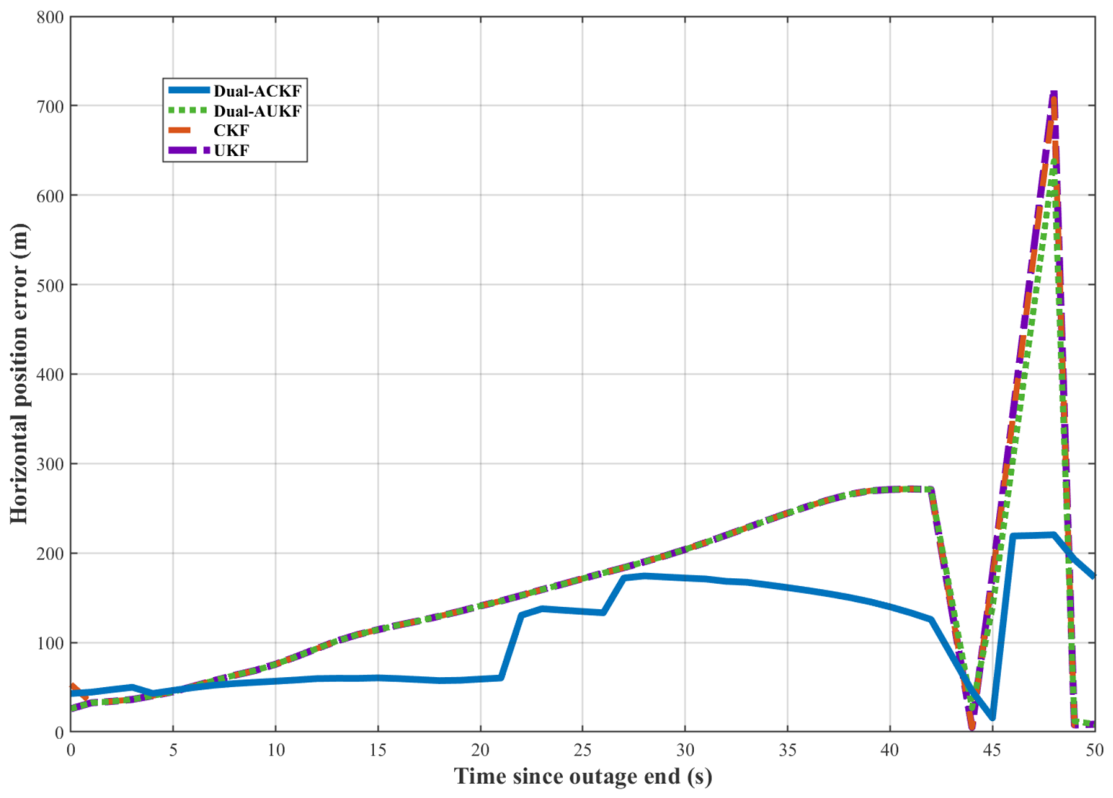
The comparative results show that the proposed Dual-ACKF provides clearer advantages in these phases than in the nominal segment. In outage intervals, it exhibits slower horizontal error growth and lower upper-tail error statistics than the comparison methods. This indicates that the proposed framework is more effective at limiting drift accumulation when reliable GNSS correction is unavailable.
The proposed method also shows improved robustness during the recovery phase. Instead of immediately trusting recovered GNSS observations, Dual-ACKF maintains a more cautious update behavior, which helps reduce abrupt state dragging caused by unstable post-outage measurements. As a result, the transition from outage to re-observation is more stable than that of the baseline filters.
Figure 5 illustrates the error evolution during GNSS outage and post-outage recovery. As shown in the figure, the proposed method maintains a substantially lower error peak during the post-outage recovery phase and avoids the severe error surge observed in the comparison methods. This temporal behavior is consistent with the robustness-oriented statistics summarized in
Table 8.
The outage and recovery results reveal different failure mechanisms among the compared filters. For CKF and UKF, the GNSS measurement covariance is fixed during the position-only update. Therefore, once a contaminated GNSS position is accepted by the filter, the corresponding innovation can directly correct the vehicle position state through the Kalman gain. This behavior is particularly problematic near outage boundaries and during signal reacquisition, where the receiver may output a formally valid GNSS position while the position-domain error remains biased or unstable.
Dual-AUKF alleviates this problem by adaptively regulating the GNSS measurement covariance. However, covariance adaptation alone mainly treats GNSS degradation as a stochastic measurement-noise variation. In dense urban environments, part of the GNSS error may behave more like a persistent position-domain distortion than a zero-mean random perturbation. Without an explicit bias-absorption mechanism, this residual distortion can still be partially mapped into the navigation state, especially during severe canyon periods and post-outage recovery.
In contrast, the proposed Dual-ACKF combines several complementary mechanisms during degraded and recovery-related periods. First, the adaptive measurement-noise estimator reduces the confidence assigned to inconsistent GNSS observations. Second, the residual-based robust update and recovery protection prevent abnormal or unstable measurements from producing excessive position corrections. Third, the GNSS bias state provides an additional channel for absorbing slowly varying position-domain distortions. During a complete GNSS outage, the NHC update further constrains the INS-driven drift when GNSS observations are unavailable.
This mechanism is consistent with the quantitative results. In the outage segment, Dual-ACKF reduces the P95 horizontal error from 521.23 m, 582.72 m, and 591.60 m for Dual-AUKF, CKF, and UKF to 228.21 m. The maximum horizontal error is also reduced from 638.02 m, 707.37 m, and 718.78 m to 246.45 m. Similarly, the outage-drift P95 decreases from 400.99 m, 432.76 m, and 436.52 m to 169.13 m. These improvements indicate that the main benefit of Dual-ACKF lies in suppressing long-tail errors and limiting drift growth rather than only reducing the median error.
The transition-period results show a similar trend. Although all filters can recover after GNSS observations become available again, the quality of the recovered GNSS position is not always reliable. As shown by the representative high-error epochs in
Table 6, valid GNSS observations can still contain large horizontal position-domain errors. Therefore, directly restoring full measurement confidence after signal reacquisition may introduce a large correction into the vehicle position state. The recovery protection and bias-state absorption are designed to reduce this risk. However, the updated transition-segment statistics show that all filters are strongly affected by several highly distorted reacquired GNSS epochs, and the differences among methods are therefore relatively small in this segment.
Overall, the outage and recovery analysis suggests that Dual-ACKF is most effective under conditions where GNSS errors are time-varying, heavy-tailed, or bias-like. The proposed method does not simply reject all degraded GNSS observations. Instead, it applies graded observation treatment by combining adaptive covariance regulation, residual consistency checking, GNSS bias compensation, and NHC assistance. This design explains why the performance gain is most evident in P95, P99, maximum error, and outage-drift indicators.
5.4. Consistency and Runtime Analysis
In addition to positioning accuracy and robustness, the statistical consistency of the compared methods is also evaluated using NEES and NIS. Their runtime is further recorded to provide a basic comparison of computational cost.
The results show that the proposed Dual-ACKF exhibits more moderate uncertainty behavior than the baseline filters under degraded urban GNSS conditions. In the evaluated segments, its position-related NEES is much lower than that of CKF and UKF, and also lower than that of Dual-AUKF in the more degraded conditions. A similar trend is observed in the NIS statistics. The proposed method maintains a high proportion of innovation consistency within the expected confidence range, particularly under canyon and transition conditions.
The runtime comparison shows that Dual-ACKF requires a higher computational cost than Dual-AUKF, CKF, and UKF. This increase is expected because the proposed framework includes an augmented state, a slave adaptive process, and scenario-aware robust update regulation. However, the additional cost remains acceptable for offline evaluation and near-real-time integrated positioning analysis.
Overall, the results indicate that the proposed Dual-ACKF improves consistency under degraded urban GNSS conditions while introducing only a manageable increase in runtime. The consistency indicators and runtime of the evaluated filters are summarized in
Table 9.
5.5. Ablation Study of Dual-ACKF
To further examine the contribution of each key component in the proposed Dual-ACKF, an ablation study was conducted under the same UrbanNav sequence and the same position-only INS/GNSS integration setting. The complete Dual-ACKF was compared with four ablated variants: Dual-ACKF without the GNSS positioning bias state, Dual-ACKF without adaptive measurement-noise estimation, Dual-ACKF without scenario-aware robust update regulation, and Dual-ACKF without NHC assistance. All variants used the same input data, initial conditions, reference trajectory, and segment definitions as the main comparison experiment.
The ablation results are summarized in
Table 10. In the canyon segment, the complete Dual-ACKF achieves the lowest P95 horizontal error among all variants. Its P95 error is 192.82 m, whereas removing the GNSS bias state increases the P95 error to 254.23 m. This result indicates that the explicit GNSS positioning bias state plays an important role in absorbing persistent position-domain distortion under degraded urban GNSS conditions. Without this bias channel, a larger portion of the contaminated GNSS residual is mapped directly into the vehicle position state, which leads to larger upper-tail errors.
The effect of the scenario-aware robust update strategy is also evident in the canyon segment. When this strategy is removed, the P95 error increases from 192.82 m to 254.25 m, which is close to the result obtained by removing the GNSS bias state. This suggests that phase-dependent update regulation is essential for handling degraded GNSS observations. By adjusting residual checks, update strength, and correction distribution according to GNSS quality conditions, the complete Dual-ACKF can avoid over-trusting severely distorted but still valid GNSS measurements.
The adaptive measurement-noise estimator also contributes to improved robustness. Removing adaptive measurement-noise estimation increases the canyon-segment P95 error from 192.82 m to 202.95 m. Although the degradation is smaller than that caused by removing the GNSS bias state or the scenario-aware update strategy, the result still shows that online measurement-confidence regulation helps suppress large GNSS-induced errors. This confirms that the slave innovation-energy-based estimator provides useful information for adjusting GNSS observation confidence under time-varying urban conditions.
The role of NHC assistance is more complex. Removing NHC increases the canyon-segment P95 error to 251.70 m, which indicates that motion constraints can also support positioning stability in degraded conditions. However, in the outage segment, some ablated variants show smaller maximum errors than the complete version. This non-monotonic behavior is mainly related to the small number of outage samples and the fact that GNSS position updates are unavailable during outage intervals. Therefore, the outage-segment ablation results should be interpreted as auxiliary evidence rather than as the primary basis for judging the contribution of each module.
Overall, the ablation study demonstrates that the performance improvement of Dual-ACKF is not caused by a single module alone. Instead, the robustness gain mainly results from the joint effect of GNSS bias-state absorption, adaptive measurement-confidence regulation, scenario-aware robust update control, and NHC-based motion assistance. Among the evaluated segments, the canyon segment provides the clearest evidence of module effectiveness, because it contains valid but degraded GNSS observations where robust measurement treatment is most critical.
6. Discussion
6.1. Main Findings and Interpretation
The results indicate that the main advantage of the proposed Dual-ACKF lies in improved robustness under degraded urban GNSS conditions rather than universal superiority in all positioning metrics. In the selected UrbanNav sequence, the raw GNSS observations already contain substantial distortion even in some quality-defined normal intervals. Under such conditions, the proposed method does not necessarily achieve the smallest central-error statistics in every segment, but it more effectively suppresses long-tail positioning errors and reduces the risk of severe positioning divergence during canyon, outage, and recovery periods.
This behavior is consistent with the design of the proposed framework. First, the slave adaptive process enables online regulation of GNSS measurement confidence according to innovation energy, which helps avoid excessive trust in unstable observations. Second, the explicit GNSS bias state allows part of the observation residual to be interpreted as persistent positioning distortion rather than true vehicle motion. Third, the scenario-aware robust update strategy provides phase-dependent update regulation, which is particularly beneficial during outage and post-outage recovery. The combined effect of these mechanisms explains why the proposed method shows better robustness in upper-tail error control, drift limitation, and recovery stability.
Another important observation is that quality-defined GNSS conditions and error-defined positioning quality are not strictly equivalent in realistic urban environments. This explains why the normal segment in the selected dataset does not always correspond to low-error positioning behavior, and why robust integrated positioning remains necessary even when some GNSS quality indicators appear acceptable. From this perspective, the proposed method is not designed to maximize aggressive correction under all conditions, but to maintain stable and reliable positioning behavior when GNSS quality becomes uncertain, distorted, or temporarily unavailable.
The large gap in NEES between Dual-ACKF and the baseline filters further suggests that the main difference lies not only in positioning accuracy, but also in covariance consistency. In the degraded segments, the baseline filters tend to remain severely overconfident, whereas Dual-ACKF provides a more moderate uncertainty description through adaptive covariance regulation, robust update control, and GNSS bias absorption. This behavior is consistent with the NIS results and supports the interpretation that the proposed framework improves both robustness and statistical consistency under degraded urban GNSS conditions.
The ablation study further supports this interpretation. In the canyon segment, removing either the GNSS bias state or the scenario-aware robust update strategy increases the P95 horizontal error from 192.82 m to more than 254 m. Removing adaptive measurement-noise estimation also increases the P95 error to 202.95 m. These results indicate that the proposed framework benefits from the coupling of bias absorption, online measurement-confidence regulation, and phase-dependent robust update control. However, the ablation results in the outage and recovery transition segments are not fully monotonic. This is mainly because the outage segment contains only a limited number of samples and the recovery segment still includes valid but highly distorted GNSS observations. Therefore, the canyon-segment ablation results provide the clearest evidence for the contribution of the proposed modules.
Overall, these findings suggest that robust urban vehicle INS/GNSS integration should not be evaluated only by average positioning accuracy. In challenging urban canyon environments, the ability to suppress long-tail errors, limit drift accumulation, and maintain stable recovery after GNSS degradation is equally important. In this robustness-oriented sense, the proposed Dual-ACKF provides a practical and effective solution for urban vehicle positioning under degraded GNSS conditions.
6.2. Limitations and Future Work
Although the proposed Dual-ACKF shows improved robustness under degraded urban GNSS conditions, several limitations of the present study should be acknowledged. First, the experimental validation is currently based on a single selected UrbanNav sequence under a position-only INS/GNSS integration setting. Although this sequence contains representative urban positioning challenges, including multipath effects, signal attenuation, and partial GNSS outages, the use of only one sequence inevitably limits the broader generalization of the results. Therefore, the reported improvements should be interpreted as evidence obtained under the tested degraded-GNSS scenario rather than as a comprehensive demonstration of performance across all urban environments. Further validation using additional UrbanNav sequences and independent datasets is required to assess the robustness of the proposed method under different city layouts, satellite geometries, receiver configurations, IMU grades, vehicle motion patterns, and longer or more diverse GNSS outage conditions.
Second, the proposed framework includes several scenario-aware regulation mechanisms and related parameters. While these designs improve robustness in practice, their parameter sensitivity and transferability across different datasets have not yet been systematically investigated. A more comprehensive analysis of parameter tuning and cross-scenario adaptability would further strengthen the practical applicability of the method. In addition, the ablation analysis is based on a single selected sequence and a limited number of outage epochs. Although the canyon-segment results clearly demonstrate the contribution of the proposed modules, further experiments on longer outage intervals and more diverse recovery scenarios are needed to fully quantify the individual contribution of NHC and recovery protection.
Third, the present work focuses on robust positioning under degraded GNSS observations within a position-only INS/GNSS integration framework. Further extensions could incorporate additional sensors or more generalized motion constraints to improve robustness under more challenging operating conditions.
Future work will therefore focus on broader cross-dataset validation, more adaptive and self-tuning robust regulation strategies, and extension of the current framework toward more general multi-sensor integrated positioning.
7. Conclusions
This paper proposed a dual-adaptive robust cubature Kalman filter (Dual-ACKF) for urban vehicle position-only INS/GNSS integration under degraded GNSS conditions. The proposed method combines adaptive measurement-noise estimation, an explicit GNSS positioning bias state, and scenario-aware robust update regulation to improve positioning robustness in urban canyon environments. In addition, optional NHC assistance is incorporated during GNSS outage periods to enhance motion consistency.
The proposed method was validated using a public UrbanNav sequence collected under challenging urban driving conditions. Comparative experiments against Dual-AUKF, CKF, and UKF showed that the main advantage of Dual-ACKF lies in robustness under degraded GNSS observations. In particular, the proposed method more effectively suppresses long-tail positioning errors and maintains more stable behavior during canyon, outage, and recovery periods, while also providing improved consistency under degraded conditions. The ablation study further showed that the GNSS bias state, adaptive measurement-noise estimation, scenario-aware robust update regulation, and NHC assistance jointly contribute to the robustness of the proposed method, with the clearest improvement observed in the canyon segment.
Overall, the results suggest that robust urban vehicle INS/GNSS integration should be evaluated not only by average positioning accuracy, but also by its ability to control risk under degraded observations. In this robustness-oriented sense, the proposed Dual-ACKF provides a practical and effective solution for urban vehicle positioning under degraded GNSS conditions.
Nevertheless, since the evaluation was performed on a single selected UrbanNav sequence, the conclusions should be interpreted within the scope of the tested degraded-GNSS scenario. Future work will extend the validation to multiple urban datasets and more diverse GNSS-denied or GNSS-degraded conditions to further examine the generalization capability of the proposed method.