Enhanced Tensor Incomplete Multi-View Clustering with Dual Adaptive Weight

Abstract
1. Introduction
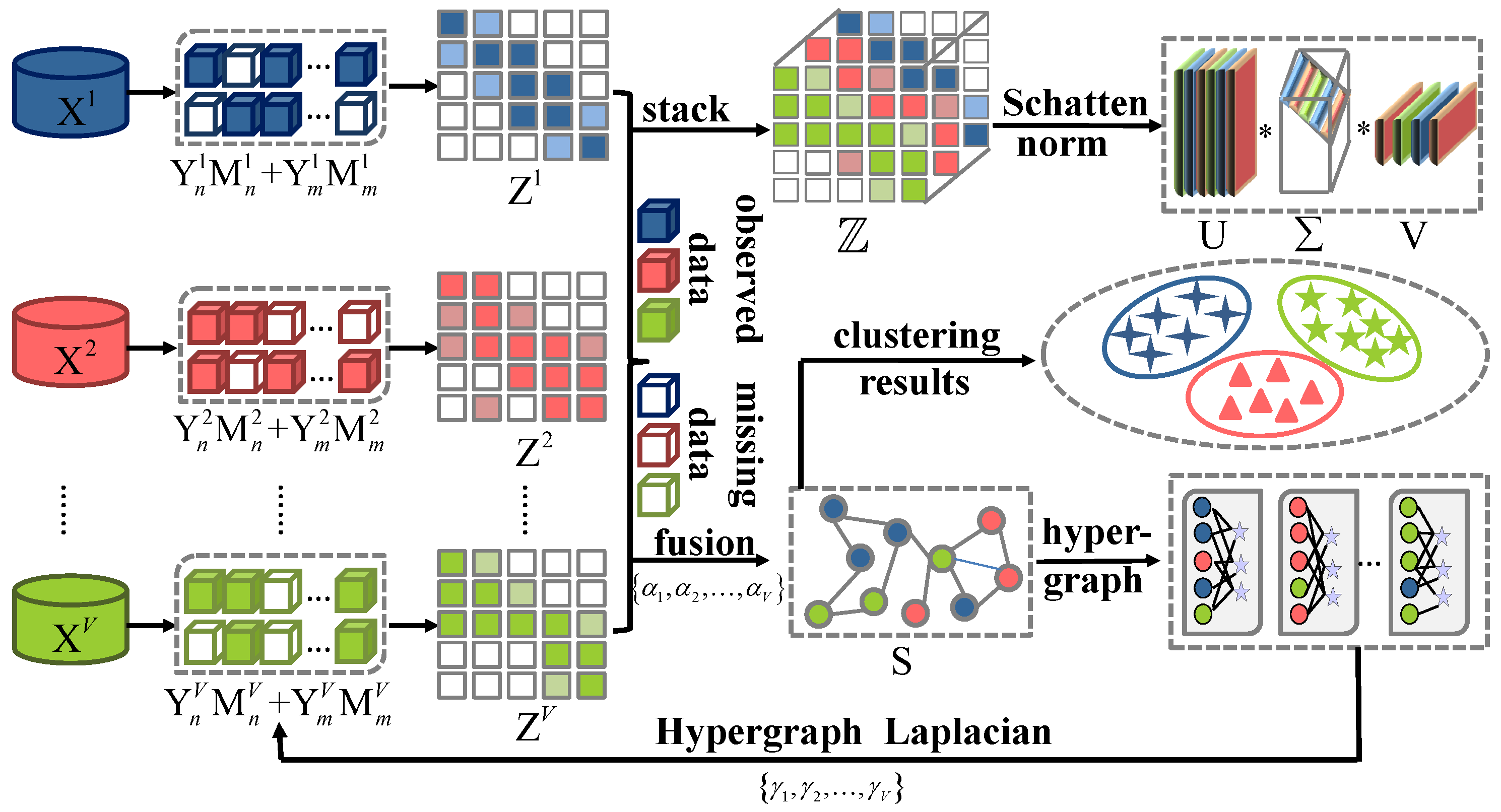
- The proposed ETIMC can obtain the higher-order information from the incomplete multi-view data, solving the tensor minimization problem with the Schatten-p norm to increase flexibility and ensuring the low-rank characteristics.
- The adaptive hypergraph Laplacian mechanism can recover the missing samples by hypergraph neighbors and preserve the higher-order local geometry structure of the original data.
- The proposed ETIMC considers the differences among multiple perspectives via a self-weighting mechanism, which contributes to identifying the contribution of each low-dimensional representation in learning consensus representations.
2. Related Work
3. Methods
3.1. Problem Formulation
3.2. Optimization
| Algorithm 1 Optimization procedure of ETIMC |
|
3.3. Computational Complexity
4. Experiment
4.1. Experiment Settings
4.2. Clustering Performance
- Compared with other methods, the proposed ETIMC can achieve optimal performance on these three natural incomplete datasets. For instance, ETIMC is 3.8%, 8.1%, 3.8%, 7.9%, 6.3%, and 7.1% higher in terms of ACC, NMI, PUR, AR, F-score, and Precision than the second-best algorithm in the BBC dataset. This result indicates that hypergraph regularization, Schatten-p norm, and adaptive mechanism contribute to improving the performance of incomplete multi-view clustering.
- The performance of MIC on the three datasets is poor, which indicates that simply completing the incomplete samples using 0 or the mean value is not conducive to improving the performance of incomplete multi-view clustering. This method may introduce unnecessary noise and obtain incorrect information, leading to performance degradation. On the contrary, FLSD processes incomplete multi-view data by saving the locality of missing samples, and it can obtain better clustering results in most circumstances. However, our proposed ETIMC is superior to FLSD, indicating that capturing higher-order information between multiple perspectives applies to processing multi-perspective data.
- PIC, AWP, and UEAF methods outperform other methods in most cases. The reason is that these three methods all apply an adaptive mechanism, indicating that assigning reasonable weights to different views is also beneficial to the clustering results. The ETIMC develops adaptive weights in consensus representation learning and the construction of incomplete data items, which promotes the performance of the whole algorithm to a certain extent.
- The clustering performance of DDMVC and RecFormer shows a clear decline compared with traditional methods, mainly because deep models are well suited for analyzing data distributions in large-scale datasets but face greater difficulty when learning from small-scale data. Consequently, ETIMC exhibits a clear advantage over deep approaches on small datasets.
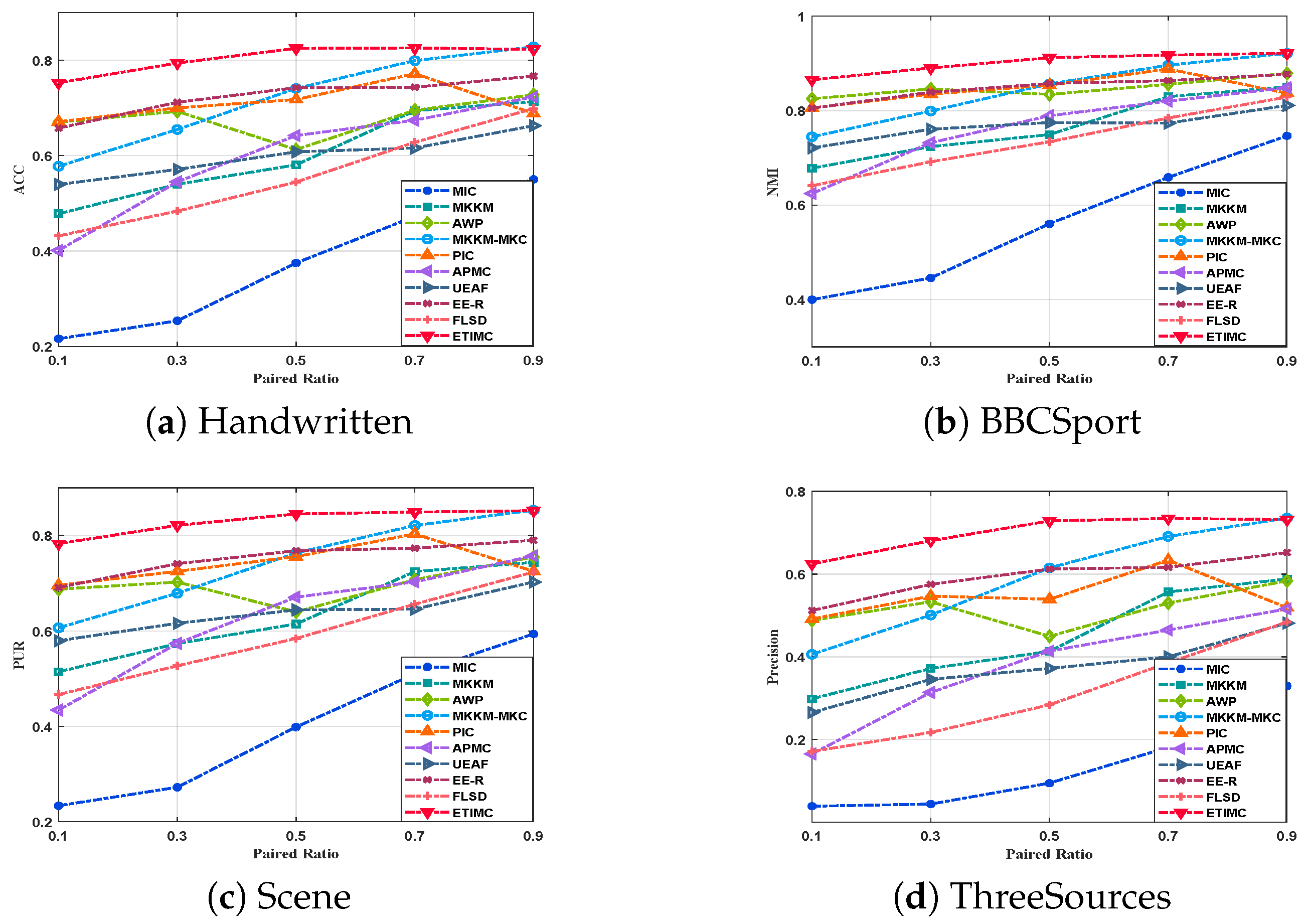
- In different miss rates, our proposed ETIMC is superior to other comparison methods. On the one hand, ETIMC applies a dual adaptive mechanism to capture consistent information in incomplete multi-view data and infer incomplete samples with hypergraph constraints. On the other hand, tensor and hypergraph constraints can explore the higher-order information in incomplete multi-view data, which promotes the clustering performance.
- Generally, as pairing ratios increase, the performances of incomplete data improve. However, the ORL dataset reaches the best when the pairing ratio is 0.5, mainly because the incomplete data may be disturbed by noise. Since the proposed ETIMC adopts the dual adaptive weight mechanism, the hypergraph Laplacian regularization, and tensor constraint to process the incomplete multi-view data. Therefore, ETIMC has the ability to process noise data.
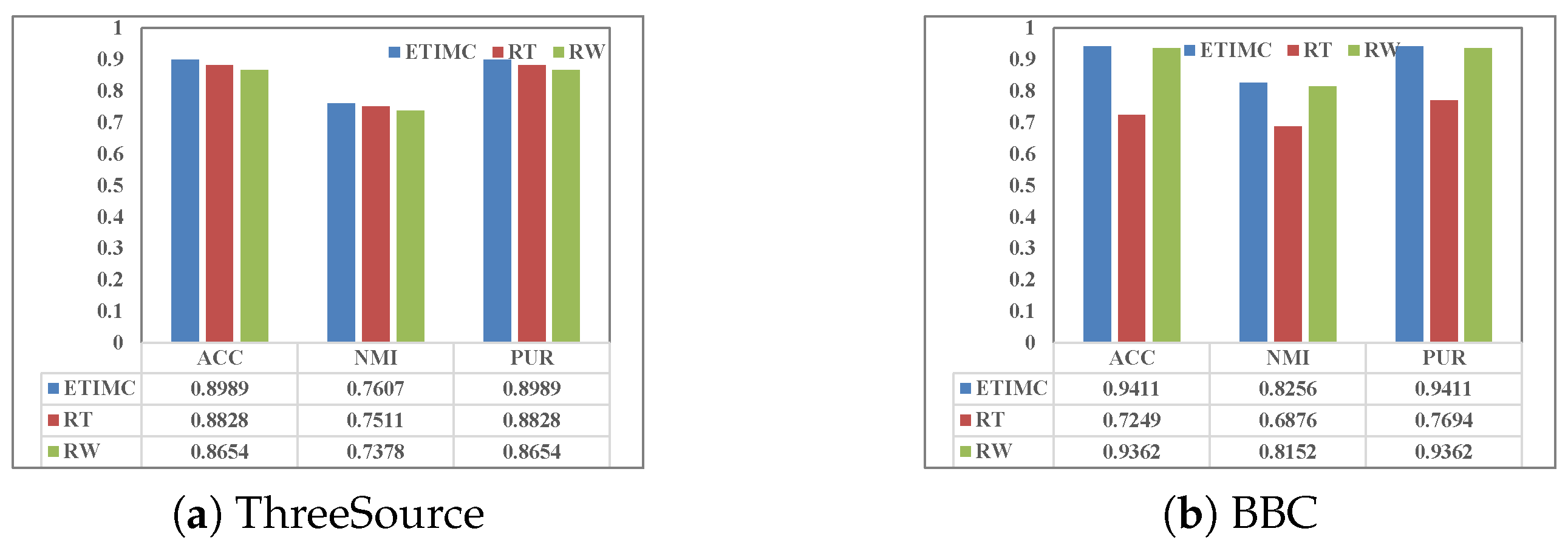
4.3. Ablation Study
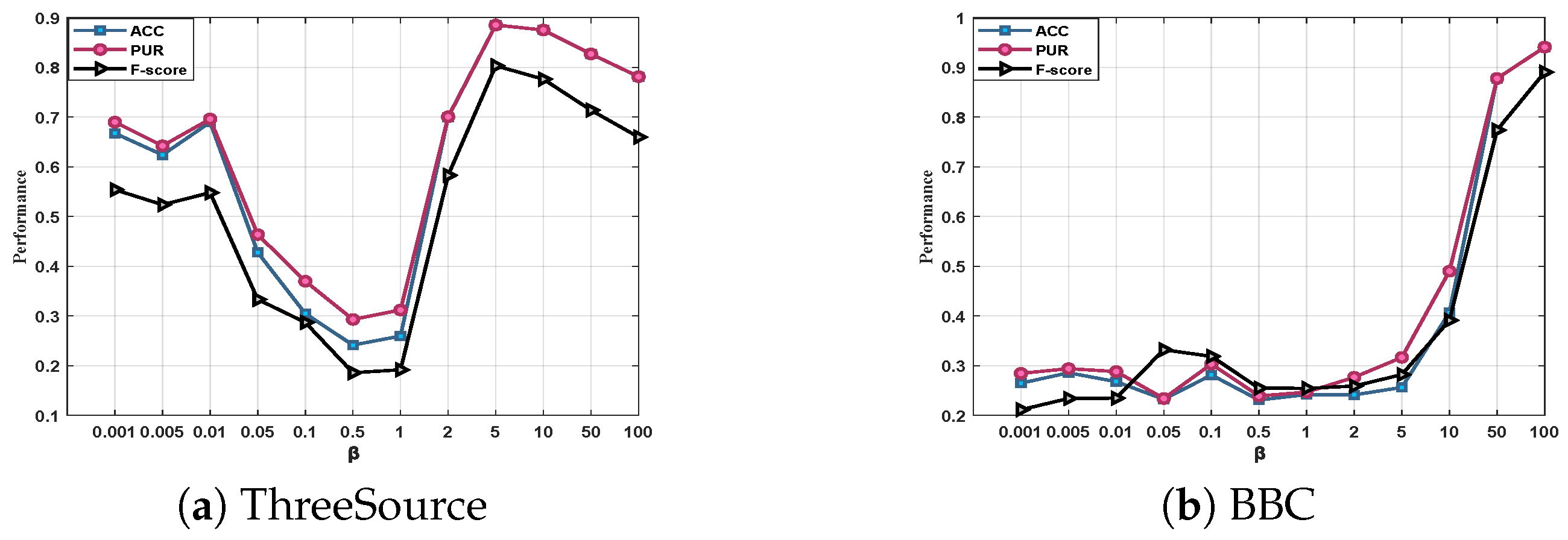
4.4. Parameter Analysis
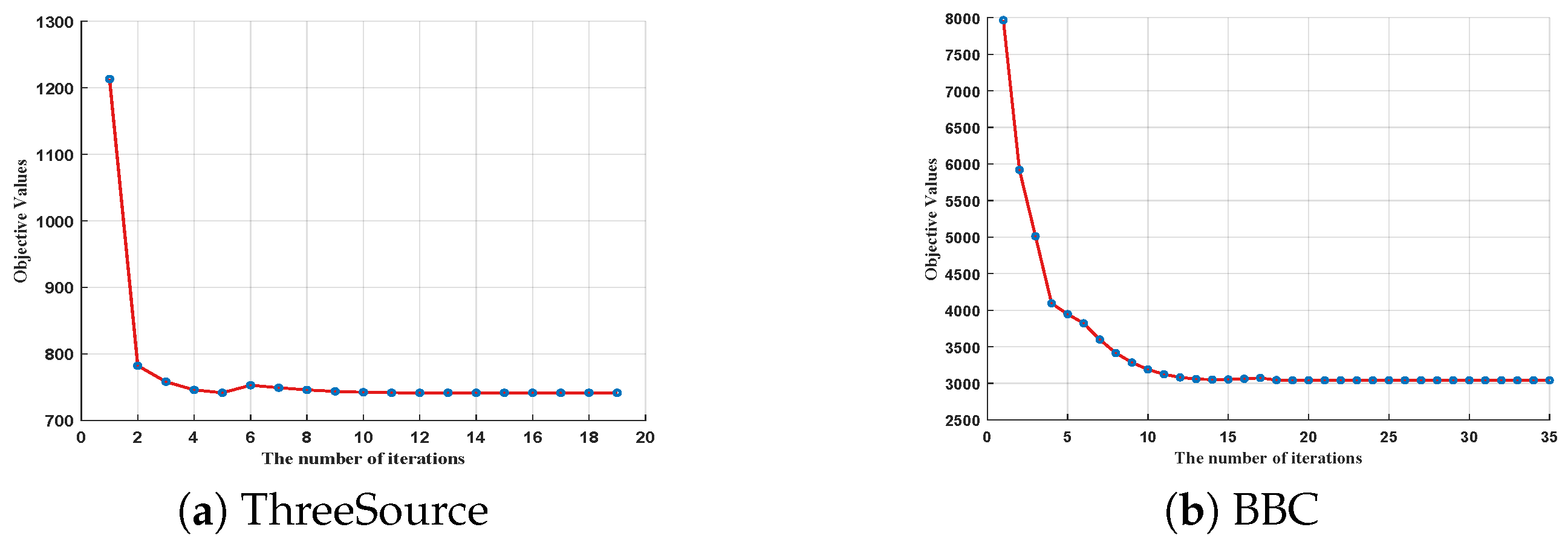
4.5. Convergence Analysis
5. Conclusions
Author Contributions
Funding
Data Availability Statement
Conflicts of Interest
References
- Cai, X.; Huang, D.; Zhang, G.-Y.; Wang, C.-D. Seeking commonness and inconsistencies: A jointly smoothed approach to multi-view subspace clustering. Inf. Fusion 2023, 91, 364–375. [Google Scholar] [CrossRef]
- Zhang, G.-Y.; Huang, D.; Wang, C.-D. Facilitated low-rank multi-view subspace clustering. Knowl. Based Syst. 2023, 260, 110141. [Google Scholar] [CrossRef]
- Fu, L.; Huang, S.; Zhang, L.; Yang, J.; Zheng, Z.; Zhang, C.; Chen, C. Subspace-contrastive multi-view clustering. ACM Trans. Knowl. Discov. Data 2024, 18, 1–35. [Google Scholar] [CrossRef]
- Du, Y.; Lu, G.-F.; Ji, G.-Y. Robust and optimal neighborhood graph learning for multi-view clustering. Inf. Sci. 2023, 631, 429–448. [Google Scholar] [CrossRef]
- Liu, W.; Zhu, J.; Wang, H.; Zhang, Y. Robust Multi-view Clustering via Graph-oriented High-order Correlations Learning. IEEE Trans. Netw. Sci. Eng. 2024, 12, 559–570. [Google Scholar] [CrossRef]
- Chao, G.; Xu, K.; Xie, X.; Chen, Y. Global Graph Propagation with Hierarchical Information Transfer for Incomplete Contrastive Multi-view Clustering. In Proceedings of the AAAI Conference on Artificial Intelligence, Philadelphia, PA, USA, 25 February–4 March 2025; Volume 39, pp. 15713–15721. [Google Scholar]
- Trivedi, A.; Rai, P.; Daumé, H., III; DuVall, S.L. Multiview clustering with incomplete views. In NIPS Workshop; NeurIPS: San Diego, CA, USA, 2010; Volume 224, pp. 1–8. [Google Scholar]
- Gao, H.; Peng, Y.; Jian, S. Incomplete multi-view clustering. In Proceedings of the 9th International Conference on Intelligent Information Processing (IIP), Melbourne, Australia, 18–21 November 2016; pp. 245–255. [Google Scholar]
- Zhao, H.; Liu, H.; Fu, Y. Incomplete multi-modal visual data grouping. In Proceedings of the IJCAI, New York, NY, USA, 9–15 July 2016; pp. 2392–2398. [Google Scholar]
- Wen, J.; Zhang, Z.; Zhang, Z.; Zhu, L.; Fei, L.; Zhang, B.; Xu, Y. Unified tensor framework for incomplete multi-view clustering and missing-view inferring. In Proceedings of the AAAI Conference on Artificial Intelligence, Virtual, 2–9 February 2021; Volume 35, pp. 10273–10281. [Google Scholar]
- Hu, M.; Chen, S. Doubly aligned incomplete multi-view clustering. arXiv 2019, arXiv:1903.02785. [Google Scholar] [CrossRef]
- Gai, Y.; Liu, J. Interpretable unsupervised neural network structure for data clustering via differentiable reconstruction of ONMF and sparse autoencoder. Neural Netw. 2025, 188, 107504. [Google Scholar] [CrossRef]
- Li, Z.; Tang, C.; Liu, X.; Zheng, X.; Zhang, W.; Zhu, E. Tensor-Based Multi-View Block-Diagonal Structure Diffusion for Clustering Incomplete Multi-View Data. In Proceedings of the 2021 IEEE International Conference Multimedia Expo (ICME), Shenzhen, China, 5–9 July 2021; pp. 1–6. [Google Scholar]
- Zhang, C.; Li, H.; Lv, W.; Huang, Z.; Gao, Y.; Chen, C. Enhanced tensor low-rank and sparse representation recovery for incomplete multi-view clustering. In Proceedings of the AAAI Conference on Artificial Intelligence, Washington, DC, USA, 7–14 February 2023; Volume 37, pp. 11174–11182. [Google Scholar]
- Liu, X.; Zhu, X.; Li, M.; Wang, L.; Zhu, E.; Liu, T.; Kloft, M.; Shen, D.; Yin, J.; Gao, W. Multiple kernel k-means with incomplete kernels. IEEE Trans. Pattern Anal. Mach. Intell. 2019, 42, 1191–1204. [Google Scholar] [CrossRef]
- Wen, J.; Yan, K.; Zhang, Z.; Xu, Y.; Wang, J.; Fei, L.; Zhang, B. Adaptive graph completion based incomplete multi-view clustering. IEEE Trans. Multimed. 2020, 23, 2493–2504. [Google Scholar] [CrossRef]
- Liu, C.; Wu, Z.; Wen, J.; Xu, Y.; Huang, C. Localized sparse incomplete multi-view clustering. IEEE Trans. Multimed. 2022, 25, 5539–5551. [Google Scholar] [CrossRef]
- Wen, J.; Zhang, Z.; Zhang, Z.; Wu, Z.; Fei, L.; Xu, Y.; Zhang, B. Dimc-net: Deep incomplete multi-view clustering network. In Proceedings of the 28th ACM International Conference Multimedia, Seattle, WA, USA, 12–16 October 2020; pp. 3753–3761. [Google Scholar]
- Wen, J.; Wu, Z.; Zhang, Z.; Fei, L.; Zhang, B.; Xu, Y. Structural Deep Incomplete Multi-view Clustering Network. In Proceedings of the 30th ACM International Conference on Information and Knowledge Management, Gold Coast, Australia, 1–5 November 2021; pp. 3538–3542. [Google Scholar]
- Lin, Y.; Gou, Y.; Liu, Z.; Li, B.; Lv, J.; Peng, X. Completer: Incomplete multi-view clustering via contrastive prediction. In Proceedings of the IEEE/CVF Conference on Computer Vision and Pattern Recognition, Nashville, TN, USA, 20–25 June 2021; pp. 11174–11183. [Google Scholar]
- Jin, J.; Wang, S.; Dong, Z.; Liu, X.; Zhu, E. Deep incomplete multi-view clustering with cross-view partial sample and prototype alignment. In Proceedings of the IEEE/CVF conference on computer vision and pattern recognition, Vancouver, BC, Canada, 17–24 June 2023; pp. 11600–11609. [Google Scholar]
- Li, X.; Sun, Q.; Ren, Z.; Sun, Y. Dynamic incomplete multi-view imputing and clustering. In Proceedings of the 30th ACM International Conference on Multimedia, Lisboa, Portugal, 10–14 October 2022; pp. 3412–3420. [Google Scholar]
- Li, H.; Li, Y.; Yang, M.; Hu, P.; Peng, D.; Peng, X. Incomplete multi-view clustering via prototype-based imputation. In Proceedings of the Thirty-Second International Joint Conference on Artificial Intelligence, Macao, China, 19–25 August 2023; pp. 3911–3919. [Google Scholar]
- Wen, J.; Deng, S.; Wong, W.; Chao, G.; Huang, C.; Fei, L.; Xu, Y. Diffusion-based missing-view generation with the application on incomplete multi-view clustering. In Proceedings of the 41st International Conference on Machine Learning, Vienna, Austria, 21–27 July 2024; pp. 52762–52778. [Google Scholar]
- Chen, J.; Ling, Y.; Xu, J.; Ren, Y.; Huang, S.; Pu, X. Variational graph generator for multiview graph clustering. IEEE Trans. Neural Netw. Learn. Syst. 2025, 18, 11078–11091. [Google Scholar] [CrossRef] [PubMed]
- Lin, Y.; Gou, Y.; Liu, X.; Bai, J.; Lv, J.; Peng, X. Dual contrastive prediction for incomplete multi-view representation learning. IEEE Trans. Pattern Anal. Mach. Intell. 2022, 45, 4447–4461. [Google Scholar] [CrossRef] [PubMed]
- Xu, J.; Li, C.; Peng, L.; Ren, Y.; Shi, X.; Shen, H.T.; Zhu, X. Adaptive feature projection with distribution alignment for deep incomplete multi-view clustering. IEEE Trans. Image Process. 2023, 32, 1354–1366. [Google Scholar] [CrossRef] [PubMed]
- Xie, Y.; Tao, D.; Zhang, W.; Liu, Y.; Zhang, L.; Qu, Y. On unifying multi-view self-representations for clustering by tensor multi-rank minimization. Int. J. Comput. Vis. 2018, 126, 1157–1179. [Google Scholar] [CrossRef]
- Jiang, G.; Peng, J.; Wang, H.; Mi, Z.; Fu, X. Tensorial Multi-view Clustering via Low-rank Constrained High-order Graph Learning. IEEE Trans. Circuits Syst. Video Technol. 2022, 32, 5307–5318. [Google Scholar] [CrossRef]
- Nie, F.; Li, J.; Li, X. Self-weighted Multiview Clustering with Multiple Graphs. In Proceedings of the IJCAI, Melbourne, Australia, 19–25 August 2017; pp. 2564–2570. [Google Scholar]
- Xie, Y.; Zhang, W.; Qu, Y.; Dai, L.; Tao, D. Hyper-Laplacian regularized multilinear multiview self-representations for clustering and semisupervised learning. IEEE Trans. Cybern. 2018, 50, 572–586. [Google Scholar] [CrossRef] [PubMed]
- Fu, L.; Chen, Z.; Chen, Y.; Wang, S. Unified Low-Rank Tensor Learning and Spectral Embedding for Multi-View Subspace Clustering. IEEE Trans. Multimed. 2022, 25, 4972–4985. [Google Scholar] [CrossRef]
- Gao, Q.; Zhang, P.; Xia, W.; Xie, D.; Gao, X.; Tao, D. Enhanced tensor RPCA and its application. IEEE Trans. Pattern Anal. Mach. Intell. 2020, 43, 2133–2140. [Google Scholar] [CrossRef] [PubMed]
- Xu, J.; Meng, M.; Liu, J.; Wu, J. Deep multi-view clustering with diverse and discriminative feature learning. Pattern Recognit. 2025, 161, 111322. [Google Scholar] [CrossRef]
- Liu, C.; Wen, J.; Wu, Z.; Luo, X.; Huang, C.; Xu, Y. Information Recovery-Driven Deep Incomplete Multiview Clustering Network. IEEE Trans. Neural Netw. Learn. Syst. 2024, 35, 15442–15452. [Google Scholar] [CrossRef] [PubMed]




| Dataset | EE-R | UEAF | ETIMC (Ours) |
|---|---|---|---|
| ThreeSources | 0.12 | 1.47 | 4.33 |
| BBCSport | 0.18 | 1.72 | 4.63 |
| BBC | 0.39 | 3.85 | 11.79 |
| Datasets | Size | Clusters | Views | Features |
|---|---|---|---|---|
| ThreeSources | 416 | 6 | 3 | 3560,3631,3068 |
| BBCSport | 737 | 5 | 2 | 3183,3203 |
| ORL | 400 | 40 | 3 | 4096,3304,6750 |
| BBC | 2225 | 5 | 4 | 4659,4633,4665,4684 |
| Datasets | Methods | ACC | NMI | PUR | AR | F-Score | Precision |
|---|---|---|---|---|---|---|---|
| ThreeSources | MIC | 42.6 | 34.1 | 44.7 | 7.90 | 30.7 | 22.1 |
| MKKM | 82.0 | 68.6 | 82.0 | 63.8 | 70.1 | 72.0 | |
| AWP | 76.4 | 67.1 | 76.4 | 66.2 | 72.7 | 67.0 | |
| MKKM-MKC | 75.3 | 61.5 | 75.3 | 51.3 | 59.8 | 61.1 | |
| PIC | 87.5 | 72.6 | 87.5 | 72.6 | 77.5 | 77.7 | |
| APMC | 81.9 | 67.4 | 81.9 | 63.7 | 70.1 | 70.7 | |
| UEAF | 83.5 | 68.1 | 83.5 | 65.8 | 71.9 | 72.6 | |
| EE-R | 71.9 | 57.3 | 71.9 | 50.0 | 58.6 | 60.5 | |
| FLSD | 88.7 | 74.3 | 88.7 | 75.5 | 79.9 | 79.9 | |
| DDMVC | 60.4 | 41.7 | 63.3 | 38.5 | 6.3 | 4.9 | |
| RecFormer | 42.6 | 22.2 | 43.2 | 14.3 | 25.7 | 46.1 | |
| ETIMC | 89.9 | 76.1 | 89.9 | 78.1 | 82.0 | 82.0 | |
| BBCSport | MIC | 54.8 | 48.0 | 59.8 | 37.2 | 54.5 | 46.3 |
| MKKM | 85.2 | 67.8 | 85.2 | 66.4 | 73.9 | 77.6 | |
| AWP | 94.0 | 82.8 | 94.0 | 84.7 | 88.3 | 87.7 | |
| MKKM-MKC | 83.8 | 65.8 | 83.8 | 63.9 | 71.9 | 75.7 | |
| PIC | 74.4 | 74.5 | 78.2 | 60.9 | 72.0 | 59.2 | |
| APMC | 72.9 | 72.6 | 76.4 | 55.4 | 68.6 | 54.3 | |
| UEAF | 87.5 | 70.4 | 87.5 | 69.8 | 76.8 | 77.3 | |
| EE-R | 82.3 | 59.2 | 82.3 | 60.1 | 69.0 | 72.4 | |
| FLSD | 92.7 | 80.1 | 92.7 | 81.1 | 85.6 | 84.9 | |
| DDMVC | 56.8 | 37.9 | 59.4 | 26.5 | 9.4 | 9.9 | |
| RecFormer | 32.4 | 4.4 | 39.1 | 0.7 | 14.2 | 39.2 | |
| ETIMC | 94.2 | 83.7 | 94.2 | 84.7 | 88.3 | 88.7 | |
| BBC | MIC | 44.4 | 30.2 | 44.6 | 11.0 | 36.9 | 25.7 |
| MKKM | 92.6 | 79.2 | 92.6 | 83.0 | 86.5 | 86.1 | |
| AWP | 72.6 | 61.6 | 72.6 | 51.4 | 63.1 | 53.1 | |
| MKKM-MKC | 91.6 | 76.5 | 91.6 | 80.6 | 84.6 | 84.1 | |
| PIC | 73.6 | 66.4 | 78.0 | 62.0 | 70.3 | 65.0 | |
| APMC | - | - | - | - | - | - | |
| UEAF | 92.4 | 78.8 | 92.4 | 82.4 | 86.0 | 85.3 | |
| EE-R | 88.8 | 70.8 | 88.8 | 74.5 | 79.7 | 79.2 | |
| FLSD | 89.8 | 74.1 | 89.8 | 77.4 | 82.0 | 81.2 | |
| DDMVC | 62.8 | 44.6 | 64.4 | 45.7 | 9.8 | 13.7 | |
| RecFormer | 36.1 | 5.4 | 38.3 | 4.7 | 22.3 | 22.8 | |
| ETIMC | 93.6 | 82.2 | 93.6 | 85.3 | 88.3 | 88.3 |
Disclaimer/Publisher’s Note: The statements, opinions and data contained in all publications are solely those of the individual author(s) and contributor(s) and not of MDPI and/or the editor(s). MDPI and/or the editor(s) disclaim responsibility for any injury to people or property resulting from any ideas, methods, instructions or products referred to in the content. |
© 2025 by the authors. Licensee MDPI, Basel, Switzerland. This article is an open access article distributed under the terms and conditions of the Creative Commons Attribution (CC BY) license.
Share and Cite
Zhu, J.; Liu, W.; Xu, Z.; Zhou, C. Enhanced Tensor Incomplete Multi-View Clustering with Dual Adaptive Weight. Electronics 2026, 15, 9. https://doi.org/10.3390/electronics15010009
Zhu J, Liu W, Xu Z, Zhou C. Enhanced Tensor Incomplete Multi-View Clustering with Dual Adaptive Weight. Electronics. 2026; 15(1):9. https://doi.org/10.3390/electronics15010009
Chicago/Turabian StyleZhu, Jiongcheng, Wenzhe Liu, Zhenyu Xu, and Changjun Zhou. 2026. "Enhanced Tensor Incomplete Multi-View Clustering with Dual Adaptive Weight" Electronics 15, no. 1: 9. https://doi.org/10.3390/electronics15010009
APA StyleZhu, J., Liu, W., Xu, Z., & Zhou, C. (2026). Enhanced Tensor Incomplete Multi-View Clustering with Dual Adaptive Weight. Electronics, 15(1), 9. https://doi.org/10.3390/electronics15010009