Article

Brain-Computer Interface Based Engagement Feedback in Virtual Reality Rehabilitation: Promoting Motor Cortex Activation


by
Hyunmi Lim
,
Bilal Ahmed
and
Jeonghun Ku
*
Department of Biomedical Engineering, College of Engineering, Keimyung University, Daegu 42601, Republic of Korea
*
Author to whom correspondence should be addressed.
Electronics 2025, 14(5), 827; https://doi.org/10.3390/electronics14050827

Submission received: 9 January 2025 / Revised: 13 February 2025 / Accepted: 17 February 2025 / Published: 20 February 2025
(This article belongs to the Special Issue EEG Analysis and Brain–Computer Interface (BCI) Technology)

Abstract

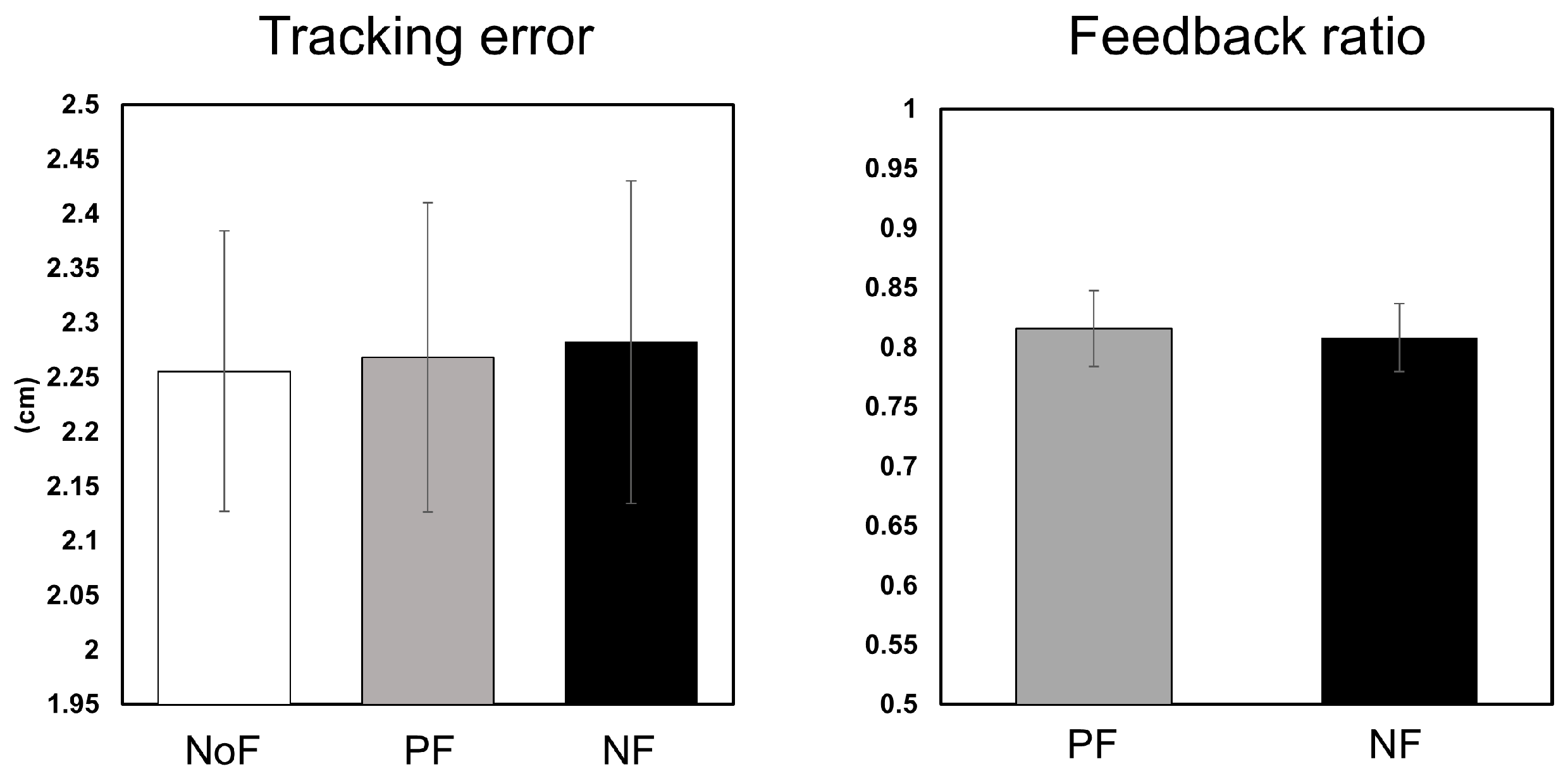
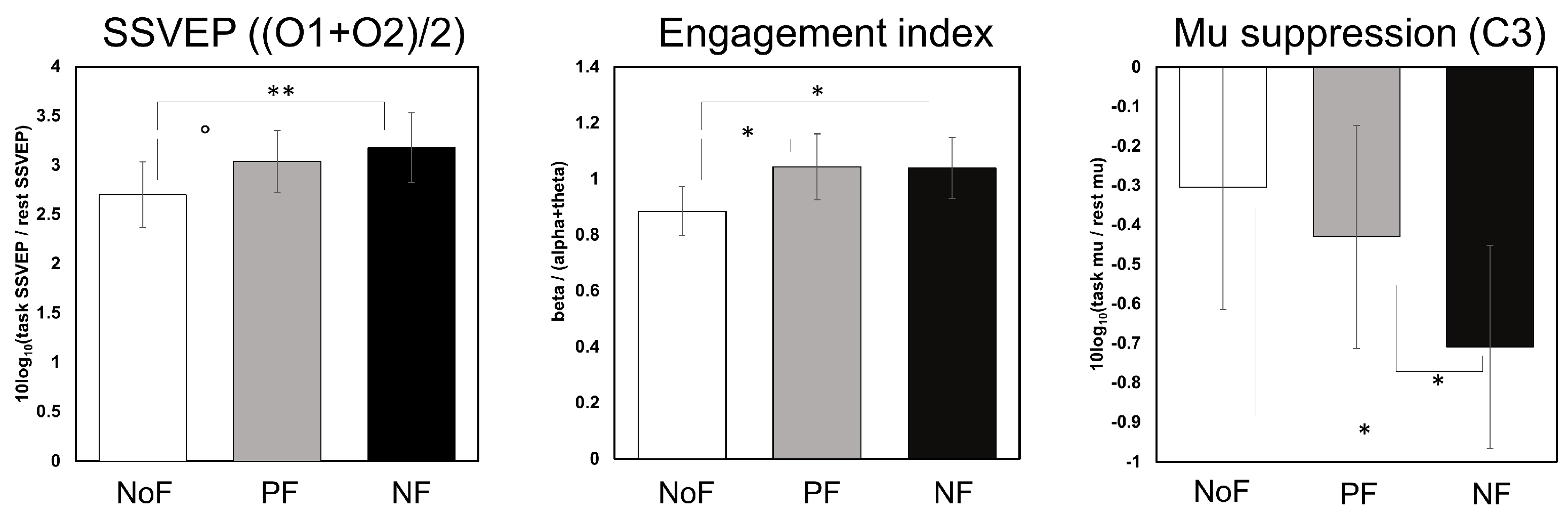
Maintaining optimal levels of engagement during rehabilitation training is crucial for inducing neuroplasticity in the motor cortex, which directly influences positive rehabilitation outcomes. In this research article, we propose a virtual reality (VR) rehabilitation system that incorporates a steady-state visual evoked potential (SSVEP) paradigm to provide engagement feedback. The system utilizes a flickering target and cursor to detect the user’s engagement levels during a target-tracking task. Eighteen healthy participants were recruited to experience three experimental conditions: no feedback (NoF), performance feedback (PF), and neurofeedback (NF). Our results reveal significantly greater Mu suppression in the NF condition compared to the other conditions. However, no significant differences were observed in performance metrics, such as tracking error, among the three conditions. The amount of feedback between the PF and NF conditions also showed no substantial difference. These findings suggest the efficacy of our SSVEP-based engagement feedback paradigm in stimulating motor cortex activity during rehabilitation. Consequently, we conclude that neurofeedback, based on the user’s attentional state, proves to be more effective in promoting motor cortex activation and facilitating neuroplastic changes. This research highlights the potential of integrating VR rehabilitation with an engagement feedback system for successful rehabilitation training.
Keywords: rehabilitation training; virtual reality; engagement feedback; neuroplasticity; motor cortex activation; steady-state visual evoked potential (SSVEP); neurofeedback rehabilitation training; virtual reality; engagement feedback; neuroplasticity; motor cortex activation; steady-state visual evoked potential (SSVEP); neurofeedback