Article

Design of a Blockchain-Based Ubiquitous System for the Supply Chain with Autonomous Vehicles

by
Cándido Caballero-Gil
1,*,
Jezabel Molina-Gil
1,
Candelaria Hernández-Goya
1,
Sonia Diaz-Santos
1 and
Mike Burmester
2
1
Department of Computer Science and Systems, University of La Laguna, 38270 La Laguna, Tenerife, Spain
2
Department of Computer Science, Florida State University, Tallahassee, FL 32306, USA
*
Author to whom correspondence should be addressed.
Electronics 2025, 14(23), 4744; https://doi.org/10.3390/electronics14234744
Submission received: 11 October 2025 / Revised: 18 November 2025 / Accepted: 28 November 2025 / Published: 2 December 2025

Abstract

This paper presents a ubiquitous, blockchain-based system designed to improve transparency, traceability and trust in supply chains involving autonomous vehicles (AVs). The framework integrates Internet of Things (IoT) sensors, radio-frequency identification (RFID) and QR identifiers, global positioning system (GPS) tracking, and mobile communications with smart contracts implemented on the Ethereum 2.0 blockchain. The main contributions are as follows: (1) an architecture enabling real-time monitoring and automated verification of logistics transactions; (2) a proof of concept integrating blockchain, the IoT and Android-based OBUs; and (3) a quantitative analysis of gas and smart contract execution costs. Experimental tests show gas consumption ranging from 21,000 to 5,000,000 units and transaction costs ranging from 0.0001 to 0.0033 ETH, confirming the system’s technical feasibility and cost-efficiency. As well as cost and efficiency, the process improved transparency, real-time traceability and decentralized verification, confirming the system’s efficacy for supply chains involving autonomous vehicles.

1. Introduction

The increasing complexity of international logistics and the accelerating pace of transport innovations have emphasized the urgent need for verifiable and robust supply chains that guarantee transparency and accountability among participants. Meanwhile, the rise of artificial intelligence, the introduction of autonomous vehicles and the development of renewable, efficient energy sources offer opportunities to reduce supply chain costs and improve efficiency, provided proper transparency and interoperability mechanisms are adopted.
Recent disruptions to global logistics have highlighted the importance of automation and reliable data sharing among stakeholders. The increasing adoption of autonomous and electric vehicles could mitigate operational delays and costs, but it also demands advanced digital frameworks to guarantee trust and traceability among multiple actors. This challenge motivates the integration of blockchain and Internet of Things (IoT) technologies to create secure, decentralized, and verifiable logistics systems.
Furthermore, automation and the use of autonomous vehicles will make transportation faster and more efficient. According to regulations, after 4.5 h of daily driving, a truck driver is required to take a 45-min rest break, which is recorded in the truck’s tachograph. A truck driver typically has a 40-h workweek, and human drivers tend to experience greater fatigue at night.
In contrast, autonomous trucks would eliminate the 27.7% associated with the cost of driver salaries. Furthermore, they have the capacity to operate in a continuous manner without the need for rest periods, thereby reducing transit times and avoiding distractions by driving during off-peak hours, which are typically night-time periods. Moreover, the implementation of autonomous electric trucks has the potential to reduce fuel costs by between 15% and 22%. However, a disadvantage associated with electric vehicles is that the recharging process is significantly more time-consuming, which has the potential to increase transport times. Considering extensive research combining blockchain and IoT technology in logistics, most existing models do not address integration with autonomous vehicles or provide real-time verifiable traceability of goods. Furthermore, few implementations include quantitative evaluation of smart-contract execution costs. This research specifically targets these gaps by designing and implementing a blockchain-based architecture that enables secure, automated interaction among AVs, IoT devices, and logistics stakeholders.
Autonomous-vehicle-based supply chains face persistent challenges of trust, interoperability, and real-time data validation. Participants often depend on centralized intermediaries for verification. This reliance introduces delays and increases the risk of data manipulation.
This study presents the design and prototype of a solution that will automate many processes within the supply chain, enabling product tracking through blockchain, thereby providing trust to authorities in a decentralized and non-controlled system.
Most companies in the transport and logistics industry must adapt to the new paradigm of autonomous vehicles and the end of globalization [1], including the required supervision and control of products that are supplied from an origin to a destination, involving a system of multiple organizations, people, activities, information, and resources. AVs will reduce costs and delivery times, increasing the reliability and safety in the supply chain.
This is a complex process that implies many different risks and threats, such as the possible unjustified loss of inventory, counterfeiting, and smuggling of products, which must be addressed in order to ensure that products reach the consumer with the required quality and on time. Consequently, there is a necessity for specific mechanisms to be implemented in order to preserve the integrity, functionality and reliability of supply chain operations, thus increasing resilience to these threats, particularly in the context of autonomous vehicles.
It is imperative that goods are monitored in real time to ensure the continuity and quality control of transportation operations. The monitoring process should encompass the following parameters: location history, environmental parameters (such as temperature and humidity), and timestamps of logistic events. The utilization of these data can offer suppliers considerable benefits, including resource optimization, minimizing inventory loss, and reducing storage costs. Recent reviews on blockchain traceability and IoT [2] emphasize that supply chain analysis and end-to-end visibility are key strategic priorities for modern logistics.
On the other hand, greater supply chain reliability generally implies greater quality of the service or product offered, which is the most important aspect for customers. Recent data indicates that advances in digital supply chain technologies, including AI, blockchain, and IoT, are associated with improved logistics performance and transparency [3].
Furthermore, an efficient supply chain for essential goods can be crucial, potentially making the difference between life and death in non-commercial situations such as disasters and emergencies. This work originates from the observation that several conventional supply-chain procedures closely resemble the operational logic of blockchain systems. Hence, it can be concluded that many supply chain needs and requirements can be addressed using blockchain technology.
One of the most relevant milestones in the history of blockchain has been the emergence of smart contracts, because they are executed automatically and autonomously as part of a transaction, and contain the terms of the agreement that the interested parties have reached. Thus, smart contracts are fully transparent, traceable, and irreversible because once the conditions of an agreement are reached, the pre-established actions are carried out automatically. In addition, through the use of smart contracts, the execution of any type of agreement between two parties is allowed, without the need for third parties.

1.1. Smart Contracts in Ethereum

When creating a smart contract, the developer defines its behavior and the terms of the agreement directly in lines of programming code. Once the contract is included in the blockchain, it cannot be modified, so it can be ensured that its execution will take place as scheduled. Thus, smart contracts can be seen as independent programs stored on the blockchain that carry out transactions, operations, or actions autonomously if certain conditions are met. The developer is the one who specifies these actions and conditions depending on the scope and purpose of the application that is being implemented. Smart contracts include the following elements:
  • Contractually defined terms and conditions, along with established procedures, designed by the parties to facilitate the exchange.
  • Software implementation, since the contract operations are specified by lines of software code.
  • Algorithms that define the rules that each party must comply with in order to perform actions in relation to the smart contract.
  • Self-execution of the contract, since once signed, the execution is automated and the results are usually irrevocable.
Ethereum is the major blockchain-based platform for smart contracts. It incorporates Solidity, which is a Turing-complete programming language specifically designed for the creation of smart contracts, and in fact, is currently the most popular programming language for writing smart contracts. The use of smart contracts allows developers to implement Decentralized Applications (DApps), in which it is possible to define ownership rules and own transaction formats fully customized for every specific application scope. One of the most relevant aspects of Ethereum lies in the easy way to create DApps that take advantage of all the benefits that the blockchain offers.
Ethereum’s fundamental unit is the account, whose state is recorded on the blockchain. Every value or information exchange between accounts is logged as a state change. Ethereum allows for two types of accounts: contract accounts and externally owned accounts (EOAs). EOAs are controlled by private keys owned by individuals, while Contract Accounts house smart contracts governed by their internal code and can only be activated by EOAs. To interact with a smart contract, a user employs their EOA to create a transaction encrypted with their private key. This transaction is broadcast to network nodes, which verify its authenticity using the corresponding public key. Upon consensus, the transaction is appended to the blockchain, triggering smart contract execution. The results of the contract are subsequently recorded on the blockchain. Ethereum 2.0 employs a Proof-of-Stake (PoS) consensus mechanism. Every action altering Ethereum’s state, including smart contract deployment and execution, incurs a transaction fee paid in Ether, the platform’s native cryptocurrency.
On the public Ethereum blockchain, storing a significant amount of information incurs a high cost and may result in penalties. Additionally, creating more blocks requires more information and, consequently, extra computational power. Therefore, saving data indiscriminately is considered a bad practice. However, in the face of permissioned blockchains, another scenario arises. Being a private network with restricted and more controlled access, storing a greater amount of information is not a big problem, since it is based on the assumption that a private blockchain will grow less than a public one.

1.2. Autonomous Vehicles

The integration of AVs into supply chain logistics (see Figure 1) represents a transformative advancement, enhancing efficiency, reducing operational costs, and improving safety. Various types of AVs can be incorporated into different stages of the supply chain, each serving specific functions. This section provides details on the main categories of autonomous vehicles used in supply chain logistics.
  • Autonomous Trucks: These are essential for long-distance transport and use artificial intelligence-based navigation to optimize routes and reduce fuel consumption. Leading this technological development are Tesla, Waymo, and Daimler.
  • Autonomous Delivery Vans: They optimize last-mile delivery and navigate urban environments using real-time data. Examples include Nuro’s delivery pods and Amazon’s Scout.
  • Autonomous Drones: They enable aerial deliveries to remote locations and are used by companies such as Zipline and Wing to transport medical and consumer products.
  • Autonomous Mobile Robots (AMRs): Used in warehouses for picking, sorting, and transport, developed by Amazon (Kiva Systems) and Fetch Robotics.
  • Autonomous Forklifts: Automate material handling, increasing efficiency and safety, with solutions from Seegrid and Toyota.
  • Autonomous Tugger Trains: Used in manufacturing to transport materials along predefined routes, benefiting lean production environments.
These AV technologies are revolutionizing logistics by improving automation, speed, and precision in all supply chain operations.
The main objective of this work is to propose the design and implementation of technological solutions adapted for AVs in order to control the products during acquisition, shipment, and delivery. The proposal is based on different types of communications and technological devices, and a decentralized system based on blockchain to ensure the immutability of data. In particular, the innovative solution proposed in this paper for the management of the complete supply chain process combines many different technologies such as Radio Frequency Identification (RFID), Global Positioning System (GPS), WiFi Direct, Quick Response (QR) codes, and mobile technology with the emerging blockchain paradigm, to automate the process of authentication and tracking of different products and goods. Specifically, the proposed system employs Ethereum-based smart contracts to establish a private consortium network that supports the acquisition, verification, and monitoring of products throughout the logistics process.
Main Contributions. This work makes the following key contributions:
(1)
It proposes a blockchain-based architecture that integrates IoT devices, RFID/QR technologies, and Autonomous Vehicles for real-time logistics monitoring.
(2)
It provides an implemented proof-of-concept on Ethereum 2.0, including smart contracts, a web interface, and an Android-based On-Board Unit (OBU).
(3)
It presents a quantitative analysis of gas consumption and transaction costs, validating the feasibility and efficiency of the system.
(4)
It incorporates advanced cryptographic mechanisms, such as Physical Unclonable Functions and lightweight encryption, to enhance privacy and security in the supply-chain process.
In general, this introductory section establishes the motivation and research gap to integrate blockchain with autonomous vehicles in logistics, which forms the foundation of the proposed system described in the following sections.
This paper is structured as follows. In Section 2, some works related to this proposal are mentioned. Some specific details of the designed solution, along with a few comments related to preliminary experiments of parts of the proposal, are included in Section 3. Section 4 shows the different parts of the implemented prototype, including the integration of RFID and QR codes in the supply chain, the Android OBU system, the web application, and the Blockchain. Section 5 includes a study of security and privacy, a test of the blockchain operation implemented, and a comparison with other studies. Finally, the paper concludes with several conclusions and open problems in Section 6.

2. Related Work

2.1. Blockchain in Logistics

Blockchain applications in logistics have evolved rapidly, enabling greater transparency, automation, and sustainability in distributed supply chains. Recent research has investigated its incorporation into forward and reverse logistics procedures.
The integration of blockchain technology into reverse supply chain management has attracted considerable interest due to its potential to enhance transparency, security, and traceability. In this context, the study by [4] proposes a blockchain-based framework to manage the reverse supply chain of power batteries. This framework addresses critical challenges such as data integrity, trust, and efficient resource recovery. The study emphasizes the potential of decentralized ledger technology to enhance the efficiency of battery recycling processes, while ensuring adherence to environmental regulations and industry standards. The findings of this research provide valuable information for the development of secure and efficient IoT-based supply chain solutions. Recent studies, such as [5], demonstrate how blockchain-driven models can enhance logistics and recycling processes in electric vehicle supply chains through decentralized decision making.
This study builds on the theoretical research conducted on logistics enabled by IoT and blockchain [6]. The current study extends these concepts by developing a full implementation adapted to the integration of an autonomous vehicle and including quantitative performance evaluation.
The fundamental concepts of conventional supply chain management, including the value of information and coordination between stakeholders, remain relevant in the context of digital transformation [7]. Recent literature on digital supply chains synthesize how modern technologies (IoT, blockchain, and AI) can improve responsiveness and reduce delivery time across logistics processes.
Recent comprehensive reviews [8,9] have synthesised blockchain applications in logistics and sustainable supply chains, highlighting transparency, interoperability, and environmental impact as key research trends. Recent studies, which have undergone the peer-review process, have addressed the integration of blockchain-enabled provenance and the circular economy as key elements of green and sustainable supply chain strategies [10].
An increased level of interest on the part of businesses in blockchain-enabled logistics has resulted in a number of pilot projects and industrial applications. Recent industrial case studies and reviews document the integration of RFID and blockchain technology for real-time tracking and automation in logistics operations [11].
Ensuring the sustainability and ethical sourcing of minerals, particularly critical materials such as cobalt, is a growing concern. The study by [12] presents a blockchain-based framework designed to enhance transparency, traceability, and accountability in cobalt sourcing. The utilization of decentralized ledger technology is pivotal in addressing salient challenges, including provenance verification, supply chain inefficiencies, and adherence to responsible procurement standards. These insights are of particular relevance to industries that rely on ethically sourced raw materials, thereby reinforcing the role of blockchain technology in achieving sustainable and secure supply chain management.

2.2. Integration with Autonomous Vehicles

In recent years, there has been significant interest in the integration of blockchain technology and AVs within supply chains. This reflects advancements in digital innovations designed to enhance efficiency, transparency and security in various sectors. This section focuses on significant advances and contributions from the literature to provide a comprehensive knowledge of the current state of the art across multiple disciplines.
The introduction of intelligent AVs has had a considerable impact on digital supply chains. Recent studies highlight how autonomous vehicles and digital twins can enable resilient and sustainable logistics networks. For instance, ref. [13] discusses blockchain-based frameworks in autonomous vehicles, with a focus on enhancing trust and communication. Similarly, ref. [14] reviews AI-enabled optimization approaches in supply chains, emphasizing flexibility and responsiveness. The work [15] further discusses the applications, challenges, and opportunities of AVs, highlighting their potential to transform intelligent automation in supply chains through enhanced data analytics and decision-making processes. In line with these findings, ref. [16] proposes a blockchain-based authentication algorithm to secure information sharing in vehicular networks, highlighting the synergy between AVs and blockchain technologies.
Blockchain technology has emerged as a key solution to address trust, traceability, and efficiency issues in supply chains. The paper [17] explores the potential of these technologies to enhance transparency and security in logistics operations. The study employs an experimental design to validate the efficacy of blockchain integration, highlighting its potential to streamline processes and mitigate risks associated with data manipulation and unauthorized access. In a related study, ref. [18] developed a blockchain-based model for electric vehicle charging transactions, showing how decentralized ledgers can streamline operations and ensure secure interactions across the network.
In the agricultural sector, blockchain technology continues to play a critical role in ensuring trust and traceability in agri-food supply chains. Recent analyses, such as [19], have examined how blockchain technology can enhance product verification, reduce fraudulent activities, and promote sustainability through transparent data exchange and automated smart contracts.
Blockchain technology has a key role to perform in tracking the provenance of materials in construction, thus supporting sustainable reuse. A novel multilayer blockchain framework, as proposed in [20], improves material traceability and data accessibility, creating a robust audit trail. This framework is designed to address challenges related to verification, scalability, privacy, and interoperability, ultimately fostering transparency and information sharing among stakeholders. The proposed solution aims to create a blockchain-based prototype for construction supply chains, promoting the management of circular and reliable materials within the built environment.
The solution proposed here, in contrast to those previously mentioned, integrates a range of advanced technologies to facilitate the tracking of information from multiple operators across the web using multiple devices, including laptops, phones, and tablets. It encompasses the delivery note at the beginning of the supply chain and the subsequent tracking of the merchandise to its destination.
Recent work has explored how distributed ledgers can facilitate secure data sharing, coordination, and trust among autonomous vehicles. These studies highlight the growing convergence between blockchain technology and autonomous vehicle systems, providing a foundation for the architecture proposed in this work.

2.3. IoT, RFID, and QR Technologies

Numerous bibliographic references address reliability and security issues in the transport and logistics sectors through the application of ubiquitous technologies. Recent frameworks and case studies identify a range of supply chain security vulnerabilities, including service interruptions, unattended assets, and physical manipulation. They discuss how blockchain-based traceability can mitigate these risks by improving auditability and provenance tracking [12].
Recent studies review modern lightweight authentication mechanisms and RFID-based traceability solutions for Industry 4.0 supply chains, highlighting practical approaches to prevent counterfeiting and cloning [21,22]. The proposed system must also address the potential problem of technology cloning, which could allow products to be altered without detection. To address this security concern, we are proposing a robust authentication scheme based on challenge-response protocols and zero-knowledge mechanisms. This approach eliminates the need to store secrets in a readable form, enhancing the security of our systems. In line with this approach, ref. [23] extends this approach by introducing a blockchain-based cross-domain authentication scheme for vehicular networks, illustrating how decentralized security protocols can reinforce trust in IoT-enabled supply chains.
Recent studies have analyzed the role of technology in transforming logistics operations. For example, ref. [22] presents a comprehensive review of RFID-based decision-support systems in the context of Industry 4.0. This demonstrates how such technologies enhance supply chain traceability and overall operational efficiency. Other studies have proposed the use of blockchain-enabled IoT gateways to improve privacy and interoperability in industrial and logistics environments. For instance, ref. [24] reviews lightweight blockchain frameworks for secure IoT data exchange, demonstrating applicability in resource-constrained environments such as smart factories and transport systems.

2.4. Smart Contracts and Scalability

Blockchain technology can bring many potential benefits to supply chain management, as shown in several recent publications. The concept of blockchain originated as a decentralized model for secure data sharing and immutable recordkeeping [25], which has since evolved into various enterprise-grade frameworks applicable far beyond cryptocurrency.
Now, enterprise-grade blockchain platforms such as Hyperledger Fabric [26] have demonstrated the feasibility of permissioned blockchain environments for various sectors, including IoT and logistics. Several studies have analyzed how blockchain-based smart contracts can transform logistics operations. According to [27], the relationship between blockchain adoption and sustainable supply chain management emphasizes transparency and efficiency improvements.
Recent analyses have evaluated blockchain-based smart contracts for logistics and supply chain operations [28]. For example, ref. [29] investigates the deployment of smart contracts in logistics networks, assessing implementations in terrestrial, maritime, and aerial logistics domains, while [30] provides a comprehensive content analysis of the use of smart contracts from a sustainability perspective, highlighting cost, energy, and execution performance trade-offs in smart contract implementations.
The publication [31] presents a blockchain-based solution to ensure the traceability of COVID-19 personal protective equipment in the supply chain; Smart contracts were checked using the Remix IDE v1.2.0. The paper [32] integrates a review of the literature on the subject, creating a methodology to design use cases of blockchain technology that are not related to financial applications.
The combination of RFID and blockchain technologies has been increasingly explored to strengthen authentication and data integrity in logistics. Several recent works [33] demonstrate how these technologies can jointly enable real-time item verification, decentralized tracking, and secure data exchange. In particular, ref. [34] highlights how blockchain can facilitate registration and authentication in multi-entity systems, supporting the secure and transparent management of transported goods.
In general, unlike all the aforementioned publications, the scheme proposed here includes the possibility of connection with multiple entities using RFID and several types of IoT devices, together with a novel automation process based on smart contracts to avoid different possible problems in the management of transported merchandise.
In contrast to previous approaches that focus on specific segments of the supply chain or rely solely on centralized architectures, the proposed framework integrates blockchain, IoT, and AVs into a unified system. This enables end-to-end automation and traceability while maintaining decentralized control and interoperability among all participants.
Table 1 summarizes representative blockchain-based logistics systems from the literature, highlighting their objectives, applied technologies, and main outcomes. This comparative overview allows one to identify the distinctive features of the proposed system in relation to previous blockchain-based logistics frameworks.

3. An Automated Blockchain-Based System for the Supply Chain

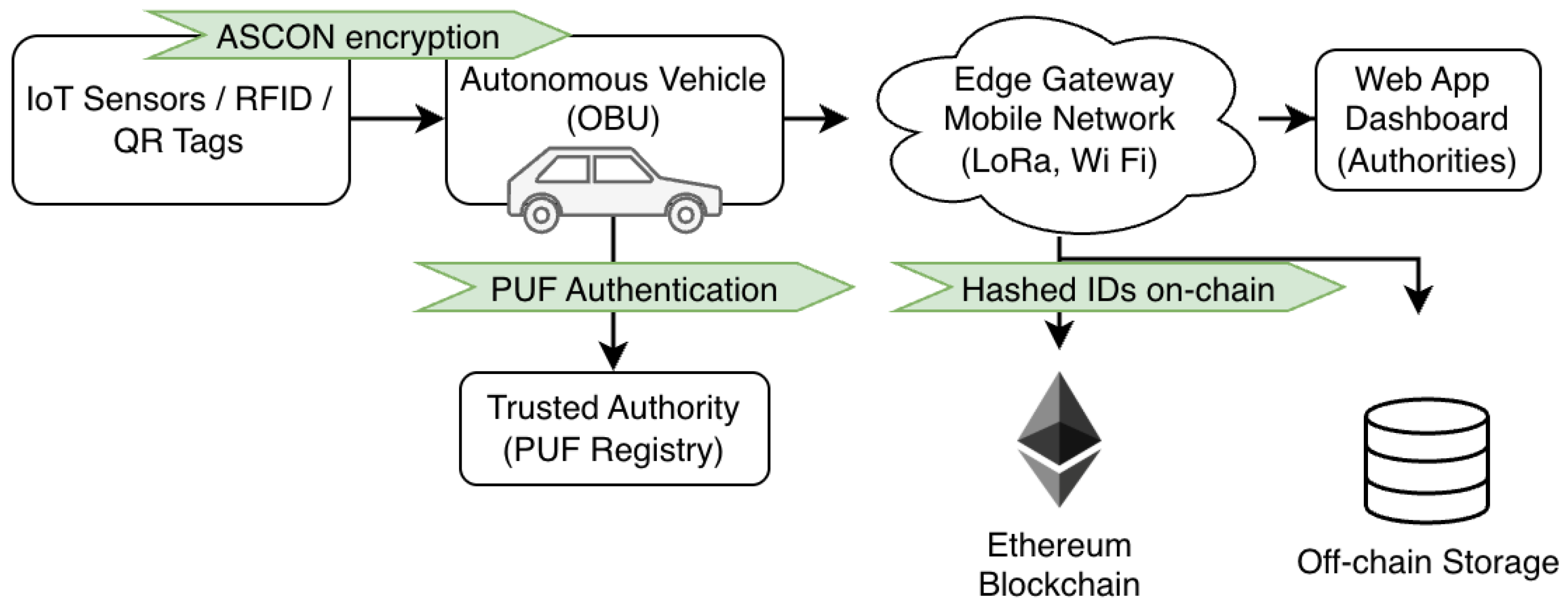
The scheme outlined here covers the entire process, from the controlled manufacture of products to their delivery to the end customer. It includes the use of ubiquitous technologies to aid customs authorities and all modes of transport involved in the transit of goods. Figure 2 shows how different technologies are involved according to the distinct phases of the process. Some of the security mechanisms shown in this figure are further explained in Section 5.1. The blockchain is an essential part of the process, as explained below.

3.1. Phases of the Transport Process

  • Before transporting goods
    The first phase consists of organizing the goods to be transported and generating the corresponding delivery note. This delivery note will not only detail the goods corresponding to a customer but will also include a QR code. The purpose of this QR code is to digitally display the content of the delivery note and, therefore, the content of the container. After scanning it, it will provide the following information: ID of the delivery note, number of products, product code, date, origin, and destination of the goods, and companies and carriers. Since this QR code will be attached to the container, the information included in it will be protected using the lightweight authenticated encryption standard (ASCON) [21]. ASCON, established by NIST as a standard for Lightweight Authenticated Ciphers, provides both a hash function and a version with a longer key length resistant to brute force attacks through Grover’s algorithm. Hence, it protects against some quantum attacks.
    Finally, in this phase, the goods are labeled. For this, RFID codes are used to automate the merchandise check, which is detailed in the next phase. Once this phase is completed, the first transaction for the blockchain is generated, allowing the monitoring and control of the goods. This transaction contains information about items that are transported in clear or a hash with the information in case it is private.
  • Loading and transport of goods
    Once the truck/vehicle is loaded, the mapping between the goods and the delivery note is carried out. For this, the truck has an RFID reader with a WiFi connection, which is used to read the RFID tags of the merchandise placed on the truck, and through a WiFi connection, it sends the information to the vehicle’s mobile terminal, where the mapping is carried out. If the mapping is correct, the ID of the delivery note and the ID of the vehicle are associated. At this time, the vehicle starts the transport of goods, and a new transaction is generated with this information on the blockchain. On the contrary, if the mapping is not correct, the vehicle alerts to correct the problems for the transport of goods, and a new blockchain transaction is generated with the vehicle’s ID, the delivery note ID, and the reasons for the rejection. This phase is repeated as many times as the goods change the carrier.
  • Freight transport
    During this phase, the proposed system allows two types of monitoring: the location of the goods at any time and the control of the merchandise. The first one is carried out with the GPS coordinates issued by the vehicle’s terminal, and a transaction for the blockchain is generated every time there is a large enough pool of locations. The second method involves connecting to the carrier’s application, allowing the owner of the goods to remotely query the status of the merchandise at any time. This transaction is registered on the blockchain, identifying the person who requested the query.
  • Control of merchandise by the authorities
    The proposed system simplifies the work of authorities who need information about transported goods. Through a custom interface for customs authorities, they can quickly access details about the goods, including their origin and destination. This access is also recorded on the blockchain. Additionally, authorities will have full access to the blockchain, allowing them to see all transactions generated throughout the process.
The proposed system is entirely decentralized, meaning that it does not depend on any services beyond the web server used for deployment. It can be operated solely through a browser or an application. All information related to vehicle registration and authentication is available on the blockchain. This allows for the verification of the correctness of collected merchandise by identifying potential errors in the transport process at the delivery moment. In addition, the system includes an online verification process and maintains a comprehensive record of freight movement because the blockchain has to store all the information about products and registered companies for the correct operation of the application. This process incorporates stringent security measures to safeguard the supply chain. Cryptographic algorithms are utilized to prevent unauthorized reading, writing, or modification of delivery note information.
Only hashed identifiers, timestamps, and transaction metadata are stored on the chain, while raw sensor readings, personal data, and logistics documents remain in off-chain databases managed by the Trusted Authority and authorized stakeholders. This hybrid design minimizes blockchain congestion and preserves confidentiality. Sensitive data are pseudonymized before hashing, ensuring traceability without exposing personal information.

3.2. System Implementation

Typical supply chains involve five key actors: suppliers, manufacturers, distributors, retailers, and customers. Our proposed system aligns with these stages, incorporating QR code generation and extraction for container goods, RFID validation for merchandise, web-based fleet tracking, WiFi peer-to-peer customs verification, and blockchain with smart contracts for comprehensive traceability.
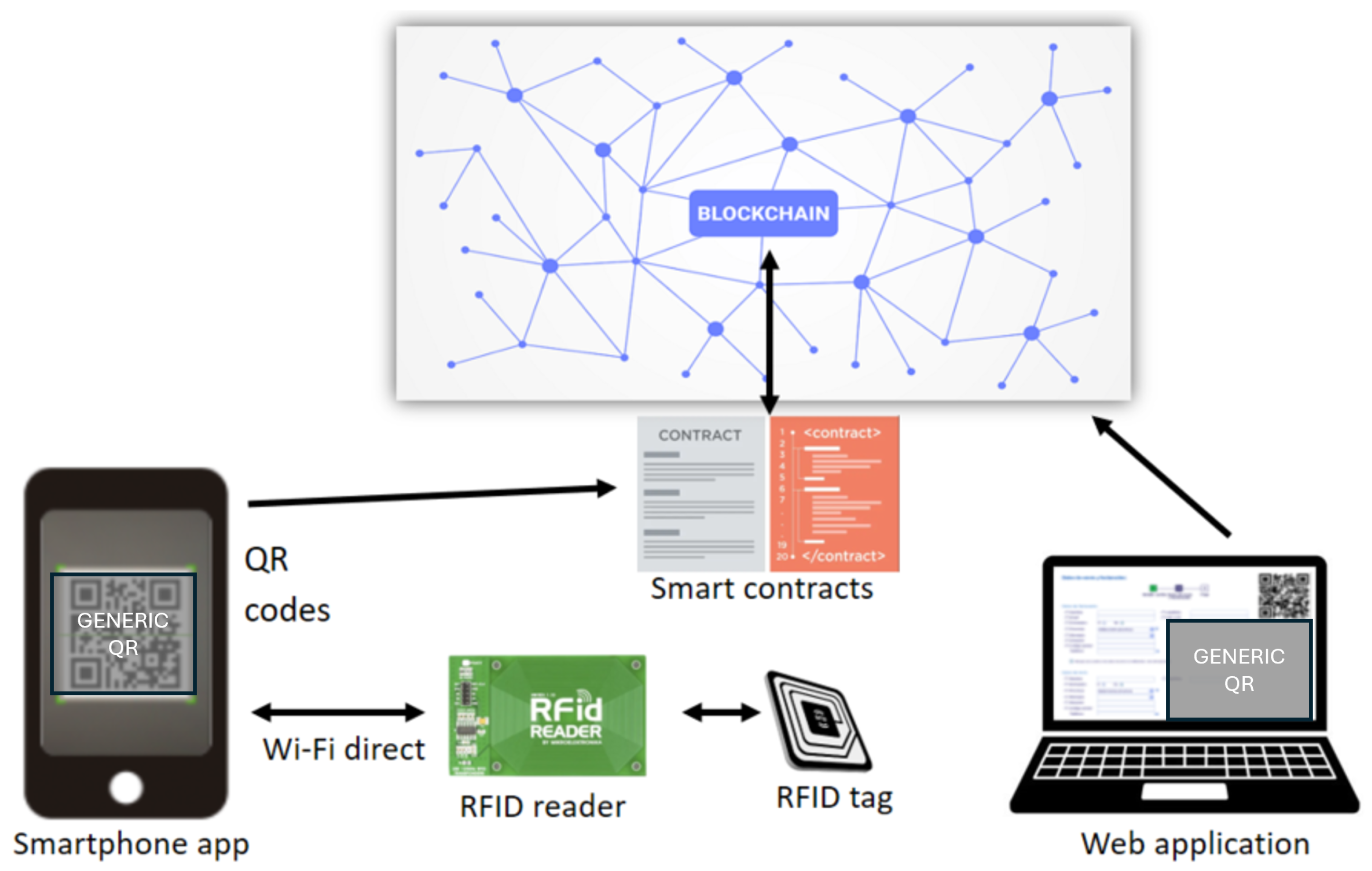
Figure 3 illustrates the technology workflow, with arrows representing the communication pathways between system components, representing a flow of information. Some communications, such as queries from smartphones and web applications, can be simultaneously sent to the blockchain via an oracle, enabling multiple users or authorities to independently verify and trace the container and its contents.

4. Implemented Prototype

4.1. Implementation of Smart Contracts for the Supply Chain System

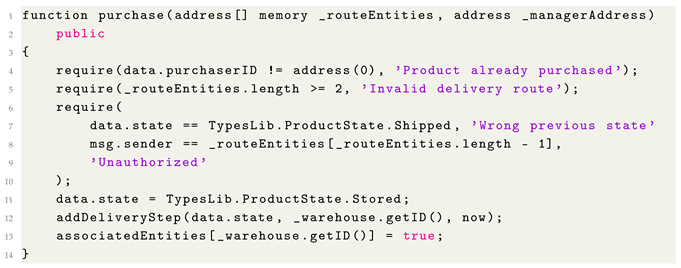
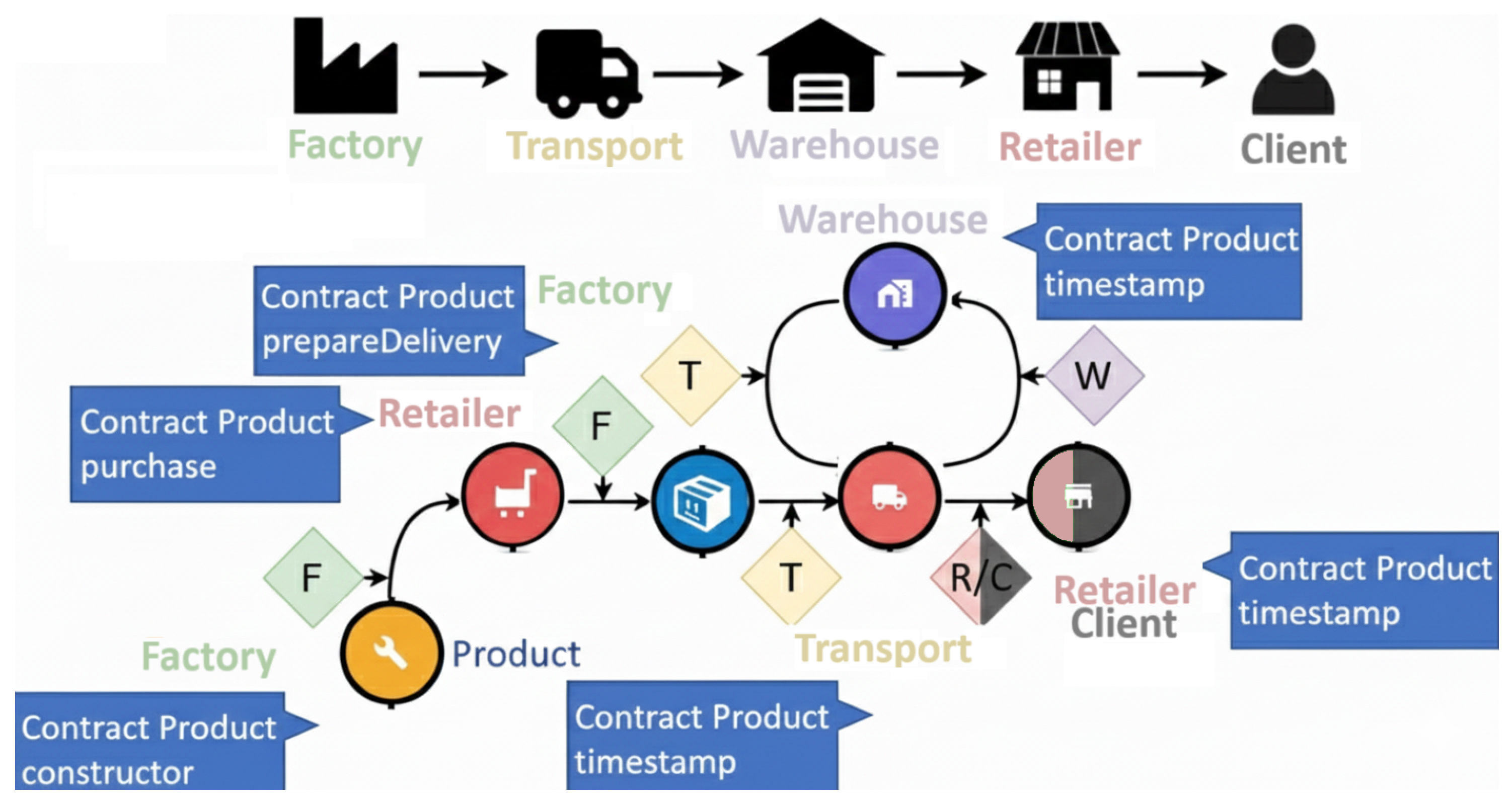
The blockchain allows us to check the status of products at any time (see Figure 4), including information such as smart contract address, an array of delivery entities and timestamps, and a field with the next step called deliveryStep.
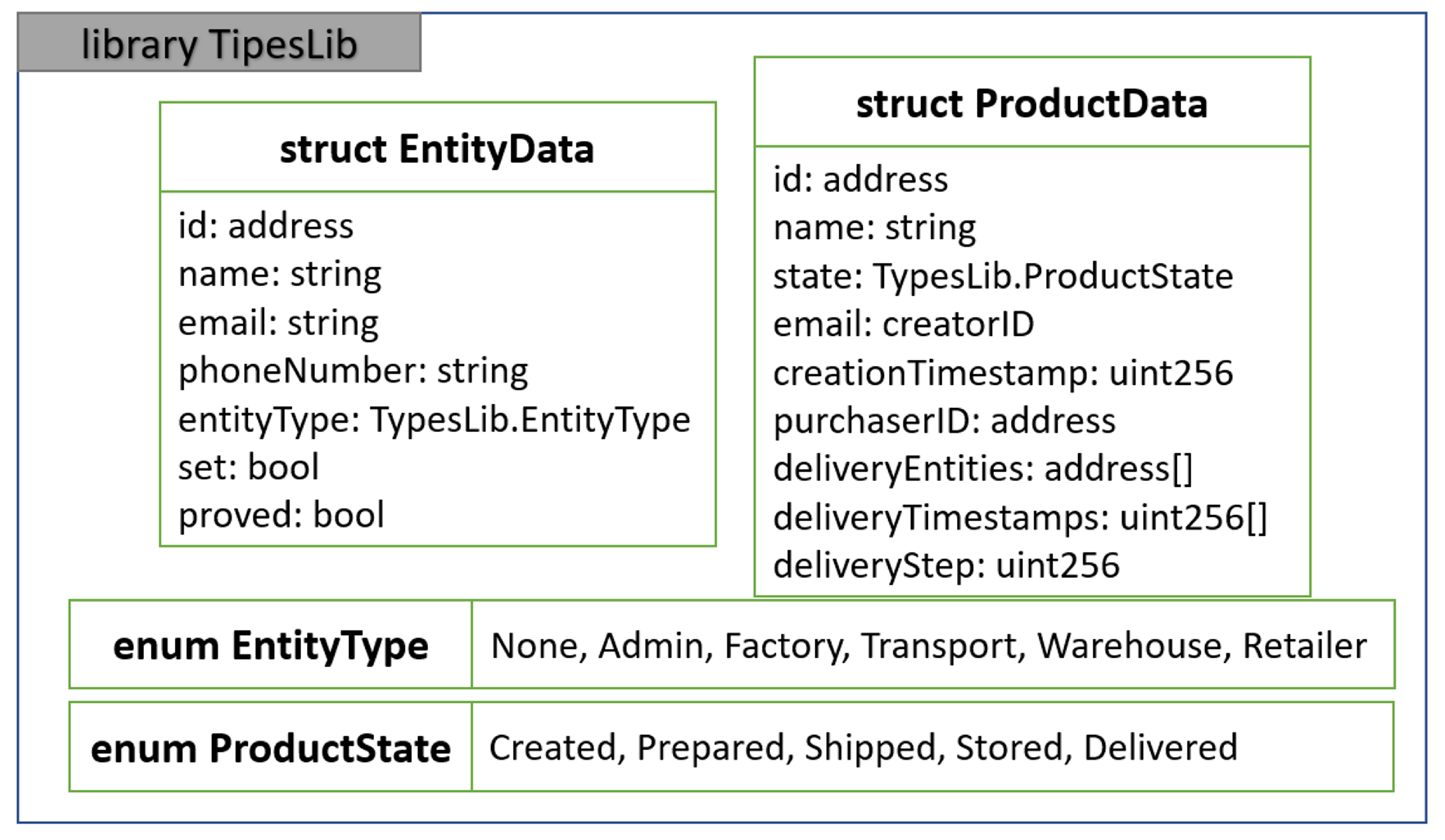
TypesLibrary contains the declaration of the EntityData (see Figure 5) and ProductData structures used to store information about users (entities) and products/shipments, respectively. In addition, the auxiliary variables enums that define the type of an EntityType and ProductState are also declared.
The smart contract stores the data associated with a product and the entities related to it. In this way, the blockchain allows the introduction of the entity that owns the product at all times, including the factory, transport, warehouse, retailer, and also the moment in which the products are created, prepared, shipped, stored, or delivered.
Moreover, combining blockchain with regular product checks provides precise product location and carrier details.
The methods that the different entities complete for the transaction are:
  • purchase (see Listing 1): It starts the product lifecycle and creates the complete route for this specific product.
  • prepareDelivery: It sets the product status to Prepared, in the place to connect the RFID reader to check that the products are in the container.
  • timestampDeliveryStep: It changes the status and timestamp of the products.
This smart contract maps the entities that will be involved from the beginning to the end for each product.
Therefore, the Manager will use the methods createEntity, createProduct, approveEntity, getEntities, or getProducts.
The Manager smart contract occupies an important position in the operation of SupplyBlocks since it acts as a coordination service within the blockchain. It is the only smart contract among those developed that is directly deployed by Truffle, a suite of tools for smart contract development.
Listing 1. Smart contract purchase function.
Electronics 14 04744 i001

4.2. Integration of RFID and QR Code Technologies in Supply Chain Management

By leveraging inexpensive, commonplace devices such as low-cost passive RFID tags and standard smartphones, the proposed scheme significantly reduces costs. In addition, in this economical way, the cost of product loss or theft can be reduced. Currently, many supply chain companies leverage RFID technology to efficiently validate product details and pinpoint item locations within any container.
The system initiates by generating a detailed inventory of container contents. This inventory includes product information, along with specific details such as involved companies, carriers, origin, destination, dates, a unique receipt ID, 13-character product codes, quantities, and additional relevant data. After this, the carrier initiates the second stage using the transport tracking application, which can be running on an On-Board Unit (OBU) in one of the vehicles of the fleet or on the vehicle’s terminal. In the latter case, the terminal requirements are simple since it is only necessary to have a mobile data plan to have a permanent connection with the cloud and the blockchain, a camera to read the QR codes, and Bluetooth to connect with the RFID reader. The experimental validation was carried out using a generic commercial Android smartphone, as the system does not depend on specialized hardware.

4.3. OBU Android Application

An Android smartphone or tablet can be used as an OBU to read the QR code using the implemented application. In order to prevent everyone from knowing the content of a container, the QR code is encrypted so that its content can only be decrypted with the shared key that is distributed to all parties involved in the specific transport. After reading the code, the vehicle has all the data from the QR bill of goods stored in its OBU terminal.
Autonomous Vehicles play a central role in the proposed architecture by acting as mobile nodes that autonomously collect, sign, and transmit logistics data through their OBUs.
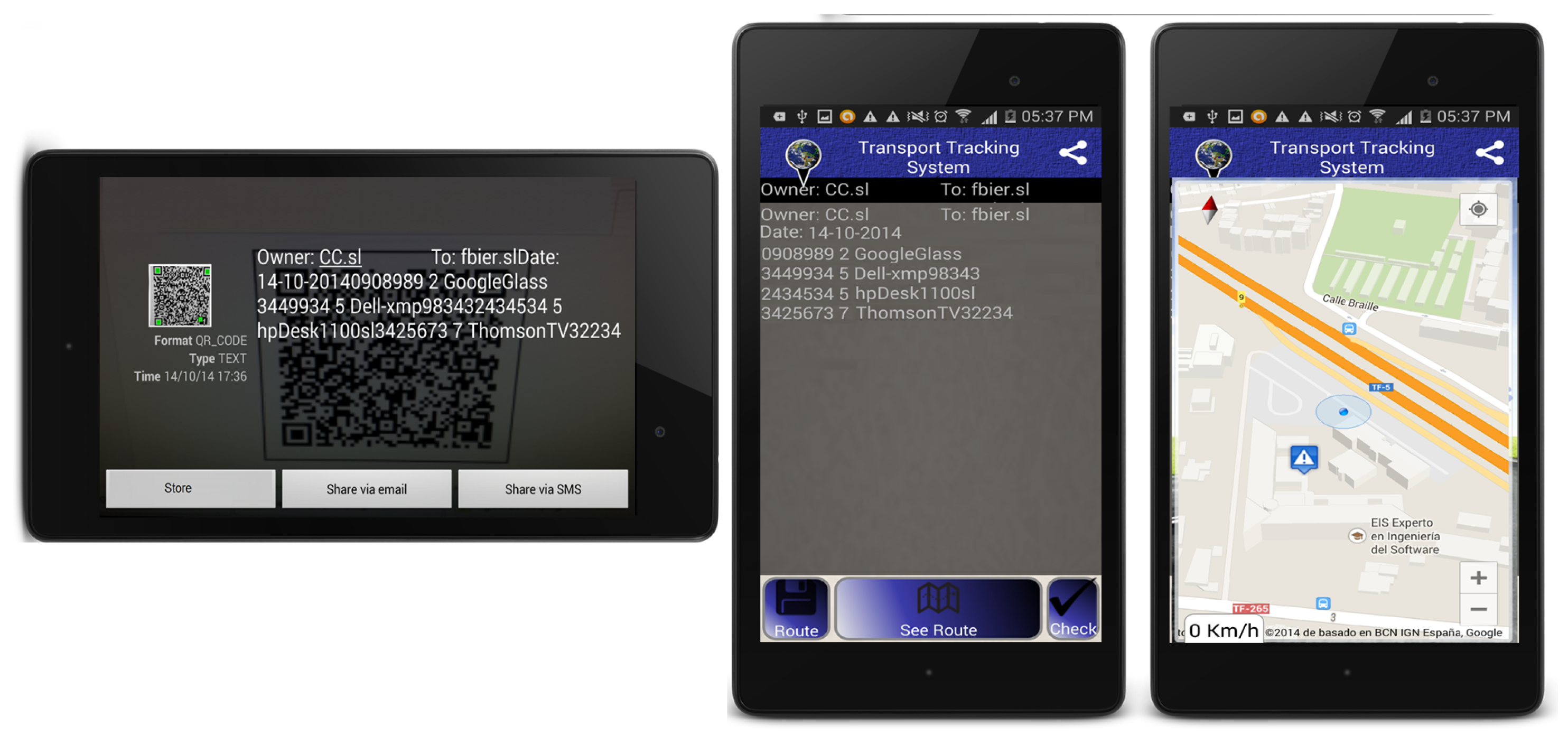
Each AV interacts directly with the blockchain to record the status of shipment and geolocation updates without requiring human input [35]. This integration enables real-time traceability and verification of transported goods, as well as supporting autonomous decision-making and reducing operational latency along the supply chain. The smartphone application was developed on the Android platform to provide real-time container tracking and communication with the blockchain. It also allows for the reading of QR codes using a library called ZXing (see Figure 6).
Data are initially stored locally in a SQLite database for offline access. The Google Maps Android API visualizes the origin and destination points. Subsequently, this information is transmitted to the blockchain for inclusion as a new block, enhancing data integrity and preventing tampering. The tracking of containers and their contents begins with an initial interaction within a smart contract. This interaction establishes key relationships, such as linking tags to specific products (ProductData).
Additionally, the system initializes the container’s first owner, tracking ownership from sender to receiver (EntityData). This process is crucial not only during initial loading but also for subsequent deliveries to minimize errors. Traceability provides granular details about the freight route, enabling the identification of potential bottlenecks for route optimization. Each carrier handover is recorded on the blockchain, allowing users to monitor performance.
The system offers a short-range interface to streamline customs inspections and inventory management. Authorized personnel, such as agents or supervisors, can utilize this interface to remotely examine container contents without physical inspection. The cloud-based server employs robust security measures to protect data privacy. The web platform utilizes a Node.js server with Firebase for data storage and the Express framework for web services. Bootstrap and Google Maps API were integrated to create a responsive front-end.

4.4. Web Application

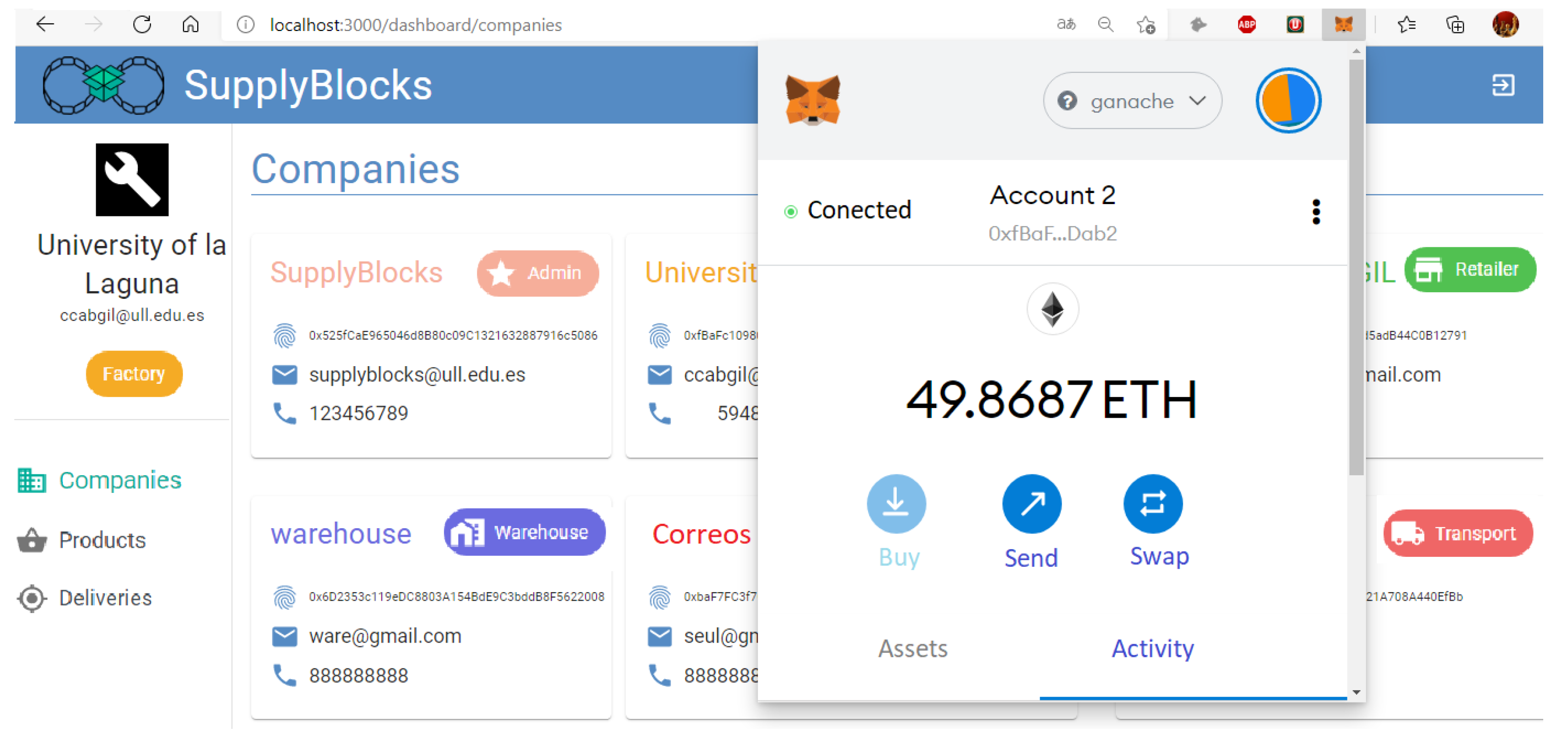
The web application consists of three main views: Home, Registration, and Dashboard. The most important component of the Home view is to check if the current user (active account in Metamask) has been registered and approved by the administrator, which is equivalent to being a valid SupplyBlocks user.
The Registration view presents a form for companies wishing to join SupplyBlocks to fill out an application.
The Dashboard view is the most important in SupplyBlocks. This is the page from which the different companies will carry out the permitted actions and will be able to check the status of their products and/or the shipments associated with them. It is divided into three menus: Companies, Products, and Shipping.
The Companies menu displays the companies registered in the SupplyBlocks (see Figure 7). For each user, their name, the type of company, the address of the associated Entity smart contract, their email address, and their contact number are displayed. In case the current user is the administrator, the interface will also show the requests to join SupplyBlocks.
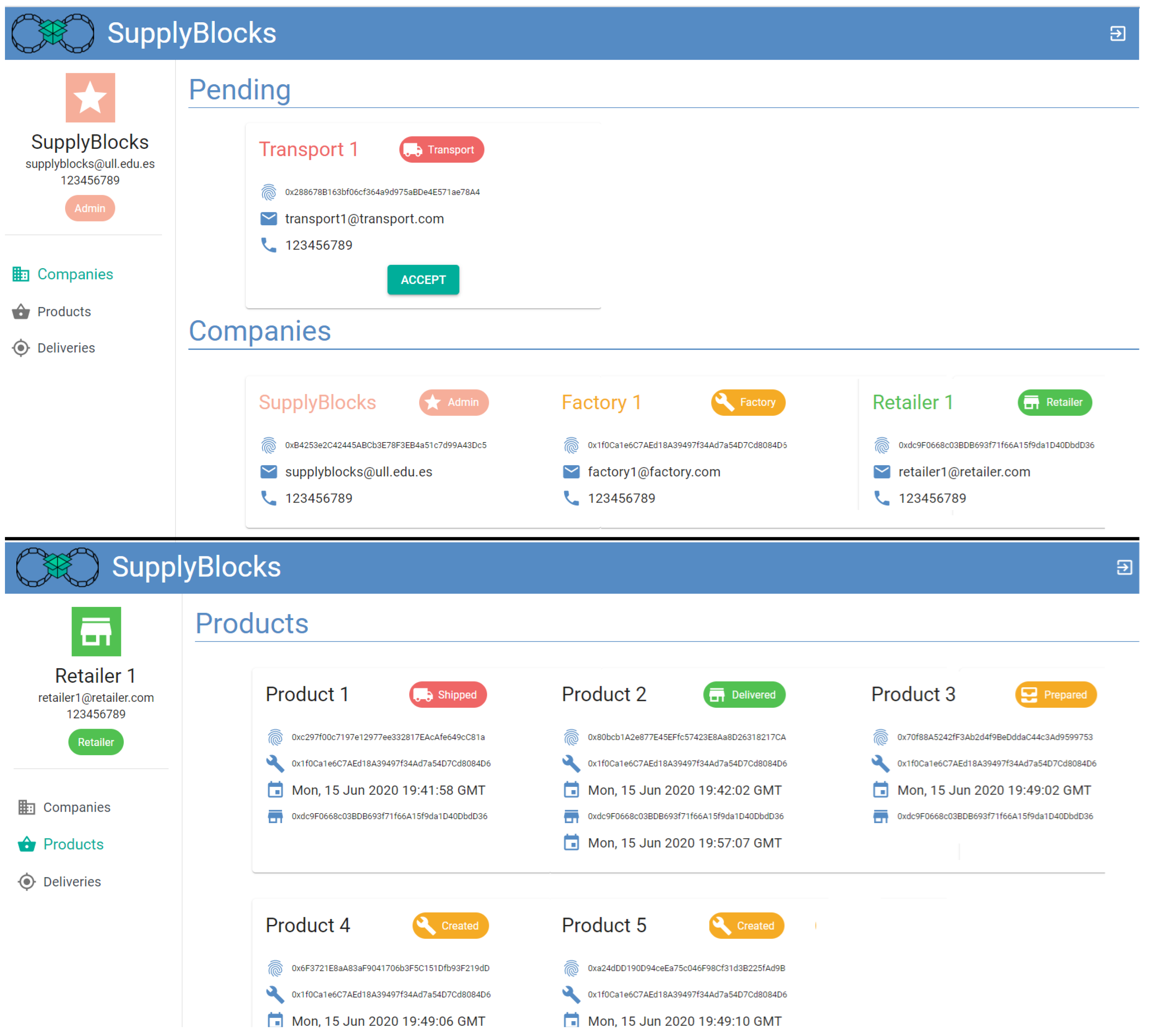
The Products menu displays the products associated with the current account (see Figure 8). The following fields are presented for each product:
  • Product name;
  • Product status;
  • Address of the associated product smart contract;
  • Entity smart contract address of type F user who created it;
  • Creation date;
  • Entity smart contract address of the type M user who acquired it or if it has been acquired;
  • Delivery date, if delivered.
Furthermore, this view also behaves differently depending on the current user type:
  • Administrator: all registered products are displayed.
  • Manufacturer: a form is displayed to add new products. If a product has been purchased, a button will appear next to its card to prepare the shipment, or whatever the same, to change the status of the product from C to P.
  • Retailer: all registered products appear, and a button next to them to purchase them. This type of user is the only one who can purchase products.
  • Transport company: products to be transported or products transported in the past are displayed.
  • Warehousing company: products currently or past stored are displayed.
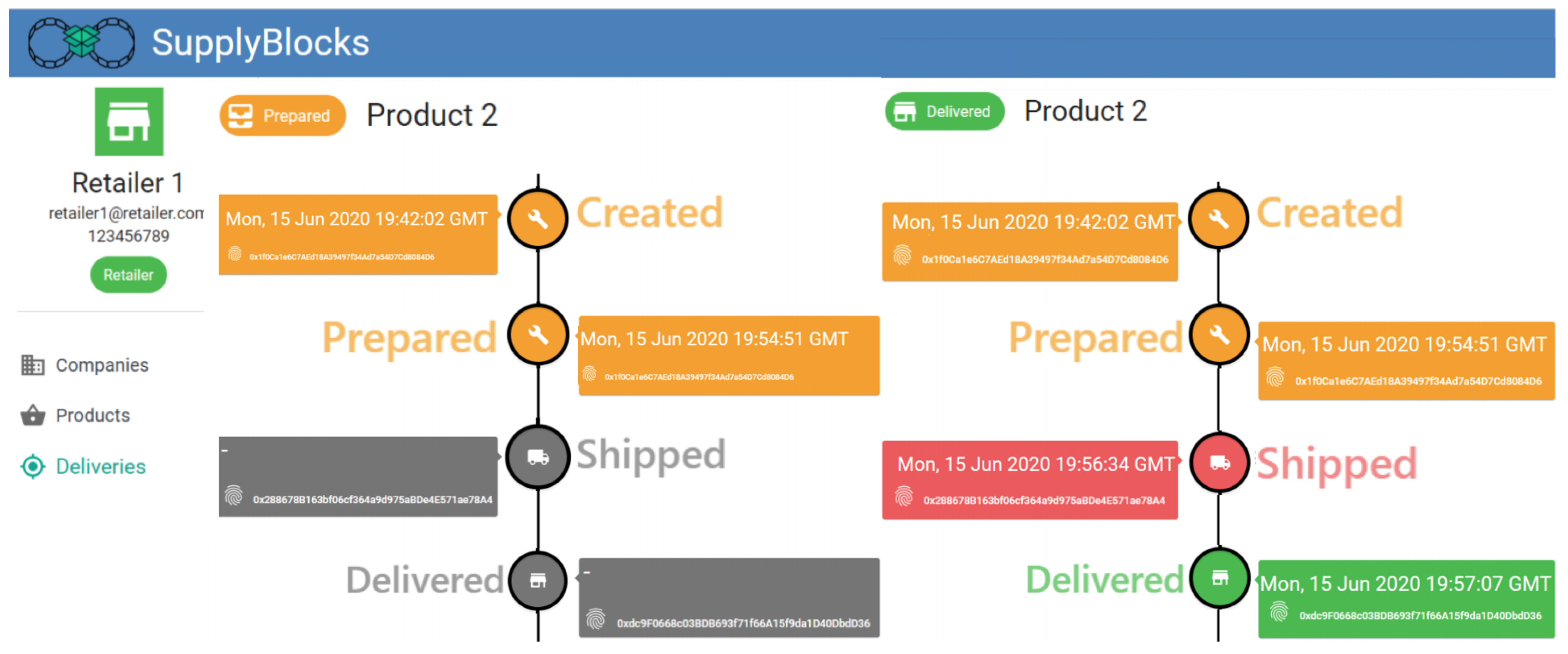
The last menu of the dashboard, Shipping menu, shows the history of orders associated with products related to the current account. A drop-down panel is shown for each order, and the minimum information that it contains is the current status of the product and its name, as well as whether the product shipment requires confirmation by the current user to change its status.
If the submission has not been completed, the corresponding elements of the timeline will still appear in gray. An example of the previously discussed drop-down panels is shown in Figure 9. They correspond to the orders of the products: Product 1, Product 2, and Product 3. At the same time, it is possible to see the status of these products: Created, Shipped, Delivered, and Prepared, respectively. Figure 9 shows the timeline associated with the shipment of Product 2, which has not been completed, and the same time after the shipment has been completed.
The complete code of the blockchain implementation and the web application can be found in [36,37].

4.5. Experimental Setup

To ensure the reproducibility of the prototype, as requested by the reviewers, this section details the experimental setup. The system was developed and tested using a combination of specific hardware and software components.
  • Hardware Environment:
    Server/PC: The blockchain node and web application were hosted in a local development environment on a desktop PC (Dell, Round Rock, Texas, USA) equipped with an Intel(R) Core(TM) i5-6400 CPU @ 2.70 GHz and 16.0 GB RAM, running a 64-bit Windows operating system (Windows 10/11).
    OBU (On-Board Unit): A Nexus 5 smartphone was used as the hardware for the initial proof-of-concept implementation phase of this research (c. 2014).
    IoT Hardware: A Small long-range UHF RFID reader module (Invelion, Shenzhen, China) with an R200 chip, TTL antenna, and UART board SDK for ESP32 Raspberry Pi embedded system.
  • Software Environment:
    Blockchain Stack:The system was simulated on an Ethereum network using Ganache v7.9.0. Smart contracts were written in Solidity v0.8.20 and deployed via the Truffle Suite v5.11.5.
    Web Stack: The web backend used Node.js v18.LTS, MongoDB v6.0, React v18, and the web3.js v1.10.0 library.
    Mobile OBU Stack:The OBU application was developed natively for Android 4.4 (KitKat) in an Eclipse IDE with the ADT plugin, using Java (JDK 7) and the ZXing (Zebra Crossing) v3.5.0 library.

5. Discussion

This section presents and discusses the main outcomes of the proof-of-concept implementation. The results are analyzed in relation to the research objective: demonstrating how blockchain, IoT, and autonomous vehicles can be integrated into a unified framework to achieve transparency, traceability, and decentralized control in supply chain management.
The proposed approach demonstrates the feasibility of combining blockchain, IoT, and AV technologies to automate trust and verification processes in logistics. Its significance lies in reducing human intervention, enhancing auditability, and improving transparency without requiring centralized authorities. By providing a decentralized verification mechanism, the system supports continuous monitoring and strengthens accountability across all supply chain participants.
The methodology of this work includes the design and implementation of a blockchain system for the supply chain with an integrated application for fast checking of goods with RFID readers and tags. It also includes QR codes or online methods for an easy exchange or verification of products.
The proposed system allows real-time and certified monitoring of products from origin to destination, including details such as transactions between agents involved in smart contracts and blockchain, real-time monitoring through the use of mobile data whenever possible, together with GPS, and verification of products in the container remotely or by the authorities through RFID technology and QR codes. This kind of technology has already been used in many works, but the combination of all of them is one of the most innovative aspects of this work.
Once the system is deployed by a company, the highest monetary cost would be RFID tags, which can cost between 0.1 to 0.5 dollars each, a price that is cheap individually but in large quantities could mean a significant cost. Until now, Barcodes have been the most common way of fulfilling this function since this printed code has little cost. Therefore, the use of RFID is not the most appropriate in all cases, or at least, not to include RFID in all products. However, it can be included in a pallet or set of products, or for products whose cost is high, and therefore, their loss or theft should be detected very quickly.

5.1. Security and Privacy Analysis

The system considers possible threats such as data interception, RFID tag cloning, and compromised on-board units. To address these security and privacy concerns, the article implements advanced authentication mechanisms. A Trust Authority (TA) is required to initiate the network, register the vehicles participating in it, and publish the necessary parameters to secure communications on the blockchain.
The main threats can be mitigated by using lightweight encryption, mutual authentication via Physical Unclonable Functions (PUFs), and secure communication channels between AVs and the Trusted Authority. PUFs use the unique characteristics acquired by each chip during manufacturing to generate a digital fingerprint for the device. This defines a challenge–response protocol that aims to authenticate and identify the associated device [38].
Each vehicle must be registered on the network via the TA, which publishes the information relating to the vehicle’s PUF-based challenge/response protocol on the blockchain. Therefore, before a vehicle can send its delivery note, a mutual authentication process is initiated between the vehicles involved using the information stored on the blockchain.
After the authentication process, a shared key must be generated. We propose using Physical Layer Key Generation (PLKG) for this task [39,40]. The advantages of this method for vehicle-to-vehicle connections are its lightweight nature and independence from trusted third parties. The generated session keys can be used with lightweight secret-key encryption methods, such as the ASCON cryptosystem [21].
To further protect the identity of each vehicle, a pseudonym can be generated by applying a cryptographic hash function to the response produced by the PUF. These pseudonyms are published on the blockchain and can be updated to ensure privacy. The immutability of blockchain technology also prevents unauthorized modification of recorded events.
The proposed security framework mitigates threats that include denial-of-service (DoS) attacks, man-in-the-middle interception, and RFID cloning. It uses a combination of strong authentication, encryption, and the immutable nature of blockchain technology to protect the confidentiality, integrity, and availability of supply chain data.

5.2. Scalability Analysis

In terms of scalability, the proposed architecture can handle higher transaction volumes by incorporating Layer-2 solutions or side-chain strategies that are compatible with Ethereum 2.0 [41].
The TA’s primary functions are restricted to registering vehicles and publishing authentication information on the blockchain. This limited TA role facilitates scalability, as all other security mechanisms utilized have already been validated in IoT settings.
Furthermore, the modular design of smart contracts enables subsystems, such as product registration and delivery management, to be scaled independently.
Future work will evaluate the system’s performance under increased data loads and multi-vehicle interactions to ensure sustainable scalability. This will involve benchmarking throughput, latency, and transaction costs on larger test networks and alternative blockchain environments.

5.3. Performance Evaluation and Platform Justification

Ethereum 2.0 was selected as the deployment platform because its Proof-of-Stake (PoS) consensus mechanism reduces energy consumption and improves transaction efficiency compared to Proof-of-Work systems. Additionally, Ethereum provides well-established development tools (such as Remix v0.10.0, MetaMask v9.1.0, and Solidity v0.7.6) that facilitate the implementation and testing of the smart contracts employed in this work. To enhance reproducibility, the implementation details and experimental setup are described in explicit detail in Section 4.5.
The quantitative evaluation focused on computational cost, measured through gas consumption. These parameters are standard blockchain metrics that indicate computational efficiency and the cost of executing smart contracts within the Ethereum 2.0 environment. Lower gas usage reflects better execution, whereas transaction costs determine the operational feasibility of deployment. These indicators provide a practical assessment of system performance.
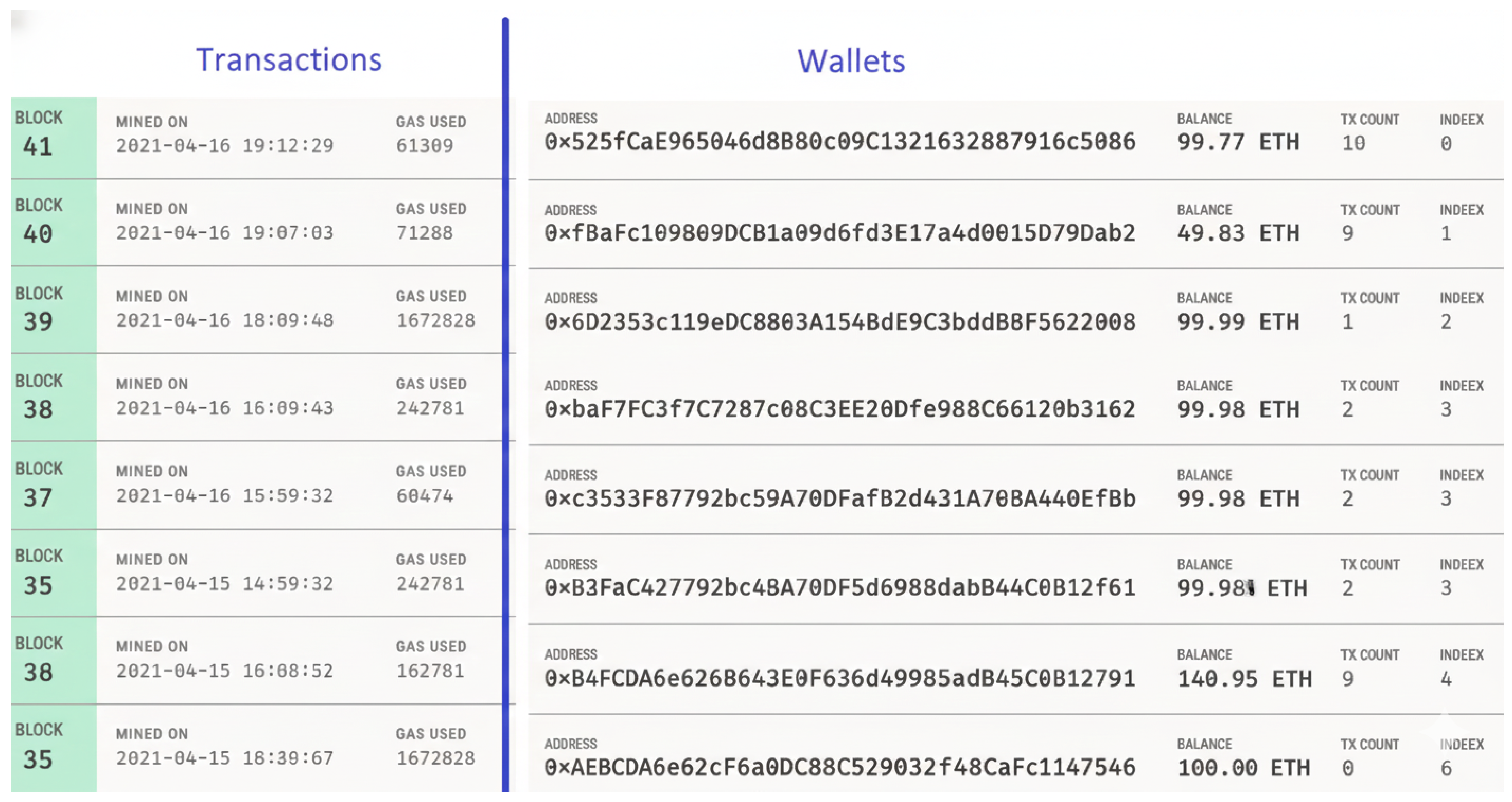
This section discusses the evaluation metrics for the prototype. Given that the primary contribution of this work is the functional feasibility of the end-to-end architecture (detailed in Section 4), our quantitative evaluation focused on computational cost. We measured the gas consumption required to execute the main smart contract functions on the Ganache testnet (see Section 4.5), as this is the standard metric for determining the economic feasibility and computational efficiency of a DLT solution (Table 2 and Figure 10).
A comprehensive benchmark of network performance was considered, specifically latency (transaction finality time) and throughput (transactions per second), which is beyond the scope of this feasibility study. These metrics are highly dependent on the final deployment network (e.g., PoS or Layer-2) and are designated as a primary item for future work, as detailed in the Conclusions.

5.4. Comparison with Related Work

Unlike the publications mentioned in Section 2, the scheme proposed here includes the possibility of quick verification of products through the use of RFID readers and other IoT devices that allow real-time checking by multiple entities. In addition, a novel automation process is proposed with smart contracts based on blockchain technology that provides a distributed and transparent system.
The proposed system allows for rapid verification for both dealers and customs agents, reducing the checkout and delivery time and addressing potential inefficiencies in the management of transported goods. Table 3 summarizes the main aspects of the proposal compared to the latest work in this field.
The results confirm that the proposed blockchain-based ubiquitous system is more automated, interoperable and transparent than related approaches, proving its suitability for logistics operations driven by autonomous vehicles.

6. Conclusions

This paper presents a ubiquitous system designed to deliver an automated solution for the logistics sector. The system is focused on adapting to the integration of autonomous vehicles and the reduction in globalisation. Using the most suitable available technologies, the system overcomes practical challenges within the supply chain.
In this system, IoT devices facilitate the use of practical, real-time detection technologies, while blockchain technology provides a distributed framework for supply chain systems. This framework autonomously verifies, records and coordinates all transactions in a decentralized manner, ensuring the immutability of the data throughout the process.
Implementing the proposed system shows that the use of current technologies strategically fosters a high level of trust among the participating agents. This is achieved by ensuring the integrity, functionality and reliability of the supply chain through the comprehensive monitoring, tracking, and traceability of critical supply chain management elements. The key aspects covered include controlling transported goods during acquisition, shipment and exchange, verifying product transfer conditions, continuously tracking location, communicating with regulatory authorities, and detecting issues at any point within the supply chain.
A proof-of-concept system comprising smart contracts on the Ethereum 2.0 blockchain has been created and tested, producing initial results that demonstrate the system’s advantages in terms of transparency, immutability, and decentralization of processes. The system includes an Android-based OBU that can read encrypted QR codes to update the status of the item. It can also connect to the main system to transmit real-time location information.
The article addresses security and privacy concerns by implementing advanced authentication mechanisms. Specifically, it incorporates PUFs and lightweight cryptographic methods to enhance communication security between vehicles and protect sensitive supply chain data. This additional layer fortifies the system against potential attacks and unauthorized access, effectively complementing blockchain’s inherent security features and addressing any remaining vulnerabilities.
These results directly address the main research question of this work, demonstrating that the integration of blockchain, IoT, and autonomous vehicles can achieve secure, transparent, and traceable logistics management. The prototype implemented validated the technical feasibility of this approach through the quantitative evaluation of gas usage and transaction cost, confirming its potential for real-world supply chain applications.
Although the proposed system demonstrates its feasibility and benefits in improving transparency and automation, several limitations remain. The current implementation depends on the connectivity and transaction costs of the Ethereum network, which can affect scalability.
Interoperability with non-blockchain systems and optimization of AV energy consumption are identified as future enhancements. Future work will also include benchmarking with Layer-2 networks and larger-scale deployment scenarios.
Despite promising results, several limitations remain. The prototype was tested in a controlled Ethereum environment and did not include large-scale performance or latency evaluation. Future work will address scalability testing, integration with other blockchain platforms, and extended trials with semi-autonomous vehicles using Comma 3 in real logistics scenarios. In addition, the energy consumption and network dependency of the on-board devices will be analyzed to improve the system’s sustainability. Although the current study successfully demonstrated the architectural feasibility and computational cost (by gas analysis) of the prototype, a comprehensive benchmark is required to evaluate its real-world scalability. Therefore, the immediate priority for future work is to conduct a rigorous analysis of network latency and system throughput to quantify performance under load.

Author Contributions

Conceptualization, C.C.-G. and M.B.; Methodology, C.C.-G.; Software, C.C.-G. and J.M.-G.; Validation, C.C.-G. and J.M.-G.; Formal Analysis, S.D.-S.; Investigation, C.H.-G.; Resources, M.B.; Data Curation, C.C.-G. and S.D.-S.; Writing—Original Draft Preparation, C.C.-G. and C.H.-G.; Writing—Review and Editing, S.D.-S. and M.B.; Supervision, C.C.-G. and M.B.; Project Administration, C.C.-G. All authors have read and agreed to the published version of the manuscript.

Funding

This research was supported by the Recovery, Transformation and Resilience Plan, financed by the European Union (Next Generation EU) under the strategic project C064/23 SCITALA (INCIBE-ULL), as well as by the Agencia Canaria de Investigación, Innovación y Sociedad de la Información of the Consejería de Universidades, Ciencia e Innovación y Cultura, and by the European Social Fund Plus (FSE+) under the Programa Operativo Integrado de Canarias 2021–2027, Eje 3 Tema Prioritario 74 (85%).

Institutional Review Board Statement

Not applicable.

Informed Consent Statement

Not applicable.

Data Availability Statement

Data are available on request from the corresponding author.

Conflicts of Interest

The authors declare no conflicts of interest.

References

  1. Olivié, I.; Gracia, M. Is this the end of globalization (as we know it)? Globalizations 2020, 17, 990–1007. [Google Scholar] [CrossRef]
  2. Wong, E.K.S.; Ting, H.Y.; Atanda, A.F. Enhancing Supply Chain Traceability through Blockchain and IoT Integration: A Comprehensive Review. Green Intell. Syst. Appl. 2024, 4, 11–28. [Google Scholar] [CrossRef]
  3. Zhang, S.; Yu, Q.; Wan, S.; Cao, H.; Huang, Y. Digital supply chain: Literature review of seven related technologies. Manuf. Rev. 2024, 11, 17. [Google Scholar] [CrossRef]
  4. Zhang, X.; Feng, X.; Jiang, Z.; Gong, Q.; Wang, Y. A blockchain-enabled framework for reverse supply chain management of power batteries. J. Clean. Prod. 2023, 415, 137823. [Google Scholar] [CrossRef]
  5. Guo, X.; Zhang, G.; Zhang, Y. Blockchain-Based Information Sharing Mechanism for Complex Product Supply Chain. Electronics 2025, 14, 1780. [Google Scholar] [CrossRef]
  6. Rivero-García, A.; Santos-González, I.; Caballero-Gil, C.; Molina-Gil, J.; Hernández-Goya, C.; Caballero-Gil, P. Blockchain-Based Ubiquitous Transport and Logistics Monitoring System. Proceedings 2019, 31, 9. [Google Scholar] [CrossRef]
  7. Simchi-Levi, D.; Kaminsky, P.; Simchi-Levi, E. Designing and Managing the Supply Chain: Concepts, Strategies and Case Studies, 4th ed.; McGraw-Hill: New York City, NY, USA, 2020. [Google Scholar]
  8. Rejeb, A.; Rejeb, K.; Simske, S.; Treiblmaier, H. Blockchain Technologies in Logistics and Supply Chain Management: A Bibliometric Review. Logistics 2021, 5, 72. [Google Scholar] [CrossRef]
  9. Panwar, A.; Khari, M.; Misra, S.; Sugandh, U. Blockchain in Agriculture to Ensure Trust, Effectiveness, and Traceability from Farm Fields to Groceries. Future Internet 2023, 15, 404. [Google Scholar] [CrossRef]
  10. Tsolakis, N.; Schumacher, R.; Dora, M.; Kumar, M. Artificial intelligence and blockchain implementation in supply chains: A pathway to sustainability and data monetisation? Ann. Oper. Res. 2023, 327, 157–210. [Google Scholar] [CrossRef]
  11. Varriale, V.; Cammarano, A.; Michelino, F.; Caputo, M. Blockchain as enabling factor for implementing RFID and IoT technologies in VMI: A simulation on the Parmigiano Reggiano supply chain. Oper. Manag. Res. 2022, 15, 121–140. [Google Scholar] [CrossRef]
  12. Mugurusi, G.; Ahishakiye, E. Blockchain technology needs for sustainable mineral supply chains: A framework for responsible sourcing of Cobalt. Procedia Comput. Sci. 2022, 200, 638–647. [Google Scholar] [CrossRef]
  13. Biswas, A.; Wang, H.C. Autonomous Vehicles Enabled by the Integration of IoT, Edge Intelligence, 5G, and Blockchain. Sensors 2023, 23, 1963. [Google Scholar] [CrossRef]
  14. Toorajipour, R.; Sohrabpour, V.; Nazarpour, A.; Oghazi, P.; Fischl, M. Artificial Intelligence in Supply Chain Management: A Systematic Literature Review. J. Bus. Res. 2021, 122, 502–517. [Google Scholar] [CrossRef]
  15. Bathla, G.; Bhadane, K.; Singh, R.K.; Kumar, R.; Aluvalu, R.; Krishnamurthi, R.; Kumar, A.; Thakur, R.N.; Basheer, S. Autonomous Vehicles and Intelligent Automation: Applications, Challenges, and Opportunities. Mob. Inf. Syst. 2022, 2022, 7632892. [Google Scholar] [CrossRef]
  16. Aldweesh, A. A Blockchain-Based Data Authentication Algorithm for Secure Information Sharing in Internet of Vehicles. World Electr. Veh. J. 2023, 14, 223. [Google Scholar] [CrossRef]
  17. Arunmozhi, M.; Venkatesh, V.; Arisian, S.; Shi, Y.; Sreedharan, V.R. Application of blockchain and smart contracts in autonomous vehicle supply chains: An experimental design. Transp. Res. Part Logist. Transp. Rev. 2022, 165, 102864. [Google Scholar] [CrossRef]
  18. Cui, D.; He, J.; Cheng, X.; Liu, Z. Electric Vehicle Charging Transaction Model Based on Alliance Blockchain. World Electr. Veh. J. 2023, 14, 192. [Google Scholar] [CrossRef]
  19. Yogarajan, L.; Masukujjaman, M.; Ali, M.H.; Khalid, N.; Osman, L.H.; Alam, S.S. Exploring the Hype of Blockchain Adoption in Agri-Food Supply Chain: A Systematic Literature Review. Agriculture 2023, 13, 1173. [Google Scholar] [CrossRef]
  20. Wilson, S.; Adu-Duodu, K.; Li, Y.; Sham, R.; Almubarak, M.; Wang, Y.; Solaiman, E.; Perera, C.; Ranjan, R.; Rana, O. Blockchain-Enabled Provenance Tracking for Sustainable Material Reuse in Construction Supply Chains. Future Internet 2024, 16, 135. [Google Scholar] [CrossRef]
  21. Dobraunig, C.; Eichlseder, M.; Mendel, F.; Schläffer, M. Ascon v1.2: Lightweight Authenticated Encryption and Hashing. J. Cryptol. 2021, 34, 33. [Google Scholar] [CrossRef]
  22. Unhelkar, B.; Joshi, S.; Sharma, M.; Prakash, S.; Mani, A.K.; Prasad, M. Enhancing supply chain performance using RFID technology and decision support systems in Industry 4.0: A systematic literature review. Int. J. Inf. Manag. Data Insights 2022, 2, 100084. [Google Scholar] [CrossRef]
  23. Viswanadham, Y.V.R.S.; Jayavel, K. A Framework for Data Privacy Preserving in Supply Chain Management Using Hybrid Meta-Heuristic Algorithm with Ethereum Blockchain Technology. Electronics 2023, 12, 1404. [Google Scholar] [CrossRef]
  24. Stefanescu, D.; Galán-García, P.; Montalvillo, L.; Urbieta, A. A Systematic Literature Review of Lightweight Blockchain for IoT. IEEE Access 2022, 10, 123138–123159. [Google Scholar] [CrossRef]
  25. Liu, B.; Si, X.; Kang, H. A Literature Review of Blockchain-Based Applications in Supply Chain. Sustainability 2022, 14, 15210. [Google Scholar] [CrossRef]
  26. Androulaki, E.; Barger, A.; Bortnikov, V.; Cachin, C.; Christidis, K.; Caro, A.D.; Enyeart, D.; Ferris, C.; Gagliano, G.; Manevich, Y.; et al. Hyperledger Fabric: A Distributed Operating System for Permissioned Blockchains. In Proceedings of the Thirteenth EuroSys Conference, Porto, Portugal, 23–26 April 2018. [Google Scholar] [CrossRef]
  27. Saberi, S.; Kouhizadeh, M.; Sarkis, J.; Shen, L. Blockchain technology and its relationships to sustainable supply chain management. Int. J. Prod. Res. 2019, 57, 2117–2135. [Google Scholar] [CrossRef]
  28. Touloupou, M.; Themistocleous, M.; Iosif, E.; Christodoulou, K. A Systematic Literature Review Toward a Blockchain Benchmarking Framework. IEEE Access 2022, 10, 70630–70644. [Google Scholar] [CrossRef]
  29. Alshudukhi, K.S.; Khemakhem, M.A.; Eassa, F.E.; Jambi, K.M. An Interoperable Blockchain Security Frameworks Based on Microservices and Smart Contract in IoT Environment. Electronics 2023, 12, 776. [Google Scholar] [CrossRef]
  30. Cheng, M.; Chong, H.Y.; Xu, Y. Blockchain-Smart Contracts for Sustainable Project Performance: Bibliometric and Content Analyses. Environ. Dev. Sustain. 2024, 26, 8159–8182. [Google Scholar] [CrossRef] [PubMed]
  31. Omar, I.; Debe, M.; Jayaraman, R.; Salah, K.; Omar, M.; Arshad, J. Blockchain-based Supply Chain Traceability for COVID-19 PPE. Comput. Ind. Eng. 2022, 167, 107995. [Google Scholar] [CrossRef] [PubMed]
  32. Perboli, G.; Musso, S.; Rosano, M. Blockchain in Logistics and Supply Chain: A Lean Approach for Designing Real-World Use Cases. IEEE Access 2018, 6, 62018–62028. [Google Scholar] [CrossRef]
  33. A’zam, M.K.Z.N.; Muhammad, M.H.; Ahmarofi, A.A.; Zukhi, M.Z.M.; Sobry, S.C.; Hanafi, A.H.A. Integrating Blockchain, AI, and RFID Technologies to Combat Counterfeiting in Supply Chain Management: A Comprehensive Literature Review. J. Inf. Technol. Manag. 2025, 10, 87–118. [Google Scholar] [CrossRef]
  34. Alqarni, M.A.; Alkatheiri, M.S.; Chauhdary, S.H.; Saleem, S. Use of Blockchain-Based Smart Contracts in Logistics and Supply Chains. Electronics 2023, 12, 1340. [Google Scholar] [CrossRef]
  35. Khan, R.; Mehmood, A.; Maple, C.; Curran, K.; Song, H. Performance Analysis of Blockchain-Enabled Security and Privacy Algorithms in Connected and Autonomous Vehicles: A Comprehensive Review. IEEE Trans. Intell. Transp. Syst. 2024, 25, 4773–4784. [Google Scholar] [CrossRef]
  36. Rodríguez, D. SupplyBlocks. 2020. Available online: https://github.com/DauteRR/SupplyBlocks (accessed on 30 January 2022).
  37. Rodríguez, D. Master’s Final Project: Aplicación de Blockchain en Logística. Master’s Thesis, University of La Laguna, Tenerife, Spain, 2020. [Google Scholar]
  38. Babaei, A.; Schiele, G. Physical Unclonable Functions in the Internet of Things: State of the Art and Open Challenges. Sensors 2019, 19, 3208. [Google Scholar] [CrossRef] [PubMed]
  39. Han, B.; Peng, S.; Wu, C.; Wang, X.; Wang, B. LoRa-Based Physical Layer Key Generation for Secure V2V/V2I Communications. Sensors 2020, 20, 682. [Google Scholar] [CrossRef] [PubMed]
  40. Zhao, H.; Guo, E.; Lian, Z.; Zhao, Y.; Huang, X.; Su, C. A review and implementation of physical layer channel key generation in the Internet of Things. J. Inf. Secur. Appl. 2024, 83, 103779. [Google Scholar] [CrossRef]
  41. Gangwal, A.; Gangavalli, H.R.; Thirupathi, A. A survey of Layer-two blockchain protocols. J. Netw. Comput. Appl. 2023, 209, 103539. [Google Scholar] [CrossRef]
  42. Raj, P.; Jauhar, S.; Ramkumar, M.; Pratap, S. Procurement, Traceability and Advance Cash Credit Payment Transactions in Supply Chain Using Blockchain Smart Contracts. Comput. Ind. Eng. 2022, 167, 108038. [Google Scholar] [CrossRef]
  43. Feng, T. An agri-food supply chain traceability system for China based on RFID & blockchain technology. In Proceedings of the 2016 13th International Conference on Service Systems and Service Management, Kunming, China, 24–26 June 2016. [Google Scholar]
  44. Helo, P.; Shamsuzzoha, A. A blockchain architecture for project deliveries. Robot. -Comput.-Integr. Manuf. 2020, 63, 101909. [Google Scholar] [CrossRef]
  45. ShipChain Company. The End-to-End Logistics Platform of the Future: Trustless, Transparent Tracking. 2019. Available online: https://www.blockdata.tech/profiles/shipchain (accessed on 30 January 2022).
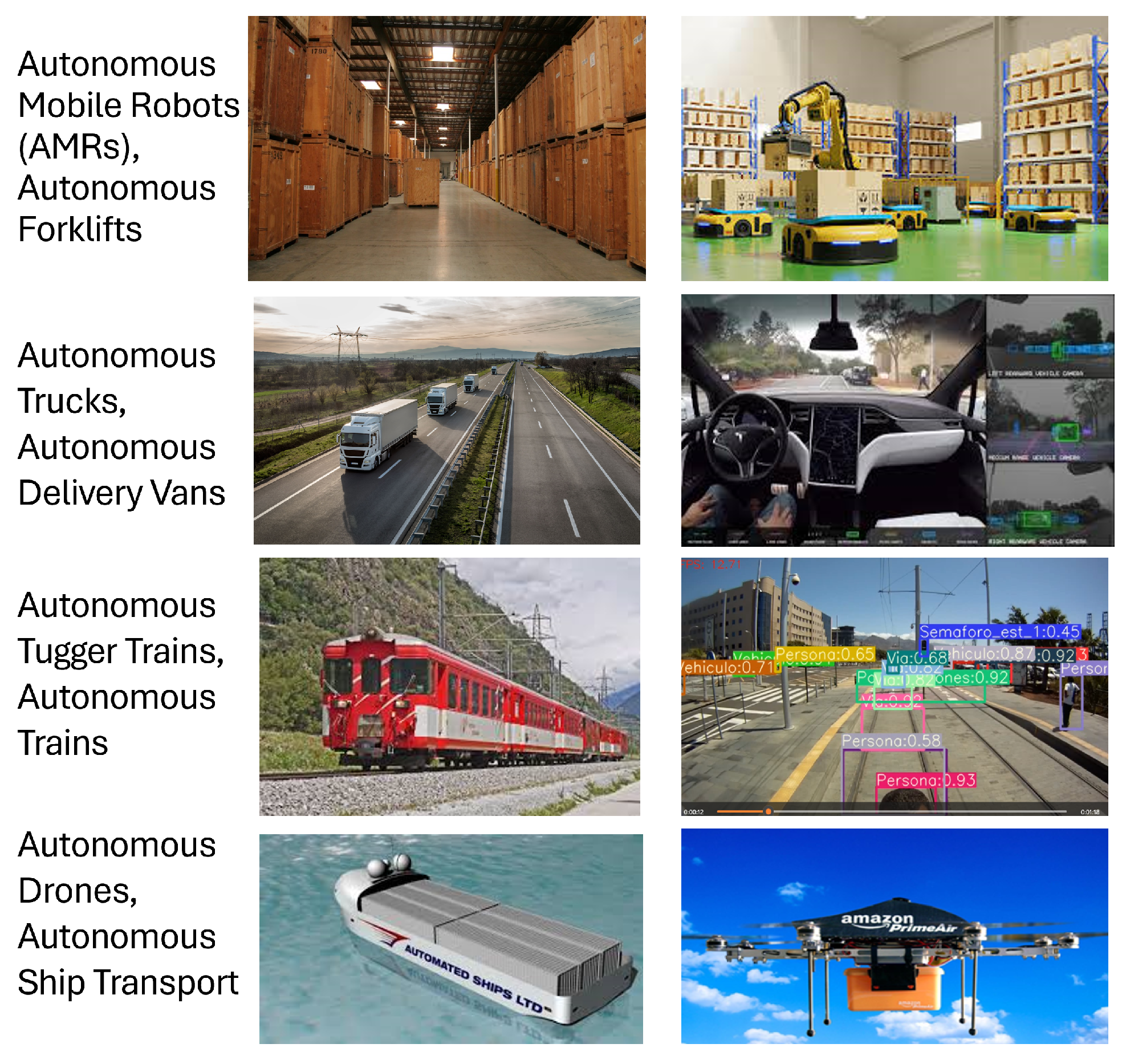
Figure 1. Autonomous vehicles involved in the logistics system.
Electronics 14 04744 g001
Figure 2. Architecture of the proposed blockchain-based ubiquitous supply chain system.
Electronics 14 04744 g002
Figure 3. Relationship between technologies for the ubiquitous supply chain system.
Electronics 14 04744 g003
Figure 4. Life Cycle of the Blockchain. The letters inside the diamonds indicate the entity responsible for each step: F = Factory, T = Transport, W = Warehouse, R = Retailer, and C = Client.
Electronics 14 04744 g004
Figure 5. Data structs to represent user data, product data, and status.
Electronics 14 04744 g005
Figure 6. Android OBU implementation of the supply chain tool.
Electronics 14 04744 g006
Figure 7. Registered entities and activated account with Metamask.
Electronics 14 04744 g007
Figure 8. Screenshot of Companies and Products menu with blockchain information and status of each one.
Electronics 14 04744 g008
Figure 9. Product sequence in the blockchain.
Electronics 14 04744 g009
Figure 10. Overview of gas consumption distribution during prototype testing on the Ganache testnet.
Electronics 14 04744 g010
Table 1. Summary of representative blockchain-based logistics systems.
ReferenceObjectiveTechnologiesMain Outcome
[2]Supply chain traceabilityBlockchain, IoTIdentified benefits and limitations of blockchain–IoT integration
[5]Information sharing in complex product supply chainsBlockchain, CP-ABE, IPFSProposed a secure and efficient information-sharing mechanism enhancing transparency and collaboration
[4]Reverse supply chain management of power batteriesBlockchain, Smart contracts, Double-chain structureImproved traceability and transparency in battery recycling
[23]Privacy-preserving data protection in supply chain managementBlockchain, Hybrid meta-heuristic optimization, Ethereum smart contractsDeveloped a privacy-preserving framework improving data confidentiality and secure processing in supply-chain operations
[3]Digital transformation of supply chainsBlockchain, AI, IoT, Big DataProposed integration framework linking seven key digital technologies to optimize logistics performance
Table 2. Average Gas Consumption for Core Smart Contract Functions.
Smart Contract FunctionAverage Gas Used
Manager.createEntity719,498
Manager.approveEntity59,319
Product.constructor1,672,850
Product.purchase242,781
Product.prepareDelivery71,288
Product.timestamp60,474
Table 3. Technology comparison between the state-of-art works.
Supply Chain SystemBlockchain TrackingReal-Time TrackingRFID CheckingAuthorities InterfaceImplemented
Omar et al. [42]Yes, not specifiedNot mentionedRFID is used for
authentication
Not mentionedNo
Feng [43]Yes (platform not mentioned)Yes, GPSYes, method not specifiedindirectlyNo
Helo et al. [44]Yes (Ethereum and Kovan Network)Yes, GPSYes, method not specifiednot mentionedYes, blockchain, web and smartphone app
Shipchain [45]YesYesYesNot mentionedOffers implementations
SupplyBlocksEthereum, in the future, CardanoYes, GPS and positioning systemsYes, in containersYesYes, Ethereum blockchain, web platform, and Android app
Disclaimer/Publisher’s Note: The statements, opinions and data contained in all publications are solely those of the individual author(s) and contributor(s) and not of MDPI and/or the editor(s). MDPI and/or the editor(s) disclaim responsibility for any injury to people or property resulting from any ideas, methods, instructions or products referred to in the content.