Multivariate Time Series Feature Extraction and Clustering Framework for Multi-Function Radar Work Mode Recognition

Abstract
1. Introduction
- (1)
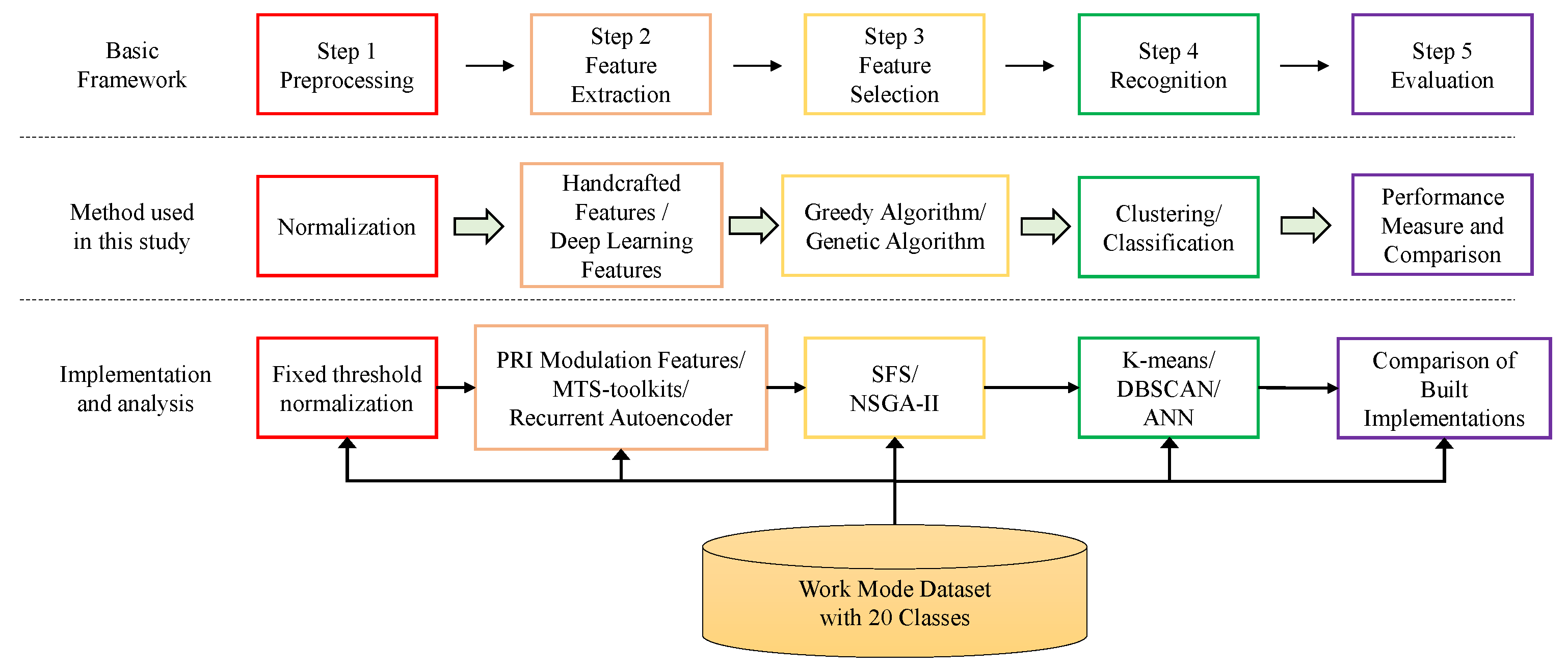
- A multivariate time series feature extraction and clustering framework is designed for MFR pulse sequences.
- (2)
- Several different implementations of the proposed framework are evaluated and compared. In each implementation, effective and advanced methods are utilized.
- (3)
- The experimental dataset includes a rich variety of radar modulation patterns; therefore, the selected features possess better universality.
2. Problem Formulation
2.1. MFR Work Modes Definition
2.2. Time Series Representation of an MFR Pulse Sequence
2.3. Multivariate Time Series Clustering Task of MFR Pulse Sequences
3. Methodology
3.1. Framework Architecture
3.2. Preprocessing Method
3.3. Feature Extraction Methods
3.3.1. PRI Modulation Features
3.3.2. MTS Features
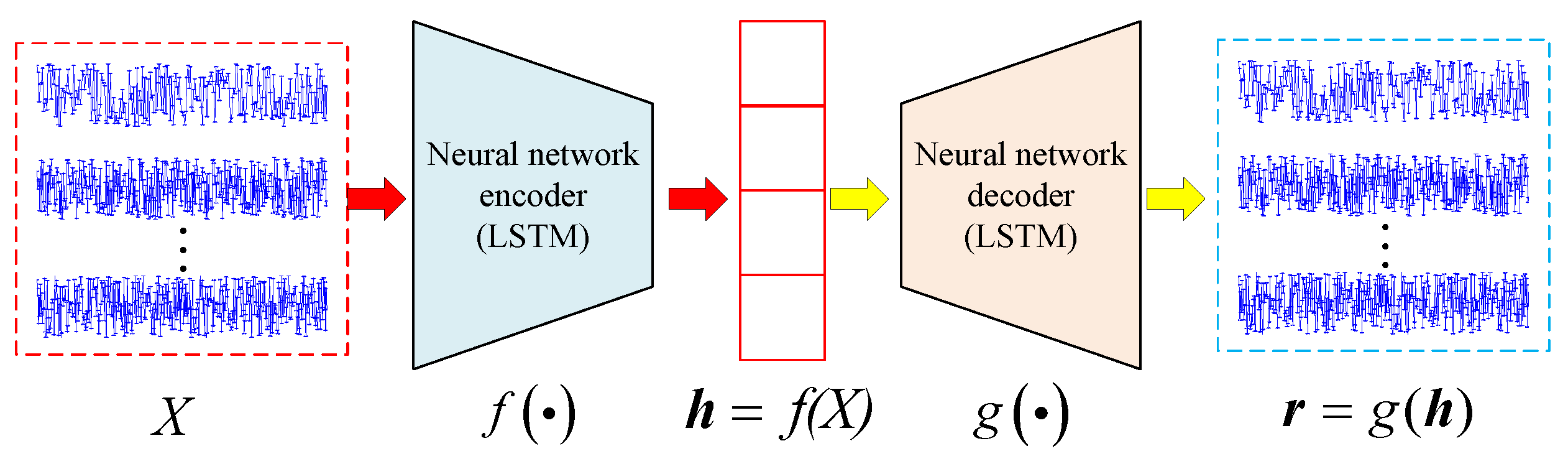
3.3.3. Unsupervised Neural Network Features
3.4. Feature Selection Methods
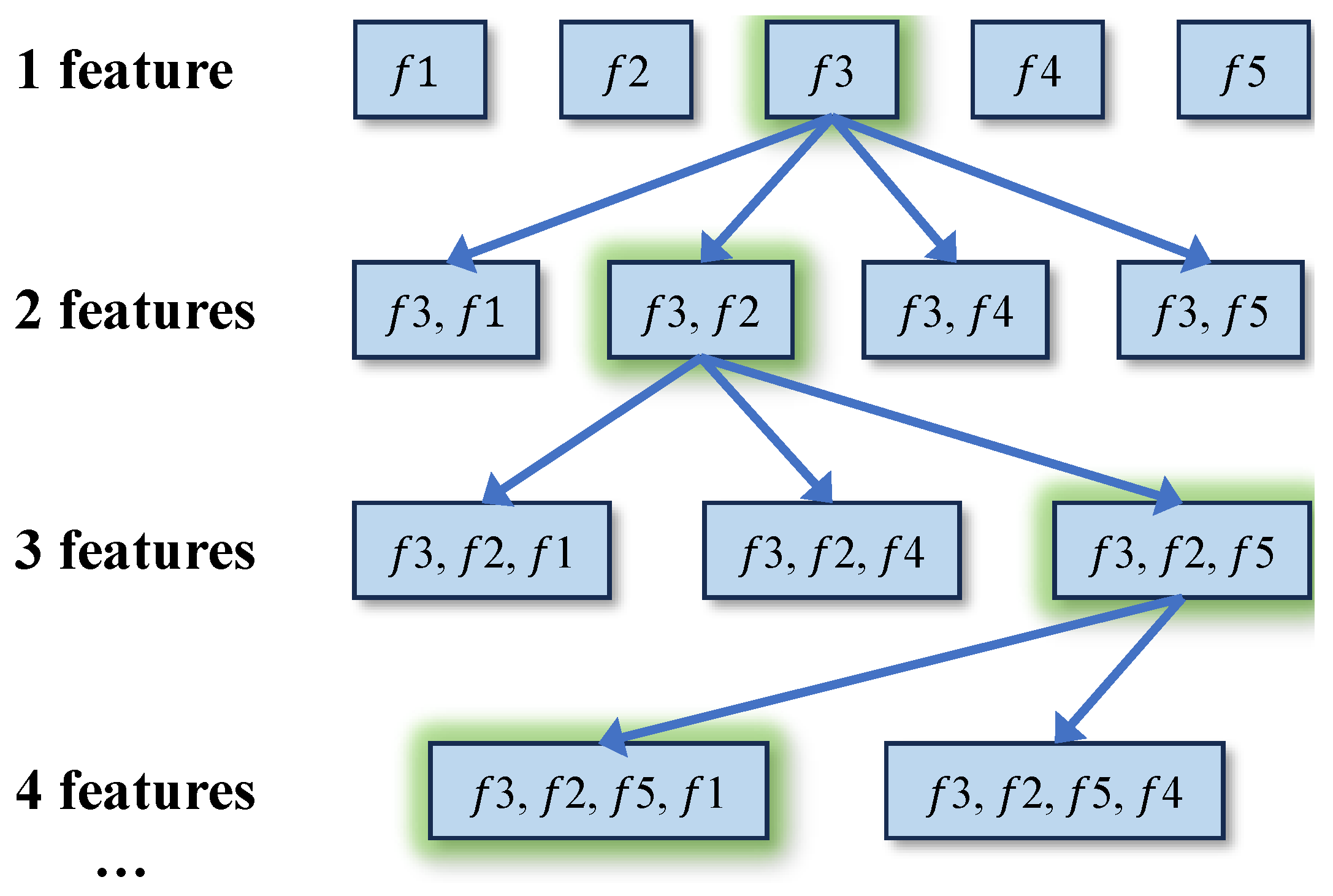
3.4.1. Sequential Forward Selection (SFS)
| Algorithm 1 Sequential Forward Selection (SFS) |
| 1: Input complete feature set Y, maximum number of feature subsets K 2: Initially the feature subset F to an empty set. 3: In each iteration, select feature f from the complete feature set Y and add it to F such that the feature evaluation function achieves the maximum value. 4: Check whether the current number of features k is equal to the desired number of feature subsets K. 5: If yes, stop; otherwise, repeat the previous step until the condition is satisfied. |
3.4.2. Non-Dominated Sorting Genetic Algorithm (NSGA-II)
| Algorithm 2 Non-dominated Sorting Genetic Algorithm (NSGA-II) |
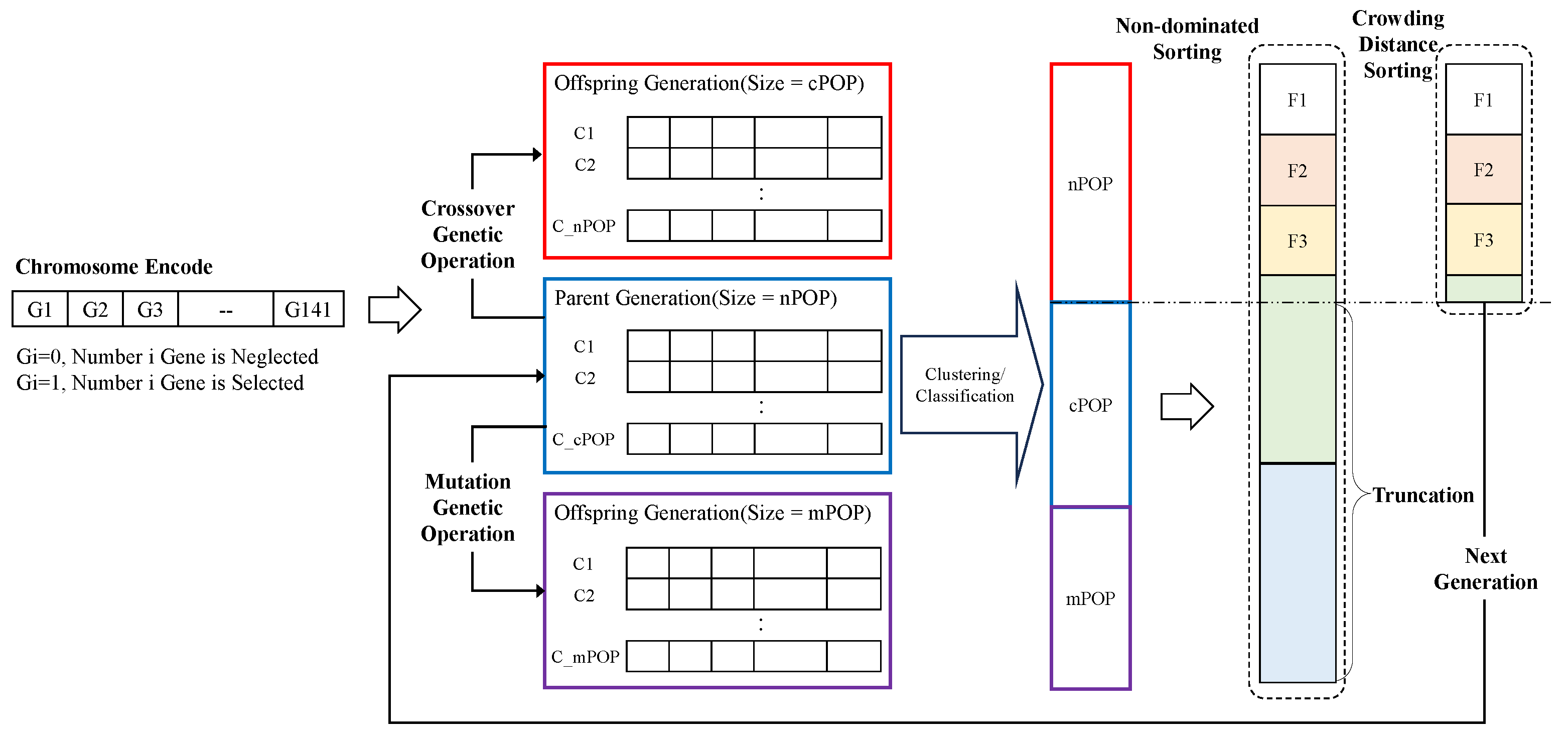
| 1: Input complete feature set Y, maximum number of iteration limit L 2: Initially, randomly select a subset of features from the original feature set as the first-generation population P. 3: In each iteration, select excellent individuals by sequentially comparing the labels and Crowding Distance (CD) values of two individuals. 4: Apply crossover and mutation operations to generate a new generation population Q. 5: Merge P and Q into a combined population R, and similarly use two levels of preference operators to select the optimal N individuals from R as the next-generation population. 6: Check whether the preset iteration limit L is reached. 7: If yes, stop; otherwise, repeat the previous step until the condition is satisfied |
3.5. Recognition Methods
4. Experiment and Analysis
4.1. Experimental Design
4.1.1. Dataset Description
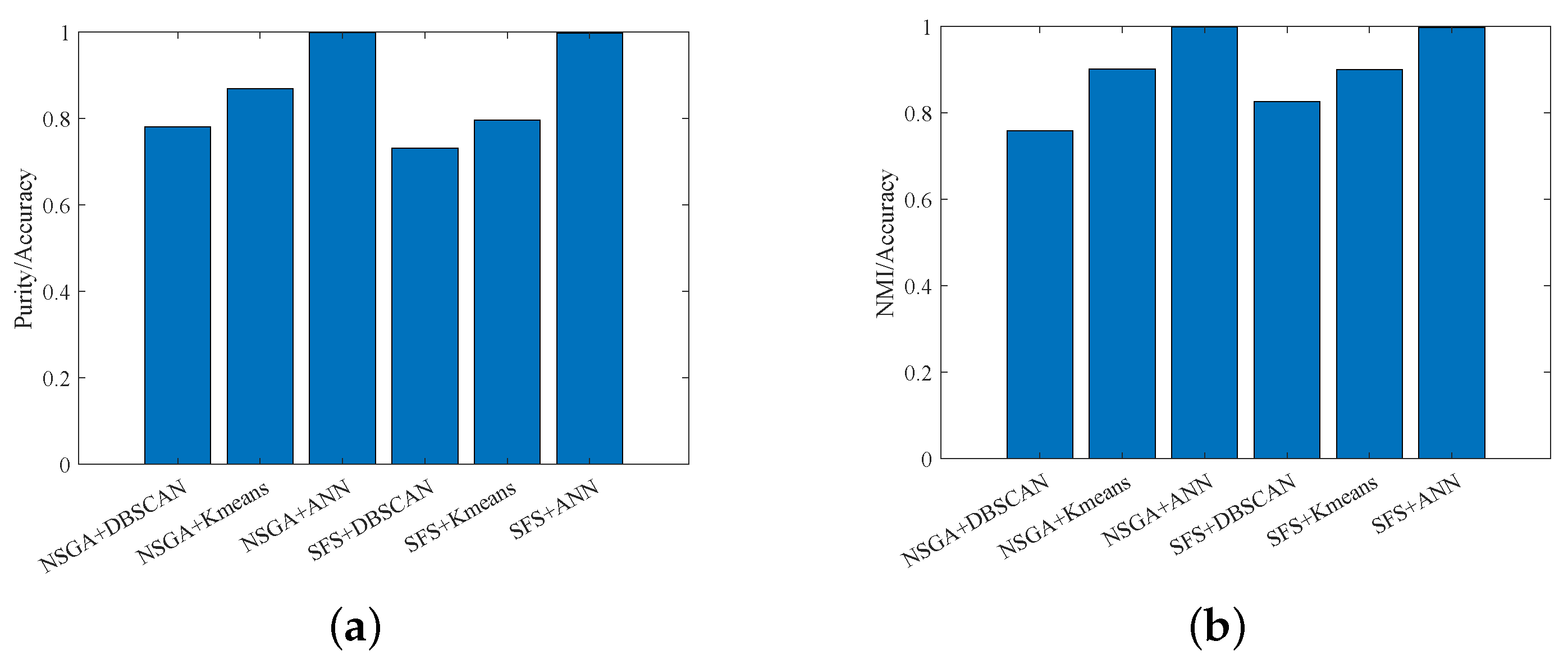
4.1.2. Evaluation Metrics
- (1)
- Purity
- (2)
- Normalized mutual information
- (3)
- Cross-entropy loss
4.1.3. Experimental Design
- (1)
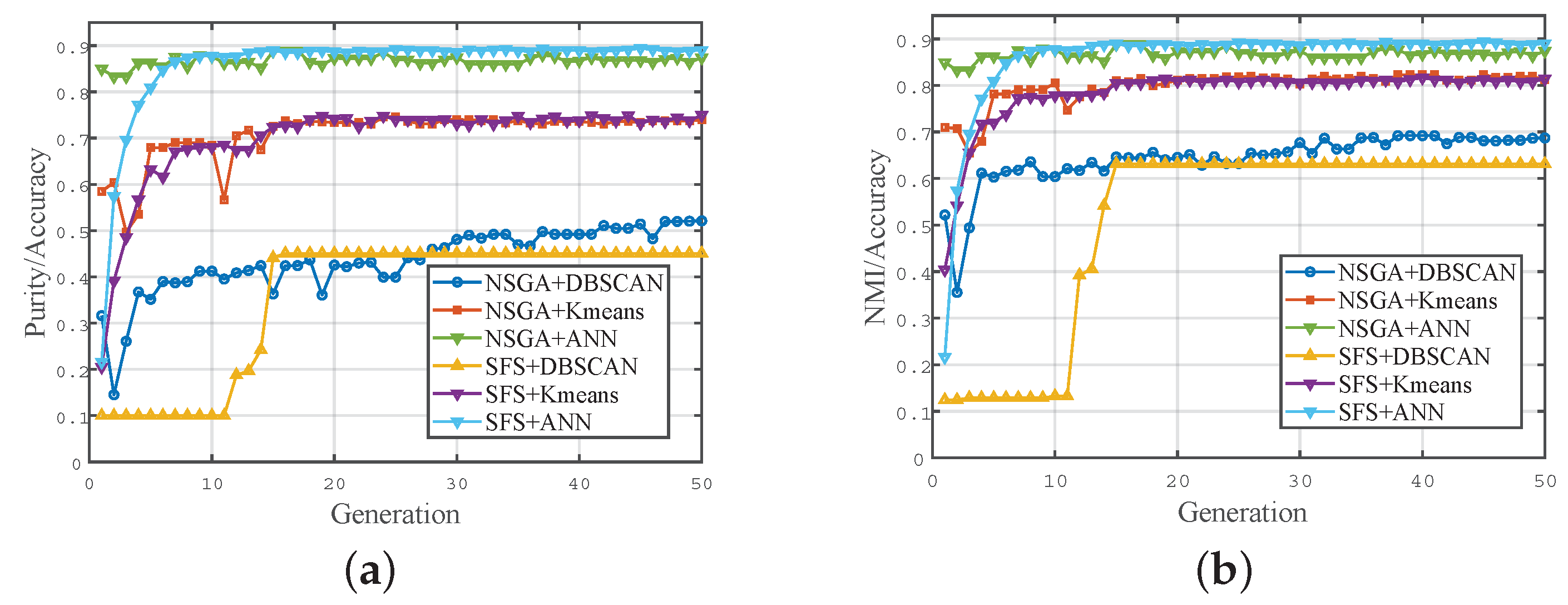
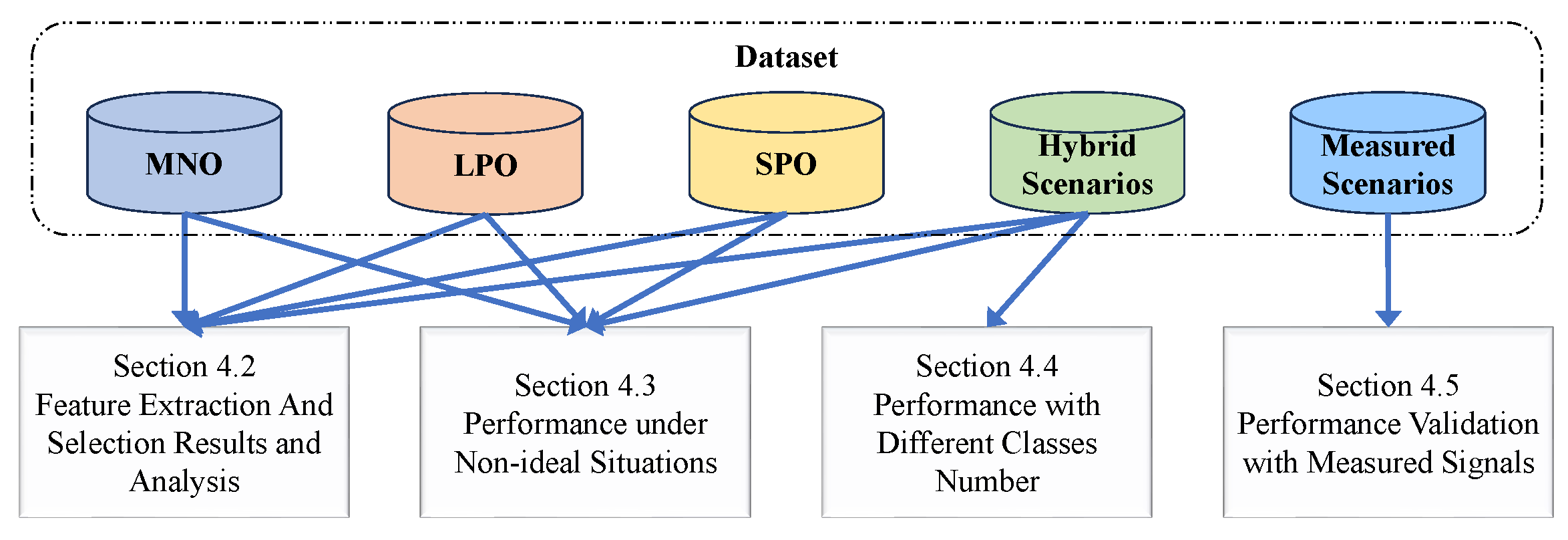
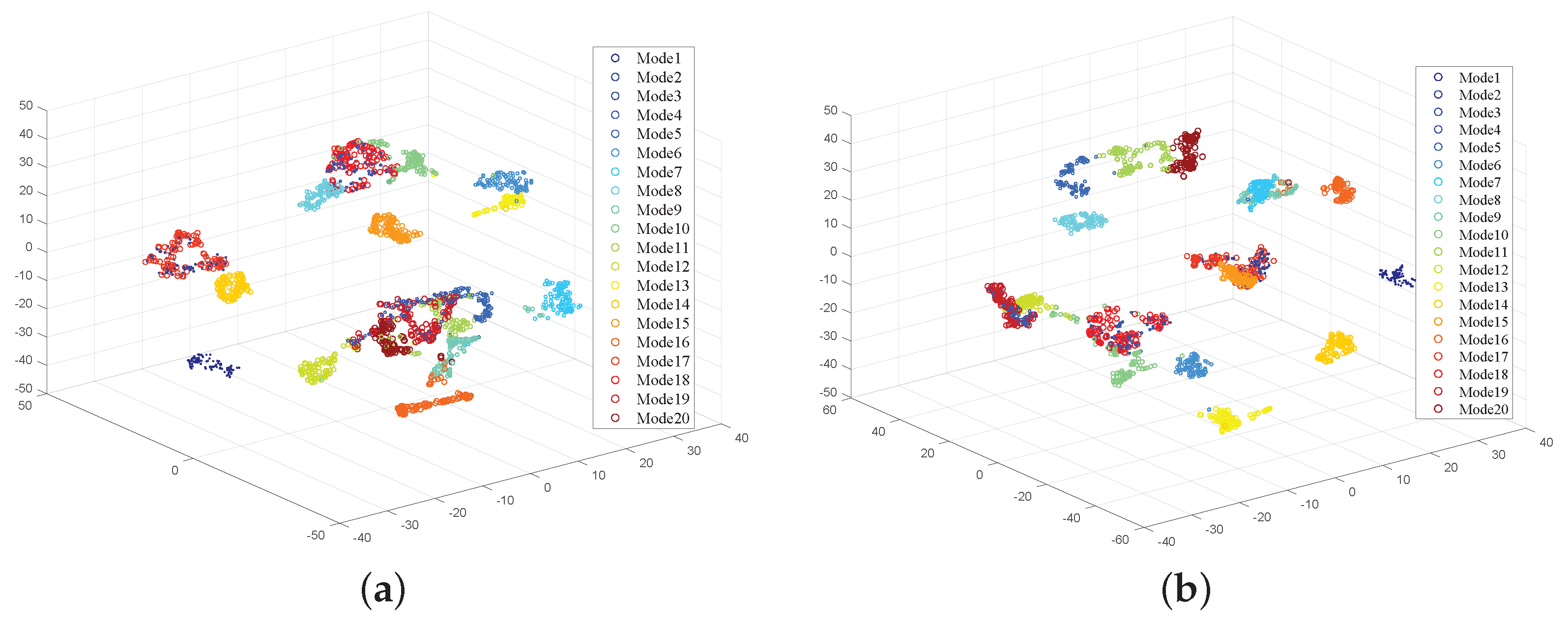
- Feature selection results analysis for different optimization methods (Section 4.2).
- (2)
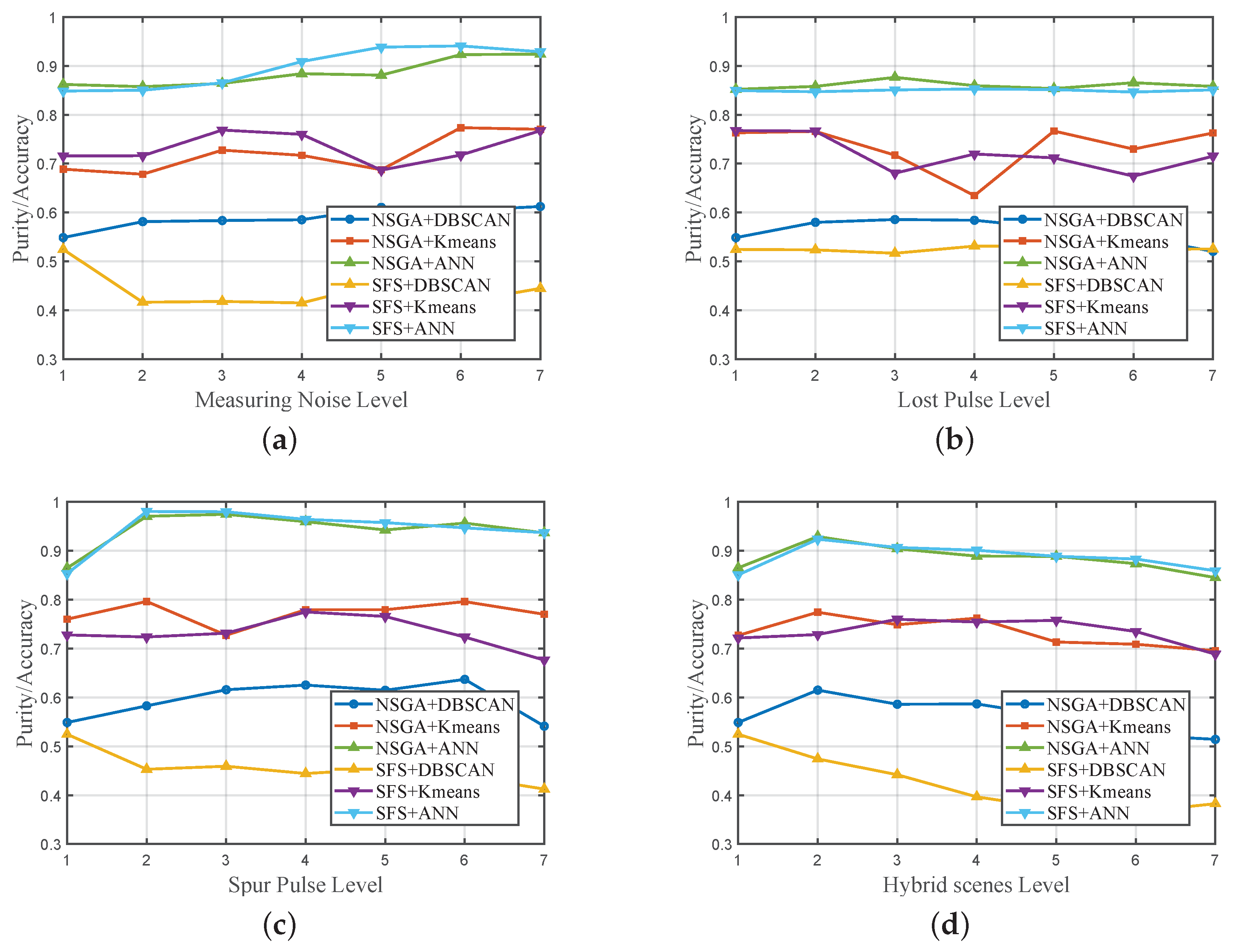
- Robustness against typical non-ideal situations (Section 4.3).
- (3)
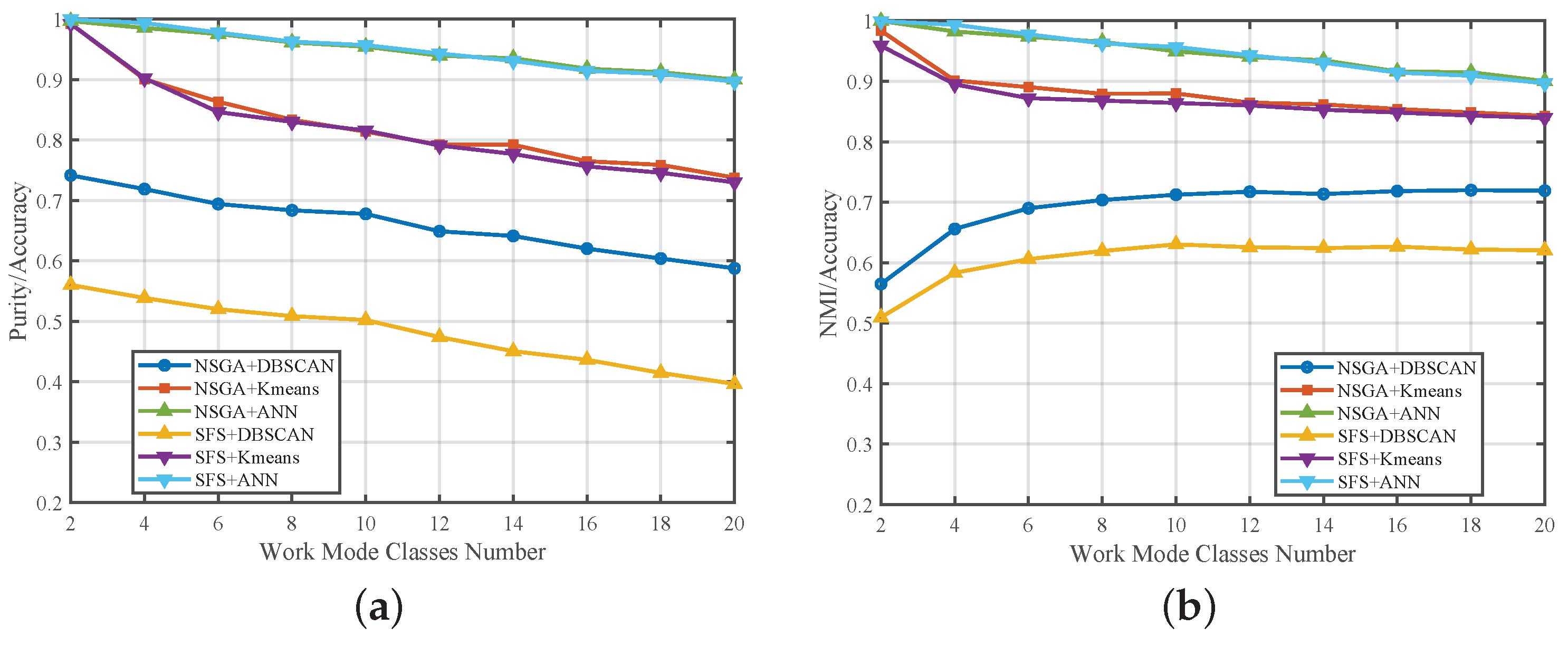
- Performance against different numbers of MFR work mode classes (Section 4.4).
- (4)
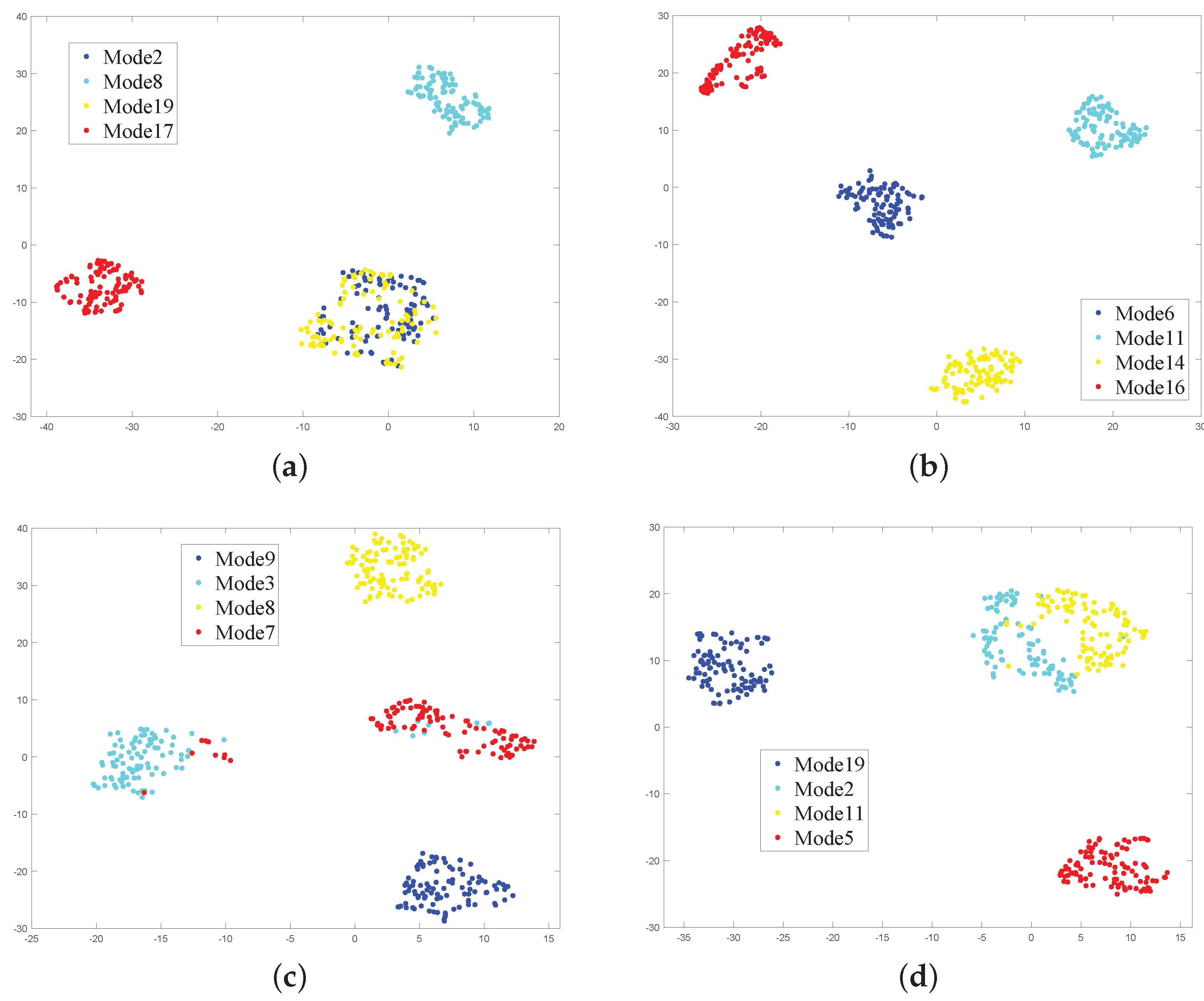
- Performance validation with measured signals (Section 4.5).
4.2. Feature Extraction and Selection Results and Analysis
4.3. Performance under Non-Ideal Situations
4.4. Performance with Different Class Numbers
4.5. Performance Validation with Measured Signals
5. Conclusions
Author Contributions
Funding
Data Availability Statement
Acknowledgments
Conflicts of Interest
References
- Weber, M.E.; Cho, J.Y.N.; Thomas, H.G. Command and Control for Multifunction Phased Array Radar. IEEE Trans. Geosci. Remote Sens. 2017, 55, 5899–5912. [Google Scholar] [CrossRef] [Scilit]
- Stailey, J.E.; Hondl, K.D. Multifunction Phased Array Radar for Aircraft and Weather Surveillance. Proc. IEEE 2016, 104, 649–659. [Google Scholar] [CrossRef] [Scilit]
- Mir, H.S.; Guitouni, A. Variable Dwell Time Task Scheduling for Multifunction Radar. IEEE Trans. Autom. Sci. Eng. 2014, 11, 463–472. [Google Scholar] [CrossRef]
- Boers, Y.; Driessen, H.; Zwaga, J. Adaptive MFR parameter control: Fixed against variable probabilities of detection. IEE Proc.—Radar Sonar Navig. 2006, 153, 2–6. [Google Scholar] [CrossRef] [Scilit]
- Arasaratnam, I.; Haykin, S.; Kirubarajan, T.; Dilkes, F.A. Tracking the mode of operation of multi-function radars. In Proceedings of the IEEE Conference on Radar, Verona, NY, USA, 24–27 April 2006. [Google Scholar]
- Visnevski, N.; Krishnamurthy, V.; Wang, A.; Haykin, S. Syntactic Modeling and Signal Processing of Multifunction Radars: A Stochastic Context-Free Grammar Approach. Proc. IEEE 2007, 95, 1000–1025. [Google Scholar] [CrossRef] [Scilit]
- Apfeld, S.; Charlish, A.; Ascheid, G. Modelling, Learning and Prediction of Complex Radar Emitter Behaviour. In Proceedings of the 2019 18th IEEE International Conference On Machine Learning And Applications (ICMLA), Boca Raton, FL, USA, 16–19 December 2019; pp. 305–310. [Google Scholar] [CrossRef] [Scilit]
- Visnevski, N.A. Syntactic Modeling of Multi-Function Radars. Ph.D. Thesis, McMaster University, Hamilton, ON, Canada, 2005. [Google Scholar]
- Wang, A.; Krishnamurthy, V. Threat Estimation of Multifunction Radars: Modeling and Statistical Signal Processing of Stochastic Context Free Grammars. In Proceedings of the IEEE International Conference on Acoustics, Honolulu, HI, USA, 15–20 April 2007. [Google Scholar]
- Wang, A.; Krishnamurthy, V. Signal Interpretation of Multifunction Radars: Modeling and Statistical Signal Processing With Stochastic Context Free Grammar. IEEE Trans. Signal Process. 2008, 56, 1106–1119. [Google Scholar] [CrossRef] [Scilit]
- Ou, J.; Chen, Y.; Zhao, F.; Ai, X.; Yang, J. Research on extension of hierarchical structure for multi-function radar signals. In Proceedings of the 2017 Progress In Electromagnetics Research Symposium—Spring (PIERS), St. Petersburg, Russia, 22–25 May 2017; pp. 2612–2616. [Google Scholar] [CrossRef] [Scilit]
- Haykin, S.; Xue, Y.; Setoodeh, P. Cognitive Radar: Step toward Bridging the Gap between Neuroscience and Engineering. Proc. IEEE 2012, 100, 3102–3130. [Google Scholar] [CrossRef] [Scilit]
- Blunt, S.D.; Mokole, E.L. Overview of radar waveform diversity. IEEE Aerosp. Electron. Syst. Mag. 2016, 31, 2–42. [Google Scholar] [CrossRef] [Scilit]
- Greco, M.S.; Gini, F.; Stinco, P.; Bell, K. Cognitive Radars: On the Road to Reality: Progress thus Far and Possibilities for the Future. IEEE Signal Process. Mag. 2018, 35, 112–125. [Google Scholar] [CrossRef] [Scilit]
- Gurbuz, S.Z.; Griffiths, H.D.; Charlish, A.; Rangaswamy, M.; Greco, M.; Bell, K.L. An Overview of Cognitive Radar: Past, Present, and Future. IEEE Aerosp. Electron. Syst. Mag. 2019, 34, 6–18. [Google Scholar] [CrossRef] [Scilit]
- Kauppi, J.P.; Martikainen, K.; Ruotsalainen, U. Hierarchical classification of dynamically varying radar pulse repetition interval modulation patterns. Neural Netw. 2010, 23, 1226–1237. [Google Scholar] [CrossRef] [Scilit] [PubMed]
- Liu, Y.; Zhang, Q. An improved algorithm for PRI modulation recognition. In Proceedings of the 2017 IEEE International Conference on Signal Processing, Communications and Computing (ICSPCC), Xiamen, China, 22–25 October 2017; pp. 1–5. [Google Scholar] [CrossRef] [Scilit]
- Hu, G.; Liu, Y. An Efficient Method of Pulse Repetition Interval Modulation Recognition. In Proceedings of the International Conference on Communications & Mobile Computing, Shenzhen, China, 12–14 April 2010. [Google Scholar]
- Mahmoud, K.; Amir Mansour, P.; Forouhar, F. A new method for detection of complex Pulse Repetition Interval Modulations. In Proceedings of the IEEE International Conference on Signal Processing, Beijing, China, 21–25 October 2012. [Google Scholar]
- Li, X.; Huang, Z.; Wang, F.; Xiang, W.; Liu, T. Towards Convolutional Neural Networks on Pulse Repetition Interval Modulation Recognition. IEEE Commun. Lett. 2018, 22, 2286–2289. [Google Scholar] [CrossRef] [Scilit]
- Liu, Z.M.; Yu, P.S. Classification, Denoising and Deinterleaving of Pulse Streams with Recurrent Neural Networks. IEEE Trans. Aerosp. Electron. Syst. 2019, 55, 1624–1639. [Google Scholar] [CrossRef] [Scilit]
- Zhu, M.; Li, Y.; Wang, S. Model-based Time Series Clustering and Inter-pulse Modulation Parameter Estimation of Multi-function Radar Pulse Sequences. IEEE Trans. Aerosp. Electron. Syst. 2021, 57, 3673–3690. [Google Scholar] [CrossRef] [Scilit]
- Wang, B.; Wang, S.; Zeng, D.; Wang, M. Convolutional Neural Network-Based Radar Antenna Scanning Period Recognition. Electronics 2022, 11, 1383. [Google Scholar] [CrossRef] [Scilit]
- Li, W.; Dong, Y.Y.; Zhang, L.; Dong, C. Time Domain Attention Mechanism Based Multi-Functional Radar Working Mode Recognition. In Proceedings of the 2023 8th International Conference on Communication, Image and Signal Processing (CCISP), Chengdu, China, 17–19 November 2023; pp. 457–462. [Google Scholar] [CrossRef] [Scilit]
- Wang, W.; Wang, Y. A Parameter-Optimized SLS-TSVM Method for Working Modes Recognition of Airborne Fire Control Radar. In Proceedings of the 2020 IEEE 4th Information Technology, Networking, Electronic and Automation Control Conference (ITNEC), Networking, Chongqing, China, 12–14 June 2020; Volume 1, pp. 948–953. [Google Scholar] [CrossRef] [Scilit]
- Tang, Z.; Gong, Y.; Tao, M.; Su, J.; Fan, Y.; Li, T. Recognition of Working Mode for Multifunctional Phased Array Radar Under Small Sample Condition. In Proceedings of the 2023 IEEE 6th International Conference on Electronic Information and Communication Technology (ICEICT), Qingdao, China, 7–9 August 2023; pp. 1157–1160. [Google Scholar] [CrossRef] [Scilit]
- Gao, J.; Wang, T.; Ye, F. Radar Working Mode Recognition Algorithm Based on Siamese Network and Deep Auto Encoder-Affinity Propagation. In Proceedings of the 2022 International Symposium on Antennas and Propagation (ISAP), Sydney, Australia, 31 October–3 November 2022; pp. 371–372. [Google Scholar] [CrossRef] [Scilit]
- Zhang, Z.; Shi, X.; Zhou, F. An Incremental Recognition Method for MFR Working Modes Based on Deep Feature Extension in Dynamic Observation Scenarios. IEEE Sens. J. 2023, 23, 21574–21587. [Google Scholar] [CrossRef] [Scilit]
- Li, Y.; Zhu, M.; Ma, Y.; Yang, J. Work Modes Recognition and Boundary Identification of MFR Pulse Sequences with a Hierarchical Seq2seq LSTM. Electronic Article. 2020. Available online: https://digital-library.theiet.org/content/journals/10.1049/iet-rsn.2020.0060 (accessed on 24 July 2020).
- Charlish, A.; Hoffmann, F.; Degen, C.; Schlangen, I. The Development from Adaptive to Cognitive Radar Resource Management. IEEE Aerosp. Electron. Syst. Mag. 2020, 35, 8–19. [Google Scholar] [CrossRef] [Scilit]
- Martone, A.F.; Charlish, A. Cognitive radar for waveform diversity utilization. In Proceedings of the IEEE Radar Conference, Atlanta, GA, USA, 7–14 May 2021. [Google Scholar]
- Guan, X.; Zhang, Y.; Ling, H. Main pattern extraction of electronic scanning radar. Electron. Opt. Control. 2018, 25, 84–88. (In Chinese) [Google Scholar]
- Fang, Y.; Bi, D.; Pan, J.; Chen, Q. Multi-function Radar Behavior State Detection Algorithm based on Bayesian Criterion. In Proceedings of the 2019 IEEE 4th Advanced Information Technology, Electronic and Automation Control Conference (IAEAC), Chengdu, China, 20–22 December 2019; IEEE: Piscataway, NJ, USA, 2020; pp. 213–217. [Google Scholar]
- Liu, Z.; Yuan, S.; Kang, S. Semantic Coding and Model Reconstruction of Multifunction Radar Pulse Train. J. Radars 2021, 10, 559–570. (In Chinese) [Google Scholar]
- Guillaume, R.; Ali, M.D.; Cyrille, E. Radar emitters classification and clustering with a scale mixture of Normal distributions. IET Radar Sonar Navig. 2018, 13, 128–138. [Google Scholar]
- Salles, R.; Belloze, K.T.; Porto, F.; Gonzalez, P.H.; Ogasawara, E. Nonstationary time series transformation methods: An experimental review. Knowl. Based Syst. 2019, 164, 274–291. [Google Scholar] [CrossRef] [Scilit]
- Esling, P.; Agon, C. Time-series data mining. ACM Comput. Surv. 2012, 45, 1–34. [Google Scholar] [CrossRef] [Scilit]
- Aghabozorgi, S.; Shirkhorshidi, A.S.; Wah, T.Y. Time-series clustering—A decade review. Inf. Syst. 2015, 53, 16–38. [Google Scholar] [CrossRef] [Scilit]
- Zolhavarieh, S.; Aghabozorgi, S.; Teh, Y.W. A Review of Subsequence Time Series Clustering. Sci. World J. 2014, 2014, 312521. [Google Scholar] [CrossRef] [Scilit]
- Liao, T.W. Clustering of time series data-a survey. Pattern Recognit. 2005, 38, 1857–1874. [Google Scholar] [CrossRef] [Scilit]
- Chamroukhi, F.; Mohammed, S.; Trabelsi, D.; Oukhellou, L.; Amirat, Y. Joint segmentation of multivariate time series with hidden process regression for human activity recognition. Neurocomputing 2013, 120, 633–644. [Google Scholar] [CrossRef] [Scilit]
- Han, M.; Liu, X. Feature selection techniques with class separability for multivariate time series. Neurocomputing 2013, 110, 29–34. [Google Scholar] [CrossRef] [Scilit]
- Tuncel, K.S.; Baydogan, M.G. Autoregressive forests for multivariate time series modeling. Pattern Recognit. 2018, 73, 202–215. [Google Scholar] [CrossRef] [Scilit]
- Zhou, L.; Du, G.; Tao, D.; Chen, H.; Cheng, J.; Gong, L. Clustering Multivariate Time Series Data via Multi-Nonnegative Matrix Factorization in Multi-Relational Networks. IEEE Access 2018, 6, 74747–74761. [Google Scholar] [CrossRef] [Scilit]
- González-Vidal, A.; Jiménez, F.; Gómez-Skarmeta, A.F. A methodology for energy multivariate time series forecasting in smart buildings based on feature selection. Energy Build. 2019, 196, 71–82. [Google Scholar] [CrossRef] [Scilit]
- Li, H. Multivariate time series clustering based on common principal component analysis. Neurocomputing 2019, 349, 239–247. [Google Scholar] [CrossRef] [Scilit]
- Jiménez, F.; Palma, J.; Sánchez, G.; Marín, D.; Francisco Palacios, M.D.; Lucía López, M.D. Feature selection based multivariate time series forecasting: An application to antibiotic resistance outbreaks prediction. Artif. Intell. Med. 2020, 104, 101818. [Google Scholar] [CrossRef] [Scilit] [PubMed]
- Li, H.; Liu, Z. Multivariate time series clustering based on complex network. Pattern Recognit. 2021, 115, 107919. [Google Scholar] [CrossRef] [Scilit]
- Sanhudo, L.; Rodrigues, J.; Filho, E.V. Multivariate time series clustering and forecasting for building energy analysis: Application to weather data quality control. J. Build. Eng. 2021, 35, 101996. [Google Scholar] [CrossRef] [Scilit]
- Wiley, R. ELINT: The Interception and Analysis of Radar Signals; Artech House: Norwood, MA, USA, 2006; Volume 111. [Google Scholar] [CrossRef] [Scilit]
- Ahmadzadeh, A.; Sinha, K.; Aydin, B.; Angryk, R.A. MVTS-Data Toolkit: A Python package for preprocessing multivariate time series data. SoftwareX 2020, 12, 100518. [Google Scholar] [CrossRef] [Scilit]
- Greff, K.; Srivastava, R.K.; Koutník, J.; Steunebrink, B.R.; Schmidhuber, J. LSTM: A Search Space Odyssey. IEEE Trans. Neural Netw. Learn. Syst. 2017, 28, 2222–2232. [Google Scholar] [CrossRef] [Scilit] [PubMed]
- Hochreiter, S.; Schmidhuber, J. Long Short-Term Memory. Neural Comput. 1997, 9, 1735–1780. [Google Scholar] [CrossRef] [Scilit] [PubMed]
- Deb, K.; Pratap, A.; Agarwal, S.; Meyarivan, T. A fast and elitist multiobjective genetic algorithm: NSGA-II. IEEE Trans. Evol. Comput. 2002, 6, 182–197. [Google Scholar] [CrossRef] [Scilit]
- Li, Y.; Ma, D.; Zhu, M.; Zeng, Z.; Wang, Y. Identification of significant factors in fatal-injury highway crashes using genetic algorithm and neural network. Accid. Anal. Prev. 2018, 111, 354–363. [Google Scholar] [CrossRef] [Scilit] [PubMed]
- Luxburg, U. A tutorial on spectral clustering. Stat. Comput. 2007, 17, 395–416. [Google Scholar] [CrossRef] [Scilit]
- Feng, X.; Hu, X.; Liu, Y. Radar signal sorting algorithm of k-means clustering based on data field. In Proceedings of the 2017 3rd IEEE International Conference on Computer and Communications (ICCC), Chengdu, China, 3–16 December 2017; pp. 2262–2266. [Google Scholar] [CrossRef] [Scilit]
- Yang, Z.; Wu, Z.; Yin, Z.; Quan, T.; Sun, H. Hybrid Radar Emitter Recognition Based on Rough k-Means Classifier and Relevance Vector Machine. Sensors 2013, 13, 848–864. [Google Scholar] [CrossRef] [Scilit] [PubMed]
- Ester, M.; Kriegel, H.P.; Sander, J.; Xu, X. A density-based algorithm for discovering clusters in large spatial databases with noise. In Proceedings of the Second International Conference on Knowledge Discovery and Data Mining—KDD’96, Portland, OR, USA, 2–4 August 1996; AAAI Press: Washington, DC, USA, 1996; pp. 226–231. [Google Scholar]
- Guyon, I.; Elisseeff, A. An introduction to variable and feature selection. J. Mach. Learn. Res. 2003, 3, 1157–1182. [Google Scholar]





| Parameters | Candidate Modulation Types |
|---|---|
| PRI | constant, agile, jittered, dwell and switch, sliding, periodic |
| RF | constant, agile, jittered, dwell and switch, sliding |
| PW | constant, agile, jittered |
| Variables | PRI | RF | PW |
|---|---|---|---|
| Pulse parameters | |||
| Initial value interval | |||
| Agile | |||
| Number of bursts | |||
| Dwell and switch | |||
| Number of bursts | – | ||
| Jittered | |||
| Deviation | |||
| Sliding | |||
| Number of bursts | – | ||
| Size of step | – | ||
| Periodic (Sinusoidal) Carrier frequency | – | – | |
| Amplitude | – | – | |
| Deviation | – | – |
| Scene | Measuring Noise (s, MHz, s) | Lost Pulse (%) | Spurious Pulse (%) |
|---|---|---|---|
| 1 | [0, 0, 0] | 0 | 0 |
| 2 | [0.05, 0.5, 0.05] | 5 | 5 |
| 3 | [0.1, 1, 0.1] | 10 | 10 |
| 4 | [0.15, 1.5, 0.15] | 15 | 15 |
| 5 | [0.2, 2, 0.2] | 20 | 20 |
| 6 | [0.25, 2.5, 0.25] | 25 | 25 |
| 7 | [0.3, 3, 0.3] | 30 | 30 |
| Implementation | Optimization Objectives | Maximum Iteration/Maximum Number of Features |
|---|---|---|
| NSGA + DBSCAN | 50 | |
| NSGA + Kmeans | 50 | |
| NSGA + ANN | 50 | |
| SFS + DBSCAN | 50 | |
| SFS + Kmeans | 50 | |
| SFS + ANN | 50 |
| Implementation | PRI Modulation Features Number | MTS Features Number | Unsupervised Neural Network Features Number |
|---|---|---|---|
| Complete Feature Set | 15 | 106 | 20 |
| NSGA + DBSCAN | 10 | 3 | 2 |
| NSGA + Kmeans | 12 | 9 | 1 |
| NSGA + ANN | 9 | 4 | 1 |
| SFS + DBSCAN | 6 | 4 | 2 |
| SFS + Kmeans | 7 | 22 | 2 |
| SFS + ANN | 8 | 17 | 3 |
Disclaimer/Publisher’s Note: The statements, opinions and data contained in all publications are solely those of the individual author(s) and contributor(s) and not of MDPI and/or the editor(s). MDPI and/or the editor(s) disclaim responsibility for any injury to people or property resulting from any ideas, methods, instructions or products referred to in the content. |
© 2024 by the authors. Licensee MDPI, Basel, Switzerland. This article is an open access article distributed under the terms and conditions of the Creative Commons Attribution (CC BY) license (https://creativecommons.org/licenses/by/4.0/).
Share and Cite
Fan, R.; Zhu, M.; Zhang, X. Multivariate Time Series Feature Extraction and Clustering Framework for Multi-Function Radar Work Mode Recognition. Electronics 2024, 13, 1412. https://doi.org/10.3390/electronics13081412
Fan R, Zhu M, Zhang X. Multivariate Time Series Feature Extraction and Clustering Framework for Multi-Function Radar Work Mode Recognition. Electronics. 2024; 13(8):1412. https://doi.org/10.3390/electronics13081412
Chicago/Turabian StyleFan, Ruozhou, Mengtao Zhu, and Xiongkui Zhang. 2024. "Multivariate Time Series Feature Extraction and Clustering Framework for Multi-Function Radar Work Mode Recognition" Electronics 13, no. 8: 1412. https://doi.org/10.3390/electronics13081412
APA StyleFan, R., Zhu, M., & Zhang, X. (2024). Multivariate Time Series Feature Extraction and Clustering Framework for Multi-Function Radar Work Mode Recognition. Electronics, 13(8), 1412. https://doi.org/10.3390/electronics13081412