Article

Ship Classification Based on AIS Data and Machine Learning Methods

1
Maritime Development and Training Center, National Taiwan Ocean University, Keelung 202301, Taiwan
2
Department of Merchant Marine, National Taiwan Ocean University, Keelung 202301, Taiwan
3
Ship Traffic Service, Port of Keelung, Taiwan International Ports Corporation, Ltd., Kaohsiung 804004, Taiwan
*
Author to whom correspondence should be addressed.
Electronics 2024, 13(1), 98; https://doi.org/10.3390/electronics13010098

Submission received: 14 November 2023 / Revised: 16 December 2023 / Accepted: 21 December 2023 / Published: 25 December 2023

Abstract

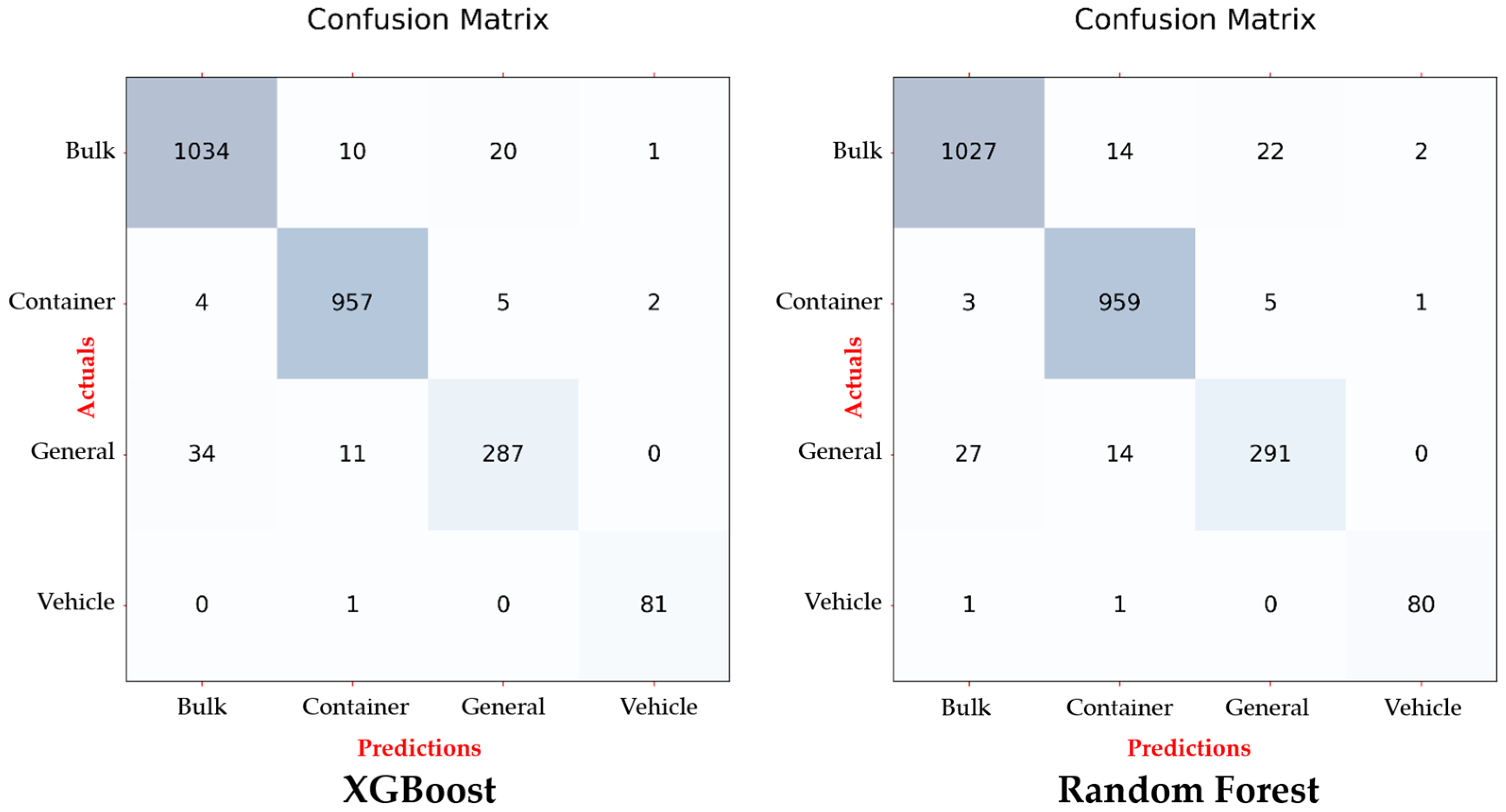
AIS ship-type code categorizes ships into broad classes, such as fishing, passenger, and cargo, yet struggles with finer distinctions among cargo ships, such as bulk carriers and containers. Different ship types significantly impact acceleration, steering performance, and stopping distance, thus making precise identification of unfamiliar ship types crucial for maritime monitoring. This study introduces an original classification study based on AIS data for cargo ships, presenting a classifier tailored for bulk carriers, containers, general cargo, and vehicle carriers. The model’s efficacy was tested within the Changhua Wind Farm Channel using eight classification algorithms across tree-structure-based, proximity-based, and regression-based categories and employing standard metrics (Accuracy, Precision, Recall, F1-score) to assess the performance. The results show that tree-structure-based algorithms, particularly XGBoost and Random Forest, demonstrated superior performance. This study also implemented a feature selection strategy with five methods, revealing that a model trained with only four features (three ship-geometric features and one trajectory behavior feature) can achieve high accuracy. Conclusively, the classifier effectively overcame the challenges of limited AIS data labels, achieving a classification accuracy of 97% for ships in the Changhua Wind Farm Channel. These results are pivotal in identifying abnormal ship behavior, highlighting the classifier’s potential for maritime monitoring applications.
Keywords: ship-type classification; machine learning; AIS data; offshore wind farm channel ship-type classification; machine learning; AIS data; offshore wind farm channel