Analysis of Challenges and Solutions of IoT in Smart Grids Using AI and Machine Learning Techniques: A Review

 ,
,  ,
,  ,
,  and
and
Abstract
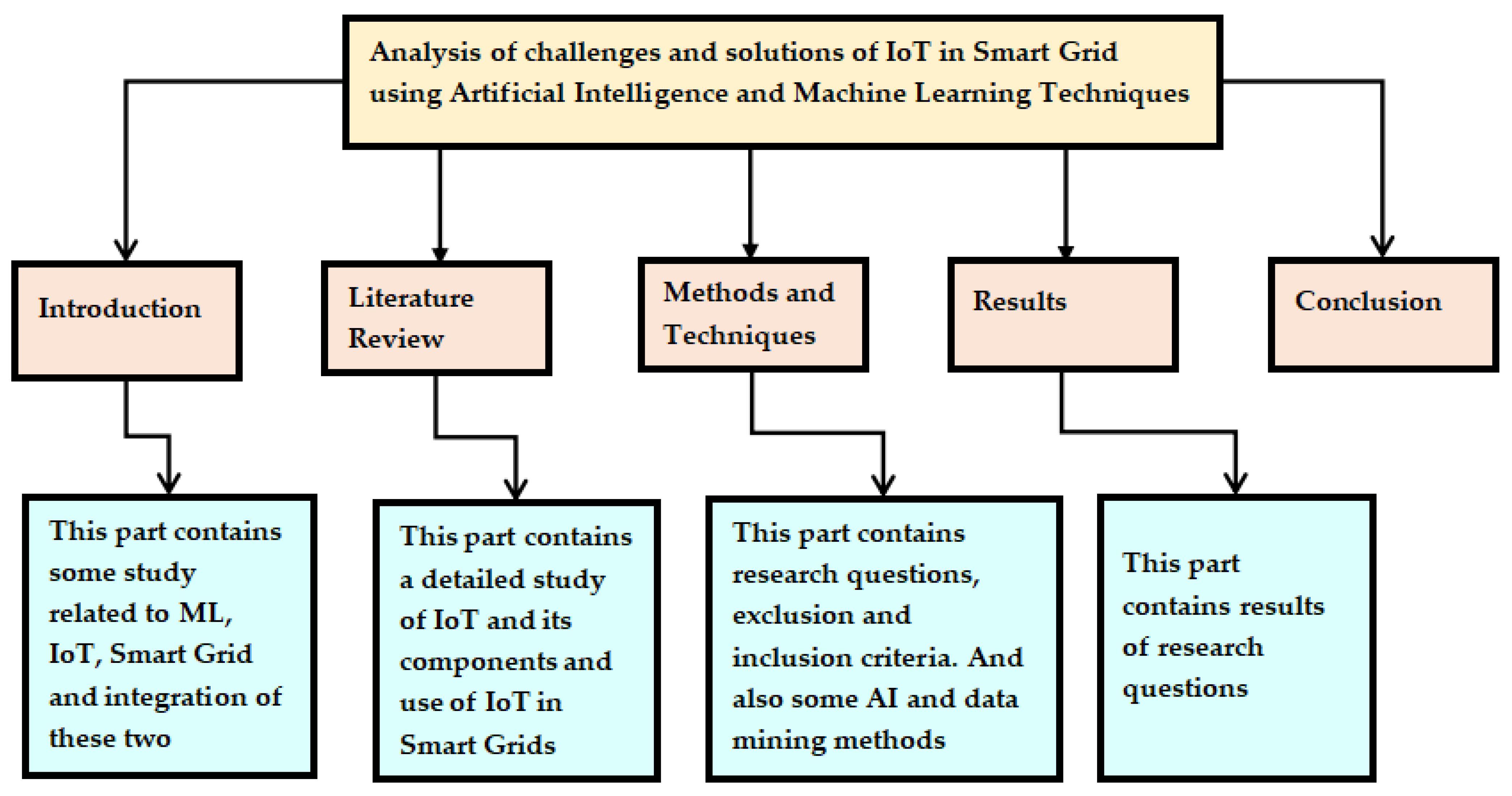
1. Introduction
2. Literature Review
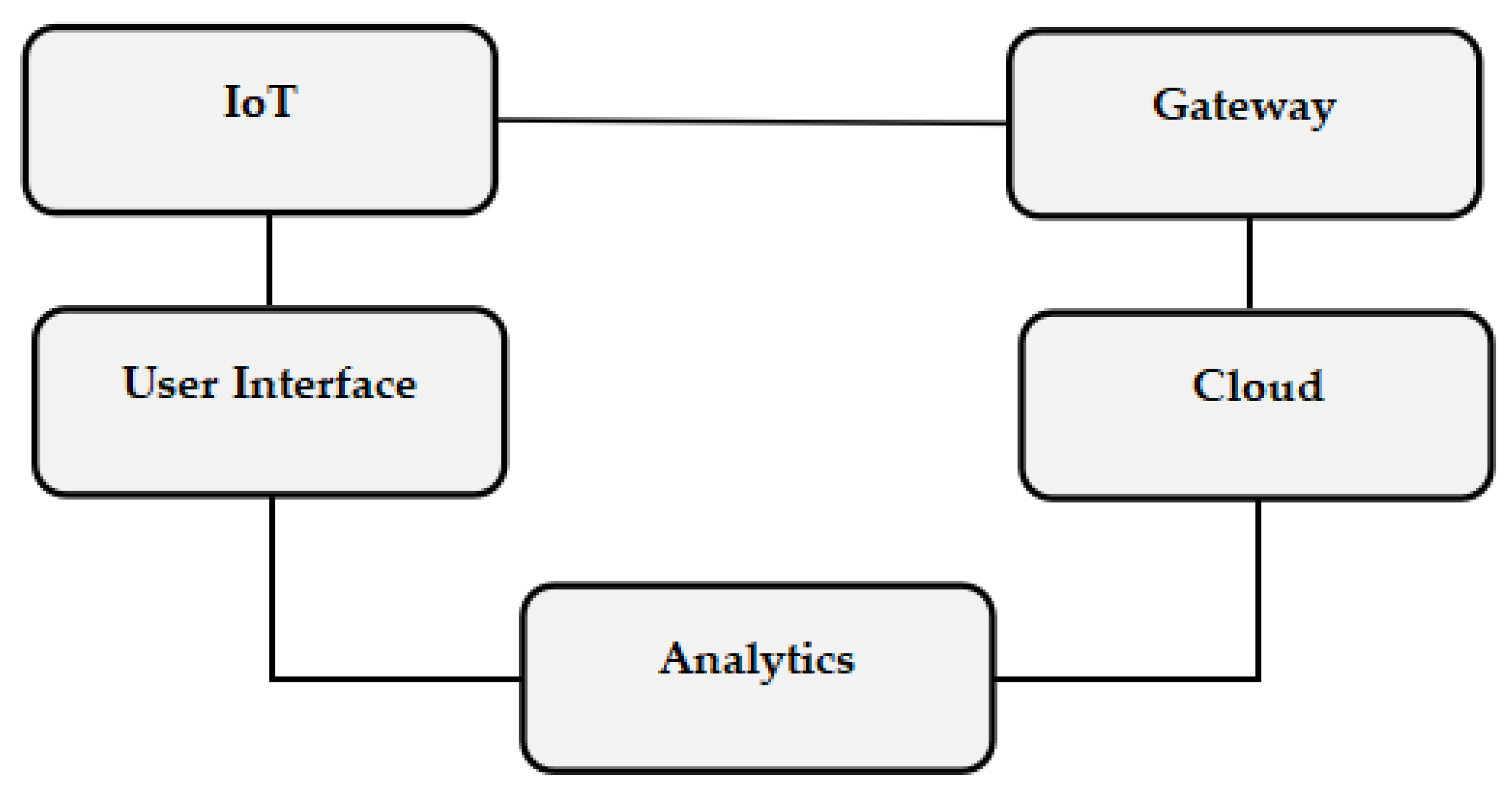
2.1. Parts of IoT-Based Devices
2.1.1. Cloud Infrastructure
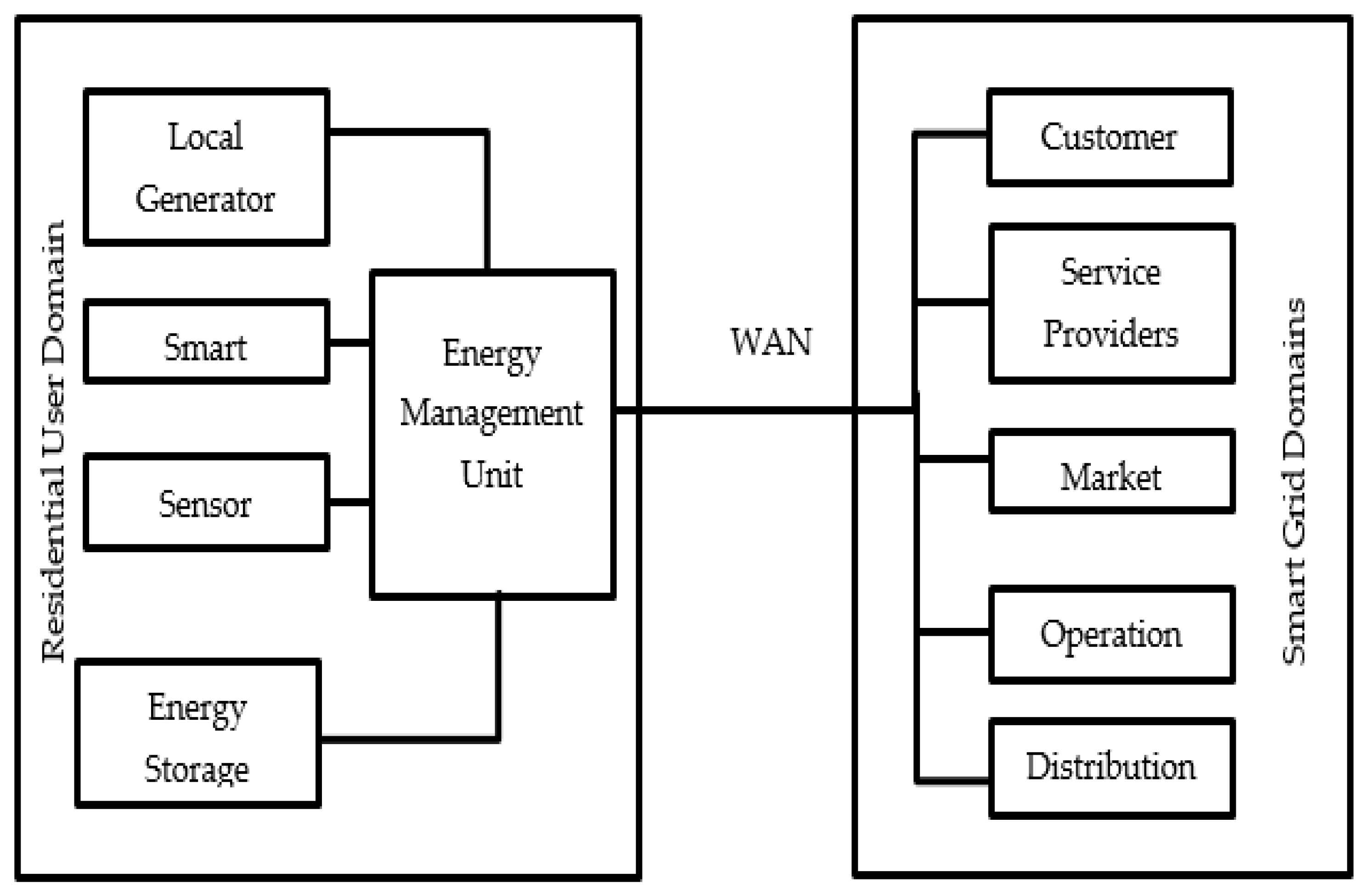
2.1.2. Network Model
2.1.3. IoT Gateways
2.1.4. IoT Sensors
2.1.5. SGMS
2.1.6. Advances in Power Line Communication Technology
2.1.7. Short-Term Memory Network
2.1.8. Energy Storage and Power Electronics Technologies
3. Methods and Techniques
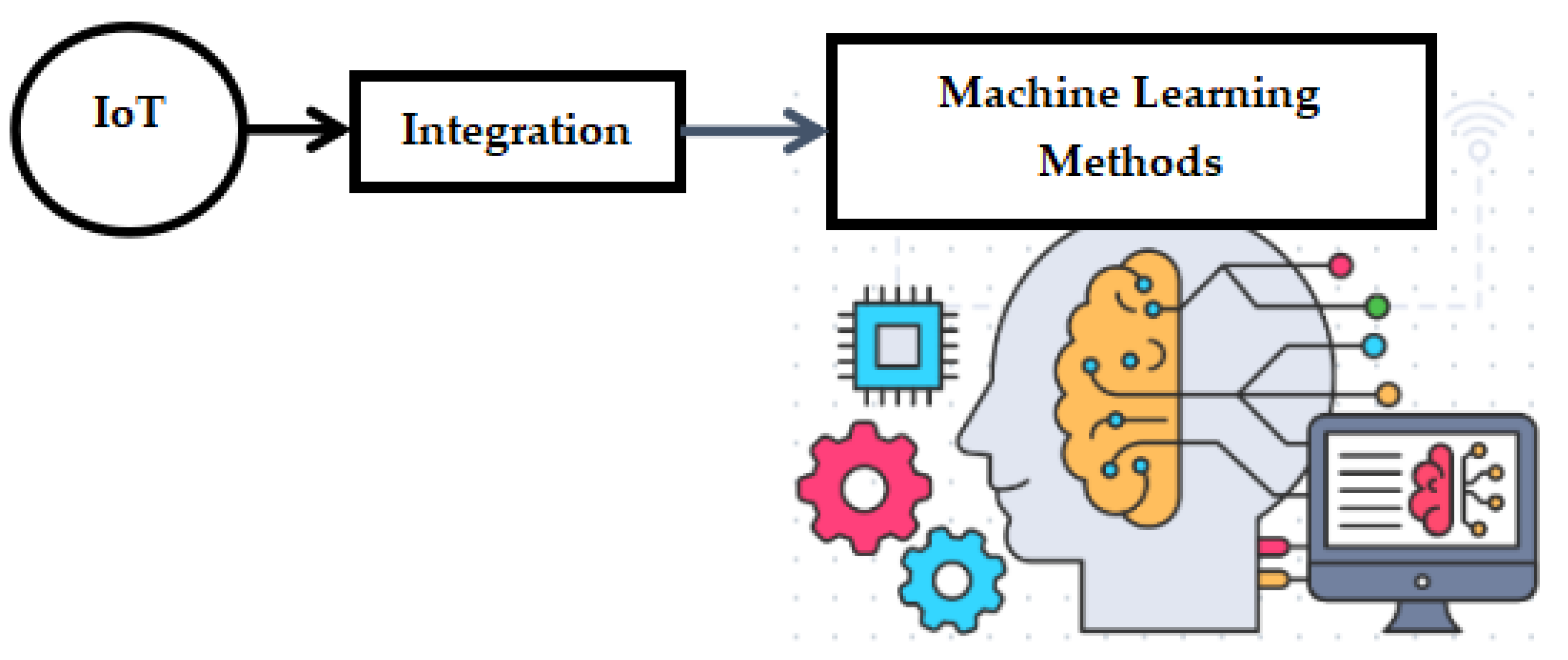
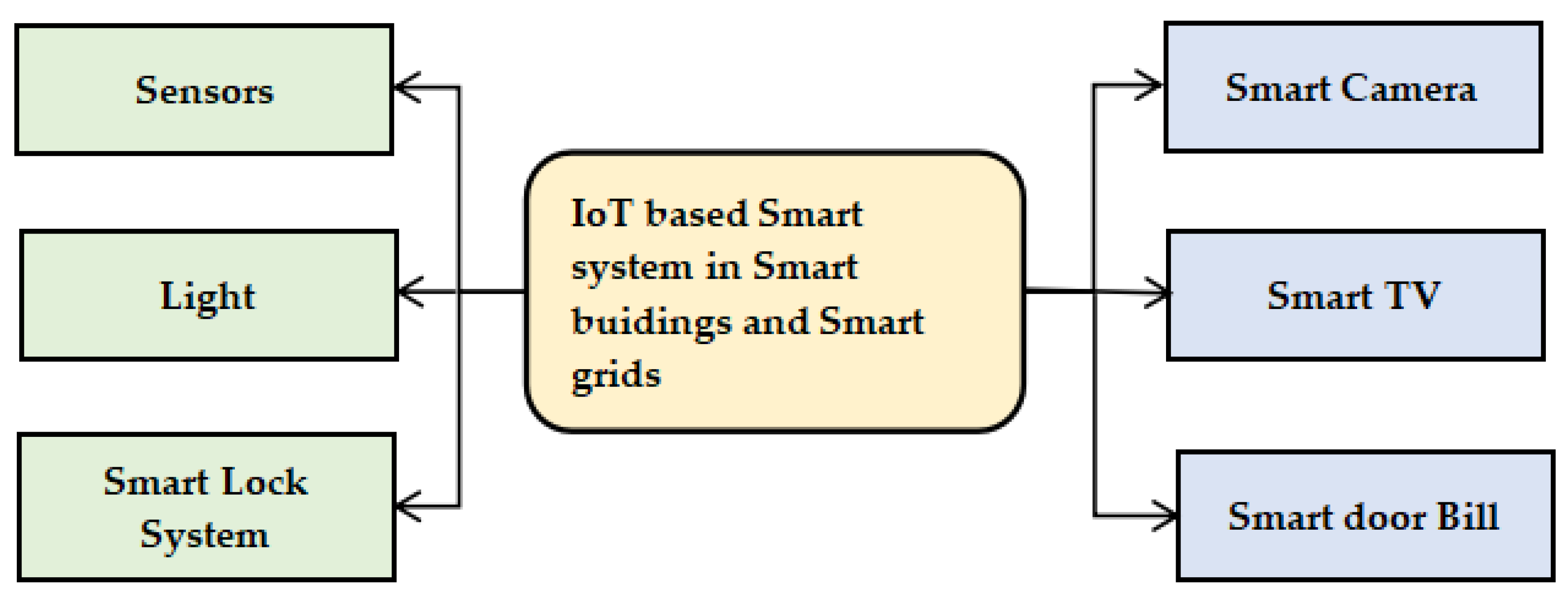
3.1. Integration of IoT with Machine Learning to Create Smart Grid
3.2. Exclusion and Inclusion
Research Question
- What machine learning methods are used in SG?
- What is the role of the machine learning methods in SG (critical analysis)?
- What are the challenges in IoT-enabled SGs?
3.3. AI-Based Approaches in Smart Grids
3.4. Machine Learning in Smart Grid
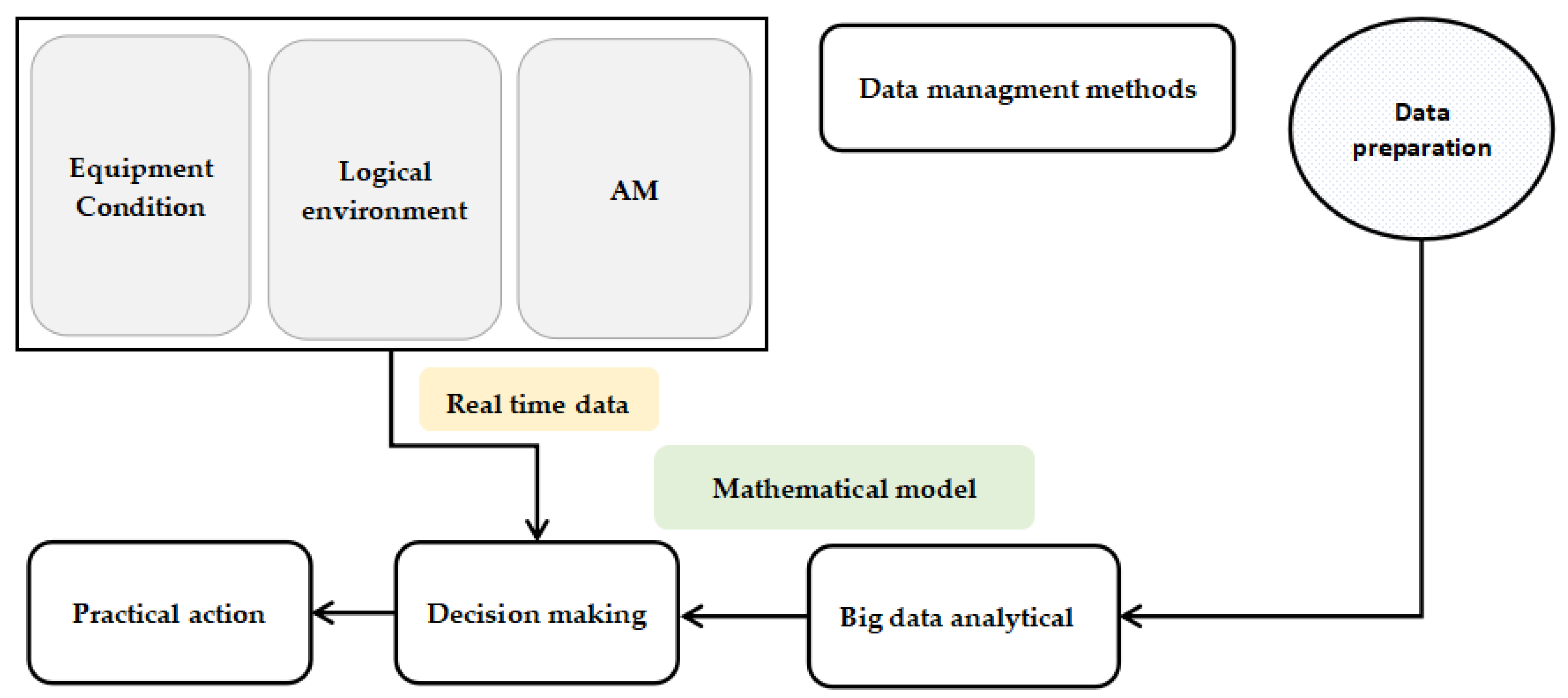
3.5. Data Mining in Smart Grids
4. Results
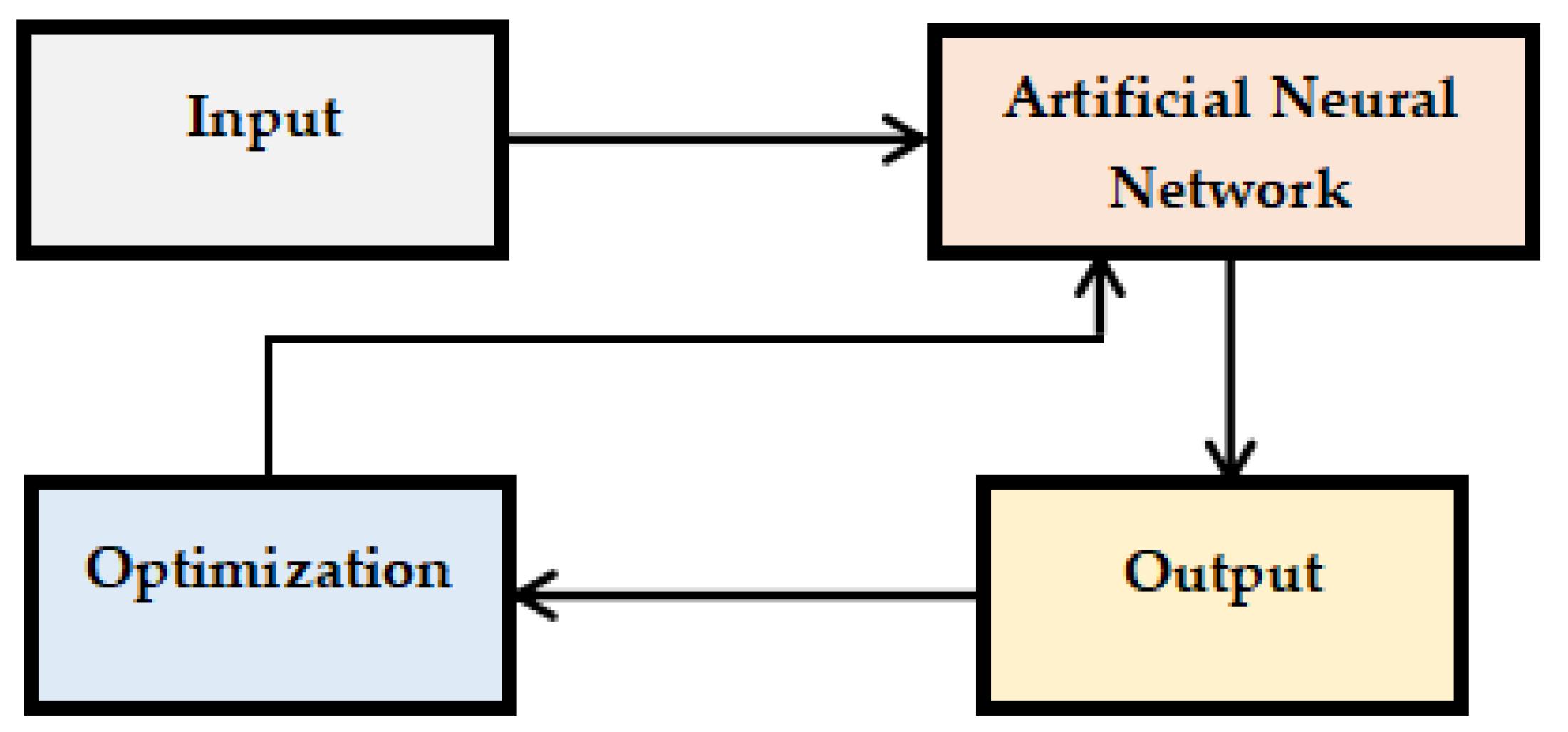
4.1. Artificial Neural Networks (ANNs)
4.1.1. Wavelet Neural Network
4.1.2. Machine Learning Algorithms
4.1.3. Time Series Analysis
4.1.4. Regression
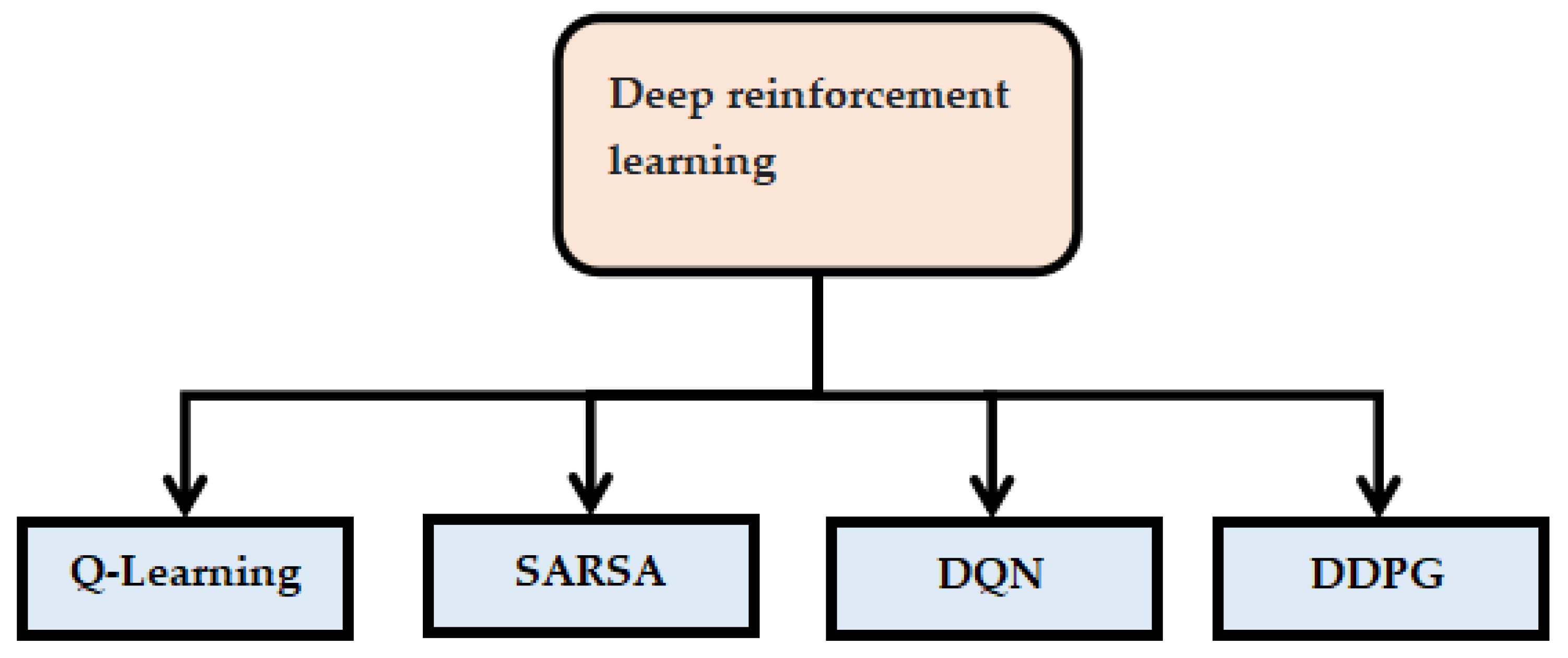
4.1.5. Deep Learning Methods
4.1.6. Decision Tree Classification Algorithm
4.1.7. Genetic Algorithms and Their Use-Cases in Machine Learning
4.1.8. Support Vector Machines (SVMs)
4.2. Challenges in IoT-Enabled Smart Grids
5. Conclusions
Author Contributions
Funding
Data Availability Statement
Acknowledgments
Conflicts of Interest
References
- Zúquete, A.; Gomes, H.; Amaral, J.; Oliveira, C. Security-Oriented Architecture for Managing IoT Deployments. Symmetry 2019, 11, 1315. [Google Scholar] [CrossRef] [Scilit]
- Nappi, I.; de Campos Ribeiro, G. Internet of Things technology applications in the workplace environment: A critical review. J. Corp. Real Estate 2020, 22, 71–90. [Google Scholar] [CrossRef] [Scilit]
- Dos Santos, D.R.; Dagrada, M.; Costante, E. Leveraging operational technology and the Internet of things to attack smart buildings. J. Comput. Virol. Hacking Tech. 2021, 17, 1–20. [Google Scholar] [CrossRef] [Scilit]
- Ghorbanian, M.; Dolatabadi, S.H.; Siano, P.; Kouveliotis-Lysikatos, I.; Hatziargyriou, N.D. Methods for flexible management of blockchain-based cryptocurrencies in electricity markets and smart grids. IEEE Trans. Smart Grid 2020, 11, 4227–4235. [Google Scholar] [CrossRef] [Scilit]
- Chui, K.T.; Gupta, B.B.; Liu, R.W.; Vasant, P. Handling data heterogeneity in electricity load disaggregation via complete optimized ensemble empirical mode decomposition and wavelet packet transform. Sensors 2021, 21, 3133. [Google Scholar] [CrossRef] [Scilit]
- Lee, J.; Yoon, S.; Hwang, E. Frequency Selective Auto-Encoder for Smart Meter Data Compression. Sensors 2021, 21, 1521. [Google Scholar] [CrossRef] [Scilit]
- Diamantoulakis, P.; Dalamagkas, C.; Radoglou-Grammatikis, P.; Sarigiannidis, P.; Karagiannidis, G. Game-theoretic honeypot deployment in smart Grid. Sensors 2020, 20, 4199. [Google Scholar] [CrossRef] [Scilit]
- Khajenasiri, I.; Estebsari, A.; Verhelst, M.; Gielen, G. A review on Internet of Things solutions for intelligent energy control in buildings for smart city applications. Energy Procedia 2017, 111, 770–779. [Google Scholar] [CrossRef] [Scilit]
- Machorro-Cano, I.; Alor-Hernández, G.; Paredes-Valverde, M.A.; Rodríguez-Mazahua, L.; Sánchez-Cervantes, J.L.; Olmedo-Aguirre, J.O. HEMS-IoT: A big data and machine learning-based smart home system for energy saving. Energies 2020, 13, 1097. [Google Scholar] [CrossRef] [Scilit]
- Mohanta, B.K.; Jena, D.; Satapathy, U.; Patnaik, S. Survey on IoT security: Challenges and solution using machine learning, artificial intelligence, and blockchain technology. Internet Things 2020, 11, 100227. [Google Scholar] [CrossRef] [Scilit]
- Mavropoulos, O.; Mouratidis, H.; Fish, A.; Panaousis, E.; Kalloniatis, C. A conceptual model to support security analysis in the IoT. Comput. Sci. Inf. Syst. 2017, 14, 557–578. [Google Scholar] [CrossRef] [Scilit]
- Lawal, K.; Rafsanjani, H.N. Trends, benefits, risks, and challenges of IoT implementation in residential and commercial buildings. Energy Built Environ. 2021, 3, 251–266. [Google Scholar] [CrossRef] [Scilit]
- Cui, L.; Yang, S.; Chen, F.; Ming, Z.; Lu, N.; Qin, J. A survey on the application of machine learning for IoT. Int. J. Mach. Learn. Cybern. 2018, 9, 1399–1417. [Google Scholar] [CrossRef] [Scilit]
- Javed, A.; Larijani, H.; Wixted, A. Improving energy consumption of a commercial building with IoT and machine learning. IT Prof. 2018, 20, 30–38. [Google Scholar] [CrossRef] [Scilit]
- Hussain, F.; Hassan, S.A.; Hussain, R.; Hossain, E. Machine learning for resource management in cellular and IoT networks: Potentials, current solutions, and open challenges. IEEE Commun. Surv. Tutor. 2020, 22, 1251–1275. [Google Scholar] [CrossRef] [Scilit]
- Mahdavinejad, M.S.; Rezvan, M.; Barekatain, M.; Adibi, P.; Barnaghi, P.; Sheth, A.P. Machine learning for Internet of Things data analysis: A survey. Digit. Commun. Netw. 2018, 4, 161–175. [Google Scholar] [CrossRef] [Scilit]
- Zantalis, F.; Koulouras, G.; Karabetsos, S.; Kandris, D. A review of machine learning and IoT in smart transportation. Future Internet 2019, 11, 94. [Google Scholar] [CrossRef] [Scilit]
- Mollah, M.B.; Zhao, J.; Niyato, D.; Lam, K.Y.; Zhang, X.; Ghias, A.M.; Yang, L. Blockchain for future smart grid: A comprehensive survey. IEEE Internet Things J. 2020, 8, 18–43. [Google Scholar] [CrossRef] [Scilit]
- Almshari, M.; Tsaramirsis, G.; Khadidos, A.O.; Buhari, S.M.; Khan, F.Q.; Khadidos, A.O. Detection of potentially compromised computer nodes and clusters connected on a smart grid, using power consumption data. Sensors 2020, 20, 5075. [Google Scholar] [CrossRef] [Scilit]
- Sun, L.; Zhou, K.; Zhang, X.; Yang, S. Outlier data treatment methods toward smart grid applications. IEEE Access 2018, 6, 39849–39859. [Google Scholar] [CrossRef] [Scilit]
- Saadat, S.; Bahizad, S.; Ahmed, T.; Maingot, S. Smart Grid and Cybersecurity Challenges. In Proceedings of the 2020 5th IEEE Workshop on the Electronic Grid (eGRID), Aachen, Germany, 2–4 November 2020. [Google Scholar]
- Qolomany, B.; Al-Fuqaha, A.; Gupta, A.; Benhaddou, D.; Alwajidi, S.; Qadir, J.; Fong, A.C. Leveraging machine learning and big data for smart buildings: A comprehensive survey. IEEE Access 2019, 7, 90316–90356. [Google Scholar] [CrossRef] [Scilit]
- Kumar, A.; Sharma, S.; Goyal, N.; Singh, A.; Cheng, X.; Singh, P. Secure and energy-efficient smart building architecture with emerging technology IoT. Comput. Commun. 2021, 176, 207–217. [Google Scholar] [CrossRef] [Scilit]
- Golmohamadi, H. Demand-Side Flexibility in Power Systems: A Survey of Residential, Industrial, Commercial, and Agricultural Sectors. Sustainability 2022, 14, 7916. [Google Scholar] [CrossRef] [Scilit]
- Park, C.K.; Kim, H.J.; Kim, Y.S. A study of factors enhancing smart grid consumer engagement. Energy Policy 2014, 72, 211–218. [Google Scholar] [CrossRef] [Scilit]
- Ahmed, E.; Yaqoob, I.; Hashem IA, T.; Khan, I.; Ahmed AI, A.; Imran, M.; Vasilakos, A.V. The role of big data analytics in IoT. Comput. Netw. 2017, 129, 459–471. [Google Scholar] [CrossRef] [Scilit]
- Yang, H.; Kim, Y. Design and implementation of fast fault detection in cloud infrastructure for containerized IoT services. Sensors 2020, 20, 4592. [Google Scholar] [CrossRef] [Scilit] [PubMed]
- Killian, M.; Zauner, M.; Kozek, M. Comprehensive smart home energy management system using mixed-integer quadratic programming. Appl. Energy 2018, 222, 662–672. [Google Scholar] [CrossRef] [Scilit]
- Finnegan, J.; Brown, S. A comparative survey of L.P.W.A. networking. arXiv 2018, arXiv:1802.04222. [Google Scholar]
- Ali, Q.; Thaheem, M.J.; Ullah, F.; Sepasgozar, S.M. The performance gap in energy-efficient office buildings: How the occupants can help? Energies 2020, 13, 1480. [Google Scholar] [CrossRef] [Scilit]
- Jia, M.; Komeily, A.; Wang, Y.; Srinivasan, R.S. Adopting Internet of Things for developing smart buildings: A review of enabling technologies and applications. Autom. Constr. 2019, 101, 111–126. [Google Scholar] [CrossRef] [Scilit]
- Tran, C.; Misra, S. The technical foundations of IoT. IEEE Wirel. Commun. 2019, 26, 8. [Google Scholar] [CrossRef] [Scilit]
- Capehart, B.L.; Kennedy, W.; Turner, W. Guide to Energy Management: International Version; River Publishers: Aalborg, Denmark, 2020. [Google Scholar]
- Seneviratne, C.; Wijesekara, P.; Leung, H. Performance analysis of distributed estimation for data fusion using a statistical approach in smart Grid noisy wireless sensor networks. Sensors 2020, 20, 567. [Google Scholar] [CrossRef] [Scilit] [PubMed]
- Slacik, J.; Mlynek, P.; Rusz, M.; Musil, P.; Benesl, L.; Ptacek, M. Broadband power line communication for integrating energy sensors within a smart city ecosystem. Sensors 2021, 21, 3402. [Google Scholar] [CrossRef] [Scilit] [PubMed]
- Yang, Z.; Han, R.; Chen, Y.; Wang, X. Green-RPL: An energy-efficient protocol for cognitive radio enabled A.M.I. network in smart Grid. IEEE Access 2018, 6, 18335–18344. [Google Scholar] [CrossRef] [Scilit]
- Panda, M. Intelligent data analysis for sustainable smart grids using hybrid classification by genetic algorithm based discretization. Intell. Decis. Technol. 2017, 11, 137–151. [Google Scholar] [CrossRef] [Scilit]
- Sood, V.K.; Fischer, D.; Eklund, J.M.; Brown, T. Developing a communication infrastructure for the smart Grid. In Proceedings of the 2009 IEEE Electrical Power & Energy Conference (E.P.E.C.), Montreal, QC, Canada, 22–23 October 2009. [Google Scholar]
- Farao, A.; Veroni, E.; Ntantogian, C.; Xenakis, C. P4G2Go: A Privacy-Preserving Scheme for Roaming Energy Consumers of the Smart Grid-to-Go. Sensors 2021, 21, 2686. [Google Scholar] [CrossRef] [Scilit] [PubMed]
- Liu, Z.; Wang, D.; Wang, J.; Wang, X.; Li, H. A blockchain-enabled secure power trading mechanism for smart Grid employing wireless networks. IEEE Access 2020, 8, 177745–177756. [Google Scholar] [CrossRef] [Scilit]
- Huh, J.H.; Park, J.H. Infrastructure for integrating legacy electrical equipment into a smart-grid using wireless sensor networks. Sensors 2018, 18, 1312. [Google Scholar]
- Molina, M.G. Energy storage and power electronics technologies: A solid combination for empowering the smart grid transformation. Proc. IEEE 2017, 105, 2191–2219. [Google Scholar] [CrossRef] [Scilit]
- Kazerani, M.; Tehrani, K. Grid of Hybrid AC/DC Microgrids: A New Paradigm for Smart City of Tomorrow. In Proceedings of the 2020 IEEE 15th International Conference of System of Systems Engineering (SoSE), Budapest, Hungary, 2–4 June 2020. [Google Scholar]
- Beidou, F.B.; Morsi, W.G.; Diduch, C.P.; Chang, L. Smart grid: Challenges, research directions, and possible solutions. In Proceedings of the 2nd International Symposium on Power Electronics for Distributed Generation Systems, Hefei, China, 16–18 June 2010. [Google Scholar]
- Munirathinam, S. Industry 4.0: Industrial Internet of Things (I.I.O.T.). In Computer Advances; Elsevier: Amsterdam, The Netherlands, 2020; pp. 129–164. [Google Scholar]
- Bhatia, M.S.; Kumar, S. Critical success factors of Industry 4.0 in automotive manufacturing. IEEE Trans. Eng. Manag. 2020, 69, 2439–2453. [Google Scholar] [CrossRef] [Scilit]
- Eini, R.; Linkous, L.; Zohrabi, N.; Abdelwahed, S. Smart building management system: Performance specifications and design requirements. J. Build. Eng. 2021, 39, 102222. [Google Scholar] [CrossRef] [Scilit]
- Minoli, D.; Occhiogrosso, B. IoT-Driven Advances in Commercial and Industrial Building Lighting. In Industrial IoT; Springer: Berlin/Heidelberg, Germany, 2020; pp. 97–159. [Google Scholar]
- Ahsan, M.; Based, M.A.; Haider, J.; Rodrigues, E.M. Smart monitoring and controlling appliances using LoRa-based IoT system. Designs 2021, 5, 17. [Google Scholar]
- Awotunde, J.B.; Ogundokun, R.; Misra, S. Cloud and IoMT-based extensive data analytics system during COVID-19 pandemic. In Efficient Data Handling for Massive Internet of Medical Things; Springer: Berlin/Heidelberg, Germany, 2021; pp. 181–201. [Google Scholar]
- Daissaoui, A.; Boulmakoul, A.; Karim, L.; Lbath, A. IoT and big data analytics for smart buildings: A survey. Procedia Comput. Sci. 2020, 170, 161–168. [Google Scholar] [CrossRef] [Scilit]
- Mofidi, F.; Akbari, H. Intelligent buildings: An overview. Energy Build. 2020, 223, 110192. [Google Scholar] [CrossRef] [Scilit]
- Lv, Z.; Qiao, L.; Kumar Singh, A.; Wang, Q. AI-empowered IoT security for smart cities. ACM Trans. Internet Technol. 2021, 21, 1–21. [Google Scholar] [CrossRef] [Scilit]
- Aguilar, J.; Ardila, D.; Avendaño, A.; Macias, F.; White, C.; Gomez-Pulido, J.; Garces-Jimenez, A. An autonomic cycle of data analysis tasks for the supervision of HVAC systems of smart building. Energies 2020, 13, 3103. [Google Scholar] [CrossRef] [Scilit]
- Saini, K.; Kalra, S.; Sood, S. Disaster emergency response framework for smart buildings. Future Gener. Comput. Syst. 2022, 131, 106–120. [Google Scholar] [CrossRef] [Scilit]
- Shih, C.-S.; Chou, J.-J.; Lin, K.-J. WuKong: Secure Run-Time environment and data-driven IoT applications for Smart Cities and Smart Buildings. J. Internet Serv. Inf. Secur. 2018, 8, 1–17. [Google Scholar]
- Dong, B.; Prakash, V.; Feng, F.; O'Neill, Z. A review of smart building sensing system for better indoor environment control. Energy Build. 2019, 199, 29–46. [Google Scholar] [CrossRef] [Scilit]
- Benavente-Peces, C. On the energy efficiency in the next generation of smart buildings—Supporting technologies and techniques. Energies 2019, 12, 4399. [Google Scholar] [CrossRef] [Scilit]
- Asaad, S.M.; Maghdid, H. A Comprehensive Review of Indoor/Outdoor Localization Solutions in IoT era: Research Challenges and Future Perspectives. Comput. Netw. 2022, 212, 109041. [Google Scholar] [CrossRef] [Scilit]
- Molzahn, D.K.; Dörfler, F.; Sandberg, H.; Low, S.H.; Chakrabarti, S.; Baldick, R.; Lavaei, J. A survey of distributed optimization and control algorithms for electric power systems. IEEE Trans. Smart Grid 2017, 8, 2941–2962. [Google Scholar] [CrossRef] [Scilit]
- León-Trigo, L.I.; Reyes-Archundia, E.; Gutiérrez-Gnecchi, J.A.; Méndez-Patiño, A.; Chávez-Campos, G.M. Smart Grids en México: Situación actual, retos y propuesta de implementación. Ing. Investig. Tecnol. 2019, 20. [Google Scholar] [CrossRef]
- Moreno Escobar, J.J.; Morales Matamoros, O.; Tejeida Padilla, R.; Lina Reyes, I.; Quintana Espinosa, H. A comprehensive review on smart grids: Challenges and opportunities. Sensors 2021, 21, 6978. [Google Scholar] [CrossRef] [Scilit] [PubMed]
- Farzaneh, H.; Malehmirchegini, L.; Bejan, A.; Afolabi, T.; Mulumba, A.; Daka, P.P. Artificial intelligence evolution in smart buildings for energy efficiency. Appl. Sci. 2021, 11, 763. [Google Scholar] [CrossRef] [Scilit]
- Li, J.; Wang, F. Non-technical loss detection in power grids with statistical profile images based on semi-supervised learning. Sensors 2019, 20, 236. [Google Scholar] [CrossRef] [Scilit]
- Yang, Z.; Shi, Z.; Jin, C. SACRB-MAC: A high-capacity M.A.C. protocol for cognitive radio sensor networks in smart Grid. Sensors 2016, 16, 464. [Google Scholar] [CrossRef] [Scilit]
- Zhong, W.; Xie, K.; Liu, Y.; Yang, C.; Xie, S.; Zhang, Y. Online control and near-optimal algorithm for distributed energy storage sharing in smart grid. IEEE Trans. Smart Grid 2019, 11, 2552–2562. [Google Scholar] [CrossRef] [Scilit]
- Dharmadhikari, S.C.; Gampala, V.; Rao, C.M.; Khasim, S.; Jain, S.; Bhaskaran, R. A smart grid incorporated with ML and IoT for a security management system. Microprocess. Microsyst. 2021, 83, 103954. [Google Scholar] [CrossRef] [Scilit]
- Si, C.; Xu, S.; Wan, C.; Chen, D.; Cui, W.; Zhao, J. Electric load clustering in smart Grid: Methodologies, applications, and future trends. J. Mod. Power Syst. Clean Energy 2021, 9, 237–252. [Google Scholar] [CrossRef] [Scilit]
- Astill, J.; Dara, R.A.; Fraser, E.D.; Roberts, B.; Sharif, S. Smart poultry management: Smart sensors, big data, and the IoT. Comput. Electron. Agric. 2020, 170, 105291. [Google Scholar] [CrossRef] [Scilit]
- Aliero, M.S.; Asif, M.; Ghani, I.; Pasha, M.F.; Jeong, S.R. Systematic Review Analysis on Smart Building: Challenges and Opportunities. Sustainability 2022, 14, 3009. [Google Scholar] [CrossRef] [Scilit]
- Sierra, S.; Ihasalo, H.; Vyatkin, V. A Review of Reinforcement Learning Applications to Control of Heating, Ventilation, and Air Conditioning Systems. Energies 2022, 15, 3526. [Google Scholar] [CrossRef] [Scilit]
- Ahmad, T.; Madonski, R.; Zhang, D.; Huang, C.; Mujeeb, A. Data-driven probabilistic machine learning in sustainable smart energy/smart energy systems: Key developments, challenges, and future research opportunities in the context of smart grid paradigm. Renew. Sustain. Energy Rev. 2022, 160, 112128. [Google Scholar] [CrossRef] [Scilit]
- Zhang, H.; Feng, H.; Hewage, K.; Arashpour, M. Artificial Neural Network for Predicting Building Energy Performance: A Surrogate Energy Retrofits Decision Support Framework. Buildings 2022, 12, 829. [Google Scholar] [CrossRef] [Scilit]
- Demirezen, G.; Fung, A.; Deprez, M. Development and optimization of artificial neural network algorithms for the prediction of building specific local temperature for HVAC control. Int. J. Energy Res. 2020, 44, 8513–8531. [Google Scholar] [CrossRef] [Scilit]
- Sammak, S. Using Artificial Intelligence in Renewable Energies. Energy 2021, 2. [Google Scholar]
- Mazhar, T.; Malik, M.A.; Haq, I.; Rozeela, I.; Ullah, I.; Khan, M.A.; Adhikari, D.; Ben Othman, M.T.; Hamam, H. The Role of ML, AI and 5G Technology in Smart Energy and Smart Building Management. Electronics 2022, 11, 3960. [Google Scholar] [CrossRef] [Scilit]
- Gupta, D.; Juneja, S.; Nauman, A.; Hamid, Y.; Ullah, I.; Kim, T.; Tag eldin, E.M.; Ghamry, N.A. Energy Saving Implementation in Hydraulic Press Using Industrial Internet of Things (IIoT). Electronics 2022, 11, 4061. [Google Scholar]
- Khan, R.; Yang, Q.; Ullah, I.; Rehman, A.U.; Tufail, A.B.; Noor, A.; Rehman, A.; Cengiz, K. 3D convolutional neural networks based automatic modulation classification in the presence of channel noise. IET Commun. 2022, 16, 497–509. [Google Scholar] [CrossRef] [Scilit]
- Raza, M.; Barket, A.R.; Rehman, A.U.; Rehman, A.; Ullah, I. Mobile crowdsensing based architecture for intelligent traffic prediction and quickest path selection. In Proceedings of the 2020 International Conference on UK-China Emerging Technologies (UCET), Glasgow, UK, 20–21 August 2020; pp. 1–4. [Google Scholar]
- Muralitharan, K.; Sakthivel, R.; Vishnuvarthan, R. Neural network based optimization approach for energy demand prediction in smart Grid. Neurocomputing 2018, 273, 199–208. [Google Scholar] [CrossRef] [Scilit]
- Eisen, M.; Ribeiro, A. Optimal wireless resource allocation with random edge graph neural networks. Ieee Trans. Signal Process. 2020, 68, 2977–2991. [Google Scholar] [CrossRef] [Scilit]
- Rashid, K.M.; Louis, J.; Fiawoyife, K. Wireless electric appliance control for smart buildings using indoor location tracking and BIM-based virtual environments. Autom. Constr. 2019, 101, 48–58. [Google Scholar] [CrossRef] [Scilit]
- Djenouri, D.; Laidi, R.; Djenouri, Y.; Balasingham, I. Machine learning for smart building applications: Review and taxonomy. ACM Comput. Surv. 2019, 52, 1–36. [Google Scholar] [CrossRef] [Scilit]
- Li, R.; Zhang, X.; Liu, L.; Li, Y.; Xu, Q. Application of neural network to building environmental prediction and control. Build. Serv. Eng. Res. Technol. 2020, 41, 25–45. [Google Scholar] [CrossRef] [Scilit]
- Zhao, Y.; Du, X.; Xia, G.; Wu, L. A novel algorithm for wavelet neural networks with application to enhanced P.I.D. controller design. Neurocomputing 2015, 158, 257–267. [Google Scholar] [CrossRef] [Scilit]
- Alkhatib, H.; Lemarchand, P.; Norton, B.; O'Sullivan DT, J. Deployment and control of adaptive building facades for energy generation, thermal insulation, ventilation and daylighting: A review. Appl. Therm. Eng. 2021, 185, 116331. [Google Scholar] [CrossRef] [Scilit]
- Aste, N.; Manfred, M.; Marenzi, G. Building Automation and Control Systems and performance optimization: A framework for analysis. Renew. Sustain. Energy Rev. 2017, 75, 313–330. [Google Scholar] [CrossRef] [Scilit]
- Thompson, N.C.; Greenewald, K.; Lee, K.; Manso, G.F. The computational limits of deep learning. arXiv 2020, arXiv:2007.05558. [Google Scholar]
- Agyemang, J.O.; Yu, D.; Kponyo, J. Autonomic IoT: Towards Smart System Components with Cognitive IoT. In Proceedings of the Pan-African Artificial Intelligence and Smart Systems Conference, Windhoek, Namibia, 6–8 September 2021; Springer: Berlin/Heidelberg, Germany. [Google Scholar]
- Bashir, A.K.; Khan, S.; Prabadevi, B.; Deepa, N.; Alnumay, W.S.; Gadekallu, T.R.; Maddikunta PK, R. Comparative analysis of machine learning algorithms for predicting smart grid stability. Int. Trans. Electr. Energy Syst. 2021, 31, e12706. [Google Scholar] [CrossRef] [Scilit]
- Chen, F.; Deng, P.; Wan, J.; Zhang, D.; Vasilakos, A.V.; Rong, X. Data mining for the Internet of things: Literature review and challenges. Int. J. Distrib. Sens. Netw. 2015, 11, 431047. [Google Scholar] [CrossRef] [Scilit]
- Divina, F.; Garcia Torres, M.; Goméz Vela, F.A.; Vazquez Noguera, J.L. A comparative study of time series forecasting methods for short-term electric energy consumption prediction in smart buildings. Energies 2019, 12, 1934. [Google Scholar] [CrossRef] [Scilit]
- Tian, W.; Heo, Y.; De Wilde, P.; Li, Z.; Yan, D.; Park, C.S.; Augenbroe, G. A review of uncertainty analysis in building energy assessment. Renew. Sustain. Energy Rev. 2018, 93, 285–301. [Google Scholar] [CrossRef] [Scilit]
- Thrampoulidis, E.; Mavromatidis, G.; Lucchi, A.; Orehounig, K. A machine learning-based surrogate model to approximate optimal building retrofit solutions. Appl. Energy 2021, 281, 116024. [Google Scholar] [CrossRef] [Scilit]
- Mirnaghi, M.S.; Haghighat, F. Fault detection and diagnosis of large-scale HVAC systems in buildings using data-driven methods: A comprehensive review. Energy Build. 2020, 229, 110492. [Google Scholar] [CrossRef] [Scilit]
- Agarwal, A.; Dudík, M.; Wu, Z. Fair regression: Quantitative definitions and reduction-based algorithms. In Proceedings of the International Conference on Machine Learning, Long Beach, CA, USA, 10–15 June 2019. [Google Scholar]
- Jeon, B.K.; Kim, E.J.; Shin, Y.; Lee, K.H. Learning-based predictive building energy model using weather forecasts for optimal control of domestic energy systems. Sustainability 2018, 11, 147. [Google Scholar] [CrossRef] [Scilit]
- Lin, B.; Yu, B. Smart building uncertainty analysis via adaptive Lasso. IET Cyber Phys. Syst. Theory Appl. 2017, 2, 42–48. [Google Scholar] [CrossRef] [Scilit]
- Yildiz, B.; Bilbao, J.; Sproul, A. A review and analysis of regression and machine learning models on commercial building electricity load forecasting. Renew. Sustain. Energy Rev. 2017, 73, 1104–1122. [Google Scholar] [CrossRef] [Scilit]
- Toubeau, J.F.; Bakhshideh Zad, B.; Hupez, M.; De Grève, Z.; Vallée, F. Deep reinforcement learning-based voltage control to deal with model uncertainties in distribution networks. Energies 2020, 13, 3928. [Google Scholar] [CrossRef] [Scilit]
- Khan, W.U.; Imtiaz, N.; Ullah, I. Joint optimization of NOMA-enabled backscatter communications for beyond 5G IoT networks. Internet Technol. Lett. 2021, 4, e265. [Google Scholar] [CrossRef] [Scilit]
- Yu, S.; Liu, J.; Wang, J.; Ullah, I. Adaptive double-threshold cooperative spectrum sensing algorithm based on history energy detection. Wirel. Commun. Mob. Comput. 2020, 2020, 4794136. [Google Scholar] [CrossRef] [Scilit]
- Khan, I.; Tian, Y.B.; Ullah, I.; Kamal, M.M.; Ullah, H.; Khan, A. Designing of E-shaped microstrip antenna using artificial neural network. Int. J. Comput. Commun. Instrum. Eng. 2018, 5. [Google Scholar] [CrossRef] [Scilit]
- Asif, M.; Khan, W.U.; Afzal, H.R.; Nebhen, J.; Ullah, I.; Rehman, A.U.; Kaabar, M.K. Reduced-complexity LDPC decoding for next-generation IoT networks. Wirel. Commun. Mob. Comput. 2021, 2021, 2029560. [Google Scholar] [CrossRef] [Scilit]
- Yousafzai, B.K.; Khan, S.A.; Rahman, T.; Khan, I.; Ullah, I.; Ur Rehman, A.; Baz, M.; Hamam, H.; Cheikhrouhou, O. Student-performulator: Student academic performance using hybrid deep neural network. Sustainability 2021, 13, 9775. [Google Scholar] [CrossRef] [Scilit]
- Yu, L. Deep reinforcement learning for smart building energy management: A survey. arXiv 2020, arXiv:2008.05074. [Google Scholar]
- Zhang, D.; Han, X.; Deng, C. Review on the research and practice of deep learning and reinforcement learning in smart grids. CSEE J. Power Energy Syst. 2018, 4, 362–370. [Google Scholar] [CrossRef] [Scilit]
- Hagras, H. Toward human-understandable, explainable AI. Computer 2018, 51, 28–36. [Google Scholar] [CrossRef] [Scilit]
- Sarker, I.H.; Colman, A.; Han, J.; Khan, A.I.; Abushark, Y.B.; Salah, K. Behavdt: A behavioral decision tree learning to build a user-centric context-aware predictive model. Mob. Netw. Appl. 2020, 25, 1151–1161. [Google Scholar] [CrossRef] [Scilit]
- Aliyan, E.; Aghamohammadi, M.; Kia, M.; Heidari, A.; Shafie-khah, M.; Catalão, J.P. Decision tree analysis to identify harmful contingencies and estimate blackout indices for predicting system vulnerability. Electr. Power Syst. Res. 2020, 178, 106036. [Google Scholar] [CrossRef] [Scilit]
- Alipour, M.M.; Razavi, S.N.; Feizi Derakhshi, M.R.; Balafar, M.A. A hybrid algorithm using a genetic algorithm and multiagent reinforcement learning heuristic to solve the traveling salesman problem. Neural Comput. Appl. 2018, 30, 2935–2951. [Google Scholar] [CrossRef] [Scilit]
- Konar, D.; Bhattacharyya, S.; Sharma, K.; Sharma, S.; Pradhan, S.R. An improved hybrid quantum-inspired genetic algorithm (H.Q.I.G.A.) for real-time task scheduling in a multiprocessor system. Appl. Soft Comput. 2017, 53, 296–307. [Google Scholar] [CrossRef] [Scilit]
- Bhasin, H.; Bhatia, S. Application of genetic algorithms in machine learning. IJCSIT 2011, 2, 2412–2415. [Google Scholar]
- Shah SF, A.; Iqbal, M.; Aziz, Z.; Rana, T.A.; Khalid, A.; Cheah, Y.N.; Arif, M. The role of machine learning and the Internet of things in smart buildings for energy efficiency. Appl. Sci. 2022, 12, 7882. [Google Scholar] [CrossRef] [Scilit]
- Shirzadfar, H.; Gordoghli, A. Detection and Classification of Brain Tumors by Analyzing Images from M.R.I. Using the Support Vector Machines (SVM) Algorithm. Significances Bioeng. Biosci. 2019, 3, 1–8. [Google Scholar]
- Masadeh, R.; AlSaaidah, B.; Masadeh, E.; Al-Hadidi, M.D.R.; Almomani, O. Elastic Hop Count Trickle Timer Algorithm in Internet of Things. Sustainability 2022, 14, 12417. [Google Scholar] [CrossRef] [Scilit]
- Saaidah, A.; Almomani, O.; Al-Qaisi, L.; Kamel, M. An efficient design of RPL objective function for routing in internet of things using fuzzy logic. Int. J. Adv. Comput. Sci. Appl. 2019, 10. [Google Scholar] [CrossRef] [Scilit]
- Saaidah, A.; Almomani, O.; Al-Qaisi, L.; Alsharman, N.; Alzyoud, F. A comprehensive survey on node metrics of RPL protocol for IoT. Mod. Appl. Sci. 2019, 13, 1. [Google Scholar] [CrossRef] [Scilit]
- Mohammadi, M.; Rashid, T.A.; Karim, S.H.T.; Aldalwie, A.H.M.; Tho, Q.T.; Bidaki, M.; Rahmani, A.M.; Hosseinzadeh, M. A comprehensive survey and taxonomy of the SVM-based intrusion detection systems. J. Netw. Comput. Appl. 2021, 178, 102983. [Google Scholar] [CrossRef] [Scilit]
- Almaiah, M.A.; Almomani, O.; Alsaaidah, A.; Al-Otaibi, S.; Bani-Hani, N.; Hwaitat, A.K.A.; Al-Zahrani, A.; Lutfi, A.; Awad, A.B.; Aldhyani, T.H. Performance Investigation of Principal Component Analysis for Intrusion Detection System Using Different Support Vector Machine Kernels. Electronics 2022, 11, 3571. [Google Scholar] [CrossRef] [Scilit]




| Abbreviations | Full Form |
|---|---|
| IoT | Internet of Things |
| AI | Artificial intelligence |
| SG | Smart grid |
| SB | Smart buildings |
| HVAC | Heating, ventilation, and air conditioning |
| ELD | Electrical Line Disintegration |
| OCEEMD-WPT | Optimized complete set empirical model decomposition and wave packet transformation |
| AE | Automatic Encoders |
| NE | Network |
| HEMS | Home energy management system |
| PC | Personal computer |
| IETF | Internet Engineering Task Force |
| ROC | Receiver Operating Characteristic |
| V2V | Vehicle-to-vehicle |
| LPWAN | Low-power wide area networks |
| LTE | Long-Term Evolution |
| Ml | Machine learning |
| SGMS | Smart grid management system |
| CR AMI | Capability requirement for Advanced Metering Infrastructure |
| EVD | External ventricular drain |
| RPL | Routing Protocol for Low-Power and Lossy Networks |
| PMU | Phasor measurement unit |
| CAMS | Comprehensive area monitoring system |
| SCADA | Supervisory control and data acquisition |
| IED | An intelligent electronic device |
| HAN | Home-area network |
| WAN | Wide-area network |
| FIDO2 | Password-less authentication |
| Intelligent Device | Technology | Application |
|---|---|---|
| Advanced metering infrastructure (AMI) | Customers and the utilities that provide them may develop two-way communication via data management systems, communication networks, and smart meters. | Power quality monitoring, on-site management, and remote meter setup |
| Phasor measurement unit (PMU) | A single-time reference is used to synchronize the findings of many distant sites taking real-time measurements at a pace of 30 to 60 samples per second. | The measurement of electrical waves using the power grid |
| Comprehensive area monitoring system (WAMS) | An application server processes the data that PMUs acquire. | Grid stability under dynamic load |
| Supervisory control and data acquisition (SCADA) | Both manually and automatically, respectively | Monitoring of the system, processing of events, and alarming |
| An intelligent electronic device (IED) | Monitoring and documenting the substation and its incoming and outgoing feeds for any signs of wear and tear | The combination of many different types of relay protection with the recording and monitoring of measurements |
| Type of Network | Function | Characteristic |
|---|---|---|
| H.A.N. | Integrating smart appliances with smart home and office devices to control local energy | Use only at home or in businesses; prolonged data transfer rate (less than 1 Kbps) |
| NAN | Data about energy usage are gathered and stored at the load data center, which is made up of many HANS (LDC) | Up to 2 Kbps per second is installed within a few kilometers |
| WAN | Facilitating communication between components of the intelligent grid | Designed for usage over short distances of tens of kilometers or less, and when employed under such conditions, capable of data transfer at many gigabits per second. |
| Sr. # | Machine Learning Models/Algorithms | Objectives in IoT Technologies | Smart Grids Applications Domain | Advantages | Disadvantages |
|---|---|---|---|---|---|
| 1 | ANNs | Making predictions and models | Intelligent sensors may help to cut energy use | Excellent accuracy and comfortable monitoring | Complex |
| 2 | WNN. | Making predictions based on historical facts | Useful for architectural lights and window coverings | Excellent consistency | Low speed |
| 3 | Deep learning | Both data predictions and pattern modeling benefit from it | Helpful for modeling and planning energy-saving solutions | High precision and acceptable speed | Very complicated |
| 4 | Time series analysis | High dimensionality | Produces accurate findings for energy use forecasting in buildings. | Predict the future | The observationsare not independent of one another |
| 5 | Regression | Predictions based on behavior | Learn more about the physical and environmental factors affecting Smart Grids’ energy efficiency. | Rapid speed | Unreliable precision |
| 6 | Deep reinforcement learning | They are systematically making decisions | It may help solve the problem of energy waste in intelligent structures. | Solve complicatedtasks | Very complicated |
| 7 | Decision treeclassification | Presents many available options | Indicates the probability of an outage and manages the building’s energy supply and use. | Simple to understand | Relative inaccurate |
| 8 | Genetic algorithms | Troubles are optimized | Optimal load management and improved energy efficiency. | Excellent accuracy | Low speed |
| 9 | Support vector data and the machines | Methods for ensuring its safety in the IoT environment. | Estimation of future construction energy consumption. | Excellent accuracy | It is complex, and the speed is low |
| Sr. # | Challenges | Function, Role in IoT and Smart Grids | Descriptions |
|---|---|---|---|
| 1 | Big data analytics | Critical data volumes are produced every second in smart grids | Vast amounts of varied, high-resolution data are being produced by the IoT, which may be put to various uses—applied to gathering massive amounts of data for analytical purposes, given the situation [108]. |
| 2 | Availability of services and networks | Intelligent buildings manage a complex network | For intelligent buildings, coordinating the operations of several linked building systems is a big task [109]. |
| 3 | Cyber security | Take care of the building operations’ growing complexity | Increased demands on building operations need to incorporate IP cameras into building automation systems (BASs). These changes put individuals in harm’s way and opened up new attack vectors [110]. |
| 4 | Control and legislation of how much energy a structure uses | The system is in place to manage a building’s energy use | It is impossible to manage energy effectively without this system implemented in the facility. Energy cost inspection, energy use anomaly detection, and automated demand response offer significant challenges [111]. |
| 5 | Boost visibility | To find improper settings, visibility is crucial | Monitoring the data flow into and out of the network is critical when there is a connection. Only if there is visibility into them may misconfigurations, errors, or anomalies that might result in a security vulnerability be detected [112]. |
| 6 | Connectivity, programmability, and manageability | Offers users high-level services while minimizing the number of resources used | Intelligent building management using the IoT could improve user experience and resource efficiency. The main concerns include control, connection, and programmability [113]. |
| 7 | Sensors’ range | To convey data, smart grids need sensors | Costs may quickly increase, particularly for “smart” buildings, when the range of sensors is restricted [114]. |
| 8 | Smart grids reduce energy usage | It offers data analytics on the energy consumption of intelligent structures | Finding the most pertinent elements to the issue at hand is the first step in increasing energy efficiency; with this information, appropriate algorithms may then be designed for processing the data and information acquired [115]. |
| 9 | Information gathering, handling, and storage | The system should concurrently gather several sorts of data | Thanks to the IoT, data may be gathered from a building’s interior, exterior, and infrastructure. For the system to provide accurate results, it must be able to concurrently collect many kinds of data [116]. |
| 10 | Recognizing and attempting to anticipate the behavior of locals | The precision needed for safe navigation inside contemporary constructions is nonexistent in existing GPS systems. | Deciphering resident behavior is complex, and finding those who have concealed themselves within structures is much more difficult. The precision of current GPS systems is insufficient for usage in enclosed spaces; instead of assisting with navigation, they are intended to track geo-fences and other location-based applications [108]. |
Disclaimer/Publisher’s Note: The statements, opinions and data contained in all publications are solely those of the individual author(s) and contributor(s) and not of MDPI and/or the editor(s). MDPI and/or the editor(s) disclaim responsibility for any injury to people or property resulting from any ideas, methods, instructions or products referred to in the content. |
© 2023 by the authors. Licensee MDPI, Basel, Switzerland. This article is an open access article distributed under the terms and conditions of the Creative Commons Attribution (CC BY) license (https://creativecommons.org/licenses/by/4.0/).
Share and Cite
Mazhar, T.; Irfan, H.M.; Haq, I.; Ullah, I.; Ashraf, M.; Shloul, T.A.; Ghadi, Y.Y.; Imran; Elkamchouchi, D.H. Analysis of Challenges and Solutions of IoT in Smart Grids Using AI and Machine Learning Techniques: A Review. Electronics 2023, 12, 242. https://doi.org/10.3390/electronics12010242
Mazhar T, Irfan HM, Haq I, Ullah I, Ashraf M, Shloul TA, Ghadi YY, Imran, Elkamchouchi DH. Analysis of Challenges and Solutions of IoT in Smart Grids Using AI and Machine Learning Techniques: A Review. Electronics. 2023; 12(1):242. https://doi.org/10.3390/electronics12010242
Chicago/Turabian StyleMazhar, Tehseen, Hafiz Muhammad Irfan, Inayatul Haq, Inam Ullah, Madiha Ashraf, Tamara Al Shloul, Yazeed Yasin Ghadi, Imran, and Dalia H. Elkamchouchi. 2023. "Analysis of Challenges and Solutions of IoT in Smart Grids Using AI and Machine Learning Techniques: A Review" Electronics 12, no. 1: 242. https://doi.org/10.3390/electronics12010242
APA StyleMazhar, T., Irfan, H. M., Haq, I., Ullah, I., Ashraf, M., Shloul, T. A., Ghadi, Y. Y., Imran, & Elkamchouchi, D. H. (2023). Analysis of Challenges and Solutions of IoT in Smart Grids Using AI and Machine Learning Techniques: A Review. Electronics, 12(1), 242. https://doi.org/10.3390/electronics12010242